💥UPSC 2026, 2027, 2028 UAP Mentorship (March Batch) + Access XFactor Notes & Microthemes PDF

Search results for: “”

  • Supreme Court’s ruling on GST deepens the churn in the tax regime

    Context

    Last week, the Supreme Court ruled that the decisions taken by the GST Council are merely recommendations with “persuasive value” and are not binding.

    GST as a advisory body

    • The court has rejected the Centre’s contention that the entire structure of GST would crumble if the Council’s decisions were not treated as enforceable.
    • In some ways, the verdict states the obvious.
    • Article 246-A inserted after the 122nd constitutional amendment states, “Notwithstanding anything contained in articles 246 and 254, Parliament, and, subject to clause (2), the Legislature of every state, have the power to make laws with respect to the GST imposed by the Union or by such state.”
    • Thus, the power to levy the central GST (CGST) vests with Parliament, the power to levy state GST (SGST) vests with state legislatures and Parliament has exclusive power to make laws with respect to the GST on items that are part of inter-state trade or commerce.
    •  Thus, the GST Council is only an advisory body and the actual decisions regarding model GST levies, principles of levy, apportionment of GST levied on inter-state supplies, principles relating to place of supply, exemptions and rate structure and any special provisions will have to be taken by either Parliament in the case of CGST and IGST or the states in the case of SGST.
    • In effect, decisions on the structure and operation of the tax can be made by the Centre and individual states without discussion and deliberation in the Council and both can ignore any recommendation made by the Council.
    • The judgment reiterates that the sovereign right to levy the tax still exists with the Union and state governments and it is for them to consider the recommendations of the Council.
    • The chance of having a harmonised GST and reforms in the tax regime will crucially depend upon continued negotiation and bargaining between the Union and states.
    • Intergovernmental cooperation has been kept alive to ensure a harmonised GST and unless both the Centre and the states see the gains, reforms will be hard to come by and if the Centre desires the reforms more than the states, it will have to ensure a “buy in” from the states to agree for the reform.

    Implications of the judgement

    • Given that the GST Council has been declared as only an advisory body with a persuasive value, what happens to the dream of having a harmonised one nation, one tax, if a state or a group of states decides to deviate?
    • But the judgment paves the way for more intensive bargaining and negotiations, placing states on an equal footing with the Centre in taking decisions on the structure and operations of the tax.
    • At present, decisions get approved in the GST Council when passed by a majority of three-fourths of the weighted votes of the members present and voting, with the Centre having one-third weight and individual states (and UTs) having an equal share of the remaining two-thirds weight.
    • However, in the past, all decisions in the Council have been taken by consensus (except in the case of determining the rate on lotteries), and the Supreme Court decision reinforces this convention.
    • The immediate impact of this will be bargaining by states for extending the period of compensation for the loss of revenue.
    •  As the five-year period of compensation gets over at the end of June, this decision will now help the states to bargain hard for the extension.

    Way forward

    •  Though the period of collecting compensation cess has been extended till March 2026 to meet the interest and repayment requirements of the funds borrowed from the RBI to meet the compensation requirements, the lasting solution lies in increasing the revenue productivity of the tax by pruning the list of exempted items, rationalising the rates and taking administrative measures.
    • These reforms will require strengthening the cooperative spirit.

    Conclusion

    This has come at a time when reforms have to be set in motion and hopefully, the Court’s decision will strengthen the cooperative spirit in reforming the domestic consumption tax system in the country.

    UPSC 2023 countdown has begun! Get your personal guidance plan now! (Click here)

  • Direct joining link for Webinar by Shubham Nagargoje, IPS 2020 | Don’t read every NCERT for UPSC, do only the important ones | attend free live webinar to know the toppers’ approach to NCERT

    Direct joining link for Webinar by Shubham Nagargoje, IPS 2020 | Don’t read every NCERT for UPSC, do only the important ones | attend free live webinar to know the toppers’ approach to NCERT

    Feel free to join with UPSC 2020 Topper & know actually how many NCERT books to read/How to read & what to read.

    Join Zoom Meeting

    https://us06web.zoom.us/j/89908021391?pwd=WktmbVNSZkxqQ2xjZXlqRnRyZ2RUdz09

    Meeting ID: 899 0802 1391

    Passcode: 185807

    Civilsdaily Team is inviting you to a scheduled Zoom meeting.
    *Don’t read every NCERT for UPSC, do only the important ones || by Shubham Nagargoje, IPS 2020*Date & Time: *May 26, 2022 @07:00 PM (Start Login by 06:45 PM) India*

    Can we avoid NCERT for UPSC?

    That would be a severe mistake. NCERTs are essential and the best place to begin your UPSC preparation. They form a fundamental foundation and can help you understand basic and critical concepts more quickly. But, Are all NCERTs to be read? Finding reliable sources for this information can be extremely difficult.

    If you have to command over UPSC exams, you hold command over NCERT books first. These books are the weakest point of UPSC, it must be your strong point. So, to know which NCERTs are a must & which are not, follow this topper’s footprint.

    Attend this free live webinar conducted by Civilsdaily’s topper IPS Officer to get certain value-added insights on which NCERTs are heaven for Clearing UPSC-CSE.

    Webinar Details:

    Grasp the opportunity to get outstanding tips on ‘what are the best strategies to choose NCERTs ’, and ‘how to read & what to read from them’. This entire webinar is free. All aspirants are wholeheartedly welcome to attend.

    Date: 26th May 2022 (Thursday)

    Time: 7 PM to 8 PM

    Infallible ideas & Tips in This Free Live Webinar by Shubham Nagargoje!

    1. Best, minimum NCERT materials for UPSC-CSE Preparation. Do’s & Don’t, Understanding the science behind how society works is important, so what are the best 3 to 5 NCERTs to read. Don’t forget NCERTs are even going to help you in your optional too.
    1. For a foundational preparation for prelims and mains, students can start with NCERT history books, to begin with, their history preparation. What are those books that have proven to be extremely beneficial in the case of students that come from commerce or science backgrounds?
    1. It is critical to understand Indian and global geography. Maps and information about different climatic regions provided in NCERT Geography books help in answering many questions about geography. How to learn & what maps/diagrams/footnotes are not to be ignored will also be discussed.
    2. Political Science covers the country’s legal and fundamental aspects, which makes it an extremely important subject. How to & what to cover from NCERTs so that ‘Laxmikant’ becomes easier to read and revise.
    3. The subject of the Indian Economy covers India’s current and past economic aspects, which makes it an important topic. Knowing its fundamentals is crucial for UPSC exams. So, What is to be learnt by heart & which NCERTs are fit for the economy will be comprehensively discussed.
    4. What is the difference between ‘The Old Version NCERTs’ & ‘The New Version NCERTs’ & for which subjects, which versions of NCERTs you should focus on,  will also be discussed thoroughly in this ask me anything session? 
    5.  The untold secret of ‘how & from where UPSC asks direct questions from NCERTs. How to build command over NCERTs is going to be another crucial point of this awesome session.
    About Shubham Nagargoje:

    UPSC 2020 TopperIPS Officer Shubham Nagargoje lived by this saying during his entire UPSC and RBI Grade B preparation three years. Hence, failing to clear the UPSC Prelims twice didn’t deter him. He finally got appointment letters both as an RBI Grade B officer and an IPS officer.

    Wish you all the best.

  • How to secure score 110+ in UPSC Prelims 2022  with  100+ most probable topics with detailed solution | register at the earliest to get the full list

    How to secure score 110+ in UPSC Prelims 2022 with 100+ most probable topics with detailed solution | register at the earliest to get the full list

    UPSC IAS prelims 2022 will be held on June 5 in pen and paper mode. The IAS preparation is the interaction of important UPSC Syllabus topics. Check out the list of important topics for the UPSC prelims below and pave the way to score 110+.

    Certain topics seem to be important for the UPSC prelims exam, but they are not asked in the exam. The UPSC primarily inquires about the context of current events. Ideally, UPSC asks about four aspects of a topic in one question with multiple options, with only one correct answer. Only those perplexing questions can be answered by the candidate who has a firm grasp on the subject. Candidates should balance their preparation in static General Studies topics and current affairs topics so that they can connect the two. 

    Prelims is an elimination round. Those who learn & analyze everything may get eliminated. It’s all about utilizing your subjective recognition rather than critically analyzing.

    The syllabus for the prelims exam does not go into great detail about the topics. Candidates should understand the prelims’ demand by analyzing the UPSC syllabus and question papers concurrently. Overall preparation necessitates over a year of focused preparation in the right direction with the right strategy. Important Prelims exam topics are just the tip of the iceberg when it comes to the syllabus. Important topics guide will guide preparation in the right direction to sit for UPSC Mains 2022.

    So, our highly experienced toppers’ teachers & mentors group has prepared the most trusted list of the most important topics. 

    Expect many questions in UPSC civil services Preliminary exam – 2022 (also in mains 2022). You need to prepare 4-5 points on each of these topics keeping in mind the nature of questions that were asked in Prelims 2020 & 2021. 

    Must Read Topics For Prelims 2022 (Static + Current Affairs & Combination of Both)

    Polity

    Electronic voting machine (EVM) 

    Balance of rights and duty 

    Recent amendments and Bills 

    One election- one nation- Amendments required 

    RPA 1951 and 1950 

    Office of the governor and discretionary powers 

    PESA Act, 1996 

    ETC.

    Economy

    Inflation (2 questions expected- conceptual) 

    Conceptual questions based on interlinking between fiscal policy, inflation, and monetary policy (2-3 questions) 

    Banking in India 

    Money market 

    Taxation (1 question) 

    GDP Estimates (1 question) 

    ETC.

    Modern Indian Hist.

    -Personality (1 question)- focus on prominent freedom fighters, social reformers, viceroys 

    – Chronology- focus on the time between 1925-35 and 1939-47 

    – British wars 

    – NCM, CDM, quit India 

    – Congress sessions 

    ETC.

    History & Culture

     -Adi Sankaracharya 

    Kakatiya Rudreshwara Temple 

    Moplah Rebellion 

    Sun Temple of Konark (In the news) 

    Architecture (1 question on temple, 1 from medieval history) 

     Dance (classical and folk)

    ETC.

    Geography

    World Physical Geography: 

    – Geomorphology- landforms and major terminologies, origin and evolution of the earth, volcanism and earthquake, plate tectonics and continental drift theory – Oceanography – warm and cold currents, and rests other chapters.

    Mapping

    Indian Physical Map 

    Rivers: Pannchnad, Himalayan rivers(Ganga, Brahmaputra, Yamuna), Peninsular rivers(Damodar, Mahanadi, Godavari, Krishna, Kaveri, Periyar)- Tributaries b. North to the south alignment of mountains in Eastern ghat and Western ghat c. Major Cities in India 

    World Physical Map as well of various places & regions according to Current Affairs.

    Government Schemes 

     Recent schemes on Agriculture, Vulnerable sections, MSMEs, Banking, ETC.

    Science & Technology 

    Antimicrobial resistance (AMR) 

    Electric Vehicles 

    Dark Genome 

    Biotechnology 

    Assistant reproductive technique 

    Emerging technologies (5G, AI, Machine learning) & ETC.

    Social Issues

     Digital education issues 

    New acts and amendments (1-2 question) 

    ETC.

    Environment 

    India State Forest Report (ISFR) 2021 

    Red sanders 

    Zero Budget Natural Farming 

    Heat Dome 

    Net Zero Producers Forum

    Glasgow summit 

    National parks and wildlife sanctuaries, tiger reserves and wetlands (mapping)

    Reports and indices (1 question) 

    Development induced displacement 

    Pollution related current affairs & Many other hot topics.

    Security Issues

    Reverse Engineering 

    Top defense dealers and importers 

    India’s missile program 

    Recent amendments in NIA, UAPA acts etc. 

    We have covered all these issues in both test series and current affairs. But if you can give special focus on these topics, you will definitely reap extra benefits.

    All The Best.

  • Understanding the nature of US-Taiwan Relations

    The US President made a controversial statement on whether the US will come to the aid of Taiwan militarily in case of an invasion by China.

    What is the Taiwan issue?

    • Taiwan is an island territory located off the coast of mainland China, across the Taiwan Strait.
    • After their defeat to the communist forces in the Chinese civil war (1945-1949), the ruling Kuomintang (Nationalist) government of China fled to Taiwan.
    • They transplanted the Republic of China (ROC) government in Taiwan, while the Communist Party of China (CPC) established the People’s Republic of China (PRC) in the mainland.
    • Since then, the PRC considers the island as a renegade province awaiting reunification by peaceful means, if possible.

    Game changer: Cold war affiliations

    • Meanwhile, the ROC retained its membership at the United Nations and its permanent seat at the UN Security Council (UNSC).
    • The cross-strait relations became strained as a result of the Cold War, with the PRC allying itself with the Soviet Union (USSR) and ROC with the U.S.
    • This resulted in the two Taiwan Strait crises of the 1950s.

    The US and One-China Principle

    • With the shifting geopolitics of the Cold War, the PRC and the U.S. were forced to come together in the 1970s to counter the growing influence of the USSR.
    • This led to the US-China rapprochement demonstrated by the historic visit of then US President Richard Nixon to PRC in 1972.
    • The same year, the PRC displaced ROC as the official representative of the Chinese nation at the UN.
    • Diplomatic relations with the PRC became possible only if countries abided by its “One China Principle” — recognizing PRC and not the ROC as China.

    Rise of Taiwan

    • Taiwan transitioned from a single party state to a multi-party democracy.
    • At the same time that China reformed its economic system under Deng Xiaoping, and by the end of the Cold War they became economically entangled.
    • Nevertheless, they continue to compete for international recognition and preparing themselves for the worst possible scenario.

    How has the US’s stance on the Taiwan question evolved vis-à-vis China?

    • The very foundation of the US rapprochement as well as its recognition of the PRC is a mutual understanding on the Taiwan question.
    • This has been outlined in three documents — the Shanghai Communique (1972), the Normalisation Communique (1979) and the 1982 Communique.
    • According to the 1972 communique, the US agreed to the ‘one China principle’, with an understanding that it “acknowledges” and “does not challenge” that all Chinese on either side of the Taiwan Strait.
    • It maintained that there is one China and Taiwan is a part of China.
    • However, the US also established unofficial relations with Taiwan through this communique in the name of the people of both the countries.

     Why is the issue significant today?

    • As Taiwan’s democracy flourished, the popular mood drifted towards a new Taiwanese identity and a pro-independence stance on sovereignty.
    • The past decade has seen considerable souring of ties across the Strait, as the Democratic People’s Party (DPP) became the most powerful political force in Taiwan.
    • The DPP government has been catering to the pro-independence constituency in Taiwan and seeks to diversify economic relations away from China.
    • China has always seen Taiwan as a territory with high geopolitical significance.
    • This is due to its central location in the First Island Chain between Japan and the South China Sea, which is seen as the first benchmark or barrier for China’s power projection.

    Why is China so obsessed with Taiwan?

    • Taiwan is at China’s geostrategic calculus.
    • Moreover, its reunification will formally bury the remaining ghosts of China’s “century of humiliation”.
    • China under Xi Jinping seems to have lost its patience and currently sees very slim chances of a peaceful reunification.
    • China usually makes aerial transgressions in Taiwan’s Air Defence Identification Zone (ADIZ).
    • Also, this build-up of tensions is happening simultaneously and drawing parallels with the Russo-Ukrainian conflict.

    Is US strategy towards Taiwan witnessing a major transformation?

    • The US strategy towards Taiwan in light of the unresolved nature of the cross-Strait relations has been marked by what has been called “strategic ambiguity”.
    • This is under the Taiwan Relations Act (TRA) of 1979.
    • As per the TRA, the US has stated clearly that the establishment of bilateral relations with the PRC rests upon “the expectation that the future of Taiwan will be determined by peaceful means”.
    • It also states the US policy to maintain the capacity to resist any resort to force or other forms of coercion that would jeopardise the security, or the social or economic system, of the people on Taiwan.
    • Hence, there is no clear guarantee here that the US will militarily involve in a situation where China attempts to invade Taiwan, short of supplying “defensive weapons”.

    Enjoying the ambiguity

    • The US has for long utilized this strategic ambiguity with its own interpretation of the ‘one China principle to maintain its strategic interests in the Western Pacific.
    • It is in this context that Mr. Biden’s statements have made controversy.


    UPSC 2023 countdown has begun! Get your personal guidance plan now! (Click here)

  • Monkeypox Virus: Origins and Outbreaks

    With cases being reported from across the world, monkeypox has caught everyone’s attention.

    What is Monkeypox?

    • Monkeypox is not a new virus.
    • The virus, belonging to the poxvirus family of viruses, was first identified in monkeys way back in 1958, and therefore the name.
    • The first human case was described in 1970 from the Democratic Republic of Congo.
    • Many sporadic outbreaks of animal to human as well as human to human transmission has occurred in Central and West Africa in the past with significant mortality.
    • After the elimination of smallpox, monkeypox has become one of the dominant poxviruses in humans, with cases increasing over years along with a consequent reduction in the age-group affected.

    How is it transmitted?

    • Since the transmission occurs only with close contact, the outbreaks have been in many cases self-limiting.
    • Since in the majority of affected people, the incubation period ranges from five to 21 days and is often mild or self-limiting, asymptomatic cases could transmit the disease unknowingly.
    • The outbreaks in Central Africa are thought to have been contributed by close contact with animals in regions adjoining forests.
    • While monkeys are possibly only incidental hosts, the reservoir is not known.
    • It is believed that rodents and non-human primates could be potential reservoirs.

    Does the virus mutate?

    • Monkeypox virus is a DNA virus with a quite large genome of around 2,00,000 nucleotide bases.
    • While being a DNA virus, the rate of mutations in the monkeypox virus is significantly lower (~1-2 mutations per year) compared to RNA viruses like SARS-CoV-2.
    • The low rate of mutation therefore limits the wide application of genomic surveillance in providing detailed clues to the networks of transmission for monkeypox.
    • A number of genome sequences in recent years from Africa and across the world suggest that there are two distinct clades of the virus — the Congo Basin/Central African clade and the West African clade.
    • Each of the clades further have many lineages.

    What do the genomes say?

    • With over a dozen genome sequences of monkeypox, it is reassuring that the sequences are quite identical to each other suggesting that only a few introductions resulted in the present spread of cases.
    • Additionally, almost all genomes have come from the West African clade, which has much lesser fatality compared to the Central African one.
    • This also roughly corroborates with the epidemiological understanding that major congregations in the recent past contributed to the widespread transmission across different countries.

    Does it have an effective vaccine?

    • It is reassuring that we know quite a lot more about the virus and its transmission patterns.
    • We also have effective ways of preventing the spread, including a vaccine.
    • Smallpox/vaccinia vaccine provides protection.
    • While the vaccine has been discontinued in 1980 following the eradication of smallpox, emergency stockpiles of the vaccines are maintained by many countries.
    • Younger individuals are unlikely to have received the vaccine and are therefore potentially susceptible to monkeypox which could partly explain its emergence in younger individuals.


    UPSC 2023 countdown has begun! Get your personal guidance plan now! (Click here)

  • What is the Service Charge levied by Restaurants on Customers?

    The Centre has called a meeting of restaurant owners over service charge levied by them on customers.

    Why in news?

    • The restaurants are collecting service charges from consumers by default, even though collection of any such charge is voluntary and at the discretion of consumers and not mandatory as per law.

    What are the components of a food bill?

    • A restaurant bill in India comprises food charge (from the menu), with an addition of service charge (anywhere between 5 to 15 per cent) and a 5 per cent GST on this amount (IGST+SGST).
    • This is for all kinds of standalone restaurants.
    • In case a restaurant is located inside a hotel wherein room rate is upwards of Rs 7,500 (mostly in case of five-stars), the GST would be 18 per cent.

    Nature of Service charge

    • While the GST is a mandatory component as per law, the service charge is supposed to be optional.
    • It is the equivalent of what is known as gratuity around the world, or tip, in casual parlance.
    • Most restaurants decide the service charge on their own, and print it at the bottom of the menu with an asterisk.

    Policy measures

    • The Ministry of Consumer Affairs had come out with “Guidelines on Fair Trade Practices Related to Charging of Service Charge from Consumers by Hotels/ Restaurants”.
    • Here it was clearly mentioned that a component of service is inherent in the provision of food and beverages ordered by a customer.
    • Hence the pricing of the product is expected to cover both the goods and service components.
    • It said that the bill “may clearly display that service charge is voluntary, and the service charge column of the bill may be left blank for the customer to fill up before making payment.”

    What do the restaurants say?

    • The levy of service charge by a restaurant is a matter of individual policy to decide if it is to be charged or not.
    • There is no illegality in levying such a charge.
    • Once the customer is made aware of such a charge in advance and then decides to place the order, it becomes an agreement between the parties, and is not an unfair trade practice.
    • GST is also paid on the said charge to the Government.

    Where does the fund go?

    • Restaurants claim that a major chunk of the service charge thus collected goes to the staff, while the rest goes towards a welfare fund to help them out during good and bad times.
    • It’s a default billing option, even as customers can choose not to pay it if they don’t want to.
    • Of course, they are paid the salaries but the service charge works as an incentive for them.
    • Restaurateurs also say that patrons can decide not to pay the charge and tip the server directly, but in this case, the backroom staff doesn’t get anything.
    • A service charge ensures all staff members are rewarded evenly.

    What is the issue then?

    • The issue is that almost all restaurants have put service charge (fixed at their own accord) as a default billing option.
    • And if a consumer is aware that it is not compulsory and wants it removed or wants to tip the server directly, the onus is on them to convince the management why they don’t want to pay it.
    • The department says they received several complaints saying it leads to public embarrassment and spoils the dining experience since at the end of it, they either pay the charge quietly and exit the place feeling cheated, or have to try hard to get it removed.
    • Also, there is no transparency as to where this charge goes.
    • The officials also say that collecting service charge on their own and paying GST on it to the government doesn’t make it authorised.

    Problems faced by customers

    • It is this component which has come under dispute from time to time, with consumers arguing they are not bound to pay it.
    • It also said that hotels and restaurants charging tips from customers without their express consent in the name of service charges amounts to unfair trade practice.


    UPSC 2023 countdown has begun! Get your personal guidance plan now! (Click here)

  • Imp: Must Read RBI’s FAQ Page Summary for Prelims 2022

    Talk to our mentors for a Roadmap to 2023 Attempt. Click Here


    1. Passive Funds:

    The Securities and Exchange Board of India (SEBI) recently issued a circular on passive funds covering matters related to transparency, liquidity and operational aspects of exchange-traded funds (ETFs) and index funds.

    What are Passive Funds?
    • A passive fund is an investment vehicle that tracks a market index, or a specific market segment, to determine what to invest in.
    • Unlike with an active fund, the fund manager does not decide what securities the fund takes on.
    • This normally makes passive funds cheaper to invest in than active funds, which require the fund manager to spend time researching and analyzing opportunities to invest in.
    • Tracker funds, such as ETFs (exchange traded funds) and index funds fall under the banner of passive funds.

    2. Initial Public Offer:

    Last year IPO was making huge attention in India after Paytm and Zomato IPOs were open.

    What is an IPO?
    • Every company needs money to grow and expand.
    • They do this by borrowing or by issuing shares.
    • If the company decides to opt for the second route of issuing shares, it must invite public investors to buy its shares.
    • This is its first public invitation in the stock market and is called the Initial Public Offering (IPO).
    How does an IPO work?
    • The Securities and Exchange Board of India (SEBI) regulates the entire process of investment via an IPO in India.
    • A company intending to issue shares through IPOs first registers with SEBI.
    • SEBI scrutinizes the documents submitted, and only then approves them.
    Who can hold IPOs?
    • It could be a new, young company or an old company that decides to be listed on an exchange and hence goes public.

    3. Derivatives:

    • A derivative is a contract between two parties which derives its value/price from an underlying asset.
    • The value of the underlying asset is bound to change as the value of the underlying assets keep changing continuously.
    • Generally, stocks, bonds, currency, commodities and interest rates form the underlying asset.
    Types of Derivatives

    The most common types of derivatives are futures, options, forwards and swaps:

    (1) Futures

    • Futures are standardized contracts that allow the holder to buy/sell the asset at an agreed price at the specified date.
    • The parties to the futures contract are under an obligation to perform the contract. These contracts are traded on the stock exchange.
    • The value of future contracts is marked to market every day.
    • It means that the contract value is adjusted according to market movements till the expiration date.

     (2) Options

    • Options are derivative contracts that give the buyer a right to buy/sell the underlying asset at the specified price during a certain period of time.
    • The buyer is not under any obligation to exercise the option.
    • The option seller is known as the option writer. The specified price is known as the strike price.

    (3) Forwards

    • Forwards are like futures contracts wherein the holder is under an obligation to perform the contract.
    • But forwards are unstandardized and not traded on stock exchanges.
    • These are available over-the-counter and are not marked-to-market.
    • These can be customized to suit the requirements of the parties to the contract.

    (4) Swaps

    • Swaps are derivative contracts wherein two parties exchange their financial obligations.
    • The cash flows are based on a notional principal amount agreed between both parties without the exchange of principal.
    • The amount of cash flows is based on a rate of interest.
    • One cash flow is generally fixed and the other changes on the basis of a benchmark interest rate.
    • Swaps are not traded on stock exchanges and are over-the-counter contracts between businesses or financial institutions.

    4. What are Agri-Futures?

    Like equity, currency or interest rate futures, they allows to buy or sell an underlier at a preset price on a future date. All agri contracts end in compulsory delivery.

    • Agri products available for trade include wheat, sugar, chana, soyabean, castor, chilli , jeera futures, etc. Edible oil seeds and oils, spices and items like guar are among the more liquid contracts.
    • An objective of futures trading is gains reaching farmers, by establishing an efficient price-discovery platform.
    • This has been achieved to a large extent on NCDEX, in products such as castor, chana, soy complex, mustard, guar, cumin, etc.

    Securities & Exchange Board of India (SEBI) has issued an order suspending futures trading in paddy (non-basmati), wheat, Bengal gram (chana dal), mustard seeds and its derivatives, soyabean and its derivatives, crude palm oil and green gram (moong dal) for a year.

    5. Infrastructure Investments Trusts:

    The National Highway Authority of India’s first infrastructure investment trust has raised more than Rs 5,000 crore, informed the Ministry of Road Transport and Highways of India.

    What are InvITs?

    • InvITs are like a mutual fund, which enables direct investment of small amounts of money from possible individual/institutional investors in infrastructure to earn a small portion of the income as return.
    • They work like mutual funds or real estate investment trusts (REITs) in features.
    • They can be treated as the modified version of REITs designed to suit the specific circumstances of the infrastructure sector.

    How are they notified in India?

    • SEBI notified the Sebi (Infrastructure Investment Trusts) Regulations, 2014 on September 26, 2014, providing for registration and regulation of InvITs in India.
    • The objective of InvITs is to facilitate investment in the infrastructure sector.

    Their structure

    InvITS are like mutual funds in structure. InvITs can be established as a trust and registered with Sebi. An InvIT consists of four elements:

    1. Trustee: He inspects the performance of an InvIT is certified by Sebi and he cannot be an associate of the sponsor or manager.
    2. Sponsor(s): They are people who promote and refer to any organisation or a corporate entity with a capital of Rs 100 crore, which establishes the InvIT and is designated as such at the time of the application made to SEBI, and in case of PPP projects, base developer.
    3. Investment Manager: It is an entity or limited liability partnership (LLP) or organisation that supervises assets and investments of the InvIT and guarantees activities of the InvIT.
    4. Project Manager: It is the person who acts as the project manager and whose duty is to attain the execution of the project and in case of PPP projects.

    6. Important Points from RBIs FAQs Page:

    What is a Bond?

    A bond is a debt instrument in which an investor loans money to an entity (typically corporate or government) which borrows the funds for a defined period of time at a variable or fixed interest rate. Bonds are used by companies, municipalities, states and sovereign governments to raise money to finance a variety of projects and activities. Owners of bonds are debt holders, or creditors, of the issuer.

    What is Government Security (G-Sec)?

    A Government Security (G-Sec) is a tradable instrument issued by the Central Government or the State Governments. Such securities are short term (usually called treasury bills, with original maturities of less than one year) or long term (usually called Government bonds or dated securities with original maturity of one year or more). In India, the Central Government issues both, treasury bills and bonds or dated securities while the State Governments issue only bonds or dated securities, which are called the State Development Loans (SDLs). G-Secs carry practically no risk of default and, hence, are called risk-free gilt-edged instruments.

    • Treasury Bills (T-bills): Treasury bills or T-bills, which are money market instruments, are short term debt instruments issued by the Government of India and are presently issued in three tenors, namely, 91 day, 182 day and 364 day. Treasury bills are zero coupon securities and pay no interest. Instead, they are issued at a discount and redeemed at the face value at maturity.
    • Cash Management Bills (CMBs):  In 2010, Government of India, in consultation with RBI introduced a new short-term instrument, known as Cash Management Bills (CMBs), to meet the temporary mismatches in the cash flow of the Government of India. The CMBs have the generic character of T-bills but are issued for maturities less than 91 days.
    • Dated G Secs: Dated G-Secs are securities which carry a fixed or floating coupon (interest rate) which is paid on the face value, on a half-yearly basis. Generally, the tenor of dated securities ranges from 5 years to 40 years.

    The Public Debt Office: The Public Debt Office (PDO) of the Reserve Bank of India acts as the registry / depository of G-Secs and deals with the issue, interest payment and repayment of principal at maturity. Most of the dated securities are fixed coupon securities.

    Fixed Rate Bonds – These are bonds on which the coupon rate is fixed for the entire life (i.e. till maturity) of the bond. Most Government bonds in India are issued as fixed rate bonds.

    Floating Rate Bonds (FRB) – FRBs are securities which do not have a fixed coupon rate. Instead it has a variable coupon rate which is re-set at pre-announced intervals (say, every six months or one year). 

    Capital Indexed Bonds – These are bonds, the principal of which is linked to an accepted index of inflation with a view to protecting the Principal amount of the investors from inflation.

    Inflation Indexed Bonds (IIBs) – IIBs are bonds wherein both coupon flows and Principal amounts are protected against inflation. The inflation index used in IIBs may be Wholesale Price Index (WPI) or Consumer Price Index (CPI). Globally, IIBs were first issued in 1981 in the UK. In India, the Government of India through RBI issued IIBs (linked to WPI) in June 2013.

    Special Securities – Under the market borrowing program, the Government of India also issues, from time to time, special securities to entities like Oil Marketing Companies, Fertilizer Companies, the Food Corporation of India, etc. (popularly called oil bonds, fertiliser bonds and food bonds respectively) as compensation to these companies in lieu of cash subsidies These securities are usually long dated securities and carry a marginally higher coupon over the yield of the dated securities of comparable maturity. These securities are, however, not eligible as SLR securities but are eligible as collateral for market repo transactions.

    STRIPS – Separate Trading of Registered Interest and Principal of Securities. – STRIPS are the securities created by way of separating the cash flows associated with a regular G-Sec i.e. each semi-annual coupon payment and the final principal payment to be received from the issuer, into separate securities. They are essentially Zero Coupon Bonds (ZCBs). Being G-Secs, STRIPS are eligible for SLR. All fixed coupon securities issued by Government of India, irrespective of the year of maturity, are eligible for Stripping/Reconstitution, provided that the securities are reckoned as eligible investment for the purpose of Statutory Liquidity Ratio (SLR) and the securities are transferable.

    State Development Loans: :State Governments also raise loans from the market which are called SDLs. SDLs are dated securities issued through normal auction similar to the auctions conducted for dated securities issued by the Central Government. Interest is serviced at half-yearly intervals and the principal is repaid on the maturity date.

    Under the amended RBI Act, the monetary policy making is as under:

    • The MPC is required to meet at least four times in a year.
    • The quorum for the meeting of the MPC is four members.
    • Each member of the MPC has one vote, and in the event of an equality of votes, the Governor has a second or casting vote.

          The resolution adopted by the MPC is published after the conclusion of every meeting of the MPC in     
          according to the provisions of Chapter III F of the Reserve Bank of India Act, 1934.

    • On the 14th day, the minutes of the proceedings of the MPC are published which include:
      1. a. the resolution adopted by the MPC;
      2. b. the vote of each member on the resolution, ascribed to such member; and
      3. c. the statement of each member on the resolution adopted.
    • Once in every six months, the Reserve Bank is required to publish a document called the Monetary Policy Report to explain:
      1. a. the sources of inflation; and
      2. b. the forecast of inflation for 6-18 months ahead.

  • The message from the government’s wheat export ban

    Context

    The ban on the export of wheat was not unexpected. The rather ambivalent approach to agriculture comes out clearly with this move.

    Understanding how this ban has come about

    • We are not comfortable with market forces operating in agriculture.
    • Nor are we quite sure whether we want the farmer to get a better price or the consumer to pay less.
    • Governments spend a lot of money in the form of subsidies to ensure farmers are enthused to produce more wheat.
    • The Centre keeps increasing the MSP for this purpose and states often pay a bonus for procurement.
    • There are political reasons too as the farmer lobby needs to be placated.
    •  There are political reasons too as the farmer lobby needs to be placated.
    • We have been taking credit for the production of wheat and every year we set a new record.
    • This year, the Ministry announced that wheat production will touch a record of 111 million tonnes, which has recently been revised downwards.
    • With the war, conditions have changed. Russia and Ukraine are large producers of wheat and their supply to world markets has been cut off due to sanctions and supply chain disruptions.
    • With supplies interrupted, there is an opportunity for other surplus nations to step in.
    • But the disruption has caused world prices to rise significantly.

    Opportunity for India

    • The World Bank data indicates that the price of US (soft red winter) wheat has gone up from $328/tonne in December to $672/tonne while US (hard red winter) wheat is up from $377 to $496/tonne.
    • Countries that produce abundant wheat now have a chance to leverage this opportunity to export.
    • However, in case of India it does appear that production will be lower than expected.
    • Low wheat stock: The government has also not been able to procure wheat as farmers are no longer selling at MSP (which is at Rs 2,015/quintal) as they are getting higher prices in mandis.
    • As of May 10, procurement was just 18 million tonnes against 43 million tonnes last year.
    • This is a significant fall.
    • But stocks with the Centre and other state agencies are 30.3 million tonnes, way above the buffer norms of 27.6 million tonnes.
    • The ban on wheat exports is because of this.

    Two constraints on the wheat economy

    • In 2007 and again in 2021, the government banned futures trading in wheat on grounds that it led to speculative pressure on prices even though the quantity traded and the open interest were minuscule.
    • At that time, it was a decline in expected output which triggered this action.
    • It does look like the wheat economy will continue to operate within two constraints that have become barriers to commercialisation.
    • MSP and government procurement: The first is MSP and government procurement, which feeds into the public distribution system.
    • Arhatiya system: The second is the arhatiya system of trading where middlemen have come in the way of any reform.

    Suggestions

    • Abolish MSP and procurement system: The MSP and procurement system needs to be dismantled.
    • Cash transfers: As the government has successfully expanded both the Aadhaar and Jan Dhan programmes, there should be simple cash transfers to beneficiaries.
    • Buffer stocks can be held to ease distress during a crisis, but government involvement should stop there.
    • Procuring unlimited quantities of wheat and keeping huge stocks has distorted the wheat matrix.
    • The mandi system too needs to be revisited and alternatives have to be made available so that farmers can choose the point of sale.

    Conclusion

    We have been talking about being a part of global supply chains to augment value addition and accelerate growth. But when it comes to agriculture it is a blow-hot blow-cold approach. This not only affects our credibility but also sends confusing signals to producers as to what is the best way out for them.

    UPSC 2023 countdown has begun! Get your personal guidance plan now! (Click here)

  • How the Quad can become more than an anti-China grouping

    Context

    On May 23, before the Quad leaders’ summit in Tokyo, the United States launched the Indo-Pacific Economic Framework (IPEF).

    Significance IPEF

    • The Indo-Pacific Economic Framework (IPEF) will consist of a diverse group of 12 countries initially — Australia, Brunei, India, Indonesia, Japan, the Republic of Korea, Malaysia, New Zealand, the Philippines, Singapore, Thailand and Vietnam.
    • The IPEF — which covers fair trade, supply chain resilience, infrastructure, clean energy, and decarbonisation, among others — is likely to complement the other Indo-Pacific projects like the Supply Chain Resilience Initiative (SCRI)  that also seeks to build resilient and secure trade linkages by reducing dependence on China.
    • Decoupling from Chinese over-dependence: The US-led economic engagement is a salient attempt to allow countries to decouple from Chinese over-dependence in order to ultimately strengthen the existing free and open rules-based global order.
    • Extension of plus grouping: The launch of IPEF signifies the essence of the Quad and its extension as a “plus” grouping.
    •  It brings together seven critical countries of the Association of Southeast Asian Nations (ASEAN), all Quad states, and dialogue partners, including South Korea, solidifying a case for the “plus” characterisation of the Quad process.
    • Thus, it is an encouraging sign that the Quad countries are investing their strategic orientation in this regard.
    • Importantly, both the IPEF launch, and the Tokyo summit dispel any remaining misgivings about the Quad disintegrating and certify that it is a cohesive unit where it matters.
    •  It would potentially represent an amalgamation of the eastern and western “like-minded” countries.
    • The expanded grouping and the related Quad initiatives will build a comprehensive and integrated approach to combating shared challenges arising out of Chinese aggression.
    • A hallmark of Biden’s latest Asia visit has been South Korea’s embrace of the Indo-Pacific framework.
    • This is a long-awaited turn that could potentially lead to South Korea participating in a more meaningful manner in the Quad in the near future.

    Importance of Taiwan

    • Taiwan is a major economy in the Indo-Pacific region (as also the US’s eighth-largest trading partner in 2021 and a critical partner in diversifying the US supply chains), which is already engaged in the US-Taiwan Economic Prosperity Partnership Dialogue that includes many of the issues proposed in the IPEF.
    • The inclusion of Taiwan, which already has a critical role in the global semi-conductor supply chain network, in the SCRI and the IPEF as well as, by extension, in the Quad format, in some manner would be a welcome addition.
    • Geopolitical statement against coercive tactics: Importantly, Taiwan’s inclusion would also be a geopolitical statement against coercion tactics by international actors.

    Inclusivity characteristics based on a  commitment to the existing international order

    • In its current abstract framework, the plus framework includes a wide array of states (which also comprise the IPEF) — developing and developed economies as well as middle and major powers that are committed to maintaining an inclusive, rules-based and liberal institutional order.
    • The inclusivity angle is suspect as the grouping is essentially what China calls a US-led “anti-China” tool.
    • Therefore, what interested states must envision is a broad, all-embracing, and comprehensive framework that can stand as a pillar for regional security and stability, multilateralism, and defence of global institutionalism and the status quo.

    Conclusion

    States are showing their willingness, and now it is incumbent on the Quad states to allow for the creation of a “corridor of communication” that ultimately leads to a “continental connect” to strengthen a rules-based order.

    UPSC 2023 countdown has begun! Get your personal guidance plan now! (Click here)

  • Looking for the best test series for prelims? Score 140+ in UPSC prelims with Prime Prelims TS-2023 and on-demand mentorship program | Enroll at the earliest

    Looking for the best test series for prelims? Score 140+ in UPSC prelims with Prime Prelims TS-2023 and on-demand mentorship program | Enroll at the earliest

    Prime Prelims TS 2023


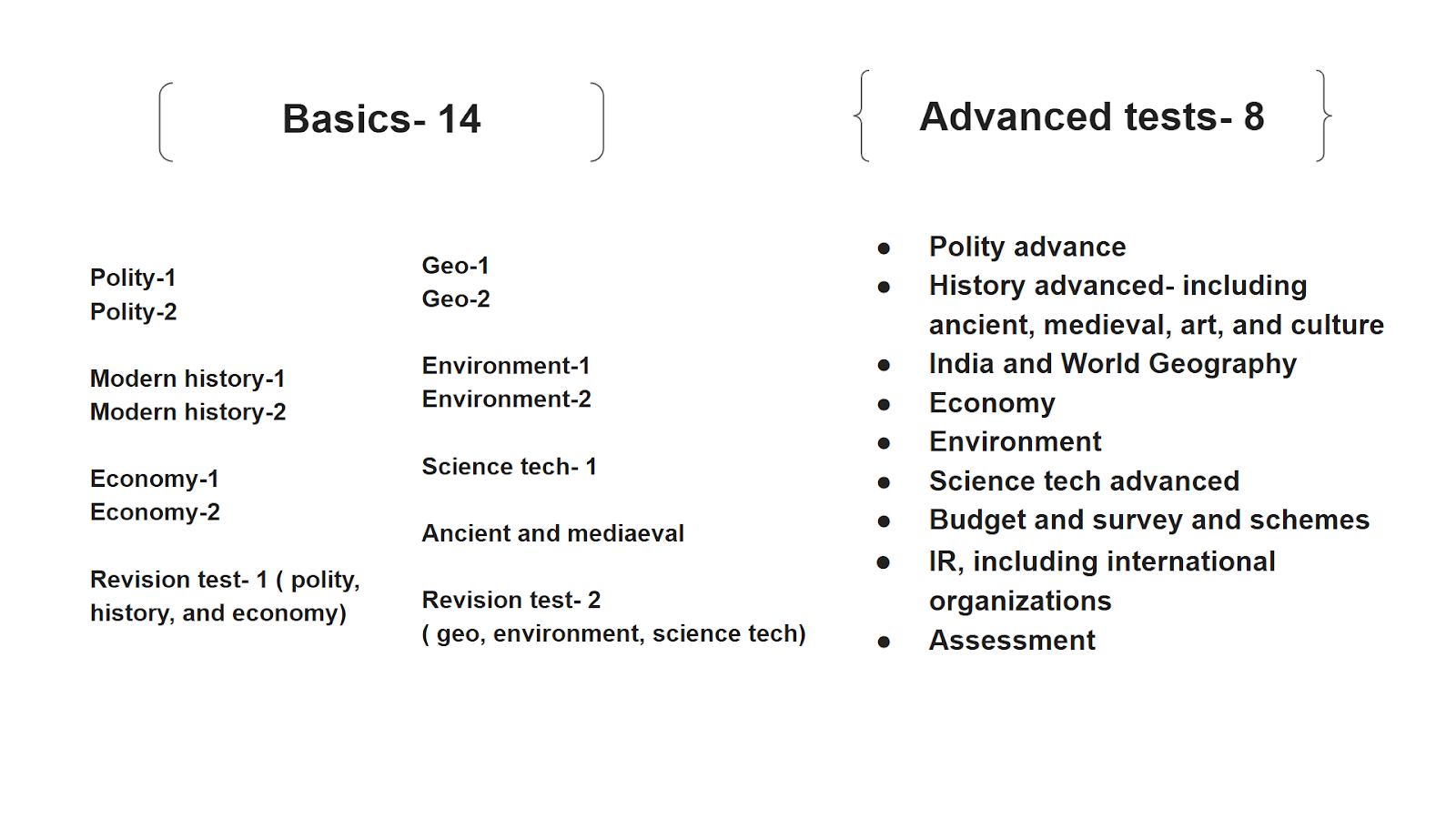
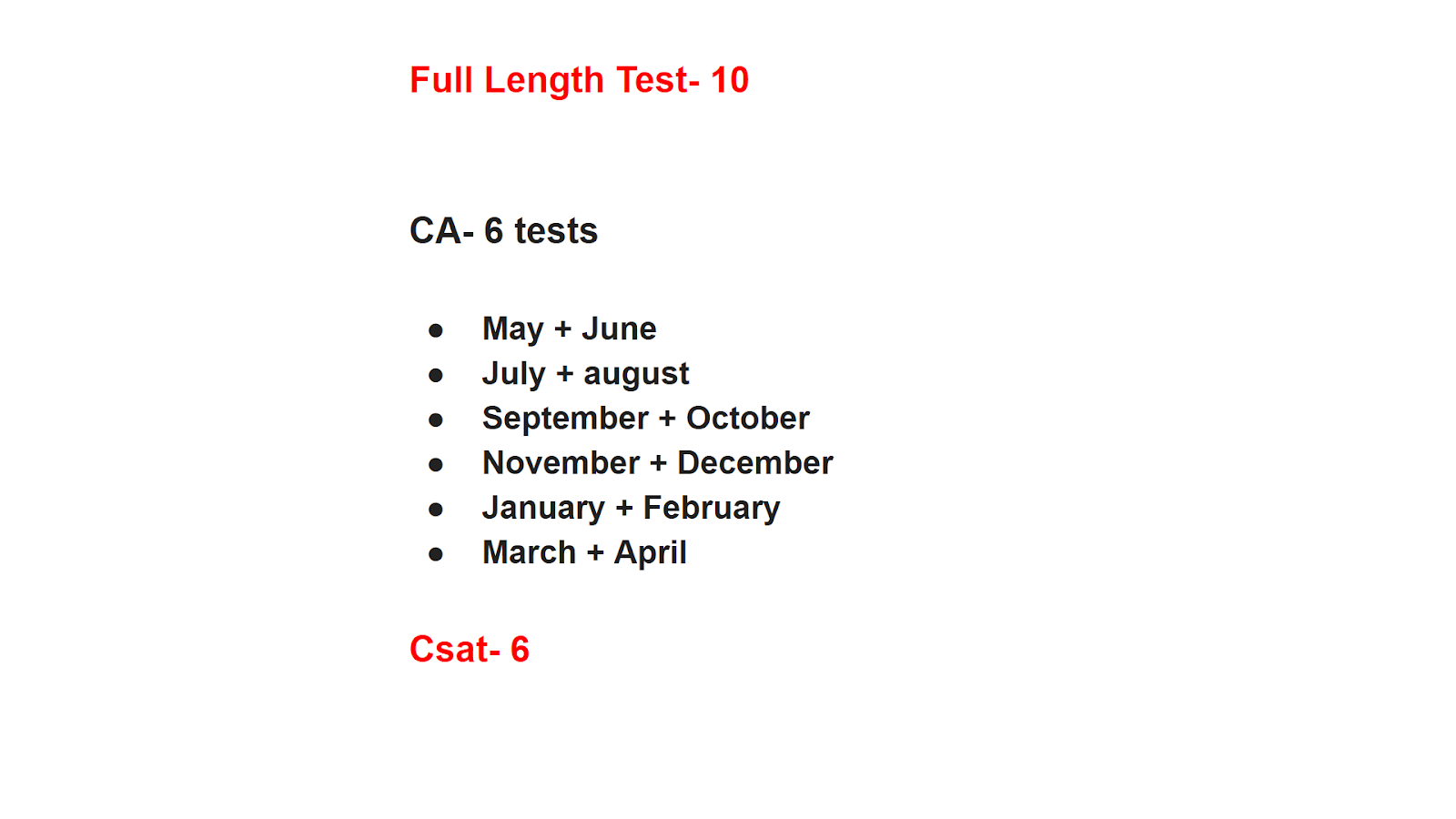
    44 Tests (14 Basic, 8 Advanced, 6 Current Affairs Based Test, 10 Full-Length Tests, 6 CSAT-Tests)

    The new Tests are going to start on 11th June, 2022

    ‘What are you waiting for….?’

    Civil Services Preliminary Exam is the first phase of the Civil Services Exam but not necessarily the simplest. There is a wide difference between the syllabi of the Preliminary and Main Exam, the nature of questions, and consequently, the preparation strategy needs to be well thought out. 

    Despite the churnings happening around us, few fundamentals couldn’t be questioned at least about the UPSC exam. Much coveted UPSC civil service has always attracted the best talents from across India. Hence on the flip side heightens the competition. So, you have to strive hard. As a result, a focused and measured approach is always needed, and that too throughout the year.

    Those who have already faced the exam would know it themselves. The importance & contribution of the Test series in fine-tuning the prep process.

    -Civilsdaily’s majestic mentorship program. The Hindu Newspaper has acknowledged…

    Presenting you a few highlights about our Prime Prelims Program 2023

    Target UPSC 2023 (Prelims): There are no shortcuts. Only smart work with the most probable questions works for you. Expect many questions in UPSC civil services Preliminary exam – 2023 directly from our Prime Prelims Test Series. You need to revise the solved points provided with each of these tests keeping in mind the nature of questions that were asked in Prelims 2021 & 2022. 

    Avoid Last Time Rush..

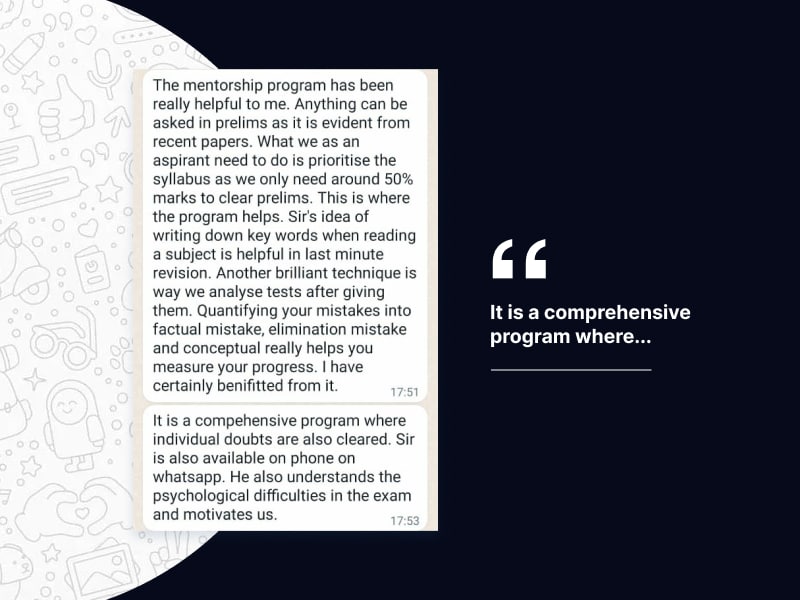
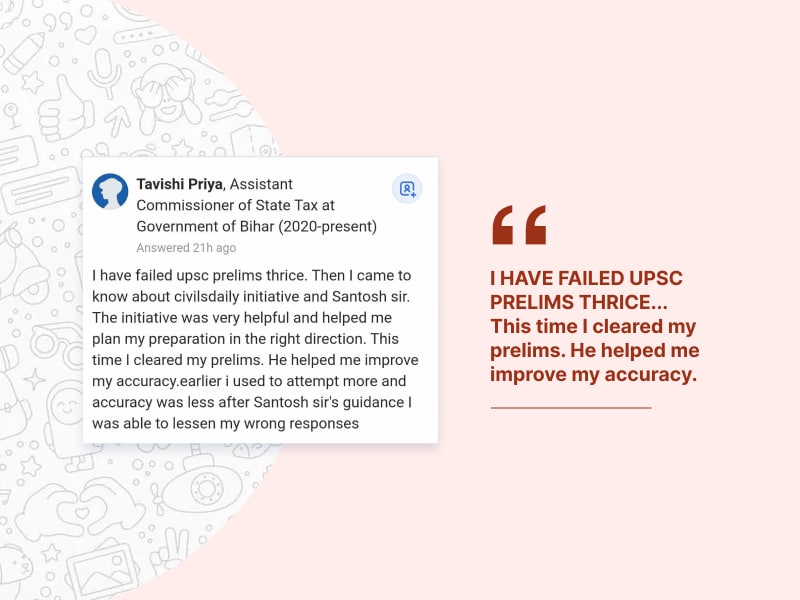
    Students Views: How Santosh Sir’s Mentorship Leads to Success in Prelims

    Our Students’ Testimonials.

    WHAT ARE MAKING OUR PRIME PRELIMS TS-2023 DIFFERENT FROM OTHERS

    1. Complete course revision with Test Paper-based time-plan

    The complete course has 44 Test papers, to enhance the exam worthiness of an aspirant. Especially those who have their house (concepts) in order about the course/syllabus. The idea of solving tests or mock papers is with the intent to find out the gaps in our preparation. Sometimes they are also helpful for the mains or subjective type questions.

    2. A holistic mix of Static – cum- Dynamic Test series

    Course completion is what we care to establish with each finishing module. And this incorporates the aspect of Current affairs and Associated statics as well. Hence an aspirant gets a holistic mix of Static cum Dynamic elements featured in this course.

    3. Mentor & Discussion help for 1-1

    Civilsdaily Mentorship with tests is going to help an aspirant keep a track of the syllabus, which was earlier either glossed over or paid little attention to. Our Senior Mentors will be the person who would have the responsibility to ensure you end up with all the papers. Also, imparting valuable advice to stay rational and mindful.

    1. Detailed Orientation session
    1. Year-long mentorship till prelims and beyond
    1. Mentor call after every 4 tests or one call/month
    1. Bi-Weekly zoom sessions for doubts and discussions
    1. 24*7 Habitat group mentors support

    Civilsdaily’s mentors are highly qualified, with at least 3+ years of mentorship experience and two UPSC-CSE Interviews under their belts. They are well-versed in the many stages of preparation. These mentors will assist you in developing both a comprehensive and micro schedule. They’ll put together a weekly program for you, complete with mentorship calls. This schedule will be created based on a thorough examination of the importance of subjects as well as the interconnection of topics to make it easier for students to grasp the material.

    Our highly experienced mentors will guide you with the all-round strategy

    • of How to deal with unfamiliar MCQs by using TIKDAM (Intelligent Guessing)
    • How many questions you should attempt.
    • When to start coding on OMR sheet
    • How to focus on strong areas

    4. All India Rankings

    All India ranking factors are here to help you deal with the moments of truth vis-à-vis your preparation level. They give you the necessary nudge to focus back on evaluating the current state of preparation. Your mentor would have a lot more to focus on wrt the rankings you achieve.

    5. Performance-based Aspirant Cohorts on Civilsdaily Habitat

    At Civilsdaily, you would get a community always ready to deal with unexpected roadblocks. We aim to create a like-minded and similarly placed aspirant cohort. For a better discussion of tasks and problem-solving capabilities. So as a member of any Cohort, chat (responsibly) with other learners.

    If you have a question, chances are, you’re not alone. Reach out in the discussion forum to ask for help from other learners taking this program.

    6. CivilsDaily Habitat Sessions – Ask Anything

    Were your queries about courses/syllabus / basic doubts would be addressed to keep you always on the move.

    Throughout this course, you will learn about the techniques of time management, and the ability to find a static–dynamic convergence. Also, peace of mind about course completion under the guidance of a mentor. 

    The mentor would also provide a lot of reading material from time to time. But sometimes, you may need to look things up on your own for extra learning. Things change fast in our dynamic socio-political setup, so it is critical to do your own research so you can stay up-to-date on what is new.

    What is there on Habitat?

    • An ecosystem for co-learning and active learning.
    • A highly motivated community to bring flexibility and consistency to your preparation.


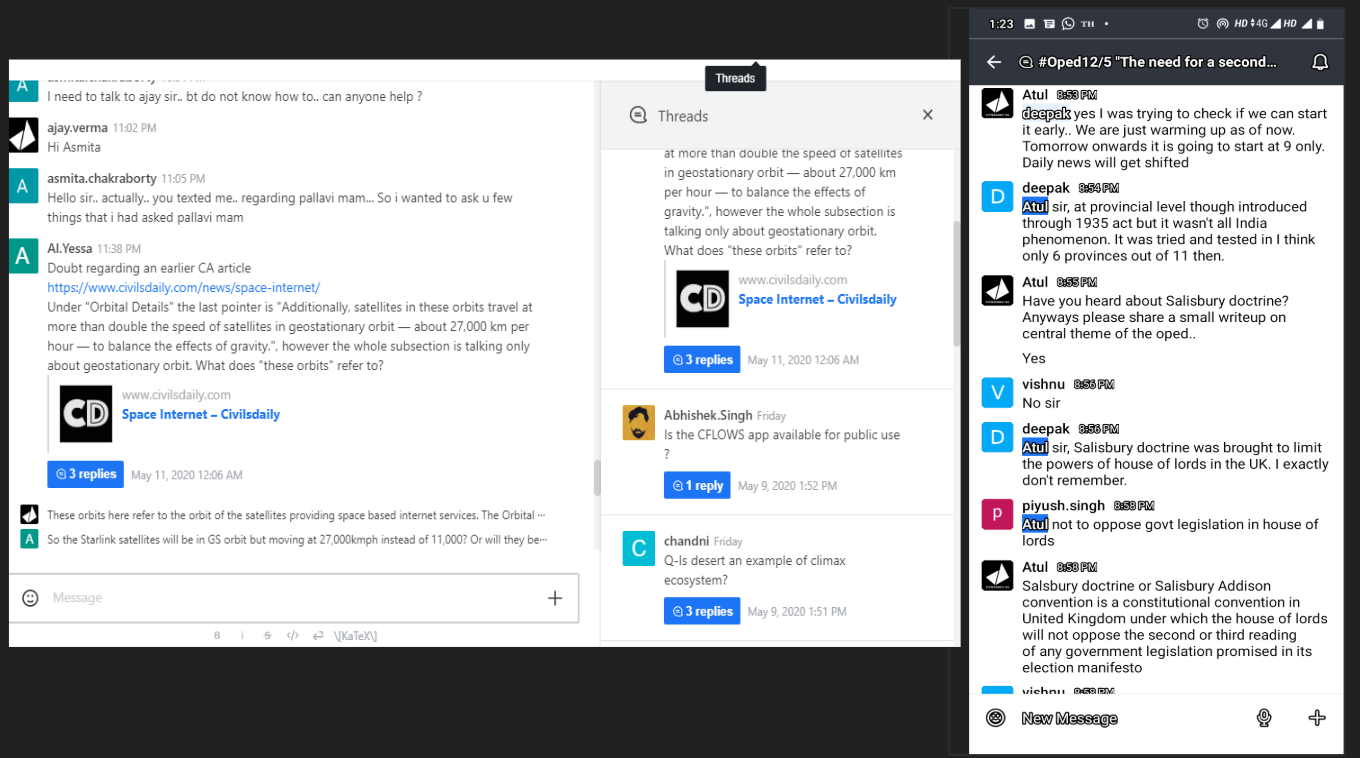
    Samachar Manthan Civilsdaily IAS Current Affairs UPSCHabitat – Desktop and Mobile view


    Download PDF for better visibility – Prime Prelims TS 2023 Time Table (New Batch)


    Program Inclusion

    • 44 Tests
      • 14 Basic tests
      • 8 Advanced tests
      • 6 Current Affairs Based Tests
      • 10 Full-Length Tests
      • 6 CSAT Tests
    • Civilsdaily’s Monthly Magazine Combo
    • Individual Mentorship
    • Economic Survey & Budget Videos and Notes
    • Advanced Static + Tikdam Videos
    • Admission to the exclusive Civilsdaily Prelims club on Habitat.

    Where to find the tests?

    After enrolling, you will receive a confirmation email with links to the tests and materials. These links are also available in the curriculum section of this course.

    Facing any issues with test access post-enrollment?

    Share your payment confirmation, name, email id, and contact number along with the issue that you are facing (with screenshots if possible) at dj@civilsdaily.com and cc it to hello@civilsdaily.com

    We will resolve your issues in minutes.

    This is what our students have to say about our mock tests…

    Feedback for 2022 Prelims Mocks

    Civilsdaily’s Community: Testimonials

    -Still have queries?

    All The Best.

  • QUAD: its origins, goals and future plans

    Why was it formed?

    • While not stated explicitly by the leaders, a major basis for the grouping is to check China’s growing influence in the region.
    • After the Indian Ocean tsunami in 2004 wreaked havoc in the region now called the Indo-Pacific, India stepped up its rescue efforts.
    • India provided assistance to its maritime neighbours: Sri Lanka, the Maldives and Indonesia.
    • Soon, the disaster relief effort was joined by three other naval powers — the U.S., Australia and Japan.
    • Then US President George W. Bush announced that the four countries would set up an international coalition to coordinate the massive effort.
    • While the charge of the rescue operations was handed over to the United Nations shortly after, it led to the birth of a new framework: the Quadrilateral or Quad.

    Development of present day QUAD

    • Then Japanese PM Shinzo Abe had been promoting the idea of an “arc of prosperity and freedom”.
    • This brought the Quad countries closer together, further developed the concept and discussed it with then PM Manmohan Singh during a summit in December 2006.
    • The 2007 Indo-U.S. Malabar naval exercises also saw the partial involvement of Japan, Australia and Singapore.
    • The exercises and coordination were seen by China as an attempt to encircle it, which termed the grouping as trying to build “an Asian NATO”.

    Descent and revival in its formation

    • The Quad lost momentum post the 2007 meeting as the effort “dissipated amidst member leadership transitions.
    • The grouping was only revived an entire decade later in 2017, at a time when all four countries had revised their assessment of the China challenge; and India had witnessed the Doklam standoff.
    • Leaders of all four countries met in the Philippines for the ‘India-Australia-Japan-U.S.’ dialogue, not referred to as a Quad dialogue to avoid the notion of a “gang-up”.

    Basis: Indo-Pacific

    • Even at this point, a set of objectives, areas of cooperation, and even the definition of Indo-Pacific were not fixed among Quad members.
    • It was in March 2021 that Mr. Biden, Mr. Modi, Australia’s outgoing PM Scott Morrison, and then Japanese PM Yoshihide Suga met virtually, for the first time as an official Quad summit.
    • It released a set of objectives for the grouping in a joint statement called the ‘The Spirit of the Quad’.

    What were the objectives of the grouping?

    • Coming together to foster a free and open Indo-Pacific formed the bedrock of cooperation.
    • Now it commits to promoting the free, open, rules-based order, rooted in international law and undaunted by coercion, to bolster security and prosperity in the Indo-Pacific and beyond.
    • Emphasis was laid on “rule of law, territorial integrity, freedom of navigation and overflight, peaceful resolution of disputes, and democratic values” in the region.

    Various initiatives of QUAD

    • Quad leaders launched the Quad Vaccine Initiative (QVI) with the aim of manufacturing and distributing at least a billion COVID-19 vaccines for the Asia region by the end of 2022.
    • As for emerging technologies, the four countries aimed to work on the development and diversification of 5G telecommunications.
    • They aim for creation of supply chains for critical minerals and technologies for making semiconductors used in smartphones, another area where China is a leader.
    • Quad nations had also agreed to build joint connectivity projects and transparent infrastructure funding for countries in the region.
    • The Quad also created a working group for combating climate change which would oversee efforts to foster green shipping by decarbonising maritime supply chains and promoting the use of clean hydrogen.

    What are the future plans of the Quad?

    • The Leaders will review the progress of Quad initiatives and Working Groups, identify new areas of cooperation and provide strategic guidance and vision for future collaboration.
    • The Quad summit is expected to discuss the Russian war in Ukraine, and the impact of three months of Western sanctions.
    • US also unveiled the ‘Indo-Pacific Economic Framework’ (IPEF) which is a programme to bind countries in the region more closely through common standards.
    • Quad members also launched a maritime monitoring plan to curb illegal fishing in the Indo-Pacific.

    Various challenges

    • How to deal with China thus remains the central question for Quad. Each Quad member views the Chinese threat differently.
    • For Australia too, trade was the biggest issue until the recent establishment of a Chinese military base in the Solomon Islands brought a new dimension.
    • Japan and India are closest to China, and both face belligerent Chinese claims to territory.
    • The security build-up of QUAD is also yet to materialize.


    UPSC 2023 countdown has begun! Get your personal guidance plan now! (Click here)

  • Qutub Minar not a Place of Worship: ASI

    The Qutub Minar complex is not a place of worship and its character cannot be changed now, the Archaeological Survey of India submitted in a Delhi Court while opposing a plea challenging the dismissal of a civil suit seeking “restoration” of temples on the premises.

    What is the case?

    • The original suit claimed that 27 temples were demolished to build the Quwwat-ul-Islam mosque at the Qutub Minar complex.
    • This pleas was dismissed last year under the provisions of Places of Worship (Special Provisions) Act, 1991.
    • The Additional District Judge (ADJ) has now reserved the order.
    • The petitioner said that the dismissal of the original suit based on the 1991 Act was wrong.
    • The Qutub Minar complex comes under the purview of the Ancient Monuments and Archaeological Sites and Remains (AMASR) Act of 1958.

    Why in news now?

    • The ASI now submitted that the Qutub Minar complex was not a place of worship when it was first notified as a protected monument in 1914.
    • The ASI, explained that the character of a monument is decided on the date when it comes under protection.

    About Qutub Minar

    • The Qutub Minar is a minaret and “victory tower” that forms part of the Qutb complex, which lies at the site of Delhi’s oldest fortified city, Lal Kot, founded by the Tomar Rajputs.
    • It is a UNESCO World Heritage Site in the Mehrauli area of South Delhi.
    • It can be compared to the 62-metre all-brick Minaret of Jam in Afghanistan, of c. 1190, which was constructed a decade or so before the probable start of the Delhi tower.
    • The surfaces of both are elaborately decorated with inscriptions and geometric patterns.
    • The Qutb Minar has a shaft that is fluted with “superb stalactite bracketing under the balconies” at the top of each stage.

    Its construction

    • The Qutb Minar was built over the ruins of the Lal Kot, the citadel of Dhillika.
    • Qutub Minar was begun after the Quwwat-ul-Islam Mosque, which was started around 1192 by Qutb-ud-din Aibak, first ruler of the Delhi Sultanate.
    • It is usually thought that the tower is named for Qutb-ud-din Aibak, who began it.
    • It is also possible that it is named after Khwaja Qutbuddin Bakhtiar Kaki a 13th-century sufi saint, because Shamsuddin Iltutmish was a devotee of his.
    • Quwwat-ul-Islam Mosque, to the north-east of the Minar was built by Qutub-ud-Din Aibak in A.D. 1198.
    • It consists of a rectangular courtyard enclosed by cloisters, erected with the carved columns and architectural members of 27 Jain and Hindu temples, which were demolished by Qutub-ud-Din.
    • This is recorded in his inscription on the main eastern entrance.

    Back2Basics:

    What is the Places of Worship Act?

    UPSC 2023 countdown has begun! Get your personal guidance plan now! (Click here)

  • Who was Prithviraj Chauhan?

    There is controversy around a new film where some communities of Rajasthan are laying claim over the 12th century emperor Prithviraj Chauhan.

    Prithviraj Chauhan

    • Prithviraj Chauhan (1177–1192 CE) popularly known as a king from the Chauhan (Chahamana) dynasty who ruled the territory of Sapadalaksha, with his capital at Ajmer in present-day Rajasthan.
    • Ascending the throne as a minor in 1177 CE, Prithviraj inherited a kingdom which stretched from Thanesar in the north to Jahazpur (Mewar) in the south.

    His legend

    • He aimed to expand by military actions against neighbouring kingdoms, most notably defeating the Chandela’s.
    • Prithviraj unified several Rajput clans and defeated the Ghurid army led by Muhammad Ghori near Taraori in 1191 AD.
    • However, in 1192 CE, Ghori returned with an army of Turkish mounted archers and defeated the Rajput army on the same battlefield.
    • Prithviraj fled the battlefield, but was captured near Sirsa and executed.
    • His defeat at Tarain is seen as a landmark event in the Islamic conquest of India, and has been described in several semi-legendary accounts, most notably the Prithviraj Raso.

    Prithviraj in literary works

    • The image of Prithviraj as a fearless and skilled warrior that is now etched in the folk imagination can be traced back to his depiction in ‘Prithviraj Raso’.
    • This was a poem in Brajbhasha attributed to Chand Bardai, which is thought to have been composed in the 16th century.
    • James Mill’s ‘The History of British India’ (1817) categorized Indian history into the Hindu, Muhammadan and British periods.
    • In this formulation, Prithviraj Chauhan would be the last ruler of ‘Hindu’ India.

    Why is he being revived?

    • To a vocal section of the Hindu right, Prithviraj Chauhan appears as “the last Hindu emperor” of India who made a valiant attempt to stop the radical invaders.
    • In the popular imagination, he is the heroic figure who symbolises the exalted ideals of patriotism and national pride.
    • However the historical evidence demonstrates rather different ways in which Prithviraj has been seen over the ages.


    UPSC 2023 countdown has begun! Get your personal guidance plan now! (Click here)

  • FDI inflow ‘highest ever’ at $83.57 bn

    The foreign direct investment (FDI) in the financial year 2021-22 has touched a “highest-ever” figure of $83.57 billion.

    Get aware with the recently updated FDI norms. Key facts mentioned in this newscard can make a direct statement based MCQ in the prelims.

    Ex. FDI source in decreasing order: Singapore – Mauritius – Netherland – Ceyman Islands – Japan – France

    What is Foreign Direct Investment (FDI)?

    • An FDI is an investment in the form of a controlling ownership in a business in one country by an entity based in another country.
    • It is thus distinguished from a foreign portfolio investment by a notion of direct control.
    • FDI may be made either “inorganically” by buying a company in the target country or “organically” by expanding the operations of an existing business in that country.
    • Broadly, FDI includes “mergers and acquisitions, building new facilities, reinvesting profits earned from overseas operations, and intra company loans”.
    • In a narrow sense, it refers just to building a new facility, and lasting management interest.

    FDI in India

    • Foreign investment was introduced in 1991 under Foreign Exchange Management Act (FEMA), driven by then FM Manmohan Singh.
    • There are two routes by which India gets FDI.

    1) Automatic route: By this route, FDI is allowed without prior approval by Government or RBI.

    2) Government route: Prior approval by the government is needed via this route. The application needs to be made through Foreign Investment Facilitation Portal, which will facilitate the single-window clearance of FDI application under Approval Route.

    • India imposes a cap on equity holding by foreign investors in various sectors, current FDI in aviation and insurance sectors is limited to a maximum of 49%.
    • In 2015 India overtook China and the US as the top destination for the Foreign Direct Investment.

    Features of FDI

    • Any investment from an individual or firm that is located in a foreign country into a country is FDI.
    • Generally, FDI is when a foreign entity acquires ownership or controlling stake in the shares of a company in one country, or establishes businesses there.
    • It is different from foreign portfolio investment where the foreign entity merely buys equity shares of a company.
    • In FDI, the foreign entity has a say in the day-to-day operations of the company.
    • FDI is not just the inflow of money, but also the inflow of technology, knowledge, skills and expertise.
    • It is a major source of non-debt financial resources for the economic development of a country.

    Significance of rising FDI

    • This is a testament of India’s status among global investors.

    Recent amendments in 2020

    • The govt. has amended para 3.1.1 of extant FDI policy as contained in Consolidated FDI Policy, 2017.
    • In the event of the transfer of ownership of any existing or future FDI in an entity in India, directly or indirectly, resulting in the beneficial ownership, such subsequent change in beneficial ownership will also require Government approval.

    The present position and revised position in the matters will be as under:

    Present Position

    • A non-resident entity can invest in India, subject to the FDI Policy except in those sectors/activities which are prohibited.
    • However, a citizen of Bangladesh or an entity incorporated in Bangladesh can invest only under the Government route.
    • Further, a citizen of Pakistan or an entity incorporated in Pakistan can invest, only under the Government route, in sectors/activities other than defence, space, atomic energy and sectors/activities prohibited for foreign investment.

    Revised Position

    • A non-resident entity can invest in India, subject to the FDI Policy except in those sectors/activities which are prohibited.

    [spot the difference]

    • However, an entity of a country, which shares a land border with India or where the beneficial owner of investment into India is situated in or is a citizen of any such country, can invest only under the Government route.
    • Further, a citizen of Pakistan or an entity incorporated in Pakistan can invest, only under the Government route, in sectors/activities other than defence, space, atomic energy and sectors/activities prohibited for foreign investment.

    In response to China

    • China accused that India’s recently adopted policy goes against the principles of the World Trade Organisation (WTO).
    • It tends to violate WTO’s principle of non-discrimination, and go against the general trend of liberalisation and facilitation of trade and investment.


    UPSC 2023 countdown has begun! Get your personal guidance plan now! (Click here)

  • Norms eased for GM Crop Research

    The Department of Biotechnology (DBT) has issued guidelines easing norms for research into genetically modified (GM) crops and circumventing challenges of using foreign genes to change crops profile.

    Guidelines for Safety Assessment of Genome Edited Plants, 2022: Key Highlights

    • It exempt researchers who use gene-editing technology to modify the genome of the plant from seeking approvals from the Genetic Engineering Appraisal Committee (GEAC).
    • The environment ministry in March 2022 exempted SDN 1 and SDN 2 genomes from Rules 7-11 of the Environment Protection Act.
    • Conventional breeding technique takes 8- 10 years for development of new crop varieties; genome-editing can do this faster.
    • The Environment Ministry too has sanctioned this exemption.

    What are the SDNs?

    The genome edited plants derived from the use of genome editing techniques employing site- directed nucleases (SDNs) such ZFNs, TALENs, CRISPR and other nucleases with similar functions are generally classified under three categories as

    1. Site-Directed Nuclease (SDN)-1, a site-directed mutagenesis without using a DNA sequence template;
    2. SDN-2, a site-directed mutagenesis using a DNA sequence template; and
    3. SDN-3, site-directed insertion of gene/large DNA sequence using a DNA sequence template.

    What are GM crops?

    • The GM plants involve transgenic technology or introducing a gene from a different species into a plant, for instance BT-cotton, where a gene from soil bacterium is used to protect a plant from pest attack.
    • The worry around this method is that these genes may spread to neighboring plants, where such effects are not intended and so their applications have been controversial.
    • Genome editing involves the use of technologies that allow genetic material to be added, removed, or altered at particular locations in the genome. Several approaches to genome editing have been developed.
    • A well-known one is called CRISPR-Cas9, which is short for clustered regularly interspaced short palindromic repeats and CRISPR-associated protein 9.

    Try this PYQ:

    Q.The Genetic Engineering Appraisal Committee is constituted under the:

    (a) Food Safety and Standards Act, 2006

    (b) Geographical Indications of Goods (Registration and Protection) Act, 1999

    (c) Environment (Protection) Act, 1986

    (d) Wildlife (Protection) Act, 1972


    Post your answers here.

    About Genetic Engineering Appraisal Committee (GEAC)

    • The Genetic Engineering Appraisal Committee (GEAC) is a statutory body conotified under the Environment (Protection) Act, 1986.
    • It was formed as the Genetic Engineering Approval Committee and was renamed to its current name in 2010.
    • It functions under the Ministry of Environment, Forests & Climate Change.
    • The body regulates the use, manufacture, storage, import and export of hazardous microorganisms or genetically-engineered organisms and cells in India.


  • What is Pravaig Field Pack?

    A Bengaluru-based venture has produced a rugged tactical battery that it is now planning to sell to the North Atlantic Treaty Organisation (NATO) forces in Europe.

    Pravaig Field Pack

    • It is a heavy-duty power bank that is portable and weighs 14 kilograms.
    • It is of great utility to the digitally connected modern military and Special Forces personnel who have to operate in high-risk zones while using gadgets that require constant power back-up.
    • These batteries are designed, engineered and made in India.
    • The field pack can be used to charge a MacBook 60 times.

    Significance of Pravaig

    • This supply marks a major shift in the defense landscape of India — a tipping point in the reversal of India’s high technology defense industry, from users to developers, from importers to exporters.
    • The field pack can be used to energize a military person’s field duties and it can be used to deploy remote sensors.
    • A powerful tactical battery can be used even to operate larger military equipment such as drones and it can even help coordinate tactical operations which involve multiple weapons systems.


    UPSC 2023 countdown has begun! Get your personal guidance plan now! (Click here)

More posts