The Union government has filed a draft document with the stock market regulator for selling 5% of its shares in the Life Insurance Corporation (LIC) of India.
Details of the IPO
The IPO is a 100% OFS [offer for sale] by the Government of India and entails no fresh issue of shares by LIC.
6 Crore shares are on offer representing 5% of the government’s equity in the firm.
As much as 10% of the offer could be reserved for LIC policyholders, as per the regulatory filing, and another 5% of the shares may be reserved for employees.
About Life Insurance Corporation of India (LIC)
LIC is an Indian state-owned insurance group and investment corporation owned by the Government of India.
It was founded in 1956 when the Parliament of India passed the Life Insurance of India Act that nationalized the insurance industry in India.
Over 245 insurance companies and provident societies were merged to create the state-owned LIC.
Why LIC?
LIC is India’s largest financial institution.
When listed on stock exchanges, it could easily emerge as the country’s top listed company in terms of market valuation, overtaking current leaders Reliance and TCS.
It is also the largest investor in government securities and stock markets every year.
On average, LIC invests Rs 55,000 crore to Rs 65,000 crore in stock markets every year and emerges as the largest investor in Indian stocks.
LIC also has huge investments in debentures and bonds besides providing funding for many infrastructure projects.
Impacts of listing of LICs
Profit-making for govt: The government is trying to make the most of the brand value of LIC, given that it is one of the few remaining profit-making entities owned by the state.
Better returns: Listing will boost LIC’s efficiency and thereby policy returns.
Reforming the insurance sector: LIC will also become more competitive. This will put pressure on its peers to innovate, benefitting policyholders in terms of pricing, product features, and services.
Better financial position: Less govt interference will be a positive for LIC’s financial health.
Risk-free: As long as a sovereign guarantee over the maturity proceeds and the sum assured to continue, policyholders won’t perceive any risk.
Various challenges
Structural challenges: LIC can even evolve into a bank like many of its global peers like Axa, Berkshire, and Munich Re.
Market hurdles: LIC’s own issues are not the only challenge the company would face in going public. It also remains to be seen if the Indian share market is ready to absorb such a large public issue.
Impact on growth: The size of the IPO will determine the extent of liquidity it will suck out, but Indian markets do not have the depth to take the issue of a very size.
Fears of disclosure: The Company’s books and operations have been opaque for far too long but it is trusted by 250 million policyholders.
Investors trust at risk: Being one of the biggest financial institutions of the country, the move to privatize LIC will shake the confidence of the common man and will be an affront to our financial sovereignty.
Way Forward
Over the years, LIC has become the lender of last resort to the Government of India.
Confronted with an unprecedented fiscal deficit and worried by an economy in crisis, the government has to find resources.
This disinvestment is also a preferred option for ideological and practical reasons.
The government could utilize the money gained by selling off its stakes to improve services in public goods like infrastructure, health, and education.
Poll-bound Uttarakhand CM’s announcement to prepare a draft of the Uniform Civil Code (UCC) in the State, raises questions over whether an individual State can bring its own family law code.
What is a Uniform Civil Code?
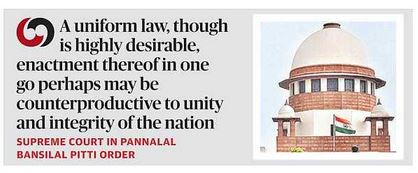
A Uniform Civil Code is one that would provide for one law for the entire country, applicable to all religious communities in their personal matters such as marriage, divorce, inheritance, adoption, etc.
Article 44, one of the directive principles of the Constitution lays down that the state shall endeavor to secure a Uniform Civil Code for the citizens throughout the territory of India.
These, as defined in Article 37, are not justiciable (not enforceable by any court) but the principles laid down therein are fundamental in governance.
Why need UCC?
UCC would provide equal status to all citizens
It would promote gender parity in Indian society.
UCC would accommodate the aspirations of the young population who imbibe liberal ideology.
Its implementation would thus support the national integration.
Hurdles to UCC implementation
There are practical difficulties due to religious and cultural diversity in India.
The UCC is often perceived by the minorities as an encroachment on religious freedom.
It is often regarded as interference of the state in personal matters of the minorities.
Experts often argue that the time is not ripe for Indian society to embrace such UCC.
UCC vs. Right to Freedom of Religion
Article 25 lays down an individual’s fundamental right to religion;
Article 26(b) upholds the right of each religious denomination or any section thereof to “manage its own affairs in matters of religion”;
Article 29 defines the right to conserve distinctive culture.
An individual’s freedom of religion under Article 25 is subject to “public order, health, morality” and other provisions relating to FRs, but a group’s freedom under Article 26 has not been subjected to other FRs.
In the Constituent Assembly, there was division on the issue of putting UCC in the fundamental rights chapter. The matter was settled by a vote.
By a 5:4 majority, the fundamental rights sub-committee headed by Sardar Patel held that the provision was outside the scope of FRs and therefore the UCC was made less important.
Enacting and Enforcing UCC: A reality check
Fundamental rights are enforceable in a court of law.
While Article 44 uses the words “the state shall endeavor”, other Articles in the ‘Directive Principles’ chapter use words such as “in particular strive”; “shall, in particular, direct its policy”; “shall be an obligation of the state” etc.
Article 43 mentions “state shall endeavor by suitable legislation” while the phrase “by suitable legislation” is absent in Article 44.
All this implies that the duty of the state is greater in other directive principles than in Article 44.
What are more important — fundamental rights or directive principles?
There is no doubt that fundamental rights are more important.
The Supreme Court held in Minerva Mills (1980): Indian Constitution is founded on the bedrock of the balance between Parts III (Fundamental Rights) and IV (Directive Principles).
To give absolute primacy to one over the other is to disturb the harmony of the Constitution.
Article 31C inserted by the 42nd Amendment in 1976, however, lays down that if a law is made to implement any directive principle, it cannot be challenged on the ground of being violative of the FRs under Articles 14 and 19.
What about Personal Laws?
Citizens belonging to different religions and denominations follow different property and matrimonial laws which are an affront to the nation’s unity.
If the framers of the Constitution had intended to have a UCC, they would have given exclusive jurisdiction to Parliament in respect of personal laws, by including this subject in the Union List.
But “personal laws” are mentioned in the Concurrent List.
Various customary laws
All Hindus of the country are not governed by one law, nor are all Muslims or all Christians.
Muslims of Kashmir were governed by a customary law, which in many ways was at variance with Muslim Personal Law in the rest of the country and was, in fact, closer to Hindu law.
Even on registration of marriage among Muslims, laws differ from place to place.
In the Northeast, there are more than 200 tribes with their own varied customary laws.
The Constitution itself protects local customs in Nagaland. Similar protections are enjoyed by Meghalaya and Mizoram.
Even reformed Hindu law, in spite of codification, protects customary practices.
Minority opinion in the Constituent Assembly
Some members sought to immunize Muslim Personal Law from state regulation.
Mohammed Ismail, who thrice tried unsuccessfully to get Muslim Personal Law exempted from Article 44, said a secular state should not interfere with the personal law of people.
B Pocker Saheb said he had received representations against a common civil code from various organizations, including Hindu organizations.
Hussain Imam questioned whether there could ever be uniformity of personal laws in a diverse country like India.
B R Ambedkar said, “no government can use its provisions in a way that would force the Muslims to revolt”.
Alladi Krishnaswami, who was in favor of a UCC, conceded that it would be unwise to enact UCC ignoring strong opposition from any community.
Gender justice was never discussed in these debates.
Conclusion
Article 44 of the Constitution creates an obligation upon the State to endeavour to secure for citizens a Uniform Civil Code throughout the country.
The purpose behind UCC is to strengthen the object of “Secular Democratic Republic” as enshrined in the Preamble of the Constitution.
This provision is provided to effect the integration of India by bringing communities on the common platform on matters which are at present governed by diverse personal laws.
Hence UCC should be enforced taking into confidence all the sections of Indian society.
Goa’s Portuguese Civil Code of 1867 is an example of a common family law existing in harmony.
Are you at that stage of prelims preparation where you are devoting 50-60% of your time in solving MCQs and test series? While, some of you might be scoring above 100 marks, others might be struggle to answer questions effectively.
While answering an MCQ, are you able to atleast eliminate two options correctly, but are confused with the rest two? Are you finding it difficult to recall the required information within 1-2 minutes of reading a question? Do you think you are making mistakes while interpreting the meaning of a question? Certainly, there are keywords that change the entire meaning of the question which you need to look for.
Open to All, Free Live Webinar by UPSC 2017 Topper & Civilsdaily mentor Megha Gupta Ma’am
In the last four months, many aspirants make notes that will help them revise the important facts of a topic right before an exam. Are you on it already? Have you taken notes on the important judgements of this year, the constituional amendments, the wildlife conventions, sancturies and the international rankings of this year? If not, how must you go about this?
When it comes to current affairs sources, online reports and standard books, it’s not only important what to read but how to read them as well. Since, there are many crash course study materials in the market, which are the reliable ones? If you haven’t yet started preparation for a subject, how should you read it’s book effectively to be able to cover the entire syllabus within a week?
If you are yet to find answers to all these questions and want to know the roadmap for the next four months of your UPSC-CSE Prelims preparation then you must register for the free live webinar by UPSC-CSE AIR 674 2017 Topper and Civilsdaily Mentor Megha Gupta Ma’am.
What will you learn in this free live UPSC Prelims Webinar by Megha Gupta Ma’am?
1. What are the changes you need to make in your prelims preparation if you are unable to score well?
2. What are the high weightage topics in CSAT which can fetch you maximum marks?
3. What are the online and offline revision materials one needs to study right now?
4. How to make notes from Prelims persepective right now?
5. What are the study technqiues you must use in the last 4 months of Prelims and what should you avoid?
6. How to complete revising a subject in one week?
7. What are the methods to recall information while reading a tricky question in the exam hall? (With live demonstration)
Webinar Details
Study hard, break your limits. Then, get used to it. That’s how you prepare for UPSC-CSE. We hope this webinar will help all 2022 aspirants implement the suggestions of Megha Gupta Ma’am.
The Government has banned the import of drones barring for R&D, defense, and security purposes.
Why in news?
To promote Make-in-India drones.
Before this order, the import of drones was “restricted” and needed prior clearance of the Directorate General of Civil Aviation (DGCA) and an import license from DGFT.
India’s sources of Imports
For its defense needs, India imports from Israel and the US.
Consumer drones such as those used for wedding photography come from China and drones for light shows also come from China apart from Russia.
Why need drones?
Indian drone manufacturers and service providers arrange drones for a variety of use cases such as survey and mapping, security and surveillance, inspection, construction progress monitoring, and drone delivery.
What does the order say?
The Directorate General of Foreign Trade (DGFT) issued an order prohibiting with immediate effect the import of drones in Completely-Built-Up (CBU), Semi-knocked-down (SKD), or Completely-Knocked-down (CKD) forms.
Import of drones by government entities, educational institutions recognized by the Central or State governments, government-recognized R&D entities, and drone manufacturers for R&D purposes as well as for defense and security purposes will be allowed.
For this, there has to be an import authorization obtained from the DGFT.
The import of drone components is “free”, implying that no permission is needed from the DGFT allowing local manufacturers to import parts like diodes, chips, motors, lithium-ion batteries, etc.
Steps taken to promote indigenous drone manufacturing
In August last year, the Government brought out liberalized Drone Rules, 2021 which reduced the number of forms to be filled to seek authorization from 25 to five.
They also dispensed with the need for security clearance before any registration or issuance of the license.
R&D entities too have been provided blanket exemption from all kinds of permissions, and restrictions on foreign-owned companies registered in India have also been removed.
The Government has also announced a production-linked incentive scheme for drones and drone components with the aim to make India a “global drone hub by 2030”.
Foreign manufacturers will be encouraged to set up assembly lines in India.
Why such a blanket ban?
Most drone manufacturers in India assemble imported components in India, and there is less manufacturing.
The import ban will ensure that an Indian manufacturer has control of the IP, design, and software which gives him or her a total understanding and control of the product.
Over a period of time, this can enable further indigenization.
Possible repercussions of the ban
The ban is likely to hurt those who use drones for photography and videography for weddings and events.
These drones primarily come from China because they are cheaper and easy to use and India still has a lot of catching up to do in manufacturing them.
The Union government has approved the continuation of a police modernization scheme for five years up to 2025-26 with a financial outlay of ₹26,275 crores.
What is the Modernization of Police Forces Scheme?
Police’ and ‘law and order’ fall under the category of subjects within the domain of the State as per Entry 2 of List II of the VIIth Schedule in the Constitution of India.
Thus, the principal responsibility for managing these subjects lies with the State Governments.
However, the States have not been able to fully modernize and equip their police forces up to the desired level due to financial constraints.
It is in this context that the Ministry of Home Affairs (MHA) has been supplementing the efforts and resources of the States, from time to time, by implementing the MPF Scheme since 1969-70.
Objectives:
The focus of the scheme is to strengthen police infrastructure at cutting edge level by constructing secure police stations, training centers, police housing (residential), equipping the police stations with the required mobility, modern weaponry, communication equipment, and forensic set-up, etc.
Components of the scheme
The scheme included security-related expenditure in J&K, northeastern States, and Maoist-affected areas, for raising new battalions, developing high-tech forensic laboratories and other investigation tools.
Provisions have been made under the scheme for internal security, law and order, and the adoption of modern technology by the police.
Assistance will be given to the States for narcotics control and strengthening the criminal justice system by developing a robust forensic setup in the country.
Funding pattern
Under the Scheme, the States are grouped into two categories, namely Category ‘A’ and Category ‘B’ for the purpose of funding both under ‘Non-Plan’ and Plan.
Category ‘A’ States, namely, J&K and 8 North Eastern States including Sikkim will be eligible to receive financial assistance on a 90:10 Centre: State sharing basis.
The remaining States will be in Category ‘B’ and will be eligible for financial assistance on a 60:40 Centre: State sharing basis.
The capital gains tax structure in India is complicated, and it is time for a relook since the union budget has provisions for 30% tax on cryptocurrency.
What is Capital Gains Tax?
Capital gains tax is levied on the profits made on investments.
It covers real estate, gold, stocks, mutual funds, and various other financial and non-financial assets.
Types
It is divided into long-term capital gains tax (LTCG) and short-term capital gains tax (STCG) depending on how long you have held the investment in question.
Unlike income tax, the percentage of tax does not change on the basis of your overall tax slab.
The LTCG tax, excluding surcharge, on equity is the same for gains of ₹10 lakh or ₹10 crore.
There is also a separate set of deductions that apply to LTCG, which do not apply to ordinary income.
Why is it so complicated?
Capital gains tax is complicated for a few primary reasons.
First, the rate changes from asset to asset. LTCG tax on stocks and equity mutual funds is 10% but on debt mutual funds is 20% with indexation.
Second, holding period changes from asset to asset. The holding period for LTCG tax is two years in real estate, one year for stocks, and three years for debt mutual funds and gold.
Third, exemptions available against it come with their own complex conditions. For instance, buying a house after selling one can get you an exemption, but the new house must be bought in two years or built in three years of the sale.
Is cryptocurrency taxed as capital gains?
The 2022 budget has proposed a 30% tax on cryptocurrency, which is higher than capital gains tax in many cases.
Besides, under capital gains tax, investors can adjust profits and losses on different investments against each other or against profits/losses in the future.
However, this cannot be done with cryptocurrency.
What distortions does it create?
As capital gains tax is the same regardless of your overall income it can compound inequality.
For instance, a person with a salary of ₹40 lakh will pay 30% tax on it but just 10% LTCG tax on gains from stock trading.
A person with a salary of ₹5 lakh will pay a 5% tax on it but the same 10% LTCG tax on stock trading.
Second, the smaller one-year qualifying period for LTCG in stocks compared to three years in debt mutual funds may encourage short-term trading in equity.
What can be done to fix these anomalies?
The government can bring about uniformity in rates and holding periods for various assets to ensure that the tax for one asset is not more attractive than another.
A uniform and long holding period to qualify for LTCG can also discourage short-term trading and speculative behavior in assets such as stocks.
The exemptions for LTCGsuch as reinvestment in another house property or capital gains bonds can also be made simpler, with fewer conditions.
Small investors can also be given relief by reducing rates of capital gains.
After a disappointing 2021 which saw just one successful launch, ISRO is getting back to business with the EOS-04, an earth observation satellite.
What are EOS?
An EOS or Earth remote sensing satellite is a satellite used or designed for Earth observation (EO) from orbit.
It includes spy satellites and similar ones intended for non-military uses such as environmental monitoring, meteorology, cartography, and others.
The most common type is Earth-imaging satellites that take satellite images, analogous to aerial photographs.
Some EOS may perform remote sensing without forming pictures, such as in GNSS radio occultation.
What is EOS-04 all about?
The EOS-04 is fourth in a series of earth observation satellites that are being launched under a new generic name.
It is designed to provide high-quality images for applications such as agriculture, forestry, and plantations, flood mapping, soil moisture, and hydrology.
It will complement the data from Resourcesat, Cartosat and RISAT-2B series of satellites that are already in orbit.
Why such different nomenclature?
Two years ago, ISRO had moved to a new naming system for its earth observation satellites which till then had been named thematically, according to the purpose they were meant for.
The Cartosat series of satellites were meant to provide data for land topography and mapping, while the Oceansat satellites were meant for observations overseas.
Some INSAT-series, Resourcesat series, GISAT, Scatsat, and a few other earth observation satellites were named differently for the specific jobs they were assigned to do, or the different instruments that they.
All these would now become part of the new EOS series of satellites.
What other satellites are being launched?
Besides EOS-04, two other small satellites —INSPIREsat-1 and INS-2TD — will ride on the heaviest version of the PSLV rocket in the early hours from the Sriharikota launch range.
The other co-passenger, INS-2TD, is a technology demonstrator for the first India-Bhutan joint satellite that is scheduled to be launched next month.
The two countries had signed a space agreement last year, and its first outcome would be the launch of Bhutan-Sat, or INS-2B, on a PSLV rocket.
How many satellites does India have in space?
India currently has 53 operational satellites, of which 21 are earth observation ones and another 21 are communication-based.
EOS-4 launch would be the 54th flight of the PSLV rocket, and the 23rd of its most powerful XL-version that has six strap-on boosters.
India signed an agreement with the United Nation’s World Food Programme (WFP) for the distribution of 50,000 tonnes of wheat that it has committed to sending Afghanistan as part of humanitarian assistance.
What is WFP?
The WFP is the food-assistance branch of the United Nations (UN).
It is the world’s largest humanitarian organization focused on hunger and food security, and the largest provider of school meals.
Founded in 1961, it is headquartered in Rome and has offices in 80 countries.
In addition to emergency food relief, WFP offers technical assistance and development aid, such as building capacity for emergency preparedness and response, managing supply chains and logistics, etc.
The agency is also a major provider of direct cash assistance and medical supplies and provides passenger services for humanitarian workers.
Feats achieved
As of 2020, it served 115.5 million people in 80-plus countries, the largest since 2012.
The WFP was awarded the Nobel Peace Prize in 2020 for its efforts to provide food assistance in areas of conflict and to prevent the use of food as a weapon of war and conflict.
WFP in Afghanistan
The wheat will be taken through Pakistan to the Afghan border crossing and handed over to WFP officials in Kandahar.
The WFP runs its own logistics network inside Afghanistan, partnering with civil society groups.
The Registry Building, a two-storey structure at Chandernagore built in 1875 and a symbol of French settlement of the colonial town, has been awaiting restoration for a long time.
French in India
France was the last of the major European maritime powers of the 17th century to enter the East India trade.
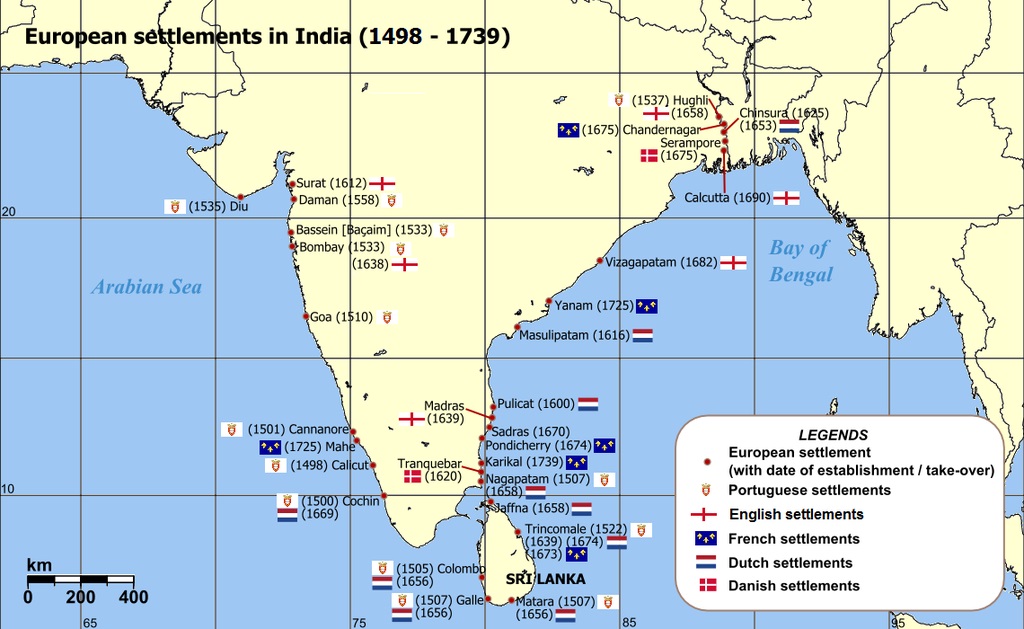
The French settlement in India began in 1673 with the purchase of land at Chandernagore from the Mughal Governor of Bengal.
The next year they acquired Pondicherry from the Sultan of Bijapur. Both became the centers of maritime commercial activities of the French in India.
Joseph Francois Dupleix who was initially appointed as Intendent of Chandernagore in 1731, sowed the seeds of colonization.
The village, which hitherto was engaged in maritime commerce along with Pondicherry, got fortified by him.
Significance of Chandernagore
Chandernagore, though a part of French colonies in India, was unique in many ways.
It was very active in spearheading the freedom movement against the British. Due to its close proximity to Calcutta, it became a safe haven for freedom fighters of all hues.
Even Aurobindo Ghosh who was one of the accused in the Alipore Bomb case of 1909, was acquitted unconditionally and after a short stay at Chandernagore moved to Pondicherry.
Since the partition of Bengal in 1905, Chandernagore was in the thick of activities of freedom fighters against the British and produced several martyrs including Kanailal Dutt.
Merger into India
As the British decided to hand over powers to the people of India by August 15, 1947, the people living under French rule in Pondicherry, Chandernagore, Karaikal, Mahe and Yanam were eager to join their homeland.
But the French were yet to learn their lessons. They tried all the tricks in the book to avert this.
Facing the onslaught from the people under their rule and the British and Indian rulers, the French declared Chandernagore as free city in 1947.
In June 1948, they conducted a referendum in which an overwhelming majority of 97 per cent people opted for a merger with India.
After so many legal hurdles, it became a part of India on October 2, 1955.
The foreign ministers of the Quad grouping of India, the US, Australia and Japan vowed to work vigorously to achieve the grouping’s shared vision of a free, open and inclusive Indo-Pacific and collectively deal with common threats such as terrorism.
QUAD: A backgrounder
Quadrilateral Security Dialogue or the Quad is an informal strategic forum between the United States, Japan, India and Australia that is maintained by semi-regular summits, information exchanges and military drills between member countries.
The US, Japan, India and Australia came together in the aftermath of the 2004 Indian Ocean tsunami to assist the devastated countries.
Later, officials of the four countries met in 2007 “to look at issues of common interest.” During an India visit, then Japanese PM Shinzo Abe unveiled the idea of “the Confluence of the Two Seas” that gave birth to the concept of the Indo-Pacific.
A decade later officials of the four countries met in the Philippines in 2017 to talk about an aggressively rising China.
In 2019, the foreign ministers of the Quad countries met in Washington for the first time.
In November, the Quad nations came together to participate in a two-phase joint military exercise, Malabar 2020, in the Bay of Bengal and in the Arabian Sea.
Now it is increasingly viewed as ‘Asian NATO’.
Focus on Indo-Pacific: For the China-wary world
The latest meeting of Quad comes at a time when all four countries have either trade or security disputes with China.
Despite not explicitly mentioning China, Quad has been openly supporting a “free and fair” Indo-Pacific which is seen as a clear message to Beijing that it needs to curb its assertive behaviour.
The optics were hard to miss when India, the US, Japan and Australia joined their navies for the mega Malabar military exercise late last year, an activity which raised alarm in Beijing.
This posturing by the Quad nations sent a strong signal to China.
(1) US vs China
USA had followed a policy to contain China’s increasing influence in East Asia. Therefore, USA sees the coalition as an opportunity to regain its influence in the Indo-Pacific region.
The US has described China, along with Russia, as a strategic rival in its National Security Strategy, National Defence Strategy and the Pentagon’s report on Indo-Pacific Strategy.
Both are navigating intense disagreements over trade and human rights in Tibet, Hong Kong and the western Xinjiang region, as well as the coronavirus pandemic and increasing Chinese assertiveness in the South China Sea.
(2) Australia vs China
Australia is concerned about China’s growing interest in its land, infrastructure and politics, and influence on its universities.
Ties have been on a downward spiral since 2018 when Australia, accusing China of meddling in its domestic affairs, passed a new law against foreign interference and espionage.
It also barred Huawei from building the country’s 5G mobile network, among the first countries to do so, citing national security.
The atmosphere worsened when PM Scott Morrison’s government called for an international inquiry into the origins of the coronavirus that causes Covid-19.
(3) Japan vs. China
Tensions between Japan and China over the Senkaku/Diaoyu Islands dispute have recently increased.
China has relentlessly continued attempts to unilaterally change the status quo by coercion in the sea area around the Senkaku Islands.
The more salient indicator is the number of Chinese patrols inside the territorial sea of the islands, which Japan sees as an explicit violation of its territorial sovereignty.
(4) India vs. China
India’s strained relations with China needs no explanation. The year long border dispute is the testimony.
The Quad summit is taking place in the backdrop of an ongoing military disengagement between India and China following their months-long border standoff in eastern Ladakh.
China is increasing its footprint in our neighborhood through its Belt and Road policy and political coercion following the debt trap are some of the increasing concerns other than economic imbalance.
Opportunities unveiled for India
India’s engagement with the Quad goes back to China’s expanding footprint in South Asia and the Indian Ocean Region over the last few years. India can reap some benefits as discussed below:
(1) Checkmating the Chinese
The maritime sphere is wide open to India to undertake coalition building, rule sets, and other forms of strategic exploration than compared to land borders.
The maritime space is more important to China than engaging in land grab attempts in the Himalayas. A huge chunk of Chinese trade happens via the Indian oceanic routes that pass through maritime chokepoints.
(2) Channelizing geo-politics
There is a growing great power interest in the maritime sphere, especially with the arrival of the concept of ‘Indo-Pacific’. For instance, many European countries have recently released their Indo-Pacific strategies.
The most recent was for France to send its warship in the international waters of the South China Sea.
(3) Maritime domain for India
Above is the backdrop against which one must see the progressive evolution of Exercise “Malabar”,
In the beginning, it was a bilateral event involving just the Indian and US navies. It became tri-lateral with the inclusion of Japan in 2015.
And now it has transformed into a four-cornered naval drill that will also include Australia.
(4) Check on China’s India Ocean Ambitions
The Quad has a valuable role to play as a check on China’s Indian Ocean ambitions.
India must develop ingrained habits of interoperable cooperation with its Quad partners.
This interoperable cooperation could pre-emptively dissuade China from mounting a naval challenge in its backyard.
(5) Eccentricity in South Asia
With India, located right at the centre of the Indo-Pacific geopolitical imagination can realize the vision of a ‘broader Asia’ that can extend its influence away from geographical boundaries.
Further, India with Quad countries can check the imperialist policies of China in the Indian Ocean region and ensure Security and growth for all in the region.
Issues with Quad
(1) Structural problems
The Quad has a core structural problem as its objective pivots around the U.S.
The Quad riles China as a hostile grouping, but hardly serves the security interests of its members.
Despite rhetoric relating to the promotion of a ‘rules-based’ world order, the Quad neither shares a strategic vision nor is it animated by a shared agenda.
(2) Nature of alliance
Alliances involve written commitments to come to the defence of the other against a third party.
Despite the potential for cooperation, the Quad remains a mechanism without a defined strategic mission.
(3) Economic alliance not feasible
Quad is neither a military alliance nor an economic partnership.
Its intention to counter China in the rare-earth sector is logical given the dominant role the country plays in supplying more than half of the world’s such key materials.
But, for a country like India, the lack of relevant technologies and talent pool could obstruct its progress in building up a supply chain from scratch.
(4) Overt emphasis on Maritime domain
The entire focus on the Indo-Pacific makes the Quad a maritime, rather than a land-based grouping, raising questions whether the cooperation extends to the Asia-Pacific and Eurasian regions.
India’s core concerns with China are primarily undemarcated borders and trade deficit.
(5) Lack of existence of Indo-Pacific system
There has never been Indo-Pacific system ever since the rise of the port-based kingdoms of Indochina in the first half of the second millennium.
There were two Asian systems — an Indian Ocean system and an East Asian system — with intricate sub-regional balances.
The effort by a U.S. to artificially manufacture to combine the Indo and the Pacific into a unitary system is unlikely to succeed.
(6) Indian borders can go more vulnerable
A lesson for India is China’s long-held and strategic interest in parts of Jammu and Kashmir.
It is wrongly argued that it is Pakistan that is the issue in J&K.
China undoubtedly is as big an issue but has quietly hidden behind Pakistan’s cover.
Challenges: China will retaliate
(1) China’s assertiveness
China claims that it has historical ownership over nearly the entire region of South China Sea, which gives it the right to manufacture islands.
However, the International Court of Arbitration rejected the claim in 2016.
Since then, the incidences of Chinese transgression has only increased making China more assertive for its interest.
(2) Preying small nations
The ASEAN countries have a well-knit relationship with China. So are other SAARC countries have fallen prey to Chinese debt traps.
The Regional Cooperation Economic Partnership (RCEP) is a recent example of China’s increasing influence over ASEAN nations to which Australia is even a forerunner.
(3) Monopoly
Considering the economic might of China and the dependence of Quad nations like Japan and Australia on China, the Quad nations cannot afford to have strained relations with it in the long run.
India too, is still very heavily dependent on Chinese exports.
Way Forward
Need for a clearer vision: It is important for members of the Quad not to be reactive. It is also important to exhibit openness, and ensure that all talk of a ‘Free and Open Indo-Pacific’ is more than just a mere slogan.
Consensus for a common objective: The Quad nations need to better explain the Indo-Pacific Vision in an overarching framework with the objective of advancing everyone’s economic and security interests.
Setting an agenda: This will reassure the littoral States that the Quad will be a factor for regional benefit, and a far cry from Chinese allegations that it is some sort of a military alliance. Future meetings can be an opportunity to define the idea and chart a future path.
Expanding Quad: India has many other partners in the Indo-Pacific; therefore India should pitch for countries like Indonesia, Singapore to be invited to join in the future. There is also a vital need to economically expand the Quad.
Conclusion
The Quad framework derives its geopolitical validation from India’s association and presents a unique opportunity for India to be an active participant in shaping regional security architecture with global undertones.
India’s moves with the Quad will be closely watched, as they bear more meaning than ever before on the path it will take to realise its strategic future.
Mental health is a major concern that affects UPSC-CSE aspirants by large but is also ignored by them in the same measure. We like to discuss about strategy, timetables, books etc. but not resolve the no. 1 factor that motivates us to implement them … Mental Health. There are aspirants who know what to do but they are unable to do it as they feel discouraged and anxious while preparing for UPSC-CSE.
IPS Officer Rajiv Kumar explains how Civilsdaily Free Mentorship Helped Him Prepare For UPSC without any Stress
An exam with uncertainity needs certaininity and confidence in your abilities to clear it. And that’s why we urge you to fill Samanvaya form to discuss and resolve your UPSC IAS preparation issues, doubts, and insecurities with us.
Finding success in the UPSC journey requires every aspirant to identify their “weak” areas and rectify them.
I think my number of revisions of the syllabus is still less.
Why are my marks stagnant in the mock test? Do I need a new book?
Should I change the optional subject?
Sometimes, it’s your study technique that needs to be tweaked. However, without someone telling you this you might assume that your entire preparation is not right or you are not capable of clearing UPSC-CSE. Preparing with this nagging thought honestly does more harm than good.
Why should the stress and anxiety of UPSC-CSE preparation not get the adequate platform to be discussed? We value your privacy and the personalised 1-on-1 call will turn you into a new leaf. For once, the session will not be just about what others are doing that you can do but are not aware of the same.
Getting feedback on how to improve by a CD Mentor who has cleared UPSC-CSE Interview is much better than getting criticisms from the wrong people who keep doubting your abilities. Topper Divyansh explains how
Honestly, sometimes you need more than a motivational quote. In our interaction with some 1000+ students, even the smallest act of acknowledging an aspirant’s anxiety and stress can go a long way in maintaining the right frame of mind during preparation.
Most of our Mentors like Sudhanshu sir, Sajal sir, Santhosh sir, Pravin sir, Parth Verma sir and Sukanya Ma’am were UPSC aspirants themselves and have attended UPSC Mains more than five times and UPSC Interview more than twice. Hence their mentorship is always a blend of the best test series, comprehensive notes and current affairs knowledge.
GAIN THE RIGHT CONFIDENCE TO HANDLE BOTH SUCCESS AND FAILURE
Emotional Stability is crucial to enjoy the whole process of UPSC-CSE preparation. The first step towards a balanced approach is to identify that as a human having lows and highs is pretty much normal. If you are not able to finish the decided target, then it is alright to feel bad and push yourself a little extra for the next day. What you need to avoid is “unhealthy behaviour”.For example, putting yourself under so much pressure that your performance starts to deteriorate or belittling yourself that it starts to affect your confidence.
We are not here to diagnose any clinical conditions. But as former aspirants and gaining years of experience through mentorship, we are a big advocate of people’s interaction for healthy minds.
Sometimes, in this preparation, all you need is a person to hear you out and understand you. And unfortunately, some of us are not able to find that one person in our family or friends. There is no shame in asking for emotional help. It helps if you have a person who can listen to your worries and reduce some of your pressure. Talking to your mentor can make you feel supported in the toughest times. The worst part of silo preparation is that aspirants tend to create the idea that all these emotional upheavals are exclusive to them. Trust us this is not true!
Why Mentorship helps you double your efforts in half the time?
A holistic UPSC preparation includes the right technique to complete your syllabus, revisions and mock test and a healthy mindset.
Reach out to us if you feel like nothing is going right in your preparation. Talk to our mentors about your emotional worries, and remove the burden of anxieties from your preparation.
Lack of direction in your UPSC IAS preparation, an absence of a well-defined strategy and inability to make required necessary changes either due to lack of guidance or awareness are the biggest killers of your LBSNAA dream.
Therefore, it is essential for you to get your approach rectified and tuned as per the demands of UPSC. If you feel lost in UPSC preparation and have been gripped by negativity, self-doubt, and demotivation, this is for you.
Fill the Samanvaya form for a free on-call mentorship session. We’ll call you within 24 hours.
Abhishek has benefited from Civilsdaily’s approach, so did 70+ candidates who cleared UPSC IAS 2019
The Perfect exam cracking pattern
Integrate them in your preparation. We’ll tell you how to do itIt’s about how ‘you’ should be doing it instead of how someone else did it. That is the ‘elephant in the room’.
1. First step starts with this Samanvaya call: Once you fill in the form, our senior mentors will have a 1-to-1 detailed discussion (on-callbased on which we create a step by step plan for next week, next month and so on.
2. You are given access to our invite-only chat platform, Habitat where you can connect with mentors, ask your daily doubts, discuss your test-prep questions and have real-time live sessions on news and op-eds, and find your optional groups.
Daily target monitoring.
3. The third and the most personalized tier is the dedicated 1 on 1 mentor allotment who stays with you through the course of your UPSC preparation – always-on chat and on scheduled calls to help you assess, evaluate, and chart the next milestone of your IAS 2022/2023 journey.
Daily target monitoring on Habitat
Who are you?
Working Junta? If you are preparing for IAS 2022-23 and working simultaneously, we can help you strategize and decipher the IAS exam and design a timetable that fits right in your hectic schedule.
First-time prep? If you are in the last year of college or thinking of dropping a year and preparing for IAS 2022-23 full time, we’ll help you pick the right books and craft a practical & personalstrategy.
Have appeared before? and weren’t successful. We’ll help you identify your mistakes, rectify them for the necessary course correction. Let this be your final and successful attempt.
You just have to take 5 minutes out and fill this form: Samanvaya For IAS 2022-23
Fill up the following details in Samanvaya form given below to schedule a free one-on-one mentorship session with senior mentors from Civilsdaily. We’ll call you within 24 hours.
Mental health is a major concern that affects UPSC-CSE aspirants by large but is also ignored by them in the same measure. We like to discuss about strategy, timetables, books etc. but not resolve the no. 1 factor that motivates us to implement them … Mental Health. There are aspirants who know what to do but they are unable to do it as they feel discouraged and anxious while preparing for UPSC-CSE.
IPS Officer Rajiv Kumar explains how Civilsdaily Free Mentorship Helped Him Prepare For UPSC without any Stress
An exam with uncertainity needs certaininity and confidence in your abilities to clear it. And that’s why we urge you to fill Samanvaya form to discuss and resolve your UPSC IAS preparation issues, doubts, and insecurities with us.
Finding success in the UPSC journey requires every aspirant to identify their “weak” areas and rectify them.
I think my number of revisions of the syllabus is still less.
Why are my marks stagnant in the mock test? Do I need a new book?
Should I change the optional subject?
Sometimes, it’s your study technique that needs to be tweaked. However, without someone telling you this you might assume that your entire preparation is not right or you are not capable of clearing UPSC-CSE. Preparing with this nagging thought honestly does more harm than good.
Why should the stress and anxiety of UPSC-CSE preparation not get the adequate platform to be discussed? We value your privacy and the personalised 1-on-1 call will turn you into a new leaf. For once, the session will not be just about what others are doing that you can do but are not aware of the same.
Getting feedback on how to improve by a CD Mentor who has cleared UPSC-CSE Interview is much better than getting criticisms from the wrong people who keep doubting your abilities. Topper Divyansh explains how
Honestly, sometimes you need more than a motivational quote. In our interaction with some 1000+ students, even the smallest act of acknowledging an aspirant’s anxiety and stress can go a long way in maintaining the right frame of mind during preparation.
Most of our Mentors like Sudhanshu sir, Sajal sir, Santhosh sir, Pravin sir, Parth Verma sir and Sukanya Ma’am were UPSC aspirants themselves and have attended UPSC Mains more than five times and UPSC Interview more than twice. Hence their mentorship is always a blend of the best test series, comprehensive notes and current affairs knowledge.
GAIN THE RIGHT CONFIDENCE TO HANDLE BOTH SUCCESS AND FAILURE
Emotional Stability is crucial to enjoy the whole process of UPSC-CSE preparation. The first step towards a balanced approach is to identify that as a human having lows and highs is pretty much normal. If you are not able to finish the decided target, then it is alright to feel bad and push yourself a little extra for the next day. What you need to avoid is “unhealthy behaviour”.For example, putting yourself under so much pressure that your performance starts to deteriorate or belittling yourself that it starts to affect your confidence.
We are not here to diagnose any clinical conditions. But as former aspirants and gaining years of experience through mentorship, we are a big advocate of people’s interaction for healthy minds.
Sometimes, in this preparation, all you need is a person to hear you out and understand you. And unfortunately, some of us are not able to find that one person in our family or friends. There is no shame in asking for emotional help. It helps if you have a person who can listen to your worries and reduce some of your pressure. Talking to your mentor can make you feel supported in the toughest times. The worst part of silo preparation is that aspirants tend to create the idea that all these emotional upheavals are exclusive to them. Trust us this is not true!
Why Mentorship helps you double your efforts in half the time?
A holistic UPSC preparation includes the right technique to complete your syllabus, revisions and mock test and a healthy mindset.
Reach out to us if you feel like nothing is going right in your preparation. Talk to our mentors about your emotional worries, and remove the burden of anxieties from your preparation.
Lack of direction in your UPSC IAS preparation, an absence of a well-defined strategy and inability to make required necessary changes either due to lack of guidance or awareness are the biggest killers of your LBSNAA dream.
Therefore, it is essential for you to get your approach rectified and tuned as per the demands of UPSC. If you feel lost in UPSC preparation and have been gripped by negativity, self-doubt, and demotivation, this is for you.
Fill the Samanvaya form for a free on-call mentorship session. We’ll call you within 24 hours.
Abhishek has benefited from Civilsdaily’s approach, so did 70+ candidates who cleared UPSC IAS 2019
The Perfect exam cracking pattern
Integrate them in your preparation. We’ll tell you how to do itIt’s about how ‘you’ should be doing it instead of how someone else did it. That is the ‘elephant in the room’.
1. First step starts with this Samanvaya call: Once you fill in the form, our senior mentors will have a 1-to-1 detailed discussion (on-callbased on which we create a step by step plan for next week, next month and so on.
2. You are given access to our invite-only chat platform, Habitat where you can connect with mentors, ask your daily doubts, discuss your test-prep questions and have real-time live sessions on news and op-eds, and find your optional groups.
Daily target monitoring.
3. The third and the most personalized tier is the dedicated 1 on 1 mentor allotment who stays with you through the course of your UPSC preparation – always-on chat and on scheduled calls to help you assess, evaluate, and chart the next milestone of your IAS 2022/2023 journey.
Daily target monitoring on Habitat
Who are you?
Working Junta? If you are preparing for IAS 2022-23 and working simultaneously, we can help you strategize and decipher the IAS exam and design a timetable that fits right in your hectic schedule.
First-time prep? If you are in the last year of college or thinking of dropping a year and preparing for IAS 2022-23 full time, we’ll help you pick the right books and craft a practical & personalstrategy.
Have appeared before? and weren’t successful. We’ll help you identify your mistakes, rectify them for the necessary course correction. Let this be your final and successful attempt.
You just have to take 5 minutes out and fill this form: Samanvaya For IAS 2022-23
Fill up the following details in Samanvaya form given below to schedule a free one-on-one mentorship session with senior mentors from Civilsdaily. We’ll call you within 24 hours.
Smash Prelims Program is back after a thumping success in Prelims 2021. Out of 25 students Santosh sir has mentored, 15 have cleared prelims this time.Our students were kind enough to take time out of their hectic Mains preparation and let us know how Santosh sir’s mentorship benefitted them in the exams. We wish them all the very best for the upcoming Mains exam from 7th January onwards!
https://youtu.be/oTRUMSOQEY4
Why Your Focus for Next 5 Months Must be About Scoring Above Cut-Off Marks in UPSC-CSE Prelims? Isn’t the last 1 Month Enough for This?
Every year, the competition for UPSC-CSE is increasing while vacancies are decreasing drastically. This year there are only 712 vacancies as against 2019 which had 927 vacancies. However, atleast 10 lakh students will attempt the prelims exam. This is why right now, it’s important to start having an Olympic Athlete mindset. You need to daily focus on scoring above the cut-off marks in your test series.
Civilsdaily Student and 2019 UPSC-CSE AIR 8 Topper Abhishek Saraf had practiced nearly 6000+ MCQs under us to clear prelims!
What makes prelims tough? It’s because the paper is unpredictable. If this year, science questions are a breeze then the next year you will have to answer advanced concept-based questions. Unlike Mains, Prelims has negative markings.
Toppers like Pranav Vijayvergiya (AIR 65) andSwati Sharma(AIR 17) have found Prelims to be tougher than Mains. In fact, Pranav failed to clear Prelims thrice. But, in his fourth attempt he took Civilsdaily mentorship and cleared Prelims, Mains and Interview in one shot!
Are you feeling low that you are unable to get the required cut-off marks in your test series. Worry not, for about 65% of the UPSC toppers have said that they scored below cut-off marks till December. But by June, they were able to boost their marks to get through the prelims hurdle. It’s time to be like them now.
One has to be good at elimination methods to choose the right option amongst two similar ones. Our Smash Prelims Program started as a pilot project last year with an aim to introduce step-wise improvement in our chosen 25 aspirants. Over a period of 2 months, Santhosh sir inculcated confidence in aspirants who were either newbies or gave too many attempts. This year, we achieved a remarkable 60% success ratio. Next year, we have set our eyes on 100%. Yes, we are ambitious and aspirational just like any other UPSC aspirant.
Why is Mentorship Required for UPSC-CSE Prelims in Every Step – From Test Series, to Study Materials, Classes to Doubt Resolution?
If you are appearing for UPSC-CSE 2022 exams, you might have completed your entire prelims and mains syllabus right now. So what are your main priorities right now? To succeed in UPSC-CSE Prelims 2022, you have to check all these boxes in terms of preparation—
You need clear strategy for next 150 days.
You need to revise effectively to remember whole syllabus at the eve of exam.
You need to practice lots of tests to score accurately, to understand elimination techniques and reduce exam anxiety.
You need to revise current affair of 1.5 years that you have been studying daily.
You need a mentor to fill the critical gaps that have been ignoring till now as you had no one to address them for you.
Santhosh Sir’s Weekly Zoom Session
Do you want to have a mentor who conducts and evaluates medium to advanced test series regularly? A mentor explains to you the different kinds of elimination techniques after you have taken a test series. Before attending a test do you want the mentor to discuss with you the study materials required for the test and provide the right notes with integrated current affairs? While studying a subject, you might have umpteen number of questions. Having someone who responds quickly and explains the topics in simple terms saves your time. And, after a test do you want an experienced mentor to discuss the right answers and motivate you? Do you want the mentor to provide you classes on static+dynamic prelims topics? If yes, then this is the right program for you! The registrations are open for all UPSC 2022 aspirants
Self Preparation with Mentorship: What do Civilsdaily Students think of Santosh Sir’s Mentorship for UPSC-CSE Prelims?
Santhosh Sir, Core Civilsdaily Mentor. He has attended Interview Thrice & Cleared Prelims 6/6 times with above 145 marks.
We asked Santosh sir’s students about their opinion on mentorship — if it was something that saved their time or wasted their time in studies and this is what they had to say:
Kamini: “If I can say in one word, then Santosh sir’s mentorship is unique. Before I joined his program, I used to score 90 marks in Full Length Test Series. Santhosh sir had done in depth analysis of my test papers and suggested ways to reduce the negatives. Right now I am able to score 100+ in advanced test series of not only Civilsdaily but other institutes. He is always available to clear my doubts and solve my issues on call or phone. No issue is too big enough for Santosh sir. He has always told me after you finish a test series, read the same topics again and take another test series the same day to see if your marks improve. From Santosh sir’s polity and economic survey notes, we got questions in 2021 Prelims. I always feel its better to do self studies with mentorship than join coaching institutes and get spoon fed with information.”
Sweetie Raj: “I am a banking professional, living with a joint family. Attending coaching classes is out of question because I won’t have time to read the books myself. Santosh sir helps me self-study by providing me mentorship daily. I study daily from 9PM to 3AM. Santosh sir has been available for 1 hour strategy calls even during this time. No other teacher would have wanted me to succeed as much as he wants me to. I can understand concepts by myself and don’t need help in that. I want someone who pushes me to complete the target modules, checks if I did my mains answer writing for the day and analyses the previous year question papers with me. Because of Santosh sir, I understood that its just not enough reading one book but at the same time I dont have to waste time reading many books. He tells me the topic-wise sources to refer. Also he has designed a study plan for me that I can follow every week. Once, I told Santhosh sir I was missing test series discussion classes as it was conducted at 7PM. Immediately, he provided me recorded videos and kept the session at 8.30PM.”
Specific Features of Smash Prelims 2022 by Santosh Sir
Sincere aspirants who are scoring in the range of 80-90 marks must not attend last minute crash courses right now. They should instead focus on self revision, test series practice and guided mentorship to qualify for UPSC Prelims 2022. Here are the features of Prelims Focused Program by Civilsdaily —
Pillar-1
PRELIMS TESTS:
40 Full Length Tests(12 Basic + 6 Advanced + 10 CA tests + 8 Full tests + 4 CSAT).
In addition to this, in the month of January, we will have 60 sectional tests for practice. This will have 50 questions each. Hence, totally 100 Test Papers (40 FLTs + 60 Sectional Test Papers)
CHECK OUT THE TEST SERIES PROGRAM ON FEBRUARY 15TH & REGISTER ASAP.
VALUE ADDITIONS NOTES AND CLASSES BY VETERAN CIVILSDAILY MENTORS like SUDHANSHU SIR, SAJAL SIR & SUKANYA MA’AM
Polity: Sudhanshu sirwill conduct two sessions covering all the Polity Fundamentals, a session analyzing past year papers, another session on important current affairs related to polity this year and will discuss your test solutions.
History: Santosh Gupta sir will conduct a session on Sectoral Developments in Modern History, a session analyzing past year papers, and test discussion.
Economy: Sajal sir will conduct sessions on economic survey, trend analysis, discussion of most important economic current affairs, past year paper analysis, and economy final test discussion.
Geography: Santosh sir will conduct sessions on the most difficult aspects like Geography Mapping, Economic Geography, and Indian Agriculture.
Environment:Sukanya Ma’amwill cover sessions on Environment innovatively. Key concepts like vegetation and biome, Indian wildlife, conventions and protocols, national parks and sanctuaries, agriculture and sustainable development, and environment current affairs will be covered.
Science & Technology: This year’s prelims paper questioned on the basic concepts of science. Keeping this in mind, Santosh Gupta sir will conduct 2 sessions on One basic concept and current affairs of science and technology.
2. Civilsdaily Current Affairs Magazines for 1 year
3. Civilsdaily compilations of Yojna, Kurukshetra, PRS and RS TV.
4. Civilsdaily Budget And Economic Survey Summary.
5. Handouts on key subject-wise static topics to remember the terms and definitions for Prelims 2022.
Pillar-3
Santosh Gupta sir’s mentorship program
1. Introductory mentor call to every aspirant immediately upon commencement of program.
2. Weekly zoom strategy session by Santosh sir for doubt clearance and continuous improvement.
3. 1-1 mentor calls after 3-4 tests by mentor. After every test series, zoom sessions will be conducted by Birendra sir with all members of the batch for test discussion.
4. Support from mentors on the Habitat Group.
5. Frequent sessions with toppers for support and guidance. will have these special features for aspirants.
6. Mentor will guide on the FCE Approach i.e the Factual and Conceptual Methods of Elimination.
7. Mentor call as per request and mandatory check up call by mentor once a month.
Toppers’ Speak: How Civilsdaily Mentorship Helped Me Clear UPSC?
https://www.youtube.com/watch?v=DSwO38weHAA
About Santosh Gupta Sir
Santosh sir has scored above 140 twice in UPSC prelims and 120 plus in all 6 attempts. He has written all 6 mains and has appeared for Interviews 3 times. He has qualified UPSC EPFO and BPSC 56-59th also. As the Prelims coordinator at Civilsdaily, he has helped 15 out of 25 students clear the prelims examination this year.
Mental health is a major concern that affects UPSC-CSE aspirants by large but is also ignored by them in the same measure. We like to discuss about strategy, timetables, books etc. but not resolve the no. 1 factor that motivates us to implement them … Mental Health. There are aspirants who know what to do but they are unable to do it as they feel discouraged and anxious while preparing for UPSC-CSE.
IPS Officer Rajiv Kumar explains how Civilsdaily Free Mentorship Helped Him Prepare For UPSC without any Stress
An exam with uncertainity needs certaininity and confidence in your abilities to clear it. And that’s why we urge you to fill Samanvaya form to discuss and resolve your UPSC IAS preparation issues, doubts, and insecurities with us.
Finding success in the UPSC journey requires every aspirant to identify their “weak” areas and rectify them.
I think my number of revisions of the syllabus is still less.
Why are my marks stagnant in the mock test? Do I need a new book?
Should I change the optional subject?
Sometimes, it’s your study technique that needs to be tweaked. However, without someone telling you this you might assume that your entire preparation is not right or you are not capable of clearing UPSC-CSE. Preparing with this nagging thought honestly does more harm than good.
Why should the stress and anxiety of UPSC-CSE preparation not get the adequate platform to be discussed? We value your privacy and the personalised 1-on-1 call will turn you into a new leaf. For once, the session will not be just about what others are doing that you can do but are not aware of the same.
Getting feedback on how to improve by a CD Mentor who has cleared UPSC-CSE Interview is much better than getting criticisms from the wrong people who keep doubting your abilities. Topper Divyansh explains how
Honestly, sometimes you need more than a motivational quote. In our interaction with some 1000+ students, even the smallest act of acknowledging an aspirant’s anxiety and stress can go a long way in maintaining the right frame of mind during preparation.
Most of our Mentors like Sudhanshu sir, Sajal sir, Santhosh sir, Pravin sir, Parth Verma sir and Sukanya Ma’am were UPSC aspirants themselves and have attended UPSC Mains more than five times and UPSC Interview more than twice. Hence their mentorship is always a blend of the best test series, comprehensive notes and current affairs knowledge.
GAIN THE RIGHT CONFIDENCE TO HANDLE BOTH SUCCESS AND FAILURE
Emotional Stability is crucial to enjoy the whole process of UPSC-CSE preparation. The first step towards a balanced approach is to identify that as a human having lows and highs is pretty much normal. If you are not able to finish the decided target, then it is alright to feel bad and push yourself a little extra for the next day. What you need to avoid is “unhealthy behaviour”.For example, putting yourself under so much pressure that your performance starts to deteriorate or belittling yourself that it starts to affect your confidence.
We are not here to diagnose any clinical conditions. But as former aspirants and gaining years of experience through mentorship, we are a big advocate of people’s interaction for healthy minds.
Sometimes, in this preparation, all you need is a person to hear you out and understand you. And unfortunately, some of us are not able to find that one person in our family or friends. There is no shame in asking for emotional help. It helps if you have a person who can listen to your worries and reduce some of your pressure. Talking to your mentor can make you feel supported in the toughest times. The worst part of silo preparation is that aspirants tend to create the idea that all these emotional upheavals are exclusive to them. Trust us this is not true!
Why Mentorship helps you double your efforts in half the time?
A holistic UPSC preparation includes the right technique to complete your syllabus, revisions and mock test and a healthy mindset.
Reach out to us if you feel like nothing is going right in your preparation. Talk to our mentors about your emotional worries, and remove the burden of anxieties from your preparation.
Lack of direction in your UPSC IAS preparation, an absence of a well-defined strategy and inability to make required necessary changes either due to lack of guidance or awareness are the biggest killers of your LBSNAA dream.
Therefore, it is essential for you to get your approach rectified and tuned as per the demands of UPSC. If you feel lost in UPSC preparation and have been gripped by negativity, self-doubt, and demotivation, this is for you.
Fill the Samanvaya form for a free on-call mentorship session. We’ll call you within 24 hours.
Abhishek has benefited from Civilsdaily’s approach, so did 70+ candidates who cleared UPSC IAS 2019
The Perfect exam cracking pattern
Integrate them in your preparation. We’ll tell you how to do itIt’s about how ‘you’ should be doing it instead of how someone else did it. That is the ‘elephant in the room’.
1. First step starts with this Samanvaya call: Once you fill in the form, our senior mentors will have a 1-to-1 detailed discussion (on-callbased on which we create a step by step plan for next week, next month and so on.
2. You are given access to our invite-only chat platform, Habitat where you can connect with mentors, ask your daily doubts, discuss your test-prep questions and have real-time live sessions on news and op-eds, and find your optional groups.
Daily target monitoring.
3. The third and the most personalized tier is the dedicated 1 on 1 mentor allotment who stays with you through the course of your UPSC preparation – always-on chat and on scheduled calls to help you assess, evaluate, and chart the next milestone of your IAS 2022/2023 journey.
Daily target monitoring on Habitat
Who are you?
Working Junta? If you are preparing for IAS 2022-23 and working simultaneously, we can help you strategize and decipher the IAS exam and design a timetable that fits right in your hectic schedule.
First-time prep? If you are in the last year of college or thinking of dropping a year and preparing for IAS 2022-23 full time, we’ll help you pick the right books and craft a practical & personalstrategy.
Have appeared before? and weren’t successful. We’ll help you identify your mistakes, rectify them for the necessary course correction. Let this be your final and successful attempt.
You just have to take 5 minutes out and fill this form: Samanvaya For IAS 2022-23
Fill up the following details in Samanvaya form given below to schedule a free one-on-one mentorship session with senior mentors from Civilsdaily. We’ll call you within 24 hours.
Cyber-attacks may be a relatively new phenomenon, but in a short timeframe have come to be assessed as dangerous as terrorism.
A cyber attack is a type of attack that targets computer systems, infrastructures, networks, or personal computer devices using various methods at hand. India is ranked 10th (among 194 countries) in the Global Cybersecurity Index (GCI) 2020 ahead of China and
Pakistan.
The increasing threat of cyber attacks
Stuxnet Worm in 2010: Resulted in large-scale damage to Iran’s centrifuge capabilities.
Natanz nuclear facility (Iran) in 2021: Targeted the industrial control systems and destroyed the power supply to centrifuges used to create enriched uranium
Chinese cyberattack on the power system in Mumbai brought the entire city to a halt.
Ransomware as a Service (RaaS) — a business model for ransomware developers — is no mere idle threat.
Advanced Persistent Threats (APT) attacks are set to increase, with criminal networks working overtime and the Dark web allowing criminals to access even sensitive corporate networks.
Tools of Cyberattacks
Malware: Malicious software to disrupt computers. It can include Viruses, Spyware, Trojans, etc.
Phishing: It is the method of trying to gather personal information using deceptive e-mails and websites.
Denial of Service attacks: A Denial-of-Service (DoS) attack is an attack meant to shut down a machine or network, making it inaccessible to its intended users.
Hacktivism: Misusing a computer system or network for a socially or politically motivated reason. For example, hacktivists can block access to Government’s website, deface the government’s website or unblock the sites which have been blocked by the Government.
Social Engineering: Entice users to provide confidential information. For example, these days u must have come across some of the fake Facebook accounts which are opened in the name of your close friends. First, the cyber attackers send you the friend request in the name of your close friend. Once u accept it, they will ask to request you to transfer some money.
Consequences of Cyberattacks
Impact on data: Confidentiality, Integrity and Availability of information.
Impact on Critical Information Infrastructure: Presently, most of the sectors are critically dependent on the use of ICT to carry on their operations. These sectors are Banking and Finance, Power systems, Transport sector, Telecommunication, etc. Cyber attacks on these critical information infrastructures can bring the entire country to a grinding halt. For example, the recent Chinese cyber attack on the power system in Mumbai brought the entire city to a halt.
Creates Distrust: A cyber-attack on a specific component exposes vulnerabilities in the entire system which may negatively impact relations with allies and adversaries and questions our nuclear reliability.
Financial loss: Estimates of the cost to the world in 2021 from cyberattacks are still being computed, but if the cost of cybercrimes in 2020 (believed to be more than $1 trillion) is any guide, it is likely to range between $3trillion-$4 trillion.
Threat to National Security and peace and stability in a country.
Steps taken by India to improve Cyber Security
Section 66F of ITA: Specific provision dealing with the issue of cyber terrorism that covers denial of access, unauthorized access, introduction of computer contaminant leading to harm to persons, property, critical infrastructure, disruption of supplies, ‘sensitive data’ thefts. Provides for punishment which may extend to life imprisonment.
National Cyber Security Policy 2013: Policy document drafted by the Department of Electronics and Information Technology. Established National Critical Information Infrastructure Protection Centre (NCIIPC) to improve the protection and resilience of the country’s critical infrastructure information; Create a workforce of 5 lakh professionals skilled in cybersecurity in the next 5 years.
National Critical Information Infrastructure Protection Centre (NCIIPC): It has been setup to enhance the protection and resilience of Nation’s Critical information infrastructure. It functions under the National Technical Research Organization (NTRO).
CERT-IN: Organization under the Ministry of Electronics and Information Technology with an objective of securing Indian cyberspace. The purpose of CERT-In is to respond to computer security incidents, report on vulnerabilities, and promote effective IT security practices throughout the country. According to the provisions of the Information Technology Amendment Act 2008, CERT-In is responsible for overseeing the administration of the Act.
Cyber Surakshit Bharat Initiative: It was launched in 2018 with an aim to spread awareness about cybercrime and build capacity for safety measures for Chief Information Security Officers (CISOs) and frontline IT staff across all government departments.
Cyber Crisis Management Plan (CCMP): It aims at countering cyber threats and cyber-terrorism.
National Cyber Coordination Centre (NCCC): It seeks to generate necessary situational awareness of existing and potential cyber security threats and enable timely information sharing for proactive, preventive and protective actions by individual entities.
National Cyber Security Coordinator (NCSC) under National Security Council Secretariat (NSCS) coordinates with different agencies at the national level for cyber security matters.
Cyber Swachhta Kendra: This platform was introduced for internet users to clean their computers and devices by wiping out viruses and malware.
Information Security Education and Awareness Project (ISEA): Training of personnel to raise awareness and to provide research, education, and training in the field of Information Security.
Challenges
Structural: a)Absence of any geographical constraints.
b)Lack of uniformity in devices used for internet access.
Administrative:
a) Lack of national-level architecture for cybersecurity
b) Security audit does not occur periodically, nor does it adhere to the international standards.
c) The appointment of the National Cyber Security Coordinator in 2014 has not been supplemented by creating liaison officers in states.
Procedural
a) Lack of awareness in local police of various provisions of IT Act, 2000, and also of IPSC related to cybercrime.
b) Lack of data protection regime.
Human Resource Related
a) Inadequate awareness among people about the security of devices and online transactions.
Way forward
International Convention: Presently, Budapest Convention is the first international treaty that promotes greater cooperation between countries in fighting cybercrimes. India should accede to Budapest Convention at the earliest. It would reduce India’s capacity to combat cybercrimes at a global level.
PPP Framework for Cyber Security: Presently, most of the cyber security operations are carried out by the Government agencies such as CERT-In. Given the fast-changing nature and intensity of cyber threats, there is a need to leverage private sector expertise in combating cyber crimes through the PPP framework.
Capacity building and skill development- Recently, according to a report published by NASSCOM, India needs around 10 lakh, cyber security experts. However, presently there are only around 64,000 professionals. One of the main reasons for the lower number of cyber security professionals is due to lack of an adequate number of specialized courses in cyber security, poor training Infrastructure, lack of availability of trainers, etc. Hence, accordingly, the Government has to recognize the lacunae and increase the number of Skilled professionals.
Promoting Startups in the field of Cybersecurity.
Investment in R&D to improve Cyber Security- Big data, AI
Learning from best practices such as the Tallinn manual of the US.
Conclusion
Failure to build resilience — at both the ‘technical and human level — will mean that the cycle of cyber attacks and the distrust they give rise to will continue to threaten the foundations of a democratic society. Preventing erosion of trust is critical in this day and age.
The PM recently took a jibe at then PM Nehru, saying that it could have liberated Goa in 1947 itself had Nehru sent the Indian Army there.
What is the news?
Goa was liberated 15 years after India attained freedom.
PM Modi accused Nehru as guilty of leaving satyagrahis in the dismay, refusing to send the Indian Army to liberate Goa, even after 25 of them were shot dead by the Portuguese Army.
Goa’s Colonization: A backgrounder
Goa became a Portuguese colony in 1510, when Admiral Afonso de Albuquerque defeated the forces of the sultan of Bjiapur, Yusuf Adil Shah.
The next four and a half centuries saw one of Asia’s longest colonial encounters — Goa found itself at the intersection of competing regional and global powers.
It received a religious and cultural ferment that lead eventually to the germination of a distinct Goan identity that continues to be a source of contestation even today.
By the turn of the twentieth century, Goa had started to witness an upsurge of nationalist sentiment opposed to Portugal’s colonial rule, in sync with the anti-British nationalist movement.
Beginning of freedom movement
Tristao de Braganza Cunha, celebrated as the father of Goan nationalism, founded the Goa National Congress at the Calcutta session of the Indian National Congress in 1928.
In 1946, the socialist leader Ram Manohar Lohia led a historic rally in Goa that gave a call for civil liberties and freedom, and eventual integration with India.
This event became a watershed moment in Goa’s freedom struggle.
At the same time, there was a thinking that civil liberties could not be won by peaceful methods, and a more aggressive armed struggle was needed.
This was the view of the Azad Gomantak Dal (AGD), whose co-founder Prabhakar Sinari is one of the few freedom fighters still living today.
Finally, Goa was liberated on December 19, 1961 by swift Indian military action that lasted less than two days.
Recognition of Goa
The Supreme Court of India recognized the validity of the annexation and rejected the continued applicability of the law of occupation.
In a treaty with retroactive effect, Portugal recognized Indian sovereignty in 1974.
Under the jus cogens rule, forceful annexations including the annexation of Goa are held as illegal since they have taken place after the UN Charter came into force.
Why was Goa left un-colonized?
As India moved towards independence, however, it became clear that Goa would not be free any time soon, because of a variety of complex factors.
No immediate war: Then PM Nehru felt that if he launched a military operation (like in Hyderabad) to oust the colonial rulers, his image as a global leader of peace would be impacted.
Trauma of Partition: The trauma of Partition and the massive rupture that followed, coupled with the war with Pakistan, kept the Government of India from opening another front.
Internationalization of the issue: This might have led the international community to get involved.
No demand from within: It was Gandhi’s opinion that a lot of groundwork was still needed to raise the consciousness of the people, and the diverse political voices emerging within be brought under a common umbrella.
Nehruvian dilemma
India’s global image: Nehru was headed in shaping India’s position in the comity of nations.
Trying peaceful options: He was trying to exhaust all options available to him given the circumstances that India was emerging from.
Portuguese obsession: Portugal had changed its constitution in 1951 to claim Goa not as a colonial possession, but as an overseas province.
Portugal in NATO: The move was apparently aimed at making Goa a part of the newly formed North Atlantic Treaty Organisation (NATO) military alliance. Hence the collective security clause of the treaty would be triggered.
Weak indigenous push: Nehru saw it prudent to pursue bilateral diplomatic measures with Portugal to negotiate a peaceful transfer while, at the same time, a more ‘overt’ indigenous push for liberation.
Why did Nehru wait until December 1961 to launch a full-scale military offensive?
India could no longer be seen to delay the liberation of Goa because:
Portuguese offensive against Satyagrahis: The firing incident also provoked a sharp response from the Government of India, which snapped diplomatic and consular ties with Portugal in 1955.
India as torchbearer of de-colonization: India got itself firmly established as a leader of the Non Aligned World and Afro Asian Unity, with decolonisation and anti-imperialism as the pillars of its policy.
Criticisms from African nations: An Indian Council of Africa seminar on Portuguese colonies organized in 1961 heard strong views from African as this was hampering their own struggles against the ruthless regime.
Weakening Colonialism: The delegates were certain that the Portuguese empire would collapse the day Goa was liberated.
The debate in 2022
Politics needs to be charitable to history, because at some point it would be put to the same scrutiny and judgment as it becomes history itself.
Goa has seen 60 years of eventful liberation and successful amalgamation in the Indian Union.
It is more important for it to look ahead to its future than to rapidly receding, increasingly dim images in the rear-view mirror.
The Supreme Court has decided to examine a habeas corpus plea made by the children of a Pakistan national who they believe has been unlawfully detained for seven years.
What is Habeas Corpus?
Habeas corpus is a recourse in law through which a person can report an unlawful detention or imprisonment to a court.
He/she can request that the court order the custodian of the person, usually a prison official, to bring the prisoner to court, to determine whether the detention is lawful.
In India the power to issue a writ of habeas corpus is vested only in the Supreme Court and the High Court.
Habeas corpus is the writ which was visualized as an effective means to provide a quick remedy to a person who has lost his personal liberty without any legal justification.
What is Article 32?
Article 32 deals with the ‘Right to Constitutional Remedies’, or affirms the right to move the Supreme Court by appropriate proceedings for the enforcement of the rights conferred in Part III of the Constitution.
It is one of the fundamental rights listed in the Constitution that each citizen is entitled.
It states that the Supreme Court “shall have the power to issue directions or orders or writs for the enforcement of any of the rights conferred by this Part”.
The right guaranteed by this Article “shall not be suspended except as otherwise provided for by this Constitution”.
Dr B R Ambedkar has called it the very soul and heart of the Constitution. It cannot be suspended except during the period of Emergency.
Rights protected by A32
The article is included in Part III of the Constitution with other fundamental rights including to Equality, Freedom of Speech and Expression, Life and Personal Liberty, and Freedom of Religion.
Only if any of these fundamental rights is violated can a person can approach the Supreme Court directly under Article 32.
Types of Writs under it
Both the High Courts and the Supreme Court can be approached for violation or enactment of fundamental rights through five kinds of writs:
Habeas corpus (related to personal liberty in cases of illegal detentions and wrongful arrests)
Mandamus — directing public officials, governments, courts to perform a statutory duty;
Quo Warranto — to show by what warrant is a person holding public office;
Prohibition — directing judicial or quasi-judicial authorities to stop proceedings which it has no jurisdiction for; and
Certiorari — re-examination of an order given by judicial, quasi-judicial or administrative authorities.
In civil or criminal matters, the first remedy available to an aggrieved person is that of trial courts, followed by an appeal in the High Court and then the Supreme Court.
When it comes to violation of fundamental rights, an individual can approach the High Court under Article 226 or the Supreme Court directly under Article 32.
Try this PYQ:
Q.Which of the following is included in the original jurisdiction of the Supreme Court?
Dispute between the Government of India and one or more States
A dispute regarding elections to either House of the parliament or that of Legislature of a State
A dispute between the Government of India and Union Territory
A dispute between two or more States.
Select the correct answer using the codes given below:
Exercise Milan as well as the Fleet Review by President is scheduled to be held this month for which 46 countries have been invited.
Exercise Milan
Milan began in 1995 and is held biennially and brings together Navies of all the countries in the region.
It has so far been held at Port Blair in Andaman and Nicobar but is now being shifted to Visakhapatnam which offers more infrastructure as well as sea space for the exercise.
It has several themes such as anti-submarine warfare among others along with deliberations, including by subject matter experts.
What is Fleet Review?
A Fleet Review is usually conducted once during the tenure of the President.
The first PFR was held in 1953 for the first President Dr. Rajendra Prasad.
Since Independence 11 PFRs have been conducted by the Navy, of which two have been International Fleet Reviews in 2011 and 2016.
In terms of significance, the Navy’s Presidential review is second only to the Republic Day Parade.
Once found in abundance, Australia’s much-loved koalas have now been officially classified as ‘endangered’ after widespread bushfires, drought and land clearing destroyed much of their eucalyptus-rich habitat.
Koalas
IUCN Status: Vulnerable
According to fossil records, Koala species have inhabited parts of Australia for at least 25 million years, a WWF report states.
But today, only one species remains — the Phascolarctos cinereus.
They are found in the wild in the southeast and eastern sides of Australia — in coastal Queensland, New South Wales, South Australia and Victoria.
Threats to Koalas
Since Europeans first settled in the region, the Koala population has faced widespread habitat loss, particularly due to agriculture and the construction of urban settlements.
They survive on a strict diet of up to a kilogram of eucalyptus leaves every day.
Due to the low nutritional value of these leaves, koalas tend to sleep for extended periods, often up to 18 hours a day, to conserve energy.
Mental health is a major concern that affects UPSC-CSE aspirants by large but is also ignored by them in the same measure. We like to discuss about strategy, timetables, books etc. but not resolve the no. 1 factor that motivates us to implement them … Mental Health. There are aspirants who know what to do but they are unable to do it as they feel discouraged and anxious while preparing for UPSC-CSE.
IPS Officer Rajiv Kumar explains how Civilsdaily Free Mentorship Helped Him Prepare For UPSC without any Stress
An exam with uncertainity needs certaininity and confidence in your abilities to clear it. And that’s why we urge you to fill Samanvaya form to discuss and resolve your UPSC IAS preparation issues, doubts, and insecurities with us.
Finding success in the UPSC journey requires every aspirant to identify their “weak” areas and rectify them.
I think my number of revisions of the syllabus is still less.
Why are my marks stagnant in the mock test? Do I need a new book?
Should I change the optional subject?
Sometimes, it’s your study technique that needs to be tweaked. However, without someone telling you this you might assume that your entire preparation is not right or you are not capable of clearing UPSC-CSE. Preparing with this nagging thought honestly does more harm than good.
Why should the stress and anxiety of UPSC-CSE preparation not get the adequate platform to be discussed? We value your privacy and the personalised 1-on-1 call will turn you into a new leaf. For once, the session will not be just about what others are doing that you can do but are not aware of the same.
Getting feedback on how to improve by a CD Mentor who has cleared UPSC-CSE Interview is much better than getting criticisms from the wrong people who keep doubting your abilities. Topper Divyansh explains how
Honestly, sometimes you need more than a motivational quote. In our interaction with some 1000+ students, even the smallest act of acknowledging an aspirant’s anxiety and stress can go a long way in maintaining the right frame of mind during preparation.
Most of our Mentors like Sudhanshu sir, Sajal sir, Santhosh sir, Pravin sir, Parth Verma sir and Sukanya Ma’am were UPSC aspirants themselves and have attended UPSC Mains more than five times and UPSC Interview more than twice. Hence their mentorship is always a blend of the best test series, comprehensive notes and current affairs knowledge.
GAIN THE RIGHT CONFIDENCE TO HANDLE BOTH SUCCESS AND FAILURE
Emotional Stability is crucial to enjoy the whole process of UPSC-CSE preparation. The first step towards a balanced approach is to identify that as a human having lows and highs is pretty much normal. If you are not able to finish the decided target, then it is alright to feel bad and push yourself a little extra for the next day. What you need to avoid is “unhealthy behaviour”.For example, putting yourself under so much pressure that your performance starts to deteriorate or belittling yourself that it starts to affect your confidence.
We are not here to diagnose any clinical conditions. But as former aspirants and gaining years of experience through mentorship, we are a big advocate of people’s interaction for healthy minds.
Sometimes, in this preparation, all you need is a person to hear you out and understand you. And unfortunately, some of us are not able to find that one person in our family or friends. There is no shame in asking for emotional help. It helps if you have a person who can listen to your worries and reduce some of your pressure. Talking to your mentor can make you feel supported in the toughest times. The worst part of silo preparation is that aspirants tend to create the idea that all these emotional upheavals are exclusive to them. Trust us this is not true!
Why Mentorship helps you double your efforts in half the time?
A holistic UPSC preparation includes the right technique to complete your syllabus, revisions and mock test and a healthy mindset.
Reach out to us if you feel like nothing is going right in your preparation. Talk to our mentors about your emotional worries, and remove the burden of anxieties from your preparation.
Lack of direction in your UPSC IAS preparation, an absence of a well-defined strategy and inability to make required necessary changes either due to lack of guidance or awareness are the biggest killers of your LBSNAA dream.
Therefore, it is essential for you to get your approach rectified and tuned as per the demands of UPSC. If you feel lost in UPSC preparation and have been gripped by negativity, self-doubt, and demotivation, this is for you.
Fill the Samanvaya form for a free on-call mentorship session. We’ll call you within 24 hours.
Abhishek has benefited from Civilsdaily’s approach, so did 70+ candidates who cleared UPSC IAS 2019
The Perfect exam cracking pattern
Integrate them in your preparation. We’ll tell you how to do itIt’s about how ‘you’ should be doing it instead of how someone else did it. That is the ‘elephant in the room’.
1. First step starts with this Samanvaya call: Once you fill in the form, our senior mentors will have a 1-to-1 detailed discussion (on-callbased on which we create a step by step plan for next week, next month and so on.
2. You are given access to our invite-only chat platform, Habitat where you can connect with mentors, ask your daily doubts, discuss your test-prep questions and have real-time live sessions on news and op-eds, and find your optional groups.
Daily target monitoring.
3. The third and the most personalized tier is the dedicated 1 on 1 mentor allotment who stays with you through the course of your UPSC preparation – always-on chat and on scheduled calls to help you assess, evaluate, and chart the next milestone of your IAS 2022/2023 journey.
Daily target monitoring on Habitat
Who are you?
Working Junta? If you are preparing for IAS 2022-23 and working simultaneously, we can help you strategize and decipher the IAS exam and design a timetable that fits right in your hectic schedule.
First-time prep? If you are in the last year of college or thinking of dropping a year and preparing for IAS 2022-23 full time, we’ll help you pick the right books and craft a practical & personalstrategy.
Have appeared before? and weren’t successful. We’ll help you identify your mistakes, rectify them for the necessary course correction. Let this be your final and successful attempt.
You just have to take 5 minutes out and fill this form: Samanvaya For IAS 2022-23
Fill up the following details in Samanvaya form given below to schedule a free one-on-one mentorship session with senior mentors from Civilsdaily. We’ll call you within 24 hours.