Most of the aspirants don’t think about CSAT preparation until the fag end of UPSC Prelims only because it’s a qualifying paper. You have to get 33% of total marks i.e 66 marks to be clear Prelims. Failure to do so, will prevent you from writing Mains even if you have scored above 100+ marks in the GS Paper.
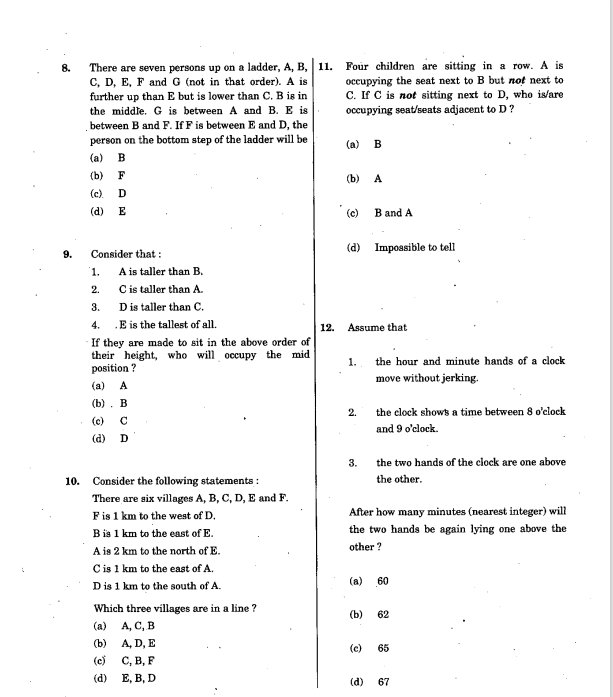
Since the last two years, the English Comprehension passages are getting lengthier and the Mathematical questions trickier. Let’s take a look at the 2012 CSAT Paper and compare it with the 2021 CSAT paper.
2014 CSAT Paper
Here the questions are asked chapter by chapter and are basic-to-moderate. Questions are direct and straightforward without much combination numerals.
2021 CSAT Paper
There is no particular order of questions asked. Immediately after LR questions, we have a question on time and distance. Also the questions are moderate-to-advanced. One cannot find out the answer in first glance itself. There is no one-size fits for all approach or a uniform formula by which you can crack the sequential questions.
Free Open to All CSAT Session by Civilsdaily Mentor Ravi Sir
If you have to clear the paper, then you have to attempt atleast 50 questions out of 80. Out of these 50 questions, 27 need to be right. There is also negative marking of 1.5 marks for every wrong answer. Hence, for aspirants from a non-mathematics background the challenge lies in practising for CSAT without reducing time for GS Preparation.
Do you want to know how you can complete both the lengthy comprehension passages and tricky mathematical questions within the stipulated time? Then it’s time you attended Civilsdaily Mentor Ravi sir’s webinar on Sunday.
Ravi sirhas cleared UPSC Prelims six times and attended the Interview round thrice. As a mentor, Ravi sir is a lifelong UPSC aspirant because he daily reads, checks and evaluates the right study materials for his students. On Monday, he will conduct a session on CSAT which is free for every aspirant to attend. All you have to do is register yourself for the session.
Key Takeaways in the CSAT Session Conducted by Ravi Sir
1. Topic-wise live demonstration on how to solve problems.
2. Examples of easy, moderate and advanced questions to solve.
3. Variety of questions under each topic.
4. Previous year question paper analysis from 2013 onwards. How to be ready for the new paper pattern.
5. Books one can refer for CSAT test series practice and to understand the concepts.
6. How to practice CSAT without compromising on GS paper studies.
7. Topic-wise weightage in Quantitative Aptitude.
8. Ravi sir will solve your doubts in a Q&A discussion towards the end of the session.
Webinar Details
If you want to know the secrets of finishing the CSAT paper in 2 hours, then this webinar is for you! We hope this webinar will help all 2022 aspirants implement the suggestions of Ravi sir
Most of the aspirants don’t think about CSAT preparation until the fag end of UPSC Prelims only because it’s a qualifying paper. You have to get 33% of total marks i.e 66 marks to be clear Prelims. Failure to do so, will prevent you from writing Mains even if you have scored above 100+ marks in the GS Paper.
Since the last two years, the English Comprehension passages are getting lengthier and the Mathematical questions trickier. Let’s take a look at the 2012 CSAT Paper and compare it with the 2021 CSAT paper.
2014 CSAT Paper
Here the questions are asked chapter by chapter and are basic-to-moderate. Questions are direct and straightforward without much combination numerals.
2021 CSAT Paper
There is no particular order of questions asked. Immediately after LR questions, we have a question on time and distance. Also the questions are moderate-to-advanced. One cannot find out the answer in first glance itself. There is no one-size fits for all approach or a uniform formula by which you can crack the sequential questions.
Free Open to All CSAT Session by Civilsdaily Mentor Ravi Sir
If you have to clear the paper, then you have to attempt atleast 50 questions out of 80. Out of these 50 questions, 27 need to be right. There is also negative marking of 1.5 marks for every wrong answer. Hence, for aspirants from a non-mathematics background the challenge lies in practising for CSAT without reducing time for GS Preparation.
Do you want to know how you can complete both the lengthy comprehension passages and tricky mathematical questions within the stipulated time? Then it’s time you attended Civilsdaily Mentor Ravi sir’s webinar on Sunday.
Ravi sirhas cleared UPSC Prelims six times and attended the Interview round thrice. As a mentor, Ravi sir is a lifelong UPSC aspirant because he daily reads, checks and evaluates the right study materials for his students. On Monday, he will conduct a session on CSAT which is free for every aspirant to attend. All you have to do is register yourself for the session.
Key Takeaways in the CSAT Session Conducted by Ravi Sir
1. Topic-wise live demonstration on how to solve problems.
2. Examples of easy, moderate and advanced questions to solve.
3. Variety of questions under each topic.
4. Previous year question paper analysis from 2013 onwards. How to be ready for the new paper pattern.
5. Books one can refer for CSAT test series practice and to understand the concepts.
6. How to practice CSAT without compromising on GS paper studies.
7. Topic-wise weightage in Quantitative Aptitude.
8. Ravi sir will solve your doubts in a Q&A discussion towards the end of the session.
Webinar Details
If you want to know the secrets of finishing the CSAT paper in 2 hours, then this webinar is for you! We hope this webinar will help all 2022 aspirants implement the suggestions of Ravi sir
The 2021 GS 2 Mains Paper has concluded today. From this, we learnt not to skip the basics of polity or governance. A lot of answers in this year’s paper could have been tackled with static knowledge. Do not avoid preparing for topics like pressure groups or SHG, considering them as supplementary topics. These are in fact repeating themes in UPSC GS 2 since 2019. Quoting examples from current affairs and latest trends can get you that extra edge in the paper. International relations is all about identifying major themes and then keeping track of current developments on those topics. For 2022 students, identify the major themes first and then draft your notes.
Try to answer these questions. In case you are facing any difficulties, fill the form below for a dedicated Civilsdaily mentor to give you a strategy call in 24 hours. Share us your burdens and concerns, we are waiting to resolve them.
However, we did a quick analysis of this year’s paper and are glad that 85% of the questions asked came from our Samachar Manthan and Smash Mains Test Series. In fact, one of our students, Rajiv let us know the same as well. Take a look —
Most of the aspirants don’t think about CSAT preparation until the fag end of UPSC Prelims only because it’s a qualifying paper. You have to get 33% of total marks i.e 66 marks to be clear Prelims. Failure to do so, will prevent you from writing Mains even if you have scored above 100+ marks in the GS Paper.
Since the last two years, the English Comprehension passages are getting lengthier and the Mathematical questions trickier. Let’s take a look at the 2014 CSAT Paper and compare it with the 2021 CSAT paper.
2014 CSAT Paper
Here the questions are asked chapter by chapter and are basic-to-moderate. Questions are direct and straightforward without much combination numerals.
2021 CSAT Paper
There is no particular order of questions asked. Immediately after LR questions, we have a question on time and distance. Also the questions are moderate-to-advanced. One cannot find out the answer in first glance itself. There is no one-size fits for all approach or a uniform formula by which you can crack the sequential questions.
Free Open to All CSAT Session by Civilsdaily Mentor Ravi Sir
If you have to clear the paper, then you have to attempt atleast 50 questions out of 80. Out of these 50 questions, 27 need to be right. There is also negative marking of 1.5 marks for every wrong answer. Hence, for aspirants from a non-mathematics background the challenge lies in practising for CSAT without reducing time for GS Preparation.
Do you want to know how you can complete both the lengthy comprehension passages and tricky mathematical questions within the stipulated time? Then it’s time you attended Civilsdaily Mentor Ravi sir’s webinar on Sunday.
Ravi sirhas cleared UPSC Prelims six times and attended the Interview round thrice. As a mentor, Ravi sir is a lifelong UPSC aspirant because he daily reads, checks and evaluates the right study materials for his students. On Monday, he will conduct a session on CSAT which is free for every aspirant to attend. All you have to do is register yourself for the session.
Key Takeaways in the CSAT Session Conducted by Ravi Sir
1. Topic-wise live demonstration on how to solve problems.
2. Examples of easy, moderate and advanced questions to solve.
3. Variety of questions under each topic.
4. Previous year question paper analysis from 2013 onwards. How to be ready for the new paper pattern.
5. Books one can refer for CSAT test series practice and to understand the concepts.
6. How to practice CSAT without compromising on GS paper studies.
7. Topic-wise weightage in Quantitative Aptitude.
8. Ravi sir will solve your doubts in a Q&A discussion towards the end of the session.
Webinar Details
If you want to know the secrets of finishing the CSAT paper in 2 hours, then this webinar is for you! We hope this webinar will help all 2022 aspirants implement the suggestions of Ravi sir
The latest in the series of aggressive Chinese actions is the use of lawfare through the passing of the “Land Boundary Law” on October 21 which became effective this week.
Background of the Chinese approach
The last residue of the Qing dynasty was wiped out in the 1911 revolution when China was established as a republic.
The republic was again overthrown in 1949 by the Chinese Communist Party.
Three successive Chinese governments in China refused to delineate or demarcate the boundary with either Tibet or India.
British archival records, many declassified points to attempts made by Imperial Britain to formally formulate a boundary with China.
Yet, all three regimes were united in their refusal to accept a formal limiting of China’s territorial expanse and kept their response ambiguous.
Even during the Simla Convention of 1913-14, when the Republic was ascendant in China, there was a vehement refusal to recognise any demarcation of boundaries between Tibet and China.
Strong-arm tactics against India
Having operated from a maximalist position to settle its borders with 12 of its 14 neighbours so far, China has attempted to use the same strong-arm tactics with both India and Bhutan.
It has offered to forgo its claims in the larger parts of North Bhutan in lieu of gaining a relatively smaller area in West Bhutan.
Threat to Siliguri corridor: This seeming magnanimity is calculated to expand into the Chumbi Valley in the South, threatening the narrow and strategic Siliguri corridor in India.
In its latest move, China has made a new claim on Sakteng sanctuary in Bhutan which may form a launchpad for future operations against Tawang in Arunachal Pradesh.
China has also strengthened its collusion with Pakistan.
There is a deliberate attempt by China to physically link with Pakistan in the Northern Areas by removing the Indian wedge of DBO, the doorway to the Karakoram Pass.
A Training Mobilisation Order (TMO) issued by Xi Jinping in January 2020 called for “confrontational training” for its troops and officers to assess their preparedness, especially in light of the new reforms undertaken by the PLA.
These factors seem to be the tactical beginnings of China’s grand strategy which also saw China flexing in the South China Sea and Taiwan, almost simultaneously.
China making use of lawfare and implications for India
The latest in the series of aggressive Chinese actions is the use of lawfare through the passing of the “Land Boundary Law”.
Formalises and legalises land Chinese grab: The law formalises and legalises China’s geographic creep towards Tawang, Arunachal Pradesh and parts of eastern Ladakh and creates conditions for using newly-constructed border villages close to the LAC for claiming sovereignty over disputed areas.
The import of the law is most critical for India but will affect China’s disputes with other countries too.
What China has done, therefore, is convert a territory dispute over borders into a sovereignty dispute which precludes any give or take of territory.
China will attempt to settle its Han population in the Tibetan regions, reversing established demographic patterns and at the same time.
Future negotiations over territory, if they occur, will then refer to the Border Defence Cooperation Agreements of 2005 and 2012 which call for border settlements to be done keeping in mind the local population in the border regions.
Way forward
A deliberate thought process needs to be evolved to offset our disadvantages as purely military actions may not solve the situation in the long term.
Conclusion
What emerges clearly is that by adopting the Land Boundary Law, in conjunction with its physical actions on the LAC, China has consolidated its position in eastern Ladakh and kept possibilities open in Arunachal Pradesh.
Smash Prelims Program is back after a thumping success in Prelims 2021. Out of 25 students Santosh sir has mentored, 15 have cleared prelims this time.Our students were kind enough to take time out of their hectic Mains preparation and let us know how Santosh sir’s mentorship benefitted them in the exams. We wish them all the very best for the upcoming Mains exam from 7th January onwards!
Why Your Focus for Next 5 Months Must be About Scoring Above Cut-Off Marks in UPSC-CSE Prelims? Isn’t the last 1 Month Enough for This?
Every year, the competition for UPSC-CSE is increasing while vacancies are decreasing drastically. This year there are only 712 vacancies as against 2019 which had 927 vacancies. However, atleast 10 lakh students will attempt the prelims exam. This is why right now, it’s important to start having an Olympic Athlete mindset. You need to daily focus on scoring above the cut-off marks in your test series.
Civilsdaily Student and 2019 UPSC-CSE AIR 8 Topper Abhishek Saraf had practiced nearly 6000+ MCQs under us to clear prelims!
What makes prelims tough? It’s because the paper is unpredictable. If this year, science questions are a breeze then the next year you will have to answer advanced concept-based questions. Unlike Mains, Prelims has negative markings.
Toppers like Pranav Vijayvergiya (AIR 65) andSwati Sharma(AIR 17) have found Prelims to be tougher than Mains. In fact, Pranav failed to clear Prelims thrice. But, in his fourth attempt he took Civilsdaily mentorship and cleared Prelims, Mains and Interview in one shot!
Are you feeling low that you are unable to get the required cut-off marks in your test series. Worry not, for about 65% of the UPSC toppers have said that they scored below cut-off marks till December. But by June, they were able to boost their marks to get through the prelims hurdle. It’s time to be like them now.
One has to be good at elimination methods to choose the right option amongst two similar ones. Our Smash Prelims Program started as a pilot project last year with an aim to introduce step-wise improvement in our chosen 25 aspirants. Over a period of 2 months, Santhosh sir inculcated confidence in aspirants who were either newbies or gave too many attempts. This year, we achieved a remarkable 60% success ratio. Next year, we have set our eyes on 100%. Yes, we are ambitious and aspirational just like any other UPSC aspirant.
Why is Mentorship Required for UPSC-CSE Prelims in Every Step – From Test Series, to Study Materials, Classes to Doubt Resolution?
If you are appearing for UPSC-CSE 2022 exams, you might have completed your entire prelims and mains syllabus right now. So what are your main priorities right now? To succeed in UPSC-CSE Prelims 2022, you have to check all these boxes in terms of preparation—
You need clear strategy for next 150 days.
You need to revise effectively to remember whole syllabus at the eve of exam.
You need to practice lots of tests to score accurately, to understand elimination techniques and reduce exam anxiety.
You need to revise current affair of 1.5 years that you have been studying daily.
You need a mentor to fill the critical gaps that have been ignoring till now as you had no one to address them for you.
Santhosh Sir’s Weekly Zoom Session
Do you want to have a mentor who conducts and evaluates medium to advanced test series regularly? A mentor explains to you the different kinds of elimination techniques after you have taken a test series. Before attending a test do you want the mentor to discuss with you the study materials required for the test and provide the right notes with integrated current affairs? While studying a subject, you might have umpteen number of questions. Having someone who responds quickly and explains the topics in simple terms saves your time. And, after a test do you want an experienced mentor to discuss the right answers and motivate you? Do you want the mentor to provide you classes on static+dynamic prelims topics? If yes, then this is the right program for you! The registrations are open for all UPSC 2022 aspirants
Self Preparation with Mentorship: What do Civilsdaily Students think of Santosh Sir’s Mentorship for UPSC-CSE Prelims?
Santhosh Sir, Core Civilsdaily Mentor. He has attended Interview Thrice & Cleared Prelims 6/6 times with above 145 marks.
We asked Santosh sir’s students about their opinion on mentorship — if it was something that saved their time or wasted their time in studies and this is what they had to say:
Kamini: “If I can say in one word, then Santosh sir’s mentorship is unique. Before I joined his program, I used to score 90 marks in Full Length Test Series. Santhosh sir had done in depth analysis of my test papers and suggested ways to reduce the negatives. Right now I am able to score 100+ in advanced test series of not only Civilsdaily but other institutes. He is always available to clear my doubts and solve my issues on call or phone. No issue is too big enough for Santosh sir. He has always told me after you finish a test series, read the same topics again and take another test series the same day to see if your marks improve. From Santosh sir’s polity and economic survey notes, we got questions in 2021 Prelims. I always feel its better to do self studies with mentorship than join coaching institutes and get spoon fed with information.”
Sweetie Raj: “I am a banking professional, living with a joint family. Attending coaching classes is out of question because I won’t have time to read the books myself. Santosh sir helps me self-study by providing me mentorship daily. I study daily from 9PM to 3AM. Santosh sir has been available for 1 hour strategy calls even during this time. No other teacher would have wanted me to succeed as much as he wants me to. I can understand concepts by myself and don’t need help in that. I want someone who pushes me to complete the target modules, checks if I did my mains answer writing for the day and analyses the previous year question papers with me. Because of Santosh sir, I understood that its just not enough reading one book but at the same time I dont have to waste time reading many books. He tells me the topic-wise sources to refer. Also he has designed a study plan for me that I can follow every week. Once, I told Santhosh sir I was missing test series discussion classes as it was conducted at 7PM. Immediately, he provided me recorded videos and kept the session at 8.30PM.”
Specific Features of Smash Prelims 2022 by Santosh Sir
Sincere aspirants who are scoring in the range of 80-90 marks must not attend last minute crash courses right now. They should instead focus on self revision, test series practice and guided mentorship to qualify for UPSC Prelims 2022. Here are the features of Prelims Focused Program by Civilsdaily —
Pillar-1
PRELIMS TESTS:
40 Full Length Tests(12 Basic + 6 Advanced + 10 CA tests + 8 Full tests + 4 CSAT).
In addition to this, in the month of January, we will have 60 sectional tests for practice. This will have 50 questions each. Hence, totally 100 Test Papers (40 FLTs + 60 Sectional Test Papers)
FIRST TEST WILL START ON JANUARY 15TH. SO, REGISTER ASAP.
VALUE ADDITIONS NOTES AND CLASSES BY VETERAN CIVILSDAILY MENTORS like SUDHANSHU SIR, SAJAL SIR & SUKANYA MA’AM
Polity: Sudhanshu sirwill conduct two sessions covering all the Polity Fundamentals, a session analyzing past year papers, another session on important current affairs related to polity this year and will discuss your test solutions.
History: Santosh Gupta sir will conduct a session on Sectoral Developments in Modern History, a session analyzing past year papers, and test discussion.
Economy: Sajal sir will conduct sessions on economic survey, trend analysis, discussion of most important economic current affairs, past year paper analysis, and economy final test discussion.
Geography: Santosh sir will conduct sessions on the most difficult aspects like Geography Mapping, Economic Geography, and Indian Agriculture.
Environment:Sukanya Ma’amwill cover sessions on Environment innovatively. Key concepts like vegetation and biome, Indian wildlife, conventions and protocols, national parks and sanctuaries, agriculture and sustainable development, and environment current affairs will be covered.
Science & Technology: This year’s prelims paper questioned on the basic concepts of science. Keeping this in mind, Santosh Gupta sir will conduct 2 sessions on One basic concept and current affairs of science and technology.
2. Civilsdaily Current Affairs Magazines for 1 year
3. Civilsdaily compilations of Yojna, Kurukshetra, PRS and RS TV.
4. Civilsdaily Budget And Economic Survey Summary.
5. Handouts on key subject-wise static topics to remember the terms and definitions for Prelims 2022.
Pillar-3
Santosh Gupta sir’s mentorship program
1. Introductory mentor call to every aspirant immediately upon commencement of program.
2. Weekly zoom strategy session by Santosh sir for doubt clearance and continuous improvement.
3. 1-1 mentor calls after 3-4 tests by mentor. After every test series, zoom sessions will be conducted by Birendra sir with all members of the batch for test discussion.
4. Support from mentors on the Habitat Group.
5. Frequent sessions with toppers for support and guidance. will have these special features for aspirants.
6. Mentor will guide on the FCE Approach i.e the Factual and Conceptual Methods of Elimination.
7. Mentor call as per request and mandatory check up call by mentor once a month.
Toppers’ Speak: How Civilsdaily Mentorship Helped Me Clear UPSC?
https://www.youtube.com/watch?v=DSwO38weHAA
About Santosh Gupta Sir
Santosh sir has scored above 140 twice in UPSC prelims and 120 plus in all 6 attempts. He has written all 6 mains and has appeared for Interviews 3 times. He has qualified UPSC EPFO and BPSC 56-59th also. As the Prelims coordinator at Civilsdaily, he has helped 15 out of 25 students clear the prelims examination this year.
India’s pledge to set a net-zero target by 2070, at the COP26 summit, Glasgow, has again highlighted the importance of forests to help mitigate the challenges of climate change.
Need for sustainable management of forests
The United Nations Framework Convention on Climate Change (UNFCC) framework (2013) of REDD+ for Reducing Emissions from Deforestation and Forest Degradation has highlighted the importance of forest along with the ‘sustainable management of forests for the conservation and enhancement of forest carbon stocks’.
Land-based sinks: In a study by Griscom (2017), land-based sinks (natural climate solutions which also include forests) can provide up to 37% of emission reduction and help in keeping the global temperature below 2° C.
Natural regeneration model: Recent research has favoured a natural regeneration model of restoration over the existing much-hyped mode of tree planting as such forests are said to secure nearly 32% carbon storage, as per one report of the Intergovernmental Panel on Climate Change.
Degradation and deforestation in India
As per the State of Forests Report (1989), the country had 2,57,409 sq.km (7.83% of its geographical area) under the open forest category, having a density of 10% to less than 40%.
However, in 30 years (2019) this has been increased to 3,04,499 sq. km (9.26%).
This means every year on average, nearly 1.57 lakh hectare of forests was degraded.
Anthropogenic pressure: This degradation highlights the presence of anthropogenic pressures including encroachment, grazing, fire, which our forests are subjected to.
Need for the participation of people to achieve target of carbon sequestration
The degradation warrants the participation of people as an essential and effective route to achieve the desired target of carbon sequestration through the restoration of forests.
As envisaged in National Forest Policy, 1988, India made its attempt, in 1990, to engage local communities in a partnership mode while protecting and managing forests and restoring wastelands with the concept of care and share.
Later, the concept of forest development agencies was introduced to consolidate the efforts in an autonomous model.
Creation of joint forest management committees: The efforts to make this participatory approach operative resulted in the formation of nearly 1.18 lakh joint forest management committees managing over 25 million hectares of forest area.
Most of these became active and operative while implementing various projects financed by external agencies such as the World Bank, the Overseas Economic Cooperation Fund (OECF) Japan, the Department for International Development (DFID) United Kingdom and the European Union (EU).
A similar system of joint management in the case of national parks, sanctuaries and tiger reserves which existed in the name of eco-development committees initially proved effective.
However, the completion of the project period and lack of subsequent funding affected their functionality and also the protection of forests due to a lack of support from participating local communities including associated non-governmental organisations.
Customary participation: Except for the National Mission for Green India, in all other centrally sponsored programmes such as Project Tiger, fire management, Integrated Development of Wildlife Habitats (IDWH) including the Compensatory Afforestation Management and Planning Authority (CAMPA), the lack of priority and policy support to ensure the participation of local communities via the institutions of joint forest management committees slowly made their participation customary.
This caused a gradual decline in their effectiveness.
Role change: The role of local institutions of gram panchayat or joint forest management committees is now restricted to be a consultative institution instead of being partners in planning and implementation.
Implications of role change: This indifference and alienation from the participatory planning and implementation of various schemes
Way forward
Revisit legal and policy mechanism: To achieve net-zero targets there is a need to revisit our existing legal and policy mechanisms.
Incentivise local communities: We also need to incentivise the local communities appropriately and ensure fund flow for restoration interventions.
There is a need for duly providing for the adequate participation of local people in planning and implementation through local institutions.
Replicate Telangana model: Political priority and appropriate policy interventions as done recently in Telangana by amending the panchayat and municipal acts and creating a provision for Telangana Haritha Nidhi need replication in other States.
Financial and institutional support mechanisms: These should be supported by enabling financial and institutional support mechanisms and negotiations with stakeholders
Though India did not become a signatory of the Glasgow Leaders’ Declaration on Forests and Land Use, the considerations of land tenure and the forest rights of participatory communities with accelerated finances will help aid steps in the race toward net zero.
Consider the question “India is witnessing enormous degradation of forests and deforestation. This warrants the participation of people as an essential and effective route to achieve the desired target of carbon sequestration. In context of this, elaborate the importance of people participation and suggest the way forward.”
Conclusion
This inclusive approach with political prioritisation will not only help reduce emissions but also help to conserve and increase ‘our forest cover’ to ‘a third of our total area’. It will also protect our once rich and precious biological diversity.
UPSC Mains 2021 has started today with the GS 1 Paper. You can view the UPSC IAS Mains 2021 GS 1 Paper in the text format and in the picture given above.
Those who are not attempting 2021 exam will get an idea that this year’s paper has taken the candidates by surprise as usual. In fact, the ‘U’ in UPSC stands for Unpredictable. However, 60% of the questions have come from Civilsdaily Mains Test Series. Here are the questions from our test series which was asked again (but framed differently) by UPSC
1. What are landslides and their types? What are the causes of these and what steps should be taken in order to prevent loss of life and property due to landslides?
2. What do you understand about the Gig economy? Discuss the significance of the sector in the Indian Economy which is reeling under pressure from the pandemic and subdued employment generation. Going ahead, what according to you are the issues associated with this sector?
3. Explain the concept of Permafrost thawing. With reference to it, discuss the major impact it will have on the Arctic region.
4. Monotheism and polytheism as separate ideologies have benefited equally from the Bhakti movements in India. Justify.
5. What do you understand about cryptocurrency? It is said that it has the potential to galvanise social development in India. Examine
6. Explain the socio-religious reform movements with special reference to Young Bengal and Brahmo Samaj.
7. What is the contribution of moderates to the freedom movement?
8. Evaluate the nature of the Bhakti Literature and its contribution to Indian culture.
9. Explain the contribution of Mahatma Gandhi during Non-Cooperation Movement and Civil Disobedience Movement.
10. Examine the environmental implications of the volcano eruptions in 2021.
11. Explain the issues faced in integrating princely states after independence.
Try to answer these questions. In case you are facing any difficulties, fill the form below for a dedicated Civilsdaily mentor to give you a strategy call in 24 hours. Share us your burdens and concerns, we are waiting to resolve them.
PAPER – 1
Q1. Evaluate the nature of the Bhakti Literature and its contribution to Indian culture. (Answer in 150 words) 10 marks
Q2. Trace the rise and growth of socio-religious reform movements with special reference to Young Bengal and Brahmo Samaj. (Answer in 150 words) 10 marks
Q3. Assess the main administrative issues and socio-cultural problems in the integration process of Indian Princely States. (Answer in 150 words) 10 marks
Q4. Differentiate the causes of landslides in the Himalayan region and Western Ghats. (Answer in 150 words) 10 marks
Q5. Despite India being one of the countries of the Gondwanaland, its mining industry contributes much less to its Gross Domestic Product(GDP) in percentage. Discuss.(Answer in 150 words) 10 marks
Q6. What are the environmental implications of the reclamation of the water bodies into urban land use? Explain with examples. (Answer in 150 words) 10 marks
Q7. Mention the global occurrence of volcanic eruptions in 2021 and their impact on regional environment. (Answer in 150 words) 10 marks
Q8. Why is India considered as a sub-continent? Elaborate your answer. (Answer in 150 words) 10 marks
Q9. Examine the uniqueness of tribal knowledge system when compared with mainstream knowledge and cultural systems. (Answer in 150 words) 10 marks
Q10. Examine the role of ‘Gig Economy’ in the process of empowerment of women in India. (Answer in 150 words) 10 marks
Q11. To what extent did the role of the moderates prepare a base for the wider freedom movement? Comment. (Answer in 250 words) 15 marks
Q12. Bring out the constructive programmes of Mahatma Gandhi during Non-Cooperation Movement and Civil Disobedience Movement. (Answer in 250 words) 15 marks
Q13. “There arose a serious challenge to the Democratic State System between the two World Wars.” Evaluate the statement. (Answer in 250 words) 15 marks
Q14. Briefly mention the alignment of major mountain ranges of the world and explain their impact on local weather conditions, with examples. (Answer in 250 words) 15 marks
Q15. How do the melting of the Arctic ice and glaciers of the Antarctic differently affect the weather patterns and human activities on the Earth? Explain. (Answer in 250 words) 15 marks
Q16. Discuss the multi-dimensional implications of uneven distribution of mineral oil in the world. (Answer in 250 words) 15 marks
Q17. What are the main socio-economic implications arising out of the development of IT industries in major cities of India? (Answer in 250 words) 15 marks
Q18. Discuss the main objectives of Population Education and point out the measures to achieve them in India in detail. (Answer in 250 words) 15 marks
Q19. What is Cryptocurrency? How does it affect global society? Has it been affecting Indian society also?(Answer in 250 words) 15 marks
Q20. How does Indian society maintain continuity in traditional social values? Enumerate the changes taking place in it.(Answer in 250 words) 15 marks
Advice for UPSC 2022 Aspirants by 2017 GS Topper Sajal Sir
History might seem like a cake walk this year but do not underestimate UPSC in this section. Students should prepare all sections well in history. Start preparing your World Geography examples and notes as well. You can also practice some world maps to get that extra mark in the paper. Usually students do not spend much time on the Society section, so this year’s experience tells us not to ignore this section as it also has scope for innovative thinking.
The Centre has informed the Delhi HC that it was awaiting the report of the Law Commission of India, which is examining various issues relating to the Uniform Civil Code.
What is a Uniform Civil Code?
A Uniform Civil Code is one that would provide for one law for the entire country, applicable to all religious communities in their personal matters such as marriage, divorce, inheritance, adoption etc.
Article 44, one of the directive principles of the Constitution lays down that the state shall endeavour to secure a Uniform Civil Code for the citizens throughout the territory of India.
These, as defined in Article 37, are not justiciable (not enforceable by any court) but the principles laid down therein are fundamental in governance.
Why need UCC?
UCC would provide equal status to all citizens
It would promote gender parity in Indian society.
UCC would accommodate the aspirations of the young population who imbibe liberal ideology.
Its implementation would thus support the national integration.
Hurdles to UCC implementation
There are practical difficulties due to religious and cultural diversity in India.
The UCC is often perceived by the minorities as an encroachment on religious freedom.
It is often regarded as interference of the state in personal matters of the minorities.
Experts often argue that the time is not ripe for Indian society to embrace such UCC.
UCC vs. Right to Freedom of Religion
Article 25 lays down an individual’s fundamental right to religion;
Article 26(b) upholds the right of each religious denomination or any section thereof to “manage its own affairs in matters of religion”;
Article 29 defines the right to conserve distinctive culture.
An individual’s freedom of religion under Article 25 is subject to “public order, health, morality” and other provisions relating to FRs, but a group’s freedom under Article 26 has not been subjected to other FRs.
In the Constituent Assembly, there was division on the issue of putting UCC in the fundamental rights chapter. The matter was settled by a vote.
By a 5:4 majority, the fundamental rights sub-committee headed by Sardar Patel held that the provision was outside the scope of FRs and therefore the UCC was made less important.
Enacting and Enforcing UCC
Fundamental rights are enforceable in a court of law.
While Article 44 uses the words “state shall endeavour”, other Articles in the ‘Directive Principles’ chapter use words such as “in particular strive”; “shall in particular direct its policy”; “shall be obligation of the state” etc.
Article 43 mentions “state shall endeavour by suitable legislation” while the phrase “by suitable legislation” is absent in Article 44.
All this implies that the duty of the state is greater in other directive principles than in Article 44.
What are more important — fundamental rights or directive principles?
There is no doubt that fundamental rights are more important.
The Supreme Court held in Minerva Mills (1980): Indian Constitution is founded on the bed-rock of the balance between Parts III (Fundamental Rights) and IV (Directive Principles).
To give absolute primacy to one over the other is to disturb the harmony of the Constitution.
Article 31C inserted by the 42nd Amendment in 1976, however, lays down that if a law is made to implement any directive principle, it cannot be challenged on the ground of being violative of the FRs under Articles 14 and 19.
What about Personal Laws?
Citizens belonging to different religious and denominations follow different property and matrimonial laws which are an affront to the nation’s unity.
If the framers of the Constitution had intended to have a UCC, they would have given exclusive jurisdiction to Parliament in respect of personal laws, by including this subject in the Union List.
But “personal laws” are mentioned in the Concurrent List.
Various customary laws
All Hindus of the country are not governed by one law, nor are all Muslims or all Christians.
Muslims of Kashmir were governed by a customary law, which in many ways was at variance with Muslim Personal Law in the rest of the country and was, in fact, closer to Hindu law.
Even on registration of marriage among Muslims, laws differ from place to place.
In the Northeast, there are more than 200 tribes with their own varied customary laws.
The Constitution itself protects local customs in Nagaland. Similar protections are enjoyed by Meghalaya and Mizoram.
Even reformed Hindu law, in spite of codification, protects customary practices.
Minority opinion in the Constituent Assembly
Some members sought to immunize Muslim Personal Law from state regulation.
Mohammed Ismail, who thrice tried unsuccessfully to get Muslim Personal Law exempted from Article 44, said a secular state should not interfere with the personal law of people.
B Pocker Saheb said he had received representations against a common civil code from various organisations, including Hindu organisations.
Hussain Imam questioned whether there could ever be uniformity of personal laws in a diverse country like India.
B R Ambedkar said “no government can use its provisions in a way that would force the Muslims to revolt”.
Alladi Krishnaswami, who was in favour of a UCC, conceded that it would be unwise to enact UCC ignoring strong opposition from any community.
Gender justice was never discussed in these debates.
Conclusion
Article 44 of the Constitution creates an obligation upon the State to endeavour to secure for citizens a Uniform Civil Code throughout the country.
The purpose behind UCC is to strengthen the object of “Secular Democratic Republic” as enshrined in the Preamble of the Constitution.
This provision is provided to effect integration of India by bringing communities on the common platform on matters which are at present governed by diverse personal laws.
Hence it UCC should be enforced taking into confidence all the sections of Indian society.
The Ministry of Statistics and Programme Implementation (MoSPI) has released the First Advance Estimates (FAE) for the current financial year (2021-22 or FY22).
GDP measures the monetary value of all goods and services produced within the domestic boundaries of a country within a timeframe (generally, a year).
It is slightly different from the other commonly used statistic for national income — the GNP.
The Gross National Product (GNP) measures the monetary value of all goods and services by the people and companies of a country regardless of where this value was created.
GDP estimates for FY22
According to MoSPI, India’s GDP will grow by 9.2 per cent in 2020-21.
Last financial year, FY21, the GDP had contracted by 7.3%.
What are the First Advance Estimates of GDP?
The FAE, which were first introduced in 2016-17, are typically published at the end of the first week of January.
They are the “first” official estimates of how GDP is expected to grow in that financial year.
But they are also the “advance” estimates because they are published long before the financial year (April to March) is over.
It is important to note that even though the FAE are published soon after the end of the third quarter (October, November, December), they do not include the formal Q3 GDP data.
Q3 data is published at the end of February as part of the Second Advance Estimates (SAE).
Significance of FAE
Budgetary calculations: Since the SAE will be published next month, the main significance of FAE lies in the fact that they are the GDP estimates that the Union Finance Ministry uses to decide the next financial year’s budget allocations.
Basis for nominal GDP: From the Budget-making perspective, it is important to note what has happened to nominal GDP — both absolute level and its growth rate. That’s because nominal GDP is the actual observed variable.
Note: Real GDP, which is the GDP after taking away the effect of inflation, is a derived metric. All Budget calculations start with the nominal GDP.
Real GDP = Nominal GDP — Inflation Rate
The difference between the real and nominal GDP shows the levels of inflation in the year.
How are the FAE arrived at before the end of the concerned financial year?
Ans. Benchmark-Indicator method
The FAE are derived by extrapolating (uses ratio and proportion) the available data.
The approach for compiling the Advance Estimates is based on Benchmark-Indicator method.
In this, the estimates available for the previous year (2020-21 in this case) are extrapolated using relevant indicators reflecting the performance of sectors.”
What are the main takeaways?
#1 GDP Growth
At 9.2%, the real GDP growth rate for FY22 is slightly lower than most expectations, including RBI’s, which pegged it at 9.5%.
These estimates are based on data before the rise of the Omicron variant.
#2 Role of high inflation
For FY22, while real GDP (with 2011-12 base prices) will grow by 9.2%, nominal GDP (calculated using current market prices) will grow by a whopping 17.6%.
The difference between the two growth rates — about 8.5 percentage points — is essentially a marker of inflation (or the rate at which average prices have increased in this financial year).
#3 Private consumption continues to struggle
The FAE analyses the three main contributors to GDP — private consumption demand, investments in the economy, and government expenditures.
It shows that while the latter two are expected to claw back to the pre-Covid level, the first engine will continue to stay in a slump.
#4 Average Indian is much worse off
For the bulk of the Indian population, thus, aggregate data recovering to pre-Covid levels are largely academic.
An average Indian has lost almost 2 years in terms of income levels and 3 years in terms of spending levels.
Try this PYQ:
Q. In the context of Indian economy, consider the following statements:
The growth rate of GDP has steadily increased in the last five years.
The growth rate in per capita income has steadily increased in the last five years.
Which of the statements given above is/are correct?
(a) 1 only
(b) 2 only
(c) Both 1 and 2
(d) Neither 1 nor 2
Note: There can be no absolute answers to such questions unless the year is mentioned. Still try to substantiate your answer with the FY21 context.
Omisure — India’s first home-grown testing kit has recently received approval from the Drugs Controller General of India.
About Omisure
Omisure is an omicron detecting RT-PCR kit developed by the Mumbai-based Tata Medical and Diagnostics Ltd (TATA MD) in partnership with the Indian Council of Medical Research (ICMR).
It can differentiate the omicron strain of the novel coronavirus from the delta, alpha and the other variants in under four hours.
It can diagnose this variant in a single step
How does it work?
This new kit can identify the Omicron variant by targeting two regions of the S or the spike gene.
This gene codes for the spike protein, which helps the novel coronavirus enter and infect human cells.
The S, the Enveloped (E), and Nucleocapsid (N) genes are some of the targets of conventional RT-PCR tests.
When it detects these genes, a patient sample is labelled positive. As omicron bears heavy mutations in the S gene, the RT-PCR can sometimes miss it.
The absence of S gene likely indicates omicron’s presence.
This is called S gene dropout or S gene target failure — and is one of the targets of Omisure.
How does Omisure compare with gene sequencing?
Gene sequencing reads the order of nucleotides, which are the building blocks of deoxyribonucleic acid (DNA) and ribonucleic acid (RNA).
Despite being considered the gold standard, sequencing has a few limitations.
It is slow, expensive and complicated. It is a multi-step process.
It begins with extracting the virus’ RNA from patient samples, converting it into DNA, amplifying or multiplying it through RT-PCR before finally sending it for gene sequencing.
This entire process can take as many as three days.
The Union Ministry of Youth Affairs and Sports (MYAS) has approved the inclusion of Alpine Skiing athlete Mohammad Arif Khan in the Target Olympic Podium Scheme (TOPS) Core group.
Target Olympic Podium Scheme
In order to improve India’s performance at the Olympics and Paralympics, the MYAS started the Target Olympic Podium Scheme (TOPS) in September 2014.
It includes foreign training, international competition, equipment, and coaching camp besides a monthly stipend of Rs. 50,000/- for each athlete.
It was particularly launched for India’s Olympic medal dream, at the 2016 (Rio) and 2020 (Tokyo) Olympics.
How does it function?
The Mission Olympic Cell is a dedicated body created to assist the athletes who are selected under the TOP Scheme.
The MOC is under the Chairmanship of the Director-General, Sports Authority of India (DG, SAI).
The idea of the MOC is to debate, discuss and decide the processes and methods so that the athlete receives the best assistance.
The MOC also focuses on the selection, exclusion, and retention of athletes, coaches, training institutes that can receive TOPS assistance.
Smash Prelims Program is back after a thumping success in Prelims 2021. Out of 25 students Santosh sir has mentored, 15 have cleared prelims this time.Our students were kind enough to take time out of their hectic Mains preparation and let us know how Santosh sir’s mentorship benefitted them in the exams. We wish them all the very best for the upcoming Mains exam from 7th January onwards!
https://youtu.be/oTRUMSOQEY4
Why Your Focus for Next 5 Months Must be About Scoring Above Cut-Off Marks in UPSC-CSE Prelims? Isn’t the last 1 Month Enough for This?
Every year, the competition for UPSC-CSE is increasing while vacancies are decreasing drastically. This year there are only 712 vacancies as against 2019 which had 927 vacancies. However, atleast 10 lakh students will attempt the prelims exam. This is why right now, it’s important to start having an Olympic Athlete mindset. You need to daily focus on scoring above the cut-off marks in your test series.
Civilsdaily Student and 2019 UPSC-CSE AIR 8 Topper Abhishek Saraf had practiced nearly 6000+ MCQs under us to clear prelims!
What makes prelims tough? It’s because the paper is unpredictable. If this year, science questions are a breeze then the next year you will have to answer advanced concept-based questions. Unlike Mains, Prelims has negative markings.
Toppers like Pranav Vijayvergiya (AIR 65) andSwati Sharma(AIR 17) have found Prelims to be tougher than Mains. In fact, Pranav failed to clear Prelims thrice. But, in his fourth attempt he took Civilsdaily mentorship and cleared Prelims, Mains and Interview in one shot!
Are you feeling low that you are unable to get the required cut-off marks in your test series. Worry not, for about 65% of the UPSC toppers have said that they scored below cut-off marks till December. But by June, they were able to boost their marks to get through the prelims hurdle. It’s time to be like them now.
One has to be good at elimination methods to choose the right option amongst two similar ones. Our Smash Prelims Program started as a pilot project last year with an aim to introduce step-wise improvement in our chosen 25 aspirants. Over a period of 2 months, Santhosh sir inculcated confidence in aspirants who were either newbies or gave too many attempts. This year, we achieved a remarkable 60% success ratio. Next year, we have set our eyes on 100%. Yes, we are ambitious and aspirational just like any other UPSC aspirant.
Why is Mentorship Required for UPSC-CSE Prelims in Every Step – From Test Series, to Study Materials, Classes to Doubt Resolution?
If you are appearing for UPSC-CSE 2022 exams, you might have completed your entire prelims and mains syllabus right now. So what are your main priorities right now? To succeed in UPSC-CSE Prelims 2022, you have to check all these boxes in terms of preparation—
You need clear strategy for next 150 days.
You need to revise effectively to remember whole syllabus at the eve of exam.
You need to practice lots of tests to score accurately, to understand elimination techniques and reduce exam anxiety.
You need to revise current affair of 1.5 years that you have been studying daily.
You need a mentor to fill the critical gaps that have been ignoring till now as you had no one to address them for you.
Santhosh Sir’s Weekly Zoom Session
Do you want to have a mentor who conducts and evaluates medium to advanced test series regularly? A mentor explains to you the different kinds of elimination techniques after you have taken a test series. Before attending a test do you want the mentor to discuss with you the study materials required for the test and provide the right notes with integrated current affairs? While studying a subject, you might have umpteen number of questions. Having someone who responds quickly and explains the topics in simple terms saves your time. And, after a test do you want an experienced mentor to discuss the right answers and motivate you? Do you want the mentor to provide you classes on static+dynamic prelims topics? If yes, then this is the right program for you! The registrations are open for all UPSC 2022 aspirants
Self Preparation with Mentorship: What do Civilsdaily Students think of Santosh Sir’s Mentorship for UPSC-CSE Prelims?
Santhosh Sir, Core Civilsdaily Mentor. He has attended Interview Thrice & Cleared Prelims 6/6 times with above 145 marks.
We asked Santosh sir’s students about their opinion on mentorship — if it was something that saved their time or wasted their time in studies and this is what they had to say:
Kamini: “If I can say in one word, then Santosh sir’s mentorship is unique. Before I joined his program, I used to score 90 marks in Full Length Test Series. Santhosh sir had done in depth analysis of my test papers and suggested ways to reduce the negatives. Right now I am able to score 100+ in advanced test series of not only Civilsdaily but other institutes. He is always available to clear my doubts and solve my issues on call or phone. No issue is too big enough for Santosh sir. He has always told me after you finish a test series, read the same topics again and take another test series the same day to see if your marks improve. From Santosh sir’s polity and economic survey notes, we got questions in 2021 Prelims. I always feel its better to do self studies with mentorship than join coaching institutes and get spoon fed with information.”
Sweetie Raj: “I am a banking professional, living with a joint family. Attending coaching classes is out of question because I won’t have time to read the books myself. Santosh sir helps me self-study by providing me mentorship daily. I study daily from 9PM to 3AM. Santosh sir has been available for 1 hour strategy calls even during this time. No other teacher would have wanted me to succeed as much as he wants me to. I can understand concepts by myself and don’t need help in that. I want someone who pushes me to complete the target modules, checks if I did my mains answer writing for the day and analyses the previous year question papers with me. Because of Santosh sir, I understood that its just not enough reading one book but at the same time I dont have to waste time reading many books. He tells me the topic-wise sources to refer. Also he has designed a study plan for me that I can follow every week. Once, I told Santhosh sir I was missing test series discussion classes as it was conducted at 7PM. Immediately, he provided me recorded videos and kept the session at 8.30PM.”
Specific Features of Smash Prelims 2022 by Santosh Sir
Sincere aspirants who are scoring in the range of 80-90 marks must not attend last minute crash courses right now. They should instead focus on self revision, test series practice and guided mentorship to qualify for UPSC Prelims 2022. Here are the features of Prelims Focused Program by Civilsdaily —
Pillar-1
PRELIMS TESTS:
40 Full Length Tests(12 Basic + 6 Advanced + 10 CA tests + 8 Full tests + 4 CSAT).
In addition to this, in the month of January, we will have 60 sectional tests for practice. This will have 50 questions each. Hence, totally 100 Test Papers (40 FLTs + 60 Sectional Test Papers)
FIRST TEST WILL START ON JANUARY 15TH. SO, REGISTER ASAP.
VALUE ADDITIONS NOTES AND CLASSES BY VETERAN CIVILSDAILY MENTORS like SUDHANSHU SIR, SAJAL SIR & SUKANYA MA’AM
Polity: Sudhanshu sirwill conduct two sessions covering all the Polity Fundamentals, a session analyzing past year papers, another session on important current affairs related to polity this year and will discuss your test solutions.
History: Santosh Gupta sir will conduct a session on Sectoral Developments in Modern History, a session analyzing past year papers, and test discussion.
Economy: Sajal sir will conduct sessions on economic survey, trend analysis, discussion of most important economic current affairs, past year paper analysis, and economy final test discussion.
Geography: Santosh sir will conduct sessions on the most difficult aspects like Geography Mapping, Economic Geography, and Indian Agriculture.
Environment:Sukanya Ma’amwill cover sessions on Environment innovatively. Key concepts like vegetation and biome, Indian wildlife, conventions and protocols, national parks and sanctuaries, agriculture and sustainable development, and environment current affairs will be covered.
Science & Technology: This year’s prelims paper questioned on the basic concepts of science. Keeping this in mind, Santosh Gupta sir will conduct 2 sessions on One basic concept and current affairs of science and technology.
2. Civilsdaily Current Affairs Magazines for 1 year
3. Civilsdaily compilations of Yojna, Kurukshetra, PRS and RS TV.
4. Civilsdaily Budget And Economic Survey Summary.
5. Handouts on key subject-wise static topics to remember the terms and definitions for Prelims 2022.
Pillar-3
Santosh Gupta sir’s mentorship program
1. Introductory mentor call to every aspirant immediately upon commencement of program.
2. Weekly zoom strategy session by Santosh sir for doubt clearance and continuous improvement.
3. 1-1 mentor calls after 3-4 tests by mentor. After every test series, zoom sessions will be conducted by Birendra sir with all members of the batch for test discussion.
4. Support from mentors on the Habitat Group.
5. Frequent sessions with toppers for support and guidance. will have these special features for aspirants.
6. Mentor will guide on the FCE Approach i.e the Factual and Conceptual Methods of Elimination.
7. Mentor call as per request and mandatory check up call by mentor once a month.
Toppers’ Speak: How Civilsdaily Mentorship Helped Me Clear UPSC?
https://www.youtube.com/watch?v=DSwO38weHAA
About Santosh Gupta Sir
Santosh sir has scored above 140 twice in UPSC prelims and 120 plus in all 6 attempts. He has written all 6 mains and has appeared for Interviews 3 times. He has qualified UPSC EPFO and BPSC 56-59th also. As the Prelims coordinator at Civilsdaily, he has helped 15 out of 25 students clear the prelims examination this year.
The Union government has approved reservations for the OBC and EWS (Economically Weaker Section) categories within the All India Quota (AIQ) for National Eligibility-cum-Entrance Test (NEET), the uniform entrance examination for medical and dental colleges across the country.
What is NEET?
The National Eligibility-cum-Entrance Test (NEET) is the entrance examination for entry to all undergraduate (NEET-UG) and postgraduate (NEET-PG) medical and dental courses in the country.
On April 13, 2016, the Supreme Court upheld the newly inserted section 10-D of the Indian Medical Council Act.
This provided for a uniform entrance examination to all medical educational institutions at the undergraduate level and postgraduate level in Hindi, English and various other languages.
What is the All-India Quota?
Although the same examination is held across the country, a chunk of the seats in state medical/dental colleges is reserved for students domiciled in their respective states.
The remaining seats —15% in UG and 50% in PG — are surrendered by the states to the All India Quota.
The AIQ scheme was introduced in 1986 under the directions of the Supreme Court to provide for domicile-free, merit-based opportunities to students from any state to study in a good medical college in any other state.
In deemed/central universities, ESIC, and Armed Forces Medical College (AFMC), 100% seats are reserved under the AIQ.
What was the reservation policy followed so far?
Until 2007, no reservation was implemented within the All-India Quota for medical admission.
On January 31, 2007, in Abhay Nath v University of Delhi and Others, the Supreme Court directed that reservation of 15% for Scheduled Castes and 7.5% for Scheduled Tribes be introduced in the AIQ.
The same year, the government passed the Central Educational Institutions (Reservation in Admission) Act, 2007 providing for 27% reservation to OBC students in central government institutions.
While state government medical and dental colleges provide reservations to OBCs in seats outside the All India Quota, this benefit was so far not extended to seats allocated under the AIQ in these state colleges.
The 10% EWS quota under the Constitution (One Hundred And Third Amendment) Act, 2019, too, has been implemented in central educational institutions, but not in the NEET AIQ for state institutions.
What led to the decision?
The denial of OBC and EWS reservations has been the subject of protests for years.
In July last year, the Madras High Court ruled that OBC students too can avail reservation in the AIQ.
It held that the reservation could not be implemented for the then academic year for want of time, and can be implemented from 2021-22.
Let us look at the EWS quota and related information in detail.
EWS Quota: A Backgrounder
The 10% reservation was introduced through the 103rd Constitution Amendment and enforced in January 2019.
It added Clause (6) to Article 15 to empower the Government to introduce special provisions for the EWS among citizens except those in the classes that already enjoy reservation.
It allows reservation in educational institutions, both public and private, whether aided or unaided, excluding those run by minority institutions, up to a maximum of 10%.
It also added Clause (6) to Article 16 to facilitate reservation in employment.
The new clauses make it clear that the EWS reservation will be in addition to the existing reservation.
Inception of EWS Quota
EWS reservation was granted based on the recommendations of a commission headed by Major General (retd) S R Sinho.
The Commission for Economically Backward Classes was constituted by the then UPA government in 2005, and submitted its report in July 2010.
Based on this, the Cabinet in January 2019 decided to amend the Constitution (103rd Amendment) to provide reservation to EWS.
Why was the new committee constituted?
The committee aimed to revisit the criteria for determining the economically weaker sections in terms of the provisions of the explanation to Article 15 of the Constitution.
It followed the Supreme Court’s observation that the income criterion for determining EWS was “arbitrary”.
Significance of the quota
Empowering economically weaker sections: The 10% quota is progressive and could address the issues of educational and income inequality in India since the economically weaker sections of citizens have remained excluded from attending higher educational institutions and public employment due to their financial incapacity.
Constitutional recognition of the Economic Backwards: There are many people or classes other than backward classes who are living under hunger and poverty-stricken conditions.
The proposed reservation through a constitutional amendment would give constitutional recognition to the poor from the upper castes.
Reduction of Caste Based Discrimination: It will gradually remove the stigma associated with reservation because reservation has historically been related with caste and most often the upper caste look down upon those who come through the reservation.
InRam Singh v. Union of India (2015), SC asserted that social deficiencies may exist beyond the concept of caste (e.g. economic status/gender identity as in transgenders).
What are the criteria to identify the section?
The main criterion is that those above an annual income limit of ₹8 lakh are excluded.
It accounts income from all sources such as salary, business, agriculture and profession for the financial year prior to the application of the family, applicants, their parents, siblings and minor children.
Possession of any of these assets, too, can take a person outside the EWS pool:
Five or more acres of agricultural land
A residential flat of 1,000 sq.ft. and above
A residential plot of 100 square yards and above in notified municipalities, and
A residential plot of 200 square yards and above in other areas
What are the court’s questions about the criteria?
Reduction within general category: The EWS quota remains a controversy as its critics say it reduces the size of the open category, besides breaching the 50% limit on the total reservation.
Arbitrariness over income limit: The court has been intrigued by the income limit being fixed at ₹8 lakh per year. It is the same figure for excluding the ‘creamy layer’ from OBC reservation benefits.
Socio-economic backwardness: A crucial difference is that those in the general category, to whom the EWS quota is applicable, do not suffer from social or educational backwardness, unlike those classified as the OBC.
Metropolitan criteria: There are other questions as to whether any exercise was undertaken to derive the exceptions such as why the flat criterion does not differentiate between metropolitan and non-metropolitan areas.
OBC like criteria: The question the court has raised is that when the OBC category is socially and educationally backward and, therefore, has additional impediments to overcome.
Not based on relevant data: In line with the Supreme Court’s known position that any reservation or norms for exclusion should be based on relevant data.
Breaches reservation cap: There is a cap of 50% on reservation as ruled in the Indira Sawhney Case. The principle of balancing equality ordains reservation.
What is the current status of the EWS quota?
The reservation for the EWS is being implemented by the Union Government for the second year now.
Recruitment test results show that the category has a lower cut-off mark than the OBC, a point that has upset the traditional beneficiaries of reservation based on caste.
The explanation is that only a small number of people are currently applying under the EWS category — one has to get an income certificate from the revenue authorities — and therefore the cut-off is low.
However, when the number picks up over time, the cut-off marks are expected to rise.
Practical issues with EWS Quota
The EWS quota will come in for judicial scrutiny soon. But it’s not only a matter for the judiciary, India’s Parliament should revisit the law too.
Hasty legislation: This law was passed in haste. It was passed in both the houses within 48 hours, and got presidential approval the next day.
Minority appeasement: It is widely argued that the law was passed to appease a certain section of upper-caste society and to suppress the demands for minority reservations.
Morality put to question: Imagine! A constitutional amendment has been made with few hours of deliberation and without consultation of the targeted group. This is certainly against constitutional morality and propriety.
Substantial backing is missing: This amendment is based on a wrong or unverified premise. This is at best a wild guess or a supposition because the government has not produced any data to back this point.
Under-reservation of Backward Classes: The assertion is based on the fact that we have different data to prove the under-representation of SC, ST, OBCs. That implies that ‘upper’ castes are over-represented (with 100 minus reservation).
Rationale of 10%: There is one more problem in this regard. The SC and ST quota is based on their total population. But the rationale for the 10 per cent quota was never discussed.
Principle of Equality: Economic backwardness is quite a fluid identity. It has nothing to do with historic wrongdoings and liabilities caused to the Backward Classes.
Should India need reservation?
Duty of the state to provide equality of status and opportunity: Reservation is one of the tools against social oppression and injustice against certain classes. Otherwise known as affirmative action, reservation helps in uplifting backward classes.
Reservation is just one of the methods for social upliftment: There are many other methods like providing scholarships, funds, coachings, and other welfare schemes.
Vote bank politics: Indian Constitution allowed reservation only for socially and educationally backward classes. However, in India, it became caste-based reservation instead of class-based reservation.
Mandal Commission Report: Initially, the reservation was intended only for SC/ST communities – that too for a period of 10 years (1951-1961). However, it got extended ever since.
After the implementation of Mandal Commission report in 1990, the scope of the reservation was widened to include Other Backward Communities (OBCs).
The benefits of the reservation were successively enjoyed only by a few communities (or families), excluding the truly deserving ones. Even 70 years after independence, the demand for reservation has only increased.
Now, with the introduction of economic criteria for reservation, in addition to the caste-criteria which already existed, things have become more complicated.
Way forward
Preserving the merit: We cannot rule out the sorry state of economic backwardness hampering merit in our country.
Rational critera: There has to be collective wisdom to define and measure the economic weakness of certain sections of the society in order to shape the concept of economic justice.
Judicial guidance: Judicial interpretation will pave the wave forward for deciding the criterion for EWS Quota.
Targetted beneficiaries. The centre needs to resort to more rational criteria for deciding the targeted beneficiary of this reservation system. Caste Census data can be useful in this regard.
Income study: The per capita income or GDP or the difference in purchasing power in the rural and urban areas, should be taken into account while a single income limit was formulated for the whole country.
Conclusion
Reservation is a constitutional scheme to ensure the participation of backward classes shoulder to shoulder with all citizens in the nation-building process.
The EWS quota with above discussed ambiguities is the subversion of the constitutional scheme for reservation.
There is no doubt that tobacco use is highly detrimental to public health. We have to find the ways and the means to reduce the demand for tobacco among existing as well as aspiring users.
Impact of tobacco
Tobacco is a product that kills more than 13 lakh Indians every year.
Annual burden: The annual economic burden from tobacco use is estimated to be ₹177,340 crore which is more than 1% of India’s GDP.
About 27 crore people above the age of 15 years and 8.5% of school-going children in the age group 13-15 years use tobacco in some form in India.
Are price and tax measures effective against tobacco use?
When tobacco products become more expensive, people either quit using them or use them less, and it incentivises many to not initiate the habit.
Because it hurts both revenue and profits, the tobacco industry, globally, is always devising tactics and narratives that will pre-empt any kind of tax increases on tobacco products.
The narrative of “increasing illicit trade” is something the tobacco industry has historically used to pre-empt potential tax increases on tobacco products in most countries around the world.
The story is no different in India.
In a recent report by the Tobacco Institute of India, it was said that the illicit cigarette volume in India has grown by 44% from 2011 to 2019 while adding that high and increasing tax rates provide a profitable opportunity for tax evasion and encourage growth in illegal trade.
A study published in 2018 which used a survey of empty cigarette packs collected from retail outlets across different cities in India estimated that illicit cigarettes constitute 2.7% of the market.
The second study published in 2020 used tax-gap analysis to estimate that the percentage of illicit cigarettes was 5.1% in 2009-10 and 6.6% in 2016-17.
Are taxes and prices key determinants of illicit trade?
It is to be noted that taxes and prices are not the key determinants of illicit trade.
There is sufficient evidence in the literature on illicit trade in cigarettes that shows tax increases only have a minimal impact, if at all, on illicit trade.
There are several countries where tobacco taxes are quite high and yet have low levels of illicit trade, while there are also countries with high levels of illicit trade despite having relatively low tax rates.
Several factors such as the quality of tax administration, the strength of the regulatory framework, government commitment to control illicit trade, the strength of governance, social acceptance, and the presence of informal distribution networks are known to play a larger role in determining the scale and the extent of an illicit market.
Way forward
WHO protocol: Eliminating all forms of illicit trade in tobacco products through a package of measures is one of the major objectives of the Protocol to Eliminate Illicit Trade in Tobacco Products under the World Health Organization’s Framework Convention on Tobacco Control.
The Protocol provides the tools and the measures to eliminate or minimise illicit trade which includes strong governance, establishing an international track and trace system, and securing supply chains.
India has already ratified the World Health Organization Protocol and it should now show leadership in implementing these measures to effectively address even the relatively lower levels of illicit trade.
Conclusion
There is no scientific or public health rationale not to increase tax on tobacco products for unfounded fear of increasing illicit trade.
Smash Prelims Program is back after a thumping success in Prelims 2021. Out of 25 students Santosh sir has mentored, 15 have cleared prelims this time.Our students were kind enough to take time out of their hectic Mains preparation and let us know how Santosh sir’s mentorship benefitted them in the exams. We wish them all the very best for the upcoming Mains exam from 7th January onwards!
Why Your Focus for Next 5 Months Must be About Scoring Above Cut-Off Marks in UPSC-CSE Prelims? Isn’t the last 1 Month Enough for This?
Every year, the competition for UPSC-CSE is increasing while vacancies are decreasing drastically. This year there are only 712 vacancies as against 2019 which had 927 vacancies. However, atleast 10 lakh students will attempt the prelims exam. This is why right now, it’s important to start having an Olympic Athlete mindset. You need to daily focus on scoring above the cut-off marks in your test series.
Civilsdaily Student and 2019 UPSC-CSE AIR 8 Topper Abhishek Saraf had practiced nearly 6000+ MCQs under us to clear prelims!
What makes prelims tough? It’s because the paper is unpredictable. If this year, science questions are a breeze then the next year you will have to answer advanced concept-based questions. Unlike Mains, Prelims has negative markings.
Toppers like Pranav Vijayvergiya (AIR 65) andSwati Sharma(AIR 17) have found Prelims to be tougher than Mains. In fact, Pranav failed to clear Prelims thrice. But, in his fourth attempt he took Civilsdaily mentorship and cleared Prelims, Mains and Interview in one shot!
Are you feeling low that you are unable to get the required cut-off marks in your test series. Worry not, for about 65% of the UPSC toppers have said that they scored below cut-off marks till December. But by June, they were able to boost their marks to get through the prelims hurdle. It’s time to be like them now.
One has to be good at elimination methods to choose the right option amongst two similar ones. Our Smash Prelims Program started as a pilot project last year with an aim to introduce step-wise improvement in our chosen 25 aspirants. Over a period of 2 months, Santhosh sir inculcated confidence in aspirants who were either newbies or gave too many attempts. This year, we achieved a remarkable 60% success ratio. Next year, we have set our eyes on 100%. Yes, we are ambitious and aspirational just like any other UPSC aspirant.
Why is Mentorship Required for UPSC-CSE Prelims in Every Step – From Test Series, to Study Materials, Classes to Doubt Resolution?
If you are appearing for UPSC-CSE 2022 exams, you might have completed your entire prelims and mains syllabus right now. So what are your main priorities right now? To succeed in UPSC-CSE Prelims 2022, you have to check all these boxes in terms of preparation—
You need clear strategy for next 150 days.
You need to revise effectively to remember whole syllabus at the eve of exam.
You need to practice lots of tests to score accurately, to understand elimination techniques and reduce exam anxiety.
You need to revise current affair of 1.5 years that you have been studying daily.
You need a mentor to fill the critical gaps that have been ignoring till now as you had no one to address them for you.
Santhosh Sir’s Weekly Zoom Session
Do you want to have a mentor who conducts and evaluates medium to advanced test series regularly? A mentor explains to you the different kinds of elimination techniques after you have taken a test series. Before attending a test do you want the mentor to discuss with you the study materials required for the test and provide the right notes with integrated current affairs? While studying a subject, you might have umpteen number of questions. Having someone who responds quickly and explains the topics in simple terms saves your time. And, after a test do you want an experienced mentor to discuss the right answers and motivate you? Do you want the mentor to provide you classes on static+dynamic prelims topics? If yes, then this is the right program for you! The registrations are open for all UPSC 2022 aspirants
Self Preparation with Mentorship: What do Civilsdaily Students think of Santosh Sir’s Mentorship for UPSC-CSE Prelims?
Santhosh Sir, Core Civilsdaily Mentor. He has attended Interview Thrice & Cleared Prelims 6/6 times with above 145 marks.
We asked Santosh sir’s students about their opinion on mentorship — if it was something that saved their time or wasted their time in studies and this is what they had to say:
Kamini: “If I can say in one word, then Santosh sir’s mentorship is unique. Before I joined his program, I used to score 90 marks in Full Length Test Series. Santhosh sir had done in depth analysis of my test papers and suggested ways to reduce the negatives. Right now I am able to score 100+ in advanced test series of not only Civilsdaily but other institutes. He is always available to clear my doubts and solve my issues on call or phone. No issue is too big enough for Santosh sir. He has always told me after you finish a test series, read the same topics again and take another test series the same day to see if your marks improve. From Santosh sir’s polity and economic survey notes, we got questions in 2021 Prelims. I always feel its better to do self studies with mentorship than join coaching institutes and get spoon fed with information.”
Sweetie Raj: “I am a banking professional, living with a joint family. Attending coaching classes is out of question because I won’t have time to read the books myself. Santosh sir helps me self-study by providing me mentorship daily. I study daily from 9PM to 3AM. Santosh sir has been available for 1 hour strategy calls even during this time. No other teacher would have wanted me to succeed as much as he wants me to. I can understand concepts by myself and don’t need help in that. I want someone who pushes me to complete the target modules, checks if I did my mains answer writing for the day and analyses the previous year question papers with me. Because of Santosh sir, I understood that its just not enough reading one book but at the same time I dont have to waste time reading many books. He tells me the topic-wise sources to refer. Also he has designed a study plan for me that I can follow every week. Once, I told Santhosh sir I was missing test series discussion classes as it was conducted at 7PM. Immediately, he provided me recorded videos and kept the session at 8.30PM.”
Specific Features of Smash Prelims 2022 by Santosh Sir
Sincere aspirants who are scoring in the range of 80-90 marks must not attend last minute crash courses right now. They should instead focus on self revision, test series practice and guided mentorship to qualify for UPSC Prelims 2022. Here are the features of Prelims Focused Program by Civilsdaily —
Pillar-1
PRELIMS TESTS:
40 Full Length Tests(12 Basic + 6 Advanced + 10 CA tests + 8 Full tests + 4 CSAT).
In addition to this, in the month of January, we will have 60 sectional tests for practice. This will have 50 questions each. Hence, totally 100 Test Papers (40 FLTs + 60 Sectional Test Papers)
FIRST TEST WILL START ON JANUARY 15TH. SO, REGISTER ASAP.
VALUE ADDITIONS NOTES AND CLASSES BY VETERAN CIVILSDAILY MENTORS like SUDHANSHU SIR, SAJAL SIR & SUKANYA MA’AM
Polity: Sudhanshu sirwill conduct two sessions covering all the Polity Fundamentals, a session analyzing past year papers, another session on important current affairs related to polity this year and will discuss your test solutions.
History: Santosh Gupta sir will conduct a session on Sectoral Developments in Modern History, a session analyzing past year papers, and test discussion.
Economy: Sajal sir will conduct sessions on economic survey, trend analysis, discussion of most important economic current affairs, past year paper analysis, and economy final test discussion.
Geography: Santosh sir will conduct sessions on the most difficult aspects like Geography Mapping, Economic Geography, and Indian Agriculture.
Environment:Sukanya Ma’amwill cover sessions on Environment innovatively. Key concepts like vegetation and biome, Indian wildlife, conventions and protocols, national parks and sanctuaries, agriculture and sustainable development, and environment current affairs will be covered.
Science & Technology: This year’s prelims paper questioned on the basic concepts of science. Keeping this in mind, Santosh Gupta sir will conduct 2 sessions on One basic concept and current affairs of science and technology.
2. Civilsdaily Current Affairs Magazines for 1 year
3. Civilsdaily compilations of Yojna, Kurukshetra, PRS and RS TV.
4. Civilsdaily Budget And Economic Survey Summary.
5. Handouts on key subject-wise static topics to remember the terms and definitions for Prelims 2022.
Pillar-3
Santosh Gupta sir’s mentorship program
1. Introductory mentor call to every aspirant immediately upon commencement of program.
2. Weekly zoom strategy session by Santosh sir for doubt clearance and continuous improvement.
3. 1-1 mentor calls after 3-4 tests by mentor. After every test series, zoom sessions will be conducted by Birendra sir with all members of the batch for test discussion.
4. Support from mentors on the Habitat Group.
5. Frequent sessions with toppers for support and guidance. will have these special features for aspirants.
6. Mentor will guide on the FCE Approach i.e the Factual and Conceptual Methods of Elimination.
7. Mentor call as per request and mandatory check up call by mentor once a month.
Toppers’ Speak: How Civilsdaily Mentorship Helped Me Clear UPSC?
https://www.youtube.com/watch?v=DSwO38weHAA
About Santosh Gupta Sir
Santosh sir has scored above 140 twice in UPSC prelims and 120 plus in all 6 attempts. He has written all 6 mains and has appeared for Interviews 3 times. He has qualified UPSC EPFO and BPSC 56-59th also. As the Prelims coordinator at Civilsdaily, he has helped 15 out of 25 students clear the prelims examination this year.
Smash Prelims Program is back after a thumping success in Prelims 2021. Out of 25 students Santosh sir has mentored, 15 have cleared prelims this time.Our students were kind enough to take time out of their hectic Mains preparation and let us know how Santosh sir’s mentorship benefitted them in the exams. We wish them all the very best for the upcoming Mains exam from 7th January onwards!
Why Your Focus for Next 5 Months Must be About Scoring Above Cut-Off Marks in UPSC-CSE Prelims? Isn’t the last 1 Month Enough for This?
Every year, the competition for UPSC-CSE is increasing while vacancies are decreasing drastically. This year there are only 712 vacancies as against 2019 which had 927 vacancies. However, atleast 10 lakh students will attempt the prelims exam. This is why right now, it’s important to start having an Olympic Athlete mindset. You need to daily focus on scoring above the cut-off marks in your test series.
Civilsdaily Student and 2019 UPSC-CSE AIR 8 Topper Abhishek Saraf had practiced nearly 6000+ MCQs under us to clear prelims!
What makes prelims tough? It’s because the paper is unpredictable. If this year, science questions are a breeze then the next year you will have to answer advanced concept-based questions. Unlike Mains, Prelims has negative markings.
Toppers like Pranav Vijayvergiya (AIR 65) andSwati Sharma(AIR 17) have found Prelims to be tougher than Mains. In fact, Pranav failed to clear Prelims thrice. But, in his fourth attempt he took Civilsdaily mentorship and cleared Prelims, Mains and Interview in one shot!
Are you feeling low that you are unable to get the required cut-off marks in your test series. Worry not, for about 65% of the UPSC toppers have said that they scored below cut-off marks till December. But by June, they were able to boost their marks to get through the prelims hurdle. It’s time to be like them now.
One has to be good at elimination methods to choose the right option amongst two similar ones. Our Smash Prelims Program started as a pilot project last year with an aim to introduce step-wise improvement in our chosen 25 aspirants. Over a period of 2 months, Santhosh sir inculcated confidence in aspirants who were either newbies or gave too many attempts. This year, we achieved a remarkable 60% success ratio. Next year, we have set our eyes on 100%. Yes, we are ambitious and aspirational just like any other UPSC aspirant.
Why is Mentorship Required for UPSC-CSE Prelims in Every Step – From Test Series, to Study Materials, Classes to Doubt Resolution?
If you are appearing for UPSC-CSE 2022 exams, you might have completed your entire prelims and mains syllabus right now. So what are your main priorities right now? To succeed in UPSC-CSE Prelims 2022, you have to check all these boxes in terms of preparation—
You need clear strategy for next 150 days.
You need to revise effectively to remember whole syllabus at the eve of exam.
You need to practice lots of tests to score accurately, to understand elimination techniques and reduce exam anxiety.
You need to revise current affair of 1.5 years that you have been studying daily.
You need a mentor to fill the critical gaps that have been ignoring till now as you had no one to address them for you.
Santhosh Sir’s Weekly Zoom Session
Do you want to have a mentor who conducts and evaluates medium to advanced test series regularly? A mentor explains to you the different kinds of elimination techniques after you have taken a test series. Before attending a test do you want the mentor to discuss with you the study materials required for the test and provide the right notes with integrated current affairs? While studying a subject, you might have umpteen number of questions. Having someone who responds quickly and explains the topics in simple terms saves your time. And, after a test do you want an experienced mentor to discuss the right answers and motivate you? Do you want the mentor to provide you classes on static+dynamic prelims topics? If yes, then this is the right program for you! The registrations are open for all UPSC 2022 aspirants
Self Preparation with Mentorship: What do Civilsdaily Students think of Santosh Sir’s Mentorship for UPSC-CSE Prelims?
Santhosh Sir, Core Civilsdaily Mentor. He has attended Interview Thrice & Cleared Prelims 6/6 times with above 145 marks.
We asked Santosh sir’s students about their opinion on mentorship — if it was something that saved their time or wasted their time in studies and this is what they had to say:
Kamini: “If I can say in one word, then Santosh sir’s mentorship is unique. Before I joined his program, I used to score 90 marks in Full Length Test Series. Santhosh sir had done in depth analysis of my test papers and suggested ways to reduce the negatives. Right now I am able to score 100+ in advanced test series of not only Civilsdaily but other institutes. He is always available to clear my doubts and solve my issues on call or phone. No issue is too big enough for Santosh sir. He has always told me after you finish a test series, read the same topics again and take another test series the same day to see if your marks improve. From Santosh sir’s polity and economic survey notes, we got questions in 2021 Prelims. I always feel its better to do self studies with mentorship than join coaching institutes and get spoon fed with information.”
Sweetie Raj: “I am a banking professional, living with a joint family. Attending coaching classes is out of question because I won’t have time to read the books myself. Santosh sir helps me self-study by providing me mentorship daily. I study daily from 9PM to 3AM. Santosh sir has been available for 1 hour strategy calls even during this time. No other teacher would have wanted me to succeed as much as he wants me to. I can understand concepts by myself and don’t need help in that. I want someone who pushes me to complete the target modules, checks if I did my mains answer writing for the day and analyses the previous year question papers with me. Because of Santosh sir, I understood that its just not enough reading one book but at the same time I dont have to waste time reading many books. He tells me the topic-wise sources to refer. Also he has designed a study plan for me that I can follow every week. Once, I told Santhosh sir I was missing test series discussion classes as it was conducted at 7PM. Immediately, he provided me recorded videos and kept the session at 8.30PM.”
Specific Features of Smash Prelims 2022 by Santosh Sir
Sincere aspirants who are scoring in the range of 80-90 marks must not attend last minute crash courses right now. They should instead focus on self revision, test series practice and guided mentorship to qualify for UPSC Prelims 2022. Here are the features of Prelims Focused Program by Civilsdaily —
Pillar-1
PRELIMS TESTS:
40 Full Length Tests(12 Basic + 6 Advanced + 10 CA tests + 8 Full tests + 4 CSAT).
In addition to this, in the month of January, we will have 60 sectional tests for practice. This will have 50 questions each. Hence, totally 100 Test Papers (40 FLTs + 60 Sectional Test Papers)
FIRST TEST WILL START ON JANUARY 15TH. SO, REGISTER ASAP.
VALUE ADDITIONS NOTES AND CLASSES BY VETERAN CIVILSDAILY MENTORS like SUDHANSHU SIR, SAJAL SIR & SUKANYA MA’AM
Polity: Sudhanshu sirwill conduct two sessions covering all the Polity Fundamentals, a session analyzing past year papers, another session on important current affairs related to polity this year and will discuss your test solutions.
History: Santosh Gupta sir will conduct a session on Sectoral Developments in Modern History, a session analyzing past year papers, and test discussion.
Economy: Sajal sir will conduct sessions on economic survey, trend analysis, discussion of most important economic current affairs, past year paper analysis, and economy final test discussion.
Geography: Santosh sir will conduct sessions on the most difficult aspects like Geography Mapping, Economic Geography, and Indian Agriculture.
Environment:Sukanya Ma’amwill cover sessions on Environment innovatively. Key concepts like vegetation and biome, Indian wildlife, conventions and protocols, national parks and sanctuaries, agriculture and sustainable development, and environment current affairs will be covered.
Science & Technology: This year’s prelims paper questioned on the basic concepts of science. Keeping this in mind, Santosh Gupta sir will conduct 2 sessions on One basic concept and current affairs of science and technology.
2. Civilsdaily Current Affairs Magazines for 1 year
3. Civilsdaily compilations of Yojna, Kurukshetra, PRS and RS TV.
4. Civilsdaily Budget And Economic Survey Summary.
5. Handouts on key subject-wise static topics to remember the terms and definitions for Prelims 2022.
Pillar-3
Santosh Gupta sir’s mentorship program
1. Introductory mentor call to every aspirant immediately upon commencement of program.
2. Weekly zoom strategy session by Santosh sir for doubt clearance and continuous improvement.
3. 1-1 mentor calls after 3-4 tests by mentor. After every test series, zoom sessions will be conducted by Birendra sir with all members of the batch for test discussion.
4. Support from mentors on the Habitat Group.
5. Frequent sessions with toppers for support and guidance. will have these special features for aspirants.
6. Mentor will guide on the FCE Approach i.e the Factual and Conceptual Methods of Elimination.
7. Mentor call as per request and mandatory check up call by mentor once a month.
Toppers’ Speak: How Civilsdaily Mentorship Helped Me Clear UPSC?
https://www.youtube.com/watch?v=DSwO38weHAA
About Santosh Gupta Sir
Santosh sir has scored above 140 twice in UPSC prelims and 120 plus in all 6 attempts. He has written all 6 mains and has appeared for Interviews 3 times. He has qualified UPSC EPFO and BPSC 56-59th also. As the Prelims coordinator at Civilsdaily, he has helped 15 out of 25 students clear the prelims examination this year.
The NFHS-5 factsheets for India and all states and Union territories are now out. At first glance, it appears to be a mixed bag — much to cheer about, but concern areas remain.
Positives from the NFHS-5 survey
Change in demographic trends: For the first time since the NFHS 1992-93 survey, the sex ratio is slightly higher among the adult population.
Improvement in sex ratio at birth: For the first time in 15 years that the sex ratio at birth has reached 929 (it was 919 for 1,000 males in 2015-16).
The total fertility rate has also dropped from 2.2 per cent to a replacement rate of 2 per cent, albeit with not much change in the huge fertility divide between the high and low fertility states.
Improvement in literacy level of women: There has been an appreciable improvement in general literacy levels and in the percentage of women and men who have completed 10 years or more of schooling, which has reached 41 per cent and 50.2 per cent respectively.
Improvements in health indicators: The health sector deserves credit for achieving a significant improvement in the percentage of institutional births, antenatal care, and children’s immunisation rates.
There has also been a consistent drop in neonatal, infant and child mortality rates — a decrease of around 1 per cent per year for neonatal and infant mortality and a 1.6 per cent decrease per year for under five mortality rate.
Nutrition: Area of concern
Increase in anaemic people: India has become a country with more anaemic people since NFHS-4 (2015-16), with anaemia rates rising significantly across age groups, ranging from children below six years, adolescent girls and boys, pregnant women, and women between 15 to 49 years.
Why anaemia is a concern? Adverse effects of anaemia affect all age groups — lower physical and cognitive growth and alertness among children and adolescents, and lesser capacity to learn and play, directly impacting their future potential as productive citizens.
Further, anaemia among adolescent girls (59.1 per cent) advances to maternal anaemia and is a major cause of maternal and infant mortality and general morbidity and ill health in a community.
The detailed report will explain why a dedicated programme like Anaemia Mukt Bharat which focused on IFA consumption failed to gain impetus.
Slow pace of improvement in nutritional indicators: Between NFHS 4 and NFHS 5, the percentage of children below five years who are moderately underweight has reduced from 35.8 per cent to 32.1 per cent.
Moderately stunted children have fallen from 38.4 per cent to 35.5 per cent, moderately wasted from 21 per cent to 19.3 per cent and severely wasted have increased slightly from 7.5 per cent to 7.7 per cent.
Inadequate diet: The root cause for this is that the percentage of children below two years receiving an adequate diet is a mere 11.3 per cent, increasing marginally from 9.6 per cent in NFHS-4.
Way forward
India’s nutrition programmes must undergo a periodic review.
The Integrated Child Development Services (ICDS), which is perceived as the guardian of the nation’s nutritional well-being must reassess itself and address critical intervention gaps, both conceptually and programmatically, and produce rapid outcomes.
Conclusion
The nutritional deficit which ought to be considered an indicator of great concern is generally ignored by policymakers and experts. Unless this is addressed, rapid improvement in nutritional indicators cannot happen.
GS-1 History of the world will include events from 18th century such as industrial revolution, world wars, redrawal of national boundaries, colonization, decolonization, political philosophies like communism, capitalism, socialism etc.- their forms and effect on the society
GS-2 Bilateral, regional and global groupings and agreements involving India and/or affecting India’s interests.
GS-3 Indian Economy, Money-laundering and its prevention.
GS-4 Contributions of moral thinkers and philosophers from India and world.
HOW TO ATTEMPT ANSWERS IN DAILY ANSWER WRITING ENHANCEMENT(AWE)?
Daily 4 questions from General studies 1, 2, 3, and 4 will be provided to you.
A Mentor’s Comment will be available for all answers. This can be used as a guidance tool but we encourage you to write original answers.
You can write your answer on an A4 sheet and scan/click pictures of the same.
Upload the scanned answer in the comment section of the same question.
Along with the scanned answer, please share your Razor payment ID, so that paid members are given priority.
If you upload the answer on the same day like the answer of 11th October is uploaded on 11th October then your answer will be checked within 72 hours. Also, reviews will be in the order of submission- First come first serve basis
If you are writing answers late, for example, 11th October is uploaded on 13th October, then these answers will be evaluated as per the mentor’s schedule.
We encourage you to write answers on the same day. However, if you are uploading an answer late then tag the mentor like @Staff so that the mentor is notified about your answer.
*In case your answer is not reviewed, reply to your answer saying *NOT CHECKED*.