💥Mains Ready By December. Smash Mains & Smash PYQ Admissions Open

Subject: Basic Sciences

  • Kinzhal Advanced Hypersonic Missile

    Russia said that it had unleashed hypersonic missiles against an arms depot in Ukraine, the first use of the next-generation weapons in combat.

    Kinzhal Missile

    • It is a nuclear-capable air-launched ballistic missile that flies at 10 times the speed of sound and can overcome air-defence systems. Kinzhal means ‘dagger’.
    • The missile has a range of approximately 1,500-2,000km and can carry a nuclear payload or conventional payload of 480 kg.
    • The Kinzhal was one of an array of new weapons Russian President Vladimir Putin unveiled in his state-of-the-nation address in 2018. Putin had termed Kinzhal as “an ideal weapon”.
    • This is the first time that Russia has admitted to using the high-precision weapon in combat.
    • Following launch, the Kinzhal rapidly accelerates to Mach 4 (4,900 km/h), and may reach speeds of up to Mach 10 (12,350 km/hr).

    What is a hypersonic weapon?

    • They are normally defined as fast, low-flying, and highly manoeuvrable weapons designed to be too quick and agile for traditional missile defence systems to detect in time, according to Bloomberg.
    • Unlike ballistic missiles, hypersonic weapons don’t follow a predetermined, arched trajectory and can maneuver on the way to their destination.
    • The term “hypersonic” describes any speed faster than five times that of sound, which is roughly 760 miles (1,220 kilometers) per hour at sea level.
    • At hypersonic speeds, the air molecules around the flight vehicle start to change, breaking apart or gaining a charge in a process called ionization.
    • This subjects the hypersonic vehicle to “tremendous” stresses as it pushes through the atmosphere.

    Types of hypersonic weapons

    • There are two main types of these weapons — glide vehicles and cruise missiles.
    • Most of the attention is focused on the former, which are launched from a rocket before gliding to their target, because of the challenges of achieving hypersonic propulsion of missiles.
    • The missiles have engines called scramjets that use the air’s oxygen and produce thrust during their flight, allowing them to cruise at a steady speed and altitude.

    Who has these weapons?

    • US, China and Russia have the most advanced capabilities.
    • Several other countries are investigating the technology, including India, Japan, Australia, France, Germany and North Korea, which claims to have tested a hypersonic missile.
    • In fact, India is also closing in on having such weapons in its arsenal.
    • Last year, India successfully tested its hypersonic technology demonstrator vehicle (HSTDV), powered by a scramjet engine.
    • The HSTDV will serve as a crucial building block in the development of long-range hypersonic weapons, which will take at least another four to five years to become a reality.

    Back2Basics: Types of Missiles

    (1) Subsonic missiles

    • They travel at a rate slower than the speed of sound.
    • Most well-known missiles, such as the US Tomahawk cruise missile, the French Exocet, and the Indian Nirbhay, fall into this category.
    • These travel at about Mach-0.9 (705 mph), and are slower and easier to intercept, but they continue to play a significant role in modern battlefields.
    • They significantly less expensive to produce because the technological challenges have already been overcome and mastered.
    • Due to their low speed and small size, subsonic missiles provide an additional layer of strategic value.

    (2) Supersonic missiles

    • They are the one that travels faster than the speed of sound (Mach 1) but not faster than Mach-3.
    • Most supersonic missiles travel at speeds ranging from Mach-2 to Mach-3, or up to 2,300 mph.
    • The Indian/Russian BrahMos, currently the fastest operational supersonic missile capable of speeds of around 2,100–2,300 mph, is the most well-known supersonic missile.

    (3) Hypersonic Missiles

    Explained above


  • What is Daylight Saving Time (DST)?

    The United States Senate unanimously passed a law making daylight saving time (DST) permanent, scrapping the biannual practice of putting clocks forward and back coinciding with the arrival and departure of winter.

    What does this imply?

    • With clocks in the US going back an hour, the time difference between New York and India will increase from the current nine and a half hours to ten and a half hours.
    • In the Southern Hemisphere, the opposite has happened, where countries have “sprung forward”, and time difference with India has reduced.

    What is DST?

    • DST is the practise of resetting clocks ahead by an hour in spring, and behind by an hour in autumn (or fall).
    • During these months, countries that follow this system get an extra hour of daylight in the evening.
    • Because the spring to fall cycle is opposite in the Northern and Southern Hemispheres, DST lasts from March to October/November in Europe and the US, and from September/October to April in New Zealand and Australia.
    • Dates for this switch, which happens twice a year (in the spring and autumn) are decided beforehand.
    • By law, the 28 member states of the EU switch together — moving forward on the last Sunday of March and falling back on the last Sunday in October.
    • In the US, clocks go back on the first Sunday of November.

    Now try this PYQ:

    Q.On 21st June, the Sun

    (a) Does not set below the horizon at the Arctic Circle

    (b) Does not set below the horizon at Antarctic Circle

    (c) Shines vertically overhead at noon on the Equator

    (d) Shines vertically overhead at the Tropic of Capricorn

    How many countries use DST?

    • DST is in practice in some 70 countries, including those in the European Union.
    • India does not follow DST; since countries near the Equator do not experience high variations in daytime hours between seasons.
    • There is, however, a separate debate around the logic of sticking with an only one-time zone in a country as large as India.

    What does this system mean to achieve?

    • The key argument is that DST is meant to save energy.
    • The rationale behind setting clocks ahead of standard time, usually by 1 hour during springtime, is to ensure that the clocks show a later sunrise and later sunset — in effect a longer evening daytime.
    • Individuals will wake an hour earlier than usual, complete their daily work routines an hour earlier, and have an extra hour of daylight at the end.
  • What are Man-Portable Air-Defence Systems (MANPADS)?

    The United States has approved a $200-million arms package for Ukraine, which would include US made Stinger Missiles, which are a type of shoulder-fired Man-Portable Air-Defence Systems (MANPADS).

    What are MANPADS?

    • Man-Portable Air-Defence Systems are short-range, lightweight and portable surface-to-air missiles that can be fired by individuals or small groups to destroy aircraft or helicopters.
    • They help shield troops from aerial attacks and are most effective in targeting low-flying aircrafts.
    • MANPATs or Man-Portable Anti-Tank Systems work in a similar manner but are used to destroy or incapacitate military tanks.

    Uniqueness of MANPADS

    • MANPADS can be shoulder-fired, launched from atop a ground-vehicle, fired from a tripod or stand, and from a helicopter or boat.
    • They weigh anywhere between 10 to 20 kilograms and not being longer than 1.8 metres.
    • They are fairly lightweight as compared to other elaborate weapon systems, making them easy to operate by individual soldiers.
    • Operating MANPADS requires substantially less training.
    • MANPADS have a maximum range of 8 kilometres and can engage targets at altitudes of 4.5 km.

    Stealth features

    • They have passive or ‘fire and forget’ guidance systems, meaning that the operator is not required to guide the missile to its target, enabling them to run and relocate immediately after firing.
    • The missile stays locked-on to the targeted object, not requiring active guidance from the soldier.
    • The missiles are fitted with infrared (IR) seekers that identify and target the airborne vehicle through heat radiation being emitted by the latter.


    UPSC 2022 countdown has begun! Get your personal guidance plan now! (Click here)

  • [pib] Petascale Supercomputer “PARAM Ganga” established at IIT Roorkee

    The National Supercomputing Mission (NSM) has now deployed “PARAM Ganga”, a supercomputer at IIT Roorkee, with a supercomputing capacity of 1.66 Petaflops.

    What is a Supercomputer?

    • A supercomputer is a computer with a high level of performance as compared to a general-purpose computer.
    • The performance of a supercomputer is commonly measured in floating-point operations per second (FLOPS) instead of million instructions per second (MIPS).
    • Since 2017, there are supercomputers which can perform over a hundred quadrillion FLOPS (peta FLOPS).
    • Since November 2017, all of the world’s fastest 500 supercomputers run Linux-based operating systems.

    PARAM Ganga

    • PARAM Ganga is designed and commissioned by C-DAC under Phase 2 of the build approach of the NSM.
    • It is based on a heterogeneous and hybrid configuration of Intel Xeon Cascade lake processors, and NVIDIA Tesla V100.
    • There are 312 (CPU+GPU+HM) nodes with a total peak computing capacity of 1.67 (CPU+GPU+HM) PFLOPS performance.
    • The cluster consists of compute nodes connected with the Mellanox (HDR) InfiniBand interconnect network.
    • The system uses the Lustre parallel file system and operating system is CentOS 7.x.

    Back2Basics: National Supercomputing Mission (NSM)

    • NSM is a proposed plan by GoI to create a cluster of seventy supercomputers connecting various academic and research institutions across India.
    • In April 2015 the government approved the NSM with a total outlay of Rs.4500 crore for a period of 7 years.
    • The mission was set up to provide the country with supercomputing infrastructure to meet the increasing computational demands of academia, researchers, MSMEs, and startups by creating the capability design, manufacturing, of supercomputers indigenously in India.
    • Currently there are four supercomputers from India in Top 500 list of supercomputers in the world.

    Aims and objectives

    • The target of the mission was set to establish a network of supercomputers ranging from a few Tera Flops (TF) to Hundreds of Tera Flops (TF) and three systems with greater than or equal to 3 Peta Flops (PF) in academic and research institutions of National importance across the country by 2022.
    • This network of Supercomputers envisaging a total of 15-20 PF was approved in 2015 and was later revised to a total of 45 PF (45000 TFs), a jump of 6 times more compute power within the same cost and capable of solving large and complex computational problems.

    When did India initiate its efforts to build supercomputers?

    • India’s supercomputer program was initiated in the late 1980s, when the United States ceased the export of a Cray Supercomputer due to technology embargos.
    • This resulted in India setting up C-DAC in 1988, which in 1991, unveiled the prototype of PARAM 800, benchmarked at 5 Gflops. This supercomputer was the second-fastest in the world at that time.
    • Since June 2018, the USA’s Summit is the fastest supercomputer in the world, taking away this position from China.
    • As of January 2018, Pratyush and Mihir are the fastest supercomputers in India with a maximum speed of Peta Flops.

    What are the phases of the National Supercomputing Mission?

    Phase I:

    • In the first phase of the NSM, parts of the supercomputers are imported and assembled in India.
    • A total of 6 supercomputers are to be installed in this phase.
    • The first supercomputer that was assembled indigenously is called Param Shivay. It was installed in IIT (BHU) located in Varanasi.
    • Similar systems, Param Shakti (IIT Kharagpur) and Param Brahma (IISER, Pune) were also later installed within the country.
    • The rest will be installed at IIT Kanpur, IIT Hyderabad and Jawaharlal Nehru Institute of Advanced Studies (JNIAS).

    Phase II:

    • The supercomputers that are installed so far are about 60% indigenous.
    • The 11 systems that are going to be installed in the next phase will have processors designed by the Centre for Development of Advanced Computing (C-DAC) and will have a cumulative capacity of 10 petaflops.
    • These new systems are to be constructed more cost-effectively than the previous ones.
    • One of the 11 proposed supercomputers will be installed
    • at C-DAC exclusively for small and medium enterprises so that they can train employees as well as work on supercomputers at a very low cost.

    Phase III:

    • The third phase aims to build fully indigenous supercomputers.
    • The government had also approved a project to develop a cryogenic cooling system that rapidly dispels the heat generated by a computing chip. This will be jointly built together by IIT-Bombay and C-DAC.


    UPSC 2022 countdown has begun! Get your personal guidance plan now! (Click here)

  • Kavach: the Indian technology that can prevent collision of Trains

    Kavach, this indigenously developed Automatic Train Protection System is earmarked for aggressive rollout on 2,000 km in 2022-23, according the Budget proposals.

    What is Kavach?

    • It is India’s very own automatic protection system in development since 2012, under the name Train Collision Avoidance System (TCAS), which got rechristened to Kavach or “armour”.
    • Simply put, it is a set of electronic devices and Radio Frequency Identification devices installed in locomotives, in the signalling system as well the tracks.
    • They connect to each other using ultra high radio frequencies to control the brakes of trains and also alert drivers, all based on the logic programmed into them.

    Key features of Kavach

    • One of its features is that by continuously refreshing the movement information of a train, it is able to send out triggers when a loco pilot jumps signal, called Signal Passed at Danger (SPAD).
    • The devices also continuously relay the signals ahead to the locomotive, making it useful for loco pilots in low visibility, especially during dense fog.
    • It includes the key elements from already existing, and tried and tested systems like the European Train Protection and Warning System, and the indigenous Anti Collison Device.
    • It will also carry features of the high-tech European Train Control System Level-2 in future.
    • The current form of Kavach adheres to the highest level of safety and reliability standard called Safety Integrity Level 4.

    What is the upgrade?

    • In the new avatar, India wants to position Kavach as an exportable system, a cheaper alternative to the European systems in vogue across the world.
    • While now Kavach uses Ultra High Frequency, work is on to make it compatible with 4G Long Term Evolution (LTE) technology and make the product for global markets.
    • Work is on to make the system such that it can be compatible with other already installed systems globally.

    How far is the rollout?

    • So far, Kavach has been deployed on over 1,098 km and 65 locomotives in ongoing projects of the South Central Railway.
    • In future it will be implemented on 3000 km of the Delhi-Mumbai and Delhi-Howrah corridors where the tracks and systems are being upgraded to host a top speed of 160 kmph.
    • Further, over 34,000 km on the High Density Network (HDN) and Highly Utilized Network (HUN) of on the Golden Quadrilateral have been included in its sanctioned plans.


    UPSC 2022 countdown has begun! Get your personal guidance plan now! (Click here)

  • What are Cluster Bombs and Thermobaric Weapons?

    Human rights group Amnesty International has accused Russia of using cluster bombs and vacuum bombs in the ongoing war.

    What are Cluster Munitions?

    • According to the 2008 Convention on Cluster Munitions, a cluster munition means a “conventional munition that is designed to disperse or release explosive submunitions each weighing less than 20 kilograms, and includes those explosive submunitions”.
    • Essentially, cluster munitions are non-precision weapons that are designed to injure or kill human beings indiscriminately over a large area.
    • They are often designed to destroy vehicles and infrastructure such as runways, railway or power transmission lines.
    • They can be dropped from an aircraft or launched in a projectile that spins in flight, scattering many bomblets as it travels.
    • Many of these bomblets end up not exploding, but continue to lie on the ground, often partially or fully hidden and difficult to locate and remove, posing a threat to the civilian population.
    • The Convention on Cluster Munitions specifically identifies “cluster munition remnants”, which include “failed cluster munitions, abandoned cluster munitions, unexploded submunitions and unexploded bomblets”.

    And what is a Thermobaric Weapon?

    • Thermobaric weapons — also known as aerosol bombs, fuel air explosives, or vaccum bombs — use oxygen from the air for a large, high-temperature blast.
    • A thermobaric weapon causes significantly greater devastation than a conventional bomb of comparable size.
    • The weapons, which go off in two separate stages, can be fired as rockets from tank-mounted launchers or dropped from aircraft.
    • As they hit their target, a first explosion splits open the bomb’s fuel container, releasing a cloud of fuel and metal particles that spreads over a large area.
    • A second explosion then occurs, igniting the aerosol cloud into a giant ball of fire and sending out intense blast waves that can destroy even reinforced buildings or equipment and vaporise human beings.

    Is it legal to use these weapons?

    • Countries that have ratified the Convention on Cluster Munitions are prohibited from using cluster bombs.
    • As of date, there are 110 state parties to the convention, and 13 other countries have signed up but are yet to ratify it.
    • Neither Russia nor Ukraine are signatories.
    • These bombs are not prohibited by any international law or agreement, but their use against civilian populations in built-up areas, schools or hospitals, could attract action under the Hague Conventions of 1899 and 1907.
    • International humanitarian law prohibits the use of inherently indiscriminate weapons such as cluster munitions.
    • Launching indiscriminate attacks that kill or injure civilians constitutes a war crime.


    UPSC 2022 countdown has begun! Get your personal guidance plan now! (Click here)

  • Antonov AN-225: World’s largest aircraft

    Amid Moscow’s assault on Ukraine, the world’s largest cargo aircraft, the Antonov AN-225 or ‘Mriya’, was destroyed by Russian troops during an attack on an airport near Kyiv.

    Antonov AN-225

    • With a wingspan of over 290-feet, the unique Antonov AN-225 was designed in what was then the Ukrainian USSR during the 1980s amid a tense race to space between the US and the Soviet Union.
    • The plane, nicknamed ‘Mriya’ or ‘dream’ in Ukrainian, is very popular in aviation circles, and is known to attract huge crowds of fans at air shows around the world.
    • It was initially designed as part of the Soviet aeronautical program to carry the Buran, which was the Soviet version of the US’ Space Shuttle.
    • After the collapse of the Soviet Union in 1991, when the Buran program was cancelled, the aircraft was instead used to transport massive cargo loads.

    Its manufacturing

    • Only one AN-225 was ever built by the Kyiv-based Antonov Company, the defence manufacturers who originally designed the plane.
    • It is essentially a large version of another design by the Antonoc Company — the four-engine An-124 ‘Condor’, which is used by the Russian Air Force.
    • The aircraft first took flight in 1988 and has been in use ever since.
    • In the recent past, it has been used for delivering relief supplies during calamities in neighbouring nations.


    UPSC 2022 countdown has begun! Get your personal guidance plan now! (Click here)

  • [pib] Quantum Key Distribution

    A joint team of scientists from DRDO and IIT Delhi, for the first time in the country successfully demonstrated Quantum Key Distribution (QKD) link between Prayagraj and Vindhyachal in Uttar Pradesh, a distance of more than 100 kilometers.

    What is QKD Technology?

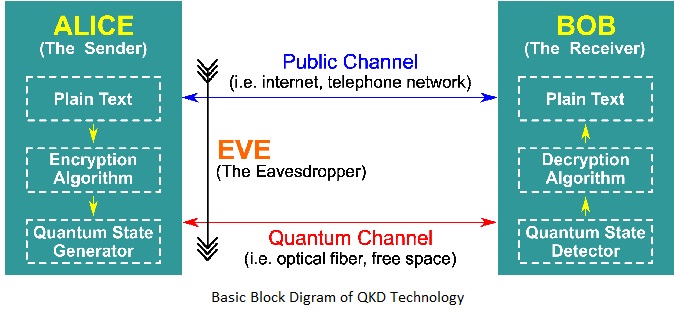
    • Quantum key distribution (QKD) is a secure communication method that implements a cryptographic protocol involving components of quantum mechanics.
    • It enables two parties to produce a shared random secret key known only to them, which can then be used to encrypt and decrypt messages.
    • It gives the ability of the two communicating users to detect the presence of any third party trying to gain knowledge of the key.
    • This is a result of a fundamental aspect of quantum mechanics: the process of measuring a quantum system, in general, disturbs the system.
    • By using quantum superposition or quantum entanglement and transmitting information in quantum states, a communication system can be implemented that detects data leak.

    How does it work?

    • QKD works by transmitting many light particles, or photons, over fiber optic cables between parties.
    • Each photon has a random quantum state, and collectively, the photons sent make up a stream of ones and zeros.
    • This stream of quantum states that make up ones and zeros are called qubits — the equivalent of bits in a binary system.
    • When a photon reaches its receiving end, it will travel through a beam splitter, which forces the photon to randomly take one path or another into a photon collector.
    • The receiver will then respond to the original sender with data regarding the sequence of the photons sent, and the sender will then compare that with the emitter, which would have sent each photon.

    Benefits offered

    • It allows the detection of data leak or hacking because it can detect any such attempt.
    • It also allows the process of setting the error level between the intercepted data in dependence.


    UPSC 2022 countdown has begun! Get your personal guidance plan now! (Click here)

  • A miracle cure against HIV

    There is considerable excitement in the world of medicine after scientists reported that a woman living with HIV (Human Immunodeficiency Virus) and administered an experimental treatment is likely ‘cured’.

    What is HIV/AIDS?

    • HIV (human immunodeficiency virus) is a virus that attacks cells that help the body fight infection, making a person more vulnerable to other infections and diseases.
    • First identified in 1981, HIV is the cause of one of humanity’s deadliest and most persistent epidemics.
    • It is spread by contact with certain bodily fluids of a person with HIV, most commonly during unprotected sex, or through sharing injection drug equipment.
    • If left untreated, HIV can lead to the disease AIDS (acquired immunodeficiency syndrome).
    • The human body can’t get rid of HIV and no effective HIV cure exists.

    Treating HIV

    • However, by taking HIV medicine (called antiretroviral therapy or ART), people with HIV can live long and healthy lives and prevent transmitting HIV to their sexual partners.
    • In addition, there are effective methods to prevent getting HIV through sex or drug use, including pre-exposure prophylaxis (PrEP) and post-exposure prophylaxis (PEP).

    What is the new breakthrough?

    • US researchers have described the case of a 60-year-old African American woman who was diagnosed with an HIV infection in 2013.
    • She was started on the standard HIV treatment regimen of anti-retroviral treatment (ART) therapy consisting of tenofovir, emtricitabine, and raltegravir.
    • She was given cord blood, or embryonic stem cells, from a donor with a rare mutation that naturally blocks the HIV virus from infecting cells.
    • She was also given blood stem cells, or adult stem cells, from a relative.

    What actually worked?

    • The adult stem cells boosted the patient’s immunity and possibly helped the cord blood cells fully integrate with the lady’s immune system.
    • Now she has no sign of HIV in her blood and also has no detectable antibodies to the virus.
    • Embryonic stem cells are potentially able to grow into any kind of cell and hence their appeal as therapy, though there is no explanation for why this mode of treatment appeared to be more effective.

    Is this treatment the long-sought cure for AIDS?

    • Not at all. While this approach is certainly a welcome addition to the arsenal of treatments, stem cell therapy is a cumbersome exercise and barely accessible to most HIV patients in the world.
    • Moreover, this requires stem cells from that rare group of individuals with the beneficial mutation.
    • Anti-retroviral therapy, through the years, has now ensured that HIV/AIDS isn’t always a death sentence and many with access to proper treatment have lifespans comparable to those without HIV.
    • A vaccine for HIV or a drug that eliminates the virus is still elusive and would be the long-sought ‘cure’ for HIV/AIDS.

    What is the prevalence of HIV/AIDS in India?

    • As per the India HIV Estimation 2019 report, the estimated adult (15 to 49 years) HIV prevalence trend has been declining in India since the epidemic’s peak in the year 2000 and has been stabilizing in recent years.
    • In 2019, HIV prevalence among adult males (15–49 years) was estimated at 0.24% and among adult females at 0.20% of the population.
    • There were 23.48 lakh Indians living with HIV in 2019.
    • Maharashtra had the maximum at 3.96 lakh followed by Andhra Pradesh (3.14 lakh) and Karnataka.
    • ART is freely available to all those who require and there are deputed centers across the country where they can be availed from.


  • What is a Solar Storm?

    Spacex’s newest fleet of satellites is tumbling out of orbit after being struck by a solar storm.

    Solar Storm

    • A solar storm or a Coronal Mass Ejection as astronomers call it is an ejection of highly magnetized particles from the sun.
    • These particles can travel several million km per hour and can take about 13 hours to five days to reach Earth.
    • Earth’s atmosphere protects us, humans, from these particles.
    • But the particles can interact with our Earth’s magnetic field, induce strong electric currents on the surface and affect man-made structures.

    How did they impact SpaceX satellites?

    • The issue came up due to increased drag created by the solar storm in the upper reaches of the Earth’s atmosphere.
    • These storms cause the atmosphere to warm and atmospheric density at our low deployment altitudes to increase.
    • In fact onboard GPS suggests the escalation speed and severity of the storm caused atmospheric drag to increase up to 50 percent higher than during previous launches.

    History of solar storms

    • The first recorded solar storm occurred in 1859 and it reached Earth in about 17 hours.
    • It affected the telegraph network and many operators experienced electric shocks.
    • A solar storm that occurred in 1921 impacted New York telegraph and railroad systems and another small-scale storm collapsed the power grid in Quebec, Canada in 1989.
    • A 2013 report noted that if a solar storm similar to the 1859 one hit the US today, about 20-40 million people could be without power for 1-2 years, and the total economic cost will be $0.6-2.6 trillion.

    Why are they a cause of concern?

    • The Sun goes through an 11-year cycle – cycles of high and low activity.
    • It also has a longer 100-year cycle.
    • During the last three decades, when the internet infrastructure was booming, it was a low period.
    • And very soon, either in this cycle or the next cycle, we are going towards the peaks of the 100-year cycle.
    • So it is highly likely that we might see one powerful solar storm during our lifetime.


    UPSC 2022 countdown has begun! Get your personal guidance plan now! (Click here)