💥Mains Ready By December. Smash Mains & Smash PYQ Admissions Open

Subject: Basic Sciences

  • RNA granules to treat neurodegenerative disorders

    Researchers at IISc Bangalore have identified a protein in yeast cells that dissolves RNA-protein complexes, also known as RNA granules.

    What is mRNA?

    • Messenger RNA (mRNA) is a single-stranded RNA (Ribo Nucleic Acid) molecule that is complementary to one of the DNA strands of a gene.
    • The mRNA is an RNA version of the gene that leaves the cell nucleus and moves to the cytoplasm where proteins are made.
    • During protein synthesis, an organelle called a ribosome moves along the mRNA, reads its base sequence, and uses the genetic code to translate each three-base triplet, or codon, into its corresponding amino acid.

    What are RNA granules?

    • Inside the cytoplasm of any cell there are structures made of messenger RNA (mRNA) and proteins known as RNA granules.
    • Unlike other structures in the cell (such as mitochondria), the RNA granules are not covered and confined by a membrane.
    • This makes them highly dynamic in nature, thereby allowing them to constantly exchange components with the surrounding.
    • RNA granules are present in the cytoplasm at low numbers under normal conditions but increase in number and size under stressful conditions including diseases.

    Why are they unique?

    • A defining feature which does not change from one organism to another (conserved) of the RNA granule protein components is the presence of stretches containing repeats of certain amino acids.
    • Such stretches are referred to as low complexity regions.
    • Repeats of arginine (R), glycine (G) and glycine (G) — known as RGG — are an example of low complexity sequence.

    Functions of RNA granules

    • Messenger RNAs are converted to proteins (building blocks of the cell) by the process of translation.
    • RNA granules determine messenger RNA (mRNA) fate by deciding when and how much protein would be produced from mRNA.
    • Protein synthesis is a multi-step and energy-expensive process.
    • Therefore, a common strategy used by cells when it encounters unfavorable conditions is to shut down protein production and conserve energy to deal with a stressful situation.
    • RNA granules help in the process of shutting down protein production.
    • Some RNA granule types (such as Processing bodies or P-bodies) not only regulate protein production but also accomplish degradation and elimination of the mRNAs, which in turn helps in reducing protein production.

    What is the recent study?

    • Researchers concluded that low complexity sequences which normally promote granule formation, in this case promote the disintegration of RNA granules in yeast cells.
    • They observed that the identified protein Sbp1 is specific for dissolving P-bodies and not stress granules which are related RNA granule type also present in the cytoplasm.

    Significance of the study

    • This study has highlighted the potential of amino acid repeats (RGG) as a therapeutic intervention.
    • The study may help analyze the effect of repeat sequences in genetically engineered mice that accumulate insoluble pathological aggregates in brain cells.
    • This could possibly help in treating neurodegenerative disorders such as Alzheimer’s disease.


    UPSC 2023 countdown has begun! Get your personal guidance plan now! (Click here)
  • What are W Bosons?

    Researchers from Collider Detector at Fermilab (CDF) Collaboration, in the US, announced that they have made a precise measurement of the mass of the so-called W boson.

    Do you know?

    There are four fundamental forces at work in the universe: the strong force, the weak force, the electromagnetic force, and the gravitational force. They work over different ranges and have different strengths. Gravity is the weakest but it has an infinite range.

    What is W Boson?

    • Discovered in 1983, the W boson is a fundamental particle.
    • Together with the Z boson, it is responsible for the weak force, one of four fundamental forces that govern the behaviour of matter in our universe.
    • Particles of matter interact by exchanging these bosons, but only over short distances.
    • The W boson, which is electrically charged, changes the very make up of particles.
    • It switches protons into neutrons, and vice versa, through the weak force, triggering nuclear fusion and letting stars burn.
    • This burning also creates heavier elements and, when a star dies, those elements are tossed into space as the building blocks for planets and even people.

    Debate over W Boson’s mass

    • The weak force was combined with the electromagnetic force in theories of a unified electroweak force in the 1960s, in an effort to make the basic physics mathematically consistent.
    • But the theory called for the force-carrying particles to be massless, even though scientists knew the theoretical W boson had to be heavy to account for its short range.
    • Theorists accounted for the mass of the W by introducing another unseen mechanism. This became known as the Higgs mechanism, which calls for the existence of a Higgs boson.

    What is the news?

    • CDF researchers stated that this precisely determined value did not match with what was expected from estimates using the standard model of particle physics.
    • This result is highly significant because this implies the incompleteness of the standard model description.
    • This is a major claim, since the standard model has been extraordinarily successful in the past decades.
    • Hence, physicists are looking for corroboration from other, independent, future experiments.

    What is the standard model of elementary particle physics?

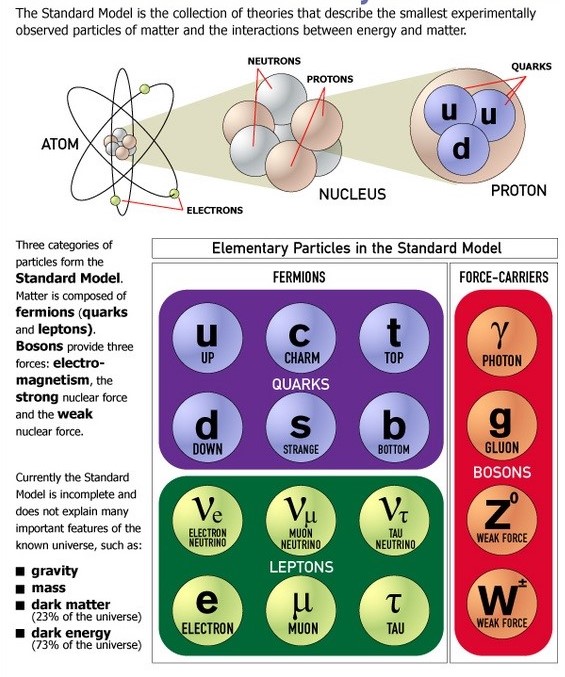
    • The Standard Model of particle physics is the theory describing three of the four known fundamental forces (the electromagnetic, weak, and strong interactions while omitting gravity) in the universe and classifying all known elementary particles.
    • It is a theoretical construct in physics that describes particles of matter and their interaction. Ex. Proton, Neutron, Electron etc.
    • It is a description that views the elementary particles of the world as being connected by mathematical symmetries, just as an object and its mirror image are connected by a bilateral (left–right) symmetry.
    • These are mathematical groups generated by continuous transformations from, say, one particle to another.
    • According to this model there are a finite number of fundamental particles which are represented by the characteristic “eigen” states of these groups.
    • The particles predicted by the model, such as the Z boson, have been seen in experiments and the last to be discovered, in 2012, was the Higgs boson which gives mass to the heavy particles.

    Why is the standard model believed to be incomplete?

    • The standard model is thought to be incomplete because it gives a unified picture of only three of the four fundamental forces of nature and it totally omits gravity.
    • So, in the grand plan of unifying all forces so that a single equation would describe all the interactions of matter, the standard model was found to be lacking.
    • The other gap in the standard model is that it does not include a description of dark matter particles.

    How are the symmetries related to particles?

    • The symmetries of the standard model are known as gauge symmetries, as they are generated by “gauge transformations” which are a set of continuous transformations (like rotation is a continuous transformation).
    • Each symmetry is associated with a gauge boson.
    • For example, the gauge boson associated with electromagnetic interactions is the photon.
    • The gauge bosons associated with weak interactions are the W and Z bosons. There are two W bosons — W+ and W-.

    What is the main result of the recent experiment?

    • The recent experiment at CDF, which measured the mass of the W boson as 80,433.5 +/- 9.4 Mev/c2, which is approximately 80 times the mass of a hydrogen nucleus.
    • This came out to be more than what is expected from the standard model.
    • The expected value using the standard model is 80,357 +/- 8 MeV/c2 .
    • Thus, the W boson mass itself is a prediction of the standard model.
    • Therefore, any discrepancy in its mass means a lack of self-consistency in the standard model.

    What is the discrepancy they obtained?

    • The mass discrepancy of the W boson needs to be checked and confirmed to the same accuracy by other facilities, for example, the Large Hadron Collider (LHC).

    Where do we stand now in terms of new physics?

    • New physics is in the air, and experiments have been gearing up for some years now to detect new particles.
    • With its high-precision determination of the W boson mass, the CDF has struck at the heart of the standard model.
    • So it is a significant finding and if this is confirmed by the LHC and other experiments, it will throw open the field for ideas and experiment.


    UPSC 2023 countdown has begun! Get your personal guidance plan now! (Click here)
  • Why are Electric Vehicles Catching Fire?

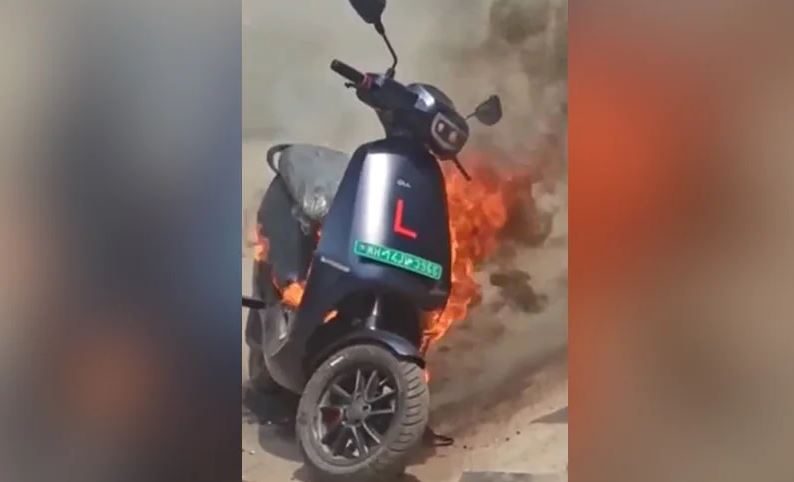
    The Union government has constituted an expert panel to probe the recent series of battery explosions in electric vehicles (EVs).

    Why is the world poised to transition to electric vehicles?

    • The growing concern over climate change has led to global efforts to electrify the transportation sector.
    • In parallel, cost of Li-ion (Lithium-ion) battery technology has decreased by a staggering order of magnitude in the past decade.
    • The convergence of these two factors has resulted in a unique time in our history where we are at the cusp of a dramatic transition in the transportation sector.
    • There are multiple trade-offs in this complex ecosystem: engineering higher safety often results in higher costs and lower driving range.
    • In this competitive landscape where companies are vying for market share, a race to the bottom can compromise safety.

    A race to nowhere

    • The world has taken note of this moment with governments providing incentives to usher in the transition and private industry ramping up plans for capturing the market.
    • There is a worldwide race emerging, with vehicle companies, battery manufacturers, and material suppliers vying with each other for market share.
    • However, Li-ion batteries are complex devices requiring a level of sophistication that can takes years to perfect.
    • Hurrying the development of this complex technology without careful safeguards are leading to increasing safety incidents, as evidenced recently on Indian roads.

    What goes into a Li-ion battery?

    • Every Li-ion battery consists of three active components:
    1. Anode: typically graphite
    2. Cathode: based on a nickel, cobalt, and manganese-based oxide; and
    3. Electrolyte: A salt of lithium in an inorganic solvent
    • Battery cells are assembled into modules and then further assembled into packs.
    • Li-ion batteries require tight control on the state of charge and the temperature of operation to enhance safety and increase usable life, achieved by adding multiple sensors.
    • Packs are designed to ensure uniform temperature profile with minimal thermal variation during operation.

    What is the level of precision involved?

    • Battery manufacturing is a complex operation involving forming sheets of the anode and cathode and assembling them into a sandwich structure held apart by a thin separator.
    • Separators, about 15 microns in thickness — about a fifth of the thickness of the human hair — perform the critical function of preventing the anode and cathode from shorting.
    • Accidental shorting of the electrodes is a known cause of fires in Li-ion cells.
    • It is important that the various layers are assembled with high precision with tight tolerances maintained throughout the manufacturing process.
    • Safety features, such as thermal switches that turn off if the battery overheats, are added as the sandwich is packaged into a battery cell.

    What causes battery fires?

    • Battery fires, like other fires, occur due to the convergence of three parts of the “fire triangle”: heat, oxygen, and fuel.
    • If an adverse event such as a short circuit occurs in the battery, the internal temperature can raise as the anode and cathode release their energy through the short.
    • This, in turn, can lead to a series of reactions from the battery materials, especially the cathode, that release heat in an uncontrolled manner, along with oxygen.
    • Such events also rupture the sealed battery further exposing the components to outside air and the second part of the fire triangle, namely, oxygen.
    • The final component of the triangle is the liquid electrolyte, which is highly flammable and serves as a fuel.
    • The combination leads to a catastrophic failure of the battery resulting in smoke, heat, and fire, released instantaneously and explosively.

    What triggers battery fire?

    • The trigger for such events can be a result of internal shorts (like a manufacturing defect that results in sharp objects penetrating the separator).
    • The external events may be accident leading to puncture of the cell and shorting of the electrodes, overcharging the battery.
    • Any of these triggers may cascade into a significant safety incident.

    Are battery fires inevitable?

    • Over the past three decades, Li-ion batteries have proved to be extremely safe, with the industry increasing controls as safety incidents have surfaced.
    • Safety is a must and is an important consideration that battery and vehicle manufacturers can design for at multiple levels from the choice of battery material to designs at the cell, pack, and vehicle level.
    • Protecting the cell with robust thermal management is critical, especially in India where ambient temperatures are high.
    • Finally, battery packs need to be protected from external penetration.
    • Any large-scale manufacturing process inevitably has a certain percentage of defects; therefore, such steps are needed to minimise the number of adverse events.

    Why battery safety matters?

    • Safety remains a concern for Li-ion manufacturers worldwide especially as cell sizes become larger for applications such as solar-connected storage.
    • There is a need to remove the threat of battery fires as the roll out of mass electrification takes place.


    UPSC 2023 countdown has begun! Get your personal guidance plan now! (Click here)

  • Russia’s new nuclear missile ‘Sarmat’

    Amidst stiff resistance from Ukraine in the ongoing war and harsh sanctions imposed by the West, Russia went ahead and tested its new Inter Continental Ballistic Missile (ICBM) Sarmat.

    What is Sarmat?

    • The RS-28 Sarmat (NATO name Satan-II) is reported to be able to carry ten or more warheads and decoys
    • It has the capability of firing over either of the earth’s poles with a range of 11,000 to 18,000 km.
    • It is expected to pose a significant challenge to the ground-and-satellite-based radar tracking systems of the western powers, particularly the USA.
    • The ten warheads are Multiple Independently-Targetable Re-entry Vehicles and each has a blast yield of .75 MT.
    • The Sarmat will also be the first Russian missile which can carry smaller hypersonic boost-glide vehicles. These are manoeuvrable and hard to intercept.
    • It is a liquid-fuelled missile as compared to US ICBMs which have moved on to solid fuel systems.

    Who is it named after?

    • The Sarmat is named after nomadic tribes that roamed the steppes of present-day Southern Russia, Ukraine and Kazakhstan in the early medieval period.
    • Sarmatians were highly developed in horsemanship and warfare.
    • It goes on to say that the administrative capabilities and political expertise of Sarmatians contributed to their gaining widespread influence and by the 5th century BC.
    • They held control of the land between the Urals and the Don River.
    • In the 4th century they crossed the Don and conquered the Scythians, replacing them as rulers of almost all of southern Russia by the 2nd century.

    Was Russia known to be developing this missile?

    • It was widely known that Russia was developing a new ICBM to replace its older ones.
    • An announcement in this regard was made by Vladimir Putin in 2018 while making his State of the Nation address to the Federal Assembly.
    • He had stated at the time that the first Regiment fully armed with Sarmat ICBM will be operational by the end of 2022.
    • The deteriorating relations between Russia and the Western Powers is said to have given an impetus to its development.


    UPSC 2022 countdown has begun! Get your personal guidance plan now! (Click here)

  • Near Field Communication (NFC) technology for instant payments

    Google Pay has recently launched a new feature in India, ‘Tap to pay for UPI’, in collaboration with Pine Labs. The feature makes use of Near Field Communication (NFC) technology.

    What is Near Field Communication (NFC)?

    • NFC is a short-range wireless connectivity technology that allows NFC-enabled devices to communicate with each other and transfer information quickly and easily with a single touch.
    • It makes possible to pay bills, exchange business cards, download coupons, or share a document.

    How does it work?

    • NFC transmits data through electromagnetic radio fields, to enable communication between two devices. Both devices must contain NFC chips, as transactions take place within a very short distance.
    • NFC-enabled devices must be either physically touching or within a few centimetres from each other for data transfer to occur.

    When did NFC tech start?

    • In 2004, consumer electronics companies, Nokia, Philips and Sony together formed the NFC Forum, which outlined the architecture for NFC technology to create powerful new consumer-driven products.
    • Nokia released the first NFC-enabled phone in 2007.

    How will this technology work with the recently launched feature, ‘Tap to pay for UPI’?

    • Google Pay has been the first among UPI apps to bring the Tap to Pay feature working on POS terminals.
    • It will allow users with UPI accounts configured on Google Pay to make payments just by tapping their NFC-enabled Android smartphones on any Pine Labs Android POS terminal.
    • Once users tap their phones on the POS terminal, it will automatically open the Google pay app with the payment amount pre-filled.
    • Users can then verify the amount and merchant name and authenticate the payment, using their UPI PIN.
    • The process is much faster compared to scanning a QR code or entering the UPI-linked mobile number which has been the conventional way till now.

    What are the other applications of NFC technology?

    • NFC tech has a wide range of applications besides driving payment services.
    • It is used in contactless banking cards to perform money transactions or to generate contact-less tickets for public transport.
    • Contactless cards and readers use NFC in several applications from securing networks and buildings to monitoring inventory and sales, preventing auto theft, keeping tabs on library books,
    • NFC is behind the cards that we wave over card readers in subway turnstiles and on buses to check tickets.
    • It is present in speakers, household appliances, and other electronic devices that we monitor and control through our smartphones.
    • With just a touch, NFC can also set up WiFi and Bluetooth devices in our homes, investopedia noted.
    • It also has an application in healthcare, to monitor patient stats through NFC-enabled wristbands.
    • NFC is used in wireless charging too.

    How safe is this technology?

    • NFC technology is designed for an operation between devices within a few centimetres from each other.
    • This makes it difficult for attackers to record the communication between the devices compared to other wireless technologies which have a working distance of several metres, according to the NFC forum, a non-profit industry association.
    • The user of the NFC-enabled device determines by the touch gesture which entity the NFC communication should take place with, making it more difficult for the attacker to get connected.
    • The security level of the NFC communication is by default higher compared to other wireless communication protocols.

    Where does it stand in comparison to other wireless technologies?

    • There are other wireless technologies available which are replacing cable-based connections.
    • The IrDa technology is a short range (a few metres) connection based on the exchange of data over infrared light where the two communication devices must be positioned within a line of sight.
    • Today, this technology is mainly used for remote control devices. For larger data communication with computer devices this technology was replaced by Bluetooth or WiFi connections.
    • However, for these technologies’ receiver devices need their own power supply due to the larger working distance.
    • Therefore, the receiving device cannot be powered by the radiofrequency (RF) field like in NFC, the NFC forum highlighted.
    • Another consequence of the larger working distance is the need for the user to configure their device and to pair them together for communication.


    UPSC 2022 countdown has begun! Get your personal guidance plan now! (Click here)

  • India’s Lithium Dependency Worries

    Lithium has been among the most sought-after mineral during the past few years, largely on the back of its usage in battery manufacturing.

    India is at odds with a major import source for the mineral, China.

    About Lithium

    • Lithium is a chemical element with the symbol Li and atomic number 3.
    • It is a soft, silvery-white alkali metal. Under standard conditions, it is the lightest metal and the lightest solid element.
    • Like all alkali metals, lithium is highly reactive and flammable and must be stored in mineral oil.
    • When cut, it exhibits a metallic lustre, but moist air corrodes it quickly to a dull silvery grey, then black tarnish.
    • Lithium metal is isolated electrolytically from a mixture of lithium chloride and potassium chloride.
    • It is a crucial building block of the lithium-ion rechargeable batteries that power electric vehicles (EVs), laptops and mobile phones.

    Lithium-ion batteries

    • A lithium-ion battery or Li-ion battery is a type of rechargeable battery.
    • They are commonly used for portable electronics and electric vehicles and are growing in popularity for military and aerospace applications.
    • A prototype Li-ion battery was developed by Akira Yoshino in 1985, based on earlier research by John Goodenough, M. Stanley Whittingham, Rachid Yazami and Koichi Mizushima during the 1970s–1980s.
    • In 2019, the Nobel Prize in Chemistry was given to this trio “for the development of lithium-ion batteries”.

    Global producers of lithium

    • Australia and Chile have swapped positions as the world’s leading lithium-producing country over the past decade. In 2019, the world’s Top 5 lithium producers were:
    1. Australia – 52.9% of global production
    2. Chile – 21.5%
    3. China – 9.7%
    4. Argentina – 8.3%
    5. Zimbabwe – 2.1%
    • The U.S. ranked 7th with 1.2% of the world’s lithium production.
    • In 2019, the world’s Top 5 lithium reserves by country were:
    1. Chile – 55.5% of the world’s total
    2. Australia – 18.1%
    3. Argentina – 11.0%
    4. China – 6.5%
    5. U.S. – 4.1%

    Why is India looking for lithium?

    • India has been scouting for lithium reserves since the Centre’s push to boost the adoption of electric vehicles (EVs) in the country.
    • The ₹18,000 crore production-linked incentive scheme for advanced chemistry cell (ACC) battery storage, a flagship incentive scheme for the industry has kicked off.
    • However, the supply of lithium, which is largely an imported product, has declined.
    • With India being in a diplomatic tussle with China, the supplies from the neighbouring country have declined and India too is looking for other import avenues.

    Why has the supply of lithium declined?

    • The supply of lithium has not been in line with the surge in demand from electric vehicle makers across the world.
    • China also is witnessing a mismatch between demand and supply, which has led to a rise in prices.


    UPSC 2022 countdown has begun! Get your personal guidance plan now! (Click here)

  • DRDO’s Corner-Shot Weapon System

    A corner-shot weapon system (CSWS), designed and developed by the Defence Research and Development Organisation (DRDO), is at an advanced stage of being inducted by the Central Reserve Police Force (CRPF) and the Jammu and Kashmir police.

    What is CSWS?

    • The CSWS is a special purpose weapon designed by the Armament Research and Development Establishment (ARDE), Pune.
    • It can engage targets located around the corners as the system bends and captures video feed thus saving soldiers from any surprise counter-attack and is best suited for urban, close quarter situations.
    • It is equipped with weapon, camera, laser, infrared illuminator and torch in front portion, while display, electronics, battery and swivelling mechanism are located at rear portion.
    • The body is made from high-grade aluminium alloy to make it lighter and durable.

    Key features

    • Day-night firing capability, colour display, digital zoom, zeroing facility, hot keys, high power battery along with status display and compliance with JSS 5855 makes it a very potent system for security forces.
    • It is very helpful in Counter Insurgency and Counter Terror (CI/CT) operations.
    • This indigenously developed system has many superior features compared to its contemporary international systems and available for 9 mm GLOCK 17/19 and 1A1 Auto Pistol variant.


    UPSC 2022 countdown has begun! Get your personal guidance plan now! (Click here)

  • What is T-Cell Immunity?

    A new study from Wuhan has studied the role of T-Cell Immunity against prolonged and sever COVID-19.

    What are T-Cells?

    • Like B cells, which produce antibodies, T cells are central players in the immune response to viral infection.
    • For your immune system to fight off any kind of invader, such as a virus, you need a kind of white blood cell called a B cell, which makes antibodies, and a similar-looking white blood cell called a T cell.
    • T cells can play different roles altogether.
    • They can act as “killer cells”, attacking cells which have been infected with a virus or another kind of pathogen, or they can act as “helper cells” by supporting B cells to produce antibodies.

    How do they function?

    • Alongside antibodies, the immune system produces a battalion of T cells that can target viruses.
    • Some of these, known as killer T cells (or CD8+ T cells), seek out and destroy cells that are infected with the virus.
    • Others, called helper T cells (or CD4+ T cells) are important for various immune functions, including stimulating the production of antibodies and killer T cells.
    • T cells do not prevent infection, because they kick into action only after a virus has infiltrated the body. But they are important for clearing an infection that has already started.
    • In the case of COVID-19, killer T cells could mean the difference between a mild infection and a severe one that requires hospital treatment.

    What did the latest research find?

    • The researchers found that neutralising antibodies were detectable even 12 months after infection in “most individuals”.
    • It remained stable 6-12 months after initial infection in people younger than 60 years.
    • The researchers found that “multifunctional T cell responses were detected for all SARS-CoV-2 viral proteins tested”.
    • And most importantly, the magnitude of T cell responses did not show any difference immaterial of how severe the disease was.
    • While the ability of antibodies to neutralise was nearly absent against the Beta variant, it was reduced in the case of the Delta variant.

    Neutralizing antibodies

    • SARS-CoV-2-specific neutralising antibody and T cell responses were retained 12 months after initial infection.
    • Neutralising antibodies to the D614G, Beta, and Delta were reduced compared with those for the original strain, and were diminished in general.
    • Memory T cell responses to the original strain were not disrupted by new variants.
    • The findings show that robust antibody and T cell immunity against SARS-CoV-2 is present in majority of recovered patients 12 months after moderate-to-critical infection.

    Robustness of antibodies

    • The study reveals the durability and robustness of the T cell responses against variants, including Delta, even after one year of infection.
    • Most importantly, the robust and longstanding T cell responses were seen in people who have not been reinfected or vaccinated.
    • This would mean even in the absence of vaccination, a person who has been infected by the virus even one year ago would have robust immune responses.
    • It would offer protection against disease progressing to a severe form requiring hospitalization.


    UPSC 2022 countdown has begun! Get your personal guidance plan now! (Click here)

  • What is NASA’s Artemis I Mission?

    On March 17, the National Aeronautics and Space Administration (NASA) rolled out its Artemis I moon mission to the launchpad for testing at the Kennedy Space Centre in Florida, United States.

    What is the Artemis I Mission?

    • NASA’s Artemis mission is touted as the next generation of lunar exploration, and is named after the twin sister of Apollo from Greek mythology.
    • Artemis is also the goddess of the moon.
    • Artemis I is the first of NASA’s deep space exploration systems.
    • It is an uncrewed space mission where the spacecraft will launch on SLS — the most powerful rocket in the world — and travel 2,80,000 miles from the earth for over four to six weeks during the course of the mission.
    • The Orion spacecraft is going to remain in space without docking to a space station, longer than any ship for astronauts has ever done before.
    • The SLS rocket has been designed for space missions beyond the low-earth orbit and can carry crew or cargo to the moon and beyond.

    Key objectives of the mission

    • With the Artemis Mission, NASA aims to land humans on the moon by 2024, and it also plans to land the first woman and first person of colour on the moon.
    • With this mission, NASA aims to contribute to scientific discovery and economic benefits and inspire a new generation of explorers.
    • NASA will establish an Artemis Base Camp on the surface and a gateway in the lunar orbit to aid exploration by robots and astronauts.
    • The gateway is a critical component of NASA’s sustainable lunar operations and will serve as a multi-purpose outpost orbiting the moon.

    Other agencies involved

    • Other space agencies are also involved in the Artemis programme.
    • The Canadian Space Agency has committed to providing advanced robotics for the gateway.
    • The European Space Agency will provide the International Habitat and the ESPRIT module, which will deliver additional communications capabilities among other things.
    • The Japan Aerospace Exploration Agency plans to contribute habitation components and logistics resupply.

    What is the mission trajectory?

    • SLS and Orion under Artemis I will be launched from the Kennedy Space Centre in Florida, U.S. in the summer of 2022.
    • The spacecraft will deploy the interim cryogenic propulsion stage (ICPS), a liquid oxygen/liquid hydrogen-based propulsion system that will give Orion the thrust needed to leave the earth’s orbit and travel towards the moon.
    • On its way to the moon, Orion will be propelled by a service module provided by the European Space Agency (ESA).
    • The spacecraft will communicate with the control centre back on Earth through the deep-space network.
    • It will fly around 100 km above the surface of the moon and use its gravitational pull to propel Orion into an opposite deep orbit around 70,000 km from the moon, where it will stay for approximately six days.

    What are the future missions in the Artemis programme?

    • The second flight under the programme will have crew on board and will test Orion’s critical systems with humans onboard.
    • Eventually, the learnings from the Artemis programme will be utilised to send the first astronauts to Mars.
    • NASA plans on using the lunar orbit to gain the necessary experience to extend human exploration of space farther into the solar system.


    UPSC 2022 countdown has begun! Get your personal guidance plan now! (Click here)

  • Why the Russia-Ukraine crisis may lead to a shortage in Semiconductors?

    The global supply of semiconductors is now being threatened once again by the Ukraine crisis on account of supply of two key raw materials — neon and palladium — that are at a risk of being constrained.

    What are Semiconductors?

    • A semiconductor sits between a conductor and an insulator and is commonly used in the development of electronic chips, computing components, and devices.
    • It’s generally created using silicon, germanium, and other pure elements.
    • Semiconductors are created by adding impurities to the element.

    Why are neon and palladium important for chipmaking?

    (a) Neon

    • Neon gas is used in the photolithography process that is the most common method for fabricating integrated circuits.
    • Specifically, the neon gas is used in the laser machines that carve the integrated circuits.
    • But for use of neon gas in the semiconductor industry, the gas has to reach 99.99% purity levels — which makes it a rarity.
    • More than half of semiconductor-grade neon comes from Ukrainian companies Incas and Cryoin.

    (b) Palladium

    • It is used for multiple purposes in semiconductor and electronic manufacturing.
    • It is used to coat electrodes that help control flow of electricity.
    • It is also used in plating of microprocessors and printed circuit boards — which is an essential process of chip making.
    • Russia accounts for nearly half the global supplies of palladium and the multiple trade sanctions on Moscow threaten to constrain the availability of the element.

    Why was there a shortage in semiconductors?

    • The trigger point was the beginning of the Covid-19 pandemic and the subsequent lockdowns across the world that forced chip-making facilities to shut in countries like Japan, South Korea, China and the US.
    • A key feature in a chip shortage is that it almost always causes cascading effects, given that the first one creates pent-up demand that becomes the cause for the follow-up famine.

    How is the Russia-Ukraine crisis protracting this shortage?

    • Palladium and neon are two resources that are key to the production of semiconductor chips.
    • Russia supplies over 40 per cent of world’s palladium and Ukraine produces 70 per cent of neon.

    How long will the semiconductor shortage last?

    • The answer to that question is a function of two variables:
    1. Existing stockpiles of these raw materials with chip manufacturers
    2. Time for which the crisis in Ukraine prevails
    • If a deal is not brokered in the coming months, expect the chip shortage to get worse and for industries highly dependent on them to be similarly affected.
    • This means significant risks are ahead for many automakers, electronic device manufacturers, phone makers, and many other sectors that are increasingly reliant on chips for their products to work.


    UPSC 2022 countdown has begun! Get your personal guidance plan now! (Click here)