💥Mains Ready By December. Smash Mains & Smash PYQ Admissions Open

Subject: Basic Sciences

  • International Thermonuclear Experimental Reactor (ITER)

    Scientists in the United Kingdom have achieved a new milestone in producing nuclear fusion energy or imitating the way energy is produced in the Sun. The record and scientific data from these crucial experiments are a major boost for ITER.

    ITER Project

    • ITER is international nuclear fusion research and engineering megaproject, which will be the world’s largest magnetic confinement plasma physics experiment.
    • The goal of ITER is to demonstrate the scientific and technological feasibility of fusion energy for peaceful use.

    Project details

    • The project is funded and run by seven member entities—the European Union, India, Japan, China, Russia, South Korea and the United States.
    • The EU, as host party for the ITER complex, is contributing about 45 per cent of the cost, with the other six parties contributing approximately 9 per cent each.
    • Construction of the ITER Tokamak (doughnut-shaped apparatus) complex started in 2013 and the building costs were over US$14 billion by June 2015.

    How does it work?

    • Hydrogen plasma will be heated to 150 million degrees Celsius, ten times hotter than the core of the Sun, to enable the fusion reaction.
    • The process happens in a doughnut-shaped reactor, called a tokamak, which is surrounded by giant magnets that confine and circulate the superheated, ionized plasma, away from the metal walls.
    • The superconducting magnets must be cooled to -269°C (-398°F), as cold as interstellar space.
    • Scientists have long sought to mimic the process of nuclear fusion that occurs inside the sun, arguing that it could provide an almost limitless source of cheap, safe and clean electricity.
    • Unlike in existing fission reactors, which split plutonium or uranium atoms, there’s no risk of an uncontrolled chain reaction with fusion and it doesn’t produce long-lived radioactive waste.

    Back2Basics: Nuclear Fusion
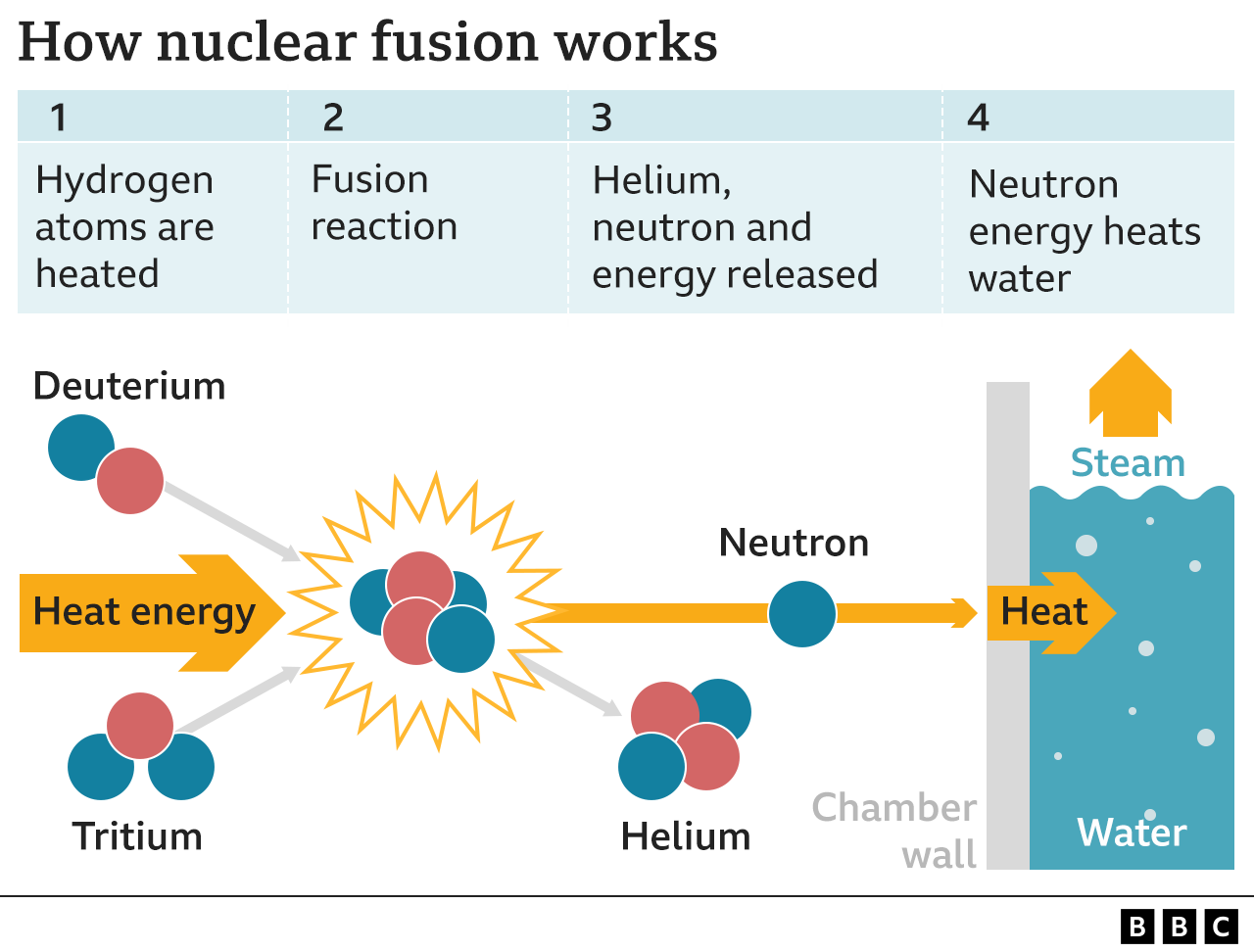
    Major breakthrough on nuclear fusion energy - BBC News

    • Nuclear fusion is the process of making a single heavy nucleus (part of an atom) from two lighter nuclei. This process is called a nuclear reaction.
    • The nucleus made by fusion is heavier than either of the starting nuclei. It releases a large amount of energy.
    • Fusion is what powers the sun. Atoms of Tritium and Deuterium (isotopes of hydrogen, Hydrogen-3 and Hydrogen-2, respectively) unite under extreme pressure and temperature to produce a neutron and a helium isotope.
    • Along with this, an enormous amount of energy is released, which is several times the amount produced by fission.
    • Scientists continue to work on controlling nuclear fusion in an effort to make a fusion reactor to produce electricity.

    How it is different from nuclear fission?

    • Simply put, fission is the division of one atom into two (by neutron bombardment), and fusion is the combination of two lighter atoms into a larger one (at a very high temperature).
    • Nuclear fission takes place when a large, somewhat unstable isotope (atoms with the same number of protons but a different number of neutrons) is bombarded by high-speed particles, usually neutrons.


    UPSC 2022 countdown has begun! Get your personal guidance plan now! (Click here)

  • What are Artificial Neural Networks (ANN)?

    This newscard is an excerpt from the original article published in TH.

    What are ANN?

    • The concept behind an ANN is to define inputs and outputs, feed pieces of inputs to computer programs that function like neurons and make inferences or calculations.
    • It then forwards those results to another layer of computer programs and so on, until a result is obtained.
    • As part of this neural network, a difference between intended output and input is computed at each layer and this difference is used to tune the parameters to each program.
    • This method is called back-propagation and is an essential component to the Neural Network.

    Setting up of ANNs

    • Instead of CPUs, Graphic Processing Units (GPU) which are good at performing massive parallel tasks can be used for setting up ANNs.
    • A few free ANN frameworks are TensorFlow, Keras, PyTorch and Theano.
    • These can be used for both normal Machine Learning tasks like classification or clustering and for Deep Learning/ANN tasks.

    Why called Neural Network?

    • Neuron is the building block of the brain and it inspired computer scientists from the 1950s to make a computer perform tasks like a brain does.
    • It is not a simple problem and the clue to its complexity is in the brain structure.

    Why ANN?

    Ans. Making an artificial brain

    • We need billions of artificial neurons if we were to build an artificial brain.
    • With the increase in computing power, mimicking billions of neurons is now possible.

    Popularity of ANNs

    • Data Science, used interchangeably with Machine Learning, is the computer technology that uses data to detect patterns.
    • Hand-written digit recognition is a good example of machine learning.
    • However, in order for the computer to do this task, large amounts of sample data need to be manually labelled as examples of images of digits.
    • The ANN mentioned above with its backpropagation does exactly this.
    • This is why ANNs have become hugely popular in the past decade. This approach of using neural networks of many layers to automatically detect patterns and parameters is called Deep Learning.


    UPSC 2022 countdown has begun! Get your personal guidance plan now! (Click here)

  • Web 3.0: A vision for the future

    The concept of Web3, also called Web 3.0, used to describe a potential next phase of the internet, created quite a buzz in 2021.

    What is Web3?

    • The model, a decentralized internet to be run on blockchain technology, would be different from the versions in use, Web 1.0 and Web 2.0.
    • In web3, users will have ownership stakes in platforms and applications unlike now where tech giants control the platforms.

    Previous versions of Web

    To understand web3, we should start with Web 1.0 and Web 2.0.

    [1] Web 1

    • Web 1.0 is the world wide web or the internet that was invented in 1989. It became popular from 1993.
    • The internet in the Web 1.0 days was mostly static web pages where users would go to a website and then read and interact with the static information.
    • Even though there were e-commerce websites in the initial days it was still a closed environment and the users themselves could not create any content or post reviews on the internet.
    • Web 1.0 lasted until 1999.

    [2] Web 2

    • Web 2.0 started in some form in the late 1990s itself though 2004 was when most of its features were fully available. It is still the age of Web 2.0 now.
    • The differentiating characteristic of Web 2.0 compared to Web 1.0 is that users can create content.
    • They can interact and contribute in the form of comments, registering likes, sharing and uploading their photos or videos and perform other such activities.
    • Primarily, a social media kind of interaction is the differentiating trait of Web 2.0.

    What are some of the concerns?

    • In Web 2.0, most of the data in the internet and the internet traffic are owned or handled by very few behemoth companies ex. Google.
    • This has created issues related to data privacy, data security and abuse of such data.
    • There is a sense of disappointment that the original purpose of the internet has been distorted.
    • It is in this context that the buzz around Web3 is significant.

    Dawn of Web3

    • Gavin Wood, founder of Ethereum, a block chain technology company, used the term Web3 first in 2014 and in the past few years many others have added to the idea of Web3.
    • In 2021, owing to the popularity of crypto-currency, more discussions happened on Web3.

    How will Web3 address the problems of data monopoly?

    Web3 will deliver decentralized and fair internet where users control their own data.

    • Currently if a seller has to make a business to the buyer, both the buyer and seller need to be registered on a “shop” or “platform” like Amazon or Ebay or any such e-commerce portal.
    • What this “platform” currently does is that it authenticates that the buyer and seller are genuine parties for the transaction.
    • Web3 would try to remove the role of the “platform”.
    • For the buyer to be authenticated, the usual proofs aided by block chain technology will be used. The same goes for the seller.

    How is blockchain technology used here?

    • With block chain, the time and place of the transaction are recorded permanently.
    • Thus, Web3 enables peer to peer (seller to buyer) transaction by eliminating the role of the intermediary. This concept can be extended to other transactions also.
    • Consider a social media application where you want to share pictures with your followers.
    • It could be a broadcast operation from you aided by blockchain and you don’t need social media accounts for all the participants to be able to perform this.

    Another key feature: Decentralized Autonomous Organization

    • The key concepts in Web3 seen so far are peer to peer transaction and block chain.
    • The spirit of Web3 is Decentralized Autonomous Organization (DAO).
    • DAO is all about the business rules and governing rules in any transaction are transparently available for anyone to see and software will be written conforming to these rules.
    • Crypto-currency and block chain are technologies that follow the DAO principle.
    • With DAO, there is no need for a central authority to authenticate or validate.

    Will it take off?

    • We don’t know yet if Web3 will become the dominant mode of handling the internet but the questions it raises are relevant.
    • Web3 is in its very initial days and there is no consensus if it will take off like Web 1.0 or Web 2.0 did.
    • There is much skepticism from top tech brains in the industry and the academic community that Web3 does not solve the problems it purports to solve.


    UPSC 2022 countdown has begun! Get your personal guidance plan now! (Click here)

  • Carbon Footprints of Cryptocurrencies

    Bitcoin prices are rising these days and so will be its mining. As cryptocurrency will become mainstream, its carbon footprint cannot be ignored.

    What are Cryptocurrencies?

    Cryptocurrency

    Global crypto market

    • In 2019, the global cryptocurrency market was approximately $793 million.
    • It’s now expected to reach nearly $5.2 billion by 2026, according to a report by the market research organization Facts and Factors.
    • In just one year—between July 2020 and June 2021—the global adoption of cryptocurrency surged by more than 880 percent.

    Carbon footprints of Bitcoins

    • Increasing popularity of cryptocurrency has environmentalists on edge, as the digital “mining” of it creates a massive carbon footprint due to the staggering amount of energy it requires.
    • A/c to the Bitcoin Energy Consumption Index, the carbon footprint of Bitcoin is equivalent to that of New Zealand.
    • Both emit nearly 37 megatons of carbon dioxide into the atmosphere every year.

    What is Mining?

    • Mining is a process in which computational puzzles are solved in order to verify transactions between users, which are then added to the blockchain.
    • In simpler terms, the works are created, or “minted,” through a process called proof-of-work (PoW), which establishes its unique identity.

    How do cryptocurrencies create such a footprint?

    • Unlike mainstream traditional currencies, bitcoin is virtual and not made from paper or plastic, or even metal.
    • Bitcoin is virtual but power-hungry as it is created using high-powered computers around the globe.
    • Bitcoin is created when high-powered computers compete against other machines to solve complex mathematical puzzles.
    • This is an energy-intensive process that often relies on fossil fuels, particularly coal, the dirtiest of them all.

    Conclusion

    • What this means is that, unlike traditional currency or gold, Bitcoin is not solely a settlement layer, not solely a store of value, and not solely a medium of exchange.
    • This makes Bitcoin’s relative energy consumption productive in comparison to comparative sectors, given its robust potential uses.
    • The promise of such an endeavor offers hope for a more sustainable cryptocurrency future.
    • Whether this will make much difference to the climate crisis in light of government and industrial inaction remains to be seen.

    Back2Basics: Bitcoin Energy Consumption Index


    UPSC 2022 countdown has begun! Get your personal guidance plan now! (Click here)

  • Zebrafish study reveals how the brain makes its connections

    Recent work by researchers at the National Centre of Biological Sciences, Bengaluru, has thrown light on what stimulates the synapses (connection of nerve cells) to form.

    What are Synapses?

    • Neurons, or nerve cells, in the brain connect by means of junctions known as synapses through which they transmit signals.
    • There are two types of synapses – chemical and electrical:

    (1) Chemical Synapse

    • In this, there is a space of about 20 nanometres between two neurons, and the way they communicate is this: One neuron converts electrical signal into chemical signals.
    • This chemical is released into the synaptic space and the receiving neuron converts the chemical signal back into an electrical signal.

    (2) Electrical synapse

    • In these synapses, the two neurons have a physical connection and the conversion of electrical to chemical need not occur, and they communicate directly.
    • Electrical synapses are like a physical wire, communication is faster but they are also fewer in number.

    Observing these synapses

    • Researchers from TIFR-National Centre of Biological Sciences, Bengaluru, have chosen Zebrafish as a model organism to study this process.
    • Zebrafish are transparent and neuron development in larval zebrafish can be observed from day to day by injecting a dye or by engineering the fish to express fluorescent proteins.
    • It was observed that electrical synapses are formed before chemical synapses, they are like a blueprint in which neurons make a handshake. This results in the making of chemical synapses.
    • Research on organisms such as leeches showed that if you remove electrical synapses, the chemical synapses do not form.
    • However, the mechanism of how it happens in higher organisms such as vertebrates was not known.

    What induces these synapses?

    • The group observed that knocking out a particular protein known as the gap junction delta 2b (gjd2b) in the cerebellum of zebrafish affected levels of the enzyme CaMKII.
    • Levels of CaMKII were seen to increase in the Purkinje neurons in the cerebellum.
    • These neurons and the cerebellum itself control coordination of movements in the organism.

    Why study this?

    • In humans for example, excess abuse of alcohol leads to damage of these cells, which results in lack of coordination in movement.
    • The cerebellum shows an evolutionary continuity in all vertebrates, so, too, the Purkinje neurons.
    • Even though fish and humans diverged from a common ancestor about 500 million years ago, the cerebellum has been evolutionarily conserved.
    • While zebrafish have about 300-400 Purkinje neurons, humans have thousands of these.


    UPSC 2022 countdown has begun! Get your personal guidance plan now! (Click here)

  • Omisure: India’s first RT-PCR kit to identify Omicron strain

    Omisure — India’s first home-grown testing kit has recently received approval from the Drugs Controller General of India.

    About Omisure

    • Omisure is an omicron detecting RT-PCR kit developed by the Mumbai-based Tata Medical and Diagnostics Ltd (TATA MD) in partnership with the Indian Council of Medical Research (ICMR).
    • It can differentiate the omicron strain of the novel coronavirus from the delta, alpha and the other variants in under four hours.
    • It can diagnose this variant in a single step

    How does it work?

    • This new kit can identify the Omicron variant by targeting two regions of the S or the spike gene.
    • This gene codes for the spike protein, which helps the novel coronavirus enter and infect human cells.
    • The S, the Enveloped (E), and Nucleocapsid (N) genes are some of the targets of conventional RT-PCR tests.
    • When it detects these genes, a patient sample is labelled positive. As omicron bears heavy mutations in the S gene, the RT-PCR can sometimes miss it.
    • The absence of S gene likely indicates omicron’s presence.
    • This is called S gene dropout or S gene target failure — and is one of the targets of Omisure.

    How does Omisure compare with gene sequencing?

    • Gene sequencing reads the order of nucleotides, which are the building blocks of deoxyribonucleic acid (DNA) and ribonucleic acid (RNA).
    • Despite being considered the gold standard, sequencing has a few limitations.
    • It is slow, expensive and complicated. It is a multi-step process.
    • It begins with extracting the virus’ RNA from patient samples, converting it into DNA, amplifying or multiplying it through RT-PCR before finally sending it for gene sequencing.
    • This entire process can take as many as three days.

    Back2Basics:

    PCR Test for Diagnosis of the COVID-19


    UPSC 2022 countdown has begun! Get your personal guidance plan now! (Click here)

  • The functioning of INSACOG

    The Indian SARS-CoV-2 Consortium on Genomics (INSACOG) has sequenced about 1,00,000 samples.

    What is INSACOG?

    • INSACOG is a consortium of 10 labs and 18 satellite labs across India tasked with scanning COVID samples from patients and finding the variants that has led to spike in transmission.
    • The institutes involved include the laboratories of the Department of Biotechnology, Council of Scientific and Industrial Research, Indian Council of Medical Research, and the Health Ministry.
    • Its work began in January 2020, by sequencing all samples with a history of travel from the U.K. and a proportion of positive samples in the community.

    Tasks of INSACOG

    • The NCDC is tasked with coordinating collections of samples from the States as well as correlating disease with certain mutations.
    • It is mainly involved in genomic sequencing which is done by isolating the genetic material of the coronavirus samples.
    • It is also tasked with tracking certain combinations of mutations that become more widespread in India.

    What has it found so far?

    • The INSACOG sequenced about 1,00,000 samples as of early December 2021 when this data was last made publicly available.
    • The bulk of its effort has been focussed on identifying international ‘variants of concern’ (VoC) that are marked out by the WHO as being particularly infectious or pathogenic.
    • International travellers who arrive in India and test positive are the ones whose samples usually get sent to INSACOG for determining the genomic variant.

    Why is genome sequencing useful?

    • Understanding mutations: The purpose of genome sequencing is to understand the role of certain mutations in increasing the virus’s infectivity.
    • Immune response: Some mutations have also been linked to immune escape, or the virus’s ability to evade antibodies, and this has consequences for vaccines.
    • Effectiveness of vaccines: Labs across the world, including many in India, have been studying if the vaccines developed so far are effective against such mutant strains of the virus.
    • Evolution of viruses: Studies such as this have shown that Omicron, for instance, has evolved to evade antibodies much better than the Alpha or Delta variant. This prompted the push towards booster doses.

    How is it done?

    • Genomic sequencing is done by isolating the genetic material (RNA) of the coronavirus samples.
    • RNA consists of millions of nucleotide bases and genomic sequencing is about identifying and comparing the sequence in a given sample to a reference sample.
    • Changes in the sequence are clues to mutations that show that the virus may have undergone distinct changes at some key locations.
    • There are several approaches to genome sequencing — whole genome sequencing, next-generation sequencing — that have different advantages.
    • It has now evolved to a stage where large sequencers can process even thousands of samples simultaneously.

    Various challenges that INSACOG faces

    • Geographical variations: Given that COVID-19 is spreading, mutating and showing geographical variations, the original aim of the group was to sequence at least 5% of COVID-19 samples.
    • Shortage of funds: But only 1% has been achieved yet, primarily due to a shortage of funds, insufficient reagents and tools necessary to rapidly scale up.
    • Red-tapism: The INSACOG, in spite of being peopled by expert scientists, is ultimately within the Central government’s communication structure.
    • Infrastructure lacunae: Not all INSACOG labs have the same quality of equipment and manpower and therefore a surge or spike in some cities can mean difficulties in processing.


    UPSC 2022 countdown has begun! Get your personal guidance plan now! (Click here)

  • What are Solid-State Batteries?

    After Twitter CEO Parag Agrawal, now another Indian origin is in the headline is Jagdeep Singh, CEO and founder of a US battery startup. The reason for his recent buzz for his breakthrough battery technology.

    About QuantumScape

    • QuantumScape Corp is a battery startup backed by Volkswagen AG.
    • Its solid-state battery — lithium metal with a solid electrolyte separating the two electrodes — is seen as an exceptionally bright prospect in E-Vehicle industry.

    What are Solid-state batteries?

    • A solid-state battery is a battery technology that uses solid electrodes and a solid electrolyte, instead of the liquid or polymer gel electrolytes found in lithium-ion or lithium polymer batteries.
    • Such batteries can provide potential solutions for many problems of liquid Li-ion battery, such as flammability, limited voltage, unstable solid-electrolyte interphase formation, poor cycling performance and strength.

    What are Li-ion Batteries?

    • Lithium-ion batteries use aqueous electrolyte solutions, where ions transfer to and fro between the anode (negative electrode generally made of graphite) and cathode (positive electrode made of lithium), triggering the recharge and discharge of electrons.
    • The energy density of lithium-ion cells used in today’s mobile phones and electric vehicles is nearly four times higher than that of older-generation nickel-cadmium batteries.

    Its limitations

    • Low energy density: Despite improvements in technology over the last decade, issues such as long charging times and weak energy density persist.
    • Small appliances: While lithium-ion batteries are seen as sufficiently efficient for phones and laptops, they still lack the range that would make EVs a viable alternative.
    • Extreme reactivity: One major problem is that lithium metal is extremely reactive.
    • Corrosion of cells: The main form of lithium corrosion is dendrites (branched lithium structures) that grow out from the electrode and can potentially pierce the separator short-circuiting the cell.
    • Fire hazard: In current lithium-ion batteries, in which the electrolyte is a flammable liquid, dendrite formation can trigger a fire.

    What is the breakthrough?

    • QuantumScape claims to prevent dendrites formation.
    • It uses a solid-state separator technology that eliminates the side reaction between the liquid electrolyte and the carbon/graphite in the anode of conventional lithium-ion cells.
    • The replacement of the separator enables the use of a lithium-metal anode in place of the traditional
    • The lithium metal anode is more energy-dense than conventional anodes, which allows the battery to store more energy in the same volume, according to the company.

    Key advantages of QuantumScape Battery

    • The advantages of the solid-state battery technology include higher cell energy density (by eliminating the carbon anode), lower charge time (by eliminating the need to have lithium diffuse into the carbon particles in conventional lithium-ion cells).
    • It has the ability to undertake more charging cycles and thereby a longer life, and improved safety.
    • Lower cost could be a game-changer, given that at 30 per cent of the total cost, battery expenses are a key driver of the vehicle costs.

    India’s battery push

    • The centre is working on a blueprint for a project of around 4,000 MWh of grid-scale battery storage system at the regional load dispatch centres that control the country’s power grid, primarily to balance the vagaries of renewable generation.
    • Reliance Industries Ltd has announced plans to set up an Energy Storage Giga factory; state-owned NTPC Ltd has floated a global tender for a grid-scale battery storage project.
    • The Ministry of Heavy Industries issued a request for proposal for setting up manufacturing facilities for Advanced Chemistry Cell (ACC) battery storage in India.


    UPSC 2022 countdown has begun! Get your personal guidance plan now! (Click here)

  • Program for Development of Semiconductors and Display Manufacturing Ecosystem in India

    The Union Cabinet has approved a ₹76,000 crore scheme to boost semiconductor and display manufacturing in the country.

    About the Program

    • The scheme would provide financial support of up to 50% of the project cost for setting up semiconductor and display fabrication units.
    • The scheme was aimed at making India a global hub of electronic system design and manufacturing, the statement noted.
    • In addition, the Centre would work with the States to set up high-tech clusters with the necessary infrastructure such as land and semiconductor-grade water.

    Components of the mission

    [1] Semiconductor Fabs and Display Fabs

    • This shall extend fiscal support of up to 50% of project cost to eligible applicants.
    • The govt will work closely with the states establish High-Tech Clusters with requisite infrastructure in terms of land, semiconductor grade water, high quality power, logistics and research.

    [2] Semi-conductor Laboratory (SCL):

    • The Ministry of Electronics and Information Technology will take requisite steps for the modernization and commercialization of the Semi-conductor Laboratory (SCL).
    • MeitY will explore the possibility for the Joint Venture of SCL with a commercial fab partner to modernize the brownfield fab facility.

    [3] Semiconductor Design Companies:

    • The Design Linked Incentive (DLI) Scheme shall extend product design linked incentive of up to 50% of eligible expenditure and product deployment linked incentive of 6% – 4% on net sales for five years.
    • Support will be provided to 100 domestic companies of semiconductor design for Integrated Circuits (ICs), Chipsets, System on Chips (SoCs), Systems & IP Cores.

    [4] India Semiconductor Mission:

    • In order to drive the long-term strategies for developing sustainable semiconductors and display ecosystem, a specialized and independent ISM will be set up.
    • The ISM will be led by global experts in the semiconductor and display industry.
    • It will act as the nodal agency for efficient and smooth implementation of the schemes on Semiconductors and Display ecosystem.

    [5] Chips to start-ups Program

    • This program would develop 85,000 well-trained engineers, he claimed. Semiconductor designers would be given the opportunity to launch start-ups.
    • The government would bear 50% of the expense under the design-linked incentive scheme.
    • The entire programme would lead to 35,000 high-quality direct jobs and 1 lakh indirect employment.

    Significance of the scheme

    • In the current geopolitical scenario, trusted sources of semiconductors and displays hold strategic importance and are key to the security of critical information infrastructure.
    • The approved program will propel innovation and build domestic capacities to ensure the digital sovereignty of India.
    • It will also create highly skilled employment opportunities to harness the demographic dividend of the country.
    • Development of semiconductor and display ecosystem will have a multiplier effect across different sectors of the economy with deeper integration to the global value chain.


    UPSC 2022 countdown has begun! Get your personal guidance plan now! (Click here)

  • 5G Network and Aviation Safety

    The US Federal Aviation Administration (FAA) has issued directives to create a framework as well as gather more information about the potential effects of 5G on crucial aviation safety equipment.

    What is 5G technology?

    • 5G or fifth generation is the latest upgrade in the long-term evolution (LTE) mobile broadband networks.
    • It mainly works in 3 bands, namely low, mid and high-frequency spectrum — all of which have their own uses as well as limitations.

    Three bands of 5G

    • The low band spectrum has shown great promise in terms of coverage and speed of internet and data exchange, the maximum speed is limited to 100 Mbps (Megabits per second).
    • This means that while telcos can use and install it for commercial cellphones users who may not have specific demands for very high-speed internet, the low band spectrum may not be optimal for specialised needs of the industry.
    • The mid-band spectrum, on the other hand, offers higher speeds compared to the low band but has limitations in terms of coverage area and penetration of signals.
    • Telcos and companies, which have taken the lead on 5G, have indicated that this band may be used by industries and specialised factory units for building captive networks that can be moulded into the needs of that particular industry.
    • The high-band spectrum offers the highest speed of all the three bands, but has extremely limited coverage and signal penetration strength.
    • Internet speeds in the high-band spectrum of 5G have been tested to be as high as 20 Gbps (gigabits per second), while, in most cases, the maximum internet data speed in 4G has been recorded at 1 Gbps.

    What is the issue?

    • There is a threat of potential radar altimeter interference from 5G cellular in the 3700 MHz-3800 MHz frequency or the C-band.
    • The 3700-4200 MHz band is close to the 4200 MHz-4400 MHz range used by aircraft radio altimeters.

    Potential impacts

    • Operations by aircraft including large jets could be limited or prohibited from using certain landing and navigation systems in places where there is scope for potential interference from new 5G cellular networks.
    • The restrictions could be severe for smaller aircraft and helicopters.
    • Overall, these could result in flight cancellations, delays or diversions in 46 places where these towers are, according to an aviation report.

    What is the aircraft equipment that can be affected?

    • The radio altimeter measures height (not altitude) of the aircraft above the surface immediately below the plane. It transmits a radio signal directly below.
    • There are various other systems that depend on inputs from the radio altimeter — for example, predictive wind shear, ground proximity warning system, traffic collision avoidance system, and auto land.
    • These effects are only when the aircraft is close to the ground, i.e. up to 2,500 ft above ground level (depending on the aircraft make).
    • Any disturbance to internal radio altimeter readings caused by 5G or other equipment transmitting in frequency bands close to it can result in disastrous effects on crucial systems during approach/landing.

    Impact of mobile phones

    • 5G devices can interfere with aircraft altitude instruments and recommended that they should be turned off (or put to flight mode) during flight.
    • Experts believe that electrical interference from a mobile phone could have been a factor in the crash of a small aircraft.
    • The navigation system of the small aircraft could be disrupted by mobile phone signals.
    • But up until now, there has been no evidence of a mobile phone having caused a crash.

    What about the implications for India?

    • Pilots in India are aware of the implications of 5G in the country.
    • However, in India, 5G could be rolled out in the 3.2 GHz-3.6 GHz band, which may not have the potential to interfere with aircraft operations.


    UPSC 2022 countdown has begun! Get your personal guidance plan now! (Click here)