💥Join UPSC 2027,2028 Mentorship (July Batch) + XFactor Notes & Microthemes PDF

Subject: Bilateral Relations

1. Major World Events
2. India’s Interests in neighbourhood
3. Effects of our Policies

  • [20 March 2024] The Hindu Op-ed: Ties that epitomize India’s neighborhood first policy

    PYQ Relevance:Mains: 

    Q) What is meant by Gujral doctrine? Does it have any relevance today? Discuss. (2013)

    Q) Analyze internal security threats and transborder crimes along Myanmar, Bangladesh, and Pakistan borders including the Line of Control (LoC). Also, discuss the role played by various security forces in this regard. (2020)

    Prelims:

    Q) What is the importance of developing Chabahar Port by India? (2017)

    (a) India’s trade with African countries will enormously increase.
    (b) India’s relations with oil-producing Arab countries will be strengthened.
    (c) India will not depend on Pakistan for access to Afghanistan and Central Asia.
    (d) Pakistan will facilitate and protect the installation of a gas pipeline between Iraq and India.

    Note4Students: 

    Prelims: Constitutional Provisions for Women;

    Mains: Women Issues; Government Schemes and Initiatives for Minorities;

    Mentor comments: Since the recent infrastructure project – ‘Gelephu’, Bhutan has long known that there is no real threat to its sovereignty or identity from its southern flank. Hence, it has looked to India to help it grow, develop and prosper. India has lived up to this expectation. Over the past decade, India has demonstrated its unwavering support for its neighbouring nations during times of crisis. Whether responding to natural disasters, health emergencies, economic challenges, or providing support on the international stage, India has consistently been the first to offer assistance and will continue to do so. Furthermore, we have established sustained diplomatic outreach within India’s Neighborhood First Policy.

    Let’s learn. 

    Why in the News?

    According to recent observations, ‘Neighborhood Policy’  has continued to develop through dialogs and sentiments considering South Asian demography.

    Context:

    • Gelephu Project is near remote parts of West Bengal and Assam, and the success of this city will have positive socio-economic spillovers for these geographies as well. 
    • It will provide yet another example of the win-win cooperation between India and Bhutan on the lines of Neighborhood First Policy.

    About India’s ‘Neighborhood First’ policy: 

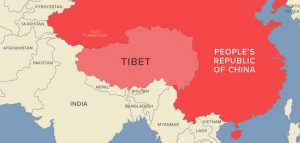
    • The South Asian region, which is home to eight countries, and the Indian Ocean region come under the broad geographic expanse of India’s neighborhood – the nations include Afghanistan, Bhutan, Bangladesh, Maldives, Pakistan, Nepal, Myanmar, Tibetan (autonomous region of China) and Sri Lanka. 
    • The ‘Neighborhood First’ policy is a foreign policy initiative introduced by India in 2014 which aims to strengthen India’s relations with its immediate neighbours emphasizing on creating a peaceful, prosperous, and stable neighborhood.
    • Principles of ‘Neighborhood First’ policy
      • Sovereignty and territorial integrity
      • Mutual respect and sensitivity
      • Non-interference in internal affairs.
      • Shared prosperity
      • Connectivity for regional integration 
      • People-to-people exchanges
    Govt. of India initiatives to harmonize the relations in the neighborhood: Country-specific initiatives: 

    Bhutan: 
    India signed the Indo-Bhutan Treaty of Peace and Friendship in 1949 and the Agreement on cooperation in Hydropower in 2006. India also provides financial support to Bhutan’s five-year plans. India is also part of the sub-regional grouping of the Bangladesh–Bhutan–India–Nepal (BBIN) network.

    Myanmar: India has also been assisting in various fields such as education, healthcare, disaster management, capacity-building
    culture etc.Promoting connectivity initiatives such as the Kaladan multimodal transit transport project in Myanmar.

    Sri Lanka: India is assisting in implementing the ‘Unitary digital identity framework’. India has also been providing financial support in the face of the recent balance of payment crisis in Sri Lanka.

    Afghanistan: PM Narendra Modi went to visit Afghanistan in 2015 and inaugurated the Afghan Parliament, which was made with the help of India. He visited Afghanistan again in 2016 to inaugurate the Salma Dam in Herat. 

    Nepal: India signed the Treaty of Peace and Friendship in 1950. There are various agreements related to hydropower projects like the Arun hydropower project etc. PM Modi was the first Indian PM to visit Nepal after 17 years in 2014.

    Bangladesh: India has signed agreements relating to the sharing of river waters with Bangladesh.

    Maldives: Greater Male connectivity project by an Indian company to provide connectivity in Maldives, restoration of Addu atolls, etc.

    Other initiatives: 
    Development cooperation: Providing development assistance through various initiatives such as the Indian Technical and Economic Cooperation (ITEC) Program, the Indian Council for Cultural Relations (ICCR), etc.
    Vaccine Maitri: India, through its vaccine diplomacy, extended help on priority to its neighbors during the COVID-19 pandemic.
    Leveraging Science and Technology: India successfully launched the first-ever South Asia Satellite (SAS) to boost communication and improve disaster links among its South Asian neighbors. 

    What are the challenges in India’s relations with its Neighbours?

    India’s relations with its neighbors have been marked by a range of challenges and issues over the years.

    • Terrorism and Illegal Immigration: India has been a victim of terrorism perpetrated by groups based in neighboring states, especially Pakistan and Bangladesh.
      • Example: Recent Assam and Tripura Issue (2024)
    • Border disputes: India has long-standing border disputes, particularly with China (Line of Actual Control) and Pakistan (Line of Control), which have led to military conflicts and tensions.
      • China Factor: India’s growing geopolitical and economic influence in the region has led to competition with China. This has led to tensions over issues such as borders, trade and investment.
        • Example: Recent Galwan Valley and border conflicts with Arunachal Pradesh (2023).
    • Water sharing: India shares rivers with several of its neighbors like Pakistan, Bangladesh, and Nepal, and water sharing has been a source of tension, which has led to disputes.
      • Example: Disputes over the Indus Water Treaty with Pakistan (the recent being on the Ravi water dispute).
    • Political instability: Several of India’s neighbors have experienced political instability and internal ethnic conflicts, which have had an impact on regional stability and security.
      • Example: Recent Manipur issue (2023).

    Way forward for strengthening India’s relations with its neighbors:

    • Economic cooperation: South Asia’s intra-regional trade is the lowest globally, constituting only 5% of the region’s total trade. By increasing trade, investment, and cross-border connectivity we can stand on weighted sides.
    • People-to-people exchanges: India can promote people-to-people exchanges by facilitating cultural, educational, and tourism exchanges.
    • Security cooperation: India can strengthen security cooperation with its neighbors to address common security challenges such as terrorism, cyber threats, and transnational crime. SAARC and BIMSTEC frameworks can play an important role in this.
    • Regional integration: India can support regional integration by participating actively in regional forums such as SAARC, BIMSTEC, and IORA.
    • Diplomatic outreach: India should engage in sustained diplomatic outreach to its neighbors to promote dialogue, resolve outstanding issues, and build mutual trust. 
    Some of the India’s Neighborhood Policies:

    Look East policy: Launched in 1991, it aimed to strengthen economic and political ties with countries in Southeast Asia.

    The Gujral Doctrine of 1996: It was a set of five principles to guide the conduct of foreign relations with India’s immediate neighbors.Non-reciprocity with neighbours.Territory should not be used against the interest of another country.Non-interference in internal affairs.Respect each other’s territorial integrity and sovereignty.Settle all disputes through peaceful bilateral negotiations. 

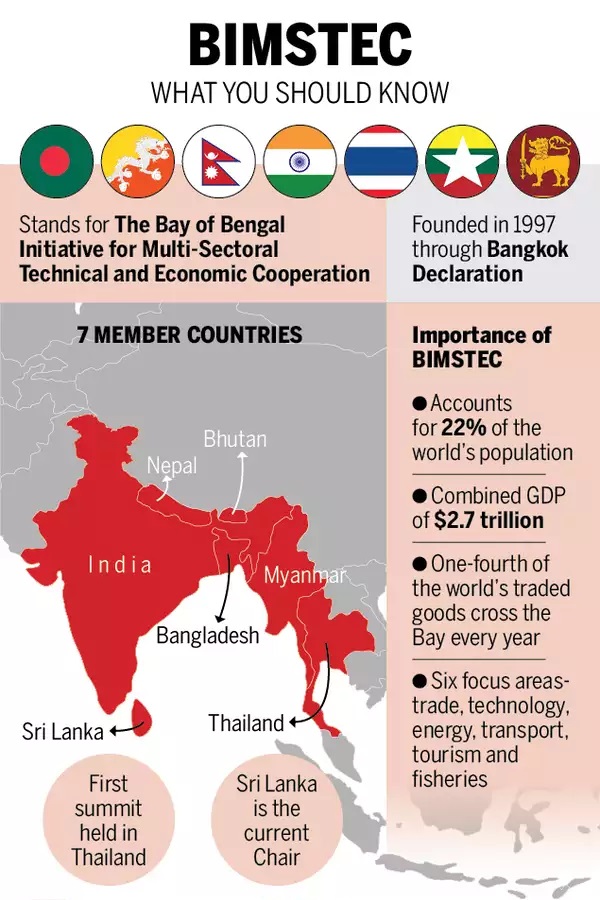
    Bay of Bengal Initiative for Multi-Sectoral Technical and Economic Cooperation (BIMSTEC), 1997: BIMSTEC was established as a regional organization comprising seven member states (Bangladesh, Bhutan, India, Nepal, Sri Lanka, Myanmar, and Thailand) lying in the littoral and adjacent areas of the Bay of Bengal constituting a contiguous regional unity. 

    Indian Ocean Rim Association (IORA) of 1997: It is an intergovernmental organization that brings together countries bordering the Indian Ocean to promote regional cooperation and economic integration.

    https://www.thehindu.com/opinion/op-ed/ties-that-epitomise-indias-neighbourhood-first-policy/article67969422.ece

    https://prsindia.org/policy/report-summaries/india-s-neighbourhood-first-policy

    https://pib.gov.in/PressReleasePage.aspx?PRID=2005229

  • [18 March 2024] The Hindu Op-ed: The Myanmar conflict is a regional problem

    Mains PYQ Relevance:

    1. Analyze internal security threats and transborder crimes along Myanmar, Bangladesh, and Pakistan borders including the Line of Control (LoC). Also, discuss the role played by various security forces in this regard. (UPSC CSE 2020)
    2. The cross-border movement of insurgents is only one of the several security challenges facing the policing of the border in North-East India. Examine the various challenges currently emanating across the India-Myanmar border. Also, discuss the steps to counter the challenges. (UPSC CSE 2019)
    3. Evaluate the economic and strategic dimensions of India’s Look East Policy in the context of the post-Cold War international scenario. (UPSC CSE 2016)

    Note4Students: 

    • Prelims: ASEAN; Bilateral Relations;
    • Mains: North-East India; Bilateral Relations; International Organisation; Act East Policy;

    Mentor comments: The conflict in Myanmar is not just a domestic issue but a regional problem that requires support from ASEAN and other international stakeholders. The situation on the ground is dire, with over two million civilians displaced within Myanmar and 1.5 million seeking refuge outside the country since the 2021 coup. This mass exodus has led to significant destabilization, affecting approximately 25 million people living in poverty in Myanmar. The conflict has spilled over into neighboring countries, posing security risks and humanitarian challenges for Bangladesh, China, India, and Thailand. We must study and analyze this issue given the ASEAN neighbors step up their efforts to resolve the conflict and support Myanmar’s people in their quest for stable, prosperous, and democratic resolutions.

    Let’s learn.

    Why in the News?

    Despite efforts by ASEAN and other international bodies to mediate, the conflict has worsened over the past three years.

    • By the end of 2023, most of Myanmar’s townships are experiencing active fighting, with a substantial portion out of democratic control.
    What is the Current Situation?
    • By the end of 2023, around 40% of Myanmar’s townships were beyond the junta’s control, with a surge in resistance groups challenging the junta’s authority.
    • Operation 1027, an offensive by ethnic forces in October 2023, successfully overran numerous junta camps and gained control of border gates.

    What are the two major causes that are responsible for the illegal migration of the Myanmar Population?

    Since the 2021 coup in Myanmar, the two major issues have led to significant displacement, with over 1.5 million individuals seeking refuge outside the country.

    • The Ethnic Conflict and ‘Rohingya Crisis’:
      • The crisis has particularly affected the Rohingya population, with more than 960,000 Rohingya refugees living in Bangladesh, primarily in the Cox’s Bazar region.
      • Previously the conflict escalated in August 2017, leading to a massive exodus of Rohingya refugees following brutal crackdowns by the military in Rakhine State.
      • This was described as “the most persecuted minority in the world,” that faced decades of violence, discrimination, and persecution in Myanmar.
    • Natural Disasters:
      • The situation has been worsened by environmental hazards like cyclones and monsoons, which pose additional risks with inadequate shelter and sanitation facilities.
      • Cyclone Mocha in May 2023 caused widespread destruction and impacted Rohingya refugees.
      • Although the International community, including organizations like UNHCR, is working towards providing humanitarian assistance, protection, and support, still the issue continues with escalations.

    The challenges for ASEAN in Stability with Myanmar:

    • Ineffectiveness of ASEAN:
      • Despite claims of over 260 meetings by Indonesia, the ASEAN chair, to address the crisis in Myanmar, the conflict in Myanmar has worsened over the past three years, with most townships experiencing active fighting and a significant portion out of the junta’s control.
      • ASEAN special envoy was stonewalled by Naypyidaw. This has been criticized for its inability to address the escalating violence and human rights abuses in Myanmar.
    • Post-Coup Dilemma:
      • After the 2021 coup in Myanmar, international stakeholders, including the US, UN, and EU, looked to ASEAN to lead efforts in resolving the conflict.
      • However, ASEAN was engaged in discussions with junta leader General Min Aung Hlaing, reaching a five-point consensus after one month of serious events like the looting of Mizzima’s headquarters.
    • Criticism for Ignoring People’s Response:
      • Despite widespread calls for an end to military rule and the establishment of democracy, the State Administration Council (SAC) – the junta’s self-styled name – continues to ignore the people’s demands.
      • The junta has escalated its suppression tactics, including arbitrary arrests, torture, extrajudicial killings, and attacks on civilians and journalists, disregarding the population’s pleas for change.

    Challenges faced by Independent Media in Myanmar:

    • Media Landscape Post-Coup: Post military coup in 2021, led to severe crackdowns on independent media outlets, with licenses revoked and journalists facing violent repression hampering Freedom of Expression.
      • Myanmar’s media landscape has evolved over the years, transitioning from strict censorship to more openness before facing setbacks post-coup.
      Journalists’ Safety: Journalists were among the first targets after the coup, leading to arrests, killings, and a significant decline in the fundamentals of Living Rights and Press Freedom.
    • Financial Struggles: Independent media outlets in Myanmar face financial challenges due to a collapse in digital advertising prices and restrictions on social media platforms.

    How India’s Act East Policy can play a significant role in addressing the Myanmar issue?

    • Economic Development and Trade: By promoting trade relations with ASEAN countries for economic development and industrialization, India can contribute to Myanmar’s economic growth and stability, which is crucial for addressing the ongoing crisis.
    • Connectivity and Infrastructure Development: Projects like the Kaladan Multi-Modal Transit Port Project, which connects India’s eastern seaports to Myanmar’s Sittwe Port, initiatives can improve trade routes and facilitate economic development in Myanmar, contributing to stability and progress.
    • Humanitarian Assistance and Refugee Crisis: The Act East Policy can address the humanitarian aspect by providing support to refugees and working towards resolving the root causes of displacement, India can contribute to alleviating the humanitarian challenges faced by Myanmar and its people.
    • Diplomatic Engagement and Regional Cooperation: India’s diplomatic efforts within ASEAN through active engagement and dialogue, India can support peace-building initiatives and contribute to stability in Myanmar.

    Conclusion: The international community, including ASEAN and the UN, continues to work towards finding a political solution in Myanmar, emphasizing the importance of coordinated action, targeted sanctions, and diplomatic efforts to address the crisis and protect the people of Myanmar.

    https://www.thehindu.com/opinion/op-ed/the-myanmar-conflict-is-a-regional-problem/article67961958.ece

    https://thewire.in/article/south-asia/has-military-rule-in-myanmar-affected-indias-act-east-policy

    https://economictimes.com/news/india/significance-of-myanmar-in-indias-act-east-policy/articleshow/101763567.cms

    https://timesofindia.com/india/explainer-why-myanmar-is-a-major-hurdle-to-indias-act-east-push/articleshow/101810016.cms

  • [15 March 2024] The Hindu Op-ed: Bhutan’s opening move, its Gelephu gambit

    [15 March 2024] The Hindu Op-ed: Bhutan’s opening move, its Gelephu gambit

    Mains PYQ Relevance: 
    How does illegal transborder migration pose a threat to India’s security? Discuss the strategies to curb this, bringing out the factors which give impetus to such migration. [UPSC 2014]

    Border management is a complex task due to difficult terrain and hostile relations with some countries. Elucidate the challenges and strategies for effective border management. [UPSC 2016]

    ‘China is using its economic relations and positive trade surplus as tools to develop potential military power status in Asia’, In the light of this statement, discuss its impact on India as her neighbor. [UPSC 2017]

    Note4Students: 

    Prelims: Bilateral Relations; Neighboring Countries;

    Mains: Bilateral Relations; Neighboring Countries;

    Mentor comments: Bhutan’s Gelephu project, aims to create a “Gelephu Mindfulness City” as a carbon-neutral economic hub spanning 1,000 square kilometers. This initiative focuses on sustainable industries like IT, education, and healthcare, positioning Gelephu as an investment destination and health and wellness center. This project is aligned with Bhutan’s Gross National Happiness philosophy, aiming to drive regional development and job creation responsibly. The project is crucial for Bhutan’s economic challenges, including the need to boost tourism revenues and address outmigration of youth seeking jobs abroad. Along this infrastructural learning, we need to align India’s involvement with its regional connectivity to emphasize the importance of land-based connectivity throughout Asia and the Indo-Pacific region.

    Let’s learn. 

    Why in the News?

    The recent project by Bhutan government of “Gelephu Mindfulness City” holds geopolitical significance, offering Bhutan a controlled way to engage globally while managing relations with China. 

    About the Gelephu Project:

    The Gelephu Mindfulness City project in Bhutan is a significant initiative envisioned by His Majesty the King Jigme Khesar Namgyel Wangchuck to create a unique economic hub with a focus on sustainable development and cultural preservation.

    This project involves the establishment of a Special Administrative Region (SAR) covering 1000 square kilometers, emphasizing conscious and sustainable businesses inspired by Bhutan’s spiritual heritage and values.

    The SAR will have executive autonomy, legal independence, and will prioritize businesses that align with Bhutan’s Gross National Happiness philosophy, aiming to drive regional development and job creation responsibly.

    India’s involvement aligns with its regional connectivity plans, emphasizing the importance of land-based connectivity across South Asia and the Indo-Pacific region.

    How are Bhutanese concerns aligned with India?

    1) Geographical concerns:

    • Floods: With warmer temperatures than in the mountains, Gelephu gets high amounts of rainfall during a monsoon season that lasts several months, leading to considerable flooding each year.
    • Habitat and Conservation Issues: The surrounding forests and wildlife populations place Gelephu right in the middle of elephant corridors.

    2) Geopolitical concerns:

    • China Factor: Pressure from its northern neighbor China to conclude a boundary resolution deal and to establish diplomatic ties.
      • Far away to the south, Gelephu offers Bhutan a way to open itself up in a controlled manner to the rest of the world, while also continuing negotiations with Beijing for a stable border.
    • Security Issues:Insurgencies in Assam and the northeastern states and just across the Indian border in Myanmar have been an area of great concern in the past.
      • This has led to a major military operation (Operation All Clear) by Bhutan’s former king in 2003, working with the Indian Army to drive out militant groups sheltering in the area.
    • Administrative Concern: As Gelephu is landlocked, it is dependent on primarily India, to provide the infrastructure for trade and transport out of the special administrative region.

    3) Economic concerns:

    • Lag in Decision Making: Apart from hydropower, tourism is Bhutan’s mainstay, but the kingdom has always discouraged mass tourism, preferring instead a “high value, low volume” motto to ensure sustainability.
      • Bhutan needs to scale up its capacity to take in more tourists and visitors and land bigger planes in the narrow Paro valley.
    • Financial need for infrastructure: The Gelephu project involves scaling up the Gelephu airport and tarmac to international standards, which will need financing and expertise from India.
    • Employment issue: The growing “outmigration” of Bhutanese youth in search of jobs abroad is another challenge, and the government hopes a mega project such as Gelephu will stem that.
    Prevailing India-Bhutan Relationship:

    Officially, the diplomatic relations between Bhutan and India were established in January 1968. This Bilateral relationship is majorly guided by the Indo-Bhutan Friendship Treaty.

    Article 2 of the Treaty declares that India would not interfere in Bhutan’s administrative affairs and the latter would be guided by the former’s advice in its external relations.

    Economic Cooperation:

    Since 2014, India’s trade with Bhutan has almost tripled from USD 484 million in 2014-15 to USD 1422 million in 2021-22. This accounts for about 80% of Bhutan’s overall trade, with the balance of trade in India’s favor.

    India is the leading source of investments in Bhutan, comprising 50% of the country’s total FDI. Interestingly, Bhutanese currency Ngultrum is officially pegged to the Indian Rupee.

    Infrastructural Cooperation:
    India has constructed three Hydroelectric Projects (HEPs) in Bhutan: 336 MW Chukha HEP, 60 MW Kurichhu HEP and 1020 MW Tala HEP. These three plants are operational and export surplus power to India. Hydropower projects in Bhutan are an example of win-win cooperation, providing a reliable source of inexpensive and clean electricity to India, generating export revenue for Bhutan and cementing our economic integration.

    Growth Cooperation:
    For the 12th Five-Year Plan of Bhutan, India is assisting Rs. 45 billion.

    What needs to be India’s current interest w.r.t the recent escalating Geopolitics?

    • Climate Change: India’s plans for a South Asian power grid (through Solar and Wind power generation projects) that would draw electricity from Nepal and Bhutan, with supply to Bangladesh and Sri Lanka would lend itself to more consistent power supplies needed for Gelephu.
    • Connectivity: Nearly decades of deteriorating ties with Pakistan have seen the Indian government virtually cut off any plans for land connectivity over India’s western border. The International North-South Transport Corridor, faces western sanctions, the IMEC and I2U2 initiative are challenged by Israel’s bombardment of Gaza and Houthi attacks in the Red Sea.

    Conclusion:

    At the 7th Indian Ocean Conference 2024, External Affairs Minister highlighted the need for lateral land-based connectivity across the Indian Ocean region, which is essential to supplement and complement the maritime flows. The Gelephu project offers a chance for the region to conjure an imagination beyond the problematic present. Although it is a huge gamble for Bhutan, but also a potential game changer for the region, with help from India.

    https://www.thehindu.com/opinion/op-ed/bhutans-opening-move-its-gelephu-gambit/article67951801.ece

    https://thediplomat.com/2024/01/gelephu-the-worlds-first-mindfulness-city-is-in-bhutan/

  • Tamil Nadu Fishermen’s Plight over Katchatheevu Island

    In the news

    • Frustrated by the continuous actions against them by Sri Lankan authorities, Tamil Nadu fishermen announced an indefinite strike starting February 17, disrupting their daily activities.
    • The fishermen’s protest led to an unprecedented decision to abstain from the annual St. Antony’s Church festival at Katchatheevu, a significant event symbolizing their fishing rights.

    Katchatheevu Island: Historical Background

    • Colonial Influence: Katchatheevu, a 285-acre island, has its origins in a 14-century volcanic eruption. It was historically under the control of the Jaffna kingdom in Sri Lanka and later the Ramnad Zamindari in India.
    • British-Era Claims: Both India and Sri Lanka claimed Katchatheevu in the early 20th century to establish fishing boundaries. The ownership dispute continued even during the British Raj.

    1974 Indo-Sri Lankan Maritime Agreement

    • Landmark Decision: Indira Gandhi’s government decided to cede Katchatheevu to Sri Lanka as part of the 1974 agreement, aiming to establish maritime borders.
    • Political Implications: The decision raised concerns in Tamil Nadu, where voices protested the lack of state assembly consultation and the impact on traditional fishing rights.
    • Fishing Ambiguity: The agreement allowed Indian fishermen access to Katchatheevu “hitherto,” but fishing rights remained ambiguous, leading to disputes.

    Sri Lankan Civil War and Beyond

    • Civil War Dynamics: The Sri Lankan civil war (1983-2009) shifted focus from the Katchatheevu issue as Sri Lanka’s naval forces grappled with internal strife.
    • Post-War Reality: Post the civil war, Sri Lanka reinforced maritime defense, leading to the arrest of Indian fishermen venturing into their waters, reigniting demands for Katchatheevu’s retrieval.

    Tamil Nadu’s Persistent Concerns

    • Political Backlash: Tamil Nadu politicians across parties raised objections against ceding Katchatheevu without state assembly consent, citing historical ties and livelihood impacts.
    • Legal Battles: Late J Jayalalitha’s AIADMK filed petitions challenging the 1974 agreement, arguing it affected traditional fishing rights. However, the Union government’s stance remained unaltered.
    • Government’s Position: Despite vocal demands from Tamil politicians, the Modi government maintained that the island’s status was finalized in 1974 and reclaiming it would require drastic measures.

    Contemporary Implications

    • Symbol of Sovereignty: Katchatheevu symbolizes regional and sovereignty concerns, reflecting tensions between Tamil Nadu’s interests and central government decisions.
    • Geopolitical Dilemma: The case highlights the delicate balance between historical claims, political sentiments, and international agreements in the context of bilateral relations.

    Conclusion

    • The island of Katchatheevu continues to serve as a reminder of India’s historical intricacies, reflecting the delicate balancing act between state interests, national decisions, and regional aspirations.
    • While Tamil Nadu’s calls for retrieval echo in the political corridors, the longstanding 1974 agreement and subsequent geopolitical realities create a complex landscape.
    • As the island’s fate intertwines with broader diplomatic relations, Katchatheevu remains a testament to the complexities of national sovereignty and regional sentiment.
  • India seizes Dual-Use Items bound for Pakistan from China


    In the news

    • Indian customs officials at Mumbai Port seized two advanced Computer Numerical Control (CNC) machines manufactured by GKD, Italy, en route to the port of Karachi from China.
    • The CNC machines, critical for manufacturing parts utilized in Pakistan’s missile development program, were destined for Karachi.

    What are Dual-Use Items?

    • Definition: Dual-use items refer to commodities that possess the potential for application in both civilian and military contexts.
    • Regulatory Scrutiny: These items are subject to stringent regulation due to their capability to be initially designed for civilian purposes but later repurposed for military or even terrorist activities.
    • Examples: Examples of dual-use items include global positioning satellites, missiles, nuclear technology, chemical and biological weapons, night vision technology, drones, precision-engineered aluminium pipes, and specific types of ball bearings.

    Global Control Mechanisms for Dual-Use Items

    (1) Missile Technology Control Regime (MTCR):

    • Established: In 1987 by G-7 countries.
    • Purpose: To limit the proliferation of missiles capable of delivering weapons of mass destruction.
    • Membership: Consists of 35 member countries.
    • Guidelines: Members coordinate national export controls to prevent missile proliferation.
    • India’s Membership: India became the 35th member in 2016.

    (2) Wassenaar Arrangement (WA):

    • Established: In 1996 with 42 participating states.
    • Purpose: Prevent destabilizing accumulations of conventional arms and dual-use goods and technologies.
    • Export Controls: Member countries apply controls on listed items to avoid enhancing military capabilities.
    • India not a member: It it has expressed interest in joining to strengthen its export controls and enhance its non-proliferation efforts.

    (3) Australia Group (AG):

    • Formation: Prompted by Iraq’s use of chemical weapons in 1985.
    • Focus: Initially on chemical weapons precursor chemicals, expanded to include biological weapons prevention.
    • Membership: Composed of 42 member countries. India is NOT a member.
    • Objective: Harmonization of international export controls on chemical and biological technologies.

    (4) Nuclear Suppliers Group (NSG):

    • Established: In 1974 in response to India’s nuclear tests.
    • Purpose: Control nuclear and nuclear-related technology to prevent proliferation.
    • Membership: Consists of 48 participating governments.
    • Guidelines: Aim to prevent the spread of nuclear weapons through control measures.

    [Note: India is also party to key conventions such as the Chemical Weapons Convention (CWC) and Biological and Toxic Weapons Convention (BWC).]

    India’s in-house mechanisms against Dual-Use Items

    • Role of DGFT: The Director General of Foreign Trade (DGFT) in India oversees the regulation of dual-use items through the SCOMET list (Specialty Chemicals, Organisms, Materials, Equipment, and Technologies).
    • SCOMET List: SCOMET items encompass special chemicals, organisms, materials, equipment, and technologies with dual-use potential.
    • Regulatory Framework: Exporting SCOMET items is subject to strict regulations, either requiring a license or being prohibited altogether.
    • Alignment with International Controls: The SCOMET control list aligns with the control lists of various multilateral export control regimes and conventions.
  • The Hindu Op-ed: Change and continuity in India’s Palestine policy

    The Hindu Op-ed: Change and continuity in India’s Palestine policy

    PYQ Relevance:

    Prelims:
    The area known as ‘Golan Heights’ sometimes appears in the news in the context of the events is related to: (2015)
    a)      Central Asia
    b)      Middle East
    c)       South-East Asia
    d)      Central Africa

    Mains: 

    1. The question of India’s Energy Security constitutes the most important part of India’s economic progress. Analyze India’s energy policy cooperation with West Asian Countries. (2017)

    2. “India’s relations with Israel have, of late, acquired a depth and diversity, which cannot be rolled back.” Discuss. (2018))

    Note4Students:

    Mains: International issues; India-West Asia; 

    Prelims: Two-state solution; Israel-Palestine;

    Mentor comments: India has historically supported Palestine while also developing ties with Israel. Prime Minister Modi expressed solidarity with Israel after a Hamas attack but India’s stance on Palestine remains balanced. Over the years, India’s policy towards Palestine has evolved, recognizing Israel in 1950 but supporting a two-state solution. Recent UN votes show India’s continued support for Palestine despite abstaining from some resolutions. What are those?

    Let’s Learn.

    Why in the News?

    The strategic implications of recent events in West Asia have influenced India’s Foreign Policy towards Israel and Palestine, emphasizing the importance of stability and resolution in West Asia.

    Background: India’s historical policy towards Palestine:

    India’s solidarity with Palestine was rooted in anti-colonial and non-aligned principles, aligning with Arab states and advocating for Palestinian statehood. 

    In 1947: Initially, India strongly supported the Palestinian cause, voting against the partition of Palestine and recognizing the Palestinian Liberation Organization (PLO) as the legitimate representative of Palestinians. 

    In 1992: Despite recognizing Israel in 1950, India did not establish full diplomatic relations until 1992.

    In 2003: India co-sponsored the draft resolution on “the right of Palestinians to self-determination” and voted in favor of it during the 53rd session of the United Nations General Assembly (UNGA). India also voted in favour of the UNGA Resolution in October 2003 against construction of the Separation Wall by Israel.

    In 2011:  India voted in favor of including Palestine as a full member of UNESCO. 

    • India has further strengthened ties with Israel, marking a strategic shift towards closer relations. This shift is driven by structural imperatives like independent foreign policy, strategic goals, and counterterrorism efforts especially in defense and trade.

    Paradigm shift of India’s policy towards Palestine:

    While India has maintained its support for the Palestinian cause, it has also deepened its ties with Israel, particularly in defense and trade

    • In 1950: India recognized Israel in 1950 but did not establish full diplomatic relations until 1992. Since then, bilateral ties have grown significantly, with India becoming Israel’s top market for defense exports. 
    • In 2017-18: Prime Minister Narendra Modi’s government has been more public in its engagement with Israel, with Modi being the first Indian Prime Minister to visit Israel in 2017 and the first to visit Ramallah in 2018. 
    • In 2023: Barely three weeks after the Hamas attack, India abstained from a vote at the United Nations General Assembly (UNGA) that called for an “immediate, durable and sustainable humanitarian truce” in Gaza. 

    While India maintains support for a two-state solution and Palestinian rights, its alignment with Israel reflects a nuanced balancing act influenced by changing geopolitical dynamics and national interests. India has also faced criticism for its perceived shift towards Israel.

    Balancing the approach of India at UNGA after the terror attack:

    • Recognizing Palestinian rights: India supported resolutions affirming Palestine by condemning Israeli settlements in Palestine, expressing concern over Israel’s occupation of Golan Heights, and calling for a humanitarian ceasefire. It was neither a strong moral critic, like Brazil or South Africa, of the way Israel is conducting the war, nor a mute spectator or enabler of Israel, like the United States or the United Kingdom.
    • Supporting Two-state solution: This stance reflects India’s commitment to a two-state solution and a balanced approach in addressing the complexities of the Israel-Palestine conflict. Despite growing ties with Israel in defense and trade, India maintains support for Palestinian statehood while strategically engaging with Israel.

    What is the present Scenario and Indian Interests considering the present context?

    • Being Leader for Global South: India’s support for Palestine is rooted in National interests, including the humanitarian crises in Gaza and the need to maintain its reputation as a leader in the Global South.
    • Reflecting towards its commitment: India’s criticism of Israel’s action and its support for a two-state solution reflect its commitment to international law and stability in the Global south region.
      • The strategic implications of recent events in the region, such as the Abraham Accords and the crises in Gaza, have influenced India’s Foreign policy towards Israel and Palestine, emphasizing the importance of stability and resolution in West Asia.

    Way Forward

    Supporting a two-state solution requires ending violence, promoting dialogue, condemning settlements, and upholding Palestinian self-determination. India aligns with this approach, emphasizing diplomacy over conflict. In contrast, the U.S., despite claiming support for a two-state solution, votes against relevant UN resolutions and fails to endorse ceasefire calls.

    References:

    https://www.thehindu.com/opinion/lead/change-and-continuity-in-indias-palestine-policy/article67904383.ece

    https://www.mea.gov.in/Portal/ForeignRelation/Bilateral_Brief-Sept_2019.pdf

    https://thediplomat.com/2023/11/india-once-was-a-strong-ally-of-palestine-what-changed/


    References: https://www.thehindu.com/opinion/op-ed/the-economic-case-for-investing-in-indias-children/article67896821.ece

  • PM inaugurates Naval Base and Airstrip in Agalega Island, Mauritius

    Agalega Island

    In the news

    • PM Modi in collaboration with his Mauritian counterpart Pravind Jugnauth, inaugurated a series of projects on Mauritius’ Agalega Island.

    Agalega Island: A Strategic Location

    • Agaléga are two outer islands of Mauritius located in the Indian Ocean, about 1,000 kilometers north of Mauritius island.
    • The islands have a total area of 2,600 ha (6,400 acres).
    • Notable settlements include Vingt Cinq on the North Island and Sainte Rita on the South Island, serving as primary hubs for residents and economic activities.

    Significance of New Airstrip and the Base

    • India’s Strategic Presence: The inauguration of a new airstrip and jetty underscores India’s commitment to strengthening its influence in the southwestern Indian Ocean, aligning with its broader strategic objectives.
    • Economic Impetus: Agalega Island’s strategic location facilitates trade and connectivity in the Indian Ocean region, enhancing economic opportunities for Mauritius and neighboring countries.
    • Trade Security: With a significant portion of India’s trade traversing the Indian Ocean, the development of infrastructure on Agalega Island contributes to safeguarding trade routes and ensuring maritime security.

    Benefits for Mauritius

    • Developmental support: Historically a slave plantation, North Agalega Island reflects the legacy of colonial exploitation, with its main town, Vingt Cinq, evoking the brutality of slavery.
    • Strategic boost: India’s development initiatives aim to ameliorate conditions for the island’s inhabitants, alongside bolstering Mauritian Defence Force operations.

    India’s Strategic Imperative

    • Counterbalancing Chinese Influence: India’s developmental endeavors on Agalega Island serve as a proactive measure to counter China’s expanding ‘String of Pearls’ strategy, safeguarding its regional interests and sovereignty.
    • Enhanced Security Infrastructure: By upgrading security infrastructure, including facilities for surveillance and monitoring, Mauritius strengthens its security apparatus, contributing to overall regional stability and resilience.
    • Regional Cooperation: The projects on Agalega Island are aligned with India’s Security and Growth for All in the Region (SAGAR) policy initiative, aimed at fostering regional development and security cooperation among Indian Ocean Rim countries.
  • India stops Ravi water flow to Pakistan

    Why in the News?

    • India has completed the Shahpur Kandi Barrage Project, halting the flow of water from the Ravi river into Pakistan after 45 years of waiting.
    • Under the 1960 Indus Water Treaty, India possesses exclusive rights to the waters of the Ravi river, enabling it to utilize the resource for local agricultural purposes.

    What are the Potential Benefits for India of stopping Ravi River Water to Pakistan?

    • Water Security: Retaining Ravi river water can enhance water security for Indian regions. The Jammu and Kashmir region will now benefit from the 1,150 cusecs of water that was previously allocated to Pakistan.
    • Agricultural Productivity: By ensuring access to Ravi river water, India can support increased agricultural productivity and efficiency, promoting sustainable farming practices and boosting food security
    • Economic Opportunities: Retaining control over Ravi river water can lead to the creation of new job opportunities, additional revenue streams from commercial activities along the riverbanks, and improved habitat quality supporting biodiversity
    • Urban Development: Halting the flow of Ravi river water to Pakistan can facilitate the development of sustainable urban areas along the riverbanks, contributing to planned urban housing and economic growth in India.
      • India can implement modern waste management systems, promote recycling industries, and adopt circular economies for sustainable water usage and protection of ecosystems.
    • Health Benefits: India can ensure cleaner drinking water sources, reducing health risks associated with contaminated water and enhancing public health outcomes.

    About Shahpur Kandi Barrage Project

    • It is located on the Ravi River, in Punjab’s Pathankot district, near the border of Punjab and Jammu and Kashmir.
    • Project Evolution:
      • The foundation stone of the Shahpur Kandi Barrage Project was laid by then Prime Minister PV Narasimha Rao in 1995.
      • In 2016, the government started to optimize water resources from the Sutlej, Beas, and Ravi rivers for Indian farmers, leading to renewed efforts to complete the project.
      • Finally, Jammu and Kashmir and Punjab signed an agreement in 2018 to resume work on the Shahpur-Kandi dam project, which had been hanging fire for the last 40 years.
    • Project Capacity:
      • The project comprises a 5 m high concrete gravity dam, a 7.7 km long hydel channel, two head regulators, and two powerhouses.
      • It is expected to generate up to 206MW of electricity and provide irrigation to Punjab (5,000 Ha) and Jammu and Kashmir (32,173 Ha).

    Indus Waters Treaty

    • The Indus Waters Treaty is an agreement between India and Pakistan, mediated by the World Bank in 1960.
    • The treaty allocates the Western Rivers (Indus, Jhelum, Chenab) to Pakistan and the Eastern Rivers (Ravi, Beas, Sutlej) to India.
    • However, the treaty permits limited usage of the Eastern Rivers by Pakistan and vice versa.
    • The treaty created the Permanent Indus Commission, comprising one representative from each nation, to facilitate communication and dispute resolution.
    • The treaty facilitated the construction of dams, link canals, barrages, and tube wells, providing water to Pakistan as per its previous entitlement.
    • The treaty came into effect due to the partition in 1947, leading to the division of the water systems.
    • After the expiry of the temporary Standstill Agreement of 1947, India started holding back water from canals flowing towards Pakistan.
    • The Inter-Dominion Accord of May 4, 1948, mandated India to supply water to Pakistani areas of the basin in exchange for yearly payments.

    Try this PYQ from CSP 2021:

    d) Sutlej

    Q. Present an account of the Indus Water Treaty and examine its ecological, economic and political implications in the context of changing bilateral relations. (UPSC 2016)


    [wpdiscuz-feedback id=”gvjopkqbvh” question=”Please leave a feedback on this” opened=”1″]Post your answers here.​[/wpdiscuz-feedback]

  • In a tough world, the beacon of U.K.-India strategic ties


    India to England Distance | Medium

    Central Idea:

    The article emphasizes the deepening partnership between the United Kingdom and India, highlighting their shared interests in maritime security, global trade, and defense cooperation. It underscores the importance of strategic relationships, particularly in the face of global challenges such as maritime threats and conflicts like the Ukraine crisis. The piece celebrates the growing ties between the two nations and their collaborative efforts towards peace, prosperity, and upholding the rules-based International Order.

    Key Highlights:

    • Mutual reliance on maritime trade and the significance of securing global sea routes.
    • Collaboration in Operation Prosperity Guardian to protect commercial shipping in the Red Sea and Gulf of Aden.
    • Support for Ukraine against Russian aggression, including substantial military aid and ongoing assistance.
    • Recognition of the Indo-Asia-Pacific region’s growing economic importance and the establishment of the U.K. tilt towards it.
    • Strengthening defense ties between the UK and India, with increased military interactions, joint exercises, and defense industrial partnerships.

    Key Challenges:

    • Threats to maritime security, including aggression from groups like the Houthis and conflicts like the Ukraine crisis.
    • Balancing national interests with international cooperation in addressing global challenges.
    • Navigating geopolitical complexities and maintaining alliances amidst shifting power dynamics.
    • Ensuring sustainable economic growth and prosperity in the face of global uncertainties.

    Main Terms:

    • Maritime security
    • Global trade
    • Defense partnership
    • Operation Prosperity Guardian
    • Indo-Asia-Pacific region
    • Rules-based International Order

    India-UK - INSIGHTSIAS

    Important Phrases for mains answer writing:

    • “The global lifelines of goods and resource”
    • “Wanton violence and disregard for international law”
    • “Strategies of isolationism or coercion”
    • “Rules-based International Order”
    • “Shared operational capabilities”

    Quotes that can add value to to your arguments in mains answers:

    • “Our nations need to secure, and make free from aggression and exploitation, the global lifelines of goods and resource that flow across the seas.”
    • “The U.K., India, and the world have a common interest in ensuring this wanton violence and disregard for international law are not allowed to become normalised.”
    • “The possibilities for global prosperity cannot be understated, and the importance of the Indo-Asia Pacific, not just to the United Kingdom, but to the world, has never been clearer.”

    Anecdotes:

    • Highlighting the successful efforts of Ukraine’s armed forces in resisting Russian aggression and reopening maritime corridors for grain exports.
    • The positive reception of the UK Carrier Strike Group during its visit to India and the hospitality extended by Indian authorities.

    Useful Statements for mains answer writing:

    • “In this ever more unstable world, the U.K. is fortunate to have India as a good friend.”
    • “History teaches us that strategies of isolationism or coercion have rarely produced strong coalitions.”

    Examples and References:

    • Mention of Operation Prosperity Guardian and the joint efforts to protect maritime trade routes.
    • Ukraine’s resilience against Russian aggression and the support provided by the UK.
    • Increased military interactions and defense collaborations between the UK and India.

    Facts and Data for credibility in your answer:

    • £2.5 billion in military aid provided by the UK to Ukraine in 2024-25, totaling almost £12 billion since 2022.
    • Record numbers of UK ship visits to India and the deepening defense partnership between the two nations.
    • The shift of the global economic center of gravity towards the Indo-Asia-Pacific region by 2050.

    Critical Analysis:

    The article provides a comprehensive overview of the strategic partnership between the UK and India, emphasizing shared interests in maritime security, global trade, and defense cooperation. It effectively highlights the challenges posed by maritime threats and conflicts like the Ukraine crisis while advocating for continued international cooperation and upholding the rules-based International Order. The piece demonstrates the importance of strategic alliances in navigating global uncertainties and promoting peace and prosperity.

    Way Forward:

    • Strengthening defense ties and collaborative efforts in maritime security.
    • Continued support for Ukraine and other nations facing security threats.
    • Enhancing economic cooperation and leveraging the opportunities in the Indo-Asia-Pacific region.
    • Advocating for the rules-based International Order and promoting stability through diplomatic engagement and multilateral cooperation.
  • Raisina Dialogue: Everything You Need to Know  

    Introduction

    • The ninth edition of the Raisina Dialogue will be held from February 23 in New Delhi.

    What is Raisina Dialogue?

    • The Raisina Dialogue is an annual multilateral conference.
    • The inaugural edition was held in March 2016.
    • It is held in New Delhi, India.
    • It is organized by the Observer Research Foundation (ORF) and held in collaboration with the Ministry of External Affairs of India.
    • It is modelled after Singapore’s Shangri-La Dialogue.
    • The dialogue brings together policymakers, experts, scholars, and leaders from various fields.
    • It focuses on discussing geopolitical, economic, and strategic issues facing the world.

    Theme of this year’s edition

    • The theme of the 2024 edition is “Chaturanga: Conflict, Contest, Cooperate, Create,” according to a press release by the Ministry of External Affairs.
    • The participants will engage with each other over six “thematic pillars”:
    1. Tech Frontiers: Regulations & Realities;
    2. Peace with the Planet: Invest & Innovate;
    3. War & Peace: Armouries & Asymmetries;
    4. Decolonising Multilateralism: Institutions & Inclusion;
    5. Post 2030 Agenda: People & Progress; and
    6. Defending Democracy: Society & Sovereignty.

    Why is it a significant event for India’s Foreign Policy?

    • International Representation: Reflects India’s aspiration to play a leading role and make significant contributions globally.
    • Platform for Engagement: Offers India avenues to engage with key regional and global issues.
    • Advocacy for World Order: Demonstrates India’s commitment to a world order based on rules, inclusivity, and cooperation.
    • Strengthening Global Image: Enhances India’s reputation as a responsible and resilient global partner.

    Similar Dialogues around the World

    • Shangri-La Dialogue: Security summit in Singapore organized by the IISS.
    • Munich Security Conference: International conference in Germany focusing on security issues.
    • Halifax International Security Forum: Forum in Canada addressing global security threats.
    • Doha Forum: Dialogue platform in Qatar exploring global peace, security, and cooperation trends.
    • Valdai Discussion Club: Russian think tank organizing annual meetings on global politics and economics.