đŸ’„Join UPSC 2027,2028 Mentorship (July Batch) + XFactor Notes & Microthemes PDF

Subject: Conservation & Mitigation

1. Conservation Progs.
2. Worldwide initiatives
3. Mitigation Strategies
4. Conventions and Protocols

  • Future for the World’s Children Report 2020

    The Future for the World’s Children Report 2020 was recently released.

    About the report

    • The report was released by a commission of over 40 child and adolescent health experts from around the world after assessing 180 countries.
    • It was commissioned by the World Health Organization (WHO), UN Children’s Fund (UNICEF) and The Lancet medical journal.

    What is Flourishing Index?

    • Flourishing is the geometric mean of Surviving and Thriving.
    • For Surviving, the authors selected maternal survival, survival in children younger than 5 years old, suicide, access to maternal and child health services, basic hygiene and sanitation, and lack of extreme poverty.
    • For Thriving, the domains were educational achievement, growth and nutrition, reproductive freedom, and protection from violence.

    Threats to Children

    • The report highlights the distinct threat posed to children from harmful marketing.
    • Evidence suggests that children in some countries see as many as 30,000 advertisements on television alone in a single year, while youth exposure to vaping (e-cigarettes) advertisements increased by more than 250% in the U.S. over two years, reaching more than 24 million young people.
    • Studies in Australia, Canada, Mexico, New Zealand and the U.S. — among many others — have shown that self-regulation has not hampered commercial ability to advertise to children.
    • Children’s exposure to commercial marketing of junk food and sugary beverages is associated with the purchase of unhealthy foods and overweight and obesity, linking predatory marketing to the alarming rise in childhood obesity.
    • The number of obese children and adolescents increased from 11 million in 1975 to 124 million in 2016 — an 11-fold increase, with dire individual and societal costs, the report said.

    What is Sustainability Index?

    • Under the Sustainability Index, the authors noted that promoting today’s national conditions for children to survive and thrive must not come at the cost of eroding future global conditions for children’s ability to flourish.
    • It ranks countries on excess carbon emissions compared with the 2030 target.
    • This provides a convenient and available proxy for a country’s contribution to sustainability in future.

    Highlights of the SI

    • The report noted that under realistic assumptions about possible trajectories towards sustainable greenhouse gas emissions, models predict that global carbon emissions need to be reduced from 39·7 gigatonnes to 22·8 gigatonnes per year by 2030 to maintain even a 66% chance of keeping global warming below 1·5degrees C.
    • No country in the world is currently providing the conditions we need to support every child to grow up and have a healthy future alarmed the report.

    India’s performance

    India ranked 77th on a sustainability index that takes into account per capita carbon emissions and ability of children in a nation to live healthy lives and secures 131st spot on a flourishing ranking that measures the best chance at survival and well-being for children.

    Performance of nations in SI

    •  Norway leads the table for survival, health, education and nutrition rates – followed by South Korea and the Netherlands.
    • The central African Republic, Chad and Somalia come at the bottom.
    • However, when taking into account per capita CO2 emissions, these top countries trail behind, with Norway 156th, the Republic of Korea 166th and the Netherlands 160th.
    • Each of the three emits 210 per cent more CO2 per capita than their 2030 target, the data shows, while the U.S., Australia, and Saudi Arabia are among the 10 worst emitters.
    • The lowest emitters are Burundi, Chad and Somalia.
    • According to the report, the only countries on track to beat CO2 emission per capita targets by 2030, while also performing fairly — within the top 70 — on child flourishing measures are Albania, Armenia, Grenada, Jordan, Moldova, Sri Lanka, Tunisia, Uruguay and Vietnam.
  • Conquering the green frontier

    Context

    India has to forge a different development model -one that will shift India’s workforce from agriculture to globally leading, resource-efficient businesses.

     How India can deliver sustainable prosperity?

    • The two intertwined forces: Just as liberalisation and globalisation transformed the economy in the past, two different yet intertwined forces will likely transform the economy in the future.
    • FirstHigh competitiveness: India must have globally leading companies across a range of key sectors such as financial services and manufacturing.
      • Global productivity frontier: These super competitive businesses should define the global productivity frontier so that they can surpass the production processes of the best companies in the world.
    • Second-Long term sustainability: India must also adopt a resource-efficient, low-carbon development pathway to utilise scarce natural resources effectively. There is no other way.
      • Apocalyptic air pollution.
      • Dire water shortages.
      • Rising temperatures and-
      • Extreme climate events- have already brought us to the brink of an environmental crisis.
      • The need for India’s leadership for achieving the target: Moreover, note that the world needs India’s leadership to achieve the 2 degree Celsius global warming target.
      • In short, India’s growth has to be green.
    • What is the problem in achieving these goals?
      • No nation has ever attempted these twin transformations — high competitiveness and long-term sustainability — simultaneously.
      • The traditional development model: The traditional development model has been a farm-to-factory development model with economies transitioning from traditional agriculture to resource-intensive, urban manufacturing.
      • India has to forge a different development model — one that will shift India’s workforce from agriculture to globally leading, resource-efficient businesses.
      • Also, these companies must use the most advanced green technologies and business models.
      • India’s development model will, therefore, need to take the Indian economy from “the farm-to-green frontier”.

    Three focus area for green transformation

    • The productivity transformation driven by super competitive businesses is well underway.
      • We now need to consider a comprehensive policy package that will enable us to simultaneously undertake a green transformation.
      • Global best practices and India’s own experiences suggest three focus areas for such a transformation.
    • India has the third-largest start-up ecosystem in the world and our larger companies are also pursuing innovation-driven growth.
    • Specific and stable policy goals
      • Specific and stable policy goals need to be established to set detailed green targets for various sectors.
      • A macro-economic model that factors in-
      • Current skills.
      • Sectoral connections.
      • Relative emission and-
      • Financial constraints are necessary to inform such targets going forward.
      • Such a model can then be used to evaluate various green growth scenarios.
      • Decarbonisation approaches in the green frontier scenario will drive the growth of green industries, green jobs, green skills, green entrepreneurs and green finance.
    • Pursuing the policy goals: Global and Indian experience highlights that green targets will have to be pursued in a stable manner across decades.
      • Most large emitters and pollutants are associated with long-lived (20-30 plus years useful life) assets.
      • The basic requirement for investment in green assets: Investments in green assets will only be possible if there is the sanctity of contracts, pricing stability, and consistent policies that are backed up by the full force of law.
      • Implementation: Finally, these specific and stable policy goals need to be implemented urgently to avoid lock-in with high-carbon assets.
    • Revamp the institutional framework: India may need to revamp its existing institutional framework for environmental governance in order to align it with the country’s green transformation.
      • Four levels of institutional structure: As demonstrated by global best practices, a comprehensive institutional framework could include four levels — super sovereign, sovereign, state/province and city.
      • Council for monitoring: An independent council or board may also be required to monitor, report, and verify green targets.
    • Appropriate financing capacity: Indian policymakers and entrepreneurs will unleash market forces that will drive the growth of waste management, solar panels, electric vehicles, super-efficient appliances, recyclable food packaging, clean coal, etc.
      • These green industries will require massive investments and appropriate financing capacity will have to be created to support their growth.
      • Preliminary estimates suggest that India’s green transformation may require an average investment of $95 billion to $125 billion per year, aggregating over $1 trillion in the next decade.
      • A “green super fund” could be established to jumpstart green investments by pooling together international and domestic capital.
      • Dual roles of financial institution: Such a financial institution could play a dual role in mediating and mitigating risk for global capital, as well as identifying sectoral project pipelines.
      • The success of financial institution: Indian financial institutions have been very successful in building up new industries such as microfinance, EdTech, and affordable healthcare, which have delivered both financial and social returns; however, financial support for green industries will have to be orders of magnitude larger.
      • Moreover, the “green super fund” may have to be able to invest across the capital structure (debt plus equity) as well as across the company lifecycle (early stage, growth capital, infrastructure investments, and so on).

    Conclusion

    Our future depends on how we resolve our environmental challenges. Further, we are the world’s third-largest carbon emitter and will play a crucial role in getting the planet to a low-carbon trajectory. Simply put, we must urgently transform our economy to get to the green frontier.

  • [pib] International protection for Great Indian Bustard, Bengal Florican and Asian Elephant

    India’s proposal to include Great Indian Bustard, Asian Elephant and Bengal Florican in Appendix I of UN Convention on migratory species was unanimously accepted at the undergoing CMS CoP in Gandhinagar.

    Great Indian Bustard

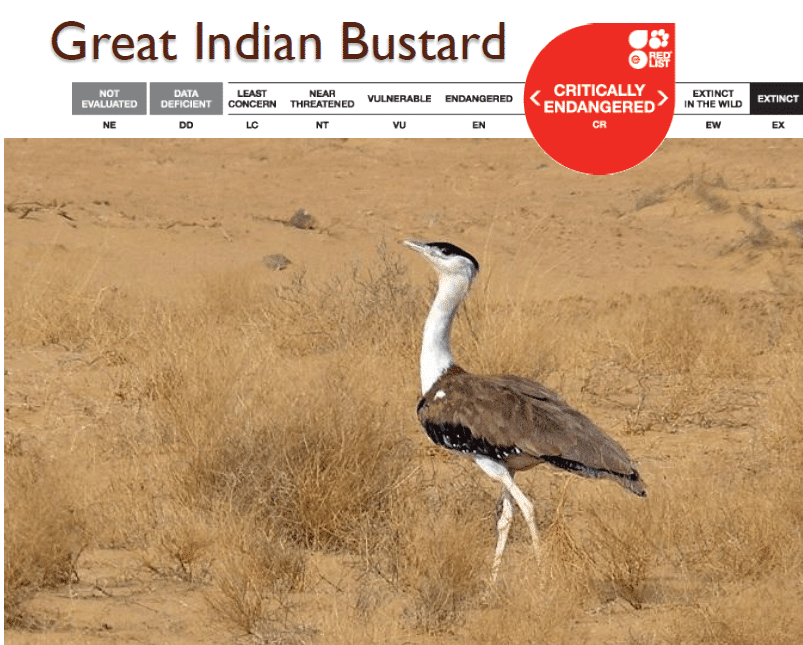
    • The Great Indian Bustard, an iconic, critically endangered and conservation dependent species, exhibits transboundary movements, and its migration exposes it to threats such as hunting in the boundary area of Pakistan-India and power-line collisions in India.
    • Inclusion of the species in Appendix I of CMS will aide in transboundary conservation efforts facilitated by International conservation bodies and existing international laws and agreement.

    Asian Elephant

    • The Government of India has declared Indian elephant as National Heritage Animal. It is also provided with the highest degree of legal protection by listing it in Schedule I of the Wildlife (Protection) Act, 1972.
    • The Great Indian Bustard is a Critically Endangered species with a small population of about 100–150 individuals that is largely restricted to Thar desert in Rajasthan, India.
    • The species has disappeared from 90% of this range; their population has reduced by 90% within 50 years (six generations), and their threats are expected to increase in future.

    Bengal Florican

    • The Bengal Florican an iconic, critically endangered species of topmost conservation priority, exhibits transboundary movements, and its migration exposes it to threats such as land-use changes, collision with power transmission line at the boundary area of India-Nepal and probable power-line collisions.
    • Inclusion of the species in Appendix I of CMS will aid in transboundary conservation efforts facilitated by International conservation bodies and existing international laws and agreement.
    • It populations has declined as a result of habitat loss, hunting and the species no longer breeds outside Protected Areas in the Indian subcontinent, except in a few areas of Assam.
  • Specie in news: ‘World’s largest’ subterranean fish


    Systematic exploration of the Meghalayan caves has been underway for almost 30 years and hundreds of kilometres of cave passages have been explored and mapped. In a cave in a remote forested area of Meghalaya’s Jaintia Hills a research expedition found large specie of a subterranean fish (occurring under the earth’s surface).

    About the fish

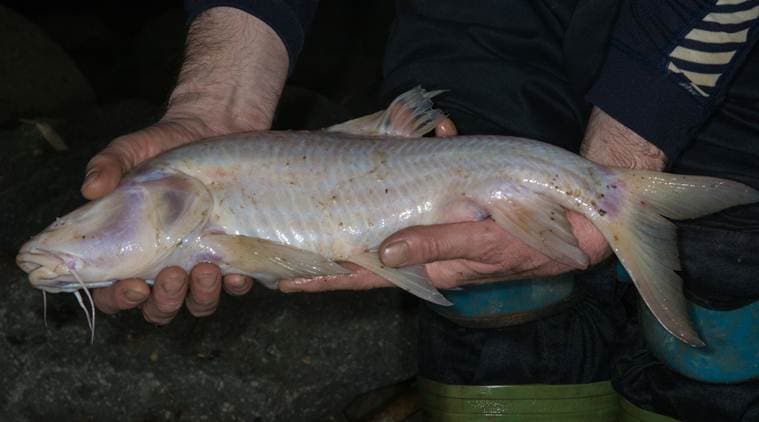
    • The blind fish was over 40 cm. It has not been named so far.
    • It is nearly five times the mean length (85mm/8.5 cm) for all known subterranean fish to date.
    • The only other species exceeding 300mm (30 cm) in length are eel-like Synbranchidae with nothing like the bulk of the new fish.
    • The 250-known subterranean (occurring under the earth’s surface) fish species around the world measure only around 8.5 cm on average.
    • The specialists say that possibly one (or more) populations of these fish became isolated deeper in the caves and over generations became adapted to the dark, losing their eyes in the process.

    Closest resemblance

    • The experts feel that the fish species is very similar to the Golden Mahseer or the Tor Putitora, one of the most famous game fish of the Himalayan rivers.
    • Unique characters that distinguishes it from the Golden Mahseer is the lack of pigmentation, a lack of eyes and of course, its subterranean habitat – being locked in caves.
    • There are ‘normal’ Golden Mahseer in the area too but there is not much surface water (at least in the dry winter months) so fish end up in the cave pools and underground rivers.

    Features of Subterranean ecosystems

    • Subterranean ecosystems are considered extreme, high-stress environments characterised by darkness, truncated food webs and food scarcity.
    • Despite this, they harbour exceptional vertebrate and invertebrate taxa (21,000+ species), many of which are evolutionarily unique, and relics of ancient fauna given their long-term isolation.
    • Many cave fish show different adaptations – some don’t have eyes, some have reduced eyes, some don’t have fins, some have weird body shapes.
  • State of India’s Birds 2020 (SoIB) Assessment


    State of India’s Birds 2020 (SoIB) assessment was recently released.

    Highlights of the report


    • The SoIB was produced using a base of 867 species (among 1,333 birds ever recorded in India), and analysed with the help of data uploaded by birdwatchers to the online platform, eBird.
    • Adequate data on how birds fared over a period of over 25 years (long-term trend) are available only for 261 species.
    • Current annual trends are calculated over a five-year period.

    Alarming declines

    • The SoIB assessment raises the alarm that several spectacular birds, many of them endemic to the sub-continent, face a growing threat from loss of habitat due to human activity, widespread presence of toxins including pesticides, hunting and trapping for the pet trade.
    • Diminishing population sizes of many birds because of one factor brings them closer to extinction because of the accelerated effects of others, the report warned.
    • Over a fifth of India’s bird diversity, ranging from the Short-toed Snake Eagle to the Sirkeer Malkoha, has suffered strong long-term declines over a 25-year period.
    • More recent annual trends point to a drastic 80% loss among several common birds.

    Various species mentioned

    • Of 101 species categorised as being of High Conservation Concern — 59 based on range and abundance and the rest included from high-risk birds on the IUCN Red List.
    • Endemics such as the Rufous-fronted Prinia, Nilgiri Thrush, Nilgiri Pipit and Indian vulture were confirmed as suffering current decline.
    • And all except 13 had a restricted or highly restricted range, indicating greater vulnerability to man-made threats.
    • Peafowl, on the other hand, are rising in numbers, expanding their range into places such as Kerala, which is drying overall, and areas in the Thar desert where canals and irrigation have been introduced. Stricter protection for peacocks under law also could be at work.
  • Species in news: Indian Pangolin


    The Madhya Pradesh forest department has radio-tagged an Indian Pangolin (Manis crassicaudata) for the first time.

    Pangolins

    IUCN status: Endangered

    • India is home to two species of pangolin.
    • While the Chinese Pangolin (Manis pentadactyla) is found in northeastern India, the Indian Pangolin is distributed in other parts of the country as well as Sri Lanka, Bangladesh and Pakistan.
    • Both these species are protected and are listed under the Schedule I Part I of the Wild Life (Protection) Act, 1972 and under Appendix I of the Convention on International Trade in Endangered Species (CITES).
    • Commonly known as ‘scaly anteaters’, the toothless animals are unique, a result of millions of years of evolution.
    • Pangolins evolved scales as a means of protection. When threatened by big carnivores like lions or tigers they usually curl into a ball.
    • The scales defend them against dental attacks from the predators.

    Why this radio-tagging?

    • The radio-tagging aims to know its ecology and develop an effective conservation plan for it.
    • The radio-tagging is part of a joint project by the department and non-profit, the Wildlife Conservation Trust (WCT) that also involves the species’ monitoring apart from other activities.

    Why protect Pangolins?

    • Pangolins are currently the most trafficked wildlife species in the world.
    • These Scales has now become the main cause of the pangolin’s disappearance.
    • The scales are in high demand in China, where they are used in traditional Chinese medicine.
    • Pangolin meat is also in high demand in China and Southeast Asia.
    • Consequently, pangolins have seen a rapid reduction in population globally. The projected population declines range from 50 per cent to 80 per cent across the genus.
  • Global cost of air pollution from fossil fuels


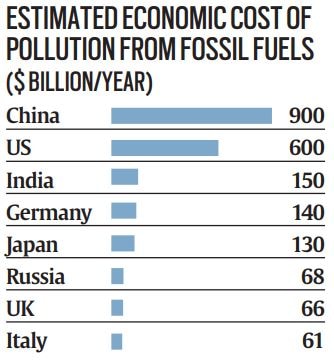
    A new Greenpeace report has estimated the global cost of air pollution from fossil fuels at around $2.9 trillion per year, or $8 billion per day — 3.3% of the world’s GDP.

    Cost of air pollution

    India is estimated to bear a cost of $150 billion, or 5.4% of the country’s GDP, which is the third-highest absolute cost from fossil fuel air pollution worldwide.

    China and the US are estimated to bear the highest absolute costs from fossil fuel air pollution, respectively at $900 billion and $600 billion.

    Loss of lives

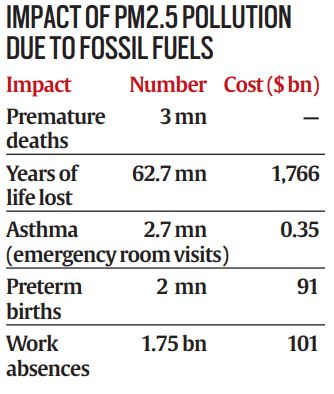
    • Globally, air pollution is estimated to cause 4.5 million premature deaths each year.
    • This includes 3 million deaths attributable globally to PM2.5, which is one of the principal pollutants in northern Indian cities including Delhi.
    • Globally, PM2.5 is also estimated to cause the loss of 62.7 million years of life, 2.7 million emergency room visits due to asthma, 2 million preterm births and 1.75 billion work absences.
    • The 2 million preterm births include 981,000 in India and over 350,000 in China.

    Economic cost

    In India, exposure to fossil fuels also leads to a loss of around 490 million workdays, the report said.

  • [pib] 13th COP of the Convention on the Conservation of Migratory Species of Wild Animals (CMS)


    The 13th Conference of Parties (COP) of the Convention on the Conservation of Migratory Species of Wild Animals (CMS) is going to be hosted by India at Gandhinagar in Gujarat.

    13th COP of CMS

    • The theme of CMS COP13 in India is, “Migratory species connect the planet and we welcome them home.
    • The CMS COP 13 logo is inspired by ‘Kolam’, a traditional artform from southern India.
    • In the logo of CMS COP-13, Kolam art form is used to depict key migratory species in India like Amur falcon, humpback whale and marine turtles.
    • The mascot for CMS COP13, “Gibi – The Great Indian Bustard” is a critically endangered species which has been accorded the highest protection status under the Wildlife Protection Act, 1972.

    About CMS

    • CMS is an international treaty concluded under aegis of UN Environment Programme (UNEP), concerned with conservation of wildlife and habitats on a global scale.
    • It is commonly abbreviated as Convention on Migratory Species (CMS) or the Bonn Convention.
    • It aims to conserve terrestrial, marine and avian migratory species throughout their range.
    • It was signed in 1979 in Bonn (hence the name), Germany and entered into force in 1983.
    • Its headquarters are in Bonn, Germany.
    • CMS is only global and UN-based intergovernmental organization established exclusively for conservation and management of terrestrial, aquatic and avian migratory species throughout their range.

    Prospects for India

    • As the host, India shall be designated the President for the next three years.
    • India is Signatory to the CMS since 1983.
    • India has been taking necessary actions to protect and conserve migratory marine species.
    • Seven species that include Dugong, Whale Shark, Marine Turtle (two species), have been identified for preparation of Conservation and Recovery Action Plan.

    Other facts

    • The Indian sub-continent is also part of the major bird flyway network, i.e, the Central Asian Flyway (CAF) that covers areas between the Arctic and Indian Oceans, and covers at least 279 populations of 182 migratory water bird species, including 29 globally threatened species.
    • India is home to several migratory species of wildlife including snow leopard, Amur falcons, bar headed Geese, black necked cranes, marine turtles, dugongs, humpbacked whales, etc.
    • It has signed non legally binding MOU with CMS on the conservation and management of Siberian Cranes (1998), Marine Turtles (2007), Dugongs (2008) and Raptors (2016).
  • Energy stored in wastewater

    The world generates about 380 trillion litres (tl) wastewater every year. These stores vast amounts of energy, nutrients for fertilizers besides, of course, water, according to recent study by the UN Institute for Water Environment and Health (UNU-INWEH).

    Energy in wastewater

    • In principle, nutrients such as nitrogen, phosphorous and potassium recovered from wastewater produced annually can offset 13.4 per cent of global demand to produce fertilizers.
    • Assuming full-energy recovery, the study estimated, current wastewater volume could provide enough methane fuel to power 196 million households by 2030 and 239 million households by 2050.
    • Usable water reclaimed from wastewater can irrigate up to 31 million hectares (mha) of land, the study claimed.
    • The volume of wastewater being generated is projected to rise roughly 24 per cent by 2030 to 470 tl and 51 per cent by 2050 to 574 tl.
    • Treating wastewater efficiently can go a long way in achieving the UN-mandated sustainable development goals (SDG).

    About UNU-INWEH

    • UNU-INWEH acts as the “UN Think Tank on Water” and contributes to the resolution of the global water challenge through a unique programme of applied research and education.
    • It conceives, develops, and manages water initiatives that help developing countries build their capacity for lasting improvements in human and ecosystem health, and overall reduction in poverty.
    • The  University is not a traditional university in the sense of having a faculty, campus, or students.
    • They respond directly to the regional and global water crisis and facilitate efforts to meet UN Development goals by providing a scientific evidence base.
    • UNU-INWEH carries out its work in cooperation with other research institutions, international organizations, individual scholars, and scientists throughout the world.
  • Forest Fire: Its Prevention and Management

    The Minister for Environment, Forests and Climate Change (MoEFCC) has informed that area covering 93,273 hectares was affected by forest fires in 2019. Most of the fires have been “ground fires” burning ground vegetation.

    Measures to curb Forest fires:

    1) National Action Plan on Forest Fires

    • The MoEFCC has prepared a National Action Plan on Forest Fires in 2018 after several rounds of consultation with all states and UTs.
    • The objective of this plan is to minimize forest fires by informing, enabling and empowering forest fringe communities and incentivizing them to work in tandem with the State Forest Departments.
    • The plan also intends to substantially reduce the vulnerability of forests across diverse forest ecosystems in the country against fire hazards, enhance capabilities of forest personnel and institutions in fighting fires and swift recovery subsequent to fire incidents.

    2) Forest Fire Prevention and Management scheme

    • The MoEFCC provides forest fire prevention and management measures under the Centrally Sponsored Forest Fire Prevention and Management (FPM) scheme.
    • The FPM is the only centrally funded program specifically dedicated to assist the states in dealing with forest fires.
    • The FPM replaced the Intensification of Forest Management Scheme (IFMS) in 2017. By revamping the IFMS, the FPM has increased the amount dedicated for forest fire work.
    • Funds allocated under the FPM are according to the 90:10 ratio of central to state funding in the Northeast and Western Himalayan regions and 60:40 ratio for all other states.
    • Nodal officers for forest fire prevention and control have been appointed in each state.