đŸ’„Join UPSC 2027,2028 Mentorship (July Batch) + XFactor Notes & Microthemes PDF

Subject: Conservation & Mitigation

1. Conservation Progs.
2. Worldwide initiatives
3. Mitigation Strategies
4. Conventions and Protocols

  • Irrawaddy Dolphins

    146 Irrawaddy dolphins were recently sighted in Chilika Lake of Odisha. The lake has highest single lagoon population of the aquatic mammal in the world.

    Irrawaddy Dolphins

    • IUCN Status: Endangered
    • Scientific Name: Orcaella brevirostris
    • Habitats: Lakes, Rivers, Estuaries, and Coasts

    • The Irrawaddy dolphin is a euryhaline species of oceanic dolphin found in discontinuous subpopulations near sea coasts and in estuaries and rivers in parts of the Bay of Bengal and Southeast Asia.
    • They are also found in coastal areas in South and Southeast Asia, and in three rivers: the Ayeyarwady (Myanmar), the Mahakam (Indonesian Borneo) and the Mekong.
    • The total population of these aquatic mammals in the world is estimated to be less than 7,500.
    • Of these, more than 6,000 Irrawaddy dolphins have been reported from Bangladesh, while the dolphin distribution in Chilika is considered to be the highest single lagoon population.
  • [pib] Saksham Campaign

    ‘Saksham’ Campaign for fuel conservation has been launched.

    ‘Saksham’ Campaign

    • It is an annual one-month long, people-centric fuel conservation mega campaign of Petroleum Conservation Research Association (PCRA) under the aegis of Ministry of Petroleum and Natural Gas.
    • PCRA and Oil & Gas companies carry out various interactive programs during this month-long campaign.
    • Activities like ‘Saksham’ Cycle Day, Cyclothons, Workshops for drivers of commercial vehicles, Seminars for housewives/cooks on adopting simple fuel saving measure.
  • Centre eases CRZ rules for ‘Blue Flag’ beaches

    The MoEFCC has relaxed Coastal Regulation Zone (CRZ) rules that restrict construction near beaches to help States construct infrastructure and enable them to receive ‘Blue Flag’ certification.

    Why such move?

    • The Blue Flag certification, however, requires beaches to create certain infrastructure — portable toilet blocks, grey water treatment plants, a solar power plant, seating facilities, CCTV surveillance and the like.
    • However, India’s CRZ laws don’t allow the construction of such infrastructure on beaches and islands.
    • The new order allows for some constructions subject to maintaining a minimum distance of 10 meters from HTL (High Tide Line).

    Blue Flag certification

    • The ‘Blue Flag’ beach is an ‘eco-tourism model’ and marks out beaches as providing tourists and beachgoers clean and hygienic bathing water, facilities/amenities, a safe and healthy environment, and sustainable development of the area.
    • The certification is accorded by the Denmark-based Foundation for Environment Education.
    • It started in France in 1985 and has been implemented in Europe since 1987, and in areas outside Europe since 2001, when South Africa joined.
    • It has 33 stringent criteria under four major heads for the beaches, that is, (i) Environmental Education and Information (ii) Bathing Water Quality (iii) Environment Management and Conservation and (iv) Safety and Services.

    Blue Flag beaches

    • Japan and South Korea are the only countries in south and southeastern Asia to have Blue Flag beaches.
    • Spain tops the list with 566 such beaches; Greece and France follow with 515 and 395 Blue Flag beaches, respectively.

    In India

    • Last year, the Ministry selected 13 beaches in India to vie for the certificate.
    • The earmarked beaches are — Ghoghala beach (Diu), Shivrajpur beach (Gujarat), Bhogave beach (Maharashtra), Padubidri and Kasarkod beaches (Karnataka), Kappad beach (Kerala), Kovalam beach (Tamil Nadu), Eden beach (Puducherry), Rushikonda beach (Andhra Pradesh), Miramar beach (Goa), Golden beach (Odisha), Radhanagar beach (Andaman & Nicobar Islands) and Bangaram beach (Lakshadweep).
  • Kaziranga National Park

    Kaziranga, home of the world’s most one-horned rhinos, has 96 species of wetland birds — one of the highest for wildlife preserves in India.

    Kaziranga National Park

    • It is a protected area in the northeast state of Assam.
    • Spread across the floodplains of the Brahmaputra River, its forests, wetlands and grasslands are home to tigers, elephants and the world’s largest population of Indian one-horned rhinoceroses.
    • Much of the focus of conservation efforts in Kaziranga are focused on the ‘big four’ species— rhino, elephant, Royal Bengal tiger and Asiatic water buffalo.
    • The 2018 census had yielded 2,413 rhinos and approximately 1,100 elephants.
    • The tiger census of 2014 said Kaziranga had an estimated 103 tigers, the third highest population of the striped cat in India after Jim Corbett National Park (215) in Uttarakhand and Bandipur National Park (120) in Karnataka.
    • Kaziranga is also home to nine of the 14 species of primates found in the Indian subcontinent.
  • Species in news: Chinese paddlefish

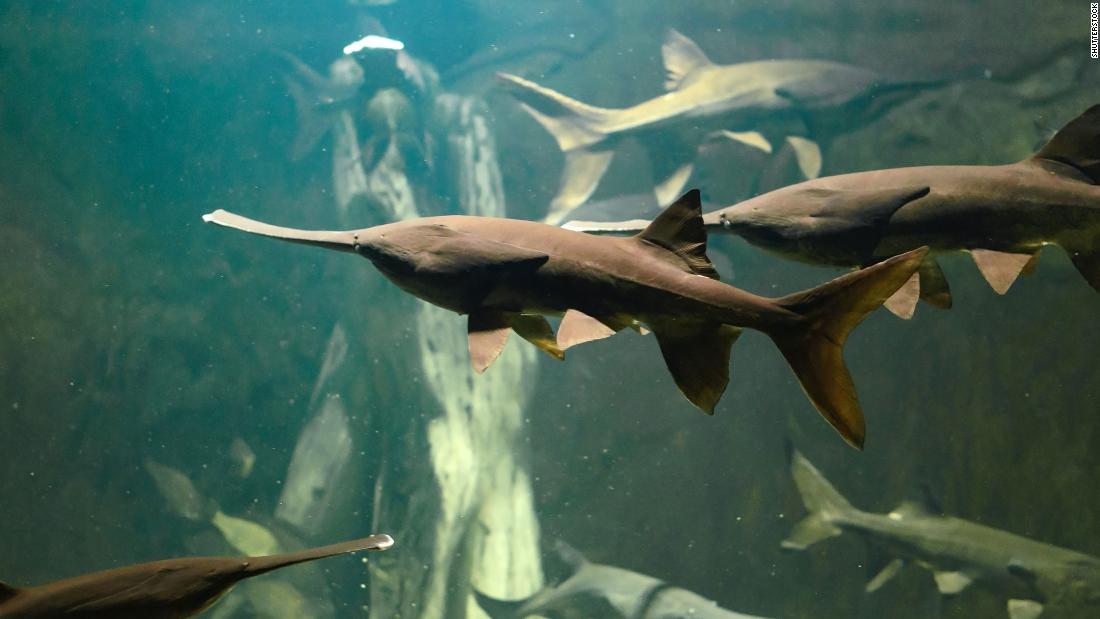
    One of the largest freshwater species, Chinese paddlefish has been declared extinct.

    Chinese paddlefish

    • The Chinese paddlefish (Psephurus gladius) was an iconic species, measuring up to 7 m in length, dating back from 200 million years ago, and therefore swimming the rivers when dinosaurs ruled the Earth.
    • Its ancestral home was the Yangtze River.
    • It was once common in the Yangtze, before overfishing and habitat fragmentation — including dam building — caused its population to dwindle from the 1970s onwards.
    • Between 1981 and 2003, there were just around 210 sightings of the fish. The researchers estimate that it became functionally extinct by 1993, and extinct sometime between 2005-2010.

    How did the study determine that it has gone extinct?

    • Chinese researchers made this conclusion based on the Red List criteria of the International Union for Conservation of Nature (IUCN).
    • The Red List has several categories for extinction, or for how endangered a species is.
    • For example, “extinct in the wild” means a species survives only in a captive environment while “locally extinct” means a species has ceased to exist in a particular area but may exist in other areas.
    • Then there is “functionally extinct”, which means the species continues to exist but it has too few members to enable to reproduce meaningfully enough to ensure survival.
    • To be “globally extinct”, it means a species has no surviving member anywhere. Such a conclusion is reached when there is no reasonable doubt left that its last member has died.

    How does extinction status matters for conservation?

    • Declaring a species extinct is an elaborate process.
    • It involves a series of exhaustive surveys, which need to be taken at appropriate times, throughout the species’ historic range and over a time-frame that is appropriate to the species’ life cycle and form.
    • When these surveys fail to record the existence of any individuals belonging to that species, a species may be presumed to be extinct.
    • Once declared extinct, a species is not eligible for protective measures and conservation funding; therefore, the declaration has significant consequences.
  • Green Credit Scheme

    The Forest Advisory Committee has approved a scheme that could allow “forests” to be traded as a commodity.  FAC is an apex body tasked with adjudicating requests by the industry to raze forest land for commercial ends.

    Green Credit Scheme

    • The proposed ‘Green Credit Scheme’, as it is called, allows agencies — they could be private companies, village forest communities — to identify land and begin growing plantations.
    • After three years, they would be eligible to be considered as compensatory forest land if they met the Forest Department’s criteria.
    • An industry needing forest land could then approach the agency and pay it for parcels of such forested land, and this would then be transferred to the Forest Department and be recorded as forest land.
    • The participating agency will be free to trade its asset, that is plantation, in parcels, with project proponents who need forest land.
    • This is not the first time that such a scheme has been mooted.
    • In 2015, a ‘Green Credit Scheme’ for degraded forest land with public-private participation was recommended, but it was not approved by the Union Environment Minister, the final authority.

    Impact

    • In the current system, industry needs to make good the loss of forest by finding appropriate non-forest land — equal to that which would be razed.
    • It also must pay the State Forest Department the current economic equivalent — called Net Present Value — of the forest land.
    • It’s then the Forest Department’s responsibility to grow appropriate vegetation that, over time, would grow into forests.
    • Industries have often complained that they find it hard to acquire appropriate non-forest land, which has to be contiguous to existing forest.
    • If implemented it allows the Forest Department to outsource one of its responsibilities of reforesting to non-government agencies.

     Individuals outside

    • One of India’s prongs to combat climate change is the Green India Mission that aims to sequester 2.523 billion tonnes of carbon by 2020-30, and this involves adding 30 million hectares in addition to existing forest.
    • Critics held that it does not solve the core problems of compensatory afforestation.
    • It creates problems of privatizing multi-use forest areas as monoculture plantation plots. Forests are treated as a mere commodity without any social or ecological character.
  • Why Australia is killing thousands of camels

    Australia began a five-day cull of up to 10,000 camels, using sniper fire from helicopters. The exercise is taking place in Anangu Pitjantjatjara Yankunytjatjara (called APY Lands) in South Australia state where the animals will be killed according to the “highest standards of animal welfare”.

    Australia’s camel woes

    • Australia is believed to have the largest population of wild camels in the world — over 10 lakh, which is rapidly growing.
    • The herds roam in the country’s inland deserts and are considered a pest, as they foul water sources and trample native flora while foraging for food over vast distances each day.
    • Unless their breeding is controlled, the camel population doubles every nine years.
    • The animals also have a massive carbon footprint, each camel emitting methane equivalent to one tonne of carbon ÂŹdioxide a year.
    • Some in the APY Lands are now demanding legislation that would allow them to legally cull the animals, which could help offset greenhouse emissions.

    Camels from India

    • Camels in Australia, which number over 10 lakh today, were first brought to the continent in the late 19th century from India when Australia’s massive interior region was first being discovered.
    • Over 20,000 were imported from India between the 1840s and the 1900s.

    Why is Australia killing the camels?

    • The year 2019 was the driest and hottest on record in Australia.
    • A catastrophic bushfire season, that began months before usual, has left over 25 people dead and has burned over 1.5 crore acres of land, killing an estimated 100 crore animals.
    • The acute drought has pushed massive herds of feral or wild camels towards remote towns looking for water, endangering indigenous communities.
    • According to South Australia’s environment department, some camels have died of thirst or trampled each other as they rushed to find water.
    • The camels have been threatening scarce reserves of food and water, besides damaging infrastructure and creating a hazard for drivers, authorities have said.
    • The herds have also contaminated important water sources and cultural sites.
  • [pib] Snow and Avalanche Study Establishment (SASE)

    Snow and Avalanche Study Establishment (SASE) has issued an Avalanche warning to Leh in Ladakh region.

    SASE

    • SASE is a laboratory of the Defence Research and Development Organization (DRDO)
    • It is located near Manali, Himachal Pradesh.
    • Its primary function is research in the field of snow and avalanches to provide avalanche control measures and forecasting support to Armed forces.
    • Leh is important as it has two passes namely Chang La and Khardung La with world’s highest motorable roads through them with several avalanche-prone zones.
    • Its utility is also meant for the soldiers in the worlds highest battle filed Siachen, in the region.
  • Species in news: Great Indian Bustard

    Since June last year, nine GIB eggs collected from the Desert National Park in Jaisalmer where a conservation centre has been set up, have hatched, and the chicks are reported to be doing well.

    Great Indian Bustard

    • The Great Indian Bustard, one of the heaviest flying birds, can weigh up to 15 kg and grow up to one metre in height.
    • It is considered the flagship grassland species, representing the health of the grassland ecology.
    • For long, conservationists have been demanding to secure this population, warning that the bird might get extinct in the coming decades.
    • It would become the first mega species to disappear from India after Cheetah in recent times.
    • Till 1980s, about 1,500-2,000 Great Indian Bustards were spread throughout the western half of India, spanning eleven states.
    • However, with rampant hunting and declining grasslands, their population dwindled.
    • In July 2011, the bird was categorised as “critically endangered” by the International Union for Conservation of Nature (IUCN).

    Various threats to GIBs

    I. General threats to GIB

    • Habitat loss & fragmentation, change of land use pattern, desertification, ill-thought plantation of exotic & invasive species in grassland ecosystems are some of the generic causes.
    • Neglect of state institutions due to classification of ‘grasslands’ as ‘wastelands’, conversion of grasslands to agriculture lands due to increasing irrigation potential and decline of nature/GIB-friendly agrarian practices, are all commonly and correctly blamed for the steady decline in India’s GIB population.

    II. Role of Noise Pollution

    • Noise pollution affects the mating and courtship practices of the GIB.
    • The male GIB inflates his ‘gular’ pouch (near the neck) which almost touches the ground, in order to produce a large booming sound which reverberates across the grassland.
    • The male GIB does this to attract GIB females and to inform them of his exact location in the vast expanse of the grassland.
    • Thus, the sound of the male GIB should be loud enough to transcend the walls of the sanctuary and be audible to female GIBs in the fields nearby.
    • The noise generated by human activities, whether be it by vehicles, tractors, music during processions, firecrackers, may interfere with the GIB’s mating call and drown it out.

    III. Other threats

    • The rate of reproduction amongst GIBs is very low; the female GIB lays only one egg per year.
    • This solitary egg is under threat from natural predators of the grasslands such as jackals, hyenas or foxes or invasive species such as crows or feral dogs.
    • In such a scenario, every opportunity the GIBs lose to mate pushes the species closer to extinction.

    Protection Measures

    • Birdlife International uplisted this species from Endangered to Critically Endangered (2011)
    • Protection under CITES Appendix I
    • Protection under Schedule I Wildlife (Protection) Amendment Act 2002
    • Project Great Indian Bustard (Rajasthan):  aims at identifying and fencing off bustard breeding grounds in existing protected areas as well as provide secure breeding enclosures in areas outside protected areas.
  • Miyawaki Method

    Kerala Forest Dept. has adopted Miyawaki afforestation concept to be used in govt. offices, schools and puramboke land.

    Miyawaki Method

    • Miyawaki method is a method of urban afforestation by turning backyards into mini-forests.
    • It includes planting trees as close as possible in the same area which not only saves space, but the planted saplings also support each other in growth and block sunlight reaching the ground, thereby preventing the growth of weed.
    • Thus the saplings become maintenance-free (self sustainable) after the first three years.
    • It helps to create a forest in just 20 to 30 years while through conventional methods it takes anywhere between 200 to 300 years.

    The technique

    • The native trees of the region are identified and divided into four layers — shrub, sub-tree, tree, and canopy.
    • The quality of soil is analysed and biomass which would help enhance the perforation capacity, water retention capacity, and nutrients in it, is mixed with it.
    • A mound is built with the soil and the seeds are planted at a very high density — three to five sapling per square meter.
    • The ground is covered with a thick layer of mulch.