đŸ’„Join UPSC 2027,2028 Mentorship (July Batch) + XFactor Notes & Microthemes PDF

Subject: Conservation & Mitigation

1. Conservation Progs.
2. Worldwide initiatives
3. Mitigation Strategies
4. Conventions and Protocols

  • Ujh Multi-purpose Project


    The Union government has approved a nearly â‚č6,000-crore multi-purpose project for the Ujh multi-purpose project.

    Ujh Multi-purpose Project

    • The project will store around 781 million cubic meters of water of river Ujh, a tributary of river Ravi.
    • It aims to provide uninterrupted water for irrigation to farmers in J&K’s Kathua district and to produce power.
    • After completion of the project, utilization of waters of eastern rivers allotted to India as per the Indus Water Treaty would be enhanced by utilising the flow that presently goes across the border to Pakistan.

    Back2Basics

    Indus Waters Treaty, 1960

    • The IWT is a water-distribution treaty between India and Pakistan, brokered by the World Bank signed in Karachi in 1960.
    • According to this agreement, control over the water flowing in three “eastern” rivers of India — the Beas, the Ravi and the Sutlej was given to India
    • The control over the water flowing in three “western” rivers of India — the Indus, the Chenab and the Jhelum was given to Pakistan
    • The treaty allowed India to use western rivers water for limited irrigation use and unrestricted use for power generation, domestic, industrial and non-consumptive uses such as navigation, floating of property, fish culture, etc. while laying down precise regulations for India to build projects
    • India has also been given the right to generate hydroelectricity through run of the river (RoR) projects on the Western Rivers which, subject to specific criteria for design and operation is unrestricted.

    Present Status of Development

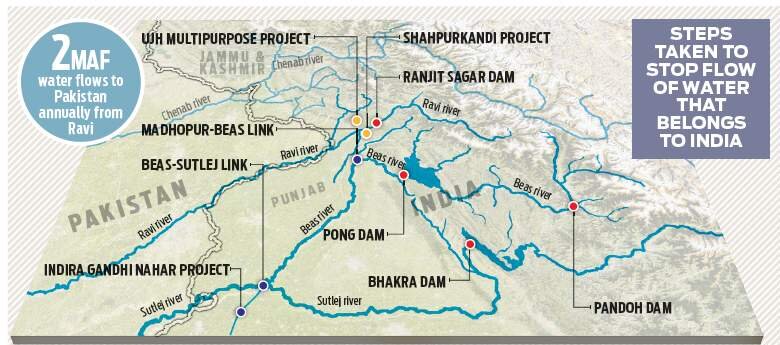
    • To utilize the waters of the Eastern rivers which have been allocated to India for exclusive use, India has constructed Bhakra Dam on Satluj, Pong and Pandoh Dam on Beas and Thein (Ranjitsagar) on Ravi.
    • These storage works, together with other works like Beas-Sutlej Link, Madhopur-Beas Link, Indira Gandhi Nahar Project etc has helped India utilize nearly entire share (95 %) of waters of Eastern rivers.
    • However, about 2 MAF of water annually from Ravi is reported to be still flowing unutilized to Pakistan below Madhopur.
    • The three projects will help India to utilize its entire share of waters given under the Indus Waters Treaty 1960:

    I. Resumption of Construction of Shahpurkandi project

    • It is a dam project under construction on Ravi River.

    II. Construction of Ujh multipurpose project

    • It is a dam project under construction on Ujh, a tributary of Ravi River.

    III. 2nd Ravi Beas link below Ujh

    • This project is being planned to tap excess water flowing down to Pakistan through river Ravi, even after construction of Thein Dam.
    • It aims constructing a barrage across river Ravi for diverting water through a  tunnel link to Beas basin.
  • Species in news: Flame-throated Bulbul

    The flame-throated bulbul, also called the Rubigula, was chosen as the mascot of the 36th National Games to be held in Goa. It is the State bird of Goa.

    Flame-throated Bulbul

    IUCN status: Least Concern

    • The Flame-throated Bulbul is endemic to southern peninsular India where it is locally distributed in southern Andhra Pradesh, eastern Karnataka, Goa, Orissa, eastern Kerala and northern Tamil Nadu.
    • It prefer habitats like rocky, scrub-covered hills mostly in the Eastern Ghats and central peninsular India but also in some places in the Western Ghats.
    • It is a Schedule – IV bird under the Wildlife (Protection) Act, 1972.
  • Plantation Corporation of India

    The Union government is likely to announce the setting up of a Plantation Corporation of India in the upcoming budget.

    Plantation Corporation of India

    • The PCI will subsume all afforestation-related schemes currently underway in India including the Green India Mission, National Afforestation Programme and compensatory afforestation.
    • The corporation will use Compensatory Afforestation Fund (CAF) money to undertake the plantations and investment will also come from the global pension fund.
    • CAF is a huge corpus of money collected from projects proponents for diverting forest land to be used for non-forestry activity.

    Issues with PCI

    • Critics have raised concerns over the move’s impact on the federal structure of forest governance in the country.
    • While forests are a concurrent subject, land-related issues are the responsibility of the states.
  • Reintroduction of African Cheetahs in Indian forests


    The Supreme Court lifted its seven-year stay on a proposal to introduce African cheetahs from Namibia into the Indian habitat on an experimental basis. The plan was to revive the Indian cheetah population.

    Asiatic cheetahs in India

    • In 1947, Maharaja Ramanuj Pratap Singh of Deoghar of Koriya, Chhattisgarh — who was infamous for shooting over 1,150 tigers — reportedly killed the last known Asiatic cheetah in India.
    • In that year, a few miles from Ramgarh village in the state, the Maharaja killed three of the animals — brothers — during a night drive.
    • After that, the Maharaja’s kin continued to report the presence of a few stragglers in the forests of Surguja district, including a pregnant female, up until the late 1960s.
    • Some more unconfirmed sightings were reported in 1951 and 1952, from the Orissa-Andhra Pradesh border and Chittoor district.
    • The latter sighting is generally accepted to be the final credible sighting of a cheetah in India. In 1952, the cheetah was officially declared extinct from India.

    African cheetah and Asiatic cheetah

    • Before Namibia, India had approached Iran for Asiatic cheetahs, but had been refused.
    • The Asiatic cheetah is classified as a “critically endangered” species by the IUCN Red List, and is believed to survive only in Iran.
    • From 400 in the 1990s, their numbers are estimated to have plummetted to 50-70 today, because of poaching, hunting of their main prey (gazelles) and encroachment on their habitat.
    • ‘Critically endangered’ means that the species faces an extremely high risk of extinction in the wild.

    Why does NTCA want to reintroduce cheetahs?

    • A section of conservationists has long advocated the reintroduction of the species in the country.
    • Reintroductions of large carnivores have increasingly been recognised as a strategy to conserve threatened species and restore ecosystem functions.
    • The cheetah is the only large carnivore that has been extirpated, mainly by over-hunting in India in historical times.
    • India now has the economic ability to consider restoring its lost natural heritage for ethical as well as ecological reasons.

    Why was the project halted?

    • The court was also worried whether the African cheetahs would find the sanctuary a favourable clime as far as abundance of prey is concerned.
    • Those who challenged the plan argued that the habitat of cheetahs needed to support a genetically viable population.

    What did court say?

    • The Supreme Court made it clear that a proper survey should be done to identify the best possible habitat for the cheetahs.
    • Every effort should be taken to ensure that they adapt to the Indian conditions.
    • The committee would help, advice and monitor the NTCA on these issues. The action of the introduction of the animal would be left to the NTCA’s discretion.
  • 10 more wetlands from India get the Ramsar site tag

    Ramsar has declared 10 more wetland sites from India as sites of international importance.

    News Ramsar Wetlands

    With this, the numbers of Ramsar sites in India are now 37 and the surface area covered by these sites is now 1,067,939 hectares.

    1. Maharashtra gets its first Ramsar site (Nandur Madhameshwar) ,
    2. Punjab which already had 3 Ramsar sites adds 3 more (Keshopur-Miani, Beas Conservation Reserve, Nangal) and
    3. UP with 1 Ramsar site has added 6 more (Nawabganj, Parvati Agra, Saman, Samaspur, Sandi and Sarsai Nawar).

    Why conserve wetlands?

    • Wetlands provide a wide range of important resources and ecosystem services such as food, water, fibre, groundwater recharge, water purification, flood moderation, erosion control and climate regulation.
    • They are, in fact, are a major source of water and our main supply of freshwater comes from an array of wetlands which help soak rainfall and recharge groundwater.

    Back2Basics

    Ramsar Convention

    • The Convention on Wetlands of International Importance (better known as the Ramsar Convention) is an international agreement promoting the conservation and wise use of wetlands.
    • It is the only global treaty to focus on a single ecosystem.
    • The convention was adopted in the Iranian city of Ramsar in 1971 and came into force in 1975.
    • Traditionally viewed as a wasteland or breeding ground of disease, wetlands actually provide freshwater and food, and serve as nature’s shock absorber.
    • Wetlands, critical for biodiversity, are disappearing rapidly, with recent estimates showing that 64% or more of the world’s wetlands have vanished since 1900.
    • Major changes in land use for agriculture and grazing, water diversion for dams and canals and infrastructure development are considered to be some of the main causes of loss and degradation of wetlands.
  • Biorock technique for Coral Restoration

    The Zoological Survey of India (ZSI), with help from Gujarat’s forest department, is attempting for the first time a process to restore coral reefs using biorock or mineral accretion technology.

    What is Biorock Technique?

    • Biorock is the name given to the substance formed by electro accumulation of minerals dissolved in seawater on steel structures that are lowered onto the sea bed and are connected to a power source, in this case solar panels that float on the surface.
    • The technology works by passing a small amount of electrical current through electrodes in the water.
    • When a positively charged anode and negatively charged cathode are placed on the sea floor, with an electric current flowing between them, calcium ions combine with carbonate ions and adhere to the structure (cathode).
    • This results in calcium carbonate formation. Coral larvae adhere to the CaCO3 and grow quickly.
    • Fragments of broken corals are also tied to the biorock structure, where they are able to grow at least four to six times faster than their actual growth as they need not spend their energy in building their own calcium carbonate skeletons.

    Significance of the move

    • The technology helps corals, including the highly sensitive branching corals, to counter the threats posed by global warming.
    • In 2015, the same group of ZSI scientists had successfully restored branching coral species (staghorn corals) belonging to the family Acroporidae (Acropora formosa, Acropora humilis, Montipora digitata) that had gone extinct about 10,000 years ago to the Gulf of Kachchh.

    Back2Basics

    Coral Bleaching

    • The stunning colours in corals come from a marine algae called zooxanthellae, which live inside their tissues.
    • This algae provides the corals with an easy food supply thanks to photosynthesis, which gives the corals energy, allowing them to grow and reproduce.
    • When corals get stressed, from things such as heat or pollution, they react by expelling this algae, leaving a ghostly, transparent skeleton behind.
    • This is known as ‘coral bleaching’. Some corals can feed themselves, but without the zooxanthellae most corals starve.
  • Threat of Invasive Alien Species in Shola Forests of the Nilgiris


    Shola Forests

    • The Shola forests of South India derive their name from the Tamil word solai, which means a ‘tropical rain forest’.
    • Classified as ‘Southern Montane Wet Temperate Forest’ the Sholas are found in the upper reaches of the Nilgiris, Anamalais, Palni hills, Kalakadu, Mundanthurai and Kanyakumari in the states of Tamil Nadu and Kerala.
    • These forests are found sheltered in valleys with sufficient moisture and proper drainage, at an altitude of more than 1,500 metres.

    Vegetation

    • The upper reaches are covered with grasslands, known as Shola grasslands.
    • The vegetation that grows in Shola forests is evergreen. The trees are stunted and have many branches. Their rounded and dense canopies appear in different colours.
    • Generally, the leaves are small in size and leathery. Red-coloured young leaves turning into different colours on maturity is a prominent characteristic of the Shola forests.
    • Epiphytes like lichens, ferns and bryophytes usually grow on the trees.
    • The occurrence of Himalayan plants like rhododendron in these Shola forests is a mystery.

    Significance of Sholas

    • Sholas thus act as ‘overhead water tanks’. They play a major role in conserving water supply of the Nilgiris’ streams.
    • The trees are slow-growing varieties which produce timber of little or no value and probably take at least a century to mature.
    • The rolling grasslands found on top of the Western Ghats, enhance the beauty of the region. Usually, Shola forests and grasslands are found in a ratio of 1:5.
    • The rain received from the Southwest and Northeast monsoons is harvested by the Shola forest-grassland ecosystem, leading to the formation of the Bhavani river that finally drains into the Cauvery.
    • Thus, the Shola forest-grassland ecosystem of the Nilgiris, also supports the prosperity of Cauvery delta farmers.
    • As tree species of the montane, evergreen forests are flammable, regeneration of any Shola tree species is completely prevented except for Rhododendron nilagiricum, the only Shola tree that can tolerate fire.

    Threats to Sholas

    • Unfortunately, the Sholas have begun to gradually shrink due to the introduction of alien plant species and annual fire occurrences.
    • Alien species like Sticky Snakeroot, Gorse and Scotch Broom introduced during British rule, have encroached upon the grasslands.
    • During 1840, tree species such as Acacia and Eucalyptus were introduced from Australia.
    • Afterwards, between 1886 and 1891, Pine and Cypress were introduced, again from Australia. As the alien species grew, the forests and grasslands gradually became degraded and shrank.
    • In addition, unscientific agricultural practices like growing tea on the slopes, cattle grazing and fuel wood collection have become serious causes for degradation.
    • Unregulated tourism has created concrete jungles, traffic congestion and caused the generation of garbage.

    Wrath of Eucalyptus

    • During 1849, the extent of Shola forests was 8,600 hectares (ha), grasslands 29,875 ha and agriculture was 10,875 ha.
    • No wattle or eucalyptus was planted in the area at that time.
    • The comparison of the results of the 1849 and 1992 studies shows that cultivation of tea, wattle and eucalyptus has reduced the Shola forest-grassland ecosystem to a great extent.

    Protective measures

    • After realizing the seriousness of the situation, the government banned the planting of wattle and eucalyptus completely in 1987.
    • Ecological restoration and biodiversity conservation were given importance.
    • Under the Hill Area Development Programme since the mid-1980s, seedlings have been planted in degraded patches and protected with chain-link fences to restore the forests.
    • Special Shola forest protection committees were formed involving teachers, nature lovers, ecologists, environmentalists, students and villagers in the Nilgiris.
    • They were motivated to remove plastic garbage from the nearby forests, protect Shola trees, remove alien species and learn about the importance of the Sholas.
    • Presently, the Tamil Nadu forest department is now focusing on eradicating wattle, providing fencing and planting shola seedlings in degraded shola forests.
  • Carbon Disclosure Project Report 2019

    The Carbon Disclosure Project (CDP) 2019 report was recently published.

    Carbon Disclosure Project

    • CDP is published by the Global Reporting Initiative.
    • It is aimed at measuring the carbon reduction activities undertaken by different companies and firms operating in various countries across the globe.
    • The report surveys corporate commitments to science-based targets (SBT) and evaluates the climate change risk that they are exposed to.

    India’s performance

    • India secured the 5th spot on the project report.
    • The CDP Report 2019 said that a total of 58 companies shared details about the environment-related activities undertaken by them in this year.
    • The report also claims that over 98 percent of top Indian companies have formed some type or committee or group within its organization to drive and address climate-related issues.
    • The report also showcased the changing mind-set of India Inc with nearly all major companies setting up some form of oversight to evaluate climate risk.

    Global scenario

    • The US topped the annual CDP report with 135 companies disclosing their climate-related activities, followed by Japan in the second position with 83 companies and the UK in the third position with 78 countries.
    • While France was placed fourth with 51 companies disclosing their details, India was placed fifth with 38 companies committing to the science-based targets.
    • In 2018, India had only 25 companies committing to the SBTs.
    • India is followed by Germany and Sweden with 30 and 27 companies respectively, while Switzerland and Spain had 23 and 22 companies respectively.
    • Netherlands was listed 10th on the list with 18 companies committing to SBT initiatives.

    Importance

    • India was ranked 5th, ahead of Germany and Sweden.
    • India is the first developing economy with a maximum number of companies committing to the science-based targets.
  •  [op-ed snap] Global warming puts forests, plantations in the country at risk

    Context

    Global warming, drought and El Niño may lead to increased forest fires.

    The success story of India

    • Reduced deforestation: India has succeeded in reducing deforestation to some extent through an effective Forest Conservation Act and large-scale afforestation programme.
      • Comparison with other countries: India performed better when compared with other forest-rich tropical countries such as Brazil, Indonesia and the Democratic Republic of Congo.
      • Without the Forest Conservation Act and its reasonably effective implementation, India would have lost significant extent of forest area.
    • Increased afforestation: India has also been implementing significant scale afforestation, though the rates of afforestation have declined recently.
      • Agro-forestry, involving raising fruit tree plantations contribute to some extent.
      • Commercial plantations of eucalyptus, casuarina, teak, poplar, etc., have been raised by farmers for commercial purposes.
      • The above steps have resulted in potentially reducing the pressure on natural forests.

    Need to measure ‘natural forest’

    • Increase in an area under forest: According to the latest biennial State of Forest Report (SFR) of the Forest Survey of India (FSI), an area under forests has been increasing.
    • Natural forests not specifically measured: It is not clear what percentage of increase in forest area is due to changes in natural forests which are generally rich in biodiversity.
      • The report doesn’t specify what percentage of change in area is due to commercial plantation and what percentage is contributed by horticulture or urban parks.
    • Need to define ‘natural forest’: What will be of most concern to forest and biodiversity conservation is to understand the status of natural forest and biodiversity.
      • India can use the same definition of forests but must estimate and report the area under natural forests and other forest plantation categories.
      • India needs to define ‘natural forests’ first, further, this would involve additional staff time and resources.
    • The resilience of natural forests to forest fires: Tropical forests rich in biodiversity are likely to be more resilient than monoculture dominated plantations or exotics.
      • Vulnerability to forest fires varies from forests to forests: Studies by the Indian Institute of Science (IISc) have shown that degraded forests, fragmented forests and biodiversity-poor forests are more vulnerable to climate change.

    Climate change and its impacts

    • IPCC reports on large scale loss: The United Nations Intergovernmental Panel on Climate Change (IPCC) reports have repeatedly concluded that climate change will lead to large-scale loss of biodiversity, before the end of the current century or even earlier.
    • Modelling studies by IISc.: Preliminary modelling studies by Indian Institute of Science (IISc) have shown that about 20% of forests will be impacted by climate change.
      • No change to adapt: The modelling studies means that existing forest biodiversity and its structure and composition will not be able to adapt to the new climate and there could be mortality or forest dieback.
    • The threat of forest fires: Further, warming, drought and El Niño will lead to increased forest fires, and may even be favourable to forest pests.
      • Unfortunately, the models currently in use for assessing the impact of climate change are not suitable for the complex and highly diverse forest types that exist in India.

    Conclusions

    • Given that global warming will continue, India will have to brace itself to adapt to the impending impacts. In India, there is very limited research on climate change and its impacts on forests, putting our famed biodiversity-rich country status under threat.
    • India needs to realistically assess, monitor and model climate change and its impacts and be prepared to adapt to impending climate change.
  • Steppe Eagle


    A lone endangered steppe eagle (Aquila nipalensis) has been sighted by a group of birdwatchers in a paddy field near Vijayawada.

    Steppe Eagle

    • The Steppe Eagle is a migratory raptor which has undergone extremely rapid population declines within all its range.
    • It breeds in Russia, Kazakhstan, and Mongolia during the winter season.
    • Steppe eagle is the second-largest migratory eagle species to India.
    • IUCN Status: It has moved from ‘Least Concern’ to ‘Endangered’