💥Join UPSC 2027,2028 Mentorship (July Batch) + XFactor Notes & Microthemes PDF

Subject: History

  • Person in news: Sree Narayana Guru

    The Prime Minister has paid tributes to Sree Narayana Guru on his Jayanti.

    Sree Narayana Guru (1856-1928)

    • Narayana Guru was a philosopher, spiritual leader and social reformer in India.
    • He led a reform movement against the injustice in the caste-ridden society of Kerala in order to promote spiritual enlightenment and social equality.

    His legacy:

    Temple Entry

    • He was in the forefront of the movement for universal temple entry and against the societal ills like the social discrimination of untouchables.
    • He gave the famous slogan “One Caste, One Religion, One God for All”.
    • In 1888, he built a temple dedicated to Lord Shiva at Aruvippuram which was against the caste-based restrictions of the time.
    • In one temple he consecrated at Kalavancode, he kept mirrors instead of idols. This symbolised his message that the divine was within each individual.

    Untouchability

    • The social protest of Vaikom Satyagraha (1924-25) was an agitation by the lower caste against untouchability in Hindu society of Travancore.
    • He taught equality but felt the inequalities should not be exploited to carry out conversions and therefore generate strife in society.

    Philosophy

    • Sree Narayana Guru became one of the greatest proponents and re-evaluators of Advaita Vedanta, the principle of non-duality put forward by Adi Shankara.

    Answer this PYQ:

    Q.Which one of the following pairs does not form part of the six systems of Indian Philosophy?

    (a) Mimamsa and Vedanta

    (b) Nyaya and Vaisheshika

    (c) Lokayata and Kapalika

    (d) Sankhya and Yoga


    [wpdiscuz-feedback id=”k8wz5imcou” question=”Please leave a feedback on this” opened=”1″]Post your answers here.[/wpdiscuz-feedback]

    UPSC 2022 countdown has begun! Get your personal guidance plan now! (Click here)

  • Malabar Rebellion of 1921

    This August 20, marked the centenary of the Malabar rebellion, which is also known as the Moplah riots.

    Try this question from CSP 2020:

    Q. With reference to the history of India, “Ulgulan” or the Great Tumult is the description of which of the following event?

    (a) The Revolt of 1857

    (b) The Mappila Rebellion of 1921

    (c) The Indigo Revolt of 1859-60

    (d) Birsa Munda’s Revolt of 1899-1900


    [wpdiscuz-feedback id=”f3uqp4pzhu” question=”Please leave a feedback on this” opened=”1″]Sign-in to post your answers here.[/wpdiscuz-feedback]

    Malabar Rebellion

    • The Malabar Rebellion in 1921 started as resistance against the British colonial rule and the feudal system in southern Malabar but ended in communal violence between Hindus and Muslims.
    • There were a series of clashes between Mappila peasantry and their landlords, supported by the British, throughout the 19th and early 20th centuries.
    • It began as a reaction against a heavy-handed crackdown on the Khilafat Movement, a campaign in defence of the Ottoman Caliphate by the British authorities in the Eranad and Valluvanad taluks of Malabar.
    • The Mappilas attacked and took control of police stations, British government offices, courts and government treasuries.

    Who was Variyankunna Kunjahammed Haji?

    • He was one of the leaders of the Malabar Rebellion of 1921.
    • He raised 75000 natives, seized control of large territory from the British rule and set up a parallel government.
    • In January 1922, under the guise of a treaty, the British betrayed Haji through his close friend Unyan Musaliyar, arresting him from his hideout and producing him before a British judge.
    • He was sentenced to death along with his compatriots.

    UPSC 2022 countdown has begun! Get your personal guidance plan now! (Click here)


    Also read

    Important Rebellion

  • Person in news: Maharaja Ranjit Singh

    A bronze statue of the first ruler of the Sikh Empire, Maharaja Ranjit Singh, was vandalized in Pakistan.

    Who was Maharaja Ranjit Singh?

    • Maharaja Ranjit Singh (13 November 1780 – 27 June 1839), popularly known as Sher-e-Punjab or “Lion of Punjab”, was the first Maharaja of the Sikh Empire.
    • He survived smallpox in infancy but lost sight in his left eye.
    • Prior to his rise, the Punjab region had numerous warring misls (confederacies), twelve of which were under Sikh rulers and one Muslim.
    • Ranjit Singh successfully absorbed and united the Sikh misls and took over other local kingdoms to create the Sikh Empire.
    • He repeatedly defeated invasions by outside armies, particularly those arriving from Afghanistan, and established friendly relations with the British.

    Empirical expansion

    • Ranjit Singh’s trans-regional empire spread over several states. His empire included the former Mughal provinces of Lahore and Multan besides part of Kabul and the entire Peshawar.
    • The boundaries of his state went up to Ladakh — Zorawar Singh, a general from Jammu, had conquered Ladakh in Ranjit Singh’s name — in the northeast.
    • His empire extended till Khyber pass in the northwest, and up to Panjnad in the south where the five rivers of Punjab fell into the Indus.
    • During his regime, Punjab was a land of six rivers, the sixth being the Indus.

    His legacy

    • Ranjit Singh’s reign introduced reforms, modernization, investment into infrastructure, and general prosperity.
    • His Khalsa army and government included Sikhs, Hindus, Muslims, and Europeans.
    • His legacy includes a period of Sikh cultural and artistic renaissance, including the rebuilding of the Harmandir Sahib in Amritsar, Takht Sri Patna Sahib, Bihar, and Hazur Sahib Nanded, Maharashtra under his sponsorship.

    UPSC 2022 countdown has begun! Get your personal guidance plan now! (Click here)

  • Karez System of Irrigation

    The Taliban are set to seize Kabul, but some expert believes they will spare the age-old Karez system of underground aqueducts in the country given its importance.

    What is a Qanat / Karez?

    • This system of underground vertical shafts in a gently sloping tunnel that is built from an upland aquifer to ground level.
    • Some historians and archaeologists have attributed people in the southeast Arabian Peninsula as the first developers. Others, however, ascribe it to the ancient Persians.
    • The Qanat / Karez system, wherever it was developed, soon spread to many Persian, Arab and Turkic lands.
    • It even came to the Indian Subcontinent during the 800-year-old Islamic Period.

    Karez in India

    • The system was brought in the Indian Subcontinent during the Bahamani Sultanate, founded by Alaudin Bahman Shah.
    • It later broke into five other Sultantates: Bijapur, Golconda, Ahmadnagar, Bidar and Berar.
    • The Bahamani Sultanate was Persianate in nature and encouraged many things Persian, among them, the Karez.
    • They was built in the city of Bidar during the reign of Bahamani Sultan Ahmad Shah Wali (1422-1436), who shifted the capital from Gulbarga to Bidar.
    • By the 15th century, Bijapur city had a network of pipelines. Everyone got 24×7 supply of water.
    • It also worked as confidence-building measure between the Sultan and his subjects since the Karez was built the state.

    Try answering this PYQ:

    With reference to the economic history of medieval India, the term Araghatta’ refers to:

    (CSP 2016)

    (a) bonded labour

    (b) land grants made to military officers

    (c) waterwheel used in the irrigation of land

    (d) wastel and converted to cultivated land


    [wpdiscuz-feedback id=”gc5xdagqcc” question=”Please leave a feedback on this” opened=”1″]Post your answers here.[/wpdiscuz-feedback]

    UPSC 2022 countdown has begun! Get your personal guidance plan now! (Click here)

  • [pib] Quit India Movement

    The Prime Minister has greeted the nation on the eve of the anniversary of Quit India Movement Day.

    Before proceeding, answer this PYQ:

    Q. Quit India Movement was launched in response to:

    (a) Cabinet Mission Plan

    (b) Cripps Proposals

    (c) Simon Commission Report

    (d) Wavell Plan

    [wpdiscuz-feedback id=”g2gx8acc0a” question=”Please leave a feedback on this” opened=”1″]Post your answers here: [/wpdiscuz-feedback]

    About the day

    • The Quit India Movement is also known as the Bharat Chhodo Andolan was launched by Mahatma Gandhi on August 8, 1942, at the Bombay session of the All India Congress Committee (AICC).
    • The movement demanded an end to British rule in India.
    • Since the protest was held in August, it also went on to be known as August Kranti or August Movement.
    • The ‘Do or Die’ speech was etched in the hearts of Indians, and many faced the consequences of the movement.
    • Every year, the day is celebrated by paying tribute to freedom fighters who laid their lives for the country.

    Quit India Movement

    • The movement began on August 8, 1942, with its foundations being laid back in 1939 when the Governor-general of India was Lord Lilingthow.
    • In 1942, Staford Cripps was sent to India by the British Establishment to negotiate with the leaders of the All India Congress Committee for gaining their support in exchange for their freedom.
    • July 1942- The Quit India Movement Resolution was passed at the Wardha Conference of All India Congress Committee.

    Series of events

    • Mahatma Gandhi delivered his speech at Mumbai’s Gowalia Tank Maidan, also called August Kranti Maidan, on 08th August 1942.
    • Gandhi Ji was arrested and jailed at Pune’s Aga Khan Palace and his wife Kasturba Gandhi, Sarojini Naidu and secretary Mahadev Desai.
    • Many other senior members of the Indian National Congress were also arrested, including Jawaharlal Nehru and Abul Kalam Azad, and were kept in the Yerwada Jail.
    • The British Government banned the Congress Committee declaring it an unlawful association.
    • Aruna Asaf Ali, popularly known as the ‘Grand Old Lady’ of the Independence Movement, hoisted the National Flag at Mumbai’s Gowalia Tank Maidan.
    • This event was followed by an uproar among the people and the emergence of several young leaders such as Ram Manohar Lohia, JP Narayan, SM Joshi, and others who continued to fuel the fire of the movement throughout India during the period of World War II.

    Causes of the Movement

    • Involvement of India in World War II without prior consultation with the leaders: The Indian Nationalists were disgruntled with the Governor-General of India, Lord Linlithgow, as he brought India to the verge of World War II without consulting them.
    • Failure of Cripps Mission: The British sent Stafford Cripps to India to gain the cooperation of India, which failed because the Cripps Mission offered India not complete freedom but the Dominion Status to India, along with the partition. After the failure of Cripps Mission, the Indian Nationalist Leaders knew that the Britishers were in no mood to amend the Constitution before the end of World War II.
    • Shortage of essential commodities: There was widespread discontent due to the shortage of essential commodities and rising prices of salt, rice, etc., and commandeering of boats in Bengal and Orissa. There were fears that the Britishers would follow a scorched earth policy in Assam, Bengal, and Orissa in reaction to the advancement of the Japanese. The Economy also shattered as a result of World War II.
    • Prevalence of anti-British sentiment: The sentiments were widely anti-British, and the masses were demanding complete independence from the British Government.
    • Centralization of many small movements: The Ground for the movement was already prepared by various associated and affiliated bodies of the Congress, like Forward Bloc, All India Kisan Sabha, and others. They were leading the mass movements on a much more radical level for more than two decades. The also channelized many militant outbursts, which were happening at several places in the country.

    Phases of Quit India Movement

    The Quit India Movement can be viewed in three phases from its inception to end. The phases are as follows:

    1. First phase: The first phase or the inception of the movement had no violence. It began with civil disobedience, boycotts, strikes that the British Government quickly suppressed. Almost all members of the Congress Committee, including Gandhiji, were arrested and kept in Jail till 1945 without any trial.
    2. Second phase: In its second phase, the movement shifted to the countryside. The second phase of the movement took a violent and aggressive turn. Any building or offices which were the symbol of the colonial authority was attacked and distracted. Communication systems, railway stations & tracks, telegraph poles and wires were also targeted.
    3. Third and last phase: In the last phase of the movement, there was the formation of many independent national or parallel governments in the isolated pockets of the country, such as Ballia, Satara, Tamluk, etc.

    Successes

    • Women empowerment: Aruna Asif Ali hoisted the national flag on the Gowalia tank maidan; Usha Mehta, on the other hand, helped set up the underground radio station to spread awareness about the movement.
    • Rise of future leaders : This movement also gave some future prominent leaders such as Biku Patnaik, Aruna Asif Ali, Ram Manohar Lohia, Sucheta Kriplani, J.P. Narayan, etc. These leaders were helping the movement through underground activities.
    • Rise of nationalism: A greater sense of unity and brotherhood emerged due to the Quit India Movement. Many students dropped out of schools and colleges, people gave up their jobs and withdrew money from the banks.

    Failure of the movement

    The movement did not have the support of many organizations of the country itself.

    • The Britishers were supported by the Princely States, British Indian Army, Indian Civil Services, Viceroy’s Council (which had Indians in the majority), All India Muslim League, Indian Imperial Police.
    • The Hindu Mahasabha, Rashtriya Swayamsevak Sangh (RSS) & Muslim League also opposed the Quit India Movement.
    • Many Congress members like C Rajagopalachari resigned from the provincial legislature as they did not favor Mahatma Gandhi’s idea.
  • Who was Dara Shikoh (1615-1659)?

    The final resting place of Mughal prince Dara Shikoh remains a mystery, with the Archaeological Survey of India saying it has not located the grave within the Humayun’s Tomb complex.

    Dara Shikoh

    • Dara Shikoh, who was Mughal emperor Shah Jahan’s son and expected heir, was killed on the orders of his brother Aurangzeb in 1659 after losing the war of succession.
    • He was the eldest son and heir-apparent of the Mughal emperor Shah Jahan.
    • Dara was designated with the title Padshahzada-i-Buzurg Martaba (Prince of High Rank) and was favored as a successor by his father and his older sister, Princess Jahanara Begum.
    • In the war of succession which ensued after Shah Jahan’s illness in 1657, Dara was defeated by his younger brother Prince Muhiuddin (Aurangzeb).
    • He was executed in 1659 on Aurangzeb’s orders in a bitter struggle for the imperial throne.

    His legacy

    • Dara was a liberal-minded unorthodox Muslim as opposed to the orthodox Aurangzeb.
    • He authored the work The Confluence of the Two Seas, which argues for the harmony of Sufi philosophy in Islam and Vedanta philosophy in Hinduism.
    • It was Dara Shikoh who was responsible for making the Upanishads available to the West as he had them translated.
    • He had commissioned a translation of Yoga Vasistha.
    • A great patron of the arts, he was also more inclined towards philosophy and mysticism rather than military pursuits.
    • The course of the history of the Indian subcontinent, had Dara Shikoh prevailed over Aurangzeb, has been a matter of some conjecture among historians.

    Q.Who among the following Mughal Emperors shifted emphasis from illustrated manuscripts to album and individual portrait?

    (a) Humayun

    (b) Akbar

    (c) Jahangir

    (d) Shah Jahan

    [wpdiscuz-feedback id=”wxdghzxxyf” question=”Please leave a feedback on this” opened=”1″]Answer this PYQ here: [/wpdiscuz-feedback]

  • Dholavira gets into UNESCO World Heritage list

    The Harappan city of Dholavira, in present-day Gujarat, has been named the 40th Indian site on UNESCO’s World Heritage list.

    Dholavira site

    • The IVC acropolis is located on a hillock near present-day Dholavira village in Kutch district, from which it gets its name.
    • It was discovered in 1968 by archaeologist Jagat Pati Joshi.
    • The site’s excavation between 1990 and 2005 under the supervision of archaeologist Ravindra Singh Bisht uncovered the ancient commercial city.

    Key features

    • It is one of the very few well preserved urban settlements in South Asia dating from the 3rd to mid-2nd millennium BCE.
    • It was located in the island of Khadir which was strategic to harness different mineral and raw material sources (copper, shell, agate-carnelian, steatite, lead, banded limestone, among others).
    • It facilitated internal as well as external trade to the Magan (modern Oman peninsula) and Mesopotamian regions.
    • One finds the origin of the Buddhist Stupas in memorials in Dholavira.

    A gem in the IVC acropolis

    • After Mohen-jo-Daro, Ganweriwala and Harappa in Pakistan and Rakhigarhi in Haryana of India, Dholavira is the fifth largest metropolis of IVC.
    • The site has a fortified citadel, a middle town and a lower town with walls made of sandstone or limestone instead of mud bricks in many other Harappan sites.
    • While unlike graves at other IVC sites, no mortal remains of humans have been discovered at Dholavira.

    Its architecture

    • The city demonstrates its multifaceted achievements in terms of urban planning, construction techniques, water management, social governance and development, art, manufacturing, trading, and belief system.
    • The property comprises two parts:
    1. A walled city: Consists of a fortified Castle with attached fortified Bailey and Ceremonial Ground, and a fortified Middle Town and a Lower Town
    2. A cemetery to the west of the city

    Trade and commercial activities

    • Remains of a copper smelter indicate of Harappans, who lived in Dholavira, knew metallurgy.
    • It is believed that traders of Dholavira used to source copper ore from present-day Rajasthan and Oman and UAE and export finished products.
    • It was also a hub of manufacturing jewellery made of shells and semi-precious stones, like agate and used to export timber.
    • Such beads peculiar to the Harappan workmanship have been found in the royal graves of Mesopotamia, indicating Dholavira used to trade with the Mesopotamians.

    Famous for water conservation

    • The expansive water management system designed to store every drop of water available shows the ingenuity of the people to survive against the rapid geo-climatic transformations.
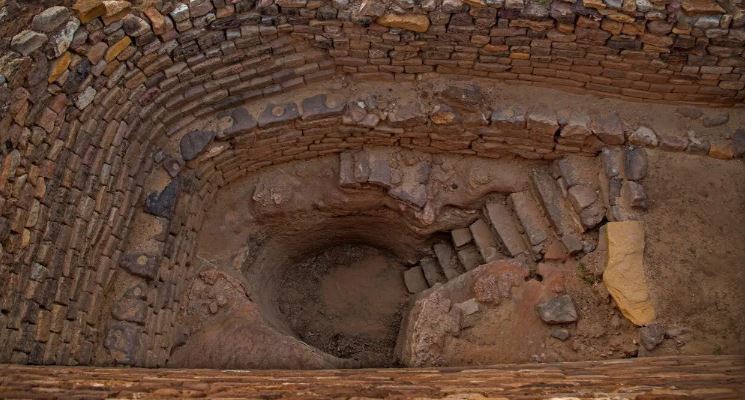
    • Water diverted from seasonal streams, scanty precipitation and available ground was sourced, stored, in large stone-cut reservoirs which are extant along the eastern and southern fortification.
    • To further access water, few rock-cut wells, which date as one of the oldest examples, are evident in different parts of the city, the most impressive one being located in the citadel.
    • Such elaborate water conservation methods of Dholavira is unique and measures as one of the most efficient systems of the ancient world.

    Causes for its decline

    • Harappans, who were maritime people, lost a huge market, affecting the local mining, manufacturing, marketing and export businesses once Mesopotamia fell.
    • From 2000 BC, Dholavira entered a phase of severe aridity due to climate change and rivers like Saraswati drying up.
    • Because of a drought-like situation, people started migrating toward the Ganges valley or towards south Gujarat and further beyond in Maharashtra.
    • In those times the Great Rann of Kutch, which surrounds the Khadir island on which Dholavira is located, used to be navigable, but the sea receded gradually and the Rann became a mudflat.

    Other Harappan sites in Gujarat

    • Before Dholavira was excavated, Lothal, in Saragwala village on the bank of Sabarmati in Dholka taluka of Ahmedabad district, was the most prominent site of IVC in Gujarat.
    • It was excavated between 1955 and 1960 and was discovered to be an important port city of the ancient civilisation, with structures made of mud bricks.
    • From a graveyard in Lothal, 21 human skeletons were found. Foundries for making copperware were also discovered. Ornaments made of semi-precious stones, gold etc. were also found from the site.
    • Besides Lothal, Rangpur on the bank of Bhadar river in Surendranagar district was the first Harappan site in the state to be excavated.
    • Rojdi in Rajkot district, Prabhas near Veraval in Gir Somnath district, Lakhabaval in Jamnagar, and Deshalpar in Bhuj taluka of Kutch are among other Harappan sites in the state.

    Answer this PYQ in the comment box:

    Q.Which one of the following is not a Harappan site? (CSP 2019)

    (a) Chanhudaro

    (b) Kot Diji

    (c) Sohgaura

    (d) Desalpur

    Also read:

    Telangana’s Rudreswara Temple inscribed as a World Heritage Site

  • Telangana’s Rudreswara Temple inscribed as a World Heritage Site

    India’s nomination of Rudreswara Temple, (also known as the Ramappa Temple) at Palampet, Mulugu district, near Warangal in the state of Telangana has been inscribed on UNESCO’s World Heritage list. This would be the 39th site in India.

    Also read:

    [pib] Declaration of World Heritage Sites by UNESCO                 

    Rudreswara Temple

    • The Rudreswara temple was constructed in 1213 AD during the reign of the Kakatiya Empire by Recharla Rudra, a general of Kakatiya king Ganapati Deva.
    • It is also known as the Ramappa temple, after the sculptor who executed the work in the temple for 40 years.
    • The main temple is flanked by the collapsed structures of the Kateshwarayya and Kameshwarayya temples in Palampet, about 220 km from Hyderabad.
    • An inscription dates the temple to 1135 Samvat-Saka on the eighth day of Magha (January 12, 1214).

    Its architecture

    • The temple, known for its exquisite craftsmanship and delicate relief work, is a savvy blend of technical know-how and materials of its time.
    • The foundation is built with the “sandbox technique”, the flooring is granite, and the pillars are basalt.
    • The lower part of the temple is red sandstone while the white gopuram is built with light bricks that reportedly float on water.
    • The temple complexes of Kakatiyas have a distinct style, technology, and decoration exhibiting the influence of the Kakatiyan sculptor.
    • The temple stands on a 6 feet high star-shaped platform with walls, pillars, and ceilings adorned with intricate carvings that attest to the unique skill of the Kakatiyan sculptors.
    • European merchants and travelers were mesmerized by the beauty of the temple and one such traveler had remarked that the temple was the “brightest star in the galaxy of medieval temples of the Deccan”.

    Surviving through ages

    • According to the temple priest, some of the iconography on the temple was damaged during the invasion of Malik Kafur in 1310.
    • Treasure hunters vandalized the rest
    • But the biggest test for the temple was an earthquake in the 17th century (one of the biggest was that of 7.7-8.2-magnitude on June 16, 1819).

    Answer this PYQ in the comment box:

    Q.Which one of the following was a very important seaport in the Kakatiya kingdom? (CSP 2017)

    (a) Kakinada

    (b) Motupalli

    (c) Machilipatnam (Masulipatnam)

    (d) Nelluru


    Back2Basics: UNESCO World Heritage Sites

    • A World Heritage Site is a landmark or area, selected by the UN Educational, Scientific and Cultural Organization (UNESCO) for having cultural, historical, scientific, or other forms of significance, which is legally protected by international treaties.
    • The sites are judged to be important for the collective and preservative interests of humanity.
    • To be selected, a WHS must be an already-classified landmark, unique in some respect as a geographically and historically identifiable place having special cultural or physical significance (such as an ancient ruin or historical structure, building, city, complex, desert, forest, island, lake, monument, mountain, or wilderness area).
    • It may signify a remarkable accomplishment of humanity, and serve as evidence of our intellectual history on the planet.
    • The sites are intended for practical conservation for posterity, which otherwise would be subject to risk from human or animal trespassing, unmonitored/uncontrolled/unrestricted access, or threat from local administrative negligence.
    • The list is maintained by the international World Heritage Program administered by the UNESCO World Heritage Committee, composed of 21 “states parties” that are elected by their General Assembly.

    UNESCO World Heritage Committee

    • The World Heritage Committee selects the sites to be listed as UNESCO World Heritage Sites, including the World Heritage List and the List of World Heritage in Danger.
    • It monitors the state of conservation of the World Heritage properties, defines the use of the World Heritage Fund, and allocates financial assistance upon requests from States Parties.
    • It is composed of 21 states parties that are elected by the General Assembly of States Parties for a four-year term.
    • India is NOT a member of this Committee.
  • Festival in news: Harela Festival

    Villagers across Uttarakhand celebrated Harela, a festival of greenery, peace, prosperity and environmental conservation.

    Harela Festival

    • Harela means ‘day of green’ and is celebrated in the month of Shravan (the fifth month of the Hindu lunar calendar) to worship Lord Shiva and Goddess Parvati.
    • People across Uttarakhand, especially the Kumaun region, associate greenery with prosperity.
    • The seeds of five to seven types of crops —  maize, til (sesame), urad (black gram), mustard, oats —  are sown in donas (bowl made of leaves) or ringalare (hill bamboo baskets) nine days before the festival.
    • They are harvested on the ninth day and distributed to neighbours, friends and relatives.
    • The flourish of the crops symbolizes prosperity in the year ahead.
    • People make clay statues of Lord Shiva and Goddess Parvati, known as Dikare, and worship them a day before the festival.
    • Harela is also linked to the Barahnaza system (12 types of crops), a crop diversification technique followed in the region.

    Answer this PYQ in the comment box:

    Q.Consider the following pairs:
    Tradition: State
    1. Chapchar Kut: festival Mizoram
    2. Khongjom Parba ballad: Manipur
    3. Thang Ta dance: Sikkim
    Which of the pairs given above is/are correct?

    (a) 1 only
    (b) 1 and 2
    (c) 3 only
    (d) 2 and 3

  • When were Tilak and Gandhi tried under the Sedition Law?

    Recently, Chief Justice of India N V Ramana observed that the “colonial law” was used by the British to silence Mahatma Gandhi and Bal Gangadhar Tilak.

    Must read:

    Sedition Law and its discontents

    Use of sedition law through history

    • According to the LOC blog, the first known instance of the application of the law was the trial of newspaper editor Jogendra Chandra Bose in 1891.
    • Other prominent examples of the application of the law include the trials of Tilak and Gandhi.
    • Apart from this, Jawaharlal Nehru, Abul Kalam Azad and Vinayak Damodar Savarkar were also charged with sedition.

    When was sedition law used against Gandhi and Tilak?

    • In 1922, Gandhi was arrested on charges of sedition in Bombay for taking part in protests against the colonial government.
    • He was sentenced to six years in prison but was released after two years because of medical reasons.
    • Before Gandhi, Tilak faced three trials in cases related to sedition and was imprisoned twice.
    • He was charged with sedition in 1897 for writing an article in his weekly publication called Kesari and was sentenced to 12 months imprisonment.
    • He has tried again in 1908 and was represented by MA Jinnah. But his application for bail was rejected and he was sentenced to six years.
    • The second time he was tried was also because of his writings, one of which referred to the murder of European women in Muzzafarpur when bombs were thrown by Bengali revolutionaries.
    • Interestingly, the judge who announced Tilak’s sentence in the second trial, Justice DD Davar, had represented him in his first trial in 1897.