đŸ’„Join UPSC 2027,2028 Mentorship (July Batch) + XFactor Notes & Microthemes PDF

Subject: Trivia

  • UPSC Pre 2015 Results Are Declared. Download the PDF NOW

    The UPSC Pre 2015 Results are OUT!

    Download the PDF from this linkCLICK HERE.


    Did you make it through? A lot of you guys are mailing us with queries on the cutoffs! It seems a bit odd that even people speculating it the range of 105+ could not make it in the final list.

    What to do next after Prelims Results? Read this post on your next steps

    Wish to start afresh? Read the ultimate guide from Aspirant to IAS Officer

  • The Importance of Answer Writing for IAS Mains


    Update: Participate in the FREE Target Mains initiative going over at CD – Click Here

    We cannot stress more upon the importance of the answer writing for IAS Mains, but let’s take you step by step on questions which an IAS aspirant face when he plans to go for it.

    All of you must have read articles/books/notes on various topics. And all of you must be having some favourite writers over the other. Agreed, Civil Services is not about choosing the potential writers rather the administrators but truth be told, writing is the only way the examiner evaluates the level of your understanding of various topics, your ability to deal with unexpected questions and eventually your potential as a civil servant.

    Believe me civil servants have to do a lot of writing, from file notings to blogs and they do it meticulously. Short, simple, pertinent.

    Now look at the importance of writing from another angle. Suppose you are brilliant reader and have mugged up all the books available and are invincible in any debate on any topic. But unfortunately the UPSC has no place for group discussion in the selection process. You have to write.

    Let us break down the entire thing into the following heads:

    #1. When should be start practicing writing?

    Many suggest that first one should wait till he/she has enough knowledge of all the topics and then start practicing writing. ‘Enough’ knowledge of all the topics? And when is that going to be? Two months before the Mains or one month before the Mains? And then you shall start writing for 4-5 hours daily. But then who will read the newspapers? Who will revise the notes/books? Who will take the tests?

    The answer writing practice has to go hand-in-hand with your preparation. There shall never be one fine day when you shall stop reading and start writing thereupon. This exam is way above such stereotypical compartmentalization. Once you start preparing star writing. If not full-fledged time-bound answers then at least start scribbling. Ponder over a topic and see if you can generate some relevant points. Get into this habit so that in the examination hall you can generate some points for questions for which you have only a faint idea.

    Moreover you shall have to write about 8,000-10,000 words in a single day during the Mains exam and if you have not cultivated a habit of writing over a period of time, writing itself might become insurmountable obstacle between you and a place in the final list.

    #2. What should one write?

    If you lament that you understand how important it is writing and you really, like really, want to write but do not know what to write, then you are not alone.

    7 out of 10 candidates who set down to the task of writing face this problem. And interestingly, each one of you know the answer. Read a topic, frame a question on it yourself and write. If you cannot frame a question, use the heading of the article add a suitable word like ‘discuss’, ‘explain’, ‘comment’ and write the answer. And of course practice question from previous year papers as well.

    #3. What should be the level of our writing?

    Far from Shakespearean. Your writing should reflect the maturity of a civil servant. What does that mean? It means your writing should be free from grammatical errors, misspellings, sentences of disproportionate length, bombastic words, bluff, irrelevant facts and figures. Do break down the answer into paragraphs or points, as you may choose.

    If you are using a quote, please don’t change or rearrange its words.

    #4. Should we use flowcharts and/or diagrams?

    If you can find time for it do it. But don’t do it just because you have a target of using two flowcharts/diagrams in each answer. Flowcharts/diagrams should facilitate the examiner go through your answer and not over shadow it.

    #5. Paragraph or Point-wise writing

    There is perhaps one question which has no authoritative answer. Number of toppers who shall vouch for paragraph writing and those siding with writing in points abound. The current topper favoured the point-wise writing. Let us see if we can infer something about this debate from what we are witnessing.

    Firstly, from 2013, UPSC started this trend of asking 20-25 questions in each paper of GS requiring a candidate to write about 4000-5000 words in each paper and it is quite an uphill task even if you know the answer to all of them.

    Probably one of the reason behind increasing the number of questions and limiting the space available to write an answer is to ensure that candidates do not get a chance to write frivolous things and just write the pertinent points if they have to attempt all questions!

    Secondly, an important departure was that while introducing this pattern UPSC took it upon itself to tell the students that “Contents of the answer are more important than its length.”

    Thirdly, the marks scored by the topper in last two years have hovered around 50-55 percent than the usual 60-65 percent of the previous years. What I see here is a pattern of ‘ruthless’ marking by the examiners wherein they are more interested in candidate writing more relevant points instead of writing few points subsumed under paragraphs. Somehow they seem to have taken the ‘content more important than length’ instruction too seriously and are not interested in the superficial answers. And we shall all agree that if we have more information to provide in the answer, point-wise writing is more relevant. We tend to use paragraphs where we have few points which we hide though the paragraphs and then underline them so that the examiner is inveigled into believing that we not only wrote points but also wrote using good enough number of words. But I guess UPSC this time conducted a country-wise exam to choose the examiners who can see through such tactics!

    But again the question remains unanswered. Paragraph or points? To be honest, I have no yes or no answer to this. Choose the style that’s suits you. As they say this exam is an individual exam and one topper’s strategy might be suicidal for another.

    Any questions? I would love to help you guys out!

  • CD’s Guide to IAS Prep: From Aspirant to IAS Officer

    Yoda’s most memorable quote, bar none, and one of the greatest in all of Star Wars holds quite true for all civil service aspirants (irrespective of their stage of preparation). And it goes something like this –

    LUKE SKYWALKER: Master, moving stones around is one thing. This is totally different!
    YODA (irritated): No! No different! Only different in your mind. You must unlearn what you have learned.
    LUKE (focusing, quietly): All right, I’ll give it a try.


    If you are doing it, DO IT. Don’t pretend doing it.

    Civil Services Preparation (IAS/ UPSC Prep) has been veritably described as a ‘life changing process’, ‘a journey of transformation’, ‘a quest of excellence’ and what not!

    But truth be told, preparing for Civil Services can only mean 2 things:

    1. A wholehearted effort to become a Civil Servant or
    2. An equally wholehearted effort to waste best years of one’s life.

    So, If you are doing it, DO IT, don’t pretend doing it. Fair Enough? Let’s jump onto the roadmap then!


    The 3 Kinds of IAS Aspirants


    It is important to understand your stage in the Life Cycle of an IAS Aspirant so that you plan your onward strategy accordingly. Let’s take a closer look:


    #1. The Idealists/ College goers


    There is something about these idealists that is very disconcerting for the aam aadmi students. They are the benchmarks of the societies – the sharmaji ke bachche who constitute the bedrock of the society (in your parents’ eyes). They grew up reading Dominique Lapierre’s Freedom At Midnight and devoured Hindu for breakfast!

    If you identify yourself with this category, you have got a few of things correct. You need to meticulously build your base and play on your strong points.

    If you are in college, do not sweat it out in vain. No point joining any regular classes or diving into the subject books as of now. Just be more aware. Read these few articles to get a flavor of what lies ahead –


    1. Be a regular at the Civilsdaily’s Android App: It’s FREE, FOREVER and we take due care with summarising UPSC relevant news articles for you. Everyday.
    2. A Beginner’s Guide on How to Clear IAS: These 5 commandments will do well to get you started with the IAS Prep
    3. 3 Key Points on How to Read Newspapers for IAS Prep: Newspapers hold an important significance – more so in the changing times
    4. Understanding the IAS Prelims Syllabus: Start reading with what UPSC expects of you in the Prelims Exams
    5. Need Motivation? Read these posts on some Amazingly Badass Civil Servants:
    6. Recommended Memoirs of Famous Bureaucrats: To keep your spirits high among other things!


    #2. The Wildcard Entrants


    Remember TVF’s Pitchers?

    “Is desh ke graduates apni 9-5 jobs se bore hone lagte hain toh bahar nikalne ke liye keval 3 raste dikhte hain: MBA, IAS & Start-up.”
    (“When graduates of this country get bored of their 9-5 jobs, they look up to only 3 options : MBA, IAS & Start-up.”)

    Since you are joining the party late, you have a lot of lost opportunities (and syllabus) to cover! If you are juggling IAS preparation along with job, you might be biting a lot more than you can chew! In that case, these few articles can come in handy before you make up your mind and scale up your efforts to take an extended sabbatical from your corporate life –

    1. Along with CD’s Android App updates, be a regular at one national daily – Hindu or Indian Express. Live Mint is very good for its article on Economics and Business Standard may be referred for some heavy gyan (but it is avoidable).
    2. Know Thy Syllabus:
    3. Choose your Optional Wisely: We do not have authoritative articles on how to go about that but we will be inviting UPSC Rankers to share their strategies.
    4. Coaching: To do or not to do? – Read the pros and cons of self study/ coaching
    5. Importance of Writing Practice? Everything you need to know about answer writing for IAS Mains
    6. Test Series for Pre & Mains? [to be published]
    7. Analyse the Previous Year UPSC Prelims:
    8. Analyse Previous Year UPSC Mains Examination [to be published]


    #3. The Nirvana Seekers


    They have weathered all storms, seen one too many pattern changes, possibly even attended a few LIVE interview and are still sticking it out for that magical double digit rank. For them,

    Winning isn’t everything, it’s the only thing.

    What do we have for you? 

    1. Go through our neatly curated News Stories in full: Since you already have a good understanding of current affairs in general – you will be able to appreciate and gain from our connected news stories.
    2. Run through our CD Explains at the CD Hub: Revise and build upon your basics as we try our best to break down complex news for you.
    3. Importance of Writing Practice? [to be published]
    4. Test Series for Pre & Mains? [to be published]
    5. What beyond UPSC? In a rare case that you run out of time or attempts – what should you do to prepare yourself for the bumps ahead? [to be published]

    This page will be frequently updated. Share this among your friends and relatives who might benefit from this.

  • The Concept of Currency Devaluation & The Chinese Move: Part #2

    This theme has been covered in 2 parts. Read the Part #1, here.


    Before, we proceed to understand the current move, let’s put some light on the background:

    During 1997, most of East Asian countries witnessed financial crisis. This led China to devalue its currency in order to encourage its exports.

    During 2005-06, China had come back to market-determined exchange rates , but later shifted to managed exchange rates.

    Now, let’s take a look at how the recent events unfolded

    Currently, Chinese economy is witnessing slowdown, due to dip in exports.
    Do keep in mind, that China is export-oriented economy, unlike US which is more of consumption-based economy.


    Now, let’s explore the Chinese move.

    Technically, it is depreciation because China has allowed market forces to operate in determining the exchange rates. This is the reason, you may find at times, newspaper writing depreciation.

    Now, the obvious question, why is it called devaluation ?

    Because, Central Bank of China determines when the market forces will play their role.

    Basically, before the this move, Chinese currency was a managed exchange rates, i.e. Central Bank decided the exchange rates.

    As China knew that its currency will depreciate due to economic slowdown, so it allowed market forces to operate, i.e. China withdrew from currency exchange market.

    Now, let’s dive deep into the issue.

    Few questions, which may surface into your mind, that China could have simply devalued its currency. Why does it want market forces to play a role in determining the exchange rate.

    What are the intentions behind such a move ?

    Since Chinese economy is heavily dependent on exports, therefore China wanted to make its exports cheaper & thereby boost its exports.

    China has been demanding from long time, that its currency Yuan, be made a global reserve currency at IMF.

    Now, why would IMF reject such a demand?

    Actually, IMF is a vocal supporter of free market economy, but, Chinese currency was managed by its Central Bank. Therefore, IMF rejected the demand to include Yuan in SDR.

    This was the reason Chinese central bank allowed market forces to play their role.

    Lets understand, Why would China want Yuan to be included in IMF.

    1. When a currency becomes part of SDR, then every country’s Central Bank would hold those currencies as part of their FOREX.
    2. This makes a Yuan a hard currency.
    3. Politically, a country has a major role to play in IMF, once its currency becomes part of SDR.

    Now let’s come to India, the biggest question, what will be the impact on India.

    • We are losing out in export markets with respect to China, as some common exports on which we are competing with China such as textile are facing the heat.
    • As Chinese products will become cheaper in India too, the industries aligned to domestic markets, will also face the pressure.
    • The indirect impact is that many FPI’s are moving out of India, to China and US.

    Published with inputs from Pushpendra
  • UPSC Syllabus | GS Paper 3 | IAS Prep


    UPSC Syllabus for GS Paper 3 with Infographics [250 marks]


    Read the IAS Mains - GS Paper 1 Syllabus already? Click Here.
    Read the IAS Mains - GS Paper 2 Syllabus already? Click Here.

    The Civil Services Main examination is designed to test the academic talent of the aspirant, also his/her ability to present his/ her knowledge in a clear and coherent manner.

    The Main Examination is intended to assess the overall intellectual traits and depth of understanding of candidates rather than merely the range of their information and memory.

    Economics & Enviro are the mainstay of this GS Paper 3. While we can say that Economics will be an interesting read, not much can be said about Environment & Biodiversity. The other 3 topics form a relatively small segment of this paper and are mostly covered at the end of time (which is a euphemism for last month of IAS Mains).


    #1. Indian Economy


    1. Indian Economy and issues relating to planning, mobilization of resources, growth, development and employment.
    2. Inclusive growth and issues arising from it.  
    3. Government Budgeting.
    4. Major cropping patterns in various parts of the country, different types of irrigation and irrigation systems  storage, transport and marketing of agricultural produce and issues and related constraints; e-technology in the aid of farmers.
    5. Issues related to direct and indirect farm subsidies and minimum support prices; Public Distribution System– objectives, functioning, limitations, revamping;  issues of buffer stocks and food security; Technology missions;  economics of animal-rearing.
    6. Food processing and related industries in India– scope and significance, location, upstream and downstream requirements, supply chain management.
    7. Land reforms in India.
    8. Effects of liberalization on the economy, changes in industrial policy and their effects on industrial growth.
    9. Infrastructure: Energy, Ports, Roads,  Airports, Railways  etc.
    10. Investment models

    Civilsdaily.com focuses on Current Economics News here – Stories @Economics


    #2. Environment & Biodiversity


    #3. Science & Tech

    1. Science and  Technology – developments and their applications and effects in everyday life.
    2. Achievements of Indians in science & technology; indigenization of technology and developing new technology.
    3. Awareness in the fields of IT, Space, Computers, robotics, nano-technology, bio-technology and issues relating to intellectual property rights.

      #4. Disaster Management

    It forms an integral part of Environment & BioD. So, beyond policy and institutional maneuvers (by Center and State), you won’t have to focus on anything separately.


    #5. Internal Security 

    1. Linkages between development and spread of extremism.
    2. Role of external state and nonstate actors in creating challenges to internal security.
    3. Challenges to internal security through communication networks, role of media and social networking sites in internal security challenges, basics of cyber security; money-laundering and its prevention.
    4. Security challenges and their management in border areas;linkages of organized crime with terrorism.
    5. Various Security forces and agencies and their mandate.


    What’s with all the hashtags?

    1. We are thinking of adding sub categories to news and explainers which we put forth.
    2. What that will do is bring more focus to your preparation and give you more context on current affairs.
    3. While we do make efforts to make current affairs easy and approachable – that still leaves a LOT and LOT of current affairs to be covered! Hence, in our continued efforts on making “complex news, easy” – we will try out this experiment.
    4. The Civilsdaily’s Android App however will still carry the same old broad categories. Don’t want to create a clutter of categories everywhere!

    Anything that you would love to share? or Propose?

    PS: We will be sharing the pdfs of these infographics in a short while.


  • The Concept of Currency Devaluation & The Chinese Move

    This theme will be covered in 2 parts. You are reading the Part 1.

    Recently, China devalued its currency and there was so much hue and cry across the world markets. Let us try to understand these complex processes, and the implications of Chinese move.


    Broadly speaking, what is currency devaluation?

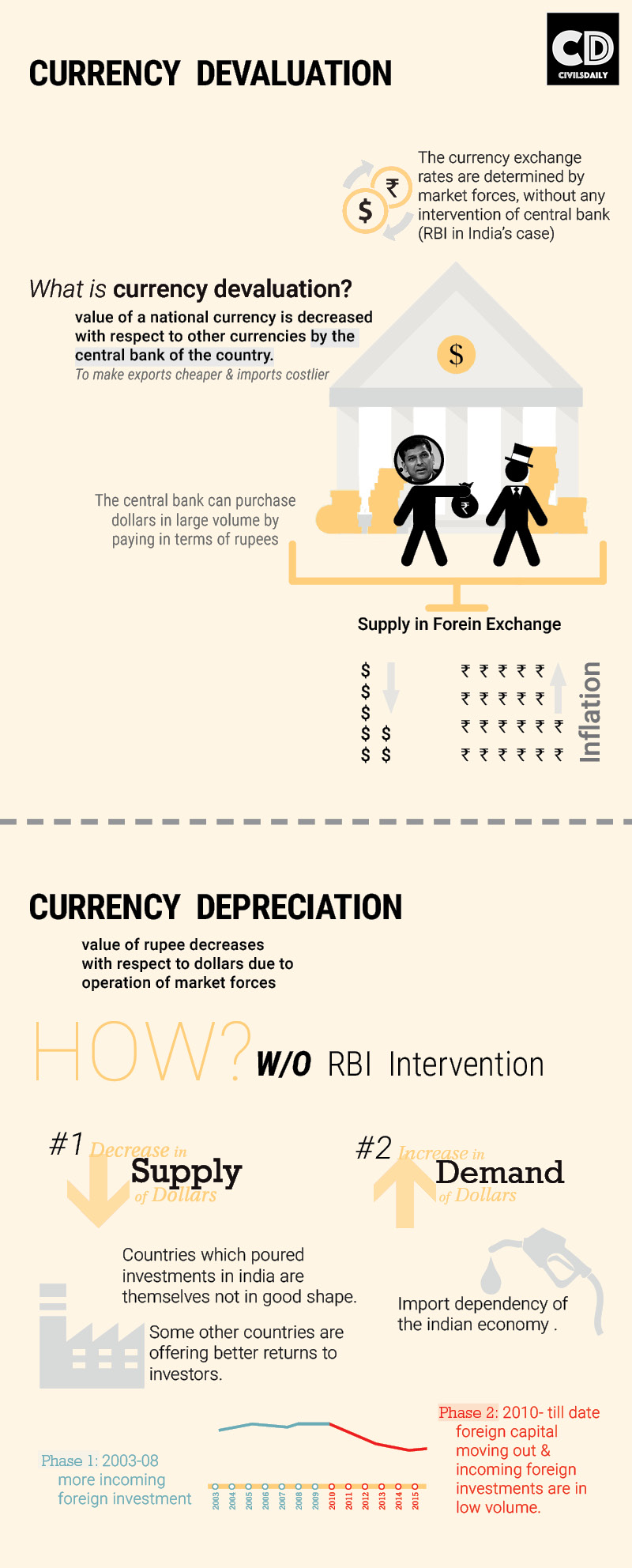
    Under currency devaluation, the value of a national currency is decreased with respect to other currencies by the central bank of the country.

    Before, we delve into the concept of devaluation, lets explore how does currency exchange rates are determined normally. The currency exchange rates are determined by market forces, without any intervention of central bank (RBI in India’s case). <Central Bank and RBI will be used interchangeably in India’s case>


    Now, we will try to understand the process of Devaluation, how it actually happens.

    So, the basic condition for devaluation to happen is that RBI has to become a player in the foreign exchange market.

    Before, we move further, lets explore who all are the players in the forex market. They are importers, exporters, investors & some dealers who deal in foreign exchange (for example exchange banks).

    What will central bank do in the foreign exchange market ?
    The central bank will change the supply of dollars in the market.

    How does it change the supply of dollars in the market?
    The central bank goes to these exchange banks & it will purchase the dollars in large volume by paying in terms of rupees. This will lead to decrease in supply of dollars.

    Now, lets understand the negative implications of such a move.
    As RBI paid in terms of rupees while purchasing dollars, it will increase the money supply in the market, leading to inflation.

    Therefore, devaluation is accompanied with selling of govt. securities.

    RBI can devalue rupee by selling it to purchase dollars in the forex market. It makes exports cheaper & imports costlier & therefore a solution to BOP crisis.


    CURRENCY DEPRECIATION:

    It is a market driven process , determined by market forces.
    Under this, the value of rupee decreases with respect to dollars due to operation of market forces.

    How do the market forces act?

    There are two ways/ causes for currency depreciation :

    #1. Decreases in supply of dollars – without RBI intervention

    This is a very realistic situation that india faced over last few years , when the foreign capital was moving out & foreign investment were not coming in huge volume.

    What could be the reasons? Countries which poured investments in india are themselves not in good shape. Some other countries are offering better returns to investors.

    Phase 1 : 2003-08 – more incoming foreign investment
    Phase 2 : 2010- till date – foreign capital moving out & incoming foreign investments are in low volume.

    #2. Increase in demand of dollars without RBI intervention

    The basic reason behind this is the import dependency of the indian economy .
    This is a traditional reason for depreciation of our currency , since we have been a net import based economy from long time.


    PS: There is another interesting blog on the same topic, written by an economics professor @Civilsdaily – Nursery Rhymes, SDRs and Devaluation of the Yuan

    While you are at it, you might want to read this as well – The Great Fall of China


  • US ke paas Google hai, China ke paas Alibaba hai, India ke paas Kya hai?

    Start-Up India Initiative has been doing the rounds for over a month now and going by the knack of the UPSC to pick-up fancy terms, let’s see if we can deep dive on this topic.


    From the ramparts of the historic Red Fort, Prime Minister announced the “Start-Up India, Stand-up India” to encourage entrepreneurship and job creation.

    Start-Up India aims to make India the hub for the “Start-Ups”.
    However, it is pertinent to discuss the roadblocks to this ambitious plan given that about 80% of the Start-Ups in India fail and also the opportunity it presents if all goes as per the plan.


    We may discuss the issue under the following heads:

    1. Regulatory impediments
    2. Risk aversion
    3. Funding Issues
    4. Gestation Period
    5. Need for Start-Ups
    6. Entrepreneurial SkillSet/ Aptitude
    7. Opportunity to absorb the young work force
    8. Role in making India developed by 2022, the PM’s mission

    Let’s start then!


  • 5 Simple Tips Which Can Turbocharge Your Reading Speed

    Just look at this picture, and tell me one thing. What if you need to revise the entire pile of books in just 5 days, because the 6th day is your doom’s day? You need to finish so you crack your IAS, okay?


    Yes! Of course I know, you people aren’t much bothered to read or memorise stuff. Even if it is the IAS exam, you hallucinate and hope some magic to happen that you remember all the stuff in the examination hall. But here’s an option! How about being able to remember everything on your own and let your confidence be the real magic that can hit the ‘bingo’ point?

    The IAS exam comes with a lot to memorise and nobody can escape that.

    You know what – There are a hell lot of ways in which you could memorise faster, without making you sit bored for hours long. The most important thing being, pacing up your reading speed. If your reading speed is pathetic, you’ll 100% get bored of finishing that entire syllabus or even revising it on the eve of your exam. On the contrary, what if you develop a great speed for reading? That’ll definitely help you retain those facts faster. Not only faster, but you could even revise the portion if you cut out that time of reading.

    Say – reading a page as this one takes you 4 minutes, what if it could get done in around 2.5 minutes? You could read more, even retain more in your brain which you think is just too small.

    So, there you go with some great ways to help you improve upon your reading speed.


    #1. STOP TALKING TO YOURSELF WHILE READING

    • While you read mutely, you tend to speak those words internally and that makes your jaws move. This puts a control on the speed of reading. The speed decreases as you clearly try to utter each word in your mind.
    • Rather, while reading in mind, stop your mind from pronouncing those words clearly internally. Skipping these clear utterances will make you run through the words faster, ending your reading session waay faster by 2/3 times.

    #2. COVER THE WORDS YOU’VE ALREADY READ


    • Covering the words you’ve already read with your palm or a ruler helps, as your eyes don’t keep moving around those extra words that are unnecessary. Covering them will help you to focus on what you’re actually supposed to read.

    #3. MAKE LESSER EYE MOVEMENTS

    • If the next words are familiar, the brain decides to move your eyes in a way that you can read faster. Training your eyes to move directly to the familiar words helps you read the entire page quickly, as you jump through and understand quickly.

    #4. UNDERSTAND EYE MOVEMENTS

    • Don’t give jerks to your eyes while reading. Let your eyes read the words naturally and smoothly all throughout the line. Make fewer movements of your eyes while reading all the words in a line.

    #5. TRUST YOUR BRAIN

    • To improve reading speed, you have to start trusting your brain. If you can start trusting your brain more, you will definitely have an easier time breaking your old reading habits and learning new ones. This is because without your brain you could not have come as far as you’ve come already.
    • Every step of the way, your brain has been right alongside you. And whether you believe it right now or not, your brain is fully capable of understanding all the information you read. Don’t just panic because it is the nervousness that tends to make you forget things you have read. Be calm and trust your memory power for a very effective quick learning.

    So, that’s it.

    I gave you enough tips to work upon your reading speed. All you need to crack an IAS exam is, a good memory, which would come with a great reading speed. Of course, common sense and intelligence stand two of the main concerns.
    Good luck! Hope you’ll have a happy speed – read.


    P.S. – Reading faster is not everything. Read fast, and UNDERSTAND your facts. Because, only if both are added, you get enough to clear an exam such as IAS. Not only could you get passing marks, but also finish any Harry Potter in 2 days! But I really hope you get extra time, from your IAS related readings!


    Want to get the best out of Civilsdaily?

  • Why does Dengue Wreck Havoc in Delhi’s Backyard?


    What is Dengue?

    According to the World Health Organisation, Dengue is a vector-borne disease transmitted by the bite of an infected female Aedes Aegypti mosquito.

    The mosquito becomes infected when it feeds on the blood of a person infected with the virus. After about one week, the mosquito can then transmit the virus while biting a healthy person.

    How many strains of dengue are there?

    There are 4 serotypes of the virus that causes dengue. These are known as DEN-1, DEN-2, DEN-3, DEN-4.

    Infection with one strain will provide life-time protection only against that particular strain. However, it is still possible to become infected by other strains and develop into severe dengue.

    You might not be grilled by UPSC in Mains but in case you are a doctor, this might come in handy during interviews!

    Can it spread from person to person?

    Dengue cannot be spread directly from person to person. However, a person infected and suffering from dengue fever can infect other mosquitoes.

    Where does dengue happen?

    Most cases occur in tropical areas of the world, including the Indian subcontinent, Southeast Asia, Southern China, Taiwan, the Pacific Islands, the Caribbean, Mexico, Africa, Central and South America.

    What are the symptoms of dengue?

    Dengue causes flu-like symptoms and lasts for 2-7 days. Dengue fever usually occurs after an incubation period of 4-10 days after the bite of the infected mosquito.

    High Fever (40°C/ 104°F) is usually accompanied by at least two of the following symptoms: headaches, pain behind eyes, nausea, vomiting, swollen glands, joint, bone or muscle pains and rash.


    What happens in severe dengue?

    Severe abdominal pain, persistent vomiting, bleeding gums, vomiting blood, rapid breathing, fatigue/ restlessness.

    What is the treatment for dengue?

    There is no vaccine or specific medication for dengue fever. Patients should seek medical advice, rest and drink plenty of fluids.

    Paracetamol can be taken to bring down fever and reduce joint pains. However, aspirin or ibuprofen should not be taken since they can increase the risk of bleeding.

    Patients who are already infected with the dengue virus can transmit the infection via Aedes mosquitoes after the first symptoms appear.

    As a precautionary approach, patients can adopt measures to reduce transmission by sleeping under a treated net especially during the period of illness with fever.

    What should I do if I suspect I have dengue?

    If you suspect you have dengue you need to see a doctor immediately. To diagnose dengue fever, your doctor will:

    1. Evaluate your signs and symptoms
    2. Test your blood for evidence of a dengue virus
    3. Review your medical and travel history

    Who spreads dengue and severe dengue?

    Dengue is spread through the bite of the female mosquito (Aedes aegypti). The mosquito becomes infected when it takes the blood of a person infected with the virus. After about one week, the mosquito can then transmit the virus while biting a healthy person.

    The mosquito can fly up to 400 meters looking for water-filled containers to lay their eggs but usually remains close to the human habitation.

    Aedes aegypti is a daytime feeder: The peak biting periods are early in the morning and in the evening before dusk.

    Aedes aegypti has evolved into an intermittent biter and prefers to bite more than one person during the feeding period. This mechanism has made Aedes aegypti a very highly efficient epidemic vector mosquito.

    Where do the mosquitoes breed?

    The mosquitoes thrive in areas close to human population (urban areas).

    The dengue mosquito lays its eggs in water-filled containers inside the house and surrounding areas of dwellings (this includes non-used bottles, containers, discarded waste, tyres etc.which hold water).

    The eggs hatch when in contact with water. Eggs can withstand very dry conditions and survive for months. Female mosquitoes lay dozens of
    eggs up to 5 times during their lifetime.

    Some Technological research areas to control Dengue

    #1. Insecticide-treated materials

    Insecticide-treated materials (ITMs) consist of long-lasting insecticidal nets, curtains and wall hangings. Bednets have proved highly effective in
    preventing diseases transmitted by nocturnally active mosquitoes.

    Insecticide-treated window curtains and sheet covers can also reduce dengue vector densities and transmission.

    In studies in Mexico and Venezuela, ITMs (particularly curtains) were well accepted by the communities as their efficacy was reinforced by
    the reduction of other biting insects as well as cockroaches, houseflies and other pests.

    #2. Lethal ovitraps

    Ovitraps or oviposition traps collect the eggs laid by the mosquitoes which develop into larva, pupa and adult mosquitoes.

    Lethal ovitraps (which incorporate an insecticide on the oviposition substrate), autocidal ovitraps (which allow oviposition but prevent adult
    emergence), and sticky ovitraps (which trap the mosquito when it lands) have been used on a limited basis. Studies have shown that population densities can be reduced with sufficiently large numbers of frequently-serviced traps.

    #3. Genetically-modified mosquitoes

    There are two methods of reducing disease transmission using genetics:

    Population suppression: reduce mosquito population such that it would not be able to sustain pathogen transmission. This includes sterility,
    reduced adult longevity, or decrease larva/pupa survival.

    Population replacement: Reduce inherent ability to transmit the pathogen. Mating will alter the genetic pool of the wild population.

    And now to the main question: What are the reasons for Dengue in Delhi?

    The reason for the temporal shift, say experts, is the erratic weather and rainfall that the country has witnessed this year.

    Many scientists are in agreement that a combination of higher mean temperature in a region and high humidity fosters higher rates of dengue transmission and incidence.

    Usually when it rains, the rainwater flushes away stagnant pools that act as sites for mosquito breeding. This year, we saw rainfall early in the season which was followed by long dry spells during which there has been high humidity, especially in Delhi.

    This has enabled a shift from the usual trend of dengue transmission that we have observed and the virus has struck parts of the country earlier than usual.

    So, are there sufficient resource management in Delhi? or does it again shows a huge mismanagement crisis?

    Published with inputs from Arun
  • Debating Santhara: The Right to Death

    What is Santhara?

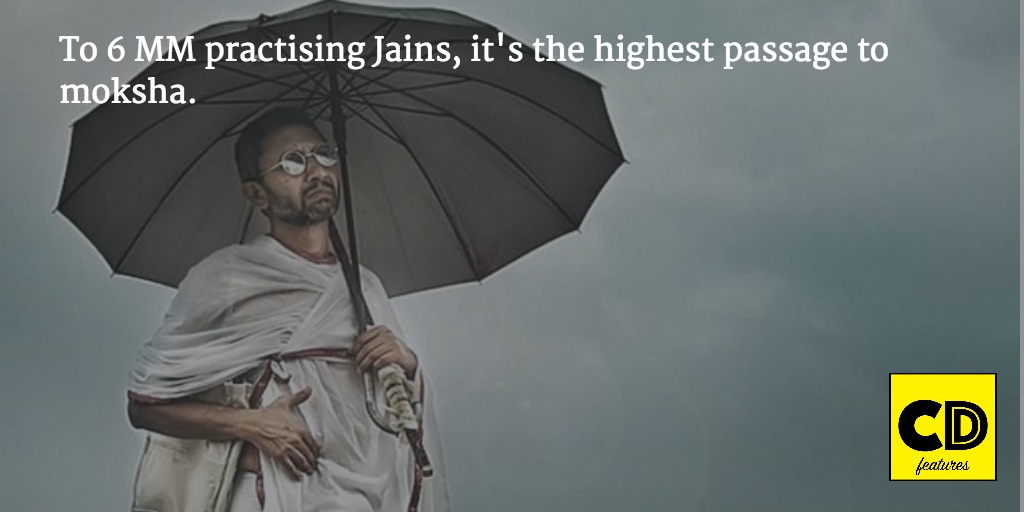
    Santhara also called as Sallekhana, Samadhi-marana, Sanyasana-marana, is the Jain ritual practice of facing death voluntarily at the end of one’s life.

    What’s so significant about this practice?

    1. From Jain community, Santhara, is believed to have been practised since the foundation of Jainism and finds mention in its agams (religious texts).
    2. The Pratikramana Sutra in Shravaka Anuvrata (the code of conduct for Jains) clearly explains santhara, saying that when all purposes of life have been served, or when the body is unable to serve any more purpose, a person can opt for it.

    Then, why do some people oppose it?

    1. Human rights activists alleged that it’s a social evil, and old people are made to undertake Santhara by family members who don’t want to look after them for a variety of reasons.
    2. The petition in the High Court compared the practice with that of Sati.

    Okay, so how did it all started? When did the case come up before the Rajasthan High Court?

    1. In 2006, Jaipur-based lawyer Nikhil Soni filed a public interest litigation and sought directions under Article 226 to the central and state governments to treat Santhara, the fast unto death practised by Swetambara Jains (Digambars call it Sallekhana), as illegal and punishable under the laws of the land.
    2. Calling it suicide and, therefore, a criminal act, the PIL also sought prosecution of those supporting the practice for abetment to suicide.
    3. The PIL argued that death by Santhara was not a fundamental right under Article 25 (freedom of conscience and free profession, practice and propagation of religion), because it violated the right to life guaranteed under Article 21. It argued that religious freedom is subject to public order, morality and health.

    What did the High court say in its order?

    1. The Bench said that it was not established that Santhara or Sallekhana is an essential practice of the Jain religion. Jain scriptures or texts don’t say that moksha (salvation) can be achieved only by Santhara.
    2. According to the judges, it was one thing to argue that Santhara is not suicide, and quite another to say that it is a permissible religious practice protected by Articles 25 and 26.
    3. The court asked the state to stop the practice in any form, and directed that any complaint made in this regard be registered as a criminal offence in accordance with Section 309 (attempted suicide) or Section 306 (abetment to suicide) of the IPC.

    So many articles cites, so much legalities brought into the picture! So, what did the Jain Community say?

    1. Jain community defends that, Santhara is an ancient religious practice aimed at self-purification.
    2. The vow of Santhara/Sallekhana is taken when all purposes of life have been served, or when the body is unable to serve any purpose of life. It is not the giving up of life, but taking death in their stride.

    How did the Jain community react to the judgment? What line have the Rajasthan, Madhya Pradesh and central governments taken?

    1. No government has articulated an official line, but politicians, including ministers, have criticised the judgment.
    2. Members of the Jain community took to the streets immediately by organising protest rallies.
    3. On August 24, the community took out massive silent rallies in several cities and towns. In meetings held before the rallies, members of the community openly criticised the judges, calling them ignorant and disrespectful of religious practices.

    How does constitution interpret this issue? <and this is the part which should be important for an IAS Aspirant>

    1. The preamble to the Constitution states that the Constitution secures to all its citizens liberty of thought, expression, belief, faith and worship.
    2. Article 25 guarantees that every person in India shall have freedom of conscience and a right to profess, practice and propagate religion.
    3. Article 29 goes further and declares that any section of citizens having a distinct culture shall have a right to conserve the same. If any law comes in conflict with constitutional rights, it will have to yield.”

    Relief from SC judgement?
    The Supreme Court restored the Jain religious practice of a ritualistic fast unto death by staying an order of the Rajasthan High Court, which compared it to an act of suicide.

    Some philosophical issues which spring out of this debate

    This has been a debate that pits state versus individual; law versus custom; and the right to life versus the right to choose the outcome of one’s own life.

    1. In the context of law the issue is presented as a conflict of rights, that is, between the right to freedom of religion and the right to life. When posed in this way, Santhara comes to be cast as a ritual or a religious practice, an action, rather than a way of knowing and being.
    2. It is framed as a choice to die rather than as a fast unto freedom, expressed in terms such as “she left her body” as opposed to “she died” or that “she is dead.”
      The practice exemplifies how the subject or self is regarded as continuing to exist and flourish long after it leaves the body, rather than as coming to an end.
    3. This practice cannot be compared to Sati, as some have done, arguing that it is coerced and mainly forced upon women. Not only is the vow made by both men and women in the Jain community, the fast is undertaken by the concerned subject for self-realisation, and not for some dead husband or for the sake of honour, self sacrifice, and all the other hugely problematic reasons given to justify violent acts towards women through the language of familialism and sacrality.

    Have other religious practices faced legal challenges earlier?

    1. Bal Diksha, the controversial practice in which children as young as 8 years take diksha to become ‘Bal Munis’, a role that requires them to observe a strict, regimented lifestyle, has been challenged in the courts.
    2. Case was filed in Goa against a naked Digambar monk for obscenity. When an amendment in the Wildlife Protection Act was proposed to ban domestic trade of peacock feathers, the community feared that monks would be stopped from carrying peacock feathers.
    3. The community is also against a ban on open defecation because that is the way some monks answer nature’s call.

    So, what’s your opinion on Santhara ritual? It’s curse or sacred in fundamental nature of ritual?


    Published with inputs from Arun