💥Join UPSC 2027,2028 Mentorship (July Batch) + XFactor Notes & Microthemes PDF

Author: B2B

  • Problem of Non Performing Assets in India

    Non-Performing Assets

    An NPA is a loan or advance for which the principle or interest payment remained overdue for a period of 90 days.

    Banks are further required to classify NPA into:

    Key Facts about India’s NPA Problem

    • The financial position of India’s Public Sector Banks has deteriorated sharply since 2011.
    • Gross NPA has risen to 9.5 percent of total advances in 2015-16.
    • Gross NPA has expected to rise further and touch 11.5 percent in coming years.
    • At the aggregate level, PSBs reported a loss of 17672 crores in 2015-16.
    • Most of the loans were made during the boom period of 2004-2008.
    • The banks inspired by the boom kept on lending to business houses without inspecting the projects.
    • When Global Crisis happened, the projects become unviable, and losses started to happen.
    • Healthy Banking relies on healthy debt contracts. A debt contract is an agreement between a borrower and a lender, where the borrower promises to repay the lender principle with interest as per scheduled timeline. If the borrower can not repay, he is in default.
    • In India, most of the defaulters in recent years are not the small retail borrowers but are large borrowers and corporate houses.
    • Across the World, when a borrower defaults irrespective of how big he is, the borrower has to make sacrifices if he defaults. Sacrifices can be in terms of asset confiscation, taking over of firms etc.
    • The biggest problem in India’s Banking system is lack of incentives the big borrower has to repay the loans back. They do not have to make many sacrifices if they default. This is the single most major reason of the NPAs in Public Sector Banks.
    • In much of the Globe when large borrower defaults they are filled with guilt and desperate to convince their lenders that they should continue their trust in them.
    • In India, however, large borrower insists on their divine right to stay in control despite their unwillingness to put in new money. The firms and its workers, as well as past bank loans, are taken as hostages in this game. The promoters threaten to run the enterprise into the ground unless the government do not bail them out.

    Reasons for NPAs

    How to Tackle Problem of NPAs

    Resolving the NPA Problem

    • The legacy of the NPAs must be resolved as quickly as possible so that banks can focus on resuming lending.
    • Some assets that are classified as Loss assets should be written off from banks books.
    • The new Bankruptcy code can be a game changer but will take time to operationalise.
    • In many cases, the projects can be turned around through a combination of fresh capital from investors and new management.
    • RBI has devised two schemes in this regard: the Strategic Debt Restructuring Scheme, which allows the bank to convert their debts into equity, take control of the company and then induced a new management to turn it around.
    • Action has been initiated under the SDR, but no successful revival has been completed so far.
    • The second RBI scheme is the Scheme for Sustainable Structuring of Stressed Assets (S4A) under which bank can offer existing management an opportunity to rehabilitate the project by dividing the debt into two parts: a “sustainable component” which can be serviced by the project based on some assumption by revenue and the “excess component” which can be converted into equity or redeemable preference shares.
    • Sustainable debt must be more than 50% of the total debt.
    • S4A leaves the project in the hands of existing managements and also gives the banks more flexibility in the time taken to resolve the problem. A key issue is how large a part of the debt is deemed to be sustainable. Management and banks are bound to differ on this issue.
    • There is much talk of selling assets to privately managed asset reconstruction companies (ARCs), which can then organize the turnaround.
    • Another idea is that the proposed National Infrastructure and Investment Fund (NIIF), operating with private partners, provide both equity and new credit to stressed infrastructure projects going through the SDR mechanism.
    • The problem could be solved by creating a government-owned “bad bank” which purchases problem loans from the banks and concentrates on turning the projects around, possibly with the help of private ARCs.
    • Bank managements will be much more willing to sell assets at a discounted price to another public sector company, which will then undertake the task of negotiating the best deal with potential new owners. The terms of reference of the new entity can be sufficiently clarified to encourage it to negotiate the best possible deal with new private managements. It could work in partnership with ARCs to fulfil this mandate.

    Improving the Quality of Lending

    • The quality of lending by PSB must be improved in future so that the same problem does not arise again.
    • To provide Public sector banks with greater autonomy the shareholding of the government can be reduced to less than 50 percent or 33 percent.
    • The P.J. Nayak committee had suggested that if the dilution of shareholding is not acceptable, it should be possible to distance the government from the managements of the banks by creating a public sector holding company and vesting the government’s shares in the holding company. Some statements have been made that this may be acceptable and the newly created Banks Board Bureau is the first step in this direction.
    • There are two key elements in any effort to distance government. One is that the public sector banks should deal with only one regulator, RBI, and the extensive quasi-regulatory control exercised by the department of financial services should be ended. The role of the government as the owner would be performed by the holding company, and the government would deal only with the holding company on all issues.
    • A second requirement is that public sector banks should become board-managed institutions, with the board responsible for all appointments, including that of the chief executive officer (CEO). If the shares of the government are actually transferred to a holding company, then decisions regarding appointments could be taken by the board of the new company on the recommendation of the board of the bank.
    • The objective of creating a genuinely commercial environment in which public sector banks can function and managements are made accountable can only be achieved if the government is willing to step back from exercising direct control. Unless strong action is taken along these lines, we can assume that things will continue as they have.


    By
    Himanshu Arora
    Doctoral Scholar in Economics & Senior Research Fellow, CDS, Jawaharlal Nehru University

  • Banking Sector Reforms in India: Narasimhan Committee 1&2, Nachiket Mor Committee, P J Nayak Committee

    Banking Sector Reforms

    First Narasimhan Committee Report – 1991

    To promote the healthy development of the financial sector, the Narasimhan committee made recommendations.

    Recommendations of Narasimhan Committee

    1.    Establishment of 4 tier hierarchy for banking structure with 3 to 4 large banks (including SBI) at the top and at bottom rural banks engaged in agricultural activities.

    2.    The supervisory functions over banks and financial institutions can be assigned to a quasi-autonomous body sponsored by RBI.

    3.    A phased reduction in statutory liquidity ratio.

    4.    Phased achievement of 8% capital adequacy ratio.

    5.    Abolition of branch licensing policy.

    6.    Proper classification of assets and full disclosure of accounts of banks and financial institutions.

    7.    Deregulation of Interest rates.

    8.    Delegation of direct lending activity of IDBI to a separate corporate body.

    9.    Competition among financial institutions on participating approach.

    10.  Setting up Asset Reconstruction fund to take over a portion of the loan portfolio of banks whose recovery has become difficult.

     Banking Reform Measures of Government: –

    On the recommendations of Narasimhan Committee, following measures were undertaken by government since 1991: –

    1.    Lowering SLR and CRR

    • The high SLR and CRR reduced the profits of the banks. The SLR had been reduced from 38.5% in 1991 to 25% in 1997. This has left more funds with banks for allocation to agriculture, industry, trade etc.
    • The Cash Reserve Ratio (CRR) is the cash ratio of banks total deposits to be maintained with RBI. The CRR had been brought down from 15% in 1991 to 4.1% in June 2003. The purpose is to release the funds locked up with RBI.

    2.    Prudential Norms: –

    • Prudential norms have been started by RBI in order to impart professionalism in commercial banks. The purpose of prudential norms includes proper disclosure of income, classification of assets and provision for Bad debts so as to ensure that the books of commercial banks reflect the accurate and correct picture of financial position.
    • Prudential norms required banks to make 100% provision for all Non-performing Assets (NPAs). Funding for this purpose was placed at Rs. 10,000 crores phased over 2 years.

    3.    Capital Adequacy Norms (CAN): –

    • Capital Adequacy ratio is the ratio of minimum capital to risk asset ratio. In April 1992 RBI fixed CAN at 8%. By March 1996, all public sector banks had attained the ratio of 8%. It was also attained by foreign banks.

    4.    Deregulation of Interest Rates

    • The Narasimhan Committee advocated that interest rates should be allowed to be determined by market forces. Since 1992, interest rates have become much simpler and freer.
    • Scheduled Commercial banks have now the freedom to set interest rates on their deposits subject to minimum floor rates and maximum ceiling rates.
    • The interest rate on domestic term deposits has been decontrolled.
    • The prime lending rate of SBI and other banks on general advances of over Rs. 2 lakhs has been reduced.
    • The rate of Interest on bank loans above Rs. 2 lakhs has been fully decontrolled.
    • The interest rates on deposits and advances of all Co-operative banks have been deregulated subject to a minimum lending rate of 13%.

    5.    Recovery of Debts

    • The Government of India passed the “Recovery of debts due to Banks and Financial Institutions Act 1993” in order to facilitate and speed up the recovery of debts due to banks and financial institutions. Six Special Recovery Tribunals have been set up. An Appellate Tribunal has also been set up in Mumbai.

    6.    Competition from New Private Sector Banks

      • Banking is open to the private sector.
      • New private sector banks have already started functioning. These new private sector banks are allowed to raise capital contribution from foreign institutional investors up to 20% and from NRIs up to 40%. This has led to increased competition.

    7.    Access To Capital Market

    • The Banking Companies (Acquisition and Transfer of Undertakings) Act was amended to enable the banks to raise capital through public issues. This is subject to the provision that the holding of Central Government would not fall below 51% of paid-up-capital. SBI has already raised a substantial amount of funds through equity and bonds.

    8.    Freedom of Operation

    • Scheduled Commercial Banks are given freedom to open new branches and upgrade extension counters, after attaining capital adequacy ratio and prudential accounting norms. The banks are also permitted to close non-viable branches other than in rural areas.

    9.  Local Area Banks (LABs)

    • In 1996, RBI issued guidelines for setting up of Local Area Banks, and it gave Its approval for setting up of 7 LABs in private sector. LABs will help in mobilizing rural savings and in channelling them into investment in local areas.

    10.  Supervision of Commercial Banks

    • The RBI has set up a Board of financial Supervision with an advisory Council to strengthen the supervision of banks and financial institutions. In 1993, RBI established a new department known as Department of Supervision as an independent unit for supervision of commercial banks.

    Narasimham Committee Report II – 1998

    In 1998 the government appointed yet another committee under the chairmanship of Mr Narsimham. It is better known as the Banking Sector Committee. It was told to review the banking reform progress and design a programme for further strengthening the financial system of India. The committee focused on various areas such as capital adequacy, bank mergers, bank legislation, etc.

    It submitted its report to the Government in April 1998 with the following recommendations.

    1. Strengthening Banks in India : The committee considered the stronger banking system in the context of the Current Account Convertibility ‘CAC’. It thought that Indian banks must be capable of handling problems regarding domestic liquidity and exchange rate management in the light of CAC. Thus, it recommended the merger of strong banks which will have ‘multiplier effect’ on the industry.
    2. Narrow Banking : Those days many public sector banks were facing a problem of the Non-performing assets (NPAs). Some of them had NPAs were as high as 20 percent of their assets. Thus for successful rehabilitation of these banks, it recommended ‘Narrow Banking Concept’ where weak banks will be allowed to place their funds only in the short term and risk-free assets.
    3. Capital Adequacy Ratio : In order to improve the inherent strength of the Indian banking system the committee recommended that the Government should raise the prescribed capital adequacy norms. This will further improve their absorption capacity also. Currently, the capital adequacy ratio for Indian banks is at 9 percent.
    4. Bank ownership : As it had earlier mentioned the freedom for banks in its working and bank autonomy, it felt that the government control over the banks in the form of management and ownership and bank autonomy does not go hand in hand and thus it recommended a review of functions of boards and enabled them to adopt professional corporate strategy.
    5. Review of banking laws : The committee considered that there was an urgent need for reviewing and amending main laws governing Indian Banking Industry like RBI Act, Banking Regulation Act, State Bank of India Act, Bank Nationalisation Act, etc. This up gradation will bring them in line with the present needs of the banking sector in India.

    Apart from these major recommendations, the committee has also recommended faster computerization, technology up gradation, training of staff, depoliticizing of banks, professionalism in banking, reviewing bank recruitment, etc.

    C.Nachiket Mor committee

    The Committee on Comprehensive Financial Services for Small Businesses and Low-Income Households, set up by the RBI in September 2013, was mandated with the task of framing a clear and detailed vision for financial inclusion and financial deepening in India.

    In its final report, the Committee has outlined six vision statements for full financial inclusion and financial deepening in India:

    The Committee further lays down a set of four design principles namely;

    1. Stability,
    2. Transparency,
    3. Neutrality, and
    4. Responsibility,
    • The principles will guide the development of institutional frameworks and regulation for achieving the visions outlined. Any approach that seeks to achieve the goals of financial inclusion and deepening must be evaluated based on its impact on overall systemic risk and stability, and at no cost should the stability of the system be compromised.
    • A well-functioning financial system must also mandate participants to build completely transparent balance sheets that are made visible in a high-frequency manner, accurately reflecting both the current status and the impact of stressful situations on this status.
    • In addition, the treatment of each participant in the financial system must be strictly neutral and entirely determined by the role it is expected to perform in the system and not its specific institutional character.
    • Finally, the financial system must maintain the principle that the provider is responsible for sale of suitable financial services to customers and ensure that providers are incentivised to make every effort to offer customers only welfare-enhancing products and not offer those that are not.
    • At its core the Committee’s recommendations argue that in order to achieve the vision of full financial inclusion and financial deepening in a manner that enhances systemic stability, there is a need to move away from a limited focus on anyone model to an approach where multiple models and partnerships are allowed to emerge, particularly between national full-service banks, regional banks of various types, non-bank finance companies, and financial markets. Thus, the recommendations of the Committee seek to encourage partnerships between specialists, instead of focussing only on the large generalist institutions.
    • In the spirit of the RBI’s approach paper on differentiated Banks, the Committee recommends that the RBI may also seriously consider licensing, with lowered entry barriers but otherwise equivalent treatment, more functionally focused banks like Payments Banks, Wholesale Consumer Banks, and Wholesale Investment Banks.
    • Payments Banks are envisaged as entities that would focus on ensuring rapid out-reach with respect to payments and deposit services.
    • The Wholesale Consumer Banks and Wholesale Investment Banks would not take retail deposits but would instead focus their attention on expanding the penetration of credit services.
    • The Committee also recommends that the extant Priority Sector Lending norms be modified in order to allow and incentivize providers to specialise in one or more sectors of the economy and regions of the country, rather than requiring each and every bank to enter all the segments.
    • Finally, the Committee proposes a shift in the current approach to customer protection to one that places a greater onus on the financial services provider to provide suitable products and services.
    • The committee has suggested a fixed term of 5 years for the chairman/managing director of a bank and a term of 3 years for a whole-time director.

    PJ Nayak Committee

    Key Observations

    Specific Recommendations made by the committee.


    By
    Himanshu Arora
    Doctoral Scholar in Economics & Senior Research Fellow, CDS, Jawaharlal Nehru University


  • Statutory Bodies: Establishment, Functions, Examples

    Statutory bodies are established by acts which Parliament and State Legislatures can pass. These bodies are entities shaped by an Act of Parliament or state legislatures and set up by the government to consider the data and make judgments in some area of activity.

    Basically, a statutory body is an organization of government which is not demarcated in Constitution of India but it gets its powers, service rules, authority by an act of parliament or state legislatures. They are generally established to perform specific functions which a government considers effectively performed outside a traditional departmental executive structure.

    They fulfil the requirement for some operational independence from the government; funding arrangements that are not dependent on the annual appropriations processes; or to establish a separate legal body. Statutory bodies are normally set up in countries which are ruled under parliamentary democracy form of political setup.

    Under the law, statutory bodies are organizations with the authority to monitor that the activities of a business and check whether these institutions are legal and follow official rules. For example, the General Medical Council is the statutory body which regulates doctors.

    The statutory bodies may be established to permit a certain level of independence from government, the government is still accountable to guarantee that taxpayers funds expended in the operations of statutory bodies are spent in the most, effective and economical way.

    These bodies are subject to varying degrees of ministerial control which are identified in the statutory body’s enabling legislation. Ministers are accountable to Parliament for the operation of all government boards and agencies within their portfolios and are necessary to table their annual reports in Parliament. State representatives have authority for many reasons such as transparency, accountability, effectiveness, and bipartisanship.

    The meaning of a ‘statutory body’ may change depending upon the legislation. For example, a local council is not a statutory body for the purposes of the Financial Accountability Act, but it is for the purposes of the Statutory Bodies Financial Arrangements Act.

    All statutory bodies are established and operate under the provisions of their own enabling legislation, which sets out the purpose and specific powers of the agency.

    The enabling legislation may also include provisions for the levels of fees to be charged for services/products provided by the statutory body, the power of the statutory body to borrow or invest funds, whether the board can delegate powers to officers of the statutory body and whether the body represents the State.

    The example of statuary body is The University Grants Commission, a statutory organization established by an Act of Parliament in 1956 for the coordination, determination, and maintenance of standards of university education. Apart from providing grants to eligible universities and colleges, the Commission also recommends the Central and State Governments on the measures which are necessary for the development of Higher Education.

    It functions from New Delhi as well as its six Regional offices located in Bangalore, Bhopal, Guwahati, Hyderabad, Kolkata, and Pune.

    Important Statutory Bodies

    1. National Human Rights Commission
    2. National Commission for Women
    3. National Commission for Minorities
    4. National Commission for Backward Classes
    5. National Law Commission
    6. National Green Tribunal
    7. National Consumer Disputes Redressal Commission
    8. Armed Forces Tribunal
  • Nationalisation of Banks

    Lead Bank Scheme

    After the Nationalisation of the commercial Banks, the government took the initiative for extending banking facilities in rural areas.

    Prof D. R. Gadgil, chairman of National Credit Study Group, recommended the adaptation of an “area approach” to evolve plans and programs for the development of an adequate  banking and credit structure in rural areas.

    As a sequel to this “area approach”, recommended by DR Gadgil study group, the Lead Bank Scheme was introduced in December 1969.

    The Lead Bank Scheme: Under this scheme, a particular district is allotted to every nationalized commercial bank. The allotment of districts to the various banks was based on such criteria as the size of the banks, the adequacy of their resources for handling the volume of work.

    The lead banks initially conduct basic surveys in their respective lead districts and prepare district credit plans designed for the purpose of estimating credit needs of the concerned district so that physical and manpower resources available may be utilized properly.

    The district credit plans are linked with the development programs and are based on the integrated development of the concerned district with a special emphasis on the development of rural and backward areas. Since the introduction of lead bank scheme, notable progress has been achieved by commercial banks in respect of branch expansion, deposit mobilization and credit deployment.

    Undoubtedly, the scheme is a major step towards banks fulfilling their new social objectives and holds promise for making banks as an effective instrument for bringing about the economic development of the allotted districts.

    Objectives of Lead Bank Scheme

    Why the Scheme Failed

    Nationalisation of Banks

    In a Free Market economy, business houses operate as per the invisible hand of the market (responding to demand and supply conditions) with the sole objective of profits. The case of commercial banks is no different. In a capitalist economy, they operate only for profit and not for any social purpose.

    In a poor country like India which lacks resources and has inequitable wealth distribution the access to credit to all is an important bottleneck. In a poor country, the Profit making Banking can lead to following problems:

    To avoid all such problems the Government decided to Nationalised Commercial Banks in 1969. The major Rationale of Nationalisation was the following;

    The Timeline of Bank Nationalisation


    By
    Himanshu Arora
    Doctoral Scholar in Economics & Senior Research Fellow, CDS, Jawaharlal Nehru University


  • Development Finance Institutions: IFCI, ICICI, SIDBI, IDBI, UTI, LIC, GIC

    Development Finance Institutions

    The Need of DFIs

    Classification of DFIs

    All India DFIs Special DFIs Investment Institutions Refinance Institutions State Level DFIs
    IFCI

    IDBI

    SIDBI

    ICICI

    ICICI ceased to be a DFI and converted into a Bank on 30 March 2002.

    IDBI was converted into a Bank on 11 October 2004.

    EXIM Bank

    IFCI Venture Capitalist Fund

    Tourism Finance Corporation of India.

    IDFC.

    LIC

    Union Trust of India.

    General Insurance Corporation.

    National Housing Board.

    NABARD.

    State Financial Corporation.

    State Industrial Development Corporations.


    All India Development Finance Institutions

    IFCI ICICI IDBI SIDBI
    IFCI was the first DFI to be setup in 1948. It was setup in January 1995. The IDBI was initially set up as a Subsidiary of the RBI. In February 1976, IDBI was made fully autonomous. SIDBI was setup as a subsidiary of IDBI in 1989.
    With Effect from 1 July 1993, IFCI has been converted into Public Limited Company. With effect from April 2002, ICICI has been converted into a Bank. The IDBI was designated as apex organisation in the field of Development Financing. However, it was converted in a bank wef Oct 2004. The SIDBI was designated as apex organisation in the field of Small Scale Finance.

    The Union Budget of 1998-99 proposed the delinking of SIDBI from IDBI.

    The key function of IFCI was; granting long-term loans(25 years and above); Guaranteeing rupee loans floated in open markets by industries; Underwriting of shares and debentures; Providing guarantees for industries. The key functions of ICICI were; to provide long term or medium term loans or equity participation; Guaranteeing loans from other private sources; providing consultancy services to industry. The key functions of IDBI were; it provides refinance against loans granted to industries; it subscribed to the share capital and bond issues of other DFIs; it also acted as the coordinator of DFIs at all India level. The key function of SIDBI was; to provide assistance to small scale units; initiating steps for technological up gradation and modernization of SSIs; expanding the marketing channel for the Small Scale Industries product; promotion of employment creating SSIs.
    IFCI was a public sector DFI. The ICICI differed from IFCI and IDBI with respect to ownership, management and lending operation. ICICI was a Private sector DFI. It was a Public sector DFI.


    Investment Institutions

    UTI LIC GIC
    The UTI was setup on Nov 1963 after Parliament passed the UTI Act. LIC was setup in 1956 after the insurance business was nationalised. The GIC was formed by the central government in 1971.
    The objective of UTI was to channel the savings of people into equities and corporate debts. The flagship scheme of the UTI was called Unit Scheme 64. The objective of LIC is to provide assistance in the form of term loans; subscription of shares and debentures;resource support to financial institutions and Life insurance coverages. The GIC had four subsidiaries; National Insurance Co; New India Assurance; Oriental Insurance; and United India Insurance.
    In 2002, the Union Cabinet had decided to split UTI into UTI 1 and UTI 2 as a result of the prolonged crisis in UTI. The General Insurance Nationalisation Amendment Act, 2002, has delinked the GIC from its four subsidiaries.


    By
    Himanshu Arora
    Doctoral Scholar in Economics & Senior Research Fellow, CDS, Jawaharlal Nehru University

  • Banking in India: Definition, Functions and Types of Banks

    CLICK:-REGISTER & DISCUSS ECONOMICS CONCEPTS & YOUR UPSC PREPARATION WITH CD MENTORS FOR FREE

    Definition of a Bank

    A bank is a financial institution which performs the deposit and lending function. A bank allows a person with excess money (Saver) to deposit his money in the bank and earns an interest rate. Similarly, the bank lends to a person who needs money (investor/borrower) at an interest rate. Thus, the banks act as an intermediary between the saver and the borrower.

    The bank usually takes a deposit from the public at a much lower rate called deposit rate and lends the money to the borrower at a higher interest rate called lending rate.

    The difference between the deposit and lending rate is called ‘net interest spread’, and the interest spread constitutes the banks income.

    Essential Features/functions of the Bank

    Financial Intermediation

    The process of taking funds from the depositor and then lending them out to a borrower is known as Financial Intermediation. Through the process of Financial Intermediation, banks transform assets into liabilities. Thus, promoting economic growth by channelling funds from those who have surplus money to those who do not have desired money to carry out productive investment.

    The bank also acts as a risk mitigator by allowing savers to deposit their money safely (reducing the risk of theft, robbery) and also earns interest on the same deposit. Bank provides services like saving account deposits and demand deposits which allow savers to withdraw money on an immediate basis thus, providing liquidity (which is as good as holding cash) with security.

    How Banks promote economic growth?

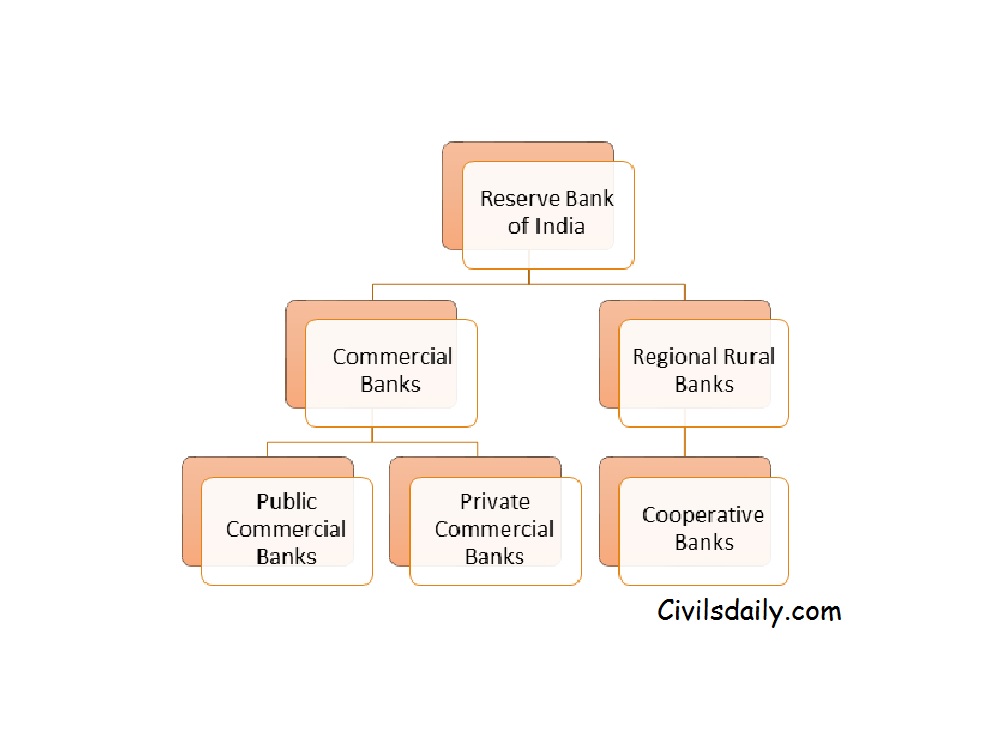
    Types/Structure of Banks in India

    Scheduled Commercial Banks

    • All the commercial banks in India- Scheduled and Non-Scheduled is regulated under Banking Regulation Act 1949.
    • By definition, any bank which is listed in the 2nd schedule of the Reserve Bank of India Act, 1934 is considered a scheduled bank. The list includes the State Bank of India and its subsidiaries (like State Bank of Travancore), all nationalised banks (Bank of Baroda, Bank of India etc), Private sector banks, Foreign banks, regional rural banks (RRBs), foreign banks (HSBC Holdings Plc, Citibank NA) and some co-operative banks.
    • Till 2017, Scheduled commercial banks in India comprised 26 Public sector banks including SBI and its associates, and 19 Nationalised Bank and IDBI. The creation of Bhartiya Mahaila Bank has increased the total no of Public sector SCB’s to 27, but the recent merger of the Mahaila Bank with SBI had reduced the list back to 26.
    • The scheduled private sector bank includes old private sector banks and new private sector banks. There are 13 old private sector banks and 9 new private sector banks including the newly formed IDFC and Bandhan Bank.
    • There are also 43 Foreign National Banks operating in India.
    • The Regional Rural Banks were started in India back in the 1970s due to the inability of the commercial banks to lend to farmers/rural sectors/agriculture. The governance structure/shareholding of RRBs is as follows:
    • Central Government: 50%, State Government: 15% and Sponsor Bank: 35%.
    • RBI has kept CRR (Cash Reserve Requirements) of RRBs at 3% and SLR (Statutory Liquidity Requirement) at 25% of their total net liabilities.

    Important Facts Relating to Scheduled Commercial Banks

    • In terms of Business, Public sector banks dominate the Indian Banking.
    • PSB accounts for close to 50% of total assets, 70% of deposits and close to 70% of the advances.
    • Amongst the Public-Sector Banks, SBI and its Associates has the highest number of Branches.
    • The committee on Regional Rural Bank headed by M Narasimhan recommended the setting up of RRBs for the purpose of providing rural credit.
    • An RRB is sponsored by a Public-Sector Bank which also provides a part of its share capital. Example: Maharashtra Gramin Bank (sponsored by the Bank of Maharashtra) and the Himachal Gramin Bank (Sponsored by Punjab National Bank). RRBs were set up to eliminate other unorganized financial institutions like money lenders and supplement the efforts of co-operative banks.
    • The Private Commercial banks account for close to 1/4th of the assets of the total banking assets.

    Why RRBs Failed to Achieve ITs Objective

    The RRB Amendment Bill, 2014

    • The Regional Rural Banks (Amendment) Bill, 2014 was introduced by the Minister of Finance, Mr Arun Jaitley, in Lok Sabha on December 18, 2014.  The Bill seeks to amend the Regional Rural Banks Act, 1976. It was passed by parliament in April 2015.
    • The Regional Rural Banks Act, 1976 mainly provides for the incorporation, regulation and winding up of Regional Rural Banks (RRBs).
    • Sponsor banks:  The Act provides for RRBs to be sponsored by banks.  These sponsor banks are required to (i) subscribe to the share capital of RRBs, (ii) train their personnel, and (iii) provide managerial and financial assistance for the first five years.  The Bill removes the five-year limit, thus allowing such assistance to continue beyond this duration.
    • Authorized capital:  The Act provides for the authorized capital of each RRB to be Rs five crore.  It does not permit the authorized capital to be reduced below Rs 25 lakh.  The Bill seeks to raise the amount of authorized capital to Rs 2,000 crore and states that it cannot be reduced below Rs one crore.
    • Issued capital:  The Act allows the central government to specify the capital issued by an RRB, between Rs 25 lakh and Rs one crore.  The Bill requires that the capital issued should be at least Rs one crore.
    • Shareholding:  The Act mandates that of the capital issued by an RRB, 50% shall be held by the central government, 15% by the concerned state government and 35% by the sponsor bank.  The Bill allows RRBs to raise their capital from sources other than the central and state governments, and sponsor banks.  In such a case, the combined shareholding of the central government and the sponsor bank cannot be less than 51%.  Additionally, if the shareholding of the state government in the RRB is reduced below 15%, the central government would have to consult the concerned state government.
    • The Bill states that the central government may by notification raise or reduce the limit of the shareholding of the central government, state government or the sponsor bank in the RRB. In doing so, the central government may consult the state government and the sponsor bank.  The central government is required to consult the concerned state government when reducing the limit of the shareholding of the state government in the RRB.
    • Board of directors:  The Act specifies the composition of the Board of Directors of the RRB to include a Chairman and directors to be appointed by the central government, NABARD, sponsor bank, Reserve Bank of India, etc.  The Bill states that any person who is a director of an RRB is not eligible to be on the Board of Directors of another RRB.
    • The Bill also adds a provision for directors to be elected by shareholders based on the total amount of equity share capital issued to such shareholders.  If the equity share capital issued to shareholders is 10% or less, one director shall be elected by such shareholders.  Two directors shall be elected by shareholders where the equity share capital issued to them is from 10% to 25%.  Three directors shall be elected in case of equity share capital issued being 25% or above.  If required, the central government can also appoint an officer to the board of directors to ensure the effective functioning of the RRB.
    • The Act specifies the term of office of a director (excluding the Chairman) to be not more than two years.  The Bill raises this tenure to three years.  The Bill also states that no director can hold office for a total period exceeding six years.
    • Closure and balancing of books:  As per the Act, the books of an RRB should be closed and balanced as on December 31 every year.  The Bill changes this date to March 31 to bring the Act in uniformity with the financial year.

    Non-scheduled Banks

    • Non-scheduled banks by definition are those which are not listed in the 2nd schedule of the RBI Act, 1934.
    • Banks with a reserve capital of less than 5 lakh rupees qualify as non-scheduled banks.
    • Unlike scheduled banks, they are not entitled to borrow from the RBI for normal banking purposes, except, in emergency or “abnormal circumstances.”
    • Jammu & Kashmir Bank is an example of a non-scheduled commercial bank.

    Cooperative Banks

    • Co-operative banks operate in both urban and non-urban areas. All banks registered under the Cooperative Societies Act, 1912 are considered co-operative banks.
    • In the urban centres, they mainly finance entrepreneurs, small businesses, industries, self-employment and cater to home buying and educational loans.
    • Likewise, co-operative banks in the rural areas primarily cater to agricultural-based activities, which include farming, livestock’s, diaries and hatcheries etc.
    • They also extend loans to small scale units, cottage industries, and self-employment activities like artisanship.
    • Unlike commercial banks, who are driven by profit, cooperative banks work on a “no profit, no loss” basis.
    • Co-operative Banks are regulated by the Reserve Bank of India under the Banking Regulation Act, 1949 and Banking Laws (Application to Co-operative Societies) Act, 1965.

    By
    Himanshu Arora
    Doctoral Scholar in Economics & Senior Research Fellow, CDS, Jawaharlal Nehru University

    CLICK:-REGISTER & DISCUSS ECONOMICS CONCEPTS & YOUR UPSC PREPARATION WITH CD MENTORS FOR FREE
  • Budgetary procedure in India

    The budgetary procedure in India involves four different operations that are

    • Preparation of the budget
    • Enactment of the budget
    • Execution of the budget
    • Parliamentary control over finance

    Preparation of the budget

    The exercise of the preparation of the budget by the ministry of finance starts sometimes around in the month of September every year. There is a budget Division of the Department of Economic affair of the ministry of finance for this purpose.

    The ministry of finance compiles and coordinates the estimates of the expenditure of different ministers and departments and prepare an estimate or a plan outlay.

    Estimates of plan outlay are scrutinized by the Planning Commission. The budget proposals of finance ministers are examined by the finance ministry who has the power of making changes in them with the consultation of the prime minister.

    Enactment of the budget

    Once the budget is prepared, it goes to the parliament for enactment and legislation. The budget has to pass through the following stages:

    • The finance minister presents the budget in the Lok Sabha. He makes his budget in the Lok Sabha. Simultaneously, the copy of the budget is laid on the table of the Rajya Sabha. Printed copies of the budget are distributed among the members of the parliament to go through the details of the budgetary provisions.
    • The finance bill is presented to the parliament immediately after the presentation of the budget. Finance Bill relates to the proposals regarding the imposition of new taxes, modification on the existing taxes or the abolition of the old taxes.
    • The proposals on revenue and expenditure are discussed in the Parliament. Members of the Parliament actively take part in the discussion.
    • Demands for grants are presented to the Parliament along with the budget These demands for grants show that the estimates of the expenditure for various departments and they need to be voted by the Parliament.
    • After the demands for grants are voted by the parliament, the Appropriation Bill is introduced, considered and passed by the appropriation of the Parliament. It provides the legal authority for withdrawal of funds of what is known as the Consolidated Fund of India.
    • After the passing of the appropriation bill, finance bill is discussed and passed. At this stage, the members of the parliament can suggest and make some amendments which the finance minister can approve or reject.
    • Appropriation bill and Finance bill are sent to Rajya Sabha. The Rajya Sabha is required to send back these bills to the Lok Sabha within fourteen days with or without amendments. However, Lok Sabha may or may not accept the bill.
    • Finance Bill is sent to the President for his assent. The bill becomes the statue after presidents’ sign. The president does not have the power to reject the bill.

    Execution of the budget

    • Once the finance and appropriation bill is passed, execution of the budget starts. The executive department gets a green signal to collect the revenue and start spending money on approved schemes.
    • Revenue Department of the ministry of finance is entrusted with the responsibility of collection of revenue. Various ministries are authorized to draw the necessary amounts and spend them.
    • For this purpose, the Secretary of minister’s acts as the chief accounting authority.
    • The accounts of the various ministers are prepared as per the laid down procedures in this regard. These accounts are audited by the Comptroller and Auditor General of India.

    Parliament Control over Finance

    • There is a prescribed procedure by which the Finance Bill and the Appropriation Bill are presented, debated and passed.
    • The Parliament being sovereign gives grants to the executive, which makes demands. These demands can be of varieties like the demands for grants, supplementary grants, additional grants, etc.
    • The estimates of expenditure, other than those specified for the Consolidated Fund of India, are presented to the Lok Sabha in the form of demands for grants.
    • The Lok Sabha has the power to assent to or to reject, any demand, or to assent to any demand, subject to a reduction of the amount specified. After the conclusion of the general debate on the budget, the demands for grants of various ministries are presented to the Lok Sabha.
    • Formerly, all demands were introduced by the finance minister; but, now, they are formally introduced by the ministers of the concerned departments. These demands are not presented to the Rajya Sabha, though a general debate on the budget takes place there too.
    • The Constitution provides that the Parliament may make a grant for meeting an unexpected demand upon the nation’s resources, when, on account of the magnitude or the indefinite character of the service, the demand cannot be stated with the details ordinarily given in the annual financial statement.
    • An Appropriation Act is again essential for passing such a grant. It is intended to meet specific purposes, such as for meeting war needs.

    Merging Railway budget into Union budget – Pros and Cons

    After 92 years of seeing them separately, the year 2017 witnessed the Railway budget being merged into Union budget. This move is being lauded for it will be beneficial for the economy at large and there will be positive influence in the development in railways.

    During the British reign, having a separate Railway budget made sense because a larger part of the country’s GDP depended on railway revenue. The tradition of having the budgets separately continued when India gained freedom even though the revenue from railway continued to go lower than most of the organizations in the public and private sector.

    Pros
    1. The scores: During the British rule Railways took up to 85 percent of the yearly budget while now it has gone down to about 15 percent only. Having separate railway budget stopped making sense long ago but the old tradition was not done away with. Scrapping the old for the renewed and better is always a positive change to look upon.

    2. Better policies: Now that the Railway budget will be introduced along with the union budget, there will be less wastage of time when a new policy is to be initiated and implemented. Keeping them separate resulted in a lot of drawbacks and hindrances that had to be faced by the railway ministry before it could decide upon a solution.

    3. Party politics: Minority parties fighting to meet their intentions and ministers of certain states arguing new railways and trains for their region has always been known to result in an everlasting brawl. There will be less of political pressure on the Railway budget and the centre will have the ultimate hold of the decision making.

    4. Goodbye to annual dividend: When Rail budget had to be introduced separately, the railways needed to pay an annual dividend to render its budgetary support to the government. The railways will be free of this now and the same fund could now be used in better ways for development the conditions of Indian railways.

    5. The huge loss: Our railways are running on loss. There are lesser funds for development plans and most of them are wasted in wrongful manner when there emerges a demand from the regional MLA who promised new trains and stoppages for their location during the time of election. When it goes into the hands of finance ministry, it would mean and absolute end to this and a more commercialized distribution of resources.

    Cons

    1. The rise and fall: Henceforth, the distribution and allocation of funds to various departments will all go under the finance ministry, which will take decisions according to rise and fall of budget. A fall in the annual budget will mean a similar cut in the railway and other budgets. This will be something unusual for the railways and they might not react supportively to that.

    2. Conditions of government departments: The depleting conditions of the various departments under the government have always been prominent. There is lesser attention paid to the responsibilities and everyone is busy sorting out their own means. Railways might see drastic disadvantage if the merging doesn’t reap the desired result.

    3. Goodbye to privatization: There have previously been talks of privatization of Indian railways in order to improve and develop them with world class facilities and cleanliness. It was not well received earlier and after the merging, there will a complete end to any future chances of privatization. At the efficient hands of government employees, nothing big could be expected.

    4. Loss for the railways: We know how much our parties love making promises and then reducing price to earn the favor of the voters. Not in their wildest dreams would they want to hike the railway prices and lose the vote bank that flows from commuters. Lesser hikes in price might pose loss for the railways department.

    There have been mismanagement of the highest order in Indian railways and if there are chances of seeing it improve, merging it with the Union budget is just the solution that could help. The falling revenue and more projects for new trains and stoppages have been a difficult project for the railway ministry which took the right step by merging the two budgets.

    Budget advancement:

    The objective behind this move is to have the Budget constitutionally approved by Parliament and assented to by the President, and all allocations at different tiers disseminated to budget-holders, before the financial year begins on April 1.

    • The proposal for a change in the budget presentation date was first mooted by some of the government’s senior most bureaucrats as part of a ‘Transforming India’ initiative in January 2016.

    Presenting the budget earlier comes with both advantages and disadvantages.

    Advantages:

    • In the existing system, the Lok Sabha passes a vote on account for the April-June quarter, under which departments are provided a sixth of their total allocation for the year. This is done by March. The Finance Bill is not passed before late April or early May. If the Budget is read in January and passed by February-March, it would enable the government to do away with a vote on account for the first three months of a financial year.
    • Retired and serving officials say the biggest plus would be that the Finance Bill, incorporating the Budget proposals, could be passed by February or March. So, government departments, agencies and state-owned companies would know their allocations right from April 1, when the financial year begins.
    • It would also help the private sector to anticipate government procurement trends and evolve their business plans. And, civil society could deliberate on and give feedback in time for the parliamentary discussions. 

    Disadvantages:

    • One big disadvantage of advancing the Budget preparations is lack of comprehensive revenue and expenditure data. Currently, work on the Budget begins in earnest by December. By the time it is finalised in mid-February, data on revenue collections and expenditure trends is available for the first nine months of the financial year, i.e April-December. Based on which, projections for the full year can be made.
    • To read the Budget in January, the centre will have to start preparing it by early October. To go by less than six months of data and making projections for the full year and the next year, based on such an incomplete picture, will be an impossible task.
    • Advancing the Budget dates would be fraught with practical difficulties. Effective Budget planning also depends on the monsoon forecasts for the coming year, making the advancing the whole exercise even more difficult.
    • Besides, whether the chambers of Parliament and its standing committees will get adequate time to deliberate on the budget is a moot point. The standing committees of Parliament, whose charter is to examine the justification of the ministry-wise allocations and funding needs of concomitant programmes included in the Budget, undertake their scrutiny during a two to three-week gap within the budget session period, when the houses are adjourned. This scrutiny is an essential element in the parliamentary budget approval system.

    Way ahead:

    Advancing the presentation of the Budget, so as to allow Parliament to vote on tax and spending proposals before the beginning of the new financial year on April 1, is a good idea. It would do away with the need for a vote on account and allow new direct tax measures to have a full year’s play. Members of Parliament now will have to work hard over two months to vet Budget proposals, for this to work. 

    Conclusion:

    These reforms make sense, but Budget reform has to go further, to incorporate a multi-year time horizon and shift to outcome-linked expenditure management, as had been recommended by a committee headed by C Rangarajan in 2011.

    By
    Himanshu Arora
    Doctoral Scholar in Economics & Senior Research Fellow, CDS, Jawaharlal Nehru University

  • The Role of the Government in the Economy

    • India embraced an economic model which has the features of both free market capitalism and socialism. The policy makers called this a model of ‘Mixed Economy’.
    • The reason for adopting such a hybrid model was to raise people’s standard of living and reduce income inequality.
    • India embraced an economic model that uniquely combined free market capitalism with that of State intervention in essential sectors of the economy.
    • The record of India’s successive governments in providing social welfare is at best mediocre.
    • The Government must build a comprehensive welfare state with a strong emphasis on redistribution of resources to poor along with provisions of social services (Public Health, Education, Equitable Institutions, Un-Employment Benefits, Old Age Pensions etc.) financed through taxation.
    • In today’s changing World of high technology, the Government must do a lot of public spending on investment in human capital and research and development.
    • On Jobs creation front, the government must adopt a judicious mix of labour market institution that includes a fairly flexible labour market allowing easy hiring and firing of employees along with strong labour associations to safeguard the interest of employees.
    • On the External front, the government must embrace globalisation, openness to trade and investment but with risk sharing approach. The government should share the risk arising out of globalisation, by training and skilling those who have suffered from the negative impact of globalisation. The process of risk sharing will make globalisation acceptable to all.
    • Adopting the above features will allow India to achieve high growth along with high social ambitions/indicators.
    • Therefore, in a nutshell, the future of India’s rapid and sustainable development lies in the following:


    Functions of Government

    Allocation Function

    • The government provides certain public goods and services which the private sector fails to provide because there exists no market for them.
    • Example: National Defence, Public Parks and National Highways etc.
    • The reason of government providing such goods is the nature of public goods. The public goods are by nature non-rival and non-excludable.
    • Non-Rivalry means, the consumption of the good by one individual does not stop another individual from consuming the same good. The goods remain available to all the citizens.
    • Non-Excludability means the government cannot exclude any person from enjoying the benefit of the good whether they pay or not. The goods are non-excludable in nature.
    Private Goods Public Goods
    They are Rival in nature. Rivalry means if one person consumes a good, then it will not be available for the consumption of another individual. Example- Any private good like a car, a pen, a mobile handset etc. if I own a car, then that particular car is not available to any other person. They are non-rival in nature. Consumption by one individual does not affect consumption of another individual. Example: National Defence or Public Highway- if I am driving a car on the highway that does not stop any other individual from driving his/her car on the same highway.
    They are excludable in nature. Excludability means that exclusion is possible. If someone does not buy a metro ticket, then he/she can be excluded from riding on the metro train. They are non-excludable in nature. It means exclusion is not possible. If a public park is constructed, then no person can be excluded from using it, whether he pay tax/price or not.
    The market for private goods exist. The existence of market helps in their price discovery, and hence prices for private goods exist which makes exclusion possible. The market for public goods does not exist. Hence price discovery is not possible. With no price available private sector will never supply such goods. Thus, Government must provide such goods.
    Property Rights of private goods are well determined. If I own a house, then I have exclusive property rights over its usage. The house is in my name; it belongs to me. Property Rights are not determined. No person owns the Highway or a public park. They are common goods to be shared by all. No single person can claim that it belongs to them.
    Free Ridership is not possible. Free ridership is a situation when someone who has not paid for it started using it. Free ridership is possible. Example- Government comes up with a provision that all houses must contribute Re 100 towards spreading of medicine for Dengue prevention. Despite this, some houses refuse to pay. The government simply does not let its prevention program fail because some houses are not paying. Since the issue involves public health threat, the government decides to provide it anyway. Thus, the houses that had not paid Re 100 will also enjoy the benefit of dengue prevention program.

    Distribution Function

    • The government through its tax and expenditure policies attempts to bring out income redistribution in the society that is fair to all.
    • The government transfer payments from one citizen to other through taxation policy.
    • Example: Old age pensions, Social sector initiatives for the poor. Through these programs, the government provides income support to those individuals who do not have any source of earnings. The funds for running these programs comes from progressive taxation. Those with higher income paying higher taxes.
    • The idea of distribution is not to rob the rich by forcing them to pay high taxes or to discourage people from earning more but to make just redistribution which will be equitable for all.
    • Think like this, the per capita consumption of common resources will be higher for rich individuals as compared to the poorer individual (who survives on bare necessities). Thus they must pay a higher price for its provision. Space taken by an SUV or Sedan on the road is much higher than the space taken by Bicycle. Thus, the SUV owner must pay a higher price/ tax for the construction of the road as compared to bicycle owner. The above example explained the concept Progressive taxation.
    • Similarly, the old age pensions are not grants by the government but are right of those individuals who have worked endlessly during their productive years. Thus, the government must take care of them by providing them old age benefits.

    Stabilisation Function

    • The economy tends to undergo periods of instability and fluctuations. The periods of fluctuations require the government to play an active role in removing it.
    • The year of 2008-09 witnessed the Global Financial Crisis. The GFC led to a decline in GDP growth rate along with employment. To help recover economy from the GFC, the government provided Fiscal Stimulus package for the industry.
    • Let’s understand the channel

    • Similarly, the economy may at times overshoot when expenditure becomes greater than output. In such a situation when consumers are spending more than what producer are willing to supply. Inflation happens. To remove inflationary pressure from the economy, the government intervenes through tight fiscal policy.

    By
    Himanshu Arora
    Doctoral Scholar in Economics & Senior Research Fellow, CDS, Jawaharlal Nehru University
  • Types of Budgets in India

    Balance Budget versus Unbalanced Budget

    Balanced Budget Unbalanced Budget
    A balanced budget is a situation, in which estimated revenue of the government during the year is equal to its anticipated expenditure.


    The budget in which income & expenditure are not equal to each other is known as Unbalanced Budget.


    The government’s estimated

    Revenue = Government’s proposed Expenditure.


    Unbalanced budget is of two types:

    Surplus Budget

    Deficit Budget


    Surplus Budget

    The budget is a surplus budget when the estimated revenues of the year are greater than anticipated expenditures.

    The government expected revenue > Government proposed Expenditure.


    The surplus budget shows the financial soundness of the government. When there is too much inflation, the government can adopt the policy of surplus budget as it will reduce aggregate demand.


    Deficit Budget

    Deficit budget is one where the estimated government expenditure is more than expected revenue. Government’s estimated Revenue is less than Government’s proposed Expenditure.


    If over a period of time expenditure exceeds revenue, the budget is said to be unbalanced

    Such deficit amount is generally covered through public borrowings or withdrawing resources from the accumulated reserve surplus. A way a deficit budget is a liability of the government as it creates a burden of debt or it reduces the stock of reserves of the government.

    In developing countries like India, where huge resources are needed for the purpose of economic growth & development it is not possible to raise such resources through taxation, deficit budgeting is the only option.

    In Underdeveloped countries, deficit budget is used for financing planned development & in advanced countries, it is used as stability tool to control business & economic fluctuations.


    Zero Based Budgeting versus Traditional Budgeting

    Zero Based Budgeting Traditional Budgeting
     Zero based budgeting is a method of budgeting in which all expenses are evaluated each time a budget is made and expenses must be justified for each new period. Traditional budgeting calls for incremental increases over previous budgets, such as 2% increase in spending.
    Zero budgeting starts from the zero base and every function of the government is analysed for its needs and cost. Budget are then made based on the needs. Traditional budgeting analyses only new expenditures, while zero based budgeting starts from zero and calls for justification of old recurring expenses in addition to new expenditures.

     Outcome Budget

    If was first introduced in the year 2005. Outcome budget analyses the progress of each ministry and department and what the respected ministry has done with its budget outlay.

    The Outcome Budget will comprise scheme or project wise outlays for all central ministries, departments and organizations during an annual year listed against corresponding outcomes (measurable physical targets) to be achieved during the year.

    It measures the development outcomes of all government programs. Which means that if you want to find out whether some money allocated for, say, the building of a school or a health center has actually been given, you might be able to. It will also tell you if the money has been spent for the purpose it was sanctioned and the outcome of the fund-usage.

    Gender Budgeting

    • Gender Budgeting is a powerful tool for achieving gender mainstreaming so as to ensure that benefits of development reach women as much as men.
    • It is not an accounting exercise but an ongoing process of keeping a gender perspective in policy/ programme formulation, its implementation and review.
    • Gender Budgeting entails dissection of the Government budgets to establish its gender differential impacts and to ensure that gender commitments are translated in to budgetary commitments.
    • Experts defines Gender Budgeting as “Gender budget initiatives. To analyse how governments raise and spend public money, with the aim of securing gender equality in decision-making about public resource allocation; and gender equality in the distribution of the impact of government budgets, both in their benefits and in their burdens.
    • The impact of government budgets on the most disadvantaged groups of women is a focus of special attention.
    • The rationale for gender budgeting arises from recognition of the fact that national budgets impact men and women differently through the pattern of resource allocation.
    • Women, constitute 48% of India’s population, but they lag behind men on many social indicators like health, education, economic opportunities, etc. Hence, they warrant special attention due to their vulnerability and lack of access to resources.
    • The way Government budgets allocate resources, has the potential to transform these gender inequalities. In view of this, Gender Budgeting, as a tool for achieving gender mainstreaming, has been propagated.


    By
    Himanshu Arora
    Doctoral Scholar in Economics & Senior Research Fellow, CDS, Jawaharlal Nehru University