💥Join UPSC 2027,2028 Mentorship (July Batch) + XFactor Notes & Microthemes PDF

Category: Burning Issues

  • [Burning Issue] Rise of Economic Nationalism

    “Globalization presumes sustained economic growth. Otherwise, the process loses its economic benefits and political support.”

    Paul Samuelson

    Context

    Guess what Corona virus pandemic did that even Soviet union could not? It has shown the world decaying of the capitalist system. Spread of the virus has lead to various forms of lock downs across the globe. This caused multiple problems in economic globalisation to erupt, which made each country look to the protection of its “own” economy. Now this funda of “own” economy and local over global is what we will focus upon. So stay tuned.

    Is it the end of Globalization?
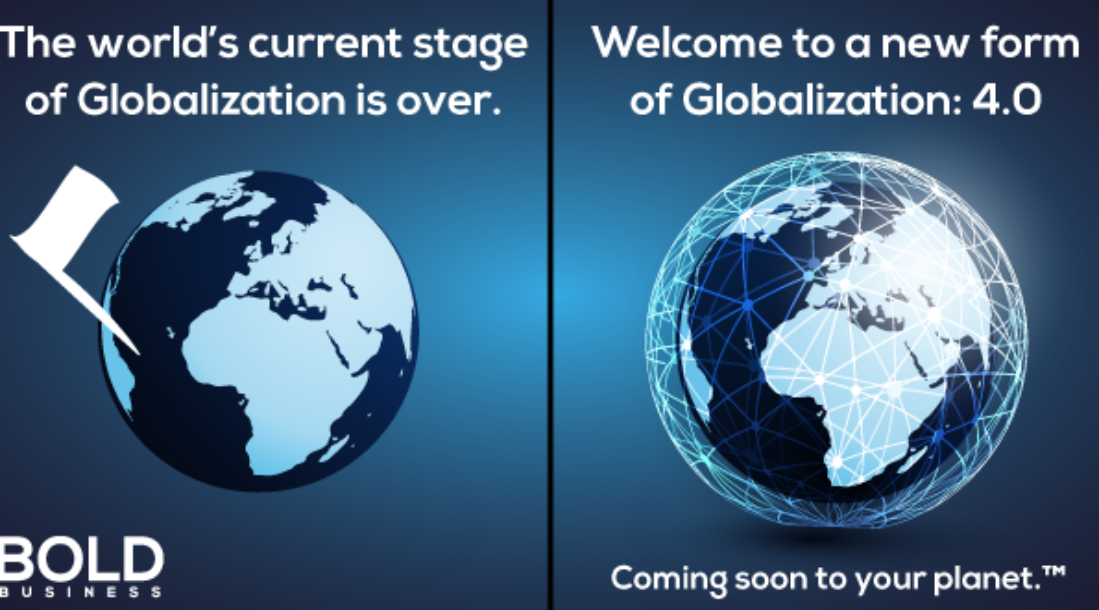
    Globalization As We Know It Is Dead - Bold Business

    One of the devastating impacts of Covid-19 will be that nations are going to look even more inwards. Rather than look beyond its borders, nations will focus on their narrowly-defined national interests.

    • Reflecting on the debate on globalization, one may wonder whether the world was entering a new, uncharted territory or if Covid-19 was simply accelerating a push-back against globalization that has been taking place for some time with the rise of economic nationalism across countries.
    • Here’s a hint: Globalization has undeniably been in retreat for some years now and the coronavirus pandemic is likely to exacerbate this process.

    Dawn of Economic Nationalism

    What is Economic Nationalism?

    • Economic nationalism, also called economic patriotism and economic populism, is an ideology that favours state interventionism over other market mechanisms.
    • It connotes not only controls of external relations, but also to mobilize internal resources.
    • It tends to see international trade as zero-sum, where the goal is to derive relative gains (as opposed to mutual gains).

    What happens in a nationalist economy?

    • Economic nationalism tends to emphasize industrialization (and often aids industries with state support), due to beliefs that industry has positive spillover effects on the rest of the economy, enhances the self-sufficiency and political autonomy of the country, and is a crucial aspect in building military power.
    • It imbibes policies such as domestic control of the economy, labour, and capital formation, even if this requires the imposition of tariffs and other restrictions on the movement of labour, goods and capital.

    Its evolution – A walk into the past

    • References to economic nationalism appeared initially in the years following World War I when the international economy was subjected to high stress arising out of the economic and political dislocation inherited from the war.
    • A similar explanation of the term followed after the Second World War.
    • In this period, economic protectionism was seen as an alternative to revive damaged economies after the world war.
    • The role and status of the ‘state’ emerged to be essentially important in managing economic affairs. The Soviet Union presented a model where state planning was central.
    • Under this model where the state has been the prime facilitator of, means of production and distribution, the public, as well as the private sector, growing at the same rate.
    • This model consolidated the idea of economic nationalism against that of western inherited capitalism.

    Facets of Economic Nationalism: “ME FIRST”

    Proof that economic Nationalism existed way before the COVID era.

    1) American Protectionism

    • America First: USA remains the main proponent of economic nationalism, under the “America First” doctrine of the Trump administration.
    • US-China Tussle: Trade war had been launched through the imposition of tariffs and China’s plan for economic and technological development had been declared an existential threat to US national security.
    • It has been accompanied by a series of bans on Chinese telecom companies and the launching of a global campaign by the US to have its allies exclude the Chinese company, Huawei, from the development of 5G networks.

    2) Chinese Expansionism

    • China’s strategy is, of course, no different than the one pursued by the US.
    • Backed by its great economic and military might, China seeks to achieve the same objectives using its economic prowess and its pole position in the global manufacturing chain to achieve the said objectives.
    • The ambitious ‘Belt and Road Initiative’ is the testimony of its economic nationalism.

    3) EU contractionist tendencies

    • Brexit: Classic example of economic nationalism.
    • Europe, too is taking a turn towards economic nationalism.
    • Many EU countries have been vocal as saying “in the long term we cannot depend on Asia, on China for goods that are strategic for us, whether in the aerospace or medical sectors or in other supply chains.”

    4) India’s ‘self-reliance’ Mantra of being ‘Vocal about Local’

    • When PM romped to a massive and decisive victory in 2014, neo liberal globalists believed that India would unflinchingly embrace globalisation and undertake economic reforms.
    • Indeed, at global forums, India often batted for economic globalisation, slammed rising trade protectionism.
    • The late Arun Jaitley, in his 2018 budget, admitted to this when he made a “calibrated departure” from the decades-long policy of cutting tariff rates.
    • But there has been a bit of economic nationalism here as well.
    • The resolve to augment domestic manufacturing in India – ‘Make in India’ campaign is a case for local over global.
    • Earlier, India chickened out at the last minute from joining the 16 members RCEP agreement to protect local industry.
    • Likewise, the central government has decided that it will not buy goods or services valued less than 200 crore rupees from global companies.
    • The recent amendment of the FDI rules by India so as to discourage Chinese investment in India – something that may not be consistent with India’s WTO obligations – also smacks of protectionism.

    Why there is a rise in the popularity of Economic Nationalism?

    • Not all countries benefited equally from the economic liberalism of the 1990s. It had its winners and losers.
    • National economic recoveries, i.e., nationalistic interests, have proved out to be paramount in the worldwide pandemic.
    • Economic nationalism to some extent can provide the framework within which economic development is possibly providing a way for savings to accumulate and investment to grow.
    • Goods when made locally help to protect local entrepreneurs, reduce imports and one can attract foreign investment.

    Issues with Economic Nationalism

    • Becoming too nationalistic at the expense of one’s trading partners can be counterproductive.
    • It is an approach that creates conflict. Being more nationalistic tends to be a zero-sum game in an increasingly interdependent world economy, where countries depend on other countries for their economic and political and national security well being.
    • When companies cooperate, they can become more competitive.
    • When they are more competitive, they hire more workers, pay higher salaries, and otherwise contribute to economic growth.
    • ‘Vocal about local’ epitomizes this trade protectionism and pushes a flawed and oversimplified economic logic that domestic manufacturing can be resurrected by actively encouraging (even forcing) customers to buy products ‘made in India’.
    • However, the policy measures adopted to achieve this goal are unsound as they mark a relapse to protectionism.
    • India’s economic experience of the first four decades after independence amply demonstrates that a protectionist and a highly controlled economic model do not yield a competitive and proficient manufacturing sector.

    Analysis from India’s perspective

    The government evidently wants to strengthen local businesses and make them globally competitive so that India can become the next manufacturing hub, like China. The prime minister has perhaps taken the disruption caused by the pandemic as an opportunity to push India towards developing its manufacturing prowess and emulate China’s export-driven rise.

    Economic Nationalism – chequered past in India

    • Era of license-permit raj, umbrella of protectionism and import substitution lead to lack of competition and inefficiency in domestic businesses.
    • The economy suffered a distortion that led to eventual bankruptcy and brought India to the brink of defaulting on international debt obligations in 1991.

    Is India ready to go down that path again?

    • If localisation is an increasingly popular global policy response to the lessons taught by the pandemic, it is not clear how India may suddenly become the next manufacturing powerhouse.
    • India doesn’t already dominate global supply chains, lacks the manufacturing prowess of China and is faced with a world where countries are busy ring-fencing risks and pulling up the drawbridge.
    • The danger is that in its push towards becoming more self-reliant and promotes domestic manufacturing; India may end up taking an even more unequivocally protectionist turn.

    Some problems to solve before we head to the nationalist road

    Problem I- India’s inherent- Investment problem

    • Today, globalisation is seen from the lens of the recipients of foreign investments.
    • The receivers of foreign inflows are at the centre of things, the nuclei around which capital revolves.
    • The power of FDI destinations will grow in the near future, as MNCs try to combat the twin pressures of protectionism and localisation.
    • To achieve its ambitions, nations will simultaneously try to woo foreign investment despite the growing nationalism.
    • In fact, economic xenophobia will become the means to do so in perverted and inverse globalisation.
    • As was the case with Make in India—and now Make in Thailand and Make in Vietnam—nations will want MNCs to invest capital and introduce technology in faraway destinations.

    Problem II- Structural Reforms And Labour Lessons needed

    • To cast a ‘nationalistic’ obligation on them to boost domestic industry instead of undertaking reforms that would improve the domestic industry’s competitiveness is fallacious.
    • Moreover, to expect the world to buy goods ‘made in India’ when we close our markets to foreign goods would be like living in a fool’s paradise!
    • The coming decade will be dominated by automation, robotics, AI, 3D printing and smart techniques that will aid economic nationalism, protectionism and localisation.
    • This marks the end of the ‘Age of Industrial Revolution’, and ushers in Industry 5.0.
    • Post-crisis, nations will seek opportunities to reform and change labour as well as laws that govern it. Some, like India, will hope to please businesses at the expense of labour.
    • Recently several states increased the work hours in factories and made it easier to sack workers and more difficult to form trade unions.

    Way Forward

    • India should work to strike a balance between making itself an integral part of the global supply chain (like China) while promoting local industries and empowering small businesses so that they can compete with the world’s best.
    • The focus must be making India a very competitive nation so that our local companies, products and services are purchased by the domestic consumers as well as enthusiastically by consumers around the world.
    • One aspect of being resilient is that our local companies are as competitive as possible.
    • India’s competitiveness will be unshackled not by clamping down on imports and asking consumers to go local, buy local and promote local.
    • Rather, small businesses and local producers will become more efficient and even globally recognised in a competitive environment aided by a government that makes doing business easier.
    • Until that transformation happens the argument that we can suddenly become world-beaters by turning self-sufficient is not convincing.

    For the World to do better,

    • The rhetoric of global power cannot suddenly change to the globe of power.
    • Squeezing the global economy through individual version of protectionism is lethal at the moment.
    • The world may not spend time deliberating the merits and demerits of globalization after the pandemic is contained. But, it should work together for a common and larger objective and approach for all.
    • Only structural reforms, not the dismantling of present architecture  can do best to resolve these issues.
    • India and other developing countries should  work together to reform the present WTO structure for everyone’s  benefit and particularly for the ones which are disadvantaged.
    • The need of the hour is to explore the relationship between comparative advantage and optimal trade policy where all countries are relatively benefited.

    Conclusion

    Nationalist moves are crucial because they will allow nations to reduce dependence on exports and foreign markets, curtail imports or foreign suppliers and enhance economic nationalism through local consumption of domestic goods and services.

    But obviously we do not want trade wars. Covid has also taught us the necessity of international collaboration and co-operation. Unlike US and China, India cannot afford to pursue such obscure economic approaches. We may end up making a terrible mistake if we consider international trade to be a zero-sum game.

    Instead of turning its back on globalisation, India should play a leadership role in strengthening the international economic architecture, which populists in the West want to demolish, premised on a win-win relationship that produces mutual prosperity and global peace.


    Try this:

    Q. Dadabhai Naoroji was the first to realize the significance of Economic Nationalism in the early phase of nationalists awakening. Elucidate.


    References

    https://www.firstpost.com/india/is-this-government-pushing-india-back-to-the-indira-era-idea-of-economic-nationalism-will-work-only-if-backed-by-structural-reform-8377681.html

    https://www.wsws.org/en/articles/2020/04/21/pers-a21.html

    https://thewire.in/political-economy/can-india-compete-with-china-in-the-post-covid-19-world https://thewire.in/economy/india-global-trade-vocal-about-local

    https://www.orfonline.org/research/post-covid-nations-will-look-inwards-india-should-look-at-neighbourhood-ex-nsa-66318/

    https://www.opindia.com/2020/05/china-australia-usa-netherlands-japan-kazakhstan-kyrgystan-economy-manufacturing-coronavirus/

    https://www.outlookindia.com/magazine/story/business-news-why-china-india-will-suffer-the-worst-economic-disaster-in-almost-a-100-years/303222

  • [Burning Issue] India-China Skirmish in Ladakh

    “Hindi Chini bhai bhai” – The tale of these brothers is filled with so much action and drama that it can give Bollywood writers a run for money. See, border issues is never easy to resolve, never has been and never will be. Pangong Tso or Doklam – All point to Troubled LAC and an aggressive neighbour, which is a tough combination for India. Let’s dive into this article to learn about the border skirmishes.

    Current Incidents

    On May 5, around 250 Indian and Chinese army personnel clashed with iron rods, sticks, and even resorted to stone-pelting in the Pangong Tso lake area of Ladakh, in which soldiers on both sides sustained injuries. In a separate incident, nearly 150 Indian and Chinese military personnel were engaged in a face-off near Naku La Pass in the Sikkim sector on May 9. At least 10 soldiers from both sides sustained injuries.

    After Chinese accusation of Indian Army’s border transgressions and strong Indian pushback, Ladakh has become a new festering point for the Sino-Indian relations.

    A deeper look into reasons of present tensions

    • The stand-off in Galwan valley, according to reports, was triggered by China moving in troops and equipment to stop construction activity by India.
    • Delhi claims that it was well within India’s side of the LAC. The LAC was thought to be settled in this area which has not seen many incidents in the past, but China now appears to think otherwise.
    • The northern bank of Pangong lake has, however, been a point of contention where there are differing perceptions of the LAC.
    • The Sikkim incident is unexpected as the contours of the LAC are broadly agreed to in this sector.
    • Unofficial reason: The broader context for the tensions appears to be a changing dynamic along the LAC, as India plans to catch-up in improving infrastructure there.

    Some old bruises in border relations

    • India and China do not have a well-defined border, and troop face-offs are common along its 3,500 km Line of Actual Control (LAC), though not a bullet has been fired for four decades.
    • After the 1962 Sino-Indian war, one of the longest standoffs between the Indian and Chinese armies happened at Sumdorongchu (near the Bhutan tri-junction) in 1986, when the troops had an eye-to-eye stalemate.
    • In 2017, at Doklam, near the same Bhutan tri-junction, the troops of India and China were engaged in a 73-day stand-off, triggering fears of a war between the two nuclear-armed neighbours.

    The Gandhi-Deng bargain

      • A year after a military skirmish between India and China in the Sumdorong Chu Valley in Arunachal Pradesh, then PM Rajiv Gandhi visited his counterpart Deng Xiaoping in Beijing to mend ties.
      • The two leaders agreed to establish a forward-looking relationship but border dispute were temporarily set aside.
      • The reason for this pragmatism was rooted in economic and strategic factors: Both China and India needed a stable external environment to promote domestic economic development.
      • China was already a decade into the dramatic economic reforms that Deng had initiated, while Gandhi’s India had also embarked on a similar path.
      • The Gandhi-Deng bargain paved the way for a number of border management agreements (including the 1993 and 1996 agreements related to confidence-building measures.

    Then, Why do face-offs occur so frequently?

    • Basic: Face-off and stand-off situations occur along the LAC in areas where India and China have overlapping claim lines. The LAC has never been demarcated.
    • The boundary in the Sikkim sector is broadly agreed but has not been delineated.
    • Face-offs occur when patrols encounter each other in the contested zones between overlapping claim lines.
    • Protocols agreed to in 2005 and 2013 detail rules of engagement to prevent such incidents, but have not always been adhered to.

    What are the various sectors on the India-China border?

    • The border can be broadly divided into three sectors—Western, Middle and Eastern.
    • The Western sector, which includes Ladakh, is governed by the Johnson Line, making Aksai Chin (controlled by China) in Jammu and Kashmir contested territory for India.
    • The Middle sector, consisting of Uttarakhand and Himachal, is relatively tranquil. Even map exchanges between the two countries have taken place, based on a broad understanding of borders.
    • In the Eastern Sector (where Indian controls territory based on the MacMahon Line), China claims Arunachal Pradesh as part of southern Tibet, while India contests it.
    • The MacMahon Line was drawn at the tripartite 1913-14 Simla Convention attended by British India, Tibet and China; the problem: Tibet is involved and China is not a signatory to this pact.

    LAC: Why no solution yet?

    • It’s not like nothing has been done!
    • Maps have been exchanged in the Middle Sector, but the exercise fell through in the Western Sector where divergence is the greatest.
    • China has rejected this exercise, viewing it as adding another complication to the on-going boundary negotiations.
    • India’s argument is rather than agree on one LAC, the exercise could help both sides understand the claims of the other, paving the way to regulate activities in contested areas until a final settlement of the boundary dispute.

    Also, Chinese transgressions are frequent: Dragon’s aggressiveness

    • A higher number indicates that the Chinese soldiers are coming to the Indian side more often, and their movements are being observed and recorded by the Indian soldiers.
    • This can be seen as an indicator of increased Chinese assertiveness.
    • Since 73-day Doklam standoff on Sikkim-Bhutan border in 2017 there had been no major standoff.
    • PM Modi and President Xi met in Wuhan, following the Doklam crisis, and passed some instructions.

    Wuhan Coziness turned sour

    • Modi and Xi had met for their first informal summit at Wuhan in April 2018, where the two leaders had issued strategic guidance to their respective militaries.
    • These guidelines aimed to strengthen communication in order to build trust and mutual understanding and enhance predictability and effectiveness in the management of border affairs.
    • They had also directed their militaries to earnestly implement various confidence-building measures agreed upon between the two sides, including the principle of mutual and equal security.
    • But the latest border issues show hollowness of such talks.

    International forces in this bilateral ties

    • In addition to the border dispute, some of the core issues in the Sino-Indian rivalry include Tibet (the presence of the Dalai Lama, the Tibetan government-in-exile), the burgeoning China-Pakistan partnership, and the two countries’ overlapping spheres of influence in Asia.
    • These issues have become more salient in the context of the two countries’ simultaneous but asymmetric rising power.
    • In addition to accruing power domestically, India is also building strong strategic partnerships with China’s other rivals, especially the US and Japan.
    • Meanwhile, a rising China has stabilized its northern borders with Russia and is working to undermine the US primacy in the East Asian maritime (particularly the South China Sea).
    • This basically leaves only one border issue with a rival unresolved: namely, the Sino-Indian border.
    • It is hardly surprising that it is exerting periodic pressure on India along this front—a trend that is only likely to escalate.

    India should not fear. Why?

    To be sure, China’s regional aggression is COVID-proof. From Japan to Malaysia, Vietnam, Philippines and Taiwan, everyone has had to push back against Beijing’s marauding missions.

    1) India can retaliate

    • India, while still under-resourced, is no longer a pushover, having emerged stronger and wiser from the Depsang incident of 2013, when Chinese troops pitched tents to establish their control over the area.
    • India and China are both nuclear-armed countries with strong militaries.
    • India has been building a road along the Galwan River to Daulat Beg Oldie that would improve India’s access to the Karakoram Highway, as well as 61 border roads with a total length of 3,346 km across the Himalayan frontier.
    • The Indian Air Force’s capabilities have improved as well.

    2) China is wooing its people

    • Presently, China is in the midst of its annual “2 Sessions” of the CPCC (Chinese People’s Political Consultative Process) and NPC (National People’s Congress), where the ruling sentiment is how China is being bold and tough.
    • Hong Kong was an example of that sentiment. It is likely the India moves may be related. No softening or reasonableness can be expected from China until the NPC ends.
    • China is, as usual, changing the ground realities to influence a future boundary agreement.

    The ground realities before we think settlement

    • India sees China as occupying 38,000 sq km in Aksai Chin. In the east, China claims as much as 90,000 sq km, extending all across Arunachal Pradesh.
    • A swap was hinted at by China in 1960 and in the early 1980s, which would have essentially formalized the status quo.
    • Both sides have now ruled out the status quo as a settlement, agreeing to meaningful and mutual adjustments.
    • At the same time, the most realistic solution will involve only minor adjustments along the LAC, considering neither side will be willing to part with territory already held.

    Way forward

    • India and China should grasp the current situation as an opportunity to revive the stalled process of clarifying the LAC.
    • Clarifying the LAC may even provide a fresh impetus to the stalled boundary talks between the Special Representatives.
    • Beyond the posturing, both sides know a final settlement will ultimately have to use the LAC as a basis, with only minor adjustments. Only a settlement will end the shadow boxing on the LAC.
    • With both countries in the midst of an unprecedented global pandemic, the time to push for a settlement to a distracting, protracted dispute is now.

    Conclusion

    • The issue is basically the fundamental difference in how both sides view the boundary question.
    • India insists that its relations with China won’t improve until the border dispute is resolved.
    • But China differs here.
    • In some sense, Beijing appears to view an unsettled border as holding some leverage with India, one of the many pressure points it could use to keep India off-guard.
    • But for now, India should resist the Chinese design which could have disastrous consequences for India’s defence and strategic interests. Lastly, Diplomatic channels is always a better option than skirmishes on the borders.


  • [Burning Issues] Atmanirbhar Abhiyan Package


    Today we decode parts of the “20 lakh crore” Economic Package.

    Fair warning though. It’s a long  journey to walk!

    • The COVID-19 pandemic and the prolonged national lockdown have brought the Indian economy to a standstill.
    • The various announcements made by the Finance Minister concluded the relief measures undertaken in five tranches by the government as part of the economic package announced by PM Modi for ‘Atmanirbhar Bharat’.

    Impacts of COVID-19 on Economy: Broad Picture

    Given an uncertain future for the rest of the year, it can be clearly seen that the Indian economy is contracting.

    • That is, it will produce less in 2020-21 than it did in 2019-20. This means the Gross Value Added across sectors — agriculture, industry and services — will fall.
    • As incomes fall, three things will happen.
    • One, individuals will cut down their expenditure. In particular, all discretionary expenditure — be it an additional pack of cigarettes or a new car or a house — will come down sharply.
    • Two, seeing overall demand fall, businesses, which were already not investing, will likely postpone their investments further.
    • Three, the government revenues will take a massive hit. This means that if the government wants to maintain its level of fiscal deficit (the gap between what it earns as revenues and what it spends), it will have to cut its overall expenditure this year.
    • These three types of “expenditures” — by individuals, businesses and government — essentially make up the GDP of India.
    • There is a fourth component called net exports (that is, the net of exports and imports), but with the global demand plummeting as well, this too is unlikely to help matters.

    Atmanirbhar Bharat: With a special package

    • PM has announced a special economic package and gave a clarion call for Self-reliant India.
    • This package, taken together with earlier announcements by the government during COVID crisis and decisions taken by RBI, is to the tune of Rs 20 lakh crore, which is equivalent to almost 10% of India’s GDP.
    • The package will also focus on land, labour, liquidity and laws. It will cater to various sections including cottage industry, MSMEs, labourers, middle class, and industries, among others.

    Complete details of the package

    First Tranche: Rs 5,94,550 crore

    • The first set of relief measures announced by Nirmala Sitharaman focused on enabling the Indian economy’s backbone – MSMEs that employ around 11 crore people and have a GDP share of approximately 29 per cent.
    • Out of the 16 announcements made by the minister, six were dedicated to the MSME segment to infuse liquidity.
    • This included Rs 3 lakh crore collateral-free loans and Rs 50,000 crore equity infusions for MSMEs through Fund of Funds.
    • Liquidity relief measures worth Rs 30,000 crore were also announced for NBFCs, HFCs etc. and Rs 90,000 crore for power distribution companies.
    • The minister also advised states and regulatory authorities for extending the registration and completion date of real estate projects under RERA to de-stress developers and ensure completion of projects for home buyers to get their booked houses on time.

    Second tranche – Rs 3,10,000 crore

    • FM’s second tranche of measures catered to migrant workers and street vendors.
    • The minister introduced ‘one nation one ration card’ to allow migrant workers to buy ration from any depot in the country.
    • A special credit facility of Rs 5,000 crore was announced to support around 50 lakh street vendors who will have access to an initial Rs 10,000 working capital.
    • The minister also said that close to Rs 2 lakh crore will be given to farmers through Kisan credit cards while 2.5 crore farmers, including fishermen and animal husbandry farmers, would be able to get institutional credit at a concessional rate.
    • The government allowed states to fund the food and shelter facilities to migrant workers from the disaster response fund that would cost Rs 11,000 crore to the centre.

    Third tranche – Rs 1, 50,000 crore

    • The third tranche of the measures worth Rs 1.5 lakh crore focused on the agriculture and allied sectors including dairy, animal husbandry and fisheries as the government announced steps to strengthen the overall farm sector.
    • Sitharaman announced Rs 1 lakh crore agriculture infrastructure funds for farm-gate infrastructure including using it for setting up cold chains and post-harvest management infrastructure.
    • Other key announcements made by the minister included Rs 20,000 to be provided to fishermen through PM Matsya Sampada Yojana, and Rs 10,000 crore to formalize micro food enterprises.
    • Rs 4,000 crore for herbal cultivation, a Rs 15,000 crore Animal Husbandry Infrastructure Development Fund, Rs 500 crore for bee-keeping related infrastructure development were other packages announced by the minister.

    Fourth and fifth tranches – Rs 48,100 crore

    • The fourth instalment comprised of reforms for sectors including coal, minerals, defence production, air space management, airports, MRO, distribution companies in UTs, space sector, and atomic energy.
    • She announced easing utilization of the Indian air space to reduce air travel cost.
    • The minister also announced the commercial mining in the coal sector and privatizing discoms in metros to streamline their functions for better accountability.

    • The minister allocated an additional Rs 40,000 crore for the MGNREGA for job creation in India’s hinterland. The government had earlier allocated Rs 61,000 crore in the budget for this financial year.
    • She also announced the formulation of a new Public Sector Enterprises Policy that would allow for consolidation of the PSU firms in strategic sectors.
    • Each sector would have up to four such firms while state-owned enterprises will be privatized.

    Is this a new package?

    • The PM did not give the details, but he specified that this calculation of Rs 20 lakh crore includes what the government has already announced and the steps taken by the RBI.
    • This means the total amount of additional money — that is over and above what the government would have spent even in the absence of a COVID crisis — will not be Rs 20 lakh crore. It would be substantially less.
    • PM has included the actions of RBI, India’s central bank, as part of the government’s “fiscal” package, even though only the government controls the fiscal policy and not the RBI (which controls the ‘monetary’ policy).
    • A rough estimate suggests that the RBI’s decisions have provided additional liquidity of Rs 5-6 lakh crore since the start of the Covid-19 crisis.

    What is the approach adopted?

    • The measures taken up are largely in line of –

    1) Giving a strong supply-side push by boosting the availability of capital on easy terms

    2) Keeping income and wage support schemes to the minimum

    3) Empowering constituencies ranging from farmers and workers to businesses

    • Above all, the government seems to be keen on keeping the damage to the fiscal as low as possible.
    • The fiscal impact of the Rs. 20-lakh crore packages is estimated by economists at between 2-3% of GDP.
    • This includes withdrawals from provisions already made in the Budget for this fiscal.

    Idea behind the Atmanirbhar

    • The pillar on which the package rests is liquidity support so that businesses can be revived. This, in turn, is expected to set the economic cycle back in motion.
    • The option of a demand-side stimulus through a resort to deficit financing seems to be reserved for a future date.
    • This could be in case if the infection does not subside or a second wave begins prompting another lockdown.

    Significance of self-efficiency and self-reliance

    • Global supply chains have been disrupted and all nations have become preoccupied with meeting their own challenges.
    • The importance of local manufacturing, local market and local supply chains was realized during the pandemic time. All our demands during the crisis were met ‘locally’.
    • Now, it was a ripe time to be vocal about the local products and help these local products become global.
    • For instance, the supply chain and global manufacturing controlled by Chinese economy got disrupted due to COVID. Thus there is a need to become self-reliant for essential goods and service like N95 masks, ventilators etc.
    • Restrictions on travel and mobility have meant tight controls over the flow of goods, services and labour across international, state and district borders.
    • The international economic order is changing; the possibility of greater economic cooperation is diminishing. So the emphasis should be on the need to leverage India’s inner potential.
    • The Self-Reliance neither signifies any exclusionary or isolationist strategies but involves the creation of a helping hand to the whole world.
    • This is neither an economic nationalism or a rejection of globalization, but a call for a new form of globalization — from profit-driven to people-centric which takes into account the needs of labours, vulnerable and have nots.

    Positives of the package

    In the numbers provided, the government has tried to project a ‘maximum bang for minimum buck’ approach.

    Most support measures have translated into forms of regulatory relief, broader liquidity support or are reflected in its contingent liabilities, rather than in the form of explicit budgetary support.

    It seems the Union government has very craftily used the COVID-19 pandemic crisis to plough through long pending, deep-rooted structural reforms. That should be welcomed.

    Other welcome moves

    • The government has done well in increasing the budget for MGNREGA by two-thirds, adding another Rs. 40,000 crore.
    • With migrants now returning to their villages, MGNREGA can be leveraged to keep them occupied with meaningful work.
    • The demand of States for higher borrowings limit has also been granted but with clear reform milestones that they have to meet.
    • The government has also used the opportunity to unleash some much-needed reforms in agriculture marketing.
    • The measures also include –

    1) opening up more sectors for private participation

    2) enhancing foreign direct investment in defence

    3) corporatizing the monolith Ordnance Factory Board, and so on

    On contract farming

    • The Centre is considering introducing a law on contract farming under the Contract Act of 1872 to enable farmers to directly engage with processors, aggregators, large retailers and exporters in a fair and transparent manner.
    • It would allow private players to invest in inputs and technology in the agricultural sector.

    Criticisms of the package

    • Yet, many have openly questioned the ability of this economic package to either provide adequate immediate relief to the most distressed sections of the economy or indeed stem the rapid decline in India’s GDP growth.
    • There are multiple fronts where this package is seen as inadequate. Let us discuss that-

    1) Old demand met with conditions

    • The package contains several generic announcements which should ideally, has been a part of a normal economic agenda.
    • The industry has been demanding a package to the tune of 7% to 8% of India’s GDP of over $2.8 trillion since a long time.
    • There was nothing unusual given that similar packages have been announced by other countries to mitigate the damage done to their economies.
    • So, a package of the size of almost 10% of the GDP was offered like a masterstroke but without coming clear on the source of funding and oversight provision.

    2) Bluff over MSMEs

    • Since MSMEs have been the hardest hit, being the main employers of industrial workers, their plight is grim.
    • It is small businesses that give traction to entrepreneurial activities in the unorganised sector where migrants from rural India mostly work.
    • The redefinition of MSMEs has been long-pending and cannot be called a reform.
    • There is nothing for the States to look forward to that can serve the immediate purpose.

    3) No stakeholders consulted

    • Ideally, after the first round of an insufficient package, the government should have begun consultations with parliamentarians, states and industry representatives to prepare a well-thought-out relief package.
    • States which have been at the forefront of the war against COVID-19 have not been given the required funds to help them cope with the public health emergency.
    • They have however shouldered the high influx of returning migrant labourers from industrial locations.

    4) Job losses unaddressed

    • India’s great middle class, which is also suffering, has found no solace either; nor is it likely that they will get anything substantial from this package.
    • A large number of workers in the organised sector are facing heavy pay cuts, job losses, a sharp fall in income, and uncertainty.
    • The expansion of MGNREGA, has a negative aspect, as it could impact labour availability, as rural migrants may not rush back for jobs (construction, transport most impacted).

    5) Farmers’ plight ignored

    • The package nowhere mentions resuming normal procurement operations.
    • Farmers are finding it difficult to get the minimum support price (MSP) for their produce; a majority of them are in debt and face many obstacles.
    • Many APMCs are shut with no signs to begin normal operations. Middlemen and Adhatiyas are plunging in to purchase the produces far below the MSP.

    6) Migrant workers ignored

    • The first national lockdown was announced in the most dramatic manner late in the evening and without adequate notice.
    • This created panic among migrants and painful displacement began which could have been avoided by offering the industry a timely financial package on the eleventh hour.
    • Economic desperation might leave poor workers with no choice but to return to work. But many of them are truly worried about getting infected.
    • Though Shramik Express trains were flagged off from certain destinations to take back migrant workers to their home States, but there was another shock — the charges levied by the Indian Railways.
    • Now India faces the loss of lives and livelihoods against the backdrop of the ruling dispensation’s apathy towards the poor and the disadvantaged.

    7) Healthcare needs more attention

    • Our healthcare delivery system in most States is extremely fragile.
    • One wonders, for instance, whether Bihar can handle the consequences if the virus begins to spread with the return of millions of migrant workers back to the State.
    • Many other States also face a similar plight given the poor state of primary healthcare facilities.
    • The pandemic has exposed a hard truth: most private healthcare providers seem to be incapable of and unwilling to help even during a national crisis.

    8) Undue pressure on Banks

    • Indian MSMEs have little access to risk capital, and hence raise it from banks, calling it loans. RBI has lent billions to banks to refinance those loans.
    • It will never get its money back. The FM has, for the first time, showing some awareness of the problem.
    • But the solution is weird. GoI will facilitate— whatever that means — provision of Rs 20,000 crore as subordinate debt. That is debt that does not have to be paid until all other loans have been repaid.
    • In other words, banks will be asked to give loans with an informal guarantee that they are gifts unless the bankrupt firm starts making huge profits someday.

    9) Broader reforms lack the spark

    • India’s self-reliance package to match global stimulus numbers is perhaps the driver for the claim of a large package (USD 280bn, 10% of GDP).
    • India does not have fiscal buffers hence a large fiscal stimulus would have been a bold bet – as that could have impacted ratings and currency, if not executed properly.
    • Not much was discussed on land, labour reforms, tax rationalization or on any coherent plan to invite foreign manufacturing.
    • The government’s defence indigenization plan is not new and has been poorly executed in the past and that is also the case with commercial mining for coal.

    10) Ignoring demand stimulus

    • The problem with this approach is that there is now a desperate need for demand stimulus; the government has focussed on supply-side push.
    • A strategy to drive consumption may have worked better under prevailing conditions.
    • The options could have been suspending GST for a couple of months or at least cutting rates temporarily, combined with a liquidity boost.

    What needs to be done at this immediate hour?

    1) Food and cash transfers first

    • The immediate need is to provide free food and cash transfers to those rendered incomeless.
    • Putting money in the hands of the poor is the best stimulus to economic revival, as it creates effective demand and in local markets.
    • Hence, an immediate programme of food and cash transfers must command the highest priority.

    2) Revamp MGNREGA work

    • Millions of migrant workers have endured immense hardships to trudge back home, and are unlikely to return to towns in the foreseeable future.
    • Employment has to be provided to them where they are, for which the MGNREGS must be expanded greatly and revamped with wage arrears paid immediately.
    • And permissible work must include not just agricultural and construction work, but work in rural enterprises and in care activities too.
    • The revamped MGNREGS could cover wage bills of rural enterprises started by panchayats, along with those of existing rural enterprises, until they can stand on their own feet.

    3) The urban focus

    • In urban areas, it was absolutely essential to revive the MSMEs.
    • Simultaneously, the vast numbers of workers who have stayed on in towns have to be provided with employment and income after our proposed cash transfers run out.
    • The best way to overcome both problems would be to introduce an Urban Employment Guarantee Programme, to serve diverse groups of the urban unemployed, including the educated unemployed.
    • Urban local bodies must take charge of this programme and would need to be revamped for this purpose.

    4) The ‘care’ economy

    • The pandemic has underscored the extreme importance of a public health-care system, and the folly of privatization of essential services.
    • The post-pandemic period must see significant increases in public expenditure on education and health, especially primary and secondary health including for the urban and rural poor.
    • The “care economy” provides immense scope for increasing employment. Vacancies in public employment, especially in such activities, must be immediately filled.
    • Anganwadi and Accredited Social Health Activists/workers who provide essential services to the population, including during this pandemic, are paid a pittance and treated with extreme unfairness.

    5) Increasing revenue

    • All the tasks mentioned in the package could be financed by printing money. But in the medium term, public revenues must be increased.
    • This is not because there is a shortage of real resources which, therefore, has to take from other existing uses through taxation.
    • Rather, since much-unutilized capacity exists in the economy, the shortage is not of real resources; the government has to just get command over them.
    • A combination of wealth and inheritance taxation and getting multinational companies to pay the same effective rate as local companies through a system of unitary taxation will garner substantial public revenue.

    6) Looping in foreign capital

    • It would be argued that this might cause large financial outflows, which the country can ill-afford.
    • Contrarily, even foreign capital is more likely to be attracted to a growing economy than one in sharp decline because of a lack of stimulus.
    • Also, a fresh issue of special drawing rights by the IMF (which India has surprisingly opposed along with the United States) would provide additional external resources.

    Conclusion

    • The coronavirus disease pandemic has offered India a valuable lesson on the importance of self-reliance and self-sufficiency that we must aspire to attain the twin goals.
    • Self-reliance will prepare the country for tough competition in the global supply chain, and it is important that the country wins this competition.
    • It will not only increase efficiency in various sectors but also ensure quality.
    • In sum, the package has several notable features not all of which are COVID-19 relief. But, the government has clearly refused to borrow and spend more on boosting demand.
    • If the strategy of boosting supply works, it is fine. However, if it does not work on expected lines, the government will be faced with a bigger problem down the line.

    Way Forward

    • Several bold reforms are needed to make the country self-reliant so that the impact of crisis such as COVID can be negated in future.
    • These reforms include supply chain reforms for agriculture, rational tax system, simple and clear laws, capable human resource and a strong financial system.
    • These reforms will promote business, attract investment, and further strengthen Make in India.
    • Local Governments should be playing a key role in supporting the government’s outreach in vast belts of rural India to spread awareness about the coronavirus disease.
    • Local governments can undertake door-to-door campaigns; stitched masks; made hand sanitisers for local populations; and provided support to the local administrative and security machinery in both providing basic services to residents and enforcing the lockdown.

    Try this:

    Q. The palpable unsustainability of the earlier globalisation surfaced after the COVID outbreak means that growth in India in the coming days will have to be sustained by the home market. Examine.


    References

    https://www.hindustantimes.com/india-news/stimulus-package-a-lost-opportunity-bernstein/story-dedaae4OQjenIjk9oLjm7H.html

    https://indianexpress.com/article/explained/explainspeaking-why-the-atmanirbhar-bharat-abhiyan-economic-package-is-being-criticised-6414905/

    https://www.thehindu.com/opinion/op-ed/where-is-health-in-the-stimulus-package/article31609611.ece

    https://www.thehindu.com/news/national/coronavirus-package-will-migrant-workers-benefit-from-the-centres-measures/article31603590.ece

    https://www.thehindu.com/opinion/editorial/a-matter-of-relief-on-economic-stimulus-package/article31617547.ece

    https://www.financialexpress.com/economy/breakup-of-the-rs-20-lakh-crore-economic-stimulus-package-by-fm-sitharaman/1961843/

    https://thewire.in/political-economy/modis-stimulus-package-is-a-gigantic-confidence-trick-played-on-the-people-of-india

    https://economictimes.indiatimes.com/news/economy/policy/why-india-needs-to-go-vocal-for-local-stores/articleshow/75812730.cms?from=mdr

    https://www.thehindu.com/opinion/editorial/local-motif-the-hindu-editorial-on-modis-call-for-self-reliance/article31577225.ece

  • [Burning Issues] Fiscal Push for MSME Sector of India (Part I)

    The Covid-19 pandemic has left its impact on all sectors of the economy but nowhere is the hurt as much as the Medium, Small and Micro Enterprises (MSMEs) of India. All anecdotal evidence available, such as the hundreds of thousands of stranded migrant workers across the country, suggests that MSMEs have been the worst casualty of lockdown.

    A closer look at the anatomy of the MSME sector explains why MSMEs are so vulnerable to economic stress.

    Backgrounder: India’s MSME Sector

    • The Indian MSME sector is the backbone of the national economic structure and has unremittingly acted as the bulwark for the Indian economy, providing it resilience to ward off global economic shocks and adversities.
    • With around 63.4 million units throughout the geographical expanse of the country, MSMEs contribute around 6.11% of the manufacturing GDP and 24.63% of the GDP from service activities as well as 33.4% of India’s manufacturing output.
    • They have been able to provide employment to around 120 million persons and contribute around 45% of the overall exports from India.

    What are MSMEs? How are they defined?

    • Formally, MSMEs are defined in terms of investment in plant and machinery.

    The significance of MSMEs:

    The significance of MSMEs is attributable to their calibre for employment generation, low capital and technology requirement.

    • They are also important for the promotion of industrial development in rural areas, use of traditional or inherited skill, use of local resources, mobilization of resources and exportability of products.
    • According to the estimates of the Ministry of MSME, Government of India, the sector generates around 100 million jobs through over 46 million units situated throughout the geographical expanse of the country.
    • With 38% contribution to the nation’s GDP and 40% and 45% share of the overall exports and manufacturing output, respectively, it is easy to comprehend the salience of the role they play in social and economic restructuring of India.
    • Besides the wide range of services provided by the sector, the sector is engaged in the manufacturing of over 6,000 products ranging from traditional to hi-tech items.

    Why the MSME sector is important specially for India?

    • The Indian MSME sector provides maximum opportunities for both self-employment and wage-employment outside the agricultural sector.
    • It contributes to building an inclusive and sustainable society in innumerable ways through the creation of non-farm livelihood at low cost, balanced regional development, gender and social balance, environmentally sustainable development, etc.

    How many MSMEs does India have, who owns them?

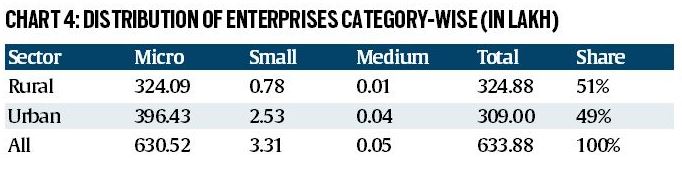
    • According to the latest available (2018-19) Annual Report of Department of MSMEs, there are 6.34 crore MSMEs in the country.
    • Around 51 per cent of these are situated in rural India.
    • Together, they employ a little over 11 crore people but 55 per cent of the employment happens in the urban MSMEs.

    • The numbers suggest that, on average, less than two people are employed per MSME.
    • At one level that gives a picture of how small these really are. But a breakup of all MSMEs into micro, small and medium categories is even more revealing.

    What kind of problems do MSMEs in India face?

    Given the shape and form of MSMEs, it is not hard to envisage the kind of problems they would face.

    • No/Low Formal registration: To begin with, most of them are not registered anywhere. A big reason for this is that they are just too small. But, as it is clear in a time of crisis, it also constrains a government’s ability to help them.
    • Away from Tax norms: GST has its threshold and most micro-enterprises do not qualify. Being out of the formal network, they do not have to maintain accounts, pay taxes or adhere to regulatory norms etc. This brings down their costs.
    • Lack of Financial buffer: According to a 2018 report by the International Finance Corporation (part of the World Bank), the formal banking system supplies less than one-third (or about Rs 11 lakh crore) of the credit MSME credit need that it can potentially fund (Chart 5).

    • They don’t have the buffers of the bigger firms or access to cheap capital to help them tide over this period.
    • Bad credit history:

    The other big issue plaguing the sector is the delays in payments to MSMEs — be it from their buyers or things likes GST refunds etc. A key reason why banks dither from extending loans to MSMEs is the high ratio of bad loans (Chart 6).

    Other problems

    • Long receivables cycles make a mess of working capital management.
    • Limited access to trained labour, technical progress and management support limit their growth.
    • Other common problems faced by small enterprises are related to the availability of technology, infrastructure and managerial competence, and limitations posed by labour laws, taxation policy, market uncertainty and imperfect competition.

    Opportunity areas for MSMEs in India

    Telecommunications

    • Domestic manufacturing of low-cost mobile phones, handsets, and devices;
    • Manufacturing of telecom networking equipment, including routers and switches;
    • Manufacture of base transceiver station equipment;
    • Mobile customer data analytics – services oriented toward analytical solutions; and
    • Development of value-added services

    Healthcare

    • Manufacturing of personal protective equipment (PPE) and face masks, as the COVID-19 pandemic has fundamentally changed social behaviour, public health and hospital needs, and created new demand;
    • Manufacturing of low-cost medical devices, and medical accessories such as surgical gloves, scrubs, and syringes;
    • Low-cost surgical procedures to reduce the cost of healthcare;
    • Telemedicine; and
    • Diagnostic labs.

    Electronics

    • Domestic manufacturing of low-cost consumer electronics, consumer durables;
    • Nano-electronics and microelectronics;
    • Electronic Systems Design and Manufacturing including semiconductor design, electronic components design and hi-tech manufacturing under India’s ‘National Electronics Mission; and
    • Strategic electronics, as the government is keen on encouraging the domestic manufacturing of products needed by the security forces.

    Others

    • Other areas that offer opportunities for MSMEs include information technology, pharmaceutical, chemical, automotive, renewables, gems and jewellery, textile, and food and agriculture.

    Part II of the BI will be published shortly…………

  • [Burning Issue] Vizag Gas Leak

    • The Vizag Gas Leak was an industrial accident that occurred at a chemical plant in R. R. Venkatapuram village near Gopalapatnam on the outskirts of Visakhapatnam, Andhra Pradesh on the early morning of 7 May 2020.
    • The source of the leak was a styrene plant owned by South Korean electronics giant LG.
    • The leaked gas spread over a radius of about 3 kilometres affecting the nearby areas and villages. The incident had a death toll was of 12 and more than 1,000 people were affected.

    What is Styrene?

    • It is a flammable liquid that is used in the manufacturing of polystyrene plastics, fibre glass, rubber, and latex.
    • Styrene is also found in vehicle exhaust, cigarette smoke, and in natural foods like fruits and vegetables.
    • According to The Manufacture, Storage and Import of Hazardous Chemicals Rules, 1989, styrene is classified as a toxic and hazardous chemical.

    What happens when exposed to styrene?

    • A short-term exposure to the substance can result in respiratory problems, irritation in the eyes, irritation in the mucous membrane, and gastrointestinal issues.
    • And long-term exposure could drastically affect the central nervous system and lead to other related problems like peripheral neuropathy.
    • It is, likely, a carcinogenic substance that can react with oxygen in the air to mutate into styrene dioxide, a substance that is more lethal.
    • However, there is no sufficient evidence despite several epidemiology studies indicating there may be an association between styrene exposure and an increased risk of leukaemia and lymphoma.

    What are the symptoms?

    • Symptoms include headache, hearing loss, fatigue, weakness, difficulty in concentrating etc.
    • Animal studies have reported effects on the nervous system, liver, kidney, and eye and nasal irritation from inhalation exposure to styrene.

    How bad is the situation in Visakhapatnam?

    • It is yet unclear whether the deaths are due to direct exposure to styrene gas or one of its byproducts.
    • However, hundreds of people including many children were admitted to hospitals.
    • The cases are high as the gas leak was only detected at 3 am in the morning, meaning several crucial hours have been lost till safety precautions were taken.
    • More fatally, the gas was leaked while people were fast asleep.

    What caused the leak?

    • Styrene monomer was used at the manufacturing plant to produce expandable plastics.
    • The storage requirement of styrene monomer strictly mentions that it has to be below 17 degrees Celsius.
    • There was a temporary and partial shutdown of the plant because of the nationwide lockdown.
    • The leak occurred as a result of styrene gas not being kept at the appropriate temperature.
    • This caused a pressure build-up in the storage chamber that contained styrene and caused the valve to break, resulting in the gas leakage.

    Is it under control?

    • The leak has been plugged and NDRF teams moved into the five affected villages and have started opening the houses to find out if anyone was stranded inside.
    • The Covid-19 preparedness helped a lot as dozens of ambulances with oxygen cylinders and ventilators were readily available.
    • The spread of the gas depends on wind speeds. So far it is estimated that areas within a five-kilometre radius have been affected.

    What are the safeguards against chemical disasters in India?

    The law in India provides protection to victims of such chemical disasters. Here’s a look at some of these provisions:

    Scars from the Bhopal Gas Tragedy

    • At the time of the Bhopal gas tragedy, the Indian Penal Code (IPC) was the only relevant law specifying criminal liability for such incidents.
    • The CBI had initially charged the accused in the case under Section 304 (culpable homicide not amounting to murder) of the Indian Penal Code (IPC).
    • Soon after the tragedy, which had killed 2,000 people, the government passed a series of laws regulating the environment and prescribing and specifying safeguards and penalties.

    Some of these laws were:

    1) Bhopal Gas Leak (Processing of Claims) Act, 1985, which gives powers to the central government to secure the claims arising out of or connected with the Bhopal gas tragedy. Under the provisions of this Act, such claims are dealt with speedily and equitably.

    2) The Environment Protection Act, 1986, which gives powers to the central government to undertake measures for improving the environment and set standards and inspect industrial units.

    3) The Public Liability Insurance Act, 1991, which is insurance meant to provide relief to persons affected by accidents that occur while handling hazardous substances.

    4) The National Environment Appellate Authority Act, 1997, under which the National Environment Appellate Authority can hear appeals regarding the restriction of areas in which any industries, operations or processes or class of industries, operations or processes shall not be carried out or shall be carried out subject to certain safeguards under the Environment (Protection) Act, 1986.

    5) National Green Tribunal, 2010, provides for the establishment of a tribunal for effective and expeditious disposal of cases related to environmental protection and conservation of forests.

    Trial of such cases

    • The legal gains made during the Bhopal Gas Leak, and subsequently with the Delhi Oleum Leakage case, held the principle of absolute enterprise liability for hazardous substances.
    • That is, any manufacturer of hazardous or inherently injurious substance was to be held liable.
    • Any incident similar to the Bhopal gas tragedy will be tried in the National Green Tribunal and most likely under the provisions of the Environment (Protection) Act, 1986.
    • If an offence is committed by a company, every person directly in charge and responsible will be deemed guilty, unless he proves that the offence was committed without his/her knowledge or that he had exercised all due diligence to prevent the commission of such an offence.

    India’s handling of industrial disasters suffers from systemic apathy. To respond to the currently unfolding Visakhapatnam Gas Leak effectively and sensitively, it must reflect on and learn from its inadequate handling of the Bhopal Gas Tragedy. 

    Why the gas leak should set off alarm bells?

    Gruesome pictures and videos emerged, showing people having collapsed by the wayside.  It was reminiscent of the Bhopal gas tragedy of 1984, considered one of the world’s worst industrial disasters.

    1) No lessons learnt from Bhopal

    • The judicial processing of the Bhopal Gas Tragedy took approximately 26 years to yield a penalty that was not only disproportionate but was in itself a result of a great systemic disservice to those involved.
    • The present regulation imposes no-fault liability on the owner of hazardous substance and requires the owner to compensate victims of accident irrespective of any neglect or default.
    • For this, the owner is required to take out an insurance policy covering potential liability from any accident.
    • The government’s failure in protecting the legal rights of the gas victims is evident from the fact that years after the disaster, the registration of claimants is far from complete.
    • This, however, hindered the ability of survivors to negotiate their own settlements on their own terms.
    • Additionally, by the time the final judgement had been passed, most of the claimants had died.

    2) Invisibility of victims

    • As a result of the disorganized response on part of the state machinery, a mass evacuation programme, referred to as “Operation Faith,” was launched in Bhopal.
    • This meant that a significant proportion of the affected population was moved away from the city, making it difficult and almost impossible for following up on health repercussions of the disaster.
    • This invisibilisation of the survivors has become a strategy consistently employed by the state to sweep the enormity of the systemic failure that resulted in the Bhopal disaster, as well as that which succeeded it.
    • Instead of working through the problem of providing medicare, both the state and city governments instead redirected their efforts towards wiping the problem away from the space.

    3) Lax regulation continues

    • Usually, in times of crises, governments tighten safety rules and regulations.
    • But as panic over the economy mounts, governments could end up travelling in the opposite direction.
    • The environment ministry has been giving clearances to industrial proposals through video conference for “seamless economic growth” during Covid-19.
    • Lax regimes could become a haven for hazardous industries and sweatshops.

    4) Operational security neglected

    • Industries have failed to overhaul its working system urgently, especially that is tasked with safety practices.
    • There are no regulatory measures to ensure safety at two ends—on-site and off-site.
    • The on-site one involves all the safety of the in-house personnel and workers, and the off-site deals with ensuring the safety and well being of the habitats in the surrounding areas as well as the surrounding environment.

    5) Multiple Laws with no enforcing agencies

    • One of the most basic and overlooked aspects in the current time is the proper regulatory oversight.
    • The regulators, like SPCBs, are limited in number.
    • Add to it their inability to mount comprehensive and stringent oversight due to budgetary constraints.

    6) Poor checks and monitoring

    • Improper inspection and inspection report and show cause notices are not released in the public domain by state pollution control boards.
    • The MoEF&CC gives the authorisation for the hazardous chemical storage, but inspection is done by factory inspector and by SPCB in case of isolated storage i.e. outside the industry.
    • This is very absurd for safety considerations. Inspections are not done properly and are more of “having a look” rather than being a proper verification as per inspection checklist.
    • This overtime perpetuates negligence by the safety personnel leading to accidents.

    7) Low or no awareness

    • Having a robust disaster management plan (DMP) is a pre-requisite for every industry. However, the availability of DMP does not suffice the purpose.
    • What is needed most is to communicate the same with the local stakeholders. In the case of the Bhopal gas tragedy, we experienced how such miscommunication can lead to higher human casualties.
    • The plant did have the DMP but it never informed the residents around the plant on the measures to be taken in case of any accident.
    • However, looking at the current accident at Vizag, it seems that no lesson has been learnt from past accidents.

    8) Judiciary has failed to relieve

    • The gas leak is just yet another in the long list of such accidents that have happened until now and will happen in the future.
    • So far, the NGT has issued notices to the Centre, LG Polymers India Pvt, Central Pollution Control Board and others in addition to directing LG Polymers India Pvt to pay Rs 50 crore an interim amount for damage to life.
    • There are many other tragedies in the past, where the owners were not held accountable for the damage to life and were let out on bail.

    9) Yet no fixation of accountability

    • Fixing accountability for an accident or negligent actions is another aspect of the legal system that we often ignore.
    • A suit is usually against a company involved in an accident. But, in such a situation, we let free the company employed individuals – responsible for negligent behaviour.
    • In some cases, the industry does suspend or terminate their employment but that’s the maximum that it goes to.

    Possible solutions

    Regulatory: We do not have a strong regulatory body to ensure proper enforcement of laws and regulations related to industrial accidents. The regulators, like SPCBs,  needs to be given a revamp.

    Monitoring and Reporting: Improving monitoring both inside and outside the industry and designing a proper protocol for reporting should be undertaken. Relevance must also be given to monitoring and prompt reporting of sudden events that can lead to industrial accidents.

    Operational safety: In order to avert the rising number of industrial accidents, a more rational approach is required in terms of implementing the existing policies and practices properly. There are many guidelines and protocols for industrial safety that have been designed based on the outlines given in various acts and rules.

    Ensuring thorough capacity building of the employees and management staff – Continually cultivate a safety standard among employees and management staff. Training employees about the importance of following safety measures as often as possible is very crucial. Supplemental training in body mechanics can reduce strain injuries, and keep employees safe during lifting and moving.

    Ensuring a strict code and oversight on not taking shortcuts – Accidents happen when employees skip steps to complete a job ahead of schedule. Make sure all instructions are clear and organized to prevent undue mishaps in the workplace.

    Employing the use of Failure Mode Effects Analysis (FMEA) – FMEA is a structured approach to discovering potential failures that may exist within the design of a product or process. There are various modes by which a process can fail and are called Failure modes that result in undesirable effects. However, FMEA is designed to identify, prioritize and limit these failure modes.

    Installation of a proper alert system – This is one of the most essential components of the immediate response protocol and can really help prevent higher rates of fatalities and/or damage.

    NDMA guidelines for Industrial chemical disasters

    National chemical disaster management guidelines drawn up by the National Disaster Management Authority (NDMA) are as follows:

    • The NDMA guidelines for chemical safety call for harmonization of regulations like land use policy, standardization of national codes and practices and stringent enforcement of safety practices through audits and an inspection system.
    • Industrial units using hazardous chemicals as raw materials will be required to have onsite and offsite emergency plans in place and put them to test by organizing regular mock drills.
    • Given that coordination between the individual units and the local administration is crucial to the management of chemical disasters, the guidelines spell out a key role for the latter.
    • This includes strengthening of state and district mechanisms for accurate and timely dissemination of warning of potentially hazardous gas leaks and chemical spills, GIS-based technologies, and ensuring testing of emergency plans through mock exercises, besides creating awareness and education.
    • The guidelines call upon the industries handling hazardous chemicals to share resources and enter into mutual aid agreements.
    • According to the NDMA, medical preparedness including creation of trained medical first responders, facilities for fast detection and decontamination, mobile hospitals/mobile teams and hospital disaster management plans need to be amalgamated with the preventive strategies to safeguard industrial processes and procedures.

    Way Forward

    Ensuring public safety, a comprehensive safety audit of all the industries should be taken up and a Standard Operating Procedure should be enforced.

    • Preventing these tragedies is not a one man’s act. It will take the combined effort of competent authorities, the private sector, and society to prevent tragic environmental events from happening.
    • Apart from the regular inspections, one must maintain safety processes internally to help prevent and/or reduce the frequency of natural gas leaks.
    • Most of all, it is important to adhere to environmental norms. Taking environmental safety and public health risks seriously and promoting do-no-harm industrial development can make a big difference.
    • There is a clear need to promote clean development that innovatively addresses potential negative impacts on the environment.
    • To prevent future environmental disasters, all sectors could also do more to integrate environmental emergency preparedness and response activities into strategies and sustainable development programs.
    • Some measures include: Developing policies to ensure that industries operate in accordance with technical and safety standards and allocating resources for risk assessment and monitoring.
    • These measures could make a big difference in people’s health and wellbeing and avoid future tragedies.


    References

    https://www.civilsdaily.com/news/vizag-gas-leak-what-is-styrene-gas/

    https://economictimes.indiatimes.com/news/politics-and-nation/how-visakhapatnam-gas-leak-sets-off-alarm-bells-in-more-ways-than-one/articleshow/75648391.cms

    https://www.epw.in/engage/article/gas-leaks-industrial-disasters-reflecting-indias


    Back2Basics: The Bhopal Gas Tragedy

    • It occurred on the cold wintry night in the early hours of 3 December, 1984.
    • At around midnight, the chemical reaction started in the Union Carbide (India) Limited factory that culminated in the leakage of deadly Methyl Isocyanate (MIC) gas from one of the tanks of the factory.
    • As a result, a cloud of gas gradually started descending and enveloping the city in its lethal folds. And the city and lakes turned into a gas chamber.
    • In the tragedy around 3000 lives of innocent people were lost and thousands and thousands of people were physically impaired or affected in several forms.

    What is Methyl Isocyanate?

    • Methyl Isocyanate (MIC) is a chemical that is used in the manufacture of polyurethane foam, pesticides, and plastics.
    • It is handled in liquid form which can be easily burned and explosive. It evaporates quickly in the air and has a strong odour.
    • Its molecular formula is CH3NCO or C2H3NO and its molecular weight is approx. 57.05 g/mol.
    • It is used in the production of pesticides, polyurethane foam, and plastics.
  • [Burning Issue] Judiciary in Times of COVID-19 Outbreak


    During the Second World War, when the Luftwaffe (German air force) was wreaking havoc over London with its incessant bombing attacks, the British Prime Minister Winston Churchill took cognizance of the heavy casualties and economic devastation. While he was briefed on the casualties and economic collapse, he asked, “Are the courts functioning?” When told that the judges were dispensing justice as normal, Churchill replied, “Thank God. If the courts are working, nothing can go wrong.”


    Context

    • Covid-19 has brought almost the entire world to a near-standstill, and India’s justice delivery system — rarely known for its speed even in the best of times — is no different.
    • Official data shows that while the institution of new cases, both in the higher judiciary and subordinate judiciary, has come down since the beginning of the nationwide lockdown on 25 March, the disposal rate has also been severely affected due to the forced closure of courts.
    • The judiciary has come under immense pressure to innovate during this pandemic so as to balance public health concerns with access to justice.

    Background

    • Our Judicial system has been the nation’s moral conscience, speaking truth to political power, upholding the rights of citizens, mediating Centre-state conflicts, providing justice to the rich and poor alike, and on several momentous occasions, saving democracy itself.
    • Despite its achievements, a gap between the ideal and reality has been becoming clear over the years.
    • The justice del­ivery is slow, the appointment of judges is mired in controversy, disciplinary mechanisms scarcely work, hierarchy rather than merit is preferred, women are severely under-represented, and constitutional matters often languish in the Supreme Court for years.
    • As Justice Chelameswar said in his dissent in the NJAC judgment, the courts must reform, so that they can preserve.

    Inherent Issues with Indian Judiciary

    The Constitution of India, through its Preamble, has guaranteed to its citizens ‘Justice’—economic, political and social. But even after 70 years of independence, achieving substantive justice for the vast majority of the citizens has remained a distant dream. In the specific area of justice delivery system, India is faced with several problems relating to large backlogs and pendency of cases.

    Despite the independence of the judiciary from the executive and legislative bodies, the Indian judicial system faces a lot of problems. The major issues that the system faces are:

    • The pendency of cases.
    • Corruption.
    • Lack of transparency (particularly in the appointment of judges).
    • Under trials of the accused.
    • Lack of information and interaction among people and courts.

    1) Pendency of cases

    • India’s legal system has the largest backlog of pending cases in the world – as many as 30 million pending cases. Of them, over four million are High Court cases, 65,000 Supreme Court cases.
    • This number is continuously increasing and this itself shows the inadequacy of the legal system.
    • And also due to this backlog, most of the prisoners in India’s prisons are detainees awaiting trial.
    • It is also reported that in Mumbai, India’s financial hub, the courts are burdened with age-old land disputes, which act as a hurdle in the city’s industrial development.

    What led to the under-performance of Indian Judiciary?

    The issue of heavy arrears pending in the various courts of the country has been a matter of concern since the time of independence. The primary factors contributing to docket explosion and arrears as highlighted by Justice Malimath Committee report are as follows:

    • Population explosion
    • Litigation explosion
    • Hasty and imperfect drafting of legislation
    • Plurality and accumulation of appeals (Multiple appeals for the same issue)
    • Inadequacy of judge strength
    • Failure to provide adequate forums of appeal against quasi-judicial orders
    • Lack of priority for disposal of old cases (due to the improper constitution of benches)

    2) Corruption in judiciary

    • Like any other institution of the Government, the Indian judicial system is also allegedly corrupt.
    • There is no system of accountability. The media also do not give a clear picture on account of the fear of contempt.

    3) Lack of transparency

    • Another problem facing the Indian judicial system is the lack of transparency. It is seen that the Right to Information (RTI) Act is totally out of the ambit of the legal system.
    • Thus, in the functioning of the judiciary, the substantial issues like the quality of justice and accountability are not known properly.
    • In the recent past, there have been many debates regarding the Collegium system and the new system that the government wanted to introduce for the appointment of judges, the NJAC.

    4) Hardships of the undertrials

    • Right to a speedy trial is an integral part of the principles of fair trial and is fundamental to the international human rights discourse.
    • In Indian jails, most of the prisoners are undertrials, which are confined to the jails until their case comes to a definite conclusion.
    • In most of the cases, they end up spending more time in the jail than the actual term that might have had been awarded to them had the case been decided on a time and, assuming, against them.
    • Plus, the expenses and pain and agony of defending themselves in courts is worse than serving the actual sentence. Undertrials are not guilty till convicted.

    5) No interaction with society

    • It is very essential that the judiciary of any country should be an integral part of the society and its interactions with society must be made regular and relevant.
    • Lack of faith in a fair and swift judicial system creates a low-trust society.
    • The rule of law and trust are central to enable people in large societies, who do not personally know each other, to live together peacefully and collaborate.

    Impact of Coronavirus


    1) Decline in cases

    Don’t go by the number of reduced cases … just imagine the scale of burden on Indian Judiciary due to reduced disposal rate!

    • With only limited benches presiding over select matters daily, cases pending before constitution benches have been put on the back burner.
    • In the entire month of April, 82,725 cases were filed in India’s courts, while 35,169 cases were disposed of.
    • Compare this to 2019, when the average number of cases filed per month was around 14 lakh (total number of cases 1.70 crores), while the average number disposed of per month was 13.25 lakh.
    • In all, there are about 3.23 crore cases pending in the 19,683 subordinate courts in the country, of which 90 lakh are civil cases and 2.32 crore are criminal cases
    • The situation in the high courts’ is no better. Currently, there are over a total of about 48.16 lakh cases including civil and criminal cases.

    2) The new normal of Social Distancing

    • Accessibility is a core function of justice – the quality of adjudication in a courtroom is of little utility to potential litigants if they cannot access it.
    • All courts, including the Supreme Court, high courts and district courts, have been operating in a highly restricted manner.
    • Most courts have already decided to persist with the restricted functioning until at least 17 May.

    3) Judicial appointments stalled

    • The process of appointment of judges too has been impacted by Covid-19 and the resulting lockdown.
    • Even before Covid-19, over 35 per cent posts in high courts were vacant — out of 1,079 sanctioned posts, 201 permanent ones and 184 additional judges’ positions were yet to be filled.
    • But now, the appointment of over 120 high court judges is pending with the Supreme Court Collegium, while 50-odd fresh recommendations have been made by the various high court collegiums.

    4) Quasi-judicial bodies have stopped working

    • What is also perplexing is how proceedings in over a dozen tribunals have come to a grinding halt during the lockdown despite these judicial bodies being equipped with video conferencing infrastructure.
    • The central zonal bench of the National Green Tribunal had been hearing matters through video conferencing for nearly two years but stopped functioning since the lockdown.
    • The public will have to pay a huge price for this stalemate as the NGT had stayed work on some key government-funded projects.
    • With proceedings now on hold, cost escalation for these projects would eventually be passed on to common citizens.

    Need for a change

    The pandemic has been changing many aspects of our life and forcing us to innovate or embrace the novel changes. The judiciary is not immune to this change. The time is ripe for the adoption and popularization of online court. But there were several attempts at the adoption of technology in the working of courts even before the pandemic. Time has now come to adopt these technological frameworks on a wider scale.

    Alternatives to conventional courts in practice:

    • The Online courts where the judge is physically present in the courtroom but the lawyer or litigant is not.
    • This is the present arrangement, except that now the courtroom is the residential office of the judge, due to the lockdown.
    • And the Virtual courts(VC) where there is no judge, lawyer or litigant and a computer takes a decision based on the inputs of the litigant.

    1) Online Courts

    • Amid this pandemic, a few district judges have taken a step forward and recorded the statement of parties in cases of divorce by mutual consent.
    • As of now, several such cases, including those involving NRIs, are dealt with through VC in online courts.
    • Punjab and Haryana judges have gone even further ahead. The online courts record the expert evidence of doctors from PGIMER through VC.
    • This has freed the doctors from time-consuming trips to the courts and has resulted in savings of several crores for the exchequer.
    • The SC hearings use the VIDYO App hosted by the National Informatics Centre. Some platforms like Zoom, WhatsApp, and WebEx are being used in some high courts.

    2) Virtual courts

    • A virtual court is a unique contribution of the eCourts Project.
    • A pilot virtual court was launched in August 2018 in Delhi for traffic offences and it has been a great success.
    • Virtual courts have been successfully tried out in Delhi, Haryana, Maharashtra and Tamil Nadu.
    • The virtual court system has the potential of being upscaled and other petty offences attracting a fine such as delayed payments of local taxes or compoundable offences can also be dealt with by virtual courts.
    • This will ease the burden on conventional courts and therefore must be strongly encouraged.

    The Supreme Court support for video conferencing

    The outbreak of coronavirus or COVID-19 in several countries including India has necessitated immediate adoption of measures to ensure social distancing to prevent transmission of the virus.

    • A bench headed by CJI SA Bobde said that every high court would be authorised to determine the modalities suitable to the temporary transition to the use of video conferencing technologies.
    • All measures taken by the courts, to reduce the need for the physical presence of all stakeholders within court premises and to secure the functioning of courts in consonance with social distancing guidelines and best public health practices shall be deemed to be lawful, said the bench.
    • The top court directed that district courts in each state shall adopt the mode of video-conferencing prescribed by the concerned high court.
    • The concerned courts shall maintain a helpline to ensure that any complaint in regard to the quality or audibility of feed shall be communicated during the proceeding or immediately after its conclusion.
    • The bench directed that courts shall duly notify and make available the facilities for video-conferencing for such litigants who do not have the means or access to such facilities.
    • Until appropriate rules are framed by the high courts, video conferencing shall be mainly employed for hearing arguments whether at the trial stage or at the appellate stage.

    The only option lies in technology

    • One way to retain access for most litigants as quarantine, self-isolation and social distancing are being implemented to avoid contracting the deadly virus, is by using technology.
    • Some jurisdictions abroad have the facility to operate online courts and even telephone hearings for non-substantive issues.
    • The importance of allowing technology within the judicial process is already recognised in studies conducted by Indian legal analysts.
    • For instance, DAKSH’s white paper series on a next-generational justice platform moots the idea of re-calibrating the Indian judicial system through a natively digital platform.

    Various issues with these courts

    • Unfamiliarity with the medium of communication is the major issue. Judges are simply not used to consciously facing a camera generally and in particular while hearing a case.
    • Similarly, lawyers find it difficult to comfortably argue while seated.
    • Some technical problems in conducting online hearings have also surfaced. The bandwidth is not adequate or stable enough. The picture sometimes breaks or gets frozen and the voice often cracks.
    • Consultations are also a problem: Lawyers occasionally need to consult their client or the instructing advocate; judges also need to consult each other during a hearing.

    Lack of a unified portal

    • The Supreme Court initially instructed litigants to use an app called Vidyo. There have been instances of using Whatsapp, Google and Zoom video conferencing tools.
    • These apps raise obvious security and sovereignty questions when used for judicial proceedings.
    • A public function as critical as adjudication cannot rely on third-party proprietary software.
    • The National Informatics Centre will have to create a platform that includes features such as videoconferencing and e-filing.
    • This will benefit not just the judiciary but all other components of the justice system – such as the police, prisons and lawyers – and provide more people more justice more speedily.

    Conclusion

    • As a matter of fact, the present system of justice is totally out of place and out of time and tune with democratic procedures and norms that please only a certain section of the society with vested interests.
    • Therefore, there is an immediate need to restructure the entire judicial system to make it answerable to the needs of a democratic, progressive society.
    • The judiciary has a golden opportunity to envisage a justice delivery system that could function unhindered at all levels during any emergency.
    • The online court is one of a number of related justice modernization needs. It may cost several billion and look a massive sum to commit at a time of austerity, but if it succeeds it will save several more billions.
    • This saving will be made by eliminating many of the costs of running a paper-based system using rented premises which look more like shop windows and craft workshops than actual courtrooms.

    The inherent issues can be addressed with some simple measures like:

    • For pendency, time-limits should be prescribed for all cases based on priorities. So setting time-standards is essential and it will vary for different cases, and also for different courts depending on their disposal-capacity. Alternative disputes resolution  (ADR) mechanisms should be promoted for out of court settlements.
    • To imbibe transparency, a thorough understanding of the principle of independence of the judiciary and ensuring its accountability is the sole prerogative of the Supreme Court itself. The judiciary should come up with its own solution for transparent functioning and judicial appointments.
    • To make trials speedy, the judiciary must scrutinize the sensitivity of a particular case before taking up for hearing. Fast track courts must be established for varieties of cases.

    Way Forward

    • Necessity is the mother of invention – once Covid-19 is contained, the judiciary will be presented with an opportunity to reform the justice system to better serve a public that will desperately need it.
    • The legislative underpinning of the courts’ modernization should begin boldly and immediately.
    • First and foremost, it needs to massively increase the number of leaders and innovators who are addressing issues of law and justice.
    • The coronavirus crisis has encouraged courts around the world to find innovative ways of delivering justice. Courts and their users must ‘seize the moment’.
    • We urgently need a set of new laws and procedural rules for the online courts.
    • We have to create more awareness and understanding and also create platforms and spaces that invite and enable changemakers to come together, dialogue and collaborate to create effective solutions.
    • We must use technology and new media to create a citizens movement by equipping citizens with the knowledge, resources and tools to put pressure on the system to change.
    • The rapidly evolving field of “legal tech” enables us to use emerging technologies like digitization, process automation, data and analytics, AI to completely reimagine how a 21st century, the citizen-centric legal system should work.


    References

    https://theprint.in/judiciary/how-lockdown-has-hit-judiciary-in-numbers-april-cases-fall-to-82k-from-14-lakh-avg-in-2019/413666/

    https://indianexpress.com/article/opinion/columns/india-coronavirus-parliament-judiciary-lockdown-6367368/

    https://theprint.in/opinion/corona-is-a-wake-up-call-for-indian-courts-they-arent-equipped-to-function-in-a-crisis/389224/

    https://www.bloombergquint.com/law-and-policy/how-indian-courts-are-adapting-in-the-times-of-covid-19

    https://scroll.in/article/958271/the-coronavirus-pandemic-is-an-unfortunate-opportunity-for-indias-judicial-system-to-modernise

    https://indiankanoon.org/doc/32424520/

    https://www.magzter.com/article/News/Outlook/Higher-Resolution

  • [Burning Issues] Fiscal Push for MSME Sector of India (Part II)

    COVID-19 and MSMEs

    • The MSMEs were already struggling — in terms of declining revenues and capacity utilization — in the lead-up to the Covid-19 crisis.
    • The total lockdown has raised a question mark on workers payment primarily because these firms mostly transact on cash. That explains the job losses.
    • The problem with most small Indian businesses is that they operate on thin margins and don’t have the deep financial resources to survive a significant dip in cash flows.
    • So, when an unexpected event like a lockdown happens and MSMEs can’t sell/produce their goods or services, it also means for many they can’t meet their monthly expenses – this includes costs like paying salaries to their employees.

    Fiscal stimulus package to MSMEs under Atmanirbhar Bharat Abhiyan

    Finance Minister has announced the first tranche of the Atmanirbhar Bharat Abhiyan economic package. The main thrust of the announcements was a relief to Medium, Small and Micro Enterprises (MSMEs) in the form of a massive increase in credit guarantees to them.

    What is the package about?

    Instead of directly infusing money into the economy or giving it directly to MSMEs in terms of a bailout package, the government has resorted to taking over the credit risk of MSMEs.

    1) 100% credit guarantee

    • Firstly, it will give a 100% credit guarantee for Rs 3 lakh crore worth of collateral-free loans to MSMEs that were doing fine before the pandemic hit and are now in trouble.
    • This deal will only apply to small businesses that already had an outstanding loan of Rs 25 crore or those with a turnover of less than Rs 100 crore.
    • This doesn’t mean the government is directly infusing Rs 3 lakh crore into India’s MSMEs.
    • Put simply, if an MSME wants to take a loan of Rs 1 crore from a bank now, the Centre is saying that if the business fails to repay that loan, it will step in and make good all of that Rs 1 crore.
    • Thus, banks don’t have to worry about potential NPAs – that headache is transferred to the government.

    2) Subordinate debt scheme

    • The second measure is a ‘subordinate debt scheme’ worth Rs 20,000 crore and is mainly for MSMEs who are already struggling with debt and are unlikely to get fresh funding by themselves.
    • This scheme will allow banks and NBCs to give loans to MSMEs which are already deemed as ‘stressed’ and are thus less credit-worthy.
    • For these firms, the government will only provide partial credit guarantee support to banks.

    3) Availability of Funds

    • The final step involves the government creating a Rs 50,000-crore fund which will infuse equity into “viable” MSMEs, thus helping them to expand and grow.
    • The Centre will put only Rs 10,000 crore into this and get other PSU institutions like SBI or LIC to help fund the remaining amount.
    • The basic idea behind this is that MSMEs who have been forced into a cash-strapped corner by the national lockdown will be able to apply for some working capital that will keep their businesses afloat until they are able to operate at pre-pandemic levels.
    • By doing this, the government also hopes to protect the employment that MSMEs create and thus save jobs.

    4)Other measures

    • There are two other MSME policy announcements – one aimed at bringing more firms into the MSME net, while the other is oriented towards providing a level playing field.
    • The first is defining what the firm gets to be an ‘MSME’ and avail of all the government benefits that are given to that category of business.
    • The criteria have been expanded quite loosely and will mean that companies don’t have to be as small as they were to avail of MSME benefits.
    • Put simply, the government will now subsidize more smaller companies than they used to.
    • Second, there is a change in the definition of an MSME that was pending for long.
    • Now MSMEs will be judged on turnover and there will be no difference between a manufacturing MSME and services MSME.
    • FM also extended the initiation period of fresh insolvency proceedings against MSMEs by six months to up to one year depending upon the COVID situation.

    Need for such measures

    • Even before the Covid-19 crisis, Indian government finances were in poor health. This pandemic has meant that government revenues will come under further pressure.
    • For instance, experts are already talking about a GDP contraction of 5% to 10% in the current financial year. It will result in a revenue loss of anywhere between Rs 5 to 7 lakh crore.
    • And yet, this is also the year when employees and firms want the government to help them out financially.
    • Banks, quite justifiably, suspect that any new loans will only add to their growing mountain of non-performing assets (NPAs).
    • So the government was facing an odd problem: Banks had the money but were not willing to lend to the credit-starved sections of the economy, while the government itself did not have enough money to directly help the economy.

    • The solution — credit guarantees — finally chosen by the government is not a new one, because this fiscal conundrum is not a new one either (see chart).

    Why Rs 3 lakh crore?

    • The total outstanding loan to MSMEs by the banking and NBFC sector is around Rs 16 to 18 lakh crore.
    • Assuming that 80% of these loans are working capital loans where there would be a 20% incremental funding needs, that gives an amount of approximately Rs 3 lakh crore.
    • So the government is hoping that this credit guarantee will help those MSMEs take out another loan and recover.
    • The hope is that since these MSMEs were able to pay back before the crisis, there is no reason why they cannot after the crisis, provided they are given some extra money to survive this period.

    How far will these measures help?

    • The Rs 3 lakh crore credit guarantees are the most substantive announcement as it will most likely have a significant impact.
    • It will help MSMEs pay salaries and keep their heads above the water even as the economy slows down.
    • This measure is expected to help as many as 45 lakh MSMEs.

    Issues with the package

    1) No banks consulted

    • The scheme for MSMEs has left bankers unhappy as the guarantee is not being offered by the government, but from the credit guarantee trust fund for micro and small enterprises (CGTMSE) instead of being a sovereign guarantee.

    2) Criteria of availability

    • The benefits of the package will not be available to businesses which had repayments overdue by more than 30 days as on Feb 29, 2020.
    • Only for the stressed MSMEs and those whose loans have turned bad, a Rs 20,000-crore subordinated debt scheme has been envisaged.

    3) Employee’s welfare faintly addressed

    • With the package, the government has mandated MSMEs for paying the wages.
    • The MSMEs are short of revenues to be able to pay the salaries. It has now become a matter of ability to pay.
    • Manpower cost for ancillary suppliers is one of the largest. Not every company has the ability to pay their employees so going forward will be more stressful.

    4) Too much of loans

    • The package has offered for taking additional loans, but the MSME sector is already leveraged heavily.
    • At this point, taking additional loans can help with major short term liquidity, but in the longer-term, the companies or the units abilities for repaying these loans is grossly neglected.
    • Also the onus on increasing the competitiveness of MSMEs post the lockdown has been grossly neglected.

    Way forward

    • The challenge now is to create a policy environment that will encourage the growth of more MSME that can hold their own in a competitive market.
    • The problems faced by MSMEs need to be considered in a disaggregated manner for successful policy implementation as they produce very diverse products, use different inputs and operate in distinct environments.
    • In general, there is a need for tax provisions and laws that are not only labour-friendly but also entrepreneur-friendly.
    • More importantly, there is a need for skill formation and continuous upgrade both for labour and entrepreneurs.
    • While the government has to strengthen the existing skilling efforts for labour, there is an urgent need for managerial skill development for entrepreneurs running MSMEs — an area that is considerably neglected.
    • Further, the government could consider dedicated television and radio programmes, similar to agriculture, to help educate entrepreneurs running small businesses.

    Conclusion

    Covid-19 is a crisis with an unforeseeable ending. What is clear though is that the government and businesses—both large and small—will have to work together to ensure the protection of workers, be ready for risk management in terms of phased re-starting of business operations and be prepared and open to structural changes in business activities.

    • Issues related to credit, like adequacy, timely availability, cost and mortgages continue to be a concern for MSME. These enterprises are dependent on self-finance. Profit margins are also low.
    • The government drive for financial inclusion could benefit such entities.
    • The government could consider dedicating specialised financial schemes for addressing difficulties in assessing and providing credit for small enterprises, as also providing a line of credit to firms which are under financial stress.
    • The road ahead remains unclear, but it is likely that the economic damage is already much larger than the measures undertaken so far.
    • A continued focus on reforms and on sustaining India’s growth potential will be critical in preventing macroeconomic instability.


    References

    https://www.civilsdaily.com/news/what-makes-msmes-most-vulnerable-to-covid-19-disruptions/

    https://www.cii.in/Sectors.aspx?enc=prvePUj2bdMtgTmvPwvisYH+5EnGjyGXO9hLECvTuNuXK6QP3tp4gPGuPr/xpT2f

    https://economictimes.indiatimes.com/cibil/articles/msme-sector-panacea-of-all-ills/articleshow/61836122.cms?from=mdr

    https://thewire.in/economy/narendra-modi-msme-package-cost


    Also read: Various schemes related to MSME Sector

    [Prelims Spotlight] Acts and schemes related to MSME sector

  • [Burning Issue] Key takeaways from the report on National Infrastructure Pipeline (NIP)

    As India embarks on its journey of 5 trillion Economy, the importance of Infrastructure cannot be undermined. PM Modi in his Independence Day speech 2019 had highlighted this aspect by allocating ₹100 lakh crore for infrastructure projects over the next 5 years.

    The latest move- ‘National Infrastructure Pipeline (NIP)’. NIP will help to augment infrastructure and create jobs in the country. The government task force on NIP in its report has projected total investment of Rs 111 lakh crore in infra projects over 5 years.

    The emphasis would be on ease of living: safe drinking water, access to clean and affordable energy, healthcare for all, modern railway stations, airports, bus terminals and world-class educational institutes.


    What is the National Infrastructure Pipeline (NIP)?

    • NIP includes economic and social infrastructure projects.
    • During the fiscal years, 2020 to 2025, sectors such as Energy (24%), Roads (19%), Urban (16%), and Railways (13%) will amount to around 70% of the projected capital expenditure in infrastructure in India.
    • It has outlined plans to invest more than ₹102 lakh crore on infrastructure projects by 2024-25, with the Centre, States and the private sector to share the capital expenditure in a 39:39:22 formula.

    Why the infra sector is given more emphasis these days?

    • Slowdown due to the pandemic is a good time to catch up on infrastructure capacity and increase the expenditure.
    • Infrastructure spending is a critical component of the fiscal stimulus as it has multiplier effects on the economy and job creation.
    • Quality infrastructure is important not only for faster economic growth but also to ensure inclusive growth.
    • Lack of adequate infrastructure not only holds a lack of economic development, but it also causes additional costs in terms of time, effort and money of the people for accessing essential social services.

    Key benefits of NIP

    • Economic: Well-planned NIP will enable more infra projects, grow businesses, create jobs, improve ease of living, and provide equitable access to infrastructure for all, making growth more inclusive.
    • Government: Well-developed infrastructure enhances the level of economic activity, creates additional fiscal space by improving the revenue base of the government, and ensures the quality of expenditure focused on productive areas.
    • Developers: Provides a better view of project supply, provides time to be better prepared for project bidding, reduces aggressive bids/ failure in project delivery, ensures enhanced access to sources of finance as a result of increased investor confidence.
    • Banks/financial institutions (F1s)/investors: Builds investor confidence as identified projects are likely to be better prepared, exposures less likely to suffer stress given active project monitoring, thereby less likelihood of NPAs.

    Projects included


    • The report contains recommendations on general and sector reforms relating to key infrastructure sectors for implementation by the Centre and states.
    • Sectors such as energy (24%), roads (18%), urban (17%) and railways (12%) amount to around 71% of the projected investments.
    • The projects will also be spread across sectors such as irrigation, mobility, education, health, water and the digital sector.

    Major constraints in implementation

    The major implementation constraints that will be faced possibly in future are:

    • Availability of funds for financing large projects
    • Lengthy processes in land acquisition and payment of compensation
    • Environmental concerns
    • Time and cost overruns due to delays in project implementation and procedural
    • Delays and lesser traffic growth than expected to increase the riskiness of the projects
    • Stalled or languishing projects and a shortfall in funds for maintenance

    Highlights of the task forces’ report

    Components of Infrastructure Vision 2025

    The Taskforce has proposed certain goals, strategies and standards under its Infrastructure Vision 2025. Following are the components of the vision.

    (a) Affordable and clean energy

    • Ensuring 24×7 power availability;
    • Reduce pollution through green and clean renewable energy and environment-friendly fuel for transportation.

    (b) Digital Services

    • Providing access for all.
    • 100% population coverage for telecom and high-quality broadband services for socio-economic empowerment of every citizen;
    • Digital payments and e-governance Infrastructure for delivery of banking and public services

    (c) Quality Education:

    • World-class educational institutes for teaching and research, technology-driven learning meeting GER target of 35 by 2025 as per the draft National Education Policy, 2019.

    (d) Convenient and efficient transportation and logistics

    • Roads: Enhanced road connectivity to remotest areas and trunk connectivity through expressways, major economic corridors, strategic areas and tourist destinations. Extensive charging and on-road traction infrastructure for electric vehicles.
    • Rail: World-class stations and fully integrated rail network with inter-modal connectivity to remote regions and close to nil accidents.
    • Air: Airport and related infrastructure to enable international and regional connectivity so as to achieve passenger and cargo traffic on the vision of NCAP 2016. Air connectivity to all Tier II and most Tier III cities.
    • Ports: Port and Waterway infrastructure focused on reducing logistics time and cost for foreign and domestic trade as per the Sagarmala National Perspective Plan 2016.
    • Metro-connectivity: Urban mobility MRTS and bus connectivity within 800 metres of homes in more than 50 cities. High standards of living for citizens by providing metro connectivity in at least 25 cities.

    (e) Housing and water supply for all

    • Housing for all by 2022 PMAY negligible slum population.
    • All households to have piped water meeting national standards by 2024.
    • Wastewater recycling and treatment.

    (f) Agriculture infrastructure:

    • Increased irrigation and micro-irrigation coverage;
    • Integrated agro logistics systems from farm gate to end consumers storage, processing and packing, transportation, market and digital infrastructure for agriculture produce.

    (g) Good health and well being

    • Superior healthcare facilities, electronic health records infrastructure.
    • Superior accessible primary, secondary and tertiary healthcare infrastructure facilities across India to meet NHP 2017 goals.
    • Medical para medical education infrastructure meeting manpower needs by 2020 and CHVs by 2025 as per IPHS norms.

    Major area of focus

    • According to the report, India would need to spend $4.51 trillion on infrastructure by 2030 to become a $5 trillion economy by 2025.
    • Of the Rs 111 lakh crore, the plan suggests spending 24 per cent in the energy sector, 18 per cent in roads, 17 per cent in urban infrastructure, 12 per cent in railways, and the rest on airports, agriculture and food processing infrastructure, industrial infrastructure, among others.
    • Healthcare, clubbed with the social sector, ranks alongside ports and airports.
    • The biggest allocations go to power, roads, railways, irrigation, urban and rural infrastructure.
    • The report allocated Rs 3.93 lakh crore to social infrastructure, including higher and school education, health and family welfare, sports and tourism. That’s higher than Rs 3.56 lakh crore proposed in the interim report.

    Here are other highlights of the report:

    Financing

    • The report suggests forming a steering committee in the Department of Economic Affairs for raising financial resources for infrastructure projects
    • It recommends setting up a well-capitalized credit enhancement fund to improve the rating of projects to easy investments by institutional investors in infrastructure through capital market instruments
    • Channeling resources from the pension and insurance sector into the infrastructure bond market
    • Strengthening the municipal bond market in India
    • Developing infrastructure financing institution IIFCL as a development finance institution in consultation with the Reserve Bank of India
    • The monetisation of assets by government departments and public sector entities to reduce the debt burden and invest in asset creation

    Monitoring

    • Creation of a tool to monitor projects under development
    • A steering committee of lenders and equity investors to monitor compliances, resource mobilization and design
    • An empowered committee for clearance of large projects

    Health sector

    It suggests:

    • Scaling up India’s medical devices and diagnostic equipment manufacturing under “Make in India” initiative
    • Exploring public-private partnership in medical education
    • Use of tele-consultation which will link tertiary care institutions to district and sub-district hospitals which provide secondary care facilities

    Various issues with the report

    Issue of Finance

    • The report of the Task Force recommends diversifying financing sources, along with strengthening the existing means.
    • The report also suggested for efficient monitoring of project execution and enhancing the execution capacity of private sector participants.
    • It said that necessary steps or initiatives need to be undertaken in order to solve the challenge of stressed assets faced by banks by encouraging usage of innovative mechanisms such as loan securitization, InvITs, etc and increased participation of Infrastructure debt funds (IDFs), DFIs, among others.

    Neglecting health sector

    • While the Covid-19 pandemic has bared inadequacies in India’s healthcare, a task force preparing a fresh infrastructure spending road map has lowered allocation to the sector from what is recommended in the interim report.
    • It suggested spending of Rs 1.51 lakh crore in five years ending March 2025 on health and family welfare, according to the final report submitted on April 29.
    • That’s lower than 1.5 per cent of the overall Rs 111 lakh crore infrastructure spending target.
    • The task force’s allocations contrast with its suggestions on improving healthcare infrastructure at the time when COVID-19 is uprooting various inadequacies.

    No measure to address Economic slowdown

    • With India already grappling with an economic slowdown and job losses, COVID-19 has struck at the most inopportune time.
    • The countrywide lock down had to be neutralized with some sort of stimulus package. This is where the task force report remains silent.

    Conclusion

    • Infrastructure development is the key to economic growth and well-being of the country’s people, as it will propel economic growth, improve quality of life contribute to GDP nationally.
    • Capacity creation and expansion in important segments like roads and highways, power, railways, renewable sector, ports, airports, metros etc, is a must for delivering impressive results.
    • The current buoyancy has not just confined to urban areas but also extended to rural areas and improving the quality of life for the masses.
    • Over the period, formalization of the economy has taken place and any growth now onwards once NIP is in place will be more sustainable, rather than a boom-and-bust process.
    • Therefore, massive infrastructure development through NIP is a sure way of achieving the government’s $5 trillion economy target.
    • This is will give a boost to several sectors, create new jobs directly and indirectly, and eventually boost the commercial market, thereby propelling the country’s economic growth.

    Way Forward

    • A country’s level of human and economic development is closely related to its levels of achievement in physical and social infrastructure.
    • While physical infrastructure is an important determinant of domestic production, good social infrastructure is vital for human development as well as economic progress through better educated, better skilled, and healthier citizens.
    • Striking a balance between the two is the real challenge for any government in action.
    • Translating the government’s vision to become a USD 5 trillion economy by 2023-24 may be a formidable task, but is achievable.
    • This should, in the long term address all the issues which are either way hurdled with infrastructural inadequacies.


    References

    https://www.civilsdaily.com/news/national-infrastructure-pipeline-nip/

    https://www.bloombergquint.com/economy-finance/taskforce-on-infrastructure-cuts-healthcare-allocation-in-final-report

    164.100.117.97 › userfiles › DEA IPF NIP Report Vol 1

  • [Burning Issue] The COVID chapter in Indian Diplomacy

    The outbreak and spread of COVID-19 has created multiple challenges for the entire world. Apart from primary challenges like containing the spread of the virus and treating infected patients, there are rising political issues such as the blame game between US and China, crumbling role of WHO and questions about the future world order. Amid this entire crisis, India has been playing an important role as reflected in the praises being heaped on our PM from worldwide, paving way for stronger future partnerships. This also creates an opportunity for India’s so-called “medical diplomacy” which is already growing at an unprecedented scale.

    Background

    • The spread of COVID at lightning speed has exposed the void in collective leadership at the global level.
    • The contemporary global order and institutions have proved to be hegemonic exercises meant to deal with isolated political and military crises but failed to serve humanity at large.
    • To top it all, the worst nativist tendencies of the global leaders are visible in the face of this major crisis.
    • The fact that UNSC took so long to meet (that too inconclusively) to discuss the pandemic is a ringing testimony to the UN’s insignificance.
    • In this global chaos, India’s handling of the pandemic and its bilateral moves, shows India’s mettle to awaken the conscience of the superpowers and catalyse collective global action.

    The World on its knees (credits COVID-19)

    Fall of WHO

    • WHO is under criticism for giving China too much benefit of the doubt at the beginning of this pandemic.
    • At the center of public outrage, WHO is now being mimicked as “Chinese Health Organisation” even as it is at the forefront of fighting its worldwide spread.
    • The largest contributor to WHO’s finance, the US has halted its funding making WHO a paper organisation.

    The Trumplomacy

    • The US decision to suspend contributions to the WHO is an extraordinary act of moral abdication and international vandalism at a time when the world desperately needs to find means of working together.
    • From unnecessary trade war to an increasingly desperate coronavirus war, US and China are trapped in a blame game with no easy way out.
    • Weakened economically and politically after COVID-19, U.S.’s capacity to play a critical role in world affairs is diminishing.

    EU woes

    • The EU, the most progressive post-national regional arrangement, stood clueless when the virus spread like wildfire in Europe.
    • Its member states turned inward for solutions: self-help, not regional coordination, was their first instinct.
    • These regional institutions haven’t fared any better in the past as well.
    • Europe, in the short and medium-term, will prove incapable of defining and defending its common interests, let alone having any influence in world affairs.

    Problems in West Asia

    • In West Asia, both Saudi Arabia and Iran are set to face difficult times.
    • The oil price meltdown will aggravate an already difficult situation across the region.
    • There may be no victors, but Israel may be one country that is in a position to exploit this situation to its advantage.
    • Israel could exploit this situation to strengthen its control over Palestine (benefiting from its dependency) and crush the Hamas.

    Looming global depression

    • Neoliberal economic globalization may face a major beating in the wake of the pandemic and signs of the global recession are eminent.
    • The pre-existing structural weakness of the global order will further feed states’ protectionist tendencies fueled by hyper-nationalism.

    The Great Strategist: China

    • China is seeking to convert its ‘failure’ into a significant opportunity. This is Sino-centrism at its best, or possibly its worst for the world.

     Point in Case

    • China has surprisingly accelerated its movements in the South China Sea.
    • It plans using its manufacturing capability to its geo-economic advantage.
    • There are enough reports of China’s intentions to acquire financial assets and stakes in banks and companies across the world amid crisis.
    • Shares in HDFC: India seems to have woken up only recently to this threat after the Peoples’ Bank of China acquired a 1% stake in India’s HDFC.

    Taking advantage of RCEP and Belt and Road Initiative

    • Restricting hostile takeovers may not be adequate to checkmate China.
    • It is poised to dominate the Regional Comprehensive Economic Partnership (RCEP).
    • It will enable China to exploit market access across the Association of Southeast Asian Nations, East Asian nations, Australia and New Zealand.
    • Together with its Belt and Road Initiative, China is ostensibly preparing the way for a China-centric multilateral globalization framework.

    India steps in as a Leader

    • India has been proactive at both the domestic level – the steps taken to tackle the crisis at home — and the diplomatic level — India’s assistance to other countries, especially in the Indian Ocean Region (IOR), amid the pandemic.
    • Despite the existing domestic challenges emanating out of the pandemic, India has decided to render possible help to countries like the US, a few European, African, and Latin American countries, as well as countries in the Middle East by providing medicines and sending medical professionals.

    What steps did India take?

    • The first element of India’s medical diplomacy includes issuing speedy clearances for the export of the anti-malarial drug hydroxychloroquine – seen as useful in the treatment of patients suffering from the novel coronavirus – at the last count to 55 countries.
    • The second element includes dispatch of Indian military doctors teams to countries like Nepal, the Maldives and Kuwait to help local administrations draw up plans to combat the spread of this pandemic.

    India and IOR

    1) Early evacuations

    • One of the first steps taken by India was to evacuate citizens of different countries along with its own citizens from Wuhan, China, the epicentre of the first COVID-19 outbreak.
    • Those evacuated as compassionate cases includes citizens from IOR countries such as Bangladesh, Myanmar, the Maldives, South Africa, and Madagascar.
    • India not only evacuated these people but also quarantined them in India as a precautionary measure before sending them to their respective countries.

    2) Supply of essential medicines

    • India has emerged as a major supplier of medicines to different countries worldwide in the fight against COVID-19.
    • As part of that effort, India was the first responder to Mauritius and Seychelles.
    • Accordingly, India sent a consignment of life-saving drugs, including hydroxychloroquine, to Mauritius and Seychelles.

    3) Settling the neighbourhood irritants

    • In the past few months, India’s relations were strained to owe to Iran and Malaysia’s criticisms of India on CAA issue.
    • However, recently India and Iran cooperated with each other in order to evacuate Indians stranded in Iran.
    • Apart from this, India has sent a wheat consignment to Afghanistan through Iran’s Chabahar port.
    • With respect to Malaysia, India has agreed to supply anti-malarial drugs, indicating an improvement in bilateral relations.

    India and Middle-East

    • While the current Indian government has been placing immense importance on promoting its “Neighborhood First” policy, it is simultaneously strengthening overall cooperation with its “extended neighbours.”
    • This is where the Middle Eastern countries come to the fore.

    Extending the cooperation

    • India’s cooperation with this region has become more comprehensive, moving beyond the oil-energy trade to include military-security ties, maritime cooperation, strategic oil reserves, joint energy exploration projects, and mutual investments.
    • India has dispatched a team of 15 doctors and healthcare professionals to assist the efforts of the Kuwaiti government in its fight against the pandemic.
    • Jordan, UAE and Oman are some of the countries to whom India has supplied hydroxychloroquine (HCQ).
    • Apart from the above-mentioned Arab countries, India has also provided medical-related and humanitarian assistance to Israel, which is one of its largest arms suppliers.

    India and SAARC

    • India has assumed leadership of the South Asian charge against COVID-19.
    • India has backed to set up an emergency fund to fight the rapid spread of Covid-19 pandemic and has pledged $10 million toward this emergency fund.

    India and US

    • India lifted the ban on HCQ, displaying its ability to rise above politics despite Trump’s consistent politicization of COVID-19 response efforts.

    The thought behind Indian Diplomacy

    1) Acting in-principle with Vasudhaiva Kutumbakam

    • At this crucial juncture when almost every part of the globe is engulfed by the deadly COVID-19 pandemic, India has taken a step forward by providing medical assistance to some of its international partners.
    • Precisely, India has been propagating the ancient Sanskrit dictum Vasudhaiva Kutumbakam, meaning “the world is one family.”
    • Such goodwill reflects the evolving nature of the Indian foreign policy, and this has gradually been acknowledged by other countries.

    2) India chose collaboration over confrontation

    • Crises bring out the best and worst in individuals, and the same appears to be the case for nation-states.
    • While rivals China and the US engage in a high-profile war of words amidst the COVID-19 crisis, India has chosen the approach of collaboration over confrontation.
    • This approach also provided India with an opportunity to address the irritants in its ties with countries, most notably Iran and Malaysia.

    3) Being the global pharmacy

    • India is often dubbed “the pharmacy of the world” that produces 70 per cent of the world’s HCQ.
    • The Indian pharma industry is the world’s third-largest drug producer by volume and the country’s market manufactures 60 per cent of vaccines globally.

    4) Addressing the ‘threat everywhere’

    • Covid-19 does not respect borders – even closed ones – and its continued transmission anywhere poses a threat to health everywhere.
    • If the pandemic worsens, intensive international cooperation will be required to get expertise and resources to where they are needed the most – especially as the disease takes root in impoverished countries in the Global South.

    5) Occupying the vacuum generated

    • The COVID-19 crisis presents an opportunity for India. This entire crisis has put the focus on China from different quarters.
    • At present, more and more countries in the world have an unfavourable opinion about China.
    • On the other hand, India has been nimble-footed enough to take this opportunity and build up goodwill, which could result in elevated status in the post-COVID-19 period.

    Conclusion

    • History teaches us that the collective action needed to address this crisis will not just emerge spontaneously – it must be built painfully, step by step, by countries that trust one another and are able to look beyond their own immediate interests.
    • Indian diplomacy has been often accused as a response to the transactional discussions. However, India is making genuine sacrifices to show international solidarity and not to monger profits.
    • India’s foreign policy has instilled this principle in letter and spirit and is acting accordingly because of even the smallest contribution matters.

    Way ahead

    • The new world order is on the way. The spread of concepts like “before corona” and “after corona” will become commonplace.
    • Far-reaching changes can be anticipated in the realm of geo-economics and geopolitics.
    • India is gearing up itself for the emerging challenges on various fronts.
    • The effort and message are clear: India’s careful diplomacy reflects a balance between the country’s values and interests.
    • The Indian act of generosity has turned the world attention towards India and is sure to open doors towards deeper ties around the world in the near future.


    References

    https://www.civilsdaily.com/news/covid-19-and-the-crumbling-world-order/

    https://www.civilsdaily.com/burning-issue-world-health-organization-who-and-coronavirus-handling/

    https://thediplomat.com/2020/04/indias-indian-ocean-diplomacy-in-the-covid-19-crisis/

    https://www.thehindu.com/opinion/lead/the-deep-void-in-global-leadership/article31200881.ece

  • [Burning Issue] 100% Reservation and Associated Issues

    Background

    • Reservation in India is a system of affirmative action by the State that provides representation for historically and currently disadvantaged groups in Indian society in education, employment and politics.
    • It was envisaged to help address social disparities and economic backwardness of certain sections of the population within a few decades.
    • But gradually, amendments have been made, and there is no review of the list nor has reservation come to an end. Instead, there is a demand to increase them.
    • Now it is very tough for any elected government to have the political will to meet the challenges that arise from the reservation.

    Reservation being an all-time contested issue is a less inevitable topic for mains. However, we can expect some of the thought triggering questions such as – “Reservation is hardly capable of striking a balance between social inclusion and merit. Critically comment. (250 W)”

    OR

    Essay topic like- “Meritocracy is unrealized without an egalitarian society” are ready to raid your mind.

    Present context

    • Recently, the Constitution Bench of the Supreme Court has held it unconstitutional to provide 100% reservation for tribal teachers in schools located in Scheduled Areas across the country.
    • The Bench was answering a reference made to it in 2016 on whether 100% reservation is permissible under the Constitution.
    • The principal grounds cited are mainly found in a 1992 judgment of a nine-judge Bench in Indra Sawhney vs Union of India.

    Yet again in the news

    • Since 1992, governments—both the Centre and the states—have been liberal in their interpretation of “extraordinary situation”, and have used various legal provisions to protect policies that breached the 50% cap.
    • For instance, some states have used the Schedule IX shield to protect state laws that expanded reservation beyond 50%. (A Tamil Nadu law that provides 69 per cent reservation in the state is part of the Schedule.)
    • Maharashtra recently enacted legislation to give reservation benefits to Marathas.
    • On the other hand, the Centre created a 10% quota for people from economically “weaker” sections (defying the sole criteria of socio-economic backwardness).

    What is the present case?

    • The Supreme Court has overruled the Andhra Pradesh government’s decision in 1988 to provide a 100% reservation to Scheduled Tribes for teacher posts in Scheduled Areas.
    • The notification to provide a 100% reservation to Scheduled Tribes (STs) for teacher posts in Scheduled Areas was issued by then governor of the erstwhile Andhra Pradesh.
    • The Fifth Schedule of the Constitution dealing with the administration of Scheduled Areas vests the Governor with legislative and administrative powers.

    Note: We shall not indulge in dicussing the pros and cons of reservations. Numerous politicians and forged bhakts are there to brainstorm them.

    Why did AP bring such a provision?

    • The scheduled areas are treated differently from the other areas in the country because they are inhabited by ‘aboriginals’ who are socially and economically rather backwards and special efforts need to be made to improve their condition.
    • Therefore, the whole of the normal administrative machinery operating in a state is not extended to the scheduled areas.
    • Then AP govt. observed that there was chronic absenteeism among teachers who did not belong to those remote areas where the schools were located.

    No 100% quota permissible

    • The apex court held that it is an obnoxious idea that tribals only should teach the tribals.
    • Merit cannot be denied in toto by providing reservation observed the judgement.
    • Citizens have equal rights, and the total exclusion of others by creating an opportunity for one class is not contemplated by the founding fathers of the Constitution of India.

    Constitutionality check: ‘Failed’

    • The Supreme Court concluded that reservation in the case violated Articles 14 (equality before law), 15(1) (discrimination against citizens) and 16 (equal opportunity) of the Constitution.
    • The Court ruled that the Governor’s powers under para 5 of Schedule V are subject to the fundamental rights guaranteed under Part III of the Constitution.
    • It observed that in this case, “there were no such extraordinary circumstances to provide a 100 per cent reservation in Scheduled Areas”.
    • The court also took note of a Presidential Order issued in 1975 under Article 371-D (Special provisions for Andhra Pradesh) of the Constitution, which said employment to people in the state were limited to only their districts.

    Other legal loopholes

    • Paragraph 5(1) of Schedule V empowers the Governor to issue a notification directing that any central or state law may not apply to a scheduled area or shall apply to the area with modifications and exemptions.
    • The then Andhra Pradesh Governor had cited this provision.
    • The government order had also cited Andhra Pradesh State and Subordinate Service Rules 1996, which provides for 6 per cent reservation for Scheduled Tribes in the State.
    • But the bench ruled that Para 5(1) of Schedule V does not allow modification of Rules.

    Invoking Indra Sawhney judgment: The 50% Cap

    • The court referred to the famous Indra Sawhney judgment (Mandal case- Indra Sawhney v. Union of India 1992), which caps reservation at 50%.
    • The court held that a 100% reservation is discriminatory and impermissible.
    • Among others, it recognized socially and economically backward classes as a category and recognized the validity of the 27 per cent reservation.
    • The concept of ‘creamy layer’ gained currency through this judgment. Those among the OBCs who had transcended their social backwardness were to be excluded from the reservation.

    Significance of the present judgement

    • The verdict quashing the 100% quota is not against affirmative programmes as such, but caution against implementing them in a manner detrimental to the rest of society.
    • However, the solution for drafting only members of the local tribes was not a viable solution.
    • As the Bench noted, it could have come up with other incentives to ensure the attendance of teachers.
    • Another aspect that the court took into account was that Andhra Pradesh has a local area system of recruitment to public services.
    • Thus, the 100% quota deprived residents of the Scheduled Areas of any opportunity to apply for teaching posts.

    Why so much confusion persists over ‘reservation’ after several Judgements?

    • There are many other reservation-related judgements where the SC has either read down its earlier judgments or has completely side-stepped these.
    • A fair share of the blame, however, must rest with the SC itself in 1994, in Ajay Kumar Singh SC ruled on reservations at the highest levels of education, which Indra Sawhney proscribes.
    • For instance, SC in 2018 upheld one part of the Nagaraj judgment saying that reservations can’t be allowed to affect efficiency negatively while in another judgment.
    • It is necessary to liberate the concept of efficiency from a one-sided approach which ignores the need for and the positive effects of the inclusion of diverse segments of society on the efficiency of administration.
    • Unless the apex court lays down its opinion with some degree of certitude, the reservation will likely continue in perpetuity.

    What is the remedy for such a situation?

    • B.R. Ambedkar observed during the debate in the Constituent Assembly on the equality clause, that any reservation normally ought to be for a “minority of seats”.
    • This is one of the points often urged in favour of the 50% cap imposed by the Court on the total reservation, albeit with some allowance for relaxation in special circumstances.
    • It is still a matter of debate whether the ceiling has innate sanctity, but it is clear that wherever it is imperative that the cap be breached; a special case must be made for it (as TN and MH did).
    • Such a debate should not divert attention from the fact that there is a continuing need for a significant quota for STs, especially those living in areas under the Fifth Schedule special dispensation.

    Way Forward

    • The reservation policy was introduced only for a temporary timeframe until equality reigns amongst all bases of discrimination.
    • However, the policy of reservation has been continuing for over six decades now and continues to expand. Since, Reservation is necessary to provide equality, equity, and diversity in society.
    • The Indra Sawhney judgement started a new era of reservation in India. But actual work of social upliftment is still incomplete.
    • The present system seeks to elevate a section or decelerates another regardless of merit to bring them all on the same level.
    • Still, it is the only prerogative for social upliftment of marginalized sections.
    • There is a need for rationalizing the policy so that a balance can be established between social mobility and merit.


    Back2Basics: What are Fifth Schedule Areas?

    • The Fifth Schedule of the Constitution deals with the administration and control of scheduled areas and scheduled tribes in any state except the four states of Assam, Meghalaya, Tripura and Mizoram (ATM2).

    Who can declare an area to be Scheduled Area?

    • The President is empowered to declare an area to be a scheduled area.
    • He can also increase or decrease its area, alter its boundary lines, rescind such designation or make fresh orders for such re-designation on an area in consultation with the governor of the state concerned.

    Administration of Scheduled Areas

    • The executive power of a state extends to the scheduled areas therein. But the governor has a special responsibility regarding such areas.
    • The executive power of the Centre extends to giving directions to the states regarding the administration of such areas.

    Role of Governor

    • He has to submit a report to the President regarding the administration of such areas, annually or whenever so required by the President.
    • The Governor is empowered to direct that any particular act of Parliament or the state legislature does not apply to a scheduled area or apply with specified modifications and exceptions.
    • He can also make regulations for the peace and good government of a scheduled area after consulting the tribes advisory council.

    The Tribes Advisory Council

    • Each state having scheduled areas has to establish a tribes’ advisory council to advice on welfare and advancement of the scheduled tribes.

    States having Scheduled Areas

    • At present, 10 States namely Andhra Pradesh, Chhattisgarh, Gujarat, Himachal Pradesh, Jharkhand, Madhya Pradesh, Maharashtra, Odisha, Rajasthan and Telangana have Fifth Schedule Areas.
    • Tribal habitations in the states of Kerala, Tamil Nadu, Karnataka, West Bengal, Uttar Pradesh and Jammu & Kashmir have not been brought under the Fifth or Sixth Schedule.

    Also read:

    Ninth Schedule of the Indian Constitution


    References

    https://www.civilsdaily.com/news/no-100-quota-for-scheduled-areas/

    https://theprint.in/judiciary/no-rhyme-or-reason-for-100-reservation-why-sc-quashed-2000-andhra-order-for-st-teachers/407217/

    https://www.thehindu.com/opinion/editorial/no-100-quota-the-hindu-editorial-on-overzealous-reservation/article31427747.ece