Customers will have to pay a 5% Goods and Services Tax (GST) on pre-packed, labelled food items such as atta, paneer and curd, besides hospital rooms with rents above ₹5,000.
What is GST?
GST launched in India on 1 July 2017 is a comprehensive indirect tax for the entire country.
It is charged at the time of supply and depends on the destination of consumption.
For instance, if a good is manufactured in state A but consumed in state B, then the revenue generated through GST collection is credited to the state of consumption (state B) and not to the state of production (state A).
GST, being a consumption-based tax, resulted in loss of revenue for manufacturing-heavy states.
What are GST Slabs?
In India, almost 500+ services and over 1300 products fall under the 4 major GST slabs.
There are five broad tax rates of zero, 5%, 12%, 18% and 28%, plus a cess levied over and above the 28% on some ‘sin’ goods.
The GST Council periodically revises the items under each slab rate to adjust them according to industry demands and market trends.
The updated structure ensures that the essential items fall under lower tax brackets, while luxury products and services entail higher GST rates.
The 28% rate is levied on demerit goods such as tobacco products, automobiles, and aerated drinks, along with an additional GST compensation cess.
Why rationalize GST slabs?
From businesses’ viewpoint, there are just too many tax rate slabs, compounded by aberrations in the duty structure through their supply chains with some inputs taxed more than the final product.
These are far too many rates and do not necessarily constitute a Good and Simple Tax.
Multiple rate changes since the introduction of the GST regime in July 2017 have brought the effective GST rate to 11.6% from the original revenue-neutral rate of 15.5%.
Merging the 12% and 18% GST rates into any tax rate lower than 18% may result in revenue loss.
Anayoottu, an annual ritual at the Sree Vadakkunnathan Temple, Thrissur was recently held.
Why in news?
There is a history behind this annual ritual at the temple.
Kerala’s elephant pooram was selected, along with other cultural forms of the country, for display at the opening ceremony of the Asian Games held in Delhi in 1982.
Elephants were transported all throughout the country to New Delhi.
What is Anayoottu?
The Aanayoottu (gaja pooja/ feeding of elephants) is a festival held in the precincts of the Vadakkunnathan temple in City of Thrissur, in Kerala.
The festival falls on the first day of the month of Karkkidakam (timed against the Malayalam calendar), which coincides with the month of July.
It involves a number of unadorned elephants being positioned amid a multitude of people for being worshipped and fed.
Crowds throng the temple to feed the elephants.
Mythology behind
It is believed that offering poojas and delicious feed to the elephants is a way to satisfy Lord Ganesha—the god of wealth and of the fulfillment of wishes.
The Vadakkunnathan temple, which is considered to be one of the oldest Shiva temples in southern India, has hosted the Aanayottoo event for the past few years.
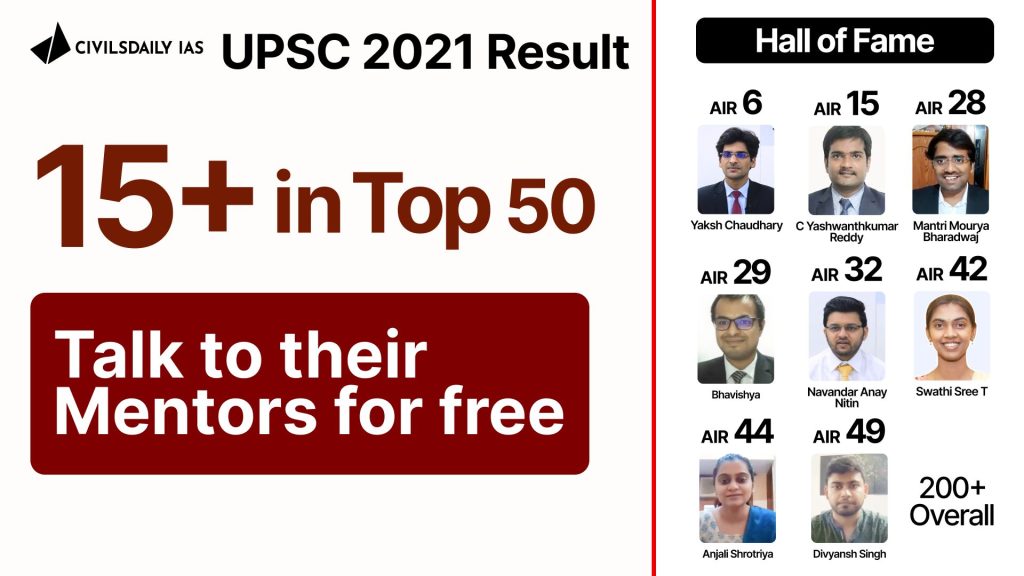
Divyansh Singh, AIR 49, UPSC 2021. Civilsdaily Mentorship Student
Divyansh Singh was one of CD’s mentorship students under Sajal sir, Sukanya ma’am, and other mentors under the Smash Mains program. Divyansh was determined about improving himself. He improved his marks in GS-2 and GS-4 2021 in 2021 Mains.
He filled A-to-Z Preparation Gaps under the Guidance of Sajal Sir
A-Awareness Gap
B-Behavioral gap
C- Confidence gap
D-Delivery Gap
E-Excessiveness/Exclusiveness Gap
F-Focus gap
G-Generic approach gap
H-Herd mentality gap
I-Introvert nature gap
J-Juggling multiple things
K-Knowledge gap
L- Learning Gap
M- Mentoring Gap
N- Narrative Gap
O-Objectivity gap
P-Practice gap
Q-Quantification gap
R-Revision gap
S-Smartwork gap
T-Testing gap
U- Understanding gap
V-Vanity issue gap
W- Wrong attitude gap
X-X-Factor gap
Y-Yardstick approach gap
Z-Zealous approach gap
This was Divyansh’s 4th attempt and in the 2nd attempt in 2019, he secured 484, in the 3rd attempt his rank was 425. Divyansh’s optional was Chemistry.
In a candid interview with Siddharth Sir, Divyansh revealed how he improved his All India Rank to 49.
Divyansh is an engineer by education. After graduation, he joined Microsoft. But soon he realized that UPSC is the right career for him. He started pursuing leaving his corporate job.
In 2020, after joining Smash Mains Program, Divyansh Singh received the remedial studies he had been looking for for 3 years. He attributed his success to Sajal Sir and Sukanya Ma’am.
He said that Sajal Sir was like his best friend throughout his entire journey. He helped Divyansh to improve his marks in GS 2 and GS 4 efficiently.
In GS-2 he scored 119 and according to him, it wasn’t possible without Sajal Sir’s remedial mentorship.
In GS-4, Ethics paper, he scored 117. He said that Sukanya Ma’am’s 1-1 mentorship worked for him. in 2020, he scored only 86 in GS-4. But he improved by 31 marks in 2021. And thus he secured 49 All India Rank.
Program’s focus is on conceptual clarity, simplicity, relevance, and making interlinkages between current affairs and the basic/static part of the syllabus.
Sajal Sir’s guidance got him 10 times more likely to prepare for current affairs linking with the static part in a very short time.
Next-level evaluation of answers helped him a lot to fetch more scores in all GS papers.
CA Resource consolidation on Prelims and Mains’ Preparation.
An ecosystem for co-learning and active learning.
Many more…
Before getting to CD’s Mentorship Program under Sajal Sir in 2020, he had been securing below ranks consistently. He said that he couldn’t figure out the necessary things which are highly required to work on.
Divyansh has made us proud by securing AIR 49 in UPSC 2021 exam. It is yet another validation of CivilsDaily’s vision and approach to personalized mentorship.
Anay has inspired us and we wish him all the best. He’s going to be an administrator of great integrity!
Guys, successful and unsuccessful people do not vary greatly in their abilities. They vary in their desires to reach their goal. Disrobe your failure. Civilsdaily senior mentors team are happy to fulfill your IAS dream.Talk to Us
Are you a staunch aspirant of UPSC IAS exam? if yes, you should keep in mind that Civilsdaily provides the best 1-1 mentorship program on UPSC CSE preparation. In 2021 merit list, 200+ selections are from our mentorship program.
The Hindu has acknowledged the success rate of our mentorship program
Civil Services Aptitude Test is a part of UPSC CSE prelims. There is no such paper in UPSC Mains. It is a qualifying paper. Candidates have to score 33% to clear the paper.
Total Number of questions: 80
Full marks: 200
Time: 2 hours
Though it is qualifying in nature, it plays a crucial role in passing prelims.
The objective of the CSAT is to judge the aspirants on their reading, analytical & reasoning skills.
It proves a little challenging to many students because of its standard level.
But, if you prepare it with a concrete strategy under the guidance of a senior IAS mentor, you can easily score 33%+.
Quantitative Aptitude has been gaining prominence over the years.
The number of logical reasoning is getting less.
The number of comprehensions is stable.
How to deal with CSAT?
As it’sa qualifying paper, too much time investing is not feasible.
Prepare in any of these ways.
Make your quant. Strong enough. We already found that even if a student just attempts the quant section errorlessly, he/she can pass the paper easily.
Work on both Quantitative aptitude and Logical reasoning with the same focus if you feel a little weaker in maths. Because the reasoning questions are very easy and scoring.
Reading comprehension is one of the most difficult sections. If you are a master of English, you can invest time in it.
You are doing previous question papers. And that’s appreciated. But, have you ever thought that all the aspirants are also doing the same? Then how our ‘Hall of Fame’ toppers distinguished themselves on the final merit list!
To gain more accuracy, speed, and performance and To save time, money & energy, they used to attend Online workshops on IAS prep strategy with senior IAS mentors.
UPSC Previous year papers are those sets of questions that went before in time and order. Like all other exams, there are copies of UPSC-CSE PYQs exist. You can download PDFs of PYQs from the Civilsdaily. And analyze what types of questions are asked in Civil Service Examination.
How many previous year papers are required?
Previous year’s papers are the core and essence of the UPSC preparation. But, how many previous questions really play an important role!
After mentoring 5000+ IAS aspirants, the Civilsdaily senior IAS mentors team has made a list of essential previous question papers, an IAS aspirant must do.
UPSC prelims
GS-1
GS-2 (CSAT)
Past 10 years’ questions are needful
Past 5 years’ questions are needful
UPSC Mains
Essay
Previous 5 years
GS – I
Previous 10 years
GS – II
Previous 10 years
GS – III
Previous 3 years
GS – IV
Previous 6 years
Optional Subject
Previous 12 years
Importance of previous questions
From toppers to Mentors, none can deny the significance of the previous year’s question papers. They are important from different angles.
Every exam is unique in itself. So, the exam patterns also differ from one another. To know the Ques. pattern, the role of PYQs is undeniable.
They help us know the difficulty level of the questions. And in how much depth we should maintain while preparing the subjects.
Previous Years’ questions let us know those pet topics of the exams.
To know the dynamic trends, PYQs are incomparable.
PYQs work as the pieces of equipment for a fence. You can have a grip on the entire syllabus following them.
How to do them
If you wish to start UPSC Preparation without coaching, make previous years’ question papers your mentor.
Read and analyze the previous years’ question papers in the following ways so that it means a lot to you.
Previous Years’ Question Papers (UPSC Prelims)
Previous 10 Years Question papers of GS-1
Previous 5 Years Question Papers of GS-2 (CSAT – A qualifying paper)
Now, start investing 30 days to 45 days to analyze them fully and comprehensively.
Take a note of the weightage of the topic and subject-wise questions.
Try to comprehend how UPSC connected current affairs with static.
In CSAT, start solving papers one by one from the second day.
Try to find out offbeat questions. And the way how UPSC designed such questions.
Every question has its unique demand. Identify them.
Take a note of whether the trend of a question from a particular chapter has been going towards an easier level or a more difficult level.
Always do the pet chapters in 360 degrees.
Supplementary materials
It’s undeniable fact that UPSC preparation starts with previous question papers but gets velocity with essential books, Daily MCQs, Test Series, Daily answer writing, etc.
All the question papers mentioned above are co-related. If you miss one, others may not help you.
Online Workshop on UPSC previous question papers strategy
You are doing previous question papers. And that’s appreciated. But, have you ever thought that all the aspirants are also doing the same? Then how our ‘Hall of Fame’ toppers distinguished themselves on the final merit list!
To gain more accuracy, speed, and performance and To save time, money & energy, they used to attend Online workshops on IAS prep strategy with senior IAS mentors.
The civil services examination (CSE) is a National level competitive examination. The exam is conducted by the UPSC almost every year.
CSE is also widely known as the IAS exam.
CSE is for the recruitment of bureaucrats (Civil Servants/HIgher Govt. officials) for 3 services under the Government of India
All India Services
Group A Services or Central Services
Group B services or State services
Every year millions of Indian youths start preparing for the exam. But a handful of candidates can clear the exam because it is the toughest exam in the country and is unpredictable too.
What services are there under UPSC CSE?
All India Services:
Indian Administrative Service
Indian Foreign Service
Indian Police Service
Group A Services or Central Services
Indian Audit and Accounts Service
Indian Civil Accounts Service
Indian Corporate Law Service
Indian Defence Accounts Service
Indian Defence Estates Service
Indian Information Service, Junior Grade
Indian Postal Service, Group
Indian P&T Accounts and Finance Service
Indian Railway Protection Force Service
Indian Revenue Service (Customs & Indirect Taxes)
Indian Revenue Service (Income Tax)
Indian Trade Service
Group B services or State services
Armed Forces Headquarters
Delhi, Andaman, and the Nicobar Islands, Lakshadweep, Daman & Diu, and Dadra & Nagar Haveli Civil Service (DANICS)
Delhi, Andaman, and the Nicobar Islands, Lakshadweep, Daman & Diu, and Dadra & Nagar Haveli Police Service (DANIPS).
Pondicherry Civil Service (PONDICS)
UPSC-CSE Salary
All the posts start in the level 10 pay matrix and the pay band is between Rs. 56,100 and Rs. 1,77,500.
Eligibility:
Nationality:
For the Indian Administrative Service, the Indian Foreign Service, and the Indian Police Service, a candidate must be a citizen of India.
(2) For other services, a candidate must be either:—
(a) a citizen of India or (b) a subject of Nepal
(c) a subject of Bhutan
(d) a Tibetan refugee who came over to India before 1st January 1962 intending to permanently settle in India
(e) a person of Indian origin who has migrated from Pakistan, Burma, Sri Lanka, East African countries of Kenya, Uganda, the United Republic of Tanzania, Zambia, Malawi, Zaire, Ethiopia, and Vietnam intending to permanently settle in India. Provided that a candidate belonging to categories (b), (c), (d) and (e) shall be a person in whose favour a certificate of eligibility has been issued by the Government of India. A candidate in whose case a certificate of eligibility is necessary may be admitted to the examination but the offer of appointment may be given only after the necessary eligibility certificate has been issued to him/her by the Government of India.
Minimum Educational Qualification:
A candidate must hold a Graduate degree from any of the Universities incorporated by an Act of the central or State Legislature in India or other educational institutions established by an Act of Parliament or declared to be deemed as a University under Section 3 of the University Grants Commission Act, 1956 or possess an equivalent qualification.
Age:
(1) A candidate must have attained the age of 21 years and must not have attained the age of 32 years
(2) The upper age limit prescribed above will be relaxable:
(a) up to a maximum of five years if a candidate belongs to a Scheduled Caste or a Scheduled Tribe;
(b) up to a maximum of three years in the case of candidates belonging to Other Backward Classes who are eligible to avail of reservation applicable to such candidates;
(c) up to a maximum of three years in the case of Defence Services Personnel, disabled in operations during hostilities with any foreign country or in a disturbed area and released as a consequence thereof;
(d) up to a maximum of five years in the case of ex-servicemen including Commissioned Officers and Emergency Commissioned Officers (ECOs)/ Short Service Commissioned Officers (SSCOs) who have rendered at least five years of Military Service
(e) up to a maximum of five years in the case of ECOs/SSCOs who have completed an initial period of assignment of five years of Military Service
(f) up to a maximum of 10 years in the case of candidates belonging to Persons with Benchmark Disabilities (PwBD) categories viz. (i) blindness and low vision; (ii) deaf and hard of hearing; (iii) locomotor disability including cerebral palsy, leprosy cured, dwarfism, acid attack victims and muscular dystrophy; (iv) autism, intellectual disability, specific learning disability, and mental illness; (v) multiple disabilities from amongst person under clauses (i) to (iv) including deaf-blindness
Number of Attempts:
Every candidate appearing at the examination, who is otherwise eligible, shall be permitted six (6) attempts at the CSE. However, relaxation in the number of attempts will be available to the SC/ST/OBC and PwBD category candidates who are otherwise eligible. The number of attempts available to such candidates as per relaxation is as under:
Fees:
Candidates (excepting Female/SC/ST/Persons with Benchmark Disability Candidates who are exempted from payment of fee) are required to pay a fee of Rs. 100/- (Rupees One Hundred only)
Guys, though we have provided above the most comprehensive details for your CSE preparation, we would like to recommend you to have a personalized mentor. Because UPSC CSE is a hard nut to crack.
Guys, successful and unsuccessful people do not vary greatly in their abilities. They vary in their desires to reach their goal.
Getting confused? connect with us. We will help you to make out.
Lamenting that jails across the country were flooded with undertrial prisoners, the apex court urged the Centre to introduce reforms in the bail laws.
It stated that bail applications should be disposed of within two weeks while those for anticipatory bail be decided within six weeks
What is Bail?
Bail is the conditional release of a defendant with the promise to appear in court when required.
The term also means the security that is deposited in order to secure the release of the accused.
In India’s legal world, the term offense has been categorized as bailable offenses and non-bailable under the Code of Criminal Procedure.
Why need Bail?
Bail is a fundamental aspect of any criminal justice system.
The practice of bail grew out of the need to safeguard the fundamental right to liberty.
Liberty is the right of one whose guilt has not yet been proven.
Types of Bail in India
Depending upon the sage of the criminal matter, there are commonly three types of bail in India:
Regular bail: Regular bail is generally granted to a person who has been arrested or is in police custody. A bail application can be filed for regular bail under sections 437 and 439 of CrPC.
Interim bail: This type of bail is granted for a short period of time and it is granted before the hearing for the grant of regular bail or anticipatory bail.
Anticipatory bail: Anticipatory bail is granted under section 438 of CrPC either by session court or High Court. An application for the grant of anticipatory bail can be filed by the person who discerns that he may be arrested by the police for a non-bailable offense.
Conditions for Grant of Bail in Bailable Offences
Section 436 of the Code of Criminal Procedure, 1973, lays down that a person accused of a bailable offense under IPC can be granted bail if:
There are sufficient reasons to believe that the accused has not committed the offence.
There is sufficient reason to conduct a further inquiry in the matter.
The person is not accused of any offence punishable with death, life imprisonment or imprisonment up to 10 years.
Conditions for Grant of Bail in Non-Bailable Offences
Section 437 of Code of Criminal Procedure, 1973 lays down that the accused does not have the right to apply for bail in non-bailable offences.
It is discretion of the court to grant bail in case of non-bailable offences if:
The accused is a woman or a child, bail can be granted in a non-bailable offence.
There is a lack of evidence then bail in non-Bailable offenses can be granted.
There is a delay in lodging FIR by the complainant, bail may be granted.
The accused is gravely sick.
What is the recent ruling about?
The Supreme Court underlined that arrest is a draconian measure that needs to be used sparingly.
The ruling is essentially a reiteration of several crucial principles of criminal procedure.
Why bail needs reform?
Huge pendency of undertrials: Referring to the state of jails in the country, where over two-thirds lodged are undertrials,
Indiscriminatearrests: Of this category of prisoners, majority may not even be required to be arrested despite registration of a cognizable offense, being charged with offenses punishable for seven years or less.
Disadvantageous for some sections: They are not only poor and illiterate but also would include women. Thus, there is a culture of offense being inherited by many of them.
Colonial legacy: Theoretically, the court also linked the idea of indiscriminate arrests to magistrates ignoring the rule of “bail, not jail” to a colonial mindset.
Is there any bail law on bail?
The CrPC does not define the word bail but only categories offenses under the Indian Penal Code as ‘bailable’ and ‘non-bailable’.
The CrPC empowers magistrates to grant bail for bailable offenses as a matter of right.
This would involve release on furnishing a bail bond, without or without security.
And what is UK law?
The Bail Act of the United Kingdom, 1976, prescribes the procedure for granting bail.
A key feature is that one of the aims of the legislation is “reducing the size of the inmate population”.
The law also has provisions for ensuring legal aid for defendants.
The Act recognises a “general right” to be granted bail.
What has the Supreme Court held on reforms?
The court’s ruling is in the form of guidelines, and it also draws the line on certain procedural issues for the police and judiciary:
Separate law on Bail: The court underlined that the CrPC, despite amendments since Independence, largely retains its original structure as drafted by a colonial power over its subjects.
Uniform exercise of discretionary powers: It also highlighted that magistrates do not necessarily
Avoid indiscriminate arrests: The SC also directed all state governments and Union Territories to facilitate standing orders to comply with the orders and avoid indiscriminate arrests.
Way forward
Bail Law would certainly take care of not only the unwarranted arrests but also the clogging of bail applications before various courts.
With restrictive bail conditions and a conservative view on bail, we may forget the meaning of personal liberty, which is the greatest of human freedoms enjoyed in India.
Hi guys, are you looking for UPSC previous question papers? well, you’ll get them here. But, they aren’t enough for your preparation. Ensuring the needful, team Civilsdaily has brought all the exam-centric resources to one place for you. Never ignore these 6 types of Question Papers for UPSC.
Previous question papers are the heart and soul of the UPSC preparation. But, how many previous questions really play an important role!
After mentoring 5000+ IAS aspirants, the Civilsdaily senior IAS mentors team has made a list of essential previous question papers, an IAS aspirant must do.
UPSC prelims
GS-1
GS-2 (CSAT)
Past 10 years’ questions are needful
Past 5 years’ questions are needful
UPSC Mains
Essay
Previous 5 years
GS – I
Previous 10 years
GS – II
Previous 10 years
GS – III
Previous 3 years
GS – IV
Previous 6 years
Optional Subject
Previous 12 years
Importance of previous questions
From toppers to Mentors, none can deny the significance of the previous year’s question papers. They are important from different angles.
Every exam is unique in itself. So, the exam patterns also differ from one another. To know the Ques. pattern, the role of PYQs is undeniable.
They help us know the difficulty level of the questions. And in how much depth we should maintain while preparing the subjects.
Previous Years’ questions let us know those pet topics of the exams.
To know the dynamic trends, PYQs are incomparable.
PYQs work as the pieces of equipment for a fence. You can have a grip on the entire syllabus following them.
How to do them
If you wish to start UPSC Preparation without coaching, make previous years’ question papers your mentor.
Read and analyze the previous years’ question papers in the following ways so that it means a lot to you.
Previous Years’ Question Papers (UPSC Prelims)
Previous 10 Years Question papers of GS-1
Previous 5 Years Question Papers of GS-2 (CSAT – A qualifying paper)
Now, start investing 30 days to 45 days to analyze them fully and comprehensively.
Take a note of the weightage of the topic and subject-wise questions.
Try to comprehend how UPSC connected current affairs with static.
In CSAT, start solving papers one by one from the second day.
Try to find out offbeat questions. And the way how UPSC designed such questions.
Every question has its unique demand. Identify them.
Take a note of whether the trend of a question from a particular chapter has been going towards an easier level or a more difficult level.
Always do the pet chapters in 360 degrees.
Supplementary materials
It’s undeniable fact that UPSC preparation starts with previous question papers but gets velocity with essential books, Daily MCQs, Test Series, Daily answer writing, etc.
All the question papers mentioned above are co-related. If you miss one, others may not help you.
Online Workshop on UPSC previous question papers strategy
You are doing previous question papers. And that’s appreciated. But, have you ever thought that all the aspirants are also doing the same? Then how our ‘Hall of Fame’ toppers distinguished themselves on the final merit list!
To gain more accuracy, speed, and performance and To save time, money & energy, they used to attend Online workshops on IAS prep strategy with senior IAS mentors.
Welcome! We know you came here in search of only previous years’ questions but it’s our promise, you’ll return with things that will mean a lot to you. UPSC preparation reaches its climax stage when an aspirant works smartly.And for smart work, you need to proceed with these 6 types of basic materials. Let’s explore.
Previous years’ question papers are those sets of questions that went before in time and order. Like all other exams, there are copies of UPSC-CSE PYQs exist. You can download PDFs of PYQs from our teachers. And analyze what types of questions are asked in Civil Service Examination.
Here our specialist team arrange daily online mock test:
1. In the comments section, share your score and also let everyone know the logic you’ve used to mark certain answers. This will trigger intelligent discussions benefitting everyone.
2. Completing the test should be your top priority. Focus on accuracy rather than simply attempting more questions. Give enough thought to each question, we have increased the time limit so you can do this.
3. At the end of the test, click on ‘View Questions’ button to check the solutions.
*You can attempt the test multiple times for your own practice but only your first attempt will be counted for rankings.
Smash Prelims
Smash Prelims 2023 under Santosh Gupta sir’s mentorship can increase your chances to clear Prelims by 85%
There is no doubt that UPSC Prelims could be the toughest stage. It is the great filter that weeds out the not so serious candidates but at times many serious ones too.
While there could be many reasons for failing in Prelims like insufficient syllabus coverage, mocks or test series not attempted, no proper planning, lack of conceptual understanding, etc but the major one is lack of guidance, preparation analysis and course correction at regular intervals.
Previous years’ question papers are those sets of questions that went before in time and order. Like all other exams, there are copies of UPSC-CSE PYQs exist. You can get solved PDFs of PYQs from our experienced teachers. And analyze what types of questions are asked in Civil Service Examination.
“We must never forget the lonely non-glamorous long hard work behind success”. It’s not a success story of ‘Proving’. It’s a story of ‘Improving’.
Abhijit Ray was one of the mentorship and Samachar Manthan students under Sajal sir. After losing the first 3 attempts, he strongly realized that it’s a foolish act to overestimate yourself and think that even a non-serious effort will take you through. There is a thin line between confidence and arrogance.
Current affairs are indispensable for every stage of the UPSC exam. Understanding the importance of current affairs is just one part of the UPSC puzzle. To solve the whole puzzle, there is no substitute for Samachar Manthan.
In 2020, after joining SM, Abhijit Ray received the remedial current affairs studies he had been looking for for 3 years. He attributed his success to the remedial advice of Sajal Sir under Samachar Manthan.
CD’s team is there to provide handholding support all through your UPSC journey. Increased interaction with the faculty and teachers from Civilsdaily will help you align your preparation and make it more relevant. You can reach out to Sajal sir and other teachers on Habitat.
Program’s focus is on conceptual clarity, simplicity, relevance, and making interlinkages between current affairs and basic/static part of the syllabus.
Sajal Sir’s guidance got him 10 times more likely to prepare for current affairs linking with the static part in a very short time.
Next-level evaluation of answers helped him a lot to fetch more scores in all GS papers.
CA Resource consolidation on Prelims and Mains’ Preparation.
An ecosystem for co-learning and active learning.
Many more…
Before getting to Samachar Manthan. He had been facing failure consistently. He said that he couldn’t figure out the necessary things which are highly required to work on.
For ultimate success what matters is an ecosystem for co-learning and active learning together learning, doubt clearing, notes, references, mentors, and a focused community. You’re going to learn and discuss like never before.
Abhijit believes whether it is UPSC prelims or Mains, to clear both stages it is your performance in that matters. Other than this “..you need clarity of vision”, says Abhijit, to keep yourself determined to your goal.
He came to know about Sajal Sir’s Samachar Manthan. As soon as he heard, he connected with Sajal Sir and joined without losing any more seconds.
He improved his marks drastically in this 2021 Mains. In a candid conversation with Civilsdaily, Abhijit shared his journey, motivations, up and downs, lessons learned, and his secret of what kept him going.
It is yet another validation of CivilsDaily’s vision and approach to personalized mentorship.