💥UPSC 2026, 2027, 2028 UAP Mentorship (March Batch) + Access XFactor Notes & Microthemes PDF

Search results for: “”

  • Issues with use of NMMS app in NREGA

    Context

    The National Mobile Monitoring Software (NMMS) app seeks to improve citizen oversight and increase transparency in NREGA works. This causes significant difficulty for NREGA workers.

    About NMMS app

    • National Mobile Monitoring Software (NMMS) App  was launched by the Minister of Rural Development on May, 21 2021.
    • The National Mobile Monitoring App is applicable for the Mahatma Gandhi NREGA workers for all the States/ Union Territories.
    • This app is aimed at bringing more transparency and ensure proper monitoring of the schemes.
    •  The main feature of the app is the real-time, photographed, geo-tagged attendance of every worker to be taken once in each half of the day. 
    • The app helps in increasing citizen oversight of the programme.

    Issues with the use of the app

    • While such an app may be useful in monitoring the attendance of workers who have fixed work timings, in most States, NREGA wages are calculated based on the amount of work done each day, and workers do not need to commit to fixed hours.
    • Disproportionately affects women: NREGA has historically had a higher proportion of women workers (54.7% in FY 2021-22) and has been pivotal in changing working conditions for women in rural areas.
    • Due to the traditional burden of household chores and care work on women, the app is likely to disproportionately affect women workers.
    • Lack of stable network: There are challenges of implementation with the NMMS as well.
    • A stable network is a must for real-time monitoring; unfortunately, it remains patchy in much of rural India.
    • NREGA Mates impacted: The app has adversely impacted NREGA Mates as well.
    • The role of a Mate was conceptualised as an opportunity to empower local women to manage attendance and work measurement in their panchayat.
    • To be a Mate, one needs to have a smartphone.
    • This new condition disqualifies thousands of women who do not own smartphones from becoming Mates.
    • Erosion of transparency:  The app claims to “increase citizen oversight” by “bringing more transparency and ensuring proper monitoring of the schemes, besides potentially enabling processing payments faster”.
    • With no physical attendance records signed by workers anymore, workers have no proof of their attendance and work done.
    • No clarity provided on corruption: While ostensibly the NMMS’s focus on real-time, geo-tagged attendance could be one way of addressing this corruption, the MoRD has not provided much clarity on either the magnitude of this corruption or the manner in which the NMMS addresses it.
    • No parameters: There are no parameters established to assess the app’s performance, either on transparency, or on quicker processed payments.

    Way forward

    • Social audits: Social audits are citizen-centric institutions, where the citizens of the panchayat have a direct role and say in how NREGA functions in their panchayat.
    • Audits have worked well in the past, allowing the local rights holders to be invested in decisions, and hold the administration accountable themselves.

    Conclusion

    The NMMS has very clear problems that will make it increasingly difficult for workers to continue working under NREGA, eroding the right to work that underwrites the NREGA Act.

    UPSC 2023 countdown has begun! Get your personal guidance plan now! (Click here)

  • (YT LIVE link inside) Let AIR 12, Yasharth Shekhar resolve all your UPSC IAS exam related doubts | 1-1 Live Ask me anything UPSC 2021 Topper’s Session | Registration Free

    (YT LIVE link inside) Let AIR 12, Yasharth Shekhar resolve all your UPSC IAS exam related doubts | 1-1 Live Ask me anything UPSC 2021 Topper’s Session | Registration Free

    Watch the LIVE here by AIR 12, Yasharth Shekhar

    So, Yasharth Shekhar, AIR 12 ranker will be LIVE on Saturday for a 1-1 session. He will be taking your questions and will personally resolve each one of your doubts. So, put up your question for Yasharth Shekhar below and set up a reminder for 5 pm coming Saturday.

    What is Yasharth Shekhar going to discuss!

    • Understanding the expectations
    • Planning and Strategizing
    • Learning
    • Analyzing
    • Execution
    • How to pluck loopholes
    • How to write ‘Rule of answers’ what the question demands
    • And many other untold secrets that only a topper can explain

    So, whether you’re a Working Junta or a full-time college fresher, preparing for IAS 2023/24 & made up your mind, a topper’s session can help you strategize and decipher the IAS exam and design a timetable that fits right in your hectic schedule. Besides he can help you pick the right books and craft a practical & personal strategy.

    1-1 Live Session Details:

    Date: 25th June (Saturday)

    Time: 5 pm

    About Yasharth Shekhar

    A graduate in Economics from St. Stephen’s, Yasharth Shekhar secured AIR 12 in his third attempt. His optional was Geography. He wants to use his knowledge in developing better infrastructure for the country.

  • (Direct Joining Link) UPSC Mains Bootcamp starts @12:30 P.M| Open Test to Learn writing quality answers, making mains worthy notes, and more with Mridul- 22yo, First attempt, AIR 247| Register for Mridul’s notes + Exclusive Telegram group  Copy

    (Direct Joining Link) UPSC Mains Bootcamp starts @12:30 P.M| Open Test to Learn writing quality answers, making mains worthy notes, and more with Mridul- 22yo, First attempt, AIR 247| Register for Mridul’s notes + Exclusive Telegram group Copy

    Join using this Link: https://us06web.zoom.us/j/82434146383?pwd=ZE00aFlvNHhBN3BoWGxHM0dJSEh4QT09

    Meeting ID: 824 3414 6383
    Passcode: 195793

    Register for the Open test, Mridul’s notes, and access to Telegram group

    UPSC Mains 2022 is just ~80 days away. Get your Mains prep started with UPSC Ranker, Mridul. Register for CivilsDaily’s Bootcamp: 25th June 2022. This will be followed by an Open Mains Test on the same day. Details below

    Haven’t started with mains prep? Feel nervous about Mains answer writing? Not able to write all 20 questions? Can’t make yourself sit and start answer writing?

    Facing the same issues as mentioned above? This webinar cum UPSC Bootcamp is for you.

    Mridul Shivhare, AIR 247 is a special ranker. He cleared UPSC in his first attempt at the young age of 22. His quality of answers is amazing. He has tricks to literally compel the examiner to give marks. By the way, a crazy fact- Mridul left around 170 marks worth of questions in his Mains and still was able to secure AIR 247 (yup, quality of answer matters).

    In this special session, we will also be joined by Sukanya Rana, UPSC Mains head, CivilsDaily IAS. Sukanya has been able to guide successfully around 50 rankers in 2021 including AIR 28,32, 49, and more.

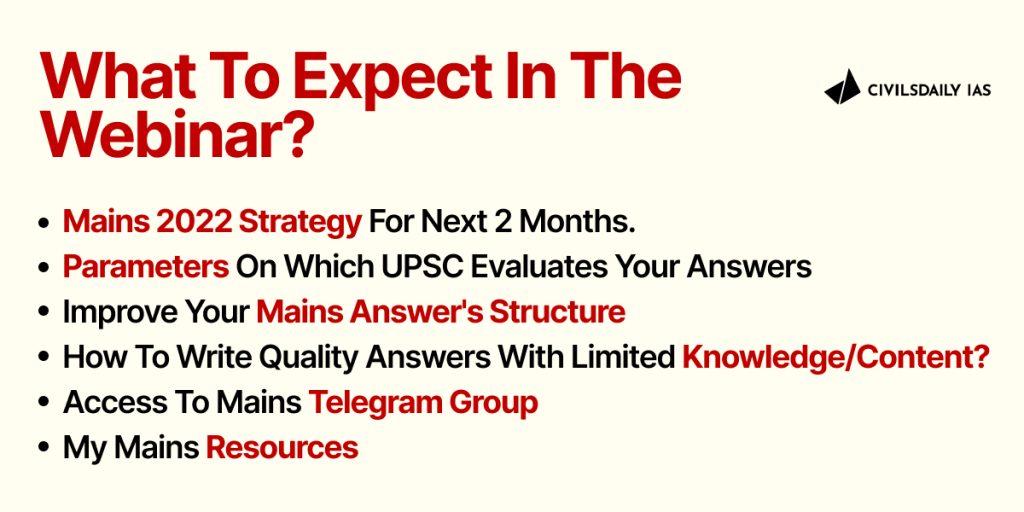
    UPSC Mains 2022 strategy for next 2 months.
Parameters on which UPSC evaluates your answers
Improve your mains answer's structure
How to write quality answers with limited knowledge/content?
Access to Mains Telegram group 
My Mains resources
    After Bootcamp, we will be having an Open Mains Test on 25th June only, at 6 pm. Top five scorers will get a Scholarship for Mains Mentorship Test Series and Program.

    Register for the Bootcamp and we will email you the link for the Telegram group, Open test question paper, and other Mains resources.


    This image has an empty alt attribute; its file name is WhatsApp-Image-2022-05-16-at-3.48.43-PM-1024x745-6.jpeg

    About CivilsDaily’s Mains Programs

    Mains Essential Program FLT EDITION 2022

    Program Inclusion Details:

    • 12 Full-length tests: After the prelims, it is time to go full gear. Practice 3 rounds of FLT based on 4 GS paper.
    • Quality Enrichment Program Notes: QEP is an intensive and holistic program for IAS Mains 2022 GS papers. We aim to cover up to 250 most relevant issues with a 360-degree view, covering all dimensions of each and every topic. Not only you’ll learn and analyze these issues but will also understand how to utilize them via Daily Answer Writing and Mains Test Series.
    • Personalized discussion in 1-to-1 mentorship: You doubt why you are scoring less or how you can improve your score for the next paper. No worries! Just schedule a call with our mentor to clear all your doubts and queries.
    • Civilsdaily’s handholding
    • Civilsdaily magazine: Your current affairs will be covered with access to our 1-year subscription.

    Click Here to Check Details

    Have a query about the program? Reach Us

    Smash Ethics Program

    Smash Ethics 2022 (Batch 2) with 1-to-1 Mentorship | Score 110+ in Ethics GS-4

    Program Inclusion:

    • Comprehensive Video Lectures covering Paper 4
    • Full syllabus Notes.
    • 8 FLT tests
    • 1-1 Mentorship support after every test
    • Membership of Ethics group (exclusive) on Civilsdaily’s Habitat
    • Doubt resolution session on Habitat

    Click Here to Enroll the Course

    Have a query about the program? Reach Us

    MEP Super 100 2023

    Program inclusion:

    • 12 Sectional tests: The whole syllabus will be divided into portions like history, economics, and geography. The test will be spread for a period of 8 months. This will ensure that your basic static preparation happens on a continuous basis alongside your mains answer writing program. Killing two birds with one stone!
    • 12 Full-length tests: After the prelims, it is time to go full gear.
    • Personalized discussion: You doubt why you are scoring less or how you can improve your score for the next paper. No worries! Just schedule a call with our mentor to clear all your doubts and queries.
    • Civilsdaily’s handholding: You will be provided membership to Mains 2023 club on Habitat. There you can put up your doubts and queries. Also can be used to interact with peers on strategies to improve your mains writing. You can also contact mentors like Sajal sir, Sukanya ma’am, Sudhanshu sir and Poornima Ma’am. They all have interview-level experience, so utilize their experience to your benefit.
    • Civilsdaily magazine: Your current affairs will be covered with access to our 1-year subscription. (June 2022 to May 2023)

    Click Here to Enroll the Course

    Have a query about the program? Reach Us

    Essay Program

    Program inclusion:

    • 8 FLTs
    • Detailed orientation for beginners
    • Process building Sessions
    • Content/Approach Building Sessions
    • Model essays
    • One-to-one mentorship
    • Membership in exclusive Essay group on Habitat
    • Notes and references on Habitat
    • Topic-wise arranged PYQs

    Check Out Now

    Have a query about the program? Reach Us

    This image has an empty alt attribute; its file name is CivilsDailys-Hall-of-Fame-UPSC-2028-4-713x1024-8.jpg
  • US Supreme Court overturns Abortion Right

    In a significant curtailment of women’s rights, the US Supreme Court overturned Roe v. Wade, a 1973 landmark decision giving women in America the right to have an abortion before the foetus is viable outside the womb — before the 24-28 week mark.

    What is Roe vs. Wade Case: Upholding the Right to Abortion

    • Roe, short for Jane Roe, is the pseudonym for a Texas woman who in 1970 sought to have an abortion when she was five months pregnant.
    • Texas then had ban on abortions except to save a mother’s life. The case then went to the US Supreme Court (SCOTUS).
    • The 7-2 majority opinion of the SCOTUS written in 1973, paved the way for the recognition of abortion as a constitutional right in the US considering foetal viability.

    [Foetal viability is the point at which a foetus can survive outside the womb, at the time considered to be around 28 weeks, but today is closer to 23 or 24 weeks owing to advances in medicine and technology.]

    Right to Abortion Judgment: Key takeaways

    Based on the Roe vs Wade case, the framework of regulations that applied towards the right to abortion:

    1. Almost no limitations could be placed on that right;
    2. Only limitations to abortion rights that were aimed at protecting a woman’s health were permitted; and in the third trimester,
    3. State governments had greater leeway to limit the right to abortion except for cases in which the life and health of the mother were endangered.

    What is the debate?

    The abortion debate is the ongoing controversy surrounding the moral, legal, and religious status of induced abortion.

    The sides involved in the debate are the self-described “pro-choice” and “pro-life” movements.

    1. Pro-choice emphasizes the woman’s choice whether to terminate a pregnancy.
    2. Pro-life position stresses the humanity of both the mother and foetus, arguing that a fetus is a human person deserving of legal protection.

    Why is the judgement overturned?

    • Foetuses feel the pain: If the foetus is beyond 20 weeks of gestation, gynaecs assume that there will be pain caused to the foetus.
    • Biblical gospel: The Bible does not draw a distinction between foetuses and babies. By the time a baby is conceived, he or she is recognized by God.
    • Abortions cause psychological damage: Young adult women who undergo abortion may be at increased risk for subsequent depression.
    • Abortions reduce the number of adoptable babies: Instead of having the option to abort, women should give their unwanted babies to people who cannot conceive. Single parenthood is also gaining popularity in the US.
    • Cases of selective abortion: Such cases based on physical and genetic abnormalities (eugenic termination) is overt discrimination.
    • Abortion as a form of contraception: It is immoral to kill an unborn child for convenience. Many women are using abortion as a contraceptive method.
    • Morality put to question: If women become pregnant, they should accept the responsibility that comes with producing a child. People need to take responsibility for their actions and accept the consequences.
    • Abortion promotes throwaway culture: The legalization of abortion sends a message that human life has little value and promotes the throwaway culture.
    • Racial afflictions: Abortion disproportionately affects African American babies. In the US, black women are 3.3 times as likely as white women to have an abortion.

    Arguments in favour for Abortion Rights

    • Upholding individual conscience and decision-making:  The US Supreme Court has declared abortion to be a fundamental right guaranteed by the US Constitution.
    • Reproductive choice empowers women: The choice over when and whether to have children is central to a woman’s independence and ability to determine her future.
    • Foetal viability occurs post-birth:  Personhood begins after a foetus becomes “viable” (able to survive outside the womb) or after birth, not at conception. Abortion is the termination of a pregnancy, not a baby.
    • No proof of foetal pain: Most neuroscientists believe that the cortex is necessary for pain perception. The cortex does not become functional until at least the 26th week of a foetus’ development.
    • Preventing illegal abortions: Access to legal, professionally-performed abortions reduces maternal injury and death caused by unsafe, illegal abortions.
    • Mother’s health: Modern abortion procedures are safe and do not cause lasting health issues such as cancer and infertility.
    • Child’s health: Abortion gives pregnant women the option to choose not to bring fetuses with profound abnormalities to full term.
    • Prevents women’s exclusion: Women who are denied abortions are more likely to become unemployed, to be on public welfare, to be below the poverty line, and to become victims of domestic violence.
    • Reproductive choice protects women from financial disadvantage: Many women who choose abortion don’t have the financial resources to support a child.
    • Justified means of population control: Many defends abortion as a way to curb overpopulation. Malnutrition, starvation, poverty, lack of medical and educational services, pollution, underdevelopment, and conflict over resources are all consequences of overpopulation.

    Way forward

    • A search for the middle path perhaps the right of a woman to choose what to do with the foetus has to be balanced with the right of the foetus to survive.
    • It is only that a foetus does not have the ability to exercise an option while the person who carries it does.
    • Rather than banning abortion, lawmakers must focus on counselling, employment security, social welfare, and financial support to persuade pregnant women to give birth to their children.
    • We must achieve some degree of protection for the unborn by obtaining voluntary recognition of personal responsibility and respect for the personhood of the unborn.

    Back2Basics: Medical Termination of Pregnancy (MTP) Act

    • Abortion in India has been a legal right under various circumstances for the last 50 years with the introduction of Medical Termination of Pregnancy (MTP) Act in 1971.
    • The Act was amended in 2003 to enable women’s accessibility to safe and legal abortion services.
    • Abortion is covered 100% by the government’s public national health insurance funds, Ayushman Bharat and Employees’ State Insurance with the package rate for surgical abortion.

    The idea of terminating your pregnancy cannot originate by choice and is purely circumstantial. There are four situations under which a legal abortion is performed:

    1. If continuation of the pregnancy poses any risks to the life of the mother or mental health
    2. If the foetus has any severe abnormalities
    3. If pregnancy occurred as a result of failure of contraception (but this is only applicable to married women)
    4. If pregnancy is a result of sexual assault or rape

    These are the key changes that the Medical Termination of Pregnancy (Amendment) Act, 2021, has brought in:

    1. The gestation limit for abortions has been raised from the earlier ceiling of 20 weeks to 24 weeks, but only for special categories of pregnant women such as rape or incest survivors. But this termination would need the approval of two registered doctors.
    2. All pregnancies up to 20 weeks require one doctor’s approval. The earlier law, the MTP Act 1971, required one doctor’s approval for pregnancies upto 12 weeks and two doctors’ for pregnancies between 12 and 20 weeks.
    3. Women can now terminate unwanted pregnancies caused by contraceptive failure, regardless of their marital status. Earlier the law specified that only a “married woman and her husband” could do this.
    4. There is also no upper gestation limit for abortion in case of foetal disability if so decided by a medical board of specialist doctors, which state governments and union territories’ administrations would set up.


    UPSC 2023 countdown has begun! Get your personal guidance plan now! (Click here)

  • Parameswaran Iyer will be new NITI Aayog CEO

    Parameswaran Iyer, a senior official who helmed the Swachh Bharat Abhiyan, will be the new Chief Executive Officer (CEO) of the NITI Aayog.

    What is the news?

    • Iyer replaces Amitabh Kant, who completes his term in the office on June 30.
    • Kant was appointed CEO of the National Institutions for Transforming India (NITI) Aayog on February 17, 2016, for two years.
    • He got three extensions during his tenure.

    Do you know?

    Under Mr. Kant, the NITI Aayog helped the Centre launch several programmes such as Digital India and Make in India.

    What is NITI Aayog?

    • The NITI Aayog serves as the apex public policy think tank of the GoI.
    • It was established in 2015, by the NDA government, to replace the Planning Commission which followed a top-down model.
    • It advises both the centre and states on social and economic issues.
    • It is neither a constitutional body nor a statutory body but the outcome of an executive resolution. It was not created by the act of parliament.

    Composition of NITI Aayog

    • The Prime Minister of India is the chairperson/chairman of the NITI Aayog.
    • The PM appoints one Vice-Chairperson, who holds the rank of a cabinet minister.
    • It includes the Chief Ministers of all the states and Union territories.
    • It has Regional Councils for looking after contingencies in regional areas. It is convened and chaired by the Prime Minister of India and includes concerned chief ministers and Lt. Governors.
    • The Prime Minister nominates Personalities with skilled knowledge, who are experts in particular domains as special invitees.
    • There are full-time members who hold the rank of ministers.
    • There is a maximum of two Part-time members who are invited from leading organisations, universities, and research centres.
    • The Prime Minister also appoints one Chief Executive Officer (CEO) who holds the rank of a Secretary.

    Aims, Agenda, and Objectives of NITI Aayog

    The purpose with which NITI Aayog was formed in place of the Planning Commission was a far-sighted vision. It was important to boost the development of India in the emerging global scenario. The objectives are:

    • To generate a platform for national development, sectors and strategies with the collaboration of states and centre.
    • To boost the factor of cooperative federalism between the centre and the states. For national development, it is necessary for both wings to work in synergy.
    • To develop such mechanisms which work at the ground root level for progressive growth. A nation develops when its regions and states develop.
    • To work on long term policies and strategies for long-term development. To set up a system for monitoring progress so that it can be used for analysing and improving methods.
    • To provide a platform for resolving inter-departmental issues amicably.
    • To make it a platform where the programmes, strategies, and schemes can be monitored on a day to day basis, and it could be understood which sector needs more resources to develop.
    • To upgrade technological advancements in such a manner that focus can be made on iNITIatives and programmes.
    • To ensure India’s level and ranking at the worldwide level and to make India an actively participating nation.
    • To progress from food security towards nutrition and standardised meals and focus on agricultural production.
    • To make use of more technology to avoid misadventures and corruption in governance.
    • To make the working system more transparent and accountable.

    NITI Aayog – Seven Pillars of Effective Governance

    • NITI Aayog works on principles like Antyodaya (upliftment of poor), inclusion (to include all sections under one head), people participation, and so on.
    • NITI Aayog is a body that follows seven pillars of governance. They are:
    1. To look after pro-people agenda so that the aspirations and desires of no one are compromised.
    2. To respond and work on the needs of citizens.
    3. Make citizens of the nation involve and participate in various streams.
    4. To empower women in all fields, be it social, technical, economic, or other.
    5. To include all sects and classes under one head. To give special attention to marginalised and minority groups.
    6. To provide equal opportunity for the young generation.
    7. To make the working of government more accountable and transparent. It will ensure less chance of corruption and malpractices.


    Try this PYQ from CSP 2019:

    In India, which of the following review the independent regulators in sectors like telecommunications, insurance, electricity, etc.?

    1. Ad Hoc Committees set up by the Parliament
    2. Parliamentary Department Related Standing Committees
    3. Finance Commission
    4. Financial Sector Legislative Reforms Commission
    5. NITI Aayog

    Select the correct answer using the code given below:

    (a) 1 and 2

    (b) 1, 3 and 4

    (c) 3, 4 and 5

    (d) 2 and 5


    Post your answer here.


    UPSC 2023 countdown has begun! Get your personal guidance plan now! (Click here)

  • [Burning Issue] Anti-defection Law under Spotlight

    UPSC 2023 countdown has begun! Get your personal guidance plan now! (Click here)
    Context

    We all aspirants are closely observing what has been happening in the state of Maharashtra.

    Now the rebel leader has moved the Supreme Court against the disqualification notice issued by the deputy speaker to him and some other rebel legislators, calling the action “illegal and unconstitutional” and seeking a stay on it.

    What is Anti-defection Law?

    • The Anti-Defection Law under the Tenth Schedule of the Constitution punishes MPs/ MLAs for defecting from their party by taking away their membership of the legislature.
    • It gives the Speaker of the legislature the power to decide the outcome of defection proceedings.
    • It was added to the Constitution through the Fifty-Second (Amendment) Act, 1985 when Rajiv Gandhi was PM.
    • The law applies to both Parliament and state assemblies.

    Cases consider under the anti-defection law

    The law covers three scenarios with respect to shifting of political parties by an MP or an MLA.

    (1) Voluntary give-up

    • The first is when a member elected on the ticket of a political party “voluntarily gives up” membership of such a party or votes in the House against the wishes of the party.
    • Such persons lose his seat.

    (2) Independent members

    • When a legislator who has won his or her seat as an independent candidate joins a political party after the election.
    • In both these instances, the legislator loses the seat in the legislature on changing (or joining) a party.

    (3) Nominated MPs

    • In their case, the law gives them six months to join a political party, after being nominated.
    • If they join a party after such time, they stand to lose their seat in the House.

    Covering independent members

    • In 1969, a committee chaired by Home Minister Y B Chavan examined the issue of defection.
    • It observed that after the 1967 general elections, defections changed the political scene in India: 176 of 376 independent legislators later joined a political party.
    • However, the committee did not recommend any action against independent legislators.
    • A member disagreed with the committee on the issue of independents and wanted them disqualified if they joined a political party.
    • In the absence of a recommendation on this issue by the Chavan committee, the initial attempts at creating the anti-defection law (1969, 1973) did not cover independent legislators joining political parties.
    • The next legislative attempt, in 1978, allowed independent and nominated legislators to join a political party once.
    • But when the Constitution was amended in 1985, independent legislators were prevented from joining a political party and nominated legislators were given six months’ time.

    Powers to disqualification

    • Under the anti-defection law, the power to decide the disqualification of an MP or MLA rests with the presiding officer of the legislature.
    • The law does not specify a time frame in which such a decision has to be made.
    • As a result, Speakers of legislatures have sometimes acted very quickly or have delayed the decision for years — and have been accused of political bias in both situations.

    Issues with the Anti-defection cases these days

    • Generally, when doubts are cast on the CM that he has lost the majority, the opposition and the Governor would rally for a floor test.
    • Now, this may seem like an administrative act. But loopholes around the law has brought politics into the picture. Let us understand the various ground situations involved:

    1) Defection proceeding

    • A Supreme Court Bench is scheduled to hear an appeal filed by the Rajasthan Assembly Speaker’s office challenging the State High Court order to defer anti-defection proceedings against former Deputy CM.
    • The petition said the HC has crossed its jurisdiction by asking the Speaker to put off his decision on the disqualification notices issued to dissident MLAs.
    • The High Court’s interim order granting extended time to rebel MLAs to file their replies to anti-defection notices amounted to a violation of Article 212 (courts not to inquire into the proceedings of the legislature).
    • The petition said that judicial review of ongoing anti-defection proceedings was limited.
    • The petition referred to the Constitution Bench judgment of the top court in the Kihoto Hollohan case in 1992 in this context.
    • Judicial review cannot be available at a stage prior to the making of a decision by the Speaker/Chairman and a prior action would not be permissible.
    • Nor would interference be permissible at an interlocutory stage of the proceedings, the verdict says.

    2) Summoning the house

    Rajasthan Governor returning the fresh proposal by the state Cabinet – seeking to convene a session of the Assembly has raised fresh legal questions on the powers of the Governor. But a Constitution Bench judgment of the Supreme Court has held that a Governor is bound to convene a meeting of the Assembly for a floor test on the recommendation of the Cabinet.

    • Article 174 of the Constitution gives the Governor the power to summon from time to time “the House or each House of the Legislature of the State to meet at such time and place as he thinks fit…”
    • However, the phrase “as he thinks fit” is read as per Article 163 of the Constitution which says that the Governor acts on the aid and advice of the cabinet.
    • Article 163(1) essentially limits any discretionary power of the Governor only to cases where the Constitution expressly specifies that the Governor must act on his own and apply an independent mind.
    • The Supreme Court in Nabam Rebia and Bamang Felix vs Deputy Speaker (2016) expressly said that the power to summon the House is not solely vested in the Governor.
    • The court has highlighted that Article 163 of the Constitution does not give the Governor a “general discretionary power to act against or without the advice of his Council of Ministers.
    • The discretionary powers are limited to specified areas like giving assent or withholding/referring a Bill to the President or appointment of a CM or dismissal of a government that has lost confidence but refuses to quit, etc.

    3) Floor test

    • Now, we know that the Governor cannot refuse the request of the Cabinet to call for a sitting of the House for legislative purposes or for the chief minister to prove his majority.
    • In fact, on numerous occasions, including in the 2016 Uttarakhand case, the court has clarified that when the majority of the ruling party is in question, a floor test must be conducted at the earliest available opportunity.
    • In 2016, the Supreme Court in Nabam Rebia and Bamang Felix vs Deputy Speaker expressly said that the power to summon the House is not solely vested in the Governor.

    4) Time Limit for defection plea

    • The Anti-defection law does not specify a time period for the Presiding Officer to decide on a disqualification plea.
    • Given that courts can intervene only after the Presiding Officer has decided on the matter, the petitioner seeking disqualification has no option but to wait for this decision to be made.

    5) Deciding on merger or split

    • The Tenth Schedule of the Constitution prohibits defection to protect the stability of governments but does not prohibit mergers.
    • Paragraph 4(2) of the Tenth Schedule, dealing with mergers, says that only when two-thirds of the members agree to “merge” the party would they be exempt from disqualification.
    • The “merger” referred to in Paragraph 4(2) is seen as a legal fiction, where members are deemed to have merged for the purposes of being exempt from disqualification, rather than a merger in the true sense.
    • Major political parties argue that a state unit of a national party cannot be merged without the party being merged at the national level.
    • However, the Tenth Schedule identifies this dichotomy between state units and national units.
    • As per Paragraph 4(2), “merger” of a party means merger of a legislative party of that House and not the national party.

    Yet another feature: ‘Resort’ Politics

    • The sight of legislators being packed off in luxury buses, and lodged in comfortable, even luxurious, hotels and resorts, has become a common feature of Indian politics.
    • It usually happens when a state government is in crisis, when a crucial election for a Rajya Sabha seat is underway and numbers are fluid, or when a rebellion is underway to change the regime in a state.
    • A political party — or the rebel faction — then rushes to consolidate the legislators who are in its favour.
    • The objective is to ensure that these legislators don’t succumb to temptations and inducements offered by the other side, and instead, remain under constant surveillance.
    • The method then adopted is to lock them in, till the crisis is resolved one way or the other.

    What we can learn from the ongoing situation?

    As recent events have made clear, however, the Tenth Schedule is no longer an effective check on the phenomenon of defection, and an urgent reconsideration is required. There are a few reasons why this is so.

    1)  Loopholes are present in the law itself

    • The first is that the defecting MLAs have found a way around the restrictions in the Tenth Schedule.
    • Instead of formally “crossing the floor” or voting against their party in a confidence motion, they resign from the party.
    • This brings down the party’s strength in the House, and the government is toppled.
    • A few months later, when by-elections are held, the same MLAs then stand for election on the ticket of the opposition party and are returned to the assembly.

    2) Judiciary can ‘conditionally’ intervene

    • Unfortunately, in their recent judgments, the courts have failed to stop defection practices (although, arguably, the language of the Tenth Schedule does not leave much room to the judiciary).
    • No matter how well-drafted a constitutional provision is, ultimately, its implementation depends upon constitutional functionaries acting in good faith.
    • As BR Ambedkar pointed out soon after the framing of the Constitution, every constitutional text can be subverted if those charged with running the affairs of government are inclined to do so.

    3) Political commitment is under question

    • In recent times, it has become clear that the major constitutional actors involved in times of constitutional instability — i.e., the governors and the speakers — do not act in good faith.
    • In every constitutional crisis over the last few years, governors/speakers have acted like partisan representatives of the political party that appointed them, and have flouted constitutional conventions with impunity.
    • Instances include decisions regarding which party to call first to form the government in a hung house, to order — or refusing to order — floor tests to prove majorities.

    4) Horse-trading persists in Indian politics

    • More recently, the Rajasthan High Court effectively injuncted the Speaker of the Rajasthan Assembly from acting upon disqualification notices, despite clear SC precedent to the contrary.
    • It can be pointed out that horse-trading of legislators persists.
    • It has been widely reported that huge sums of money are offered to MLAs to desert their parties and bring down the government.

    5) Role of Legislators is being compromised

    • The anti-defection law has restrained legislators from effectively carrying out their functions.
    • In a parliamentary system, legislators are expected to exercise their independent judgement while determining their position on an issue.
    • The choice of the member may be based on a combination of public interest, constituency interests, and party affiliations.
    • This fundamental freedom of choice could be undermined if the member is mandated to vote along the party line on every Bill or motion.

    6) Accountability of the government is compromised

    • The anti-defection law deters legislators from holding the government accountable for its actions.
    • One of the key features of parliamentary democracy is that the government is accountable for its decisions.
    • However, the anti-defection law deters a legislator from his duty to hold the government accountable, by requiring him to follow the instruction of the party/coalition on almost every decision.

    7) Overall decision making is hindered

    • The anti-defection law leads to major decisions in the legislature being taken by a few party leaders and not by the larger body of legislators.
    • This implies that anyone who controls the party leadership can issue directions to all legislators.
    • Thus, voting in the House will be as per the wishes of a few party leaders/ coalition leader rather than the beliefs of all legislators or the need for urgency.
    • Consensus if often dictated against which democratization within political parties is sought.

    8) Clueless voters are the ultimate losers

    • The anti-defection law breaks the chain of accountability between elected representatives and the voter.
    • The legislator would have to justify his decision if he differs from such a view.
    • If he dissented from the party line, he would lose his seat and would be unable to work for the citizens’ interests on other issues.
    • This further reduces the accountability of elected representatives to citizens.

    Article 164(1B)

    • A member of the Legislative Assembly of a State or either House of the Legislature of a State having Legislative Council belonging to any political party who is disqualified for being a member of that House under paragraph 2 of the Tenth Schedule shall also be disqualified to be appointed as a Minister under clause (1) for duration of the period commencing from the date of his disqualification till the date on which the term of his office as such member would expire or where he contests any election to the Legislative Assembly of a State or either House of the Legislature of a State having Legislative Council, as the case may be, before the expiry of such period, till the date on which he is declared elected, whichever is earlier.

    Need for urgent attention to Article 164(1B)

    • This allows for the toppling of governments by inducements of various kinds.
    • The motivation is that a fresh election allows the disqualified member to be re-elected.
    • He then becomes a member of the assembly once again, as its term is not over and can also be appointed a minister.
    • Under Article 164(1B), such a defection has no real consequences.

    Way forward

    • Ensure impartiality of Speaker: Speakers, when elected must resign from the party to which they belong.
    • At the end of their term, there should be a cooling-off period before they can become members of any political party.
    • Omit Paragraph 4 through Amendment: Paragraph 4 of the Tenth Schedule should be omitted by moving a constitutional amendment.
    • Make disqualification for 5 years: All those disqualified under paragraph 2 of the Tenth Schedule should neither be entitled to contest elections nor hold public office for five years from the date of their disqualification.
    • Article 164(1B) should be omitted by moving a constitutional amendment.
    • Set time limit to decide petition for disqualification: All petitions for disqualification of members under paragraph 2 of the Tenth Schedule should be decided, by adopting a summary procedure, within a period of three months.

  • (Zoom Link inside) UPSC Mains Bootcamp + Open Test (25th Jun)| Learn writing quality answers, making mains worthy notes, and more with Mridul- 22yo, First attempt, AIR 247| Register for Mridul’s notes + Exclusive Telegram group

    (Zoom Link inside) UPSC Mains Bootcamp + Open Test (25th Jun)| Learn writing quality answers, making mains worthy notes, and more with Mridul- 22yo, First attempt, AIR 247| Register for Mridul’s notes + Exclusive Telegram group

    Join using this Link: https://us06web.zoom.us/j/82434146383?pwd=ZE00aFlvNHhBN3BoWGxHM0dJSEh4QT09

    Meeting ID: 824 3414 6383
    Passcode: 195793

    Register for the Open test, Mridul’s notes, and access to Telegram group

    UPSC Mains 2022 is just ~80 days away. Get your Mains prep started with UPSC Ranker, Mridul. Register for CivilsDaily’s Bootcamp: 25th June 2022. This will be followed by an Open Mains Test on the same day. Details below

    Haven’t started with mains prep? Feel nervous about Mains answer writing? Not able to write all 20 questions? Can’t make yourself sit and start answer writing?

    Facing the same issues as mentioned above? This webinar cum UPSC Bootcamp is for you.

    Mridul Shivhare, AIR 247 is a special ranker. He cleared UPSC in his first attempt at the young age of 22. His quality of answers is amazing. He has tricks to literally compel the examiner to give marks. By the way, a crazy fact- Mridul left around 170 marks worth of questions in his Mains and still was able to secure AIR 247 (yup, quality of answer matters).

    In this special session, we will also be joined by Sukanya Rana, UPSC Mains head, CivilsDaily IAS. Sukanya has been able to guide successfully around 50 rankers in 2021 including AIR 28,32, 49, and more.

    UPSC Mains 2022 strategy for next 2 months.
Parameters on which UPSC evaluates your answers
Improve your mains answer's structure
How to write quality answers with limited knowledge/content?
Access to Mains Telegram group 
My Mains resources
    After Bootcamp, we will be having an Open Mains Test on 25th June only, at 6 pm. Top five scorers will get a Scholarship for Mains Mentorship Test Series and Program.

    Register for the Bootcamp and we will email you the link for the Telegram group, Open test question paper, and other Mains resources.


    This image has an empty alt attribute; its file name is WhatsApp-Image-2022-05-16-at-3.48.43-PM-1024x745-6.jpeg

    About CivilsDaily’s Mains Programs

    Mains Essential Program FLT EDITION 2022

    Program Inclusion Details:

    • 12 Full-length tests: After the prelims, it is time to go full gear. Practice 3 rounds of FLT based on 4 GS paper.
    • Quality Enrichment Program Notes: QEP is an intensive and holistic program for IAS Mains 2022 GS papers. We aim to cover up to 250 most relevant issues with a 360-degree view, covering all dimensions of each and every topic. Not only you’ll learn and analyze these issues but will also understand how to utilize them via Daily Answer Writing and Mains Test Series.
    • Personalized discussion in 1-to-1 mentorship: You doubt why you are scoring less or how you can improve your score for the next paper. No worries! Just schedule a call with our mentor to clear all your doubts and queries.
    • Civilsdaily’s handholding
    • Civilsdaily magazine: Your current affairs will be covered with access to our 1-year subscription.

    Click Here to Check Details

    Have a query about the program? Reach Us

    Smash Ethics Program

    Smash Ethics 2022 (Batch 2) with 1-to-1 Mentorship | Score 110+ in Ethics GS-4

    Program Inclusion:

    • Comprehensive Video Lectures covering Paper 4
    • Full syllabus Notes.
    • 8 FLT tests
    • 1-1 Mentorship support after every test
    • Membership of Ethics group (exclusive) on Civilsdaily’s Habitat
    • Doubt resolution session on Habitat

    Click Here to Enroll the Course

    Have a query about the program? Reach Us

    MEP Super 100 2023

    Program inclusion:

    • 12 Sectional tests: The whole syllabus will be divided into portions like history, economics, and geography. The test will be spread for a period of 8 months. This will ensure that your basic static preparation happens on a continuous basis alongside your mains answer writing program. Killing two birds with one stone!
    • 12 Full-length tests: After the prelims, it is time to go full gear.
    • Personalized discussion: You doubt why you are scoring less or how you can improve your score for the next paper. No worries! Just schedule a call with our mentor to clear all your doubts and queries.
    • Civilsdaily’s handholding: You will be provided membership to Mains 2023 club on Habitat. There you can put up your doubts and queries. Also can be used to interact with peers on strategies to improve your mains writing. You can also contact mentors like Sajal sir, Sukanya ma’am, Sudhanshu sir and Poornima Ma’am. They all have interview-level experience, so utilize their experience to your benefit.
    • Civilsdaily magazine: Your current affairs will be covered with access to our 1-year subscription. (June 2022 to May 2023)

    Click Here to Enroll the Course

    Have a query about the program? Reach Us

    Essay Program

    Program inclusion:

    • 8 FLTs
    • Detailed orientation for beginners
    • Process building Sessions
    • Content/Approach Building Sessions
    • Model essays
    • One-to-one mentorship
    • Membership in exclusive Essay group on Habitat
    • Notes and references on Habitat
    • Topic-wise arranged PYQs

    Check Out Now

    Have a query about the program? Reach Us

    This image has an empty alt attribute; its file name is CivilsDailys-Hall-of-Fame-UPSC-2028-4-713x1024-8.jpg
  • Cleared Prelims 2022? Great! But don’t forget, the goal is UPSC 2022 | Do these 6 things (Read inside)- Assessing preparedness, starting answer writing, and more.

    Cleared Prelims 2022? Great! But don’t forget, the goal is UPSC 2022 | Do these 6 things (Read inside)- Assessing preparedness, starting answer writing, and more.

    Your next steps are going to decide your success in the UPSC 2022 exam. Read below: What you should be doing, Bootcamp and Open Test || Talk to a senior mentor.


    Hey aspirants, Prelims 2022 result was released a day before and congrats if you have qualified for the Mains 2022. Well, it calls for a celebration but if you are still celebrating please consider this as a wake-up call.

    ..only a super calculated, extremely planned, measurable, and adaptive strategy will sail you through the UPSC final list (without even bothering about interview marks).

    Friends, the expectations and requirements of UPSC from a Mains candidate are very different compared to that from a Prelims candidate. You need a distinct temperament and fresh approach to tackle Mains. But only a super calculated, extremely planned, measurable, and adaptive strategy will sail you through the UPSC final list (without even bothering about interview marks).

    What to do now?

    1. Self-awareness: Know where you stand wrt your Mains preparation

    You know the endpoint (clearing UPSC Mains) knowing where you have to start is essential. You must know your current preparation status, syllabus coverage, the time you have, how many hours can you dedicate to optional, GS, current affairs, etc. Talk(1-1) to CivilsDaily’s senior mentor to assess your prep status.

    The best way would be to write a few answers. We have an Open Test preceded by a Mains Bootcamp on 25th June.

    Register for CivilsDaily’s Bootcamp: 25th June 2022. This will be followed by an Open Mains Test on the same day. (click for more details)

    2. Start making or organizing your Mains notes: 1-2 page crisp notes for every Mains-worthy topic that helps you write any question asked from a particular topic.

    There is no denying the fact that you need content or information. That has to be comprehensive and organized in a usable format (enabling you to write answers).

    If you haven’t prepared them, get on a call with CivilsDaily’s mentors to understand How to make awesome notes? and register for the Bootcamp tomorrow (Mridul, AIR 247, and other rankers had some awesome notes that they will share)

    We will be sharing our Quality Enhancement Program very soon and such notes will be provided to you in that program.

    3. Start Answer Writing Practice. From today only.

    Well, this is a no-brainer. It would be better if that is under the guidance of a mentor and discussed with peers as well. By the way, we have a Mains-focused Telegram group, it is invite-only. Register for the Bootcamp, and we’ll email the link to you.

    You can also have a look at Daily Answer Writing Enhancement Program.

    In the Bootcamp tomorrow, AIR 247 Mridul and Sukanya Rana, Mains head, CivilsDaily will tell you exactly how to start answer writing.

    This image has an empty alt attribute; its file name is UPSC-Mains-Bootcamp-2-3-1024x512.jpg
    Register for CivilsDaily’s Bootcamp: 25th June 2022. This will be followed by an Open Mains Test on the same day. (click for more details)

    4. Join a Mains Test series or Mains program.

    Best test series for Mains? (answers from Quora)

    You must invest in a good test series. And with so many of them in the market which one to go for. Well, there are just a few things that you must take note of: (Details of CivilsDaily’s test here)

    • Test series or Mains program must include Personalized Mentorship. A mentor will help you understand the requirements of UPSC mains, the pattern and format will be there to resolve all your doubts, analyze your checked copies – question by question, provide you feedback and necessary inputs, and a roadmap to integrate those inputs into your preparation.
    • Questions must be evidence-based (as per UPSC pattern) and relevant to the current year. There are many famous institutes with outdated questions in the test series.
    • It must be evaluated by seasoned evaluators and not just another aspirant like you who might not have even appeared for a single UPSC interview. Yes, many famous institutes do this. All of CivilsDaily’s evaluators have years of experience and qualify the criteria of at least 3 UPSC interviews.

    CivilsDaily’s Mains Program and Test series have been launched. Schedule a call with a senior UPSC mentor to know which one should you join.

    5. Don’t ignore UPSC Essay and Ethics: They’re a game-changer

    Many of the aspirants ignore these till Prelims and feel insufficiently or totally unprepared for both UPSC Essay and Ethics (GS Paper 4). Integrate them in your Mains timetable and strategy now. We have launched Mentorship driven Smash Essay 2022 under Zeeshan Hashmi and Smash Ethics 2022 under Sukanya Rana.

    Just get on a call with us to plan and discuss how to cover UPSC Essay and Ethics. We’ll have a detailed discussion.

    6. Get a Mentor for Mains 2022. You don’t want to waste an attempt.

    Someone who has an experience of at least 4 Mains or 2-3 UPSC interviews. One who should be able to provide you a patient ear and regular feedback. One who is sympathetic to your issues understands your weaknesses and is committed to helping you improve day by day, question by question, and test by test.

    Don’t have a mentor? Oh, you have one at CivilsDaily.

    CivilsDaily’s Mains Programs

    Smash Mains 2022 – only 5 seats left

    Mains 2022 Programs details

    Smash Ethics 2022

    Smash Essay 2022

  • Need for transparency in RBI’s policy making

    Context

    Modern inflation targeting central banks are often bound by explicit statutory mandates. Critics have argued that the RBI ignored its statutory inflation targeting duty.

    Why transparency and predictability of the central bank is important?

    • Prior to the 1990s, central banks preferred secrecy.
    • Surprising market: The common wisdom was that the efficacy of monetary policy depended on taking markets by surprise.
    • This belief started changing gradually with the adoption of inflation targeting.
    • Influencing the inflation expectations: Targeting inflation required central banks to influence households’ and firms’ decisions.
    • Thus emerged the need for central banks to be transparent and predictable.

    Independence with accountability of the Central bank

    • There was growing international recognition that central banks as monetary authorities should enjoy a relatively higher degree of independence from governments.
    •  In a democratic polity, this could only be expected in exchange for increased accountability.
    • As a result, regulatory governance gradually emerged as a relevant consideration for independent central banks over the last three decades.

    Regulatory governance at the RBI

    • The regulatory governance discourse in India came into the focus with the report of the Financial Sector Legislative Reforms Commission in 2013.
    •  Like a state, regulators usually enjoy significant legislative, executive and judicial powers and should be subject to appropriate accountability mechanisms.
    • These should include internal separation of powers; a well-structured regulation making process overseen by the board, through public consultation and cost-benefit analysis; duty to explain its actions to regulated entities and public at large; regular reporting requirements; and judicial review.
    • Based on these recommendations, the Ministry of Finance released a handbook in 2013 for voluntary adoption of these enhanced governance standards by all financial sector regulators.
    • These developments turned the spotlight on the RBI’s regulatory governance.

    Reasons for the criticism of the RBI

    • Targeting exchange rate: The central bank appears to have ventured into uncharted legal territory by possibly targeting the exchange rate instead of inflation.
    • Regulatory governance issues: Separately, critics have also highlighted broader regulatory governance challenges at the RBI.
    • For instance, its alleged use of informal nudges to restrict a foreign player’s access to the Indian payment ecosystem goes against an adverse Supreme Court ruling.
    • Such criticisms underline an urgent need to improve the credibility of the central bank’s rule of law quotient.
    • Least responsive in legislative function:  A 2019 research paper found the central bank’s legislative functions to be the least responsive in comparison to three other regulators – SEBI, TRAI and AERA.
    • RBI’ss consultation papers usually presented only one solution and did not offer merits and demerits of multiple possible solutions.

    Implications of weak regulatory governance: Judicial scrutiny

    • Weak regulatory governance resulted in weak regulations, inviting judicial scrutiny.
    • Changes in master circular: In 2019, the Supreme Court effectively rewrote RBI’s master circular on wilful defaulters to provide additional procedural safeguards to borrowers.
    •  Striking down of crypto ban: In 2020, the court struck down an RBI circular that sought to ban its regulated entities from dealing or settling in virtual currencies.
    • The court found that the RBI had neither adduced any cogent evidence of the likely harm, nor had it considered any less intrusive alternative before issuing the circular.

    RRA 2.0 suggestions for the RBI

    • The recent report of the Regulations Review Authority 2.0 (RRA) offers useful suggestions to improve the central bank’s regulation-making process.
    • The RBI had set up the Review Authority 2.0 (RRA) in April 2021 to streamline its regulations.
    • Skill improvement in regulatory drafting: RRA has advocated for skill development in regulatory drafting inside the RBI.
    • Public consultation: To improve regulatory governance at the RBI, RRA suggested that its regulatory instructions should be issued only after public consultation, except if they are urgent or time sensitive.
    • They must contain a brief statement of objects and reasons clearly explaining the rationale behind their issuance.
    •  Although much softer than the FSRLC standards, RRA nevertheless signal a progressive step forward.

    Conclusion

    The RBI should heed these recommendations. It should ideally hardcode the suggested principles into a secondary legislation that is binding on itself. That would be the best way to signal that the central bank takes regulatory governance and rule of law seriously.

    UPSC 2023 countdown has begun! Get your personal guidance plan now! (Click here)

  • 24th June 2022| Daily Answer Writing Enhancement(AWE)

    Topics for Today’s questions:

    GS-1          Social Empowerment

    GS-2        Bilateral, regional and global groupings and agreements involving India and/or affecting  India’s interests.

    GS-3        Indian Economy

    GS-4        Case Studies

    Question 1)


    Q.1 Identify the barriers faced by Persons with Disabilities (PwDs) in India. What measures have been taken by the government in this context? (10 Marks)


    Question 2)

    Q.2 How Ukraine crisis affects BRICS? How BRICS can tackle the challenges posed to it by the crisis? (10 Marks)

    Question 3)

    Q.3 India is heavily import-dependent for its mineral fertiliser requirements. What are the issues with such import-dependence? Suggest ways to reduce the import dependence. (10 Marks)

    Question 4)  

    Q.4 The Ken-Betwa link project is expected to provide annual irrigation of 10.62 lakh hectares, drinking water supply to about 62 lakh people and also generate 103 MW of hydropower. At the same time, the ambitious project will lead to a large-scale displacement of the people. A total area of about 9,000 hectares will be submerged due to the proposed dam. Some of the area also lies within the Panna Tiger Reserve, considered to be the core habitat of tigers in the region. People fear losing their livelihoods as well. Due to these issues, there has been an ongoing protest by the local people against the project. You, as the head of the project, are given the responsibility to ensure timely completion of the project and ensure its success, as it spearheads India’s ambition of river interlinking. Consider the following questions: (a) What are the ethical issues involved in the above case? (b) Discuss the steps that can be taken to address these issues. Also suggest some long term measures for such issues. (20 Marks)


    HOW TO ATTEMPT ANSWERS IN DAILY ANSWER WRITING ENHANCEMENT(AWE)?

    1. Daily 4 questions from General studies 1, 2, 3, and 4 will be provided to you.

    2. A Mentor’s Comment will be available for all answers. This can be used as a guidance tool but we encourage you to write original answers.

    3. You can write your answer on an A4 sheet and scan/click pictures of the same.

    4.  Upload the scanned answer in the comment section of the same question.

    5. Along with the scanned answer, please share your Razor payment ID, so that paid members are given priority.

    6. If you upload the answer on the same day like the answer of 11th  February is uploaded on 11th February then your answer will be checked within 72 hours. Also, reviews will be in the order of submission- First come first serve basis

    7. If you are writing answers late, for example, 11th February is uploaded on 13th February , then these answers will be evaluated as per the mentor’s schedule.

    8. We encourage you to write answers on the same day. However, if you are uploading an answer late then tag the mentor like @Staff so that the mentor is notified about your answer.

    *In case your answer is not reviewed, reply to your answer saying *NOT CHECKED*. 

    1. For the philosophy of AWE and payment: 

More posts
