💥UPSC 2026, 2027, 2028 UAP Mentorship (March Batch) + Access XFactor Notes & Microthemes PDF

Search results for: “”

  • E-Technology in Indian Agriculture to Aid the Farmers

    E-Technology in Agriculture

    E-Platform for Agriculture Markets in India.

    The electronic trading portal for national agricultural market is an attempt to use modern technology for transforming the system of agricultural marketing.

    National Agriculture Market

    • The National Agriculture Market (NAM) is envisaged as a pan-India electronic trading portal which seeks to network the existing APMC and other market yards to create a unified national market for agricultural commodities. NAM is a “virtual” market, but it has a physical market at the backend.
    • NAM was announced during the Budget of 2014-15 and is proposed to be achieved through the setting up of a common e-platform to which initially 585 APMCs selected by the states are linked. NAM was launched on 14 April 2016 with 21 mandis from 8 States joining it and the first phase of connecting 250 mandis was over on 6 October 2016.
    • NAM will be implemented as a Centrally Sponsored Scheme through Agri-Tech Infrastructure Fund (ATIF). The Department of Agriculture & Cooperation (DAC), Ministry of Agriculture will set it up through the Small Farmers Agribusiness Consortium (SFAC).
    • The Central Government will provide the software free of cost to the states, and in addition, a grant of up to Rs. 30 lakhs per mandi /market will be given as a onetime measure for related equipment and infrastructure requirements. In order to promote genuine price discovery, it is proposed to provide the private mandis also with access to the software, but they would not have any monetary support from Government.

    Benefits of NAM
    NAM is said to have the following advantages:

    • For the farmers, NAM promises more options for sale. It would increase his access to markets through warehouse based sales and thus obviate the need to transport his produce to the mandi.
    • For the local trader in the mandi / market, NAM offers the opportunity to access a larger national market for secondary trading.
    • Bulk buyers, processors, exporters etc. benefit from being able to participate directly in trading at the local mandi / market level through the NAM platform, thereby reducing their intermediation costs.
    • The gradual integration of all the major mandis in the States into NAM will ensure common procedures for issue of licences, levy of fee and movement of produce. In a period of 5-7 years Union Cabinet expects significant benefits through higher returns to farmers, lower transaction costs to buyers and stable prices and availability to consumers.
    • The NAM will also facilitate the emergence of value chains in major agricultural commodities across the country and help to promote scientific storage and movement of agriculture goods.
    1. Karnataka Agriculture Marketing Model
    • Among various states of the country, Karnataka has been the forerunner in market reforms and in devising innovative practices to improve agricultural markets and competitiveness.
    • In order to take advantage of modern technology to improve agricultural marketing, the state prepared a plan in 2012–13 with the assistance of NCDEX (National Commodity and Derivatives Exchange) Spot Exchange for automation of auction process in mandis (primary agricultural markets where producers sell their agricultural produce).
    • The plan involves the creation of transparent, integrated e-trading mechanism coupled with facilities for grading and standardisation to facilitate seamless trading across mandis (APMCs). The approach was to integrate all such APMCs with major consumption market to fetch remunerative prices to farmers.
    • The plan has been implemented through Rashtriya e-Market Services (ReMS) Private Limited Company, which is a joint venture created by the state government and NCDEX Spot Exchange.
    • ReMS offers automated auction and post-auction facilities (weighing, invoicing, market fee collection, accounting), assaying facilities in the markets, facilitation of warehouse-based sale of produce, commodity funding and price dissemination. NCDEX is also implementing a unified market platform, whereby all mandis in the state are being unified for single trading.
    • The unified online agricultural market initiative was launched in Karnataka on 22 February 2014. A total of 105 markets spread across 27 districts have been brought under the Unifi ed Market Platform (UMP) as of March 2016.
    • Under this initiative, every farmer who brings produce to the APMC market is given an identified cation number for the lot brought into the mandi.
    • The farmer has a choice to use the common platform or the platform of commission agent for the auction of the produce. These lots are then assayed, and information about quantity and quality is put on the portal of ReMS.

    Agriculture Marketing Information Network (AGMARKNET).

    • Agricultural Marketing Information Network (AGMARKNET) was launched in March 2000 by the Union Ministry of Agriculture.
    • The Directorate of Marketing and Inspection (DMI), under the Ministry, links around 7,000 agricultural wholesale markets in India with the State Agricultural Marketing Boards and Directorates for effective information exchange.
    • This e-governance portal AGMARKNET, implemented by National Informatics Centre (NIC), facilitates generation and transmission of prices, commodity arrival information from agricultural produce markets, and web-based dissemination to producers, consumers, traders, and policymakers transparently and quickly.
    • The e-governance portal caters to the needs of various stakeholders such as farmers, industry, policymakers and academic institutions by providing agricultural marketing related information from a single window.
    • The portal has helped to reach farmers who do not have sufficient resources to get adequate market information. It facilitates web-based information flow, of the daily arrivals and prices of commodities in the agricultural produce markets spread across the country.
    • The data transmitted from all the markets is available on the AGMARKNET portal in 8 regional languages and English.
    • It displays Commodity-wise, Variety-wise daily prices and arrivals information from all wholesale markets. Various types of reports can be viewed including trend reports for prices and arrivals for important commodities.
    • Currently, about 1,800 markets are connected, and work is in progress for another 700 markets. The AGMARKNET portal now has a database of about 300 commodities and 2,000 varieties.

    The information being disseminated through the AGMARKNET portal includes:

    • Prices and Arrivals (Daily Max, Min, Modal, MSP; Weekly/ monthly prices/arrivals trends; Future prices from 3 National commodity exchanges)
    • Grades and Standards
    • Commodity Profiles (Paddy/Rice, Bengal Gram, Mustard-Rapeseed, Red Gram, Soybean, Wheat, Groundnut, Sunflower, Black Gram, Sesame, Green Gram, Potato, Maize, Jowar, Cotton, Grapes, Chilies, Mandarin Orange etc.)
    • Market Profiles (Contact details, rail/road connectivity, market charges, infrastructure facilities, revenue etc.)
    • Other Reports (Best Marketing Practices, Market Directory, Scheme Guidelines, DPRs of Terminal Markets etc.)
    • Research Studies
    • Companies involved in Contract Farming
    • Schemes of DMI for strengthening Agricultural Marketing Infrastructure

    Schemes and Projects of Government and its agencies in e-technology for farmers.

    Agricultural Technology Management Agency (A T M A)

    • ATMA is a society of key stakeholders involved in agricultural activities for sustainable agriculture development in the district. It is a focal point for integrating Research and Extension activities.
    • It is a registered society responsible for technology dissemination at the district level. As a whole, the ATMA would be a facilitating agency rather than implementing Agency.
    • The scheme is supported by the Central Government. The funding pattern is 90% by the central Government and 10% by the state government. The 10% state’s share shall consist of cash contribution of the State, beneficiary contribution or the contribution of other non-governmental organizations.

    The objectives of ATMA are

    • To strengthen research – extension – farmer linkages.
    • To provide an effective mechanism for co-ordination and management of activities of different agencies involved in technology adaptation / validation and dissemination at the district level and below.
    • To increase the quality and type of technologies being disseminated.
    • To move towards shared ownership of the agricultural technology system by key shareholders.
    • To develop new partnerships with the private institutions including NGOs.

    National Mission on Agricultural Extension and Technology (NMAET)

    National Mission on Agricultural Extension and Technology (NMAET) is being implemented during the 12th Plan period.

    NMAET consists of 4 Sub Missions:

    1. Sub Mission on Agricultural Extension (SMAE)
    2. Sub-Mission on Seed and Planting Material (SMSP)
    3. Sub Mission on Agricultural Mechanization (SMAM)
    4. Sub Mission on Plant Protection and Plant Quarantine (SMPP)
    • Agricultural Technology, including the adoption/ promotion of critical inputs, and improved agronomic practices were being disseminated under 17 different schemes of the Department of Agriculture & Cooperation during the 11th Plan. The Modified Extension Reforms Scheme was introduced in 2010 with the objective of strengthening extension machinery and utilizing it for synergizing interventions under these schemes under the umbrella of the Agriculture Technology Management Agency (ATMA).
    • The NMAET has been envisaged as the next step towards this objective through the amalgamation of these schemes.
    • The common threads running across all 4 Sub-Missions in NMAET are Extension and Technology. Therefore, while 4 separate Sub-Missions are being proposed for administrative convenience, these are inextricably linked to each other at the field level, and most components thereof have to be disseminated among farmers and other stakeholders through a strong extension network.
    • The aim of the mission is: to restructure and strengthen agricultural extension to enable delivery of appropriate technology and improved agronomic practices to farmers.

    This aim is envisaged to be achieved by a judicious mix of:

    1. extensive physical outreach and interactive methods of information dissemination,
    2. use of ICT,
    3. popularisation of modern and appropriate technologies,
    4. capacity building and institution strengthening to promote mechanisation, availability of quality seeds, plant protection etc. and
    5. encourage aggregation of Farmers into Interest Groups (FIGs) to form Farmer Producer Organisations (FPOs).
    • In order to overcome systemic challenges being faced by the Extension System, there is a need for a focused approach in mission mode to disseminate appropriate technologies and relevant information to larger number of farmer households through interpersonal and innovative methods of technology dissemination including ICT.

    M-Kisan SMS Portal

    • Though there are about 38 crore mobile telephone connections in rural areas, internet penetration in the countryside is still abysmally low. Therefore, mobile messaging is the most effective tool so far having pervasive outreach to nearly 8.93 crore farm families.
    • M-Kisan SMS Portal for farmers enables all Central and State government organizations in agriculture and allied sectors to give information/services/advisories to farmers by SMS in their language, preference of agricultural practices and location.
    • These messages are specific to farmers’ specific needs & relevance at a particular point of time and generate heavy inflow of calls in the Kisan Call Centres where people call up to get supplementary information.
    • As part of agricultural extension (extending research from the lab to the field), under the National e-Governance Plan – Agriculture (NeGP-A), various modes of delivery of services have been envisaged. These include internet, touch screen kiosks, agri-clinics, private kiosks, mass media, Common Service Centres, Kisan Call Centres, and integrated platforms in the departmental offices coupled with physical outreach of extension personnel equipped with pico-projectors and handheld devices. However, mobile telephony (with or without internet) is the most potent and omnipresent tool of agricultural extension.
    • USSD (Unstructured Supplementary Service Data), IVRS (Interactive Voice Response System) and Pull SMS are value added services which have enabled farmers and other stakeholders not only to receive broadcast messages but also to get web based services on their mobile without having internet. Semi-literate and illiterate farmers have also been targeted to be reached through voice messages.

    Kisan Call Centres

    • In order to harness the potential of ICT in Agriculture, Ministry of Agriculture launched the scheme “Kisan Call Centres (KCCs)” on January 21, 2004. The main aim of the project is to answer farmers’ queries on a telephone call in their own dialect. These call Centres are working in 14 different locations covering all the States and UTs. A countrywide common eleven-digit Toll-Free number 1800-180-1551 has been allotted for Kisan Call Centre.
    • Replies to the farmers’ queries are given in 22 local languages. Call centre services are available from 6.00 am to 10.00 pm on all seven days of the week at each KCC location.
    • A Kisan Knowledge Management System (KKMS) to facilitate correct, consistent and quick replies to the queries of farmers and capture all the details of their calls, has been developed. The Kisan Call Centre (KCC) Agents working at various KCC locations throughout the country have access to it.

    Sandesh Pathak

    • The Sandesh Pathak application developed jointly by C-DAC Mumbai, IIT-Madras, IIIT Hyderabad, IIT Kharagpur, and C-DAC Thiruvananthapuram will enable SMS messages to be read out loud, for the benefit of farmers who may have difficulty in reading.
    • It is usable by people who cannot read. A large population of farmers belongs to this category. So, when they receive an SMS message either containing agriculture-related advice or some other thing, this app will read aloud the content.
    • It uses the text-to-speech synthesis systems developed by the Indian Language TTS Consortium. To make it especially useful for farmers, the TTS engines of all these languages have been tested on the agriculture domain-related texts and fine-tuned accordingly.
    • The app which is available for download from the App store of Mobile Seva Project of the government of India.

    Kisan credit card

    • Kisan credit card uses the ICT to provide affordable credit for farmers in India. It was started by the Government of India, Reserve Bank of India (RBI), and National Bank for Agriculture and Rural Development (NABARD) in 1998 to help farmers access timely and adequate credit.
    • The aim of Kisan Credit Card Scheme is to provide adequate and timely support from the banking system to the farmers for their short-term credit needs during their cultivation for purchase of inputs etc., during the cropping season.
    • Kisan Credit Card has emerged as an innovative credit delivery mechanism to meet the production credit requirements of the farmers in a timely and hassle-free manner.
    • The scheme is under implementation in the entire country by the vast institutional credit framework involving Commercial Banks, RRBs and Cooperatives and has received wide acceptability amongst bankers and farmers.

    Sanchar Shakti scheme

    • The Sanchar Shakti scheme for Mobile Value Added Services (VAS) provisioning envisages development of content/information customized to the requirements of women SHG members engaged in diverse activities in rural areas across India. The scheme entails innovative application of technology in designing & delivering the VAS content so as to ensure its easier accessibility & effective assimilation among the targeted women beneficiaries.
    • Sanchar Shakti scheme has been initiated by the Universal Service Obligation Fund(USOF) which launched wireless broadband Scheme in 2009. USOF is funding the National Optic Fibre Network which is being managed by Bharat Broadband Network Limited. Bandwidth from NOFN will be eligible to give wide range of services to rural India.

    Agropedia –ICAR initiative

    Content availability and its intelligent organization continues to be a serious challenge in agriculture. This prevents offer of meaningful and efficient advisory and allied services to farmers and other stakeholders. Agropedia is an attempt to infuse semantic and social networking technologies into agriculture information management to alleviate this problem.

    Voice Krishi Vigyan Kendra

    • KVK places a special emphasis on training and education of farmers, entrepreneurs, farm women, rural youth, financial institutions extension functionaries as well as voluntary organizations.
    • The centre plays a First Line Extension role- A linkage between research and the field in augmenting the socio-economic conditions of farmers, farm women and livestock owners since 1985 – 86.
    • Total 631 Krishi Vigyan Kendras-KVKs have been established across the country at the district level with a team of multidisciplinary team of experts. The KVKs aim at technology assessment and refinement and work as knowledge and resource centre in the district.
    • A voice KVK (VKVK) is a set of advisors (KVK experts) and peers (lead smallholder farmers) connected through mobile and internet technologies. In the VKVK, the interaction between the two parties can be entirely electronic.
    • The agropedia platform acts as ‘middle ware’ for this interaction providing amplification (one-to-many and many-to-one), persistence (messages are stored and can be searched, retrieved), monitoring and other utilities which are possible when the content is electronically stored and semantically indexed.

    E-NAM

    In April 2016 Union Government launched the pilot of e-NAM – the e-trading platform for the National Agriculture Market.

    Key features of E-portal

    • The e-NAM is a pan India e-trading portal to network existing APMC and other market yards to create a unified national market for agri commodities.
    • The portal will provide a single window service for all APMC related information and services.
    • The portal will connect e-mandis in several states and is aimed at ushering in much needed agri marketing reforms to enable farmers to get better price of their produce and double their income.
    • It is designed to create a combined national market for agricultural commodities. Farmers can display case their crop online from their adjacent market and dealers can costing price from anywhere.
    • Online trade will be allowed within the state and inter-state trade will be likely once all states and mandis are integrated at the primarily stage. 25 possessions including onion, potato, apple, wheat, pulses, coarse grains and cotton, have been recognized for online trading.
    • To mix a wholesale mandis from corner to corner from the country with the online platform, the state governments have to amend their Agriculture Produce Market Committee (APMC) Act.
    • eNAM will be realized in different phases with an aim to assimilate 585 controlled markets across the country with the common e-market platform by March 2018. So far 365 mandis from 12 states have been established approval.

    Significance of E-NAM

    • A major objective of the common market is to iron out the price differentials that exist across the country, by curbing the tendency to hoard, which could lead to moderation of food inflation.
    • The initiative will usher in transparency that will greatly benefit the farmers. Farmers are often forced to sell at a distress prices in the closest mandi (market) and the e-NAM platform will allow them to sell their produce anywhere in the country.while farmers will earn more, traders will have a wider choice and consumers can expect lower prices
    • The current state-level APMC laws permit the first sale of crops — after harvesting by farmers — to take place only in regulated market yards or mandis. It, thus, restricts the farmer’s universe of buyers to just the traders licensed to operate in the mandi under the concerned APMC’s jurisdiction.
    • Even traders have to procure separate licenses to operate in different mandis within the same state. NAM would essentially be a common electronic platform allowing farmers to sell their crops to buyers anywhere in the country and vice versa. The benefits to buyers — be it large retailers, processors or exporters — are obvious, as they can log into the platform and source from any mandi in India connected to it. They don’t need to be physically present or depend on intermediaries with trading licenses in those mandis.
    • Horticultural crops such as onions and potatoes are often sold at varying rates in different states and a unified market can help bring a parity in prices.
    • A farmer in north India can sell his produce on the NAM to a trader in the west or south based on price. This will make a significant difference because there is no state or national price.

    Challenges/Criticism

    • While buyers would definitely gain from this portal same could not be clearly said about the Farmers as Most farmers do not take their crop to the mandis; they sell off to the local arhatiya or produce aggregator even before that. Even the ones who take would offer a trolley load or two at most — hardly enough to excite distant buyers bidding online.
    • The National Sample Survey Office’s (NSSO) recently released ‘Some Aspects of Farming in India’ report shows almost 85 per cent of coconut growers selling their produce to retailers and dealers in their immediate neighbourhood. These ratios are well above 50 per cent in most crops.
    • The survey data also provides a possible reason why most farmers lack the flexibility to even take their crop to the mandis. The survey data indicates that Farmers procure most of their Fertilizers, Fodder, and credit for seasonal agricultural operations from the local Bania and the credit and other inputs are given to the farmers on the condition that they will have to sell their goods to the local bania.
    • The biggest challenge will be to bring in uniformity and rationalization in taxes as agriculture and the marketing is a state subject.
    • Essentially the farmers cannot do away with the procurement agents whom the government wants to cut off from the ecosystem by having a transparent system.” Even APMC is only a “political platform of powerful and connected traders”. These traders own large tracts of land themselves. This nexus needs to be knocked off.

    Way Forward

    • eNAM may become a game changer for agriculture but States need to deliver by amending there age old APMC laws. The government should have centralized APMCs and put a cabinet rank minister to cater to commerce part of agriculture.
    • Farmers can greatly benefit if they were to find ways for aggregating produce on their own, bypassing the arhatiya, Local Bania and even the local mandi in the process. This is where farmer producer organisations and cooperatives can play a role, by facilitating aggregation and creation of volumes that is intrinsic to the success of any ambitious virtual marketplace experiment.
    • In order to reduce the role of Village Bania in the life of Farmer, we need to improve the structure of formal source of credit, Fertilizers and other Agriculture inputs.
    • While e-NAM Can bring together both Buyers and sellers at a virtual space however in order of have adequate physical connectivity between the Farmer and retailer (which is a necessity if virtual deal needs to be transformed into actual deal )rural infrastructure like roads, warehouses and cold storage Infrastructure need to be improved simultaneously.
    By
    Himanshu Arora
    Doctoral Scholar in Economics & Senior Research Fellow, CDS, Jawaharlal Nehru University
  • Private and Co-operative Sector in Marketing of Agriculture Produce in India, Crop Insurance in India

    The entry of private sector in Agriculture Marketing

    1. As a step towards liberalisation of agricultural trade, the union government issued an order on 15 February 2002, which removed licensing requirements and all restrictions on buying, stocking and transporting specified commodities, including wheat, rice, oilseeds and sugar. They were further decontrolled after this.
    2. Similarly, the dairy sector was liberalised through various amendments to the Milk and Milk Product Order, beginning in 1992. The main purpose of these changes was to allow increased participation by the private sector in marketing agricultural commodities.
    3. In response, private-sector investments in the dairy sector have increased, and it has a healthy competition between cooperatives and the private sector.
    4. However, the experience of liberalising grain trade has not been very encouraging. The 2002 change in the ECA attracted big domestic and multinational players like ITC, Cargill, Australian Wheat Board, Britannia, Agricore, Delhi Floor Mills and Adani Enterprises to the grain trade.
    5. This came after the government had accumulated excessive foodgrain during 2001-03. But soon, the domestic foodgrain demand and supply balance, particularly for wheat, turned adverse and India had to import more than 6 million tonnes of wheat in 2006-07.

    Successful Alternative Models of Agriculture Marketing in India

    Some other Innovative Marketing Mechanisms

    Some innovative marketing mechanisms have been developed in some states, which involve the direct sale of farm produce to consumers, the sale of produce to buyers without routing it through mandis, and group marketing. Many states have attempted to promote direct contact between producers and consumers by making arrangements for sale at designated places in urban areas.

    Farm producers’ organisations (FPOs) of various kinds are emerging as a new model for organised marketing and farm business. Such models include informal farmers’ groups or associations, marketing cooperatives and formal organisations like producers’ companies. Producers can benefit from getting together to sell their produce through economies of scale in the use of transport and other services, and raise their bargaining power in sales transactions, while marketing expenses get distributed. This results in a better share of net returns. Such models are particularly required for small farmers to overcome their constraints of both small size and modest marketable quantities.

    Organised Retail Outlets: The direct purchase of farm produce by retailers has been steadily increasing with the growth of organised retailing in India. This is expected to accelerate if the entry of foreign direct investment (FDI) to the field is allowed further.

    Food World (of the RPG group) is the leader among organised food retail chains, and there are many more such as Fab Mall, Monday to Sunday, Family Mart, More for You, Heritage, Reliance Fresh and Big Bazaar.

    Most food chains are regional in nature, having one or two outlets in the main cities, but no big presence outside their states. Rapid urbanisation, urban population growth, increase in incomes and consumer spending, changing lifestyles, and access to technology have been the important factors behind the expansion of food retail chains in India. Despite several factors favouring organised retail trade, it is still in a nascent stage in the country.

    Crop Insurance in India


    PM Fasal Bima Yojana: An Analysis


    The PMFBY is in line with the concept of the ‘one nation one scheme’ theme. The purpose of PMFBY is to remove the shortcomings of the previous agriculture insurance schemes and incorporates the best features of previous insurance schemes. The PMFBY has replaced the National Agricultural Insurance Scheme and Modified National Agricultural Scheme. The PMFBY has been introduced with the following objectives:

    1. To provide insurance coverage and financial support to the farmer in the event of crop failure or any natural calamity
    2. To stabilise the income of the farmers
    3. To encourage farmers to undertake innovative and modern agricultural practices
    4. To ensure flow of credit to farmers

    Features of the scheme

    1. The Scheme covers all Food & Oilseeds crops and Annual Commercial/Horticultural Crops.
    2. The scheme is compulsory for loanee farmers obtaining Crop Loan /KCC account for notified crops. However, it is voluntary for other/non loanee farmers who have insurable interest in the insured crop.
    3. The scheme provisions have been simplified for easy understanding and the Maximum Premium payable by the farmers will be 2% for all Kharif Food & Oilseeds crops, 1.5% for Rabi Food & Oilseeds crops and 5% for Annual Commercial/Horticultural Crops.
    4. The difference between premium and the rate of insurance charges payable by farmers shall be shared equally by the Centre and State.
    5. The Scheme shall be implemented on an ‘Area Approach basis’. The unit of insurance shall be Village/Village Panchayat level for major crops and for other crops it may be a unit of size above the level of Village/Village Panchayat.
    6. Claims for wide spread calamities are being calculated on area approach. However, losses due to localised perils (hailstorm, landslide & inundation) and Post-Harvest losses due to specified perils, (cyclone/cyclonic rain & unseasonal rains) shall be assessed at the affected insured field of the individual insured farmer.
    7. There is no upper limit on government subsidy. Even if balance premium is 90%, it will be borne by the Government.
    8. Earlier, there was a provision of capping the premium rate which resulted in low claims being paid to farmers. This capping was done to limit Government outgo on the premium subsidy. This capping has now been removed and farmers will get claims against full sum insured without any reduction.
    9. The use of technology will be encouraged to a great extent. Smart phones will be used to capture and upload data of crop cutting to reduce the delays in claim payment to farmers. Remote sensing will be used to reduce the number of crop cutting experiments.

    Table 1: A Comparison of PMFBY and other Insurance Schemes

    Parameters NAIS MNAIS PMFBY Improvements, if any.
    Farmers Covered All farmers including sharecroppers and tenant farmers growing the notified crops in the notified areas were eligible for coverage. Scheme was compulsory for farmers availing crop loans and voluntary for others Same as NAIS Same as NAIS The coverage of farmers has remained the same.
    Risks Covered All yield risk All yield risk plus sowing failure covers (localised risk like pest diseases etc) Same as MNAIS No improvement over MNAIS
    Crops Covered Food crops, Commercial crops, Horticulture crops Same as NAIS Same as NAIS The crops covered has remained the same.
    Insurance Unit Unit area of insurance may be a gram panchayat, mandal, hobli, circle, phirka, block, taluka, etc. Unit area to be reduced to village / village panchayat or other equivalent unit for all crops. Ordinarily insurance unit to be village / village panchayat for major crops and higher than village/village panchayat like block, taluka for other crops. A combination of both NAIS and MNAIS is used for insurance unit.
    Threshold Yield Average of last three years for wheat and rice and five years for other crops multiply by indemnity level Average of last seven years excluding maximum two calamities years for all crops multiply by indemnity level Same as MNAIS No improvement over MNAIS
    Sum Insured Loanee farmers – Equivalent to the amount of loan availed.

    Non-loanee farmers –Upto value of 150 per cent of average yield.

    In case of loanee farmers-Equivalent to the ‘cost of cultivation’. Sum insured will be at least equal to amount of crop loan sanctioned/advanced. Non-loanee farmers -Equivalent to sum insured upto value of 150 per cent value of average yield. Same as MNAIS No improvement over MNAIS
    Premium Rate Kharif season 3.5 per cent – Oilseeds and bajra 2.5 per cent – Cereals, millets & pulses

    Rabi season 1.5 per cent- Wheat 2 per cent –Other food and oilseeds crops

    Actuarial premium for Annual commercial/ horticultural crops

    Actuarial premium as well as net premium rates (premium rates actually payable by farmers after premium subsidy) for each notified crop through standard actuarial methodology in conformity with provisions of IRDA. Maximum premium of 2 per cent of sum insured for Kharif (food & oilseed) crops.

    1.5 per cent of sum insured for Rabi (food and oilseed) crops; and

    5 per cent of sum insured for Annual commercial/ horticultural crops.

    The premiums to be paid by the farmers are significantly lower than the previous two schemes.
    Subsidy 10 per cent to small and marginal farmers only, to be shared equally between Centre and states. Actual premium with subsidy upto 75 per cent to all farmers, to be shared equally between Centre and states. The difference between the Actuarial Premium Rate (APR) and insurance charges payable by farmers shall be provided by Governments as subsidy and shall be shared equally by the Centre and states. Significant improvement in subsidy offered over previous schemes.
    Indemnity Level Three level of indemnity – 90 per cent, 80 per cent and 60 per cent (low/medium/high risk areas) were available for all crops. The insured farmers may opt for higher level of Indemnity on payment of additional premium The minimum Indemnity level increased to 70 per cent from 60 per cent from NAIS 70 per cent, 80 per cent and 90 per cent based on the risks experiences and coefficient of variation in the past 10 years.
    Claims Liability In case of food crops and oilseeds, claim liability of upto 100 per cent of premium collected was to be borne by the AIC. Thereafter, the Centre and state governments shared the liability equally. In the case of Annual commercial/horticultural crops, claim liability beyond 150 per cent of premium in the first three or five years and beyond 200 per cent thereafter, equally shared by Centre and state governments. All claims were to be borne by the Implementing Agencies. To protect IAs, against overall loss exceeding 500 per cent of gross premium, a Catastrophe Fund at national level was to be set up with contribution of Centre and state governments All claim liabilities on insurer and claim liability beyond 350 per cent of premium collected or 35 per cent of sum insured at national level to be shared equally by the Centre and state governments.
    Technology Yield estimation through traditional CCEs. Pilot studies for yield estimation through use of Remote Sensing Technology (RST). Provision for adoption of RST, drone and other technologies in yield estimation and categorization of number of CCEs after validation by pilot studies. Use of Smartphone apps for accurate and fast transmission of CCE data to facilitate early settlement of claims. The much-needed technology element is added in the PMFBY.

    Source: Report of CAG on Performance Audit of Agricultural Crop Insurance Scheme, 2017

    Table 2: Challenges faced by the MNAIS/NAIS and PMFBY

    Parameter NAIS/MNAIS PMFBY Challenge Faced
    Farmers covered Loanee and Non-loanee farmers, share croppers and tenants Loanee and Non-loanee farmers, share croppers and tenants Both the PMFBY and MNAIS fails to cover sharecroppers and tenants, despite government claiming that their coverage will be increased.
    Risk covered Yield risk and localised risk Yield and localised risk Yield loses cover under the MNAIS and PMFBY are same.

    Both the scheme faced the challenge of assessing loses due to localised calamity and the insurance companies are reluctant to investigate the crop losses due to these calamities and refuse to pay claims. This is making farmer losing interest in the scheme.

    Insurance Unit Village Panchayats, Blocks, Talukas Village panchayats for major crops and Blocks for other crops The PMFBY is an improvement over previous scheme. However, it fails to provide relief to the farmers as it does not cover losses arising out of a localised risk like wild animal attacks on individual farms.
    Premium Rates Premiums was calculated on actuarial basis (MNAIS).    2% of sum insured for kharif. 1.5% for rabi and 5% for horticulture crops. In the PMFBY, the premiums for the farmers are kept low in order to attract more farmers. Despite this the farmers are not opting for the scheme.   

    Delay in claims settlement is one of the major reason for it. The reason for delays in claim settlement are states unwillingness to pay high premiums.

    In the previous schemes, the farmers are not opting for the insurance due to higher burden of premiums.

    Now the same problem has been transferred to the states. It’s the exchequer who is facing the financial burden of high premium now.   

    Crop Cutting Experiments Crop Cutting Experiments are used to assess yield losses. Crop Cutting Experiment are used to assess yield losses. Although the methodology to assess loses is same, the PMFBY has shifted the unit area from district/block level to village level.

    As per rule, 24 CCE have to take place in a district and 16 CCE in a block for assessing the damage.

    Under the old schemes, there was a requirement of 1 million people to carry out CCE. However, after the new changes were made in PMFBY, a gram panchayat/village requires at least 4-5 such experiments to assess the crop damage. The process will require 4 million CCE and the same number people.

    Due to this there are delays in collecting CCE data and delays in claim settlement.

    Sum Insured Sum insured will be at least equal to the crop loans sanctioned.

    Non-loanee farmers -Equivalent to sum insured upto value of 150 per cent value of average yield.

    Same as MNAIS It has been observed in both the schemes that farmers are opting for sum insured equivalent to the loan amount only. In all such cases the insurance scheme is reduced to loan insurance scheme rather than a crop insurance scheme.

    By

    Himanshu Arora
    Doctoral Scholar in Economics & Senior Research Fellow, CDS, Jawaharlal Nehru University
  • Marketing of Agricultural Produce in India: Definition; Role; APMC Act, Model APMC Act, 2003

    Agricultural Marketing in India

    Definition:

    In a very narrow sense, Agriculture marketing means delivering farm product from farmers to the final consumers. The National Commission on Agriculture defined agricultural marketing as a process which starts with a decision to produce a saleable farm commodity, and it involves all aspects of market structure of system, both functional and institutional, based on technical and economic considerations and includes pre- and post-harvest operations, assembling, grading, storage, transportation and distribution.

    The Broader role of Agriculture Marketing in India.

    The prerequisites to attain these goals are:

    These conditions cannot come up on their own, particularly in a developing country like India. Therefore, agricultural market policies are treated as an integral part of development policies and their functioning has remained an important part of public policy in India.

    Government Intervention in Agriculture Markets

    Policy interventions in agricultural markets in India have a long history. Till the mid-1960s, it was mainly meant to facilitate the smooth functioning of markets and to keep a check on hoarding activities that were considered unfriendly to producers and/or consumers.

    Subsequently, the country opted for a package of direct and indirect interventions in agricultural markets and prices, initially targeted at procuring and distributing wheat and paddy. This gradually expanded to cover several other crops/products and aspects of domestic trade in agriculture.

    The present policy framework for intervention in agricultural markets and prices can be broadly grouped under three categories –

    (a) regulatory measures;

    (b) market infrastructure and institutions; and

    (c) agricultural price policy.

    Regulatory Measures

    Regulatory measures include development and regulation of wholesale markets in Indian; and, adoption of legal instruments for regulation of agriculture marketing and trade.

    Agriculture Produce Marketing Committee Regulation (APMC) Act.

    All wholesale markets for agricultural produce in states that have adopted the Agricultural Produce Market Regulation Act (APMRA) are termed as “regulated markets”. With the exception of Kerala, J & K, and Manipur, all other states have enacted APMC Act.

    The working of the APMC

    The Act is implemented and enforced by APMCs established under it.

    1. It mandates that the sale/purchase of agricultural commodities notified under it are to be carried out in specified market areas, yards or sub-yards. These markets are required to have the proper infrastructure for sale of farmers’ produce.
    2. Prices in them are to be determined by open auction, conducted in a transparent manner in the presence of an official of the market committee.
    3. Market charges for various agencies, such as commissions for commission agents (arhtiyas); statutory charges, such as market fees and taxes; and produce-handling charges, such as for cleaning of produce, and loading and unloading, are clearly defined, and no other deduction can be made from the sale proceeds of farmers. Market charges, costs, and taxes vary across states and commodities.

    The Advantages of APMC Act

    Besides improving the way markets functioned, the Acts created an environment that freed producers-sellers from exploitation by traders and mercantile capital.

    The APMC act in recent years have developed certain inefficiencies, and the opponents have strongly argued to revamp the act as per the needs of the current situations. The main argument for the changes are:

    Because of all this, the Inter-Ministerial Task Force on Agricultural Marketing Reforms (2002) recommended that the APMC Acts be amended to allow for direct marketing and the establishment of agricultural markets in the private and cooperative sectors.

    The rationale behind direct marketing is that farmers should have the option to sell their produce directly to agribusiness firms, such as processors or bulk buyers, at a lower transaction cost and in the quality/form required by the buyers.

    On the recommendation of the committee, the government had come up with a Model APMC Act in 2003.

    Model APMC Act, 2003

    1. Under the model APMC Act, the private sector and cooperatives can be licensed to set up markets.
    2. The model act also provides for contract farming and direct marketing by the private players.
    3. Except for few states, all the States and UTs have either fully or partly adopted the model APMC Act.
    4. As a result of the model act, the proportion of private trade and contract farming had increased manifold in some part of the country.
    5. However, The Model Act, so far, has not succeeded in persuading the private sector or cooperatives to set up agricultural marketing infrastructure as an alternative to the state-owned mandi system.

    How the APMC act started benefiting Middleman

    Initial situation: When the APMC Act was enacted by various states in the mid-1960s, the country was facing a serious food shortage and desperately seeking to achieve a breakthrough in food production. It was strongly felt that it would not be possible to attain and sustain food security without incentivising farmers to adopt new technology and make investments in modern inputs.

    Therefore, high priority was attached to enabling farmers to realise a reasonable price for their produce by eradicating malpractices from markets, protecting them from exploitation by middlemen, and creating a competitive pricing environment. Simultaneously, the hold traders and commission agents had over them by providing credit was diluted by increasing the supply of institutional credit. This, along with technology-led output growth, resulted in increased farm incomes, making farmers less dependent on the trading class for credit and cash requirements. It also gave farmers the freedom to choose markets and buyers for their produce.

    The Green Revolution Era: The spread and success of the green revolution during the 1970s and 1980s led to an increase in the political power of the farming class and their clout in policymaking. This was reflected in the creation and strengthening of farmer-friendly institutions and a policy environment favourable to farmers.

    Marketing institutions like market committees, state-level agricultural marketing boards and many others in the public and cooperative sectors served the interests of the farming community.

    The entry of Middlemen’s Post 1991: Over time, as the country moved closer to food self-sufficiency, public policy began losing its focus. The marketing system and marketing institutions were plagued by inefficiencies, bureaucratic control, and politicisation.

    The growth in market facilities did not keep pace with the growth in market arrivals, forcing producers to seek the help of middlemen in the market, which, in turn, led to dependence on them.

    There was also a reversal of the credit situation after 1991, making farmers more dependent on commission agents and traders for loans. The trading class quickly regained its marketing power over farmers by meeting their credit requirements with interlocked transactions, robbing producers of the freedom to decide where they would sell and whom they would sell to. Taking advantage of the lax attitude of state governments towards marketing, the trading class consolidated their power in mandis.

    Middlemen successfully turned marketing policies to their benefit, dictating terms to producers, and thwarting modern capital from entering agricultural marketing.

    Some examples of this are:

    1. increasing the commission rates of arhtiyas without any justification;
    2. Rejecting direct payment to producers, which would bypass commission agents; and
    3. Determining prices through non-transparent methods.

    The various problems facing the agricultural marketing system were summarised by the Twelfth Plan Working Group on Agricultural Marketing (Planning Commission 2011).

    • Too many intermediaries, resulting in high cost of goods and services;
    • Inadequate infrastructure for storage, sorting, grading, and post-harvest management;
    • Private sector unwilling to invest in logistics or infrastructure under prevailing conditions;
    • Price-setting mechanism not transparent;
    • Ill-equipped and untrained mandi staff;
    • Market information not easily accessible; and
    • Essential Commodities Act (ECA) impedes free movement, storage and transport of produce.

    Laws regulating agriculture marketing in India

    Essential Commodity Act: Almost all agricultural commodities, such as cereals, pulses, edible oilseeds, oilcakes, edible oils, raw cotton, sugar, gur, and jute, are included in the list of essential commodities.

    The Act provides for instruments like licences, permits, regulations and orders for

    (a) price control,

    (b) storage,

    (c) stocking limits,

    (d) movement of produce,

    (e) distribution,

    (f) disposal,

    (g) sale,

    (h) compulsory purchase by the government, and

    (i) sale (levy) to the government.

    Agriculture Produce Grading and Marketing Act: The act defines standards of quality and prescribes grade specifications for a number of products. The Act authorises an agricultural marketing adviser in each state to grant a certificate of authorisation to persons or corporate bodies who agree to grade agricultural produces as prescribed by it.

    There are AGMARK grade specifications for 212 agricultural products, but the use and awareness of it have remained low despite a better understanding of quality attributes among consumers.


    By
    Himanshu Arora
    Doctoral Scholar in Economics & Senior Research Fellow, CDS, Jawaharlal Nehru University
  • Types of Cropping Systems: Mono cropping; Crop Rotation; Sequential Cropping; Inter Cropping; Relay Cropping

    Cropping Systems/ Combinations 

    Monocropping: Example Planting Wheat year after year in the same field. Monocropping is when the field is used to grow only one crop season after season.

    Disadvantages: it is difficult to maintain cover on the soil; it encourages pests, diseases and weeds; and it can reduce the soil fertility and damage the soil structure.

    Crop Rotation: Example Planting maize one year, and beans the next. Crop Rotation means changing the type of crops grown in the field each season or each year (or changing from crops to fallow).

    Crop rotation is a key principle of agriculture conservation because it improves the soil structure and fertility, and because it helps control weeds, pests and diseases.

    Sequential Cropping: Example- Planting maize in the long rains, then beans during the short rains. Sequential Cropping involves growing two crops in the same field, one after the other in the same year.

    In some places, the rainy season is long enough to grow two crops: either two main crops, or one main crop followed by a cover crop.

    Growing Crops two crops may also be possible if there are two rainy seasons, or if there is enough moisture left in the soil to grow a second crop.

    Intercropping: Examples- Planting alternating rows of maize and beans, or growing a cover crop in between the cereal rows. Intercropping means growing two or more crops in the same field at the same time.

    Mixed Intercropping: Distribution of the seeds of both the crops, or dibbling the seeds without any row arrangement. This process is called mixed intercropping. It is easy to do but makes weeding, fertilization and harvesting difficult. Individual plants may compete with each other because they are too close together.

    Planting the main crop in rows and then spreading the seeds of the intercrop (such as a cover crop).

    Row Intercropping: Planting both the main crop and the intercrop in rows. This is called row intercropping. The rows make weeding and harvesting easier than with mixed intercropping.

    Stir Cropping: Example Planting alternating strips of maize, soybean and finger millet. Stir Cropping involves planting broad strips of several crops in the field. Each strip is 3–9 m wide. On slopes, the strips can be laid out along the contour to prevent erosion. The next year, the farmer can rotate crops by planting each strip with a different crop.

    Advantages:

    • It produces a variety of crops, the legume improves the soil fertility, and rotation helps reduce pest and weed problems.
    • The residues from one strip can be used as soil cover for neighbouring strips.
    • At the same time, strip cropping avoids some of the disadvantages of intercropping: managing the single crop within the strip is easy, and competition between the crops is reduced.

    Relay Cropping: Example- Planting maize, then sowing beans between the maize rows four weeks later.

    Relay Cropping the process of growing one crop, then planting another crop (usually a cover crop) in the same field before harvesting the first. This helps avoid competition between the main crop and the intercrop. It also uses the field for a longer time, since the cover crop usually continues to grow after the main crop is harvested.

    By
    Himanshu Arora
    Doctoral Scholar in Economics & Senior Research Fellow, CDS, Jawaharlal Nehru University
  • Cropping Patterns in India: Factors Affecting; Most Important Cropping Patterns

    Cropping Pattern in India

    Back to Basics: Cropping Pattern mean the proportion of area under different crops at a point of time, changes in this distribution overtime and factors determining these changes.

    Cropping pattern in India is determined mainly by rainfall, climate, temperature and soil type.

    Technology also plays a pivotal role in determining crop pattern. Example, the adoption of High Yield Varieties Seeds along with fertilisers in the mid 1960’s in the regions of Punjab, Haryana and Western Uttar Pradesh increased wheat production significantly.

    The multiplicity of cropping systems has been one of the main features of Indian agriculture. This may be attributed to following two major factors:

    1. Rainfed agriculture still accounts for over 92.8 million hectares or 65 percent of the cropped area. A large diversity of cropping systems exists under rainfed and dryland areas with an overriding practice of intercropping, due to greater risks involved in cultivating larger area under a particular crop.
    2. Due to prevailing socio-economic situations (such as; dependency of large population on agriculture, small land-holding size, very high population pressure on land resource etc.), improving household food security has been an issue of supreme importance to many million farmers of India, who constitute 56.15 million marginal (<1.0 hectare), 17.92 million small (1.0-2.0 hectare) and 13.25 million semi-medium (2.0-4.0 hectare) farm holdings, making together 90 percent of 97.15 million operational holdings.
    3. An important consequence of this has been that crop production in India remained to be considered, by and large, a subsistence rather than commercial activity.

    Factors Determining Cropping Pattern in India

    Cropping Pattern in India

    30 most important cropping patterns in India

    Specific Issues Related to the Cropping Pattern

    Crop Pattern Region/State Issues Related to Crop Pattern
    Rice-Wheat UP, Punjab, Haryana, Bihar, West Bengal, Madhya Pradesh. Over the years there is stagnation in the production and productivity loses.

    The main reasons for stagnation are:

    Over Mining of Nutrients from the soil.

    Declining Ground Water Table.

    Increase Pest Attacks and Diseases.

    Shortages of Labour.

    Inappropriate use of Fertilizers.

    Rice-Rice Irrigated and Humid coastal system of Orrisa, Tamil Nadu, Andhra Pradesh, Karnataka and Kerala. The major issues in sustaining the productivity of rice-rice system are:

    Deterioration in soil physical conditions.

    Micronutrient deficiency.

    Poor efficiency of nitrogen use. Imbalance in use of nutrients. Non-availability of appropriate trans planter to mitigate labour shortage during the critical period of transplanting.

    Rice- Groundnut Tamil Nadu, Andhra Pradesh, Karnataka, Orrisa and Maharashtra. The major issues in the pattern are:

    Excessive Rainfall and Water Logging.

    Non-availability of quality seeds.

    Limited expansion of Rabi Groundnut in Rice grown areas.

    Rice-Pulses Chhattisgarh, Orrisa and Bihar. Factors limiting Productivity are:

    Droughts and Erratic Rainfall distribution.

    Lack of Irrigation.

    Low coverage under HYV Seeds.

    Weed Attacks.

    Little attention to pest attacks and diseases.

    Marginalisation of land and Removal of Tribal from their own land.

    Maize-Wheat UP, Rajasthan, MP and Bihar The Reason for Poor Yields are:

    Sowing Timing.

    Poor Weed Management.

    Poor Plant Varieties.

    Poor use of organic and inorganic fertilizers.

    Large area under Rain Fed Agriculture.

    Sugarcane-Wheat UP, Punjab and Haryana accounts for 68% of the area under sugarcane.

    The other states which cover the crops are; Karnataka and MP.

    Problems in Sugarcane-Wheat system are:

    Late Planting.

    Imbalance and inadequate use of nutrients.

    Poor nitrogen use efficiency in sugarcane.

    Build-up of Trianthema partu lacastrum and Cyprus rotundus in sugarcane.

    The stubble of sugarcane pose tillage problem for succeeding crops and need to be managed properly.

    Cotton-Wheat Punjab, Haryana, West UP, Andhra Pradesh, Karnataka, Tamil Nadu. Problems in Cotton-Wheat system are:

    Delay Planting.

    Stubbles of cotton create the problem of tillage operations and poor tilth for wheat.

    Cotton Pest like Boll Worm and White Fly.

    Poor nitrogen use efficiency in cotton.

    Soya bean-Wheat Maharashtra, MP and Rajasthan Constraints limiting the soybean production and productivity are:

    A relatively recent introduction of soybean as a crop.

    Limited genetic diversity.

    Short growing period available in Indian latitudes.

    Hindered agronomy/availability of inputs at the farm level.

    Rainfed nature of crop and water scarcity at critical stage of plant growth.

    Insect pests and diseases, Quality improvement problems.

    Inadequate mechanization and partial adoption of technology by farmers have been identified.

    Legume Based Cropping Systems (Pulses-Oilseeds) MP, Gujarat, Maharashtra, Andhra Pradesh and Karnataka. The major issues in Legume based system are:

    Lack of technological advancement.

    Loses due to erratic weather and waterlogging.

    Diseases and Pests.

    Low harvest index, flower drop, indeterminate growth habit and very poor response to fertilizers and water in most of the grain legumes.

    Nutrient needs of the system have to be worked out considering N-fixation capacity of legume crops.

    Horticulture Crops in India

    India has made a good place for itself on the Horticulture Map of the World with a total annual production of horticultural crops touching over 1490 million tones during 1999-00.

    The horticultural crops cover about 9 percent of the total area contributing about 24.5 percent of the gross agricultural output in the country. However, the productivity of fruits and vegetables grown in the country is low as compared to developed countries.

    Vegetable Crops

    Vegetable crops in India are grown from the sea level to the snowline. The entire country can broadly be divided into six vegetable growing zones:

    Low productivity is the main feature of vegetable cultivation in India as farm yields of most of the vegetables in India are much lower than the average yield of the world and developed countries.

    The productivity gap is more conspicuous in tomato, cabbage, onion, chilli and peas. The preponderance of hybrid varieties and protected cultivation are mainly responsible for high productivity in the developed countries.

    Constraints in vegetable production:

    1. Lack of planning in Production

    2. Non-availability of seeds of improved varieties.

    3. High cost of basic production elements

    4. Inadequate plant protection measures and non-availability of resistant varieties.

    5. Weak marketing facilities

    6. Transportation limits

    7. Post-harvest losses

    8. Abiotic stresses.


    By
    Himanshu Arora
    Doctoral Scholar in Economics & Senior Research Fellow, CDS, Jawaharlal Nehru University


  • Situation of Indian Agriculture

    Indian Agriculture: A brief Outlook

    1. Agriculture accounted for 14% of India’s GDP in 2016-17 and provided employment to more than half a billion people. The share of Agriculture in employment is close to 54% as on 2016-17.
    2. Indian Agriculture is dominated by the small-scale farming and is characterised by low productivity.
    3. The average size of land holding in Indian Agriculture is less than 2 hectares.
    4. The low land holding size means that most of the Indian farmer practices subsistence farming, where they consume the majority of what they produce and sell whatever is left.
    5. The Indian Agriculture remains the largest employer of the female labour force in India. The share of women labour force out of total women labour force employed in agriculture is close to 65%.
    6. The Indian agriculture suffers from the twin problem of low productivity and excess workforce employed in it. Due to which the per capita productivity of workforce is very low.
    7. The low productivity results in depressing the wages in the agriculture sector leading to high level of poverty.
    8. Agriculture’s importance in India’s Trade is declining, but it still has a share of about 10% in India’s total exports.
    9. Compare to the high growth in other sectors of the Indian economy, the performance of the Indian agriculture remains poor due to slow and erratic growth rates. The average growth rate of India’s agriculture over the past decades remains low at less than 2%.
    10. At such a low growth rate of the agriculture sector, it is impossible to uplift millions of rural poor out of poverty.
    11. The agriculture sector in India has undergone very limited liberalisation. The state still plays a predominant role in the Indian agriculture.
    12. Concerns about food security and poverty with respect to the second largest population in the world lead the government to remain strongly involved in regulating India’s agriculture through fixing prices for key agricultural products at the farm and consumer levels, high border protection, bans on or support for exports, and massive subsidies for key inputs such as fertilisers, water and electricity.
    13. The Indian agriculture remains one of highly subsidised sector of the economy.
    14. Total foodgrains production in India is estimated to be 272 million tonnes in the year 2016-17.
    15. The estimated production of key cereals like wheat, rice and pulses will be 96.6 million tonnes, 106.7 million tonnes and 22.1 million tonnes respectively in the year 2016-17.
    16. The other major crops grown in India are oilseeds with an estimated production of 33.6 million tonnes, sugarcane at 309 million tonnes, cotton at 32.5 million bales.
    17. As per the land use statistics 2013-14, the total geographical area of the country is 328.7 million hectares, of which 141.4 million hectares is the reported net sown area and 200.9 million hectares is the gross cropped area with a cropping intensity of 142 %.
    18. The net sown area works out to be 43% of the total geographical area. The net irrigated area is 68.2 million hectares.
    19. The sharp deceleration in the growth of the agricultural sector against the backdrop of an impressive growth of the larger economy is widening disparities between the incomes of workers in non-agricultural and agricultural activities.

    Role of Agriculture in Indian Economy

    • A growing agriculture sector is a prerequisite for the development of India.
    • The growing surplus form the agriculture sector is needed to feed the millions of people who live below poverty line and can hardly sustain themselves.
    • The agriculture sector has to maintain a very high growth rate of above 4% in order to sustain the pressure of rising population.
    • A growing agriculture sector controls inflation because increased food supplies and agricultural raw materials keep the prices down and stable.
    • The agriculture sector has an important backward linkage with the industrial sector. The rural consumers are an important source of demand for the industrial goods.


    By
    Himanshu Arora
    Doctoral Scholar in Economics & Senior Research Fellow, CDS, Jawaharlal Nehru University


  • Privatisation of Public Sector Enterprises in India

    Privatisation of Public Sector Enterprises in India

    Privatisation is a process by which the government transfers the productive activity from the public sector to the private sector.

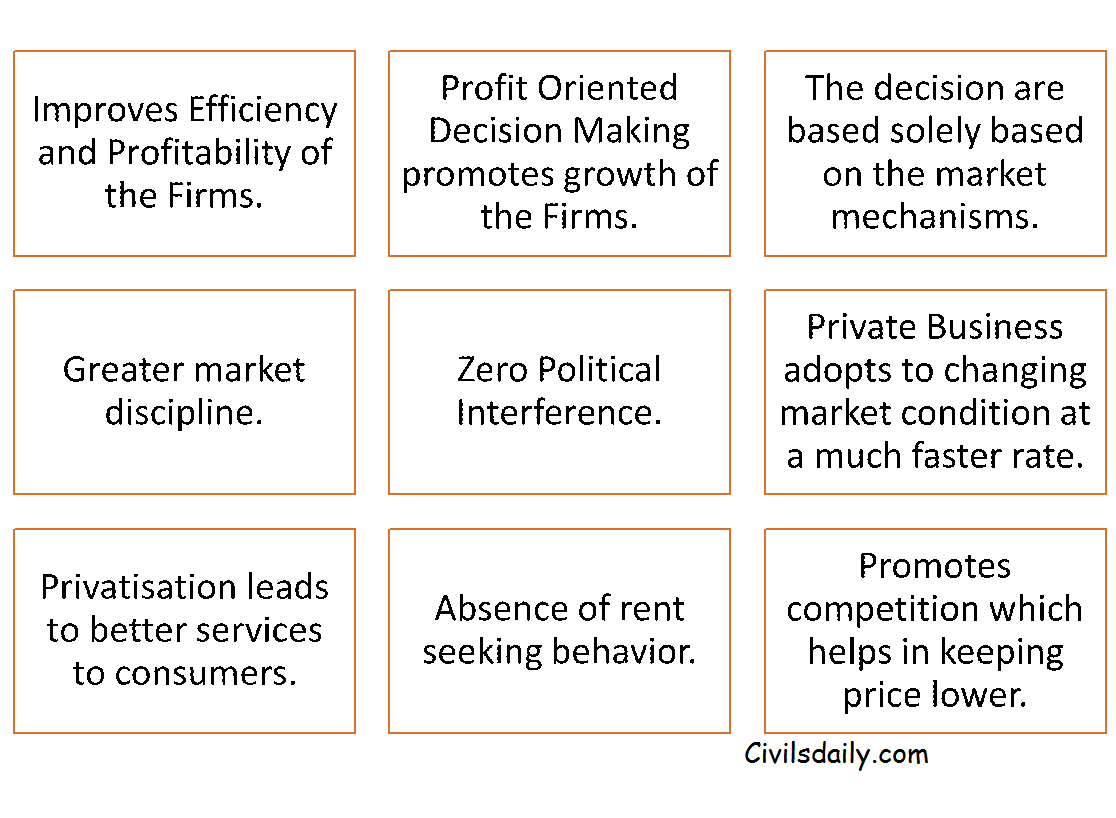
    Privatisation offers many advantages.

    Methods of Privatisation adopted in India.

    Initial Public Offers (IPO).

    IPOs are the most favoured method of privatisation followed in the developed countries of Europe and OECD. Under this method, the shares/equity holdings of the PSUs are sold to the private retail investors and institutions like Mutual Fund houses, Pension Funds and Insurance Companies etc.

    The prerequisite for the IPOs to be successful is that a country must have a well-developed and well-functioning Capital Market.

    The main advantages of the IPO method are:

    • It ensures wide participation of retail investors.
    • It is likely to face less resistance from the PSUs stakeholders like employees, as the method involves only selling of PSUs shares without any change in the management and policies.
    • It can be used to offer shares to the employees.
    • The method is best suited when the government wanted to raise financial resources without losing on the management and control of the PSU.

    Strategic Sale.

    Strategic Sale is a method in which the government decides to sell PSU shares to a strategic partner. The management in all such cases passes to the strategic buyer.

    The various advantages of the method are:

    • The performance of the PSU is expected to improve as the private player selected will already have an expertise in the management and operation of the PSU.
    • The strategic partner will be willing to pay a better price for the PSU as his business interest lies in combining his own business with that of PSU.
    • The method helps in infusion of capital and modernisation of the PSUs.
    • The method also helps the government in transferring the loss making PSU which could not have been attractive to retail buyers otherwise. The strategic partner will acquire such business as he has the prerequisite skills to turnaround the PSU.
    • The method is very important for countries having less developed capital market.

    Disadvantages:

    Sale to Foreign Firms.

    The method is a variant of the strategic sales method where the government decides to sell the PSUs to the foreign firms.

    Management and Employees Buy outs.

    In this route, management and employees come forward to but the shares and equities of the PSUs.

    Disinvestment.

    The method is followed in India from time to time. The method involves the sale of the Public sector equity to the private sector and the public at large.

    Methods of Disinvestment

    There are primarily three different approaches to disinvestments (from the sellers’ i.e. Government’s perspective)

    • Minority Disinvestment


    • Majority Disinvestment


    • Complete Privatisation
    By
    Himanshu Arora
    Doctoral Scholar in Economics & Senior Research Fellow, CDS, Jawaharlal Nehru University


More posts