[WpProQuiz 959]
[WpProQuiz_toplist 959]
UPSC 2022 countdown has begun! Get your personal guidance plan now! (Click here)
[WpProQuiz 959]
[WpProQuiz_toplist 959]
UPSC 2022 countdown has begun! Get your personal guidance plan now! (Click here)
Civilsdaily helped 100+ aspirants get ranks in UPSC 2020. We helped 30 students secure ranks in the Top 100. After speaking with them personally on our UNHERD platform, we understood that there was one thing that was common between all the rankers!
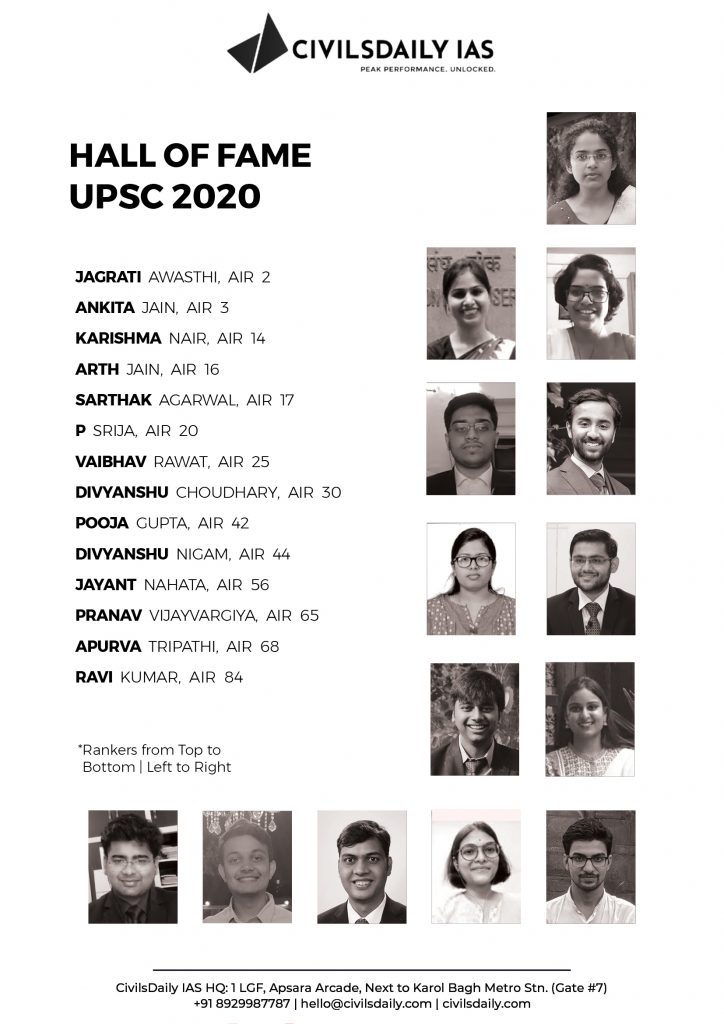
All the rankers committed themselves and NEVER postponed their preparation. They did not waste a single day but started preparing immediately. We also asked them WHY did they start immediately and did not wait?
You will fall into a vicious cycle – Our toppers said that if aspirants do not start preparing immediately, they often fall into a vicious cycle of doubt and confusion. They wait for the right moment to start preparing but keep delaying it for numerous reasons like work, college, not-ready, etc. The more time they waste, the more confused they get, and the syllabus starts piling up. The toppers told us that the best thing they did was to start immediately and it helped them succeed!
Lack of self-analysis can cost you 3-4 years – The toppers revealed that self-analysis is one of the most important things for an aspirant. You need to know the syllabus, the previous year questions for every topic, your strengths, your weaknesses, your learning speed, the best time to study, how to plan the study, etc. Most aspirants who fail the exam do not do self-analysis and just keep reading. This does not help as it wastes a lot of their time. In fact, if you are not sure about your strengths and weaknesses, it could easily cost you 3-4 years in preparation. The toppers also told us that they asked mentors for assessments when they felt confused. Self-analysis helped them focus on their weaknesses and improve them. And finally, they were able to crack the exam.
UPSC is the biggest killer of self-belief – Our toppers told us that the UPSC exam is so tough and vast that it often kills an aspirant’s self-confidence. It becomes extremely difficult for them to remain consistent and motivated for the entire year. The rankers revealed that when they faced inconsistency and lacked self-confidence, they often spoke with their mentors who guided them. They found help in the mentors who understood their concerns and kept them motivated, especially when they felt down and depressed. This helped the rankers become consistent and prepare with the same energy every day!
Self-study with no guidance doesn’t help – The rankers of 2020 told us that preparing for UPSC is like walking on a desert. You will be lost without a guide. They said that even when they were self-studying, they kept asking for guidance from mentors. What to study, what not to study, how to improve their answers, which areas to focus on, etc. The toppers stayed constantly in touch with mentors who helped them at every step. They did the hard work themselves but it would have been a waste if the hard work was not in the right direction.
Always overachieve your daily target by 25% – The toppers said that they had a study plan with targets for every day! But that was not all. They always tried to overachieve the targets by at least 25%. Every time they overachieved, it gave them the confidence to do the same every day. And by the end of their preparation, they had a clear advantage over other aspirants because they studied 25% more than everyone, every single day!
The toppers of 2020 told us that their handwork, right guidance, and smart planning at an early stage helped them succeed. They said that they did not want to postpone their preparation even by a single day as it would cost them ranks. And they were right! They started preparing immediately and are now rank-holders in UPSC!
While UPSC 2023 may seem like a year away from now, looking at the syllabus one can say it’s just about the right time away. As Prelims 2022 approaches in June, more and more aspirants will realising how close they are to 2023 and begin preparing immediately. But it may just be too late by then!
If you are reading this today, you are in luck. You have the opportunity to realise the urgency immediately. March has just begun and you can have an advantage of at least siix months over other aspirants if you start preparing today. And even with a year in your hand, it would take a high level of extremely focused study to crack the exam in June 2023.
The fact is this: You CANNOT waste a single day in experimenting, hunting for resources, trying to collect reading material, etc. Every day from today is more valuable than anything you can imagine, and this is the time to focus with every bit of concentration you have.
Given the time constraint and the urgency of the situation, you need to be practical. Speak with our mentors and get your preparation organised. Our mentors can help you streamline your preparation within 24 hours and will help you save precious time.Right now, nothing is more valuable than your time and if you wish to use it effectively, all it would take is a call with our mentors.
The urgency is real, you can calculate yourself. And every moment you waste is an opportunity wasted. All you need to do is fill this form and our senior mentors will get in touch with you, with a solution designed especially for you! Speak with us, now as it’s a free 1-on-1 mentorship session with 40 minutes dedicated only for you.
It’s understandable we are humans and not programmable robots who can maintain the same level of interest everyday. However, maintaining an overall consistency throughout our preparation is neccessary to clear this competitive and vast exam.
Our philosophy behind MENTORSHIP is to get you out of this Snooze cycle. This ensures that you are the BEST VERSION of yourself in this journey. If you are under the impression that mentorship is weekly calls you attend, then you are mistaken, my friend. Trust us, your mentor will be your ‘FRIEND, PHILOSOPHER AND GUIDE’.
TO EACH THEIR OWN – Every aspirant is different. Their strengths and weaknesses are different. Their time availability is also different. Identifying this is important so you don’t end up making unrealistic targets and lose momentum. Your mentor will make sure you start slow but remain consistent to build your confidence. Making your schedule structured based on our experience of working with 2500+ students is our first priority.

TRACK YOUR PROGRESS – When you see yourself grow, it becomes easier to motivate yourself to push boundaries. Tracking your progress can happen in many ways like mentorship calls or chat sessions or by regular tests. The idea is to ensure that you don’t go off track in your preparation, and even if you do, we have your back.

EVOLUTION – A constant guidance is important to bring consistency to your UPSC preparation. Guidance is not about clearing your doubts or asking you to study when you don’t. It is also about the evolution of your preparation. This is where you and your mentor work as a team. A constant effort to PLAN AND BUILD UP YOUR ABILITY to learn in a faster and more efficient way.

TALK IT OUT – The biggest hurdle in achieving your highest level of consistency is the emotional part. Every now and then, you. surround yourself with negative thoughts, you feel scared and depressed. Instead of resolving these emotional issues, you avoid them as it seems like a waste of your precious time. You have to understand that ignoring emotional troubles does not solve them. What your doing is building an emotional time bomb that may burst a week before your mains or prelims! This is where your MENTOR AS A FRIEND comes in. All our mentors have been through this journey. We understand your fears and anxieties. So, TALK IT OUT.

Don’t let inconsistency keep you away from your dreams.
Fill up the SAMANVAYA form given below. Let us know your problems and we will find a solution to it, just like our students say ” TOGETHER WE CAN AND WE WILL”.
The most difficult challenge faced by EVERY candidate is inconsistency. Be it inconsistency in studies, answer-writing practice, covering the syllabus, or revision, every candidate finds it difficult to cope with. But how do successful candidates manage to FIGHT Inconsistency so consistently?
In UPSC 2020, Civilsdaily helped 80+ students secure ranks in their exams. In the top 100, every 3rd ranker was a Civilsdaily student.
A very recent success story would be Vishwa Shah, student of Civilsdaily Mentor, Sukanya Ma’am. Vishwa has cleared the GPSC exam to become the Deputy Superintendent of Police in Gujarat. He has penned a thank-you note yesterday. Heartiest Congratulations to Vishwa!

One of our other Civilsdaily Student, Shubham Nagargoje cleared the exams in 2020 to become an IPS Officer. Shubham was gracious enough to let us know how he felt about Civilsdaily Samanvaya Guidance under Parth sir.


To know how all of them cleared the exam with our mentorship, visit the Unherd Podcast.
Now that results are announced for UPSC 2021 Prelims, out of 15 out of 25 students of Santhosh Gupta sir have been recommended to Mains. One such student, Rahul expresses his gratitude and extends his appreciation.
Most of our Mentors like Sudhanshu sir, Sajal sir, Santhosh sir, Pravin sir, Parth Verma sir and Sukanya Ma’am were UPSC aspirants themselves and have attended UPSC Mains more than five times and UPSC Interview more than twice. Hence their mentorship is always a blend of the best test series, comprehensive notes and current affairs knowledge.


All of them dedicate their time weekly to give 1-on-1 mentorship to every student where they discuss last week’s performance and next week’s approach.
Be it Telegram, Whatsapp or Habitiat channels, they are always available and clear student’s doubts in a turnaround time of 24 Hours.





Remember there is always light at the end of the tunnel and if you want to get out of the tunnel you have to follow the direction of the light! Our mentors’ give you direction which is divided into daily modules. All you have to do is study and complete them on time.


As every year passes by, we don’t get confident by the previous years’ performance and become laidback. Instead, we become more hungry to convert all our students into toppers.REGISTER HERE TO SCHEDULE YOUR FIRST FREE SAMANVAYA COUNSELLING SESSION IN NEXT 24 HOURS

Initially, our Civilsdaily student Smriti wasn’t confident about Prelims when she began her preparation. Though she had joined Civilsdaily in 2020, she started studying for UPSC-CSE back in 2019. At that time, Smriti had enrolled in multiple institutes. Though, most of these institutes had promised a personal mentor, she was unable to get in touch with them on a daily basis. Also those mentors never scheduled test-series on a weekly basis. Hence, despite preparing for a year, Smriti had scored only 35 marks out of 200 in her first test series by Civilsdaily.
She then started writing 20-25 test series over the course of UAP 2021 and in her last test, her scores have drastically improved. She now scores in the range of 130-135 marks in prelims’ and 110+ in mains’ papers.
In Smriti’s own words she describes her Samanvaya Mentorship Experience to be —
“Our parents provide us financial and emotional support, friends provide us moral support and the right mentor gives you logistic and logical support for UPSC. There are days when I felt I won’t be able to compete against lakhs of aspirants. That’s when my mentor, Ravi sir reminded me of my improvement and encouraged me that I can crack it with the same consistency. We need someone, who tells us we are performing well especially when we cannot see that ourselves. The mentorship at Civilsdaily helped me become mentally stronger as a person. In other institutes, mentors are allotted only for doubt resolution. But at Civilsdaily, I am getting end-to-end mentorship via value added notes, classes, test series and detailed evaluation.”
Similarly our another Civilsdaily student, Ashish sums up his Samanvaya experience with Civilsdaily mentor, Pravin Sir, “Because of Pravin sir’s support, I am able to understand a topic in lesser time.”


This is how Pravin sir evaluates Ashish’s Mains Test Series every week. After every test series evaluation, Pravin sir schedules a 1 hour call to discuss how Ashish can improve his marks and the sources he can refer for key topics.

It’s Your Turn Get the Free 40 Min Counselling Session By a CD Mentor
Civilsdaily mentors are so dedicated, consistent and focused for your UPSC goal, that you will eventually become focused into turning your dreams to reality.

At the core of Civilsdaily UPSC mentorship, lies the fact that each one of you will have a unique journey while preparing for the exam. Some will get through on the first attempt without much effort while others will take both more time and more effort.
We want to understand you better to help you optimize your journey so you can focus on the right things and not waste time on the wrong ones. We are asking you to tap into the valuable experiences of mentors who underwent the same grind and realize the pitfalls and understand the shortcuts to make it.
In the first counselling session, we will understand your weaknesses. We then help you to stick to one plan or strategy throughout your preparation. We will then follow up with you on a daily basis to check if you are right on track. TALK TO OUR MENTORS & CLARIFY YOUR DOUBTS NOW


UPSC 2022 countdown has begun! Get your personal guidance plan now! (Click here)
What more needs to be done to create a safe and secure environment for tigers? What are the challenges? We will try to find out in this article.
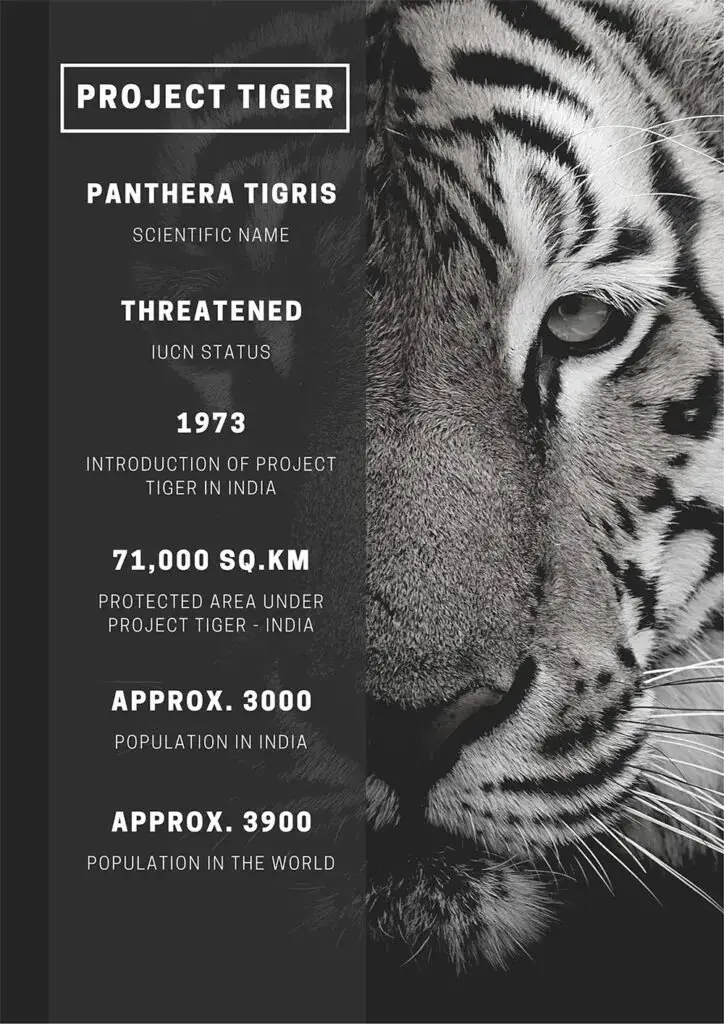
| Project Tiger has been converted into a statutory authority, National Tiger Conservation Authority (NTCA) by providing enabling provisions in the Wild Life (Protection) Act, 1972 through an amendment, via Wild Life (Protection) Amendment Act, 2006. The NTCA addresses ecological and administrative concerns for conserving tigers. It provides a statutory basis for the protection of tiger reserves and provides strengthened institutional mechanisms for the protection of ecologically sensitive areas and endangered species. |
The tiger is a unique animal that plays a pivotal role in the health and diversity of an ecosystem.
Project Tiger was administered by the NTCA. The overall administration of the project is monitored by a steering committee, which is headed by a director. A field director is appointed for each reserve, who is assisted by a group of field and technical personnel.
The various tiger reserves were created in the country based on the ‘core-buffer’ strategy:
India is home to 70 percent of the global tiger population. Therefore, the country has an important role to play in tiger conservation.
[1] Project Tiger
(discussed above)
[2] CITES (Convention on International Trade in Endangered Species of Wild Fauna and Flora)
[3] Global Tiger Forum and Tiger Range Countries
[4] CA|TS
[5] St. Petersburg Declaration
[6] Various NGOs
The four-year tiger census report, Status of Tigers in India, 2018 shows numbers of the big cat have increased across all landscapes.
The total count has risen to 2,967 from 2,226 in 2014 — an increase of 741 individuals (aged more than one year), or 33%, in four years.
Other existential threats to tigers

The Weapons of Mass Destruction and their Delivery Systems (Prohibition of Unlawful Activities) Amendment Bill, 2022 has been unanimously passed in Lok Sabha.
Nuclear Security Contact Group
Nuclear Suppliers Group
Comprehensive Nuclear-Test-Ban Treaty
Fissile material cut-off treaty
UPSC 2022 countdown has begun! Get your personal guidance plan now! (Click here)
Mortgage lender HDFC Ltd. and India’s largest private sector bank HDFC Bank on Monday announced a mega-merger.
Let’s revise them:
[1] Basel I
[2] Basel II
[3] Basel III
UPSC 2022 countdown has begun! Get your personal guidance plan now! (Click here)
The Union government has extended the scheme to provide ₹40 crore grants-in-aid to the Dalai Lama’s Central Tibetan Relief Committee (CTRC) for another five years, up to fiscal year 2025-26.
Do you think that India’s support for the Tibetan cause is the root cause of all irritants in India-China relations?
UPSC 2022 countdown has begun! Get your personal guidance plan now! (Click here)
The Asian Development Bank (ADB) forecasts has provided some useful insights about India’s GDP growth.
UPSC 2022 countdown has begun! Get your personal guidance plan now! (Click here)
Established: It was established in 1974 under the Water (Prevention and Control of Pollution) Act, 1974.
Objective: To provide technical services to the Ministry of Environment and Forests under the provisions of the Environment (Protection) Act, 1986.
Key Functions:
Established When: It is a statutory autonomous body under the Ministry of Environment and Forests, Government of India established in 2003, after India signed Convention on Biological Diversity (CBD) in 1992
Headquarter: Chennai
The objective of the body: Implementation of Biological Diversity Act, 2002
Key Functions:
It acts as a facilitating, regulating and advisory body to the Government of India “on issues of conservation, sustainable use of biological resources and fair and equitable sharing of benefits arising out of the use of biological resources.”
Additionally, it advises State Governments in identifying the areas of biodiversity importance (biodiversity hotspots) as heritage sites.
Established: It was established in December 2005 following a recommendation of the Tiger Task Force, constituted by the Prime Minister of India for reorganised management of Project Tiger and the many Tiger Reserves in India.
Headquarter: Delhi
Objective:
Key Functions:
Established When: It was established in 1962 under Section 4 of The Prevention of Cruelty to Animals Act,1960.
Headquarter: Ballabhgarh
Objective: To advise Government on Animal Welfare Laws and promotes animal welfare in the country.
Key Functions:
Established When: It is a government organization in India under the Union Ministry of Environment, Forest and Climate Change for conducting forest surveys and studies. The organization came into being in, 1981.
Headquarter: Dehradun, Uttarakhand
Objective
The objective of the organization is monitoring periodically the changing situation of land and forest resources and present the data for national planning; conservation and management of environmental preservation and implementation of social forestry projects.
Key Functions
Forest Survey of India assesses forest cover of the country every 2 years by digital interpretation of remote sensing satellite data and publishes the results in a biennial report called ‘State of Forest Report'(SFR).
Established: It was established in 1992 and constituted under the Wild Life (Protection) Act.
Headquarter: Delhi
Objective
The main objective of the authority is to complement the national effort in the conservation of wildlife.
Standards and norms for housing, upkeep, health care and overall management of animals in zoos have been laid down under the Recognition of Zoo Rules, 1992.
Key Functions
1992—
The UN Framework Convention on Climate Change (UNFCCC) was adopted and opened for signatures in Rio de Janeiro, Brazil, at the UN Conference on Environment and Development, also known as the Earth Summit.
154 signatories to the UNFCCC agreed to stabilize “greenhouse gas concentrations in the atmosphere at a level that would prevent dangerous interference with the climate system.”
The treaty is not legally binding because it sets no mandatory limits on GHG emissions. Instead, the treaty provides for future negotiations to set emissions limits. The first principal revision is the Kyoto Protocol.
1994—
The UNFCCC Treaty entered into force after receiving 50 ratifications.
1997—
KYOTO PROTOCOL
COP 3 was held in Kyoto, Japan. On December 11, the Kyoto Protocol was adopted by consensus with more than 150 signatories.
The Protocol included legally binding emissions targets for developed country Parties for the six major GHGs, which are-
Annex of the Kyoto Protocol
The Protocol offered additional means of meeting targets by way of three market-based mechanisms:
Under the Protocol, industrialized countries’ actual emissions have to be monitored and precise records have to be kept of the trades carried out.
India ratified the Kyoto Protocol in 2002.
2000—
COP 6 part I was held in The Hague, Netherlands. Negotiations faltered, and parties agreed to meet again.
COP 6part II was held in Bonn, Germany. The consensus was reached on what was called the Bonn Agreements.
All nations except the United States agreed on the mechanisms for implementation of the Kyoto Protocol.
The U.S. participated in observatory status only.
2001—
COP 7 was held in Marrakesh, Morocco. The detailed rules for the implementation of the Kyoto Protocol were adopted and called the Marrakesh Accords.
The Special Climate Change Fund (SCCF) was established to “finance projects relating to: adaptation; technology transfer and capacity building; energy transport, industry, agriculture, forestry and waste management; and economic diversification.”
The Least Developed Countries Fund was also “established to support a work programme to assist Least Developed Country Parties (LDCs) carry out, inter alia [among other things], the preparation and implementation of national adaptation programmes of action (NAPAs).”
2005—
COP 11/CMP 1 were held in Montreal, Canada. This conference was the first to take place after the Kyoto Protocol took force. The annual meeting between the parties (COP) was supplemented by the first annual Meeting of the Parties to the Kyoto Protocol (CMP).
The countries that had ratified the UNFCCC, but not accepted the Kyoto Protocol, had observer status at the latter conference.
The parties addressed issues such as “capacity building, development and transfer of technologies, the adverse effects of climate change on developing and least developed countries, and several financial and budget-related issues, including guidelines to the Global Environment Facility (GEF).” (UNFCCC)
2007—
COP 13/CMP 3 were held in Bali. COP parties agreed to a Bali Action Plan to negotiate GHG mitigation actions after the Kyoto Protocol expires in 2012. The Bali Action Plan did not require binding GHG targets for developing countries.
2009—
June – As part of the UN Framework Convention on Climate Change (UNFCCC) process, governments met in Bonn, Germany, to begin discussions on draft negotiations that would form the basis of an agreement at Copenhagen.
December – COP 15 was held in Copenhagen, Denmark.
It failed to reach agreement on binding commitments after the Kyoto Protocol commitment period ends in 2012.
During the summit, leaders from the United States, Brazil, China, Indonesia, India and South Africa agreed to what would be called the Copenhagen Accord which recognized the need to limit the global temperature rise to 2°C based on the science of climate change.
While no legally binding commitments were required by the deal, countries were asked to pledge voluntary GHG reduction targets. $100 billion was pledged in climate aid to developing countries.
2012—
COP 18 was held in Doha, Qatar.
Parties agreed to extend the expiring Kyoto Protocol, creating a second commitment phase that would begin on January 1, 2013 and end December 31, 2020. India ratified the second commitment period in 2017.
Parties failed to set a pathway to provide $100 billion per year by 2020 for developing countries to finance climate change adaptation, as agreed upon at COP 15 in Copenhagen.
The concept of “loss and damage” was introduced as developed countries pledged to help developing countries and small island nations pay for the losses and damages from climate change that they are already experiencing.
2013—
COP 19 was held in Warsaw, Poland.
Parties were expected to create a roadmap for the 2015 COP in Paris where a legally binding treaty to reduce greenhouse gas (GHG) emissions is expected to be finalized (in order to come into effect in 2020).
Differences of opinion on responsibility of GHG emissions between developing and developed countries led to a flexible ruling on the wording and a plan to discuss further at the COP 20 in Peru.
A non-binding agreement was reached among countries to set up a system tackling the “loss and damage” issue, although details of how to set up the mechanism were not discussed.
Concerning climate finance, the United Nations’ Reducing Emissions from Deforestation and Forest Degradation (REDD+) Program, aimed at preserving the world’s forests, was formally adopted.
Little progress was made on developed countries committing to the agreed upon plan of providing $100 billion per year by 2020 to developing countries.
2015—
PARIS AGREEMENT
COP 21 or CMP 11 was held in Paris.
Aims of the Paris Agreement-
1.Keep the global temperature rise this century well below 2 degrees Celsius above the pre-industrial level.
2.Pursue efforts to limit the temperature increase even further to 1.5 degrees Celsius.
3.Strengthen the ability of countries to deal with the impacts of climate change.
COP 23 – BONN(GERMANY)
First COP to be hosted by a small Island developing nation.
Countries continued to negotiate the finer details of how the agreement will work from 2020 onwards.
COP 24 – KATOWICE(POLLAND)
COP 26: Glasgow Agreement
What was achieved?
1. Mitigation:
2. Adaptation:
3. Finance:
4. Accounting earlier failures:
5. Loss and Damage:
6. Carbon Markets:
NATIONALLY DETERMINED CONTRIBURTIONS (NDCs)
Some facts-
RATIFICATION TO KIGALI AGREEMENT
The Union Cabinet has given its approval for ratification of the Kigali Amendment to the Montreal Protocol on Substances that Deplete the Ozone Layer for phase down of Hydrofluorocarbons (HFCs) by India.
What is Montreal Protocol?
What is the Kigali Amendment?

First Nikaalo Prelims Open Test was an eye opener for many by highlighting your weak spots. Knowing WEAK AREAS in early stage of preparation can give you time to improve upon them. Hence, as promised we are conducting the 2nd All India Open Prelims Test under our mission Nikaalo Prelims 2022.
GET READY TO EXPERIENCE THE COMPLETE EXAMINATION PATTERN!
We are conducting both GENERAL STUDIES and CSAT test with high quality UPSC level questions along with Test Discussion.
Click here to join Nikaalo Prelims Civilsdaily IAS Official space to Participate in the test discussion.
TIME:
GS 1: 9:30 am
GS 2: 2:30 pm
We at Civilsdaily understand the nuances of setting a paper. Through five cases explaining five questions, we’ll try to give you an idea about the varied difficulty level of prelims questions.
These questions have been taken from the first test of Nikaalo Prelims All India Open Mock Test 2020 about Government Schemes and Policies.
Ques. Which of the following are the result areas of STRIVE
Select the correct answer from the codes given below:
a. 1 and 2 only
b. 2 and 3 only
c. 1 and 3 only
d. 1 only
Correct answer- 1 and 2 only
In the above question, STRIVE has been used for SANKALP. Both of them were announced at the same time for boosting Skill India Mission. It is very easy to get confused mark a wrong answer.
Ques. Consider the following pairs:
Schemes Objectives
Which of the pairs given above are correctly matched?
a. 1 and 2 only
b. 2 and 3 only
c. 1 and 2 only
d. 1, 2 and 3
Correct answer: 1, 2 and 3
Misleading yet important names of initiatives under Ministry of Science and Technology have been used here. All pairs are correctly matched but it is very easy to get confused.
UPSC has been playing with the expenditure figures and other such facts. It is done not only for the sole reason of checking your rote memory, but the ability to think in-depth about the issues faced by various sections.
Ques. With reference to ‘Kisan Urja Suraksha evam Utthaan Mahabhiyan (KUSUM) Scheme’, consider the following statements:
Which of the statements given above is/are correct?
a. 1 only
b. 2 only
c. Both 1 and 2
d. Neither 1 nor 2
Correct answer: 1 only
A very important scheme. The farmers have to tolerate only 10% of the total expenditure to acquire and install solar pumps. The Central Govt. will provide 60% cost while the remaining 30% will be taken care of by bank as credit. One must understand the inability of Indian farmers to spend 50% on solar pumps. This would have helped in eliminating options also.
Ques. With reference to Atal Bhujal Yojana, consider the following statements:
Which of the following statements given above is/are correct?
a. 1 only
b. 2 only
c. Both 1 and 2
d. Neither 1 nor 2
Correct answer: 2 only
Here the Government of India’s collaboration with World Bank makes it important. Half of the financial contribution is from the World Bank in this initiative.
Students must not ignore the contribution of international institutions especially if it is of such overwhelming nature.
Ques. Which of the following are the components of the National Social Assistance Programme (NSAP)?
Select the correct answer from the codes given below:
a. 1 and 3
b. 2 and 3
c. 3 only
d. 1, 2, and 3
Correct answer: 1, 2 and 3
The National Social Assistance Programme (NSAP) which came into effect from 15th August 1995, represents a significant step towards the fulfilment of the Directive Principles in Article 41 of the Constitution.
It is a very important scheme under Ministry of Rural Development. Students are supposed to do flagship schemes of various ministries.
Mission Nikaalo prelims is a free fast-paced revision sequence to brush up your concepts for prelims. Major pillars of the programs are:
This initiative is meant to help you revise details and facts that can be asked in prelims. They are simplified, synthesized and prepared using most authentic sources. These can easily slip your mind or you can easily confuse these. Continuous Revision for the same is required. The themes picked up in the spotlight are not random but after analyzing and scrutinizing the PYQs of several years. Dare you to miss the updates!
Coverage and Relevance are the 2 Pillars of our Tests. Practicing tests is crucial part of Prelims preparation.
3. Nikaalo Prelims Discussion on Civilsdaily IAS Official space
All material, notes and doubt sessions will take place on Civilsdaily IAS Official Space.
Click here to join Nikaalo Prelims Civilsdaily IAS Official space.
A paradigm shift in the way we think about climate action has been reported for the first time in the recent IPCC report through a chapter on “demand, services and social aspects of mitigation”.
The latest IPCC report puts people and their well-being at the centre of climate change mitigation. The messages are from a global perspective but have relevance to the national context of every country.
UPSC 2022 countdown has begun! Get your personal guidance plan now! (Click here)
The High Court of Karnataka has not been able to settle the hijab issue. The petition has been filed in the apex court by a Muslim student against the high court judgement.
Secularism was chosen as the foundational principle of the republic to keep the nation united. Enlightened citizens should realise that if secularism is jettisoned, the hard-won national unity will be in peril. It is the patriotic duty of every citizen to strengthen secularism and thus save the republic.
UPSC 2022 countdown has begun! Get your personal guidance plan now! (Click here)
[WpProQuiz 957]
[WpProQuiz_toplist 957]
UPSC 2022 countdown has begun! Get your personal guidance plan now! (Click here)
First Nikaalo Prelims Open Test was an eye opener for many by highlighting your weak spots. Knowing WEAK AREAS in early stage of preparation can give you time to improve upon them. Hence, as promised we are conducting the 2nd All India Open Prelims Test under our mission Nikaalo Prelims 2022.
GET READY TO EXPERIENCE THE COMPLETE EXAMINATION PATTERN!
We are conducting both GENERAL STUDIES and CSAT test with high quality UPSC level questions along with Test Discussion.
Click here to join Nikaalo Prelims Civilsdaily IAS Official space to Participate in the test discussion.
TIME:
GS 1: 9:30 am
GS 2: 2:30 pm
We at Civilsdaily understand the nuances of setting a paper. Through five cases explaining five questions, we’ll try to give you an idea about the varied difficulty level of prelims questions.
These questions have been taken from the first test of Nikaalo Prelims All India Open Mock Test 2020 about Government Schemes and Policies.
Ques. Which of the following are the result areas of STRIVE
Select the correct answer from the codes given below:
a. 1 and 2 only
b. 2 and 3 only
c. 1 and 3 only
d. 1 only
Correct answer- 1 and 2 only
In the above question, STRIVE has been used for SANKALP. Both of them were announced at the same time for boosting Skill India Mission. It is very easy to get confused mark a wrong answer.
Ques. Consider the following pairs:
Schemes Objectives
Which of the pairs given above are correctly matched?
a. 1 and 2 only
b. 2 and 3 only
c. 1 and 2 only
d. 1, 2 and 3
Correct answer: 1, 2 and 3
Misleading yet important names of initiatives under Ministry of Science and Technology have been used here. All pairs are correctly matched but it is very easy to get confused.
UPSC has been playing with the expenditure figures and other such facts. It is done not only for the sole reason of checking your rote memory, but the ability to think in-depth about the issues faced by various sections.
Ques. With reference to ‘Kisan Urja Suraksha evam Utthaan Mahabhiyan (KUSUM) Scheme’, consider the following statements:
Which of the statements given above is/are correct?
a. 1 only
b. 2 only
c. Both 1 and 2
d. Neither 1 nor 2
Correct answer: 1 only
A very important scheme. The farmers have to tolerate only 10% of the total expenditure to acquire and install solar pumps. The Central Govt. will provide 60% cost while the remaining 30% will be taken care of by bank as credit. One must understand the inability of Indian farmers to spend 50% on solar pumps. This would have helped in eliminating options also.
Ques. With reference to Atal Bhujal Yojana, consider the following statements:
Which of the following statements given above is/are correct?
a. 1 only
b. 2 only
c. Both 1 and 2
d. Neither 1 nor 2
Correct answer: 2 only
Here the Government of India’s collaboration with World Bank makes it important. Half of the financial contribution is from the World Bank in this initiative.
Students must not ignore the contribution of international institutions especially if it is of such overwhelming nature.
Ques. Which of the following are the components of the National Social Assistance Programme (NSAP)?
Select the correct answer from the codes given below:
a. 1 and 3
b. 2 and 3
c. 3 only
d. 1, 2, and 3
Correct answer: 1, 2 and 3
The National Social Assistance Programme (NSAP) which came into effect from 15th August 1995, represents a significant step towards the fulfilment of the Directive Principles in Article 41 of the Constitution.
It is a very important scheme under Ministry of Rural Development. Students are supposed to do flagship schemes of various ministries.
Mission Nikaalo prelims is a free fast-paced revision sequence to brush up your concepts for prelims. Major pillars of the programs are:
This initiative is meant to help you revise details and facts that can be asked in prelims. They are simplified, synthesized and prepared using most authentic sources. These can easily slip your mind or you can easily confuse these. Continuous Revision for the same is required. The themes picked up in the spotlight are not random but after analyzing and scrutinizing the PYQs of several years. Dare you to miss the updates!
Coverage and Relevance are the 2 Pillars of our Tests. Practicing tests is crucial part of Prelims preparation.
3. Nikaalo Prelims Discussion on Civilsdaily IAS Official space
All material, notes and doubt sessions will take place on Civilsdaily IAS Official Space.
Click here to join Nikaalo Prelims Civilsdaily IAS Official space.

A standing committee of Parliament, tabled last week, has criticised the functioning of the development programme for de-notified, nomadic and semi-nomadic tribes.
UPSC 2022 countdown has begun! Get your personal guidance plan now! (Click here)

The CJI N will soon take up a long-pending challenge against the government’s electoral bonds scheme.
UPSC 2022 countdown has begun! Get your personal guidance plan now! (Click here)

The World Health Organization (WHO) has flagged the emergence of a new variant of the SARS-CoV-2 virus — the XE recombinant.
UPSC 2022 countdown has begun! Get your personal guidance plan now! (Click here)

India condemned the killing of civilians in Bucha, Ukraine, at the United Nations Security Council (UNSC) calling for an independent UN inquiry. (However India abstained from blaming Russia for the civilian deaths.)
Note: Such events are of least GS importance. However, one must recognize the severity of such massacres and the imprint that it left on entire humanity. Yes, it is not India’s war, but it is no mean activity for a military superpower to march and annexe a small neighbour. This topic holds much importance for personality test.
UPSC 2022 countdown has begun! Get your personal guidance plan now! (Click here)
Dear Aspirants,
This Spotlight is a part of our Mission Nikaalo Prelims-2022
Morning 12 PM – Prelims Spotlight Session
Evening 06:30 PM – TIKDAM/MCQs Session
Noon 03:00 PM – CSAT Google Meet Session
Evening 08 PM – Tests on Alternate Days
Download Habitat app from the Playstore Join our Official Civilsdaily Space for GS and CSAT Here
Annual financial statement:
The Union Budget is the annual financial statement that contains the government’s revenue and expenditure for a fiscal year.
It may also include planned sales volumes and revenues, resource quantities, costs and expenses, assets, liabilities and cash flows.
The statement details the revenues from all sources, and expenditure on all activities that the government will undertake for the fiscal year. The fiscal year is calculated from 1 April-31 March.
Under Article 112 of the Constitution, the government has to present a statement of estimated revenue and expenditure for every fiscal. This statement is called the annual financial statement. This document is divided into three sections: For each of these funds, the central government is required to present a statement of revenue and expenditure.
1. Consolidated Fund:
The Consolidated Fund of India, created under Article 266 of the Indian Constitution, includes the revenues received by the government and expenses made by it.
All the revenue that the government receives through direct (income tax, corporation tax etc.) or indirect tax (Goods and Services Tax or GST) go into the Consolidated Fund of India.
Revenue from non-tax sources like dividends, profits from the PSUs, and income from general services also contribute to the fund. Recoveries of loans, earnings from disinvestment and repayment of debts issued by the Centre also contribute to the fund.
However, no money can be withdrawn for meeting expenses until the government gets the approval of the Parliament. Examples of expenditure include wages, salaries and pension of government employees, and other fixed costs. The repayment of debts incurred by the government is also done through the Consolidated Fund of India.
The Consolidated Fund of India is divided into five parts:
Disbursements ‘charged’ on the Consolidated Fund of India is a special category within the Consolidated Fund of India which is not put to vote in the Parliament.
This means whatever comes under this category need to be paid, whether the Budget is passed or not.
The salary and allowances of the President, speaker and deputy speaker of the Lok Sabha, chairman and deputy chairman of the Rajya Sabha, salaries and allowances of Supreme Court judges, pensions of Supreme Court and High Court judges come under this category.
2.Contingency fund:
Like the Consolidated Fund of India, the Contingency Fund of India constitutes a part of the annual financial statement.
Established under Article 267(1) of the Indian Constitution, the fund is maintained by the ministry of finance on behalf of the President of India.
As the name suggests, the Contingency Fund of India is an account maintained for meeting expenses during any unforeseen emergencies.
Parliamentary approval for such unforeseen expenditure is obtained, ex- post-facto, and an equivalent amount is drawn from the Consolidated Fund of India to recoup the Contingency Fund after such ex-post-facto approval.
3. Public account.
Article 266 of the Constitution defines the Public Account as being those funds that are received on behalf of the Government of India.
Money held by the government in a trust — such as in the case of Provident Funds, Small Savings collections, income of government set apart for expenditure on specific objects like road development, primary education, reserve/special Funds, etc — are kept in the Public Account.
Public Account funds do not belong to the government and have to be finally paid back to the persons and authorities that deposited them.
Parliamentary authorisation for such payments is not required.
However, when money is withdrawn from the Consolidated Fund with the approval of Parliament and kept in the Public Account for expenditure for a specific purpose, it is submitted for a vote in Parliament.
Appropriation bill
Appropriation Bill is a money bill that allows the government to withdraw funds from the Consolidated Fund of India to meet its expenses during the course of a financial year.
As per Article 114 of the Constitution, the government can withdraw money from the Consolidated Fund only after receiving approval from Parliament.
To put it simply, the Finance Bill contains provisions on financing the expenditure of the government, and Appropriation Bill specifies the quantum and purpose for withdrawing money.
Vote-on-account
The Constitution says that no money can be withdrawn by the government from the Consolidated Fund of India except under appropriation made by law.
For that, an appropriation bill is passed during the Budget process.
However, the appropriation bill may take time to pass through the Parliament and become a law. Meanwhile, the government would need permission to spend even a single penny from April 1 when the new financial year starts.
Vote on the account is the permission to withdraw money from the Consolidated Fund of India in that period, usually two months.
Vote on the account is a formality and requires no debate. When elections are scheduled a few months into the new financial year, the government seeks vote on account for four months. Essentially, vote on account is the interim permission of the parliament to the government to spend money.
Corporation tax:
Corporation tax is a direct tax imposed on the net income or profit that enterprises make from their businesses. Companies, both public and privately registered in India under the Companies Act 1956, are liable to pay corporation tax. This tax is levied at a specific rate according to the provisions of the Income Tax Act, 1961.
Fringe benefits tax (FBT):
The taxation of perquisites – or fringe benefits – provided by an employer to his employees, in addition to the cash salary or wages paid, is fringe benefits tax. It was introduced in Budget 2005-06. The government felt many companies were disguising perquisites such as club facilities as ordinary business expenses, which escaped taxation altogether. Employers have to now pay FBT on a percentage of the expense incurred on such perquisites.
Direct Tax:
A direct tax is paid directly by an individual or organization to the imposing entity. A taxpayer, for example, pays direct taxes to the government for different purposes, including real property tax, personal property tax, income tax, or taxes on assets. Direct taxes are based on the ability-to-pay principle. This economic principle states that those who have more resources or earn a higher income should pay more taxes.
Indirect Tax
In the case of indirect taxes, the incidence of tax is usually not on the person who pays the tax. These are largely taxes on expenditure and include Customs, excise and service tax.
Indirect taxes are considered regressive, the burden on the rich and the poor is alike. That is why governments strive to raise a higher proportion of taxes through direct taxes. Moving on, we come to the next important receipt item in the revenue account, non-tax revenue.
Non-tax revenue:
Other than taxation being a primary source of income, the government also earns a recurring income, which is called non-tax revenue. While sources of tax revenue are few, the sources of non-tax revenue are many, with the number of collections per source. Although there are many sources of non-tax revenue, the amount per source is much less than that for tax revenue.
For example, when citizens use services offered by the government, they pay bills, which are categorised as non-tax revenue, as the government provides infrastructure support to implement the services. Non-tax revenue also includes the interest collected by the government on the loans or funds offered to states.
Grants-in-aid and contributions
The third receipt item in the revenue account is relatively small grants-in-aid and contributions. These are in the nature of pure transfers to the government without any repayment obligation.
These include expense incurred on organs of state such as Parliament, judiciary and elections. A substantial amount goes into administering fiscal services such as tax collection. The biggest item is the interest payment on loans taken by the government. Defence and other services like police also get a sizeable share. Having looked at receipts and expenditure on revenue account we come to an important item, the difference between the two, the revenue deficit.
Revenue deficit:
Revenue deficit arises when the government’s revenue expenditure exceeds the total revenue receipts.
Revenue deficit includes those transactions that have a direct impact on a government’s current income and expenditure. This represents that the government’s own earnings are not sufficient to meet the day-to-day operations of its departments. Revenue deficit turns into borrowings when the government spends more than what it earns and has to resort to the external borrowings.
Revenue Deficit= Total revenue receipts – Total revenue expenditure.
Revenue Deficit deals only with the government’s revenue receipts and revenue expenditures.
Note that revenue receipts are receipts which neither create liability nor lead to a reduction in assets.
It is further divided into two heads:
Revenue Expenditure is referred to as the expenditure that does not result in the creation of assets reduction of liabilities. It is further divided into two types
Fiscal Deficit:
The fiscal deficit is defined as an excess of total budget expenditure over total budget receipts excluding borrowings during a fiscal year. In simple words, it is the amount of borrowing the government has to resort to meet its expenses. A large deficit means a large amount of borrowing. The fiscal deficit is a measure of how much the government needs to borrow from the market to meet its expenditure when its resources are inadequate.
Primary deficit:
Primary deficit is defined as a fiscal deficit of current year minus interest payments on previous borrowings.
Primary deficit= Fiscal deficit – Interest payment on the previous borrowing
In other words, whereas fiscal deficit indicates borrowing requirement inclusive of interest payment, the primary deficit indicates borrowing requirement exclusive of interest payment (i.e., amount of loan).
We have seen that borrowing requirement of the government includes not only accumulated debt, but also interest payment on the debt. If we deduct ‘interest payment on debt’ from borrowing, the balance is called the primary deficit.
Public debt:
Public debt receipts and public debt disbursals are borrowings and repayments during the year, respectively. The difference is the net accretion to the public debt. Public debt can be split into internal (money borrowed within the country) and external (funds borrowed from non-Indian sources). Internal debt comprises treasury bills, market stabilisation schemes, ways and means advance, and securities against small savings.
Ways and means advance (WMA):
One of RBI’s roles is to serve as banker to both central and state governments. In this capacity, RBI provides temporary support to tide over mismatches in their receipts and payments in the form of ways and means advances.
CESS:
This is an additional levy on the basic tax liability. Governments resort to cess for meeting specific expenditure.
Dividend distribution tax:
A dividend is a return given by a company to its shareholders out of the profits earned by the company in a particular year. Dividend constitutes income in the hands of the shareholders which ideally should be subject to income tax.
However, the income tax laws in India provided for an exemption of the dividend income received from Indian companies by the investors by levying a tax called the Dividend Distribution Tax (DDT) on the company paying the dividend. This tax has been abolished in the 2020-21 budget.
FRBM Act 2003:
The Fiscal Responsibility and Budget Management Act (FRBM Act), 2003, establishes financial discipline to reduce the fiscal deficit.
What are the objectives of the FRBM Act?
The FRBM Act aims to introduce transparency in India’s fiscal management systems. The Act’s long-term objective is for India to achieve fiscal stability and to give the Reserve Bank of India (RBI) flexibility to deal with inflation in India. The FRBM Act was enacted to introduce a more equitable distribution of India’s debt over the years.
Key features of the FRBM Act
The FRBM Act made it mandatory for the government to place the following along with the Union Budget documents in Parliament annually:
1. Medium Term Fiscal Policy Statement
2. Macroeconomic Framework Statement
3. Fiscal Policy Strategy Statement
The FRBM Act proposed that revenue deficit, fiscal deficit, tax revenue and the total outstanding liabilities be projected as a percentage of gross domestic product (GDP) in the medium-term fiscal policy statement.
Fiscal Performance Index (FPI)
Other measures of FPI
Sabka Vishwas-Legacy Dispute Resolution Scheme
Components of the Scheme
Direct Tax Code:
Direct Tax:
Corporate Tax
Securities transaction tax (STT)
Banking cash transaction tax (BCTT)
Cess
Countervailing Duties (CVD)
Export Duty
Pass-through Status

No more just the reading of your standard NCERTs is sufficient to clear prelims. Prelims is becoming more Dynamic Year by Year. From 5 lakh plus students making it to roughly 10,000 students for mains stage is not an easy task.
LAST 60 DAYS
60 days is an apt time to not only prepare but clear prelims. Many veterans/topper who appear for prelims shift to PRELIMS MODE in the last 60 days.
This is because 60 days period comfortably allows to finish your one last static revisions of all subject, also cover current affairs revisions and write mocks. Few days less than 60, just adds on to add mental pressure, which can compromise your preparation.
Prelims is the most trickiest stage in UPSC Examination. Last 60 days is surely a DO OR DIE situation.
1. Know about essentials which should be part of your timetable in the next 60 days. How to make a perfect timetable in the last 60 days?
2. Every day counts and each subject counts! How much time should be devoted to each subject? Let the experts tell you!
3. 20, 30, 40 or 60 tests! How many tests are enough before prelims? Is there a magic number?
4. Not just do’s but one should be aware about the don’t as well. What mistakes one needs to avoid in last 60 days?
5. Revision is the most important part of UPSC preparation. Know about 5R Revision plan.
6. Time test Elimination techniques for prelims. How to use Tikdam/Logical reasoning to score extra 25 marks?
7. Confused between 2 options because they sound very similar. Know how to maximize efficiency while solving question?
8. Last few days is not about making long notes. Discuss the process of making micro notes in last 60 days.
Prelims question papers have become more or less like a game of Sudoko. Except, in Sudoko you can solve the puzzle at your leisure and over here you are limited by 2 hours. We hope this webinar will help all 2022 aspirants implement the suggestions of Sajal sir
Date: 04 April 2022 (Monday)
Time: 7 P.M.
Sajal Singh has the distinction be being 2017 topper of GS Mains. He has appeared for interview 3 times. Over 400 students have emerged as toppers under Sajal Sir’s mentorship in the last 7 years.