💥Join UPSC 2027,2028 Mentorship (August Batch) + XFactor Notes & Microthemes PDF

Subject: Space Technology

  • What are Coronal Holes?

    coronal

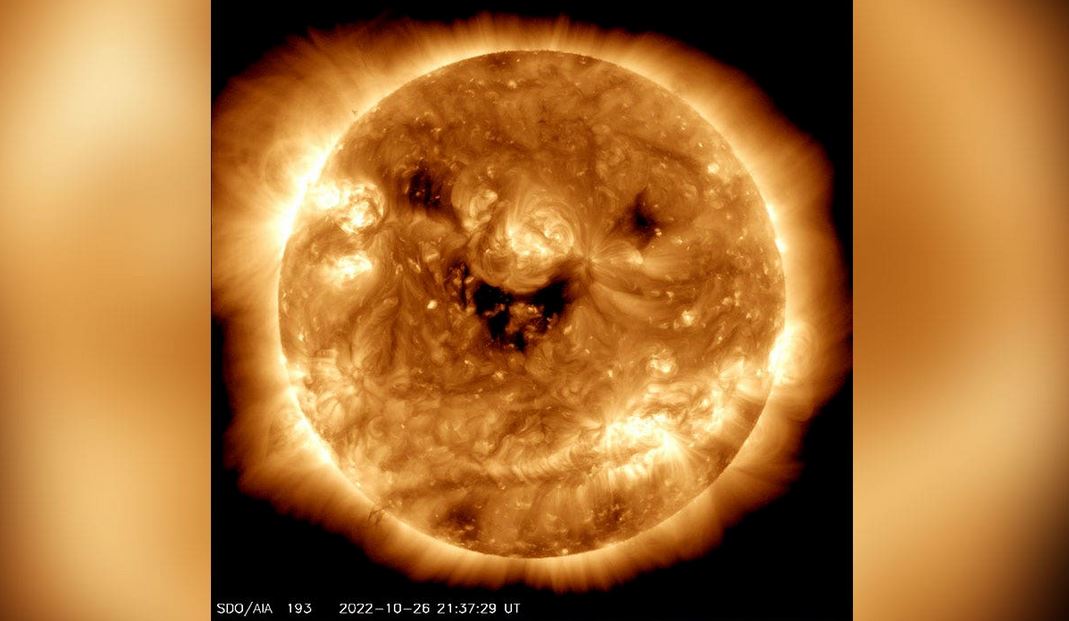
    Recently, NASA tweeted an image of the sun seemingly ‘smiling’. NASA explained that the patches are called coronal holes, which can be seen in ultraviolet light but are typically invisible to our eyes.

    What are Coronal Holes?

    • Coronal holes are regions on the sun’s surface from where fast solar wind gushes out into space.
    • Because they contain little solar material, they have lower temperatures and thus appear much darker than their surroundings.
    • Here, the magnetic field is open to interplanetary space, sending solar material out in a high-speed stream of solar wind.
    • They can last between a few weeks to months.
    • The holes are not a unique phenomenon, appearing throughout the sun’s approximately 11-year solar cycle.
    • They can last much longer during solar minimum – a period of time when activity on the Sun is substantially diminished.

    How are they formed?

    • It is unclear what causes coronal holes.
    • They correlate to areas on the sun where magnetic fields soar up and away, without looping back down to the surface as they do elsewhere.

    What do they tell us?

    • These ‘coronal holes’ are important to understanding the space environment around the earth through which our technology and astronauts travel.
    • In 2016 coronal holes covering “six-eight per cent of the total solar surface” were spotted.
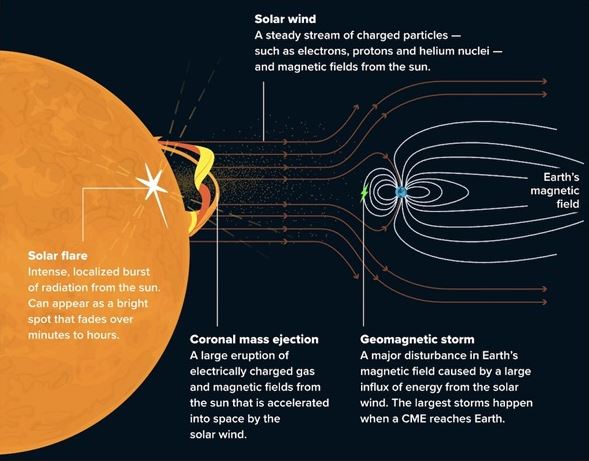
    • Scientists study these fast solar wind streams because they sometimes interact with earth’s magnetic field, creating what’s called a geomagnetic storm.
    • These storms can expose satellites to radiation and interfere with communications signals.

    Back2Basics: Geomagnetic Storms

    coronal

    • Geomagnetic storms relate to earth’s magnetosphere – the space around a planet that is influenced by its magnetic field.
    • When a high-speed solar stream arrives at the earth, in certain circumstances it can allow energetic solar wind particles to hit the atmosphere over the poles.
    • Such geomagnetic storms cause a major disturbance of the magnetosphere as there is a very efficient exchange of energy from the solar wind into the space environment surrounding earth.
    • In cases of a strong solar wind reaching the earth, the resulting geomagnetic storm can cause changes in the ionosphere, part of the earth’s upper atmosphere.
    • Radio and GPS signals travel through this layer of the atmosphere, and so communications can get disrupted.


    Click and get your FREE copy of Current Affairs micro notes

  • ISRO launches 36 satellites through its heaviest rocket LVM3

    lvm3

    The ISRO’s heaviest rocket, Launch Vehicle Mark 3 (LVM3 or GSLV Mark 3) has successfully put into orbit 36 satellites of the U.K.-based OneWeb.

    Also in news

    • The ISRO has renamed the Geosynchronous Satellite Launch Vehicle (GSLV) Mark -III as Launch Vehicle Mark-III, mainly to identify its task of placing satellites into a variety of orbits.

    What is LVM3?

    • LVM3 (erstwhile GSLV) is an expendable space launch vehicle designed, developed, and operated by the ISRO to launch satellites and other space objects into Geosynchronous Transfer Orbits.
    • It is 49.13 m tall and tallest among all other vehicles of ISRO.
    • It is a three-stage vehicle with a lift-off mass of 420 tonnes.
    • ISRO first launched LVM3 on April 18, 2001 and has made 13 launches since then.

    Stages in LVM3

    • The first stage comprises S139 solid booster with 138-tonne propellant and four liquid strap-on motors, with 40-tonne propellant.
    • The second stage is a liquid engine carrying 40-tonne of liquid propellant.
    • The third stage is the indigenously built Cryogenic Upper Stage (CUS) carrying 15-tonne of cryogenic propellants.

    Difference between PSLV and LVM3

    • LVM3 has the capability to put a heavier payload in the orbit than the Polar Satellite Launch Vehicle (PSLV).
    • PSLV can carry satellites up to a total weight of 2000 kg into space and reach up to an altitude of 600-900 km.
    • LVM3 can carry weight up to 5,000 kg and reach up to 36,000 km.
    • PSLV is designed mainly to deliver earth observation or remote sensing satellites, whereas, LVM3 has been designed for launching communication satellites.
    • LVM3 delivers satellites into a higher elliptical orbit, Geosynchronous Transfer Orbit (GTO) and Geosynchronous Earth Orbit (GEO).

    Upgrades brought by LVM3

    • The LVM3 is capable of lifting much heavier satellites than the GSLV Mk II with a bigger cryogenic upper stage and a larger first stage.
    • Both GSLV Mk II and LVM3 are three-stage vehicles, while the PSLV, which launches to low earth polar orbits, is a four-stage vehicle.
    • The GSLV Mk-II can place up to 2,500kg in geosynchronous orbits and up to 5,000kg to low earth orbit.
    • By comparison, the LVM3 can lift 4,000kg to GTO and up to 8,000 kg to LEO.


    UPSC 2023 countdown has begun! Get your personal guidance plan now! (Click here)

  • Black Hole, Resolving the Mistry

    Black Hole

    Context

    • For the very first time, scientists noted that this observation of the Laser Interferometer Gravitational Wave (LIGO) observatories coincided with the measurements made by other telescopes that measured visual and electromagnetic signals.

    What is Black hole?

    • A black hole is a place in space where gravity pulls so much that even light can not get out. The gravity is so strong because matter has been squeezed into a tiny space. This can happen when a star is dying.
    • Because no light can get out, people can’t see black holes. They are invisible. Space telescopes with special tools can help find black holes. The special tools can see how stars that are very close to black holes act differently than other stars.

    Black Hole

    What is the background?

    • LIGO Observations: In 2017, astrophysicists observed an unusual feat among the stars. The Laser Interferometer Gravitational Wave(LIGO)observatories recorded a signal which indicated that two massive and dense stellar bodies had merged to form a third body, likely a black hole.
    • Generation gravitational waves: In the process they gave off vibrations that quite literally shook the universe and its very fabric of space time.
    • Neutron stars: Scientists, piecing together evidence from complementary measurements, surmised that the event they had observed was of two neutron stars merging and forming a black hole and, in the process, giving off light.

    Black Hole

    What are the observations through telescopes?

    • The matter moving faster than light: An unusual jet of matter was observed that gave an illusion of travelling faster than light. These were all exciting phenomena observed for the very first time by telescopes and observatories.
    • Confirmation by Hubble Space Telescope: Now, using data that had been recorded by the Global astro metric Interferometer for Astrophysics (GAIA) spacecraft and Hubble Space Telescope instruments, scientists have confirmed that the above picture is correct. They have made it more precise and descriptive.
    • Seven times the speed of light: In a paper published in Nature, they describe measuring the “apparent speed” of the jet to be about seven times the speed of light.
    • Lorenz factor: They have also measured more accurately a factor called the Lorenz factor which scales with the actual speed of the particles in the jet. Unlike earlier estimates which placed this factor at about 4, the present paper estimates this factor to be over 40. This is because they measure the speed of the relativistic jet to be close to 0.9997c, where “c” is the speed of light.
    • Clarity about the source as neutron star in block hole generation: This resolves the earlier fuzziness about what the source was and puts the source clearly as massive neutron stars merging to give a black hole and throwing off relativistic jets of particles in the process.

    Black Hole

    Merging of Neutron stars

    • Born out of Supernova explosion: Neutron stars are stellar corpses, left behind after a star has undergone a supernova explosion and reached the end of its lifetime. They are extremely dense, containing more mass than the sun in a sphere that is a few tens of kilometre wide.
    • Produces fast moving material: This has been seen in many active galactic nuclei  galaxy centres that harbour black holes and binary star systems within our galaxy, where one of the stars is a black hole. “Mostly, black holes are responsible for producing such fast moving material

    Why present observations about black Hole are significant?

    • Estimating changing position of sky: The present measurements and observations made with GAIA data are extremely challenging. They amount to measuring the position of an object in sky coordinates. These authors measured a change in sky position one millionth the span of the full moon. Normally, if one were making these measurements from earth-based telescopes, it would require data from radio telescopes spaced apart by intercontinental distances.
    • VLBI technique: This technique is called Very Long Baseline Interferometry (VLBI) and was used in the earlier papers. “Here, the authors could beat VLBI in precision because they calibrated Hubble Space Telescope data with GAIA, which is a precision astrometry mission.
    • It’s an estimate not a measurement: the researchers used both their Hubble Space Telescope and GAIA optical position measurement along with the earlier VLBI position measurement to get a better estimate of the speed of the source and angle (viewing angle) with which it is travelling with respect to us on earth. This estimate requires plugging in equations of the special theory of relativity. “So, it is an estimate as opposed to a measurement.
    • Improvement in estimation: we have learnt that neutron star mergers can result in material moving with speeds as high as 0.9997c.Earlier results using Very Long Baseline Interferometry had pegged this value at about 0.938c. with the new results this lower limit has been improved. Even earlier, with VLBI, it was understood that it was a neutron star merger that produced such ultra-relativistic material. Before the VLBI results, there were several models that could replicate the observations.
    • Explanation using ultra realistic material: The observations could be explained both by ultra-relativistic material and non relativistic material, with some differences in assumptions. That study indicated that the observed gamma ray bursts were produced along with the ultra-relativistic material.

    Conclusion

    • Current discovery strengthens the hypothesis that such neutron star mergers are responsible for a class of gamma ray bursts. Gamma ray bursts are flashes of extreme gamma ray photons that release a huge amount of energy nearly 1047 They come from different galaxies in the universe and are observed here quite frequently.

    Mains Question

    Q. What is the neutron star and how the merger of two stars produces a black hole? How LIGO and Hubble space telescope are useful in demystifying the black Hole phenomenon?

    UPSC 2023 countdown has begun! Get your personal guidance plan now! (Click here)


  • The illusion of being faster than light: how a star problem was solved

    light

    Scientists have spotted something that appeared to be moving 7 times faster than the Speed of Light in a supernova like event.

    What is the news?

    • In 2017, astrophysicists observed an unusual feat among the stars.
    • The Laser Interferometer Gravitational-Wave (LIGO) observatories recorded a signal which indicated that two massive and dense stellar bodies had merged to form a third body, likely a black hole.
    • An unusual jet of matter was observed that gave an illusion of travelling faster than light.

    Can matter move faster than Light?

    • From the data, it appeared the jets of matter were moving seven times faster than light.
    • The researchers explain the reason behind the discrepancy is due to something called superluminal motion.
    • Since the jet of matter reaches Earth at the speed of light, the light it emits at later points has a relatively shorter distance, making it appear faster than it actually is.
    • After more calculations, astronomers found the real speed to be at least 99.7 percent of the speed of light (3 × 10^8 m / s).

    Crossing the speed of light: An illusion

    • The data of same incident has been recorded by the Global Astrometric Interferometer for Astrophysics (GAIA) spacecraft and Hubble (James Web) Space Telescope
    • Using it, scientists confirmed that the above picture is correct.

    How to assess it?

    • Scientists have also measured more accurately a factor called the Lorenz factor which scales with the actual speed of the particles in the jet.
    • Unlike earlier estimates which placed this factor at about 4, the present paper estimates this factor to be over 40.
    • This is because they measure the speed of the relativistic jet to be close to 9997c, where “c” is the speed of light.

    How are they observed?

    • Source is clearly as massive neutron stars merging to give a black hole and throwing off relativistic jets of particles in the process.

    Merging neutron stars: Faking to cross speed of light

    • Neutron stars are stellar corpses, left behind after a star has undergone a supernova explosion and reached the end of its lifetime.
    • They are extremely dense, containing more mass than the sun in a sphere that is a few tens of kilometre wide.
    • The observation of particles moving at seven times the speed of light is an illusion.
    • This happens in cases where a source moves (towards us) with a velocity that is very close to light’s velocity.
    • This has been seen in many active galactic nuclei — galaxy centres that harbour black holes — and binary star systems within our galaxy, where one of the stars is a black hole.
    • Mostly, black holes are responsible for producing such fast-moving material.

    How is this illusion created?

    • Normally, if one were making these measurements from earth-based telescopes, it would require data from radio telescopes spaced apart by intercontinental distances.
    • This technique is called Very Long Baseline Interferometry (VLBI) and was used in the earlier papers.

    Significance of this study

    • The significance of the paper is that now, we have learnt that neutron star mergers can result in material moving with speeds as high as 0.9997c.
    • Earlier results using Very Long Baseline Interferometry had pegged this value at about 0.938c.
    • And with the new results this lower limit has been improved.
    • Even earlier, with VLBI, it was understood that it was a neutron-star merger that produced such ultra-relativistic material.


    UPSC 2023 countdown has begun! Get your personal guidance plan now! (Click here)

  • ISRO proposes Bharat Krishi Satellite Programme

    isro

    The Indian Space Research Organisation (ISRO) has proposed dedicated satellites for supporting the country’s agriculture sector.

    Bharat Krishi Satellite Programme

    • Minimum of two satellites are stipulated to guarantee adequate coverage of the entire agricultural area of the country.
    • They will aid a gamut of farm-related activities related to crop forecasting, pesticide application, irrigation, soil data, and generation of critical data related to drought.
    • The satellites will be owned by the Department of Agriculture and not by ISRO. The ISRO will provide the technical support.
    • An ‘Earth Observation Council’ be created for addressing the current deficiencies in earth observation capabilities and data utilisation.
    • Such a council can tackle shortcomings in this area in a centralised manner.

    Why need such program?

    Current deficiencies include:

    1. Discontinuity in earth observation missions
    2. Low utilisation of available remote sensing data
    3. Technology gaps and
    4. Absence of a streamlined mechanism for data processing and dissemination as required by the industry

    Applications of space for agriculture

    isro

    Satellites in use

    Satellite Type Satellite Objectives
    Multispectral imaging satellite Resourcesat-2 & Resourcesat-2A Multispectral imaging for crop production forecast, land, water and natural resource inventory and management, and disaster management support
    Cartography satellite Cartosat-1 High resolution cartographic mapping, digital elevation mapping – drainage and irrigation networks, topographic mapping and contouring
    Radar imaging RISAT-1 All weather imaging capability targeted for kharif crop (June to November) during south-west and north-east monsoon seasons. Flood and natural disaster management
    Meteorological forecasting Kalpana-1 Comprehensive weather status reporting and forecasting
    Meteorological observation INSAT-3D & INSAT-3DR Improved meteorological observations including vertical – temperature and humidity–atmosphere weather forecasting and disaster warning


    Issues in harmonizing space technology

    • India’s satellite data is sequestered within the government.
    • The private sector has limited access to it, even though it plays an increasing role in the country’s agriculture value chain.

    Various govt programs

    • Following are some of the programs that are functioning in full spirit-
    • In 2017, these insular projects were integrated into a single entity, the National Programme on use of Space Technology for Agriculture (NPSTA).
    NPSTA Constituent Programmes Goals of the constituent Programme
    National Programme on use of Space Technology for Agriculture (NPSTA) Forecasting Agricultural output using Space, Agro-meteorology and Land-based observations (FASAL) Crop Forecasting
    National Agricultural Drought Assessment and Monitoring Systems (NADAMS) Drought Assessment
    Coordinated programme on Horticulture Assessment and Management using Geoinformatics (CHAMAN) Horticulture assessment and development
    C(K)rop Insurance using Space technology and Geoinformatics (KISAN) now incorporated into Pradhan Mantri Fasal Bima Yojna Crop Insurance


    UPSC 2023 countdown has begun! Get your personal guidance plan now! (Click here)

  • Next-Gen Launch Vehicle- NGLV to assume PSLV’s role

    The Indian Space Research Organisation (ISRO) is developing a Next-Gen Launch Vehicle (NGLV), which will one day replace operational systems like the Polar Satellite Launch Vehicle (PSLV).

    What is the news?

    • PSLV, often dubbed the ‘trusted workhorse’, “will have to retire” one day, said ISRO chairman.

    What is NGLV?

    • NGLV will feature a simple, robust design that allows bulk manufacturing, modularity in systems, sub-systems and stages and minimal turnaround time.
    • Potential uses will be in the areas of launching communication satellites, deep space missions, future human spaceflight and cargo missions.

    What all modifications would be required?

    • In NGLV, ISRO is understood to be looking at a cost-efficient, three-stage, reusable heavy-lift vehicle with a payload capability of 10 tonnes to Geostationary Transfer Orbit (GTO).
    • NGLV will feature semi-cryogenic propulsion for the booster stages which is cheaper and efficient.
    • For that, at least 10 tonne capability to GTO is needed.
    • Correspondingly, the Low Earth Orbit (LEO) capability will be twice that.
    • However, payload capability will be lower when the rocket is reusable.

    Back2Basics: Various satellite launch vehicles in India

    nglv


    UPSC 2023 countdown has begun! Get your personal guidance plan now! (Click here)

  • Adopting Sustainable Space Technology

    Sustainable

    Context

    • World Space Week this year is themed around ‘Space and Sustainability’. Among other things, the 2022 theme seeks to specifically inspire focus on the challenges the world faces to keep space safe and sustainable.

    What is mean by Space?

    • Space is an almost perfect vacuum, nearly void of matter and with extremely low pressure. In space, sound doesn’t carry because there aren’t molecules close enough together to transmit sound between them. Not quite empty, bits of gas, dust and other matter floats around “emptier” areas of the universe, while more crowded regions can host planets, stars and galaxies.
    • From our Earth-bound perspective, outer space is most often thought to begin about 62 miles (100 kilometers) above sea level at what is known as the Kármán line. This is an imaginary boundary at an altitude where there is no appreciable air to breathe or scatter light. Passing this altitude, blue starts to give way to black because oxygen molecules are not in enough abundance to make the sky blue.

    Sustainable

    What is mean by Space sustainability?

    • Space sustainability is ensuring that all humanity can continue to use outer space for peaceful purposes and socioeconomic benefit now and in the long term. This will require international cooperation, discussion, and agreements designed to ensure that outer space is safe, secure, and peaceful.

    What necessitate the sustainable space technology debate?

    • Mounting challenge of Space debris: Challenges are endless in both quantitative and qualitative terms, i.e., they are several and severe, ranging from satellite crowding and collision risk to space debris in the Low Earth Orbit (LEO).
    • Ever increasing satellites: The sense of urgency around space sustainability is already skyrocketing—more than 80 countries currently contribute to the over 6,800 active satellites in orbit, of which many are used for both civilian and military purposes, as well as over 30,000 pieces of orbital debris.
    • Militarization of space: Given the development of new and emerging space technologies, the rapid militarisation and securitisation of space, and the growing distrust amongst nations in the domain, space activity is only set to increase and acquire a more national security-oriented focus.
    • Large scale Development of ASAT: This is already visible in several countries around the world. There has been a recent uptick in the development and testing of destructive anti-satellite (ASAT) weapons, with 26 tests in the past two decades conducted by the four countries that have access to these weapons (US, Russia, China, and India).
    • Massive investment into military space capability: France, which is currently leading the European Council, has also invested several billion euros into military space capabilities, and regularly emphasises the security importance of space for other EU countries.
    • Increasing Defence space commands: Australia set up its Defence Space Command in early 2022 to increase its strategic potential in space, and South Korea deployed a spy satellite to better monitor North Korea in June 2022, giving its military space plan a huge push.
    • However, none of these countries have a sustainability provision in their defence space operations or programmes.

    Sustainable

    What are the challenges of Security and sustainability of Space?

    • Dichotomy in Security and sustainability: Sustainability and security are two sides of the same coin, but as a result of this inherent dichotomy, they are often juxtaposed against each other.
    • Keeping Security is the priority: The contrast between highly motivated and funded national security efforts and the relatively non-prioritised international engagements around space sustainability is an example of a larger trend of indifference towards sustainable development in favour of higher military spending.
    • SDG on backburner: To substantiate this point, funding for the Sustainable Development Goals (SDGs) was adversely affected due to COVID-19 in 2021, and this reportedly dramatically pushed back progress on the SDGs, but the global military expenditure has consistently been on an upward incline and crossed the US$2 trillion mark for the first time in the same year.
    • Securitization of space: The trade-off between security and sustainability can jeopardise sustainable development within a plethora of issue domains, thus, increasing the likelihood of exhausting limited resources. This in turn could exacerbate the risk of conflict due to the resulting scarce resources, ultimately creating a vicious cycle of securitisation and conflict.
    • Rat race in Space : As a case in point, the incumbent space race has always been marked by competing security and commercial interests, which has resulted in a constant escalation of global government spending on space programmes to its record value of US$98 billion in 2021. Space sustainability, on the other hand, has only seen activity recently, and primarily in an international and voluntary set-up.

    Sustainable

    What regulations are needed for Sustainable Space?

    • Prioritising peaceful use of space: A Working Group on the Long-term Sustainability of Outer Space Activities was set up by the Committee on the Peaceful Uses of Outer Space (COPUOS) in 2010, which has 95 UN member states taking part in it. The Group adopted a set of guidelines by consensus in 2019, although it failed to make these guidelines or any other regulations legally binding. It agreed to work over it for 5 years from 2022 onwards, but since the Group uses a consensus-based approach to reach agreements, it is difficult to expect more stringent or extensive regulatory frameworks to emerge from it.
    • Consensus is difficult but necessary: Consensus-based approaches in multilateral forums, especially related to arms or other security objectives, often contrast with individual national security interests of its member states and have been criticised for their slow or ineffective progress.
    • Convention on Certain Conventional Weapons: Another example of this is the Convention on Certain Conventional Weapons’ (CCW) Group of Government Experts (GGE) meetings on lethal autonomous weapons systems (LAWS), which have only produced a set of 11 non-binding guiding principles since deliberations around LAWS began in 2014.
    • Space sustainable ratings should be developed: The World Economic Forum, for instance, introduced a new standard called the Space Sustainability Rating (SSR), in 2022, which aims to recognise, reward, and encourage space actors to design and implement sustainable and responsible space missions. It remains to be seen whether countries will respond favourably to tools like the SSR, which are based on a positive reinforcement model, to be more space sustainability-conscious.

    Conclusion

    • space sustainability is only at the cusp of becoming actionable. When space experts, intergovernmental organisations, or countries themselves conclude that sustainability should be a part of their space mandate, and when they devise possible methods to help achieve this, they cannot do so in a vacuum. Space sustainability should not become the political football like climate change.

    Mains Question

    Q.What are the threats to sustainable space technology? Comment on various laws, regulations, forums on sustainable space technology.

    UPSC 2023 countdown has begun! Get your personal guidance plan now! (Click here)

  • India’s Space economy

    India’s space economy is likely to be worth nearly $13 billion by 2025, with the satellite launch services segment set to witness the fastest growth due to increasing private participation.

    About the report

    • The report is released by the Indian Space Association (ISpA) and Ernst & Young.
    • It says that the growing demand for smaller satellites is set to boost satellite manufacturing in the country.
    • It will attract global start-ups in the sector to help incubate space tech companies to India.

    Key highlights

    • India’s space economy was pegged at $9.6 billion in 2020 and is expected to touch $12.8 billion by 2025.
    • In dollar terms, the satellite services and applications segment would be the largest with a turnover of $4.6 billion by 2025, followed by the ground segment at $4 billion.
    • Satellite manufacturing stands at $3.2 billion and launch services at $1 billion.
    • The launch services segment was pegged at $600 million in 2020 and is projected to grow at a compound annual growth rate of 13 percent to reach $1 billion by 2025.

    Key drivers of this demand

    • India has of over 100 space tech start-ups with investments in the segment touching $68 million in 2021.
    • The availability of low-cost satellite launch vehicles coupled with mass production will lead to demand from customers around the world.
    • Several companies are utilising cutting-edge technologies to develop innovative launch solutions in India.

    Where does India stand in the global space market?

    • As per SpaceTech Analytics, India is the sixth-largest player in the industry internationally having 3.6% of the world’s space-tech companies (as of 2021).
    • US holds the leader’s spot housing 56.4% of all companies in the space-tech ecosystem.
    • Other major players include UK (6.5%), Canada (5.3%), China (4.7%) and Germany (4.1%).
    • The Indian Space Industry was valued at $7 billion in 2019 and aspires to grow to $50 billion by 2024.

    Why does India matter in the global space-tech market?

    • The country’s standout feature is its cost-effectiveness.
    • India holds the distinction of being the first country to have reached the Mars’ orbit in its first attempt and at $75 million — way cheaper than Western standards.

    Future prospects of India’s private ‘Space’

    Ans. India may lead in space junk management

    • Almost 60-odd start-ups had registered with the Indian Space Research Organisation (ISRO) this year.
    • A majority of them were dealing in projects related to space debris management.
    • As space becomes more congested with satellites, the technology would thus help in managing ‘space junk’ (debris of old spacecraft and satellites).

    How is the private sector’s involvement regulated in India?

    • In June 2020, the Union government announced reforms in the space sector enabling more private players to provide end-to-end services.
    • The central idea was to bring forth a predictable policy and regulatory environment for them and additionally provide access to ISRO facilities and assets to improve their capacities.

    (1) Establishment of IN-SPACe

    • An announcement for the establishment of the Indian National Space Promotion and Authorisation Centre (IN-SPACe) was made.
    • It was mandated the task of promoting, authorising and licensing private players to carry out space activities.
    • As an oversight and regulatory body, it is responsible for devising mechanisms to offer sharing of technology, expertise, and facilities free of cost to promote non-government private entities (NGPEs).
    • IN-SPACe’s Monitoring and Promotion Directorate oversees NGPE’s activities as per prescribed regulations and reports back in case any corrective actions or resolutions are required.
    • ISRO shares its expertise in matters pertaining to quality and reliability protocols, documentation, and testing procedure through IN-SPACe’s ‘interface mechanism’.

    (2) Establishment of NSIL

    • Additionally, constituted in March 2019, New Space India Ltd (NSIL), is mandated to transfer the matured technologies developed by the ISRO to Indian industries.
    • All of them are under the purview of the Ministry of Defence.
    • Private sector’s involvement in the long term, as with other commercial sectors, is believed to help spur investment and expertise in the realm which is capital-intensive and demands high technology.

    Where does India lack?

    Ans. Undisputedly, it is the finances

    • The US and Canada were the highest receivers of space-related investment in 2021.
    • The US’s space budget was $41 billion in 2021, $23.3 billion of which was focused on NASA.
    • India’s total budgetary allocation for FY2022-23 towards the Department of Space was ₹13,700 crore ($172 million).
    • Further, as per Tracxn data, funding into the sector’s start-ups (in India) nearly tripled to $67.2 million on a year-over-year basis in 2021.


    UPSC 2023 countdown has begun! Get your personal guidance plan now! (Click here)
  • Vyommitra Humanoid to undergo pre-flight tests

    vyommitra

    Vyommitra, the humanoid designed and developed by the ISRO to fly aboard unmanned test missions ahead of the Gaganyaan human space-flight mission, is undergoing pre-flight ground tests at the ISRO Inertial Systems Unit (IISU).

    Vyommitra

    • The AI-based robotic system is developed at a robotics lab at the Vikram Sarabhai Space Centre (VSSC) at Thumba, Thiruvananthapuram.
    • Vyommitra will be used for an unmanned flight of ISRO’s GSLV III rocket in December 2020, which, along with a second unmanned flight in July 2021.
    • This will serve as the test of ISRO’s preparedness for its maiden manned space mission, Gaganyaan, being targeted for 2022 to mark 75 years of India’s independence.

    Functions of the humanoid

    • Vyommitra, equipped with a head, two arms and a torso, is built to mimic crew activity inside the crew module of Gaganyaan.
    • Attaining launch and orbital postures, responding to the environment, generating warnings, replacing carbon dioxide canisters, and operating switches, monitoring of the crew module, receiving voice commands, and responding via speech (bilingual) are among the functions listed.
    • It will have a human-like face, with lips synchronized for movement to mimic speech.
    • Once it is fully developed, Vyommitra will be able to use the equipment on board the spacecraft’s crew module, like safety mechanisms and switches, as well as receive and act on commands sent from ground stations.

    What is the recent development?

    • The IISU has successfully integrated it with a computer “brain”, which enables it to “read” control panels aboard the unmanned test flights and communicate with the ISRO ground stations.
    • It has a certain level of intelligence.
    • It is intended to operate and read the display panels and communicate back to ground station using its own voice.

    Back2Basics: Gaganyaan Mission

    • Gaganyaan is crewed orbital spacecraft intended to be the formative spacecraft of the Indian Human Spaceflight Programme (IHSP).
    • The IHSP was initiated in 2007 by ISRO to develop the technology needed to launch crewed orbital spacecraft into low Earth orbit.
    • ISRO had been working on related technologies and it performed a Crew Module Atmospheric Re-entry Experiment and a Pad Abort Test for the mission.
    • If completed in meantime, India will become the fourth nation to conduct independent human spaceflight after Russia, US, and China.


    UPSC 2023 countdown has begun! Get your personal guidance plan now! (Click here)
  • Satellite Broadband Services in India

    satellite broadband

    The race for providing satellite broadband connectivity in India is heating up as companies like Jio, Oneweb, Hughes and Tata-backed Nelco are preparing to provide these services.

    Recent developments on satellite broadband

    • Earlier last month, Hughes Communications India (HCI), a satellite internet service provider launched India’s first high throughput satellite (HTS) broadband service powered by ISRO satellites.
    • It used Ku-band capacity from ISRO GSAT-11 and GSAT-29 satellites with Hughes JUPITER Platform ground technology to deliver high-speed broadband.

    What is a Satellite Broadband Service?

    • Broadband essentially means a wide bandwidth, high-capacity data transmission technique, using a broad range of frequencies.
    • In the case of a satellite broadband service, broadband services are delivered directly via satellites instead of optical fibre or mobile networks.

    How is it different from existing broadband services?

    (1) Transmission of data over space

    • The main difference is that aggregation of all the data generated and transmitted by users accessing the internet happens in the sky or space that is in the satellite.
    • In contrast to this, if we take a look at cellular networks, aggregation happens on the ground, in the base stations through optical fibre, cable, etc.

    (2) Access to the services

    • Another key difference is that to access satellite services, we will need a dish antenna just like we do in the case of TV services, so a normal mobile handset cannot directly access satellite broadband.
    • For a user to access satellite broadband a clear line of sight to the satellite is needed.

    Advantages offered

    • Speed: The main advantage of satellite services is that you can provide high-speed internet services in remote areas, where terrestrial networks cannot be set up.
    • Eliminating terrain shortcomings: For instance in the middle of the ocean, in rugged unreachable terrain such as the Himalayas — even as remote as on top of Mt. Everest, satellite broadband will work.
    • Curbing the divide: In a country with a wide range of geographies such as India, 20-25 per cent of the Indian population resides in areas where it is extremely hard for terrestrial operators to install internet facilities.

    Present scope in India

    • Currently, VSAT operators offer satellite broadband services at a very limited capacity in India in a few remote locations.
    • The utilisation of satellite services for broadband services is restricted to minimal applications — such as disaster management, defence, scientific locations, etc.

    How India (undoubtedly, the ISRO) has geared up for adapting to this?

    • ISRO’s high throughput GEO (Geostationary Equatorial Orbit) satellites – GSAT-11 and GSAT-29 a few years ago, can beam high-speed internet up to 300 gigabytes per second.
    • Apart, many global players look to provide satellite broadband services in India by deploying low earth orbit (LEO) satellites.
    • They are launching a constellation of satellites very close to the earth’s surface in order to reduce the latency of satellite broadband.
    • Presently, Elon Musk’s Starlink, Sunil Bharti Mittal-backed OneWeb and the Canadian satellite major Telesat are eyeing the Indian market.

    When will these services be available in India?

    • If things go as planned and the players get the necessary regulatory clearance, these services could become operational in India as soon as next year.
    • OneWeb wants to provide backhaul services to telcos by mid-next year, while Starlink wants to provide direct broadband services by December 2022, aiming at 2 lakh terminals.
    • Telesat, on the other hand, is eyeing an India launch by 2024.

    How much will it cost?

    • The provision of direct broadband services through satellites will be pricey.
    • According to a user guide for India, provided by Starlink, the first-year cost of a Starlink terminal will be ₹1,58,000 after which it will cost around ₹1,15,000 every year.

    Has it been rolled out in other parts of the world?

    • Starlink is operational in 14 countries, with 1 lakh terminals shipped to North America and Europe.
    • Starlink and OneWeb are still launching satellites that will be a part of their LEO constellation.

    What are the major hurdles?

    • Latency: Additionally, satellite Internet latency can be a significant problem. This can be a matter of only a second or two, but a delay on that scale can seriously affect real-time applications like video chats.
    • Spatial hurdles: Users might not be able to connect to a satellite at all if they are located under heavy foliage or surrounded by other obstructions.
    • Limited bandwidth: Satellite data transfer provides very slow Internet speeds and limited satellite bandwidth because of the distances the signals have to travel and all the potential obstacles in between.
    • Connection times: This can also be impacted by your surroundings, the length of your message, and the status and availability of the satellite network.
    • High input cost: This along with the complex equipment like satellite dishes being used to avail these services makes the service expensive.

    Perspective analysis: Why is India itself lagging in this race?

    • Globally, companies are striving to build and deploy “mega-constellations” of hundreds or thousands of satellites for this.
    • Despite India’s impressive achievements in the space sector, growth has been at snail’s pace.
    • Satellite broadband services in India remains primarily for the B2B sector with a market size of roughly $100 million.

    Reason’s for India’s slow pace

    • Upgrade issues: The Indian networks are still using conventional satellites despite the proliferation of high throughput satellites world-over.
    • Lack of domestic industries: There is a lack of domestic participation for building space infrastructure despite ‘Make in India’ mission.

    Way forward

    • An urgent re-look at deregulation and privatization is required.
    • Advanced space-faring nations have privatized most of these blocks in the value chain.
    • There is a need for building systems to help nurture the industry and create an extensive ecosystem to generate a ‘Space 2.0’ in India.


    UPSC 2023 countdown has begun! Get your personal guidance plan now! (Click here)