💥Join UPSC 2027,2028 Mentorship (August Batch) + XFactor Notes & Microthemes PDF

Subject: Space Technology

  • Rohini RH-200: ISRO eyeing 200th successful launch of Rohini RH-200

    rohini

    In a few weeks’ time, the Indian Space Research Organisation (ISRO) hopes to achieve a remarkable feat — the 200th successful launch of the Rohini RH-200 sounding rocket in a row.

    Rohini RH-200

    • RH-200 is a two-stage rocket capable of climbing to a height of 70 km bearing scientific payloads.
    • The first and second stages of RH-200 are powered by solid motors. The ‘200’ in the name denotes the diameter of the rocket in mm.
    • Other operational Rohini variants are RH-300 Mk-II and RH-560 Mk-III.
    • For years, the RH-200 rocket had used a polyvinyl chloride (PVC)-based propellant.
    • The first RH-200 to use a new propellant based on hydroxyl-terminated Polybutadiene (HTPB) was successfully flown from the TERLS in September 2020.
    • The first and second stages of RH200 rocket are powered by solid motors.
    • Since inception of RH200 rocket, both solid stages are processed using polyvinyl chloride (PVC) based propellant.
    • As compared to PVC based propellants, HTPB based propellant is more energetic, higher mechanical & interface properties and has less defects due to lower processing temperature.

    What basically is a Sounding Rocket?

    • A sounding rocket is an instrument-carrying rocket designed to take measurements and perform scientific experiments during its sub-orbital flight.
    • The rockets are used to launch instruments from 48 to 145 km above the surface of the Earth, the altitude generally between weather balloons and satellites.
    • The maximum altitude for balloons is about 40 km and the minimum for satellites is approximately 121 km.

    History of sounding rockets in India

    • Sounding rockets have an important place in the ISRO story.
    • The first sounding rocket to be launched from Thumba was the American Nike-Apache — on November 21, 1963.
    • After that, two-stage rockets imported from Russia (M-100) and France (Centaure) were flown. The ISRO launched its own version — Rohini RH-75 — in 1967.
    • The ISRO has launched more than 1,600 RH-200 rockets so far.
    • Currently, the RH200, RH300 MkII and RH560 Mk-III rockets are operational which were developed during the early phase of our journey in rocketry.


    UPSC 2023 countdown has begun! Get your personal guidance plan now! (Click here)

  • Centre’s push for NavIC System  

    navic

    The Union government is pushing tech giants to make smartphones compatible with its home-grown navigation system ‘NavIC’.

    What is NavIC?

    • NavIC, or Navigation with Indian Constellation, is an independent stand-alone navigation satellite system developed by the Indian Space Research Organisation (ISRO).
    • NavIC was originally approved in 2006 at a cost of $174 million.
    • It was expected to be completed by late 2011, but only became operational in 2018.
    • NavIC consists of eight satellites and covers the whole of India’s landmass and up to 1,500 km (930 miles) from its boundaries.

    Note: The numbers of satellites in this constellation is disputed. It is given as 7 and 8 on different sources. Total Nine satellites were launched out of which the very first (IRNSS-1A) is partially failed because of some issue in its Atomic Clock. Another and the last satellite had a launch failure. Hence the number 7/8.

    Why is the Centre pushing for NavIC?

    • Currently, NavIC’s use is limited.
    • It is being used in public vehicle tracking in India.
    • It helps providing emergency warning alerts to fishermen venturing into the deep sea where there is no terrestrial network connectivity, and for tracking and providing information related to natural disasters.
    • Enabling it in smartphones is the next step India is pushing for.
    • India’s 2021 satellite navigation draft policy stated the government will work towards expanding the coverage from regional to global to ensure availability of NavIC signal in any part of the world.

    How does NavIC compare?

    • The main difference is the serviceable area covered by these systems.
    • GPS caters to users across the globe and its satellites circle the earth twice a day, while NavIC is currently for use in India and adjacent areas.
    • Like GPS, there are three more navigation systems that have global coverage – Galileo from the European Union, Russia-owned GLONASS and China’s Beidou.
    • QZSS, operated by Japan, is another regional navigation system covering Asia-Oceania region, with a focus on Japan.

    Strategic significance of NavIC

    • India says NavIC is conceived with the aim of removing dependence on foreign satellite systems for navigation service requirements, particularly for “strategic sectors.”
    • Relying on systems like GPS and GLONASS may not always be reliable, India says, as those are operated by the defence agencies of respective nations.
    • It is possible that civilian services can be degraded or denied.
    • NavIC is an indigenous positioning system that is under Indian control.
    • There is no risk of the service being withdrawn or denied in a given situation.


    Try this PYQ:

    Q. With reference to the Indian Regional Navigation Satellite System (IRNSS), consider the following statements:

    1. IRNSS has three Satellites in geostationary and four satellites the geosynchronous orbits.
    2. IRNSS covers entire India and about 5500 sq. km beyond its borders.
    3. India will have its own satellite navigation system with full global coverage by the middle of 2019.

    Which of the statements given above is/are correct?

    (a) 1 only

    (b) 1 and 2 only

    (c) 2 and 3 only

    (d) None


    Answer: [wpdiscuz-feedback id=”20zudmif0g” question=”Please leave a feedback on this” opened=”1″](Post it here.)[/wpdiscuz-feedback]


    UPSC 2023 countdown has begun! Get your personal guidance plan now! (Click here)

  • James Webb telescope : The most powerful space telescope

    James Webb telescopeContext

    • Much of the universe remains unknown. The James Webb telescope will hopefully provide a powerful window to help resolve some of the cosmos’s many mysteries.

    What is James Webb Space Telescope (JWST)?

    • It is a space telescope being jointly developed by NASA, the European Space Agency (ESA), and the Canadian Space Agency (CSA).
    • It has taken 30 years and $10bn to develop, and is being described as one of the grand scientific endeavors of the 21st Century.

    Where it is placed?

    • The James Webb Space Telescope will not be in orbit around the Earth, like the Hubble Space Telescope is – it will actually orbit the Sun, 1.5 million kilometres (1 million miles) away from the Earth at what is called the second Lagrange point or L2.

    Mission

    • It will be “a giant leap forward in quest to understand the Universe and our origins”, as it will examine every phase of cosmic history: from the Big Bang to the formation of galaxies, stars, and planets to the evolution of our own Solar System.

    james webb telescope Special features of JWST

    • Time machine in space: Powerful space telescopes, like JWST or the Hubble Telescope, are often called time machines because of their ability to view very faraway objects. The light coming from those objects, stars or galaxies, which is captured by these telescopes, began its journey millions of years earlier. Essentially, what these telescopes see are images of these stars or galaxies as they were millions of years ago. The more distant the planet or star, the farther back in time are the telescopes able to see.
    • Farthest from Earth: James Webb telescope will also be positioned much deeper into space, about a million miles from Earth, at a spot known as L2. It is one of the five points, known as Lagrange’s points, in any revolving two-body system like Earth and Sun, where the gravitational forces of the two large bodies cancel each other out.
    • Engineering marvel: JWST has one large mirror, with a diameter of 21 feet (the height of a typical two-storey building), that will capture the infra-red light coming in from the deep universe while facing away from the Sun.

    What is the goal of this telescope?

    • The telescope will be able to see just about anything in the sky.
    • However, it has one overriding objective – to see the light coming from the very first stars to shine in the Universe.
    • These pioneer stars are thought to have switched on about 100-200 million years after the Big Bang, or a little over 13.5 billion years ago.
    • James Webb telescope will be picking out groupings of these stars.

    james webb telescope Its significance

    • It is widely expected to unveil many secrets of the universe, particularly those related to the Formation of stars and galaxies in the early period the first few hundred million years after the Big Bang.
    • Some have called James Webb telescope  the “telescope that ate astronomy”.
    • It is said to look back in time to the Dark Ages of the universe.

    Conclusion

    • The universe is vast and most of it is unknown. We hope that the James Webb telescope, over its lifetime would provide us with a powerful window to help resolve some of the many mysteries of the cosmos and make it a little bit more comprehensible.

    Mains question

    Q. What is James Webb telescope experiment? Do you think it shades light on dark matter? Explain.  

    UPSC 2023 countdown has begun! Get your personal guidance plan now! (Click here)

  • NASA’s DART mission prepares for an asteroid Dimorphos collision

    dart

    In the first-of-its kind NASA’s DART Mission is about to hit a small, harmless asteroid millions of miles away.

    What is DART Mission?

    • The main aim of the mission is to test the newly developed technology that would allow a spacecraft to crash into an asteroid and change its course.
    • It is a suicide mission and the spacecraft will be completely destroyed.
    • The target of the spacecraft is a small moonlet called Dimorphos (Greek for “two forms”).
    • It is about 160-metre in diameter and the spacecraft is expected to collide when it is 11 million kilometres away from Earth.
    • Dimorphos orbits a larger asteroid named Didymos (Greek for “twin”) which has a diameter of 780 metres.

    Why Dimorphos?

    • Didymos is a perfect system for the test mission because it is an eclipsing binary which means it has a moonlet that regularly orbits the asteroid.
    • It is observable when it passes in front of the main asteroid.
    • Earth-based telescopes can study this variation in brightness to understand how long it takes Dimorphos to orbit Didymos.

    Collision course

    • At the time of impact, Didymos and Dimorphos will be relatively close to Earth – within 6.8 million miles (11 million kilometers).
    • The spacecraft will accelerate at about 24,140 kilometers per hour when it collides with Dimorphos.
    • It aims to crash into Dimorphos to change the asteroid’s motion in space.
    • This collision will be recorded by LICIACube, or Light Italian CubeSat for Imaging of Asteroids, a companion cube satellite provided by the Italian Space Agency.
    • Three minutes after impact, the CubeSat will fly by Dimorphos to capture images and video.

    Why such mission?

    • Dimorphos was chosen for this mission because its size is relative to asteroids that could pose a threat to Earth.
    • The spacecraft is about 100 times smaller than Dimorphos, so it won’t obliterate the asteroid.
    • The fast impact will only change Dimorphos’ speed as it orbits Didymos by 1%, which doesn’t sound like a lot — but it will change the moon’s orbital period.


    UPSC 2023 countdown has begun! Get your personal guidance plan now! (Click here)

  • Patents in India

    patent systemContext

    • Increasing the efficiency of processing patent applications and wider academia-industry collaboration are crucial steps for patent system.

    What is patent system?

    • A patent system is a type of intellectual property that gives its owner the legal right to exclude others from making, using, or selling an invention for a limited period of time in exchange for publishing an enabling disclosure of the invention.

    Why are patents important?

    • A patent is important because it can help safeguard our invention. It can protect any product, design or process that meets certain specifications according to its originality, practicality, suitability, and utility. In most cases, a patent can protect an invention for up to 20 years.

    patent systemHow to get patent?

    • To get a patent, technical information about the invention must be disclosed to the public in a patent application.
    • The patent owner may give permission to, or license, other parties to use the invention on mutually agreed terms.
    • The owner may also sell the right to the invention to someone else, who will then become the new owner of the patent.
    • Once a patent expires, the protection ends, and an invention enters the public domain; that is, anyone can commercially exploit the invention without infringing the patent.

    Terms of Patent

    • Patents may be granted for inventions in any field of technology, from an everyday kitchen utensil to a nanotechnology chip.
    • An invention can be a product – such as a chemical compound, or a process, for example – or a process for producing a specific chemical compound.
    • Patent protection is granted for a limited period, generally 20 years from the filing date of the application.
    • Patents are territorial rights. In general, the exclusive rights are only applicable in the country or region in which a patent has been filed and granted, in accordance with the law of that country or region.

    patent systemHow patents can support inventors and improve lives

    • Recognize and reward: Patents recognize and reward inventors for their commercially-successful inventions. As such they serve as an incentive for inventors to invent. With a patent, an inventor or small business knows there is a good chance that they will get a return on the time, effort and money they invested in developing a technology. In sum, it means they can earn a living from their work.
    • Economic opportunity: When a new technology comes onto the market, society as a whole stands to benefit – both directly, because it may enable us to do something that was previously not possible, and indirectly in terms of the economic opportunities (business development and employment) that can flow from it.
    • Research and development (R&D): The revenues generated from commercially successful patent-protected technologies make it possible to finance further technological research and development (R&D), thereby improving the chances of even better technology becoming available in the future.
    • Opportunities for business growth: A patent effectively turns an inventor’s know-how into a commercially tradeable asset, opening up opportunities for business growth and job creation through licensing and joint ventures, for example.
    • Commercialization of a technology: Holding a patent also makes a small business more attractive to investors who play a key role in enabling the commercialization of a technology.
    • Spark new ideas: The technical information and business intelligence generated by the patenting process can spark new ideas and promote new inventions from which we can all benefit and which may, in turn, qualify for patent protection.
    • No freebies: A patent can help stop unscrupulous third parties from free riding on the efforts of the inventor.

    What is KAPILA Initiative?

    • Full form: KAPILA is an acronym for Kalam Program for IP (Intellectual Property) Literacy and Awareness.
    • Guidelines for patent Filing: Under this campaign, students pursuing education in higher educational institutions will get information about the correct system of the application process for patenting their invention and they will be aware of their rights.
    • Encouragement to students: The program will facilitate the colleges and institutions to encourage more and more students to file patents.

    Thing to remember

    Remember one thing, ‘KAPILA’ Program is related to IP awareness. It sounds much like an animal husbandry related initiative.

    Way ahead

    • As the patent system is a critical aspect of the national innovation ecosystem, investing in the patent ecosystem will help in strengthening the innovation capability of India.
    • The right interventions should be made for the promotion of the quality of patent applications and collaboration between academia and industry.

    Mains question

    Q. A patent can help stop unscrupulous third parties from free riding on the efforts of the inventor. Discuss this statement in context of protection of innovative ecosystem in India.


    UPSC 2023 countdown has begun! Get your personal guidance plan now! (Click here)

  • ISRO tests system recoverable rocket ‘Inflatable Aerodynamic Decelerator (IAD)’

    The Indian Space Research Organisation (ISRO) has successfully tested a technology that could aid the cost-effective recovery of spent rocket stages and safely land payloads on other planets.

    What is IAD?

    • IAD is a technique used for an atmospheric entry payload.
    • An inflatable envelope and an inflatant (anything that inflates the envelope, like air or helium) make up the inflatable aerodynamic decelerator.
    • While entering the atmosphere, it inflates like a balloon and decelerates the lander.
    • The inflatant is designed to fill the inflatable envelope to a condition such that it surrounds the payload meant to enter the atmosphere of a planet or satellite and causes aerodynamic forces to slow it down.
    • In simpler words, IAD is designed to increase drag upon entering the atmosphere of any planetary body, like Earth, Mars, or even Moon.
    • Its shape is maintained by a closed, gas-pressured body and the inflatant gas is also generated internally. Some versions also use ram air or both.

    How significant is this IAD?

    • Some space agencies, including NASA, have already successfully tested advanced versions of the technology, including the supersonic and hypersonic variants.
    • However, for near future missions of ISRO, the current version that it tested is perfect.
    • Its use was first proposed by NASA more than 50 years ago for planetary entries.

    Minuscule of ISRO’s IAD

    • The IAD tested by ISRO was inflated at an altitude of around 84 km and the sounding rocket’s cargo dropped through the atmosphere on it.
    • It is fitted with a booster motor. It also has a spin rocket that is ejectable.
    • The inflatable structure is made out of Kevlar fabric, which is a very strong synthetic fibre and also heat resistant to withstand atmospheric pressure and temperature changes.
    • On top of it, it’s coated with polychloroprene, an oil and wax resistant rubber, to withstand extreme temperatures.
    • In the inflation system, it uses compressed nitrogen stored in a bottle.
    • It has consistently decreased the payload’s velocity through aerodynamic drag while maintaining the expected trajectory during the test flight.

    Where does ISRO intend to use it?

    • The IAD will help ISRO in performing many space tasks effectively including recovery of spent stages of rockets, for landing payloads on missions to other planetary bodies.
    • This is the first instance where an IAD has been specially created for spent stage recovery.
    • So inter-planetary missions are certainly one aspect that ISRO wishes to explore.


    UPSC 2023 countdown has begun! Get your personal guidance plan now! (Click here)

  • India’s first Dark Sky Reserve to come up in Ladakh

    In a first-of-its-kind initiative, the Department of Science & Technology (DST) has announced the setting up of India’s first dark sky reserve at Hanle in Ladakh in the next three months.

    What is a Dark Sky Reserve?

    • A dark-sky reserve is an area, usually surrounding a park or observatory that is kept free of artificial light pollution.
    • The purpose of a dark sky preserve is generally to promote astronomy.
    • Because different national organizations have worked independently to create their programs, different terms have been used to describe the areas.

    How is it designated?

    • A dark sky reserve is a designation given to a place that has policies in place to ensure that a tract of land or region has minimal artificial light interference.
    • The International Dark Sky Association is a US-based non-profit that designates sites as international dark sky places, parks, sanctuaries and reserves, depending on the criteria they meet.
    • Several such reserves exist around the world but none so far in India.

    Dark Sky Reserve at Hanle

    • Hanle, which is about 4,500 metres above sea level, hosts telescopes and is regarded as one of the world’s most optimal sites for astronomical observations.
    • However, ensuring that the site remains well-suited for astronomy implies keeping the night sky pristine, or ensuring minimal interference to the telescopes from artificial light sources such as electric lights and vehicular lights from the ground.
    • The site will have activities to help in boosting local tourism and economy through interventions of science and technology.

    The Himalayan Chandra Telescope, High Energy Gamma Ray Telescope, Major Atmospheric Cherenkov Experiment Telescope and GROWTH-India are the prominent telescopes located at the Hanle observatory.

    Ideal conditions in India

    • The Indian Astronomical Observatory, the high-altitude station of the IIA, is situated to the north of Western Himalayas, at an altitude of 4,500 metres above mean sea level.
    • Located atop Mt. Saraswati in the Nilamkhul Plain in the Hanle Valley of Changthang, it is a dry, cold desert with sparse human population.
    • The cloudless skies and low atmospheric water vapour make it one of the best sites in the world for optical, infrared, sub-millimetre, and millimetre wavelengths.


    UPSC 2023 countdown has begun! Get your personal guidance plan now! (Click here)

  • What is Artemis 1 Mission?

    NASA’s Artemis 1 mission has sought unexpected delay due to fuel leakages issue.

    What is the Artemis I Mission?

    • NASA’s Artemis mission is touted as the next generation of lunar exploration, and is named after the twin sister of Apollo from Greek mythology.
    • Artemis is also the goddess of the moon.
    • Artemis I is the first of NASA’s deep space exploration systems.
    • It is an uncrewed space mission where the spacecraft will launch on SLS — the most powerful rocket in the world — and travel 2,80,000 miles from the earth for over four to six weeks during the course of the mission.
    • The Orion spacecraft is going to remain in space without docking to a space station, longer than any ship for astronauts has ever done before.
    • The SLS rocket has been designed for space missions beyond the low-earth orbit and can carry crew or cargo to the moon and beyond.

    Key objectives of the mission

    • With the Artemis Mission, NASA aims to land humans on the moon by 2024, and it also plans to land the first woman and first person of colour on the moon.
    • With this mission, NASA aims to contribute to scientific discovery and economic benefits and inspire a new generation of explorers.
    • NASA will establish an Artemis Base Camp on the surface and a gateway in the lunar orbit to aid exploration by robots and astronauts.
    • The gateway is a critical component of NASA’s sustainable lunar operations and will serve as a multi-purpose outpost orbiting the moon.

    Other agencies involved

    • Other space agencies are also involved in the Artemis programme.
    • The Canadian Space Agency has committed to providing advanced robotics for the gateway.
    • The European Space Agency will provide the International Habitat and the ESPRIT module, which will deliver additional communications capabilities among other things.
    • The Japan Aerospace Exploration Agency plans to contribute habitation components and logistics resupply.


    UPSC 2023 countdown has begun! Get your personal guidance plan now! (Click here)


  • In news: James Webb Space Telescope

    The James Webb Space Telescope, NASA’s latest and most powerful telescope, has captured new images of our solar system’s largest planet, Jupiter, presenting it in a never before seen light.

    What is so special about snapping Jupiter?

    • The photographs have captured a new view of the planet, presenting in detail its massive storms, colourful auroras, faint rings and two small moons — Amalthea and Adrastea.
    • While most of us are familiar with the yellow and reddish-brown gas giant.
    • The JSWT’s Near-Infrared Camera, with its specialized infrared filters, has shown Jupiter encompassed in blue, green, white, yellow and orange hues.
    • Jupiter’s famous Great Red Spot, a storm so big that it could swallow Earth, appeared bright white in the image, since it was reflecting a lot of sunlight.
    • The brightness here indicates high altitude — so the Great Red Spot has high-altitude hazes, as does the equatorial region.
    • The numerous bright white ‘spots’ and ‘streaks’ are likely very high-altitude cloud tops of condensed convective storms.

    About James Webb Space Telescope

    • JWST is a space telescope jointly developed by NASA, the European Space Agency (ESA), and the Canadian Space Agency (CSA).
    • It is planned to succeed the Hubble Space Telescope as NASA’s flagship astrophysics mission.
    • It will conduct a broad range of investigations across the fields of astronomy and cosmology, including:
    1. Observing some of the most distant events and objects in the universe such as the formation of the first galaxies
    2. Detailed atmospheric characterization of potentially habitable exoplanets

    How is it different from other telescopes?

    • JWST is much more powerful and has the ability to look in the infrared spectrum, which will allow it to peer through much deeper into the universe, and see through obstructions such as gas clouds.
    • As electromagnetic waves travel for long distances, they lose energy, resulting in an increase in their wavelength.
    • An ultraviolet wave, for example, can slowly move into the visible light spectrum and the infrared spectrum, and further weaken to microwaves or radio waves, as it loses energy.
    • Hubble was designed to look mainly into the ultraviolet and visible regions of the electromagnetic spectrum.
    • JWST is primarily an infrared telescope, the first of its kind.

    Special features of JWST

    (1) Time machine in space

    • Powerful space telescopes, like JWST or the Hubble Telescope, are often called time machines because of their ability to view very faraway objects.
    • The light coming from those objects, stars or galaxies, which is captured by these telescopes, began its journey millions of years earlier.
    • Essentially, what these telescopes see are images of these stars or galaxies as they were millions of years ago.
    • The more distant the planet or star, the farther back in time are the telescopes able to see.

    (2) Farthest from Earth

    • JWST will also be positioned much deeper into space, about a million miles from Earth, at a spot known as L2.
    • It is one of the five points, known as Lagrange’s points, in any revolving two-body system like Earth and Sun, where the gravitational forces of the two large bodies cancel each other out.
    • Objects placed at these positions are relatively stable and require minimal external energy to keep them there. L2 is a position directly behind Earth in the line joining the Sun and the Earth.
    • It would be shielded from the Sun by the Earth as it goes around the Sun, in sync with the Earth.

    (3) Engineering marvel

    • JWST has one large mirror, with a diameter of 21 feet (the height of a typical two-storey building), that will capture the infra-red light coming in from the deep universe while facing away from the Sun.
    • It will be shielded by a five-layer, tennis court-sized, kite-shaped sunscreen that is designed to block the heat from Sun and ensure the extremely cool temperatures that the instruments are built to operate at.
    • Temperatures on the sun-facing side can get as high as 110°C, while the other side would be maintained at –200° to –230°C.
    • The extremely cold temperatures are needed to detect the extremely faint heat signals from distant galaxies.
    • The mirror as well as the sunscreen is so large they could not have fit into any rocket. They have been built as foldable items and would be unravelled in space.


    UPSC 2023 countdown has begun! Get your personal guidance plan now! (Click here)

  • Small Satellite Launch Vehicle (SSLV) launched into wrong Orbit

    The Indian Space Research Organisation (ISRO) has said that the satellite onboard its’ maiden Small Satellite Launch Vehicle “are no longer usable” after the SSLV-D1 placed them in an elliptical orbit instead of a circular one.

    What is SSLV?

    • The SSLV is a small-lift launch vehicle being developed by the ISRO with payload capacity to deliver:
    1. 600 kg to Low Earth Orbit (500 km) or
    2. 300 kg to Sun-synchronous Orbit (500 km)
    • It would help launching small satellites, with the capability to support multiple orbital drop-offs.
    • In future a dedicated launch pad in Sriharikota called Small Satellite Launch Complex (SSLC) will be set up.
    • A new spaceport, under development, near Kulasekharapatnam in Tamil Nadu will handle SSLV launches when complete.
    • After entering the operational phase, the vehicle’s production and launch operations will be done by a consortium of Indian firms along with NewSpace India Limited (NSIL).

    Vehicle details

    (A) Dimensions

    • Height: 34 meters
    • Diameter: 2 meters
    • Mass: 120 tonnes

    (B) Propulsion

    • It will be a four stage launching vehicle.
    • The first three stages will use Hydroxyl-terminated polybutadiene (HTPB) based solid propellant, with a fourth terminal stage being a Velocity-Trimming Module (VTM).

    SSLV vs. PSLV: A comparison

    • The SSLV was developed with the aim of launching small satellites commercially at drastically reduced price and higher launch rate as compared to Polar SLV (PSLV).
    • The projected high launch rate relies on largely autonomous launch operation and on overall simple logistics.
    • To compare, a PSLV launch involves 600 officials while SSLV launch operations would be managed by a small team of about six people.
    • The launch readiness period of the SSLV is expected to be less than a week instead of months.
    • The SSLV can carry satellites weighing up to 500 kg to a low earth orbit while the tried and tested PSLV can launch satellites weighing in the range of 1000 kg.
    • The entire job will be done in a very short time and the cost will be only around Rs 30 crore for SSLV.

    Significance of SSLV

    • SSLV is perfectly suited for launching multiple microsatellites at a time and supports multiple orbital drop-offs.
    • The development and manufacture of the SSLV are expected to create greater synergy between the space sector and private Indian industries – a key aim of the space ministry.

    Back2Basics: Various Orbits of Satellites
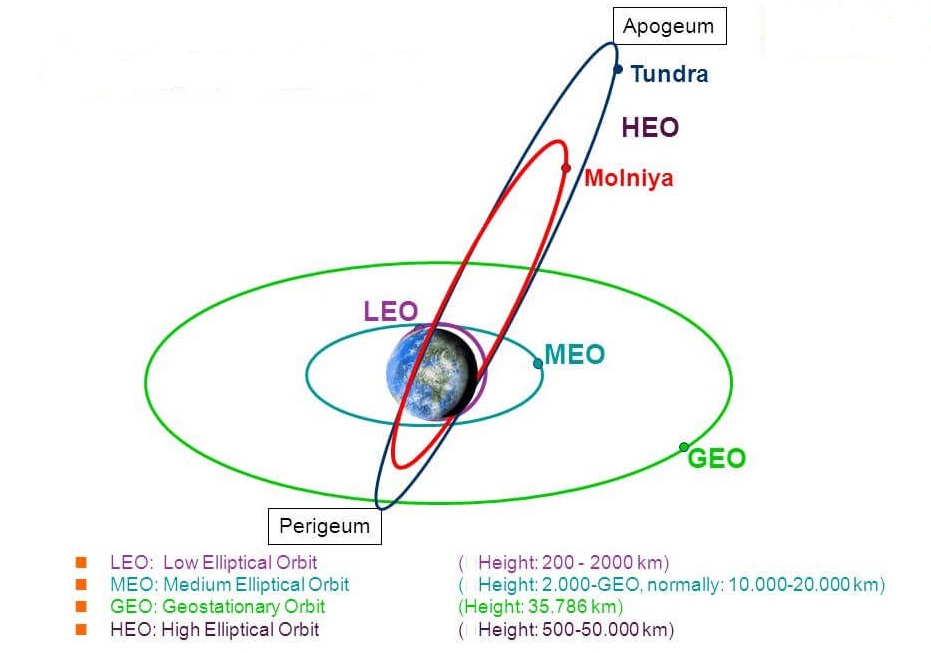
    [1] Geostationary orbit (GEO)

    • Satellites in geostationary orbit (GEO) circle Earth above the equator from west to east following Earth’s rotation – taking 23 hours 56 minutes and 4 seconds – by travelling at exactly the same rate as Earth.
    • This makes satellites in GEO appear to be ‘stationary’ over a fixed position.
    • In order to perfectly match Earth’s rotation, the speed of GEO satellites should be about 3 km per second at an altitude of 35 786 km.
    • This is much farther from Earth’s surface compared to many satellites.
    • GEO is used by satellites that need to stay constantly above one particular place over Earth, such as telecommunication satellites.
    • Satellites in GEO cover a large range of Earth so as few as three equally-spaced satellites can provide near-global coverage.

    [2] Low Earth orbit (LEO)

    • A low Earth orbit (LEO) is, as the name suggests, an orbit that is relatively close to Earth’s surface.
    • It is normally at an altitude of less than 1000 km but could be as low as 160 km above Earth – which is low compared to other orbits, but still very far above Earth’s surface.
    • Unlike satellites in GEO that must always orbit along Earth’s equator, LEO satellites do not always have to follow a particular path around Earth in the same way – their plane can be tilted.
    • This means there are more available routes for satellites in LEO, which is one of the reasons why LEO is a very commonly used orbit.
    • It is most commonly used for satellite imaging, as being near the surface allows it to take images of higher resolution.
    • Satellites in this orbit travel at a speed of around 7.8 km per second; at this speed, a satellite takes approximately 90 minutes to circle Earth.

    [3] Medium Earth orbit (MEO)

    • Medium Earth orbit comprises a wide range of orbits anywhere between LEO and GEO.
    • It is similar to LEO in that it also does not need to take specific paths around Earth, and it is used by a variety of satellites with many different applications.
    • It is very commonly used by navigation satellites, like the European Galileo system of Europe.
    • It uses a constellation of multiple satellites to provide coverage across large parts of the world all at once.

    [4] Polar Orbit

    • Satellites in polar orbits usually travel past Earth from north to south rather than from west to east, passing roughly over Earth’s poles.
    • Satellites in a polar orbit do not have to pass the North and South Pole precisely; even a deviation within 20 to 30 degrees is still classed as a polar orbit.
    • Polar orbits are a type of low Earth orbit, as they are at low altitudes between 200 to 1000 km.

    [5] Sun-synchronous orbit (SSO)

    • SSO is a particular kind of polar orbit. Satellites in SSO, travelling over the polar regions, are synchronous with the Sun.
    • This means they are synchronised to always be in the same ‘fixed’ position relative to the Sun.
    • This means that the satellite always visits the same spot at the same local time.
    • Often, satellites in SSO are synchronised so that they are in constant dawn or dusk – this is because by constantly riding a sunset or sunrise, they will never have the Sun at an angle where the Earth shadows them.
    • A satellite in a Sun-synchronous orbit would usually be at an altitude of between 600 to 800 km. At 800 km, it will be travelling at a speed of approximately 7.5 km per second.

    [6] Transfer orbits and geostationary transfer orbit (GTO)

    • Transfer orbits are a special kind of orbit used to get from one orbit to another.
    • Often, the satellites are instead placed on a transfer orbit: an orbit where, by using relatively little energy from built-in motors, the satellite or spacecraft can move from one orbit to another.
    • This allows a satellite to reach, for example, a high-altitude orbit like GEO without actually needing the launch vehicle.
    • Reaching GEO in this way is an example of one of the most common transfer orbits, called the geostationary transfer orbit (GTO).


    UPSC 2023 countdown has begun! Get your personal guidance plan now! (Click here)