- Inflation in India: CPI, WPI, GDP Deflator, Inflation Rate
- Types of Inflation: Demand Pull, Cost Push, Stagflation, Structural Inflation, Deflation and Disinflation
- The Cost of Inflation
The SDGs are an inclusive agenda. They tackle the root causes of poverty and unite us together to make a positive change for both people and planet. “Poverty eradication is at the heart of the 2030 Agenda, and so is the commitment to leave no-one behind,” UNDP Administrator Achim Steiner said. “The Agenda offers a unique opportunity to put the whole world on a more prosperous and sustainable development path. In many ways, it reflects what UNDP was created for.”
The Goals

Goal 1: No Poverty
Targets
Goal 2: Zero Hunger
Targets
Goal 3: Good Health and Well Being
Targets
Goal 4: Quality Education
Targets
Goal 5: Gender Equality
Targets
Goal 6: Clean Water and Sanitation
Targets
Goal 7: Affordable and Clean Energy
Target
Goal 8: Decent Work and Economic Growth
Targets
Goal 9: Industry, Innovation and Infrastructure
Targets
Goal 10: Reduce Inequalities
Targets
Goal 11: Sustainable Cities and Communities
Targets
Goal 12: Responsible Production and Consumption
Targets
Goal 13: Climate Actions
Targets
Goal 14: Life Below Water
Targets
Goal 15: Life on land
Targets
Goal 16: Peace, Justice and Strong Institutions
Targets
Goal 17: Partnership for the Goals
Targets
Finance
Technology
Capacity building
Trade
Systemic issues
In 2000, 189 nations made a promise to free people from extreme poverty and multiple deprivations. This pledge became the eight Millennium Development Goals to be achieved by 2015. In September 2010, the world recommitted itself to accelerate progress towards these goals.
The MDGs consists of eight goals, and these eight goals address myriad development issues. The eight (8) Goals are as under:

Eighteen (18) targets were set as quantitative benchmarks for attaining the goals. The United Nations Development Group (UNDG) in 2003 provided a framework of 53 indicators (48 basic + 5 alternative) which are categorized according to targets, for measuring the progress towards individual targets.
A revised indicator-framework drawn up by the Inter-Agency and Expert Group (IAEG) on MDGs came into effect in 2008. This framework had 8 Goals, 21 targets and 60 indicators. India has not endorsed this revised framework.
MDG and India Progress
MDG 1: Eradicate extreme poverty and hunger.
Target: Halve, between 1990 and 2015, the proportion of people whose income is less than one dollar a day.
India’s Progress:
Target: Halve, between 1990 and 2015, the proportion of people who suffer from hunger.
India’s Progress:
MDG 2: Achieve Universal Primary Education
Target: Ensure that by 2015, children everywhere, boys and girls alike, will be able to complete a full course of primary education.
India’s Progress:
MDG 3: Promote Gender Equality and Empower Women
Target: Eliminate gender disparity in primary, secondary education, preferably by 2005, and in all levels of education, no later than 2015.
India’s Progress:
MDG 4: Reduce Child Mortality
Target: Reduce by two-thirds, between 1990 and 2015, the under-five Mortality Rate.
India’s Progress:
MDG 5: Improved Mental Health
Target: Reduce by three quarters between 1990 and 2015, the Maternal Morality Ratio.
India’s Progress:
MDG 6: Combat HIV/AIDS, Malaria and Other Diseases.
Target: Have halted by 2015 and begun to reverse the spread of HIV/AIDS.
India’s Progress:
Target: Have halted by 2015 and begun to reverse the incidence of Malaria and other major diseases.
India’s Progress:
MDG 7: Ensure Environment Sustainability.
Target: Integrate the principle of sustainable development into country policies and programmes and reverse the loss of environmental resources.
India’s Progress:
TARGET: Halve, by 2015 the proportion of people without sustainable access to safe drinking water and basic sanitation
India’s Progress:
TARGET: By 2020, to have achieved a significant improvement in the lives of at least 100 million slum dwellers
India’s Progress:
MDG 8: Develop a Global Partnership for Development
Target: In co-operation with the private sector, make available the benefits of new technologies, especially information and communication.
India’s Progress
India’s Progress in a Nutshell

Green GDP and India

The four pillars of GNH:
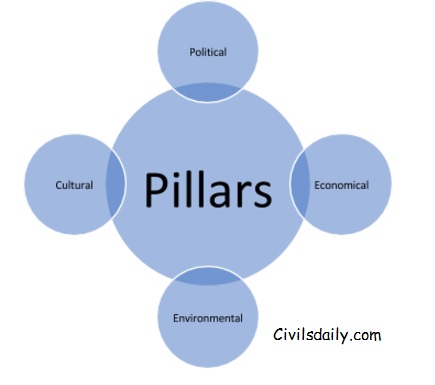
The Nine Domains of GNH

Criticism of GNH
Why do we require HDI?
Method of calculating HDI

(a)Life Expectancy Index assessment
(b) Education Index assessment
Education Index (EI) assessment is composite of two indices. They are
1. Mean Years of Schooling Index (MYSI)
2. Expected Years of Schooling Index (EYSI)
(C) Income Index assessment
How to calculate Human Development Index as per new method?
Formula to calculate Human Development Index (HDI) = (Life Expectancy Index X Education Index X Income Index) 1/3
New Human Development Index (HDI) is geometric mean of Life Expectancy Index (LEI), Education Index (EI) and Income Index (II).
After this calculation total value will be between 0 and 1. As per the values gained, countries will be placed in the list of the division of countries. They are divided into very high human development, high human development, medium high human development and low high human development countries
Global Trends in HDI
Strength of HDI index
Weaknesses of HDI index
The HDI and India

Nominal GDP is the money value of all the goods and services produced in a year. Nominal GDP is calculated at the current market prices. However, Nominal GDP does not truly indicate the real performance of the economy as the prices changes over time.
Back to Basics: Suppose, India as a country only produced cars in its economy. In the year 2016, India produced 100 Cars which were sold at RS 100,000 each. India’s GDP in this case will be RS 10,00,00,00 (100*100000).
In the year 2017, supposedly due to demonetization India only produced only 90 Cars, but their price has risen to RS 15,0000. India’s GDP in the year 2017 will be 1,35,00,000.
The Increase from RS 10,00,00,00 to RS 1,35,00,000 is the nominal GDP. The GDP of India has risen not because we have produce more units of Car but because the prices of the car have increased.
Therefore, the Nominal GDP does not capture the changes in the real economy.
Real GDP
The real GDP is calculated as the money value of all the goods and services produced in a year using the constant set of market prices that have prevailed in the certain chosen base year. The Real GDP is calculated at a fixed set of prices so that only the changes in real output or real production of goods and services is captured.
Back to Basics: Suppose, India as a country only produced cars in its economy. In the year 2016, India produced 100 Cars which were sold at RS 100,000 each. India’s GDP in this case will be RS 10,00,00,00 (100*100000).
In the year 2017, supposedly due to demonetization India only produced only 90 Cars. If we take the year 2011-12 as the base year and assumes that the price of the car in that year was RS 90,000. Then, India’s Real GDP will be 90*90,000= 81,00,000.
The Nominal GDP is RS 1,35,00,000 whereas the Real GDP is RS 81,00,000. The difference is due to the prices which have risen from 90,000 in the base year to RS 15,00,00 in the current year.
Limitations of the Concept of GDP/Economic Growth

Note for Students: The following examples will make it clear why GDP is not a perfect measure of Well Being.
Now tell me is this increase in the GDP is worth considering? The GDP has risen due to wrong reason, i.e., increase in crime.
In the above case, the GDP fails to capture the deteriorating situation of the society.
The two-argument provided above are also valid for the shortcomings of growth.
Economic Growth is a monetary concept. It only takes into account the value of goods and services produced in the economy. It tells how much a country has progressed in terms of economic indicators like GDP, Per Capita Income, Production, employments etc. It measures only quantifiable outcomes.
Let’s Understand Growth
The First Stage:

The story so far is very impressive a business-friendly government with pro-business policy increased growth and employment.
The Second Stage:

The Third Stage

The Fourth and Final stage: The Crisis

The above model is just an easy explanation of a complex system. Is it really the pro-business policies of the government that have led to the crisis?
The answer is no. It is the lack of balanced policy or a single point focus on the growth that has led to the crisis.
What has the Government missed in the process?
The First lesson, therefore, is “Along with the policies to promote Physical Capital the government must promote the policies of Human Capital”. Therefore, the first difference, “Promotion of Physical Capital is a growth oriented measure, but promoting the Human capital along with Physical Capital is a development oriented measure”.
If for example, when the first stage boom had happened, the government should have adopted the policy of promoting new firms by encouraging competition, by providing the new firms with opportunities in the form of lower taxes, interest-free capital. Instead, the government followed the existence firms demand of more rebates, more deregulation which created a monopoly like the situation with restricting enter. The new firms would have competed with the older firms, and in the process, the poor performing firms would have thrown out of the market, and the best surviving firms could have produced efficiently and at a much lower price.
The second lesson, therefore, is “The role of government is to promote competition and healthy environment for the firms to operate and not to practice Crony Capitalism in nexus with old firms”. Therefore, the policy of excessive deregulation along with creating a monopoly kind structure is a growth oriented move, but promoting and encouraging new firms through fair competition is a development oriented measure”.
The Third lesson, therefore, is “A balanced approach towards resource redistribution does more good as compare to a one-sided measure of promoting business welfare”. The governments must force the firms to provide essential services in the areas of the land takeover. Therefore, land acquisition along with welfare of the region is a development measure.
Therefore, the fourth lesson “Labour Market reforms carried with the welfare of the labour is a development oriented measure”.
The story in a nutshell, therefore, is “Growth is only a necessary condition and not a sufficient condition for promotion of well-being and raising the standard of living of the people”.
| ECONOMIC GROWTH | ECONOMIC DEVELOPMENT |
| Economic growth refers to an increase over time in a country`s real output of goods and services (GNP) or real output per capita income. | Economic development implies an upward movement of the entire social system in terms of income, savings and investment along with progressive changes in socioeconomic structure of country (institutional and technological changes) |
| Economic Growth relates to a gradual increase in one of the components of Gross Domestic Product: consumption, government spending, investment, net exports. | Development relates to the growth of human capital indexes, a decrease in inequality figures, and structural changes that improve the general population’s quality of life. |
| It is a Quantitative concept. Increases in real GDP. | It is a Qualitative concept. it includes HDI (Human Development Index), gender- related index (GDI), Human poverty index (HPI), infant mortality, literacy rate etc. |
| It only Brings quantitative changes in the economy | Its effect is that it Brings Qualitative changes in the economy. |
| Economic growth is a more relevant metric for progress in developed countries. But it’s widely used in all countries because growth is a necessary condition for development.
Growth is concerned with increase in the economy’s output |
Economic development is more relevant to measure progress and quality of life in developing nations. like India where there is rampant inequality in the distribution of wealth.
Concerned with structural changes in the economy for example generally economic development is associated with fall in the share of Agriculture in the total GDP, while the increase in the share of manufacturing in the total GDP. |
Measures of Economic Development
Green GDP and India
Gender Inequality Index

Gross National Happiness Index


Criticism of GNH
Human Development Index
Why do we require HDI?
Method of calculating HDI

(a)Life Expectancy Index assessment
(b) Education Index assessment
Education Index (EI) assessment is composite of two indices. They are
1. Mean Years of Schooling Index (MYSI)
2. Expected Years of Schooling Index (EYSI)
(C) Income Index assessment
How to calculate Human Development Index as per new method?
Formula to calculate Human Development Index (HDI) = (Life Expectancy Index X Education Index X Income Index) 1/3
New Human Development Index (HDI) is geometric mean of Life Expectancy Index (LEI), Education Index (EI) and Income Index (II).
After this calculation total value will be between 0 and 1. As per the values gained, countries will be placed in the list of the division of countries. They are divided into very high human development, high human development, medium high human development and low high human development countries
Global Trends in HDI
Strength of HDI index
Weaknesses of HDI index
The HDI and India
