💥Join UPSC 2027,2028 Mentorship (July Batch) + XFactor Notes & Microthemes PDF

Author: B2B

  • 26 Nov 2016 | Back2Basics: Daily Static and CA Revision using News

    Everyday we read news, but do we do more than read it? The best way to learn from news is to find the issues and facts which we don’t know and research them. Starting today we will try to list some topics to help you do that.

    Let’s call this the new avatar of #Back2Basics

    Following topics are based on today’s news

    1. Some new terms in the news – Robo advisors, chaebols, chit funds, Google Lunar X Prize, brown carbon. Find out what they all are. – PRELIMS

    2. HIV/AIDS Bill in the news – What is this Bill about? What is its purpose, controversies etc. Make notes on this. Every year UPSC asks one question about a Bill.

    Do you know the difference between HIV and AIDS and their full form? – MAINS

    3. Lokpal and Lokayuktas Act in a oped today – What is this Act? With the SC also commenting on it, its importance has increased. Make notes on it. – PRELIMS + MAINS

  • 25 Nov 2016 | Back2Basics: Daily Static and CA Revision using News

    Everyday we read news, but do we do more than read it? The best way to learn from news is to find the issues and facts which we don’t know and research them. Starting today we will try to list some topics to help you do that.

    Let’s call this the new avatar of #Back2Basics

    Following topics are based on today’s news

    1. Some green building terms which are frequently in the news – LEED and GRIHA. What are they? – PRELIMS

    2. Earthquake in Central America. Which countries come in Central America? What physical features can be found there? – PRELIMS

    3. Article by Kailash Satyarthi about children is in the news. Do you know who Satyarthi is? Why is he famous? Also make notes on children’s issues related to child labour etc. – MAINS

    4. What is Moody’s? What do such organisations do? – MAINS + PRELIMS

  • 24 Nov 2016 | Back2Basics: Daily Static and CA Revision using News

    Everyday we read news, but do we do more than read it? The best way to learn from news is to find the issues and facts which we don’t know and research them. Starting today we will try to list some topics to help you do that.

    Let’s call this the new avatar of #Back2Basics

    Following topics are based on today’s news

    1. There is one news item on Agni-I missiles and an Indo-Norwegian Antarctic project – these are again favorites of UPSC. Keep a list of missiles and military vessels which come in the news, that way you won’t be googling this stuff one week before prelims! – PRELIMS

    Note the Indian Antarctic research station – Maitri. Google it and make notes on it. – PRELIMS

    2. There are two opeds on Marrakech/Marrakesh – make notes on the conference and how it is building on the Paris conference. Use this opportunity to create a timeline of previous climate conferences and revise your notes. – PRELIMS + MAINS

    3. Recently there has been news regarding the pharma sector, ranging from data exclusivity issues to online sales. Read about such issues. Revise your notes on IPR. – MAINS

    4. There is a news item on angel funds. What are they? How are they different from venture capital? Why are they under SEBI and not the RBI or the ministry of corporate affairs, or some other ministry? Also revise notes on SEBI. – PRELIMS

  • 23 Nov 2016 | Back2Basics: Daily Static and CA Revision using News

    Everyday we read news, but do we do more than read it? The best way to learn from news is to find the issues and facts which we don’t know and research them. Starting today we will try to list some topics to help you do that.

    Let’s call this the new avatar of #Back2Basics

    Following topics are based on today’s news

    1. CERN in the news. What is CERN? What is its location? These organisations are a favorite of UPSC. – PRELIMS

    2. There is a new defence policy regarding business dealings and blacklisting. Recently this has been a hot topic with many updates from the Defence ministry. Visit the ministry website and make relevant notes. – MAINS

    3. News about Bangladesh and Myanmar. Note that they share a border. Look at the atlas in this region and note where they share a border. Also find out the Indian states which border both the countries. – PRELIMS

    4. Another earthquake and tsunami, this time in Japan. Revise your notes on these topics. – PRELIMS + MAINS

    5. In the oped on Asia, a no. of organisations have been mentioned. Do you what they are? Use this as an opportunity to look at this region in the atlas very closely. List the capitals of all countries in north-south order. – PRELIMS

  • 22 Nov 2016 | Back2Basics: Daily Static and CA Revision using News

    Everyday we read news, but do we do more than read it? The best way to learn from news is to find the issues and facts which we don’t know and research them. Starting today we will try to list some topics to help you do that.

    Let’s call this the new avatar of #Back2Basics

    Following topics are based on today’s news

    1. There is a news item on FRBM. Make notes on FRBM – when was the Act passed? What was its purpose? Also make notes on the recent proposals for changes to the Act. What changes are being proposed (e.g. having a range of targets) and why. – MAINS

    Also note the name of the committee, and try to read the report when it comes out. No need to read in detail, just note suggestions and the reasons for them.

    2. India-China training excercise – Hand in Hand – in the news. Keep a list of such exercises. It will be very helpful for revision before prelims. – PRELIMS

    3. The National Civil Aviation Policy is in the news. Make notes on it. Try to find some govt. document, try the ministry website. Every year there is generally one question on some policy in mains. – MAINS

    4. Niti Aayog in the news. Have you visited its website and made notes from it? If not then do it!

  • 21 Nov 2016 | Back2Basics: Daily Static and CA Revision using News

    Everyday we read news, but do we do more than read it? The best way to learn from news is to find the issues and facts which we don’t know and research them. Starting today we will try to list some topics to help you do that.

    Let’s call this the new avatar of #Back2Basics

    Following topics are based on today’s news

    1. GST in the news once again! Since it is a topic which appears so frequently in the news, you must have read many articles and made notes. Answer these questions – Why is GST better than the present system? What is CGST and IGST? What is the purpose and composition of the GST Council?

    If you can’t answer these in detail that means you haven’t made notes on them properly. Make these notes. – PRELIMS + MAINS

    2. What is quantum communication? Why is it considered so secure? – PRELIMS

    3. Lots of news about Sendai Framework. What is it? What is the legal framework for India’s disaster management? – PRELIMS + MAINS

    4. Sharia banking in the news. Make notes on it. Include it under the notes you have for financial inclusion.

  • 19 Nov 2016 | Back2Basics: Daily Static and CA Revision using News

    Everyday we read news, but do we do more than read it? The best way to learn from news is to find the issues and facts which we don’t know and research them. Starting today we will try to list some topics to help you do that.

    Let’s call this the new avatar of #Back2Basics

    Following topics are based on today’s news

    1. Here are the international groups/organisations in today’s news – NSG, International Criminal Court, Hague court. What is their purpose? Find information about their headquarters, members etc. – PRELIMS

    2. How is the Hague court different from the ICC? – PRELIMS + MAINS

    3. What are bitcoins and virtual currencies? Why are they not allowed by central banks? – PRELIMS + MAINS

    4. The news item on solar energy mentions solar parks and green energy corridors. What are they? How do they help promote solar energy? – MAINS

  • 18 Nov 2016 | Back2Basics: Daily Static and CA Revision using News

    Everyday we read news, but do we do more than read it? The best way to learn from news is to find the issues and facts which we don’t know and research them. Starting today we will try to list some topics to help you do that.

    Let’s call this the new avatar of #Back2Basics

    Following topics are based on today’s news

    1. There is a news item on OIC. What is the OIC? Make notes on who are its members, its purpose, impact on India. – PRELIM

    2. There is a news item on BBIN and MVA. Makes notes on both of these. Make a list of all such organisation in India’s north-east, e.g. BCIM etc. – PRELIM + MAINS

    3. LiDAR is mentioned in a news item on NHAI. What is LiDAR? – PRELIM

    4. There is a news item on air pollution deaths. Such news comes often, but have you made comprehensive notes on this issue? See your basic books, such as Chem NCERT for information on pollutants, do research on its health effects, laws applicable in this regard etc. No need to do a PhD, but cover the issue from all angles.

  • 17 Nov 2016 | Back2Basics: Daily Static and CA Revision using News

    Everyday we read news, but do we do more than read it? The best way to learn from news is to find the issues and facts which we don’t know and research them. Starting today we will try to list some topics to help you do that.

    Let’s call this the new avatar of #Back2Basics

    Following topics are based on today’s news

    1. There is a news item on a national gas hub. What is the Henry Hub and other such terms mentioned? (A question on similar oil and gas terms came in UPSC prelims a few years ago.) – PRELIMS

    2. There is a news item on sex selection. Don’t just look at the SC judgment and the law mentioned, use this as a occasion to research on sex selection – definition, why it happens, effects on society, govt measures to combat it etc. – MAINS

    3. There is a climate summit taking place in Marrakech, Morocco. What are the details of the summit? (Is it under UNFCCC, etc). Where is the location? (Continent, surrounding countries, water bodies etc). – PRELIMS

    4. SC dismisses Jallikattu plea. What fundamental rights can be connected to such as issue? – MAINS

    Alternatively, revise your notes on these issues if you have them.

  • 6 Types of Lakes and Their Charactersitics

    Lakes are classified depending on how they formed and on the quality of the water (freshwater or saltwater). Only in the saltiest lakes there is no life. Lakes contain 4 times more freshwater than the rivers, but, if they are not continuously supplied with freshwater, they can disappear through desiccation or accumulation of sediments.

    A lake helps in preventing flood by regulating the flow of river. During dry seasons, a lake helps to maintain an even flow of the river. Lakes can also be used for generating hydel power.

    #1.Tectonic lakes

    source
    • The movements of the Earth’s crust formed the largest lake, the Caspian Sea, and the deepest, Lake Baikal.
    • Caspian Sea is located in a depression between the Caucasus Mountains and Central Asia and its surface is still varying, millions of years after its emergence.
    • Before the formation of the Caucasus chain, it was connected to the Black Sea.
    • Wular lake (Jammu & Kashmir) is the largest freshwater lake in India. It was formed by tectonic activity.

    The Great Rift Valley in Africa harbors, from north to south, a chain of lakes like Albert, Edward, Tanganyika and Malawi. The rift penetrates to southwestern Asia, comprising the lake located at the lowest altitude: the Dead Sea, 399 m (1,330 ft) under the sea level.

    #2. Volcanic lakes

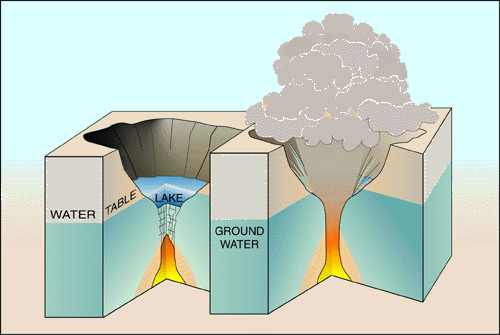
    The most common form is the one filling the caldera of a shut-off volcano. One of the largest lakes of this kind is the Crater Lake, from the crater of Mazama Mountain, Oregon, US. It formed 6,600 years ago, having 10 km (6.2 mi) in diameter, and a depth of 589 m (1.963 ft).
    source

    #3. Ox­bow Lake:

    source

    #4. Glacial Lake

    source

    A lake formed by melting of glacier is called a glacial lake. Most of the lakes in the Himalayan region are glacial lakes.

    #5. Lagoon

    When the lake is formed by spits and bars in coastal areas, it is called a lagoon. Chilika lake, Pulicat lake, Kolleru lake, etc. are examples of lagoon.

    #6. Artificial Lake