💥UPSC 2026, 2027, 2028 UAP Mentorship (March Batch) + Access XFactor Notes & Microthemes PDF

Search results for: “”

  • Constitutional Provisions relevant to Social Justice & Empowerment of Vulnerable sections

    Constitutional Provisions

    1. Article 23: Prohibition of traffic in human beings and forced labour.
    2. Article 24: Prohibition of employment of children in factories, etc.
    3. Article 37: Application of the principles contained in this Part (DPSP).
    4. Article 38: State to secure a social order for the promotion of welfare of the people.
    5. Article 39: Certain principles of policy to be followed by the State.
    6. Article 39A: Equal justice and free legal aid.
    7. Article 46: Promotion of Educational and Economic interests of Scheduled Castes, Scheduled Tribes and other weaker sections.

    Social Safeguards

    1. Article 17: Abolition of Untouchability.
    2. Article 25: Freedom of conscience and free profession, practice and propagation of religion.

    Political Safeguards

    1. Article 330: Reservation of seats for Scheduled Castes and Scheduled Tribes in the House of the People.
    2. Article 332: Reservation of seats for Scheduled Castes and Scheduled Tribes in the Legislative Assemblies of the States.
    3. Article 334: Reservation of seats and special representation to cease after sixty years.
    4. Article 243D: Reservation of seats (in Panchayats).
    5. Article 243T: Reservation of seats (in Municipalities).

    Agency for Monitoring Safeguards

    1. Article 338: National Commission for Scheduled Castes.
  • Jobless Growth in India: Reasons and Consequences

    Jobless Growth in India: Reasons and Consequences

    The Consequences of Jobless Growth in India

  • Unemployment in India: Causes and Consequences

    Unemployment in India: Causes

    Consequences of Unemployment.


  • Unemployment in India: Types, Causes and Measures

    Unemployment in India

    Back to Basics. What is Unemployment?

    Unemployment is a phenomenon that occurs when a person who is capable of working and is actively searching for the work is unable to find work.

    People who are either unfit for work due to physical reason or do not want to work are excluded from the category of unemployed.

    The most frequent measure of unemployment is unemployment rate. The unemployment rate is defined as a number of unemployed people divided by the number of people in the labour force.

    Labour Force: Persons who are either working (or employed) or seeking or available for work (or unemployed) during the reference period together constitute the labour force.

    Measure of Unemployment in India

    Usual Status Approach Weekly Status Approach Daily Status Approach
    Usual Status approach records only those persons as unemployed who had no gainful work for a major time during the 365 days preceding the date of survey and are seeking or are available for work.

    The status of activity on which a person has spent the relatively long time of the preceding 365 days prior to the date of survey is considered to be the usual principal activity status of the person.

    The weekly status approach records only those persons as unemployed who had no gainful work for a major time during the seven days preceding the date of survey. In the Daily status approach, current activity status of the person with regard to whether employed or unemployed or outside labour force is recorded for each day in the reference week. The measure adopts half day as a unit of measurement for estimating employment or unemployment.
    The Usual Status captures long-term unemployment in the economy. The weekly status approach captures both the long-term open chronic unemployment and the seasonal unemployment. The approach is most inclusive than the other two. Since it also captures the days of unemployment of those who are recorded as employed on the weekly status approach.
    The Usual Principal Activity status (UPS), written as Usual Status (PS), is determined using the majority time criterion and refers to the activity status on which h/she spent longer part of the year.

    Principal usual activity status is further used to classify him in/out the labour force.

    For instance, if an individual was ‘working’ and/or was ‘seeking or available for work’ for a major part of the year preceding the date of the survey then h/she is considered as being part of the ‘Labour Force’.

    For example, if an individual reports as having worked and sought/available for work for seven months during the year or having sought or available for work for seven months then h/she is classified as being in the Labour Force.

    A person is considered to be employed if he or she pursues any one or more of the gainful activities for at least one-hour on any day of the reference week. On the other hand, if a person does not pursue any gainful activity, but has been seeking or available for work, the person is considered as unemployed. A person who works for 4 hours or more but up to 8 hours on a day is recorded as employed for the full day.

    A person who works for 1 hour or more but less than 4 hours is recorded as employed for the half day.

    Accordingly, a person having no gainful work even for 1 hour in a day is described as unemployed for a full day.

    Types of Unemployment

    Frictional Unemployment Cyclical Unemployment
    The minimum amount of unemployment that prevails in an economy due to workers quitting their previous jobs and are searching for the new jobs is called Frictional Unemployment. Cyclical unemployment is due to deficiency or fall in effective demand from consumers which leads to fall in production and low demand for labour.

    Cyclical unemployment is a type of unemployment which is related to the cyclical trends of booms and recessions called as the business cycle.

    If an economy is doing good, cyclical unemployment will be at its lowest and will be the highest if the economy faces recession.

    The major reasons for frictional unemployment are lack of information about the availability of jobs and lack of mobility on the part of workers (it means workers are not willing to travel to a distant place or a new state for employment). The major reason for this type of unemployment is lack of demand in the economy and slowdown of economic activity.

    When the demand for goods and services is low, then the firms stop the production due to rise in the unsold stock. As a result of stopping production, the firms lay off workers and unemployment rises.

    Frictionally unemployed person remains unemployed for a very short period of time. This type of unemployment is for a long period of time and worker remains unemployed during the entire phase of slow down or recession.
    This type of unemployment is of voluntary nature. This type of unemployment is of involuntary nature.
    Voluntary Unemployment Involuntary Unemployment
    Voluntary unemployment refers to a situation where workers are either not seeking for work or are in transition from one job to another (quitting one job in search of another better job). Involuntary unemployment refers to a situation where workers are seeking work and are willing to work but are unable to get work.
    Voluntary unemployment remains in an economy during all the time. As there will always be some workers, who quit their previous jobs in search of new ones. Involuntary unemployment happens in an economy during the time of depression and fall in aggregate demand for goods and services.
    Structural Unemployment Seasonal Unemployment
    Structural unemployment refers to a situation which arises due to change in the structure of the economy. Example: An economy transforms itself from a Labour intensive economy to a Capital intensive economy.

    Structural unemployment usually occurs due to the mismatch of skills.

    Example, due to advance technological progress, the production of cars is done through robotic machines rather than traditional Machines. As a result, those workers who do know how to operate the new and advanced machines will be removed.

    The unemployment happened because the current workers do not have the required skills as wanted by their employers.

    Seasonal unemployment occurs during certain seasons of the year. In some industries and occupations like agriculture, holiday resorts etc., production activities take place only in some seasons.

    Therefore, they offer employment for only a certain period of time in a year.

    People engaged in such type of activities may remain unemployed during the off-season.

    Technological Advancement, Robotics, Artificial Intelligence, Mechanisation and Automation are the main causes of Structural unemployment. Seasonal unemployment mainly occurs in Agricultural sector, Tourism sector and in factories producing seasonal goods.

    Back to Basics: Disguised Unemployment

    • Disguised unemployment is a situation especially prevalent in poor and developing countries.
    • Disguised unemployment is when too many people are employed than what is required to produce efficiently. This kind of employment is not at all productive.
    • It is not productive in a sense that production does not suffer even if some of the employed people are withdrawn.
    • The key point to remember is that the marginal productivity of labourers under disguised unemployment is zero. The labourers are employed physically, but not economically.

    Example: In a piece of 5 Acres land, 5 family members are employed to grow 100 Kgs of rice. The maximum rice that can be grown on the land is 100 Kg only. Now, the family decides to employ additional two members of its family on the same land. In such a scenario, the additional two members will not contribute anything in production since maximum production has already been reached. The additional two members will only end up congesting the farm land. Hence, they both are disguisedly unemployed.

    Member 1 20 Kg

    Member 2 20 Kg

    Member 3 20 Kg

    Member 4 20 Kg

    Member 5 20 Kg

    Since maximum output of 100 Kg is already reached.

    Member 6 & 7 contribution will be 0 Kg.

    The situation of disguised unemployment is most prevalent in the agriculture sector of the underdeveloped countries. The key idea is that the amount of population in agriculture which can be removed from it without any change in the method of cultivation, without leading to any reduction in output.

    Back to Basics: Under Employment.

    Underemployment is the most dangerous kind of unemployment in an economy. Underemployment is a situation under which People with a higher level of skills are employed in less productive jobs. It simply means that the Labour force of the economy is not fully utilised as per their skills and experience.

    Example: an individual with an engineering or management degree working as a clerk or accountant in a firm or a social science graduate working as a pizza delivery boy.

    The consequence of Underemployment.


  • Constitutional Provisions for Socially & Educationally Backward Classes (OBCs), Safeguards relating to Educational & Public Employment

    The constitution does not describe the term backward classes.

    It is up to the centre and the states to postulate the classes that belong to this group. However, it is understood that classes that are not represented adequately in the services of the state can be termed, backward classes.

    Further, the President can, under Art. 340 constitute a commission to investigate the condition of socially and educationally backward classes. Based on this report, the president may specify the backward classes. Commission for Enquiring into Conditions of Backward Classes

    1. Article 340: Appointment of a Commission to investigate the conditions of backward classes.

    Safeguards relating to Educational & Public Employment

    1. Article 15: Prohibition of discrimination on grounds of religion, race, caste, sex or place of birth.
    2. Article 16: Equality of opportunity in matters of public employment.
    3. Art. 15 (4): “Nothing in this article or in article 29(2) shall prevent the state from making any provisions for the advancement of any socially and economically backward classes of citizens or for Scheduled Castes and Scheduled Tribes.” This clause started the era of reservations in India. You may please note that Art. 15(4) talks about backward classes and not backward castes thus caste is not the only criterion for backwardness and other criteria must also be considered.
    4. Art. 15 (5): This clause was added in 93rd amendment in 2005 and allows the state to make special provisions for backward classes or SCs or STs for admissions in private educational institutions, aided or unaided.
    5. Art. 16(4): This clause allows the state to reserve vacancies in public service for any backward classes of the state that are not adequately represented in the public services.
    6. Art. 16 (4A): This allows the state to implement reservation in the matter of promotion for SCs and STs.
    7. Art. 16(4B): This allows the state to consider unfilled vacancies reserved for backward classes as a separate class of vacancies not subject to a limit of 50% reservation.
  • Lawful Provisions for Women, Children and Aged in Constitution of India

    Constitutional Provisions for Women

    There are numerous legal provisions to enhance the status of women which is a more susceptible group in Indian society.

    1. Art. 15(3): It permits the state to make special provisions for women and children. Several acts such as Dowry Prevention Act have been passed including the most recent one of Protection of women from domestic violence Act 2005.
    2. Art. 23: Under the fundamental right against exploitation, flesh trade has been banned.
    3. Art. 39: Guarantees equal pay to women for equal work. In the case of Randhir Singh vs Union of India, SC held that the concept of equal pay for equal work is indeed a constitutional goal and is capable of being enforced through constitutional remedies under Art. 32.
    4. Art. 40: Provides 1/3 reservation in panchayat.
    5. Art. 42: Offers free pregnancy care and delivery.
    6. Art. 44: It compels the state to implement unchanging civil code, which will help progress the condition of women across all religions. It has, however, not been implemented due to politics.
    7. In the case of Sarla Mudgal vs the Union of India, SC has held that in the Indian Republic there is to be only one nation i.e. Indian nation and no community could claim to be a separate entity on the basis of religion. There is a plan to provide reservation to women in parliament as well.

    Constitutional Provisions for Children

    • Art. 19 A: Education up to 14 yrs has been made a fundamental right. Thus, the state is required to provide school education to children.

    In the case of Unni Krishnan vs the State of AP, SC held that right to education for children between 6 to 14 yrs of age is a fundamental right as it flows from Right to Life. After this decision, education was made a fundamental right explicitly through 86th amendment in 2002.

    • Art. 24: Children have a fundamental right against exploitation and it is prohibited to employ children below 14 yrs of age in factories and any hazardous processes.

    Recently the list of hazardous processes has been updated to include domestic, hotel, and restaurant work.

    Several PILs have been filed in the benefit of children. For example, in MC Mehta vs the State of TN, SC has held that children cannot be employed in match factories or which are directly connected with the process as it is hazardous for the children.

    In the case of Lakshmi Kant Pandey vs the Union of India, Justice Bhagvati has laid down guidelines for adoption of Indian children by foreigners.

    • Art. 45: Urges the state to provide early childhood care and education for children up to 6 yrs of age.

    Age and high levels of economic necessity and/or disability combine to create high levels of vulnerability to long-lasting poverty. While old age pension schemes are in place neither the small amounts made available nor the hassle of accessing them make this a solution to the problem of chronic poverty among the elderly.

    With the high occurrence of chronic ailments and health care needs of the elderly, declining family size, migration and breakdown of traditional family structures that provided support, this group of the population is awfully vulnerable to poverty.

    Constitutional Provisions for Aged

    In Constitution of India, entry 24 in list III of Schedule IV deals with the “Welfare of Labour, including conditions of work, provident funds, liability for workmen’s compensations, invalidity and Old age pension and maternity benefits.

    Further, Item No. 9 of the State List and Item No. 20, 23 and 24 of the Concurrent List relates to old age pension, social security and social insurance, and economic and social planning.

    Article 41 of the Directive Principle of the State Policy has particular relevance to Old Age Social Security. According to this Article, “the State shall, within the limits of its economic capacity and development, make effective provision for securing the right to work, to education and to public assistance in case of undeserved want.”

  • Income Inequality in India: Causes, Remedies and Consequences

    Analysis of Income Inequality in India

    • In the recent years, India has joined the club of most unequal countries.
    • Based on the new India Human Development Survey (IHDS), which provides data on income inequality for the first time, India scores a level of income equality lower than Russia, the United States, China and Brazil, and more egalitarian than only South Africa.
    • According to a report by the Johannesburg-based company New World Wealth, India is the second-most unequal country globally, with millionaires controlling 54% of its wealth.
    • In India, the richest 1% own 53% of the country’s wealth, according to the latest data from Credit Suisse.
    • The richest 5% own 68.6%, while the top 10% have 76.3%.
    • At the other end of the pyramid, the poorer half held a mere 4.1% of national wealth.
    • The Credit Suisse data shows that India’s richest 1% owned just 36.8% of the country’s wealth in 2000, while the share of the top 10% was 65.9%. Since then they have steadily increased their share of the pie. The share of the top 1% now exceeds 50%.
    • The most obvious conclusion to be drawn is that economic reforms have relatively benefited a tiny group at the top of the Indian income pyramid.
    • The increase in income inequality coincides with the sharp rise in Indian economic growth after 1980.
    • This points to the famous hypothesis put forth by Simon Kuznets—that inequality tends to rise during periods of rapid growth thanks to the uneven pace at which people move from low productivity to high productivity activities.
    • The big difference between India and China is in the fact that the middle 40% in India got 23% of the increase in national income since 1980 while the same group in China got 43%—a massive gap of 20 percentage points. This difference of 20 percentage points was largely captured by the top 1% in India.
    • The Indian top 1% has done extremely well, the Chinese middle has benefited far more than the Indian middle, and the bottom half in both countries has had broadly similar experiences.

    Causes of Income Inequality in India.

    How to reduce Inequalities

    Promotion of Labour Intensive Manufacturing: The failure to promote labour-intensive manufacturing like; Construction, Textile, Clothing, Footwear etc. is the single most reason of rising inequalities. The Labour-intensive manufacturing has the potential to absorb millions of people who are leaving farming.

    The proportion of the labour force in agriculture has come down, but the workers who have left farms have not got jobs in modern factories or offices. Most are stuck in tiny informal enterprises with abysmal productivity levels. If India could somehow reverse this trend and promote labour-intensive manufacturing than inequality could fall.

    More Inclusive Growth: The promotion and adoption of an Inclusive Growth Agenda is the only solution to rising inequality problem. Economic growth which is not inclusive will only exacerbate inequality.

    Skill Development: The development of advanced skills among the youth is a prerequisite if India wants to make use of its demographic dividend. The skilling of youth by increasing investment in education is the only way we can reduce inequality. India needs to become a Skill-led economy.

    Progressive Taxation: Higher taxes on the Rich and the luxuries will help reduce income inequalities.

    Equal Opportunity for all: The Government may devise and set up some sort of machinery which may provide equal opportunities to all rich and poor in getting employment or getting a start in trade and industry. In other words, something may be done to eliminate the family influence in the matter of choice of a profession. For example, the government may institute a system of liberal stipends and scholarships, so that even the poorest in the land can acquire the highest education and technical skill.

    Consequences of Inequality


    By
    Himanshu Arora
    Doctoral Scholar in Economics & Senior Research Fellow, CDS, Jawaharlal Nehru University

  • Inequality in India: Definition and Measures; Lorenz Curve, Gini Coefficient, Income held by Top 10%

    Inequality in India

    Back to Basics: Income Inequality

    Income inequality is the unequal distribution of household or individual income across the various participants in an economy. Income inequality is often presented as the percentage of income to a percentage of the population.
    The simplest way to understand inequality is by analysing the population by dividing it into quintiles (fifth) from poorest to richest and reporting the proportions of income held by them.

    Example: if the bottom 20% of the population held 20% of the economy’s income and the top 20% held 20% of the economy’s income, then we can call the society highly equal. But it is hardly the case, as the bottom 20% of the population hardly owns more than 3% of the total wealth of the economy.

    How to Measure Income Inequality.

    Gini Coefficient
    Gini is the most popular measure of income inequality. The Gini coefficient is derived from the Lorenz Curve.

    Note for Students: Lorenz Curve

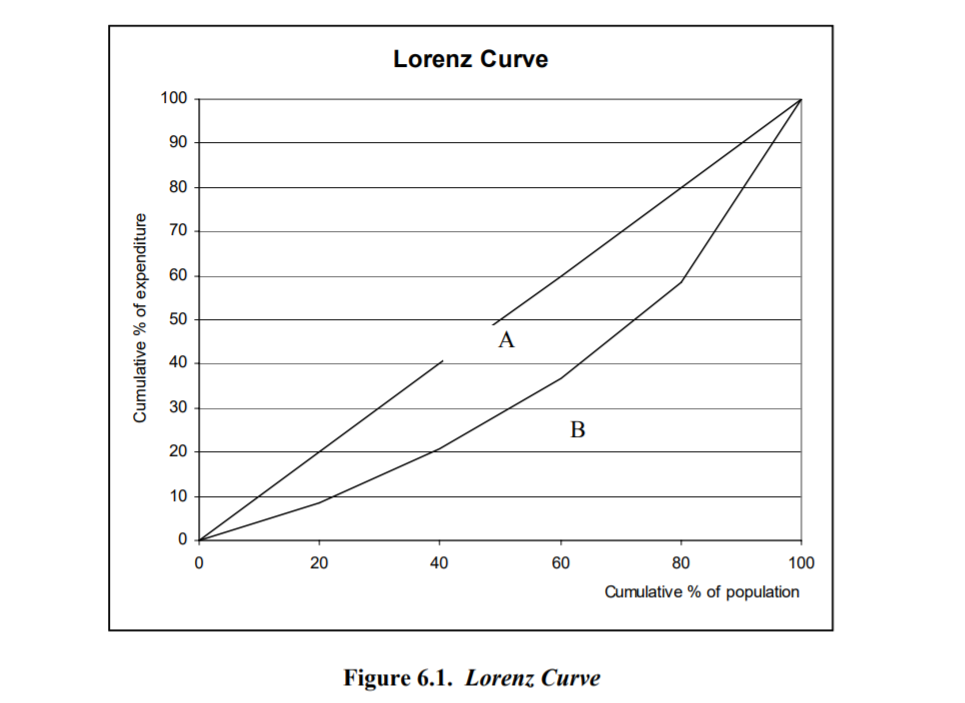
    • The Lorenz curve shows the percentage of total income earned by cumulative percentage of the population.
    • In a perfectly equal society, the “poorest” 25% of the population would earn 25% of the total income, the “poorest” 50% of the population would earn 50% of the total income and the Lorenz curve would follow the path of the 45° line of equality.
    • As inequality increases, the Lorenz curve deviates from the line of equality; the “poorest” 25% of the population may earn 10% of the total income; the “poorest” 50% of the population may earn 20% of the total income and so on.

    To construct the Gini coefficient, graph the cumulative percentage of households (from poor to rich) on the horizontal axis and the cumulative percentage of expenditure (or income) on the vertical axis.

    The Lorenz curve is shown in the figure. The diagonal line represents perfect equality.

    The Gini coefficient is defined as A/(A+B), where A and B are the areas shown on the graph. If A=0 the Gini coefficient becomes 0 which means perfect equality, whereas if B=0 the Gini coefficient becomes 1 which means complete inequality. In this example, the Gini coefficient is about 0.35.
    Income Inequality: A Comparison
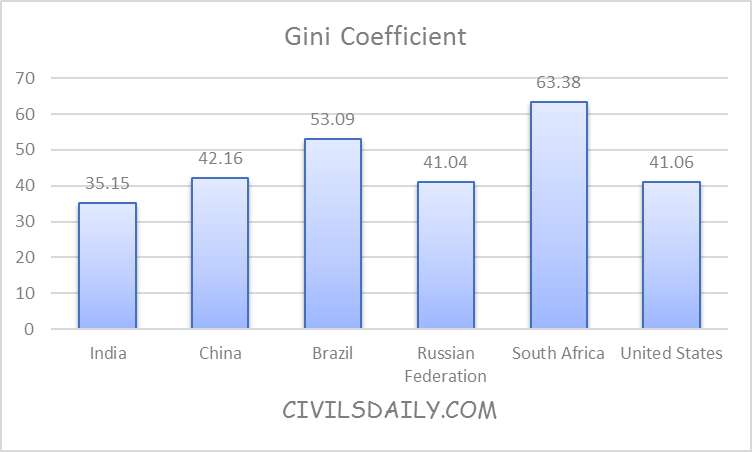
    Source: World Bank, 2011.

    The above graph represents the Gini Coefficient of the selected Countries for the year 2011.

    The Gini index of 0 represents the perfect equality, whereas the Gini index of 100 represents perfect inequality.

    India has one of the lowest inequality among the BRICS Countries with Gini Index of 35.15.

    Income Inequality: Percentage of Income held by top 10% of the Population
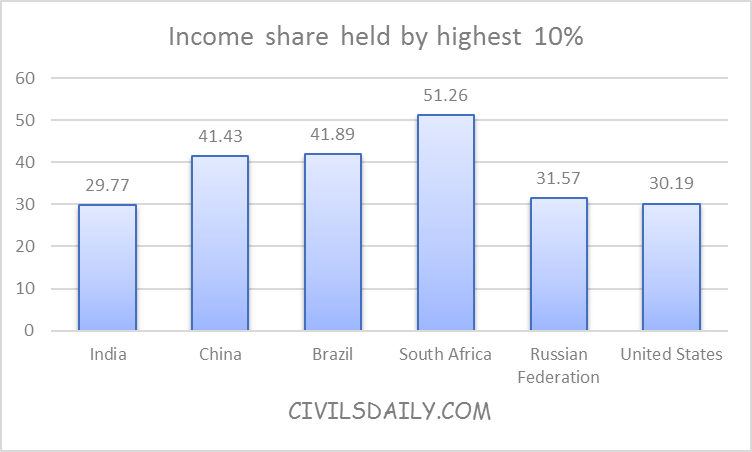
    Source: World Bank, 2011

    The graph represents the percentage of the income held by the top 10% of the population in the selected countries.

    The percentage of the income held by the top 10% in India is close to 30 percent.

    Income Inequality: Percentage of Income held by the poorest 10% of the population.

    The graph below represents the percentage of the income held by the poorest 10% of the population in the selected countries.

    The percentage of the income held by the poorest 10% in India is close to 3 percent.
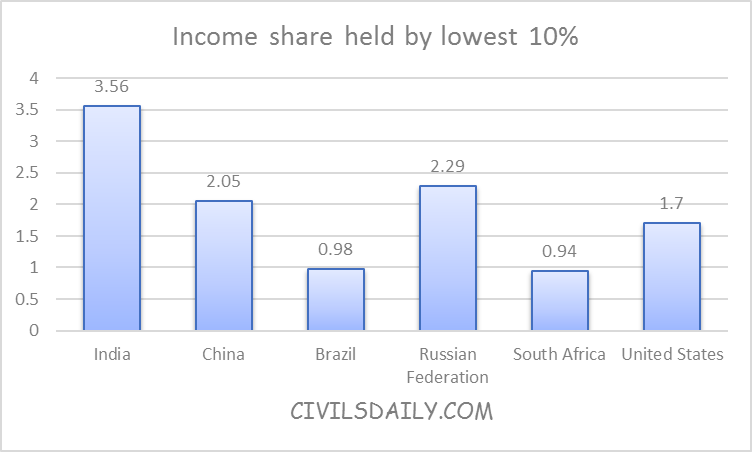
    Source: World Bank, 2011

    The Common measures of Inequality
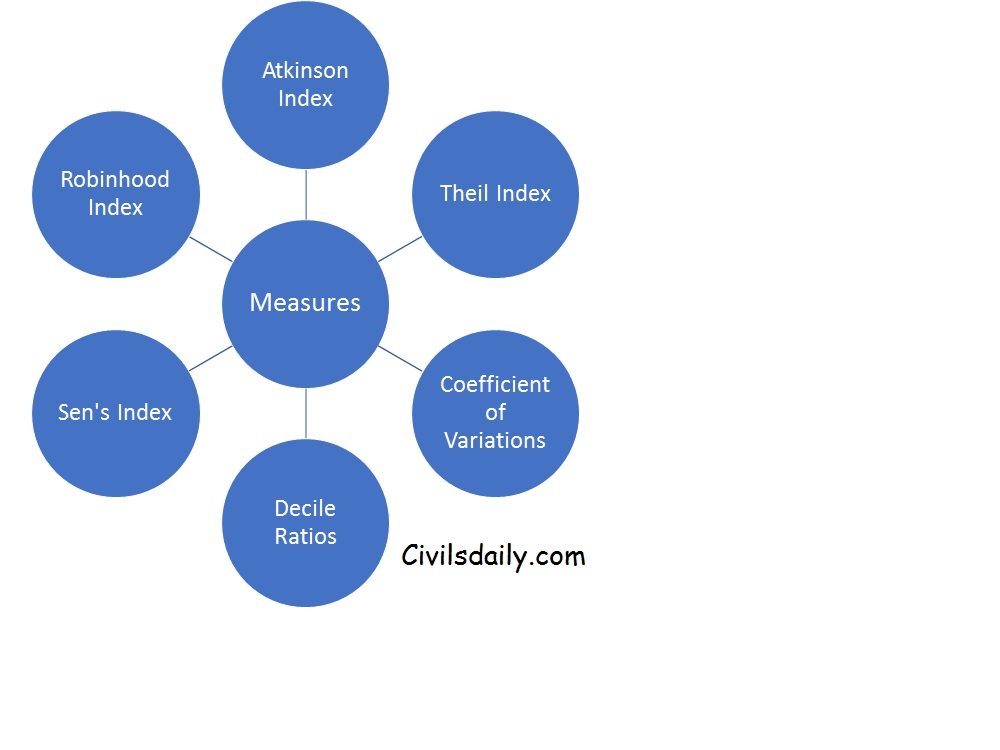
     

    By
    Himanshu Arora
    Doctoral Scholar in Economics & Senior Research Fellow, CDS, Jawaharlal Nehru University


  • Laws for the development and betterment of vulnerable sections

    Laws about vulnerable sections can be seen in two dimensions:

    1. Constitutional
    2. Statutory

    There are certain constitutional provisions which cover all vulnerable sections (common to all).

    Also, there are provisions which deal only with specific sections.

    Constitutional Provisions for the vulnerable section of SC/ST/OBC and minorities

    1. Art. 15(4): Clause 4 of article 15 is the fountainhead of all provisions regarding compensatory discrimination for SCs/STs. This clause was added in the first amendment to the constitution in 1951 after the SC judgment in the case of Champakam Dorairajan vs State of Madras.

    It states thus, “Nothing in this article or in article 29(2) shall prevent the state from making any provisions for the advancement of any socially and economically backward classes of citizens or for Scheduled Castes and Scheduled Tribes.” This clause started the era of reservations in India.

    In the case of Balaji vs State of Mysore, the SC held that reservation cannot be more than 50%. Further, Art. 15(4) talks about backward classes and not backward castes thus caste is not the only criterion for backwardness and other criteria must also be considered.

    Finally, in the case of Indra Sawhney vs the Union of India, SC upheld the decision given under Balaji vs State of Mysore that reservation should not exceed 50% except only in special circumstances. It further held that it is valid to sub-categorize the reservation between backward and more backward classes. However, total should still not exceed 50%. It also held that the carry forward rule is valid as long as reservation does not exceed 50%.

    More constitutional provisions

    1. Art. 15 (5): This clause was added in 93rd amendment in 2005 and allows the state to make special provisions for backward classes or SCs or STs for admissions in private educational institutions, aided or unaided.
    2. Art. 16(4): This clause allows the state to reserve vacancies in public service for any backward classes of the state that are not adequately represented in the public services.
    3. Art. 16 (4A): This allows the state to implement reservation in the matter of promotion for SCs and STs.
    4. Art. 16(4B): This allows the state to consider unfilled vacancies reserved for backward classes as a separate class of vacancies not subject to a limit of 50% reservation.
    5. Art. 17: This eradicates untouchability and its practice in any form. Although the term untouchability has not been demarcated in the constitution or in any act but its meaning is to be understood not in a literal sense but in the context of Indian society.

    Due to the varna system, some people were relegated to do menial jobs such as cleaning toilets. Such people were not to be touched and it was considered a sin to even touch their shadow. They were not even allowed to enter public places such as temples and shops.

    The constitution struggles to remove this abhorring practice by not only making the provision a fundamental right but also allows punishment to whoever practices or abets it in any form.

    Towards this end, Protection of Civil Rights Act 1955 was enacted. It has implemented several measures to eradicate this evil from the society. It stipulates up to 6 months imprisonment or Rs.500 fine or both. It impresses upon the public servant to investigate fully any complaint in this matter and failing to do so will amount to abetting this crime.

    In the case of State of Kar. vs Appa Balu Ingle, SC upheld the conviction for preventing a lower caste person from filling water from a bore well.

    In Asiad Projects Workers case, SC has held that right under Art 17 is available against private individuals as well and it is the duty of the state to ensure that this right is not violated.

    1. Art. 19(5): It allows the state to impose restriction on freedom of movement or of residence in the benefit of Scheduled Tribes.
    2. Art. 40: Provides reservation in 1/3 seats in Panchayats to SC/ST.
    3. Art. 46: Enjoins the states to promote with care the educational and economic interests of the weaker sections, especially SC and STs.
    4. Art. 164: Appoint special minister for tribal welfare in the states of MP, Bihar, and Orrisa.
    5. Art. 275: Allows special grant in aids to states for tribal welfare.
    6. Art. 330/332: Allows reservation of seats for SC/ST in the parliament as well as in state legislatures.
    7. Art. 335: Allows relaxation in qualifying marks for admission in educational institutes or promotions for SCs/STs.

    In the case of State of MP vs Nivedita Jain, SC held that complete relaxation of qualifying marks for SCs/STs in Pre-Medical Examinations for admission to medical colleges is valid.

    1. Art. 338/338A/339: Establishes a National Commission of SCs and STs. Art. 339 allows the central govt. to direct states to implement and execute plans for the betterment of SC/STs.
    2. Art. 340: Permits the president to appoint a commission to investigate the condition of socially and economically backward classes and table the report in the parliament.

More posts
