💥UPSC 2026, 2027, 2028 UAP Mentorship (March Batch) + Access XFactor Notes & Microthemes PDF

Search results for: “”

  • Central Bank Digital Currency (CBDC): the Digital Rupee

    Reports have said the Reserve Bank of India’s (RBI) digital rupee — the Central Bank Digital Currency (CBDC) — may be introduced in phases beginning with wholesale businesses in the current financial year.

    What is Central Bank Digital Currency (CBDC)?

    • CBDC is a central bank issued digital currency which is backed by some kind of assets in the form of either gold, currency reserves, bonds and other assets, recognised by the central banks as a monetary asset.
    • The present concept of CBDCs was directly inspired by Bitcoin, but a CBDC is different from virtual currency and cryptocurrency.
    • Cryptocurrencies are not issued by a state and lack the legal tender status declared by the government.

    What is Currency chest?

    Currency in India is managed by Currency chest. Currency chest is a place where the Reserve Bank of India (RBI) stocks the money meant for banks and ATMs. These chests are usually situated on the premises of different banks but administrated by the RBI.

    Why India needs a digital rupee?

    • Online transactions: India is a leader in digital payments, but cash remains dominant for small-value transactions.
    • High currency in circulation: India has a fairly high currency-to-GDP ratio.
    • Cost of currency management: An official digital currency would reduce the cost of currency management while enabling real-time payments without any inter-bank settlement.

    Why is CBDC preferred over Cryptocurrency?

    • Sovereign guarantee: Cryptocurrencies pose risks to consumers.  They do not have any sovereign guarantee and hence are not legal tender.
    • Market volatility: Their speculative nature also makes them highly volatile.  For instance, the value of Bitcoin fell from USD 20,000 in December 2017 to USD 3,800 in November 2018.
    • Risk in security: A user loses access to their cryptocurrency if they lose their private key (unlike traditional digital banking accounts, this password cannot be reset).
    • Malware threats: In some cases, these private keys are stored by technical service providers (cryptocurrency exchanges or wallets), which are prone to malware or hacking.
    • Money laundering: Cryptocurrencies are more vulnerable to criminal activity and money laundering.  They provide greater anonymity than other payment methods since the public keys engaging in a transaction cannot be directly linked to an individual.
    • Regulatory bypass: A central bank cannot regulate the supply of cryptocurrencies in the economy.  This could pose a risk to the financial stability of the country if their use becomes widespread.
    • Power consumption: Since validating transactions is energy-intensive, it may have adverse consequences for the country’s energy security (the total electricity use of bitcoin mining, in 2018, was equivalent to that of mid-sized economies such as Switzerland).

    Features of CBDC

    • High-security instrument: CBDC is a high-security digital instrument; like paper banknotes, it is a means of payment, a unit of account, and a store of value.
    • Uniquely identifiable: And like paper currency, each unit is uniquely identifiable to prevent counterfeit.
    • Liability of central bank: It is a liability of the central bank just as physical currency is.
    • Transferability: It’s a digital bearer instrument that can be stored, transferred, and transmitted by all kinds of digital payment systems and services.

    Key benefits offered

    • Faster system: CBDC can definitely increase the transmission of money from central banks to commercial banks and end customers much faster than the present system.
    • Financial inclusion: Specific use cases, like financial inclusion, can also be covered by CBDC that can benefit millions of citizens who need money and are currently unbanked or banked with limited banking services
    • Monetary policy facilitation: The move to bring out a CBDC could significantly improve monetary policy development in India.
    • Making of a regional currency: In the cross border payments domain, India can take a lead by leveraging digital Rupee especially in countries such as Bhutan, Saudia Arabia and Singapore where NPCI has existing arrangements.

    Others:

    • It is efficient than printing notes (cost of printing, transporting, and storing paper currency)
    • It reduces the risk of transactions
    • It makes tax collection transparent
    • Prevents money laundering

    Issues involved with CBDC

    • Innovation with centralization: The approach of bringing a sovereign digital currency stands in stark contrast to the idea of decentralization.
    • Liability on RBI:  when bank customers wish to convert their deposits into digital rupee, the RBI will have to take these liabilities from the books of banks and onto its own balance sheet.
    • Inflationary risk: Central banks would indulge in issuing more digital currencies which could potentially trigger higher inflation.
    • User adoption: User adoption could also pose a major setback for the smooth roll out of the CBDC in India. The main challenges would always be user adoption and security.
    • Reduced savings: Many, including various central bankers, fear that people may begin withdrawing money from their bank accounts as digital currencies issued by Central banks become more popular.
    • Volatility: the risk is higher and there is more price volatility and lesser acceptance as a money instrument globally, unless the trust factor and investor protection factors change.

    Way forward

    • The launch of CBDCs may not be a smooth affair and still requires more clarity in India. There are still a lot of misconceptions about the concept of digital currency in the country.
    • The effectiveness of CBDCs will depend on aspects such as privacy design and programmability.
    • There is a huge opportunity for India to take a lead globally via a large-scale rollout and adoption of digital currencies.


    UPSC 2023 countdown has begun! Get your personal guidance plan now! (Click here)

  • What are Cloudbursts? Why are they rising across India?

    Over 20 people have been killed in destruction caused by cloudbursts and flash floods in different parts of Himachal Pradesh and Uttarakhand over the last three days.

    What are Cloudbursts?

    • A cloudburst is a localised but intense rainfall activity.
    • Short spells of very heavy rainfall over a small geographical area can cause widespread destruction, especially in hilly regions where this phenomenon is the most common.
    • Not all instances of very heavy rainfall, however, are cloudbursts.
    • A cloudburst has a very specific definition: Rainfall of 10 cm or more in an hour over a roughly 10 km x 10-km area is classified as a cloudburst event.
    • By this definition, 5 cm of rainfall in a half-hour period over the same area would also be categorized as a cloudburst.

    How is it different from normal rainfall?

    • To put this in perspective, in a normal year, India, as a whole, receives about 116 cm of rainfall over the entire year.
    • This means if the entire rainfall everywhere in India during a year was spread evenly over its area, the total accumulated water would be 116 cm high.
    • There are, of course, huge geographical variations in rainfall within the country, and some areas receive over 10 times more than that amount in a year.
    • But on average, any place in India can be expected to receive about 116 cm of rain in a year.
    • During a cloudburst event, a place receives about 10% of this annual rainfall within an hour.

    How common are cloudbursts?

    • Cloudbursts are not uncommon events, particularly during the monsoon months.
    • Most of these happen in the Himalayan states where the local topology, wind systems, and temperature gradients between the lower and upper atmosphere facilitate the occurrence of such events.
    • However, not every event that is described as a cloudburst is actually, by definition, a cloudburst.
    • That is because these events are highly localized.
    • They take place in very small areas which are often devoid of rainfall measuring instruments.

    Why are they so destructive?

    • The consequences of these events, however, are not confined to small areas.
    • Because of the nature of terrain, the heavy rainfall events often trigger landslides and flash floods, causing extensive destruction downstream.
    • This is the reason why every sudden downpour that leads to destruction of life and property in the hilly areas gets described as a “cloudburst”, irrespective of whether the amount of rainfall meets the defining criteria.
    • At the same time, it is also possible that actual cloudburst events in remote locations aren’t recorded.

    Can cloudbursts be forecasted?

    • The India Meteorological Department forecasts rainfall events well in advance, but it does not predict the quantum of rainfall — in fact, no meteorological agency does.
    • The forecasts can be about light, heavy, or very heavy rainfall, but weather scientists do not have the capability to predict exactly how much rain is likely to fall at any given place.
    • Additionally, the forecasts are for a relatively large geographical area, usually a region, a state, a meteorological sub-division, or at best a district.
    • As they zoom in over smaller areas, the forecasts get more and more uncertain.
    • Theoretically, it is not impossible to forecast rainfall over a very small area as well, but it requires a very dense network of weather instruments and computing capabilities that seem unfeasible with current technologies.
    • As a result, specific cloudburst events cannot be forecast. No forecast ever mentions a possibility of a cloudburst.
    • But there are warnings for heavy to very heavy rainfall events, and these are routinely forecast four to five days in advance.
    • Possibility of extremely heavy rainfall, which could result in cloudburst kind of situations, are forecast six to 12 hours in advance.

    Are cloudburst incidents increasing?

    • There is no long-term trend that suggests that cloudbursts, as defined by the IMD, are rising.
    • What is well established, however, is that incidents of extreme rainfall, as also other extreme weather events, are increasing — not just in India but across the world.
    • While the overall amount of rainfall in India has not changed substantially, an increasing proportion of rainfall is happening in a short span of time.
    • That means that the wet spells are very wet, and are interspersed with prolonged dry spells even in the rainy season.
    • This kind of pattern, attributed to climate change, does suggest that cloudburst events might also be on the rise.


    UPSC 2023 countdown has begun! Get your personal guidance plan now! (Click here)
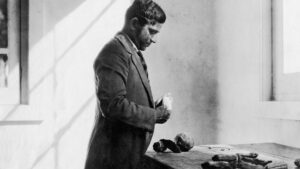
  • Pandurang Khankhoje: Ghadarite revolutionary and a hero of Mexico

    Lok Sabha Speaker, who is currently in Canada for the 65th Commonwealth Parliamentary Conference, will travel to Mexico where he will unveil statues of Swami Vivekananda and Maharashtra-born freedom fighter and agriculturalist Pandurang Khankhoje.

    Who was Pandurang Khankhoje (1883-1967)?

    • Born in Wardha, Maharashtra, in the late 19th century, Pandurang Khankhoje came in contact with other revolutionaries early on.
    • As a student, Khankhoje was an ardent admirer of the French Revolution and of the American War of Independence.
    • Closer to home, the Hindu reformer Swami Dayanand and his Arya Samaj movement, which called for a spirit of reform and social change, became the hero to a young student group led by Khankhoje.

    Revolutionary activities abroad

    • Khankhoje decided to go abroad for further training in revolutionary methods and militaristic strategy.
    • At this time, the British government’s suspicions of him were also growing due to his anti-government activities.
    • Before leaving, he visited Bal Gangadhar Tilak, by whom he was inspired.
    • Tilak advised him to go to Japan, which was itself a strong, anti-West Asian imperialistic force then.
    • After spending time with nationalists from Japan and China, Khankhoje eventually moved to the US, where he enrolled in college as a student of agriculture.

    Participation in the Indian independence movement

    • Khankhoje was one of the founding members of the Ghadar Party, established by Indians living abroad in 1914, mostly belonging to Punjab.
    • Its aim was to lead a revolutionary fight against the British in India.
    • While in the US, Khankhoje met Lala Har Dayal, an Indian intellectual teaching at Stanford University.
    • Har Dayal had begun a propaganda campaign, publishing a newspaper that featured patriotic songs and articles in the vernacular languages of India.
    • This was the seed from which the Ghadar Party would emerge.

    How did Khankhoje reach Mexico?

    • At the military academy, Khankhoje met many people from Mexico.
    • The Mexican Revolution of 1910 had led to the overthrow of the dictatorial regime, and this inspired Khankhoje.
    • He also reached out to Indians working on farms in the US with the aim of discussing the idea of Indian independence with them.
    • Along with the Indian workers, militant action was planned by Khankhoje in India, but the outbreak of the First World War halted these plans.
    • He then reached out to Bhikaji Cama in Paris, and met with Vladimir Lenin in Russia among other leaders, seeking support for the Indian cause.

    Association with Mexico

    • As he was facing possible deportation from Europe and could not go to India, he sought shelter in Mexico.
    • Soon, in part due to his prior friendship with Mexican revolutionaries, he was appointed a professor at the National School of Agriculture in Chapingo, near Mexico City.
    • He researched corn, wheat, pulses and rubber, developing frost and drought-resistant varieties, and was part of efforts to bring in the Green Revolution in Mexico.
    • Later on, the American agronomist Dr Norman Borlaug, called the Father of the Green Revolution in India, brought the Mexican wheat variety to Punjab.
    • Khankhoje was revered as an agricultural scientist in Mexico.

    Return to India

    • Both Pandurang and Jean returned to India after 1947.
    • His application for visa was initially rejected by the Indian government due to the ban by the British Indian Government, but was eventually overturned.
    • He settled in Nagpur and subsequently embarked on a political career.
    • Pandurang Khankhoje died on 22 January 1967.

    Back2Basics: Ghadar Party

    Founder: Sohan Singh Bhakna, 15 July 1913

    • The Ghadar Movement was an early 20th century, international political movement founded by expatriate Indians to overthrow British rule in India.
    • Earlier activists had established a ‘Swadesh Sevak Home’ in Vancouver and a ‘United India House’ in Seattle to carry out revolutionary activities. Finally, in 1913, the Ghadr was founded.
    • The Ghadar Party, originally known as the Pacific Coast Hindustan Association, was founded on July 15, 1913 in the US by Lala Har Dayal, Sant Baba Wasakha Singh Dadehar, Baba Jawala Singh, Santokh Singh, and Sohan Singh Bhakna.
    • The Ghadar party drew a sizable following among Indian expatriates in the United States, Canada, East Africa, and Asia.
    • It fought against colonialism from 1914 to 1917, with the support of Imperial Germany and the Ottoman Empire, both of which were Central Powers opposed to the British.
    • The party was organized around the weekly newspaper The Ghadar, which featured the masthead caption: Angrezi Raj Ka Dushman (an enemy of British rule); “Wanted brave soldiers to stir up rebellion in India,” the Ghadar declared.


  • Tribute to women freedom fighters

    Context

    • Prime Minister Narendra Modi’s Independence Day speech underlined the role of women veeranganas in our freedom movement. The initiative highlighting the brave women of our freedom struggle, under the broader celebration of Azadi Ka Amrit Mahotsav, will mark a turning point in Indian feminist history writing from an Indic perspective.

    What veerangana means?

    • Veerangana means a brave female, someone who can fight for their rights. A strong woman not only protects herself, but protects others too.

    Veerangana’s in freedom struggle

    Rani Laxmibai

    • The queen of the princely state of Jhansi, Rani Laxmibai is known for her role in the First War of India’s Independence in 1857.
    • Refusing to cede her territory, the queen decided to rule on behalf of the heir, and later joined the uprising against the British in 1857.
    • Cornered by the British, she escaped from Jhansi fort. She was wounded in combat near Gwalior’s Phool Bagh, where she later died.
    • Sir Hugh Rose, who was commanding the British army, is known to have described her as “personable, clever…and one of the most dangerous Indian leaders”.

    Jhalkari Bai

    • A soldier in Rani Laxmibai’s women’s army, Durga Dal, she rose to become one of the queen’s most trusted advisers.
    • She is known for putting her own life at risk to keep the queen out of harm’s way.
    • Till date, the story of her valour is recalled by the people of Bundelkhand, and she is often presented as a representative of Bundeli identity.

    Durga Bhabhi

    • Durgawati Devi, who was popularly known as Durga Bhabhi, was a revolutionary who joined the armed struggle against colonial rule.
    • A member of the Naujawan Bharat Sabha, she helped Bhagat Singh escape in disguise from Lahore after the 1928 killing of British police officer John P Saunders.
    • Later, as revenge for the hanging of Bhagat Singh, Rajguru, and Sukhdev, she made an unsuccessful attempt to kill the former Punjab Governor, Lord Hailey.

    Rani Gaidinliu

    • Born in 1915 in present-day Manipur, Rani Gaidinliu was a Naga spiritual and political leader who fought the British.
    • She joined the Heraka religious movement which later became a movement to drive out the British. She rebelled against the Empire, and refused to pay taxes, asking people to do the same.
    • The British launched a manhunt, but she evaded arrest, moving from village to village.
    • Gaidinliu was finally arrested in 1932 when she was just 16, and later sentenced for life. She was released in 1947.
    • Then PM Nehru described Gaidinliu as the “daughter of the hills”, and gave her the title of ‘Rani’ for her courage.

    Rani Chennamma

    • The queen of Kittur, Rani Chennamma, was among the first rulers to lead an armed rebellion against British rule.
    • Kittur was a princely state in present-day Karnataka.
    • She fought back against the attempt to control her dominion in 1824 after the death of her young son. She had lost her husband, Raja Mallasarja, in 1816.
    • She is seen among the few rulers of the time who understood the colonial designs of the British.
    • Rani Chennamma defeated the British in her first revolt, but was captured and imprisoned during the second assault by the East India Company.

    Begum Hazrat Mahal

    • After her husband, Nawab of Awadh Wajid Ali Shah, was exiled after the 1857 revolt, Begum Hazrat Mahal, along with her supporters, took on the British and wrested control of Lucknow.
    • She was forced into a retreat after the colonial rulers recaptured the area.

    Velu Nachiyar

    • Many years before the revolt of 1857, Velu Nachiyar waged a war against the British and emerged victorious. Born in Ramanathapuram in 1780, she was married to the king of Sivagangai.
    • After her husband was killed in battle with the East India Company, she entered the conflict, and won with support of neighbouring kings.
    • She went on to produce the first human bomb as well as establish the first army of trained women soldiers in the late 1700s.
    • Her army commander Kuyili is believed to have set herself ablaze and walked into a British ammunition dump.
    • She was succeeded by her daughter in 1790, and died a few years later in 1796.

    Conclusion

    • The veeranganas are a potent symbol of nationalism and patriotism. They can overturn oppressive attitudes towards women in society. Their role and celebration in popular culture also refutes the colonial allegations about the suppression of women throughout Indian history. But it is essential to discover, rewrite and reinterpret the role and representation of these heroic women in the liberation of the motherland.


    Mains question

    Q. The veerangana’s are a potent symbol of nationalism and patriotism. They can overturn oppressive attitudes towards women in society. Discuss examples of them showing how they inspire women’s today.


    UPSC 2023 countdown has begun! Get your personal guidance plan now! (Click here)


  • How to cover NCERT books for UPSC IAS 2023-24 and which 12-15 NCERTs you must not ignore? Also, learn how to make NCERT notes that helped IRPS, Prabhat gets a UPSC Rank, twice.

    How to cover NCERT books for UPSC IAS 2023-24 and which 12-15 NCERTs you must not ignore? Also, learn how to make NCERT notes that helped IRPS, Prabhat gets a UPSC Rank, twice.

    The Masterclass was rescheduled to 23rd August 2022, Tuesday as | Free Live Masterclass With Prabhat Sir, IRPS

    Prabhat sir got stuck in Uttarakhand due to landslide and cloudburst and will be taking the session today. 23rd August 2022 at 7 pm

    Can we avoid NCERT for UPSC?

    What would be the severe mistake? The answer is ‘ To skip NCERTs. If you love UPSC, first learn to love NCERTs. 

    NCERTs are essential and the best place to begin your UPSC preparation. They form a fundamental foundation and can help you understand basic and critical concepts more quickly. But, Are all NCERTs to be read? Finding reliable sources for this information can be extremely difficult.

    IRPS, Prabhat Singh will be taking a Masterclass on NCERTs

    Alert! Reading NCERTs alone is not enough for success, You can grab your success in the IAS exam, only if know how to read NCERTs, which 12-15 are exact we need to read and what is the exact process to make notes

    If you have to command over UPSC exams you hold command over NCERT books. These books are the weakest point of UPSC, it must be your strong point. So, to know which NCERTs are a must & which are not, follow this topper’s footprint.


    Masterclass Details: 23rd August 2022 (Monday) At 7 PM

    Grasp the opportunity to get outstanding tips on ‘what are the best strategies to choose NCERTs ’, and ‘how to read & what to read And how to make notes.


    Strategies & Approaches, in This Free Live Webinar by Prabhat Sir!

    1. Best, minimum NCERT materials for UPSC-CSE Preparation. Do’s & Don’t, Understanding the science behind how society works is important, so what are the best 3 to 5 NCERTs to read? Don’t forget NCERTs are even going to help you in your optional too.
    1. For a foundational preparation for prelims and mains, students can start with NCERT history books, to begin with, their history preparation. What are those books that have proven to be highly beneficial in the case of students that come from commerce or science backgrounds?
    1. It is critical to understand Indian and global geography. Maps and information about different climatic regions provided in NCERT Geography books help answer many questions about geography. How to learn & what maps/diagrams/footnotes are not to be ignored will also be discussed.
    2. Political Science covers the country’s legal and fundamental aspects, which makes it an extremely important subject. How to & what to cover from NCERTs so that ‘Laxmikant’ becomes easier to read and revise.
    3. The subject of the Indian Economy covers India’s current and past economic aspects, which makes it an important topic. Knowing its fundamentals is crucial for UPSC exams. So, What is to be learned by heart & which NCERTs are fit for the economy will be comprehensively discussed.
    1. What is the difference between ‘The Old Version NCERTs’ & ‘The New Version NCERTs’ & for which subjects, which versions of NCERTs you should focus on,  will also be discussed thoroughly in this ask me anything session? 
    2.  The untold secret of ‘how & from where UPSC asks direct questions from NCERTs. How to build command over NCERTs is going to be another crucial point of this awesome session.

    What The Hindu mentioned about Civilsdaily Mentorship

  • ‘Kerala Savari’: India’s first online taxi service as a public option

    Kerala has soft launched ‘Kerala Savari’, the country’s first online taxi service owned by a State government, to ensure fair and decent service to passengers along with fair remuneration to auto-taxi workers.

    What is Kerala Savari?

    • Operated by the Motor Workers Welfare Board under the aegis of the Labour Department, the Kerala Savari ensures safe travel for the public at ‘government approved fares’ without any ‘surge pricing’.
    • The ‘Kerala Savari’ app would be made available to the public on online platforms shortly as it is under the scrutiny of Google now.

    Why such initiative?

    • The alleged unfair trade practices and violation of consumer rights by private app-based cab aggregators have come as a major concern for governments.
    • Recently, the Central Consumer Protection Authority (CCPA) had issued notices to cab aggregators Ola and Uber for unfair trade practices and violation of consumer rights which include:
    1. Charging exorbitant fares during peak hours
    2. Unprofessional behaviour from the part of drivers
    3. Lack of proper response from customer support, and
    4. Undue levy of cancellation charges despite the cab driver refusing to accept the ride booked by the passenger etc.
    • It is against this backdrop that the Kerala government has decided to come up with an app-based platform to offer auto-taxi service for the public.

    What are the main attractions of ‘Kerala Savari’?

    • There will be no fluctuation in fares on Kerala Savari irrespective of day or night or rain.
    • But Kerala Savari only 8% service charge in addition to the rate set by the government, whereas the private cab aggregators charge up to 20 to 30% service charge.

    What are the security-related features of ‘Kerala Savari’?

    • Kerala Savari is claimed as a safe and reliable online service for women, children, and senior citizens.
    • This consideration has been given importance in app designing and driver registration.
    • A police clearance certificate is mandatory for drivers joining the scheme apart from the required proper training.
    • A panic button system has been introduced in the app.
    • It has also been decided to install GPS in vehicles at a subsidised rate.

    Will the new government initiative end the monopoly of private cab aggregators?

    • Kerala has over five lakh autorickshaws and one lakh cabs.
    • The State government plans to bring all auto-taxi workers engaged in the sector under the new platform.
    • Since smartphone literacy is high in Kerala, the State is hopeful of bringing them under the scheme in a short span of time.
    • In addition, the Kerala government has also decided to provide fuel, insurance, and tyre subsidies for vehicle owners in the future and has already initiated talks with major companies in this regard.
    • After the evaluation of the first phase of the project in Thiruvananthapuram, it will be extended to the entire State in a phased manner.
    • Kerala Savari is expected to reach Kollam, Ernakulam, Thrissur, Kozhikode, and Kannur municipal limits within a month.
    Regulation of Cab Aggregators in India

    • The Motor Vehicles Amendment Act 2019 seeks to regulate Cab aggregators in India
    • It’s the first time cab aggregators have got statutory recognition as “digital intermediaries” or “transport aggregators”.
    • They are now defined as marketplaces that can be used by passengers to connect with a driver for moving from one place to another.
    • The Centre will issue broad guidelines from time to time and the states will rely on them to frame their own rules to regulate the industry.
    • The aggregators will also have to comply with the provisions of the Information Technology Act, 2000.
    • This means they will have to follow rules on storing data safely to protect the identity of users.


    UPSC 2023 countdown has begun! Get your personal guidance plan now! (Click here)

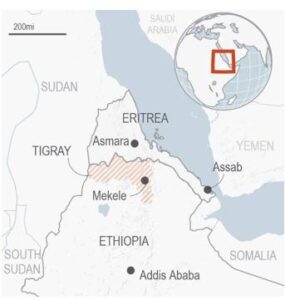
  • Tigray Crisis in Ethiopia

    The director-general of the World Health Organization (WHO), described the Tigray crisis region as the “worst humanitarian disaster on earth”.

    What is the news?

    • Ethiopia has been on the brink of a civil war.
    • On Nov 4 2020, Prime Minister Abiy Ahmed declared war on the country’s Tigray region.
    • The Tigray region is ruled by the Tigray People’s Liberation Front (TPLF).
    • The war was declared in response to the TPLF’s attack on a federal military base in Tigray.

    Tigray Crisis: A backgrounder

    • The animosity between Tigrayans and Eritrea goes back to the Ethiopian-Eritrean war that occurred between 1998 and 2000.
    • It occurred approximately two decades ago was extremely brutal and resulted in the deaths of thousands of soldiers.
    • The roots of this crisis can be traced to Ethiopia’s system of government. Since 1994, Ethiopia has had a federal system in which different ethnic groups control the affairs of 10 regions.
    • The Tigray People’s Liberation Front (TPLF) – was influential in setting up this system.
    • It was the leader of a four-party coalition that governed Ethiopia from 1991, when a military regime was ousted from power.
    • Under the coalition, Ethiopia became more prosperous and stable, but concerns were routinely raised about human rights and the level of democracy.

    How did it escalate into a crisis?

    • Eventually, discontent morphed into protest, leading to a government reshuffle that saw Mr Abiy appointed PM.
    • Abiy liberalized politics, set up a new party (the Prosperity Party), and removed key Tigrayan government leaders accused of corruption and repression.
    • Meanwhile, Abiy ended a long-standing territorial dispute with neighbouring Eritrea, earning him a Nobel Peace Prize in 2019.
    • These moves won Abiy popular acclaim, but caused unease among critics in Tigray.
    • Tigray’s leaders see Abiy’s reforms as an attempt to centralize power and destroy Ethiopia’s federal system.

    How bad is the humanitarian situation?

    • Tigray and its neighbouring regions are facing starvation.
    • There is an absence of medical facilities, no access to their own money due to shut-down banking services, ethnic and physical violence, and raids at the hands of warring forces.
    • The government declared a ceasefire on humanitarian grounds but in an effort to break the TPLF in June last year, imposed a blockade on Tigray.
    • This made it impossible to deliver humanitarian, economic, and medical assistance to Tigrayans.

    Also read:

    [Burning Issue] Ethiopian Crisis and the Geopolitics

    UPSC 2023 countdown has begun! Get your personal guidance plan now! (Click here)

  • Anganwadi scheme

    Context

    • The economic fallout of COVID-19 makes the necessity of quality public welfare services more pressing than ever.
    • The Integrated Child Development Services (ICDS) programme is one such scheme.

    What is ICDS?

    • ICDS caters to the nutrition, health and pre-education needs of children till six years of age as well as the health and nutrition of women and adolescent girls.

    What is anganwadi scheme?

    • The scheme was started in 1975 and aims at the holistic development of children and empowerment of mother.
    • It is a Centrally-Sponsored scheme. The scheme primarily runs through the Anganwadi centre. The scheme is under the Ministry of Women and Child Development.

    Need for focus on early childhood care and education (ECCE)

    • Low enrolment: The National Family Health Survey-5 (NFHS-5) finds only 13.6 per cent of children enrolled in pre-primary schools.
    • Weakest link: With its overriding focus on health and nutrition, ECCE has hitherto been the weakest link of the anganwadi system.
    • Low awareness: Unfortunately, due to a lack of parental awareness compounded by the daily stresses of poverty, disadvantaged households are unable to provide an early learning environment.

    Data to remember

    According to government data, the country has 13.77 lakh Anganwadi centres (AWCs).

    A meaningful ECCE programme in anganwadis

    • Activity-based framework which reflect local context: To design and put in place a meaningful activity-based ECCE framework that recognises the ground realities with autonomy to reflect the local context and setting.
    • Remove non-ICDS work: Routine tasks of anganwadi workers can be reduced and non-ICDS work, such as surveys, removed altogether.
    • Extend Anganwadi time: Anganwadi hours can be extended by at least three hours by providing staff with an increase in their present remuneration, with the additional time devoted for ECCE.
    • Change in policy mindset: ICDS needs a change in policy mindset, both at central and state levels, by prioritising and monitoring ECCE.
    • Engagement with parents: Anganwadi workers must be re-oriented to closely engage with parents, as they play a crucial role in the cognitive development of young children.


    Case study / value addition

    In Andhra Pradesh and Telangana, anganwadi centres have been geotagged to improve service delivery.

    Gujarat has digitised the supply chain of take-home rations and real-time data is being used to minimise stockouts at the anganwadi centres.

    Way forward

    • Government must act on the three imperatives. First, while infrastructure development and capacity building of the anganwadi remains the key to improving the programme, the standards of all its services need to be upscaled.
    • Second, states have much to learn from each other’s experiences.
    • Third, anganwadi centres must cater to the needs of the community and the programme’s workers.

    Conclusion

    • Nearly 1.4 million anganwadis of the Integrated Child Development Services (ICDS) across India must provide ECCE for the millions of young children in low-income households.

    Mains question

    Q. Some educationists have suggested that owing to the high workload of anganwadi workers, ECCE in anganwadis would remain a non-starter. Critically examine this statement and give dynamic suggestions to improve EECE in anganwadis.


  • [Burning Issue] Decoding China’s War Strategy to invade Taiwan

    UPSC 2023 countdown has begun! Get your personal guidance plan now! (Click here)

    Context

    • On 2nd August 2022, after US House Speaker Nancy Pelosi visited Taiwan, the Chinese have been conducting aggressive military drills near Taiwan. This situation is so critical that a minor miscalculation here and there could escalate this conflict to World War III itself.
    • In this edition of the burning issue, we would try to delve into the possible war strategy of China to attack and acquire Taiwan. How could this little island of Taiwan with the support of the American and Japanese armies defend against the mighty Chinese army and how could this battle of Taiwan lead to the horrific World War III.

    What is the issue between China and Taiwan?

    • Taiwan is an island about 160 km off the coast of south-eastern China, opposite the Chinese cities of Fuzhou, Quanzhou, and Xiamen. It was administered by the imperial Qing dynasty, but its control was passed to the Japanese in 1895. After the defeat of Japan in World War II, the island passed back into Chinese hands.
    • After the communists led by Mao Zedong won the civil war in mainland China, Chiang Kai-shek, the leader of the nationalist Kuomintang party, fled to Taiwan in 1949.
    • Chiang Kai-shek set up the government of the Republic of China on the island and remained President until 1975.
    • Beijing has never recognized the existence of Taiwan as an independent political entity, arguing that it was always a Chinese province under its ‘One China Policy‘. The PRC considers the island as a renegade province awaiting reunification by peaceful means, if possible.
    • This has generated strong opposition from the Taiwanese government and people. To protect its sovereignty, Taiwan remains closer to the US, buying weapons from it and thus irking China. This has become a major bone of contention between the two.

    Importance of Taiwan to China

    • TSMC (Taiwan Semiconductor Manufacturing Company) is the largest foundry in the world and holds around 65 percent of the global production of chips.
    • Any potential conflict with China would completely disrupt the entire supply chain of TSMC and labor availability and could cause a major shortage of electronic chips.
    • Being in close vicinity of China, any alliance or engagement of Taiwan with any of the enemies of China would threaten its national security. Thus, it’s necessary for China to control Taiwan’s engagements with other  

    Importance of Taiwan for the US

    • Strategic importance– After Japan, Taiwan is the geographically closest friendly territory around China for the US in the Indo-Pacific region.
    • Economic importance– US-Taiwan has a bilateral trade of $105 billion with the US high dependence on Taiwanese semiconductor chips.
    • Gaining lost credibility– the current crisis is about re-establishing steadily diminishing American credibility in the eyes of friends and foes through Taiwan.

    China’s War Strategy

    (A) Grey-zone warfare

    • The People’s Liberation Army – is waging so-called Grey-Zone warfare against Taiwan.
    • This consists of an almost daily campaign of intimidating military exercises, patrols and surveillance that falls just short of armed conflict.
    • The campaign has intensified, with Beijing stepping up the number of warplanes it is sending into the airspace around Taiwan. China has also used sand dredgers to swarm Taiwan’s outlying islands.
    • Military strategists tell that the grey-zone strategy has the potential to grind down Taipei’s resistance – but also that it may fall short, or even backfire by strengthening the island’s resolve.

    (B) Impose a blockade on Taiwan’s Matsu and Kingman islands

    • If a long campaign of grey-zone warfare fails to bring Taipei to the negotiating table the next step by China would be to impose a blockade on Taiwan’s Matsu and Kinmen Island which are just a few kilometers away from mainland China.
    • Since China is already facing the heat of Covid and the real estate bubble, China would plan to take Taiwan as quickly as possible and with as little damage as possible so the safest way to get Taiwan would be to intimidate them so much that they by default surrender without any bloodshed.
    • Chinese navy and submarines would encircle these islands and islets hundreds of sand dredgers fishing boats and Chinese paramilitary ships would move in to surround them and the Chinese fighter jets would begin round-the-clock patrols over the Taiwanese strait.

    (C) Customs quarantine strategy for mainland Taiwan

    • After the above steps, China will enforce customs, maritime and airspace jurisdictions over Taiwan. The move overrides Taiwan’s existing control of its airspace and maritime boundary.
    • China would ban all shipping from entering Taiwan’s territorial waters without its permission. The Chinese authorities inform all airlines and shipping companies that they must have Beijing’s official approval to enter or leave Taiwan’s airspace or ports. They also insist that all flights, ships and ferries submit passenger manifestos and customs declarations to Chinese authorities.
    • A vast fleet of PLA Navy, coast guard and maritime militia ships deploy around Taiwan to enforce the quarantine, intercepting ships attempting to approach the island without approval from Beijing.
    • OUTCOME: With the sudden halt to all imports and exports, Taiwan faces almost immediate shortages of essential supplies, particularly energy. The island is suddenly cut off from the world.

    (D) Full blockade of mainland Taiwan

    • Here’s where China uses its huge naval fleet to surround Taiwan in such a way that they take complete control over the entire water and airspace around Taiwan so this way neither ships nor planes could go in or come out.
    • Warships and strike aircraft would be deployed to make sure that the American and Japanese forces are prevented from approaching Taiwan and now China and Taiwan would launch air and missile strikes on each other.
    • With its blockade still in place, China may call for an immediate ceasefire, offers to allow urgently needed supplies to reach Taiwan, and invites negotiations with Washington in a bid to avert a full-scale war.

    (E) Attack on Taiwan infrastructure

    • Devastating air and missile attack will be launched on the island’s defenses. The aim is to smash Taiwan’s military, demoralize the population and force Taipei to the negotiating table before the United States and its allies can intervene.
    • PLA forces launch massive saturation attacks on key military and civilian targets. These include airfields, ports, air-defense radars, communication nodes, military command centers and headquarters, missile batteries, navy bases, major warships, key bridges, communication networks, power stations and grids, government buildings, radio and television stations, data centers and major transport arteries.

    (F) Full-fledged invasion

    • Without warning, the PLA would launch massive air, missile and cyber-attacks on key military and civilian targets all over Taiwan. At the same time, the PLA attacks U.S. bases in Japan and Guam with air and missile strikes in a bid to paralyze American forces and delay any intervention.
    • Within hours a major war will be raging in East Asia.

    Options for Taiwan

    • Fight back– Taiwan uses its full armed force to defend itself with or without US and allies. But it would be equivalent to suicide as Taiwan’s armed power is minuscule as compared to the Chinese army.
    • Surrender– surrender to the Chinese PLA thus saving itself from much destruction and hence leading to the realization of a decade-old dream of China- The unification of Taiwan with mainland China.
    • Buy time tactics– to keep China in a loop through diplomatic channels and negotiations till the time US and allies forces reach the Taiwan strait.

    Weaknesses of Taiwan

    Taiwan has three major weak points:

    • Taiwan has a very small army– China has 10 times more ground force, 8 times more naval destroyers and 30 times more submarines. Thus, China is going to outright destroy them all.
    • Communication cables in the South China Sea– Taiwan sends and receives 95 percent of the data and voice traffic along with these bundles of cable lines that run through this bay to different parts of the world. So, the Chinese fleet will cut these cables off and will completely disrupt the communication of Taiwan and more importantly the communication of the Taiwanese army.
    • Taiwan’s energy supplies- As of 2020, about 98 percent of Taiwan’s energy was imported from foreign countries and this was in the form of coal crude oil and petroleum products and these shipments come from Australia, Qatar Indonesia and Russia.

    Possible Outcomes of an invasion

    • Chinese control of Taiwan would dramatically reinforce the Communist Party’s prestige at home and eliminate the island as a viable model of a democratic alternative to authoritarian Party rule.
    • It would also give China a foothold in the so-called first island chain, the line which runs through the string of islands from the Japanese archipelago to Taiwan, the Philippines and Borneo, which enclose China’s coastal seas.
    • For China, success would translate into a commanding strategic position in Asia, undermining the security of Japan and South Korea, and allowing China to project power into the Western Pacific.
    • But if China loses the war, it might cause a revolt within CPC for new leadership and anger against President Xi Jinping or the Chinese population may rise against their communist government.
    • Severe sanctions by the western countries against China would further cripple its economy, making it difficult for China to regain its diplomatic might and economic status.

    Possible outcomes for the US and its Allies

    • If the US and its allies successfully counter China, it would be a great power booster for the US camp and the western world.
    • The US would be re-established as the only Superpower in the world, with the world order becoming unipolar once again.
    • However, if the US and its allies lose the war, it would be marked as the end of its hegemony as the world superpower, loss of power and prestige and would by default establish China’s dominance in the world.

    Implications for India and the world

    • Economic ties will be hit– Arguably more important to New Delhi is the economic component of its engagement with Taiwan. Last year, bilateral trade between India and Taiwan was estimated to be worth over $7 billion. Taiwanese firms have also invested over $2.3 billion in India. The two countries are even talking about a free trade deal and working out ways to create a semiconductor manufacturing hub in India. A war would nullify all these aspects.
    • World economy to suffer badly– Experts have predicted that any escalation in the Taiwan Strait will have an impact on trade and security throughout the entire Indo-Pacific region. Also, China has been a crucial value-adder to the global supply chain. It would be very difficult for the US to replicate Russia’s sanctioning of the aggressor and resupplying the resistor strategy on China-Taiwan. 
    • Semiconductor shortage– Taiwan is a small nation that has placed itself as one of the biggest manufacturers of essential semiconductors and electronic components. A blockade or slowdown of semiconductor chip shipments could be one of the many effects of a conflict between China and Taiwan, which would have an impact on many global industries, including manufacturing and internet communications technology.

    Way forward

    • Avoiding any escalation- both sides should maintain a restraint from further escalation of tensions keeping diplomatic channels open and actively pursuing back-channel diplomacy.
    • Respecting each-others sensitivities– on important unclear matters and taking up the trust-building process.
    • More Realistic approach by India– also, New Delhi must begin to deal with Taiwan as a weighty entity in its own right that offers so much to advance India’s prosperity.

    Conclusion

    • As Taiwan becomes the world’s most dangerous flashpoint, the geopolitical consequences for Asia and the world are real.
    • Once a sane man had said,” War is a tricky game, the only way to win it is to not play it at all”. After the war with COVID and then Russia-Ukraine ongoing war, the world cannot afford another war. Thus, a restraint from all sides is thus a sine qua non.

    UPSC 2023 countdown has begun! Get your personal guidance plan now! (Click here)

  • Protected: ‘Mains 250+ Value Added Material’ for UPSC CSE Mains 2022 | 360° Comprehensive Notes on 250 Most Important Topics

    This content is password-protected. To view it, please enter the password below.

  • 22nd August 2022| Daily Answer Writing Enhancement(AWE)

    Topics for Today’s questions:

    GS-1        Role of women and women’s organization

    GS-2       Constitution of India —historical underpinnings, evolution, features, amendments, significant provisions and basic structure.

    GS-3        Disaster Management

    GS-4        Aptitude and foundational values for Civil Service, integrity, impartiality and non-partisanship, objectivity, dedication to public service, empathy, tolerance and compassion towards the weaker sections.

    Question 1)


    Q.1 Reservation for women perpetuates a “proxy culture’’ as seen in the phenomenon of “sarpanch patis”. In this context, discuss whether reservation can address the issue of poor participation of women in Indian politics. (15 Marks)


    Question 2)

    Q.2 There have been arguments that sedition law is an attack on the very foundation of India’s liberal democratic principles, as enshrined in the Constitution. Do you agree? (10 Marks)

    Question 3)

    Q.3 The world has witnessed a huge surge in climate-induced disasters, which are largely driven by anthropogenic factors. In this context, analyse the role of early warning systems in mitigating the impact of the disasters. (10 Marks)

    Question 4)  

    Q.4 Describe the attributes and principles that made civil servants the “Steel Frame of India”. (10 Marks)


    HOW TO ATTEMPT ANSWERS IN DAILY ANSWER WRITING ENHANCEMENT(AWE)?

    1. Daily 4 questions from General studies 1, 2, 3, and 4 will be provided to you.

    2. A Mentor’s Comment will be available for all answers. This can be used as a guidance tool but we encourage you to write original answers.

    3. You can write your answer on an A4 sheet and scan/click pictures of the same.

    4.  Upload the scanned answer in the comment section of the same question.

    5. Along with the scanned answer, please share your Razor payment ID, so that paid members are given priority.

    6. If you upload the answer on the same day like the answer of 11th  February is uploaded on 11th February then your answer will be checked within 72 hours. Also, reviews will be in the order of submission- First come first serve basis

    7. If you are writing answers late, for example, 11th February is uploaded on 13th February , then these answers will be evaluated as per the mentor’s schedule.

    8. We encourage you to write answers on the same day. However, if you are uploading an answer late then tag the mentor like @Staff so that the mentor is notified about your answer.

    *In case your answer is not reviewed, reply to your answer saying *NOT CHECKED*. 

    1. For the philosophy of AWE and payment: 

  • Q.4 Describe the attributes and principles that made civil servants the “Steel Frame of India”. (10 Marks)

    Mentor’s Comments-

    • Introduce by stating that Sadar Patel called the civil servants as Steel Frame of India.
    • Discuss the attributes and principles of a civil servant.
    • Conclude by suggesting way to improve efficiency of a civil servant.
  • Q.3 The world has witnessed a huge surge in climate-induced disasters, which are largely driven by anthropogenic factors. In this context, analyse the role of early warning systems in mitigating the impact of the disasters. (10 Marks)

    Mentor’s Comments-

    • Give a brief introduction about climate-induced disasters.
    • List the factors leading to high incidence of such disasters and their impact in brief.
    • Discuss the significance of adaptability and early warning measures in mitigating their impact.
    • Conclude appropriately.
  • Concept of ‘Lifestyle for the Environment’

    Context

    In the midst of a global climate crisis, and as India gets closer to hosting the G20 presidency, it is important to recognise our country’s leadership at both ends of the climate debate: By walking the talk on our climate commitments as well as leading people-powered climate action.

    Power of individual and collective action to address the climate change

    • Adopting eco-friendly behaviours: According to the United Nation Environment Programme (UNEP), if one billion people out of the global population of close to eight billion adopt eco-friendly behaviours in their daily lives, global carbon emissions could drop by approximately 20 per cent. 
    • Such eco-friendly behaviours include turning off ACs, heaters and lights when not in use, as this, for instance, can conserve up to 282 kilowatts of electricity per day.
    • Avoiding food wastage can reduce an individual’s carbon footprint by 370 kg per year.

    The concept of Lifestyle for Environment

    • In November 2021, at the CoP 26 in Glasgow, Prime Minister Narendra Modi, in addition to announcing the panchamrit, or five climate-related commitments of the country, also articulated the concept of “Lifestyle for the Environment” (LiFE).
    • Mindful and deliberate utilisation: The concept advocate for mindful and deliberate utilisation by people worldwide, instead of “mindful and wasteful consumption”.
    • LiFE was launched on June 5, 2022, World Environment Day, by PM Modi, with a vision of harnessing the power of individual and collective action across the world to address the climate crisis.
    • The objective of the movement is to nudge individuals and communities to adopt simple and specific climate-friendly behaviours in their daily lifestyles.
    •  For instance, an individual can carry a reusable cloth bag instead of a plastic bag.
    • By making such daily actions an integral part of our collective social norms, LiFE aims to activate a global community of “Pro Planet People” and steer the world towards a sustainable model of development.
    • Global precedents: There are already precedents of pro-planet initiatives around the world.
    • For example, Denmark promotes the use of bicycles by limiting parking within the city centre and providing exclusive bike lanes.
    • Japan has its unique “walk-to-school” mandate, which has been in practice since the early 1950s.
    •  LiFE, however, is planned as a first-of-its-kind global movement, led by India in partnership with other countries, that will provide the world with a unique people-powered platform to relentlessly focus on bringing individual and collective actions to the core of the climate action narrative.

    How the LiFE moment can change people’s behaviour

    • 1] Consume responsibly: The prevailing perception that climate-friendly behaviour necessarily implies a frugal lifestyle has played a major role in preventing populations worldwide from adopting a sustainable lifestyle.
    • LiFE plans to methodically break down this mental model by nudging the world to consume responsibly, rather than consuming less.
    • Using behavioural technique: Building on the unique insights from Swachh Bharat Mission (SBM), LiFE will deploy a range of tested behavioural techniques, including nudges, social and behaviour change communication and norm influencing to make mindful consumption a mass movement.
    • 2] Produce responsibly: Our society reflects our markets and vice versa.
    • If sustainable choices are not supported from the supply-side, any change in our consumption patterns will only be temporary.
    • By nudging the consumption patterns of the society at scale, LiFE can also trigger a huge boost for the sustainability market.
    • Several green industries and a large number of jobs are likely to be initiated as a positive externality of LiFE.
    • 3] Live responsibly: The Covid pandemic is a wake-up call to all of us that no matter how much technological progress we make as a global society, we all remain at the mercy of the natural world.
    • As a global community of people with a shared natural world, a threat to one is a threat to all.
    • In this context, through its multi-dimensional, multi-cultural and global approach, the LiFE movement can play a pivotal role in not merely reversing the effects of climate change but, at a broader level, mainstream a harmonious and mindful way of living.

    Conclusion

    As the world moves in fits and starts towards its shared commitment to achieve ambitious climate goals, the time is ripe for India to lead the LiFE movement and mainstream it into the climate narrative.

    UPSC 2023 countdown has begun! Get your personal guidance plan now! (Click here)

  • Q.2 There have been arguments that sedition law is an attack on the very foundation of India’s liberal democratic principles, as enshrined in the Constitution. Do you agree? (10 Marks)

    Mentor’s Comments-

    • Start with a brief introduction of the Sedition Law in India.
    • Mention the arguments against the sedition law.
    • Write arguments in favour of the continuation of the sedition law.
    • Conclude appropriately.
  • Q.1 Reservation for women perpetuates a “proxy culture’’ as seen in the phenomenon of “sarpanch patis”. In this context, discuss whether reservation can address the issue of poor participation of women in Indian politics. (15 Marks)

    Mentor’s Comments-

    • Give a brief context of the political representation of women in India.
    • Mention the issues related to providing reservation to women in political institutions.
    • Give arguments against this proposal.
    • Conclude with a way forward.
  • What is India’s policy on the Rohingya?

    In a major boost to India’s policy on the Rohingya, the MHA would shift Rohingya refugees to flats meant for EWS in Delhi.

    Why in news?

    • This is seen as a response to the fundamentalists who claims that the NRC, CAA are against any particular community.
    • India respects & follows the UN Refugee Convention 1951 & provides refuge to all, regardless of their race, religion or creed.

    Who are the Rohingyas?

    • Rohingya, an ethnic group, mostly Muslim, hail from the Rakhine province of west Myanmar, and speak a Bengali dialect.
    • They comprise one million out of the 53 million people that live in Myanmar, forming the world’s largest stateless population in a single country.
    • Universally reviled by the country’s Buddhist majority, they have been oppressed by the government since the late 1970s when the government launched a campaign to identify ‘illegal immigrants’.
    • Serious abuses were committed, forcing as many as 250,000 Rohingya refugees to flee to Bangladesh.
    • The 1982 Citizenship Law in former Burma made the Rohingyas stateless people.
    • They have often been called the most persecuted minority in the world.
    • The 1.1 million Rohingya Muslims squeezed precariously into the northwest state of Rakhine, in mainly Buddhist Burma, bordering majority Muslim Bangladesh, are stateless and unwanted.

    Why are they stateless?

    • To qualify for citizenship, Rohingya applicants had to renounce their identity and accept being labelled as ‘Bengalis’ on all official documents.
    • They also had to prove that they could trace the presence of their family in Rakhine back three generations.
    • This is extremely difficult as many Rohingya lack documents or had lost them in 2012.

    Why did the Crisis happen?

    • Since World War II they have been treated increasingly by Burmese authorities as illegal, interloping Bengalis, facing apartheid-like conditions that deny them free movement or state education.
    • The army “clearing operations” sparked the mass exodus of Rohingyas in both October 2016.
    • In August 2017, were launched after insurgents known as the Arakan Rohingya Salvation Army (ARSA) attacked several paramilitary check posts.
    • Rohingya activists claim the insurgents are mainly young men who have been pushed to breaking point by relentless oppression.

    Security Implications

    • The Rohingya issue and its spill over impact on Myanmar`s western peripheral region and security implications figured in the discussions is not clear.
    • In all probability, the import of the ferment caused by the Rohingya migration, efforts of radical Islamists to influence some of the Rohingya youth, and the Pakistan attempts to capitalise on the situation.
    • Rising anger in the Muslim world about the plight of the Rohingya has compounded fears of home-grown militancy as well as support from international jihadists.
    • Illegal movement of people, combined with human trafficking and cross-border migration, can weaken Myanmar’s relations with its neighbour Bangladesh and its ASEAN partners.

    Where do the Rohingya live in Delhi?

    • The Rohingya live in hutments in the densely populated Kalindi Kunj and Madanpur Khadar areas in Delhi which are contiguous with Uttar Pradesh.
    • Officially, about 1,200 Rohingya have been identified as among the first batch to have arrived in Delhi in 2012.
    • After they protested outside the UNHCR (UN Refugee Agency) office in Delhi, they were provided with refugee cards.

    Total Rohingyas in India

    • In December 2017, the MHA informed Parliament that there are around 40,000 Rohingya in India, of which around 5,700 are in Jammu and also in Telangana, Punjab, Haryana, Uttar Pradesh, Delhi and Rajasthan.
    • Of these, only 16,000 are said to be registered with the UN refugee agency.
    • The MHA claimed that the exact number is not known as many of them enter the country.

    How is the Delhi government involved?

    • The Foreigners Regional Registration Office (FRRO), responsible for tracking foreigners and their visas, has been requesting space at a new location for the Rohingya from the Delhi government since 2021.
    • The FRRO is under the administrative control of the MHA.

    When did the Rohingya come to Delhi?

    • A/c to MHA, they first came to Delhi in 2012.
    • They were forced to leave Myanmar in large numbers after several waves of violence, which first began in 2012.
    • The Myanmar army revived the attacks in 2017 and lakhs took shelter in Bangladesh.
    • Around five lakh Rohingya fled to Saudi Arabia in 2012.

    What is the process of deportation?

    • According to the MHA, illegal immigrants are detected, detained and deported under provisions of the Passport Act, 1920 or the Foreigners Act, 1946.
    • Once a ‘foreigner’ has been apprehended by the police for staying illegally, without any document, he or she is produced before the local court.
    • The powers to identify and deport them have also been delegated to State governments and UTs.
    • If the accused is found guilty, they can be imprisoned for three months to eight years.
    • After completing their sentence, the court orders deportation.

    Have any Rohingya been deported?

    • Any foreign nationals who enter into India without valid travel documents are treated as illegal immigrants.
    • In 2018, seven Rohingya were deported to Myanmar.
    • It was the first time that Myanmar issued a certificate of identity to the seven Rohingya. They had been picked up in Assam in 2012.
    • Many Rohingyas have expressed their desire to return to their country and gave an undertaking that they were returning out of their free will.

    India’s stance on Rohingyas

    • Amid fears of fresh exodus of Rohingya from Myanmar, the MHA in 2017 cautioned all the States about infiltration from Rakhine State of Myanmar into Indian Territory.
    • It cited the burden on the limited resources of the country that aggravates the security challenges especially in the North-East.
    • It also said the rise in terrorism in the last few decades is a cause for concern in most nations and that illegal migrants are more vulnerable to getting recruited by terrorist organisations.

    What is India’s stand on refugees?

    • India is NOT a signatory to the 1951 UN Convention relating to the Status of Refugees and the 1967 Protocol.
    • All foreign undocumented nationals are governed as per the provisions of:
    1. The Foreigners Act, 1946
    2. The Registration of Foreigners Act, 1939
    3. The Passport (Entry into India) Act, 1920 and
    4. The Citizenship Act, 1955

    Way forward: A humane approach is needed

    • India must enact a National Asylum and Deportation Law. Since certain exoduses cannot be prevented due to international pressures.
    • We need a proper framework to make sure that refugees can access basic public services, be able to legally seek jobs and livelihood opportunities for some source of income.
    • The absence of such a framework will make the refugees vulnerable to exploitation, which is again detrimental to our own national security.
    • Our judiciary has already shown the way forward on this: In 1996, the Supreme Court ruled that the state has to protect all human beings living in India, irrespective of nationality since they enjoy the rights guaranteed by Articles 14, 20, and 21 of the Constitution to all, not just Indian citizens.
    • The enactment and enumeration of refugee rights will reduce our dependence on judge-centric approaches — or even worse, the whims of Home Ministry bureaucrats, police officers and politicians.

    Try this

    Q. In the absence of a uniform and comprehensive law to deal with asylum seekers, we lack a clear vision or policy on refugee management. In the context of this, examine the need for law to deal with asylum seeker and suggest the various aspects the law should cover. 


    UPSC 2023 countdown has begun! Get your personal guidance plan now! (Click here)

  • Kashmir Voters’ List Upgrade to include Non-Locals

    Kashmir Voters’ List Upgrade to include Non-Locals

    Recently the J&K Chief Electoral Officer (CEO) announced that anyone “who is living ordinarily in J&K” can avail the opportunity to get enlisted as a voter in the Union Territory in accordance with the provisions of the Representation of the People Act.

    Why in news?

    • Many people who were not enlisted as voters in the erstwhile State of J&K are now eligible to vote after the reading down of Article 370 on August 5, 2019.
    • The Election Commission of India (ECI) was expecting an addition of 20-25 lakh new voters in the final list in J&K.
    • This has created furore among the out-streamed politicians of the erstwhile state.

    What did the EC announce?

    • There is no need to have a domicile certificate of J&K to become a voter.
    • An employee, a student, a labourer or anyone from outside who is living ordinarily in J&K can enlist his or her name in the voting list.
    • Around 25 lakh new voters are expected to be enrolled in J&K, which has 76 lakh voters on the list. The projected 18-plus population of J&K was around 98 lakh.
    • After the abrogation of special provisions of Article 370, the Representation of the People Act 1950 and 1951 is applicable in J&K, which allows ordinarily residing persons to get registered in the electoral rolls of J&K.

    New Voters in J&K

    • Armed forces posted in J&K could also register as voters and could possibly participate in the first ever Assembly polls in the youngest Union Territory (UT) of the country.
    • The existing electoral roll is being mapped into the newly delimited Assembly constituencies as per the Delimitation Commission’s final order made applicable by the Union Law Ministry.

    Why are electoral rolls being revised?

    • The ECI is working on fresh electoral rolls in J&K after the J&K Delimitation Commission carved out seven new Assembly constituencies in the UT earlier this year.
    • The Delimitation Commission has re-drawn many constituencies and fresh electoral rolls are essential to prepare the ground for any announcement of elections in J&K.
    • The last Assembly elections took place long back in 2014.
    • In a latest move, the ECI has decided that it will also include any person who has attained the age of 18 years on or before October 1, 2022 in the fresh electoral rolls.
    • The final electoral roll would be published in November.

    Why such move?

    • Prior to August 5, 2019 when J&K had special constitutional powers, the Assembly electoral rolls in the State were drawn up according to the separate J&K Representation of the People Act 1957.
    • Therein only permanent residents of J&K were eligible to get registered in the Assembly rolls.
    • To get voting rights, Permanent Resident Certificate and domicile certificates had to be shown.
    • Several lakh residents from West Pakistan and Pakistan Occupied Kashmir, who had migrated to J&K and were living there for decades,
    • They had no voting rights in Assembly elections till August 5, 2019 but were able to vote in the parliamentary elections.

    Why has the ECI announcement caused a furore?

    • All pseudo liberal and fundamentalist political parties in J&K have reacted sharply to the ECI announcement.
    • J&K’s main regional parties also called Gupkar parties have expressed concerns that the move will open the floodgates and turn locals into an electoral minority.
    • Separatists expressed concern that there was a plan to bring 25 lakh non-locals and make them eligible to cast their votes in the next J&K elections.


    UPSC 2023 countdown has begun! Get your personal guidance plan now! (Click here)

  • Delhi Police’s use of Facial Recognition Technology

    A Right to Information (RTI) response revealed that the Delhi Police treats matches of above 80% similarity generated by its facial recognition technology (FRT) system as positive results.

    Why in news?

    • India has seen the rapid deployment of facial recognition technology (FRT) in recent years, both by the Union and State governments, without putting in place any law to regulate their use.

    What is Facial Recognition Technology?

    • Facial recognition is an algorithm-based technology that creates a digital map of the face by identifying and mapping an individual’s facial features, which it then matches against the database to which it has access.
    • It can be used for two purposes:

    (A) 1:1 verification of identity

    • Here the facial map is obtained for the purpose of matching it against the person’s photograph on a database to authenticate their identity.
    • Increasingly it is being used to provide access to any benefits or government schemes.

    (B) One-to-many identification

    • There is the one-to-many identification of identity wherein the facial map is obtained from a photograph or video and then matched against the entire database to identify the person in the photograph or video.
    • Law enforcement agencies such as the Delhi Police usually procure FRT for 1:n identification.
    • It generates a probability or a match score between the suspect who is to be identified and the available database of identified criminals.
    • A list of possible matches are generated on the basis of their likelihood to be the correct match with corresponding match scores.
    • However, ultimately it is a human analyst who selects the final probable match from the list of matches generated by FRT.

    Why is the Delhi Police using facial recognition technology?

    • The Delhi Police first obtained FRT for the purpose of tracing and identifying missing children.
    • The procurement was authorised under the 2018 direction of the Delhi High Court in Sadhan Haldar vs. NCT of Delhi.

    Issues with FRT use

    • The use of FRT presents two issues:
    1. Issues related to misidentification due to inaccuracy of the technology and
    2. Issues related to mass surveillance due to misuse of the technology
    • Extensive research into the technology has revealed that its accuracy rates fall starkly based on race and gender.
    • This can result in a false positive rate, where a person is misidentified as someone else, or a false negative where a person is not verified as themselves.
    • Cases of a false positive result can lead to bias against the individual who has been misidentified.
    • On the other hand, cases of false negative results can lead to exclusion of the individual from accessing essential schemes. Ex. Failure of biometric based authentication under Aadhaar for an 90 YO person.

    Authority to Delhi Police

    • The Delhi Police is matching the photographs/videos against photographs collected under Section three and four of the Identification of Prisoners Act, 1920.
    • This provision has now been replaced by the Criminal Procedure (Identification) Act, 2022.
    • This Act allows for wider categories of data to be collected from a wider section of people, i.e., “convicts and other persons for the purposes of identification and investigation of criminal matters”.

    Why discuss this?

    • At present, India does NOT have a data protection law or a FRT specific regulation to protect against misuse.
    • In such a legal vacuum, there are no safeguards to ensure that authorities use FRT only for the purposes that they have been authorised to, as is the case with the Delhi Police.
    • FRT can enable the constant surveillance of an individual resulting in the violation of their fundamental right to privacy.
    • Yet again the nation-security narrative comes into picture which cannot be ignored.
    • It is feared that the Act will lead to overbroad collection of personal data in violation of internationally recognised best practices for the collection and processing of data.
    • This revelation raises multiple concerns as the use of facial recognition can lead to wrongful arrests and mass surveillance resulting in privacy violations (if used for propaganda politics).


    UPSC 2023 countdown has begun! Get your personal guidance plan now! (Click here)

  • What’s at stake in talks for a UK-India Free Trade Agreement (FTA)?

    India and the UK recently revived talks for a Free Trade Agreement (FTA) to encourage trade and investment. The FTA between India and UK is expected to be signed by October.

    What is a Free Trade Agreement (FTA)?

    • It is an agreement between two or more countries to minimize barriers to imports and exports of products and services among them.
    • It includes reducing tariffs, quotas, subsidies or prohibitions which could limit exchange of goods and services across borders.
    • The FTA might allow free trade among the two nations with a few exceptions.
    • This involves a formal and mutual agreement signed between two or more countries.
    • The agreement could be comprehensive and include goods, services, investment, intellectual property, competition, government procurement and other areas.

    What is the status of the India-UK FTA?

    • India and the United Kingdom have a multi-dimensional strategic partnership and are actively engaged in bilateral trade.
    • The two countries agreed to begin formal negotiations for an FTA in January 2022, aiming to advance trade and investment relations between them.
    • The fifth round of FTA talks concluded on 29 July, and the expectation is that negotiations would be completed and the stage set for the FTA by October.
    • The FTA is important for both countries as it would provide a boost and create a robust framework of overall trade and investment between the two countries.

    Which are the countries with which India has FTAs?

    • As of April 2022, India had 13 FTAs, including the South Asian Free Trade Area, and with Nepal, Bhutan, Thailand, Singapore, Japan and Malaysia.
    • The 13 also include the agreements with Mauritius, UAE and Australia signed during the last five years.
    • Additionally, India has also signed six limited Preferential Trade Agreements.

    What is the level of India-UK trade?

    • Bilateral trade stands at $50 billion (ie approx. $35 billion in services and $15 billion in merchandise).
    • India is UK’s 12th largest trading partner and accounts for 1.9% of UK’s total trade in four quarters to the end of 2022.
    • UK is the seventh largest export destination for India.
    • The trade balance maintained by India with UK has largely been a surplus.
    • Top three services exported from India to UK are technical, trade-related and other business services, professional and management consulting services and travel.

    How will an FTA with UK benefit India?

    • Apart from reducing tariffs, the FTA also looks at lowering non-tariff barriers, particularly technical  barriers to trade around rules of origin, investor  protection and IPR.
    • MoUs on joint recognition of certain educational qualifications and an outline pact on healthcare workforce have already been signed.
    • Also, both UK and India have set up panels for a totalization deal being advocated by India and permitting Indian legal services for the UK.

    Back2Basics: Types of Trade Agreements

    (1) Free Trade Agreement – discussed above

    (2) Preferential Trade Agreement

    • In this type of agreement, two or more partners give preferential right of entry to certain products.
    • This is done by reducing duties on an agreed number of tariff lines.
    • Here a positive list is maintained i.e. the list of the products on which the two partners have agreed to provide preferential access.
    • Tariff may even be reduced to zero for some products even in a PTA.
    • India signed a PTA with Afghanistan.

    (3) Comprehensive Economic Partnership Agreement

    • Partnership agreement or cooperation agreement are more comprehensive than an FTA.
    • CECA/CEPA also looks into the regulatory aspect of trade and encompasses and agreement covering the regulatory issues.
    • CECA has the widest coverage. CEPA covers negotiation on the trade in services and investment, and other areas of economic partnership.
    • It may even consider negotiation on areas such as trade facilitation and customs cooperation, competition, and IPR.
    • India has signed CEPAs with South Korea and Japan.

    (4) Comprehensive Economic Cooperation Agreement

    • CECA generally cover negotiation on trade tariff and Tariff rate quotas (TRQs) rates only.
    • It is not as comprehensive as CEPA.
    • India has signed CECA with Malaysia.

    (5) Framework Agreement

    • Framework agreement primarily defines the scope and provisions of orientation of the potential agreement between the trading partners.
    • It provides for some new area of discussions and set the period for future liberalisation.
    • India has previously signed framework agreements with the ASEAN, Japan etc.

    (6) Early Harvest Scheme

    • An Early Harvest Scheme (EHS) is a precursor to an FTA/CECA/CEPA between two trading partners. For example, early harvest scheme of RCEP has been rolled out.
    • At this stage, the negotiating countries identify certain products for tariff liberalization pending the conclusion of actual FTA negotiations.
    • An Early Harvest Scheme is thus a step towards enhanced engagement and confidence building.


    Also read

    [Sansad TV] Perspective: Free Trade Agreement


    UPSC 2023 countdown has begun! Get your personal guidance plan now! (Click here)

More posts