💥UPSC 2026, 2027, 2028 UAP Mentorship (March Batch) + Access XFactor Notes & Microthemes PDF

Search results for: “”

  • What are Foreigners’ Tribunals?

    The Guwahati High Court has asked the Centre and the Assam government to collectively decide whether or not the ministerial staff for 200 additional Foreigners’ Tribunals (FT) would be appointed.

    Do you know?

    The Guwahati High Court has largest jurisdiction in terms of states, with its area covering the states of Assam, Arunachal Pradesh, Nagaland, and Mizoram.

    What is Foreigners Tribunal?

    • The foreigners tribunals are quasi-judicial bodies, unique to Assam, to determine if a person staying illegally is a “foreigner” or not.
    • With Assam’s NRC as the backdrop, the Ministry of Home Affairs (MHA) has laid out specific guidelines to detect, detain and deport foreign nationals staying illegally across the country.
    • The MHA has amended the Foreigners (Tribunals) Order, 1964, and has empowered district magistrates in all States and UTs to set up tribunals to decide whether a person staying illegally in India is a foreigner or not.
    • Earlier, such powers to constitute tribunals vested with the Centre only.

    Why need such tribunals?

    • In other parts, once a ‘foreigner’ has been apprehended by the police for staying illegally, he or she is produced before the local court under the Passport Act, 1920, or the Foreigners Act, 1946.
    • The punishment ranges from imprisonment of three months to eight years.
    • Once the accused have completed the sentence, the court orders their deportation, and they are moved to detention centres till the country of origin accepts them.

    What was the last amendment?

    • The 1964 order on Constitution of Tribunals said: “The Central Government may by order, refer the question as to whether a person is not a foreigner within meaning of the Foreigners Act, 1946 to a Tribunal to be constituted for the purpose.
    • The amended order issued says – “for words Central Government may,’ the words ‘the Central Government or the State Government or the UT administration or the District Collector or the District Magistrate may’ shall be substituted.”

    Impact of the Amendment

    • The amended Foreigners (Tribunal) Order, 2019 also empowers individuals to approach the Tribunals.
    • Earlier only the State administration could move the Tribunal against a suspect, but with the final NRC about to be published and to give adequate opportunity to those not included, this has been done.
    • If a person doesn’t find his or her name in the final list, they could move the Tribunal.
    • The amended order also allows District Magistrates to refer individuals who haven’t filed claims against their exclusion from NRC to the Tribunals to decide if they are foreigners or not.
    • Opportunity will also be given to those who haven’t filed claims by referring their cases to the Tribunals.
    • Fresh summons will be issued to them to prove their citizenship.


    UPSC 2023 countdown has begun! Get your personal guidance plan now! (Click here)

  • Working of the Supreme Court Collegium

    Why in news?

    • The Ramana Collegium has been particularly successful.
    • Meeting frequently and working quickly, they took the perennial problem of judicial vacancies by its horns and turned it around.

    Success of Ramana Collegium

    • The collegium was able to recommend numerous judicial appointments and scripted history by getting nine Supreme Court judges appointed in one go.
    • Of the nine, Justice B.V. Nagarathna, is in line to be the first woman CJI in 2027.

    What exactly is the Collegium System?

    • The collegium system was born out of years of friction between the judiciary and the executive.
    • The hostility was further accentuated by instances of court-packing (the practice of changing the composition of judges in a court), mass transfer of HC judges and two supersessions to the office of the CJI in the 1970s.
    • The Three Judges cases saw the evolution of the collegium system.

    Evolution: The Judges Cases

    • First Judges Case (1981) ruled that the “consultation” with the CJI in the matter of appointments must be full and effective.
    • However, it rejected the idea that the CJI’s opinion, albeit carrying great weight, should have primacy.
    • Second Judges Case (1993) introduced the Collegium system, holding that “consultation” really meant “concurrence”.
    • It added that it was not the CJI’s individual opinion, but an institutional opinion formed in consultation with the two senior-most judges in the Supreme Court.
    • Third Judges Case (1998): On a Presidential Reference for its opinion, the Supreme Court, in the Third Judges Case (1998) expanded the Collegium to a five-member body, comprising the CJI and four of his senior-most colleagues.

    How does the collegium system work?

    • The collegium of the CJI and four senior-most judges of the Supreme Court make recommendations for appointments to the apex court and High Courts.
    • The collegium can veto the government if the names are sent back by the latter for reconsideration.
    • The basic tenet behind the collegium system is that the judiciary should have primacy over the government in matters of appointments and transfers in order to remain independent.

    The procedure followed by the Collegium

    Appointment of CJI

    • The President of India appoints the CJI and the other SC judges.
    • As far as the CJI is concerned, the outgoing CJI recommends his successor.
    • In practice, it has been strictly by seniority ever since the supersession controversy of the 1970s.
    • The Union Law Minister forwards the recommendation to the PM who, in turn, advises the President.

    Other SC Judges

    • For other judges of the top court, the proposal is initiated by the CJI.
    • The CJI consults the rest of the Collegium members, as well as the senior-most judge of the court hailing from the High Court to which the recommended person belongs.
    • The consultees must record their opinions in writing and it should form part of the file.
    • The Collegium sends the recommendation to the Law Minister, who forwards it to the Prime Minister to advise the President.

    For High Courts

    • The CJs of High Courts are appointed as per the policy of having Chief Justices from outside the respective States. The Collegium takes the call on the elevation.
    • High Court judges are recommended by a Collegium comprising the CJI and two senior-most judges.
    • The proposal, however, is initiated by the Chief Justice of the High Court concerned in consultation with two senior-most colleagues.
    • The recommendation is sent to the Chief Minister, who advises the Governor to send the proposal to the Union Law Minister.

    Does the Collegium recommend transfers too?

    • Yes, the Collegium also recommends the transfer of Chief Justices and other judges.
    • Article 222 of the Constitution provides for the transfer of a judge from one High Court to another.
    • When a CJ is transferred, a replacement must also be simultaneously found for the High Court concerned. There can be an acting CJ in a High Court for not more than a month.
    • In matters of transfers, the opinion of the CJI “is determinative”, and the consent of the judge concerned is not required.
    • However, the CJI should take into account the views of the CJ of the High Court concerned and the views of one or more SC judges who are in a position to do so.
    • All transfers must be made in the public interest, that is, “for the betterment of the administration of justice”.

    Loopholes in the Collegium system

    • Lack of Transparency: Opaqueness and a lack of transparency, and the scope for nepotism are cited often.
    • Judges appointing Judge: The attempt made to replace it with a ‘National Judicial Appointments Commission’ was struck down by the court in 2015 on the ground that it posed a threat to the independence of the judiciary.
    • Criteria: Some do not believe in full disclosure of reasons for transfers, as it may make lawyers in the destination court chary of the transferred judge. It has even been accused of nepotism.

    Way ahead

    • In respect of appointments, there has been an acknowledgment that the “zone of consideration” must be expanded to avoid criticism that many appointees hail from families of retired judges.
    • The status of a proposed new memorandum of procedure, to infuse greater accountability, is also unclear.
    • Even the majority opinions admitted the need for transparency, now Collegiums’ resolutions are now posted online, but reasons are not given.

    Back2Basics:


    UPSC 2023 countdown has begun! Get your personal guidance plan now! (Click here)

  • In news: Continental Drift Theory

    This newscard is an excerpt from the original article published in TH which talks about the specie Lemurs who are supposed to jump into seas to find India which got drifted away from the Madagascar.

    Study on Lemurs

    • Many life forms in Madagascar have affinities to lineages found in India (3,800 km away) rather than Africa (413 km). This posed a ‘difficult enigma’ to naturalists.
    • One such species is the Lemurs.
    • We most likely see lemurs in a Hollywood animation movie; singing, dancing and playing pranks.
    • Zoologists was perplexed by the presence of lemurs, their relatives, and their fossils in Madagascar and India, but not in nearby Africa or the Middle East.
    • In the 1860s, he proposed that a large island or continent must have once existed between India and Madagascar, serving as a land bridge.
    • Over time, this island had sunk. He called this proposed island Lemuria.

    Existence of such Island in Indian legends

    • Tamil revivalists such as Devaneya Pavanar also took up the idea, in the form of a Tamil civilisation, lost to the sea as described in literature and in Pandyan legends.
    • They called this submerged continent Kumari Kandam.

    Basis of this legend: Continental Drift Theory

    • In the early 20th century, German geologist Alfred Wegener published a paper on his theory called continental drift.
    • It is a hypothesis that Earth’s continents were moving across Earth, and sometimes, even colliding into one another.
    • According to Wegener’s theory, Earth’s continents were once joined as a single, giant landmass, which he called Pangaea.
    • But over time, Pangaea broke apart and formed the continents as we know them today.
    • Wegener couldn’t explain why this phenomenon was happening, so at the time, his theory was heavily criticized by his colleagues.
    • But over the years, technological advances allowed scientists to study the Earth more closely, and geologists started to build on Wegener’s theory.

    Rise over to Plate Tectonics

    • Discoveries like seafloor spreading helped explain the “why” behind continental movement, and eventually, Wegener’s initial continental drift theory morphed into plate tectonic theory.
    • And now, the idea that Earth’s crust is slowly moving beneath our feet is widely accepted.

    The Seven Major Tectonic Plates

    There are seven major plates, and dozens of minor plates, that make up the outer crust of the Earth. The big seven are:

    1. North American plate
    2. Eurasian plate
    3. Pacific plate
    4. South American plate
    5. African plate
    6. Indo-Australian plate
    7. Antarctic plate


    The areas between these plates are known as plate boundaries, and their interactions cause some crazy things to happen on Earth’s surface.

    There are three types of plate boundaries:

    1. Divergent boundary
    • A divergent boundary is when two plates move away from each other, which creates a fracture in the lithosphere.
    • A well-known divergent boundary is the Mid-Atlantic Ridge, which runs approximately 10,000 miles from the Arctic Ocean all the way down to the south of Africa.
    1. Convergent boundary
    • A convergent boundary is when two plates collide with one another.
    • If the collision is between oceanic crust and continental crust, the denser oceanic crust slides underneath the other plate, which is a process known as subduction.
    • When two continental crusts collide, the rock folds and lifts at the boundary, creating mountains like the Himalayas (where the Indian plate meets the Eurasian plate).
    1. Transform Boundary
    • When two plates move parallel to one another, their meeting point is called a transform boundary. The friction causes tension.
    • Eventually, that tension needs to be released, which can cause earthquakes.
    • The San Andreas Fault is a well-known major transform boundary between the North American and Pacific plates—it caused the infamous San Francisco earthquake of 1906.

    How do we apply this theory here?

    • A landmass called Gondwana, split into two 165 million years ago — one containing what is now Africa and South America, the other comprising India, Madagascar, Australia and Antarctica.
    • Around 115 million years ago, Madagascar and India together broke free.
    • Around 88 million years ago, India moved northward, dropping a few parcels of land along the way to form Seychelles.
    • It joined the Eurasian mass 50 million years ago giving rise to the Himalayas and South Asia that we are familiar with.
    • Around 115 million years ago, it was the dinosaurs that ruled. Many life forms had not even evolved.

    Substantiation to this study

    (1) Fossil study

    • Supporting the Gondwana breakup, dinosaur fossils found in India and Madagascar are closely related and do not resemble species found in Africa and Asia.
    • Fragments of Laplatosaurus madagascarensis have been found in both India and Madagascar.

    (2) Molecular clocks

    • A powerful technique, the molecular clock, is used to estimate the time when two forms of life diverged from each other.
    • It is based on the observation that evolutionary changes in the sequence of an RNA or a protein molecule occur at a fairly constant rate.
    • The difference in the amino acids of, say the haemoglobin of two animals can tell you how long ago their lineages diverged.
    • Molecular clocks corroborate well with other evidence, such as the fossil record.
    • South India and Sri Lanka have only two genuses of the cichlid family of freshwater and brackish-water fishes — the Etroplus (a food fish in Kerala, where it is called pallathi) and Pseudetroplus.
    • Molecular comparisons show that the nearest relatives of Etroplus are found in Madagascar, and their common ancestor diverged from African cichlids 160 million years ago.

    India’s pivotal position

    • India occupies a pivotal position in the distribution of life forms in Asia, Madagascar and Africa. Gondwana creatures moved out of India.
    • Others crossed over to stay. For example, Asian freshwater crabs (Gecarcinucidae) are now found all over Southeast Asia but their most recent common ancestor evolved in India.
    • Fossil finds in the Vastan lignite mine in Gujarat by researchers have identified the earliest Indian mammal, a species of bat, and the earliest euprimate, a primitive lemur.
    • These were dated 53 million years ago, around the time (or just before) the India-Eurasian plates collided.

    What about the lemurs?

    • Madagascar is a large island, with a variety of climatic conditions. Evidence favours an ancestor primate crossing over from Africa.
    • No monkey, ape or large predator managed the crossing, so dozens of lemur species proliferated.
    • In India, we have the lorises, which are the closest extant relatives of the lemurs.
    • These are shy, nocturnal forest dwellers, with large, appealing eyes.
    • They are also believed to have survived oceanic rides from Africa.
    • They are mostly found in the Northeastern States (slow loris), and where Karnataka, Kerala and Tamil Nadu meet (slender loris).


    UPSC 2023 countdown has begun! Get your personal guidance plan now! (Click here)

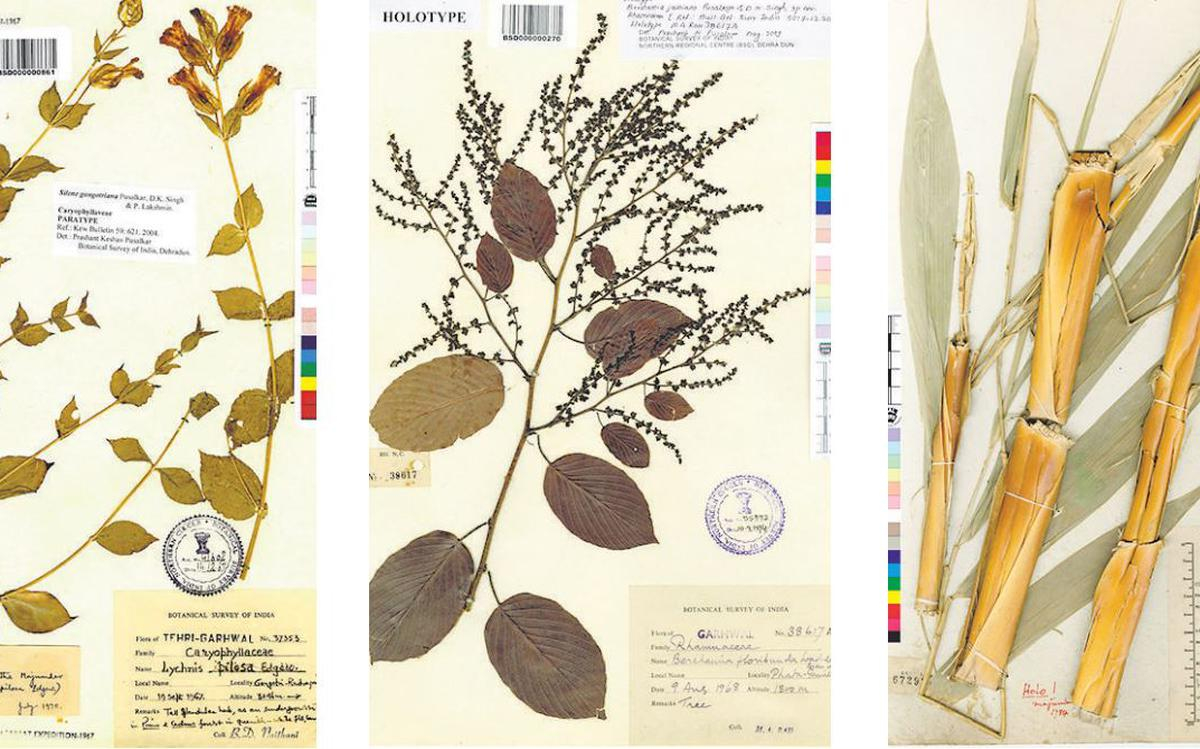
  • Indian Virtual Herbarium, biggest database of country’s flora, is a global hit

    With details of about one lakh plant specimens, the Indian Virtual Herbarium, the biggest virtual database of flora in the country, is generating a lot of interest and turning out to be an eye-catching endeavour.

    Indian Virtual Herbarium

    • A herbarium specimen is consists of dried plant parts with labelled information on Scientific name and collection data.
    • It has immense use in plant identification, systematics studies and ecological studies.
    • The Botanical Survey of India has more than 30,00,000 herbarium specimens persevered in different herbaria located in different parts of the country.
    • Developed by scientists of the Botanical Survey of India (BSI), the herbarium was inaugurated by Union Minister of Environment Forest and Climate Change in Kolkata last month.

    Why in news?

    • Since launch, the portal ivh.bsi.gov.in has had nearly two lakh hits from 55 countries.
    • The portal includes about one lakh images of herbarium specimens.
    • Each record in the digital herbarium includes an image of the preserved plant specimen, scientific name, collection locality, and collection date, collector name, and barcode number.
    • The digital herbarium includes features to extract the data State-wise, and users can search plants of their own States, which will help them identify regional plants and in building regional checklists.

    Significance of the herbaria

    • Scientists say that there are approximately three million plant specimens in the country which are with different herbaria located at zonal centres of the BSI.
    • About 52% of our type specimens are from foreign nations and collected from 82 countries of the world during the British-era.
    • The herbarium is also deeply linked with the botanical history of the country.
    • The portal provides most valuable historical collections of botanists like William Roxburgh, Nathaniel Wallich and Joseph Dalton Hooker, considered the founding fathers of botany in India.
    • The digital herbarium has some of the oldest botanical specimens dating as early as 1696.


    UPSC 2023 countdown has begun! Get your personal guidance plan now! (Click here)

  • Manipur House gives nod to National Register of Citizens (NRC)


    Bowing to demands from tribal groups, the Manipur Assembly has resolved to implement the National Register of Citizens (NRC) and establish a State Population Commission (SPC).

    To date, Assam is the only northeastern State to have implemented the NRC.

    What is National Register of Citizens (NRC)?

    • The National Register of Citizens (NRC) is a register of all Indian citizens whose creation is mandated by the 2003 amendment of the Citizenship Act, 1955.
    • The register was first prepared after the 1951 Census of India.
    • Its purpose is to document all the legal citizens of India so that the illegal immigrants can be identified and deported.
    • It has been implemented for the state of Assam starting in 2013–2014.
    • The GoI announced plans to implement it for the rest of the country in 2021, but it has not yet been implemented.

    NRC and Assam

    • Assam, being a border state with unique problems of illegal immigration, had a register of citizens created for it in 1951 based on the 1951 census data.
    • However, it was not maintained afterwards.
    • For decades, the presence of migrants, often called “bahiragat” or outsiders, has been a loaded issue here.
    • The Illegal Migrants (Determination by Tribunal) Act, 1983 was then passed by the Parliament, creating a separate tribunal process for identifying illegal migrants in Assam.
    • The Supreme Court struck it down as unconstitutional in 2005, after which the Centre agreed to update the Assam NRC.

    Who is a Foreigner in Assam?

    • The National Register of Citizens now takes its definition of illegal immigrants from the Assam Accord – anyone who cannot prove that they or their ancestors entered the country before the midnight of March 24, 1971, would be declared a foreigner and face deportation.
    • Those who entered on or after March 25, 1971, the eve of the Bangladesh War, would be declared foreigners and deported.
    • This means you could be born in India in 1971 to parents who crossed the border in that year, and still be termed an illegal immigrant at the age of 48.

    CAA and NRC protests

    • These were a series of protests in India against the Citizenship (Amendment) Act, 2019 which was enacted into law on December 12, 2019, and against the nationwide implementation of the NRC.
    • Protesters in all regions are concerned that the upcoming compilation of the National Register of Citizens might be used to deprive a community of its Indian citizenship.

    Back2Basics: National Population Register (NPR)

    • The NPR is a database containing a list of all usual residents of the country.
    • Its objective is to have a comprehensive identity database of people residing in the country.
    • It is generated through house-to-house enumeration during the “house-listing” phase of the census, which is held once in 10 years.
    • A usual resident for the purposes of NPR is a person who has resided in a place for six months or more, and intends to reside there for another six months or more.
    • Once the basic details of the head of the family are taken by the enumerator, an acknowledgement slip will be issued. This slip may be required for enrolment in NPR, whenever that process begins.
    • And, once the details are recorded in every local (village or ward), sub-district (tehsil or taluk), district and State level, there will be a population register at each of these levels.
    • Together, they constitute the National Population Register.


    UPSC 2023 countdown has begun! Get your personal guidance plan now! (Click here)
  • Jagdeep Dhankhar is new Vice-President

    National Democratic Alliance candidate and former West Bengal Governor Jagdeep Dhankhar will be the 14th Vice-President of the country.

    About Vice President of India

    • The VP is the deputy to the head of state of the Republic of India, the President of India.
    • His/her office is the second-highest constitutional office after the president and ranks second in the order of precedence and first in the line of succession to the presidency.

    Qualifications

    • As in the case of the president, to be qualified to be elected as vice president, a person must:
    1. Be a citizen of India
    2. Be at least 35 years of age
    3. Not hold any office of profit
    • Unlike in the case of the president, where a person must be qualified for election as a member of the Lok Sabha, the vice president must be qualified for election as a member of the Rajya Sabha.
    • This difference is because the vice president is to act as the ex officio Chairman of the Rajya Sabha.

    Roles and responsibilities

    • When a bill is introduced in the Rajya Sabha, the vice president decides whether it is a money bill or not.
    • If he is of the opinion that a bill introduced in the Rajya Sabha is a money bill, he shall refer it to the Speaker of the Lok Sabha.
    • The vice president also acts as the chancellor of the central universities of India.

    Election procedure

    • Article 66 of the Constitution of India states the manner of election of the vice president.
    • The vice president is elected indirectly by members of an electoral college consisting of the members of both Houses of Parliament and NOT the members of state legislative assembly.
    • The election is held as per the system of proportional representation using single transferable votes.
    • The voting is conducted by Election Commission of India via secret ballot.
    • The Electoral College for the poll will comprise 233 Rajya Sabha members, 12 nominated Rajya Sabha members and 543 Lok Sabha members.
    • The Lok Sabha Secretary-General would be appointed the Returning Officer.
    • Political parties CANNOT issue any whip to their MPs in the matter of voting in the Vice-Presidential election.

    Removal

    • The Constitution states that the vice president can be removed by a resolution of the Rajya Sabha passed by an Effective majority (majority of all the then members) and agreed by the Lok Sabha with a simple majority( Article 67(b)).
    • But no such resolution may be moved unless at least 14 days’ notice in advance has been given.
    • Notably, the Constitution does not list grounds for removal.
    • No Vice President has ever faced removal or the deputy chairman in the Rajya Sabha cannot be challenged in any court of law per Article 122.


    UPSC 2023 countdown has begun! Get your personal guidance plan now! (Click here)

  • What is Genome Sequencing?

    Researchers from across the world have made available over 650 complete genome sequences of monkeypox isolates to date in public domain databases including GISAID and GenBank.

    What is Genome Sequencing?

    • Genome sequence is the unique code of genetic material of any organism, and determines the characteristic of any organism.
    • Whole genome sequencing is the process of determining the complete DNA sequence of an organism’s genome at a single time.
    • The gene composition of novel coronavirus, for instance, is different from that of the influenza virus. Every organism has a unique genome sequence.
    • Laboratories in various countries have been isolating and sharing the genome sequences of the virus on an international platform.

    Why are so many genome sequences being isolated?

    • When viruses multiply, or reproduce, there is a copying mechanism that transfers the gene information to the next generation.
    • However, no copying mechanism is perfect. When the virus multiplies, there will be small changes, which are called mutations.
    • These mutations accumulate over time, and after prolonged periods, are responsible for evolution into new organisms.
    • Within a single reproduction, the changes are extremely minor. More than 95 per cent of the gene structure remains the same.

    How does it help scientists?

    • However, the small changes that occur are crucial to understanding the nature and behaviour of the organism.
    • In this case, for example, the small changes could provide scientists with information about the origin, transmission, and impact of the virus on the patient.
    • It could also hold clues to the differing effects the virus could have on patients with different health parameters.

    Accelerated evolution of Monkeypox

    • The monkeypox virus has a DNA genome of around 2,00,000 base pairs, roughly six times larger than that of SARS-CoV-2.
    • Like other viruses, the monkeypox virus evolves by the accumulation of genetic errors, or mutations, in its genome when it replicates inside a host.
    • Being a DNA virus, the monkeypox virus like other poxviruses was believed to have a small rate of accumulating genetic changes compared to viruses with an RNA genome like SARS-CoV-2, which have a much larger rate of mutations.
    • For poxviruses, this rate is estimated to be as low as a couple of genetic changes every year.
    • A recent study, however, revealed that the observed rate of genetic changes in the virus was higher than expected — average of around 50 genetic changes.

    Key findings

    Ans. APOBEC3 protein

    • The study also suggests that several mutations that have been identified in the new sequences of the monkeypox virus.
    • This may have emerged due to interaction between the virus genome and an important family of proteins coded by the human genome known as the Apolipoprotein B Editing Complex (or APOBEC3).
    • These proteins offer protection against certain viral infections by editing the genome sequence of the virus while it replicates in the cell.
    • Some researchers suggest that many of the genetic mutations in the monkeypox genomes from the current outbreak are relics of the effect of APOBEC3.

    Conclusion

    • Genomic surveillance of pathogens provides interesting insights by following a molecular approach for contact tracing and understanding the transmission of the virus across the world.
    • As cases of monkeypox continue to rise, it is therefore important to strengthen the genomic surveillance for the monkeypox virus.
    • Since data from the present outbreak suggest a sustained human-to-human transmission, continuous genomic surveillance is important to understand the evolution and adaptation of the virus, apart from providing useful data to epidemiologists.
    • With COVID-19 continuing unabated and monkeypox around the corner, the time has never been better, and the need never more acute, to build a sustainable system for genomic surveillance in India.


    UPSC 2023 countdown has begun! Get your personal guidance plan now! (Click here)


  • States holding up results of Economic Census: Centre

    The Centre has blamed the States for a prolonged delay in releasing the findings of the Seventh Economic Census, a critical compendium of formal and informal non-farm enterprises operating across the country, in a submission to the Parliament.

    What is National Economic Census?

    • In 1976, GoI launched a planning scheme called Economic Census and Surveys.
    • It is the census of the Indian economy through counting all entrepreneurial units in the country which involved in any economic activities of either agricultural or non-agricultural sector which are engaged in production and/or distribution of goods and/or services not for the sole purpose of own consumption.
    • It provides detailed information on operational and other characteristics such as number of establishments, number of persons employed, source of finance, type of ownership etc.
    • This information used for micro level/ decentralized planning and to assess contribution of various sectors of the economy in the GDP.

    Censuses till date

    • Total Six Economic Censuses (EC) has been conducted till date.
    • In 1977 CSO conducted First economic census in collaboration with the Directorate of Economics & Statistics (DES) in the States/UTs.
    • The Second EC was carried out in 1980 followed by the Third EC in 1990. The fourth edition took place in 1998 while the fifth EC was held in 2005.
    • The Sixth edition of the Economic Census was conducted in 2013.


    UPSC 2023 countdown has begun! Get your personal guidance plan now! (Click here)

  • [Sansad TV] Diplomatic Dispatch | UN Peacekeeping & India’s Role

    UPSC 2023 countdown has begun! Get your personal guidance plan now! (Click here)

    Context

    • Last month, two BSF personnel who were part of the United Nations Peacekeeping Mission in the Democratic Republic of the Congo, were killed during a protest in an eastern town near the border with Uganda.
    • This tragic incident has brought renewed focus on the role of peacekeepers and the urgent need to ensure their safety and security.

    What is United Nations Peacekeeping?

    • UN Peacekeeping helps countries navigate the difficult path from conflict to peace.
    • UN peacekeepers are often referred to as Blue Berets or Blue Helmets because of their light blue berets or helmets) can include soldiers, police officers, and civilian personnel.

    UN Peacekeeping is guided by three basic principles:

    1. Consent of the parties
    2. Impartiality
    3. Non-use of force except in self-defence and defence of the mandate

    UNPKF in operation

    • Since 1948, UN Peacekeepers have undertaken 71 Field Missions.
    • There are approximately 81,820 personnel serving on 13 peace operations led by UNDPO, in four continents currently.
    • This represents a nine-fold increase since 1999.
    • A total of 119 countries have contributed military and police personnel to UN peacekeeping.
    • Currently, 72,930 of those serving are troops and military observers, and about 8,890 are police personnel.

    What are the responsibilities of UNPKF?

    U.N. military personal can be tasked with:

    • Protecting civilians and other U.N. personnel
    • Monitoring disputed borders
    • Observing peace processes in post-conflict areas
    • Providing security in conflict zones
    • Providing security during elections
    • Assisting in-country military personnel with training and support
    • Assisting ex-combatants in implementing the peace agreements

    Why need UNPKF?

    • Conflict resolution: Peacekeeping has proven to be one of the most effective tools available to the UN to assist host countries navigate the difficult path from conflict to peace.
    • Burden sharing: Peacekeeping has unique strengths, including legitimacy, burden sharing, and an ability to deploy and sustain troops and police from around the globe, integrating them with civilian peacekeepers to advance multidimensional mandates.
    • Democratization: UN peacekeepers provide security and the political and peacebuilding support to help countries make the difficult, early transition from conflict to peace.

    India’s contribution to UN Peacekeeping

    (I) Largest contributor of troops

    • India has a long history of service in UN Peacekeeping, having contributed more personnel than any other country.
    • To date, more than 2,53,000 Indians have served in 49 of the 71 UN Peacekeeping missions established around the world since 1948.
    • Currently, there are around 5,500 troops and police from India who have been deployed to UN Peacekeeping missions, the fifth highest amongst troop-contributing countries.
    • India has also provided and continues to provide, eminent Force Commanders for UN Missions.
    • India is the fifth largest troop contributor (TCC) with 5,323 personnel deployed in 8 out of 13 active UN Peacekeeping Missions, of which 166 are police personnel.

    (II) History of India’s contribution

    • India’s contribution to UN Peacekeeping began with its participation in the UN operation in Korea in the 1950s.
    • This is where India’s mediatory role in resolving the stalemate over prisoners of war in Korea led to the signing of the armistice that ended the Korean War.
    • India chaired the five-member Neutral Nations Repatriation Commission, while the Indian Custodian Force supervised the process of interviews and repatriation that followed.
    • The UN entrusted the Indian armed forces with subsequent peace missions in the Middle East, Cyprus, and the Congo (since 1971, Zaire).
    • India also served as Chair of the three international commissions for supervision and control for Vietnam, Cambodia, and Laos established by the 1954 Geneva Accords on Indochina.

    (III) Role of women in Indian Peacekeeping

    • India has been sending women personnel on UN Peacekeeping Missions.
    • In 2007, India became the first country to deploy an all-women contingent to a U.N. Peacekeeping mission.
    • The Formed Police Unit in Liberia provided 24-hour guard duty and conducted night patrols in the capital Monrovia, and helped to build the capacity of the Liberian police.
    • These women officers not only played a role in restoring security in the West African nation but also contributed to an increase in the number of women in Liberia’s security sector.

    (IV) Medical care as part of India’s Missions

    • In addition to their security role, the members of the Indian Formed Police Unit also organized medical camps for Liberians, many of whom have limited access to health care services.
    • Medical care is among the many services Indian Peacekeepers provide to the communities in which they serve on behalf of the Organization.
    • They also perform specialized tasks such as veterinary support and engineering services.

    Issues with UNPKM

    [A] Issues for India

    1. Interference in Kashmir

    • Despite its presence in several countries as part of the Peacekeeping missions, India has routinely expressed its displeasure at a similar mission headquartered in Srinagar and Islamabad.
    • The UN Military Observer Group in India and Pakistan (UNMOGIP) was established on January 24, 1949 to supervise the ceasefire between India and Pakistan.

    2. Disregard for India-Pak Ceasefire

    • UNMOGIP has remained in the region to observe hostilities between the neighbouring countries and report ceasefire violations along the Line of Control (LoC).
    • India has reiterated that the mission has “outlived its relevance” after the Shimla Agreement was signed by India and Pakistan in July 1972 and the establishment of the LoC.

    [B] Global challenges

    • Diverse security challenges: India is of the view that the international community must grasp the rapid changes that are underway in the nature and role of contemporary peacekeeping operations.
    • Adequate resources: The Security Council’s mandates to UN Peacekeeping operations need to be rooted in ground realities, and co-related with the resources provided for the peacekeeping operation.
    • Greater say to troop’s country: It is critical that troop and police contributing countries should be fully involved at all stages and in all aspects of mission planning.
    • HR allocation: There should be greater financial and human resources for peace-building in post-conflict societies, where UNPKOs have been mandated.

    Way forward

    • Reform the UNSC itself: Reformed multilateralism – and its root the reform of the UNSC.
    • Multi-partner collaboration: To make counterterrorism more effective by including actors outside of the UNSC.
    • Selective modernization: The third priority is more effective peacekeeping—by modernization and greater inclusion of the UN Peace Keeping Force (UNPKF).
    • Effective decision-making: The final priority was to make the UNSC’s decision-making more human-centric, through electoral accountability.

    UPSC 2023 countdown has begun! Get your personal guidance plan now! (Click here)

  • 99% of the aspirants fail IAS Prelims. How to stay in the 1% and score 120+ in UPSC 2023-24? | FREE Masterclass by Santosh Gupta, Senior IAS Faculty

    99% of the aspirants fail IAS Prelims. How to stay in the 1% and score 120+ in UPSC 2023-24? | FREE Masterclass by Santosh Gupta, Senior IAS Faculty

    Register for recorded session: You don’t want to miss out on this special session with Santosh sir | Details of the Masterclass| Register and get: Smash Prelims Value addition notes and FREE mentorship session


    Only 10000 out of around 11 Lakhs aspirants who appear, qualify in the UPSC Prelims. Just the 1%. This leaves no scope for mistakes, yet many of you keep committing the same mistakes again and again. 

    Guys, there is no doubt that UPSC Prelims could be the toughest stage. It is the great filter that weeds out the not-so-serious candidates but at times many serious ones too.

    Our inability to fulfill Prelims’ requirements often demoralizes us and we start to lose hope. Mustn’t forget the right approach can boost your marks, but the wrong ones would not only cost you marks but possibly a year too.

    CivilsDaily has planned a FREE Masterclass for UPSC Prelims 2023-24 to enable you to tackle the unpredictable nature of UPSC. This is a must for all the IAS 2023-24 aspirants.

    Santosh Gupta heads the Smash Prelims program for CivilsDaily.

    Tavishi failed thrice in the Prelims before but after joining Santosh sir’s mentorship cleared Prelim 2022 in her 4th attempt.

    Santosh Gupta will be LIVE on Sunday, 7th August 2022 at 4 pm for the FREE Masterclass on “Cracking UPSC Prelims 2023-24 with 120+ marks”. This is a must for UPSC CSE 2023-24 aspirants.

    What are you going to learn in the Super Masterclass?

    What to expect:

    • How to stay alert at the 5 worst mistakes areas, like unknown extremely factual questions, Random questions such as from sports in 2021, Questions from old current affairs, Ques. that are not directly from current affairs but inspired by current affairs, and Questions based on common sense such as questions in prelims-2021 
    • Learn time management. Most of the time, twisted questions force you to take more time to answer. So, How to filter out and attempt easy questions in the first round quickly and move on to the next with which moderate to difficult questions? will be discussed thoroughly. 
    • How to check silly mistakes by using common sense to the plausibility of statements given. Usually, low-confident aspirants do not attempt these types of questions and overconfident ones make mistakes by overthinking.
    • Sometimes, some questions, beyond your expectation, appear on the paper and we can’t solve them and give up. How to solve such questions easily by a few mindful methods to increase your chance to clear prelims by 80%.
    • Acknowledging the recent trend in UPSC, only generalized preparation is not enough. You have to be ready for the worst. Besides usual ordinary questions, you have to solve more or less offbeat questions. Remember, Offbeat questions require an offbeat approach and it gets 120+ in prelims for you. So, how to apply ‘Intelligent guessing’, ‘the way of thinking, and ‘Core common sense.
    • And many more untold Prelims Exam facts that only a prelims guru knows are going to be disclosed in this live Masterclass

    What The Hindu mentioned about Civilsdaily Mentorship

  • MEA lashes OIC for remark on Kashmir

    Context: India has said the statement by the Organisation for Islamic Cooperation on Jammu and Kashmir “reeked of bigotry”.

    What did the MEA say?

    • The Ministry of External Affairs said the Saudi Arabia -based OIC continued to issue statements on J&K at the behest of a serial violator of human rights and notorious promoter of terrorism, indicating Pakistan.

    What is OIC?

    • The OIC — formerly Organisation of the Islamic Conference — is the world’s second-largest inter-governmental organization after the UN, with a membership of 57 states.
    • The OIC’s stated objective is “to safeguard and protect the interests of the Muslim world in the spirit of promoting international peace and harmony among various people of the world”.
    • OIC has reserved membership for Muslim-majority countries. Russia, Thailand, and a couple of other small countries have Observer status.

    India and OIC

    • At the 45th session of the Foreign Ministers’ Summit in 2018, Bangladesh suggested that India, where more than 10% of the world’s Muslims live, should be given Observer status.
    • In 1969, India was dis-invited from the Conference of Islamic Countries in Rabat, Morocco at Pakistan’s behest.
    • Then Agriculture Minister Fakhruddin Ali Ahmed was dis-invited upon arrival in Morocco after Pakistan President Yahya Khan lobbied against Indian participation.

    Recent developments

    • In 2019, India made its maiden appearance at the OIC Foreign Ministers’ meeting in Abu Dhabi, as a “guest of honor”.
    • This first-time invitation was seen as a diplomatic victory for New Delhi, especially at a time of heightened tensions with Pakistan following the Pulwama attack.
    • Pakistan had opposed the invitation to Swaraj and it boycotted the plenary after the UAE turned down its demand to rescind the invitation.

    What is the OIC’s stand on Kashmir?

    • It has been generally supportive of Pakistan’s stand on Kashmir and has issued statements criticizing India.
    • Last year, after India revoked Article 370 in Kashmir, Pakistan lobbied with the OIC for their condemnation of the move.
    • To Pakistan’s surprise, Saudi Arabia and the UAE — both top leaders among the Muslim countries — issued nuanced statements, and were not as harshly critical of New Delhi as Islamabad had hoped.
    • Since then, Islamabad has tried to rouse sentiments among the Islamic countries, but only a handful of them — Turkey and Malaysia — publicly criticized India.

    How has India been responding?

    • India has consistently underlined that J&K is an integral part of India and is a matter strictly internal to India.
    • The strength with which India has made this assertion has varied slightly at times, but never the core message.
    • It has maintained its “consistent and well-known” stand that the OIC had no locus standi.
    • This time, India went a step ahead and said the grouping continues to allow itself to be used by a certain country “which has a record on religious tolerance, radicalism, and persecution of minorities”.

    OIC members and India

    • Individually, India has good relations with almost all member nations. Ties with the UAE and Saudi Arabia, especially, have looked up significantly in recent years.
    • The OIC includes two of India’s close neighbors, Bangladesh and Maldives.
    • Indian diplomats say both countries privately admit they do not want to complicate their bilateral ties with India on Kashmir but play along with OIC.

    Way ahead

    • India now sees the duality of the OIC as untenable, since many of these countries have good bilateral ties and convey to India to ignore OIC statements.
    • But these countries sign off on the joint statements which are largely drafted by Pakistan.
    • India feels it important to challenge the double-speak since Pakistan’s campaign and currency on the Kashmir issue has hardly any takers in the international community.


    UPSC 2023 countdown has begun! Get your personal guidance plan now! (Click here)

  • What is Taiwan’s ‘Porcupine Strategy’ to protect itself if China attacks?

    As the long-range, live-fire drills began with China’s Eastern Theatre Command firing several ballistic missiles, Taiwan said that it was “preparing for war without seeking war”. What is Taiwan’s strategy to fight back in case China attempts to occupy it by force?

    What is a Military Doctrine?

    • Military doctrine is the expression of how military forces contribute to campaigns, major operations, battles, and engagements.
    • It is a guide to action, rather than being hard and fast rules. Doctrine provides a common frame of reference across the military.

    Why do need such a doctrine?

    • It helps standardize operations, facilitating readiness by establishing common ways of accomplishing military tasks.
    • It decides what you buy, produce, or prioritize, all of which flows from deciding your best fighting foot.

    What is the ‘Porcupine Doctrine’?

    • This doctrine was proposed in 2008 by US Naval War College research professor William S Murray.
    • It is a strategy of asymmetric warfare focused on fortifying a weak state’s defences to exploit the enemy’s weaknesses rather than taking on its strengths.
    • It is about building defences that would ensure that Taiwan could be attacked and damaged but not defeated, at least without unacceptably high costs and risks.

    How does this work?

    It identifies three defensive layers in the porcupine approach.

    1. The outer layer is about intelligence and reconnaissance to ensure defence forces are fully prepared. Behind this come plans for guerrilla warfare at sea with aerial support from sophisticated aircraft provided by the US.
    2. The innermost layer relies on the geography and demography of the island.
    3. While the outer surveillance layer would work to prevent a surprise attack, the second one would make it difficult for China to land its troops on the island in the face of a guerrilla campaign at sea using “agile, missile-armed small ships, supported by helicopters and missile launchers”.

    Another tactic: Asymmetric systems of defence

    • Asymmetric systems are ones that are small, numerous, smart, stealthy, mobile and hard to be detected and countered and associated with innovative tactics and employments.
    • These asymmetric capabilities will be aimed at striking the operational centre of gravity and key nodes of the enemy.
    • The geographic advantages of the Taiwan Strait shall be tapped to shape favourable conditions to disrupt the operational tempo of the enemy, frustrate its attempts and moves of invasion.
    • Taiwan underlined its shift to an asymmetric approach by adopting the Overall Defence Concept (ODC) in 2018.

    Do you know?

    Indian armed forces follow the Cold Start Doctrine that involves joint operations between India’s three services and integrated battle groups for offensive operations. A key component is the preparation of India’s forces to be able to quickly mobilize and take offensive actions without crossing the enemy’s nuclear-use threshold.

    Need for such a strategy

    • China enjoys overwhelming military superiority over Taiwan.
    • Over the past decade, Beijing has developed far more accurate and precise weapon systems to target Taiwan.
    • China has been more vocal about its intention to “reunite” the island with the mainland, by force or coercion if needed.
    • The PLA has already achieved the capabilities needed to conduct an air and naval blockade, cyberattacks, and missile strikes against Taiwan.
    • PLA leaders now likely assess they have, or will soon have, the initial capability needed to conduct a high-risk invasion of Taiwan (following Russia’s path).

    How easy will it be for China?

    • Missile strikes, cyberattacks, air and naval blockade aside, undertaking a full-scale invasion across the Taiwan Strait, with attendant risks of anti-ship and anti-air attacks, could present challenges for China.
    • The PLA is estimated to have air and naval resources to carry out an initial landing of 25,000 or more troops, which could increase if it deploys civilian ships to meet its military objectives.
    • However, it will have to first select and secure a suitable beachhead from among the handful that is available.
    • Also, with small and agile weapons systems, Taiwan can turn its coastline into a kill zone that would deny China a walkover.
    • Beijing would have to rely on cyberattacks, missile strikes on Taiwan’s air bases and runways, and a blockade to choke it into surrendering.


    UPSC 2023 countdown has begun! Get your personal guidance plan now! (Click here)
  • SC moots verdict for ‘Bodily Autonomy’

    The Supreme Court has said it may loosen the restrictive grip of a 51-year-old abortion law that bars unmarried women from terminating pregnancies up to 24 weeks old.

    What is the news?

    • The Medical Termination of Pregnancy Act of 1971 and its Rules of 2003 prohibit unmarried women who are between 20 weeks and 24 weeks pregnant to abort with the help of registered medical practitioners.

    What did the Court say now?

    • In a very significant move, the court said that the prohibition was manifestly arbitrary and violative of women’s right to bodily autonomy and dignity.
    • The danger to life is as much in the case of an unmarried woman as in the case of a married woman said Justice Chandrachud.
    • The danger of suffering a mental breakdown is much more prominent for unmarried women, said the court.

    Earlier observations

    • A woman’s right to reproductive choice is an inseparable part of her personal liberty under Article 21 of the Constitution.
    • She has a sacrosanct right to bodily integrity, the court quoted from precedents.
    • The court said forcing a woman to continue with her pregnancy would not only be a violation of her bodily integrity but also aggravate her mental trauma.

    Indispensable clause of safety

    • The court ordered a medical board to be formed by the AIIMS to check whether it was safe to conduct an abortion on the woman and submit a report in a week.

    What is the case?

    • A Bench led by Justice D.Y. Chandrachud was hearing the appeal of a woman who wanted to abort her 24-week pregnancy after her relationship failed and her partner left her.
    • The lower court had taken an “unduly restrictive view” that her plea for a safe abortion was not covered under the Medical Termination of Pregnancy Act.
    • This was since the pregnancy arose from a consensual relationship outside wedlock.

    What was the last amendment?

    • The court noted that an amendment to the Act in 2021 had substituted the term ‘husband’ with ‘partner’, a clear signal that the law covered unmarried women within its ambit.

    Reiterating the live-in recognition

    • Chastising the lower court, the Bench said live-in relationships had already been recognized by the Supreme Court.
    • There were a significant number of people in the social mainstream who see no wrong in engaging in pre-marital sex.
    • The law could not be used to quench “notions of social morality” and unduly interfere in their personal autonomy and bodily integrity.

    Back2Basics: Medical Termination of Pregnancy (MTP) Act

    • Abortion in India has been a legal right under various circumstances for the last 50 years since the introduction of the Medical Termination of Pregnancy (MTP) Act in 1971.
    • The Act was amended in 2003 to enable women’s access to safe and legal abortion services.
    • Abortion is covered 100% by the government’s public national health insurance funds, Ayushman Bharat and Employees’ State Insurance with the package rate for surgical abortion.

    The idea of terminating your pregnancy cannot originate by choice and is purely circumstantial. There are four situations under which a legal abortion is performed:

    1. If continuation of the pregnancy poses any risks to the life of the mother or mental health
    2. If the foetus has any severe abnormalities
    3. If pregnancy occurred as a result of failure of contraception (but this is only applicable to married women)
    4. If pregnancy is a result of sexual assault or rape

    These are the key changes that the Medical Termination of Pregnancy (Amendment) Act, 2021, has brought in:

    1. The gestation limit for abortions has been raised from the earlier ceiling of 20 weeks to 24 weeks, but only for special categories of pregnant women such as rape or incest survivors. But this termination would need the approval of two registered doctors.
    2. All pregnancies up to 20 weeks require one doctor’s approval. The earlier law, the MTP Act 1971, required one doctor’s approval for pregnancies upto 12 weeks and two doctors’ for pregnancies between 12 and 20 weeks.
    3. Women can now terminate unwanted pregnancies caused by contraceptive failure, regardless of their marital status. Earlier the law specified that only a “married woman and her husband” could do this.
    4. There is also no upper gestation limit for abortion in case of foetal disability if so decided by a medical board of specialist doctors, which state governments and union territories’ administrations would set up.


    UPSC 2023 countdown has begun! Get your personal guidance plan now! (Click here)

  • Centre launches ‘Ration Mitra’ Portal to register for Rations

    The Centre has launched a common facility to register names in ration cards on a pilot basis for 11 States and Union Territories.

    Ration Mitra

    • Ration Mitra’ Portal aims to enable these States to identify and verify the eligible beneficiaries for coverage under the National Food Security Act.
    • Named as Ration Mitr, this software developed by the National Informatics Centre can be used to enrol people of any State.
    • The portal is an enabler for States/UTs to complete their inclusion exercise under NFSA.
    • The NFSA provides food security coverage for 81.35 crore persons in the country. The present NFSA coverage is about 79.74 crore.

    About National Food Security (NFS) Act

    • The NFS Act, 2013 aims to provide subsidized food grains to approximately two-thirds of India’s 1.2 billion people.
    • It converts into legal entitlements for existing food security programs of the GoI.
    • It includes the Midday Meal Scheme, Integrated Child Development Services (ICDS) scheme and the Public Distribution System (PDS).
    • Further, the NFSA 2013 recognizes maternity entitlements.
    • The Midday Meal Scheme and the ICDS are universal in nature whereas the PDS will reach about two-thirds of the population (75% in rural areas and 50% in urban areas).
    • Pregnant women, lactating mothers, and certain categories of children are eligible for daily free cereals.

    Key provisions of NFSA

    • The NFSA provides a legal right to persons belonging to “eligible households” to receive foodgrains at a subsidised price.
    • It includes rice at Rs 3/kg, wheat at Rs 2/kg and coarse grain at Rs 1/kg — under the Targeted Public Distribution System (TPDS). These are called central issue prices (CIPs).


    UPSC 2023 countdown has begun! Get your personal guidance plan now! (Click here)

  • CivilsDaily IAS Pune center inaugurated | Foundation batch starting from 16th August

    CivilsDaily IAS Pune center inaugurated | Foundation batch starting from 16th August

    Civilsdaily Beyond Boundaries

    CD’s emergence as a UPSC/MPSC ecosystem in Pune has been spectacular where Sajal Sir, UPSC rankers from Maharastra & Marathi teachers have followed an integrated approach to provide a comprehensive and continuous impetus to the all-round preparation.

    👍WE INAUGURATED OUR NEW CENTRE IN PUNE WITH A BRIEF AUSPICIOUS CEREMONY.

    CivilsDaily Pune center inauguration was a big media event. Sajal sir addressing new channels

    Offline Address:
    CivilsdailyIAS, First Floor, 518, Near Jnana Prabodhini- Competitive Exam Centre, Opposite to Radhika Bhel, Sadashiv Peth, Pune – 411030

    🤳📞+91 8668582260

    👉AND OFFLINE FOUNDATION STARTS FROM 16TH AUGUST


    A comprehensive & integrated ecosystem for mastering GS

    Integrated Approach: UPSC/MPSC-relevant tests | study material | Experienced mentors and dedicated Marathi faculty. 


    Talk to US


    Courses Available

    360 Degree Solution to all your GS and Essay studies requirements
    starting from the basic to everything that you will need to score high in the prelims and Mains. Combined integrated materials, Study plan, mentorship, test series, etc.
    Special Powerful Coaching for MPSC Prelims and Mains. Same great coaching and classroom materials for your state-level GS requirement. 

    MPSC changes pattern: Aligned with UPSC, to be implemented from 2023

    Maharashtra PSC has recently released a notification citing changes in the pattern. Now the main examination will be subjective/descriptive in nature (essay type answers) instead of objective (MCQ type) questions. Also, an Ethics paper has also been introduced, modern history will also be included.

    From earlier 6 papers in MPSC Mains now we will have 9 papers, with total marks now standing at 1750 in Mains, closely resembling UPSC’s pattern.

    PapersSubjectsMarksNature of papers
    Paper 1Marathi300Descriptive (Qualifying)
    Paper 2English300Descriptive (Qualifying)
    Paper 3Essay (Marathi or English)250Descriptive
    Paper 4GS 1250Descriptive
    Paper 5GS 2250Descriptive
    Paper 6GS 3250Descriptive
    Paper 6GS 4250Descriptive
    Paper 8Optional Paper 1250Descriptive
    Paper 9Optional Paper 2250Descriptive
    1750 Marks

    Closely resembling the UPSC pattern

    Implications of this change

    It has certainly made MPSC mains more comprehensive, requiring a wide-based knowledge just like UPSC.

    • It will be easier for UPSC aspirants to prepare for MPSC and vice-versa.
    • It improve the percentage of Marathi candidates appearing and clearing UPSC as the paper pattern is almost the same.
    • It will give equal opportunity to those from rural as well as urban areas. Now every candidate must play on a level playing field.
    • For those UPSC aspirants who have exhausted their attempts, they would find it easier to appear and crack MPSC.
    • Aspirants who will reappear in 2023 will have to consider it as a fresh attempt as they have to study almost from scratch.

    All these pose an opportunity as well as a challenge for aspirants but for sure it calls for a change in strategy.

    ..amazing observation was the overwhelming number of rankers from Maharashtra.

    This was evident from 200+ rankers, including 30+ in the top 50 in the UPSC 2021 exam. Another amazing observation was the overwhelming number of rankers from Maharashtra. 

  • When pharma companies cross red lines

    pharma companiesMarketing practices of pharma companies are under scrutiny after tax officials searched the premises of a drugmaker, and an association of medical representatives moved the Supreme Court alleging unethical marketing practices by drugmakers.

    paharma companiesThe Dolo controversy

    • Bengaluru-based pharmaceuticals company Micro Labs Ltd came under the spotlight recently over the promotion of its anti-fever drug Dolo 650, which was widely used during the covid-19 pandemic.
    • Surprisingly, this drug which contained paracetamol was widely endorsed by doctors all across the India.
    • The Supreme Court last week ordered the central government to respond to a petition filed on the issue of unethical marketing practices by drug makers.
    • The Income Tax department too has accused it of claiming unallowable expenses made on freebies meant to boost sales.

    How do drugmakers incentivize doctors?

    • While many medical professionals claim that financial incentives do not influence their practice, some say that private sector doctors are enticed by pharmaceutical companies’ marketing agents to promote their drugs.
    • Pharma companies’ sales executives visit doctors to brief them about new drugs or a new drug component.
    • They try to impress upon them to prescribe their brands and in return, doctors are offered some gifts name reminders such as pens, writing pads, books and sometimes expensive gifts and holidays.
    • Such benefits extended to doctors depend upon the kind of drug, the disease burden etc.

    pharma companiesIs this a widespread industry practice?

    • A government doctor said no pharma firm can sustain without marketing its drug.
    • It mostly happens when there is an outbreak, or if there is great demand for a particular drug or when a drug is being launched.
    • Unlike in the case of other products, the decision to buy a drug is not made by the consumer, but by the doctor.
    • This makes pharma a marketing-driven industry.

    Are hospitals incentivized too?

    • Yes; doctors at a top private hospital which treated a large number of covid-19 patients said drug giants do try to incentivize hospitals.
    • The possibilities increase when a large corporate hospital chain operating across the country buys a drug in bulk.
    • A doctor at a corporate hospital does not have any control over the drugs sold in the in-house pharmacy of the hospital.
    • Doctors running small clinics see limited patients, and they do not have pharmacies; so, the issue of incentivization does not arise.

    What does the I-T dept find wrong in this?

    • While pharma companies treat freebies as a marketing expense which is deducted while computing their taxable income, getting the beneficiary of this spending to report it as his income has been a challenge.
    • In some cases, tax officials have denied promotional expenses as a deduction.
    • Hence, the government introduced a 10% tax to be deducted at source (TDS) effective 1 July, so that doctors and social media influencers report such benefits in their tax returns and pay tax on what it is worth.


    UPSC 2023 countdown has begun! Get your personal guidance plan now! (Click here)
  • [Burning issue] India’s Population Paradox: Trends, Challenges and Opportunities   

    UPSC 2023 countdown has begun! Get your personal guidance plan now! (Click here)

    Context

    • Recently, the United Nation’s World Population Prospects (WPP) Report 2022 was released which predicted that India is projected to surpass China as the world’s most populous country in 2023, much earlier than previously thought.
    • The population and related topics have been in news for past one year which makes the population and associated topics important for the upcoming Mains Examination, 2022.

    About the UN World Population Prospect Report

    • World Population Prospects 2022 is the official estimate and projections of the global population that have been published by the United Nations since 1951.
    • They form a comprehensive set of demographic data to assess population trends at the global, regional and national levels.
    • This report provides an overview of global population trends focusing on the period from 1950 to 2050 and presents a summary of key demographic prospects during the second half of the present century.

    Key highlights

    • The world’s population is projected to reach 8 billion on 15 November 2022.
    • The global population is still growing, albeit at a reduced rate. Some countries and regions continue to experience further population growth, while others have witnessed a stabilization or begun to decrease in population size.
    • In 2021, the average fertility of the world’s population stood at 2.3 births per woman over a lifetime, having fallen from about 5 births per woman in 1950.
    • The world population might peak at around 10.4 billion in 2086.

    Indian Population trends

    • The total population of India currently stands at 1.37 billion which is 17.5% of the world population.
    • Between 1992 and 2015, India’s Total fertility rate (TFR) had fallen by 35% from 3.4 to 2.2.
    • Young people (15-29 age years) form 27.2% of the population in 2021. This made India enter the Demographic dividend stage.
    • The percentage of the elderly population has been increasing from 6.8% in 1991 to 9.2% in 2016.

    Causes of Population growth

    • Higher birth rate: We have been successful in declining the death rates but the same cannot be said for birth rates.
    • Fertility rate: is much higher compared to other countries.
    • Early Marriage and Universal Marriage System: Getting married at a young age prolongs the childbearing age. Also, in India, marriage is a sacred obligation and a universal practice, where almost every woman is married at reproductive age.
    • Poverty and Illiteracy: Another factor for the rapid growth of the population is poverty. Impoverished families have this notion that more the members in the family, the more will be the numbers to earn income. Some feel that more children are needed to look after them in their old age. Also, hunger can be the cause of death of their children and hence the need for more children. Strange but true, Indian still lags behind the use of contraceptives and birth control methods. Many of them are not willing to discuss or are totally unaware of them. Illiteracy is thus another cause of overpopulation.
    • Age old cultural norm: Sons are the bread earners of families in India. This age-old thought puts considerable pressure on the parents to produce children till a male child or the required number of male children are born (This is called Son Meta preference).
    • Illegal migration: Last but not the least, we cannot ignore the fact that illegal migration is continuously taking place from Bangladesh and Nepal is leading to increased population density.
    • Lack of awareness: about family planning and its benefits, government schemes related to family welfare like free birth control measures leading to unwanted pregnancies and ultimately population growth.

    Implications of high population

    A. Negative outcomes:

    • Poor achievement of SDGs: Sustained high fertility and rapid population growth present challenges to the achievement of sustainable development. The necessity of educating growing numbers of children and young people, for example, draws resources away from efforts to improve the quality of education.
    • Unemployment: Generating employment for a huge population in a country like India is very difficult. The number of illiterate persons increases every year. The unemployment rate is thus showing an increasing trend.
    • Pressure on infrastructure: The development of infrastructural facilities is unfortunately not keeping pace with the growth of the population. The result is a lack of transportation, communication, housing, education, healthcare etc. There has been an increase in the number of slums, overcrowded houses, traffic congestion etc.
    • Manpower utilization: The number of jobless people is on the rise in India due to economic depression and slow business development and expansion activities. It has also caused India to be the home of the largest force of Gig Workers in the world and large informal economy. This ultimately leads to poor or stagnant living standards, slow progress in Human Capital Development and Social Mobility for a large section of society.
    • Faster and inefficient resource utilization: Land areas, water resources, forests are over exploited. There is also scarcity of resources.
    • Decreased production and increased costs: Food production and distribution have not been able to catch up with the increasing population and hence the costs of production have increased. Inflation is the major consequence of overpopulation.
    • Inequitable income distribution: In the face of an increasing population, unequal distribution of income and inequalities within the country widen.
    • Increasing divergence in the representation of different states in Parliament of India: higher population growth in north Indian states as compared to southern states has led to the freezing of the number of seats in parliament till 2026. This has caused a political tussle between less developed northern and largely developed southern Indian states.

    However, there are a few Positive outcomes also:

    • Largest pool of consumers: an increase in population means an increase in consumers and expansion of the demand for raw materials as well as finished products leading to high consumption and thus higher economic activities. Thus, India has become the largest market in the world for companies around the world.
    • According to the neo-classical growth model, the population is beneficial to an economy because population growth is correlated to technological advancement. The rising population promotes the need for some sort of technological change to meet the rising demands for certain goods and services.
    • Demographic dividend in India: India’s unique population structure with around 66% population in the working age group (15-59 years) has brought her at the cusp of a major transition for the next two decades. This has made it one of the youngest countries in the world which may put India on the path of high development as happened in China between 1991 and 2011.

    Population control measures that can be taken

    • Social Measure: Population outburst is considered to be a social problem and it is intensely rooted in civilization. It is, therefore, necessary to make efforts to eliminate the social iniquities in the country. Minimum age of Marriage: As fertility depends on the age of marriage therefore the minimum age of marriage should be raised. In India minimum age for marriage is 21 years for men and 18 years for women fixed by law. This law should be strongly implemented and people should also be made aware of this through promotion.
    • Raising the Status of Women: There are prevalent biases against women. They are restricted to houses. They are still confined to rearing and bearing of children. So women should be given opportunities to develop socially and economically. Free education should be given to them.
    • Spread education: The spread of education changes the views of people. The educated men take mature decisions and prefer to delay marriage and adopt small family customs. Educated women are health mindful and avoid frequent pregnancies and thus help in lowering the birth rate.
    • Adoption: is also an effective way to curb population. Some parents do not have any child, despite expensive medical treatment. It is recommended that they should adopt orphan children. It will be helpful to orphan children and children to couples.
    • Economic Measures: It is necessary is to raise the employment opportunities in rural as well as urban areas. Another economic measure for population control is the development of Agriculture and Industry. If agriculture and industry are correctly developed, a huge number of people will get employment. When their income is increased they would enhance their standard of living and accept small family norms.
    • Urbanization: process can reduce population increase. It is reported that people in urban areas have low birth rate than those living in rural areas. Urbanization should be encouraged.
    • Strict birth control measures: are needed such as China has adopted the strategy to decrease the birth rate. But it is not possible to reduce technological advancements to decrease the death rate in India. In order to reduce the birth rate, several government-funded agencies like the Family Planning Association of India spend excessive funds to promote family planning as a basic human right and the norm of a two-child family voluntarily.
    • Creating awareness about family planning: The family planning methods provided by the family planning program are vasectomy, tubectomy, IUD, conventional contraceptives (that is condoms, diaphragms, jelly/cream tubes, foam tables) and oral pills.

    Steps taken for population control in India

    • After independence, a Population Policy Committee was created in 1952 which suggested the appointment of a Family Planning Research and Programmes Committee in 1953.
    • Central Family Planning Board was created in 1956 which emphasized sterilization. Up till the 1960s a rigid policy was not adopted to arrest the fast growth of the population. The policy framed in 1951-52 was ad hoc in nature, flexible, and based on a trial and error approach.
    • The New Population Policy, 1977: The Government of India introduced first National Population Policy in 1976, which focussed on reducing birth rate, lowering infant mortality rate and improving the standard of life.
    • The National Population Policy 2000: provided a comprehensive framework to provide the reproductive and health needs of the people of India for the next ten years.
    • Mission Parivar Vikas (MPV), 2016: Under the scheme, innovative strategies like the distribution of Nayi Pehel kits, Saas Bahu Sammelan, and Saarthi vans are helping in reaching out to the community and initiating dialogues on family planning and healthy birth spacing, and the importance of small families.
    • Raising the marriage age for girls: Recently, the Government proposed the Prohibition of Child Marriage (Amendment) Bill, 2021, which seeks to raise the age of legal marriage for women from 18 to 21, which would further help in reducing fertility rates.

    Some green shoots

    • There have been some encouraging trends in India’s population in the Sample Registration System (SRS) Statistical Report (2018) and global population projections made by the Institute of Health Metrics and Evaluation (IHME), US.
    • SRS report estimated the Total Fertility Rate (TFR), the number of children a mother would have at the current pattern of fertility during her lifetime, as 2.2 in the year 2018.
    • Also, the recently released 5th National Family Health Survey report has shown that India’s TFR has currently reached below the replacement level of fertility of 2.1 children per woman.
    • As fertility declines, so does the population growth rate.

    Controversies around Population Growth

    • Demand for coercive population control measure on the lines of china: several local political leaders have been demanding coercive implementation of the 2-child policy and steps like the exclusion of couples with more than 2 children from government programs and employment. For example,

    Uttar Pradesh Population (Control, Stabilization and Welfare) Bill, 2021, seeks to provide a series of incentives as well as list several punishments to families that adhere and do not adhere to a two-child norm.

    • However, opponents of such a demand argue that it is against the fundamental rights of people and the democratic credentials of the nation and may promote illegal abortions threatening women’s health and safety.
    • Communal overtone: several politicians try to falsely portray the population data to blame a particular community for the rising population of India. Also, several religious leaders also keep demanding couples to produce multiple children in order to maintain population majority in nation.

    Way forward

    • There is an urgent need to implement population-related government policies and programme in letter and spirit.
    • Taking benefits of a smaller family to the last locality possible so as to make smaller families a norm right up to the districts which are still witnessing high TFR rates.
    • Bringing women at the centre of family planning decisions and thus giving them control over their bodies.

    Conclusion

    • Hence, from above it is clear that India has come a long way in population control and planning. The recent Demographic data suggest that a ‘Social Revolution’ is underway in India.
    • But still, a lot needs to be done. The Health, education and skills development of the Indian population needs acceleration to fully reap the benefits of the Demographic Dividend and achieve the goals of Aatmanirbhar Bharat and UN’s Sustainable Development Goals.
  • Who was Vannuramma?

    The fort of legendry Vannuramma in Nallamala forest in the present day Mydukur mandal of Kadapa district is trending due to its rundown condition.

    Who was Vannuramma?

    • Vannuramma ruled five ‘Durgams’ (under fiefdom) between 1781 and 1796 with Sakarlapadu as the administrative headquarters.
    • According to historical accounts, she was born in Pathimadugu Rekulakunta, now in Kadapa district, and got married to Veerneni Chinna Narasimha Naidu in 1764.
    • The family had the practice of praying at Vannuru Swamy temple in Kalyanadurgam of Anantapur district.
    • Vannuramma thus got her name as she was born, as believed, as the god’s gift.
    • Though there are not many historical accounts, Kadapa-based writer Bommisetty Ramesh brought out the first book last year on her.
    • Based on information culled out from the Mackenzie Kaifiyat of Kadapa, he extensively toured the region ruled by her, collected folklore and verified the same with historians.

    Her legend

    • The very mention of the name ‘Vannuramma’ brought chill to the spine of the Matli kings and Kadapa Nawabs.
    • Of all the Polegars (local chieftains) who had ruled the regional territories of Rayalaseema before the advent of the British, the lone woman ruler remains forgotten from the pages of history.
    • Under attack from fellow Polegars, Vannuramma’s family fled Thippireddypalle and took shelter in Chagalamarri fort, where they lived for eight years before her husband breathed his last in 1780.
    • Vannuramma wielded the sword when the Matli king Appayya Raju and Mysore Sultan Hyder Ali’s follower Meeru Saheb waged a war, invaded Sakerlapadu Durgam and robbed the property of locals.
    • Mobilising her army, she declared a war and brought the territory back into her fold in 1781.

    Her death

    • Even the Golconda Nawabs, through their Kadapa henchman Khadarvali Khan, tried in vain to control her.
    • It was then they hatched a plan to woo her adopted son and arrested her on some flimsy charges.
    • When the unsuspecting Vannuramma attended the Matli king’s court to prove her innocence, she was slapped with charges of treason.
    • The Nawabs captured her and sentenced her with ‘Korthi’, an inhuman form of punishment where a person is made to sit on a sharpened tree stump and left to die.
    • Vannuramma died in full public view in the year 1718 of Salivahana Saka, which translates to August 16, 1796, i.e., 226 years back.


    UPSC 2023 countdown has begun! Get your personal guidance plan now! (Click here)

  • 5th August 2022| Daily Answer Writing Enhancement(AWE)

    Topics for Today’s questions:

    GS-1       The Freedom Struggle — its various stages and important contributors/contributions from different parts of the country.

    GS-2       Effect of policies and politics of developed and developing countries on India’s interests

    GS-3        Indian Economy

    GS-4        Case Studies

    Question 1)


    Q.1 How did the Moderates and Extremists differ in their ideology, methods and goals during the Indian National Movement? (10 Marks)


    Question 2)

    Q.2 Taiwan finds itself caught in a crossfire between the US and China. What are the implications of the rising tension for India? What should be India’s approach? (10 Marks)

    Question 3)

    Q.3 India is getting a demographic dividend that will last nearly 30 years. How it handles this windfall will determine if it will rise to the top of the economic league table by the end of this century. In context of this examine the various factors that are in India’s favour when compared with the China of the 1970s when it embarked on economic reforms. (10 Marks)

    Question 4)  

    Q.4 An Indian company is active in the telecom sector and is the majority owner of a telecom company based in other geographies across the world. At one of its European headquarters, there emerged whistleblowing allegations that a local executive was bribing local government officials in order to obtain telecom cabling and construction contracts from the local government. The kickbacks were allegedly paid through a third-party consultant. More specifically, there were allegations that the executive, the third party, and a government official had some sort of business interest in common, possibly shareholdings in a limited company or the joint ownership of an undisclosed asset. The company is thought to be particularly close to the ruling dispensation in India and the news has now raised pressure to put its business operations in India under scanner as well. In this context, answer the following questions: (a) What are the ethical challenges in the given case? (b) Identify the different stakeholders and their interests. (c) As the CEO of the firm, how would you respond to the given situation? (20 Marks)


    HOW TO ATTEMPT ANSWERS IN DAILY ANSWER WRITING ENHANCEMENT(AWE)?

    1. Daily 4 questions from General studies 1, 2, 3, and 4 will be provided to you.

    2. A Mentor’s Comment will be available for all answers. This can be used as a guidance tool but we encourage you to write original answers.

    3. You can write your answer on an A4 sheet and scan/click pictures of the same.

    4.  Upload the scanned answer in the comment section of the same question.

    5. Along with the scanned answer, please share your Razor payment ID, so that paid members are given priority.

    6. If you upload the answer on the same day like the answer of 11th  February is uploaded on 11th February then your answer will be checked within 72 hours. Also, reviews will be in the order of submission- First come first serve basis

    7. If you are writing answers late, for example, 11th February is uploaded on 13th February , then these answers will be evaluated as per the mentor’s schedule.

    8. We encourage you to write answers on the same day. However, if you are uploading an answer late then tag the mentor like @Staff so that the mentor is notified about your answer.

    *In case your answer is not reviewed, reply to your answer saying *NOT CHECKED*. 

    1. For the philosophy of AWE and payment: 

More posts