💥Join UPSC 2027,2028 Mentorship (July Batch) + XFactor Notes & Microthemes PDF

Author: CD Staff

  • [Burning Issue] India-Nepal Border Row

    Culturally speaking, India and Nepal share a great people to people interaction. But lately the two countries have been in news not for the camaraderie they share but the border tensions. Like China was not enough! In this article, we provide the explanation of the map related row that’s been brewing up. Also, a general outlay of the bilateral relation is discussed to provide a better understanding for your preparation.

    Context

    Construction of an 80-km-long road through the Lipulekh Pass got the 2 Himalayan neighbors into the fighting arena. The road was constructed with the purpose to reduce the travel time for Indian pilgrims visiting the religious shrine at Kailash-Mansarovar in Tibet. Nepal claims it to be violation of it’s borders.

    But first some geography – Lipulekh Pass

    • In Uttarakhand, Lipulekh Pass comes under Chaudans valley of Dharchula, a sub-district of Pithoragarh district in the Kumaon region where it links with the Byash Valley of Nepal and with Tibet, an Autonomous Region of China.
    • The famous pilgrimage to Mount Kailash that is also known as Kailash Mansarovar Yatra, traverses from this pass.
    • The 17,000-feet high Pass is located close to the disputed Kalapani area, which is claimed by both sides.

    So, what is the issue?

    • The inauguration of the “new road to Mansarovar” on May 8 by India’s defence minister has strained the relations between Nepal and India.
    • While India argues that Kalapani is a part of Uttarakhand’s Pithoragarh district, Nepal claims it falls in its Darchula district.
    • The 1816 Sugauli Treaty between Nepal and British India placed all the territories east of the Kali (Mahakali) river, including Limpiyadhura, Kalapani and Lipu Lekh at the northwestern front of Nepal, on its side.
    • Lipu Lekh pass is 4 km northwest and Limpiyadhura 53 km west of Tinker pass.
    • The borders of Nepal, India and China intersect in this area.
    • Given the situation in 1961, Nepal and China fixed pillar number one at Tinker pass with the understanding that pillar number zero (the tri-junction of Nepal, India, and China) would be fixed later.

    The Treaty of Sugauli

    • Treaty of Sagauli, (March 4, 1816), an agreement between the Gurkha chiefs of Nepal and the British Indian government that ended the Anglo-Nepalese (Gurkha) War (1814–16).
    • By the treaty, Nepal renounced all claim to the disputed Tarai, or lowland country, and ceded its conquests west of the Kali River and extending to the Sutlej River.
    • Nepal remained independent, but it received a British resident with the status of an ambassador to an independent country rather than of the controlling agent of the supreme government in an Indian state.

    Why is Lipulekh important for India?

    • For India, the Lipulekh pass has security implications. After its disastrous 1962 border war with China, it was concerned about a possible Chinese intrusion through the pass and has been keen to hold on to the strategic Himalayan route to guard against any future incursions.
    • The link road via Lipulekh Himalayan Pass is also considered one of the shortest and most feasible trade routes between India and China.
    • The Nepalese reaction would probably have triggered in response to Chinese assertion.

    What is Nepal’s saying in all this?

    • Nepal claims Kalapani is a part of its territory, based on the Sagauli Treaty signed by Nepal’s Gurkha chiefs and British India on March 4, 1816, to end their three-year-long Anglo-Nepalese War.
    • It asserts that it ceded control of the areas west of the Kali River, as well as the disputed Tarai, but retained stretches east of the water body, including Limpiyadhura, Kalapani, and Lipulekh as per the agreement.
    • In 2015, Nepal had also expressed its disagreement over India and China agreed to include Lipulekh Pass as a bilateral trade route in a joint statement during PM Modi’s visit to Beijing.

    Indian stance

    • Nepal surrendered a part of its western territory in 1816 after its forces were defeated by the British East India company.
    • The subsequent Sugauli treaty defined the origin of the Kali river as Nepal’s border point with India. But the two countries differ on the source of the Kali river.
    • India argues that the exact coordinates of the river were not mentioned in the treaty and claims that improved survey techniques have redrawn the map in the years since.

    So has China been meddling?

    • The suspicion in Delhi is Kathmandu’s new-found confidence is because of Chinese backing.
    • The Indian army chief, General MM Naravane, has said publicly that Nepal “might have raised this problem at the behest of someone else” – an indirect reference to alleged Chinese interference.
    • And some mainstream right-wing media in India have called Nepal “China’s Proxy” for raising the border issue. The remarks did not go down well in Kathmandu.

    Solving border disputes

    • Assuming that there is political buy-in from the leadership on both sides, the one workable solution is to seek some form of co-management or shared sovereignty for the disputed territory.
    • There are many bold possibilities: maybe there could be a joint deployment of military and police forces, as during the 1960s on the Nepal-China border.
    • Given the trade potential, both countries could also consider establishing a special economic zone.
    • Finally, it is in the interest of both that Indian and Nepali pilgrims can use the improved infrastructure in the Kalapani region to reach Mount Kailash.
    • The next steps should be approval of the strip maps by the respective governments (that of the Nepalese Government is still awaited), the resolution of the differences of opinion over Kalapani and Susta, and speeding up the erection of damaged or missing border pillars.

    Various facets of India-Nepal ties

    1. Cultural ties

    • While enjoying their own peculiarities, both India and Nepal share a common culture and ways of life.
    • Religion is perhaps the most important factor and plays a predominant role in shaping the cultural relations between these two countries, marked by a cross country pilgrimage on Char Dham Yatra, Pashupatinath Temple and some Buddhist sites.
    • A considerable section of Nepalese comprises of Madhesi population which has familial & ethnic ties with states of Bihar, UP.

    2. Strategic ties

    • Nepal is a buffer state between India and China.
    • Several Nepali Citizens are also deployed in Indian defence forces as well.

    3. Political ties

    • Constitutional turmoil is not new in Nepal. India has played a vital role in the democratic transition in Nepal against the monarch King Gyanendra.
    • Nepali Congress (NC) is one of the country’s oldest parties which supports relations with India, but the communist parties show a tilt towards China.

    4. Economic ties

    • Nepal is an important export market for India.
    • Himalayan rivers flowing through Nepal can be used for Hydroelectric power projects which will benefit border states of UP, Bihar and other adjacent areas.
    • There are three major water deals between Nepal and India, namely the Kosi Agreement, the Gandak Treaty and the Mahakali Treaty. India also exports Power to Nepal.
    • Also, Nepal is the largest borrower of Indian Currency in South Asia.

    India’s importance to Nepal

    • India is the nearest foreign employer to Nepali Citizens, which provides various avenues of work and ease in assimilation into a foreign culture.
    • Nepal’s reluctance to Mandarin has overturned several Nepali students into Indian universities.
    • India is the only potential neighbour who could harness Nepal’s hydropower.
    • Moreover, Indian tourists are the major movers of Nepal’s tourism sector.

    Major Irritants in bilateral ties

    1) Nepali nationalism and Anti-India sentiments

    • Anti-India Sentiment in Nepal is largely politically motivated as it is wrongly perceived as India’s backing to Monarchy.
    • The widening gap in understanding each other’s concerns has helped feed Nepali nationalism and create a dense cloud of distrust and suspicion between the two countries.
    • The gap widened after India chose to impose an economic blockade in response to Nepal’s sovereign decision to promulgate a democratic constitution.

    2) China factor

    • Increasing Chinese presence in Nepal is one of the major concern for India. China’s move to extend the rail link to its border with Nepal can reduce its dependence on India.
    • Fundamentally these Chinese agencies are building up anti-India sentiments in Nepal.
    • Nepal’s assent for “One Belt One Region” (OBOR) initiative of China is viewed by India with suspicion.
    • Nepal has been slowly fallen prey to China’s inroad debt trap policy.

    3) India has ignored the changing political narrative for long

    • The reality is that India has ignored the changing political narrative in Nepal for far too long.
    • For too long India has invoked a “special relationship”, based on shared culture, language and religion, to anchor its ties with Nepal.
    • The 1950 Treaty of Peace and Friendship which was sought by the Nepali authorities in 1949 is viewed as a sign of an unequal relationship, and an Indian imposition.

    4) Open borders

    • The issue of open borders has also been a point of debate in Nepal in recent years- Nepalese people argue that India is benefiting more from it than Nepal.
    • It has an open border with India which leads to problems such as illegal migrants, counterfeit currency entry, drug and human trafficking.

    5) Madhesis Issue

    • Madhesis share extensive cross-border ethnic and linguistic links with India. India’s involvement in Nepali politics and the upsurge in Madhesi have deep roots in history and unless resolved.
    • Madhesis protest and India’s blockade soured the relations for the worst.

    Way Forward

    • The onus is on India to rethink on a long-term basis how to recalibrate its relationship with Nepal provided Nepal should not ignore its relations with India.
    • Broader engagement from both sides is essential towards finding a solution that satisfies both sides.
    • There are many possible modalities. Maybe it could include joint military deployment, special access rights for Nepali citizens or even a free-trade zone with China.
    • The India-Nepal border issues appear more easily solvable, so long as there is political goodwill and statecraft exercised on both sides.

    The way to move forward is to formally approve the strip maps, resolve the two remaining disputes, demarcate the entire India-Nepal boundary, and speedily execute the work of boundary maintenance.

    Conclusion

    The Indian road was not built overnight and the Nepal government was surely aware and monitoring the situation in Kalapani over the preceding months and years.

    But now the row appears to have reached an impasse. The Nepal PM’s earlier remarks on a solution, with possible road leasing to India, is a welcome step towards de-escalation. As both countries are laying claim to the same piece of land, the time has come for both countries to sit for talks to solve this issue.

    But since then, we have only seen repeated moves from both sides that have raised the temperature, further politicized the issue and thus made the dialogue more difficult. Nepal’s earlier demands were focused on the withdrawal of troops from Kalapani; its recent position now includes the insistence of Limpiyadhura as the headwaters.

    India may continue to defuse the crisis through back channels but this is no longer sustainable as the dispute had become a “permanent irritant” after Nepal’s new map.

    Based on their history of friendly relations and driven by pragmatism, it should not be difficult for India and Nepal to think out of the box and find a practical solution. Delhi and Kathmandu could lead the way to liberate the subcontinent from the sovereignist, nationalist and territorial logic that continues to leave everyone in the region worse off.


    References

    https://www.aljazeera.com/news/2020/05/india-nepal-border-dispute-200528085916240.html

    https://www.bbc.com/news/world-asia-52967452

    https://theprint.in/talk-point/nepal-map-row-has-india-provoked-kathmandu-or-is-china-instigating-trouble-for-new-delhi/426470/


    Foreign Policy Watch: India-Nepal

  • [Burning Issue] Tropical Cyclones and India


    WMO has applauded the India Meteorological Department’s forecast and updates on super cyclone Amphan as “best practice” as the weather office made a series of predictions that correctly anticipated the path of the cyclone and the associated wind speed.

    The Indian subcontinent is one of the worst affected regions in the world. The subcontinent with a long coastline of 8041 kilometres is exposed to nearly 10 per cent of the world’s tropical cyclones. Of these, the majority of have their initial genesis over the Bay of Bengal and strike the East coast of India. On an average, five to six tropical cyclones form every year, of which two or three could be severe. More cyclones occur in the Bay of Bengal than the Arabian Sea and the ratio is approximately 4:1. Cyclones occur frequently on both the coasts (the West coast – Arabian Sea; and the East coast – Bay of Bengal).

    Context

    The Indian Ocean has made its mark on the global news cycle this year.  The year 2019 was one of the most active North Indian Ocean cyclone seasons on record. There were eight cyclonic storms in and around India—the highest number of cyclones in a single year since 1976.  With Amphan and Nisarga, the year 2020 is also on the same line. The Arabian Sea, usually not known to be prone to cyclones, has had four major cyclones in a few months.

    What are Tropical Cyclones?

    A Tropical cyclone is an intense circular storm that originates over warm tropical oceans and is characterized by low atmospheric pressure, high winds, and heavy rain.

    • Cyclones are formed over slightly warm ocean waters. The temperature of the top layer of the sea, up to a depth of about 60 meters, need to be at least 28°C to support the formation of a cyclone.
    • This explains why the April-May and October-December periods are conducive for cyclones.
    • Then, the low level of air above the waters needs to have an ‘anticlockwise’ rotation (in the northern hemisphere; clockwise in the southern hemisphere).
    • During these periods, there is an ITCZ in the Bay of Bengal whose southern boundary experiences winds from west to east, while the northern boundary has winds flowing east to west.
    • Once formed, cyclones in this area usually move northwest. As it travels over the sea, the cyclone gathers more moist air from the warm sea which adds to its heft.

    Destruction caused by Cyclones

    Cyclones are disastrous in many ways. They do more harm than any good to the coastal areas.

    1) Strong Winds

    • Cyclones are known to cause severe damage to infrastructure through high-speed winds.
    • Very strong winds which accompany a cyclonic storm damages installations, dwellings, communications systems, trees etc., resulting in loss of life and property.

    2) Torrential rains and inland flooding

    • Torrential rainfall (more than 30 cm/hour) associated with cyclones is another major cause of damages. Unabated rain gives rise to unprecedented floods.
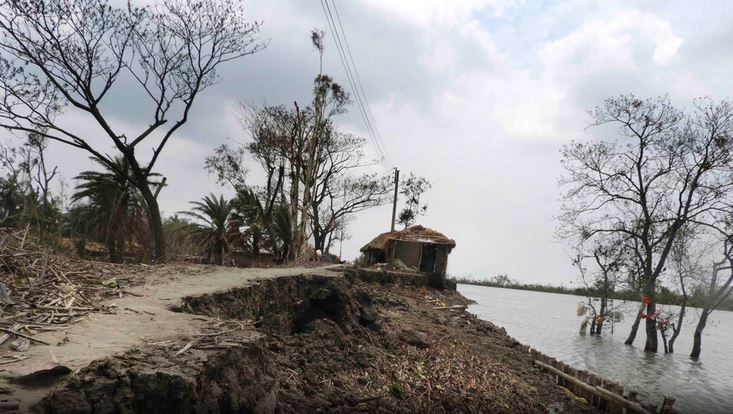
    • Heavy rainfall from a cyclone is usually spread over a wide area and cause large scale soil erosion and weakening of embankments.

    3) Storm Surge

    • A Storm surge can be defined as an abnormal rise of sea level near the coast caused by a severe tropical cyclone.
    • As a result of which seawater inundates low lying areas of coastal regions drowning human beings and life stock.
    • It causes eroding beaches and embankments, destroys vegetation and leads to the reduction of soil fertility.

    Some (unexpected) benefits

    Although Tropical cyclones are known for destruction they cause, when they strike they also bestow certain benefits to the climatic conditions of that area such as

    • Relieve drought conditions
    • Carry heat and energy away from the tropics and transport it towards temperate latitudes
    • Maintain a relatively stable and warm temperature worldwide

    Management of Cyclones in India

    In 2005, the country introduced new laws to set up what’s called the National Disaster Management Authority, a central agency charged with one thing: responding to and minimizing the impact of disasters.

    A year later, in 2006, India established a National Disaster Response Force (NDRF), a specialized corps of highly trained men and women focused on disasters such as cyclones and earthquakes. It’s now comprised of almost 25,000 personnel.

    Apart from institutional measures, there are many structural and non-structural measures  that have been taken for effective disaster management of cyclones:

    • The structural measures include construction of cyclone shelters, construction of cyclone-resistant buildings, road links, culverts, bridges, canals, drains, saline embankments, surface water tanks, communication and power transmission networks etc.
    • Non-structural measures like early warning dissemination systems, management of coastal zones, awareness generation and disaster risk management and capacity building of all the stakeholders involved.
    • These measures are being adopted and tackled on State to State basis under National Cyclone Risk Mitigation Project (NCRMP) being implemented through World Bank Assistance.

    Issues in cyclone mitigation

    • Post than pre focus: Disaster management in India is largely confined to post-disaster relief works. It is more about management than loss prevention.
    • Population: One-third of the population in India lives in the coastal area. Most of them are marginalized people who are ill-prepared and unable to cope up with a disaster.
    • Poor response: The warning of a cyclone is not properly communicated between the concerned agencies. In many cases, the warning is not taken seriously by the agencies which cause delayed effort for the prevention of a disaster. This was evident in the recent Ockhi cyclone disaster.
    • Lack of awareness: among people about the impact and magnitude of the disaster. Also what to act during and post disasters.
    • Coordination Issues:There is also a lack of coordination between the local communities for search and rescue missions. Also poor coordination state and center coordination and its agencies.

    What measures need to be taken for mitigation?

    Pre Disaster

    • Provide cyclone forecasting, tracking and warning systems
    • Construction of cyclone shelters, cyclone-resistant buildings, road links, bridges, canals, drains etc.
    • Establishing Early Warning Dissemination System (EWDS) and Capacity building for coastal communities.

    During disaster

    • Cautionary advice should be put out on social platforms urging people to stay safe
    • The perception of people decides the intensity of the disaster. If people take necessary proactive steps to deal with disaster then even the severe disaster can be dealt with minimum damage.
    • Delivery of food and health care via mobile hospitals, with priorities to women child & elders.
    • Protection of the community and their evacuation and quicker response.

    Post-disaster

    • It is vital that the learning from each event is shared nationally, and the capacity of officials and communities to manage disasters built continuously.
    • Among the securities available to individuals in many countries is insurance against property losses. Viable policies should be made available in India too.
    • Providing alternative means of communication, energy and transport just after the disaster.

    Odisha’s success in handling Cyclones

    • In the year 1999, Odisha faced a super cyclone which took almost 15000 lives. Since then, it started to build a robust disaster management system priority basis.
    • As the extremely severe cyclone Amphan inched closer, the Odisha government rolled up its sleeves and took all precautionary measures, including the evacuation of the people to meet its zero causality target.
    • Just as the IMD issued the warning, the Odisha government began its cyclone preparations which included evacuation, movement of people in low-lying areas and kutcha houses to cyclone shelters, safeguarding Rabi crops in mandis, deployment of ODRAF, NDRF teams, among other measures.

    Let’s learn from Odisha success Model

    1. Build a relief infrastructure

    • Until 1999, Odisha didn’t have a well laid out plan for disaster management. Two months after the cyclone hit, the Odisha State Disaster Management Authority was set up, and plans put in place.
    • Around 900 cyclone shelters have been built in vulnerable pockets of the state, with systems in place for the evacuation of hundreds of thousands of people.

    2. Accurate early warning systems

    • The IMD has built an effective service to predict accurate timings of cyclone formation in the Bay of Bengal and when it will make landfall along India’s coastline.
    • This early warning system enables the state to be disaster-ready and to minimize the loss of lives. It’s then crucial that people follow the protocols in place when the warnings come in.

    3. Clear communication plan

    • Roughly 2.6 m text messages were sent to locals in the clear language before cyclone Fani hit, keeping those potentially affected alert.
    • Regular press briefings were made by officials to update people of the approaching cyclone.
    • People were repeatedly advised over all forms of media not to panic and given clear “do and don’ts”. This helped in the record evacuation of 1.2 m people to safe buildings.

    4. Effective co-ordination of groups

    • Preparations to fight the onslaught should involve a number of government agencies, as well as local community groups and volunteers working together.
    • The government’s disaster response forces were pre-positioned in vulnerable locations, food packets for air-dropping were made ready for air force helicopters to drop to people.

    5. Protecting natural defenses

    • Mangroves as usual acted as a natural shield against the impact of cyclones and floods on the coastal areas.
    • Activists have been fighting for the cause of natural protectors like mangroves and salt pans even as flooding incidents regularly occur in the coastal region.

    India in line with Sendai Framework

    Preparedness to manage disaster risks is a continuous and integrated process resulting from a wide range of risk reduction activities. The preparedness not only involves coordinated planning, and reduces duplication of disaster response efforts but also increases the overall effectiveness of such efforts.

    • The Sendai Framework for Disaster Risk Reduction is the first major agreement of the post-2015 development agenda, with seven targets and four priorities for action.
    • It is a 15-year; voluntary, non-binding agreement that recognizes that the state has the primary role to reduce disaster risk but that responsibility should be shared with other stakeholders including the local government, the private sector, and other stakeholders.
    • In cyclone disasters (like Amphan, Fani), India presented a good example of its disaster preparedness and compliance to the Sendai Framework.
    • Zero casualty policy and the pinpoint accuracy of the IMD’s early warning system helped to reduce the possibility of deaths.

    Way Forward

    • India’s improved and timely forecast for cyclones gives the government opportunity and time to prepare and manage.
    • Better linkages between sectoral ministries and national disaster management authorities needed in countries when it comes to assessing disaster risks.
    • It is important to acknowledge the problem beyond disaster management framing and should be framed as an adaptation need.
    • Now the imperative for India is not only to have infrastructure that is resilient, functional and that can bounce back after a disaster, but also to have infrastructure withstand and be operational during a crisis.
    • For this India need to employ more technology, strict following of command structure, and most importantly the participation and cooperation of local communities in the affected area.


    Conclusion

    With the advent of climate change, tropical cyclones are not going ‘anywhere’, rather they are poised to become more frequent and accompanied by increased intensity. Regardless of state support and administrative help, people themselves have to step up to create local solutions using their own practices.

    In this regard, it is necessary to find ways to prevent the cyclones from becoming an unmanageable national disaster.


    References

    https://ncrmp.gov.in/cyclones-their-impact-in-india/

    https://vikaspedia.in/social-welfare/disaster-management-1/natural-disasters/cyclones

    https://www.thehindu.com/news/national/what-are-tropical-cyclones-and-super-cyclones/article31657893.ece

    https://scroll.in/article/963805/lessons-from-cyclones-amphan-and-nisarga-for-indias-disaster-management-plan

    https://ndma.gov.in/en/2013-05-03-08-06-02/disaster/natural-disaster/cyclones.html

    https://theconversation.com/indias-cyclone-fani-recovery-offers-the-world-lessons-in-disaster-preparedness-116870

    https://india.mongabay.com/2020/06/leverage-improved-forecast-to-deal-with-disasters/

    https://www.preventionweb.net/educational/view/5482

  • [Burning Issue] Reorienting MGNREGA in times of COVID


    Termed in a moment of hubris by present government as ‘“a living monument of UPA’s failures”, the government has fallen back on this Scheme in this moment of crisis. This piece is an attempt to understand the silent success of the Mahatma Gandhi National Rural Employment Guarantee Act (MGNREGA) which was allegedly dying a slow death.

    Context

    Due to the sudden lockdown and resultant job losses, over 1 crore people have returned to their homes, some walking hundreds of kilometres, others using all conceivable means of transport. A sizeable number may take several months to return to the cities and towns to earn a living. This extraordinary scenario of a pandemic poses a formidable challenge for the governments of the ‘home states’ to arrange suitable job opportunities for securing their livelihoods.

    In this bleak scenario, MGNREGA is providing a ray of hope.

    The mighty MGNREGA

    • The MGNREGA stands for Mahatma Gandhi National Rural Employment Guarantee Act of 2005.
    • This is labour law and social security measure that aims to guarantee the ‘Right to Work’.
    • The act was first proposed in 1991 by P.V. Narasimha Rao.

    The objectives of the MGNREGA are:

    • To enhance the livelihood security of the rural poor by generating wage employment opportunities.
    • To create a rural asset base which would enhance productive ways of employment, augment and sustain a rural household income.

    Anyways, what is so Unique about it?

    • MGNREGA is unique in not only ensuring at least 100 days of employment to the willing unskilled workers, but also in ensuring an enforceable commitment on the implementing machinery i.e., the State Governments, and providing a bargaining power to the labourers.
    • The failure of provision for employment within 15 days of the receipt of job application from a prospective household will result in the payment of unemployment allowance to the job seekers.
    • Employment is to be provided within 5 km of an applicant’s residence, and minimum wages are to be paid.
    • Thus, employment under MGNREGA is a legal entitlement.

    Constitutional goals of MGNREGA: The idealistic edge

    1) Implementation of DPSP

    • The MGNREGA aims to follow the DPSPs enunciated in Part IV of the Constitution of India.
    • The law by providing a ‘right to work’ is consistent with Article 41 that directs the State to secure to all citizens the right to work.
    • The statute also seeks to protect the environment through rural works which is consistent with Article 48A that directs the State to protect the environment.
    • It also follows Article 46 that requires the State to promote the interests of and work for the economic uplift of the SCs and STs and protect them from discrimination and exploitation.
    • Article 40 mandates the State to organise village panchayats and endow them with such powers and authority as may be necessary to enable them to function as units of self-government.
    • Conferring the primary responsibility of implementation on Gram Panchayats, the Act adheres to this constitutional principle.

    2) Implementation of FRs

    • In accordance with the Article 21 of the Constitution of India that guarantees the right to life with dignity to every citizen of India, this act imparts dignity to the rural people through an assurance of livelihood security.
    • The FRs enshrined in Article 16 of the Constitution of India guarantees equality of opportunity in matters of public employment.

    The REAL Issues crippling MGNREGA

    On ground, policies and schemes do depart from their idealistic purposes. Go through these Issues to understand HOW?

    1) Insufficient budgetary allocations – No Money!

    • MGNREGA’s success at the ground level is subject to proper and uninterrupted fund flow to the states.
    • Increase in the nominal budget but actual budget (after adjusting inflation) decreased over the years.
    • Rs 61,500 crore has been allocated for the MGNREGA for the year 2020-21, down by more than 13 per cent from the total estimated expenditure for 2019-20 which was at Rs 71,001.81 crore.

    2) Approved Labour Budget Constraints

    • The Centre through the arbitrary “Approved Labour Budget” has reduced the number of days of work and put a cap on funds through the National Electronic Fund Management System
    • According to Ne-FMS guidelines, states won’t be allowed to generate employment above the limits agreed by Approved labour Budget.

    3) Not so attractive wages rate

    • Currently, MGNREGA wage rates of 17 states are less than the corresponding state minimum wages.
    • The ridiculously low wage rates have resulted in a lack of interest among workers in working for MGNREGA schemes, making way for contractors and middlemen to take control, locally.

    4) Delay in wage (Not so attractive) payments

    • Under the MGNREGA, a worker is entitled to get his or her due wages within a fortnight of completion of work, failing which the worker is entitled to the compensation.
    • As of 2016-17, the total amount of wage pending is Rs. 11000 crore.
    • Even the Gram Rozgar Sevak, who is the backbone of the entire scheme, who works part-time, living in the same village, does not get paid on time.

    5) No-work situations are rising

    • None of the states was able to provide full 100 days employment as mentioned in the scheme.
    • Even though the scheme aims at providing 100 days of guaranteed employment, below 50 days of employment was actually provided an average at an all-India level in FY 18.

    6) Data manipulations by authorities

    • A recent study has found that data manipulation in the MGNREGA is leading to gross violations in its implementation.
    • Numerous ground reports across the country suggest that because of a funds crunch, field functionaries do not even enter the work demanded by labourers in the MGNREGA database.

    7) Non-purposive spending and corruptions

    • Many works sanctioned under MGNREGA often seem to be non-purposive.
    • Quite often, they are politically motivated hotspots to create rampant corruption by dominant sections of the local population.
    • Even social audits of such projects are locally manipulated.

    8) Workers penalized for administrative lapses

    • The ministry withholds wage payments for workers of states that do not meet administrative requirements within the stipulated time period (for instance, submission of the previous financial year’s audited fund statements, utilization certificates, bank reconciliation certificates etc).
    • There is no logical or legal explanation for this bizarre arrangement. It is beyond any logic as to why workers would be penalized for administrative lapses.

    9) Genuine job cards being deleted

    • Genuine job cards are being randomly deleted as there is a huge administrative pressure to meet 100 per cent DBT implementation targets in MGNREGA.
    • In states like Jharkhand, there are multiple examples where the districts had later requested to resume job cards after civil society interventions into the matter.

    10) Too much centralization weakening local governance

    • A real-time MIS-based implementation and a centralised payment system has further left the representatives of the Panchayati Raj Institutions with literally no role in implementation.
    • It has become a burden as they hardly have any power to resolve issues or make payments.

    11)  Local priorities being ignored

    • MGNREGA could be a tool to establish decentralized governance. But, with the administration almost dictating its implementation, it is literally a burden now for the people and especially for the local elected representatives.
    • The Gram Sabhas and gram panchayats’ plans are never honoured. This is a blatant violation of the Act as well.

    Dark Knight Rises: MGNREGA in times of COVID

    Within days, India has realized, political friend and foe alike, right-wing egotist and left-wing activist alike, that the world’s largest social welfare scheme, operationalised by UPA 1 in 2006 is a rare lifeline, almost as if designed for times of extreme adversity.

    The importance of the MGNREGA scheme is now accepted by one and all. No wonder that with its hands tied due to Covid-19 crisis the state governments are struggling to ensure remunerative work in villages for the large workforce.

    The central government, too, after considering all options and in order to provide job support to the large workforce which has or is reaching native villages, has acted rationally and announced another Rs 40,000 crore allocation for the MGNREGA scheme.

    Highest registrations

    • MGNREGA data shows that job demand this May was the highest in eight years even as all the data for May is still pouring in.
    • Over 45 crore person days have been generated (2.63 crore households and 3.6 crore individuals have worked) in the 45 days of 2020-21 since works began on April 20.
    • Traditionally, the months of May and June have always witnessed the highest NREGA work demand because is the lean agriculture season after Rabi harvest and before Kharif sowing.

    Only viable option available

    • MGNREGA appears to be the primary hope of sustaining livelihood in almost all states the during a time of massive reverse migration due to the lockdown imposed in light of COVID-19.
    • MGNREGA is the only viable option at present to provide relief and work to the labourers.

    Some innovation in MGNREGA that can go a long way

    1) Looping in the skilled worker

    • First, there is a suggestion to use it to meet the wage cost of their employment in small and medium enterprises (SMEs).
    • Accordingly, skilled migrant workers may be placed in SMEs and their wages would be charged to MGNREGA.

    2) Including farm related works

    • In the last few years, un-remunerative prices of several crops have been the root cause of widespread agrarian distress.
    • The suggestion is to allow farmers to employ MGNREGA workers in agricultural operations like land preparation, sowing, transplantation of paddy, plucking of cotton, intercultural operations and harvesting of crops etc. so as to reduce the cost of cultivation.
    • The idea is to pay part of the wages of labour in agricultural operations from MGNREGA.

    3) Increasing the number of Work Schemes

    • Currently, there are only 2-3 work schemes (say PMAY) running per panchayat, which is leading to the crowding of workers at worksites.
    • To prevent this and to ensure that all willing households are able to access employment through NREGA, the number of schemes needs to be increased, and 6-8 schemes must be introduced in each village.

    4) Paying Workers Immediately

    • Rural households urgently need cash-in-hand, and so the emerging demand is for immediate payment to workers. NREGA payments are frequently delayed by weeks or months.
    • Given the circumstances, such delays will be entirely counterproductive.
    • It is recommended that in remote areas, wage payments should be made in cash, and paid on the same day.

    5) Modify Daily Workloads

    • In compliance with COVID-19 guidelines, workers are wearing masks and other forms of face protection.
    • NREGA works typically involve hard physical labour and workers are finding it challenging to breathe comfortably while working.
    • Consequently, for as long as workers are required to wear masks, the daily volume of work assigned to them must be reduced.

    6) By increasing Wages

    • If NREGA wages are to effectively support rural households as they cope with this crisis, they must, at a minimum, be at par with states’ agricultural wages.
    • For example, the Government of Odisha has increased the daily-wage rate for unskilled manual work under NREGA to INR 298 per day in its 20 migration-prone blocks.

    7) Increase budgetary allocations

    • The central government’s budgetary allocation of INR 61,500 crore to NREGA for FY 2020-21 is inadequate..
    • An additional Rs 1 lakh crore needs to be allocated so that NREGA can act as a safety net and help rural households cope with the devastating impact of the lockdown.

    Way Forward

    • Large scale social security programmes like MGNREA are subjected to undergo several stumbling blocks in the times of ongoing pandemic.
    • Government and NGOs must study the impact of MGNREGA in rural areas so as to ensure that this massive anti-poverty scheme is not getting diluted from its actual path.
    • Since the adverse impact of the COVID-19 pandemic on employment is going to persist in 2020-21, government can ensure more effective implementation and strengthening of the oversight of MGNREGA through mandated social audit.
    • The scheme is not only an ocean of possibilities for the jobless migrants, but it has also given the Central government a chance to get a second bite at the cherry after the devastating economic and job creation figures now officially out for FY 2019-20.

    At this point in time what is needed is neither dismantling of the programme nor its slow suffocation.

    Conclusion

    This week the entire nation saw how teachers in Jaipur started working as MGNREGA labourers amid the pandemic. Unfortunate and not to be celebrated, it nevertheless underlines the importance of MGNREGA as a ray of hope amidst extreme darkness.

    This article has attempted to convey the transformative power of MGNREGA, particularly at a time of economic stress.

    To be clear, MGNREGA cannot substitute deeper and systemic efforts to generate jobs; nor can it address structural weaknesses in the economy. The need of the hour is for the Government to place MGNREGA at the heart of its strategy to tackle this economic emergency.

    The Economic Survey of 2019-20 suggested that MGNREGA offers an early warning signal to detect rural distress. We can help by changing the narrative that has for too long maligned MGNREGA.

    We must view MGNREGA as an opportunity and explicitly include it in a broad-based strategy to tackle the current economic crisis.


    Think!

    If the idea is to provide work to anybody demanding it, there should, in principle, be no restrictions on the kind of activities allowed under this scheme. If higher material component helps in building more assets with durable quality, why cannot these projects qualify under the MGNREGA? Why tie it down to particular “permitted works”? What stops MGNREGA labour from being used even to undertake railway or national highway work?


    References

    https://thewire.in/government/mgnrega-wage-payment-delays

    https://www.theindiaforum.in/article/continuing-relevance-mgnrega

    https://www.downtoearth.org.in/blog/economy/mgnrega-is-failing-10-reasons-why-62035

    https://thewire.in/economy/mgnrega-rural-india-farmers

    https://indianexpress.com/article/opinion/editorials/mgnrega-demand-rural-labours-migrant-workers-coronavirus-6441371/

    https://www.thequint.com/news/india/how-nrega-can-help-rural-areas-in-times-of-covid-19-distress

  • [Burning Issue] COVID-19 and its Impact on Agriculture

    Farmers in India constantly battle against skewed monsoon and erratic rainfall, extreme natural events, interrupted supply chains and rising inflation. Like this was not enough. These troubles now are supplemented this year by the COVID induced lockdowns and the heralding Locusts Attack!

    God bless our Annadatas!

    Context

    The start of the coronavirus pandemic has coincided with the peak harvesting season. As the markets are locked down, there is a threat to the crop in over 100 lakh hectares in the country.

    Even among the different segments, the impact varies widely among different regions and among producers and agricultural wage labourers. This impact will reverberate across the larger economy and will linger longer than a few months.

    Issues surfaced after COVID pandemic

    In spite of all the measures and in view of continuing restrictions on movements of people and vehicular traffic, concerns have been raised regarding negative implications of COVID19 pandemic on the farm economy. The immediate problems in agriculture at the moment are primarily categorized under two heads:

    A. Impact on Global Agriculture


    1) Crop production and availability of seeds

    • For crop production, the largest part of the seeding process will be almost unaffected between now and the summer.
    • So there would be no impact as such on seeds availability for now.
    • But if the same scenario continues till year end, then surely seed availability can be an issue.

    2) Fertilizers shortage

    • Due to global trade disturbance, farmers are facing the shortage of agricultural inputs like fertilizer and pesticides.
    • In a shorter span, there is little shortage to be expected.
    • In the longer term, the delivery of fertilizer via international markets may become a problem since some of the production plants in China have been shut down.

    3) On food production and distribution

    • Most of the countries have taken measures such as home confinement, travel bans and business closure to control the rate of infection.
    • Agriculture produce is mostly perishable in nature, so farmers are compelled to hold their unsold produce for a longer period of time.
    • This has led to a reduction in food quality as well as an increase in the cost of production.

    4) On livestock

    • Different agricultural sector such as  livestock and fishery have been hit hard by the pandemic.
    • In India, COVID-19 has caused a higher impact on livestock farming due to limited access to animal feed and a shortage of labour.
    • For example, the travel ban has affected the delivery of breeding stock of poultry.

    5) On workers

    • Agricultural workers in low and middle-income countries lack proper health services and social protection and due to little saving or no saving.
    • Many informal workers in agriculture are obligate to work for their sustenance despite the self-isolation protocol during COVID-19 pandemic.

    6) Impact on food demand and food security

    • The demand for food has affected due to reduction in income and purchasing capacity.
    • Panicked Consumers are stock piling the foods which in turn has affected the food availability and price.
    • Due to the decline in international trade, disturbance in food supply chain and food production, food insecurity may arise.

    B. Impact on India

    Agriculture contributes about 17 per cent to Indian GDP. Agriculture, with its allied sectors, is the largest source of livelihoods in India. 70 percent of rural households still depend primarily on agriculture for their livelihood.

    1) Peak harvest with no procurement

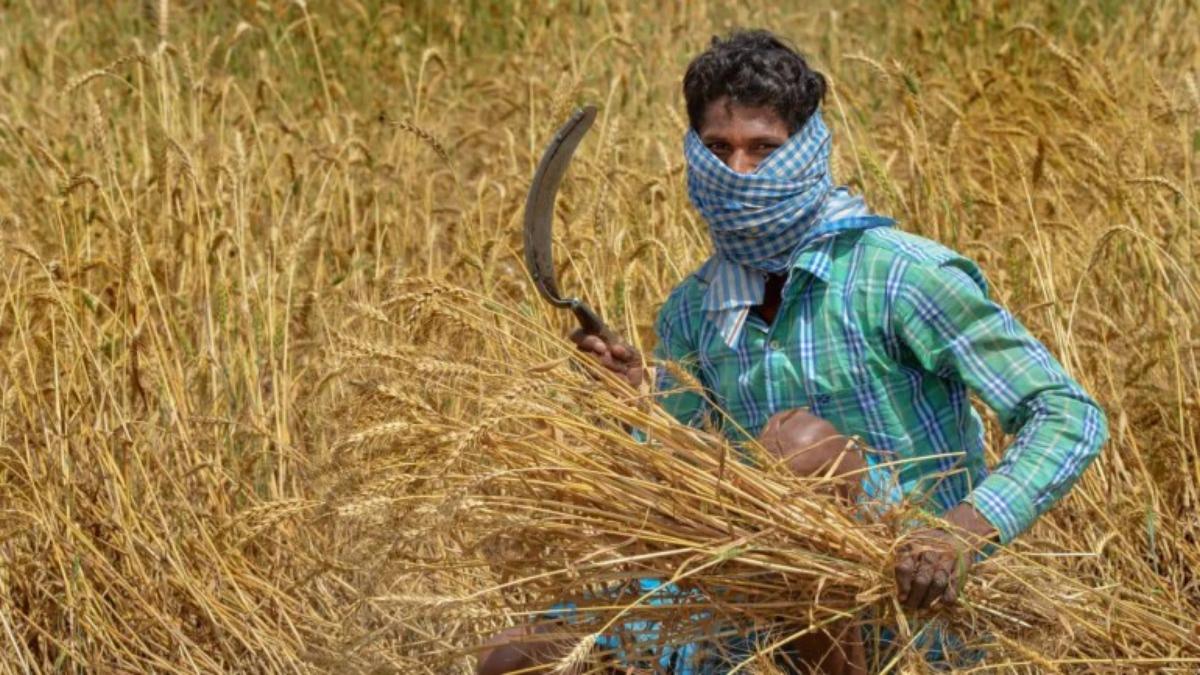
    • This is the peak of Rabi season in India and crops like wheat, gram, lentil, mustard, etc. (including paddy in irrigated tracts) were at a harvestable stage or almost reaching maturity.
    • This is also the time when the farm harvests reach the mandis for assured procurement operations by designated government agencies.

    2) Labour unavailability due to reverse migration

    • The non-availability of labour has hurt operations in many parts.
    • Consequently, the shortage of migrant labour has resulted in a sharp increase in daily wages for harvesting crops.
    • Some parts of agriculture that have the luxury of deploying technology for harvestings, like Paddy and Wheat, are relatively more insulated since they often do not have to depend on large numbers of manual labour.

    3) Fall in prices

    • Agricultural prices have collapsed due to lack of market access including the stoppage of transportation and closure of borders.
    • The rise in labour costs and lack of access means that farmers are staring at huge losses and hence allowing crops to rot in the fields, a better ‘stop-loss’ mechanism.

    4) Scarcity of public goods

    • Making the food grains, fruits and vegetables and other essential items available to consumers, both in rural and urban areas, is the most critical challenge.
    • Transportation of public distribution system (PDS) items to last-mile delivery agents, by both rail and road, has been severely impacted in the beginning.

    5) Restrictions on Sale

    • There were self-imposed restrictions on the inter- and intra-State movements of farmers/labourers, as well as harvesting and related farm machines.

    6) Disruptions in supply-chain

    • The absence of transport facilities clubbed with vigilant blocking roads has a limiting effect on the movement of migratory harvest labour and agri-machinery.
    • Also, trucks and tractors are not inclusive of ‘farm machinery’ by definition..

    7) Lockdown induced debt and Cash Flow Constraints

    • The most important issue that farmers have to surmount is the problem of repaying their crop loans, gold loans and other informal debts.
    • Crop loans are repaid between April and May and a fresh loan is granted at the onset of a new season.
    • Any failure to do so will mean that they will be forced to borrow money from the informal sector at high rates of interest for the new season.


    Impact on Food Security

    • Border closures, quarantines, and market, supply chain and trade disruptions are restricting people’s access to sufficient/diverse and nutritious sources of food, especially in countries hit hard by the virus or already affected by high levels of food insecurity.
    • In slowdown times, as demand for food will decrease over the next months, prices should go down in 2020, and this will have a negative impact on farmers and the agricultural sector.
    • As of now, disruptions have been minimal as food supply has been adequate and markets have been stable so far to meet the ongoing demands (though skewed)..

    Indian response to Covid: Agriculture version

    The Center and State Governments have worked in harmony to redress the grievances of farmers. Both have introduced a series of measures every day such as subsidies, including crop insurance to farmers, free flow of agricultural credit, unemployment allowance to rural landless/migrant workers under MANREGA, etc.

    The govt. is using every arrow in its quiver to ensure the health of farmers by continuously sensitizing the farmers about working in fields with covered faces while maintaining social distancing.

    In order to reinforce a zero hurdle harvest season, the govt has exempted the movement of farm machinery from lockdown.

    1) Reforms in e-NAM

    • The new features of National Agriculture Market platform were introduced as a welcoming move to decongest mandis.
    • They aim to strengthen agriculture marketing by reducing the need for farmers to physically access the wholesale mandis for selling their harvested produce.

    2) Technological support

    • Kisan Sabha App developed by CSIR to connect farmers to supply chain and freight transportation management system was recently launched to support farmers during the lockdown.
    • The app aims to provide the most economical and timely logistics support to the farmers and increase their profit margins by minimizing the interference of middlemen and directly connecting with the institutional buyers.
    • Kisan Rath app was also launched to facilitate farmers & traders in searching for transport vehicles for movement of Agriculture & Horticulture produce.

    3) Boost to Contract farming

    • Various states have promoted innovative model allowing investors and farmers to enter into an agreement for contract farming in view of the continuing uncertainties due to the pandemic.
    • For example, the Consumer-Farmer Compact in Telangana has been ensuring food availability and access in COVID-19 times.
    • In this system, the consumers support farmers with their agricultural needs; in return, farmers ensure consumers are able to access food in a hassle-free manner.

    4) Allocations for direct transfers

    • Increasing the allocations for DBT to farmers through PM KISAN and including everyone who is actively undertaken during the lockdown.
    • This has helped most farming families to be partially compensated for the losses seen in months of March and April.
    • It has provided them with some cushion against the deflationary effect seen on farm-prices due to the prolonged lockdown.

    Future scope of reforms

    1) Focussing on Alternative Market Channels

    • The alternative market channel works on the principles of decentralisation and direct-to-home delivery.
    • The idea is to create smaller, less congested markets in urban areas with the participation of farmers’ groups and Farmer Producer Companies (FPCs) so that farmers have direct access to consumers.
    • It may provide a valuable option against the lockdown when efforts to avoid crowding in the wholesale markets are likely to continue.

    2) Reforming APMC

    • With these reforms, the government has also set in motion plans to dismantle the decades-old monopolies of state-run APMCs, that were often blamed for unfair trading, and had become a barrier for farmers to get a fair price on their produce.
    • There is an urgent need for abolishing or reframing the APMC Act and encourage direct buying of agri-produce from farmers/farmer producer organisations (FPOs).
    • The companies, processors, organised retailers, exporters, consumer groups, that buy directly from FPOs need not pay any market fee as they do not avail the facilities of APMC yards.

    3) Designating warehouses as markets

    • The warehouse receipt system can be scaled up.
    • The private sector should be encouraged to open mandis with modern infrastructure, capping commissions.

    4) Logistics transformation

    • To sustain the demand for agricultural commodities, investments in key logistics must be enhanced.
    • Moreover, e-commerce and delivery companies and start-ups need to be encouraged with suitable policies and incentives.
    • The small and medium enterprises, running with raw materials from the agriculture and allied sector or otherwise, also need special attention so that the rural economy doesn’t collapse.

    5) Institutionalizing farm labour

    • To obviate the immediate concerns of the scarcity of farm labour, policies must facilitate easy availability of machinery through state entities, Farmer Producer Organizations (FPOs) or custom hiring centres (CHCs) with suitable incentives.
    • It is also suggested to explore leveraging NREGS funds to pay part of the farm labour (with farmers paying the balance wage amount) to lessen the monetary burden on the farmer while ensuring wage employment to the landless labourers and workers.

    6) Expanding institutional lending

    • As the Kharif (rainy/wet) season is fast approaching, institutional lending of crop loans should be expanded and facilitated for smooth (and sufficient) flow of credit to borrowing farmers.
    • Agri-inputs – seeds, fertilizers, agro-chemicals, etc. – have to be pre-positioned for easy availability. The private sector must play a significant role in necessary policy support.

    Future of Agriculture in India

    Indian agriculture is in a way, a victim of its own past success – especially the green revolution…..

    1) Farming as a Viable Livelihood

    • Agriculture is dying, not as in the production of food but as a desirable profession.
    • One bad yield, whether due to errant rains, pests, etc., and most farmers have no buffer available.
    • The last point worth considering is that food and agriculture are not the same. Expenditures on food span the value-add, including processing, preparation, service in restaurants, etc.
    • Farmers in India merely get paid for their product and not for the food we eat.

    2) Rainbow revolution holds the key

    • The first major barrier to overcome is declining productivity.
    • Data reveals that India’s average yield of cereal per hectare is far less than that of many countries. Further, there is a huge inter-regional variation.
    • In order to cross the declining productivity barrier, there is a need to herald a rainbow revolution by making a shift from the wheat-rice cycle to other cereals and pulses.
    • However, this is not sufficient and has to be complemented with a huge investment in public infrastructure.

    3) Per drop more crop

    • The second major barrier is the scarcity of two major resources for agriculture – cultivable land and water.
    • While the cultivable land per person is declining because of the fragmentation of farms due to the rising population.
    • India also has much less per capita water available  as compared to other leading agrarian countries.
    • Given this scenario, it is time to make a shift to micro-irrigation so that the efficient and judicious use of scarce water resources can be made.

    4) R&D is the future

    • One of the major barriers to boosting farm productivity is the lack of new technologies and major breakthroughs post the green revolution.
    • While the National Agriculture Research System played a major role in the green revolution, in recent years there hasn’t been any major breakthrough in research.
    • One of the main reasons for this is the lack of financial resources.
    • There has also not been any major contribution from the private sector towards research and development.
    • The government should thus woo private players by giving them incentives to play a major role in agricultural research and development.

    Way Forward

    • With a burgeoning population, there is a corresponding rise in food demand in India.
    • A post-COVID situation offers that unique opportunity to repurpose the existing food and agriculture policies for a healthier population.
    • India, being trade-surplus on commodities like rice, meat, milk products, tea, honey, horticultural products, etc. may seize the opportunities by exporting such products with a stable agri-exports policy.
    • Development of export-supportive infrastructure and logistics would need investments and support of the private sector that will be in the long term interests of farmers in boosting their income.
    • This is indeed good news in the COVID scenario, assuming agriculture can practice largely unscathed.
    • Designing agricultural policies, post-COVID scenario, must include these imperatives for a food systems transformation in India.
    • Immediately, the govt. should focus on the coming Kharif cropping season, especially ensuring timely availability of seeds, fertilisers, pesticides, credit and other inputs.

    Conclusion

    Structural reforms such as land leasing, contract farming and private agricultural markets, etc. have long been advocated to bring enhanced investments into the agriculture sector and to push its growth. However, there has not been the uniform implementation of these legislations by State Governments and so the full potential of the sector is unrealized. These reforms need significant political will.

    The end of the lockdown will not end the problems. On the contrary, they are likely to be compounded at the onset of the new agricultural sowing season. There is a greater need for government support in the form of support for other agricultural inputs. Lack of any relief will only make the agricultural crisis worse. The need of the hour is to maximise possibilities of agriculture, which has demonstrated its utility and resilience in trying times.


    References

    https://www.civilsdaily.com/news/alleviating-the-farmers-pain/

    https://www.icrisat.org/containing-covid19-impacts-on-indian-agriculture/

    https://www.deccanherald.com/opinion/covid-19-impact-on-agriculture-varied-and-devastating-828390.html

    https://indianexpress.com/article/opinion/editorials/india-agriculture-sector-crisis-corona-impact-on-farmers-niti-aayog-6392233/

    https://www.civilsdaily.com/story/agricultural-marketing-reforms/

    https://thewire.in/agriculture/what-is-the-future-of-agriculture-in-india

    http://www.fao.org/2019-ncov/q-and-a/impact-on-food-and-agriculture/en/

  • [Burning Issue] National Security Law debate in Hong Kong

    Hong Kong is burning again. Last year it was Fugitive Offenders Amendment bill, now it’s National Security Law. This anthem bill criminalises insulting China’s national anthem. No, this is not like the same dictum given to us by Supreme Court to stand up in multiplexes. But people actually fear that this law will take away Hong Kong’s basic freedoms.

    Context

    Chinese lawmakers have approved a proposal for sweeping new national security legislation in Hong Kong, which democracy advocates say will curb essential freedoms in the city.

    About Hong Kong

    • A former British Colony and Autonomous Territory: Hong Kong is an autonomous territory, and a former British colony, in southeastern China.
    • It became a colony of the British Empire at the end of the First Opium War in 1842.
    • Sovereignty over the territory was returned to China in 1997.
    • Special Administrative Region (SAR): As a SAR, Hong Kong maintains governing power and economic systems that are separate from those of mainland China.
    • The 1984 Sino-British Joint Declaration guarantees the Basic Law for 50 years after the transfer of sovereignty.
    • It does not specify how Hong Kong will be governed after 2047.
    • Thus, the central government’s role in determining the territory’s future system of government is the subject of political debate and speculation in Hong kong.

    The ‘Basic Law’

    • One country, two systems: Hong Kong is a Special Administrative Region (SAR) of China.
    • It has observed a “one country, two systems” policy since Britain returned sovereignty to China on July 1, 1997, which has allowed it retain certain freedoms, the rest of China does not have.
    • Basic Law: It is governed by a mini-constitution called the Basic Law – constitutional document is a product of the 1984 Sino-British Joint Declaration.
    • Under this, China promised to honour Hong Kong’s liberal policies, the system of governance, an independent judiciary, and individual freedoms for a period of 50 years from 1997.

    Why is Hong Kong fuming?

    • The handover agreement gave Hong kong special freedoms of press, speech, and assembly for at least 50 years.
    • These freedoms stand in stark contrast to China’s strict censorship and Jinping’s tight grip on power, which have seen dissidents jailed and interrogated in secret prisons.
    • This is why protesters here are desperate to protect their freedoms — because they fear Hong Kong to become just another Chinese city under Xi’s rule.

    China vs. Basic Law

    • Mini-constitution: Hong Kong’s mini-constitution, the Basic Law, says that ultimately both the leader and the Legislative Council should be elected in a more democratic way – but there’s been disagreement over what this should look like.
    • China dominated system: The Chinese government said in 2014 it would allow voters to choose their leaders from a list approved by a pro-Beijing committee, but critics called this a “sham democracy” and it was voted down in Hong Kong’s legislature.
    • Issue: The new proposal is also controversial because it is expected to circumvent Hong Kong’s own law-making processes – leading to accusations that Beijing is undermining Hong Kong’s autonomy.

    Why Hong Kong matters for China?

    • Legitimacy to PLA: The handover of Hong Kong by Great Britain was a major achievement of the CCP and had helped boost the party’s legitimacy.
    • Extending nationalism: The handover strengthened nationalism debates within Chinese society and was perceived as righting the wrongs of the century of humiliation.
    • Since 1978, the basic tenet of the CCP has been reform and liberalisation of the economic sphere and command and control of the political sphere.
    • Political reform (So-called): Today, after more than 40 years of reform, mainland China is yet to witness any breakthrough in political reform.
    • Beijing expects other countries to acknowledge that there exists only one China.

    The National Security Law

    • Under Article 23 of the Basic Law, Hong Kong has to enact a national security law “to prohibit any act of treason, secession, sedition, and subversion against the Chinese government.”
    • When the Hong Kong government first tried to enact the law in 2003, the issue became a rallying point for the city-wide protests which occurred that year.
    • Since then, the government has steered clear of introducing the legislation again.

    Unrest in Hong Kong

    • Banning Sedition: The new law would ban seditious activities that target mainland Chinese rule, as well as punish external interference in Hong Kong affairs.
    • Many expect a revival of the protests that rocked the city last year.
    • China, on the other hand, has sought support and understanding of India and other countries for its controversial decision as a precautionary measure.

    Rise of Taiwanese aspirations and Domino Effect

    • The upsurge in Hong Kong’s pro-democracy movement is more closely linked to the developments in Taiwan than is commonly acknowledged.
    • The Taiwanese election results have given hope to the pro-democracy supporters in Hong Kong.
    • However, to imagine that Beijing will stop interfering in the territory’s domestic sociopolitical space is perhaps over-optimistic.
    • National unity and the “One China Principle” are core issues of the Chinese communist party (CCP).
    • Hong Kong, however, is already seen as a part of China under the “one country, two systems” formula.

    implications of the Security Law across the globe

    China’s authoritarianism stands exposed in Hong Kong and its assertiveness seriously damages its soft power. The developments in Hong Kong, therefore, have global consequences for Beijing’s search of power and legitimacy.

    On Hong Kong

    • Hong Kong is a global financial hub – so a hit to its economy affects business worldwide as well.
    • Experts warn that if the unrest continues, international companies could look to pull out of Hong Kong and relocate their branches elsewhere.
    • The stock market would likely crash, followed by the housing market. A mass exodus could follow, and other countries could see migrants’ incoming from Hong Kong.
    • Many Hong Kongers hold foreign passports, a legacy of 1997, and it is easy for them to move overseas.
    • On a more abstract level, some people have framed the unrest as a tug-of-war between Chinese authoritarianism and the Western ideals of freedom and democracy.

    India’s concerns

    • India and Hong Kong have signed a double taxation avoidance agreement (DTAA).
    • It gives protection against double taxation to over 1,500 Indian companies and businesses that have a presence in Hong Kong.
    • Hong Kong is similarly host to a large number of Indian companies and professionals in banking, IT and shipping.
    • India was Hong Kong’s third-largest export market (after China and the US) in 2017 and Hong Kong was India’s third-largest export market (after the US and the UAE).
    • Hong Kong has a very well established Indian diaspora and has much wealth and business influence within the territory.

    India and Chinese diplomatic take(Informal take)

    • Possibly due to its leadership’s idolization of communism, India for long-neglected the basic principle of reciprocity in its relationship with China.
    • India has consistently upheld the “One China” policy. It was one of the first countries to recognise Tibet as a part of China.
    • Today, India is a democracy and only has to deal with the Kashmir issue.
    • But China is facing resistance movements in Tibet, Xinjiang and Southern Mongolia. Hong Kong and Taiwan, too, remain a concern for Beijing.
    • This makes Delhi’s One-China policy lopsided in terms of diplomacy.
    • China expects India to remain silent on 60 per cent of the contested area under China’s territorial control, and also Hong Kong and Taiwan, while China refuses to stand with India only on Kashmir.

    Way forward

    • China and India should never let their differences shadow the overall bilateral ties and must enhance mutual trust.
    • India’s firm military and diplomatic posturing for the ongoing border dispute has made it clear to Beijing that India is in for the long haul.
    • Given its own problems at home and the focus on Hong Kong over the coming days, de-escalation on its borders with India suits China well.

    Conclusion

    China under Xi’s leadership is one of the most assertive and aggressive powers the world has encountered in a long time. Hong Kong’s protest has been continuing for a long time now. Not just Hong Kongers but even India feels the heat of Dragon’s assertiveness on borders. No one knows the result yet but it is going to be long fight that is for sure.


    References

    https://www.civilsdaily.com/news/how-china-is-seeking-more-control-on-hong-kong/

    https://www.bbc.com/news/world-asia-china-48607723

    https://www.epw.in/engage/article/hong-kongs-basic-law-and-history-popular-protest

    https://swarajyamag.com/world/as-china-seeks-support-on-hong-kong-india-has-the-opportunity-to-revive-relations-on-new-terms

    https://www.livemint.com/Politics/IiMAWzG8C7MRi85S9OSoUO/Hong-Kong-can-be-Indias-gateway-to-China-Gautam-Bambawale.html

    https://www.orfonline.org/expert-speak/china-revisionism-hongkong-india-borders-67086/

  • [Burning Issue] Rise of Economic Nationalism

    “Globalization presumes sustained economic growth. Otherwise, the process loses its economic benefits and political support.”

    Paul Samuelson

    Context

    Guess what Corona virus pandemic did that even Soviet union could not? It has shown the world decaying of the capitalist system. Spread of the virus has lead to various forms of lock downs across the globe. This caused multiple problems in economic globalisation to erupt, which made each country look to the protection of its “own” economy. Now this funda of “own” economy and local over global is what we will focus upon. So stay tuned.

    Is it the end of Globalization?

    Globalization As We Know It Is Dead - Bold Business

    One of the devastating impacts of Covid-19 will be that nations are going to look even more inwards. Rather than look beyond its borders, nations will focus on their narrowly-defined national interests.

    • Reflecting on the debate on globalization, one may wonder whether the world was entering a new, uncharted territory or if Covid-19 was simply accelerating a push-back against globalization that has been taking place for some time with the rise of economic nationalism across countries.
    • Here’s a hint: Globalization has undeniably been in retreat for some years now and the coronavirus pandemic is likely to exacerbate this process.

    Dawn of Economic Nationalism

    What is Economic Nationalism?

    • Economic nationalism, also called economic patriotism and economic populism, is an ideology that favours state interventionism over other market mechanisms.
    • It connotes not only controls of external relations, but also to mobilize internal resources.
    • It tends to see international trade as zero-sum, where the goal is to derive relative gains (as opposed to mutual gains).

    What happens in a nationalist economy?

    • Economic nationalism tends to emphasize industrialization (and often aids industries with state support), due to beliefs that industry has positive spillover effects on the rest of the economy, enhances the self-sufficiency and political autonomy of the country, and is a crucial aspect in building military power.
    • It imbibes policies such as domestic control of the economy, labour, and capital formation, even if this requires the imposition of tariffs and other restrictions on the movement of labour, goods and capital.

    Its evolution – A walk into the past

    • References to economic nationalism appeared initially in the years following World War I when the international economy was subjected to high stress arising out of the economic and political dislocation inherited from the war.
    • A similar explanation of the term followed after the Second World War.
    • In this period, economic protectionism was seen as an alternative to revive damaged economies after the world war.
    • The role and status of the ‘state’ emerged to be essentially important in managing economic affairs. The Soviet Union presented a model where state planning was central.
    • Under this model where the state has been the prime facilitator of, means of production and distribution, the public, as well as the private sector, growing at the same rate.
    • This model consolidated the idea of economic nationalism against that of western inherited capitalism.

    Facets of Economic Nationalism: “ME FIRST”

    Proof that economic Nationalism existed way before the COVID era.

    1) American Protectionism

    • America First: USA remains the main proponent of economic nationalism, under the “America First” doctrine of the Trump administration.
    • US-China Tussle: Trade war had been launched through the imposition of tariffs and China’s plan for economic and technological development had been declared an existential threat to US national security.
    • It has been accompanied by a series of bans on Chinese telecom companies and the launching of a global campaign by the US to have its allies exclude the Chinese company, Huawei, from the development of 5G networks.

    2) Chinese Expansionism

    • China’s strategy is, of course, no different than the one pursued by the US.
    • Backed by its great economic and military might, China seeks to achieve the same objectives using its economic prowess and its pole position in the global manufacturing chain to achieve the said objectives.
    • The ambitious ‘Belt and Road Initiative’ is the testimony of its economic nationalism.

    3) EU contractionist tendencies

    • Brexit: Classic example of economic nationalism.
    • Europe, too is taking a turn towards economic nationalism.
    • Many EU countries have been vocal as saying “in the long term we cannot depend on Asia, on China for goods that are strategic for us, whether in the aerospace or medical sectors or in other supply chains.”

    4) India’s ‘self-reliance’ Mantra of being ‘Vocal about Local’

    • When PM romped to a massive and decisive victory in 2014, neo liberal globalists believed that India would unflinchingly embrace globalisation and undertake economic reforms.
    • Indeed, at global forums, India often batted for economic globalisation, slammed rising trade protectionism.
    • The late Arun Jaitley, in his 2018 budget, admitted to this when he made a “calibrated departure” from the decades-long policy of cutting tariff rates.
    • But there has been a bit of economic nationalism here as well.
    • The resolve to augment domestic manufacturing in India – ‘Make in India’ campaign is a case for local over global.
    • Earlier, India chickened out at the last minute from joining the 16 members RCEP agreement to protect local industry.
    • Likewise, the central government has decided that it will not buy goods or services valued less than 200 crore rupees from global companies.
    • The recent amendment of the FDI rules by India so as to discourage Chinese investment in India – something that may not be consistent with India’s WTO obligations – also smacks of protectionism.

    Why there is a rise in the popularity of Economic Nationalism?

    • Not all countries benefited equally from the economic liberalism of the 1990s. It had its winners and losers.
    • National economic recoveries, i.e., nationalistic interests, have proved out to be paramount in the worldwide pandemic.
    • Economic nationalism to some extent can provide the framework within which economic development is possibly providing a way for savings to accumulate and investment to grow.
    • Goods when made locally help to protect local entrepreneurs, reduce imports and one can attract foreign investment.

    Issues with Economic Nationalism

    • Becoming too nationalistic at the expense of one’s trading partners can be counterproductive.
    • It is an approach that creates conflict. Being more nationalistic tends to be a zero-sum game in an increasingly interdependent world economy, where countries depend on other countries for their economic and political and national security well being.
    • When companies cooperate, they can become more competitive.
    • When they are more competitive, they hire more workers, pay higher salaries, and otherwise contribute to economic growth.
    • ‘Vocal about local’ epitomizes this trade protectionism and pushes a flawed and oversimplified economic logic that domestic manufacturing can be resurrected by actively encouraging (even forcing) customers to buy products ‘made in India’.
    • However, the policy measures adopted to achieve this goal are unsound as they mark a relapse to protectionism.
    • India’s economic experience of the first four decades after independence amply demonstrates that a protectionist and a highly controlled economic model do not yield a competitive and proficient manufacturing sector.

    Analysis from India’s perspective

    The government evidently wants to strengthen local businesses and make them globally competitive so that India can become the next manufacturing hub, like China. The prime minister has perhaps taken the disruption caused by the pandemic as an opportunity to push India towards developing its manufacturing prowess and emulate China’s export-driven rise.

    Economic Nationalism – chequered past in India

    • Era of license-permit raj, umbrella of protectionism and import substitution lead to lack of competition and inefficiency in domestic businesses.
    • The economy suffered a distortion that led to eventual bankruptcy and brought India to the brink of defaulting on international debt obligations in 1991.

    Is India ready to go down that path again?

    • If localisation is an increasingly popular global policy response to the lessons taught by the pandemic, it is not clear how India may suddenly become the next manufacturing powerhouse.
    • India doesn’t already dominate global supply chains, lacks the manufacturing prowess of China and is faced with a world where countries are busy ring-fencing risks and pulling up the drawbridge.
    • The danger is that in its push towards becoming more self-reliant and promotes domestic manufacturing; India may end up taking an even more unequivocally protectionist turn.

    Some problems to solve before we head to the nationalist road

    Problem I- India’s inherent- Investment problem

    • Today, globalisation is seen from the lens of the recipients of foreign investments.
    • The receivers of foreign inflows are at the centre of things, the nuclei around which capital revolves.
    • The power of FDI destinations will grow in the near future, as MNCs try to combat the twin pressures of protectionism and localisation.
    • To achieve its ambitions, nations will simultaneously try to woo foreign investment despite the growing nationalism.
    • In fact, economic xenophobia will become the means to do so in perverted and inverse globalisation.
    • As was the case with Make in India—and now Make in Thailand and Make in Vietnam—nations will want MNCs to invest capital and introduce technology in faraway destinations.

    Problem II- Structural Reforms And Labour Lessons needed

    • To cast a ‘nationalistic’ obligation on them to boost domestic industry instead of undertaking reforms that would improve the domestic industry’s competitiveness is fallacious.
    • Moreover, to expect the world to buy goods ‘made in India’ when we close our markets to foreign goods would be like living in a fool’s paradise!
    • The coming decade will be dominated by automation, robotics, AI, 3D printing and smart techniques that will aid economic nationalism, protectionism and localisation.
    • This marks the end of the ‘Age of Industrial Revolution’, and ushers in Industry 5.0.
    • Post-crisis, nations will seek opportunities to reform and change labour as well as laws that govern it. Some, like India, will hope to please businesses at the expense of labour.
    • Recently several states increased the work hours in factories and made it easier to sack workers and more difficult to form trade unions.

    Way Forward

    • India should work to strike a balance between making itself an integral part of the global supply chain (like China) while promoting local industries and empowering small businesses so that they can compete with the world’s best.
    • The focus must be making India a very competitive nation so that our local companies, products and services are purchased by the domestic consumers as well as enthusiastically by consumers around the world.
    • One aspect of being resilient is that our local companies are as competitive as possible.
    • India’s competitiveness will be unshackled not by clamping down on imports and asking consumers to go local, buy local and promote local.
    • Rather, small businesses and local producers will become more efficient and even globally recognised in a competitive environment aided by a government that makes doing business easier.
    • Until that transformation happens the argument that we can suddenly become world-beaters by turning self-sufficient is not convincing.

    For the World to do better,

    • The rhetoric of global power cannot suddenly change to the globe of power.
    • Squeezing the global economy through individual version of protectionism is lethal at the moment.
    • The world may not spend time deliberating the merits and demerits of globalization after the pandemic is contained. But, it should work together for a common and larger objective and approach for all.
    • Only structural reforms, not the dismantling of present architecture  can do best to resolve these issues.
    • India and other developing countries should  work together to reform the present WTO structure for everyone’s  benefit and particularly for the ones which are disadvantaged.
    • The need of the hour is to explore the relationship between comparative advantage and optimal trade policy where all countries are relatively benefited.

    Conclusion

    Nationalist moves are crucial because they will allow nations to reduce dependence on exports and foreign markets, curtail imports or foreign suppliers and enhance economic nationalism through local consumption of domestic goods and services.

    But obviously we do not want trade wars. Covid has also taught us the necessity of international collaboration and co-operation. Unlike US and China, India cannot afford to pursue such obscure economic approaches. We may end up making a terrible mistake if we consider international trade to be a zero-sum game.

    Instead of turning its back on globalisation, India should play a leadership role in strengthening the international economic architecture, which populists in the West want to demolish, premised on a win-win relationship that produces mutual prosperity and global peace.


    Try this:

    Q. Dadabhai Naoroji was the first to realize the significance of Economic Nationalism in the early phase of nationalists awakening. Elucidate.


    References

    https://www.firstpost.com/india/is-this-government-pushing-india-back-to-the-indira-era-idea-of-economic-nationalism-will-work-only-if-backed-by-structural-reform-8377681.html

    https://www.wsws.org/en/articles/2020/04/21/pers-a21.html

    https://thewire.in/political-economy/can-india-compete-with-china-in-the-post-covid-19-world https://thewire.in/economy/india-global-trade-vocal-about-local

    https://www.orfonline.org/research/post-covid-nations-will-look-inwards-india-should-look-at-neighbourhood-ex-nsa-66318/

    https://www.opindia.com/2020/05/china-australia-usa-netherlands-japan-kazakhstan-kyrgystan-economy-manufacturing-coronavirus/

    https://www.outlookindia.com/magazine/story/business-news-why-china-india-will-suffer-the-worst-economic-disaster-in-almost-a-100-years/303222

  • [Burning Issue] India-China Skirmish in Ladakh

    “Hindi Chini bhai bhai” – The tale of these brothers is filled with so much action and drama that it can give Bollywood writers a run for money. See, border issues is never easy to resolve, never has been and never will be. Pangong Tso or Doklam – All point to Troubled LAC and an aggressive neighbour, which is a tough combination for India. Let’s dive into this article to learn about the border skirmishes.

    Current Incidents

    On May 5, around 250 Indian and Chinese army personnel clashed with iron rods, sticks, and even resorted to stone-pelting in the Pangong Tso lake area of Ladakh, in which soldiers on both sides sustained injuries. In a separate incident, nearly 150 Indian and Chinese military personnel were engaged in a face-off near Naku La Pass in the Sikkim sector on May 9. At least 10 soldiers from both sides sustained injuries.

    After Chinese accusation of Indian Army’s border transgressions and strong Indian pushback, Ladakh has become a new festering point for the Sino-Indian relations.

    A deeper look into reasons of present tensions

    • The stand-off in Galwan valley, according to reports, was triggered by China moving in troops and equipment to stop construction activity by India.
    • Delhi claims that it was well within India’s side of the LAC. The LAC was thought to be settled in this area which has not seen many incidents in the past, but China now appears to think otherwise.
    • The northern bank of Pangong lake has, however, been a point of contention where there are differing perceptions of the LAC.
    • The Sikkim incident is unexpected as the contours of the LAC are broadly agreed to in this sector.
    • Unofficial reason: The broader context for the tensions appears to be a changing dynamic along the LAC, as India plans to catch-up in improving infrastructure there.

    Some old bruises in border relations

    • India and China do not have a well-defined border, and troop face-offs are common along its 3,500 km Line of Actual Control (LAC), though not a bullet has been fired for four decades.
    • After the 1962 Sino-Indian war, one of the longest standoffs between the Indian and Chinese armies happened at Sumdorongchu (near the Bhutan tri-junction) in 1986, when the troops had an eye-to-eye stalemate.
    • In 2017, at Doklam, near the same Bhutan tri-junction, the troops of India and China were engaged in a 73-day stand-off, triggering fears of a war between the two nuclear-armed neighbours.

    The Gandhi-Deng bargain

      • A year after a military skirmish between India and China in the Sumdorong Chu Valley in Arunachal Pradesh, then PM Rajiv Gandhi visited his counterpart Deng Xiaoping in Beijing to mend ties.
      • The two leaders agreed to establish a forward-looking relationship but border dispute were temporarily set aside.
      • The reason for this pragmatism was rooted in economic and strategic factors: Both China and India needed a stable external environment to promote domestic economic development.
      • China was already a decade into the dramatic economic reforms that Deng had initiated, while Gandhi’s India had also embarked on a similar path.
      • The Gandhi-Deng bargain paved the way for a number of border management agreements (including the 1993 and 1996 agreements related to confidence-building measures.

    Then, Why do face-offs occur so frequently?

    • Basic: Face-off and stand-off situations occur along the LAC in areas where India and China have overlapping claim lines. The LAC has never been demarcated.
    • The boundary in the Sikkim sector is broadly agreed but has not been delineated.
    • Face-offs occur when patrols encounter each other in the contested zones between overlapping claim lines.
    • Protocols agreed to in 2005 and 2013 detail rules of engagement to prevent such incidents, but have not always been adhered to.

    What are the various sectors on the India-China border?

    • The border can be broadly divided into three sectors—Western, Middle and Eastern.
    • The Western sector, which includes Ladakh, is governed by the Johnson Line, making Aksai Chin (controlled by China) in Jammu and Kashmir contested territory for India.
    • The Middle sector, consisting of Uttarakhand and Himachal, is relatively tranquil. Even map exchanges between the two countries have taken place, based on a broad understanding of borders.
    • In the Eastern Sector (where Indian controls territory based on the MacMahon Line), China claims Arunachal Pradesh as part of southern Tibet, while India contests it.
    • The MacMahon Line was drawn at the tripartite 1913-14 Simla Convention attended by British India, Tibet and China; the problem: Tibet is involved and China is not a signatory to this pact.

    LAC: Why no solution yet?

    • It’s not like nothing has been done!
    • Maps have been exchanged in the Middle Sector, but the exercise fell through in the Western Sector where divergence is the greatest.
    • China has rejected this exercise, viewing it as adding another complication to the on-going boundary negotiations.
    • India’s argument is rather than agree on one LAC, the exercise could help both sides understand the claims of the other, paving the way to regulate activities in contested areas until a final settlement of the boundary dispute.

    Also, Chinese transgressions are frequent: Dragon’s aggressiveness

    • A higher number indicates that the Chinese soldiers are coming to the Indian side more often, and their movements are being observed and recorded by the Indian soldiers.
    • This can be seen as an indicator of increased Chinese assertiveness.
    • Since 73-day Doklam standoff on Sikkim-Bhutan border in 2017 there had been no major standoff.
    • PM Modi and President Xi met in Wuhan, following the Doklam crisis, and passed some instructions.

    Wuhan Coziness turned sour

    • Modi and Xi had met for their first informal summit at Wuhan in April 2018, where the two leaders had issued strategic guidance to their respective militaries.
    • These guidelines aimed to strengthen communication in order to build trust and mutual understanding and enhance predictability and effectiveness in the management of border affairs.
    • They had also directed their militaries to earnestly implement various confidence-building measures agreed upon between the two sides, including the principle of mutual and equal security.
    • But the latest border issues show hollowness of such talks.

    International forces in this bilateral ties

    • In addition to the border dispute, some of the core issues in the Sino-Indian rivalry include Tibet (the presence of the Dalai Lama, the Tibetan government-in-exile), the burgeoning China-Pakistan partnership, and the two countries’ overlapping spheres of influence in Asia.
    • These issues have become more salient in the context of the two countries’ simultaneous but asymmetric rising power.
    • In addition to accruing power domestically, India is also building strong strategic partnerships with China’s other rivals, especially the US and Japan.
    • Meanwhile, a rising China has stabilized its northern borders with Russia and is working to undermine the US primacy in the East Asian maritime (particularly the South China Sea).
    • This basically leaves only one border issue with a rival unresolved: namely, the Sino-Indian border.
    • It is hardly surprising that it is exerting periodic pressure on India along this front—a trend that is only likely to escalate.

    India should not fear. Why?

    To be sure, China’s regional aggression is COVID-proof. From Japan to Malaysia, Vietnam, Philippines and Taiwan, everyone has had to push back against Beijing’s marauding missions.

    1) India can retaliate

    • India, while still under-resourced, is no longer a pushover, having emerged stronger and wiser from the Depsang incident of 2013, when Chinese troops pitched tents to establish their control over the area.
    • India and China are both nuclear-armed countries with strong militaries.
    • India has been building a road along the Galwan River to Daulat Beg Oldie that would improve India’s access to the Karakoram Highway, as well as 61 border roads with a total length of 3,346 km across the Himalayan frontier.
    • The Indian Air Force’s capabilities have improved as well.

    2) China is wooing its people

    • Presently, China is in the midst of its annual “2 Sessions” of the CPCC (Chinese People’s Political Consultative Process) and NPC (National People’s Congress), where the ruling sentiment is how China is being bold and tough.
    • Hong Kong was an example of that sentiment. It is likely the India moves may be related. No softening or reasonableness can be expected from China until the NPC ends.
    • China is, as usual, changing the ground realities to influence a future boundary agreement.

    The ground realities before we think settlement

    • India sees China as occupying 38,000 sq km in Aksai Chin. In the east, China claims as much as 90,000 sq km, extending all across Arunachal Pradesh.
    • A swap was hinted at by China in 1960 and in the early 1980s, which would have essentially formalized the status quo.
    • Both sides have now ruled out the status quo as a settlement, agreeing to meaningful and mutual adjustments.
    • At the same time, the most realistic solution will involve only minor adjustments along the LAC, considering neither side will be willing to part with territory already held.

    Way forward

    • India and China should grasp the current situation as an opportunity to revive the stalled process of clarifying the LAC.
    • Clarifying the LAC may even provide a fresh impetus to the stalled boundary talks between the Special Representatives.
    • Beyond the posturing, both sides know a final settlement will ultimately have to use the LAC as a basis, with only minor adjustments. Only a settlement will end the shadow boxing on the LAC.
    • With both countries in the midst of an unprecedented global pandemic, the time to push for a settlement to a distracting, protracted dispute is now.

    Conclusion

    • The issue is basically the fundamental difference in how both sides view the boundary question.
    • India insists that its relations with China won’t improve until the border dispute is resolved.
    • But China differs here.
    • In some sense, Beijing appears to view an unsettled border as holding some leverage with India, one of the many pressure points it could use to keep India off-guard.
    • But for now, India should resist the Chinese design which could have disastrous consequences for India’s defence and strategic interests. Lastly, Diplomatic channels is always a better option than skirmishes on the borders.


  • [Burning Issues] Atmanirbhar Abhiyan Package


    Today we decode parts of the “20 lakh crore” Economic Package.

    Fair warning though. It’s a long  journey to walk!

    • The COVID-19 pandemic and the prolonged national lockdown have brought the Indian economy to a standstill.
    • The various announcements made by the Finance Minister concluded the relief measures undertaken in five tranches by the government as part of the economic package announced by PM Modi for ‘Atmanirbhar Bharat’.

    Impacts of COVID-19 on Economy: Broad Picture

    Given an uncertain future for the rest of the year, it can be clearly seen that the Indian economy is contracting.

    • That is, it will produce less in 2020-21 than it did in 2019-20. This means the Gross Value Added across sectors — agriculture, industry and services — will fall.
    • As incomes fall, three things will happen.
    • One, individuals will cut down their expenditure. In particular, all discretionary expenditure — be it an additional pack of cigarettes or a new car or a house — will come down sharply.
    • Two, seeing overall demand fall, businesses, which were already not investing, will likely postpone their investments further.
    • Three, the government revenues will take a massive hit. This means that if the government wants to maintain its level of fiscal deficit (the gap between what it earns as revenues and what it spends), it will have to cut its overall expenditure this year.
    • These three types of “expenditures” — by individuals, businesses and government — essentially make up the GDP of India.
    • There is a fourth component called net exports (that is, the net of exports and imports), but with the global demand plummeting as well, this too is unlikely to help matters.

    Atmanirbhar Bharat: With a special package

    • PM has announced a special economic package and gave a clarion call for Self-reliant India.
    • This package, taken together with earlier announcements by the government during COVID crisis and decisions taken by RBI, is to the tune of Rs 20 lakh crore, which is equivalent to almost 10% of India’s GDP.
    • The package will also focus on land, labour, liquidity and laws. It will cater to various sections including cottage industry, MSMEs, labourers, middle class, and industries, among others.

    Complete details of the package

    First Tranche: Rs 5,94,550 crore

    • The first set of relief measures announced by Nirmala Sitharaman focused on enabling the Indian economy’s backbone – MSMEs that employ around 11 crore people and have a GDP share of approximately 29 per cent.
    • Out of the 16 announcements made by the minister, six were dedicated to the MSME segment to infuse liquidity.
    • This included Rs 3 lakh crore collateral-free loans and Rs 50,000 crore equity infusions for MSMEs through Fund of Funds.
    • Liquidity relief measures worth Rs 30,000 crore were also announced for NBFCs, HFCs etc. and Rs 90,000 crore for power distribution companies.
    • The minister also advised states and regulatory authorities for extending the registration and completion date of real estate projects under RERA to de-stress developers and ensure completion of projects for home buyers to get their booked houses on time.

    Second tranche – Rs 3,10,000 crore

    • FM’s second tranche of measures catered to migrant workers and street vendors.
    • The minister introduced ‘one nation one ration card’ to allow migrant workers to buy ration from any depot in the country.
    • A special credit facility of Rs 5,000 crore was announced to support around 50 lakh street vendors who will have access to an initial Rs 10,000 working capital.
    • The minister also said that close to Rs 2 lakh crore will be given to farmers through Kisan credit cards while 2.5 crore farmers, including fishermen and animal husbandry farmers, would be able to get institutional credit at a concessional rate.
    • The government allowed states to fund the food and shelter facilities to migrant workers from the disaster response fund that would cost Rs 11,000 crore to the centre.

    Third tranche – Rs 1, 50,000 crore

    • The third tranche of the measures worth Rs 1.5 lakh crore focused on the agriculture and allied sectors including dairy, animal husbandry and fisheries as the government announced steps to strengthen the overall farm sector.
    • Sitharaman announced Rs 1 lakh crore agriculture infrastructure funds for farm-gate infrastructure including using it for setting up cold chains and post-harvest management infrastructure.
    • Other key announcements made by the minister included Rs 20,000 to be provided to fishermen through PM Matsya Sampada Yojana, and Rs 10,000 crore to formalize micro food enterprises.
    • Rs 4,000 crore for herbal cultivation, a Rs 15,000 crore Animal Husbandry Infrastructure Development Fund, Rs 500 crore for bee-keeping related infrastructure development were other packages announced by the minister.

    Fourth and fifth tranches – Rs 48,100 crore

    • The fourth instalment comprised of reforms for sectors including coal, minerals, defence production, air space management, airports, MRO, distribution companies in UTs, space sector, and atomic energy.
    • She announced easing utilization of the Indian air space to reduce air travel cost.
    • The minister also announced the commercial mining in the coal sector and privatizing discoms in metros to streamline their functions for better accountability.

    • The minister allocated an additional Rs 40,000 crore for the MGNREGA for job creation in India’s hinterland. The government had earlier allocated Rs 61,000 crore in the budget for this financial year.
    • She also announced the formulation of a new Public Sector Enterprises Policy that would allow for consolidation of the PSU firms in strategic sectors.
    • Each sector would have up to four such firms while state-owned enterprises will be privatized.

    Is this a new package?

    • The PM did not give the details, but he specified that this calculation of Rs 20 lakh crore includes what the government has already announced and the steps taken by the RBI.
    • This means the total amount of additional money — that is over and above what the government would have spent even in the absence of a COVID crisis — will not be Rs 20 lakh crore. It would be substantially less.
    • PM has included the actions of RBI, India’s central bank, as part of the government’s “fiscal” package, even though only the government controls the fiscal policy and not the RBI (which controls the ‘monetary’ policy).
    • A rough estimate suggests that the RBI’s decisions have provided additional liquidity of Rs 5-6 lakh crore since the start of the Covid-19 crisis.

    What is the approach adopted?

    • The measures taken up are largely in line of –

    1) Giving a strong supply-side push by boosting the availability of capital on easy terms

    2) Keeping income and wage support schemes to the minimum

    3) Empowering constituencies ranging from farmers and workers to businesses

    • Above all, the government seems to be keen on keeping the damage to the fiscal as low as possible.
    • The fiscal impact of the Rs. 20-lakh crore packages is estimated by economists at between 2-3% of GDP.
    • This includes withdrawals from provisions already made in the Budget for this fiscal.

    Idea behind the Atmanirbhar

    • The pillar on which the package rests is liquidity support so that businesses can be revived. This, in turn, is expected to set the economic cycle back in motion.
    • The option of a demand-side stimulus through a resort to deficit financing seems to be reserved for a future date.
    • This could be in case if the infection does not subside or a second wave begins prompting another lockdown.

    Significance of self-efficiency and self-reliance

    • Global supply chains have been disrupted and all nations have become preoccupied with meeting their own challenges.
    • The importance of local manufacturing, local market and local supply chains was realized during the pandemic time. All our demands during the crisis were met ‘locally’.
    • Now, it was a ripe time to be vocal about the local products and help these local products become global.
    • For instance, the supply chain and global manufacturing controlled by Chinese economy got disrupted due to COVID. Thus there is a need to become self-reliant for essential goods and service like N95 masks, ventilators etc.
    • Restrictions on travel and mobility have meant tight controls over the flow of goods, services and labour across international, state and district borders.
    • The international economic order is changing; the possibility of greater economic cooperation is diminishing. So the emphasis should be on the need to leverage India’s inner potential.
    • The Self-Reliance neither signifies any exclusionary or isolationist strategies but involves the creation of a helping hand to the whole world.
    • This is neither an economic nationalism or a rejection of globalization, but a call for a new form of globalization — from profit-driven to people-centric which takes into account the needs of labours, vulnerable and have nots.

    Positives of the package

    In the numbers provided, the government has tried to project a ‘maximum bang for minimum buck’ approach.

    Most support measures have translated into forms of regulatory relief, broader liquidity support or are reflected in its contingent liabilities, rather than in the form of explicit budgetary support.

    It seems the Union government has very craftily used the COVID-19 pandemic crisis to plough through long pending, deep-rooted structural reforms. That should be welcomed.

    Other welcome moves

    • The government has done well in increasing the budget for MGNREGA by two-thirds, adding another Rs. 40,000 crore.
    • With migrants now returning to their villages, MGNREGA can be leveraged to keep them occupied with meaningful work.
    • The demand of States for higher borrowings limit has also been granted but with clear reform milestones that they have to meet.
    • The government has also used the opportunity to unleash some much-needed reforms in agriculture marketing.
    • The measures also include –

    1) opening up more sectors for private participation

    2) enhancing foreign direct investment in defence

    3) corporatizing the monolith Ordnance Factory Board, and so on

    On contract farming

    • The Centre is considering introducing a law on contract farming under the Contract Act of 1872 to enable farmers to directly engage with processors, aggregators, large retailers and exporters in a fair and transparent manner.
    • It would allow private players to invest in inputs and technology in the agricultural sector.

    Criticisms of the package

    • Yet, many have openly questioned the ability of this economic package to either provide adequate immediate relief to the most distressed sections of the economy or indeed stem the rapid decline in India’s GDP growth.
    • There are multiple fronts where this package is seen as inadequate. Let us discuss that-

    1) Old demand met with conditions

    • The package contains several generic announcements which should ideally, has been a part of a normal economic agenda.
    • The industry has been demanding a package to the tune of 7% to 8% of India’s GDP of over $2.8 trillion since a long time.
    • There was nothing unusual given that similar packages have been announced by other countries to mitigate the damage done to their economies.
    • So, a package of the size of almost 10% of the GDP was offered like a masterstroke but without coming clear on the source of funding and oversight provision.

    2) Bluff over MSMEs

    • Since MSMEs have been the hardest hit, being the main employers of industrial workers, their plight is grim.
    • It is small businesses that give traction to entrepreneurial activities in the unorganised sector where migrants from rural India mostly work.
    • The redefinition of MSMEs has been long-pending and cannot be called a reform.
    • There is nothing for the States to look forward to that can serve the immediate purpose.

    3) No stakeholders consulted

    • Ideally, after the first round of an insufficient package, the government should have begun consultations with parliamentarians, states and industry representatives to prepare a well-thought-out relief package.
    • States which have been at the forefront of the war against COVID-19 have not been given the required funds to help them cope with the public health emergency.
    • They have however shouldered the high influx of returning migrant labourers from industrial locations.

    4) Job losses unaddressed

    • India’s great middle class, which is also suffering, has found no solace either; nor is it likely that they will get anything substantial from this package.
    • A large number of workers in the organised sector are facing heavy pay cuts, job losses, a sharp fall in income, and uncertainty.
    • The expansion of MGNREGA, has a negative aspect, as it could impact labour availability, as rural migrants may not rush back for jobs (construction, transport most impacted).

    5) Farmers’ plight ignored

    • The package nowhere mentions resuming normal procurement operations.
    • Farmers are finding it difficult to get the minimum support price (MSP) for their produce; a majority of them are in debt and face many obstacles.
    • Many APMCs are shut with no signs to begin normal operations. Middlemen and Adhatiyas are plunging in to purchase the produces far below the MSP.

    6) Migrant workers ignored

    • The first national lockdown was announced in the most dramatic manner late in the evening and without adequate notice.
    • This created panic among migrants and painful displacement began which could have been avoided by offering the industry a timely financial package on the eleventh hour.
    • Economic desperation might leave poor workers with no choice but to return to work. But many of them are truly worried about getting infected.
    • Though Shramik Express trains were flagged off from certain destinations to take back migrant workers to their home States, but there was another shock — the charges levied by the Indian Railways.
    • Now India faces the loss of lives and livelihoods against the backdrop of the ruling dispensation’s apathy towards the poor and the disadvantaged.

    7) Healthcare needs more attention

    • Our healthcare delivery system in most States is extremely fragile.
    • One wonders, for instance, whether Bihar can handle the consequences if the virus begins to spread with the return of millions of migrant workers back to the State.
    • Many other States also face a similar plight given the poor state of primary healthcare facilities.
    • The pandemic has exposed a hard truth: most private healthcare providers seem to be incapable of and unwilling to help even during a national crisis.

    8) Undue pressure on Banks

    • Indian MSMEs have little access to risk capital, and hence raise it from banks, calling it loans. RBI has lent billions to banks to refinance those loans.
    • It will never get its money back. The FM has, for the first time, showing some awareness of the problem.
    • But the solution is weird. GoI will facilitate— whatever that means — provision of Rs 20,000 crore as subordinate debt. That is debt that does not have to be paid until all other loans have been repaid.
    • In other words, banks will be asked to give loans with an informal guarantee that they are gifts unless the bankrupt firm starts making huge profits someday.

    9) Broader reforms lack the spark

    • India’s self-reliance package to match global stimulus numbers is perhaps the driver for the claim of a large package (USD 280bn, 10% of GDP).
    • India does not have fiscal buffers hence a large fiscal stimulus would have been a bold bet – as that could have impacted ratings and currency, if not executed properly.
    • Not much was discussed on land, labour reforms, tax rationalization or on any coherent plan to invite foreign manufacturing.
    • The government’s defence indigenization plan is not new and has been poorly executed in the past and that is also the case with commercial mining for coal.

    10) Ignoring demand stimulus

    • The problem with this approach is that there is now a desperate need for demand stimulus; the government has focussed on supply-side push.
    • A strategy to drive consumption may have worked better under prevailing conditions.
    • The options could have been suspending GST for a couple of months or at least cutting rates temporarily, combined with a liquidity boost.

    What needs to be done at this immediate hour?

    1) Food and cash transfers first

    • The immediate need is to provide free food and cash transfers to those rendered incomeless.
    • Putting money in the hands of the poor is the best stimulus to economic revival, as it creates effective demand and in local markets.
    • Hence, an immediate programme of food and cash transfers must command the highest priority.

    2) Revamp MGNREGA work

    • Millions of migrant workers have endured immense hardships to trudge back home, and are unlikely to return to towns in the foreseeable future.
    • Employment has to be provided to them where they are, for which the MGNREGS must be expanded greatly and revamped with wage arrears paid immediately.
    • And permissible work must include not just agricultural and construction work, but work in rural enterprises and in care activities too.
    • The revamped MGNREGS could cover wage bills of rural enterprises started by panchayats, along with those of existing rural enterprises, until they can stand on their own feet.

    3) The urban focus

    • In urban areas, it was absolutely essential to revive the MSMEs.
    • Simultaneously, the vast numbers of workers who have stayed on in towns have to be provided with employment and income after our proposed cash transfers run out.
    • The best way to overcome both problems would be to introduce an Urban Employment Guarantee Programme, to serve diverse groups of the urban unemployed, including the educated unemployed.
    • Urban local bodies must take charge of this programme and would need to be revamped for this purpose.

    4) The ‘care’ economy

    • The pandemic has underscored the extreme importance of a public health-care system, and the folly of privatization of essential services.
    • The post-pandemic period must see significant increases in public expenditure on education and health, especially primary and secondary health including for the urban and rural poor.
    • The “care economy” provides immense scope for increasing employment. Vacancies in public employment, especially in such activities, must be immediately filled.
    • Anganwadi and Accredited Social Health Activists/workers who provide essential services to the population, including during this pandemic, are paid a pittance and treated with extreme unfairness.

    5) Increasing revenue

    • All the tasks mentioned in the package could be financed by printing money. But in the medium term, public revenues must be increased.
    • This is not because there is a shortage of real resources which, therefore, has to take from other existing uses through taxation.
    • Rather, since much-unutilized capacity exists in the economy, the shortage is not of real resources; the government has to just get command over them.
    • A combination of wealth and inheritance taxation and getting multinational companies to pay the same effective rate as local companies through a system of unitary taxation will garner substantial public revenue.

    6) Looping in foreign capital

    • It would be argued that this might cause large financial outflows, which the country can ill-afford.
    • Contrarily, even foreign capital is more likely to be attracted to a growing economy than one in sharp decline because of a lack of stimulus.
    • Also, a fresh issue of special drawing rights by the IMF (which India has surprisingly opposed along with the United States) would provide additional external resources.

    Conclusion

    • The coronavirus disease pandemic has offered India a valuable lesson on the importance of self-reliance and self-sufficiency that we must aspire to attain the twin goals.
    • Self-reliance will prepare the country for tough competition in the global supply chain, and it is important that the country wins this competition.
    • It will not only increase efficiency in various sectors but also ensure quality.
    • In sum, the package has several notable features not all of which are COVID-19 relief. But, the government has clearly refused to borrow and spend more on boosting demand.
    • If the strategy of boosting supply works, it is fine. However, if it does not work on expected lines, the government will be faced with a bigger problem down the line.

    Way Forward

    • Several bold reforms are needed to make the country self-reliant so that the impact of crisis such as COVID can be negated in future.
    • These reforms include supply chain reforms for agriculture, rational tax system, simple and clear laws, capable human resource and a strong financial system.
    • These reforms will promote business, attract investment, and further strengthen Make in India.
    • Local Governments should be playing a key role in supporting the government’s outreach in vast belts of rural India to spread awareness about the coronavirus disease.
    • Local governments can undertake door-to-door campaigns; stitched masks; made hand sanitisers for local populations; and provided support to the local administrative and security machinery in both providing basic services to residents and enforcing the lockdown.

    Try this:

    Q. The palpable unsustainability of the earlier globalisation surfaced after the COVID outbreak means that growth in India in the coming days will have to be sustained by the home market. Examine.


    References

    https://www.hindustantimes.com/india-news/stimulus-package-a-lost-opportunity-bernstein/story-dedaae4OQjenIjk9oLjm7H.html

    https://indianexpress.com/article/explained/explainspeaking-why-the-atmanirbhar-bharat-abhiyan-economic-package-is-being-criticised-6414905/

    https://www.thehindu.com/opinion/op-ed/where-is-health-in-the-stimulus-package/article31609611.ece

    https://www.thehindu.com/news/national/coronavirus-package-will-migrant-workers-benefit-from-the-centres-measures/article31603590.ece

    https://www.thehindu.com/opinion/editorial/a-matter-of-relief-on-economic-stimulus-package/article31617547.ece

    https://www.financialexpress.com/economy/breakup-of-the-rs-20-lakh-crore-economic-stimulus-package-by-fm-sitharaman/1961843/

    https://thewire.in/political-economy/modis-stimulus-package-is-a-gigantic-confidence-trick-played-on-the-people-of-india

    https://economictimes.indiatimes.com/news/economy/policy/why-india-needs-to-go-vocal-for-local-stores/articleshow/75812730.cms?from=mdr

    https://www.thehindu.com/opinion/editorial/local-motif-the-hindu-editorial-on-modis-call-for-self-reliance/article31577225.ece

  • Civil Services Prelims Date To Be Announced On June 5 After Assessing Situation


    Union Public Service Commission (UPSC) has notified that it will announce the Civil Services exam (prelims) date on June 5.

    The exam, was scheduled to be held on May 31, has been postponed for the second time in a month.

    What to do now?

    Many students wasted a lot of time in thinking and speculating.

    Now take this as an opportunity to get back on track. Streamline your preparation. Give mock tests. Identify the shortcomings in your preparation. Cover those areas. Revise.

    Those who kept their minds and continued their preparation, now they are ahead of you.

    UPSC Prelims 2020 is going to be held sooner than later. Don’t waste your time now.

    Register here for Nikaalo Prelims 2020 – FLTs

    It is a power pack for UPSC Prelims 2020comprising 8 GS full-length tests, 3 CSAT tests. 

    High-quality Nikaalo Prelims handouts and in-depth discussionon Telegram group will take place.

    Fees: Only Rs. 500 + taxes

    Stay safe. Stay strong.

  • [Burning Issues] Fiscal Push for MSME Sector of India (Part I)

    The Covid-19 pandemic has left its impact on all sectors of the economy but nowhere is the hurt as much as the Medium, Small and Micro Enterprises (MSMEs) of India. All anecdotal evidence available, such as the hundreds of thousands of stranded migrant workers across the country, suggests that MSMEs have been the worst casualty of lockdown.

    A closer look at the anatomy of the MSME sector explains why MSMEs are so vulnerable to economic stress.

    Backgrounder: India’s MSME Sector

    • The Indian MSME sector is the backbone of the national economic structure and has unremittingly acted as the bulwark for the Indian economy, providing it resilience to ward off global economic shocks and adversities.
    • With around 63.4 million units throughout the geographical expanse of the country, MSMEs contribute around 6.11% of the manufacturing GDP and 24.63% of the GDP from service activities as well as 33.4% of India’s manufacturing output.
    • They have been able to provide employment to around 120 million persons and contribute around 45% of the overall exports from India.

    What are MSMEs? How are they defined?

    • Formally, MSMEs are defined in terms of investment in plant and machinery.

    The significance of MSMEs:

    The significance of MSMEs is attributable to their calibre for employment generation, low capital and technology requirement.

    • They are also important for the promotion of industrial development in rural areas, use of traditional or inherited skill, use of local resources, mobilization of resources and exportability of products.
    • According to the estimates of the Ministry of MSME, Government of India, the sector generates around 100 million jobs through over 46 million units situated throughout the geographical expanse of the country.
    • With 38% contribution to the nation’s GDP and 40% and 45% share of the overall exports and manufacturing output, respectively, it is easy to comprehend the salience of the role they play in social and economic restructuring of India.
    • Besides the wide range of services provided by the sector, the sector is engaged in the manufacturing of over 6,000 products ranging from traditional to hi-tech items.

    Why the MSME sector is important specially for India?

    • The Indian MSME sector provides maximum opportunities for both self-employment and wage-employment outside the agricultural sector.
    • It contributes to building an inclusive and sustainable society in innumerable ways through the creation of non-farm livelihood at low cost, balanced regional development, gender and social balance, environmentally sustainable development, etc.

    How many MSMEs does India have, who owns them?

    • According to the latest available (2018-19) Annual Report of Department of MSMEs, there are 6.34 crore MSMEs in the country.
    • Around 51 per cent of these are situated in rural India.
    • Together, they employ a little over 11 crore people but 55 per cent of the employment happens in the urban MSMEs.

    • The numbers suggest that, on average, less than two people are employed per MSME.
    • At one level that gives a picture of how small these really are. But a breakup of all MSMEs into micro, small and medium categories is even more revealing.

    What kind of problems do MSMEs in India face?

    Given the shape and form of MSMEs, it is not hard to envisage the kind of problems they would face.

    • No/Low Formal registration: To begin with, most of them are not registered anywhere. A big reason for this is that they are just too small. But, as it is clear in a time of crisis, it also constrains a government’s ability to help them.
    • Away from Tax norms: GST has its threshold and most micro-enterprises do not qualify. Being out of the formal network, they do not have to maintain accounts, pay taxes or adhere to regulatory norms etc. This brings down their costs.
    • Lack of Financial buffer: According to a 2018 report by the International Finance Corporation (part of the World Bank), the formal banking system supplies less than one-third (or about Rs 11 lakh crore) of the credit MSME credit need that it can potentially fund (Chart 5).

    • They don’t have the buffers of the bigger firms or access to cheap capital to help them tide over this period.
    • Bad credit history:

    The other big issue plaguing the sector is the delays in payments to MSMEs — be it from their buyers or things likes GST refunds etc. A key reason why banks dither from extending loans to MSMEs is the high ratio of bad loans (Chart 6).

    Other problems

    • Long receivables cycles make a mess of working capital management.
    • Limited access to trained labour, technical progress and management support limit their growth.
    • Other common problems faced by small enterprises are related to the availability of technology, infrastructure and managerial competence, and limitations posed by labour laws, taxation policy, market uncertainty and imperfect competition.

    Opportunity areas for MSMEs in India

    Telecommunications

    • Domestic manufacturing of low-cost mobile phones, handsets, and devices;
    • Manufacturing of telecom networking equipment, including routers and switches;
    • Manufacture of base transceiver station equipment;
    • Mobile customer data analytics – services oriented toward analytical solutions; and
    • Development of value-added services

    Healthcare

    • Manufacturing of personal protective equipment (PPE) and face masks, as the COVID-19 pandemic has fundamentally changed social behaviour, public health and hospital needs, and created new demand;
    • Manufacturing of low-cost medical devices, and medical accessories such as surgical gloves, scrubs, and syringes;
    • Low-cost surgical procedures to reduce the cost of healthcare;
    • Telemedicine; and
    • Diagnostic labs.

    Electronics

    • Domestic manufacturing of low-cost consumer electronics, consumer durables;
    • Nano-electronics and microelectronics;
    • Electronic Systems Design and Manufacturing including semiconductor design, electronic components design and hi-tech manufacturing under India’s ‘National Electronics Mission; and
    • Strategic electronics, as the government is keen on encouraging the domestic manufacturing of products needed by the security forces.

    Others

    • Other areas that offer opportunities for MSMEs include information technology, pharmaceutical, chemical, automotive, renewables, gems and jewellery, textile, and food and agriculture.

    Part II of the BI will be published shortly…………