💥Join UPSC 2027,2028 Mentorship (July Batch) + XFactor Notes & Microthemes PDF

Author: CD Staff

  • [Burning Issue] The Anti-Maritime Piracy Bill, 2019


    Context

    • The Anti-Maritime Piracy Bill, 2019 was introduced in Lok Sabha by the Ministry of External Affairs, Dr Subrahmanyam Jaishankar this month.
    • The Bill provides for prevention of maritime piracy and prosecution of persons for such piracy-related crimes. 
    • It provides for stringent punishment, including the death penalty, for those involved in piracy at sea.

    Why need such a Bill?

    • The introduction of the bill comes days after some 18 Indians aboard a crude oil carrier were kidnapped off the coast of Nigeria.
    • India is still negotiating the release of its nationals.
    • At present, India does not have a separate legislation dealing in piracy, despite the fact that many Indian nationals fall prey to the menace.
    • The provisions of the IPC pertaining to armed robbery and the admiralty jurisdiction of certain courts have been invoked in the past to prosecute pirates apprehended by the Indian Navy and the Coast Guard, it adds.
    • But in the absence of any specific law relating to the offence of maritime piracy in India, problems are being faced in ensuring effective prosecution of the pirates.
    • The Anti-Maritime Piracy Bill 2019 is aimed at promoting the safety and security of India’s maritime trade, and the safety of its crew members.
    • The government’s aim in drafting the proposed legislation was to keep up with India’s commitment to the United Nations Convention on the Law of the Sea (UNCLOS), which concluded in 1982.
    • India had ratified the UNCLOS in 1995.

    About UNCLOS:

    • The Law of the Sea Treaty formally known as the Third United Nations Convention on the Law of the Sea was adopted in 1982 at Montego Bay, Jamaica.It entered into force in 1994.
    • The convention establishes a comprehensive set of rules governing the oceans and to replace previous U.N. Conventions on the Law of the Sea
    • The convention defines distance of 12 nautical miles from the baseline as Territorial Sea limit and a distance of 200 nautical miles distance as Exclusive Economic Zone limit.

    Impact of Maritime Piracy

    • In recent years, thousands of seafarers have been killed, injured, assaulted, taken hostage or threatened as piracy and armed robbery have increased dramatically.
    • Attacks which previously were limited to Nigerian and Somali coastal waters have now expanded eastwards, across the Indian Ocean.

    Seafarers

    • Seafarers are on the frontline of the piracy problem.
    • All seafarers transiting the Gulf of Aden and Northern Indian Ocean, have to live with the risk of attack.
    • When ships are attacked by pirates, crews suffer the stress of being fired upon with guns and rocket-propelled grenades and those captured can be held hostage for months. F
    • a piracy attack those involved can be seriously affected by post-traumatic stress.

    Shipping Industry

    • For the shipping industry, costs are soaring.
    • Operators now face rising insurance premiums for a high-risk area that now covers most of the Indian Ocean and one of the busiest shipping lanes in the world.
    • Other costs include installing preventative measures and protection on board, employing private security personnel, as well as ransom payments.

    Economic Impact

    • Impact of sea piracy on economic activities is wider.
    • Shipowners are finding it increasingly hard to justify putting seafarers at risk.
    • They are also struggling to find crews that are willing to transit the area.
    • As the situation worsens a blockade of the area becomes more likely. This would add several days to most voyages, would push up transport costs, would see oil prices skyrocket and would have a huge impact on the world economy.
    • If the attacks move further into the Gulf, oil supplies worldwide may be severely affected.

    Key features of the Bill include

    Defining Piracy

    • The Bill defines piracy as any illegal act of violence, detention, or destruction committed against a ship, aircraft, person or property, for private purposes, by the crew or passengers of a private ship or aircraft. 
    • Such acts may be carried out on the high seas or in any place outside the jurisdiction of India.  Inciting or intentionally facilitating such acts would also qualify as piracy. 
    • Piracy also includes voluntary participation in the operations of a pirate ship or aircraft. It also includes any other act that is considered piracy under international law.
    • This includes a ship or aircraft which is either:
    1. intended to be used for committing any act of piracy, or
    2. has been used to commit an act of piracy, and is still under the control of the persons guilty of such act. 

    Applicability of the Bill

    • The Bill will apply to all parts of the sea adjacent to and beyond the limits of the Exclusive Economic Zone of India. 
    • Exclusive Economic Zone refers to the area of sea to which India has exclusive rights for economic activities.

    Offences and penalties

    • An act of piracy will be punishable with: (i) imprisonment for life; or (ii) death, if the act of piracy includes attempted murder, or causes death. 
    • An attempt to commit, aid, abet, or procure for an act of piracy, or directing others to participate in an act of piracy will be punishable with up to 14 years of imprisonment, and a fine.  
    • Offences will be considered extraditable.  This means that the accused can be transferred to any country for prosecution with which India has signed an extradition treaty.  
    • In the absence of such treaties, offences will be extraditable on the basis of reciprocity between the countries.

    Arrest and seizure

    • A ship or aircraft under the control of pirates may be seized, persons aboard may be arrested, and the property on board may also be seized. 
    • The seizure may be carried out only by:
    1. a warship or military aircraft of the Indian Navy,
    2. a ship or aircraft of the India Coast Guard, or
    3. ships or aircraft on government service, and authorised for such purpose.

    Designated Court

    • The central government, in consultation with the Chief Justice of the concerned High Court, may notify the Sessions Courts to be the Designated Courts under this Bill. 
    • It may also notify the territorial jurisdiction of each Designated Court.

    Jurisdiction of the Court

    • The Designated Court will try offences committed by:
    1. a person in the custody of the Indian Navy or Coast Guard, regardless of his nationality,
    2. a citizen of India, a resident foreign nationals in India, or a stateless person. 
    • Further, the Court may try a person even if the person is not physically present in the Court. 
    • The Court will not have jurisdiction over offences committed on a foreign ship unless an intervention is requested by:
    1. the country of origin of the ship,
    2. the shipowner, or
    3. any other person on the ship.
    • Warships and government ships employed for non-commercial purposes will not be under the jurisdiction of the Court.

    Presumption of guilt

    The presumption of guilt will be on the accused if:

    1. the accused is in possession of arms, explosives and other equipment which were used or intended for use in committing the offence,
    2. there is evidence of use of force against the ship’s crew or passengers, and
    3. there is evidence of the intended use of bombs and arms against the crew, passengers or cargo of a ship.

    It was very important to have a domestic anti-piracy legislation to provide the necessary legal framework within the country for the prosecution of those involved in piracy-related crimes and the bill is the right move in the direction.


    References:

    http://prsindia.org/billtrack/anti-maritime-piracy-bill-2019

    https://www.livemint.com/news/india/anti-maritime-piracy-bill-introduced-in-lok-sabha-11575893586086.html

  • [Burning Issue] National Population Register

    Context

    • The Union Cabinet has approved a proposal to conduct Census 2021 and update the National Population Register (NPR).
    • While the Census will be conducted in 2021, the NPR update will take place from April to September 2020 in all the States/UTs except Assam.

    Focus shifts of Protestors: CAA TO NPR

    • While the row over the CAA brought thousands of people to the streets — with protests turning violent at many places – a fresh controversy erupted over the updating of the National Population Register (NPR).
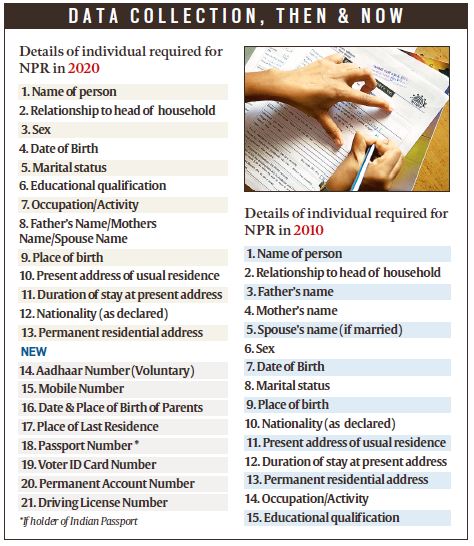
    • The NPR is a register of residents of India where the enumerator collects demographic and biometric data of individuals living at the place of enumeration for six months or more.
    • Now, this turn of events where non-NDA ruled states started to halt an ongoing enumeration of residents (NPR) process left many confused, with the time to begin counting for the Census approaching fast.
    • Is the recently passed Citizenship Amendment Act related to NPR? The answer is both yes and no. There is no direct link.
    • It depends on how the government decides to use data collected for NPR.

    What is the National Population Register (NPR)?

    • The NPR is a register of usual residents of the country. It is mandatory for every usual resident of India to register in the NPR.
    • It includes both Indian citizens as well as a foreign citizen.
    • The objective of the NPR is to create a comprehensive identity database of every usual resident in the country.
    • The first NPR was prepared in 2010 and updating this data was done during 2015 by conducting door to door survey.
    • The next update of the NPR will take place next year from April to September with the Houselisting phase of the Census 2021.
    • It is being prepared at the local (Village/sub-Town), sub-District, District, State and National level under provisions of the Citizenship Act 1955 and the Citizenship (Registration of Citizens and Issue of National Identity Cards) Rules, 2003.

    Who is the usual resident?

    • According to the Citizenship (Registration of Citizens and Issue of National Identity Cards) Rules, 2003, a usual resident is a person who has resided in a local area for the past 6 months or more or a person who intends to reside in that area for the next 6 months or more.

    The Census of India

    • The Census is the enumeration of the population of the country.
    • It is being conducted at an interval of 10 years.
    • The Census 2021 will be 16th census in the country since the first census happened in 1872. However, it will be 8th census after the Independence.
    • For the first time, the Census 2021 will use the Mobile App for data collection. It will also provide a facility to the public for self-enumeration.

    What is the whole issue?

    Issues with the states

    • Citizenship, aliens and naturalization are subject matters listed in List 1 of the Seventh Schedule that fall exclusively under the domain of Parliament.
    • Legally, the states have no say in implementing or ruling out NPR.
    • However, given that the manpower is drawn from the states, the defiance could potentially result in a showdown.

    Issues with NPR

    • Census is an exercise carried out under the Census Act, 1948. Census data is based on self-declaration made by the persons without verification.
    • NPR is carried out as per the 2003 Citizenship Rules. Under these Rules, it is compulsory for a person to share the demographic data for preparation of NPR.
    • Therefore, these Rules have a coercive element, as they penalize non-cooperating persons with fines and penalties.
    • Failure to comply with the NPR data collection can expose one to penal consequences under Rule 17.
    • It may be noted that both these processes are carried under the supervision of a single office: the Office of Registrar General of India and Census Commissioner.

    Privacy Concern

    • Officials insist that NPR information is private and confidential, meaning it will not be shared with third parties. 
    • There is no clarity on the mechanism for protection of the vast amount of data that will be collected through NPR.

    Census vs. NPR

    • The census is decadal headcount in India. It involves a detailed questionnaire aimed at gathering general data about the population of India.
    • The NPR process collects demographic and biometric particulars of individuals.
    • Both processes involve door-to-door enumeration but NPR differs from the Census in the sense that its objective is to have a comprehensive identity database of those residing in India.
    • The Census does not identify individuals.
    • However, in Census 2021, this distinction may no longer exist as the government is said to be planning to conduct it through a mobile phone application.
    • Moreover, Census data are kept and maintained centrally under the Registrar General of India.
    • But once the NPR data are recorded and ready, these details would be kept and maintained in a population register at levels of village or ward, tehsil or taluk (sub-district), district and state.
    • Together, they will constitute the National Population Register with all data at the central level.

    The link between NPR and NRC

    • The Citizenship Act empowers the government to compulsorily register every citizen and maintain a National Register of Indian Citizens.
    • A nationwide NRC — if undertaken — would flow out of NPR.
    • This does not necessarily mean that an NRC must follow NPR — no such register was compiled after the previous NPR in 2010.
    • After a list of residents is created, a nationwide NRC — if it happens — could go about verifying the citizens from that list.

    What de-links NPR and NRC?

    • The NPR is different from the NRC which excludes the foreign citizens.
    • According to the Citizenship Rules 2003, a Population Register is ‘the register containing details of persons usually residing in a village or rural area or town or ward or demarcated area within a ward in a town or urban area.
    • Whereas the NRC is a register containing details of Indian Citizens living in India and outside India.

    Advantages of NPR

    • NPR gives a comprehensive identity database of its residents with relevant demographic details. It will help the government formulate its policies better and also aid national security.
    • It will ease the life of those residing in India by cutting red tape. Not only will it help target government beneficiaries in a better way, but also further cut down paperwork and red tape in a similar manner that Aadhaar has done.
    • For instance, it is common to find a different date of birth of a person on different government documents. NPR will help eliminate that.
    • With NPR data, residents will not have to furnish various proofs of age, address and other details in official work.
    • It would also eliminate duplication in voter lists, the government insists.

    Where Aadhaar does comes to the picture?

    • There is a little back story about NPR and Aadhaar. The two were considered rival projects under the UPA government.
    • When NPR process began in the government, P Chidambaram was the Union home minister, who pushed the population register project.
    • Both the NPR and Aadhaar projects were concurrently underway collecting demographic and biometric data.
    • Initially, both had better and targeted delivery of benefits and services to people as their objectives. The works of the UIDAI and the home ministry were viewed as duplication and wastage of resources.
    • The conflict, however, ended in a compromise between the home ministry and the UIDAI where it was decided that NPR and Aadhaar databases will be used for different purposes.
    • Aadhaar will deliver welfare services and NPR will be used for other purposes of governance.
    • It was also decided that those already enrolled for Aadhaar need not give their biometric details during NPR exercise.
    • The NPR data were to be matched with Aadhaar data for de-duplication. But the final formula gave NPR an upper hand.
    • It was agreed that in case of discrepancy between Aadhaar and NPR data, NPR would prevail.
    • Simply put, NPR conducted in accordance with the Citizenship Amendment Act 2003 will form the key data set for both Aadhaar and NRC.


    References

    https://www.civilsdaily.com/news/national-population-register-npr/

    https://www.livelaw.in/top-stories/what-is-the-caa-npr-nrc-linkexplainer-151105

    https://www.indiatoday.in/news-analysis/story/caa-npr-nrc-confusion-connection-explained-india-1631534-2019-12-26


  • [Burning Issue] US’s recognition of West Bank settlements


    • The United States no longer thinks Israeli settlements in the West Bank violate international law.
    • This recognition of the Jewish settlements is yet another indication that the two-state solution is dead.

    What are the West Bank settlements?

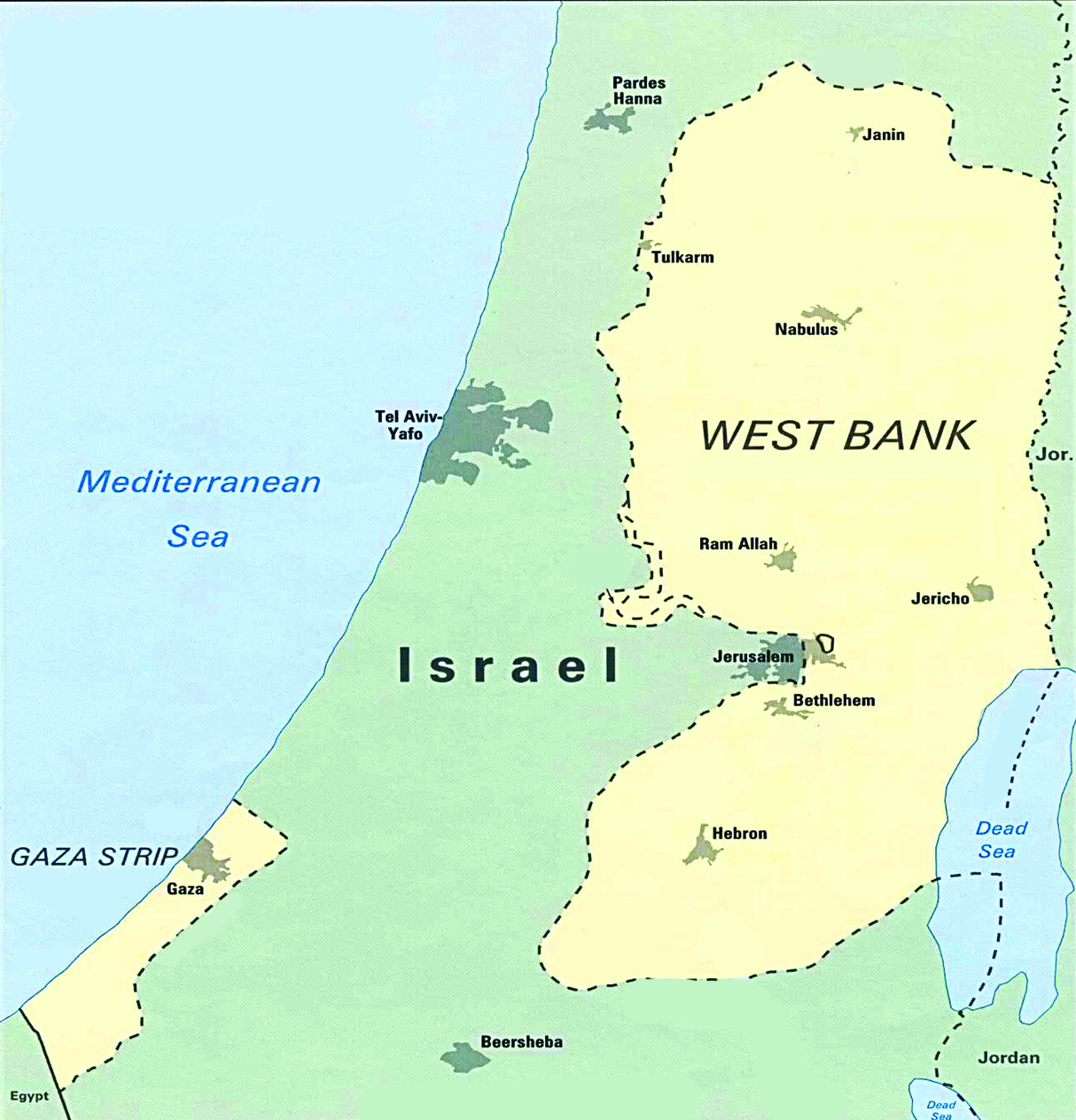
    • The West Bank, a patch of land about one and a half times the size of Goa, was captured by Jordan after the 1948 Arab-Israeli War.
    • Israel snatched it back during the Six-Day War of 1967, and has occupied it ever since.
    • It has built some 130 formal settlements in the West Bank, and a similar number of smaller, informal settlements have mushroomed over the last 20-25 years.
    • Over 4 lakh Israeli settlers many of them religious Zionists who claim a Biblical birthright over this land — now live here, along with some 26 lakh Palestinians.

    Are these Israeli settlements illegal?

    • To the vast majority of the world’s nations, yes.
    • The UN General Assembly, the UNSC, and the International Court of Justice have said that the West Bank settlements are violative of the Fourth Geneva Convention.
    • Under the Oslo Accords of the 1990s, both Israel and the Palestinians agreed that the status of settlements would be decided by negotiations. But the negotiations process has been all but dead for several years now.
    • Israel walked into East Jerusalem in 1967, and subsequently annexed it. For Israel, Jerusalem is non-negotiable.
    • The Palestinians want East Jerusalem as the capital of their future state. Most of the world’s nations look at it as occupied territory.

    What is Fourth Geneva Convention?

    • Under the Fourth Geneva Convention (1949), an occupying power “shall not deport or transfer parts of its own civilian population into the territory it occupies”.
    • Under the Rome Statute that set up the International Criminal Court in 1998, such transfers constitute war crimes, as does the “extensive destruction and appropriation of property, not justified by military necessity and carried out unlawfully and wantonly”.

    American stand on Palestine

    • In 1978, when Jimmy Carter was President, the State Department concluded that the Israeli settlements were “inconsistent with international law”.
    • Soon after taking office in 1981, President Ronald Reagan said he did not agree — even though the establishment of new Israeli communities in Palestinian territory was indeed “unnecessarily provocative”.
    • Thereafter, the United States took the line that the settlements were “illegitimate”, not “illegal”, and repeatedly blocked UN resolutions condemning Israel for them.
    • In 2016, President Barack Obama broke with this policy — and the US did not veto a resolution that called for an end to Israeli settlements.
    • The establishment of Israeli civilian settlements in the West Bank is not per se inconsistent with international law.

    US’s present stand on Palestine

    • Indeed, Trump’s recognition of the settlements means little compared to allowing Israel to build those settlements over a 52-year period.
    • Likewise, the U.S. has continued to provide aid to Israel to the tune of more than $3 billion annually, as well as unflinching military and diplomatic support — including from official sanctions over the settlements at the U.N.
    • The U.S. has also allowed its private citizens to give tax-free donations to charities and organizations that support the settlements.
    • So, while the Trump administration has gone a step further, it is not as drastic a departure from past administrations as it would seem.

    Impacts of the development

    • Those who support the right of Israelis to settle in the West Bank are likely to see the decision as an endorsement.
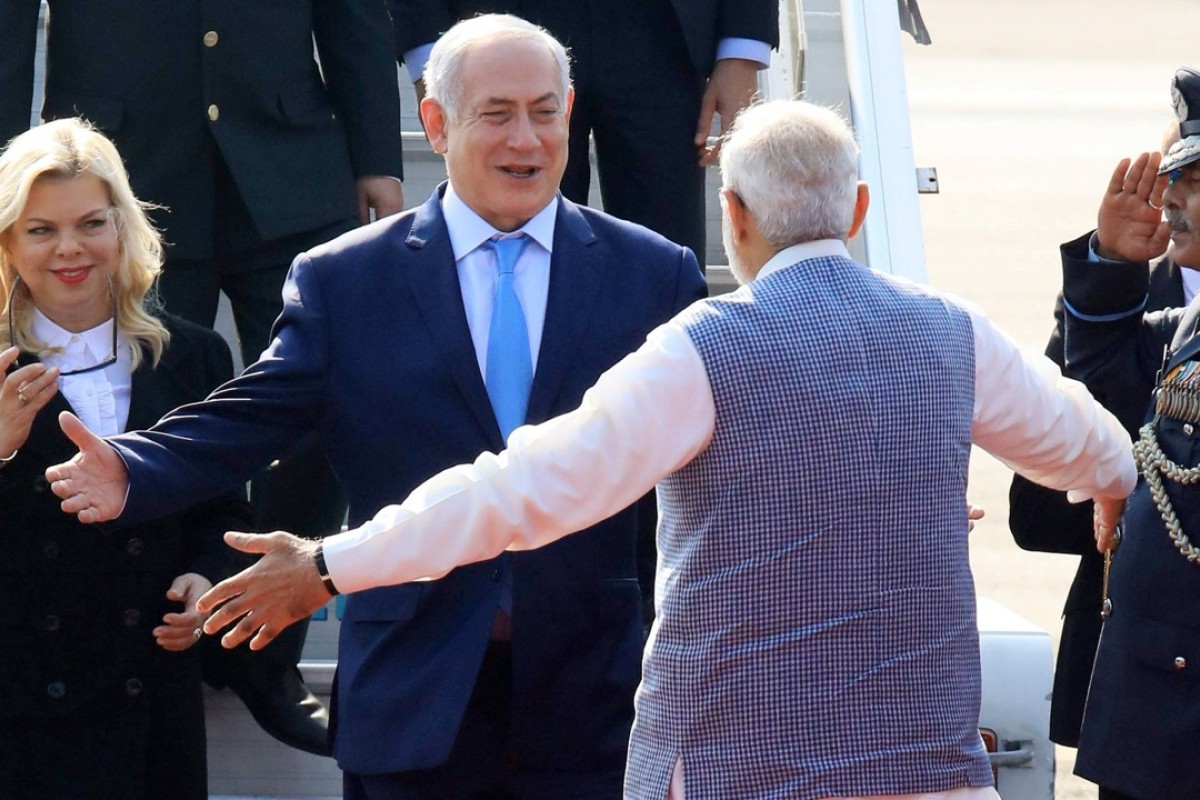
    • It will boost PM Benjamin Netanyahu, who has promised sweeping annexations in the West Bank.
    • However, Pompeo did not come out as directly backing the settlers.
    • The hard truth is there will never be a judicial resolution to the conflict, and arguments about who is right and wrong as a matter of international law will not bring peace.
    • This is a complex political problem that can only be solved by negotiations.

    Implications for Palestinians

    • What does change in a significant way, however, is what the recognition of settlements means for the status of the territory and of the government that administers it.
    • While the new U.S. policy does not alter the legal status of the Palestinian territories, Israel’s PM welcomed the change and said that it “reflects an historical truth — that the Jewish people are not foreign colonialists” in the West Bank.
    • If it is not military occupation, which undoubtedly prohibits the type of settlement that Israel has engaged in, then it is something else that Israel must clarify its position and intentions over the territory.
    • This puts the onus for fulfilling the political rights of the Palestinians back on Israel.

    India’s stance on Palestine

    • Sticking to its historic stance towards the Palestinian cause India was among 166 nations that endorsed Palestinian “right to self-determination”.
    • According to the MEA website, India’s support for the Palestinian cause is an integral part of the nation’s foreign policy.
    • In 1974, India became the first non-Arab country to recognise Palestine Liberation Organisation (PLO) as the sole and legitimate representative of the Palestinian people.
    • In 1988, India became one of the first countries to recognise the Palestinian State. While, in 1996, India opened its representative office in Gaza, which was later shifted to Ramallah in 2003.
    • India also co-sponsored the draft resolution on “the right of Palestinians to self-determination” during the 53rd session of the UNGA and voted in favour of it.
    • It also voted in favour of UNGA Resolution in October 2003 against construction of the separation wall by Israel.
    • In 2011, India voted for Palestine becoming a full member of the UNESCO.
    • At the Asian African Commemorative Conference in April 2015, India supported the Bandung Declaration on Palestine. It also backed the installation of the Palestinian flag at UN’s premises in September 2015.
    • PM Modi visited the West Bank in February 2018, which was the first visit by an Indian Prime Minister to the Palestinian territories.

    Why does India support Palestinian cause?

    • India has a considerable number of Muslim Population has been always sympathetic to the Muslim population in Palestine.
    • India did not want to jeopardize the interest of its citizens (more than 7 million) working in Arab countries which are a good source of forex reserves.
    • India is dependent on the Arab nations for its larger oil imports.
    • India’s co-operation with the Soviet Union during cold war era and our desire to counter Pakistan with the support of Arab nations was another reason for our pro-Palestine policy.
    • However, with an increased focus on closer ties with Israel, there is little doubt that India has diluted its support to Palestine.

    Limitations of Cooperation

    • India has so far been successful in building up its level of cooperation with Israel without en­dangering its relations with others.
    • Never­theless, limits to the cooperation are visible, especially in the field of security cooperation, as this remains a somewhat sensitive issue for some Arab states. However, despite its perceived fondness of Israel, India has been cautious.
    • In addition, ties with Israel are an area of potential disagreement between India and the Islamic Republic of Iran.
    • This often manifests in Iranian leaders’ flagging of the issue in Kashmir, a Muslim-majority state claimed by both India and Pakistan.

    Conclusion

    • Mutu­al interests run deeper than mere super­­ficial, short-term cooperation.
    • There is a growing marginalization of the Pales­tin­ian issue. And that has immensely benefited Indo-Israeli relations.
    • The interest-based development of bilateral ties between Israel and India is likely to prevail and result in future cooperation, even if the Pales­tinian issue regains prominence.


    References

    https://indianexpress.com/article/explained/west-bank-what-change-in-us-policy-means-6127732/

    https://www.indiatoday.in/india/story/pm-modi-amit-shah-p-chidambaram-nrc-cab-1630951-2019-12-23

    https://www.brookings.edu/blog/order-from-chaos/2019/11/25/recognizing-israeli-settlements-is-about-sovereignty-and-thats-a-game-changer/

    https://time.com/5732752/israeli-settlements-trump-administration/

  • [Burning Issue] Outcome of the Madrid Climate Talks


    Context

    • The 25th annual talks under the UNFCCC referred to as the Conference of Parties (COP) ended in Madrid.
    • The countries party to the Paris Agreement failed to agree on various important aspects regarding climate change like:
      • rules and procedures to govern a global carbon market
      • finance for losses caused by extreme weather events
      • on meeting the commitments made before the agreement and on raising their ambitions.
    • This two weeks of negotiations in the longest COP ever hence is regarded as a spectacular failure.

    What was the agenda set for Madrid COP?

    • There was only one major agenda for the Madrid talks to negotiate and decide — the rules for a new carbon market to be set up under the Paris Agreement.
    • That would have completed the Paris Agreement rulebook that was finalized in Katowice in 2018, without the provisions related to carbon markets on which countries had major disagreements.
    • Two other issues came to dominate the discussions were:
    1. First, relating to the demand to enhance climate actions being currently taken, and;
    2. Second, to make developed countries accountable to their climate obligations in the pre-2020 period

    What did India pursue?

    • India played a mixed role. It demanded the carryover of the untraded emission reduction certificates held by Indian companies (estimated at 750 million Certified Emissions Reductions or CERs), which they can sell to raise funds.
    • On the question of ‘loss and damage’, India urged developed countries to give financial teeth to the Warsaw International Mechanism on Loss and Damage (WIM).
    • India’s current efforts are already much more compared to even rich and developed countries. Thus, India reiterated its stand for ”Common but Differentiated Responsibilities”.
    • India played a strong role in critiquing the developed world’s continuing poor record on climate action.
    • India also took a lead in calling for more finance for developing countries for climate action, with the minister emphasizing that “not even 2 per cent” of the promised “$1 trillion in the last 10 years” had been delivered.

    Outcomes: An incompetent agreement

    • The first draft of the agreement had these options but was heavily bracketed — each bracket representing a difference of opinion and different option on the table.
    • The revised draft was put before the negotiators on, many of the earlier options had been removed. This triggered angry reactions from whoever was backing those.
    • The European Union, Spain, Bangladesh, Belize, Colombia, Grenada and many others pointed out that the draft text did not strongly ask the countries to raise the “ambition”.

    Lack of ambition

    • This was supposed to be a COP of ambition. However, these ambitions were reflected in nowhere.
    • Countries such as India and China lamented the fact that a provision on creating a work programme to assess the performance of developed countries on their pre-2020 promises had been dropped.
    • The problems we are facing today are not because of lack of intent but because of lack of implementation which is very glaringly visible in the unmet pre-2020 targets.

    The US deviance

    • China had already made it clear that strong provisions on the assessment of pre-2020 actions was “very important for all developing countries”, and needed to be strongly reflected in the final agreement.
    • The United States strongly objected to even a mention of assessment of pre-2020 actions and demanded that it be removed.

    Carbon Markets ignored yet again

    • While all this was being discussed, the draft text on carbon markets had not even been finalised.
    • The provisions related to carbon markets have been deeply contested with India, Brazil, China and some other developing countries.

    The most contested issue: Article 6

    • Ahead of COP25, many expected a key focus to be agreeing rules for “Article 6” carbon markets and other forms of international cooperation.
    • This deals with the question of how to deal with billions of Kyoto-era carbon offset “units”, potentially amounting to more than five billion tonnes of CO2 equivalent.
    • These units were mostly generated under the Clean Development Mechanism, where projects in developing countries created “certified emissions reductions” (CERs) in the developing world.
    • This was the last remaining piece of the Paris regime to be resolved after the rest of its “rulebook” was agreed in late 2018.

    What is it all about?

    • Article 6 contains three separate mechanisms for “voluntary cooperation” towards climate goals, with the overarching aim of raising ambition.
    • Article 6.2 governs bilateral cooperation via “internationally traded mitigation outcomes” (so-called ITMOs), which could include emissions cuts measured in tonnes of CO2 or kilowatt-hours of renewable electricity.
    • If these rules are well-implemented, supporters argue that Article 6 could unlock higher ambition or reduce costs, while drawing in the private sector and spreading finance, technology and expertise around the world.

    ‘OMGE’ for net climate benefits

    • The final major area of Article 6 disagreement was around the idea of securing “overall mitigation in global emissions” (OMGE), a concept introduced in the Paris text for Article 6.4.
    • OMGE is supposed to ensure a net-benefit for the atmosphere, rather than a zero-sum outcome where emissions in one place are offset by reductions elsewhere.
    • Some groups argued that the only way to achieve OMGE was to automatically cancel a portion of any offsets created under Article 6.
    • They argued that applying this cancellation would create an imbalance that could skew the market.

    Few successes to count

    Finance

    • While the main financial matter being discussed at this year’s COP was how to support countries affected by extreme climate impacts, the usual standing items were also being considered.
    • Both the Global Environment Facility (GEF) and the Green Climate Fund (GCF) guidance documents were caught up in the debate around whether to instruct them to start working more specifically on loss and damage.
    • There was also some discussion about the creation of a new climate finance goal, now that the deadline for “$100bn by 2020” (agreed in 2009 at the Copenhagen COP) is almost up.
    • Another issue being considered was long-term climate finance (LTF), a workstream that examines progress and scaling up of climate finance, but which is due to end in 2020.

    Gender action plan

    • A rare success story at this year’s COP was a decision on a new five-year gender action plan (GAP), intended to “support the implementation of gender-related decisions and mandates in the UNFCCC process”.
    • The original plan, agreed at COP20 in Lima, “seeks to advance women’s full, equal and meaningful participation and promote gender-responsive climate policy and the mainstreaming of a gender perspective”.
    • Early negotiations did not go smoothly. Parties initially failed to deliver a text for consideration, owing in part to disagreements about the inclusion of text relating to human rights and just transition.

    What is sought next?

    • A number of countries — mainly the ones most threatened by climate change, such as small island states, some developed countries and civil society organisations — had been demanding that countries take more climate actions.
    • They called upon all the countries to update their climate action plans, called Nationally Determined Contributions or NDCs, with greater commitments by next year.

    Conclusion

    • The Madrid talks were expected to nudge all countries to scale up their commitments under the Paris Pact — Nationally Determined Contributions or NDCs.
    • The developed countries including the EU and US were, however, non-committal when it came to honouring their previous pledges on funds and technology transfers to the developing countries.
    • CoP 25 was an opportunity to answer the questions that have been raised over the UNFCCC’s processes.
    • Unfortunately, the two weeks of negotiations have been an opportunity lost.


    References

    https://indianexpress.com/article/explained/united-nations-climate-change-conference-cop25-madrid-6170239/

    https://indianexpress.com/article/opinion/editorials/cop-25-climate-change-talks-in-madrid-6170500/

    https://www.downtoearth.org.in/news/climate-change/climate-emergency-cop-25-india-s-mixed-role-68449

    https://thewire.in/environment/developed-world-sabotages-un-climate-summit-now-declared-a-failure

  • [Burning Issue] Citizenship Amendment Act, 2019

    Context

    • The Citizenship Amendment Bill (CAB) became law after receiving the President’s assent following a bruising debate in Parliament.
    • Since then, Assam has been in the throes of violence with its capital under indefinite curfew, and Army and paramilitary columns rolling across multiple towns.
    • The protest has also rocked various colleges and university campuses across the nation along with protests in Delhi. Civil society, students and various political parties have opposed the law on various grounds.
    • At least three opposition ruled states Kerala, Punjab and West Bengal have said they will not implement the new citizenship law and legal challenges have been made in the Supreme Court.

    What is the Citizenship (Amendment) Act?

    • The act is sought to amend the Citizenship Act, 1955 to make Hindu, Sikh, Buddhist, Jain, Parsi, and Christian illegal migrants from Afghanistan, Bangladesh, and Pakistan, eligible for citizenship of India.
    • In other words, it intends to make it easier for non-Muslim immigrants from India’s three Muslim-majority neighbours to become citizens of India.
    • Under The Citizenship Act, 1955, one of the requirements for citizenship by naturalization is that the applicant must have resided in India during the last 12 months, as well as for 11 of the previous 14 years.
    • The amendment relaxes the second requirement from 11 years to 6 years as a specific condition for applicants belonging to these six religions, and the aforementioned three countries.

    Defining Illegal migrants

    • Illegal migrants cannot become Indian citizens in accordance with the present laws.
    • Under the Act, an illegal migrant is a foreigner who: (i) enters the country without valid travel documents like a passport and visa, or (ii) enters with valid documents, but stays beyond the permitted time period.
    • Illegal migrants may be put in jail or deported under the Foreigners Act, 1946 and The Passport (Entry into India) Act, 1920.
    • The Bill provides that illegal migrants who fulfil four conditions will not be treated as illegal migrants under the Act.  The conditions are:
    1. they are Hindus, Sikhs, Buddhists, Jains, Parsis or Christians;
    2. they are from Afghanistan, Bangladesh or Pakistan;
    3. they entered India on or before December 31, 2014;
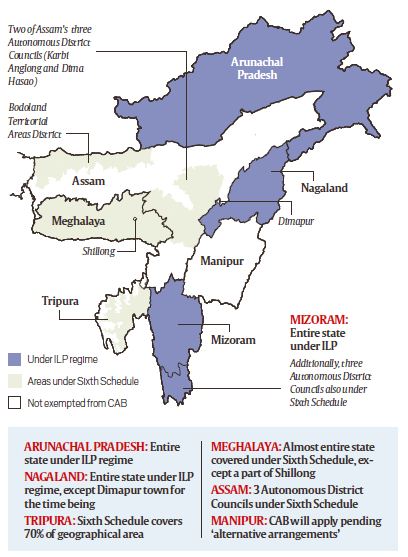
    4. they are not in certain tribal areas of Assam, Meghalaya, Mizoram, or Tripura included in the Sixth Schedule to the Constitution, or areas under the “Inner Line” permit, i.e., Arunachal Pradesh, Mizoram, and Nagaland.

    How many people could now be given Indian citizenship under the new law?

    • As of December 31, 2014, the government had identified 2, 89,394 “stateless persons in India”, according to data presented in Parliament by the Home Ministry in 2016.
    • The majority were from Bangladesh (1,03,817) and Sri Lanka (1,02,467), followed by Tibet (58,155), Myanmar (12,434), Pakistan (8,799) and Afghanistan (3,469).
    • The figures are for stateless persons of all religions. For those who came after December 31, 2014, the regular route of seeking refuge in India will apply.
    • If they are regarded as illegal immigrants, they cannot apply for citizenship through naturalization, irrespective of religion.

    States exempted from the Act

    • Citizenship, aliens and naturalization are subjects listed in List 1 of the Seventh Schedule and fall exclusively under the domain of Parliament.
    • Most states of the Northeast are, however, wholly or partially exempted under special provisions for tribal areas, such as Inner Line Permit (Arunachal Pradesh, Nagaland, Mizoram and now extended to Manipur) and the Sixth Schedule with special provisions in practically all of Meghalaya, and a large chunk of Tripura.

    Are the communities mentioned indeed persecuted in these three countries?

    • The MHA relied on news reports as evidence of religious persecution against minorities in Pakistan, ranging from forced conversion to the demolition of temples and other religious structures.
    • Notable examples were Asia Bibi, a Pakistani Christian convicted of blasphemy who spent eight years on death row before being acquitted by the Pakistan Supreme Court.
    • In Bangladesh, cases of killings of atheists by Islamic militants are well-documented.
    • Although Home Minister referred to non-Muslim religions as persecuted minorities, the law avoids using the word persecution in its text.

    Controversy with the Act

    • There are two kinds of protests that are taking place across India right now, against the Act. In the northeast, the protest is against the Act’s implementation in their areas.
    • Most of them fear that if implemented, the Act will cause a rush of immigrants that may alter their demographic and linguistic uniqueness.
    • In the rest of India, like in Kerala, West Bengal and in Delhi, people are protesting against the exclusion of Muslims, alleging it to be against the ethos of the Constitution.
    • The fundamental criticism of the Bill has been that it specifically targets Muslims. Critics argue that it is violative of Article 14 of the Constitution, which guarantees the right to equality.

    I. Country of origin

    • The Act classifies migrants based on their country of origin to include only Afghanistan, Pakistan and Bangladesh.
    • The statement of objects and reasons states that India has had historic migration of people with Afghanistan, Pakistan and Bangladesh, and these countries have a state religion, which has resulted in religious persecution of minority groups.

    II. Deviation from its own purpose

    • Given that the objective of the Bill is to provide citizenship to migrants escaping from religious persecution, it is not clear why illegal migrants belonging to religious minorities from these countries have been excluded from the Bill.
    • India shares a border with Myanmar, which has had a history of persecution of a religious minority, the Rohingya Muslims.
    • Sri Lanka has had a history of persecution of a linguistic minority in the country, the Tamil Eelam.

    III. Other religious minorities are ignored

    • It is unclear why illegal migrants from only six specified religious minorities have been included in the Act.
    • For example, over the years, there have been reports of persecution of Ahmadiyya Muslims who are considered non-Muslims in Pakistan have significant population in India.

    IV. Date of Entry

    • It is also unclear why there is a differential treatment of migrants based on their date of entry into India, i.e., whether they entered India before or after December 31, 2014.
    • The logic justifying the date has not been discussed while passing of the said act.

    V. Exclusion of Sixth Schedule Areas

    • The act excludes illegal migrants residing in areas covered by the Sixth Schedule, that is, notified tribal areas in Assam, Meghalaya, Mizoram and Tripura.
    • The act so excludes the Inner Line Permit areas. Inner Line regulates the entry of persons, including Indian citizens, into Arunachal Pradesh, Mizoram and Nagaland.
    • Once an illegal migrant residing in these areas acquires citizenship, he would be subject to the same restrictions in these areas, as are applicable to other Indian citizens.
    • Therefore, it is unclear why the Bill excludes illegal migrants residing in these areas.

    Assam Connection

    Why is Assam fuming with protests?

    • In Assam, what is primarily driving the protests is not who are excluded from the ambit of the new law, but how many are included.
    • The protesters are worried about the prospect of the arrival of more migrants, irrespective of religion, in a state whose demography and politics have been defined by migration.
    • The Assam Movement (1979-85) was built around migration from Bangladesh which many Assamese see as a threat to their culture and language, besides putting pressure on land resources and job opportunities.
    • The protesters’ argument is that the new law violates the Assam Accord of 1985, which sets March 24, 1971, as the cutoff for Indian citizenship.
    • If both CAB and the NRC will be implemented, the non-Muslims excluded under the NRC will be included under CAB.
    • The net result will be that only Muslims will be identified as illegal migrants and excluded.
    • The Assamese fear that Banglaspeakers will easily outnumber Assamese-speaking people in the state, as it has happened in Tripura where Bengali-Hindu immigrants from East Bengal now dominate political power, pushing the original tribals to the margins.
    • The Assamese look at the issue from the linguistic, and not any religious angle. For them, Bengalis are one large linguistic community who are growing in numbers and could, one day, become numerically stronger than them.
    • Hence, the Assamese view the CAB (Citizenship Amendment Bill) as legislation that will grant citizenship to Bengali-speaking migrants from Bangladesh. And that is something they do not want.

    How much of Assam is exempted?

    • In Assam, three Autonomous Districts are exempted but the new law remains applicable to the major area.
    • This also raises the question: can there be two citizenship laws applicable to the same state?
    • Under Clause 5.8 of the Assam Accord, “Foreigners who came to Assam on or after March 25, 1971, shall continue to be detected; deleted and practical steps shall be taken to expel such foreigners.”

    Legality and constitutionality check

    • Legal experts and Opposition leaders have argued that it violates the letter and spirit of the Constitution.
    • One argument made in Parliament is that the law violates Article 14 that guarantees equal protection of laws.
    • According to the legal test prescribed by courts, for a law to satisfy the conditions under Article 14, it has to first create a “reasonable class” of subjects that it seeks to govern under the law.
    • Second, the legislation has to show a “rational nexus” between the subject and the object it seeks to achieve. Even if the classification is reasonable, any person who falls in that category has to be treated alike.
    • If protecting the persecuted minorities is ostensibly the objective of the law, then the exclusions of some countries and using religion as a yardstick may fall foul of the test.

    How is this act referred to here?

    • Granting citizenship on the grounds of religion is seen to be against the secular nature of the Constitution which has been recognised as part of the basic structure that cannot be altered by Parliament.
    • It is argued that persecuted minorities in three neighbouring countries, Pakistan, Bangladesh and Afghanistan, whose state religion is Islam, is a reasonable classification.
    • Another argument is that the law does not account for other categories of migrants who may claim persecution in other countries.

    Justification of the Law given by the Central Government

    • It is argued that Muslims can never be persecuted in Islamic countries.
    • Sri Lanka and Bhutan both Bhutan and Sri Lanka offer constitutional patronage to the state religion, Buddhism.
    • Defending the exclusion of Shias and Ahmadiyyas from Pakistan it was argued by the government that a persecuted Shia would rather go to Iran than come to India.
    • There are thousands of refugees in India of Hindus, Sikhs, Jains, Buddhists, Christians and Parsis who have entered India after facing religious persecution in countries like Pakistan, Bangladesh and Afghanistan without any valid document.
    • These refugees have been facing difficulty in getting Long Term Visa (LTV) or Citizenship.
    • For Naturalization they have to stay at least 12 years in India.
    • Those minorities who are persecuted due to their religion have no other place to go except India as the three nations are declared Islamic Nations.

    It excludes only “non-Indian” Muslims

    • On the face of it, the amendment is not to exclude any Indian citizen. However, the NRC in Assam and the latest citizenship law cannot be decoupled.
    • The new law gives a fresh chance to the Bengali Hindus left out to acquire citizenship, whereas the same benefit will not be available to a Muslim left out, who will have to fight a legal battle.
    • Plugged with NRC, the new amendment becomes an enabling law to potentially disenfranchise an individual of a religion not mentioned in the amendment.
    • Politically, the law is expected to impact West Bengal and Northeastern states. Assam and West Bengal head for polls in 2021.

    Conclusion

    • India is a constitutional democracy with a basic structure that assures a secure and spacious home for all Indians, including and especially its
    • India has to undertake a balancing act here. India’s citizenship provisions are derived from the perception of the country as a secular republic.
    • In fact, it is a refutation of the two-nation theory that proposed a Hindu India and a Muslim Pakistan. Granting citizenship based on religious identity violates this principle.
    • That being said, we need to balance the civilization duties to protect those who are prosecuted in the neighbourhood.
    • Hopefully, the government pays heed to the voices of different communities and takes an action only after a consensus is achieved.


    References

    https://www.civilsdaily.com/news/explained-nehru-liaquat-agreement-of-1950/

    https://www.civilsdaily.com/news/exemption-categories-under-cab/

    https://www.livemint.com/news/india/citizenship-amendment-act-2019-all-you-need-to-know-11576401546515.html

    https://indianexpress.com/article/opinion/editorials/brute-majority-citizenship-amendment-bill-6162515/

    https://www.newindianexpress.com/thesundaystandard/2019/dec/15/citizenship-act-escaping-religious-persecution-the-broken-finally-break-free-2076236.html

    https://indianexpress.com/article/explained/explained-how-to-be-a-citizen-of-india-earlier-now-6165960/

    http://prsindia.org/billtrack/citizenship-amendment-bill-2019

  • [Burning Issue] Transgender Persons (Protection of Rights) Bill


    Context

    The Parliament has passed the Transgender Persons (Protection of Rights) Bill, 2019, with the Rajya Sabha approving it by a voice vote. The Lok Sabha had already passed the bill in December 2018.

    Why need such a bill?

    • Transgender individuals in India often face stigma and systematic exclusion in education and employment.
    • As a result, some feel they have no alternative but to turn to sex work.
    • Trans individuals also face disproportionate public violence and police brutalities.

    Background:

    • In 2013, the government set up an expert committee to study the problems of transgenders and recommend solutions.
    • The committee, comprising experts from various fields and members of the community, also looked at past experience as in the State of Tamil Nadu, which had set up a welfare board for transgender persons.
    • TN has made recommendations right from allowing a ‘third gender’ in official forms, to setting up of special toilets and customizing health interventions.
    • In 2014, a private member Bill, The Rights of Transgendered Persons, was introduced in the Rajya Sabha by Tiruchi Siva, a Member of Parliament from Tamil Nadu.
    • It looked at a range of entitlements of such persons, providing specifically for them in health, education sectors, skill development and employment opportunities, and protection from abuse and torture.
    • It was passed in the Rajya Sabha.
    • In 2016, the Government introduced its own Bill in the Lok Sabha which made a number of recommendations including defining the term persons with intersex variations, granting reservations for socially and educationally backward classes, and recognition of civil rights including marriage, partnership, divorce and adoption. However, with the dissolution of the 16th Lok Sabha (2014-19), that Bill lapsed.

    Judicial subordination

    • Indian courts have long held that trans people deserve the government’s recognition on their own terms, without mandatory intervention or discrimination.
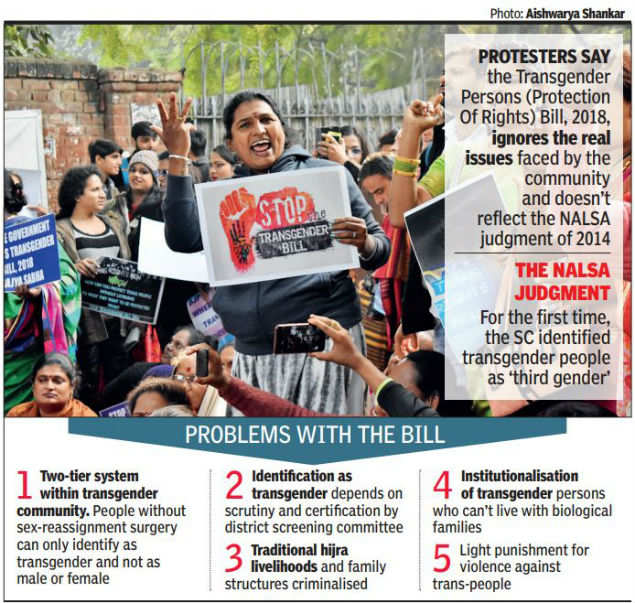
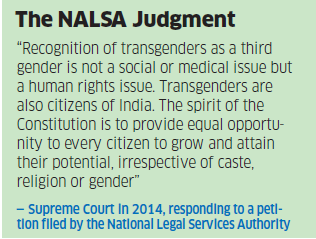
    • In 2014, the Indian Supreme Court in NALSA v. India ruled that transgender people should be recognized as a third gender and enjoy all fundamental rights, while also being entitled to specific benefits in education and employment.
    • Justice K.S. Radhakrishnan, writing for the bench, ordered that “Transgender persons’ right to decide their self-identified gender” should be recognized by state and federal authorities.
    • The court made clear that any insistence for [sex reassignment surgery] for declaring one’s gender is immoral and illegal.

    Image result for issues of transgender in india

    Transgender in India

    Count

    • Indian census has never recognized the third gender, i.e., transgender while collecting census data for years.
    • According to the 2011 Census, the number of persons who do not identify as ‘male’ or ‘female’ but as ‘other’ stands at 4,87,803 (0.04% of the total population)
    • The 2011 census also reported 55,000 children as transgenders identified by their parents.

    Issues

    • Sexual health issues
      • Transgender communities face several sexual health issues including HIV.
      • Both personal- and contextual- level factors influence sexual health condition and access to and use of sexual health services.
    • Mental health issues
      • Some of the mental health issues reported in different community forums include depression and suicidal tendencies, possibly secondary to societal stigma, lack of social support and violence-related stress.
      • Most transgender people, especially youth, face great challenges in coming to terms with one’s own gender identity which are opposite to that of the gender identity imposed on them on the basis of their biological sex.
      • They face several other related issues such as: shame, fear, and internalized transphobia; adjusting, adapting, or not adapting to social pressure to conform; fear of loss of relationships; and self-imposed limitations on expression or aspirations.
    • Violence

    Multiple studies have shown that transgender people across the age spectrum face alarmingly high rates of physical and verbal violence, including child abuse, sexual violence, intimate partner violence, workplace violence and hate crimes.

    • Social Exclusion

    Social Exclusion Framework is increasingly used in highlighting the issues and problems faced by disadvantaged and disenfranchised groups.

    • Family – Most families do not accept if their male child starts behaving in ways that are considered feminine or inappropriate to the expected gender role. Consequently, family members may threaten, scold or even assault their son/sibling from behaving or dressing-up like a girl or woman.
    • Heath care Setting Often, healthcare providers rarely had the opportunity to understand the sexual diversities and they do not have adequate knowledge about the health issues of sexual minorities.
    • Lack of livelihood options Most employers deny employment for even qualified and skilled transgender people. Lack of livelihood options is a key reason for a significant proportion of transgender people to choose or continue to be in sex work.
    • Residence – The community is grossly discriminated by Indian Society when it comes to renting or selling the house to a transgender.
    • Insurance – Health insurance companies often systematically exclude transition-related care and in many cases, these exclusions are used to deny coverage for a wide range of care for transgender people that may or may not have any connection to gender transition.

    Image result for issues of transgender in india

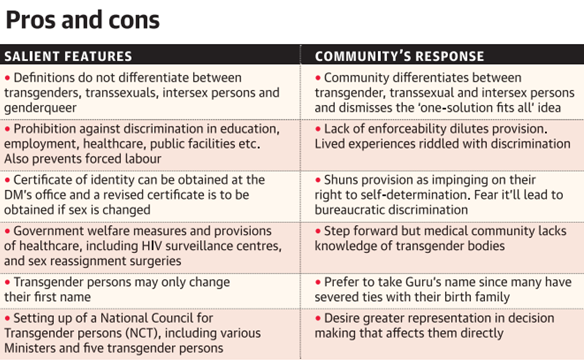
    Various Provisions of The Transgender Persons (Protection of Rights) Bill, 2019 includes:

    Defining Transperson

    • The Bill defines a transgender person as one whose gender does not match the gender assigned at birth.
    • It includes trans-men and trans-women, persons with intersex variations, gender-queers, and persons with socio-cultural identities, such as kinnar and hijra (eunuch).

    Prohibition against discrimination

    • It prohibits the discrimination against a transgender person, including denial of service or unfair treatment in relation to education, employment, healthcare, access to, or enjoyment of goods, facilities, opportunities available to the public.
    • Every transgender person shall have a right to reside and be included in his household.
    • No government or private entity can discriminate against a transgender person in employment matters, including recruitment, and promotion.

    HRD measures

    • A transgender person may make an application to the District Magistrate for a certificate of identity, indicating the gender as ‘transgender’.
    • Educational institutions funded or recognised by the relevant government shall provide inclusive facilities for transgender persons, without discrimination.
    • The government must provide health facilities to transgender persons including separate HIV surveillance centres, and sex reassignment surgeries.

    Grievances redressal

    • The National Council for Transgender persons (NCT) chaired by Union Minister for Social Justice, will advise the central government as well as monitor the impact of policies with respect to transgender persons.
    • It will also redress the grievances of transgender persons.

    Legal Protection

    The Bill imposes penalties for the offences against transgender persons like bonded labour, denial of use of public places, removal from household & village and physical, sexual, verbal, emotional or economic abuse.

    Positive Impact of the Bill:

    • The Bill will benefit a large number of transgender persons, mitigate the stigma, discrimination and abuse against this marginalized section and bring them into the mainstream of society.
    • This will lead to inclusiveness and will make the transgender persons productive members of society.

    What were the objections to the Bill?

    Binary concept of gender

    • Activists had problems right from the beginning, starting with the name.
    • ‘Transgender’ was restrictive, they argued, and it showed a lack of understanding of the complexities in people who do not conform to the gender binary, male/female.
    • Rejecting ‘Transgender’ as the nomenclature, they suggested instead that the title should be a comprehensive “Gender Identity, Gender Expression and Sex Characteristics (Protection of Rights) Bill”, and in definition, sought to introduce the distinction between transgender and intersex persons upfront.
    • Members of the community perceive transgender as different from intersex and were insistent that the distinction be made in the Bill.

    No Self-determination

    • While the Act is progressive in that it allows self-perception of identity, it mandates a certificate from a district magistrate declaring the holder to be transgender.
    • This goes against the principle of self-determination itself, activists argue, also pointing out that there is no room for redress in case an appeal for such a certificate is rejected.

    Others

    • One long-pending demand has been to declare forced, unnecessary and non-consensual sex reassignment surgery illegal, and to enforce punitive action for violations.
    • Transgender and intersex persons might require a range of unique health care needs, and that should have been incorporated into the Act, activists say.
    • While the Act envisages the setting up of a National Council to provide the institutional framework for its implementation, suggestions on the composition of such a council, or the demand to set up a working group for a Council for Intersex Persons were also ignored.

    Way Forward

    • The mention of intersex persons in the Indian bill is an important inclusion but the bill should be renamed the Rights of Transgender and Intersex Persons Bill and include explicit protections for intersex people in line with India’s international human rights obligations.
    • The bill should be revised to emphasize training teachers to help them adopt inclusive teaching methods to ensure that children are not harassed or discriminated against by staff or other children.
    • Certain provisions of Private member bill introduced in 2014 by Tiruchi Siva can also be incorporated such as reserving 2% of seats in education institutions funded by the government, formation of special employment exchanges for transgender people n government jobs, etc.
    • The bill should be provisioned in such a manner that it is able to integrate transgender persons seamlessly into the fabric of everyday public life be it public spaces, at workplaces, and in normative domestic spaces.
    • Policies and regulation alone won’t help there is a need to increase awareness and inculcate a sense of respect and acceptance for the transgender community.
    • Their grievance of being not included in policies formulation or decision making needs to be allayed and chances for their public participation should increase.
    • The government should implement stigma and discrimination reduction measures through a variety of ways like mass media awareness for the general public to focused training and sensitization for police and health care providers.
    • India should take lessons from Thailand. It is one of those model countries wherein all the required facilities are being made available to the Transgender Community.
    • Parents of the Transgender need to be counselled appropriately in order to treat Kinnar children at par with other normal children
    • There should be a proper census of the community. The community should be involved in this exercise. For the time being, the United Nations Development Programme(UNDP has more authentic data on Transgender in India. It could be used for planning welfare schemes.
    • Ministry of Social Justice and Empowerment should take up research studies to generate more evidence to design the programs and interventions for the community.
    • The ministry should also compile the existing experiences /interventions taken by many states like Tamil Nadu, Maharashtra, Sikkim, and Delhi etc.

    The Bill must recognise that gender identity must go beyond biological; gender identity is an individual’s deep and personal experience. It need not correspond to the sex assigned at birth. It includes the personal sense of the body and other expressions such as one’s own personal inducing proceeds.


    References

    https://www.civilsdaily.com/news/parliament-passes-transgender-persons-protection-of-rights-bill-2019/

    https://www.thehindu.com/news/national/why-are-there-objections-to-the-transgender-persons-bill/article30125894.ece

    https://www.hrw.org/news/2019/12/05/indias-transgender-rights-law-isnt-worth-celebrating

    https://indianexpress.com/article/explained/what-the-transgenders-rights-bill-passed-by-lok-sabha-says-5896444/

    https://indianexpress.com/article/opinion/columns/nartaki-nataraj-tiruchi-siva-my-gender-is-my-right-transgender-community-6144704/

  • [Burning Issue] Strategic Disinvestment of Central Public Sector Enterprises


    Context

    • In the biggest privatization drive, the Union Cabinet has approved sale of the government’s stake to cut shareholding in select public sector firms below 51% to boost revenue collections that have been hit by slowing economy.
    • These CPSE’s include blue-chip oil firm Bharat Petroleum Corporation Limited (BPCL), Shipping Corporation of India (SCI) and on-land cargo mover Container Corporation of India (Concor).

    Central Public Sector Enterprises (CPSEs)

    • A state-owned enterprise in India is called a public sector undertaking (PSU) or a public sector enterprise.
    • These companies are owned by the union government of India or one of the many state or territorial governments or both.
    • The company stock needs to be majority-owned by the government to be a PSU.
    • PSUs strictly may be classified as central public sector enterprises (CPSEs) or state level public enterprises (SLPEs).
    • CPSEs are companies in which the direct holding of the Central Government or other CPSEs is 51% or more.
    • They are administered by the Ministry of Heavy Industries and Public Enterprises.

    What is Disinvestment?

    • Privatization involves transforming the ownership of a public sector business to the private sector known as strategic buyer.
    • Disinvestment is also a transformation process that happens while retaining 26% or, in some contexts, 51% percent of share right (i.e. the voting power) with the public sector organization.
    • Strategic disinvestment implies the sale of portion of the Government share holding of a central public sector enterprise (CPSE) of upto 50%, or such higher percentage as the competent authority may determine, along with transfer of management control.

    Objectives of strategic disinvestment

    The following main objectives of disinvestment were outlined:

    • To reduce the financial burden on the Government.
    • To improve public finances.
    • To introduce, competition and market discipline.
    • To fund growth.
    • To encourage wider share of ownership.
    • To depoliticize non-essential services.

    When did the disinvestment process begin in India?

    • The disinvestment process in India began in the year 1991-92, with 31 selected PSUs disinvested for Rs.3,038 crore.
    • In August 1996, the Disinvestment Commission, chaired by G V Ramakrishna was set up to advice, supervise, monitor and publicize gradual disinvestment of Indian PSUs.

    Immediate causes

    • The new economic policy initiated in July 1991 clearly indicated that PSUs had shown a very negative rate of return on capital employed.
    • Inefficient PSUs had become and were continuing to be a drag on the Government’s resources turning to be more of liabilities to the Government than being assets.
    • In relation to the capital employed, the levels of profits were too low. Of the various factors responsible for low profits in the PSUs, the following were identified as particularly important:
    1. Price policy of public sector undertakings
    2. Under–utilization of capacity
    3. Problems related to planning and construction of projects
    4. Problems of labour, personnel and management
    5. Lack of autonomy

    Criterion for disinvestment

    The Union Government has mandated the NITI Aayog to identify the CPSEs that require disinvestment. The NITI Aayog identifies such CPSEs based on the certain criteria laid down by the Central Government itself. The criteria are mentioned below:

    • National Security
    • Sovereign function at arm’s length
    • Market Imperfections and Public Purpose
    • Profitability or loss of the CPSEs is not considered as a relevant criterion.

     Issues with  PSUs through years

    Inherent flaws in PSU’s

    • Public sector undertakings were established in India as a part of mixed economy with the objective of providing necessary infrastructure for the fast growth of economy & to safeguard against monopoly of industrialist community.
    • However, the entire mechanism did not turn out as efficient as it ought to be, all thanks to the prevailing hierarchy and bureaucracy.
    • Inefficient PSU’s were largely responsible for the macro-economic crisis faced by India during 1980’s.

    Lack of autonomy

    • Lack of autonomy, political interference, nepotism & corruption has further deteriorated the situation.
    • For instance, the head of a PSU is appointed by the Government, who in turn appoints all employees who play major roles in the organization.
    • So directly or indirectly the Government itself controls the appointment of all manpower in these organizations.

    Revenue losses

    • Due to the expenditure on items such as interest payments, wages and salaries of PSU employees and subsidies, the Government is left with hardly any surplus for capital expenditure on social and physical infrastructure.
    • Additionally, the continued existence of the PSEs is forcing the Government to commit further resources for the sustenance of many non-viable PSEs.
    • All this makes Disinvestment of the Government stake in the PSEs absolutely imperative.

    Lack of Competitiveness

    • In an era of LPG industrial competitiveness has especially assumed an important role, necessitating privatization or disinvestment of PSUs.
    • Though it is claimed by many that ownership isn’t all that an important indicator of an organization’s functioning as is its management, it has been proven by an ample number of examples that private controls of an organization bring about drastic changes in its effectiveness.
    • This is especially true today when competitiveness is essential not only for leading the industry but for mere survival.

    Poor performance

    • Despite the huge injection of funds in the past decades, the functioning of many public sector units (PSUs) has traditionally been characterized by poor management, slow decision-making procedures, lack of accountability, low productivity, unsatisfactory quality of goods, excessive manpower utilization etc.
    • However, with increasing privatization, disinvestment or change of control into the hands of professional managers, many organizations have seen the tables turn.
    • Some examples are IRCTC and CRIS to facilitate the functioning of Indian Railways etc.

    Importance of Disinvestment

    • Disinvestment also assumes significance due to the prevalence of an increasingly competitive environment, which makes it difficult for many PSUs to operate profitably.
    • This leads to a rapid erosion of the value of the public assets making it critical to disinvest early to realize a high value.
    • Presently, the Government has about Rs. 2 lakh crore locked up in PSUs.
    • Disinvestment of the Government stake is, thus, far too significant. The importance of disinvestment lies in the utilization of funds for:
    1. Financing the increasing fiscal deficit
    2. Financing large-scale infrastructure development
    3. For investing in the economy to encourage spending
    4. For retiring Government debt- Almost 40-45% of the Centre’s revenue receipts go towards repaying public
      debt/interest
    5. For social programs like health and education

    Implications on Economy

    • If India wants a continuous increased growth, it has to scale to the next level of performance. This is not an option but a necessity and disinvestment is a tool to get there.
    • Increased population, unemployment, and poverty levels are the main reasons why India needs to scale.
    • It needs a 10% rate of growth every year in its GDP to continue to be competitive with China and potential emergent nations in South East Asia.

    Successful examples

    • In the context of macroeconomics, time has shown us how countries like Chile, the UK, China, New Zealand, Poland successfully used disinvestment to achieve new economic heights.
    • Many countries used disinvestment as a sure means of restoring budgetary balance & to revive growth on a sustainable basis after facing an economic crisis in the 80s.
    • Analysis of these countries before & after disinvestment shows that market-driven economies are more efficient than the state-planned economies

    Attracting foreign investments

    • Disinvestment shows that govt means business which will attract FDI, FII to finance projects in India.
    • It will allow PSU to raise capital to fund their expansion plans and improve resource allocation in the economy. It will allow the government to stimulate the economy while resorting to less debt market borrowing.
    • Private borrowers won’t be crowded out of the markets by the government and will have to pay less to borrow from the open market.

    Democratization of industries

    • Disinvestment will be extremely positive for the Indian equity markets and the economy.
    • It will also draw a lot of domestic money into the markets.
    • Thus it would encourage citizens’ participation in the management of public enterprises and improve the capitalization of stock markets.

    Concerns over Disinvestment in India:

    • Process of disinvestment is not favoured socially as it is against the interest of socially disadvantageous people.
    • Political pressure from left and opposition.
    • Loss-making units don’t attract investment so easily.
    • Over the years, the policy of divestment has increasingly become a tool to raise resources to cover the fiscal deficit with little focus on market discipline or strategic objective.
    • Sometimes the emergence of private monopolies, consumer welfare will be reduced.
    • It is argued that mere change of ownership, from public to private, does not ensure higher efficiency and productivity.
    • It may lead to retrenchment of workers who will be deprived of the means of their livelihood.
    • Private sector, governed as they are by the profit motive, has a tendency to use capital-intensive techniques which will worsen the unemployment problem in India.
    • Fiscal 2016-17 is the seventh year in a row where the government is not meeting the disinvestment target fixed in the Budget.

    Why criticism over the recent move of disinvestment?

    • BPCL is a profitable refiner and oil marketing company that has consistently paid a healthy dividend.
    • It has also made investments in upstream energy resources and holds interests in overseas hydrocarbon blocks.

    Way Forward

    • With the dismal track record of several PSUs, the Centre cannot be blamed for the decision to divest.
    •  Times have changed and the economy now has other engines of growth. But it should not be hastily inferred that all PSUs have failed us.
    • Let not the ideological blinkers like ‘public sector is bad’ and ‘privatization is the panacea’ unintelligible reality.
    • But when a sterling company like BPCL is also being offered for ‘strategic disinvestment’  the nation naturally expects to know the strategy behind it.

    The Way Ahead: What should be the Objectives of Public Sector Enterprises Disinvestment and Restructuring?

    The means of achieving these objectives involve considerations such as the injection of greater competition into the industrial economy in order to foster a healthier market structure.

    Conclusion

    • Confronted with an unprecedented fiscal deficit and worried by an economy in crisis, the government has to find resources.
    • Disinvestment is a preferred option for ideological and practical reasons.
    • Short-term financial exigencies should not be the Centre’s sole reason for disinvestment in core sectors like petroleum.
    • The government could utilize the money gained by selling off PSUs to improve services in public goods like infrastructure, health and education.


    References

    Disinvestment Policy in India.

    http://www.bsepsu.com/importance-disinvestment.asp

    https://www.business-standard.com/article/markets/select-psus-rally-on-in-principle-nod-for-strategic-disinvestment-119112000797_1.html

    https://www.ukessays.com/essays/economics/impact-of-disinvestment-for-indian-economy-economics-essay.php

    https://archive.india.gov.in/spotlight/spotlight_archive.php?id=78

    https://www.newindianexpress.com/opinions/2019/dec/06/why-is-the-govt-privatising-profitable-psus-2072124.html

  • [Burning Issue] Implementation of FASTags


    Context

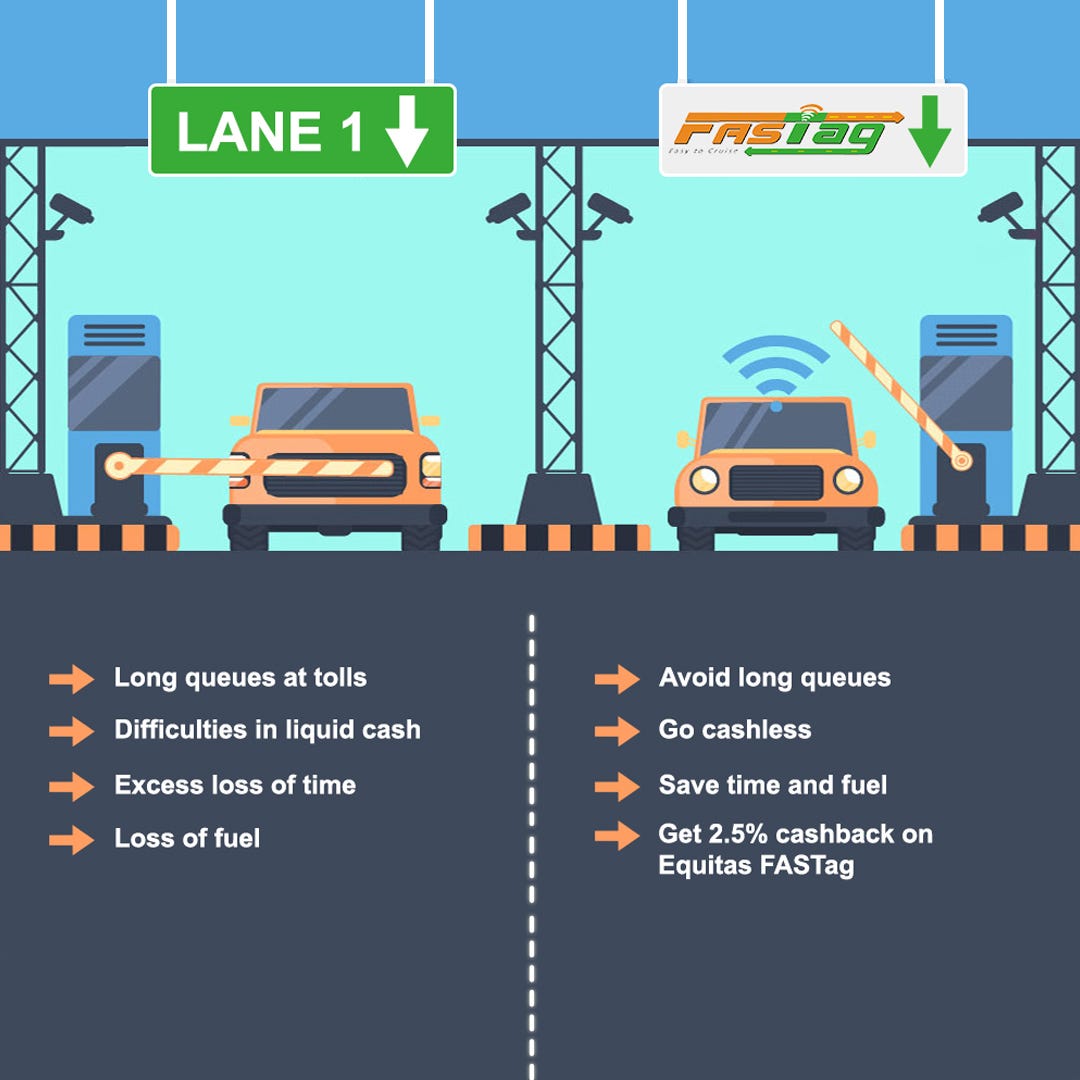
    From December 1, lanes on NH toll plazas across India has started accepting toll only through FASTag. One hybrid lane will continue to accept cash in addition to being tag-enabled.

    What is ‘FASTag’?

    • FASTags are stickers that are affixed to the windscreen of vehicles and use Radio Frequency Identification (RFID) technology to enable digital, contactless payment of tolls without having to stop at toll gates.
    • The tags are linked to bank accounts and other payment methods.
    • As a car crosses a toll plaza, the amount is automatically deducted, and a notification is sent to the registered mobile phone number.

    How does it work?

    • The device employs Radio Frequency Identification (RFID) technology for payments directly from the prepaid or savings account linked to it.
    • It is affixed on the windscreen, so the vehicle can drive through plazas without stopping.
    • RFID technology is similar to that used in transport access-control systems, like Metro smart card.
    • If the tag is linked to a prepaid account like a wallet, or a debit/credit card, then owners need to recharge/top up the tag.
    • If it is linked to a savings account, rthen money will get deducted automatically after the balance goes below a pre-defined threshold.
    • Once a vehicle crosses the toll, the owner will get an SMS alert on the deduction. In that it is like a prepaid e-wallet.

    How can one buy it?

    • E-commerce portals like Amazon and PayTM sell these tags issued by various banks.
    • Places, where these counters are set up, include Road Transport Authority offices, transport hubs, bank branches, and selected petrol pumps.
    • A FASTag bought from NHAI comes with a one-time fee of Rs 100 besides a refundable security deposit of Rs 150.
    • Apart from the currently free tags at NHAI booths, there is also a cashback of 2.5 per cent on FASTag transactions as an offer.
    • In the tag taken from NHAI, the Rs 150 security deposit, which the government is bearing as a promotion, comes back to the user as wallet value if the FASTag is linked to the NHAI e-wallet in the “My FASTag app” mobile app.
    • So in this particular scheme, the user gets Rs 150 back without even paying it.

    Penalties

    • A FASTag is valid for five years, and can be recharged as and when required.
    • Vehicles entering FASTag lanes without FASTag will be charged twice the toll amount.

    Will those living close to toll roads did not end up paying more frequently?

    • As per a government notification, users living within 10 km of a toll plaza can avail a concession on toll to be paid via FASTag.
    • They need to submit proof of residence and nearest point-of-sale location to validate.
    • Once the address is verified, the concession is ensured via FASTag affixed on the vehicle.

    Benefits of Fastags

    • FASTag will help to reduce the waiting time at the plaza
    • Accommodating the increasing traffic without additional lanes
    • Eliminating the acceleration and idling, harmful vehicular emissions and air using FASTag
    • Reducing congestion around plazas
    • Pollution reduction
    • To save fuel for the future which will also help to reduce the operating cost of the vehicles
    • To provide customers the flexibility of paying their plaza bill’s with RFID Tag
    • Reduce cash handling which aids in enhanced audit control by centralizing user accounts
    • Enhancing data collection, information such as vehicle count of the day

    Is it working smoothly?

    • The tags sold by banks are not “bank-neutral”.
    • A FASTag bought from one bank can be recharged through that particular bank only and not through other banks.
    • However, tags sold/distributed by NHAI are bank-neutral as one can use any bank account to recharge/top up the value in the tag.

    What about state highways?

    • Under a new “One Nation One FASTag” scheme, the NHAI is trying to get states on board so that one tag can be used seamlessly across highways, irrespective of whether it is the state or the Centre that owns/manages it.
    • Recently as part of a pilot, Karnataka, Andhra Pradesh and Haryana signed MoUs with the Centre to accept FASTags in state highways also.


    References

    https://www.civilsdaily.com/news/explained-fastags/

    https://timesofindia.indiatimes.com/travel/destinations/fastags-in-india-why-is-it-mandatory-for-your-vehicles-to-have-one-now/as72333185.cms

    https://www.indiatoday.in/information/story/fastag-know-how-works-benefits-details-1622964-2019-11-27

  • [Burning Issue] Labour Code on Industrial Relations


    Context

    • Labour and Employment Ministry has introduced the Labour Code on Industrial Relations bill in the Lok Sabha.
    • As part of labour reform initiatives, the labour ministry has decided to amalgamate 44 labour laws into four codes—on wages, industrial relations, social security and safety, health and working conditions.
    • The industrial relations code is the third of four labour codes that have got approval from the cabinet.

    The Industrial Relations Code Bill, 2019

    • It proposes to amalgamate
    1. The Trade Unions Act, 1926,
    2. The Industrial Employment (Standing Orders) Act, 1946, and
    3. The Industrial Disputes Act, 1947.
    • This is the third Code in the government’s proposed codification of central labour laws into four Codes.

    Aims and objectives

    • The bill aims to improve the business environment in the country largely by reducing the labour compliance burden of industries.
    • It proposes to make it easier for an employer to engage and disengage workers based on requirement.
    • This will make the process of hiring and firing smoother depending on elasticity of demand in the shop floor.

    Key propositions of the Bill

    I. Fixed-term employment

    • The most important aspect of the Bill is that it presents the legal framework for ushering in the concept of ‘fixed-term employment’ through contract workers on a pan-India basis.
    • Currently, companies hire contract workers through contractors.
    • With the introduction of fixed-term employment, they will be able to hire workers directly under a fixed-term contract, with the flexibility to tweak the length of the contract based on the seasonality of industry.
    • These workers will be treated on a par with regular workers during the tenure of the contract.
    • The move to include it in a central law will help in wider reach, and states are expected to follow similar applicability.

    II. Recognition of Negotiating Union

    • To help employers check constant unionism, the bill introduces this feature under which a trade union will be recognized as sole ‘negotiating union’ if it has the support of 75% or more of the workers on the rolls of an establishment.
    • As several trade unions are active in companies, it will be tough for any one group to manage 75% support.
    • This, thus, takes away the negotiating rights of unions. In such a case, a negotiating council will be constituted for negotiation, according to the bill.

    IV. Fixed Term Employment Workman

    • Earlier the government had included the category of ‘Fixed Term Employment Workman’ for all sectors in the Industrial Employment (Standing Orders) Act, 1946.
    • This was only applicable to ‘central sphere’ establishments, and the states did not follow suit.
    • Finance Minister saif that workers under a fixed-term contract would be taken up depending upon the seasonality of the industry, but would be treated on a par with regular workers.

    Special offerings of the bill

    • The threshold required for government permission for retrenchment has been kept unchanged at 100 employees, as against the proposal for 300 employees in an earlier draft of the Bill, which was opposed by trade unions.
    • Instead, the government has now provided flexibility for changing the threshold through notification.
    • The rigidity of labour laws about laying off labour has often been cited by industry as the main reason limiting scalability and employment generation.
    • At present, any company having 100 workers or more has to seek government approval for retrenchment.
    • The provision of fixed-term employment, which helps in the flow of social security benefits to all workers along with making it easier for companies to hire and fire, in The Industrial Relations Code Bill.
    • Layoffs usually happen due to skill issues or company performance. The bill also has a provision to create a re-skilling fund for the benefit of workers.

    Criticisms

    • Critics question the welfare context in this Code. The bill wants to contractualize the workforce, take their collective bargaining right, curtail their right to strike and even on mass leave.
    • Hiring and firing is what the government seeks to formalize through this, they argue.
    • Any discretion in law leads to uncertainty, lack of clarity, discriminatory implementation, and provides scope for unnecessary usage.
    • Provisions like fixed term employment will also instill fear of failure in startup founders and future entrepreneurs which isn’t encouraging for job creation.

    Conclusion

    • The move aims to build positivity in business environment, but workers unions called it a systemic attack on employee welfare.
    • It showcases the government’s intention to create an eco-system for job creation.


    References

    https://www.civilsdaily.com/news/the-industrial-relations-code-bill-2019/

    https://www.livemint.com/news/india/labour-code-on-industrial-relations-bill-introduced-in-parliament-11574951810922.html

    https://economictimes.indiatimes.com/news/economy/policy/industrial-relations-code-non-renewal-of-contract-wont-be-retrenchment/articleshow/72250456.cms

  • [Burning Issue] Presidential Elections in Sri Lanka and India- Sri Lanka relations in recent times


    Context


    Recently Gotabaya Rajapaksa was elected as new President of Sri Lanka. This election was based on security issues that emerged after a suicide bombing attack claimed by Islamic State on Easter Sunday this year.

    As Gotabaya settles into office and visits India end of this week, on the 29th, the Indian government would hope that its hands-off approach in the 2019 Sri Lankan elections pays off.

    Brief background of India-SL relations:


    • India is the only neighbour of Sri Lanka, separated by the Palk Strait; both nations occupy a strategic position in South Asia and have sought to build a common security umbrella in the Indian Ocean.
    • There are deep racial and cultural links between the two countries. Both share a maritime border.
    • The India- SL relations have been however tested by the Sri Lankan Civil War and by the controversy of Indian intervention during the war.
    • In recent years Sri Lanka has moved closer to China, especially in terms of naval agreements.
    • India has signed a nuclear energy deal to improve relations and made a nuclear energy pact with Sri Lanka in 2015.


    India’s role in the Lankan Civil War


    • In the 1970s–1980s, the RAW and the state government of Tamil Nadu were believed to be encouraging the funding and training for the Liberation Tigers of Tamil Eelam (LTTE), a separatist insurgent force.
    • In 1987, faced with growing anger amongst its own Tamils, and a flood of refugees India intervened directly in the conflict for the first time.
    • This was after the Sri Lankan government attempted to regain control of the northern Jaffna region by means of an economic blockade and military assaults; India supplied food and medicine by air and sea.

    Why did India intervene?

    • Indian intervention in Sri Lankan civil war became inevitable as that civil war threatened India’s unity, national interest and territorial integrity.
    • This threat came in three ways:
    1. On the one hand, external powers could take advantage of the situation to establish their base in Sri Lanka thus posing a threat to India;
    2. On the other, the LTTE’s dream of a sovereign Tamil Eelam comprising all the Tamil inhibited areas (of Sri Lanka and India) posed a threat to India’s territorial integrity.
    3. There was extensive military involvement of Pakistan in the conflict by supplying lethal weaponry and encouraging Sri Lanka to pursue military action rather than peaceful negotiations to end the civil war.

    Outcomes

    • After subsequent negotiations, India and Sri Lanka entered into an agreement.
    • The peace accord assigned a certain degree of regional autonomy in the Tamil areas with a body controlling the regional council and called for the Tamil militant groups to lay down their arms.
    • Further India was to send a peacekeeping force, named the IPKF to Sri Lanka to enforce the disarmament and to watch over the regional council.
    • The accord failed over the issue of representations. The result was that the LTTE now found itself engaged in military conflict with the Indian Army.
    • The ruthlessness of this campaign and the Indian army’s subsequent anti-LTTE operations made it extremely unpopular amongst many Tamils in Sri Lanka.
    • The conflict between the LTTE and the Indian Army left over 1,000 Indian soldiers dead.

    Areas of cooperation


    Economic relations

    • India and Sri Lanka are member nations of several regional and multilateral organizations such as the South Asian Association for Regional Cooperation (SAARC), South Asia Co-operative Environment Programme, South Asian Economic Union and BIMSTEC.
    • Since a bilateral free trade agreement was signed and came into effect in 2000, Indo-Sri Lankan trade rose 128% by 2004 and quadrupled by 2006, reaching US$2.6 billion.
    • Indian exports account for 14% of Sri Lanka’s global imports. India is also the fifth largest export destination for Sri Lankan goods, accounting for 3.6% of its exports.
    • Both nations are also signatories of the South Asia Free Trade Agreement (SAFTA).
    • India’s National Thermal Power Corp (NTPC) is also scheduled to build a 500 MW thermal power plant in Sampoor (Sampur). The NTPC claims that this plan will take the Indo-Sri Lankan relationship to a new level.

    Development co-operation

    • Line of Credit: India is active in a number of areas of development activity in Sri Lanka. About one-sixth of the total development credit granted by India is made available to Sri Lanka.
    • In the recent past, three lines of credit were extended to Sri Lanka: US$100 million for capital goods, consumer durables, consultancy services, and food items, US$31 million for the supply of 300,000 MT of wheat and US$150 million for purchase of petroleum products.
    • Fishing Sector: Projects for providing fishing equipment to the fishermen in the East of Sri Lanka and solar energy aided computer education in 25 rural schools in Eastern Sri Lanka are under consideration.
    • Healthcare: India has supplied medical equipment to hospitals at Hambantota and Point Pedro, supplied 4 state-of-the-art ambulances to the Central Province etc.
    • Tourism: Indian governments have also showed interest in collaborating with their Sri Lankan counterparts on building tourism between the two countries based on shared religious heritage.

    Defense and strategic cooperation

    • India and Sri Lanka conducts one of the largest joint Military exercises called ‘Mitra Shakti’. Both conducts joint Naval exercise called ‘SLINEX’
    • India is the largest provider of defense training program to Sri Lankan soldiers and Defence officials
    • India, Sri Lanka, and Maldives has signed trilateral maritime security cooperation in the Indian Ocean region. The cooperation aims at improving surveillance, anti-piracy operations and reducing maritime pollution


    Major outstanding issues


    Fishing disputes

    • There have been several alleged incidents of Sri Lankan Navy personnel firing on Indian fishermen fishing in the Palk Strait, where India and Sri Lanka are only separated by 12 nautical miles.
    • The issue started because of Indian fishermen having used mechanized trawlers, which deprived the Sri Lankan fishermen (including Tamils) of their catch and damaged their fishing boats.
    • The Sri Lankan government wants India to ban use of mechanized trawlers in the Palk Strait region, and negotiations on this subject are undergoing.
    • So far, no concrete agreement has been reached since India favors regulating these trawlers instead of banning them altogether.
    • Another cause of anger amongst the Sri Lankan side is the use of mechanized trawlers, which they view as ecologically damaging.

    Alleged political interference

    • A media report from Colombo soon after Rajapaksa’s defeat in the January 8 elections of 2015 had said that an Indian Intelligence official was instrumental in uniting rival political parties — the Sri Lanka Freedom Party (SLFP) and the United National Party (UNP) — against him during the polls.
    • In October 2018, President Sirisena alleged that Indian intelligence agencies were plotting his assassination.
    • He made this comment in the cabinet meeting, after CID of Sri Lanka Police arrested an Indian national in September for the alleged assassination of Sirisena and Gotabaya Rajapaksa.

    China factor

    • SL has a history of taking independent decisions even if they cause misgivings in India.
    • In the period of low profile relationship between the two nations, SL apparently started favoring China over India.
    • India and Sri Lanka in February 2015 signed a nuclear energy deal to improve relationships.
    • China has taken for lease the Hambantota deep sea port and Mattala international airport in Sri Lanka.
    • The earlier government treated our concerns about China’s increasing presence on the island with “strategic autonomy”, pursuing, as usual, a balancing approach.

    Katchatheevu Island

    • It is an uninhabited island that India ceded to Sri Lanka in 1974 based on a conditional agreement called “Kachchativu island pact”.
    • Later on, Sri Lanka declared Katchatheevu, a sacred land given the presence of a Catholic shrine
    • The central government recognizes Sri Lanka’s sovereignty over the island as per the 1974 accord. But Tamil Nadu claimed that Katchatheevu falls under the Indian territory and Tamil fishermen have traditionally believed that it belongs to them and therefore want to preserve the right to fish there.


    Why is Sri Lanka important to India?

    • India is Sri Lanka’s closest neighbor. Both sides have built upon a legacy of intellectual, cultural, religious and linguistic interaction.
    • Sri Lanka has always been politically and economically important to India given its strategic geographical position in the Indian Ocean. The relationship has been marked by close contacts at all levels.
    • Sri Lanka sits at the epicenter of the arc connecting the Persian Gulf to the Strait of Malacca. An island nation with an economy that’s mainly reliant on tourism and tea exports, Sri Lanka’s blessed geography puts it at a crucial juncture of the busy shipping lanes of the Indian Ocean.
    • India also has a vital strategic stake in Sri Lanka for its own security interests. An unfriendly Sri Lanka or a Sri Lanka under influence of a power unfriendly to India would strategically discomfit India.
    • For the Indian Navy, Sri Lanka is important as the switching of naval fleets from the Bay of Bengal to the Arabian Sea and vice versa requires the fleets to go around the island nation.
    • Both countries share a common broad understanding on major issues of international interest and experience common social-political problems relating to community divides.

    SL needs India too

    • The humanitarian work by Indian agencies like supplies of medicines, doctors and providing refuge to more than 3 lakhs IDP’s during the decade-old civil war has created a sense of mutual cooperation among the countries natives.
    • SL is one of the leading recipients of India’s Line of Credits.
    • India has always rushed for the relief at the first signs of the rains and floods in SL recently. SL still commends the post-tsunami HADR relief operations carried out by India in the end-2004.
    • India’s military, intelligence and security establishment has maintained its relations with its Sri Lankan counterpart, and both sides have been on the same page at all times.
    • The security environment in the neighborhood will be discussed in light of the 21 April Easter Church bombings, and lessons learned from it.
    • India is also the largest provider of defense training programs for Sri Lankan soldiers and Defence officials.

    The Rajapaksa Factor


    • Rajapaksa is a controversial family that is known for its pro-China tilt and also infamously remembered for its brutal acts against Tamil minorities in pursuit of ending the Sri Lankan civil war in 2009.
    • Sri Lanka witnessed an authoritarian family rule under former president Mahinda Rajapaksa between 2005 and 2015.
    • Gotabaya Rajapaksa (brother of Mahinda Rajapaksa), a former defence secretary and intelligence officer, accused of committing human rights violations, hailed by many for ending the civil war.
    • Also, India’s relations with Sri Lanka went through a troubled patch during the Mahinda Rajapaksa presidency due to his proximity with China.

    Unresolved legacy issues

    • Given Gotabaya’s role as defense minister in Mahinda’s government in the LTTE’s elimination and charges of war crimes and human rights violations, this polarization raises questions about the course of domestic politics ahead.
    • The EAM has, during his recent visit, conveyed to President Gotabaya India’s expectation that his government will proceed with national reconciliation, with a solution that meets Tamil aspirations.
    • These are, of course, the right words for the occasion and do not necessarily guarantee what happens next.
    • The Tamils would be concerned at the choice of Anuradhapura as the venue for the President’s inauguration and General Gunaratne, reputedly the scourge of Tamils in the war, as defense minister.

    Greater role for India


    Gathering convergence towards SL

    • Delhi needs to invest some political capital in resolving problems such as the long-standing dispute over fisheries.
    • Beyond its objection to China’s BRI projects, Delhi, either alone or in partnership with like-minded countries like Japan, should offer sustainable terms for infrastructure development.
    • Delhi also needs to contribute more to the development of Colombo’s defence and counter-terror capabilities.

    Answering the Tamil Question

    • The second structural factor shaping India’s relations with Sri Lanka is the Tamil question.
    • Delhi has certainly learned the dangers of being drawn too deep into the domestic conflicts of neighboring countries.
    • If the new government in Colombo can advance reconciliation with the Tamil minority, it will be easier for India to strengthen ties with the Gotabaya government.

    No china factor indeed

    • Labeling governments in Sri Lanka as “pro-China” or “pro-India” is irrelevant. It is evident that China’s economic and strategic salience in the subcontinent is not tied to the regime leadership.
    • Previous Lankan President Maithripala Sirisena who considered as pro-India came to power criticizing the Chinese projects in Sri Lanka, but within two years into power, it extended full backing to the Chinese projects.

    Harnessing the  ray of hope

    • Our challenges in Sri Lanka will continue, but we are off to a good start with the new government.
    • The new president has made repeated statements that his government would like Sri Lanka to be a “neutral country” and that “Sri Lanka won’t do anything that will harm India’s interests.”
    • Gotabaya was also critical of the previous government giving Hambantota Port on a 99-year lease to China.
    • He went on to add that giving land as investment for developing a hotel or a commercial property was not a problem but the strategically important, economically important harbor, giving that is not acceptable.
    • The Rajapaksas have acknowledged that India has not interfered in the recent elections.
    • The first visit abroad by Gotabaya Rajapaksa to India has its own symbolic significance, translating into a diplomatic gesture his statement to the EAM that while China is a trade partner, India is a relative.

    Way Forward


    • During the last few years, various constitutional amendments have weakened the Sri Lankan president’s powers considerably and it would be interesting to watch the relationship between the president and the parliament, which cannot be dissolved before February 2020 — unless it votes itself to do so.
    • This stability in the Indian government should find synergy with the new Sri Lankan president policy which includes “neutrality” and “non-alignment” between major powers.
    • Rather than focusing on building the case against China, New Delhi must step up its efforts to show what it is for.
    • India can never match Beijing’s economic wherewithal to make a difference to Colombo’s developmental requirements.
    • But it can carve out a niche role in some areas and also partner smartly with likeminded strategic partners like Japan to make an economic and strategic difference in Sri Lanka.

    Conclusion

    • The challenges for India to protect its interests remained even with the friendly Sirisena-Wickremesinghe government in power in Sri Lanka.
    • One of the biggest challenges for Indian diplomacy in the subcontinent is to persuade its neighbor that India is an opportunity and not a threat.
    • Progressive trade and economic ties are key to prosperity in India Sri Lanka relations and the free trade agreement acts as a catalyst to address this solution.
    • Sri Lanka should be allowed for recovering stable polity and growing economic ties with India through various channels.
    • The China question is only part of the recalibration that will be needed to get India-Sri Lanka relations on the right track.


    References

    https://www.civilsdaily.com/burning-issue-constitutional-crisis-in-sri-lanka/

    https://www.thequint.com/voices/opinion/india-sri-lanka-president-gotabaya-bilateral-relations-security-political-stability

    https://idsa.in/idsacomments/problem-of-fishermen-in-india-sri-lanka-relations_gsen_200516

    https://www.orfonline.org/expert-speak/why-india-needs-re-calibrate-relations-sri-lanka/

    https://thediplomat.com/2019/11/what-will-rajapaksas-return-mean-for-india-sri-lanka-relations/

    https://indianexpress.com/article/opinion/columns/gotabaya-rajapaksa-sri-lanka-elections-colombo-6126280/