💥UPSC 2026, 2027, 2028 UAP Mentorship (March Batch) + Access XFactor Notes & Microthemes PDF

Search results for: “”

  • LGBTQ leap forward for positive future growth of human rights

    LGBTQContext

    • Four years after landmark LGBTQ verdict: The march to full citizenship.

    Why in news?

    • On September 6, 2018, exactly four years ago, in Navtej Singh Johar and Ors v Union of India, a five-judge constitution bench of the Supreme Court, in a beautifully elaborate decision, liberated LGBTQI Indians from the darkness of Section 377 of the Indian Penal Code, 1860.

    What is LGBTQ?

    • LGBTQ is an initialism that stands for lesbian, gay, bisexual, and transgender. In use since the 1990s, the initialism, as well as some of its common variants, functions as an umbrella term for sexuality and gender identity.

    What is Section 377 of the IPC?

    • It reads – Unnatural offences: Whoever voluntarily has carnal intercourse against the order of nature with any man, woman or animal shall be punished with imprisonment for life, or with imprisonment of either description for a term which may extend to ten years, and shall also be liable to fine.
    • The terms “carnal intercourse” and “against the order of nature” are not defined precisely anywhere in the code.

    LGBTQRole played by the judiciary hitherto

    • The Delhi High Court’s verdict in Naz Foundation vs Government of NCT of Delhi (2009) was a landmark in the law of sexuality and equality jurisprudence in India.
    • The court held that Section 377 offended the guarantee of equality enshrined in Article 14 of the Constitution, because it creates an unreasonable classification and targets homosexuals as a class.
    • In a retrograde step, the Supreme Court, in Suresh Kumar Koushal vs Naz Foundation (2013), reinstated Section 377 to the IPC.
    • However, the Supreme Court in Navtej Singh Johar & Ors. vs Union of India (2018) declared that the application of Section 377 IPC to consensual homosexual behaviour was “unconstitutional”.
    • This Supreme Court judgment has been a great victory to the Indian individual in his quest for identity and dignity.
    • It also underscored the doctrine of progressive realisation of rights.

    LGBTQWhat’s next?

    • Overarching legislation is needed to guarantee equality to all persons on the basis of sexual orientation, gender identity and expression, sex, caste, religion, age, disability, marital status, pregnancy, nationality, and other grounds.
    • The law should impose obligations of equality and non-discrimination on all persons, public and private, and in the areas of education, employment, healthcare, land and housing and access to public places.
    • It should provide for civil remedies to stop discriminatory behaviour, costs and damages, and positive action to make reparations.
    • We need an equality law to define what equality would encompass.
    • Supreme Court comes held in its privacy judgment in K.S. Puttuswamy v. Union of India (2017) that equality and liberty cannot be separated, and equality encompasses the inclusion of dignity and basic freedoms.

    Way forward

    • Schools and colleges must effect changes in curricula for a better understanding of the community.
    • People of a different sexual orientation or gender identity often narrate harrowing tales of bullying, discrimination, stigma and ostracization.
    • Gender-neutral restrooms should be compulsory in educational institutes and other places.
    • Parents too need to be sensitised, because the first point of misunderstanding and abuse often begins at home, with teenagers being forced to opt for “conversion” therapies.

    Conclusion

    • Justice Chandrachud, speaking on the fourth anniversary of Johar and the journey ahead, while quoting the Beatles classic “All you need is love”, notes that “simply love is not enough”. Rights are necessary. Which will enhance dignity of the community.

    Mains question

    Q. “Silent segregation” on the grounds of gender, sexual orientation preferences are followed in several houses. Elucidate in context of LGBTQ issues. What Legal remedies are needed for its victims?

    UPSC 2023 countdown has begun! Get your personal guidance plan now! (Click here)

  • Public health should be led by doctor alone

    public healthContext

    • Doctor shortages are creating hurdles in health emergency response

    What is the crux of the article in simple words?

    • Medical qualification and expertise is necessary to deliver quality health services by medical professionals unlike by general health care workers who lack competency.

    What is public health?

    • Public health has been defined as “the science and art of preventing disease, prolonging life and promoting health through the organized efforts and informed choices of society, organizations, public and private, communities and individuals”.

    Why there is need of qualification?

    • Lack of training: Health workers have no training in public health; they are grassroots-level service providers. Asking them to be part of public health cadre trivialises the profession of public health.
    • Separate profession: It is important to understand that public health is a separate profession with a specific set of competencies.

    public healthWhat are 4 pillars of public health?

    • Academics: Academics refers to a good understanding of evidence generation and synthesis by having a good grounding in epidemiology and biostatistics. These competencies are also critical for monitoring and evaluating programmes, conducting surveillance, and interpreting data and routine reporting.
    • Activism: Public health is inherently linked to ‘social change’ and an element of activism is core to public health. Public health requires social mobilisation at the grassroots level by understanding community needs, community organisation, etc. This requires grounding in social and behavioural sciences.
    • Administration: Administration refers to administering health systems at different levels from a primary health centre to the district, State, and national level. This includes implementing and managing health programmes, addressing human resource issues, supply and logistical issues, etc. It includes microplanning of programme delivery, team building, leadership as well as financial management to some extent.
    • Advocacy: In public health, there is little that one can do at an individual level; there must be communication with key stakeholders to change the status quo at different levels of government. This requires clear enunciation of the need, analysis of alternative set of actions and the cost of implementation or non-implementation. Good communication and negotiation skills are critical to perform this function. The related subjects are health policy, health economics, health advocacy and global health.

    public healthWhat are the hurdles in absorbing others as public health professionals?

    • Lack of skill: Many doctors and other health professionals work at the grassroots level and develop a good sense of public health due to their inclination. But they do not become public health professionals as they may not have the necessary skills. Nevertheless, they are valuable.
    • Lack of critical expertise: Clinicians with training in epidemiology and biostatistics would not qualify to be public health professionals as they lack not only other essential and critical expertise but also an appropriate perspective.
    • Compromise on quality:

    Current challenges faced by public healthcare in India

    • Deficiency: The doctor-patient ratio of 1:1655 in India as against WHO norm of 1:1000 clearly shows the deficit of MBBS. While the government is working towards a solution and targeting to reach the required ratio, there is a need to relook at the overall medical education.
    • Post pandemic scenario: The lag in formal medical education has come up evidently post-pandemic when the nation saw the medical fraternity struggling to fill the doctor deficit.
    • Limited government seats: The number of seats available for medical education in India is far less than the number of aspirants who leave school with the dream of becoming doctors.
    • Lack of skills: Though the institutes are managing to hire professors and lecturers, there is a lack of technical skills. Finding faculties in clinical and non-clinical disciplines is difficult and there are very few faculty development programs for upskilling the existing lot.
    • Lack of infrastructure: The gap in digital learning infrastructure is currently the biggest challenge the sector is facing. There is an urgent need to adopt technology and have resources available to facilitate e-learning.
    • Lack of research and innovation: The medical research and innovation needs an added push as there haven’t been many ground-breaking research here. The education system needs to focus more on increasing the quality of research. Additionally since industry academia partnership is not available, hence innovation also takes a back-seat.

    Conclusion

    • By establishing new medical colleges, the government can increase student intake as well as enhance equitable access to public health as separate profession. This will attract the best and the brightest people into this discipline, which is very important for the nation’s health. This is one lesson that we should learn from the pandemic.

    Mains question

    Q. What do you understand by public health? Do you think it is a separate profession requiring a specific set of competencies? Examine.

    UPSC 2023 countdown has begun! Get your personal guidance plan now! (Click here)

  • 13th September 2022| Daily Answer Writing Enhancement(AWE)

    Topics for Today’s questions:

    GS-1      The Freedom Struggle — its various stages and important contributors/contributions from different parts of the country.

    GS-2       Appointment to various Constitutional posts, powers, functions and responsibilities of various Constitutional Bodies; Federalism

    GS-3        Effects of liberalization on the economy, changes in industrial policy and their effects on industrial growth. 

    GS-4        Ethics and Human Interface: Essence, determinants and consequences of Ethics in-human actions; dimensions of ethics; ethics – in private and public relationships.

    Question 1)


    Q.1 Satyagraha of Gandhi dispelled fear from the minds of masses and sealed the fate of imperialism in the country. Discuss. (10 Marks)


    Question 2)

    Q.2 Against the intentions of the constitution makers, the use of discretionary powers by governors has become a major source of tension in Centre–state relations. What are the discretionary powers of the Governor? Also, discuss the issues associated with them. (15 Marks)

    Question 3)

    Q.3 The Production Linked Incentive scheme (PLI) was launched with an intention to create a sustainable manufacturing base in India. Highlighting the need of the scheme, mention some of the advantages and concerns associated with it. (15 Marks)

    Question 4)  

    Q.4 Although ethics in private and public relations are different, they interact and influence each other. Discuss. (10 Marks)


    HOW TO ATTEMPT ANSWERS IN DAILY ANSWER WRITING ENHANCEMENT(AWE)?

    1. Daily 4 questions from General studies 1, 2, 3, and 4 will be provided to you.

    2. A Mentor’s Comment will be available for all answers. This can be used as a guidance tool but we encourage you to write original answers.

    3. You can write your answer on an A4 sheet and scan/click pictures of the same.

    4.  Upload the scanned answer in the comment section of the same question.

    5. Along with the scanned answer, please share your Razor payment ID, so that paid members are given priority.

    6. If you upload the answer on the same day like the answer of 11th  February is uploaded on 11th February then your answer will be checked within 72 hours. Also, reviews will be in the order of submission- First come first serve basis

    7. If you are writing answers late, for example, 11th February is uploaded on 13th February , then these answers will be evaluated as per the mentor’s schedule.

    8. We encourage you to write answers on the same day. However, if you are uploading an answer late then tag the mentor like @Staff so that the mentor is notified about your answer.

    *In case your answer is not reviewed, reply to your answer saying *NOT CHECKED*. 

    1. For the philosophy of AWE and payment: 

  • Gyanvapi -Kashi Vishwanath Temple Complex Dispute

    gyanvapi

    The Varanasi District and Sessions Court has rejected the plea of the organization which manages the Gyanvapi mosque complex, challenging the maintainability of the civil suits filed by some women seeking the right to worship Goddesses on the outer wall of the complex.

    About Gyanvapi Mosque

    • The Gyanvapi Mosque was built in 1669 during the reign of the Mughal emperor Aurangzeb, who ordered the demolition of the existing Vishweshwar temple at the site, and its replacement by a mosque.
    • The plinth of the temple was left untouched, and served as the courtyard of the mosque.
    • One of the walls too was spared, and it became the qibla wall, the most important wall in a mosque that faces Mecca.
    • Material from the destroyed temple was used to build the mosque, evidence of which can be seen today.
    • The name of the mosque is said to have derived from an adjoining well, the Gyanvapi, or Well of Knowledge.
    • An old sculpture of the Nandi bull inside the compound of the present Kashi Vishwanath Temple faces the wall of the mosque instead of the sanctum sanctorum of the temple.
    • It is believed that Nandi is in fact, facing the sanctum sanctorum of the original Vishweshwar temple.

    The temple to Lord Shiva

    • For more than 100 years after the mosque was built, there was no temple at the site.
    • The present Kashi Vishwanath Temple was built in the 18th century by Rani Ahilyabai Holkar of Indore, immediately to the south of the mosque.
    • Over the decades it emerged as one of the most prominent and revered centres of the Hindu religion.
    • Many Hindus have long believed that the original deity of the erstwhile Vishweshwar temple was hidden by the priests inside the Gyanvapi well during Aurangzeb’s raid.
    • This has fired the desire to conduct puja and rituals at the sacred place where the mosque now stands.

    Longstanding claims

    • From time to time, petitioners have laid claim to the mosque, saying it remains the original sacred place of Hindu worship.
    • The Ayodhya movement also aimed to “liberate” the Kashi-Vishwanath Temple-Gyanvapi mosque site and the Shri Krishna Janmabhoomi in Mathura as well.

    What laws restrict such acts?

    • The Places of Worship (Special Provisions) Act, 1991 — which mandates that the nature of all places of worship, except the one in Ayodhya that was then under litigation, shall be maintained as it was on August 15, 1947.
    • It maintains that no encroachment of any such place prior to the date can be challenged in courts — applies to the disputed complex in Varanasi.

    What was the case before the Court?

    • The temple worshipers side had argued that the mosque was built on the site of an older temple, while the another side pleaded that the mosque was built on Wakf premises.
    • The plea also said that The Places of Worship Act of 1991 barred the changing of the character of the mosque.
    • The case was initially heard by the Civil Judge (Senior Division), Varanasi, but it was transferred by the Supreme Court to the District Judge on grounds of the “complexity of the issues involved in the civil suit”.
    • The Supreme Court said it would wait for the district court’s decision on the mosque committee’s application before intervening in the matter.

    Issue in Limelight

    • In April 2021, Fast Track Court Civil Judge ordered the Archaeological Survey of India to get a comprehensive archaeological physical survey” done of the Kashi Vishwanath Temple-Gyanvapi Mosque complex.
    • It was tasked to find out as to whether the religious structure standing at present at the disputed site is a superimposition, alteration or addition or there is a structural overlapping of any kind, with or over, any religious structure.
    • The mosque is not an ASI-protected site, and the ASI has no role in its maintenance or upkeep.

    What are the people seeking now?

    • Worshippers find the cut-off date of August 15, 1947, is “arbitrary, irrational and retrospective” and prohibits Hindus, Jains, Buddhists, and Sikhs from approaching courts to “reclaim” their places of worship.
    • Such places, they argue, were “invaded” and “encroached” upon by “fundamentalist barbaric invaders”.
    • Certain groups have opposed the law even when it was introduced, arguing that the Centre has no power to legislate on “pilgrimages” or “burial grounds” which are under the state list.


    UPSC 2023 countdown has begun! Get your personal guidance plan now! (Click here)

  • Mains Essential Program (MEP) 2023: Answer writing with personalized Mentorship | Replicating 85% Success Rate for Mains 2023 results | 2nd Batch Starts 17th September | Register here

    Mains Essential Program (MEP) 2023: Answer writing with personalized Mentorship | Replicating 85% Success Rate for Mains 2023 results | 2nd Batch Starts 17th September | Register here

    Guys, as wealth without work, is a greater sin, knowledge without practice is an unacceptable folly. To attain success, polishing your thought is a must and to catch up with the hands of the clock, practice and practice are the only things that matter the most to an IAS aspirant. 

    After receiving feedback from almost 500+ of our successful UPSC candidates, Civilsdaily can claim that 85% of the questions in UPSC Mains were already asked in our previous MEP tests. And this was the only strong reason that the success rate of our MEP program has been featured in famous newspapers. 

    “UPSC level questions, detailed evaluation, and in-depth discussion of tests (question by question) improved my score.”

    AIR 28, Mourya Bharadwaj UPSC 2021

    “Impressed by the efforts put in to improve my answer writing, structured phone calls. Grateful for personal guidance.”

    Karishma Nair, AIR 14, UPSC 2020

    To satisfy the high demand, we are fully prepared now to launch MEP 2nd batch on the 17th of September, 2022

    Table of Content:


    What is MEP 2023?

    Mains essential Program (MEP) 2023 is your solution to practicing Mains Answer writing. Don’t procrastinate answer writing, developing a skill does not happen magically after you clear prelims.

    Mains Essential Program 2023 is a Mentor guided comprehensive and intensive program for GS Mains papers. The focus is on making students understand the requirement of Mains Question, its elements, using information, and imparting answer writing skills for that.


    How MEP is needed for your IAS dream:

    Your knowledge is tested through your answers: If you have not learned the art to articulate your thoughts on paper, then that’s a disaster waiting to happen. Studying and writing answers is a symbiotic relationship and one reinforces the other.

    • Helps you retain concepts, facts, and figures.
    • Learning the trick to formulate the structure of the answer.
    • Helps to revise things and learn new things not covered by conventional books.
    • Improves your writing speed, and handwriting.

    Know-How Our Mains Test Program Stands Apart?

    1. Personalised Mentorship to correct you at each step

    We believe in personalized individual attention. A one-to-one discussion with your Mentor will not only highlight your weaknesses but will also help in tracking your improvements over the subsequent tests. It will also ensure consistency, continuity, and progressive improvement.

    Students usually get swayed by only seeing the theme of the question. The question is not about electoral bonds only. Many aspirants write everything they know about electoral bonds. You need to first mention how it will cleanse India’s electoral system. After that, link it with democracy. How it violates key features of democracy like transparency, accountability, and a level playing field. Writing only Pros and Cons will not fetch you marks.

    Just schedule a call with our mentor to clear all your doubts and queries.

    2. Quality standards of questions in our test series

    Our Test series questions have consistently proven to be similar to UPSC standards.

    Here’s the proof


    Program Inclusion Details:

    • 12 Sectional tests: The whole syllabus will be divided into portions like history, economics, and geography. The test will be spread over 8 months. This will ensure that your basic static preparation happens continuously alongside your mains answer writing program. Killing two birds with one stone!
    • 12 Full-length tests: After the prelims, it is time to go full gear.
    • Personalized discussion: You doubt why you are scoring less or how you can improve your score for the next paper. No worries! Just schedule a call with our mentor to clear all your doubts and queries.
    • Civilsdaily’s handholding: You will be provided membership to Mains 2023 club on Habitat. There you can put up your doubts and queries. Also can be used to interact with peers on strategies to improve your mains writing. You can also contact mentors like Sajal sir, Sukanya ma’am, Sudhanshu sir and Poornima Ma’am. They all have interview-level experience, so utilize their experience to your benefit.
    • Civilsdaily magazine: Your current affairs will be covered with access to our 1-year subscription. (June 2022 to May 2023)

    Our Philosophy behind MEP 2023

    1. Question Formulation

    It happens under a team of experienced Civilsdaily faculty. Questions framed are from the most important UPSC relevant themes and papers are based on the latest pattern of UPSC.

    Our questions specifically state:

    • Whether they are straightforward or thought-provoking/analytical.
    • Whether they have subparts.
    • Why this question – similar to previous year’s questions, the importance of the theme, etc.

    CD InnovationRed-green highlight – to let you know about the necessary and innovative points.

    2. One-to-One Discussion

    We believe in personalized individual attention. This is the biggest reason why you should join our TS. Students can schedule a call within 2 days of receiving their checked copies.

    A one-to-one discussion with your Mentor will not only highlight your weaknesses but will also help in tracking your improvements over the subsequent tests. It will also ensure consistency, continuity, and progressive improvement.

    3. Answer Checking

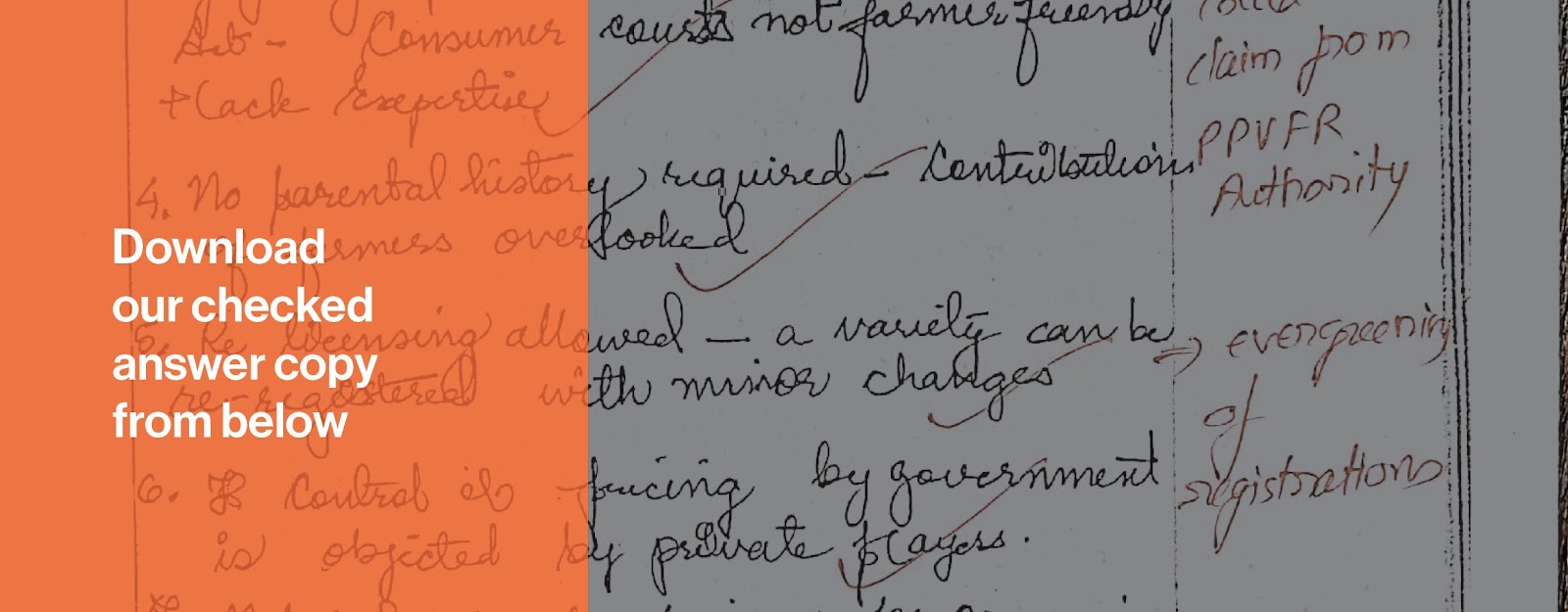
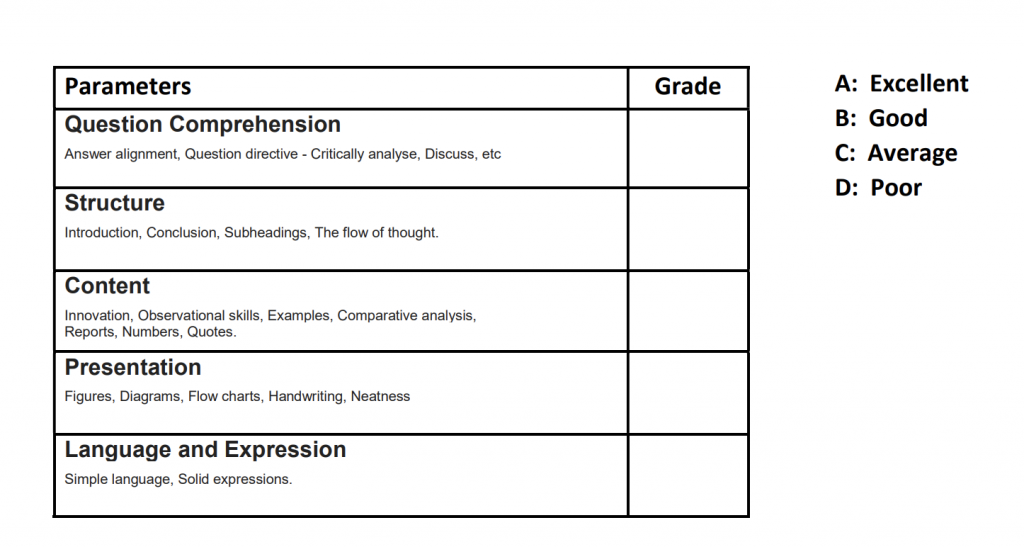
    Our evaluation focuses on multiple dimensions and parameters like structure, flow, presentation, contextuality, relevance to question, analytical excellence, and cross-domain inter-linkages than simply on superficial, memory-based lapses.

    Evaluated answer copy – 1 (Click to download)

    Evaluated answer copy – 2 (Click to download)

    Parameters we use to evaluate your answers

    4. Model Answers

    More than just simply providing information, our model answers cover all the aspects of a question and provide enriching points to the student. They also include:

    • For ‘thought-provoking/analytical’ type of questions, we’ll provide the best way to approach them.
    • Alternate introductions
    • Subheadings and categorization to enhance readability and answer structure.
    • Colour coding for main arguments, reports, data, scholars, etc.
      OTB – Out-of-the-box points for additional marks

    5. Civilsdaily’s Handholding

    You’ll be assigned to a special group on Civilsdaily’s Habitat, there you can interact with different mentors like Sajal Sir, Sukanya ma’am, Ajay Sir, Sudhanshu sir, and others.

    Civilsdaily’s Habitat – Desktop and Mobile view

    6. Value-added material

    Current affairs magazines – Civilsdaily’s Magazines are the best in terms of comprehensive coverage, superb design, and high readability.

    Listicles and other relevant study material – Supplementary content provided will help cover multiple related questions.


    About Mentor:

    Sukanya Rana:

    Sukanya ma’am has firsthand experience of 4 mains and 2 interviews of UPSC. In 2019, she scored 140 in ethics. She has also appeared in the State PCS interview. Before she worked as a Probationary officer in Canara bank. Now at Civilsdaily, she heads the Mains program and is engaged in a core team of Civilsdaily.

    As per need, we will also involve our Civilsdaily core mentors like Swatantra sir, Parth sir, etc.


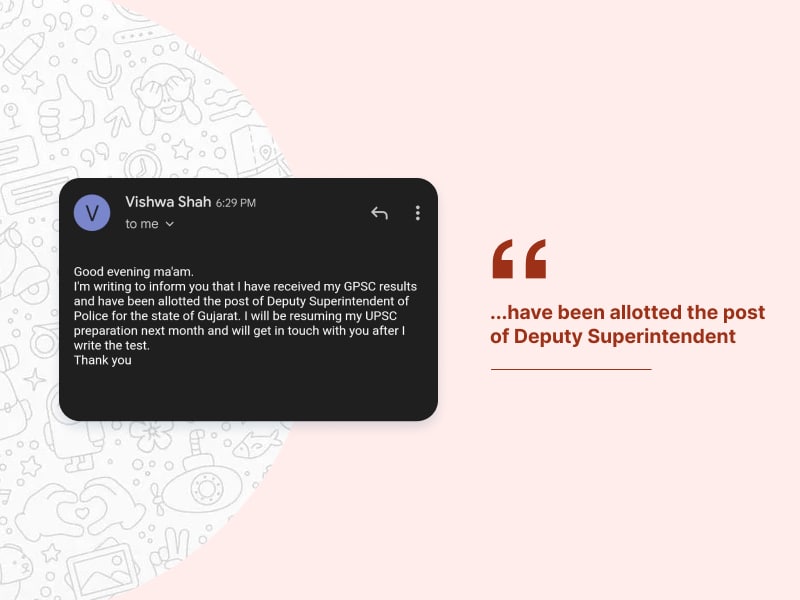
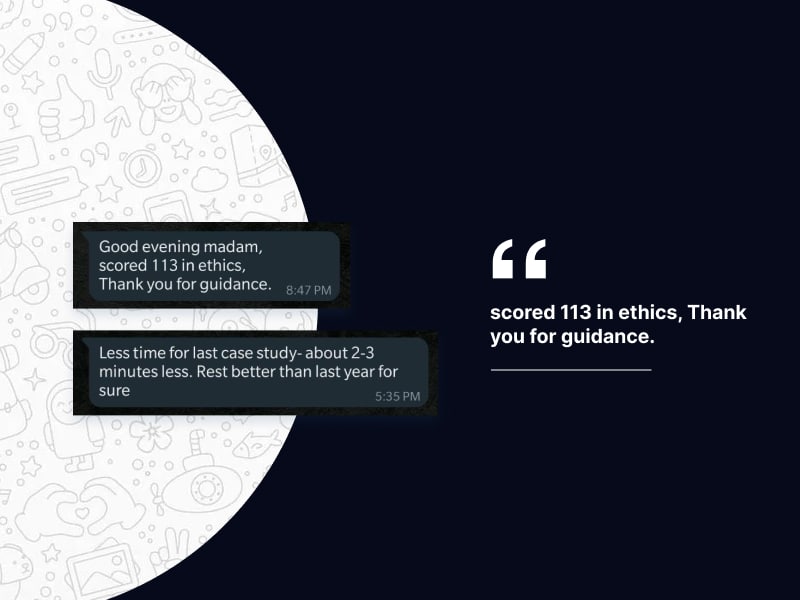
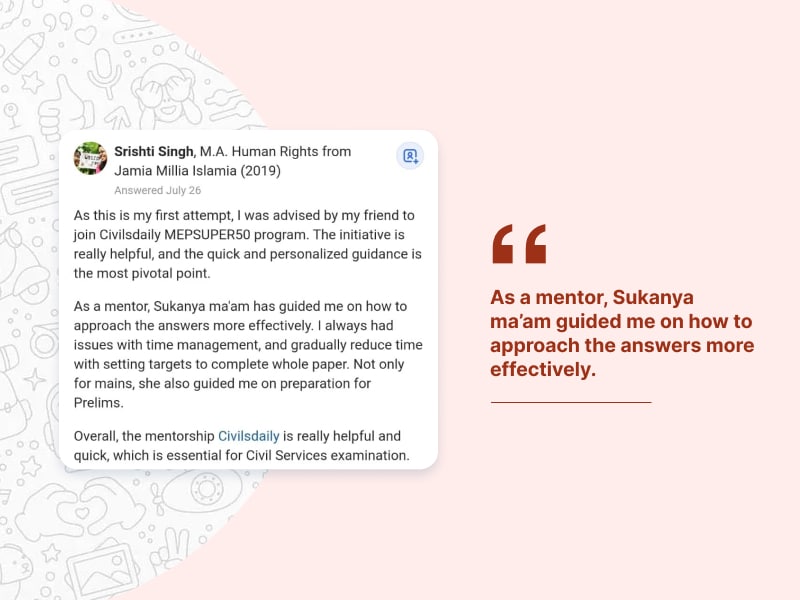
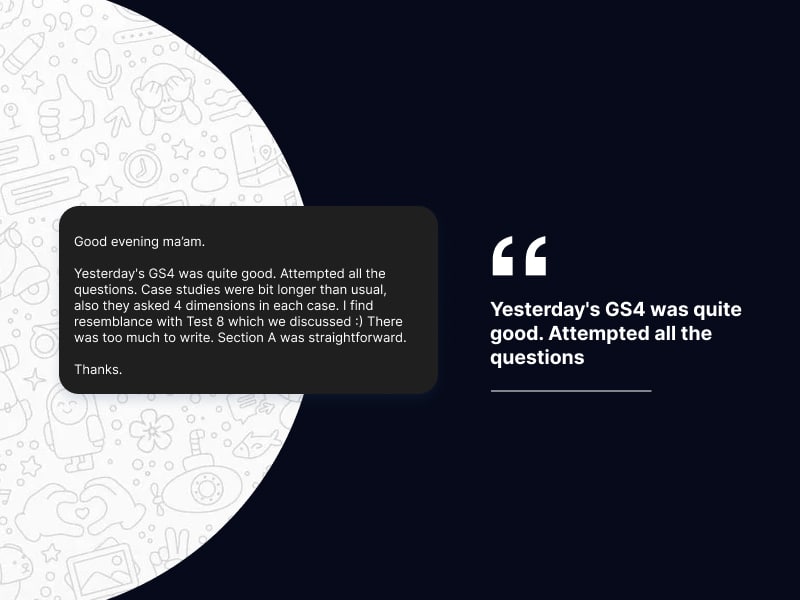
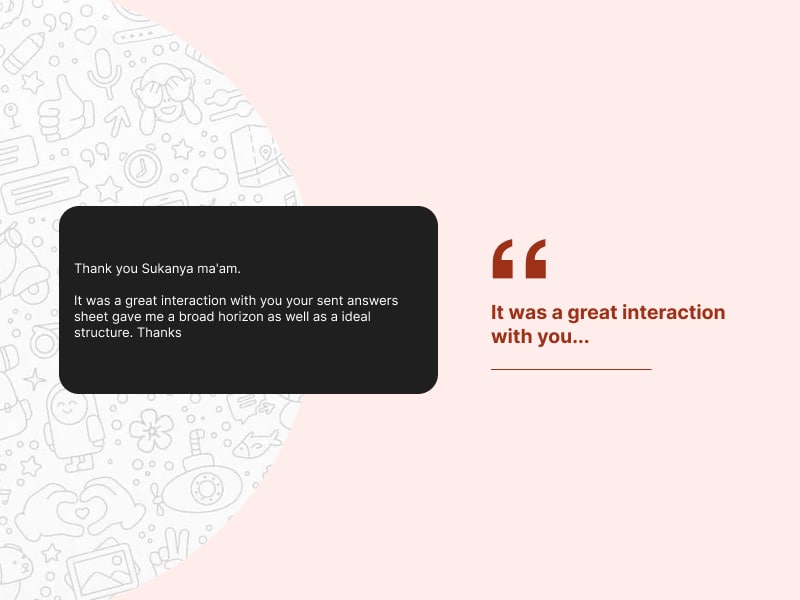
    This is what our students have to say…

    From Quora’s answer. (Read the full answer here)

  • GPS-based toll system to replace FASTag

    The government plans to start a GPS-based toll system in place of FASTag to ensure seamless payment and vehicle movement on national highways.

    Why in news?

    • The move would end the role of toll plazas across the country.

    How will a GPS-based tolling system work?

    • Vehicles will be fitted with an electronic device that can track their movement.
    • Highways will be geo-fenced, creating virtual boundaries. The system will use GPS or radio frequency identification technologies.
    • The software will recognize when a mobile device enters or leaves a particular area, and toll will be charged based on the distance travelled at the highway’s exit point.
    • As the system is based on sensors, there will be no need to stop at toll plazas.
    • Vehicles and users must be registered with the GPS toll system, linked to bank accounts that will be used to transfer toll payments.

    What are FASTags?

    • FASTags are stickers that are affixed to the windscreen of vehicles and use Radio Frequency Identification (RFID) technology to enable digital, contactless payment of tolls without having to stop at toll gates.
    • RFID uses electromagnetic fields to automatically identify and track tags attached to objects.
    • The tags are linked to bank accounts and other payment methods.
    • As a car crosses a toll plaza, the amount is automatically deducted, and a notification is sent to the registered mobile phone number.

    Issues with FASTags

    • Since the card is affixed to the windscreen, it can be easily misplaced, damaged or stolen.
    • The existing FASTag system, though faster than cash payments, still requires vehicles to stop at toll booths to enable reading of tags.
    • Also, the vehicle must wait till the gate is opened.
    • It has been observed that sometimes the toll fee is deducted twice from user account. Mostly, this happens due to a technical glitch.
    • Some card readers take longer time to read and register. Hence the purpose of saving time is itself defied.
    • Still, the wait time at toll booths is much more than the 30 seconds that was promised earlier.
    • Also, it has not helped reduce the number of toll booths.

    Hence the benefits of using FASTag far outweigh the challenges.

    Is FASTags a total failure?

    • Usage has increased since FASTag was made mandatory in 2021 after its launch in 2015.
    • Penetration has grown from nearly 16% in FY18 to 96.3% in FY22.
    • Total toll collection in FY18 was ₹21,948 crore, including ₹3,532 crore collected through FASTags.
    • In FY22, toll collection through FASTags increased sharply to ₹33,274 crore out of total toll collection of ₹34,535 crore.

    How will GPS benefit highway users?

    • GPS tolling uses satellite-based navigation and requires no halting.
    • Also, vehicles can be charged only for their actual travel on a highway stretch.
    • Currently, toll is paid at toll booths which is fixed between two points of tolling and a user does not get any concession even if he/she exits before completing the full run between two toll plazas.
    • The new system should reduce the toll amount charged for travel on highways.

    What is the progress so far on GPS tolling?

    • The Union road ministry has amended the National Highways Fee (Determination of Rates and Collection) Rules, 2008, allowing for the collection of toll based on distance travelled on national highways.
    • This will facilitate the introduction of GPS tolling.
    • First trials may be done on the under-construction Mumbai-Delhi expressway which will be geo-fenced.
    • Also the cost of GPS devices needs to be considered at very beginning.

    Way forward

    • The system needs a proper legislative framework, and a full launch is still years away. The government intends to introduce it in phases.
    • The road ministry is expected to amend the Motor Vehicles Act and create rules to facilitate GPS tolling as well as to penalize offenders.
    • Moreover, GPS will come with its own set of complications on calculating differential tolls.
    • Regulations and framework for these need to be developed first.


    UPSC 2023 countdown has begun! Get your personal guidance plan now! (Click here)

  • Uniform Civil Code

    uniform civil code

    The expert committee formed by the Uttarakhand government to examine ways for the implementation of a Uniform Civil Code (UCC) has launched a website, seeking public opinion on the plan.

    What is a Uniform Civil Code?

    • A Uniform Civil Code (UCC) is one that would provide for one personal civil law for the entire country.
    • This would be applicable to all religious communities in their personal matters such as marriage, divorce, inheritance, adoption etc.

    Basis for Uniform Civil Code

    • Article 44, one of the Directive Principles of the Constitution lays down that the state shall endeavour to secure a UCC for the citizens throughout the territory of India.
    • These, as defined in Article 37, are not justiciable (not enforceable by any court) but the principles laid down therein are fundamental in governance.

    Personal Laws And Uniform Civil Code: Timeline

    # British period
    During the British Raj, Personal laws were first framed mainly for Hindu and Muslims citizens.

    # Start of 20th Century
    In the beginning of the twentieth century, the demand for a uniform civil code was first put forward by the women activists. The objective behind this demand was the women’s rights, equality and secularism.

    # 1940 – The Idea of Uniform Civil Code is born
    The idea of Uniform Civil Code was tabled by the National Planning Commission (NPC) appointed by the Congress. There was a subcommittee who was to examine women’s status and recommends reforms of personal law for gender equality.

    # 1947 – Question of UCC as a Fundamental Right
    UCC was sought to be enshrined in the Constitution of India as a fundamental right by Minoo Masani, Hansa Mehta, Amrit Kaur and Dr. B.R Ambedkar.

    # 1948 – Constitution Assembly debated UCC
    Article 44 of the Indian Constitution i.e. Directive Principles of State Policy sets implementation of uniform civil laws which is the duty of the state under Part IV.

    # 1950 – Reformist Bill passed
    Reformist bills were passed which gave the Hindu women the right to divorce and inherit property. Bigamy and child marriages are outlawed. Such reforms were resisted by Dr. Rajendra Prasad.

    # 1951 – Dr. Ambedkar Resigns
    Dr. Ambedkar resigned from the cabinet in 1951 when his draft of the Hindu Code Bill was stalled by the Parliament.

    # 1985 – Shah Bano Case
    In this case, a divorced Muslim woman was brought within the ambit of Section 125 of Code of Criminal Procedure, 1973 by the Supreme Court in which it was declared by the Apex court that she was entitled for maintenance even after the completion ofiddatperiod.

    # 1995- Sarla Mudgal v. Union of India
    In this case, Justice Kuldip Singh reiterated the need for the Parliament to frame a Uniform Civil Code, which would help the cause of national integration by removing contradictions based on ideologies. Therefore, the responsibility entrusted on the State under Article 44 of the Constitution whereby a Uniform Civil Code must be secured has been urged by the Supreme Court repeatedly as a matter of urgency.

    # 2000 – Supreme Court advocates UCC
    The case of Lily Thomas v. Union of India (2000),where the Supreme Court said it could not direct the centre to introduce a UCC.

    # 2015 – The Debate lives through
    The apex court refused to direct the government to take a decision on having a UCC.

    # 2016 – Triple Talaq Debate
    When PM asked the Law Commission to examine the issue.

    # 2017 – Ruling of the Triple Talaq case
    Triple Talaq (Talaq -e- biddat) was declared unconstitutional on August 22, 2017.

    UCC vs. Right to Freedom of Religion

    1. Article 25 lays down an individual’s fundamental right to religion
    2. Article 26(b) upholds the right of each religious denomination or any section thereof to “manage its own affairs in matters of religion”
    3. Article 29 defines the right to conserve distinctive culture

    Reasonable restrictions on the Freedom of Religion

    • An individual’s freedom of religion under Article 25 is subject to “public order, health, morality” and other provisions relating to FRs, but a group’s freedom under Article 26 has not been subjected to other FRs.
    • In the Constituent Assembly, there was division on the issue of putting UCC in the fundamental rights chapter. The matter was settled by a vote.
    • By a 5:4 majority, the fundamental rights sub-committee headed by Sardar Patel held that the provision was outside the scope of FRs and therefore the UCC was made less important.

    Minority Opinion in the Constituent Assembly

    • Some members sought to immunize Muslim Personal Law from state regulation.
    • Mohammed Ismail, who thrice tried unsuccessfully to get Muslim Personal Law exempted from Article 44, said a secular state should not interfere with the personal law of people.
    • B Pocker Saheb said he had received representations against a common civil code from various organisations, including Hindu organisations.
    • Hussain Imam questioned whether there could ever be uniformity of personal laws in a diverse country like India.
    • B R Ambedkar said “no government can use its provisions in a way that would force the Muslims to revolt”.
    • Alladi Krishnaswami, who was in favour of a UCC, conceded that it would be unwise to enact UCC ignoring strong opposition from any community.
    • Gender justice was never discussed in these debates.

    Enacting and Enforcing UCC

    • Fundamental rights are enforceable in a court of law.
    • While Article 44 uses the words “state shall endeavour”, other Articles in the ‘Directive Principles’ chapter use words such as “in particular strive”; “shall in particular direct its policy”; “shall be obligation of the state” etc.
    • Article 43 mentions “state shall endeavour by suitable legislation” while the phrase “by suitable legislation” is absent in Article 44.
    • All this implies that the duty of the state is greater in other directive principles than in Article 44.

    What are more important — fundamental rights or directive principles?

    • There is no doubt that fundamental rights are more important.
    • The Supreme Court held in Minerva Mills (1980): Indian Constitution is founded on the bed-rock of the balance between Parts III (Fundamental Rights) and IV (Directive Principles).
    • To give absolute primacy to one over the other is to disturb the harmony of the Constitution.
    • Article 31C inserted by the 42nd Amendment in 1976, however, lays down that if a law is made to implement any directive principle, it cannot be challenged on the ground of being violative of the FRs under Articles 14 and 19.

    What about Personal Laws?

    • Citizens belonging to different religions and denominations follow different property and matrimonial laws which are an affront to the nation’s unity.
    • If the framers of the Constitution had intended to have a UCC, they would have given exclusive jurisdiction to Parliament in respect of personal laws, by including this subject in the Union List.
    • “Personal Laws” are mentioned in the Concurrent List.

    Various customary laws

    • All Hindus of the country are not governed by one law, nor are all Muslims or all Christians.
    • Muslims of Kashmir were governed by a customary law, which in many ways was at variance with Muslim Personal Law in the rest of the country and was, in fact, closer to Hindu law.
    • Even on the registration of marriage among Muslims, laws differ from place to place.
    • In the Northeast, there are more than 200 tribes with their own varied customary laws.
    • The Constitution itself protects local customs in Nagaland. Similar protections are enjoyed by Meghalaya and Mizoram.
    • Even reformed Hindu law, in spite of codification, protects customary practices.

     Why need UCC?

    • UCC would provide equal status to all citizens
    • It would promote gender parity in Indian society.
    • UCC would accommodate the aspirations of the young population who imbibe liberal ideology.
    • Its implementation would thus support the national integration.

    Hurdles to UCC implementation

    • There are practical difficulties due to religious and cultural diversity in India.
    • The UCC is often perceived by minorities as an encroachment of religious freedom.
    • It is often regarded as interference of the state in personal matters of the minorities.
    • Experts often argue that the time is not ripe for Indian society to embrace such UCC.

    These questions need to be addressed which are being completely ignored in the present din around UCC.

    1. Firstly, how can uniformity in personal laws are brought without disturbing the distinct essence of each and every component of the society.
    2. Secondly, what makes us believe that practices of one community are backward and unjust?
    3. Thirdly, has other uniformities been able to eradicate inequalities that diminish the status of our society as a whole?

    Way forward

    • It should be the duty of the religious intelligentia to educate the community about its rights and obligations based on modern liberal interpretations.
    • A good environment for the UCC must be prepared by the government by explaining the contents and significance of Article 44 taking all into confidence.
    • Social reforms are not overnight but gradual phenomena. They are often vulnerable to media evils such as fake news and disinformation.
    • Social harmony and the cultural fabric of our nation must be the priority.


    UPSC 2023 countdown has begun! Get your personal guidance plan now! (Click here)

  • IIP gives us true health of our economy

    IIPContext

    • India’s statistics ministry generates only one high-frequency gauge of economic activity. And that lone barometer, the index of industrial production (IIP), is completely broken.

    What is IIP?

    • The Index of Industrial Production (IIP) is an index that indicates the performance of various industrial sectors of the Indian economy. It is a composite indicator of the general level of industrial activity in the economy.

    IIPHow is IIP calculated?

    • IIP is calculated as the weighted average of production relatives of all the industrial activities. In the mathematical calculation Laspeyre’s fixed base formula is used.

    What are the Core Industries in India?

    • The main or the key industries constitute the core sectors of an economy.
    • In India, there are eight sectors that are considered the core sectors.
    • They are electricity, steel, refinery products, crude oil, coal, cement, natural gas and fertilizers.

    Which has highest weightage in IIP?

    • The eight core sector industries in decreasing order of their weightage: Refinery Products> Electricity> Steel> Coal> Crude Oil> Natural Gas> Cement> Fertilizers.

    IIPWhy is IIP important?

    • IIP is the only measure on the physical volume of production. It is used by government agencies including the Ministry of Finance, the Reserve Bank of India, etc. for policy-making purposes. IIP remains extremely relevant for the calculation of the quarterly and advance GDP estimates.

    Who releases IIP data?

    How useful are monthly IIP figures to draw a conclusion about India’s growth?

    • IIP figures are monthly data and as such it keeps going up and down.
    • In fact, the release calls them “quick estimates” because they tend to get revised after a month or two.

    IIP Index Components

    • Mining, manufacturing, and electricity are the three broad sectors in which IIP constituents fall.
    • The relative weights of these three sectors are 77.6% (manufacturing), 14.4% (mining) and 8% (electricity).
    • Electricity, crude oil, coal, cement, steel, refinery products, natural gas, and fertilizers are the eight core industries that comprise about 40 per cent of the weight of items included in the IIP.

    Basket of products

    • Primary Goods (consisting of mining, electricity, fuels and fertilisers)
    • Capital Goods (e.g. machinery items)
    • Intermediate Goods (e.g. yarns, chemicals, semi-finished steel items, etc)
    • Infrastructure Goods (e.g. paints, cement, cables, bricks and tiles, rail materials, etc)
    • Consumer Durables (e.g. garments, telephones, passenger vehicles, etc)
    • Consumer Non-durables (e.g. food items, medicines, toiletries, etc)

    IIP base year change

    • The base year was changed to 2011-12 from 2004-05 in the year 2017.

    Way ahead

    • IIP remains extremely relevant for the calculation of the quarterly and advance GDP (Gross Domestic Product) estimates.

    Mains question

    Q. What do you understand by IIP? How it helps us to understand economic health?


    UPSC 2023 countdown has begun! Get your personal guidance plan now! (Click here)

  • G20 summit will open pandora of opportunities

    G20 summitContext

    • India is going to be at the centre stage of geopolitical spectrum as India will be hosting G20 summit presidency from December 2022. As Harsh V. Shringla, India’s chief G20 coordinator and former Foreign Secretary, (Amitabh kant is G20 Sherpa of India) recently said, “Our G20 Presidency would place India on the global stage, and provide an opportunity for India to place its priorities and narratives on the global agenda.”

    What is G20 (Group of Twenty)?

    • Composed of most of the world’s largest economies: 19 countries plus European Union, including both industrialized and developing nations. Together, its members represent more than 80% of the world’s GDP, 75% of international trade and 60% of the world’s population.
    • Role: To address major issues related to the global economy such as international financial stability, climate change mitigation, and sustainable development.
    • It is an Intergovernmental forum.
    • Strategic role: The G20 holds a strategic role in securing global economic growth and prosperity.

    G20 summitIndia and the presidency of G20 summit

    • In November this year, the 17th G20 Heads of State and Government Summit will take place in Bali.
    • After Indonesia, India will assume the presidency of the G20 from December 1, 2022 to November 30, 2023.
    • By hosting the summit of the G20, India will have the opportunity to assume centre stage in proposing and setting the global agenda and discourse.
    • India can assert its political, economic and intellectual leadership while hosting the G20 presidency.
    • Further it Provides India an opportunity to also champion the causes of developing and least developed countries.
    • India could invite and engage countries from Africa and South America to ensure better and more balanced representation at the G20.

    G20 summitChallenges before India:

             Global

    • World affected by the pandemic: Uneven vaccine availability has been flagged by many countries. Vaccine issue upset some countries.
    • Ukraine conflict: According to external affairs ministers Dr.S.Jaishankar due to Ukraine  conflict world is divided and this poses the challenge for India to bring rival camp on same stage
    • Climate change: Divergent view of developed and developing countries on climate change can be the bone of contention between west and the rest.
    • The rise of an assertive China: To maintain the delicate balance between NATO, G7 on the on hand while Russia and china on the other (as India is part of both QUAD and SCO).

         Domestic

    • Economic challenges: Such as stagflation, unemployment, exchange rate, declining prospects for exports and rising trade deficit.
    • Terrorism: Cross border terrorism emanating from Pakistan.

    Indonesia has focused on three key pillars in its presidency of G20 presidency:

    • Global health architecture: president of Indonesia Joko Widodo talked about a global contingency fund for medical supplies, building capacity in developing countries to manufacture vaccines and the creation of global health protocols and standards.
    • Sustainable energy transition: as part of its roadmap to reach net zero by 2060, Indonesia had slashed the coverage area of forest fires sevenfold. The country has restored peatlands and rehabilitated 50,000 hectares of mangrove forests.
    • Digital transformation

    What India can address?

    • Issues of global concern: Terrorism, climate change, stagflation etc.
    • Domestic and regional: economic recovery, trade and investment, unemployment, patent waivers on diagnostics, therapeutics, vaccines etc.
    • Greater co-operation and co-ordination: free trade agreements, supply chain resilience mechanism, stressing on green and digital transformations in the economy and its impact on societal well-being.
    • Other important Areas :such as technology transfer, assistance towards green economy, greater access to trade for developing countries, addressing debt distress of countries by offering sustainable aid and loan programmes, tackling food and energy prices/security for vulnerable economies etc.

    Why G20 summit presidency is an opportunity for India?

    • India exchange the G20 presidency with Indonesia and chose 2023 instead of 2022 to host the G20 countries.
    • India wanted to showcase its prowess in its 75th year of independence as cornerstone of new emerging world order. As India is part of Quad and SCO BRICS -the warring factions at world stage, it’s an opportunity in crisis to become the bridge of the divided world.
    • India is hosting the summit in Kashmir. World media will be in the Kashmir. In the direct message to world India will again assert that Kashmir is an integral part of India.

    Way ahead

    • As India will be hosting G20 and SCO summits, India will be central in outlining key priority areas. India can assert its political, economic and intellectual leadership which will have to address issues that help in cement the Fault-line in the world order.
    • India’s leadership could define the coming years and decades of global discourse and avenues of cooperation.

    Other related Information

    SCO (Shanghai Co-operation Organization):

    • The Shanghai Cooperation Organization (SCO) is a Eurasian political, economic and security organization. It is the world’s largest regional organization, 40% of the world population, and more than 30% of global GDP.
    • Members: The Shanghai Five group was created on 26 April 1996; China, Kazakhstan, Kyrgyzstan, Russia and Tajikistan, Uzbekistan, India and Pakistan.

    QUAD:

    • Known as the ‘Quadrilateral Security Dialogue’ (QSD), the Quad is an informal strategic forum comprising four nations, namely – United States of America (USA), India, Australia and Japan.
    • One of the primary objectives of the Quad is to work for a free, open, prosperous and inclusive Indo-Pacific region.

    G7:

    • The Group of Seven (G7) is an inter-governmental political forum consisting of Canada, France Germany, Italy, Japan, the United Kingdom and the United States. In addition, the European Union is a ‘non-enumerated member.

    Mains Question

    Q. India can take advantage of G20 for its economic growth and security architecture. Discuss.

    UPSC 2023 countdown has begun! Get your personal guidance plan now! (Click here)

  • Cheetah reintroduction

    Cheetah

    Context

    • This is the world’s first intercontinental translocation of a carnivore. It is even more unique because this is the first time cheetahs has reintroduced in an unfenced protected area (PA).
    • The Government is preparing to translocate the first batch from South Africa and Namibia to Kuno National Park in Madhya Pradesh.

    About Asiatic Cheetah

    • Feature: Cheetah, the world’s fastest land animal was declared extinct in India in 1952.
    • Status: The Asiatic cheetah is classified as a “critically endangered” species by the IUCN Red List, and is believed to survive only in Iran.
    • Reintroduction: It was expected to be re-introduced into the country after the Supreme Court lifted curbs for its re-introduction.
    • Extinction: From 400 in the 1990s, their numbers are estimated to have reached to 50-70 today, because of poaching, hunting of their main prey (gazelles) and encroachment on their habitat.

    Cheetah

    Cheetah

    What caused the extinction of cheetahs in India?

    • Reduced fecundity and high infant mortality in the wild
    • Inability to breed in captivity
    • Sport hunting
    • Bounty killings

    Cheetah

    Why reintroduce Cheetahs?

    • Climate Change Mitigation: It will enhance India’s capacity to sequester carbon through ecosystem restoration activities in cheetah conservation areas and thereby contribute towards the global climate change mitigation goals.
    • Reintroductions of large carnivores have increasingly been recognized as a strategy to conserve threatened species and restore ecosystem functions.
    • The cheetah is the only large carnivore that has been extirpated, mainly by over-hunting in India in historical times.
    • India now has the economic ability to consider restoring its lost natural heritage for ethical as well as ecological reasons.

    Why was Kuno National Park chosen for Cheetah Reintroduction?

    • Both Cheetah and Asiatic Lions share the same habitats semi-arid grasslands and forests that stretch across Gujarat, Rajasthan, and Madhya Pradesh.
    • The rainfall, temperature, and altitude in the Sheopur district, where Kuno is situated, are equivalent to those of South Africa and Namibia.
    • In addition, Kuno contains a diverse population of prey species, including peafowl, wild pigs, gazelle, langurs, chital, sambhar, and nilgai.

    What are the Other Recent Initiatives for Wildlife Conservation in India?

    Legal Framework:

    • Wildlife (Protection) Act, 1972
    • Environment Protection Act, 1986
    • The Biological Diversity Act, 2002

    India’s Collaboration with Global Wildlife Conservation Efforts:

    • Convention on International Trade in Endangered Species of Wild Fauna and Flora (CITES)
    • Convention on the Conservation of Migratory Species of Wild Animals (CMS)
    • Convention on Biological Diversity (CBD)
    • Global Tiger Forum (GTF)

    UPSC 2023 countdown has begun! Get your personal guidance plan now! (Click here)

More posts