India’s approach in dealing with Pakistan today is very different from the framework that emerged at the dawn of the 1990s.
Terms of engagement with Pakistan
From the 1990s, for nearly three decades, it was Pakistan that had the political initiative.
The turmoil in Kashmir, the international focus on nuclear proliferation, and the relentless external pressure for a sustained dialogue with Pakistan put Delhi in a difficult situation.
If Pakistan was on the political offensive, a series of weak coalition governments in Delhi were forced onto the back foot.
At the heart of Pakistan’s ambition was to change the status quo in Jammu and Kashmir.
Islamabad also played up to the concerns in Western chancelleries that the conflict in Kashmir might escalate to the nuclear level.
The new international consensus that Kashmir is the “world’s most dangerous nuclear flashpoint” aligned well with Pakistan’s strategy.
Delhi had no option but to respond, but any move to counter Pakistan would make the situation worse.
Under Prime Minister Narendra Modi, India has begun to reset the terms of the engagement agenda.
Change in regional and international context: Meanwhile, the regional and international context has also altered in many ways since the early 1990s essentially in India’s favour.
Reset in engagement
India’s transformed relations with the US, the resolution of Delhi’s dispute with the global nuclear order, and getting the West to discard its temptation to mediate on Kashmir enormously improved India’s diplomatic position.
But the most consequential change has been in the economic domain.
The persistent neglect of economic challenges left Pakistan in an increasingly weaker position in relation to India.
If India has inched its way into the top six global economies, Pakistan today is broke.
Modi had the opportunity to build on these shifting fortunes of Delhi and Islamabad and develop a three-pronged strategy of his own.
1] India bet that the heavens won’t fall if Delhi stops talking to Islamabad or negotiating with Pakistan-backed militant groups in Kashmir.
2] Delhi has been unafraid of staring at nuclear escalation in responding to Pakistan’s cross-border terrorism.
3] By changing the constitutional status of Kashmir in 2019, India has reduced the scope of India’s future negotiations with Pakistan on Kashmir.
Way forward
Pakistan’s hand today is much weaker than in the 1990s and Delhi’s room for manoeuvring has grown, notwithstanding the challenges it confronts on the China border.
That opens some room for new Indian initiatives toward Pakistan.
Getting Pakistan’s army and its political class to be more practical in engaging India is certainly a tall order; but Delhi can afford to make a move.
Conclusion
While there can be much disagreement on Pakistan’s capacity to respond, Delhi’s new initiatives can reinforce the positive evolution of Indian foreign policy, and expand the space for Indian diplomacy in the region and beyond.
UPSC Prelims 2022 is over & now it’s time to cross the higher bar. Knowing the unpredictability of this journey, many believe that only hard work can make them luckier. But shockingly, even after working with all their might,90% of them remain very much clueless about their “strategy” being right or wrong.
What are the things our toppers have done different this year?
Moreover, a quick strategy re-orientation is required for 2022 Mains aspirants as no time is left now.
Sukanya ma’am will be analyzing and dissecting toppers’ answers for you to highlight what makes their answers different from an average aspirant.
Strategies & Approaches, in This Free Live Webinar by Sukanya Ma’am!
How CD’s Mains programs guaranteed 200+ aspirants to enter in UPSC 2021 final merit list. & what are the things they have done different this year. Best, authentic, minimum materials forUPSC-CSE Mains Preparation. Do’s & Dont’s, How to remake‘Recognition of information’ into ‘recall, analyze & express’.
Whether your answers ought to reflect the editorial standards of The Hindu! What should be the foolproof strategy? What subject to pick up first to start your Mains Preparation!
How toppers prioritize speed over content, and content over structure. How to fix your answer writing structure, improve the content
How to create a basic conceptual framework of the answer before committing anything to paper. Implications of overstretching your imagination.
How to fetch maximum score in both ‘Essay’ & ‘Ethics’ papers to enhance your marks in total.
What is the difference between ‘Opinion-based’ & ‘Fact-based’ questions will also be discussedthoroughly in this webinar?
How & where to present the answer, replete with a Map/diagram/flowchart/, It will help to get extra 0.25-0.5 marks across 80 questions of GS papers. If the question is in two parts,sticking to the word limit, how to address the demand of each part. What is the way to enclose also any critical analysis you should have within the subheading?
How to enhance writing patterns, where to take mock regularly, how many mock tests are fit, Etc. will be discussed in this live webinar.
The untold secret of coverage of the Mains syllabus is that the syllabus can be covered 100%. The most brilliant of candidates will testify that even their coverage of the syllabus was not completely 100%.
Our Civilsdaily Mains Program Head Mrs. Sukanya Rana has been mentoring 1500+ students & 100+ Rankers across multiple stages from prelims to mains to interviews. She is part of Smash Mains as an Ethics Mentor and helped Civilsdaily topper to achieve their dream.
She has firsthand experience of 4 mains and 2 interviews of UPSC. She has also appeared in the State PCS interview.
Sukanya Ma’am has scored consistently 100+ marks in ethics and in 2019 her marks were 140 in GS 4. In 2020 and 2021, under her mentorship, many smash mains students were able to secure 110+ marks.
The global economy was well on its path to recovery until the invasion of Ukraine by Russia.
Uncertainties in global growth prospects
Divergent economic recoveries: Economic prospects have worsened since the Ukraine crisis, worsening the divergence between the economic recoveries of advanced economies and those of the developing ones.
The prevailing uncertainties in global growth prospects come in the aftermath of frequent disruptions to worldwide supply chains in the last two years.
Against this background, two key macroeconomic variables have a persistent effect on growth rebound.
1] Price pressure: There is tenacious price pressure, leading to policy trade-offs especially in developing economies.
2] Capital outflow: There have been capital outflows and a tightening of financial conditions, affecting investment and growth in the medium and long term.
1] Price pressure
Global concern: In some of the advanced economies, inflation has reached its highest level in the last 40 years.
The major contributors to high inflation are energy and food prices.
A spike in oil and gas prices due to a tight fossil fuel supply and geopolitical uncertainty have led to substantial increases in energy costs worldwide.
In developing economies, rising food prices have had cascading effects, culminating in higher overall inflation.
This gets intensified if poor weather hits harvests and rising oil prices drive up the cost of producing and transporting fertilizers.
In developing economies, higher prices for food impacts different sections of the population differently, depending on the types of food consumed and the share of food expenditure in a household’s consumption basket.
Persistent short supply and increases in food and fuel prices could significantly increase the risk of social unrest as the poorer sections are pushed to the edge of heightened deprivation.
2] Capital outflow
Emerging markets suffered their first portfolio outflows in a year in March 2022.
The Institute of International Finance (IIF) says “foreign net portfolio outflows for emerging markets came to $9.8 billion in March.
Investors have become more selective, as higher risk sensitivity mounts due to tighter monetary conditions and rising inflation.
Reasons for capital outflow: Interest rates tightening in the United States is associated with capital flow reversals from emerging markets.
Impact on developing economies: For developing economies, the result of sudden large capital outflows is currency depreciation and tighter external sector conditions, leading to growth fluctuations.
Way forward
Monitor the pass-through of international prices: Though the factors contributing to high inflation (global supply shocks) are beyond the control of central banks, they need to carefully monitor the pass-through of rising international prices to domestic inflation to calibrate their responses.
Calibrate the pace of policy tightening: The pace of policy tightening needs to be attuned to prevailing economic situations and activity levels.
Communicate the importance of inflation targeting: Central banks could also signal a readiness to shift the monetary stance to maintain the credibility of their inflation-targeting frameworks by clearly communicating the importance of inflation stabilisation in their objectives and backing it with policy actions.
Foreign exchange interventions: As sudden capital flow reversals can threaten financial stability, foreign exchange interventions could address market imbalances.
Fiscal consolidation: There exists an imperative to prune expenditure and get back to the road of fiscal consolidation.
However, a push for consolidation should not prevent governments from prioritising spending to protect and help vulnerable populations affected by price increases and the pandemic.
Income support policies: In the post-pandemic global economy, there will be a likely cross-sectoral labour reallocation.
These transitions require labour market and income support policies that are designed to provide safety nets for workers without hindering employment growth.
Conclusion
The message from the current phase of global growth is clear. Policymakers in the developing economies have to prepare for tighter financial conditions and spillovers from geopolitical volatility.
Guys! The fundamental contrast between UPSC-CSE Prelims and Mains is that while the Prelims focus on recognition (of information) and requires an exhaustive study covering a wide variety of topics, Mains need the ability to recall, analyze and express (ideas and information, including one’s own thoughts) properly which can only be done through an intensive study of the topic. Therefore it is very important to evaluate in-depth, shun procrastination answering writing, and developing a skill does not happen magically after you clear prelims. the topics that you have picked for Mains, and in doing so you have to match your skills with the subject at hand. Using the right approach and picking the right parts of the syllabus for the intensive study will not only help manage time but also garner more marks in the end.
The FLT program with One to One mentorship will focus on how to deliver a rule of thumb to answer only what the question demands. In 2021, 82% of students in our smash mains programwere able to clear the mains examination.
The Hindu has acknowledged CD’s Mains answer writing & Mentorship programs.
..Students will also get 250+ most important topics for mains 2022
12 Full-length tests: After the prelims, it is time to go full gear. Practice 3 rounds of FLT based on 4 GS paper.
Quality Enrichment Program Notes:QEP is an intensive and holistic program for IAS Mains 2022 GS papers. We aim to cover up to 250 most relevant issues with a 360-degree view, covering all dimensions of each and every topic. Not only you’ll learn and analyze these issues but will also understand how to utilize them via Daily Answer Writing and Mains Test Series.
Additional Materials: Important keywords from economic survey, data, case studies & quality enhancement additional materials for good practices.
Personalized discussion in 1-to-1 mentorship: You doubt why you are scoring less or how you can improve your score for the next paper. No worries! Just schedule a call with our mentor to clear all your doubts and queries.
Civilsdaily’s handholding: You will be provided membership to Mains 2023 club on Habitat. There you can put up your doubts and queries. Also can be used to interact with peers on strategies to improve your mains writing. You can also contact mentors like Sajal sir, Sukanya ma’am, Sudhanshu sir and Poornima Ma’am. They all have interview-level experience, so utilize their experience to your benefit.
Civilsdaily magazine: Your current affairs will be covered with access to our 1-year subscription.
Sectional Tests: 8 sectional tests to cover your static portions in detail. The scope will be spread over your core subjects like history, economics, polity, etc.
Full-length tests: 12 FLTs to help you practice for the final main examination. These FLTs are patterned on the UPSC Examination and have medium-to-high-quality questions. They will surely boost your preparation and test your analytical skills.
One-on-One Mentorship: After every test, a call with a mentor will be arranged and you can clear your doubts on the paper. This is important as, with your mentor, you can discuss your weaknesses and strategize for the next paper.
A Quality Enrichment Program Notes: QEP is an intensive and holistic program for IAS Mains 2022 GS papers. We aim to cover up to 250 of the most relevant issues with a 360-degree view, covering all dimensions of each and every topic. Not only will you learn and analyze these issues, but you will also understand how to utilize them via Daily Answer Writing and the Mains Test Series.
Civilsdaily’s handholding: You will be provided membership to Mains 2023 club on Habitat. There you can put up your doubts and queries. Also can be used to interact with peers on strategies to improve your mains writing. You can also contact mentors like Sajal sir, Sukanya ma’am, Sudhanshu sir and Poornima Ma’am. They all have interview-level experience, so utilize their experience to your benefit.
Civilsdaily magazine: Your current affairs will be covered with access to our 1-year subscription.
It happens under a team of experienced Civilsdaily faculty. Questions framed are from the most important UPSC relevant themes and papers are based on the latest pattern of UPSC.
Our questions specifically state:
Whether they are straightforward or thought-provoking/analytical.
Whether they have sub-parts.
Why this question – similar to previous year’s questions, the importance of the theme, etc.
CD Innovation – Red-green highlight – to let you know about the necessary and innovative points.
2. One-to-One Discussion
We believe in personalized individual attention. This is the biggest reason why you should join our TS. Students can schedule a call within 2 days of receiving their checked copies.
A one-to-one discussion with your Mentor will not only highlight your weaknesses but will also help in tracking your improvements over the subsequent tests. It will also ensure consistency, continuity, and progressive improvement.
3. Answer Checking
Our evaluation focuses on multiple dimensions and parameters like structure, flow, presentation, contextuality, relevance to question, analytical excellence, and cross-domain inter-linkages than simply on superficial, memory-based lapses.
4. Model Answers
More than just simply providing information, our model answers cover all the aspects of a question and provide enriching points to the student. They also include:
For ‘thought-provoking/analytical’ type of questions, we’ll provide the best way to approach them.
Alternate introductions
Sub-headings and categorization to enhance readability and answer structure.
Colour coding for main arguments, reports, data, scholars, etc. OTB – Out of the box points for additional marks
5. Civilsdaily’s Handholding
You’ll be assigned to a special group on Civilsdaily’s Habitat, there you can interact with different mentors like Partha Sir, Sukanya ma’am, Ajay Sir, Swatantra sir, and others.
6. Value-added material
Current affairs magazines – Civilsdaily’s Magazines are the best in terms of comprehensive coverage, superb design, and high readability.
Listicles and other relevant study material – Supplementary content provided will be helpful in covering multiple related questions.
Our Civilsdaily Mains Program Head Sukanya Rana has been mentoring 1500+ students & 100+ Rankers across multiple stages from prelims to mains to interviews. She is part of Smash Mains as an Ethics Mentor and helped Civilsdaily topper to achieve their dream. She has firsthand experience of 4 mains and 2 interviews of UPSC. She has also appeared in the State PCS interview. She aims to guide future aspirants in finding success. Sukanya Ma’am has scored consistently 100+ marks in ethics and in 2019 her marks were 140 in GS 4. In 2020, under her mentorship, many smash mains students were able to secure 110+ marks.
👉 Acknowledging the need to ensure fastest mentorship response, Senior IAS mentor like Partha Sir, Swatantra Sir, will receive your call.
The Supreme Court of India recently ruled that “The recommendations of the GST Council are not binding on either the Union or the States…”.
About GST Council
The GST Council is a federal body that aims to bring together states and the Centre on a common platform for the nationwide rollout of the indirect tax reform.
Article 279 (1) of the amended Indian Constitution states that the GST Council has to be constituted by the President within 60 days of the commencement of the Article 279A.
According to the article, the GST Council will be a joint forum for the Centre and the States. It consists of the following members:
1] The Union Finance Minister will be the Chairperson.
2] As a member, the Union Minister of State will be in charge of Revenue of Finance.
3] The Minister in charge of finance or taxation or any other Minister nominated by each State government, as members.
The Council has to function as a platform to bring the Union and State governments together.
As a mark of cooperative federalism, the Council shall, unanimously or through a majority of 75% of weighted votes, decide on all matters pertaining to GST and recommend such decisions to the Union and State governments.
Article 279A (4) specifies that the Council will make recommendations to the Union and the States on the important issues related to GST, such as the goods and services will be subject or exempted from the Goods and Services Tax.
Article 246A confers simultaneous or concurrent powers on Parliament and the state legislatures to make laws relating to GST.
This article is in sharp contrast to the constitutional scheme that prevailed till 2017.
Background of the case
In Union of India Anr. vs Mohit Minerals Pvt. Ltd., the Supreme Court of India on May 19, 2022 ruled on a petition relating to the levy of Integrated Goods and Services Tax (IGST) on ocean freight paid by the foreign seller to a foreign shipping company.
Mohit Minerals had filed a writ petition before the Gujarat High Court challenging notifications levying IGST on the ground that customs duty is levied on the component of ocean freight and the levy of IGST on the freight element in the course of transportation would amount to double taxation.
GST is paid by the supplier, but if the shipping line is located in a non-taxable territory, then GST is payable by the importer, the recipient of service.
Ocean freight is a method of transport by which goods and cargo is transported by ships through shipping lines.
Important aspects of the judgement
Power to legislate simultaneously: Article 246A gives powers to the Union and State governments simultaneously to legislate on the GST.
In other words, the two tiers of the Indian Union can simultaneously legislate on matters of the GST (except the IGST, which is in the legislative domain of the Union government).
In this case, the Government of India had argued that “Neither can Article 279A override Article 246A nor can Article 246A be made subject to Article 279A.”
However, cooperative federalism is to operate through the GST Council to bring in harmony and alignment in matters pertaining to the GST from both governments.
Given this background, the Union government had almost delegated the powers to create laws under the GST Act Section 5(1) to the GST Council.
Persuasive value only: The Supreme Court of India adjudicated that the GST Council’s recommendations are non-qualified and the simultaneous legislating powers of the Union and State governments give only persuasive value to the Council’s recommendations.
The power of the recommendations rests on the practice of cooperative federalism and collaborative decision-making in the Council.
Issues with voting rights in GST council
Inbalance in voting rights: The Union government holds one-third weight for its votes and all States have two-thirds of the weight for their votes.
This gives automatic veto power to the Union government because a resolution can be passed with at least three-fourths of the weighted votes.
This imbalance in the voting rights between the Union and State governments, makes democratic decision-making difficult.
Equal weight to all states creates political problems: Though all the States are not equal in terms of tax capacity, everyone has equal weight for their votes.
This creates another political problem as the smaller States with lesser economic stakes can be easily influenced by interest groups.
Debate on political lines: The debates in the GST Council will be on political lines rather than on the economics of taxation.
When the States governed by Opposition parties are vocal on counter-points, the States governed by the same party at the Union government are mute spectators.
Way forward
Work in a harmonised manner: The Supreme Court has recorded, “Since the Constitution does not envisage a repugnance provision to resolve inconsistencies between the Central and State laws on GST, the GST Council must ideally function, as provided by Article 279A(6) in a harmonised manner to reach a workable fiscal model through cooperation and collaboration.”
Cooperative federalism: The nuanced understanding of cooperative federalism shows that there is no space for one-upmanship in either of the two tiers of the Indian federal government and particularly for the Union government under a quasi-federal Constitution.
Conclusion
Given the lopsided power structure favouring the Union government in the GST Council, it is against the spirit of democracy and federalism that the finances of governments can be left to such bodies.
For the first time since the Taliban takeover on 15 August 2021, India has sent an official delegation to Afghanistan.
India discussed a host of issues that included resumption of stalled infrastructure projects, activation of diplomatic ties, and restarting the issue of visas for Afghan students and patients.
Points of Discussion
Has India officially recognized the Talibans?
Tashkent held recently meet excluded Pakistan. Is Pakistan out of the Afghan security scenario?
Highlights of the discussion
With this, it appears that the Indian is now less divided about the need to engage formally with the Taliban and prevent Afghan people getting marginalised.
Afghanistan is vital to India’s strategic interests in the region where thepeople’s (and even Taliban’s) affection for India is legendary.
Expected outcomes of the meet
Recognition of the Taliban government is not on the cards yet.
The visit may have paved the way for the reopening of the Indian embassy, albeit a downgraded one.
India and Taliban: A quick timeline of engagement
Initial reluctance: From 1996 to now, India’s journey from first opposition, then diffidence to engaging with the Taliban is in no small measure a story of India’s problematic relationship with Pakistan.
Beginning of Kashmir Insurgency: In 1996, when the Taliban fought their way through warring mujahideen factions into Kabul for the first time, in India, fearing a spillover on Kashmir insurgency (there was indeed some).
1999 hijacking: During the hijacking of IC814, when the Pakistani hijackers took the plane to Kandahar, the then ruling Taliban acted as a support arm of the hijackers.
Since then, any engagement was a standstill.
When did India reach out to the Talibans?
9-11 terror attacks: After 9/11, under the US umbrella, India invested money and energy into the rebuilding of Afghanistan.
But by 2010, with increasing doubts about the US continuance, India was again considering reaching out to the Taliban.
New Delhi did not want to be left out or marginalised in the Afghanistan of the future.
After the execution of Osama bin Laden in Pakistan in 2011, the Obama Administration was getting ready to declare an end to the war.
Since then, the way was paved for the talks.
How did its neighbors capitalize on the Afghan Crisis?
Pakistan had delivered the Taliban to the Trump Administration for talks.
Russia was backing the Taliban fully as the future ruler of Afghanistan, seeing in this sweet revenge for its own defeat in Afghanistan by US-financed, Pakistan-trained mujahideen.
Iran was also glad at America’s defeat at the hands of the Taliban.
China leveraged its relationship with Pakistan to get a foot into Kabul.
India’s considerations: Counter-intuitive timing
Radicalism: India’s cautious opening to the Taliban has come at a time when the group has made it clear it has not changed from its previous satanical radicalism.
Restrictions on women: This has increased, from not being allowed to attend school to curbs on free movement in public spaces and at work.
Patronage to terror outfits: Taliban continues to remain close to Al-Qaeda, with a significant presence of its multinational fighting force in Afghanistan.
Threats in Kashmir: They also flag the JeM and LeT training camps in Nangarhar and Kumar, close to the Pakistan border.
Why is India engaging with the Taliban now?
Reducing Pakistan’s footprint: It is time to de-hyphenate Pakistan from the Taliban, especially as the Pakistan security establishment is finding the going tough with the Kabul regime.
Inducing political insight: Another reason advanced for India’s change in policy is that the Taliban in power are more divided than they were as a fighting force.
Averting another crisis: This situation may provide room for a layered political and diplomatic engagement with different actors.
Eliminating terrorism: It has also helped that the Taliban have made no hostile statements on Kashmir since taking over in Kabul.
Afghanistan impacts India’s security: It has, in the past, provided space to al Qaeda with which the Taliban had a special relationship. Afghanistan has an ISIS presence too.
Humanitarian assistance: India aims at facilitating humanitarian assistance through international organizations, and paving the way for access to consular services.
Protecting its investment: India built vital roads, dams, electricity transmission lines and substations, schools and hospitals, etc. Total assistance is now estimated to be worth well over $3 billion.
Way forward
An engagement with the Taliban would at least give an opportunity to convey Indian concerns directly.
The visit has encouraged those elements within the group who wish to open up its diplomatic choices.
All in all, the sooner India establishes a permanent presence in Kabul the better for the pursuit of national interests in the external sphere.
This is not an exercise in evangelism but the cold and undeterred pursuit of interests, which often requires supping with the devil — of course, with a long spoon.
The Securities and Exchange Board of India (SEBI) recently issued a circular on passive funds covering matters related to transparency, liquidity and operational aspects of exchange-traded funds (ETFs) and index funds.
What are Passive Funds?
A passive fund is an investment vehicle that tracks a market index, or a specific market segment, to determine what to invest in.
Unlike with an active fund, the fund manager does not decide what securities the fund takes on.
This normally makes passive funds cheaper to invest in than active funds, which require the fund manager to spend time researching and analysing opportunities to invest in.
Tracker funds, such as ETFs (exchange traded funds) and index funds fall under the banner of passive funds.
What is a passive ELSS scheme?
Passive funds mimic an underlying index. By contrast active funds are actively managed by fund managers.
The SEBI has now introduced a passive equity-linked saving schemes (ELSS) category, which will give taxpayers another investment option to avail of tax benefits.
According to the circular, the passive ELSS scheme will be based on any index comprising equity shares from the top 250 companies in terms of market capitalization.
Beginning 1 July, a fund house will be able to either have an active ELSS scheme or a passive ELSS scheme, but not both.
What are the norms for debt ETFs?
Passive debt funds are now divided into three categories:
Corporate debt funds with exposure to corporate bonds
G-Sec funds investing in government securities, and
Hybrid funds where allocation is a combination of corporate bonds and government securities
Currently, debt funds in the passive category invest only in AAA-rated instruments.
The Sebi circular introduces norms for each debt fund category, including portfolio exposure limits to each sector, the issuer (based on rating) and group.
Application of these provisions should help mitigate concentration risk in debt ETFs/ index funds.
What about tracking error?
As per Sebi’s circular, passive funds must disclose ‘tracking error’ and ‘tracking difference’ in their monthly fact sheets.
These metrics indicate how different the performance of the fund is compared to its underlying index—an effort to keep investors better informed.
The circular specifies limits for tracking error and tracking difference, which passive funds must follow.
What is the mandate on disclosing NAVs?
Because of poor liquidity for ETFs in the secondary market in India, ETF prices could differ widely from the net asset value (NAV) of the fund.
The NAV of the fund represents the value of the underlying asset of the ETF.
The Sebi circular mandates disclosure of NAV (indicative) on a continuous basis throughout the day on the stock exchange.
While the practice is already in existence, Sebi rules institutionalize it.
Checking the NAV can help one avoid making a transaction at a significant premium or discount.
Can one execute ETF transactions directly?
Investors can buy or sell units of ETFs only on stock exchanges.
But, large buy or sell transactions can also be directly placed with the fund house.
Sebi now says orders greater than ₹25 crore alone can be placed for redemption or subscription directly with the asset management company (AMC).
The Enforcement Directorate (ED) has summoned Rahul Gandhi and Sonia Gandhi following a trial court order in a tax assessment case of his not-for-profit company.
What is the case?
A case alleged cheating and misappropriation of funds on part of the leaders in acquiring the newspaper.
The alleged persons acquired it through a Section 25 company — in which they have 86% stake.
What is a Section 25 company?
It is defined under the Companies Act, 1956.
It is a not-for-profit charitable company.
It is formed with the sole object of promoting commerce, art, science, religion, charity, or any other useful object.
It intends to apply its profits, if any, or other income in promoting its objects, and to prohibit the payment of any dividend to its members
Section 8 of the Companies Act, 2013 includes other objects such as sports, education, research, social welfare and protection of the environment among others.
Fiscal activities allowed
While it could be a public or a private company, a Section 25 company is prohibited from payment of any dividend to its members.
Section 25 states that by its constitution the company is required/ intends to apply its profits, if any, or other income in promoting its objects and is prohibited from paying any dividend to its members.
What are prominent examples of such companies?
According to details available with the Ministry of Corporate Affairs, a large number of companies have been formed under the Section.
Among these are Reliance Foundation, Reliance Research Institute, Azim Premji Foundation, Coca Cola India Foundation, and Amazon Academic Foundation.
Why are such companies formed?
Most people looking to form a charitable entity go for forming a company under Section 25, now Section 8, rather than a Trust structure.
This is because most foreign donors like to contribute to a company rather than Trust because they are more transparent and provide more disclosures.
If a company has to be converted into a not-for-profit company, they can’t be converted into a Trust, however, they can be converted into a Section 25/ Section 8 company.
Ahead of Rajya Sabha elections in four states, various parties have accommodated legislators from at least three states in resorts, away from potential poaching by rival parties.
Do you know?
Only two UTs elect members to the Rajya Sabha, not all.
Polling is held only if the number of candidates exceeds the number of vacancies.
Independent members can also be elected etc.
Read this newscard for all such interesting facts which can be directly asked in the prelims.
Rajya Sabha Polls
A third of MPs in the Rajya Sabha (which is a permanent House and is not subject to dissolution), from each State, retire once in two years and polls are held to fill up the vacancies.
Only elected members of the State Legislative Assemblies can vote in a Rajya Sabha election.
The legislators send a batch of new members to the Upper House every two years for a six-year term.
In addition, vacancies that arise due to resignation, death or disqualification are filled up through by-polls after which those elected serve out the remainder of their predecessors’ term.
Composition of Rajya Sabha
A bloc of MPs belonging to one or more parties can elect a member of their choice if they have the requisite numbers.
This is to avoid the principle of majority, which would mean that only candidates put up by ruling parties in the respective States will be elected.
The Delhi and Puducherry Assemblies elect members to the Rajya Sabha to represent the two UTs.
What is the election process?
Polling for a Rajya Sabha election will be held only if the number of candidates exceeds the number of vacancies.
Since the strength of each party in the Assembly is known, it is not difficult to estimate the number of seats a party would win in the Rajya Sabha poll.
In many states, parties avoid a contest by fielding candidates only in respect to their strength. Where an extra candidate enters the fray, voting becomes necessary.
Candidates fielded by political parties have to be proposed by at least 10 members of the Assembly or 10% of the party’s strength in the House, whichever is less.
For independents, there should be 10 proposers, all of whom should be members of the Assembly.
Voting procedure
Voting is by single transferable vote, as the election is held on the principle of proportional representation.
A single transferable vote means electors can vote for any number of candidates in order of their preference.
A candidate requires a specified number of first preference votes to win. Each first choice vote has a value of 100 in the first round.
To qualify, a candidate needs one point more than the quotient obtained by dividing the total value of the number of seats for which elections are taking place plus one.
Example: If there are four seats and 180 MLAs voting, the qualifying number will be 180/5= 36 votes or value of 3,600.
Why do not the Rajya Sabha polls have a secret ballot?
The Rajya Sabha polls have a system of the open ballot, but it is a limited form of openness.
As a measure to check rampant cross-voting, which was taken to mean that the vote had been purchased by corrupt means.
There is a system of each party MLA showing his or her marked ballots to the party’s authorised agent (called Whip), before they are put into the ballot box.
Showing a marked ballot to anyone other than one’s own party’s authorised agent will render the vote invalid.
Not showing the ballot to the authorised agent will also mean that the vote cannot be counted.
And independent candidates are barred from showing their ballots to anyone.
Is there any NOTA option in voting?
The ECI issued two circulars, on January 24, 2014, and November 12, 2015, giving Rajya Sabha members the option to press the NOTA button in the Upper House polls.
However, in 2018, the Supreme Court struck down the provision, holding that the ‘none of the above’ option is only for general elections.
It cannot be applied to indirect elections based on proportional representation.
Does cross-voting attract disqualification?
The Supreme Court, while declining to interfere with the open ballot system, ruled that not voting for the party candidate will not attract disqualification under the anti-defection law.
As voters, MLAs retain their freedom to vote for a candidate of their choice.
However, the Court observed that since the party would know who voted against its own candidate, it is free to take disciplinary action against the legislator concerned.
Can a legislator vote without taking oath as a member of the Assembly?
While taking oath as a member is for anyone to function as a legislator, the Supreme Court has ruled that a member can vote in a Rajya Sabha election even before taking oath as a legislator.
It ruled that voting at the Rajya Sabha polls, being a non-legislative activity, can be performed without taking the oath.
A person becomes a member as soon as the list of elected members is notified by the ECI, it said.
Further, a member can also propose a candidate before taking the oath.
Try this PYQ:
Q. Consider the following statements:
The Rajya Sabha has no power either to reject or to amend a Money Bill.
The Rajya Sabha cannot vote on the Demands for Grants.
The Rajya Sabha cannot discuss the Annual Financial Statement.
Which of the statements given above is/are correct?
Setting the stage for appointment of the next Chief of Defence Staff (CDS), the government has amended Service Rules of the Army, Navy and Air Force.
The post of CDS has also been lying vacant since the demise of Late. Gen. Bipin Rawat.
What is the update in rules?
The govt has allowedretired Service Chiefs and three-star officers eligible for consideration for the country’s top military post.
However, with an age limit that the retired officer should not have attained 62 years on the date of appointment.
Retired Service chiefs are largely ruled out, especially so for the present consideration.
Office of the Chief of Defence Staff (CDS)
The CDS is a high military office that oversees and coordinates the working of the three Services, and offers seamless tri-service views and single-point advice to the Executive.
On long-term it provides for defence planning and management, including manpower, equipment and strategy, and above all, “joint manship” in operations.
In most democracies, the CDS is seen as being above inter-Service rivalries and the immediate operational preoccupations of the individual military chiefs.
The role of the CDS becomes critical in times of conflict.
Duties and Functions of the CDS
The Ministry of Defence has outlined various functions and duties for the post of CDS:
To head the Department of Military Affairs in Ministry of Defence and function as its Secretary.
To act as the Principal Military Advisor to Raksha Mantri on all Tri-Service matters.
To function as the Permanent Chairman of the Chiefs of Staff Committee
To administer the Tri-Service organizations/agencies/commands.
To be a member of Defence Acquisition Council chaired by Raksha Mantri.
To function as the Military Advisor to the Nuclear Command Authority.
To bring about jointness in operation, logistics, transport, training, support services, communications, repairs and maintenance, etc of the three Services.
To implement Five-Year Defence Capital Acquisition Plan and Two-Year roll-on Annual Acquisition Plans, as a follow up of Integrated Capability Development Plan.
To bring about reforms in the functioning of three Services with the aim to augment combat capabilities of the Armed Forces by reducing wasteful expenditure.
Why need CDS?
Tri-services coordination: The creation of the CDS will eventually lead to the formation of tri-service theatre commands intended to create vertical integration of the three forces.
Single-point military advisory: The CDS will be a single-point military adviser to the government and synergise long term planning, procurements, training and logistics of the three Services.
Efforts saving: This is expected to save money by avoiding duplication between the Services, at a time of shrinking capital expenditure within the defence budget.
Military diplomacy: This is today supporting conventional diplomacy. That can’t be done by different Services.
At an event to mark World Environment Day recently, PM mentioned India’s efforts to create ‘green jobs’.
What are ‘Green Jobs’?
‘Green jobs’ refer to a class of jobs that directly have a positive impact on the planet, and contribute to the overall environmental welfare.
Jobs involving renewable energy, conservation of resources, ensuring energy efficient means are categorised under the same.
In all, they are aimed at reducing the negative environmental impact of economic sectors and furthering the process of creating a low-carbon economy.
The idea behind a low-carbon economy or decarbonisation is fairly simple — it is about maintaining a sustainable economy.
India and ‘green jobs’
The Skill Council for Green Jobs was launched by the Union government on October 1, 2015.
Aligned to the National Skill Development Missions, it was set up to be a not-for-profit, independent, industry-led initiative.
Why need Green Jobs?
The UNEP’s 2019 Emissions Gap report dictates that it is essential for greenhouse gas emissions to reduce by 7.6% per annum between the years 2020 to 2030.
This is necessary to reach the target that was set during the Paris Agreement.
Failing to meet the same would consequently result in a failure to effectively combat global warming.
Consequently, a decarbonized economy plays a key role in ensuring a greener, safer, healthier and more sustainable planet to inhabit.
Way forward
According to the ILO, India moving to a green economy by the next decade would alone create about 3 million jobs in the renewable energy sector.
The renewable energy sector created about 47,000 new jobs in 2017 accounting for a 12% increase in just the span of a year.
For India ‘green jobs’ can prove immensely useful to the country with sectors like renewable energy, waste management, green transport and urban farming.
An integrated, systematic approach is crucial to ensuring this.
Tamil Nadu topped the State Food Safety Index (SFSI) this year.
Food safety has been in news this year quite frequent. Do make a note of following – Recommended Dietary Allowance (RDA), Red Octagon, Eat Right Movement, Food Safety Mitra etc.
State Food Safety Index (SFSI)
FSSAI has developed State Food Safety Index to measure the performance of states on various parameters of Food Safety.
This index is based on the performance of State/ UT on five significant parameters set by the Health Ministry, namely
Human Resources and Institutional Data
Compliance
Food Testing – Infrastructure and Surveillance
Training & Capacity Building and
Consumer Empowerment
The Index is a dynamic quantitative and qualitative benchmarking model that provides an objective framework for evaluating food safety across all States/UTs.
Highlights of the 2022 Report
Tamil Nadu is followed by Gujarat and Maharashtra. Among the smaller States, Goa stood first, followed by Manipur and Sikkim.
Among the Union Territories, Jammu and Kashmir, Delhi and Chandigarh secured the first, second and third ranks.
Back2Basics: Food Safety and Standards Authority of India (FSSAI)
The FSSAI is an autonomous body established under the Ministry of Health & Family Welfare, Government of India.
It has been established under the Food Safety and Standards Act, 2006 which is a consolidating statute related to food safety and regulation in India.
It is responsible for protecting and promoting public health through the regulation and supervision of food safety.
It is headed by a non-executive Chairperson, appointed by the Central Government, either holding or has held the position of not below the rank of Secretary to the Government of India.
Kashmiri Hindus, locally known as Pandits, will celebrate the Zyestha Ashtami at the Mata Kheerbhawani temple at Tulmulla in central Kashmir’s Ganderbal.
Kheerbhawani Temple
The temple is dedicated to the goddess Ragnya Devi.
The festival, known as Mela Kheerbhawani, is the largest gathering of Hindus in Kashmir after the annual Amarnath Yatra.
Situated 30 km from Srinagar city, it is one of the most sacred pilgrimage sites for Kashmiri Hindus.
The temple gets its name from kheer, or milk and rice pudding that pilgrims pour into the spring inside the temple complex as an offering to the goddess.
Hundreds of local Muslims, too, traditionally join the celebrations.
Legend of the festival
Legend has it that the water of the temple’s spring changes colour from white to red and black.
The colour of the water is said to predict the impending future.
If it changes to black, it is seen as inauspicious or an impending disaster.
Kashmiri Pandits say that the water had turned black before they were forced to flee Kashmir during the militancy of 1990.
Recently, two IAS officers were the subject of widespread public derision for misuse of power. A week later, the media and the public feted those who had successfully cracked the UPSC examination in order to become bureaucrats of the future.
About Indian Administrative Service
Civil Services refer to the career civil servants who are the permanent executive branch of the Republic of India.
The modern Indian Administrative Service was created under Article 312(2) in part XIV of the Constitution of India, and the All-India Services Act, 1951.
It is the backbone of the administrative machinery of the country.
As India is a parliamentary democracy, the ultimate responsibility for running the administration rests with the people’s elected representatives.
The elected executive decides the policy and it is civil servants, who serve at the pleasure of the President of India, implement it.
Article 311 of the Constitution protects Civil Servants from politically motivated vindictive action.
What makes civil services favourable in India
Most countries in the world have a cadre of professional civil servants but nowhere are new entrants to the system of government celebrated like in India.
Colonial legacy: The fact is that, 75 years after independence and 30 years after liberalisation, there is still an overhang of the all-powerful, all-pervasive state.
There are good reasons for a favourable view of the civil services.
Merit based selection: For one, candidates are selected on merit based on an open examination and interview.
Job security: Then there is the job security that comes with gaining entry.
Unless a civil servant does an extraordinary wrong, she has a job for life, and steady, time-bound promotions which ensure that everyone retires at the top irrespective of performance.
Issues with public perception
However, in the perceived strengths of the civil services lie its weaknesses.
Single exam: The single UPSC examination is treated as gospel.
But merit and competence cannot be judged by a single exam.
Permanence is a problem: The permanence of the job is a problem too.
Punishment for over-reach or misuse of power is a transfer, either from a weightier ministry to a lighter one or from high-profile capitals to geographically remote ones.
A system of limited accountability: The result is that all civil servants, never mind their ability or competence, operate in a system of limited accountability with few incentives to perform and plenty of opportunities to use and abuse their powers.
Way forward
Placing civil servant at par with other professions: The civil services system needs to be brought down from its pedestal and placed at par with every other profession like elsewhere in the world.
This will not happen via political diktat. It requires the weight of public opinion.
Broaden the selection criteria: The system must be manned by capable, competent individuals. This cannot be decided on the basis of one exam.
Remove the job permanency: The underperforming officers need to be separated which cannot happen when the job is for life.
It may sound radical for India’s civil services but that is the way the rest of India and the world function, including the UK from where we inherited the structure.
Conclusion
If we can make these changes in the civil services, India will get the government it needs for the 21st century.
After 25 years, BIMSTEC can do much better as a grouping, addressing shortcomings in trade and connectivity.
About BIMSTEC
BIST-EC in 1997: The 1997 Bangkok Declaration led to creation of the grouping of Bangladesh, India, Sri Lanka and Thailand with the acronym, BIST-EC.
BIMSTEC: Three countries-Nepal, Bhutan and Myanmar joined BIST-EC later to make it the Bay of Bengal Initiative for Multi-Sectoral Technical and Economic Cooperation (BIMSTEC).
At the grouping’s birth, the world was different; it was stamped by America’s ‘unipolar moment’.
India and Thailand joined hands to start an experiment of infusing a part of South Asia with the economic and institutional dynamism that defined the Association of Southeast Asian Nations (ASEAN).
But BIMSTEC found the burdens of South Asia too heavy to carry, and so it grew slowly.
The grouping has succeeded in rejuvenating itself.
Instrument of regional cooperation and integration: Since its Kathmandu summit in 2018, it is viewed as an instrument of regional cooperation and integration, not just of sub-regional cooperation.
New opportunities in the changed geopolitical context
In the third decade of the 21st century, the strategic contestation between the United States and China defines the region’s geopolitics and geo-economics, creating new tensions and opportunities.
Deepening linkage between South Asia and Southeast Asia: In this Indo-Pacific century, the Bay of Bengal Community (BOBC) has the potential to play a pivotal role, deepening linkages between South Asia and Southeast Asia.
Collaboration with IPEF: It should accelerate the region’s economic development by collaborating with the newly minted Indo-Pacific Economic Framework for Prosperity (IPEF).
New synergy should be created between BIMSTEC and the IPEF.
While all member-states are equal, three have a special responsibility: Bangladesh as the host of the BIMSTEC Secretariat; Thailand as the representative of Southeast Asia; and India as the largest state in South Asia.
Key achievements of BIMSTEC
Charter: It has crafted a new Charter for itself, spelling out the grouping’s vision, functions of its constituent parts, and has secured a legal personality.
Sectors of cooperation reduced to 7: It has prioritised the sectors of cooperation, reducing them from the unwieldy 14 to the more manageable seven, with each member-state serving as the lead country for the assigned sector.
Strengthened Secretariat: It has, finally, taken measures to strengthen the Secretariat.
Combating terrorism: The grouping has also registered progress in combating terrorism, forging security cooperation, and creating mechanisms and practices for the better management of humanitarian assistance and disaster relief.
Held regular summits: Unlike the South Asian Association for Regional Cooperation, post-2014, BIMSTEC has continued to hold its summits and meetings of Foreign Ministers.
Unlike the Indian Ocean Rim Association (IORA) which held only one summit since its establishment in 1997, BIMSTEC has succeeded in holding five summits so far; it has now resolved to hold regular summits once in two years.
Sectoral cooperation: Institutions such as an Energy Centre and the Centre on Weather and Climate are in place to push sectoral cooperation forward.
Challenges
No progress on FTA yet: A major failure relates to the continuing inability to produce a comprehensive Free Trade Agreement (FTA) 18 years after the signing of the Framework Agreement.
Lack of connectivity: The other disappointment is connectivity — in infrastructure (roads, railways, air, river, and coastal shipping links), energy, the digital and financial domain, and institutions that bring people closer together for trade, tourism and cultural exchanges.
Only limited progress has been achieved so far, despite the adoption of the Master Plan for Connectivity supported by the Asian Development Bank (ADB).
Much of the connectivity established recently is the outcome of bilateral initiatives taken by India, Bangladesh, Nepal and Bhutan to strengthen transport links.
No progress on Blue Economy: The grouping has talked about the Blue Economy but is yet to begin any work on it.
Business chambers and corporate leaders are yet to be engaged fully with the activities of BIMSTEC.
Conclusion
If BIMSTEC is truly committed to its stated goals, it must recreate the spirit of working in unison.
*Decoding UPSC Prelims 2022 & Strategy Changes Required for 2023-24 Aspirants || 1-1 LIVE session with Santosh sir*Date & Time: *Jun 7, 2022 @07:00 PM (Login starts by 06:45 PM) India*
Re-orient your strategy and discuss your UPSC Prelims-related doubts with Santosh Sir, Senior Mentor (2000+ UPSC students in the last 5 years.) Put up your question here (click)
UPSC Prelims 2022 is over & now it’s time to deal with your hope.
Acknowledging the need to ensure a post prelims approach, It is mandatory to have a Prelims Analysis with a Prelims Guru,that includes the complete UPSC prelims trend research.
When the UPSC Prelims paper is analyzed subject-wise, it involves the breakdown of complex topics into simpler and more miniature parts. Hence, an aspirant is exposed to the exact pattern UPSC Exam and the areas he/she needs to emphasize more on. For the Exam, it is essential to be aware of “What is going on and what not to?” Also, it helps to frame the right UPSC Preparation Strategy.
Knowing the unpredictability of this journey, many believe that only hard work can make them luckier. But shockingly, even after working with all their might,90% of them remain very much clueless about their “strategy” being right or wrong.
Webinar Details:
Grasp the opportunity to get exceptionalawarenessof ‘Prelims-2022- Complete Paper analysis, cutoff prediction, and way forward for next prelims. This entire webinar is free. All aspirants are wholeheartedly welcome to attend.
The UPSC-CSE Prelims 2022, the types of questions asked in the exam, the number of questions from each subject along with the difficulty level of the exam. Complete topic-wise trend analysis of Prelims-2022 questions will be discussed broadly.
Changing the pattern of prelims questions and how to tackle them. According to toppers & toppers’ mentors, ‘Pattern Analysis’ is the key to unlocking the UPSC knot.
How to tackle controversial, tricky, and random questions. Is there any tricky approach? If any, how to learn unlearned.
What is working and what will not be working in prelims 2023 in the future. How important CD’s prime prelims TS is!
How to tackle prelims-2023: Way forward after prelims. How CD’s senior mentors stand beside aspirants with hand-holding mentorship.
Santosh Gupta sir has scored up to 145 twice in UPSC prelims and always 120 plus in all 6 attempts. He wrote all 6 mains and appeared for Interviews 3 times. He has qualified UPSC EPFO and BPSC 56-59th also. He has been teaching and mentoring UPSC aspirants for the last 5 years with tremendous interest in the environment and ecology and Polity. He has helped 2000+ students crack the UPSC Prelims exam and around 100 get into the final UPSC list.
The military takeover in Myanmar on February 1, 2021 and its aftermath have seen an adverse impact on India’s Act East policy.
What happened in Myanmar?
The 2021 coup occurred in the aftermath of the general election on 8 November 2020, in which the NLD won 396 out of 476 seats in parliament, an even larger margin of victory than in the 2015 election. The military’s proxy party, the Union Solidarity and Development Party, won only 33 seats. The Army claimed the results of the election were rigged and did not acknowledge the results.
On February 3 2021, Aung San Suu Kyi was placed under house arrest under charges for breaking COVID-19 laws. Additional charges included importing and using radio and communication devices from her security team which is prohibited in Myanmar and require clearances from intelligence agencies.
Aung San Suu Kyi received an additional criminal charge for violating the National Disaster Act on 16 February, and two additional charges for violating communications laws and an intent to incite public unrest on 1 March.
Events of the Myanmar Coup
By March 31st 2021, at least 520 civilians have been killed by military or police forces and at least 3070 pope. At least three members from the NLD have died in police custody
About 400 elected parliament members were placed under house arrest. Following the coup, the NLD arranged for the MPs to remain housed in the complex until 6 February.
When the Myanmar ambassador to the United Nations, Kyaw Moe Tun, condemned the coup by the military, he was fired from his post the following day.
Civil resistance efforts have emerged within the country, in opposition to the. Numerous acts of civil disobedience labour strokes, military boycott campaign, and formal recognition of the election results by elected officials
Since the onset of the coup, residents in urban centres such as Yangon staged cacerolazos, striking pots and pans in unison every evening as a symbolic act to drive away evil, as a method of expressing their opposition to the coup.
India’s stance regarding the Myanmar Coup
Ever since the protests started, there have been reports of defections from the Myanmar Police Force. On March 11, 2021, 11 officers crossed the India-Myanmar border into the state of Mizoram with their families. The Myanmar government reached out to India to extradite them, with the Indian government replying that they would make a decision regarding that matter.
The Assam Rifles were given orders to tighten security along the India–Myanmar border. From 10 March, the border has been closed after 48 nationals from Myanmar have crossed it.
Officially, the Indian government has expressed its deepest concern regarding the developing situation in Myanmar. While supporting a smooth and transitional process towards democracy, it is also concerned that the instability in Myanmar may affect the northeastern states.
Look East Policy
In order to recover from the loss of the strategic partner -USSR (end of the Cold war 1991), India sought to build up a relationship with the USA and allies of the USA in Southeast Asia.
In this pursuit, former Prime minister of India P V Narasimha Rao launched Look East policy in 1992, to give a strategic push to India’s engagement with the South-East Asia region, to bolster its standing as a regional power and a counterweight to the strategic influence of the People’s Republic of China.
Difference Between Look East and Act East:
Look East:
Look East policy focused on the Association of Southeast Asian Nations (ASEAN) countries + Economic Integration.
India became a dialogue partner of ASEAN in 1996 and summit level partner in 2002.
In 2012 the relationship got up-graded into a Strategic Partnership.
The time when India launched the Look East Policy in 1992, India’s trade with ASEAN was USD 2 billion. After signing the Free Trade Agreement in 2010 with ASEAN, the trade has grown to USD 72 billion (2017-18).
India is also an active participant in several regional forums like the East Asia Summit (EAS), ASEAN Regional Forum (ARF) etc.
Act East:
Act East Policy focused on ASEAN countries + Economic Integration + East Asian countries + Security cooperation.
Prime minister of India highlighted 4C’s of Act East Policy.
Culture
Commerce
Connectivity
Capacity building
Security is an important dimension of India’s Act East Policy.
In the context of growing Chinese assertiveness in the South China Sea and the Indian Ocean, securing freedom of navigation and India’s own role in the Indian Ocean is a key feature of Act East Policy.
In pursuance of this, India has been engaged under the narrative of Indo-pacific and informal grouping called Quad.
Impact on Act East policy
With the present dispensation in Myanmar, the Act East policy is going nowhere.
Impact on outreach: This has not only stymied New Delhi’s initiatives in terms of land outreach towards the vibrant economies of South East Asia, but has retarded development in the Northeast.
Pragmatism demands that an ambitious policy that had fired the aspirations of the Northeast does not become a casualty to the inertia of policymakers.
There seems to be a full-bodied recalibration exercise among insurgent groups operating from the Sagaing Division and Chin State in Myanmar.
In the north, the ULFA which was until recently in a submissive mood and had declared three back-to-back unilateral ceasefires has suddenly turned belligerent.
Need for a relook at Act East policy: In this background, a fresh look needs to be taken at both the furtherance of the Act East policy and the security matrix that governs the Northeast.
Suggestions
1] Opening a new axis of land-sea connectivity
Promoting trade and commerce: Favourable bilateral relations with Bangladesh offer an opportunity for opening a new axis of land-sea connectivity for promoting trade and commerce with Southeast Asia.
Upgrade land routes: There is a need to upgrade the multitude of land routes to the seaports of Mongla and Chittagong in Bangladesh, from Assam, Meghalaya, Mizoram and Tripura.
The key land linkages from the Northeast are — Agartala via Akhaura, Dawki (Meghalaya) via Tamabil, Sutarkandi (Assam), and Srimantapur (Tripura) via Bibir Bazar.
Exploit shared river connectivity: In addition, there is a need to use inland water transport (IWT) to exploit the shared river connectivity of the Brahmaputra and Barak rivers.
2] Continued engagement with Myanmar
The land gateway to South East Asia does not seem likely in the near future.
But there should be no dilution in our initiatives to ensure that peace and stability return to Myanmar at the earliest.
For this, there is a need for continued engagement, both formal and informal, with the warring factions in Myanmar.
3] Develop appropriate infrastructure
Appropriate infrastructure such as container depots, cold storage facilities and seamless highways will have to be developed on a war footing.
Indian manufactured goods will have to be transported to the rail/roadheads in the Northeast like Guwahati for ready access to the seaports of Bangladesh.
4] Integrated defence zones
To make ineffective the strike capability of the insurgent groups there is a need to create “integrated defence zones”.
These should be jointly manned by the Tatmadaw (Myanmar army) and the Indian Army/Assam Rifles
To enthuse dynamism and empower the Assam Rifles, there is a need to retain its current structure of being officered by the Indian Army, as it ensures systemic command and control.
This force needs to be mandated to undertake intelligence operations for greater transparency of the events within Myanmar and further the national strategy.
Conclusion
The Act East policy is intertwined with India’s Northeast policy. Let not the dismal scenario of Myanmar impede our vision for the actualisation of our ambitious Act East to go East, as alternates exist. To that end, there is a need to ensure the continued economic development of Northeastern states.
An official delegation from Pakistan was in New Delhi recently to hold talks with its Indian counterparts under the aegis of the Indus Water Treaty.
Positive developments in the relations
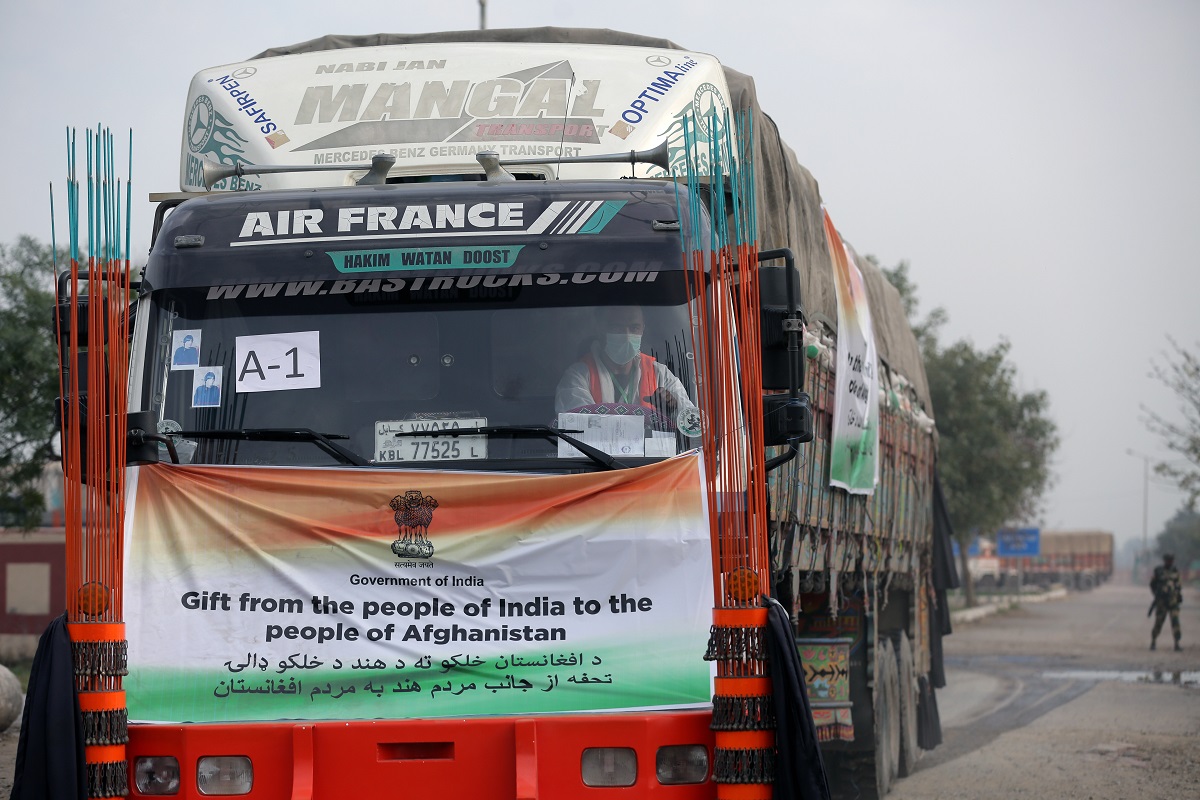
Starting from February, India has been sending through Pakistan consignments of wheat, via the World Food Programme, to the Taliban-run Afghanistan.
Evidently, channels of communication between the two governments are working and open hostility has subsided, if not vanished completely.
China factor: The change has been driven by realist considerations that surfaced during the Ladakh border crisis on the Line of Actual Control with China in the summer of 2020.
The recent change of government in Pakistan, including Imran Khan’s removal, is seen as a positive in New Delhi.
The official Indian establishment has had close ties with both the Pakistan Muslim League-Nawaz and the Pakistan Peoples Party that are now part of the government.
Countering the collusive military threat from China and Pakistan
The border crisis in Ladakh raised the spectre of a collusive military threat between China and Pakistan.
Such a challenge cannot be effectively dealt with by the military alone and would need all the instruments of the state — diplomatic, economic, informational, and military — to act in concert.
To prevent such a situation, India’s National Security Adviser Ajit Doval opened backchannel talks with Pakistan.
Way ahead
There are some low-hanging fruits which can be plucked the moment a political go-ahead is given.
These include a deal on the Sir Creek dispute, an agreement for revival of bilateral trade, return of High Commissioners to the missions in Delhi and Islamabad, and build-up of diplomatic missions to their full strength.
Demilitarisation of the Siachen glacier is still seen to be off the table as the Indian proposal is believed to be unacceptable to the Pakistan Army.
A window of opportunity would possibly open in Pakistan after the next elections, which are scheduled next year but could be held earlier.
Conclusion
India must shift course from the belligerence it has displayed and profited from earlier in favour of proper diplomatic and political engagement with Pakistan.
It is good that India has extended humanitarian assistance to Afghanistan at this time through international agencies and not let its unhappiness with the Taliban’s policies come in the way.
India’s recent engagement with Afghanistan
Recently, the Ministry of External Affairs announced that a team led by J P Singh, Joint Secretary (PAI) “is currently on a visit to Kabul to oversee the delivery operations of our humanitarian assistance to Afghanistan”.
The MEA clearly implied that this engagement should be seen only in the limited context of assistance to the Afghan people
The continuance of humanitarian assistance can be only one, though an important, segment of interaction; other aspects, especially security issues and later, connectivity and investments, as Afghanistan stabilises, have to be part of the dialogue with the Taliban.
Why Afghanistan matters to India’s security
Afghanistan impacts India’s security.
It has, in the past, provided space to al Qaeda with which the Taliban had a special relationship.
Afghanistan has an ISIS presence too.
Of special concern to India are the Taliban’s ties with the Lashkar-e-Taiba and Jaish-e-Mohammed.
A recent United Nations report has emphasised that the Taliban’s connections with these groups have not been severed.
So, what should be India’s approach toward the Taliban?
It is argued that both “principle and pragmatism” demand that India should not do business with the Taliban.
However, Pakistan has continued to sponsor terror and yet India has continued to engage it and has maintained a diplomatic presence in Islamabad.
India cannot argue that the diplomatic door must be kept open for Pakistan because it’s a neighbour while it can be shut on the Taliban because Afghanistan directly impacts Indian security.
Engagement with Taliban: An engagement with the Taliban would at least give an opportunity to convey Indian concerns directly and encourage those elements within the group who wish to open up its diplomatic choices.
Exploit contradiction: Far from being a monolith, the Taliban has significant tribal and regional contradictions.
Therefore, India should not leave the Afghan arena entirely to Pakistan and China because of the social manifestation of Taliban theology.
The Taliban is here to stay and for India, there is no alternative but to deal with it even while repeating, if it wishes, the mantra of inclusive government.
India should also maintain contacts with the leaders of the ousted Republic, especially as the Taliban itself wants them to return to the country.
Conclusion
All in all, the sooner India establishes a permanent presence in Kabul the better for the pursuit of national interests in the external sphere. This is not an exercise in evangelism but the cold and undeterred pursuit of interests.






![[Direct Joining Link] 1:1 LIVE with Prelims Topper Santosh sir | Re-orient your strategy for UPSC 2023-24 Prelims | Register (FREE) and get current week’s Samachar Manthan module](https://d18x2uyjeekruj.cloudfront.net/wp-content/uploads/2022/06/WhatsApp-Image-2022-06-06-at-6.20.07-PM.jpeg)