💥Join UPSC 2027,2028 Mentorship (July Batch) + XFactor Notes & Microthemes PDF

Subject: History

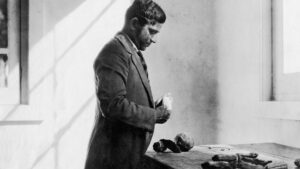
  • Pandurang Khankhoje: Ghadarite revolutionary and a hero of Mexico

    Lok Sabha Speaker, who is currently in Canada for the 65th Commonwealth Parliamentary Conference, will travel to Mexico where he will unveil statues of Swami Vivekananda and Maharashtra-born freedom fighter and agriculturalist Pandurang Khankhoje.

    Who was Pandurang Khankhoje (1883-1967)?

    • Born in Wardha, Maharashtra, in the late 19th century, Pandurang Khankhoje came in contact with other revolutionaries early on.
    • As a student, Khankhoje was an ardent admirer of the French Revolution and of the American War of Independence.
    • Closer to home, the Hindu reformer Swami Dayanand and his Arya Samaj movement, which called for a spirit of reform and social change, became the hero to a young student group led by Khankhoje.

    Revolutionary activities abroad

    • Khankhoje decided to go abroad for further training in revolutionary methods and militaristic strategy.
    • At this time, the British government’s suspicions of him were also growing due to his anti-government activities.
    • Before leaving, he visited Bal Gangadhar Tilak, by whom he was inspired.
    • Tilak advised him to go to Japan, which was itself a strong, anti-West Asian imperialistic force then.
    • After spending time with nationalists from Japan and China, Khankhoje eventually moved to the US, where he enrolled in college as a student of agriculture.

    Participation in the Indian independence movement

    • Khankhoje was one of the founding members of the Ghadar Party, established by Indians living abroad in 1914, mostly belonging to Punjab.
    • Its aim was to lead a revolutionary fight against the British in India.
    • While in the US, Khankhoje met Lala Har Dayal, an Indian intellectual teaching at Stanford University.
    • Har Dayal had begun a propaganda campaign, publishing a newspaper that featured patriotic songs and articles in the vernacular languages of India.
    • This was the seed from which the Ghadar Party would emerge.

    How did Khankhoje reach Mexico?

    • At the military academy, Khankhoje met many people from Mexico.
    • The Mexican Revolution of 1910 had led to the overthrow of the dictatorial regime, and this inspired Khankhoje.
    • He also reached out to Indians working on farms in the US with the aim of discussing the idea of Indian independence with them.
    • Along with the Indian workers, militant action was planned by Khankhoje in India, but the outbreak of the First World War halted these plans.
    • He then reached out to Bhikaji Cama in Paris, and met with Vladimir Lenin in Russia among other leaders, seeking support for the Indian cause.

    Association with Mexico

    • As he was facing possible deportation from Europe and could not go to India, he sought shelter in Mexico.
    • Soon, in part due to his prior friendship with Mexican revolutionaries, he was appointed a professor at the National School of Agriculture in Chapingo, near Mexico City.
    • He researched corn, wheat, pulses and rubber, developing frost and drought-resistant varieties, and was part of efforts to bring in the Green Revolution in Mexico.
    • Later on, the American agronomist Dr Norman Borlaug, called the Father of the Green Revolution in India, brought the Mexican wheat variety to Punjab.
    • Khankhoje was revered as an agricultural scientist in Mexico.

    Return to India

    • Both Pandurang and Jean returned to India after 1947.
    • His application for visa was initially rejected by the Indian government due to the ban by the British Indian Government, but was eventually overturned.
    • He settled in Nagpur and subsequently embarked on a political career.
    • Pandurang Khankhoje died on 22 January 1967.

    Back2Basics: Ghadar Party

    Founder: Sohan Singh Bhakna, 15 July 1913

    • The Ghadar Movement was an early 20th century, international political movement founded by expatriate Indians to overthrow British rule in India.
    • Earlier activists had established a ‘Swadesh Sevak Home’ in Vancouver and a ‘United India House’ in Seattle to carry out revolutionary activities. Finally, in 1913, the Ghadr was founded.
    • The Ghadar Party, originally known as the Pacific Coast Hindustan Association, was founded on July 15, 1913 in the US by Lala Har Dayal, Sant Baba Wasakha Singh Dadehar, Baba Jawala Singh, Santokh Singh, and Sohan Singh Bhakna.
    • The Ghadar party drew a sizable following among Indian expatriates in the United States, Canada, East Africa, and Asia.
    • It fought against colonialism from 1914 to 1917, with the support of Imperial Germany and the Ottoman Empire, both of which were Central Powers opposed to the British.
    • The party was organized around the weekly newspaper The Ghadar, which featured the masthead caption: Angrezi Raj Ka Dushman (an enemy of British rule); “Wanted brave soldiers to stir up rebellion in India,” the Ghadar declared.


  • Tribute to women freedom fighters

    Context

    • Prime Minister Narendra Modi’s Independence Day speech underlined the role of women veeranganas in our freedom movement. The initiative highlighting the brave women of our freedom struggle, under the broader celebration of Azadi Ka Amrit Mahotsav, will mark a turning point in Indian feminist history writing from an Indic perspective.

    What veerangana means?

    • Veerangana means a brave female, someone who can fight for their rights. A strong woman not only protects herself, but protects others too.

    Veerangana’s in freedom struggle

    Rani Laxmibai

    • The queen of the princely state of Jhansi, Rani Laxmibai is known for her role in the First War of India’s Independence in 1857.
    • Refusing to cede her territory, the queen decided to rule on behalf of the heir, and later joined the uprising against the British in 1857.
    • Cornered by the British, she escaped from Jhansi fort. She was wounded in combat near Gwalior’s Phool Bagh, where she later died.
    • Sir Hugh Rose, who was commanding the British army, is known to have described her as “personable, clever…and one of the most dangerous Indian leaders”.

    Jhalkari Bai

    • A soldier in Rani Laxmibai’s women’s army, Durga Dal, she rose to become one of the queen’s most trusted advisers.
    • She is known for putting her own life at risk to keep the queen out of harm’s way.
    • Till date, the story of her valour is recalled by the people of Bundelkhand, and she is often presented as a representative of Bundeli identity.

    Durga Bhabhi

    • Durgawati Devi, who was popularly known as Durga Bhabhi, was a revolutionary who joined the armed struggle against colonial rule.
    • A member of the Naujawan Bharat Sabha, she helped Bhagat Singh escape in disguise from Lahore after the 1928 killing of British police officer John P Saunders.
    • Later, as revenge for the hanging of Bhagat Singh, Rajguru, and Sukhdev, she made an unsuccessful attempt to kill the former Punjab Governor, Lord Hailey.

    Rani Gaidinliu

    • Born in 1915 in present-day Manipur, Rani Gaidinliu was a Naga spiritual and political leader who fought the British.
    • She joined the Heraka religious movement which later became a movement to drive out the British. She rebelled against the Empire, and refused to pay taxes, asking people to do the same.
    • The British launched a manhunt, but she evaded arrest, moving from village to village.
    • Gaidinliu was finally arrested in 1932 when she was just 16, and later sentenced for life. She was released in 1947.
    • Then PM Nehru described Gaidinliu as the “daughter of the hills”, and gave her the title of ‘Rani’ for her courage.

    Rani Chennamma

    • The queen of Kittur, Rani Chennamma, was among the first rulers to lead an armed rebellion against British rule.
    • Kittur was a princely state in present-day Karnataka.
    • She fought back against the attempt to control her dominion in 1824 after the death of her young son. She had lost her husband, Raja Mallasarja, in 1816.
    • She is seen among the few rulers of the time who understood the colonial designs of the British.
    • Rani Chennamma defeated the British in her first revolt, but was captured and imprisoned during the second assault by the East India Company.

    Begum Hazrat Mahal

    • After her husband, Nawab of Awadh Wajid Ali Shah, was exiled after the 1857 revolt, Begum Hazrat Mahal, along with her supporters, took on the British and wrested control of Lucknow.
    • She was forced into a retreat after the colonial rulers recaptured the area.

    Velu Nachiyar

    • Many years before the revolt of 1857, Velu Nachiyar waged a war against the British and emerged victorious. Born in Ramanathapuram in 1780, she was married to the king of Sivagangai.
    • After her husband was killed in battle with the East India Company, she entered the conflict, and won with support of neighbouring kings.
    • She went on to produce the first human bomb as well as establish the first army of trained women soldiers in the late 1700s.
    • Her army commander Kuyili is believed to have set herself ablaze and walked into a British ammunition dump.
    • She was succeeded by her daughter in 1790, and died a few years later in 1796.

    Conclusion

    • The veeranganas are a potent symbol of nationalism and patriotism. They can overturn oppressive attitudes towards women in society. Their role and celebration in popular culture also refutes the colonial allegations about the suppression of women throughout Indian history. But it is essential to discover, rewrite and reinterpret the role and representation of these heroic women in the liberation of the motherland.


    Mains question

    Q. The veerangana’s are a potent symbol of nationalism and patriotism. They can overturn oppressive attitudes towards women in society. Discuss examples of them showing how they inspire women’s today.


    UPSC 2023 countdown has begun! Get your personal guidance plan now! (Click here)


  • What is ‘Mandala’ in Art?

    Some residents of Liverpool in the UK are marveling over a mandala art the size of one and a half football pitches in length created by artist James Brunt with materials such as leaves and rocks.

    What is Mandala Art?

    • Literally meaning “circle” or “centre” in Sanskrit, a mandala art is defined by a geometric configuration that usually incorporates the circular shape in some form.
    • Mandala patterns are a centuries-old motif that are used to depict the cosmos, and have been adapted by artists the world over, each of whom have added their own interpretation and painted it as their own.
    • While it can also be created in the shape of a square, a mandala pattern is essentially interconnected.

    Its origin

    • It is believed to be rooted in Buddhism, appearing in the first century BC in India.
    • In Hinduism, the mandala imagery first appeared in Rig Veda (1500 – 500 BCE).
    • Over the next couple centuries, Buddhist missionaries travelling along the Silk Road took it to other regions.
    • By the sixth century, mandalas have been recorded in China, Korea, Japan, Indonesia and Tibet.

    The meaning of the motif

    • It is believed that by entering the mandala and moving towards its center, one is guided through the cosmic process of transforming the universe .
    • It depicts transition from one of suffering to that of joy.
    • A traditional Buddhist mandala, a circular painting drawn with coloured sand, aided in meditation, with the main objective of aiding its creator to discover their true self.
    • In Hinduism, a mandala or yantra is in the shape of a square with a circle at its center.
    • There are various elements incorporated within the mandala, each of which has its own meaning.
    • For instance, the eight spokes of the wheel (the dharmachakra) represent the eightfold path of Buddhism, the lotus flower depicts balance, and the sun represents the universe.
    • Facing up, triangles represent action and energy, and facing down, they represent creativity and knowledge.

    Mandala in modern Indian art

    • Deep-rooted in ancient philosophy, the mandala has attained varied forms in the hands of modern and contemporary Indian artists.
    • While it continues to appear in thangka paintings, it has a central place in the practice of mainstream artists associated with the tantric and neo-tantric spiritual movements.
    • Choosing to transition from the more figurative depictions of the previous generations of Indian artists, in the 1960s Sohan Qadri and Prafulla Mohanty gained widespread recognition for their works.
    • Their work is imbibed in tantric symbolism, such as mandalas that are also used in the rituals of tantric initiation.
    • Geometric compositions also dominated works of artists such as Biren De, GR Santosh, Shobha Broota, and famously SH Raza, who visualised the bindu as the center of his universe and the source of energy and life.


    UPSC 2023 countdown has begun! Get your personal guidance plan now! (Click here)

  • Who was Lord Curzon, the Viceroy of India who partitioned Bengal in 1905?

    The 119-year-old Curzon Gate in Bardhaman in West Bengal is at the centre of a political row.

    Who was Lord Curzon?

    • Born in 1859, Curzon was a British conservative politician who was educated at the elite institutions of Eton and Oxford.
    • He served as Under-Secretary of State for India (1891-1892), and for Foreign Affairs (1895-1898), before being appointed Viceroy of India in 1899.
    • As viceroy, his administration was known for intense activity and emphasis on efficiency.
    • He stated in his budget speech in 1904, “Efficiency of administration is, in my view, a synonym for the contentment of the governed”.

    Rise to infame

    • Of all the Viceroys of India, Curzon is possibly the most criticised — he is the man who partitioned Bengal in 1905, and triggered a wave of Bengali nationalism that contributed to the wider Indian national movement.
    • He was also one of the more openly imperialist of viceroys, and a man who saw Britain’s rule over India as critical to the survival of empire.
    • In 1900, Curzon famously stated, “We could lose all our [white settlement] dominions and still survive, but if we lost India, our sun would sink to its setting.”

    His works

    • Curzon created a separate Muslim majority province of the North-West Frontier Province, sent a British expedition to Tibet and established a separate police service.
    • He was instrumental in establishing the Archaeological Survey of India, in order to study and protect historical monuments.
    • Early on in his career, Curzon earned some praise from his colonial subjects for taking action against Europeans in a number of high-profile racist attacks against Indians.
    • In 1899, he punished white soldiers for raping a woman in Rangoon; he disciplined soldiers of the 9th Lancers for beating an Indian cook in Sialkot to death in 1902.
    • He had tried unsuccessfully to get the Calcutta High Court to change the meagre punishment given to an Assam tea manager for murdering a “coolie”.

    Why was he disliked then?

    • Curzon was both vexed and enraged by the growing nationalist movement in India and he sought to throttle the growing aspirations of the educated Indian middle class.
    • A staunch imperialist, he took a series of extremely unpopular measures, including passing, in 1899, the Calcutta Municipal Amendment Act.
    • He reduced the number of elected representatives in the Calcutta Corporation.
    • Among others was the Indian Universities Act (1904), that placed Calcutta University under government control, and the Indian Official Secrets Amendment Act (1904) which reduced the freedom of the press even further.
    • Ironically though, it was his biggest and most reviled decision — to partition Bengal in 1905 — that led to a spurt in nationalist sentiment and revitalized the Congress.

    How and why did the partition of Bengal take place?

    • Calcutta was the capital of the British Raj, and Bengal Presidency was one of the largest provinces in India, populated by more than 78 million people.
    • It was such a huge province encompassing present-day West Bengal, Bangladesh, Bihar, parts of Chhattisgarh, Odisha, and Assam.
    • For long, the British had maintained that Bengal was too large to efficiently manage and administer; it was also believed that with Calcutta as the nerve centre of the educated nationalists, the resistance to colonial rule would only increase.
    • Home Secretary H H Risley noted in 1904, “Bengal united is a power; Bengal divided will pull in several different ways.

    Actual course of Partition

    • In July 1905, Curzon announced the partition of Bengal into two provinces.
    • East Bengal and Assam, with a population of 38 million, was predominately Muslim, while the western province, called Bengal, and was reduced to 55 million people, primarily Hindus.
    • Protests began almost immediately after the announcement, with meetings taking place in more than 300 cities, towns, and villages across Bengal.

    What were the consequences of the partition?

    • In opposition to the partition, nationalist leaders organized a campaign a boycott British goods and institutions and encouraged the use of local products.
    • After a formal resolution was passed at a meeting in Calcutta in August 1905, the Swadeshi movement began.
    • Students were at the forefront of the movement, which was characterized by boycotts of British educational institutions and law courts, and large bonfires of imported cotton textiles.
    • There was a surge in nationalist rhetoric, and the song ‘Bande Mataram’, set to music by Rabindranath Tagore, became the informal anthem of the movement.
    • The Swadeshi movement and boycott was not restricted to Bengal, and spread to other parts of the country, including Punjab, Maharashtra, and parts of the Madras Presidency.
    • A number of secret societies, such as the Anushilan Samiti of Bengal, sought to overthrow British rule through violent means.
    • Revolutionary groups used bombs, attempted to assassinate colonial officials, and engaged in armed robberies to finance their activities.

    (Irreversible) Revocation of the Partition

    • In 1905, Curzon resigned and returned to England after losing a power struggle with the commander-in-chief of the British Army, Lord Kitchener.
    • The protests continued after his exit, and the colonial government in 1911 announced the reunification of Bengal.
    • Thenceforth the capital of the Raj was shifted from Calcutta to Delhi.


    UPSC 2023 countdown has begun! Get your personal guidance plan now! (Click here)

  • Who was Kakasaheb Gadgil?

    The Gadgil Wada of Pune was recently lighted into tricolour for the 75th anniversary of Independence.

    Gadgil Wada was where plans for the reconstitution of the socialist Rashtra Seva Dal took place in early 1940s, with socialists like S.M. Joshi, N.G. Gore, Shirubhau Limaye and Kakasaheb in the lead.

    Kakasaheb Gadgil

    • Gadgil was an Indian freedom fighter and politician from Maharashtra, India.
    • He was also a writer. He wrote in both Marathi and English.
    • Gadgil graduated from Fergusson College in Pune in 1918, and obtained a degree in Law in 1920.
    • In India’s pre-independence days, freedom fighters Lokmanya Tilak, Mahatma Gandhi, Jawaharlal Nehru, and Vallabhbhai Patel influenced Gadgil.
    • He joined the Indian National Congress in 1920, immediately after obtaining his law degree and started his active participation in the national freedom movement.
    • He suffered imprisonment from the ruling British government eight times for the participation.

    Notable work during freedom struggle

    • In India’s pre-independence days, Gadgil served as the secretary of Poona District Congress Committee (1921–25), the president of Maharashtra Pradesh Congress Committee (1937–45).
    • He was elected to the central Legislative Assembly in 1934.
    • Gadgil was a pioneer in social reform movements in Maharashtra in the 1930s.
    • During the Civil Disobedience Movement, which began in 1930, Gadgil was listed as a leader for the Maharashtra Civil Disobedience Committee and the Pune War Council.
    • He was associated with several public associations and institutions, including Sarvajanik Sabha, Pune; Young Men’s Association, Pune; Maharashtra Youth League, Bombay; Pune Central Cooperative Bank; and Pune Municipality.

    Service after India’s independence

    • Between 1947 and 1952 Gadgil served as a minister in the first central cabinet of independent India.
    • He held the portfolios of Public Works, and Mines and Power.
    • In his first year in the central Cabinet, he initiated the project of building a military-caliber road from Pathankot to Srinagar via Jammu in Kashmir as a part of India’s activities in the 1947 Indo-Pakistan War.
    • As a cabinet minister, he also initiated the important development projects pertaining to Bhakra, Koyna, and Hirakund dams.
    • He was a member of the Congress Working Committee from 1952 to 1955.
    • His son Vitthalrao Gadgil was a veteran congressman and MP from Pune Lok Sabha constituency, and his grandson Anant Gadgil is currently spokesman for Maharashtra Pradesh Congress Committee.

    Authorship

    • Gadgil wrote several books and articles on politics, economics, law, and history.
    • The following are some of Gadgil’s books:
    1. Pathik (autobiography)
    2. Rajya Shastra Wichar
    3. Shubha Shastra
    4. Waktrutwa Shastra
    5. Gyanbache Arthashastra
    6. Government from Inside
    7. Shikhancha Itihaas (history of Sikhs)


    UPSC 2023 countdown has begun! Get your personal guidance plan now! (Click here)

  • Women heroes of India’s freedom struggle, mentioned by PM in his I-Day speech

    In his Independence Day address to the nation the Prime Minister paid tributes to women freedom fighters for showing the world the true meaning of India’s “nari shakti”. A look at the women he named in his speech:

    Rani Laxmibai

    • The queen of the princely state of Jhansi, Rani Laxmibai is known for her role in the First War of India’s Independence in 1857.
    • Born Manikarnika Tambe in 1835, she married the king of Jhansi.
    • The couple adopted a son before the king’s death, which the British East India Company refused to accept as the legal heir and decided to annex Jhansi.
    • Refusing to cede her territory, the queen decided to rule on behalf of the heir, and later joined the uprising against the British in 1857.
    • Cornered by the British, she escaped from Jhansi fort. She was wounded in combat near Gwalior’s Phool Bagh, where she later died.
    • Sir Hugh Rose, who was commanding the British army, is known to have described her as “personable, clever…and one of the most dangerous Indian leaders”.

    Jhalkari Bai

    • A soldier in Rani Laxmibai’s women’s army, Durga Dal, she rose to become one of the queen’s most trusted advisers.
    • She is known for putting her own life at risk to keep the queen out of harm’s way.
    • Till date, the story of her valour is recalled by the people of Bundelkhand, and she is often presented as a representative of Bundeli identity.
    • According to Ministry of Culture’s Amrit Mahotsav website, “Many Dalit communities of the region look up to her as an incarnation of God and also celebrate Jhalkaribai Jayanti every year in her honour.”

    Durga Bhabhi

    • Durgawati Devi, who was popularly known as Durga Bhabhi, was a revolutionary who joined the armed struggle against colonial rule.
    • A member of the Naujawan Bharat Sabha, she helped Bhagat Singh escape in disguise from Lahore after the 1928 killing of British police officer John P Saunders.
    • During the train journey that followed, Durgawati and Bhagat Singh posed as a couple, and Rajguru as their servant.
    • Later, as revenge for the hanging of Bhagat Singh, Rajguru, and Sukhdev, she made an unsuccessful attempt to kill the former Punjab Governor, Lord Hailey.
    • Born in Allahabad in 1907 and married to Hindustan Socialist Republican Association (HSRA) member Bhagwati Charan Vohra, Durgawati, along with other revolutionaries, also ran a bomb factory in Delhi.

    Rani Gaidinliu

    • Born in 1915 in present-day Manipur, Rani Gaidinliu was a Naga spiritual and political leader who fought the British.
    • She joined the Heraka religious movement which later became a movement to drive out the British. She rebelled against the Empire, and refused to pay taxes, asking people to do the same.
    • The British launched a manhunt, but she evaded arrest, moving from village to village.
    • Gaidinliu was finally arrested in 1932 when she was just 16, and later sentenced for life. She was released in 1947.
    • Then PM Nehru described Gaidinliu as the “daughter of the hills”, and gave her the title of ‘Rani’ for her courage.

    Rani Chennamma

    • The queen of Kittur, Rani Chennamma, was among the first rulers to lead an armed rebellion against British rule.
    • Kittur was a princely state in present-day Karnataka.
    • She fought back against the attempt to control her dominion in 1824 after the death of her young son. She had lost her husband, Raja Mallasarja, in 1816.
    • She is seen among the few rulers of the time who understood the colonial designs of the British.
    • Rani Chennamma defeated the British in her first revolt, but was captured and imprisoned during the second assault by the East India Company.

    Begum Hazrat Mahal

    • After her husband, Nawab of Awadh Wajid Ali Shah, was exiled after the 1857 revolt, Begum Hazrat Mahal, along with her supporters, took on the British and wrested control of Lucknow.
    • She was forced into a retreat after the colonial rulers recaptured the area.

    Velu Nachiyar

    • Many years before the revolt of 1857, Velu Nachiyar waged a war against the British and emerged victorious. Born in Ramanathapuram in 1780, she was married to the king of Sivagangai.
    • After her husband was killed in battle with the East India Company, she entered the conflict, and won with support of neighbouring kings.
    • She went on to produce the first human bomb as well as establish the first army of trained women soldiers in the late 1700s.
    • Her army commander Kuyili is believed to have set herself ablaze and walked into a British ammunition dump.
    • She was succeeded by her daughter in 1790, and died a few years later in 1796.


    UPSC 2023 countdown has begun! Get your personal guidance plan now! (Click here)

  • History of popular slogans raised during Freedom Struggle

    Inspiring and controversial, this article explains the history of slogans that have endured in India’s politics.

    (1) ‘Jai Hind’ by Netaji Subhash Chandra Bose

    • Netaji Subhas Chandra Bose popularised ‘Jai Hind’ as a salutation for soldiers of his Indian National Army (INA), which fought alongside Netaji’s ally Japan in the Second World War.
    • But according to some accounts, Netaji did not actually coin the slogan.
    • A book says the term was coined by Zain-ul Abideen Hasan, the son of a collector from Hyderabad, who had gone to Germany to study.
    • There, he met Bose and eventually left his studies to join the INA.
    • Khan was tasked by Bose to look for a military greeting or salutation for the INA’s soldiers, a slogan which was not caste or community-specific, given the all-India basis of the INA.
    • The idea for ‘Jai Hind’ came to Hasan when he was at the Konigsbruck camp in Germany.

    (2) ‘Tum mujhe khoon do, main tumhe aazadi doonga’ by Netaji Subhash Chandra Bose

    • This slogan had origins in a speech Netaji made in Myanmar, then called Burma, on July 4, 1944.
    • Underlining his core philosophy of violence being necessary to achieve independence, he said, “Friends! My comrades in the War of Liberation! Today I demand of you one thing, above all.
    • He ended the speech saying “Tum mujhe khoon do, main tumhe aazadi doonga” (Give me blood and I promise you freedom).

    (3) ‘Vande Mataram’ by Bankim Chandra Chatterji

    • The term refers to a sense of respect expressed to the motherland.
    • In 1870, Bengali novelist Bankim Chandra Chattopadhyay wrote a song which would go on to assume a national stature, but would also be seen as communally divisive by some.
    • Written in Bengali, the song titled ‘Vande Mataram’ was not introduced into the public sphere until the publishing of the novel Anandamath in 1882, of which the song is a part.
    • Vande Mataram soon became the forefront of sentiments expressed during the freedom movement.
    • The novel, set in the early 1770s came against the backdrop of the Fakir-Sannyasi Rebellion against the British in Bengal.

    (4) ‘Inquilab Zindabad’ by Maulana Hasrat Mohani

    • ‘Inquilab Zindabad’ (Long live the revolution) was first used by Maulana Hasrat Mohani in 1921.
    • Hasrat was his pen name (takhallus) as a revolutionary Urdu poet, which also became his identity as a political leader.
    • Hasrat Mohani was a labour leader, scholar, poet and also one of the founders of the Communist Party of India in 1925.
    • Along with Swami Kumaranand — also involved in the Indian Communist movement — Mohani first raised the demand for complete independence or ‘Poorna Swaraj’, at the Ahmedabad session of the Congress in 1921.
    • His stress on Inquilab was inspired by his urge to fight against social and economic inequality, along with colonialism.
    • Before Mohani coined this slogan, the Bolshevik Revolution in Russia made the idea of revolution symbolic of the struggle for oppressed nationalities globally.
    • It was from the mid-1920s that this slogan became a war cry of Bhagat Singh and his Naujawan Bharat Sabha, as well as his Hindustan Socialist Republican Association (HSRA).

    (5) ‘Sarfaroshi ki Tamanna’ by Bismil Azimabadi

    • This is the first line of a poem written by Bismil Azimabadi (and NOT Ramprasad Bismil), a freedom fighter and poet from Bihar, after the Jallianwalah Bagh Massacre of 1921 in Amritsar, Punjab.
    • The lines were popularised by Ram Prasad Bismil, another revolutionary.
    • He was a part of the Kakori train robbery, a successful and ambitious operation in which a train filled with British goods and money was robbed for Indian fighters to purchase arms.

    (6) ‘Do or Die’ by Gandhi Ji

    • In 1942, the Second World War commencing and the failure of Stafford Cripps Missions – which only promised India a ‘dominion status’ where it would still have to bear allegiance to the King of England .
    • This made Gandhi Ji realise that the movement for freedom needed to be intensified.
    • On August 8, 1942, the All-India Congress Committee met in Gowalia Tank Maidan (August Kranti Maidan) in Bombay.
    • Gandhi addressed thousands after the meeting to spell out the way forward.

    (7) ‘Quit India’ by Yusuf Meherally

    • While Gandhi gave the clarion call of ‘Quit India’, the slogan was coined by Yusuf Meherally, a socialist and trade unionist who also served as Mayor of Mumbai.
    • A few years ago, in 1928, Meherally had also coined the slogan “Simon Go Back” to protest the Simon Commission – that although was meant to work on Indian constitutional reform, but lacked any Indians.
    • Meherally was a Congress Socialist Party member who was actively involved in anti-government protests.


    UPSC 2023 countdown has begun! Get your personal guidance plan now! (Click here)

  • 80 years of Quit India Movement

    On this day 80 years ago — on August 9, 1942 — the people of India launched the decisive final phase of the struggle for independence through the Quit India Movement.

    Quit India Movement

    • It was a mass upsurge against colonial rule on a scale not seen earlier, and it sent out the unmistakable message that the sun was about to set on the British Empire in India.
    • Mahatma Gandhi, who had told the Raj to “Quit India” on the previous day (August 8) was already in jail along with the entire Congress leadership.
    • So when August 9 dawned, the people were on their own — out on the street, driven by the Mahatma’s call of “Do or Die”.
    • This truly people-led movement was eventually crushed violently by the British, but by then it was clear that nothing short of their final departure was acceptable to India’s masses.

    The slogan ‘Quit India’

    • While Gandhi gave the clarion call of Quit India, the slogan was coined by Yusuf Meherally, a socialist and trade unionist who also served as Mayor of Bombay.
    • A few years ago, in 1928, it was Meherally who had coined the slogan “Simon Go Back”.

    Build-up to August 1942

    • Failure of Cripps Mission: While factors leading to such a movement had been building up, matters came to a head with the failure of the Cripps Mission. With WW2 raging, the beleaguered British government needed the cooperation of its colonial subjects. With this in mind, in March 1942, a mission led by Sir Stafford Cripps arrived in India to meet leaders of the Congress and the Muslim League.
    • Betrayal on WW2 Promises: The idea was to secure India’s whole-hearted support in the war, and the return offer to Indians was the promise of self-governance. But things did not go that way.
    • No complete freedom: Despite the promise of “the earliest possible realisation of self-government in India”, Cripps only offered dominion status, not freedom.
    • Unviable partition plan: Also, there was a provision for the partition of India, which was not acceptable to the Congress.

    Gandhiji’s departure from non-violent struggle

    • The failure of the Cripps Mission made Gandhi realise that freedom would come only if Indians fought tooth and nail for it.
    • The Congress was initially reluctant to launch a movement that could hamper Britain’s efforts to defeat the fascist forces. But it eventually decided on mass civil disobedience.
    • At the Working Committee meeting in Wardha in July 1942, it was decided the time had come for the movement to move into an active phase.

    Gandhi’s address: Do or Die

    • On August 8, 1942, Gandhi addressed the people in the Gowalia Tank maidan in Bombay (Mumbai). “Here is a mantra, a short one that I give you.
    • Imprint it on your hearts, so that in every breath you give expression to it,” he said.
    • “The mantra is: ‘Do or Die’. We shall either free India or die trying; we shall not live to see the perpetuation of our slavery,” Gandhi said.
    • Aruna Asaf Ali hoisted the Tricolour on the ground. The Quit India movement had been officially announced.
    • The government cracked down immediately, and by August 9, Gandhi and all other senior Congress leaders had been jailed.
    • Gandhi was taken to the Aga Khan Palace in Poona (Pune), and later to Yerwada jail. It was during this time that Kasturba Gandhi died at the Aga Khan Palace.

    Course of events

    (1) People vs. the Raj

    • The arrest of their leaders failed to deter the masses.
    • With no one to give directions, people took the movement into their own hands.
    • In Bombay, Poona, and Ahmedabad, hundreds of thousands of ordinary Indians clashed with the police.
    • The following day (August 10), protests erupted in Delhi, UP, and Bihar.
    • There were strikes, demonstrations and people’s marches in defiance of prohibitory orders in Kanpur, Patna, Varanasi, and Allahabad.
    • The protests spread rapidly into smaller towns and villages.
    • Till mid-September, police stations, courts, post offices, and other symbols of government authority came under repeated attack.

    (2) Working class involvement

    • Railway tracks were blocked, students went on strike in schools and colleges across India, and distributed illegal nationalist literature.
    • Mill and factory workers in Bombay, Ahmedabad, Poona, Ahmednagar, and Jamshedpur stayed away for weeks.

    (3) Violent phase

    • Bridges were blown up, telegraph wires were cut, and railway lines were taken apart.

    Outcome: Brutal suppression

    • The Quit India movement was violently suppressed by the British — people were shot and lathi-charged, villages were burnt, and backbreaking fines were imposed.
    • In the five months up to December 1942, an estimated 60,000 people had been thrown into jail.
    • However, though the movement was quelled, it changed the character of the Indian freedom struggle, with the masses rising up to demand with a passion and intensity like never before.


    Try this PYQ:

    Q. Quit India Movement was launched in response to:

    (a) Cabinet Mission Plan

    (b) Cripps Proposals

    (c) Simon Commission Report

    (d) Wavell Plan


    [wpdiscuz-feedback id=”bejmwel566″ question=”Please leave a feedback on this” opened=”1″]Post your answers here.[/wpdiscuz-feedback]


    UPSC 2023 countdown has begun! Get your personal guidance plan now! (Click here)

  • Who was Vannuramma?

    The fort of legendry Vannuramma in Nallamala forest in the present day Mydukur mandal of Kadapa district is trending due to its rundown condition.

    Who was Vannuramma?

    • Vannuramma ruled five ‘Durgams’ (under fiefdom) between 1781 and 1796 with Sakarlapadu as the administrative headquarters.
    • According to historical accounts, she was born in Pathimadugu Rekulakunta, now in Kadapa district, and got married to Veerneni Chinna Narasimha Naidu in 1764.
    • The family had the practice of praying at Vannuru Swamy temple in Kalyanadurgam of Anantapur district.
    • Vannuramma thus got her name as she was born, as believed, as the god’s gift.
    • Though there are not many historical accounts, Kadapa-based writer Bommisetty Ramesh brought out the first book last year on her.
    • Based on information culled out from the Mackenzie Kaifiyat of Kadapa, he extensively toured the region ruled by her, collected folklore and verified the same with historians.

    Her legend

    • The very mention of the name ‘Vannuramma’ brought chill to the spine of the Matli kings and Kadapa Nawabs.
    • Of all the Polegars (local chieftains) who had ruled the regional territories of Rayalaseema before the advent of the British, the lone woman ruler remains forgotten from the pages of history.
    • Under attack from fellow Polegars, Vannuramma’s family fled Thippireddypalle and took shelter in Chagalamarri fort, where they lived for eight years before her husband breathed his last in 1780.
    • Vannuramma wielded the sword when the Matli king Appayya Raju and Mysore Sultan Hyder Ali’s follower Meeru Saheb waged a war, invaded Sakerlapadu Durgam and robbed the property of locals.
    • Mobilising her army, she declared a war and brought the territory back into her fold in 1781.

    Her death

    • Even the Golconda Nawabs, through their Kadapa henchman Khadarvali Khan, tried in vain to control her.
    • It was then they hatched a plan to woo her adopted son and arrested her on some flimsy charges.
    • When the unsuspecting Vannuramma attended the Matli king’s court to prove her innocence, she was slapped with charges of treason.
    • The Nawabs captured her and sentenced her with ‘Korthi’, an inhuman form of punishment where a person is made to sit on a sharpened tree stump and left to die.
    • Vannuramma died in full public view in the year 1718 of Salivahana Saka, which translates to August 16, 1796, i.e., 226 years back.


    UPSC 2023 countdown has begun! Get your personal guidance plan now! (Click here)

  • Har Ghar Tiranga Campaign

    The Centre is set to launch a large-scale campaign to encourage Indians to fly the National Fag at their homes to mark the 75th Independence Day under the Har Ghar Tiranga Campaign.

    Also, August 2 marks 146th birth anniversary of Pingali Venkayya, the designer of Pingali Venkayya.

    Har Ghar Tiranga

    • ‘Har Ghar Tiranga’ is a campaign under the aegis of Azadi Ka Amrit Mahotsav to encourage people to bring the Tiranga home and to hoist it to mark the 75th year of India’s independence.
    • The campaign aims to have citizens hoisting our National Flag in their homes between August 13 and 15.

    Why such move?

    • Our relationship with the flag has always been more formal and institutional than personal.
    • Bringing the flag home collectively as a nation in the 75th year of independence thus becomes a symbolic act of personal connection to the Tiranga.
    • The idea behind the initiative is to invoke the feeling of patriotism in the hearts of the people and to promote awareness about the National Flag.

    Story of our National Flag

    • On July 22, 1947, the Constituent Assembly adopted our National Flag.
    • The flag that was finally chosen underwent several changes since it was originally designed by Pingali Venkayya in 1923.
    • Venkayya was not just the architect of the flag but also a freedom fighter.
    • He was known as Jhanda Venkayya as he published a book in 1916 on 30 designs for the Indian flag.
    • August 2 marks his 146th birth anniversary and citizens across this country will now know more of his contributions in designing the flag that we have today.

    How this was made possible?

    • First, the Flag Code was changed to make the flag more accessible and thus give every Indian the unique opportunity to hoist the flag at their homes.
    • Subsequently, the government has taken various steps to ensure the supply of flags across the country.
    • Flags are now available in all post offices in the country.
    • State governments have tied up with various stakeholders for the supply of flags.
    • The flag will be available on the government’s e-market marketplace (GEM) portal, on e-commerce portals, and with various self-help groups (SHGs).

    What is the Flag Code of India?

    • The Flag Code of India is a set of laws, practices and conventions that apply to the display of the national flag of India.
    • The Code took effect from 26 January 2002 and superseded the “Flag Code-India” as it existed earlier.
    • It permits the unrestricted display of the tricolour, consistent with the honour and dignity of the flag.

    The Flag Code of India has been divided into three parts:-

    • First Part: General Description of the National Flag.
    • Second Part: Display of the National Flag by members of public, private Organisations & educational institutions etc.
    • Third Part: Display of National Flag by Union or State Governments and their organisations and agencies.

    Disposing of the national flag

    • A/c to the Flag Code, such paper flags are not to be discarded or thrown on the ground after the event.
    • Such flags are to be disposed of, in private, consistent with the dignity of the flag.

    Do you know?: Hoisting the national flag is a fundamental right

    • The bench headed by Chief Justice of India V. N. Khare said that under Article 19(1)(a) of the Constitution of India, citizens had the fundamental right to fly the national flag on their premises throughout the year.
    • However, it provided that the premises do not undermine the dignity of the national flag.

    About Prevention of Insults to National Honour Act

    • The law, enacted on December 23, 1971, penalizes the desecration of or insult to Indian national symbols, such as the National Flag, the Constitution, the National Anthem, and the Indian map, as well as contempt of the Constitution of India.
    • Section 2 of the Act deals with insults to the Indian National Flag and the Constitution of India.

    Do you know?

    Article 51 ‘A’ contained in Part IV A i.e. Fundamental Duties asks:

    To abide by the constitution and respect its ideals and institutions, the National Flag and the National Anthem in clause (a).


    Back2Basics: Story of our National Flag

    (1) Public display for the first time

    • Arguably the first national flag of India is said to have been hoisted on August 7, 1906, in Kolkata at the Parsee Bagan Square (Green Park).
    • It comprised three horizontal stripes of red, yellow and green, with Vande Mataram written in the middle.
    • Believed to have been designed by freedom activists Sachindra Prasad Bose and Hemchandra Kanungo, the red stripe on the flag had symbols of the sun and a crescent moon, and the green strip had eight half-open lotuses.

    (2) In Germany

    • In 1907, Madame Cama and her group of exiled revolutionaries hoisted an Indian flag in Germany in 1907 — this was the first Indian flag to be hoisted in a foreign land.

    (3) During the Home Rule Movement

    • In 1917, Dr Annie Besant and Lokmanya Tilak adopted a new flag as part of the Home Rule Movement.
    • It had five alternate red and four green horizontal stripes, and seven stars in the saptarishi configuration.
    • A white crescent and star occupied one top corner, and the other had Union Jack.

    (4) Final version by Pingali Venkayya

    • The design of the present-day Indian tricolour is largely attributed to Pingali Venkayya, an Indian freedom fighter.
    • He reportedly first met Mahatma Gandhi in South Africa during the second Anglo-Boer War (1899-1902), when he was posted there as part of the British Indian Army.
    • Years of research went into designing the national flag. In 1916, he even published a book with possible designs of Indian flags.
    • At the All India Congress Committee in Bezwada in 1921, Venkayya again met Gandhi and proposed a basic design of the flag, consisting of two red and green bands to symbolise the two major communities, Hindus and Muslims.

    (5) During Constituent Assembly

    • On July 22, 1947, when members of the Constituent Assembly of India, the first item on the agenda was reportedly a motion by Pandit Nehru, about adopting a national flag for free India.
    • It was proposed that “the National Flag of India shall be horizontal tricolour of deep saffron (Kesari), white and dark green in equal proportion.”
    • The white band was to have a wheel in navy blue (the charkha being replaced by the chakra), which appears on the abacus of the Sarnath Lion Capital of Ashoka.


    UPSC 2022 countdown has begun! Get your personal guidance plan now! (Click here)