Introduce how the Indian freedom scenario looked before Gandhiji.
Briefly discuss the state of freedom struggle between 1870s till Gandhiji’s arrival in India. Discuss how Satyagraha freed the minds of people from fear and sealed the fate of imperialism.
UPSC IAS preparation is not just about reading and re-reading information, concepts, books, etc. It is also about evaluating what you have studied and covered, and practicing MCQs and mocks.
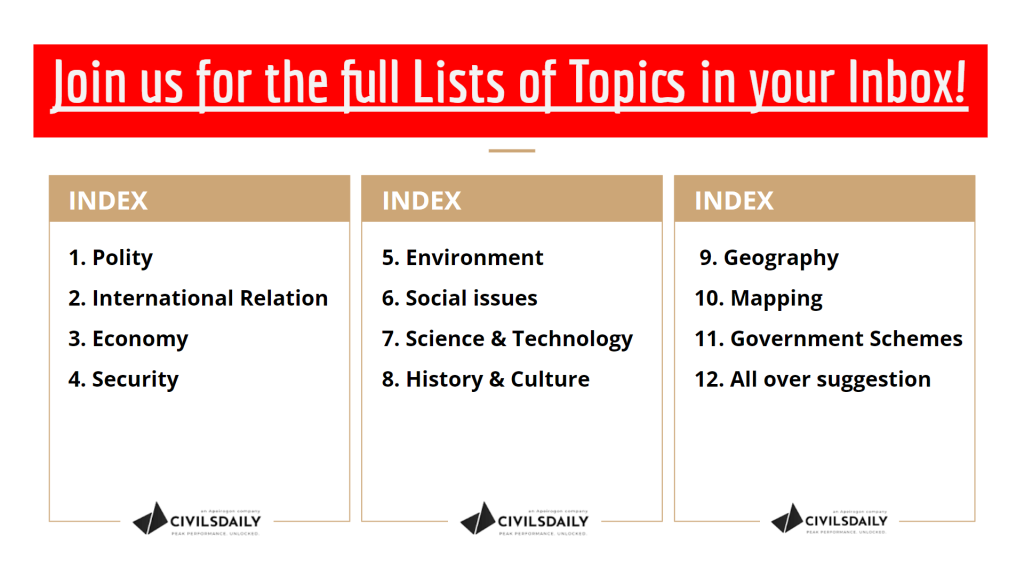
Civilsdaily has launched a free initiative to make out of the most important topics/MCQs for the UPSC prelims and pave the way to score 120+ in UPSC Prelims 2023-24
FREE PDFs INCLUDE:
Most important topics based Prelims MCQs
UPSC relevant current affairs
GS topics and concepts linked with Current affairs
UPSC level questions
From where can you register for the Prelims Weekly PDF.
On CivilsDaily’s website click on Prelims Weekly. You will come to this page. Register here.
Certain topics seem to be important for the UPSC prelims exam, but they are not asked in the exam. The UPSC primarily inquires about the context of current events. Ideally, UPSC asks about four aspects of a topic in one question with multiple options, with only one correct answer.
We have considered this aspect of UPSC as well in framing the MCQs.
The syllabus for the prelims exam does not go into great detail about the topics. Candidates should understand the prelims’ demand by analyzing the UPSC MCQs provided here.
Overall preparation necessitates over a year of focused preparation in the right direction with the right strategy. Important Prelims exam topics are just the tip of the iceberg when it comes to the syllabus. Important topics guide will guide preparation in the right direction to sit for UPSC Mains 2023.
So, our highly experienced toppers’ teachers & mentors group has prepared the most trusted list of the most important topics.
You will also get FREE Mentorship session with Senior mentors from CivilsDaily on registration.
GS-1 Modern Indian history from about the middle of the eighteenth century until the present – significant events, personalities, issues.
GS-2 Issues relating to development and management of Social Sector/Services relating to Health, Education, Human Resources.
GS-3 Major crops-cropping patterns in various parts of the country, – different types of irrigation and irrigation systems storage, transport and marketing of agricultural produce and issues and related constraints; e-technology in the aid of farmers.
GS-4 Probity in Governance: Information sharing and transparency in government, Right to Information, Codes of Ethics, Codes of Conduct, Citizen’s Charters, Work culture, Quality of service delivery, Utilization of public funds, challenges of corruption.
HOW TO ATTEMPT ANSWERS IN DAILY ANSWER WRITING ENHANCEMENT(AWE)?
Daily 4 questions from General studies 1, 2, 3, and 4 will be provided to you.
A Mentor’s Comment will be available for all answers. This can be used as a guidance tool but we encourage you to write original answers.
You can write your answer on an A4 sheet and scan/click pictures of the same.
Upload the scanned answer in the comment section of the same question.
Along with the scanned answer, please share your Razor payment ID, so that paid members are given priority.
If you upload the answer on the same day like the answer of 11th February is uploaded on 11th February then your answer will be checked within 72 hours. Also, reviews will be in the order of submission- First come first serve basis
If you are writing answers late, for example, 11th February is uploaded on 13th February , then these answers will be evaluated as per the mentor’s schedule.
We encourage you to write answers on the same day. However, if you are uploading an answer late then tag the mentor like @Staff so that the mentor is notified about your answer.
*In case your answer is not reviewed, reply to your answer saying *NOT CHECKED*.
A three-judge Bench of the Supreme Court led by Chief Justice of India (CJI) U U Lalit will hear the challenge to the contentious Citizenship (Amendment) Act.
What is Citizenship Amendment Act (CAA), 2019?
The act is sought toamend the Citizenship Act, 1955 to make Hindu, Sikh, Buddhist, Jain, Parsi, and Christian illegal migrants from Afghanistan, Bangladesh, and Pakistan, eligible for citizenship of India.
In other words, it intends to make it easier for non-Muslim immigrants from India’s three Muslim-majority neighbours to become citizens of India.
Under The Citizenship Act, 1955, one of the requirements for citizenship by naturalization is that the applicant must have resided in India during the last 12 months, as well as for 11 of the previous 14 years.
The amendment relaxes the second requirement from 11 years to 6 years as a specific condition for applicants belonging to these six religions, and the aforementioned three countries.
It exempts the members of the six communities from any criminal case under the Foreigners Act, 1946 and the Passport Act, 1920 if they entered India before December 31, 2014.
Key feature: Defining illegal migrants
Illegal migrants cannot become Indian citizens in accordance with the present laws.
Under the CAA, an illegal migrant is a foreigner who: (i) enters the country without valid travel documents like a passport and visa, or (ii) enters with valid documents, but stays beyond the permitted time period.
Illegal migrants may be put in jail or deported under the Foreigners Act, 1946 and The Passport (Entry into India) Act, 1920.
Exceptions
The Bill provides that illegal migrants who fulfil four conditions will not be treated as illegal migrants under the Act. The conditions are:
they are Hindus, Sikhs, Buddhists, Jains, Parsis or Christians;
they are from Afghanistan, Bangladesh or Pakistan;
they entered India on or before December 31, 2014;
they are not in certain tribal areas of Assam, Meghalaya, Mizoram, or Tripura included in the Sixth Schedule to the Constitution, or areas under the “Inner Line” permit, i.e., Arunachal Pradesh, Mizoram, and Nagaland.
Controversy with the Act
Country of Origin: The Act classifies migrants based on their country of origin to include only Afghanistan, Pakistan and Bangladesh.
Other religious minorities ignored: It is unclear why illegal migrants from only six specified religious minorities have been included in the Act.
Defiance of purpose: India shares a border with Myanmar, which has had a history of persecution of a religious minority, the Rohingya Muslims.
Date of Entry: It is also unclear why there is a differential treatment of migrants based on their date of entry into India, i.e., whether they entered India before or after December 31, 2014.
Against the spirit of Secularism: Further, granting citizenship on the grounds of religion is seen to be against the secular nature of the Constitution which has been recognised as part of the basic structure that cannot be altered by Parliament.
Basis of challenging in Supreme Court
The challenge rests primarily on the grounds that the law violates Article 14 of the Constitution that guarantees that no person shall be denied the right to equality before law or the equal protection of law in the territory of India.
The Supreme Court has developed a two-pronged test to examine a law on the grounds of Article 14.
First, any differentiation between groups of persons must be founded on “intelligible differentia”
Second, that differentia must have a rational nexus to the object sought to be achieved by the Act
Simply put, for a law to satisfy the conditions under Article 14, it has to first create a “reasonable class” of subjects that it seeks to govern under the law.
Even if the classification is reasonable, any person who falls in that category has to be treated alike.
What happens next?
The listing of the CAA challenge indicates that the hearing will be fast-tracked.
The court will have to ensure that all pleadings, written submissions are filed and served to the opposite party before it is listed for final hearing.
Some petitioners could also seek a referral to a larger Constitution Bench.
However, the challenge is to a statute and does not directly involve interpretation of the Constitution.
These issues are also likely to be debated before the court allots time for the final hearing.
Way forward
India is a constitutional democracy with a basic structure that assures a secure and spacious home for all Indians.
Being partitioned on religious grounds, India has to undertake a balancing act for protecting the religious minorities in its neighbourhood.
These minorities are under constant threat of persecution and vandalism.
India needs to balance its civilization duties to protect those who are prosecuted in the neighbourhood.
The characteristics of cloud burst events remain elusive, and our efforts in monitoring and forecasting them is at an embryonic stage.
Cyclones can be predicted about one week in advance. However, cloudburst forecasts still remain elusive.
What is Cloudbursts?
A cloudburst is a localised but intense rainfall activity.
Short spells of very heavy rainfall over a small geographical area can cause widespread destruction, especially in hilly regions where this phenomenon is the most common.
Not all instances of very heavy rainfall, however, are cloudbursts.
A cloudburst has a very specific definition: Rainfall of 10 cm or more in an hour over a roughly 10 km x 10-km area is classified as a cloudburst event.
By this definition, 5 cm of rainfall in a half-hour period over the same area would also be categorized as a cloudburst.
Which clouds do burst?
Cloudburst events are often associated with cumulonimbus clouds that cause thunderstorms and occasionally due to monsoon wind surges and other weather phenomena.
Cumulonimbus clouds can grow up to 12-15 km in height through the entire troposphere (occasionally up to 21 km) and can hold huge amounts of water.
Tall cumulonimbus clouds can develop in about half an hour as the moisture updraft happens rapidly, at a pace of 60 to 120 km/hr.
A single-cell cloud may last for an hour and dump all the rain in the last 20 to 30 minutes, while some of these clouds merge to form multi-cell storms and last for several hours.
However, cloudbursts are not defined based on cloud characteristics and do not indicate clouds exploding. Cloudbursts are defined by the amount of rainfall.
How is it different from normal rainfall?
According to the India Meteorological Department (IMD), 100 mm of rain in an hour is called a cloudburst.
Usually, cloudbursts occur over a small geographical region of 20 to 30 sq. km.
When do they occur?
In India, cloudbursts often occur during the monsoon season, when the southwesterly monsoon winds bring in copious amounts of moisture inland.
The moist air that converges over land gets lifted as they encounter the hills.
The moist air reaches an altitude and gets saturated, and the water starts condensing out of the air forming clouds.
This is how clouds usually form, but such an orographic lifting together with a strong moisture convergence can lead to intense cumulonimbus clouds taking in huge volumes of moisture that is dumped during cloudbursts.
How common are cloudbursts?
Cloudbursts are not uncommon events, particularly during the monsoon months.
Most of these happen in the Himalayan states where the local topology, wind systems, and temperature gradients between the lower and upper atmosphere facilitate the occurrence of such events.
However, not every event that is described as a cloudburst is actually, by definition, a cloudburst.
That is because these events are highly localized.
They take place in very small areas which are often devoid of rainfall measuring instruments.
Climate change and cloudbursts: How are they related?
Climate change is projected to increase the frequency and intensity of cloudbursts worldwide.
As the air gets warmer, it can hold more moisture and for a longer time. We call this the Clausius Clapeyron relationship.
A 1-degree Celsius rise in temperature may correspond to a 7-10% increase in moisture and rainfall.
This increase in rainfall amount does not get spread moderately throughout the season.
As the moisture holding capacity of air increases, it results in prolonged dry periods intermittent with short spells of extreme rains.
Deeper cumulonimbus clouds will form and the chances of cloudbursts also increase.
Why are they so destructive?
The consequences of these events, however, are not confined to small areas.
Because of the nature of terrain, the heavy rainfall events often trigger landslides and flash floods, causing extensive destruction downstream.
This is the reason why every sudden downpour that leads to destruction of life and property in the hilly areas gets described as a “cloudburst”, irrespective of whether the amount of rainfall meets the defining criteria.
At the same time, it is also possible that actual cloudburst events in remote locations aren’t recorded.
Detecting cloudbursts
Satellites are extensively useful in detecting large-scale monsoon weather systems.
However the resolution of the precipitation radars of these satellites can be much smaller than the area of individual cloudburst events, and hence they go undetected.
Weather forecast models also face a similar challenge in simulating the clouds at a high resolution.
The skillful forecasting of rainfall in hilly regions remains challenging due to the uncertainties in the interaction between the moisture convergence and the hilly terrain.
There also involves the cloud microphysics, and the heating-cooling mechanisms at different atmospheric levels.
Multiple radars can be a quick measure for providing warnings, but radars are an expensive affair, and installing them across the country may not be practically feasible.
Solutions to cloudbursts forecast
Multiple doppler weather radars can be used to monitor moving cloud droplets and help to provide nowcasts (forecasts for the next three hours).
A long-term measure would be mapping the cloudburst-prone regions using automatic rain gauges.
If cloudburst-prone regions are co-located with landslide-prone regions, these locations can be designated as hazardous.
Ministry of Tourism identified Tourism Industry’s potential as a Sunrise Industry.
There is a need for tourism analysts to hold tourism planners accountable.
What is tourism?
Tourism is travel for pleasure or business; also the theory and practice of touring, the business of attracting, accommodating, and entertaining tourists, and the business of operating tours.
Types of tourism
Domestic tourism: Refers to activities of a visitor within their country of residence and outside of their home (e.g. a Indian visiting other parts of India)
Inbound tourism: Refers to the activities of a visitor from outside of country of residence (e.g. a Spaniard visiting Britain).
Outbound tourism: Refers to the activities of a resident visitor outside of their country of residence (e.g. an Indian visiting an overseas country).
What does sustainable tourism mean?
Sustainable tourism is defined by the UN Environment Program and UN World Tourism Organization as “tourism that takes full account of its current and future economic, social and environmental impacts, addressing the needs of visitors, the industry, the environment and host communities.”
What is the main importance of tourism?
Tourism boosts the revenue of the economy, creates thousands of jobs, develops the infrastructures of a country, and plants a sense of cultural exchange between foreigners and citizens.
Why tourism is needed?
Tourism is not a fad. It is a compulsion driven by the urge to discover new places. Because we have this compulsion to venture into the unknown, we need each other. When humans travel, meet and exchange ideas, civilisation flourishes.
What should be done to promote tourism?
National Tourism Authority: A separate National Tourism Authority (NTA) should be established for executing and operationalizing various tourism related initiatives. Simple, flexible and elegant processes will be laid down to allow for nimbleness.
National Tourism Advisory Board: A National Tourism Advisory Board (NTAB) should be set up to provide overall vision, guidance and direction to the Development of Tourism Sector in the country.
Creating Synergy in Tourism Eco System: In order to ensure synergy at various levels of Government and with the Private Sector, it is important to have a well-defined framework in place.
Quality Tourism Framework: A robust framework for quality certification of products and services across all segments like accommodation providers, tour operators, adventure tour operators, service providers like spa and wellness, guides, restaurants etc. should be laid down.
Enhancing the existing luxury tourism products: The existing tourism products such as Nilgiri Mountain Railway, Palace on Wheels etc. should be enhanced and their numbers will also be increased. Haulage charges will be rationalised to make luxury trains viable.
Railways can be a game changer: For tourism Railways have presence in most parts of the country. Most of the tourist destinations in the country are connected by rail. Railways is also in the process of connecting more places especially the strategic locations that also are tourist places with limited connectivity at present. Indian Railways is working towards promoting tourism in the country by operating more trains connecting tourists’ destinations and also by providing an array of products starting from luxury tourist trains to budget catering tourist trains
The acronym “MICE” stands for “Meetings, Incentives, Conferences and Exhibitions”, and is essentially a version of business tourism that draws domestic and international tourists to a destination.
The policy aims to make Gujarat one of the top five MICE tourism destinations in the country.
Way forward
Enhance the contribution of tourism in Indian economy by increasing the visitation, stay and spend
Create jobs and entrepreneurial opportunities in tourism sector and ensure supply of skilled work force
Enhance the competitiveness of tourism sector and attract private sector investment
Preserve and enhance the cultural and natural resources of the country
To ensure sustainable, responsible and inclusive development of tourism in the country
Conclusion
We know that India has the highest tourism potential of any country. That is because we have every terrain and climate zone, and a range of customs, traditions, cuisines, crafts, art forms and festivals unmatched by any other nation. We should monetize our potential through putting comprehensive National tourism policy in place.
Mains question
Q. What should be done to transform our tourist destinations to provide world class visitor experience making India one of the topmost destinations for sustainable and responsible tourism?
Recent events of targeted killings of Kashmiri pandits and other Hindus by the militants in the valley lead to the protests which once again brought forward the question of their right to return and the safety of minorities living in the valley
Who are the Kashmiri pandits?
The Kashmiri Pandits are one of the highest ranked Brahman castes who are the natives of the valley, locally known as pundits.
They were the minority in the valley comprising only 5% of the total population.
Traditionally dependent on agriculture and small-scale business and one of the favored sections in the administration.
Radical Islamists and militants started targeting the Kashmiri pundits putting in front the option of either of conversion or persecution.
The Growth of militancy in the 1990s forced Kashmiri pandits to leave the valley in greater numbers. They started migrating to the other states, leaving every belonging behind and seeking refuge in other parts.
While many of them started migrating some decided to stay back in their homeland.
Conflict arose between radical Islamists organization and the Hindus leading to the mass killings of the Kashmiri Hindus in waves which is termed as exodus.
What has been done so far?
After the Pandit exodus from the Valley in the 1990s, the first few years of this century saw government efforts to send Pandits back to the Valley.
Under the Prime Minister’s return and rehabilitation of Kashmir migrants scheme, created government postings in the Valley for Kashmiri Pandit “migrant” youth.
Mostly, teachers and these government employees have lived in protected high security enclaves, but their work requires them to leave these enclaves and mingle with the rest of the population. Another segment, known as “non-migrant” Pandits because they never left the Valley, has lived in their own homes, without state-provided protection.
What is CDR?
Centre for dialogue and reconciliation (CDR) is a Delhi-based think-tank incorporated in March 2001, aims to be a catalyst for peace in South Asia.
CDR working for the peace-building process in Jammu Kashmir, supported the initiative of dialogue between the two communities as a part of self-assessment, acknowledging the mistakes.
What did CDR do in Kashmir?
CDR supported the initiative for a dialogue proposed by two prominent young Kashmiris one a Muslim and the other a Pandit both who have witnessed the violence of 1990 and the subsequent years.
They believe in the principle of talking could lead to healing.
It led to CDR’s ‘Shared Witness’, a Pandit-Muslim dialogue series, in December 2010.
Public intellectuals and other influential persons from both communities were participants
Observations of the dialogue
The dialogue series coincided with the launching of the Prime Minister’s job scheme.
Dialogues created a social environment that enabled Kashmiri Pandits to take up government postings in the Valley.
They focused on the events in and around 1990, and the incidents that triggered the displacement of the Pandit community.
By the third dialogue, participants were sharing individual experiences that did not fit into the narrative that each community had built about the other.
The process of the conversation lead them to think on the actual reason behind the conflict, was it communal differences, or was it only religion?
From the eyes of the pandits
Pandits were aggrieved that the Muslims did not protest the Pandit killings, not even when the killers claimed them. That greater responsibility lay with the Muslims as they were the majority.
If some social organizations had acted quickly, the exodus could have been stopped.
They observed that the Pandit community too had suffered from a lack of leadership.
They demand an apology and to set up of possible “Truth commission”
What do the Muslims say?
The Muslim participants felt the Pandits were in denial of the struggle of the Muslims in the Valley, who were facing violence from the system.
The Kashmiri Muslim was always portrayed as being misguided, aided, and abetted by Pakistan.
The protest in Kashmir was not against religion but against structures of power and oppression.
What is the Current situation?
The fresh spate of targeted killings of Kashmir pandits created an environment of fear and provided a major setback to their rehabilitation in the Kashmir valley.
Way ahead:
We need urgent civil society engagement between communities in Kashmir once again.
The government can enable it, but individuals and civil society will need to create conditions on the ground. They will have to encourage people to give up the blame game.
Mains question
Q. Dialogue can bring peace in Kashmir valley. Critically examine.
The increasing cost of production and the increase in GST on apple cartons has triggered protests in Himachal Pradesh’s apple farmers.
What is the issue?
The cost of production of agricultural items increased substantially, denying remunerative prices to the poor and marginal apple farmers.
Reason for crisis in apple farming
Increase in cost of production: The input cost of fertilizers, insecticides, and fungicides has risen in the last decade by 300%, as per some estimates. The cost of apple cartons and trays and packaging has also seen a dramatic rise. In the last decade, the cost of a carton, for instance, has risen from about ₹30 to ₹ The cost borne to market the Produce has also risen.
High taxation: The increase in the Goods and Services Tax on cartons from 12% to 18%. This was done to ensure that farmers are forced to sell their produce to big buyers instead of selling it in the open market. Just as the three farm laws were designed on the pretext of getting rid of the middlemen, the argument here was that commission agents, who fleece the apple farmers, will be forced to exit the picture. But this leaves the apple growers at the mercy of large giants in procurement, who have precedence of even deciding the procurement price.
No MSP in Himachal: Unlike in Jammu and Kashmir, where there is a minimum rate for procurement, there is no such law in Himachal. The government also does not seem prepared to bring in such a law. The farmers are demanding that legally guaranteed procurement at a Minimum Support Price (C2+50%) should be ensured to improve apple farmers condition.
How to address this issue?
Need for a regulator: What is required is an independent body that is duly supported and trusted by the farmers. Such a body should have representatives of apple growers, market players, commission agents and the government. This must be a statutory body that is also given the task of conducting research in the apple economy.
Directional efforts: Issues such as high input cost, lack of fair price and unavailability of infrastructure such as cold chains should be addressed.
Required research to support improvements in apple farming systems: Over the past few decades, the priorities in research projects and government policies on apple production were focused on the improvement of tree productivity and product quality. This was important to enhance the net incomes and living standards of apple producers in India. This research should be further enhanced by introducing European varieties in India.
Focussing on Alternative Market Channels: The alternative market channel works on the principles of decentralisation and direct-to-home delivery. The idea is to create smaller, less congested markets in urban areas with the participation of farmers’ groups and Farmer Producer Companies (FPCs) so that farmers have direct access to consumers.
Logistics transformation: To sustain the demand for agricultural commodities, investments in key logistics must be enhanced. Moreover, e-commerce and delivery companies and start-ups need to be encouraged with suitable policies and incentives. The small and medium enterprises, running with raw materials from the agriculture and allied sector or otherwise, also need special attention so that the rural economy doesn’t collapse.
Conclusion
Agriculture is dying, not as in the production of food but as a desirable profession. One bad yield, whether due to errant rains, pests, etc., and most farmers have no buffer available. The last point worth considering is that food and agriculture are not the same. Expenditures on food span the value-add, including processing, preparation, service in restaurants, etc. Farmers in India merely get paid for their product and not for the food we eat.
Mains question
Q. Do you think there is urgent need to extend MSP to horticulture sector also? Discuss what can be done to solve the apple farmer crisis in Himachal Pradesh.
For the first time in 26 years, India and Bangladesh agreed to share the waters of a significant transboundary river, the Kushiyara, while negotiations over a long-delayed agreement to share the Teesta River’s waters, which are politically sensitive are still ongoing.
India-Bangla water disputes: A backgrounder
The Teesta River and the Ganges River dispute are the two main long-standing water conflicts between India and Bangladesh.
Both rivers are important supplies of water for fishermen, farmers, and boatmen in both nations.
Since the sacred river flows from India to Bangladesh, the Ganga river dispute has been a source of contention between the two countries for the past 35 years.
There hasn’t been a long-term solution for sharing water offered despite several rounds of bilateral negotiations failing.
In order to establish a water sharing arrangement for the following 30 years, a treaty was signed in 1996. This deal is about to expire.
What is the Kushiyara River Treaty?
The first such deal since the 1996 signing of the Ganga water treaty, India and Bangladesh reached an interim agreement on water sharing for the Kushiyara River.
India withdrew its objection to withdrawal of Kushiyara’s waters by Bangladesh through the Rahimpur Canal.
Over the last century, the flow of the Barak river has changed in such a way that the bulk of the river’s water flows into Kushiyara while the rest goes into Surma.
The agreement is aimed at addressing part of the problem that the changing nature of the river has posed before Bangladesh as it unleashes floods during the monsoon.
It goes dry during the winter when demand of water goes up because of a crop cycle in Sylhet.
Terms of the treaty
Under this MoU, Bangladesh will be able to withdraw 153 cusecs (cubic feet per second) of water from the Kushiyara out of the approximately 2,500 cusecs of water that is there in the river during the winter season.
The agreement addresses Bangladesh’s concern over water supply along the river, during the winter months but flood control in the basin of Kushiyara is expected to require much more work.
How will Bangladesh use the water?
The water of Kushiyara will be channelled through the Rahimpur Canal project in Sylhet.
The eight km long canal is the only supplier of water from the Kushiyara to the region and Bangladesh has built a pump house and other facilities for withdrawal of water that can now be utilised.
Benefits to Bangladesh
It is generally understood that approximately 10,000 hectares of land and millions of people will benefit from the water that will flow through a network of canals in Sylhet.
It will benefit the farmers involved in Boro rice, which is basically the rice cultivated during the dry season of December to February and harvested in early summer.
Bangladesh has been complaining that the Boro rice cultivation in the region had been suffering as India did not allow it to withdraw the required water from the Kushiyara.
Why is the water from the Kushiyara so important for Rahimpur Canal?
The water of the Kushiyara has been used for centuries in Sylhet’s subdivisions like the Zakiganj, Kanaighat and Beanibazar areas.
But Bangladesh has witnessed that the flow and volume of water in the canal has reduced during the lean season.
The utility of the river and the canal during the lean/winter season had gone down, affecting cultivation of rice as well as a wide variety of vegetables for which Sylhet is famous.
What was India’s objection to the Rahimpur Canal?
India objected to the clearing and dredging of canal.
It claimed that the dyke and other infrastructure interfered in border security as Kushiyara itself forms part of the border between the two sides.
However, the agreement indicates that the economic benefits possible from the river outweighed the security
There is confusion over the implementation of new adoption rules that require the transfer of adoption petitions from courts to District Magistrates (DMs).
What is the news?
From September 1, DMs have been empowered to give adoption orders instead of courts.
All cases pending before courts have to be now transferred.
Hundreds of adoptive parents in the country are now concerned that the transfer process will further delay what is already a long and tedious process.
There are questions whether an order passed by the executive will pass muster when an adopted child’s entitlements on succession and inheritance are contested before a court.
It was empowered to maintain in various specialised adoption agencies, a registry of children, prospective adoptive parents as well as match them before adoption.
This was aimed at checking rampant corruption and trafficking as child care institutions and NGOs could directly give children for adoption after obtaining a no-objection certificate from CARA.
DMs to issue Adoption Orders
The Parliament passed the Juvenile Justice (Care and Protection of Children) Amendment Bill, 2021 in order to amend the Juvenile Justice Act (JJ Act), 2015.
The key changes include authorising District Magistrates and Additional District Magistrates to issue adoption orders under Section 61 of the JJ Act by striking out the word “court”.
This was done “in order to ensure speedy disposal of cases and enhance accountability,” according to a government statement.
The DMs have also been empowered under the Act to inspect child care institutions as well as evaluate the functioning of district child protection units, child welfare committees, juvenile justice boards, specialised juvenile police units, child care institutions etc.
Why is there concern over the revised rules?
Parents, activists, lawyers and adoption agencies will have to be transferred and the process will have to start afresh.
A delay in such an order can often mean that a child can’t get admission into a school because parents don’t yet have a birth certificate.
Parents and lawyers also state that neither judges, nor DMs are aware about the change in the JJ Act leading to confusion in the system and delays.
DMs don’t handle civil matters that bestow inheritance and succession rights on a child.
If these rights are contested when a child turns 18, a judicial order is far more tenable to ensure the child is not deprived of his or her entitlements.
Is it such a big issue?
The Central Adoption Resource Authority (CARA) says there are nearly 1,000 adoption cases pending before various courts in the country.
This is not such a huge burden.
What is the adoption procedure in India?
Adoptions in India are governed by two laws:
Hindu Adoption and Maintenance Act, 1956 (HAMA): It is a parent-centric law that provides son to the son-less for reasons of succession, inheritance, continuance of family name and for funeral rights and later adoption of daughters was incorporated because kanyadaan is considered an important part of dharma in Hindu tradition.
Juvenile Justice Act, 2015: It handles issues of children in conflict with law as well as those who are in need of care and protection and only has a small chapter on adoptions.
Both laws have their separate eligibility criteria for adoptive parents.
Those applying under the JJ Act have to register on CARA’s portal after which a specialised adoption agency carries out a home study report.
After it finds the candidate eligible for adoption, a child declared legally free for adoption is referred to the applicant.
Under HAMA, a “dattaka hom” ceremony or an adoption deed or a court order is sufficient to obtain irrevocable adoption rights.
Issues with child adoption in India
Parent-centrism: The current adoption approach is very parent-centred, but parents must make it child-centred.
Age of child: Most Indian parents also want a child between the ages of zero and two, believing that this is when the parent-child bond is formed.
Institutional issues: Because the ratio of abandoned children to children in institutionalised care is lopsided, there are not enough children available for adoption.
Lineage discrimination: Most Indians have a distorted view of adoption because they want their genes, blood, and lineage to be passed down to their children.
Red-tapism: Child adoption is also not so easy task after the Juvenile Justice Rules of 2016 and the Adoption Regulations of 2017 were launched.
Practical issues in adoption
There are no rules for monitoring adoptions and verifying sourcing of children and determining whether parents are fit to adopt.
There are many problems with the adoption system under CARA but at the heart of it is the fact that there are very few children in its registry.
According to the latest figures there are only 2,188 children in the adoption pool, while there are more than 31,000 parents waiting to adopt a child.
India stayed out of the joint declaration on the trade pillar of the US-led Indo-Pacific Economic Framework (IPEF) ministerial meet in Los Angeles, with Union Commerce Minister citing concerns over possible discrimination against developing economies.
Why did India opt out of the trade pillar?
One of the reasons for staying out of the trade pillar was that the contours of the framework had not emerged yet.
This is particularly about the kind of commitment each country would have to make on “environment, labour, digital trade and public procurement”.
It is a US-led framework for participating countries to solidify their relationships and engage in crucial economic and trade matters that concern the region, such as building resilient supply chains battered by the pandemic.
It is not a free trade agreement. No market access or tariff reductions have been outlined, although experts say it can pave the way to trade deals.
Members of IPEF
The member nations include Australia, Brunei, India, Indonesia, Japan, South Korea, Malaysia, New Zealand, the Philippines, Singapore, Thailand and Vietnam.
It includes seven out of 10 members of the Association of South East Asian Nations (ASEAN), all four Quad countries, and New Zealand.
Together, these countries account for 40 per cent of the global GDP.
Four pillars of IPEF
Trade that will include digital economy and emerging technology, labor commitments, the environment, trade facilitation, transparency and good regulatory practices, and corporate accountability, standards on cross-border data flow and data localisations;
Supply chain resilience to develop “a first-of-its-kind supply chain agreement” that would anticipate and prevent disruptions;
Clean energy and decarbonization that will include agreements on “high-ambition commitments” such as renewable energy targets, carbon removal purchasing commitments, energy efficiency standards, and new measures to combat methane emissions; and
Tax and anti-corruption, with commitments to enact and enforce “effective tax, anti-money laundering, anti-bribery schemes in line with [American] values”.
How do members participate?
Countries are free to join (or not join) initiatives under any of the stipulated pillars but are expected to adhere to all commitments once they enrol.
Negotiations are meant to determine and list the provisions under each pillar and open the floor for countries to choose their ‘commitments’.
The framework would be open to other countries willing to join in the future provided they are willing to adhere to the stipulated goals and other necessary obligations.
Reasons for the creation of IPEF
US regaining lost credibility: IPEF is also seen as a means by which the US is trying to regain credibility in the region after Trump pulled out of the Trans Pacific Partnership TPP).
Rising Chinese influence: Since then, there has been concern over the absence of a credible US economic and trade strategy to counter China’s economic influence in the region.
Competing RCEP: It is also in the 14-member Regional Comprehensive Economic Partnership, of which the US is not a member (India withdrew from RCEP).
“Pivot to Asia” strategy: US has intensified its engagement with the wider Asia-Pacific region to advance its economic and geopolitical interests.
India’s perception of IPEF
PM Modi described the grouping as born from a collective desire to make the Indo-Pacific region an engine of global economic growth.
India has called for common and creative solutions to tackle economic challenges in the Indo-Pacific region.
What does it have to do with China?
The US strategists believe the US lacks an economic and trade strategy to counter China’s increasing economic influence in the region since 2017.
US companies are looking to move away from manufacturing in China.
IPEF would therefore offer an advantage to participating countries, allowing them to bring those businesses into their territory.
However, it officially excluded Taiwan despite its willingness and economic merit to join.
This exhibits Washington’s geopolitical caution.
Reactions from the opponents
Chinese Foreign Minister Wang Yi criticized the initiative as an attempt to further economic decoupling from China.
He argued that the initiative, and the US Indo-Pacific strategy as a whole, created divisions and incited confrontation. It is destined to be ultimately be a failure.
Taiwan was excluded in order to appease key “fence-sitter” countries such as Indonesia whose governments feared angering China.
Issues with IPEF framework
IPEF would neither constitute a ‘free trade agreement,’ nor a forum to discuss tariff reductions or increasing market access.
Unlike a traditional trade agreement, the US administration will not need congressional approval to act under the IPEF. Hence its legal status isquestionable.
This also raises doubts among potential participants about their reluctance to offer significant concessions under the agreement.
The volatility of US domestic politics has raised concerns about IPEF’s durability.
Unlike traditional FTAs, the IPEF does not subscribe to the single undertaking principle, where all items on the agenda are negotiated simultaneously.
Given the divisive nature of American politics, it is unclear whether the IPEF will survive past the Biden administration.
Way forward
The IPEF’s launch in Tokyo was symbolic in nature; bringing the IPEF to fruition will involve significant domestic and international challenges.
Without ratification by Congress, the IPEF’s fortunes will remain in limbo.
Going forward, the US and the founding partners need to develop the process and criteria by which other countries from the region will be invited to join the negotiations on the IPEF.
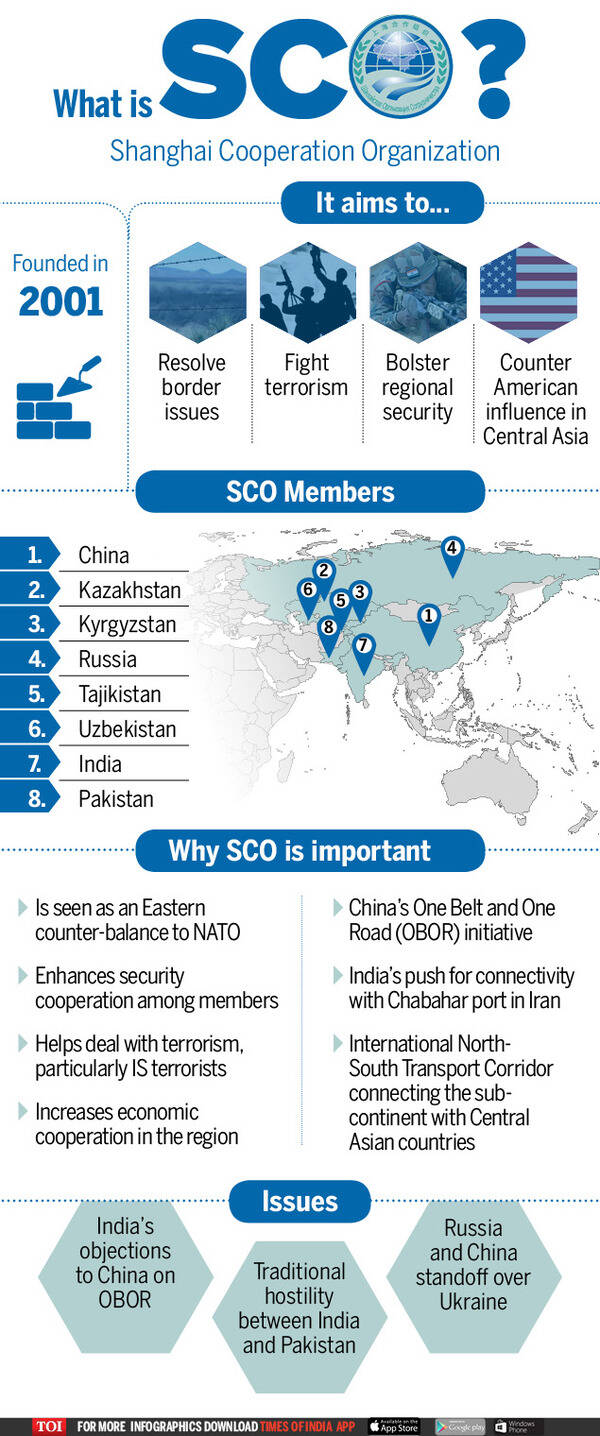
PM Modi will travel to Samarkand in Uzbekistan to attend the first in-person summit of the SCO (Shanghai Cooperation Organisation) countries since the COVID-19 pandemic.
What is SCO?
After the collapse of the Soviet Union in 1991, the then security and economic architecture in the Eurasian region dissolved and new structures had to come up.
The original Shanghai Five were China, Kazakhstan, Kyrgyzstan, Russia and Tajikistan.
The SCO was formed in 2001, with Uzbekistan included. It expanded in 2017 to include India and Pakistan.
Since its formation, the SCO has focused on regional non-traditional security, with counter-terrorism as a priority.
The fight against the “three evils” of terrorism, separatism and extremism has become its mantra. Today, areas of cooperation include themes such as economics and culture.
India’s entry to the SCO
India and Pakistan both were observer countries.
While Central Asian countries and China were not in favor of expansion initially, the main supporter — of India’s entry in particular — was Russia.
A widely held view is that Russia’s growing unease about an increasingly powerful China prompted it to push for its expansion.
From 2009 onwards, Russia officially supported India’s ambition to join the SCO in 2017.
China then asked for its all-weather friend Pakistan’s entry.
Changing the narrative of SCO
There has been discussion in the international arena that the trend of non-alignment is back.
NATO is based on Cold War thinking.
The logic of NATO is creating new enemies to sustain its own existence.
However, SCO is a cooperative organisation based on non-alignment and not targeting a third party.
India and SCO: Present status
India will host the SCO summit next year, and Varanasi has been selected as the SCO region’s first “Tourism and Cultural Capital”.
A new study shows that a decline in continental plate movement likely controlled the onset and duration of many of the major volcanic events throughout Earth’s history.
Why is the news?
Previous studies have linked major volcanic eruptions with past mass extinctions and disturbances in the global climatic, environmental and the carbon cycle.
Large igneous province volcanism, formations due to major volcanic eruptions occurring throughout Earth’s history, released large quantities of greenhouse gasses and toxic compounds into the atmosphere.
The sea warmed up by 4°C to 10°C, even at low- to mid-latitudes, the study noted.
Increased acidic levels and a lack of oxygen drove major ocean extinctions.
Large-scale volcanism took place in southern Africa, Antarctica and Australia. This is known as the Karoo-Ferrar Large Igneous Province.
About Karoo-Ferrar Large Igneous Province
The Karoo and Ferrar Large Igneous Provinces (LIPs) are two large igneous provinces in Southern Africa and Antarctica respectively, collectively known as the Karoo-Ferrar, Gondwana, or Southeast African LIP associated with the initial break-up of the Gondwana supercontinent.
Its flood basalt mostly covers South Africa and Antarctica but portions extend further into southern Africa and into South America, India, Australia and New Zealand.
Karoo-Ferrar formed just prior to the breakup of Gondwana in the Lower Jurassic epoch, about 183 million years ago.
This time corresponds to the early Toarcian anoxic event and the Pliensbachian-Toarcian extinction.
Preparing for UPSC prelims is like throwing pebbles into a pitcher partially filled with water. (Remember the story of the crow in Panchatantra?) Instant gratification and even a little lack of patience will get you nowhere. But, if you keep dropping those pebbles, you’ll see the water level rising!
Before everything, knowing and accepting the things that you have been doing in the wrong manner, is the first step towards making the change for eventual success.
If a pill couldn’t cure your disease, what would you do? Would you change your medicine? Or wait for the worst suffering?
Change is the key to success in UPSC CSE
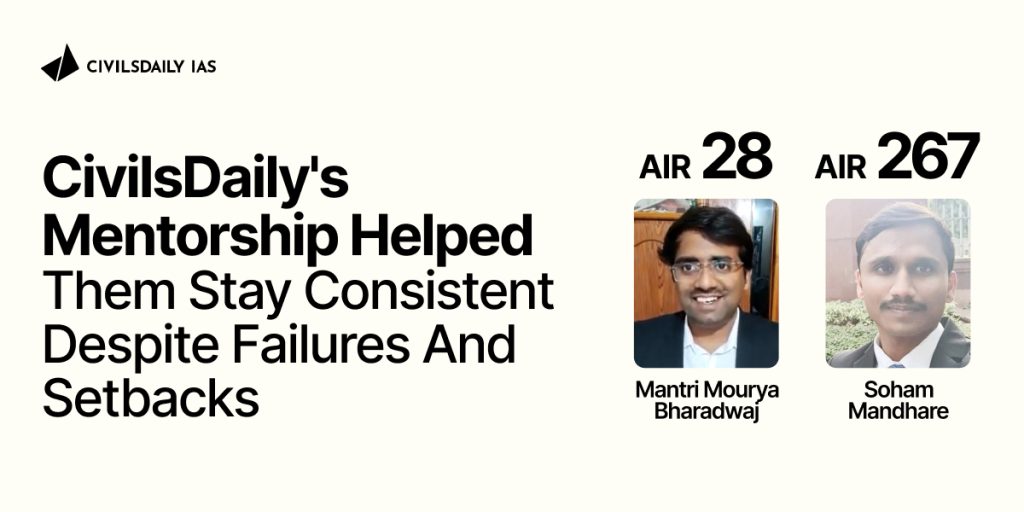
This was Mourya’s fifth attempt in which he secured an AIR 28
Even UPSC toppers have failed in the past but it was their ability to evolveand re-orient their strategy as per UPSC’s expectations that helped them succeed. Similarly, at that point, you should change your strategy. But, here you have to be extremely cautious. Because success will come only if your new strategy is better than the old one.
Ascertaining the need to ensure removing difficulties, the students face, we are conducting an on-demand Webinar by Vikash sir on How to change your UPSC Preparation strategy after a failed attempt?
The heat of fire turns gold ores into pure gold, and it is your time to shine.
About Vikash sir
Vikash Kumar sir is a senior IAS mentor at CivilsDaily. He has attempted 6 UPSC Mains and appeared in 3 UPSC interviews. He has cleared CAPF and UPPSC 2020 final exam. He has a rich experience in UPSC preparation and has been mentoring students for 4 years now. 50 of his students are writing UPSC Mains 2022.
From one of Vikash sir’s students
What The Hindu mentioned about Civilsdaily Mentorship
The Vice President has released the Arabic Version of “Majma Ul-Bahrain” of Mughal Prince Dara Shikoh.
The course of the history of the Indian subcontinent, had Dara Shikoh prevailed over Aurangzeb, has been a matter of some conjecture among historians. Critically analyse.
Who was Dara Shikoh?
Dara Shikoh, who was Mughal emperor Shah Jahan’s son and expected heir, was killed on the orders of his brother Aurangzeb in 1659 after losing the war of succession.
He was the eldest son and heir-apparent of the Mughal emperor Shah Jahan.
Dara was designated with the title Padshahzada-i-Buzurg Martaba (Prince of High Rank) and was favored as a successor by his father and his older sister, Princess Jahanara Begum.
In the war of succession which ensued after Shah Jahan’s illness in 1657, Dara was defeated by his younger brother Prince Muhiuddin (Aurangzeb).
He was executed in 1659 on Aurangzeb’s orders in a bitter struggle for the imperial throne.
His legacy
Dara was a liberal-minded unorthodox Muslim as opposed to the orthodox Aurangzeb.
He authored the work Majma Ul-Bahrain (The Confluence of the Two Seas), which argues for the harmony of Sufi philosophy in Islam and Vedanta philosophy in Hinduism.
It was Dara Shikoh who was responsible for making the Upanishads available to the West as he had them translated.
He had commissioned a translation of Yoga Vasistha.
A great patron of the arts, he was also more inclined towards philosophy and mysticism rather than military pursuits.
He translated the Upanishads and other important works from Sanskrit to Persian. He was convinced that the Upanishads are what the Qur’an calls ‘Al-Kitab Al-Maknoun’ (The Hidden book).
Try this PYQ:
Q.Who among the following Mughal Emperors shifted emphasis from illustrated manuscripts to album and individual portrait?




 Context
  What is the main importance of tourism?
 Context
 What has been done so far?
 What did CDR do in Kashmir?
 Context
  How to address this issue?
 Conclusion



![[Joining link inside] How to change your UPSC preparation strategy after failed attempts? Risk zone vs Safe side for UPSC CSE 2023-24 | FREE Webinar by PSC officer, Vikash sir, Senior IAS Mentor.](https://d18x2uyjeekruj.cloudfront.net/wp-content/uploads/2022/09/vikash.jpg)