💥Mains Ready By December. Smash Mains & Smash PYQ Admissions Open

Archives: News

  • How NASA will fly astronauts to the Moon and back for Artemis II

    Why in the News?

    NASA is set to launch Artemis II, the first crewed lunar mission since the Apollo era (1972), carrying four astronauts on a flyby trajectory around the Moon. It represents the first human return to deep space in over 50 years and the first time the Space Launch System (SLS) and Orion spacecraft will carry astronauts together.

    Why is Artemis II considered a historic milestone in space exploration?

    1. First Crewed Lunar Mission Since Apollo: Re-establishes human presence beyond low Earth orbit after 1972, marking a generational shift in exploration capability.
    2. Deep Space Human Travel: Ensures astronauts travel ~6,500 km beyond the Moon, the farthest distance humans have ever reached.
    3. Technological Transition: Validates next-generation systems replacing Saturn V and Apollo modules.
    4. Geopolitical Significance: Reinforces leadership in space amid rising competition (e.g., China’s lunar ambitions).
    5. Programmatic Continuity: Bridges Artemis I (uncrewed) and Artemis III (lunar landing).

    How does Artemis II’s trajectory and mission profile differ from earlier missions?

    1. Lunar Flyby Trajectory: Ensures a non-landing mission with orbital path around the Moon and return to Earth.
    2. Duration Optimization: Facilitates a ~10-day mission, shorter than robotic missions but efficient for human travel.
    3. Distance Benchmark: Extends human reach beyond Apollo missions, which remained closer (~400 km lunar orbit).
    4. Earth Orbit Phasing: Includes two Earth orbits before translunar injection, unlike direct Apollo launches.
    5. Splashdown Recovery: Maintains ocean landing protocol for safe retrieval.

    What technological advancements distinguish Artemis II from Apollo missions?

    1. Space Launch System (SLS): Ensures higher thrust capacity, surpassing Saturn V in operational configuration.
    2. Orion Spacecraft: Facilitates advanced life-support, navigation, and radiation shielding systems.
    3. Extended Duration Capability: Supports ~25-day endurance, compared to shorter Apollo missions.
    4. Modern Avionics: Integrates autonomous navigation and improved communication systems.
    5. Reusability Elements: Promotes partial reusability, unlike fully expendable Apollo systems.

    What challenges and risks are associated with Artemis II?

    1. Weather Sensitivity: Launch delays due to unfavorable conditions (reported 80% favorable window).
    2. Technological Validation Risks: First crewed use of SLS-Orion combination increases uncertainty.
    3. Deep Space Radiation Exposure: Extends astronaut exposure beyond Earth’s magnetosphere.
    4. Cost Constraints: High financial burden compared to earlier programs.
    5. Mission Complexity: Multi-stage trajectory and long-duration spaceflight increase operational risk.

    How does Artemis II contribute to future lunar and interplanetary missions?

    1. System Validation: Ensures reliability of life-support, propulsion, and navigation systems.
    2. Gateway Preparation: Supports future Lunar Gateway space station development.
    3. Lunar Landing Readiness: Facilitates Artemis III mission planning and execution.
    4. Mars Mission Foundation: Provides experience for long-duration deep space travel.
    5. Commercial Integration: Encourages private sector participation in space logistics.

    Conclusion

    Artemis II represents a transitional mission that bridges past achievements with future ambitions. It validates technologies, extends human reach into deep space, and lays the foundation for sustained lunar exploration and eventual Mars missions.

    PYQ Relevance

    [UPSC 2023] What is the main task of India’s third moon mission which could not be achieved in its earlier mission? List the countries that have achieved this task. Introduce the subsystems in the spacecraft launched and explain the role of the Virtual Launch Control Centre at the Vikram Sarabhai Space Centre which contributed to the successful launch from Srihari Kota.

    Linkage: The PYQ tests understanding of lunar mission objectives, spacecraft subsystems, and launch technologies, core to GS-III (Science & Tech) with emphasis on applied space capabilities. Artemis II similarly focuses on system validation (SLS-Orion) before lunar landing, paralleling Chandrayaan-3’s shift from failure to successful soft-landing capability.
  • Earth’s orbits are filling up because governance hasn’t kept pace

    Why in the News?

    Earth’s orbital space is transitioning from an open, sparsely used domain to a congested and commercially exploited environment. The issue has gained prominence due to the unprecedented surge in satellite launches, particularly large constellations like Starlink, enabled by reusable rocket technology. This marks a sharp shift from earlier state-controlled, low-density space activity to high-frequency, private-led deployments. The alarming rise in orbital debris, coupled with the absence of verifiable compliance mechanisms and enforceable global regulations, has exposed a major governance failure.

    Why is Earth’s orbital environment becoming increasingly congested and fragile?

    1. Commercial Expansion: Rapid increase in private satellite constellations has multiplied objects in orbit; Example: SpaceX’s Starlink deployment at scale.
    2. Reduced Launch Costs: Reusable rockets have lowered costs significantly, enabling frequent launches.
    3. Fragmentation Events: Collisions generate thousands of debris fragments, amplifying risks exponentially.
    4. Cumulative Congestion: Orbital space is finite; increasing density raises collision probability over time.
    5. Tracking Limitations: Small debris (even coin-sized) cannot be consistently tracked but can destroy satellites.

    What governance gaps are responsible for the current crisis?

    1. Lack of Verification Mechanisms: No regular system to verify whether operators safely dispose of satellites post-mission.
    2. Pre-launch Reliance: Regulators depend on company declarations rather than post-launch compliance checks.
    3. Fragment Identification Limits: Authorities cannot reliably identify debris origin until damage occurs.
    4. Weak Monitoring Infrastructure: Absence of global, transparent tracking systems accessible to all countries.
    5. Non-binding Norms: Existing guidelines rely on voluntary compliance without enforcement or penalties.
      1. UN Space Debris Mitigation Guidelines (2007): Adopted by the UN Committee on the Peaceful Uses of Outer Space (UNCOPUOS); provides best practices for limiting debris but has no legal enforcement.
      2. IADC (Inter-Agency Space Debris Coordination Committee) Guidelines: Technical recommendations followed by major space agencies; purely voluntary and not legally binding.
      3. Long-Term Sustainability (LTS) Guidelines (2019): Developed under UNCOPUOS to promote safe and sustainable space operations; depends on self-reporting and voluntary adoption.
      4. National-level licensing norms (e.g., US FCC, others): Often incorporate mitigation principles but lack uniform global enforcement, leading to regulatory gaps. 

    Why are existing international space laws inadequate for present challenges?

    1. Outdated Frameworks: Treaties were designed for a state-dominated, low-activity era.
    2. Outer Space Treaty Limitations: Assigns responsibility to states but lacks provisions to regulate private actors effectively.
      1. State-Centric Liability: Holds states responsible, not private companies directly.
      2. No Uniform Regulation: Leaves licensing and supervision to national laws.
      3. No Enforcement Mechanism: Lacks monitoring, verification, or penalties.
      4. Reactive Liability: Applies only after damage, not for prevention.
      5. Regulatory Fragmentation: Different national laws enable forum shopping.
      6. Outdated Framework: Does not account for large private constellations.
      7. Weak Dispute Resolution: Relies on slow state-to-state processes. 
    3. Absence of Liability Enforcement: No preventive liability mechanisms; action occurs only after damage.
    4. Innovation-Regulation Gap: Rapid private innovation has outpaced slow-moving international law.
    5. No Congestion Thresholds: Lack of defined limits for “acceptable” orbital crowding.

    How does orbital debris pose systemic risks to space infrastructure?

    1. High-Velocity Threat: Even small debris travels at orbital speeds, capable of disabling satellites.
    2. Cascade Effect (Kessler Syndrome): Collisions generate more debris, triggering chain reactions.
    3. Operational Disruptions: Satellites used for communication, GPS, and weather forecasting face increasing risks.
    4. Economic Losses: Damage to satellites leads to high replacement costs and service disruptions.
    5. Strategic Vulnerability: Space assets critical for defense and surveillance become exposed.

    What ethical and intergenerational concerns arise in orbital governance?

    1. Common Resource Ethics: Space is a global commons requiring shared responsibility.
    2. Intergenerational Equity: Current actions risk limiting future access to orbital resources.
    3. Precautionary Principle: Uncertainty should not justify inaction in preventing long-term damage.
    4. Unequal Burden Sharing: Responsible operators bear higher costs compared to non-compliant actors.
    5. Global Inequality: Developing countries face barriers in accessing already congested orbits.

    What role can India play in shaping responsible orbital governance?

    1. Policy Leadership: Opportunity to shape global norms through national legislation.
    2. Balanced Approach: Combines cost-effective space missions with sustainability concerns.
    3. Regulatory Framework Development: Licensing conditions can enforce debris mitigation.
    4. Global Norm Advocacy: India can push for enforceable international agreements.
    5. Technological Innovation: Investment in debris tracking and removal technologies. 

    Conclusion

    Orbital congestion represents a governance failure in managing a global commons. Transition from voluntary norms to enforceable regulations is essential. Sustainable space use requires integrating technological capability with ethical responsibility and international cooperation.

    PYQ Relevance

    [UPSC 2019] What is India’s plan to have its own space station and how will it benefit our space programme?

    Linkage: The PYQ tests understanding of India’s evolving space ambitions and long-term capabilities. The expansion of space infrastructure increases orbital activity, reinforcing concerns of congestion, debris, and the need for stronger global space governance.

  • Exercise Dweep Shakti: India Conducts Tri Service Military Drill

    Why in the News?

    The Indian Armed Forces concluded Exercise Dweep Shakti, a high intensity tri service exercise conducted in the Andaman and Nicobar Islands to strengthen India’s island defence and maritime security.

    What is Exercise Dweep Shakti

    • Type: Tri Service Military Exercise
    • Forces involved:
      • Indian Army
      • Indian Navy
      • Indian Air Force
    • Focus: Island defence and amphibious warfare
    • Conducted under: Andaman and Nicobar Command (ANC)

    About Andaman and Nicobar Command

    • India’s only Tri Service Theatre Command
    • Established in 2001
    • Headquarters: Port Blair
    • Strategic location near:
      • Malacca Strait
      • Indo Pacific sea routes
    [2024] Which of the following statements about ‘Exercise Mitra Shakti-2023’ are correct? 1 This was a joint military exercise between India and Bangladesh. 2 It commenced in Aundh (Pune). Joint response during counter-terrorism operations was a goal of this operation. 3 Indian Air Force was a part of this exercise. Select the correct answer using the code given below: (a) 1, 2 and 3 (b) 1 and 4 (c) 1 and 4 (d) 2, 3 and 4
  • Indian Navy Conducts IMEX TTX 2026 at Kochi

    Why in the News?

    The Indian Navy conducted IMEX TTX 2026 at the Maritime Warfare Centre, Kochi, involving multiple Indian Ocean region countries to address maritime security challenges.

    What is IMEX TTX 2026

    • IMEX: Indian Ocean Naval Symposium Maritime Exercise
    • TTX: Table-Top Exercise
    • Type: Simulated maritime security exercise
    • Location: Maritime Warfare Centre, Kochi
    • Conducted by: Indian Navy
    • This exercise focused on planning and decision-making in maritime security scenarios.

    Participating Countries

    • Countries that participated: Bangladesh, France, Indonesia, Kenya, Maldives, Mauritius, Myanmar, Seychelles, Singapore, Sri Lanka, Tanzania, and Timor-Leste
    • This highlights multinational cooperation in Indian Ocean Region (IOR).

    Why This Exercise is Important

    India Chairs Indian Ocean Naval Symposium (IONS)

    • India assumed IONS Chairmanship (2026–2028)
    • After 16 years
    • IMEX TTX 2026 strengthens India’s leadership role

    About Indian Ocean Naval Symposium (IONS)

    • Multilateral naval cooperation forum
    • Launched in 2008
    • Initiative of Indian Navy
    • Aim: Maritime security cooperation
    [2017] Consider the following in respect of Indian Ocean Naval Symposium (IONS): 1 Inaugural IONS was held in India in 2015 under the chairmanship of the Indian Navy. 2 IONS is a voluntary initiative that seeks to increase maritime co-operation among navies of the littoral states of the Indian Ocean Region. Which of the above statements is/are correct? (a) 1 only (b) 2 only (c) Both 1 and 2 (d) Neither 1 nor 2
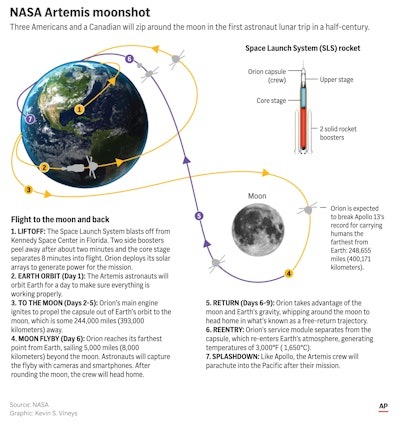
  • NASA Artemis II: How Astronauts Will Fly to the Moon and Back

    Why in the News?

    NASA’s Artemis II mission is scheduled for launch, marking the first human mission to the Moon’s vicinity since 1972 Apollo missions.

    Artemis II Mission Overview

    • Mission: Artemis II
    • Agency: NASA
    • Type: Crewed lunar flyby
    • Duration: ~10 days
    • Astronauts: 4 astronauts
    • Launch Site: Kennedy Space Center, Florida
    • Landing: Splashdown in ocean

    Mission Path (Step by Step)

    1. Launch from Earth

    • Rocket: Space Launch System (SLS)
    • Spacecraft: Orion Crew Capsule
    • Launch from Kennedy Space Center

    2. Earth Orbit

    • Orion will make two orbits around Earth
    • Systems check and trajectory adjustment

    3. Journey to Moon

    • Travel time: 3 to 4 days
    • Similar to Apollo missions
    • Why fast?
    • SLS rocket is extremely powerful
    • Shorter route requires more fuel but less time

    4. Lunar Flyby

    • Orion will circle the Moon
    • Distance from far side of Moon: ~6,500 km
    • Farthest humans have ever travelled in space

    5. Return Journey

    • Orion returns to Earth
    • Travel time: 3 to 4 days

    6. Re-entry and Splashdown

    • Spacecraft re-enters Earth’s atmosphere
    • Ocean splashdown landing

    Why Some Missions Take Longer (Like Chandrayaan 3)

    • Fuel-efficient route used by many missions
    • Takes weeks to months
    • Lower fuel requirement
    • Artemis II uses: Shorter but fuel-intensive route and Faster travel
    [2016] Consider the following statements: 1 The Mangalyaan launched by ISRO is also called the Mars Orbiter Mission 2 made India the second country to have a spacecraft orbit the Mars after USA 3 made India the only country to be successful in making its spacecraft orbit the Mars in its very first attempt Which of the statements given above is/are correct? (a) 1 only (b) 2 and 3 only (c) 1 and 3 only (d) 1, 2 and 3
  • RBI Extends Export Realisation Timeline Amid Global Disruptions

    Why in the News?

    The Reserve Bank of India (RBI) has extended export realisation timelines and credit facilities due to geopolitical tensions in West Asia and global supply chain disruptions affecting Indian exporters.

    What is Export Realisation?

    Export realisation refers to:

    • Receiving payment for exported goods/services
    • Exporters must bring foreign currency earnings back to India within RBI timeline

    Export Realisation Timeline Extended

    • Earlier timeline: 9 months
    • Extended to: 15 months
    • Applies to:
      • Goods exports
      • Software exports
      • Services exports
    • This relaxation continues due to ongoing global disruptions.

    Export Credit Period Extended

    • Export credit period: 450 days
    • Earlier validity: Up to March 31, 2026
    • Now extended to: June 30, 2026
    • Applies to: Pre-shipment credit and Post-shipment credit
    [2019] Which one of the following is not the most likely measure the Government/ RBI takes to stop the slide of Indian rupee? (a) Curbing imports of non-essential goods and promoting exports. (b) Encouraging Indian borrowers to issue rupee denominated Masala Bonds. (c) Easing conditions relating to external commercial borrowing. (d) Following an expansionary monetary policy.
  • India Faces Challenge in Meeting 2030 Maternal Mortality Target

    Why in the News?

    A recent study published in The Lancet Obstetrics, Gynaecology and Women’s Health highlights that India may struggle to meet the SDG target of reducing Maternal Mortality Ratio (MMR) below 70 per 1 lakh live births by 2030.

    Key Findings of the Study

    India’s Progress in Maternal Mortality

    • 1990: 1.19 lakh maternal deaths
    • 2015: 36,900 deaths
    • 2023: 24,700 deaths

    Maternal Mortality Ratio (MMR):

    • 1990: 508 deaths per lakh live births
    • 2023: 116 deaths per lakh live births

    India has made significant progress, but rate of improvement has slowed.

    Global Scenario

    • Global maternal deaths (2023): 2.4 lakh
    • India accounts for ~10% of global maternal deaths
    • Out of 204 countries:
      • 100 countries achieved SDG target (<70 MMR)
      • 104 countries yet to achieve
    • Countries struggling like India: Democratic Republic of Congo, Ethiopia, Nigeria, and Pakistan

    India’s Position

    • India falls in MMR range: 100–140
      (SDG target: Below 70)
    • However, India remains among countries with largest improvement since 1990, along with: Bangladesh, Ethiopia, Morocco, Nepal, and Rwanda

    State-wise Disparity 

    States pulling India’s MMR down: Assam and Uttar Pradesh

    SRS Data:

    • India: 122 (2015-17) → 88 (2021-23)
    • Assam: 215 → 110
    • Uttar Pradesh: 197 → 141
    • Southern states are closer to achieving SDG target.
    [2023] Consider the following statements in relation to Janani Suraksha Yojna: 1 It is a safe motherhood intervention of the State Health Departments. 2 Its objective is to reduce maternal and neonatal mortality among poor pregnant women. 3 It aims to promote institutional delivery among poor pregnant women. 4 Its objective includes providing public health facilities to sick infants up to one year of age. How many of the statements given above are correct? (a) Only one (b) Only two (c) Only three (d) All four
  • Japan Deploys First Long-Range Missile  

    Why in the News?

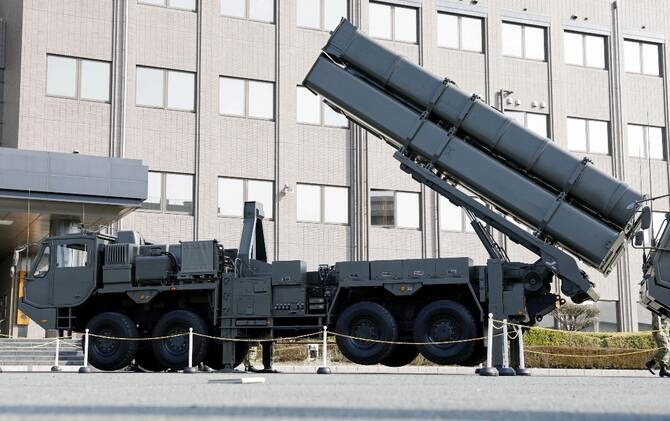
    Japan has deployed its first long-range upgraded Type-12 missile at Camp Kengun, Kumamoto Prefecture to strengthen its counter-strike capability amid rising regional tensions, particularly involving China and North Korea.

    Type-12 Missile

    • Developed by Mitsubishi Heavy Industries
    • Type: Land-to-Ship / Land-Attack Missile
    • Range:
      • Earlier: 200 km
      • Upgraded: ~1,000 km
    • Platform: Truck-mounted mobile launcher
    • Capability:
      • Can strike enemy bases
      • Enhances counter-strike capability

    Why Japan is Expanding Military Capability

    Japan cites:

    • Rising China military activity
    • North Korea missile tests
    • Tensions over Taiwan Strait
    • Regional security uncertainty
    [2023] Consider the following statements: 
    1 Ballistic missiles are jet-propelled at subsonic speeds throughout their flights, while cruise missiles are rocket-powered only in the initial phase of flight. 
    2 Agni-V is a medium-range supersonic cruise missile, while BrahMos is a solid-fuelled intercontinental ballistic missile. 
    Which of the statements given above is/are correct? 
    (a) 1 only (b) 2 only (c) Both 1 and 2 (d) Neither 1 nor 2
  • [31st March 2026] The Hindu OpED: The continued pursuit of the perfect election

    PYQ Relevance[UPSC 2024] Examine the need for electoral reforms as suggested by various committees with particular reference to ‘one nation-one election’ principle.Linkage: The PYQ directly links to issues of electoral integrity, inducements, MCC violations, and ECI capacity discussed in the article. The article’s focus on phase reduction, money power, and institutional reforms reflects the broader debate on electoral reforms and systemic efficiency.

    Mentor’s Comment

    India’s upcoming Assembly elections across five regions are being conducted in just two phases, sharply reduced from eight phases in 2021, indicating improved logistical capacity and confidence in election management. This is significant as elections involving 2.19 lakh polling stations, 17.4 crore voters, and over 25 lakh officials represent one of the largest democratic exercises globally. At the same time, persistent challenges, such as ₹10,000 crore worth of inducements seized in 2024 elections, rising misinformation, deepfakes, and electoral violence risks, highlight a stark contrast between administrative efficiency and ethical erosion in democratic processes.

    How has electoral management in India evolved in scale and efficiency?

    1. Scale of Elections: Ensures participation of 17.4 crore voters across 2.19 lakh polling stations, making it one of the largest democratic exercises globally.
    2. Administrative Deployment: Facilitates involvement of 25 lakh election officials, 8.5 lakh security personnel, and 49,000 micro-observers, ensuring logistical coverage.
    3. Geographical Reach: Ensures polling access in remote areas (e.g., officials trekking hours in Tamil Nadu and Kerala; 60 km journeys in Assam crossing rivers).
    4. Phase Reduction: Strengthens efficiency through reduction from 8 phases (2021) to 2 phases, indicating improved security coordination.
    5. Technological Integration: Supports credibility via EVM robustness and live webcasting of polling stations.

    What are the major challenges posed by the ‘4 Ms’ in elections?

    1. Money Power: Distorts electoral fairness through inducements; ₹10,000 crore seized in 2024 elections, nearly 3× of 2019 levels.
    2. Muscle Power: Undermines peaceful voting, especially in politically volatile regions like West Bengal with a history of violence.
    3. Misinformation: Weakens informed choice through fake narratives, especially via social media platforms.
    4. Model Code Violations: Challenges regulatory enforcement through appeals to caste, religion, and identity politics.

    Why do electoral inducements remain a persistent structural issue?

    1. Cash Transfers: Influences voters through direct monetary incentives before polls.
    2. Freebies and Fiscal Populism: Weakens fiscal discipline as manifestos ignore economic sustainability.
    3. Judicial Limitations: Restricts effective control despite Supreme Court observations on “freebie culture.”
    4. Enforcement Measures: Strengthens monitoring through flying squads, static surveillance teams, and digital transaction tracking.
    5. Seizure Data: Indicates scale with ₹400+ crore seized in the first month of recent elections.

    How is digital media reshaping electoral regulation challenges?

    1. Deepfakes: Complicates verification of political messaging in real-time.
    2. Social Media Ethics: Limits effectiveness of voluntary codes in curbing misinformation.
    3. Advertisement Restrictions: Ensures control by banning political ads in print media near polling day unless pre-certified.
    4. Content Monitoring: Strengthens oversight but struggles against rapid dissemination.
    5. Free Speech Debate: Raises concerns over balancing regulation with democratic freedoms.

    What institutional measures has the Election Commission adopted to ensure integrity?

    1. Section 28A Enforcement: Ensures neutrality by binding officials solely to ECI authority.
    2. Observer Deployment: Strengthens oversight through 1,100 central observers.
    3. Security Reforms: Facilitates fair polling via strategic deployment of forces in sensitive areas.
    4. Electoral Roll Revision (SIR): Enhances accuracy by removing duplicates and updating voter lists.
    5. SVEEP Programme: Promotes voter awareness and participation through systematic outreach

    What is the role of voters in safeguarding electoral democracy?

    1. Informed Voting: Ensures resistance to inducements and misinformation.
    2. Civic Responsibility: Strengthens democratic ethos through ethical participation.
    3. Awareness Programmes: Supports engagement via SVEEP initiatives.
    4. Inclusivity Measures: Facilitates participation of elderly (85+) and persons with disabilities through home voting.
    5. Moral Agency: Prevents erosion of democratic values through independent decision-making. 

    Conclusion

    India’s electoral system demonstrates high administrative capacity but faces deep-rooted ethical and regulatory challenges. Strengthening institutional enforcement, regulating digital misinformation, and enhancing voter awareness remain critical for sustaining electoral integrity.

  • On the implications of euthanasia

    Why in the News?

    The recent judgment in Harish Rana v. Union of India marks a significant evolution in India’s euthanasia jurisprudence by operationalising the right to die with dignity under Article 21 of the Indian Constitution. For the first time, the Supreme Court has explicitly permitted withdrawal of Clinically Assisted Nutrition and Hydration (CANH), going beyond earlier precedents like Common Cause v. Union of India and Aruna Shanbaug v. Union of India. This is a major shift from a highly restrictive regime to a more autonomy-centric approach, reducing procedural hurdles (such as multiple medical boards) and emphasizing patient dignity. However, it simultaneously raises critical concerns of misuse, coercion, and socio-economic inequality.

    What constitutional transformation does the judgment signify?

    1. Right to Dignity: Expands Article 21 to include dignified death; integrates life and death within the same constitutional continuum.
    2. Autonomy Recognition: Recognizes individual decision-making in end-of-life care; validates living wills and refusal of treatment.
    3. Judicial Evolution: Moves beyond Aruna Shanbaug (2011) and Common Cause (2018) by simplifying execution mechanisms.
    4. State Obligation: Ensures access to palliative care as part of the right to life; links dignity with healthcare delivery.

    How does the judgment simplify procedural mechanisms?

    1. Procedural Rationalisation: Reduces requirement from multiple medical boards to fewer layers; ensures faster decision-making.
    2. Administrative Feasibility: Removes district collector oversight; reduces bureaucratic delays.
    3. Advance Directives: Strengthens legal validity of living wills; facilitates implementation without excessive verification.
    4. Medical Oversight: Retains safeguards through medical opinion; ensures balance between autonomy and ethics.

    What are the ethical principles governing euthanasia decisions?

    1. Autonomy: Ensures patient’s right to choose treatment withdrawal; extends to next of kin in incapacitated cases.
    2. Beneficence: Prioritizes patient welfare; ensures decisions aim to relieve suffering.
    3. Non-Maleficence: Prevents harm; prohibits actions that actively cause death.
    4. Justice: Ensures fairness; raises concerns of unequal access to dignified death due to socio-economic disparities.
    5. Doctrine of Double Effect: Permits actions with dual outcomes (pain relief + possible death); justified if intent is relief, not death.

    What social risks and inequalities does euthanasia raise?

    1. Vulnerability Risk: Elderly, disabled, and poor may face coercion; financial pressures may influence consent.
    2. Economic Burden: High cost of prolonged treatment may push families toward withdrawal decisions.
    3. Social Neglect: Weak family support structures may lead to disguised abandonment.
    4. Cultural Conflict: Traditional belief in preserving life at all costs vs emerging autonomy-based ethics.
    5. Healthcare Inequality: Limited access to palliative care skews decision-making toward euthanasia.

    What is the economic and healthcare dimension of the debate?

    1. Resource Allocation: Prolonged life-support strains healthcare resources; raises efficiency concerns.
    2. Cost of Care: Long-term ICU treatment imposes financial stress; especially on middle and lower-income groups.
    3. Palliative Care Gap: India’s limited palliative infrastructure restricts genuine “choice.”
    4. Policy Implication: Need for integrated end-of-life care systems alongside euthanasia regulation.

    Does the judgment clarify or complicate the legal position?

    1. Terminological Shift: Discourages use of “passive euthanasia”; avoids confusion between acts and omissions.
    2. Legal Clarity: Establishes withdrawal of treatment as legally permissible; aligns with constitutional morality.
    3. Continuity of Care: Mandates ongoing palliative care even after withdrawal decisions.
    4. Interpretational Scope: Leaves grey areas regarding coercion and consent verification. 

    Conclusion

    The judgment marks a shift toward autonomy and dignity but must be complemented by strong safeguards, palliative care expansion, and ethical oversight to prevent misuse and ensure equitable application.

    PYQ Relevance

    [UPSC 2023] Is conscience a more reliable guide when compared to laws, rules and regulations in the context of ethical decision making? Discuss.

    Linkage: The PYQ tests ethical decision-making where legal frameworks may be insufficient or rigid. In euthanasia, even with legal sanction, final decisions rely on conscience, balancing dignity, suffering, and moral responsibility beyond written law.