💥UPSC 2026, 2027, 2028 UAP Mentorship (April Batch) + Access XFactor Notes & Microthemes PDF

Archives: News

  • Coronavirus – Health and Governance Issues

    After the lockdown

    Context

    Lockdown announcement has not been matched by national strategy — on containing fallout for poor.

    Two arguments advanced against lockdown

    • India’s decision to lock down was necessary. Two arguments are being advanced against it.
    • The first argument: India is a poor economy, with millions at the margins of subsistence, who cannot bear the consequences of a lockdown. The density and living conditions in India make social distancing difficult in many cases.
    • The second argument: It is that the extent of community transmission does not justify such drastic measures.

    What are the justifications for the lockdown?

    • The only hope: Precisely because millions in India are vulnerable and will not later have the possibilities of quarantining or medical care, the only hope we have of securing their lives is to slow down the spread of the virus as much as possible.
    • And the only shot you have at it is when community transmission is possibly still at manageable levels.
    • There is, therefore, a bit of bad faith in using the poor as the basis for expressing scepticism at the need for a lockdown. That is the most insidious form of privilege.
    • The risks of any catastrophic spread will be even more incalculable for the poor.

    Underscoring the importance of federalism and decentralisation

    • States responding in innovative ways: One of the more encouraging things has been the way in which several state governments like Punjab, Odisha, Kerala, Delhi and others have come into their own, innovating under difficult circumstances.
    • Role of panchayat and local officials: The much-neglected panchayat and local officials are key nodes in keeping track of possible cases and the creation of quarantining infrastructure.
    • Role of frontline workers: It would also be churlish not to acknowledge the ways in which most of the frontline workers of the state are responding, learning and innovating in this situation.
    • Federalism and decentralisation: If anything, this crisis is bringing home the importance of both federalism and decentralisation as central to a resilient governance architecture.

    The preparation and follow-up of the lockdown

    • But the national preparation and follow-up to take full advantage of the lockdown do not inspire full confidence.
    • Lack of strategy: The announcement of the lockdown has not been matched by a commensurate national strategy.
    • This is manifest, in the early signals on the following two important aspects:
    • Containing the economic fallout for the poor.
    • Building up the health infrastructure.
    • It is, admittedly, early days; but the signs are not good.

    Economic fallout for the poor

    • Focus is not on the poor: In the entire framing of the problem, the poor have been at best an afterthought, at worst expendable damage.
    • Steps taken not adequate: Steps like health insurance cover for frontline workers, increased food rations, are welcome steps. But a crisis of this magnitude required assurance to the most vulnerable that no stops will be pulled to secure their futures.
    • Instead, what you got was incrementalism of the worst kind, masquerading as a big commitment.
    • Low cash transfer: The cash transfers, in particular, through different schemes, are shockingly low.
    • Need for the unprecedented social security support: This crisis is one of the rare instances where economists and even bankers, from across the political spectrum, have rallied around the intellectual argument for unprecedented levels of social security support.
    • So the government’s “support by stealth” strategy is even more mystifying.
    • Impact of lockdown on migrant labour: The magnitude of the crisis unleashed for migrant labour could have been avoided with a little forethought.
    • What could have been done? Early announcement of cash transfers, shelter and food availability, would have obviated the need for migration.

    Opacity on the health infrastructure side

    • Issue of testing: Opacity is often a consequence of scarcity. And nowhere is this more manifest than in our discussion of testing.
    • Underutilisation of capacity: Everyone understands that India has the scarce testing capacity, though it seems it is also under-utilising what it has.
    • No clear testing strategy: The government is procuring more testing kits. But what is worrying is that there seems to be no publicly articulated statement of what exactly our testing strategy is, given the scarce resources.
    • But there is still no sense of how we plan to put a testing strategy in place (not just numbers of tests, but where can they be optimally deployed), that will minimise the need for future lockdowns.
    • What objectives is it trying to meet? There is more than a whiff of suspicion that there is a view that more testing might spread more panic.
    • Or it might put more pressure on the health care system than it can handle.
    • India has never understood that health expenditure is not an expenditure; it is an investment.
    • Building up of health infrastructure: The success of the lockdown strategy is premised on an unprecedentedly vigorous building up of health infrastructure to fight the pandemic.
    • There is a commitment by the Centre to infuse an extra Rs 15,000 crore in this sector. Some steps are being taken in building up capabilities, including ramping up production of ventilators and masks.
    • Need for warlike mobilisation: This is an area where India needs almost a warlike mobilisation, to make sure we have enough testing, tracking, frontline workers, logistics and equipment in place to make sure that the duration of a lockdown is minimised or a repeat is not necessary.
    • The creation of this kind of infrastructure will pay huge dividends even in non-pandemic times.

    Conclusion

    The prime minister is constantly asking the citizens to mobilise, and most of them respond. But it about time the state mobilises: On an economic stimulus that is truly meaningful and health infrastructure push that inspires confidence.

  • Disasters and Disaster Management – Sendai Framework, Floods, Cyclones, etc.

    Prime Minister’s National Relief Fund (PMNRF)

    Keeping in view the novel coronavirus crisis across the country, various govt. employees, celebrities and political dignitaries are open-heartedly contributing to the PM’s National Relief Fund (PMNRF) to help combat the disease.

    PM’s National Relief Fund (PMNRF)

    • In pursuance of an appeal by the then PM, Pt. Nehru in January, 1948, the Prime Minister’s National Relief Fund (PMNRF) was established with public contributions.
    • It was aimed to assist displaced persons from Pakistan.
    • The resources of the PMNRF are now utilized primarily to render immediate relief to families of those killed in natural calamities like floods, cyclones and earthquakes, etc. and to the victims of the major accidents and riots.
    • Assistance from PMNRF is also rendered, to partially defray the expenses for medical treatment like heart surgeries, kidney transplantation, cancer treatment and acid attack etc.
    • The fund consists entirely of public contributions and does not get any budgetary support.

    Legal status

    • PMNRF has not been constituted by the Parliament.
    • The fund is recognized as a Trust under the Income Tax Act and the same is managed by PM or multiple delegates for national causes.

    Donations

    • PMNRF accepts only voluntary donations by individuals and institutions.
    • Contributions flowing out of budgetary sources of Government or from the balance sheets of the public sector undertakings are not accepted.
    • Conditional contributions, where the donor specifically mentions that the amount is meant for a particular purpose, are not accepted in the Fund.

    Its operation

    • PMNRF operates from the Prime Minister’s Office and does not pay any license fee.
    • PM is the Chairman of PMNRF and is assisted by Officers/ Staff on an honorary basis. Permanent Account Number of PMNRF is AACTP4637Q.

    Tax exemptions

    • PMNRF is exempt under the Income Tax Act, 1961 under Section 10 and 139 for return purposes.
    • Contributions towards PMNRF are notified for 100% deduction from taxable income under section 80(G) of the Income Tax Act, 1961.
  • Food Procurement and Distribution – PDS & NFSA, Shanta Kumar Committee, FCI restructuring, Buffer stock, etc.

    Ahead: bumper crop, multiple challenges

    This is perhaps the first time ever that India is facing a national disaster or a war-like situation amidst plentiful supplies of food even as a bumper Rabi crop beckons.

    Bumper yield in crisis

    • Farmers are currently about to harvest —if they haven’t already.
    • Given the surplus and extended monsoon rains, which helped recharge ground water and fill up reservoirs, superabundant produce is round the corner.
    • This comes even as there is demand destruction from the shutting down of HORECA (hotels, restaurants and catering) and other institutional segment businesses following the nationwide lockdown.
    • It raises the possibility of a crisis similar to the one three years ago that followed demonetization. But the scale, it is feared, could be bigger.
    • The post-demonetization rabi crop, also a bumper one, was at least harvested and marketed even if it didn’t fetch a good price.

    The real challenge

    • The food and civil supplies departments in states will ultimately ensure that the terminal markets in these centres major cities receive their required daily flow of produce anyhow.
    • The problem will be in the remote towns and the rural hinterlands that are serviced through upcountry APMCs.
    • The grocers there are at the greatest risk of running out of stocks if the lockdown continues without inter-state movement restrictions in agricultural commodities being removed.

    How to transport produce

    • This time, there are doubts being raised even on that.
    • The simple reason for it is: Will farmers, labourers and machines (combines, threshers and tractor trolleys) be able to move freely to harvest the produce and take it to the mandis?
    • The UP government has issued a direction to all district administrations and law-enforcement authorities to exempt all services, including labour, that are involved in agricultural production, processing and marketing from the current lockdown provisions.
    • Other states, too, may follow. But the question remains of the directives being implemented on the ground.

    Will there be workers?

    • At the second stage comes the mandis, where marketing of the crop would happen.
    • Here again, there is a possibility of shortage of labour (the people who do unloading, cleaning, bagging and reloading of the grain that is auctioned or sold) and even gunny bags.
    • Further, it would be necessary to prevent crowding, and maintain social distancing.

    Possible alternatives

    • One way out could be to allow entry only to a limited number of farmers, who may be issued SMS alerts informing them about the date and time to bring their crop.
    • Each farmer can also be given a maximum quantity — say, one tractor-trolley load of 30-40 quintals — that may be brought in a single day.
    • The permission for the next trolley load will be only after other farmers have got their turn to sell.
    • All this will obviously delay the process of marketing, raising the prospect of panic sales.
    • This could be avoided if the government were to give a clear-cut assurance — at least in respect of crop where there is MSP-based procurement — that it will continue buying till the last grain is offered.

    Safer places than APMC

    • Besides, the marketing of produce needn’t be limited to the APMC (agricultural produce market committee) mandi yard.
    • Any flour or dal mill, and even primary school premises can be designated as an APMC marketing area.
    • The objective should be to ensure that the farmer’s produce gets marketed without resulting in overcrowding.

    Way forward

    • The risk of shortages today is really not in the metros or state capitals.
    • Once marketing is done, the crop has to move beyond the mandi.
    • This is probably the right time to dismantle all inter-state and intra-state movement restrictions in farm produce.
    • Free movement is necessary for the context of both a bumper crop and the ongoing lockdown.
  • Zoonotic Diseases: Medical Sciences Involved & Preventive Measures

    Schedule H1 drugs

    Hydroxychloroquine is now a schedule H1 drug and can be sold on prescription only.

    What are Schedule H1 drugs?

    • The sale of the Hydroxychloroquine drug from now on should be in accordance with the conditions for sale of drugs specified in Schedule H1 to the Drugs and Cosmetics Rules, 1945.
    • In exercise of the powers conferred by Section 26B of the Drugs and Cosmetics Act, 1940 (23 of 1940), the Central Government can direct that sale by retail of any drug.

    Why such move?

    • The Central Government is satisfied that the drug ‘Hydroxychloroquine’ is essential to meet the requirements of emergency arising due to pandemic COVID-19.
    • And in the public interest, it is necessary to regulate and restrict the sale and distribution of the drug ‘Hydroxychloroquine’ and preparation based thereon for preventing their misuse.

    Hydroxychloroquine

    • Hydroxychloroquine is used to prevent or treat malaria infections caused by mosquito bites.
    • It does not work against certain types of malaria (chloroquine-resistant).

    Pls take a note-

    • Hydroxychloroquine and a related drug, chloroquine, are currently under study as possible treatments for COVID-19.
    • These drugs have not yet been approved for this use.
    • Do not use these medications to treat COVID-19 unless your doctor recommends that you do so.
  • Zoonotic Diseases: Medical Sciences Involved & Preventive Measures

    Indian Scientists’ Response to CoViD-19 (ISRC) Group

    Several Indian scientists have come together to form a Google group to address some of the concerns that the COVID-19 outbreak has thrown up.

    Indian Scientists’ Response to CoViD-19 (ISRC)

    • It is a voluntary group of scientists who regularly discuss the rapidly evolving situation with its dire need for science communication.
    • With nearly 200 members, the group has scientists from institutions such as the NCBS, the IISc, the TIFR, the IITs, the IISERs and many others.
    • The group aims to study existing and available data to bring out analyses that will support the Central, State and local governments in carrying out their tasks.

    Self-assigned tasks

    • Several working groups have been formed by scientists.
    • They include one on hoax busting to address disinformation spreading with respect to the coronavirus and one on science popularization to develop material that explains concepts such as home quarantine.
    • Other groups work on resources in Indian languages, mathematical models and apps.

    Why such a group?

    • The scientific community has realized their social and democratic responsibility in the current situation, both in terms of analysing the situation and reaching out to the public.
  • Foreign Policy Watch: India-Afghanistan

    Terrorist attack in Kabul’s Gurudwara

    Context

    Attack on gurdwara underlines that the US-Taliban deal has brought Afghanistan no respite.

    The futility of US-Taliban deal highlighted

    • The attack on a gurdwara in Kabul, in which 25 people were killed, has shown that the coronavirus may well be vanquished by science, but human beings will continue to inflict barbarity upon each other.
    • Within hours, it was claimed by the Islamic State, which later also said it had carried it out in revenge for Kashmir.
    • The deal not leading to peace: If there were still doubts left on this score, it must be clear after this attack that the US-Taliban deal was not an arrangement to return Afghanistan to peace.

    Why the attack matters for India?

    • The gurdwara attack was the first strike after the agreement claimed by the IS.
    • A provision in pact: Under the pact, the Taliban have committed themselves to eliminate the Islamic State from Afghanistan.
    • Yet to start honouring commitment: If the IS claim is true, the Taliban have yet to begin honouring that commitment.
    • India’s reaction: Appearing to hint at something more sinister, the ministry of external affairs called the attack “diabolical” and condemned the “perpetrators and their backers”, a formulation usually reserved for attacks suspected to have emanated from or to have the backing of Pakistan.
    • Connection of attack with India: The Taliban’s operational leadership is now in the hands of Sirajuddin Haqqani of the Haqqani group, which has been blamed for several attacks on Indian targets, including the 2008 Indian Embassy bombing in Kabul.
    • The Taliban have denied having anything to do with the gurdwara attack, and Pakistan has condemned it strongly.
    • The question over IS in Afghanistan: Who, really, is the IS in Afghanistan is a question that security experts have been asking for some time now.

    COVID-19 outbreak in Afghanistan

    • Appeal for ceasefire: The UN Secretary-General made an appeal for an immediate ceasefire in theatres of conflict across the world, to enable governments, health workers and humanitarian aid agencies to access those who might be most vulnerable to COVID-19.
    • The epicentre of the outbreak is Herat, where over 1,00,000 Afghans recently crossed over from Iran.
    • After the number of confirmed cases rose to 58, the province has been placed under lockdown.
    • But the government is hobbled in its efforts to contain the disease, both by a contested election result — Afghanistan has two presidents — and the burden of an agreement that has brought it no respite.

    Conclusion

    With the recently concluded US-Taliban deal delivering no peace and coronavirus spreading unabated, Afghanistan faces two contagions, new and old — COVID-19 and the relentless violence.

  • Coronavirus – Economic Issues

    What the RBI has done to provide relief for the ongoing Coronavirus outbreak in India

    Context

    The RBI’s Governor’s ‘bazooka’ announcement earlier today has seen the usually conservative institution and its head pull out the big guns in word and action.

    Four steps taken by the RBI

    • One, increase the liquidity in the system.
    • Two, make sure the lower policy rate is transmitted. Steps one and two are linked.
    • Three, give a three-month window for a payback on all term loans.
    • Four, take steps to reduce volatility and provide stability.
    • Big cut in repo rate: He announced a big cut in the repo rate by 75 basis points (100 basis points make a per cent, so three-quarters of a percentage point) to 4.4%.
    • What is the repo rate? Repo rate is the rate at which the banks borrow from the RBI. Banks give ‘eligible securities’ they hold for cash that RBI gives as an overnight loan.
    • Banks pay the repo rate as interest for this borrowing.

    First two steps of the RBI: Increasing liquidity and ensuring policy rate transmission

    • Why lower repo rate matters? When the repo rate is high, banks find it costly to borrow and in turn raise the price of loans to their borrowers.
    • Reducing interest for the system: A low repo rate has the overall effect of reducing interest rates for the system. Lower rates make it easier for entrepreneurs to take loans for working capital and for households for homes, vehicles and so on.
    • Issue of policy rate transmission: Previous rate cuts have not been ‘transmitted’ by the banks who have not reduced lending rates and have preferred to keep money with the RBI at the ‘reverse repo rate’.
    • What is reverse repo rate? This is the rate at which banks lend to the RBI.

    How RBI is ensuring transmission now?

    • The RBI has now reduced the reverse repo rate by 90 basis points to 4%.
    • This cut in reverse rape sharper than the one on the repo rate to encourage banks to borrow from the RBI rather than lend to it.
    • How reverse repo rate matters? Banks have preferred to deposit money with the RBI rather than lend it out with an average daily amount of ₹3 trillion being kept with the RBI.
    • A reduction of the reverse repo to 4% makes it unattractive to banks to park it with the RBI and banks will be nudged to lend.
    • Why bank lending matters for business? Bank lending provides the needed oxygen to businesses for their working capital and longer-term loans.
    • Read this as a measure to help banks take the decision to lend rather than play it safe by keeping money with the RBI.

    How lock-down slows down the economy?

    • Rush to safety for money: If people are in a lock-down, the wheels of the economy begin to grind down and there is a rush to safety for money in the system.
    • Freezing of the markets market: Investors begin to redeem their shares, bonds and mutual funds. These redemptions cause a fire sale of assets. Finally, when there are no buyers, markets begin to freeze.

    What are the measures taken by RBI to stabilise the market?

    • To keep the wheels of the markets well-oiled with cash, the RBI has made ₹3.74 trillion available. This it has done using four weapons.
    • The first measure: It has used targeted long-term repo operations.
    • RBI will lend money to banks (a total of ₹1 trillion) that can be invested in bonds and other forms of lending instruments.
    • What is a hold-to-maturity way? Under the hold-to-maturity way, the portfolio is valued not on the market price but on what the price should be given the rate of interest of the bond, the holding period and the rating of the bond.
    • Basically, it allows trades to happen at a price that is not confused with the current pandemic in the market.
    • The second measure: The RBI reduced the cash reserve ratio (CRR) by a full percentage point down to 3% for a year.
    • The CRR is the percentage of demand and time deposits banks have to keep with the RBI.
    • Why CRR and not SLR was reduced? There is another 18.25% of deposits that is also not used for lending under the Statutory Liquidity Ratio (SLR), further reducing the money banks have to lend.
    • RBI has reduced the CRR to 3%, freeing up ₹1.37 trillion for banks to lend. CRR has been chosen rather than SLR because this increases ‘primary liquidity’ with the banks a bit better.
    • Not only is there CRR rate down, banks now need to maintain 80% of the limit on a daily basis instead of 90% till June 26, 2020.
    • The third measure: ₹1.37 trillion will be made available under the emergency lending window called the marginal standing facility (MSF).
    • Banks will now be able to borrow 3% of their deposits under this window, up from the current 2%. Basically, RBI is willing to lend more than before.
    • How much more? ₹1.37 trillion under this window.

    The third step of the RBI: Regulatory forbearance

    • What is the regulatory forbearance?

      What this means is that as economic activity grinds to a slowdown, people will not be able to pay back the loans they have taken for no fault of theirs.

    • This could be businesses with loans, households with EMIs on home loans and others with what are called ‘term loans’.
    • RBI will allow a moratorium of three months for loan repayment.
    • This is a relief especially for small entrepreneurs who have been forced to shut shop and for employees whose incomes have stopped since their place of work is shut.
    • It is good that the RBI has looked at the retail part of the market along with the corporate sector for once.
    • Working capital loans don’t come under the ‘term loan’ category, and these borrowers can defer paying interest for three months till June 2020.

    The fourth step of the RBI: Measures to reduce volatility in the exchange rate

    • Fourth is a measure to reduce the volatility of the price of the rupee in international markets by allowing banks to deal in off-shore non-deliverable rupee derivative markets.
    • It looks like reform using the crisis to bring about this long-awaited change.

    Conclusion

    We don’t know if measures taken by the RBI and the government are enough. But what is comforting is that the government and the RBI are working in tandem to deal with this giant killer of a virus.

  • RBI Notifications

    Regulation of Payment Aggregators (PAs)

    The Reserve Bank of India released guidelines for regulating payment aggregators (PAs) and payment gateways (PGs), nearly six months after it first proposed regulating these entities in a discussion paper.

    Payment Aggregators (PAs)

    • PAs are entities that facilitate e-commerce sites and merchants to accept various payment instruments from the customers for the completion of their payment obligations.
    • PGs are entities that provide technology infrastructure to route and facilitate the processing of an online payment transaction without any involvement in the handling of funds.
    • With the new set of guidelines PAs and PGs such as Paytm, Pay Pal, Mobikwik, Razorpay, PayU, CCAvenue etc. will be regulated by RBI to ensure the safety of all our online transactions.

    What are the new guidelines?

    The new guidelines say that-

    • A payment aggregator (entities that facilitate e-commerce sites and merchants to accept various payment instruments) should be a company incorporated in India under the Companies Act, 1956 / 2013.
    • Non-bank entities offering payment aggregator services will have to apply for authorisation on or before June 30, 2021.
    • E-commerce marketplaces providing payment aggregator services will have to be separated from the marketplace business and they will have to apply for authorisation on or before June 30, 2021.
    • Pas existing today will have to achieve a net worth of ₹15 crore by March 31, 2021 and a net worth of ₹25 crore by the end of third financial year, which means or before March 31, 2023.
    • The net-worth of ₹25 crore shall be maintained at all times thereafter.
  • Zoonotic Diseases: Medical Sciences Involved & Preventive Measures

    Serological test for COVID-19

    The ICMR invited bids for an estimated 10 lakh antibody kits (for serological tests) for the diagnosis of COVID-19.

    What are serological tests?

    • Viral infections are mainly identified by two kinds of tests– genetic and serological.
    • Genetic tests can identify infections that are active but cannot be used to detect past infections.
    • To trace how infections like the novel coronavirus have spread so far, it is important to detect people who contracted the disease in the past and have recovered.
    • This is what serological tests seek to determine.

    How are the two different?

    • The genetic test is conducted on a swab collected from the back of the throat, a liquid sample from the lower respiratory tract, or a simple saliva sample.
    • For SARS-COV-2, the virus’s RNA is first converted into DNA.
    • By a process called polymerase chain reaction (PCR), DNA fragments in the sample are copied exponentially — one is copied into two, the two are copied into four, and so on.
    • Unlike genetic tests, which look for RNA in swab samples, serological tests work on antibodies in blood samples. Hence, they are also called ‘antibody tests’.

    How serological tests work?

    • Antibodies, or protective proteins produced by the immune system to neutralize pathogens such as bacteria and viruses, are present in one’s bloodstream for a considerable period of time after the infection has gone.
    • To disable a pathogen, the antibody latches to a unique protein molecule on pathogen’s surface, called an antigen.
    • Serological tests use antigen molecules to detect the presence of antibodies relevant to the infection.
    • Generally, a blood sample is placed in a test tube that is lined with antigens on the inside. If the relevant antibodies are present, they latch on to the antigens.
    • Such tests are relatively inexpensive, and can display results within a few minutes.
  • G20 : Economic Cooperation ahead

    [pib] Virtual Summit of G20 Leaders

    A Virtual G20 Leaders’ Summit was recently convened yesterday to discuss the challenges posed by the outbreak of the COVID-19 pandemic and to forge a globally coordinated response.

    About G20

    • Formed in 1999, the G20 is an international forum of the governments and central bank governors from 20 major economies.
    • Collectively, the G20 economies account for around 85 percent of the Gross World Product (GWP), 80 percent of world trade.
    • To tackle the problems or the address issues that plague the world, the heads of governments of the G20 nations periodically participate in summits.
    • In addition to it, the group also hosts separate meetings of the finance ministers and foreign ministers.
    • The G20 has no permanent staff of its own and its chairmanship rotates annually between nations divided into regional groupings. 

    Aims and objectives

    • The Group was formed with the aim of studying, reviewing, and promoting high-level discussion of policy issues pertaining to the promotion of international financial stability.
    • The forum aims to pre-empt the balance of payments problems and turmoil on financial markets by improved coordination of monetary, fiscal, and financial policies.
    • It seeks to address issues that go beyond the responsibilities of any one organisation.

    Member Countries

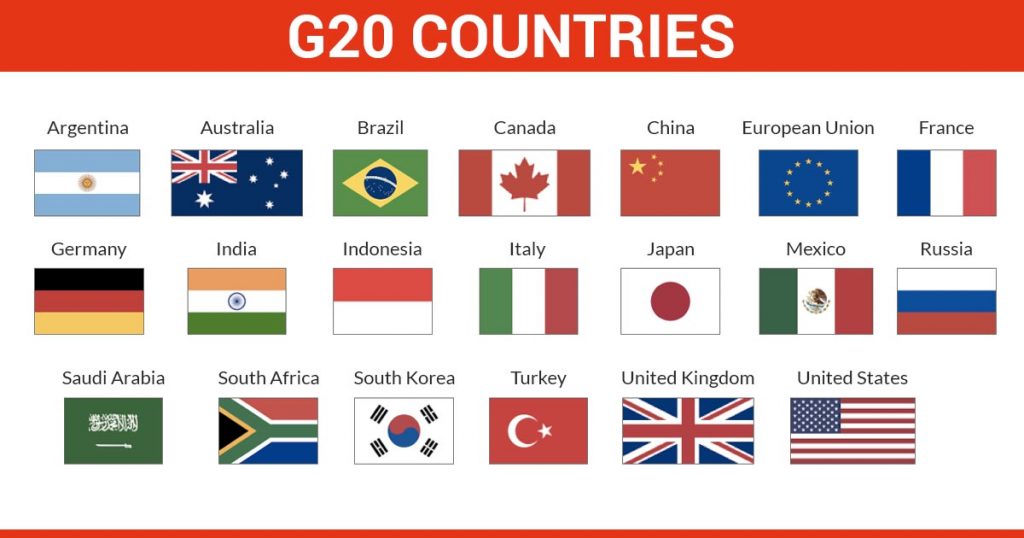
    The members of the G20 consist of 19 individual countries plus the European Union (EU).

    • The 19 member countries of the forum are Argentina, Australia, Brazil, Canada, China, France, Germany, India, Indonesia, Italy, Japan, Mexico, Russia, Saudi Arabia, South Africa, South Korea, Turkey, United Kingdom and the United States.
    • The European Union is represented by the European Commission and by the European Central Bank.

     Who are the G20 Sherpas?

    • A Sherpa is the personal representative of a head of state or government who prepares an international summit, particularly the annual G7 and G20 summits.
    • Between the summits, there are multiple Sherpa conferences where possible agreements are laid out.
    • This reduces the amount of time and resources required at the negotiations of the heads of state at the final summit.
    • The Sherpa is generally quite influential, although they do not have the authority to make a final decision about any given agreement.
    • The name is derived from the Sherpa people, a Nepalese ethnic group, who serve as guides and porters in the Himalayas, a reference to the fact that the Sherpa clears the way for a head of state at a major summit.

Join the Community

Join us across Social Media platforms.