💥UPSC 2026, 2027, 2028 UAP Mentorship (March Batch) + Access XFactor Notes & Microthemes PDF

Type: India Mapping

  • Tiger Conservation Efforts – Project Tiger, etc.

    Similipal to be 107th National Park of India

    Why in the News?

    The Odisha government has notified Similipal Tiger Reserve (STR) as a national park, covering 845.70 sq/km. It is the 107th national park and the second in eastern Odisha, following Bhitarkanika.

    Similipal to be 107th National Park of India

    About Similipal National Park:

    • Situated in the Mayurbhanj district of northern Odisha, Similipal is surrounded by high plateaus and hills.
    • It includes the Khairiburu and Meghashini peaks, rising to 1,515 meters above sea level.
    • The park has a diverse terrain with hills, open grasslands, and wooded areas, supporting various species.
    • Flora: The park is home to 1,078 plant species, including 94 species of orchids, with Sal trees dominating the forests.
    • Fauna: It boasts diverse wildlife, including leopards, gaurs, elephants, sloth bears, and pangolins. Similipal also supports migratory birds like Bar-headed geese and Brahmini ducks.
    • Several indigenous tribes inhabit the region, such as Kolha, Santhala, Bhumija, and Khadia.
    • Similipal was declared a Tiger Reserve in 1956, included under Project Tiger in 1973, and became a Biosphere Reserve in 2009.

    Melanistic Tigers of Similipal:

    • Similipal is home to the world’s only wild population of pseudo-melanistic tigers, with 13 known to inhabit the area.
    • These tigers have a distinct appearance due to higher melanin levels, causing a unique, black-striped coat.
    • The mutation in the Taqpep gene makes these tigers pseudo-melanistic.
    [UPSC 2012] Consider the following protected areas; 1. Bandipur 2. Bhitarkanika 3. Manas 4. Sundarbans

    Which of the above are declared Tiger Reserves?

    Options: (a) 1 and 2 Only (b) 1, 3 and 4 Only* (c) 2, 3 and 4 only (d) 1,2, 3 and 4


  • Wetland Conservation

    Why Naini Lake is seeing record-low water levels?

    Note4Students

    From UPSC perspective, the following things are important:

    Prelims level: Naini Lake

    Why in the News?

    Naini Lake, one of Nainital’s key attractions, has recorded a water level of 4.7 feet, marking a 5-year low, sparking concerns about drinking water scarcity as the summer season approaches.

    About Naini Lake

    • Naini Lake is situated in the heart of Nainital, a hill station in the Indian state of Uttarakhand. It is surrounded by seven hills.
    • The lake is natural kidney-shaped and is one of the main attractions of Nainital.
    • It was discovered by P. Barron, an English businessman, in the mid-19th century, which led to the development of Nainital as a hill station.
    • The deepest point of Naini Lake is 89 feet.
    • The normal gauge level of the lake is 12 feet, and its water level has recently dropped to 4.7 feet, marking a five-year low.

    Why is the Water Level declining?

    • The Uttarakhand Jal Sansthan extracts 10 million litres of water daily from Naini Lake for drinking water supply to the city of Nainital.
    • 76% of the city’s water demand was met by the lake in 2024, but increasing population, tourist activity, and commercialisation have intensified pressure on the lake’s water resources.
    • The lake faces numerous threats, including:
      • Decreased snowfall and rainfall, especially in the winter months.
      • Unplanned construction and encroachments around the lake, leading to the reduction of its catchment area.
      • Pollution due to the discharge of untreated wastewater and improper disposal of solid waste.
    • Siltation caused by debris dumping in Sukhatal Lake, a major aquifer recharge area for Naini Lake, has contributed to the shrinking of the lake’s size.
    • Climate change is affecting the region’s weather patterns, with annual temperatures rising by nearly 1.5 degrees Celsius between 1970 and 2022.

    Other Important Lakes in India (Artificial and Manmade):

    Type Lake Name Location Details
    Natural Dal Lake Jammu & Kashmir Famous for houseboats and scenic beauty, located in Srinagar.
    Vembanad Lake Kerala The longest lake in India, central to Kerala’s backwaters and tourism.
    Sambhar Lake Rajasthan Largest inland saltwater lake, important for bird migration, especially flamingos.
    Manmade Kolleru Lake Andhra Pradesh A large freshwater lake, critical for bird habitats and a wetland.
    Hussain Sagar Lake Telangana Constructed in 1562, famous for its Buddha statue and as a water source.
    Upper Lake Madhya Pradesh Artificial lake in Bhopal, important for water supply and recreational activities.
    Indira Sagar Lake Madhya Pradesh A large reservoir created by the Indira Sagar Dam for power generation and irrigation.


    [UPSC 2018] Which one of the following is an ‘Artificial Lake‘?

    (a) Kodaikanal (Tamil Nadu) (b) Kolleru (Andhra Pradesh) (c) Nainital (Uttarakhand) (d) Renuka (Himachal Pradesh)


  • Wetland Conservation

    Places in news: Anchar Lake

    Note4Students

    From UPSC perspective, the following things are important:

    Prelims level: Anchar Lake

    Why in the News?

    Anchar Lake, a vital water body in Kashmir, is renowned for producing Nadru (lotus stem), an aquatic delicacy that holds cultural, culinary, and economic significance in the region.

    Places in news: Anchar Lake

    About Anchar Lake 

    • Anchar Lake is situated in Soura, Srinagar near Ganderbal.
    • It is connected to Dal Lake via Amir Khan Nallah, which passes through Gilsar and Khushal Sar Lakes.
    • The lake is a part of the Sindh River Delta and plays a crucial role in supporting local aquatic ecosystems.
    • It is an integral part of the Shallabugh Wetland, which covers 1,675 hectares and serves as a designated bird sanctuary.
    • Its features:
      • It provides an essential habitat for migratory birds and various native aquatic species.
      • It functions as a flood-control reservoir, receiving excess water from Dal Lake during heavy rainfall.
      • It is home to the Hanji community, whose livelihood traditionally depended on fishing and other lake-based activities.

    PYQ:

    [2018] Which one of the following is an artificial lake?

    (a) Kodaikanal (Tamil Nadu)

    (b) Kolleru (Andhra Pradesh)

    (c) Nainital (Uttarakhand)

    (d) Renuka (Himachal Pradesh)


  • Wildlife Conservation Efforts

    J&K to promote Bangus Valley near LoC for Ecotourism

    Note4Students

    From UPSC perspective, the following things are important:

    Prelims level: Bangus Valley

    Why in the News?

    The Jammu and Kashmir government has announced new ecotourism policies for Bangus Valley, a scenic yet lesser-known destination near the Line of Control (LoC) in North Kashmir.

    J&K to promote Bangus Valley near LoC for Ecotourism

    About Bangus Valley

    • It is situated in Kupwara district, Jammu & Kashmir, about 100 km from Srinagar in the Pir Panjal range, close to the Line of Control (LoC).
    • It consists of 2 valleys:
      • Boud Bangus (Big Bangus): ~300 sq km, surrounded by Rajwar, Mawar, and Shamasbury ranges.
      • Lokut Bangus (Small Bangus): A smaller valley northeast of Big Bangus, known for trekking routes.
    • Its name is derived from Sanskrit words “Van” (forest) and “Gus” (grass), meaning “Forest of Grass.”
    • Connectivity:
      • Handwara via Reshwari Mawer (shortest and most preferred route).
      • Handwara via Rajwar (trekking route).
      • Kupwara via Chowkibal (under development, expected completion by 2025).
      • Road connectivity via Handwara is complete (June 2022).

    Ecological Importance of Bangus Valley:

    • Biodiversity: Home to 50+ animal species and 10+ bird species.
    • Key Mammals: Musk deer, antelope, snow leopard, brown bear, black bear, red fox, monkeys.
    • Bird Species: Tragopan, monal pheasant, black partridge, bush quail, wild fowl.
    • Flora: Rich in medicinal plants and wildflowers, supporting traditional herbal medicine.
    • Water Conservation: 14 tributaries, including Roshan Kul, Tillwan Kul, Douda Kul, feed the Pohru River.
    • Climate Sensitivity: Threatened by glacial melt and changing precipitation patterns.

    PYQ:

    [2019] Siachen Glacier is situated to the:

    (a) East of Aksai Chin

    (b) East of Leh

    (c) North of Gilgit

    (d) North of Nubra Valley


  • Tiger Conservation Efforts – Project Tiger, etc.

    Similipal Tiger Reserve

    Note4Students

    From UPSC perspective, the following things are important:

    Prelims level: Similipal Tiger Reserve

    Why in the News?

    The Similipal Tiger Reserve in Odisha has witnessed a significant reduction in poaching incidents following the installation of TrailGuard AI, an AI-powered early alert system that detects intruders in the forest.

    About Similipal Tiger Reserve (STR)

    • Located in Mayurbhanj District, Northern Odisha, characterized by hilly and undulating terrain with open grasslands and dense forests.
    • Twin peaks: Khairiburu and Meghashini, reaching 1,515 meters above sea level.
    • Inhabited by tribal communities such as Kolha, Santhala, Bhumija, Gondas, Khadia, Mankadia, and Sahara.
    • Declared a Tiger Reserve in 1956 and brought under Project Tiger in 1973.
    • Recognized as part of the World Network of Biosphere Reserves in 2009.
    • Flora:
      • 1,078 species of plants, including 94 species of orchids.
      • Sal (Shorea robusta) is the dominant tree species.
    • Fauna:
      • Rich in wildlife, including Leopards, Elephants, Gaurs, Langurs, Barking Deer, Sloth Bears, Sambar, Pythons, Pangolins, and Flying Squirrels.
      • Diverse birdlife, including migratory species like Bar-Headed Geese and Brahmini Ducks.
      • Home to freshwater snails (Radix genus) in its water bodies.

    Melanistic Tigers of Similipal:

    • Similipal is the only place in the world where pseudo-melanistic tigers are found in the wild.
    • 27 of Odisha’s 30 tigers (AOTE-2023-24) live in Similipal, including 13 pseudo-melanistic tigers.
    • The unique black-striped pattern in these tigers is due to a mutation in the Taqpep gene.


    PYQ:

    [2011] Two important rivers – one with its source in Jharkhand (and known by a different name in Odisha), and another, with its source in Odisha – merge at a place only a short distance from the coast of Bay of Bengal before flowing into the sea. This is an important site of wildlife and biodiversity and a protected area.

    Which one of the following could be this?

    (a) Bhitarkanika

    (b) Chandipur-on-sea

    (c) Gopalpur-on-sea

    (d) Simlipal


  • Wildlife Conservation Efforts

    Brahmagiri Wildlife Sanctuary

    Note4Students

    From UPSC perspective, the following things are important:

    Prelims level: Brahmagiri Wildlife Sanctuary

    Why in the News?

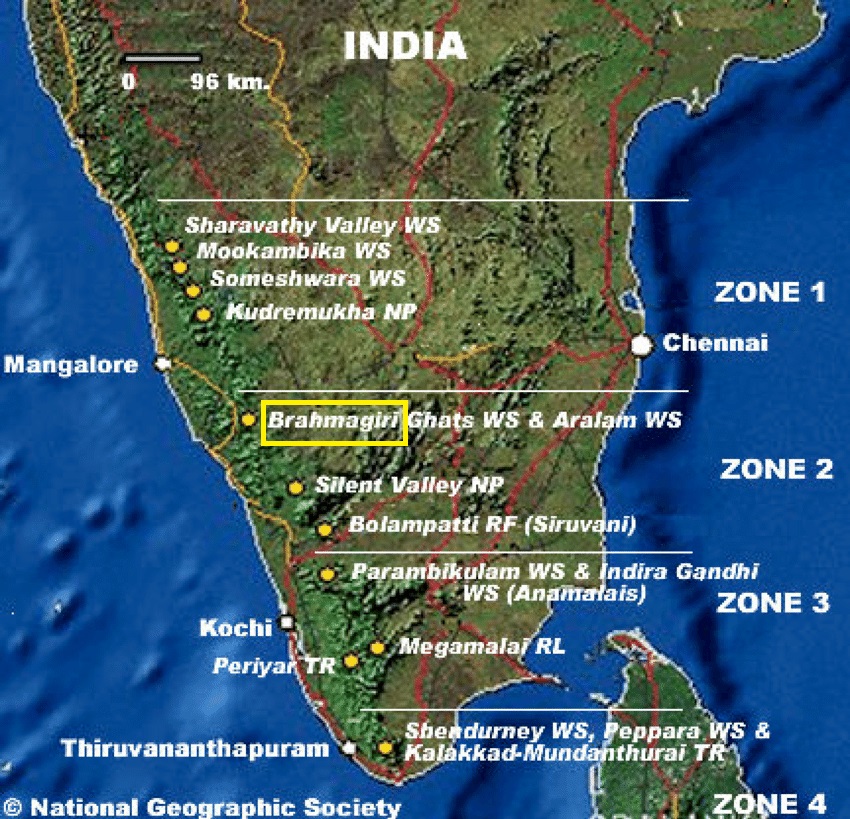
    The Karnataka government’s move to build a tribal village in Brahmagiri Wildlife Sanctuary’s buffer zone has sparked debates on environmental conservation, tribal rights, and human-wildlife conflict.

    Brahmagiri Wildlife Sanctuary

    About Brahmagiri Wildlife Sanctuary:

    • The Brahmagiri WLS is located in Kodagu District, Karnataka, within the Western Ghats.
    • It serves as a crucial ecological corridor, facilitating wildlife movement between Nagarhole National Park and Wayanad Wildlife Sanctuary.
    • Geographical Location and Features
      • It is situated approximately 250 km from Bengaluru and derives its name from the Brahmagiri Peak, the highest point in the region.
      • The sanctuary was declared a protected area on June 5, 1974, to conserve its unique flora and fauna.
      • The terrain consists of evergreen and semi-evergreen forests, grasslands, and shola forests, which provide a habitat for various species.
    • Flora:
      • Bamboo species are widely spread across the region, providing food for herbivores like elephants and deer.
      • The diverse vegetation supports a wide range of faunal species by offering food, shelter, and nesting sites.
    • Fauna:
      • Carnivores: Tigers, jungle cats, leopard cats, wild dogs, and sloth bears.
      • Herbivores: Indian elephants, gaurs, sambars, spotted deer, barking deer, mouse deer, and wild pigs.
      • Primates: Lion-tailed macaques, Nilgiri langurs, slender loris, bonnet macaques, and common langurs.
      • Small Mammals & Rodents: Malabar giant squirrels, giant flying squirrels, Nilgiri martens, common otters, brown mongooses, civets, porcupines, and pangolins.
      • Reptiles: King cobras, Indian cobras, pythons, Malabar pit vipers.
      • Birds: Emerald doves, square-tailed bulbuls, and Malabar trogons.

    PYQ:

    [2020] Which one of the following protected areas is well-known for the conservation of a sub-species of the Indian swamp deer (Barasingha) that thrives well on hard ground and is exclusively graminivorous?

    (a) Kanha National Park

    (b) Manas National Park

    (c) Mudumalai Wildlife Sanctuary

    (d) Tal Chhapar Wildlife Sanctuary


  • Wildlife Conservation Efforts

    Centre clears exploratory drilling in Hollongapar Gibbon Sanctuary

    Note4Students

    From UPSC perspective, the following things are important:

    Prelims level: Hollongapar Gibbon WLS

    Why in the News?

    Exploratory drilling for oil and gas has been approved within the eco-sensitive zone surrounding the Hollongapar Gibbon Wildlife Sanctuary.

    About the Hollongapar Gibbon WLS

    • Hollongapar Gibbon Wildlife Sanctuary was initially established as Hollongapar Reserve Forest in 1997 and renamed in 2004.
    • It is the only habitat for hollock gibbons in India.
    • Located in Assam, with the Bhogdoi River along its northern boundary.
    • Biome classified as plains alluvial semi-evergreen forests with patches of wet evergreen forests.
    • Flora:
      • Upper canopy: Dominated by Hollong trees (Dipterocarpus macrocarpus), Sam, Amari, Sopas, Bhelu, Udal, and Hingori.
      • Middle canopy: Features Nahar trees.
      • Lower canopy: Composed of evergreen shrubs and herbs.
    • Fauna:
      • Primates: Includes Hoolock Gibbons, Bengal Slow Loris (only nocturnal primate in Northeast India), stump-tailed macaques, northern pig-tailed macaques, eastern Assamese macaques, rhesus macaques, and capped langurs.
      • Other mammals: Indian elephants, tigers, leopards, jungle cats, wild boars, civets, squirrels, and more.

    About the Hoolock Gibbons:

    • Gibbons are the smallest and fastest apes, and they inhabit tropical and subtropical forests across Southeast Asia.
    • It is the only ape specie found in India.
    • They possess high intelligence, exhibit distinct personalities, and have strong familial bonds, reflecting characteristics similar to other ape species.
    • The current population of hoolock gibbons is estimated at around 12,000, found primarily in Northeast India, Bangladesh, Myanmar, and southern China.
    • Two distinct species, the eastern hoolock gibbon (Hoolock leuconedys) and the western hoolock gibbon (Hoolock hoolock), were previously reported in India.
    • Conservation Status
      • IUCN Red List: the western hoolock gibbon is classified as Endangered, and the eastern hoolock gibbon is classified as Vulnerable.
      • Both gibbon species in India are placed under Schedule I of the Wildlife (Protection) Act, 1972.


    PYQ:

    [2010] Consider the following pairs:

    Protected Area:: Well-known for

    1. Bhitarkanika, Orissa :: Salt Water Crocodile

    2. Desert National Park, Rajasthan :: Great Indian Bustard

    3. Eravikulam, Kerala :: Hoolock Gibbon

    Which of the pairs given above is/are correctly matched?

    (a) 1 only

    (b) 1 and 2 only

    (c) 2 only

    (d) 1, 2 and 3

  • Forest Conservation Efforts – NFP, Western Ghats, etc.

    Inland Mangrove of Guneri

    Note4Students

    From UPSC perspective, the following things are important:

    Prelims level: Inland Mangrove of Guneri

    Why in the News?

    The Gujarat government has declared the Guneri Inland Mangrove in Kutch as the state’s first Biodiversity Heritage Site (BHS) under The Biological Diversity Act, 2002.

    Inland Mangrove of Guneri

    Quick Facts about Mangroves in India:

    • “Red List of Mangrove Ecosystems” report released on May 22 (International Day for Biodiversity), 2024.
    • India holds 3% of South Asia’s total mangrove cover.
    • Mangrove cover increased by 54 sq km (1.10%), reaching 4,975 sq km (0.15% of India’s total area).
    • West Bengal leads (42.45%), followed by Gujarat (23.66%) and Andaman & Nicobar Islands (12.39%).
    • South 24 Parganas, West Bengal, alone contributes 41.85% of India’s mangrove cover, including Sundarbans National Park.
    • Gujarat recorded the highest increase, adding 37 sq km of mangrove cover.

    About Guneri Inland Mangroves:

    • Guneri Inland Mangroves (32.78 hectares) are a rare and unique mangrove ecosystem located in Kutch district, Gujarat.
    • It is India’s last remaining inland mangrove site and one of only eight such sites globally.
    • Unlike coastal mangroves, which thrive in tidal zones, Guneri mangroves exist inland without direct seawater contact.
    • These mangroves have historical and ecological significance, possibly originating after the Miocene marine transgression or forming along the banks of the ancient Saraswati River in the Great Rann of Kutch.

    Geographical Features:

    • It is located about 45 km from the Arabian Sea and 4 km from Kori Creek.
    • Terrain:
      • Flat land, unlike coastal mangroves that grow in muddy, tidal zones.
      • Devoid of sludge, making it resemble a forest rather than a typical mangrove swamp.
    • Water Source:
      • Thrives on limestone deposits, which help retain groundwater to sustain the mangroves.
      • No direct tidal water influx, relying entirely on underground water connectivity.
    • Biodiversity:
      • Home to 20 migratory bird species and 25 resident migratory avifaunal species.
      • Functions as a vital habitat for local and seasonal wildlife.

    PYQ:

    [2015] Which one of the following regions of India has a combination of mangrove forest, evergreen forest and deciduous forest?

    (a) North Coastal Andhra Pradesh

    (b) South-West Bengal

    (c) Southern Saurashtra

    (d) Andaman and Nicobar Islands

  • Wetland Conservation

    Four new sites to get Ramsar Tag

    Note4Students

    From UPSC perspective, the following things are important:

    Prelims level: Ramsar Wetland sites in India

    Why in the News?

    Ahead of World Wetlands Day (February 2nd), the Environment Ministry announced the inclusion of four new Ramsar sites, bringing India’s total to 89.

    The newly designated sites are Sakkarakottai Bird Sanctuary and Therthangal Bird Sanctuary in Tamil Nadu, Khecheopalri Wetland in Sikkim, and Udhwa Lake Bird Sanctuary in Jharkhand.  With this, Tamil Nadu now has 20 Ramsar sites, the highest in the country, followed by Uttar Pradesh with 10 sites.

    About the Newly Added Ramsar Sites: 

    Description
    Sakkarakottai Bird Sanctuary, Tamil Nadu
    • Location: Ramanathapuram District, Tamil Nadu.
    • Originally an irrigation tank, now a designated bird sanctuary.
    • Recharged by northeast monsoon (Oct-Jan).
    • Supports 42+ bird species, including Spot-billed Pelican, Grey Heron, Little Cormorant, and Black Kite.
    Therthangal Bird Sanctuary, Tamil Nadu
    • Location: Theerthangal Village, Ramanathapuram District, Tamil Nadu.
    • A freshwater ecosystem and an important breeding ground for waterbirds.
    • Recorded 96 bird species across 18 orders and 44 families.
    • Notable species include Oriental Darter, Black-headed Ibis, Asian Woolly-necked Stork, and Spot-billed Pelican.
    Khecheopalri Wetland, Sikkim
    • Location: West Sikkim, near Khecheopalri Village.
    • A sacred lake revered by Buddhists and Hindus.
    • Part of a temperate Himalayan peatland ecosystem, surrounded by broad-leaved mixed temperate forests.
    • Flora: Rich in macrophytes, phytoplankton, and zooplankton.
    • Fauna: Supports fish species like Cyprinus carpio, Danio aequipinnatus, and various migratory birds (Common Merganser, Tufted Duck).
    Udhwa Lake Bird Sanctuary, Jharkhand
    • Location: Sahebganj District, Jharkhand.
    • Comprises two interconnected lakes: Pataura (155 ha) and Berhale (410 ha).
    • Connected to the Ganga River via the Udhuwa Nala (25 km stretch).
    • Pataura Lake depth: ~2 meters; Berhale Lake depth: ~70 cm, covered with aquatic vegetation.
    • Flora: Home to 42 algae species and 36 aquatic macrophytes.
    • Fauna: Habitat for 83 bird species, including the Near Threatened Black-necked Stork and 22 commercially valuable fish species.


    PYQ:

    [2019] Consider the following statements:

    1. Under Ramsar Convention, it is mandatory on the part of the Government of India to protect and conserve all the wetlands in the territory of India.
    2. The Wetlands (Conservation and Management) Rules, 2010 were framed by the Government of India based on the recommendations of Ramsar Convention.
    3. The Wetlands (Conservation and Management) Rules, 2010 also encompass the drainage area or catchment regions of the wetlands as determined by the authority.

    Which of the statements given above is/are correct?

    (a) 1 and 2 only

    (b) 2 and 3 only

    (c) 3 only

    (d) 1, 3 and 3

  • Wildlife Conservation Efforts

    Nahargarh Wildlife Sanctuary

    Note4Students

    From UPSC perspective, the following things are important:

    Prelims level: Nahargarh WLS

    Why in the News?

    The Forest Department of Rajasthan has initiated efforts to revise the boundaries of the Nahargarh Wildlife Sanctuary to address existing legal and administrative complications.

    Nahargarh Wildlife Sanctuary

    About the Nahargarh Wildlife Sanctuary

    • It was established in 1980, Nahargarh Wildlife Sanctuary is located in Jaipur, Rajasthan.
    • It is named after the nearby Nahargarh Fort, which overlooks the sanctuary.
    • It is a significant part of the Ranthambore Tiger Reserve corridor, providing a habitat for wildlife movement.
    • Geographical Features:
      • It is situated in the Aravalli hills, close to Jaipur city, offering a natural escape amidst urban surroundings.
      • Its area spans approximately 50 square kilometres, featuring rugged terrain with hills, valleys, and plateaus.
      • It has seasonal streams and waterholes that serve as vital water sources for wildlife.
    • Flora and Fauna:
      • Flora: Comprises dry deciduous and thorny scrub forests, typical of the Aravalli range; Key tree species include Dhok, Babool, Khejri, and Ber; Grassy patches and scattered shrubs provide a diverse ecosystem for herbivores.
      • Fauna: Fauna: Includes leopards, hyenas, wild boars, jackals, sambars, chitals, peacocks, partridges, migratory birds, monitor lizards, snakes, turtles, and various pollinators.

    PYQ:

    [2012] In which one among the following categories of protected areas in India are local people not allowed to collect and use the biomass?

    (a) Biosphere Reserves

    (b) National Parks

    (c) Wetlands declared under Ramsar Convention

    (d) Wildlife Sanctuaries