💥Join UPSC 2027,2028 Mentorship (July Batch) + XFactor Notes & Microthemes PDF

Author: Explains

  • 07 Jan 2018 | Target Mains | 19th Weekly Test

    Q.1) Criminalising Triple Talaq is Unnecessary Overkill. Critically discuss


    Q.2) With other mega regional trade agreements like the Trans–Pacific Partnership in uncertainty, do you think there is any more rationale for India to join RCEP. Critically analyse


    Q.3) Why are the farmers distressed in India? Discuss the steps which Government are taking in recent years to reduce the distress. What more is needed ?


    Q.4) Municipal bonds can not only be used to bolster city finances but also improve Governance of Municipal corporations across India. Discuss


    Q.5) The problem of non-performing assets (NPAs) in the Indian banking system is said to be big and might affect economic growth of the country. What are the approaches that RBI and government are adopting to clean the banking system of NPAs? Examine.


    Q.6) Recently India was ranked 100 in the Global hunger index 2017? Discuss the reasons behind India’s dismal performance and steps Government is taking to address the problem.


    Q.7) The recent reduction in Maoist related  incidents proves the point that Maoist insurgency could not be tackled only with military approach. Discuss


    Q.8) Do you think India is right in opposing WTO deal to end fisheries subsidies? Critically analyse


    Q.9) According to the recently released UNESCO’s state of World’s children report less than one-third of India’s internet users are females. Discuss the reasons behind these trends and also its impact on the future condition of women in India.


    Q.10) What do you understand by Kyasanur Forest Disease(KFD)? Discuss its threat and what steps should be taken by the Government to eradicate this disease.


    Q.11) You are posted in a government office. Your staff is not punctual when it comes to timings as the last officer had no complaints about late coming as long as people did their work efficiently. However, one of your friend who is in other department advices you to be strict with you staff. He tells you that punctuality comes first even if people are doing their work efficiently. You know that your staff though comes late but is well efficient in work and their coming late to office doesn’t have any negative effect on work. What will you do? Will you follow your friend’s advice and be strict with your staff? Discuss the various options that are available to you along with their merits and demerits suggesting which course of action would you take and why?

    http://indianexpress.com/article/india/work-culture-in-central-govt-offices-has-changed-under-nda-pm-modi-4770131/


    Q.12 You are posted as DSP who is known for his integrity and sense of duty. You find two people violating traffic rules and when you give them challan, they tell you they belong to ruling party and refuse to pay challan. When you insist, they start misbehaving with you. You have a heated argument with them. They ask you to leave them or ask you to be ready to face the consequences. Next day you get a call from a local politician that you should apologise to the party workers else you will be transferred to a remote area. You have lived all your life in metro cities. Even your husband advises you to apologise, as he has a permanent job in the city and if you are transferred you might face family problems. Given below are some options. Discuss them with their merits and demerits. Also suggest which course of action would you take and why? Your course of action could be different from the options given below.

    (i) Apologise from the leader so that you are not transferred.

    (ii) Asks your husband who also knows some senior minister to help you get out of the matter.

    (iii) Be firm on your stand and decide to go to your new posting.

    (iv) Highlighting the matter in the media to get more people support.


  • 31 Dec 2017 | Target Mains | 18th Weekly Test

    Q.1) If India Wants to Remain Secular, the New Citizenship Bill Isn’t the Way to Go? Critically Comment.

    Q.2) Recently Parliament has amended Forest act 1927 and from now on Bamboo would not be considered as tree. Discuss the impact of the decision on Indian Economy, Internal security, Ecology and Society.

    Q.3) While Everyone agrees on the urgent need to reform the Indian Medical Council Act of 1956, However the Bill aiming to reform India’s medical education regulator is short of ammunitions needed to fight against the ills being faced by Medical education sector in India. Critically comment.

    Q.4) Recently the parliament has passed the IIM Bill. What are the salient features of this Bill? Examine how does it affect autonomy of IIMs.

    Q.5) Given the widespread problem of criminalization of Indian politics as shown by recent ADR data , setting of Special courts to try politicians is a excellent decision in theory, however it will be difficult to implement this decision into practice. Discuss

    Q.6) Discuss the pros and cons of increasing the area of pictorial warnings in Ciggerate packs?

    Q.7) Critically comment on the provisions of Wetlands (Conservation and Management) Rules, 2016, which has replaced the Wetland (Conservation and Management) Rules of 2010.

    Q.8) What do you Understand by Data mining? Discuss its relevance in multiple sectors. How can it help in detection of tax evasion in India?

    Q.9) What do you understand by social Audit? How is it different from Government audit? Discuss the role of social audit in enhancing transparency and accountability within the Government.

    Q.10) What do you understand by Block-chain technology? Discuss its potential and challenges of using it.

    Source: https://www.cnbc.com/2016/02/29/the-challenges-of-using-blockchain-technology.html

    Ethics test

    Q.11) You are hearing a case in court. The case is that of rash driving where a 16 year old boy has hit 3 people on road. Out of them, 1 person who was the only earning member in the family died on the spot. The boy is the son of a reputed IAS officer in the city. At the time of accident, he had come from a party and was drunk. The officer is one of your good friends. He asks you not to punish the child as this would spoil his career and it was by mistake. He requests you that this judgement will have a big impact on the career of his son. What are the ethical conflicts in the case? What are the various options before you? Discuss them with their merits and demerits. Are moral and ethical values of parents and the upbringing of children by them to be held responsible in such cases?

    Q.12) In a democratic setup, election manifestos play an important role in influencing the voting behavior of people. However, before elections the political parties make big promises, they talk to changing the system, making it efficient, transparent and corruption free.  But when it comes to fulfilling those promises, they fail to abide by them. Where does the lacuna lie in the above process? How can accountability be fixed on the political parties? Give suggestions to bring a coherency between elections manifestos promises and the fulfilling of those promises.


  • Biotechnology – Stem Cells


    Before we deep-dive into the topic, have a look at the TED talk below.


    Broadly speaking, Stem cells is a naïve/immature/unspecialized cell that can 

    i. divide to form similar cells (self renewal) and

    ii. develop into different specialized cells that perform distinct function

    A. Classification of Stem Cells

    Depending on their ability (potency) to develop into different specialized cells, stem cells can be

    • Totipotent – can form all cells of the body including the ones in the extra embryonic membranes (placenta). In humans, the 2 cell staged zygote is totipotent
    • Pluripotent – can become virtually any cell in the body except those needed to support and develop a fetus in the womb
    • Multipotent(limited ability to differentiate) -can give rise only to a small number of different cell types. Eg. bone marrow contains multipotent stem cells that can give rise to all blood cell types but not other cells.   
    • Unipotent – Found in adult tissues, unipotent stem cell has the lowest differential potential of all the stem cells.

    Depending on from where they come from different places in the body or are formed at different times in our lives. These include

     Embryonic stem cells (ESCs) which exist only at the earliest stages of development

     Adult stem cells also called somatic stem cells that appear during fetal development and are present in different tissues of our bodies throughout life.

     Induced pluripotent stem cells or iPSCs cells are not found in the body but engineered in a laboratory from cells of the body, such as those from the skin. The iPSC cells have properties similar to those of embryonic stem cells.

    A fertilised egg has a totipotency for about 3-4 days. It then remains turns into a multipotent cell. Finally specializes further.


    B. Stem Cell Therapy

    • It is a type of treatment option that uses a patient’s own stem cells to repair damaged tissue and repair injuries.
    • It is used to treat more than 80 disorders including neuromuscular and degenerative disorders. Eg. Bone-marrow transplant is used in Leukemia(blood cancer), sickle-cell anemia, immunodeficiency disorders. 
    • Stem cells are usually taken from one of the two areas in the patient’s body: bone marrow or adipose (fat) tissue in their upper thigh/abdomen. Because it is common to remove stem cells from areas of stored body fat, some refer to stem cell therapy as “Adipose Stem Cell Therapy” in some cases.
    • Once stem cells are removed from one of these locations, they are placed in a “centrifuge machine” that spins them very, very quickly and concentrates the substances that are most valuable (including up to seven different types of natural growth factors).
    • The sample of concentrated stem cells is then injected directly into the patient’s affected, painful area− allowing the cells’ growth factors to go to work immediately, building new skin cells, connective tissue and so on.

    C. Advantages

    • Immense Medical Benefits: It offers a lot of medical benefits in the therapeutic cloning and regenerative medicine
    • Treatment of Conditions and Disorders: It shows great potential in the treatment of a number of conditions like Parkinson’s disease, spinal cord injuries, Alzheimer’s disease, schizophrenia, cancer, diabetes and many others.
    • A Better Knowledge of human growth: It helps the researchers know more about the growth of human cells and their development.
    • The stem cell research can allow the scientists to test a number of potential medicines and drugs without carrying out any test on animals and humans. The drug can be tested on a population of cells directly.
    • Cure development defects before they happen: The stem cell therapy also allows researchers to study the developmental stages that cannot be known directly through the human embryo and can be used in the treatment of a number of birth defects, infertility problems and also pregnancy loss. A higher understanding will allow the treatment of the abnormal development in the human body.
    • Reduced risk of rejection: The stem cell therapy puts into use the cells of the patient’s own body and hence the risk of rejection can be reduced because the cells belong to the same human body.

    D.Challenges in SCT

    • Destruction of blastocysts: The use of the stem cells for research involves the destruction of the blastocysts that are formed from the laboratory fertilization of the human egg.
    • Unknown side-effects: Like any other new technology, it is completely unknown what the long-term effects of such an interference with nature could be
    • Limitations of adult cells: The disadvantage of adult stem cells is that the cells of a particular origin would generate cells only of that type, like brain cells would generate only brain cells and so on.
    • Potential Rejection: If the cells used in the therapy are embryonic, then the cells will not be from the same human body and there are chances of rejection.
    • Potential use in negative activities: It can be used to create bio-weapons or weapons of mass destruction

    E.Applications of SCT

    • Orthopedic injuries and musculoskeletal problems
    • Wounds and incisions following surgeries
    • Spinal cord injuries, brain trauma and spinal stenosis
    • Cardiovascular diseases, including hypertension, coronary heart disease, stroke and congestive heart failure
    • Hair loss
    • Vision impairment
    • Diabetes and other pancreatic dysfunctions
    • Neurodegenerative diseases such as Parkinson’s, multiple sclerosis and Alzheimer’s

    F. India and Stem Cell Therapy

    • According to the Indian Council of Medical research, all stem cell therapy in India considered to be experimental except bone marrow transplants
    • Stem cell therapy is legalized in India
    • Umbilical cord and adult stem cell treatment are considered permissible
    • Embryonic stem cell therapy and research is restricted


  • Biotechnology – Genetic Engineering

    N4S

    Genetic Engineering concepts, specially their applications highlight the practical implications of Biotechnology. Hence, they become the most important area for UPSC. Students are expected to be thorough with it.

    Genetic Engineering is an overarching term referring to modification of an organism’s genome. Here is a summary video outlining important techniques and applications which you might find interesting.


    The techniques of genetic engineering include the creation of recombinant DNA, use of gene cloning and gene transfer.

    A. Recombinant DNA technology

    Recombinant DNA technology involves several steps in specific sequence such as

    1.isolation of DNA,

    2.fragmentation of DNA,

    3.isolation of a desired DNA fragment,

    4.ligation of the DNA fragment into a vector,

    5.transferring the recombinant DNA into the host,

    6.culturing the host cells in a medium at large scale and extraction of the desired product.

    The DNA molecule thus produced is called recombinant DNA.


    B. Gene Cloning

    It is the creation of a genetic copy of a sequence of DNA or of the entire genome of an organism.

    It is usually done through two approaches: Somatic Cell Nuclear Transfer(SCNT) and Artificial Embryo Twinning

    1.Somatic Cell Nuclear Transfer(SCNT)

    https://lh4.googleusercontent.com/k-9b40QEDvCeRjRz_sfx_vmRSP_eNyb0OPqo0QthqiL1qQI48gHW_r0Q865s352Q7B218yZE1GVpV9m_J7AIjskYdv3kh7WGEWa0M6h6aBnuAN9EcUWHWaK0UApQoMJBaNJLCls

    • A somatic cell is any cell of a living organism other than the reproductive cells
    • The nucleus of a somatic cell is removed and kept, and the host’s egg cell is kept and nucleus removed and discarded
    • The kept nucleus is then fused with the ‘deprogrammed’ egg cell. After being inserted into the egg, the lone somatic cell nucleus is reprogrammed by the host egg cell
    • The egg, now containing the somatic cell’s nucleus is stimulated with a shock and will now begin to divide.
    • After multiple divisions, the single cell forms a blastocyst(an early stage embryo) with almost identical DNA to the original organism.
    • Dolly the sheep was the first animal ever to be cloned using SCNT
    • There are two possible uses of SCNT:
      • Therapeutic Cloning: Creating cloned human embryos are not implanted into a female uterus rather used in research and therapy to obtain stem cells
      • Reproductive Cloning: Creating cloned human embryos with the intention of placing them into the uterus where it can implant and develop


    2. Artificial Embryo Twinning

    https://lh6.googleusercontent.com/bR7gsQHXkyMEPRIEtxLALdeq_zT0v4whSLqpd1TwmZBI6-MC_5-g4jiF7Cx5iKw_P64AI90FByNXb3DcdhnW9HGb7oGuL-4awsEb8zPMOt9yxnwEi6u3zbA9hNnrIJ1dBTfcX4K9bXtnQsm-

    https://www.youtube.com/watch?v=FvjWKip6Pm8

    • This technology mimics the natural process of creating identical twins
    • The early stage embryo is manually separated into individual cells and allowed to divide and develop on their own.
    • The resulting embryos are placed into a surrogate mother, where they are carried to term and delivered. As the embryos came from the same zygote(fertilized egg), they are genetically identical.

    Summing up the similarities and differences

    Somatic Cell Nuclear Transfer(SCNT) Artificial Embryo Twinning
    Differences Genetic information is inserted in an enucleated egg cell. Cells of an embryo are manually divided.
    Similarities An exact genetic copy is made.

    A surrogate mother is used

    An exact genetic copy is made.

    A surrogate mother is used


    C. Gene Silencing

    Certain genes in a cell may be defective and could cause undesirable traits. The process of regulation or suppression of such genes is called Gene Silencing.

    RNA Interference(RNAi) and Antisense Technology are two common processes by which this is achieved. More details are not required.


    D. CRISPR-Cas9

    CRISPR-Cas9 technique has appeared extensively in news

    Salient features

    • CRISPR-Cas9 is a genome-editing tool. CRISPR is a naturally occurring defence mechanism in bacteria.
    • The CRISPR-Cas9 consists of two molecules that are responsible for gene editing.
      • An enzyme called Cas9 that acts as a pair of molecular scissors that cuts the two strands of DNA at a specific location
      • A guide RNA(gRNA) that binds to DNA and guides the Cas9 to the right part of the genome
    • The gRNA is designed to find and bind to a specific sequence in the DNA. The gRNA has bases that are complementary to those of the target DNA sequence.
    • The Cas9 follows the gRNA to the same location in the DNA sequence and makes a cut across both strands of the DNA
    • At this stage, the cell recognizes that the DNA is damaged and tries to repair it
    • Scientists can use the DNA repair machinery to introduce changes to one or more genes in the genome of the cell of interest.


    E. Gene splicing

    Gene splicing is the process of chemically cutting DNA in one organism and inserting it into the DNA strand of a vector, usually a plasmid. The DNA is cut using special chemicals called restriction enzymes. Through this technique, microorganisms are genetically engineered. Gene splicing primarily involves the following steps

    1.Cutting of DNA or genes from the donor cell.

    Tool Used – Chemicals called restriction enzymes. Restriction enzymes are chemicals extracted from certain strains of bacteria. Different restriction enzymes recognize and cut at particular nuclear sequences.

    2.Transportation of the cut or desired DNA

    A.DNA Micro injection – Direct Micro-injection of the chosen gene.

    B.Retrovirus mediated gene transfer. Retroviruses are used as vectors to transfer genetic material taking advantage of their natural ability to infect host cells and insert their DNA into host cell DNA.

    C.Embryonic Stem Cell mediated gene transfer.


    APPLICATIONS

    A. Three-parent babies

    Three-parent babies have repeatedly remained in news. The world’s first three-parent baby was born in 2016 in Mexico to Jordanian parents.

    In 2017, UK became the first country to give licenses to use this technique to prevent incurable genetic diseases being inherited by children.
    Remember we had very briefly touched upon the Mitochondria when we discussed the Cell and the Nucleus. Mitochondria contains mtDNA and mutations in it can give rise to various genetic disorders. Since mtDNA is transferred from mother to child, these disorders are also transferred. The three-parent babies technique tries to overcome this shortcoming by preventing the transfer of mitochondria from mother to child.

    There are 2 versions – Pronuclear Transfer and Spindle Transfer

    Pronuclear Transfer

    ronuclear transfer

    Spindle Transfer

    pindle transfer

    https://www.sciencenewsforstudents.org/article/how-make-three-parent-baby

    B.Gene Therapy

    It is a technique through which a new DNA is introduced into a patient to treat a genetic disease. The new DNA usually contains a functioning gene to correct the effects of a non-functioning or disease causing gene.

    A four-year old girl became the first gene therapy patient. She had adenosine deaminase (ADA) deficiency, a genetic disease which left her defenseless against infections.

    There are two types of gene therapy:

    Somatic Gene Therapy: The genes are transferred into the somatic cells of a patient. Any modifications and effects will be restricted to the individual patient only and will not be inherited by the offspring.

    Germline Gene Therapy: The genes are transferred into the germ cells(sperm or eggs). This would allow the therapy to be heritable and passed onto the offspring.


    C. Genetic Modification of Plants(GM Crops)

    https://lh4.googleusercontent.com/1pSaR51289x3eBVpI2K9quyBcli6E-YuHCUDfMIWcijeAB7zrxV7mUHm_A0vUgXSpiCChiJXB7URD9f7wTIwYYr6UT1s9UoUheEuDWKh3JDhVffOVSnvCxXUHArUr9KCMdRQnI9vYk5zpZyG

    The DNA of plants used in agriculture are modified using genetic engineering techniques

    There are two primary processes through which plants are modified:

    Cisgenic: Genes are artificially transferred between organisms that could be conventionally bred i.e. from a crossable or sexually compatible plant.

    Transgenic: Genes from a non-plant species or from a donor plant that is sexually incompatible with the recipient plant are inserted, which is a form of horizontal gene transfer


    Biotech firms make use of the following technologies to ensure sterile seeds and crops with specific properties

    Terminator Technology: It is the genetic modification of plants to make them produce sterile seeds. They are also known as suicide seeds.

    Traitor Technology: Traitor technology can allow traits in genetically modified seeds to be switched on and off by using special proprietary chemicals.


    https://lh6.googleusercontent.com/J94VWPdpu1Z1OttbqzTQaq3OszinqhkuluQr3FNtoDIrQ_dQuxvZhJFsbZLkuI4xOzdiiN926vezFwQPVkPKPtFljZTR7YVdW03seiCOfbXZp3SnLIwpUvhZObuOde7c6duLaCm6xtEtxAZB

    https://lh3.googleusercontent.com/5GJ9CxEYq-I6AXYLnyvh49E0ohLgq5P3lkOXqtdnt-AyUMSTTSt9Xat0WetMQdO_0xLEGW5ed4E-KM4WzbBkHwW2nF4-GLtDcLWp5Xqpku_cWn0mcc_sp4oZtUhZLBveKvjmYYHLU4xgKUDF

    https://lh6.googleusercontent.com/sgwpuBoFXqWeUmEtEaMtk3Z88Rzgsvx6vwBLZgECi60w4C56trsvaEfB3JRqomjT0ZjFV6oIHbkyM8gQ_Lt-aljtgx7IJmhMJgUIU7WJBX21iEFCs99jFJjiSLNCPdZ5UGyyoRHHraKfsajZ

    D. In-vitro Fertilization

    https://www.youtube.com/watch?v=J1xHUA_fiQ4

    https://lh5.googleusercontent.com/YgMrdfImcmLsTN71Ep9XEl4Fgnx3rSFyhIUNXGWqoJrSzchT55ftqN6aU_xU0oHf-3jJjZi0DTvKZ1lg1HZaS16st2_u7k4I3lntkMLakdO3SxMlI6zn2N8n-rgEStzAgNAKJfF5JpzVNGCO

    It is the process of fertilization by extracting eggs, retrieving a sperm sample, and then manually combining an egg and sperm in a laboratory dish. The embryo(s) is then transferred to the uterus to induce pregnancy.

  • Biotechnology – Basics of Cell, Nucleus, Chromosomes, DNA, RNA, Genes, Codons, Amino acids, etc.

    N4S

    Biotechnology is one of the most important topics with at least 1 question in both prelims and mains year after year. Nevertheless, it remains a major pain point for students. They have issues right from understanding the most basic terms like chromosomes, DNA, RNA, gene, codons, amino acids, proteins, etc. to recent breakthroughs.

    Understanding the level of depth expected by the exam is the key to cracking the topic. NCERTs and other reference books are detailed and technical than required.

    We will start with the basics, develop a conceptual understanding and then move to contemporary breakthroughs.

    The figure below depicts the basic hierarchy within a cell.


    1. Cell

    Cells are basic building blocks of all living organisms. Cells make up tissues which makeup organs and then organ systems further on.

    There are 2 kinds of cells – Prokaryotic(pro=before and karyos=nucleus) and Eukaryotic(eu=with)

    Prokaryotic Cells – These are simpler more archaic cells lacking most basic cell organelle including nuclei. DNA is present in the cytoplasm. Eg.Bacteria

    Eukaryotic Cells – These cells are well differentiated and contain many cell organelle. The genetic material is sequestered inside the nucleus. All plant and animal cells are examples of eukaryotic cells.

    https://www.difference.wiki/prokaryotic-cell-vs-eukaryotic-cell/

    The organelles of Animal and Plant cells are highlighted in the figure given below.

    We will discuss the two most important organelles from the point of view of the exam.

    Nucleus – contains all the genetic material(code to replicate the cell and conduct all its functions). Genetic material is in the form of Chromosomes.

    Mitochondria – Besides the nuclear DNA contained in the nucleus, cells have organelles called Mitochondria which contains Mitochondrial DNA or mtDNA or Maternal DNA. This is exclusively passed down from mothers to children(we do not inherit any Mitochondrial DNA from our fathers). We will revisit this organelle again when we discuss 3-parent-baby technique.

    The rest are given in the table below –

    In the next segment, we will cover Chromosomes, DNA, and Genes. The following figure will come in handy.

    2. Chromosomes

    Chromosomes are thread-like structures present in the nucleus.

    These are nothing but DNA tightly coiled around a protein called histone. (just like a thread wound around a cardboard tube).

    From the above figure, you can conclude,

    • Chromosomes exist in pairs. Human cells contain 23 such pairs or 46 chromosomes.
    • Each chromosome is comprised on one super-long DNA molecule.
    • Notice how the DNA is coiled around histone and then many such histones are packed together to form a chromosome.


    3. Deoxyribonucleic Acid(DNA)

    https://i.pinimg.com/736x/73/6c/eb/736ceb06de3858d85d5b8669845f912c–complementary-dna-nitrogenous-base.jpg

    DNA is called the blueprint of life because it contains the genetic code which are instructions needed for an organism to grow, develop, survive and reproduce. DNA does this by controlling protein synthesis, a process we will explain later but not in much detail. For now, simply understand that Proteins are the most important material in our body. Many would associate them with muscles but they also aid the production of enzymes which are responsible for conducting all chemical processes and reactions within the body. So, it could be derived that protein synthesis is responsible for all activities carried on by the body and it is controlled by the genes.

    The famous Double Helix model for the structure of DNA as shown in the above image is one of the most well-known models.

    The salient features

    • It is a twisting structure made up of 2 polymer chains. The ‘backbone’ of each chain is constituted by sugar-phosphate and connecting ladders of nitrogenous bases project inside. The figure above shows the backbone marked with ‘S’ and ‘P’ indicating alternating sugar and phosphates.
    • The polymer chain comprises of smaller monomers called nucleotides.
    • Each nucleotide has 3 partsa sugar(ribose), a phosphate molecule and a nitrogenous base.
    • There are 4 kinds of Nitrogenous Bases – Adenine(A), Thymine(T), Guanine(G) and Cytosine(C). These bases are complementary. A attaches with T and C attaches with G to form complementary pairs that make up the connecting attachments of the double helix model.


    4. Genes and Alleles

    Genes, as we know, are hereditary markers from which we derive various characteristics like skin color, height, etc. More technically, each DNA molecule consists of sequences of Genes. Each gene is a particular set of instructions for specific functions. Eg. globin gene would aid the production of hemoglobin, another gene would do so for insulin, so on and so forth. Each gene naturally consists of a sequence of nucleotides and base pairs.

    Alleles are alternate form genes which correspond to the same characteristic but provide for variations in that characteristic. A very crude example is as follows –

    Assume a hen. A particular gene would be responsible for the color of its feathers, say black and white. Hence we say the same gene has 2 variants. Hence they are known as Alleles. Naturally, the nucleotide sequence in them will differ.


    5. Codons, Amino acids, Peptides, and Proteins

    While describing DNA, we said that it helps with Protein Synthesis, a very fundamental process to sustain life. The concept of codons helps establish the link between Genes and protein synthesis reactions.

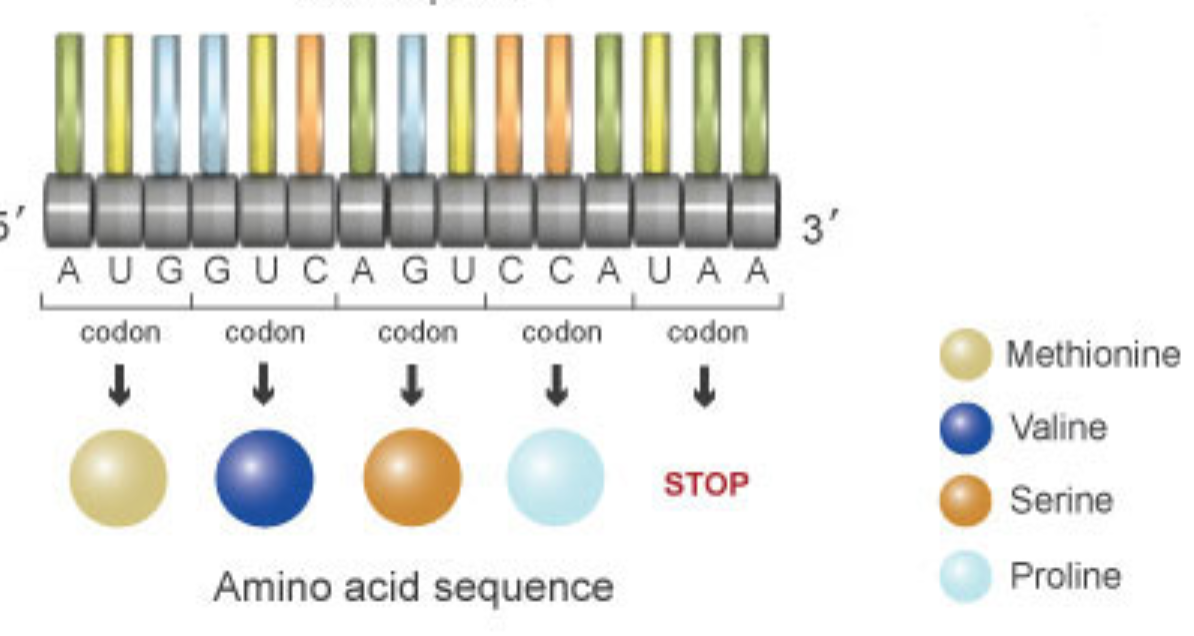
    Each Gene can be represented as a sequence of codons where codons are a sequence of base triplets – meaning 3 bases combine together to form a Codon.

    Each codon corresponds to a specific Amino acid. Eg. AUG codon corresponds to the Amino acid Methionine. Amino Acids combine together to form a particular peptide chain. The peptide chains undergo a structural transformation to form 3-Dimensional molecules called proteins.


    Types of Proteins in a Human Body

    S No. PROTEIN FUNCTION EXAMPLES
    1 Enzymes Facilitate biochemical reactions Lactase, Pepsin
    2 Hormonal Messenger proteins that help to coordinate bodily activities Insulin, Oxytocin
    3 Structural Provide support Keratin, Collagen
    4 Contractile Responsible for movement Actin, Myosin
    5 Transport Move molecules from one place to another Haemoglobin, Cytochromes


    6. Genotype and Phenotype

    https://www.youtube.com/watch?v=lYAHx7NiF3g

    • Genotype is the genetic makeup of a cell, an organism or an individual with reference to a particular trait.
    • It refers to the pairing of alleles and is not concerned with the expression of that trait
    • Phenotype refers to the organism’s expressed physical trait. It depends both on the genetic makeup(genotype) and the environment.

    7. Ribonucleic Acid(RNA)


    The bridge between DNA and protein synthesis is RNA.
    RNA is chemically similar to DNA, except that it contains ribose as its sugar and substitutes the nitrogenous base uracil for thymine.
    It is single-stranded rather than a double helix.

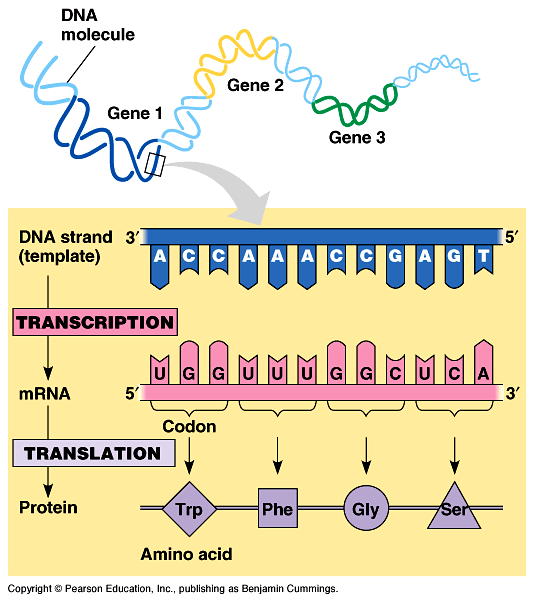
    To get from DNA, written in one chemical language, to protein, written in another, requires two major stages, transcription and translation.

    The process from DNA to RNA is known as Transcription. During transcription, a DNA strand provides a template for the synthesis of a complementary RNA strand. Transcription of a gene produces a messenger RNA (mRNA) molecule.

    During translation, the information contained in mRNA is used to determine the amino acid sequence of a polypeptide. Translation occurs at ribosomes.


  • 17 Dec 2017 | Target Mains | 17th Weekly Test


    Q.1) An interesting event which is happening in last few years is Russia and China’s continued attempts to frame global and regional politics through a similar lens, and the growing divergences between India and them. In the light of the above statement, Discuss the Challenges facing the RIC and steps required to address these challenges.

    Source: https://www.civilsdaily.com/op-ed-snap-looking-for-balance-in-power/


    Q.2) With violence decreasing and the knowledge economy growing, society is making progress towards gender equality. But there’s a long way to go, and the law plays an important role in shaping the way women are viewed. In the light of the above statement discuss some of the gender discriminatory laws in India.

    Source: https://www.civilsdaily.com/op-ed-snap-gender-based-laws-a-double-edged-sword/


    Q.3) The World inequality report 2018 highlighted that Income inequality in India has worsened over the past three-and-a-half decades. Discuss the reasons behind this phenomenon and steps needed to improve the situation.

    Source: https://www.civilsdaily.com/income-inequality-in-india-worsens-but-slower-than-russia-and-china-report/


    Q.4) Critically discuss the salient features of the Financial Resolution and deposit insurance bill?

    Source: https://www.civilsdaily.com/op-ed-snap-perils-of-going-cashless/

    https://www.civilsdaily.com/op-ed-snap-bail-in-doubts-on-financial-resolution-legislation/


    Q.5) What do you mean by E-cigarettes? Discuss the rationale behind its use and key concerns associated with it.

    Source: https://www.civilsdaily.com/maharashtra-fda-approaches-law-and-judiciary-dept-over-ban-on-e-cigarettes/


    Q.6) What is the Wassenar arrangement? What advantages will India get from being member of the Wassenar arrangement?

    Source: https://www.civilsdaily.com/op-ed-snap-in-an-elite-club-on-indias-wassenaar-entry/


    Q.7) What do you understand by PETCOKE? What are its harmful effects? Recent reports indicate that India is the biggest importer of PETCOKE generated in USA. Discuss the reason behind this unusual trend.

    Source: https://www.civilsdaily.com/sc-eases-petcoke-ban-for-2-sectors/

    https://www.civilsdaily.com/india-is-biggest-importer-of-u-s-oil-refinery-by-product-petcoke/


    Q.8) Discuss the salient features of the Maternity Benefit (Amendment) Bill, 2016? It is considered that the bill will provide women with much needed work life balance. Critically analyse. (200 Words)

    Source: https://www.civilsdaily.com/maternity-benefit-amendment-bill/

    https://thewire.in/195658/amendment-maternity-act-tool-gender-diversity/


    Q.9) In the recently concluded elections in Nepal leftist groups emerged victorious. What impact it will have on Indo-Nepal relations and Nepal-China relations, also suggest steps which India should take to improve relations with the new Government in Nepal.

    Source:  https://scroll.in/article/861272/a-communist-win-in-the-nepal-elections-is-bad-news-for-india-but-great-for-china

    https://economictimes.indiatimes.com/news/politics-and-nation/with-eye-on-china-india-to-step-up-relations-with-nepal/articleshow/62075326.cms


    Q.10) Discuss the argument for and against the Women Reservation bill?

    Source: https://www.civilsdaily.com/will-womens-reservation-bill-be-passed-in-lok-sabha-this-winter-session/


    Ethics Questions

    Q.11)  You are posted as SDM in a tehsil. Your husband is also a civil Servant and remains busy throughout the day because of the work pressure. You have a small child aged 2 years. You are finding it difficult to manage your job with the child as your job sometimes requires you to work in odd hours. One day when you discuss the matter with your husband, instead of finding a solution or cooperating you, he abruptly asks you to leave the job and look after the child as he earns well. You have no financial burdens as such and quitting the job would also give you sufficient time to spend with your child who is too young. Given below are some options. Discuss them with their merits and demerits. Also suggest which course of action would you take and why?

    (i) Resign from the job and look after your child.

    (ii) Continue your job and call your mother in law to look after the child or appoint a caretaker for the child.

    (iii) Have an argument with your husband that why only you should compromise with your job.

    (iv) Getting your child admitted in a crèche near your office


    Q.12)   The showing up off the strength, power through the use of beacons, etc is very much prevalent in India. It brings hatred and discomfort among the minds of general public. What are the pros and cons of the government’s decision of curbing VIP culture by banning red beacons?  Do you think a certain class of people should be given special benefits and important status in the society? Give arguments in support of your answer.


  • 10 Dec 2017 | Target Mains | 16th Weekly Test with Official Answer

    Q.1)  The Chabahar Port which has been inaugurated recently could bring India and its partners a new spring. In this regard, discuss the strategic, economic and political significance of Chabahar port. Also discuss in what context will India gain from this project?

    Source: https://www.civilsdaily.com/story/foreign-policy-watch-india-iran/#post-93837

    Introduction 

    Chabahar port is located in the Gulf of Oman has been is jointly developed by India and Iran. It holds significance in strategic, economic and political ways.

    Body.

    Strategically, Chabahar port can be a competitor to Gwadar port and Dubai port. It will decongest the Bandar Abbas port and reduce Iran’s dependence on UAE port. It would counter Chinese presence in the Arabian sea through the support to Pakistan in developing Gwadar port. It can be used to station security vessels for merchant ships off the African coast apart from giving the country a foothold in the western Arabian Sea, which is important as many of its energy imports pass through the route. 

    Politically, the port development represents India’s independent foreign policy towards Iran and India’s capability to overcome the barriers to develop ties with Afghanistan. It will help India plays its role in Afghanistan to bring peace in the region.

    Economically, it will strengthen India’s economic ties with Afghanistan and central Asia which is a resource rich region and has been largely neglected due to its landlocked geography. India has made several investments in infrastructure and industries such as gas discovery by ONGC, urea plant etc. in Iran. The port will further boost trade and investment and will reduce import cost of oil to India.

    Conclusion

    Thus Chabahar port will provide India a greater role in the region and will further help in exploring its extended neighborhood policy.


    Q.2) Despite representing 17.5% of the world’s population India lags far behind when it comes to conducting global clinical research. Discuss the reasons for low percentage of clinical trials in India? What steps have been taken by the government to promote clinical trials?

    Source: https://www.civilsdaily.com/story/innovation-ecosystem-in-india/#post-93819

    Introduction;

    According to the Journal of Clinical Research and Bioethics , India represents 17.5% of the world’s population but conducts only 1.4% of global clinical research. This is unfortunate, considering we have all the requisite factors, such as English-speaking health-care professionals, a large number of experts, etc.

    Why are we lagging behind?

    1. Because the regulatory system in India for clinical research has become increasingly a deterrent for biopharmaceutical- and device-companies which sponsor clinical trials
    2. The existing legal framework lacks credibility, in terms of predictability and transparency, in the criteria and protocols governing clinical research.
    3. Safety issues: Between 2005-2012, about 2800 people have died during clinical trials in the country. It has raised the safety issues involved in the trials and responsibility of pharmaceutical companies.
    4. Lack of monitoring of phase 4 clinical trials– Doctors are lured into increasing number of patients using the under trial drug or treatment in phase 4 clinical trials.
    5. Misunderstanding regarding Clinical Trials: Clinical trials also seem to be misunderstood in the media and have sometimes been portrayed as experimental procedures. Admittedly, there have also been instances of lapses in confidentiality or non-adherence to protocols or shortcomings in getting informed consent from participants and these are to be totally condemned. But everyone conducting clinical trials must not be looked at with suspicion

    Efforts done by the Government

    1. Policies: Recognising the importance of local clinical trials in developing better and safer drugs, the Government of India is now working on new policies
    2. The policies can ensure swift approvals to begin clinical trials without making compromises on patient safety
    3. Steps taken: In recent years Government has taken steps such as
      (1) recognising ethics committees,
      (2) centralising some system whereby adverse side-effects can be appropriately investigated by the Drugs Controller General of India and
      (3) formally recognising centres which are capable of conducting clinical trials in accord with regulations

    Conclusion part

    The way forward

    1. To reap the benefits of clinical trials, our objective should be to bring about more clinical research in the country while maintaining high standards to ensure patient safety and accuracy of data
    2. To further speed up the availability of new and effective drugs, the Government has proposed waiving off clinical trials for those drugs that have already proved their efficacy in developed markets
    3. Hopefully, increasing political will to create a favourable environment for research by foreign investors
    4. And to give domestic research and development the essential push, we will be able to build a stronger research ecosystem

    Q.3) The bugle for simultaneous elections to Parliament and all State Assemblies has time and again sounded in India under the banner of “one nation one election”. Critically discuss the reasons in support of and against the idea of simultaneous elections in a democratic country like India.

    Source:  https://www.civilsdaily.com/type/oped-snap/?utm_source=websidebar&utm_medium=cpc#post-93914

    Simultaneous elections in Indian context refers to holding elections to Parliament and State Assemblies(SA) simultaneously. This was practiced was discontinued some years after independence resulting in SA holding election during different time period.PM Modi and Ex-President Pranab Mukherjee recommended.

    Pros of Simultaneous elections

    1. Allow government to focus on development as frequent elections leads to Governance Problem: Whenever elections are announced the normal work comes to a standstill to a considerable extent due to MCC. This means that the government cannot announce any new schemes, make any new appointments, and the district administration machinery gets totally focused on elections. Holding simultaneous elections will solve this problem as MCC will not be implemented at separate time for Lok sabha and Vidhan sabha.

    2.Reduce expenditure on polls: Holding elections simultaneously is a costly affair since in last few decades. Holding elections together reduces expenditure made by political parties on election campaigns because of frequent elections.

    3.Allows leaders not to be always engaged in campaigning: Holding elections at one time will allow the political leaders to focus more on governance rather than on election campaigning.

    4.Increase in voting percentage: This would lead to improvement in voting percentage as migrant workers would have to move back to home town only once for polling their vote.

    5.Reduce money spent on manpower deployment: When elections are held separately, crucial manpower has to be deployed for prolonged periods on election duty. This idea will save the large amount of money spent on manpower deployment.

    Overall, conducting the election once will bring down the overall cost of conducting election in terms of distributing voter slips, bringing the staff, calling the Central personnel, delay in schemes deemed as popular, etc.

    Cons of holding elections together

    1. Frequent elections are beneficial in number of ways as politicians, who tend to forget voters after the elections for five years have to return to them. This enhances accountability, elections give a boost to the economy at the grassroots level, creating work opportunities for lakhs of people. Holding elections at one time will close these opportunities.
    2. If elections are held simultaneously, this would lead to mixing of national and local issues to distort priorities. In voters’ minds, local issues might overtake wider state and national issues or vice versa.
    3. Simultaneous conduct of elections would require large-scale purchase of Electronic Voting Machines and Voter Verifiable Paper Audit Trail (VVPAT) machines. The machines would also need to be replaced every 15 years which would again entail expenditure. Further, storing these machines would increase the warehousing cost.
    4. There are some Practical problems in implementing the scheme for example Imagine a scenario when the Lok Sabha gets dissolved too early (in 13 days, as actually happened in 1998), and for the sake of simultaneity all state assemblies with full or thin majority are also dissolved. And then, in the resultant Lok Sabha elections, the same party comes to power. This would be unfair to states.
    5. The idea of simultaneous elections clearly goes against the constitutional structure of the Indian Parliamentary system. For eg Dissolution of state legislature before completion of 5-year term will break the cycle again thereby rendering the whole exercise futile.
    6. Administrative hassles in managing all elections at the same time can leads to incidents of poll rigging and this will put heavy burden on the government in the fiscal year during which elections are conducted.

    Conclusion:

    The idea is not bad overall but there are serious challenges overall in the implementation of one nation one election. There are some basic changes which need to be made in the Constitution apart from building a consensus on this issue.


    Q.4) The Cabinet has approved setting up of 15th Finance Commission recently. Discuss the mandate of the Finance Commission in India. What challenges lie ahead for the 15th FC in this tricky time of GST?

    https://www.civilsdaily.com/op-ed-snap-new-india-formula/#post-94061

    Finance commission is a constitutional body set up by President to provide for fiscal federalism in the country.

    Finance Commission under Article 280 has following mandate:
    1. Provides for percentage of tax devolution to states from Union’s collection
    2. Suggest formula to divide this tax between states
    3. To determine factors governing Grants-in-aids to the states and magnitude of same
    4. To suggest to Presidents measures to supplement state’s financial resources for ensuring development

    15th Finance Commission has given a mandate to provide performance based incentives based on
    – initiatives for Ease of Doing business
    – deepening of GST net
    – attaining replacement rate in population growth

    The commission faces challenge due to recent changes in taxation system.

      1. Balancing Fiscal federalism vs GST burden  
        – The Union has expressed concerns over current receipts and 42% devolution to states. This would leave less funds with Centre for development initiatives.
        – The Union is required to compensate states for the loss of revenue due to implementation of GST. This also increases the need for funds.

    – On the other hand, reducing the tax devolution is counter-federal. This would be against the cooperative federalism. State could lose fiscal autonomy.

    • Urbanization

    As per the 2011 Census, a little less than a third of India has urbanized. Six years later, based largely on anecdotal information, it is clear that this trend has accelerated. The change is welcome; unfortunately, public policy has failed to keep pace. Consequently, what you see around us is urbanization through trial and error. Finance Commission should recognize that India is transforming and should make its recommendations accordingly.

    Conclusion

    The commission has a huge responsibility to ensure balance. None of the governments could be left with too less resources. At the end, people’s interest and good governance have to kept at the forefront. It is then clear that the 15th Finance Commission provides an enormous opportunity in setting out a blueprint for India’s future that rests on the foundation of a strong federal polity.


    Q.5) The creation of incentives to produce vaccines for poverty-associated infections is key to improving public health. Discuss in context of India’s Tuberculosis (TB) problem.

    https://www.civilsdaily.com/story/tuberculosis-elimination-strategy/#post-94072

    Introduction

    Every Year 1 Lakh Children die because of diarrhoea. India is the country with the highest burden of TB. The World Health Organisation (WHO) TB statistics for India for 2016 give an estimated incidence figure of 2.79 million cases of TB for India.

    Even after so much prevalence of poverty associated infections, the vaccine infrastructure in India is lacking which can be seen from the fact that the BCG vaccine that is currently in use for TB treatment in India (developed in the early 20th century) is ineffective for young people and adults.

    -There is dearth of overall R&D on diseases concentrated in India

    Why there is lack of investment in vaccine Development in countries like India.

    1. Poverty: One reason for the lack of private investment is that the potential consumers (patients and governments) are poor
    2. Research spill over: The benefits of the research on these diseases spill over to many countries, so none of the small countries has an incentive to unilaterally support the research
    3. Governments have a poor record of respecting patents
    4. Patent issues: WHO’s the Agreement on TRIPS has provisions for ‘compulsory licensing’ that allow governments to license the production of essential drugs to local manufacturers who must then pay royalties to the innovator
    5. The problem, therefore, is that the medical innovation industry doesn’t consider poor countries as their market


    Way forward

    1. The government must take steps to encourage research, both basic and applied. Since profit motive is not its objectives it will ignore the financial rationale behind the development of any vaccine.
    2. The government should have focused more on creating a vaccine.
    3. It could make budgetary accommodation, or use its position in global diplomacy to encourage other nations and donors to do so.
    4. A new vaccine, cheaper and effective diagnostic tests, and treatment for the drug-resistant strains of TB are needed
    5. Government should respect patents in normal scenarios. Rejection of patents should be a exception and not rule.

    Q.6) The recent incidents of conduct of high-profile corporate hospitals in Delhi reveal the poor status of health care in India. Discuss the major issues when it comes to providing Universal Health Coverage in India. Suggest some steps that can be taken to improve access and quality of health care to meet the goal of UHC.

    https://www.civilsdaily.com/story/health-sector/#post-94083

    Introduction:

    Three recent incidents involving the health-care sector in Delhi have sparked widespread outrage over the alleged mercenary motives and callous conduct of high-profile corporate hospitals

    Two cases involved children with dengue who died soon after leaving these hospitals in a serious condition after their families were presented huge hospitalisation and treatment bills. The third case involved a live premature baby being “declared dead” and handed over to the parents wrapped in plastic

    Major issues

    1. Three major issues are involved when we assess health care: access, quality and cost
    2. Access to readily reachable, trustworthy and affordable health care is a major challenge before poorly served rural areas and overcrowded urban areas
    3. The inadequacy of organised primary health services here is compounded by a weakness at the intermediate level of care in many district hospitals and nursing homes
    4. Government institutions of advanced care suffer from low budgets and a lack of managerial talent

    Steps to improving access

    1. The pathway to improving access lies in expanding the network of public sector facilities at all levels
    2. This calls for
    • higher levels of public financing,
    • investment in training and incentivised placements of more health personnel and
    • improved management through the creation of a public health management cadre
    1. These measures have been envisaged in the National Health Policy, 2017and need urgent and earnest implementation

    Steps to improving quality of care

    1. There must be an emphasis on the benefit and safety of tests and treatment
    2. It must be ensured that satisfaction levels of patients, families, care providers in the nature of institutional processes as well as human interactions are met
    3. This requires ensuring conformity to accepted scientific and ethical standards
    4. The Clinical Establishments Act is a good beginning, in moving health-care facilities towards registration, ensuring compliance with essential standards of equipment and performance, adopting standard management guidelines, grievance redress mechanisms, and respecting encoded patient rights

    Q.7) India has been fighting from long to gain a permanent seat in United Nations Security Council (UNSC). Discuss the reasons for India’s interest in gaining permanent status in UNSC? What strategy should be adopted by India to gain UNSC’s permanent status?

    https://www.civilsdaily.com/op-ed-snap-let-us-be-realistic-about-the-unsc/#post-94140

    Answer:

    The most important Organ of United nations is UN Security Council, as it decides on major International disputes and agenda of the Secretariat.India is fighting for a permanent seat in UNSC for decades

    Because Being a permanent member gives:


    1. Recognition: Once you are a permanent member you will come into top few recognized countries. Every will listen to you whatever and whenever you speaks.
    2. Veto Power: This is main power you get for becoming permanent member. With this you can cancel any decision taken by UN which might not good for you. (United Nations Security Council veto power)
    3. Security: Permanent members of UN don’t have to worry more about their security as they have army of many countries backing them. 

    Other benefits

    1. Can check the State-sponsored terrorism by Pakistan to considerable extent.
    2. Can check the monopoly of the West and China.
    3. Can get the VETO powers.
    4. Can hear the voice of the third world nations and the developing nations.


    What should be India’s Strategy?

    1. The principal P-5 member opposing us is China.
    2. We should not be misled by their ambiguous statements on the subject
    3. It has to be underscored that there is no way that India alone, by itself, can be elected as permanent member
    4. It will have to be a package deal in which the demands of all the geographical groups, including the Latin America and Caribbean group which, like Africa, does not have a single permanent member

    Q.8) India’s “revealed comparative advantage”, in some of the labour-intensive sectors has declined over the past decade. What are the reasons for this trend? What steps should be taken by India to increase its competitiveness in labour intensive sectors?

    https://www.civilsdaily.com/story/trade-sector-updates/#post-94144

    1. India’s “revealed comparative advantage”, an indicator of competitiveness, in some of the labour-intensive sectors has actually declined over the past decade
    2. The latest Economic Survey (2016-17) also highlighted how India is losing out in labour-intensive sectors like apparel and footwear, and why it is important to focus on these sectors

    Reasons for this trend

    1. China vacating; space filled by others and not India: Economic survey says that the space vacated by China is fast being taken over by Bangladesh and Vietnam in case of apparels and Vietnam and Indonesia in case of leather and footwear, while Indian companies struggle in face of a set of common challenges related to logistics, labour regulations, tax & tariff policy and disadvantages emanating from the international trading environment compared to competitor countries.
    2. Logistics: The survey stated that costs and time involved in getting goods from factory to destinations are greater in India than those for other countries.
    3. Labour costs: India’s source of comparative advantage in this sector, also seem not to work in its favour due to problems like regulations on minimum overtime pay, onerous mandatory contributions that become de facto taxes for low-paid workers in small firms that result in a 45 per cent lower disposable salary, lack of flexibility in part-time work and high minimum wages in some cases.
    4. Tax and tariff issues: According to the survey, in both apparel and footwear sectors, tax and tariff policies create distortions that impede India gaining export competitiveness. India imposes a 10 percent tariff on man-made fibres vis- a-vis 6 percent on cotton fibres. On the other hand, domestic taxes also favour cotton-based production rather than production based on man-made fibres, and leather footwear rather than non-leather footwear.
    5. Shift in demand: The global demand for apparel is moving from cotton fibre products to manmade fibre and similarly footwear of non-leather, it added. India’s competitors enjoy better market access by way of zero or at least lower tariffs in the two major importing markets, namely, the US and European Union (EU), the survey stated.
    6. Cattle issues: Another problem faced by the leather sector highlighted by the Survey is that despite having a large cattle population, India’s share of cattle leather exports is low and declining due to limited availability of cattle for slaughter in India

    What India can do to increase competitiveness?

    India will have to work on multiple levels to increase its competitiveness


    • It will need to improve logistics to increase efficiency, both in terms of the time and costs involved


    • The trade policy review shows that the government is addressing this issue.                 
    1. The government will need to move forward with reforms in the factor market
    • India has a large number of small enterprises, which are not in a position to attain economies of scale and compete in international markets
    • Economic Survey highlighted, Indian firms in the apparel and leather sectors are smaller than those in China, Vietnam and Bangladesh
    • The reason for this is regressive labour laws
    • Similarly, more flexibility in land acquisition will also help the manufacturing sector
    1. India needs to be prepared to protect its interests without compromising on its open trade policy
    • There is a threat of rising protectionism
    • India has always supported rule-based multilateral trade negotiations under the WTO
    • Seeing low progress on these, India should also look for opportunities to reduce trade barriers at the regional and bilateral levels
    1. Keep the currency competitive
    • India doesn’t need an undervalued currency, but the Reserve Bank of India (RBI) should not allow the rupee to appreciate sharply
    • The 36-currency exports-based real effective exchange rate is still showing significant overvaluation
    • Now that India has adequate forex reserves, policymakers should reassess the kind of funds it needs
    • This will not only assist in keeping the rupee competitive and stable but will also help in conducting the monetary policy.

    Q.9) The recent FTA between Maldives and China reflects another China’s diplomatic success in the South Asia. In what ways will it have an effect on Delhi- Male ties? Critically discuss.

    https://www.civilsdaily.com/story/foreign-policy-watch-india-maldives/#post-94147

    Introduction:

    China has been developing close cooperation with many of India’s neighbours which can be seen from the fact that they have developed ports in Pakistan, Srilanka, Myanmar and Bangladesh. India has termed China’s growing encirclement of India through port development as String of pearls policy.  Furthering policy of string of pearls to encircle India, China has recently signed FTA with small Island country Maldives. This has been considered by experts as yet another diplomatic success of China in South Asia.

    The recent FTA between Maldives and China have the following effects on Delhi-Male ties.
    ECONOMIC effect

    1. The FTA points towards economic realisation of BRI. Specially if one considers china’s ongoing negotiations with Sri Lanka, Nepal, Bangladesh on FTA
    2. Investments worth a billion can outbid india’s investment plans in the region.
    3. Indian companies will have to face serious competition with Chinese companies in Maldives.

    POLITICAL

    1.  Enhancement of FTA which will help China to connect Maldives by BRI projects which is India’s opposed because India is not part of BRI
    2. India’s fiasco marked that china’s economic trap over nations for geo strategic interest would go unabated

    SECURITY

    1. Possible military zoning of the island
    2.  Maldives lies awfully close to Lakshadweep islands and if acquired by china Militarily like Djibouti it will have security threats in place for India

    Way forward:
    a) India must strengthen the soft diplomacy with Male.
    b) Shouldn’t involve in the Male Domestic Politics and strengthen relations with any type of Government safeguarding India’s strategic, economic and Political interests.

    Conclusion

    China’s growing presence in the Indian Ocean presents a challenge to India. It is creating worries as India is trying to define its place in the U.S.-led “Indo-Pacific” realignment.


    Q.10) The India’s start up programme has boomed over the past three years as a result of incentives provided by the government. Discuss the schemes for promoting start up sector in India. How will state intervention and policy along with the efforts of the Centre government affect this sector?

    https://www.civilsdaily.com/story/start-up-ecosystem-in-india/#post-93816

    Introduction:

    1. India’s start up programme has boomed up significantly over the past 3 years which can be seen from the fact that, Over the past three years, India has become the third largest start-up ecosystem
    2. According to data compiled by Inc42, over $9.4 billion in funding has flowed into Indian start-ups in 2017, up 1.3 times over last year (as of September)
    3. There are more than a hundred funds registered with markets regulator Securities and Exchange Board of India alone.

    Various schemes of the Government

    Schemes and initiatives of the government has played an important role in success of start-up sector in India.

    1. The Centre has announced a corpus of Rs. 10,000 crore to fund start-ups, of which 75 have actually received some money so far
    2. India’s policy on foreign direct investment was specifically amended to include start-ups,
    3. Start-ups are now allowed to accept up to 100% of their funding requirement from foreign venture capital investors
    4. There are many schemes run by various arms of the government, all of which provide tax breaks, incentives, grant money and other forms of assistance to wannabe technopreneurs
    5. At last count, there were more than 44 such schemes
    6. Technical Assistance: The Department of Electronics and Information Technology offers technical assistance for filing patents
    7. And up to Rs. 15 lakh per invention, or up to 50% of the costs incurred in filing a patent
    8. The department has multiplier grants scheme which provide up to Rs. 2 crore for start-ups in the IT services, analytics, artificial intelligence, and Internet of things space
    9. Funds for Borrowings: The Credit Guarantee Fund Trust for Micro and Small enterprises underwrites borrowings of up to Rs. 1 crore per unit
    10. Encouraging initiative: The Centre’s Atal Innovation Mission funds up to Rs. 10 crore for each Atal Incubation Centre set up under the scheme
    11. The Atal Mission also provides funding to schools to set up ‘Atal Tinkering Laboratories’ to spur the spirit of innovation and enterprise amongst the young

    State intervention and policy along with efforts of the central Government will positively affect the sector. We can see the example of Israel in this regard.  Israel is the most celebrated success story of state intervention and policy creating and shaping an innovations powerhouse.


    Q.11) Your family wants you to get married. The girl is your family friend since long time. Everything is almost settled between the two families. When you go to meet the girl, you came to know that you both have a different political ideology. Your political thinking doesn’t match. You are a politically active person. When you tell this thing to your family, your family asks you to ignore this as there are no other issues apart from this. They convince you that she is a suitable match for you.

    You are confused what to do. What will you do in such a situation? Will you go ahead with the marriage or not? How can they keep their ideology and personal choices separate in case they get married?

    Answer:

    Everyone may not have same ideology and interest in this world. People may have different political ideologies and thinking and still they may be good partners. It is about respecting a person’s individual choice.

    In the above case, when all the things are settled between the families and even between the persons who are going to get married, the difference in political ideology arises. The person knows the girl from a long time. Even his family likes the girl. Political ideology may not be the sole criteria when it comes to judging compatibility between two people. If he likes the girl, he should go ahead with the marriage. He should understand that Everybody may not have same opinions. Difference of opinion is likely to happen. People may have their have our own influences, history of experiences, psychological makeup, and subjective lens through which they view the world, some differences are bound to exist or arise. If they get married, they can still lead a happy life if certain things are taken care of. He should talk to the girl and discuss it with her that what does she want. Having discussion with her is important as her opinion also matters.

    If two of them get married, they can keep their ideology and personal choices separate in ways like:

    1. Trying to avoid certain topics that could lead to irreconcilable differences like discussing on conflicting political debates.
    2. The two of them should give equal space to the opinion of each other. It is possible that they may have different opinion but then they should learn to respect that.
    3. Without having a prejudice in mind, that the other one’s ideology is always wrong, they should listen to it carefully and then take a stand. It doesn’t mean you have to agree with everything they say but you accept their opinions as valid.
    4. They may choose not to discuss sensitive issues such as politics for the sake of avoiding the potential fallout, thus possibly preserving the relationship. This strategy may also serve to maintain privacy and one’s sense of autonomy, essential ingredients for a healthy partnership.

    It can be said that the antidotes to contempt within any relationship are fondness and admiration, both of which can be maintained and strengthened by expressing appreciation and respect. Difference of opinion on political issues does not make much difference if both partners are mature to handle them. Political differences in a relationship can work if both respect each other’s differences and are able to appreciate one another’s perspectives.


    Q.12) You are posted as a DM in a small district. Your district suffers from socially backward problems like child marriage, female infanticide, dowry, etc. One day, a girl of about 18 years who is well educated, comes to you and informs you about her neighbors who are getting their daughter married at an age of 15 years. She tells you that she tried to convince her parents but was unsuccessful. You immediately reach the spot of marriage. You see that all the preparations have been made. When you talk to the family, you come to know that the family is not well educated and thinks that girls should be married early as they it’s the common practice in the whole village and they cannot go against it. Given below are some options. Discuss them with their merits and demerits. Also suggest which course of action would you take and why?

    (i) Convince the family and ask them not to send their daughter to her inlaws place despite marriage being performed.

    (ii) Talk to the girl and know her stand as that is most important.

    (iii) Take strict action against the family under the law against child marriage.

    (iv) Initiating a drive in the area in order to prevent such incidents in future.

    Answer:

    Child marriage is one of the evil practices that still exists in some parts of the country when we are living in 21st century. It is an outcome of broad social norms and societal pressures. Financial poverty further adds to the pressures along with low level of education.

    In the above case, the girl who comes to the officer is well educated and tells him that despite her convincing the parents of the girl who are getting her married at an early age of 15 years. After talking to the family, he comes to know that the family is not well educated and its opinions are surrounded by the general perceptions of others in the community.

    The various options along with their merits and demerits are discussed as:

    (i) Convince the family and ask them not to send their daughter to her inlaws place despite marriage being performed.

    This will save the girl from engaged in household chores at an early age of 15 years. Her parents can be convinced that though the marriage has been performed, they should not send their daughter to her in laws place since she is too small to bear family responsibilities. This way a middle solution cab ne found to the problem.

    (ii) Talk to the girl and know her stand as that is most important.

    The DM should talk to the girl if she has been forced to marry or the marriage is performed against her wish. Knowing her opinion on the matter is important. He should tell her about the ill effects of this evil practice and convince her that she should tell her parents not to send her to inlaws place.

    (iii) Take strict action against the family under the law against child marriage.

    This will send a strong signal in the area to the people as it is a common practice to marry their girls at an early age. This will set a good precedent in the area and they will be fearful of law when they think of doing so. But taking action might be a late step now as the marriage has already been performed. DM should have taken pre hand measures to create awareness among the people so that such incident would not have happened.

    (iv) Initiating a drive in the area in order to prevent such incidents in future.

    This will educate the people about ill effects of child marriage. Drives and campaigns can be run to tell people about importance of education for girls and tell them that girl;s are not burden. This will decrease the cases of child marriage. But such a change might not happen overnight and may take time.

    The officer should take steps to create awareness in the village regarding ill effects of child marriage. Steps should be taken to increase access to accessible, high quality and safe schooling for girl students. For change to happen, the values and norms which support the practice of child marriage need to shift. Supporting young people to be agents of change can be an effective measure of bringing change in the attitude of the people in the area.

  • 03 Dec 2017 | Target Mains | 15th Weekly Test with Official Answers

    Q.1) What do you understood by Quad arrangement? Discuss its motive. What are the major issues Quad arrangement is facing?

    Source: https://www.civilsdaily.com/op-ed-snap-quad-confusion/

    Explain about Quad Arrangement as a security dialogue between four nations. Explain about its prime motives and general perception about its initiations. Talk about the major problems associated with member countries which will halt the progress of Quad. Finally add conclusion.

    Hints:

    • The quad arrangement also known as Quadrilateral Security Dialogue (QSD) is the informal grouping of four nations USA, Australia, Japan and India aiming towards trade, economic and security tie which is centered and revolves around South and South-East Asia along with other Asia Pacific countries.
    • The dialogue was initiated in the year 2007 by the representatives of four countries which were paralleled by Joint Military Exercises of an unprecedented scale titled Exercise Malabar. Following the withdrawal of Australia apparently not to provoke China, the dialogue was ceased and started again in 2010 with the regime change in Australia.
    • However, the process of dialogue was in loop and recently, the representatives of these countries again initiated the process by holding first of its official meeting in Manila on the sideline of ASEAN Summit.

    Motives of Quad Arrangement:

    • The prime motive of quad arrangement is to expand membership by endorsing and following international laws on water, freedom of navigation, hassle free trade, parity in trade partnership, anti-piracy & anti-trafficking, help in any unprecedented disaster and to invest and financially support the targeted countries in the region.
    • The ulterior motive behind this is seen by many to form a strategic partnership deal against China’s rise in the region. As China has often been accused of unilaterally trying to alter the power axis in the region (especially the Indian Ocean region) and change the international rule based order in its own manner, hence the arrangement is seen to counter China’s assertiveness in the region.

    Major issues Quad Arrangement is facing:

    • The official motive of this Quad Arrangement is still in illusion and is yet to be firmly decided: whether, maritime security, connectivity, countering China’s moves in the Indo-Pacific and on the Belt and Road Initiative (BRI), or a combination of all three. This brings a confusing situation as some members favouring free and open Indo-Pacific region while some taking back steps on maritime security.
    • All the countries of the Quadrilateral have major interests in China economically (being their major trade partner) and yet have major security concerns about China. So, there is a need to keep a balance between controlling Chinese rising aggression and, keeping trade relations with China in parallel diplomatically.
    • Stability Concern of USA and its policy towards Asia which is fluctuating and has no surety of concrete future at present. In the case of Australia, there are concerns about the continued calls for accommodation with China.
    • Caution about India’s reliability stems from its emphasis on strategic autonomy and lingering hesitation about cooperating with the United States and its allies.
    • Rivalry with China will also expose India to criticisms from other neighboring countries for seeking external help and involving third parties in the matter. With the political deficit that is persisting in the Indian subcontinent, there is a need to build up healthy partnership with China for its development.
    • Worries about Japan stepping up can be traced to the question of whether its leadership can overcome public preference for a pacifist policy. 
    • With regard to the United States, the others are uncertain about the Trump administration’s approach to the region, and remain concerned about a potential China-U.S. G-2. Finally, there continue to be differences within governments about the value of the quadrilateral.

    Conclusion:

    • Quadrilateral dialogue not only has a security purpose but also focuses on achieving political and economic objectives. However, the involvement of India in this and also the involvement of two external powers may appear to give a negative impression on other parties. It is necessary for these parties to tread carefully before concluding any dialogue and cooperation not aggression is the true word for the Quad initiative.

    Q.2) It is said that article 239AA gives responsibility without power to the Delhi Government? Do you agree with the view? What should be done to remove this anamoly.

    Source: https://www.civilsdaily.com/op-ed-snap-responsibility-without-power/

    Hints:

    • The 69th constitutional amendment created Article 239AA and called for the formation of an assembly and a council of ministers in the Union Territory of Delhi. Powers were transferred and the assembly was conferred with executive and legislative powers on all state subjects barring three – law and order, police and land.
    • Article 239 AA states that the members of legislative assembly shall be elected by the people through direct election from territorial constituencies in the National Capital Territory. However, in a democracy, the directly elected government has the responsibility towards people to address all their grievances.
    • Moreover, the provision of Article 239AA does not empower the state government to function independently and gives hands to the centre in matters of appointment of higher administrative officials. This, in simple words, mean that the appointment, transfer and posting of any officer working in the national capital territory of Delhi rests with the central government and is delegated to the LG. Further, LG could disagree with many decisions of elected government and refer them to the president, which means the central government.
    • As per Article 239 AB (a), the council of ministers is responsible for Delhi’s administration and if it fails in its function, it will be removed by the president.
    • Further, in order to frame any law by Delhi Legislative Assembly except entries related to public order, police and land in schedule VII will have to take prior permission from LG. This undermines the executive powers of elected government and democracy.
    • For example, the LG has appointed Chief Secretary without any consultation from council of ministers. This goes against the set principles of democracy and elected executives. As per the SC rulings, the appointment and removal of officers should have to be in conformity with executives as they are the lynchpin in the administration. There should be rapport and complete understandings between officers and office of Chief Minister.
    • Democracy is for the people, by the people and of the people, hence, in order to justify the democratic principles of elected government, the Delhi Government should be given the power to legislate in independent manner under the mandate of constitution and also should be given the complete statehood by bringing necessary amendment to the constitution. This will justify the responsibility of elected government as well as to the democratic principles enshrined in our Constitution.

    Q.3) While it is expected that electoral bonds will usher a new era of transparency in India’s electoral politics, however many sceptics believe that it would endanger democracy. Discuss

    Source:  https://www.civilsdaily.com/op-ed-snap-the-danger-of-electoral-bonds/

    Hints:

    • Electoral Bond is a financial instrument for making donations to political parties. These are issued by Scheduled Commercial banks upon authorisation from the Central Government to intending donors, but only against cheque and digital payments (it cannot be purchased by paying cash).
    • These bonds shall be redeemable in the designated account of a registered political party within the prescribed time limit from issuance of bond.

    How it will usher a new era of transparency?

    • It is expected that the bond will bring more transparency on who the donor and the donee is, and is in line of cleansing political funding. There are many bogus political parties which have been registered with the Election Commission and accept donations but never contest election.
    • These parties had become avenues of dumping ill-gotten money and a check on their financial transactions will definitely help the government achieve its goal of eliminating corruption and black money from the system.
    • Further, the provision limits the amount of cash donations that political parties can receive is stipulated at Rs. 2000 from one person. However, the political parties are entitled to receive donations by cheques or digital mode from their donors and will have to file prescribed Income-tax.
    • Currently, political parties are required to report any donation of over Rs. 20,000 to the IT department. But there has been a trend of more donations flowing by way of hard cash in smaller amounts. To fix this, the Budget has reduced the disclosure limit to Rs. 2,000 and insists that any amount over this must be paid through cheque or the digital mode. The idea is that electoral bonds will prompt donors to take the banking route to donate, with their identity captured by the issuing authority.

    How it will endanger democracy?

    • There are loopholes to electoral bonds too. While the identity of the donor is captured, it is not revealed to the party or public. So transparency is not enhanced for the voter.
    • The most pernicious feature of electoral bonds is their potential to load the dice heavily in favour of the ruling party.
    • Banks receiving donation amounts on behalf of political parties as well as companies report to the RBI which in turn is subject to the central government’s will to know.
    • So, only the ruling party and no one else can ascertain which companies donated to the opposition parties.
    • It is then free to use the organs of the state to gently dissuade (or retaliate against) these misguided donors. Only the government is in a position to harass, or alternately protect donors from harassment by non-state harassers.

    Way forward:

    • There is a need to have complete transparency in funding system of political parties as 69% of the income of political parties is from unknown sources which gives opaque picture of political parties’ income.
    • Former Chief-Election Commissioner S Y Quraisi has suggested an alternative worth exploring. He suggested creating a National Electoral Fund to which all donors can contribute. The funds would be allocated to political parties in proportion to the votes they get. Not only would this protect the identity of donors, it would also weed out black money from political funding.

    Q.4) What are the concerns faced by India with respect to China Pakistan economic corridor? What steps should India take to provide an effective counter narrative?

    https://www.civilsdaily.com/responding-to-the-china-pakistan-economic-corridor-challenge/

    Hints:

    • The multibillion dollar China-Pakistan Economic Corridor which is being called a game changer in Pakistan has raised apprehensions in neighbouring India.
    • The ambitious project – part of China’s “One Belt and One Road” or new Silk Road project – is a series of roads, railways, pipelines, hydropower plants and other development projects, being built from the restive Xinjiang province in China to Gwadar in southwestern Pakistan.
    • The corridor passes through Gilgit-Baltistan in Pakistan administered Kashmir – a territory claimed by India.

    Concerns faced by India:

    • The fact that the route passes through the disputed Kashmir region seems to have worried India as China is using Indian land area illegally occupied by Pakistan. The reconstruction of Karakoram highway which is a part of the corridor is passing through the Pakistan occupied Kashmir (Gilgit-Baltistan). India is never hostile regarding CPEC except this because it is an annoyance for India. India has raised obligations for the same.
    • Pakistan has surrendered several rights to China regarding the Gwadar port, so the access of Gwadar Port by Chinese encircles the India and it would put pressures from Arabian Sea. In case of any crisis with India, China can quickly mobilize defense support to Pakistan.
    • India is in the process of strengthening the relationship with Afghanistan and Iran. Through CPEC, China wants to connect Beijing with Iran and Afghanistan. So India is not in a good state of presence with the CPEC deals.
    • The 1,300-km corridor is an alternative economic road link for the Kashmir Valley lying on the Indian side of the border. There have been calls by local business and political leaders to declare Kashmir on both sides of the LoC as Special Economic zone if CPEC proves a success, will further consolidate the region’s perception as internationally recognised Pakistani territory, diminishing India’s claim over the 73,000 sqkm piece of land which home to more than 1.8 million people.

    What should India do?

    • India has raised a serious concern about the raising of this project. Indian opposition has taken attention of those who remain suspicious of Chinese motives behind OBOR in Pakistan as well as in the rest of the world. The west is now more vocal in its concerns and voices in Pakistan are demanding a reappraisal of the project.
    • But, India needs to do more than just articulate its opposition. It need t provide a new template for the world on global connectivity projects.
    • India has taken several initiatives to counter China’s encircling policies. Asia-Africa Growth Corridor (AAGC), Structured to connect East Asia, South East Asia and South Asia with Africa and Oceania which provides a normative alternative to China’s initiatives. Further, other projects like Project Sagarmala, India’s strategic and diplomatic engagement with the nations of Middle East etc. can prove productive in countering China.
    • These moves by India are a welcome first step but, given the challenges that CPEC is facing, India will need to do much more to provide an effective counter narrative.

    Q.5) What do you understand by medical poverty trap? Discuss its prevalence in India. How can we free Indian’s from the medical poverty trap.

    https://www.civilsdaily.com/op-ed-snap-how-to-free-indians-from-the-medical-poverty-trap/

    Hints:

      • Medical Poverty Trap is a term used to denote certain section of people who are unable to afford treatment, medicine and find it burdensome or even catastrophic due to the costly affairs of treatment.


    • The problem is more acute among the urban poor mostly residing in slums. Uncertain nature of job, low wage, deplorable lack of basic necessities and dearth of fallback options add to the burden and make them certain candidates for the medical poverty trap.


    Prevalence of Medical Poverty Trap in India:

    • India is the largest supplier of generic drugs in the world, and Indian pharmaceutical companies have famously succeeded in pushing down the cost of medication in many countries across the world. Yet, too many Indian citizens do not get access to medicines owing to high costs.
    • The problem in India starts with the thin insurance cover that leads to most patients paying for medical expenses out of their pockets after they have been diagnosed with an ailment.
    • The latest National Sample Survey Office (NSSO) survey on healthcare, in 2014, shows that 86% of the rural population and 82% of the urban population were not covered under any scheme of health expenditure support, and that medicines are a major component of total health expenses—72% in rural areas and 68% in urban areas. 
    • Healthcare costs pushed 60 million Indians below the poverty line in 2011. A major reason for India’s health care crisis is that it spends only about 1.3 per cent of its GDP on health when the global average is 6 per cent.

    Ways to free Indian’s from the medical poverty trap:

    • Easy availability of medical facilities with cheap medicines at affordable costs is the ways which can be effective in freeing Indians’ from medical poverty trap. The government has taken several steps in this regard like fixing the prices of essential medicines for some time and even medical devices such as stents and knee replacement caps etc.
    • The government of India should promote Generic medicines which are cost effective and affordable versions of the drug and are equally effective on treatment. The practice of generic substitution is strongly supported by health authorities in many developed countries where bioequivalence tests are mandatory.
    • There is a need to speed up and improve the process of regulation which is required for bioequivalence testing. In India, the law has already been changed which require bioequivalence tests for some classes of generic medicines, but its coverage is not universal and enforcement is yet to be evaluated.
    • These requirements might increase the price of generic medicines slightly, but they will drive poor-quality manufacturers out of the market and allow generics to compete with branded generics.

    Q.6) Ratifying the UN Convention on torture and following it up with a domestic law against torture will not only be in the national interest of India but will also have positive implications for the protection of human rights. Discuss

    https://www.civilsdaily.com/op-ed-snap-eliminate-torture/

    Hints:

    As per National Crime Records Bureau (NCRB), 591 people died in police custody between 2010 and 2015. In this regard, Law Commission in its recent 273rd report has recommended ratification of UN Convention on Torture and framed draft law “The Prevention of Torture Bill, 2017”.

    Need for Ratification and separate law:

    1.In India’s National Interest:

    • Refused Extradition of offenders from other countries. Eg.recent UK court refusal to send two persons citing no effective system of protection from torture.
    • Limitations in provisions of Indian penal code(IPC):

                  a)Fail to cover torture other than physical injuries.

                  b)Doesn’t distinguish between public servant and others.

    • To ensure accountability of law enforcement agencies, which is in line with envisaged SMART policing.
    • Incentivises scientific investigation instead of police torture to extract false statements. Eg. recent Gurugram school case where conductor was tortured.
    • Checks judicial delays: where witnesses change their statements given under police torture.
    • Economic: Improved foreign confidence in rule of law also aids ease of doing business and foreign tourist arrival.

    2.Positive Implications for protection of Human Rights:

    • Upholds Article 5 of the Universal Declaration for Human Rights (UDHR), 1948 : “No one shall be subjected to torture, or to cruel, inhuman or degrading treatment or punishment.”
    • Strengthens fundamental right to life and personal liberty under Article 21 of the constitution.
    • Increase in India’s standing as protector of Human rights in the world.
    • Aims to improve upon SC observation that custodial violence is the “instrument of human degradation used by the state”. 
    • NHRC(National Human Right Commission) too has urged to recognise torture as separate crime and codify the punishment in separate law.

    Challenges

    • SC has noted that in custodial crimes, producing evidence against the police is very difficult because of police investigating against fellow policemen.

    Conclusion

    As per Seventh Schedule, police and public order are state subjects. Thus, the new law for prevention of torture, should form part of wider police reforms of autonomy and capacity building needed to be undertaken by states. This will ensure effective implementation and upheld principle of justice enshrined in the constitution.

    Q.7) It is commented that existing direct tax law in India is riddled with problems.  discuss how a single unified direct tax code will improve the situation?

    https://www.civilsdaily.com/op-ed-snap-towards-a-new-direct-tax-system/

    Hints

    Government has appointed a committee under Arbind Modi to draft a new tax law to replace the Income Tax act, 1961.

    1.Issues with existing direct tax law:

    • Extremely complicated
    • High cost of compliance : hurts those with lower income
    • Exemptions distort allocation of resources in the economy
    • Source of Corruption as provides administrative discretion
    • Creates excess of litigation due to ambiguities present.
    • Outdated: belongs to era of closed economy and doesn’t incorporate digital changes and use of technologies.
    • Patchwork : due to amendments in last few decades

    To tackle these, single unified direct tax code was proposed in 2009. Single Unified direct tax code means all direct taxes(income tax, corporate tax, dividend distribution tax, fringe benefit tax and wealth tax) are to be brought under single code with unified compliance procedures.

    2.Advantages of single unified direct tax code

    For Tax Payers

    • Minimises Ambiguities:  uses Simple language and every sub section is a short sentence to convey single point
    • Provides Flexibility: Only general tax principles in law while details in rules.
    • Increases Certainty : by stipulating tax rates in the code itself which can be amended by Parliament.
    • Lowers tax burden on poor: by increasing ratio of direct tax to total taxes. (Direct taxes made up for 36.31% of the total taxes in 2000-01 and the ratio has risen to 51% in 2015-16.)

    For Government

    • Expanded Tax base: Economic Survey – only 7 out of 100 voters pay taxes.
    • Easier achievement of Fiscal Consolidation targets: recommended by NK Singh committee
    • More Revenue: for expenditure in social infrastructure sector: health, education etc.

    For Economy

    • Aids Ease of Doing Business: Crucial to bring India’s ranking in top 50 in Ease of Doing business Index.
    • More Competitive Economy: through tax stability, minimal exemptions and focus on allocative efficiency. 

    Conclusion

    Success of Direct Tax Code will need well established tax infrastructure in place and gradual implementation to avoid GST like disruptions. It would be better to go with Direct Tax Code after GST gets stabilised.

    Q.8) What do you understand by GI tags? Discuss its importance? What are the short-comings of Indian GI act and steps needed to rectify the short-comings?

    https://www.civilsdaily.com/locked-out-without-a-gi-tag/

    Hints:

    GI status is an indication that identifies goods as produced from a particular area, which has special quality or reputation attributable to its geographical origin.  This gives legal protection to the products and prevents unauthorised use of a GI by others

    Some of the examples of GI includes Darjeeling Tea, Mysore Silk, Mysore Agarbathi, Kancheepuram Silk, Orissa Ikat etc.

    1.Importance of GI Tags

    • Support local production
    • Important economic tool for uplift of rural and tribal communities
    • Different from the IPR: Unlike other Intellectual Property Rights (IPRs) which guarantee the protection of individual interest, GI is a collective right.
    • Support for Developing Countries against brand usurpation by MNCs.

    India, as a member of the World Trade Organisation-Trade Related Intellectual Property Rights (WTO-TRIPS), enacted the Geographical Indications of Goods (Registration and Protection) Act, 1999.

    2.Shortcomings of Indian GI act

    • Mandatory historical proof of origin in the form of documentary evidences. TRIPS doesn’t mandate such a provision. Becomes stumbling block for getting GIs related to tribals which have oral history. Eg Judima rice wine of Assam.
    • Ambiguity is the definition of Producer. Traders, retailers misusing the benefits.
    • Lack of enforcement : Eg. sari designs by Varanasi weavers copied by Surat exporters through whatsapp
    • Under TRIPS: preference to wines and spirits over other goods.

    3.Steps Needed  

    • Do away with requirement of written documentary proof. Etymology can be considered in establishing proof of origin.
    • Need to provide GIs to actual producers and traders, retailers can use only with their permission
    • Appropriate identification of products. EU has strict monitoring at each stage of supply chain. Market monitoring needed to ensure legal compliance.

    Conclusion

    Along with resolving shortcomings of GI act, greater support to local communities is needed to utilise the benefits of Geographical Indication as collective right.

    Q.9) According to the World Economic Forum’s “Global Gender Gap Report 2017”, India’s ranking has fallen by 21 places from last year. Discuss the reasons behind this drastic fall and also suggest the steps required to improve the situation.

    https://www.civilsdaily.com/op-ed-snap-empowering-women-through-job-creation/

    Hints:

    India was ranked 108 out of 144 countries in Global Gender Gap report, 2017. It fell 21 places from last year. Gender Gap report measures the parity between men and women in 4 area: health, education, economic opportunities and political participation.

    1.Reasons of Drastic fall:

    Health and Survival

    • due to poor sex ratio at birth because of son preference.
    • Issues of reproductive health care facilities like lack of institutional deliveries which widen the gap between man and women.

    Political Empowerment

    • Lack of new generation female leadership in politics
    • Issues like “panchayat pati” in PRIs

    Economic Participation

    • disproportionate amount of unpaid work like childcare done by women:  66% of women’s work in India is unpaid, compared to 12% of men’s“.
    • women not counted as farmers: though form 65% of agricultural workforce and 75% of rural workforce.
    • Studies have shown Negative effect of in laws, children – decrease in labour force participation
    • Negative effect of husband education – labour force participation decreases with increasing education of husband. 
    • Income effect : risen husband earnings
    • Lack of labour intensive industries in tier 2 and tier 3 cities.
    • Workplace factors: lack of safety, lack of equal opportunities.

    Other Factors

    • Improved performance by other countries like Bangladesh due to increase in labour intensive employment opportunities like in Textile sector.

    2.Steps Required:{many steps can be written, but recommendation of some report will add value to answer}

    As per NITI aayog 3 year plan:

    •  Composite Gender Based Index for states: to reflect status of women on the form of report card

    Health

    • Give opportunity to ASHA to become Auxiliary nurse midwife.
    • National Health Policy: achieve Maternal mortality rate(MMR )100 in 1 lakh by 2020

    Education

    • Adequate toilet facilities in schools to carry on remarkable progress made on bridging gender gap in primary and secondary school
    • Promotion of role models in STEM fields, to increase female enrolment.

    Economic

    • Integrate Gender Budgets with Outcome budgets and generate gender disaggregated data.
    • Female customised financial literacy programmes.
    • Move skill development programmes beyond traditional skills for women like taxi driving, masonry, mechanical, electric, electronic trades.
    • Large scale job creation in formal sector: with sustained reforms in labour laws and skilling ecosystems

    Political Empowerment

    • Need for parties to push more women in political arena
    • Need to impart idea to voters to vote for parties which give fair share of tickets to women
    • New generation of female political leadership

    Conclusion

    Governmental steps carry huge importance but still have limitations in long term. To achieve Sustainable Development Goal 5 of Gender Equality, Education and public discourse on gender issues must become the key agents of bridging the gender gap.

    Q.10) Delhi’s air pollution is both a challenge and an opportunity and Success in tackling Delhi’s air pollution could provide a template for making other cities liveable. Discuss

    Hints:

    Air Quality Index has remained in severe category for Delhi in early November. Year round, Delhi’s average air quality remains 3 times worse than the national average.

    1.Challenges

    • Impact:  a.children will develop asthmatic problems much earlier than normal b.Pregnant women more likely to deliver low birth weight babies c.Senior citizens are also at risk.
    • Climatic Causes: Dust Storm from middle east. 40% contribution according to SAFAR(system of air quality and weather forecasting report) report
    • Other States Contribution: stubble burning in Punjab, Haryana and Uttar Pradesh. 25%  contribution as per SAFAR report
    • Urbanisation rate: increasing the number of vehicles and construction activities. By 2030, 50% of Indian population expected to reside in urban areas.
    • Economic Impact: on ease of doing business, foreign tourist arrival and city as cultural centre.

    2.Opportunity

    • To urbanise in sustainable manner as per SDG 11: Sustainable Cities and Communities.
    • Promote social equity through environmental friendly measures like Public Transport.
    • Template for other urbanisation in other cities.

    3.Template for other cities

    • As per WHO, eleven of the 20 most polluted cities in the world are in India.
    • Cities like Agra, Kanpur face similar issues like Delhi and thus measures succeeding in Delhi can be taken up in these cities.

    4.Steps Needed {Many Steps can be written, citing some report will add value}

    As per EPCA(Environmental Pollution Control Authority) multi-dimensional Action Plan

    Road Dust

    1. Road dust contributes about 38% of the pollution.
    2. Implement street design guidelines for footpaths and cycle tracks with adequate vegetative buffers and paving of roads.
    3. Sprinkling of recycled water (without compromising other uses); introduce water fountains at major traffic intersections, wherever feasible.

    Vehicular Emission

    1. Vehicle emissions account for 20% of the pollution.
    2. Increase the taxation of cars by introducing an annual or biannual licence fee.
    3. Introduce higher parking charges in the areas of the city that are congested.
    4. Discouragement of cars needs to be accompanied by a parallel effort to expand bus and Metro services.

    Industrial Pollution:

    1. Urgent ban on furnace oil, pet coke, which are dirty industrial fuels with high Sulphur and heavy metals
    2. Progressively close the older and more polluting thermal power plants in NCR and to move to cleaner natural gas

    Residue Burning:

    1. Rs 1,800 crore expenditure needed for purchasing happy seeder and Super SMS(straw management system)
    2. Strict enforcement of ban on residue burning
    3. Public information campaigns and intensification of extension efforts to promote these technologies.

    Conclusion

    Tackling pollution in Delhi by implementation of  EPCA multi-dimensional action plan is crucial as India aims to have sustainable cities acting as engines of growth.

    Q.11) You are heading a disaster relief volunteer team in a district which has witnessed flood on a large level. The floods have caused huge losses. It has been five days since your team is working since day and night. Your team, at this point of time is exhausted tired. Why do such operations loose energy and enthusiasm after some period? Which qualities of the person heading the operation are tested?  How will you motivate the team to work in such a situation? Discuss the various options.


    Q.12) You are living with one of your friend who is known to you since childhood. Your friend is actively involved in political debates, while you don’t have that much interest in politics. One day, he starts discussing with you on some topic but you continue to do your work without taking any interest in the discussion. He gets angry and starts telling you that youth being silent on important issues is the biggest worry for nation. He accuses you of being unpatriotic and anti-national. What is your opinion on your friend’s view? Critically comment. Do you think nationalism should be judged on objective factors like taking part in debates and speaking for national issues?


  • 26 Nov 2017 | Target Mains | 14th Weekly Test with Official answers

    Q.1) Among several factors for India’s potential growth, savings rate is the most effective one. Do you agree? What are the other factors available for growth potential? (Answer in 150 words)

    (UPSC mains 2017)

    Model Answer:

    The savings ratio a big determinant of economic activity. Investment depends on saving rate If people save more, it enables the banks to lend more to firms for investment. An economy where savings are very low means that the economy is choosing short-term consumption over long-term investment. To starve the economy of investment can lead to future bottlenecks and shortages. Therefore, saving rate are most effective determinant. Thus, saving rate is the most effective factor for India’s potential growth.

    The reduction in saving rate in India because of decline in Private saving and Government saving has been past few years

    Other factors available for growth potential are following:

    Foreign investment: it will increase the growth potential of the country. FDI and FII are the routes for foreign investment. FDI not just provides capital but also the technology for carrying out operations in India.  

    Foreign aid: it also helps in boosting investment in the country. It adds to the capital stock of the country.

    Investment rate: it has also significant impact on the growth of the country. More is the investment, better would be the chances of growth of the economy.

    ICOR: Incremental Capital Output Ratio (ICOR) is the additional capital required to increase one unit of output. This ratio is used to measure the efficiency of an industrial unit or country as an economic unit. The lesser the ICOR, more efficient the organization. Thus, these factors along with savings rate play important role in boosting the growth potential of the country


    Q.2) Explain various types of revolutions, took place in Agriculture after Independence in India. How these revolutions have helped in poverty alleviation and food security in India?

    (UPSC mains 2017)

    Explain the types of revolution- green, white, blue etc.

    Role of these revolutions in poverty alleviation and food security

    Answer: After independence, India witnessed green, blue and white revolutions in farm, fishery and dairy sector respectively.

    Green revolution: it was initiated to achieve food security in the country. It included three components: continued expansion of farming areas, double-cropping existing farmland, using seeds with improved genetics. The Green Revolution resulted in a record grain output of 131 million tons in 1978-79. This established India as one of the world’s biggest agricultural producers. It addressed the concern of frequent famine occurring in the country and also the need of import of food was eliminated. However, green revolution strategy mainly benefitted the large farmers. Moreover, several ecological issues were also involved with excessive use of chemical fertilizers and pesticides.

    White revolution: Operation Flood is considered to be the world’s largest dairy development programme. Under this programme professionals were employed at every level, particularly in marketing and application, and science and technology. The central plank of the programme was to link the rural producers with urban consumers. The milk production in India increased from a level of 17 MT in 1950- 51 to about 100.9 MT at the end of 2006-07, i.e. at the end of the Tenth Plan. The per capita availability of milk increased to about 246 gm per day in 2006-07 from a level of 124 gm per day in 1950-51. Thus, this led to the poverty alleviation and food security in india.

    Blue revolution : The Indian fisheries sector, which 50 years ago produced only 600 000 tonnes of fish, today produces 5 million tonnes, including 1.6 million tonnes from freshwater aquaculture. The Blue Revolution is being implemented to achieve economic prosperity of fishermen and fish farmers and to contribute towards food and nutritional security through optimum utilization of water resources for fisheries development in a sustainable manner, keeping in view the bio-security and environmental concerns.

    Silver revolution: It was centred around practice of raising poultry, such as chickens, turkeys, ducks, geese, as a subcategory of animal husbandry, for the purpose of farming meat or eggs for food. Grey revolution was launched in India to increase the manufacturing of fertilizer. Other agriculture revolutions like golden revolution meant for better fruit production, pink revolution meant for better prawn production, red revolution aimed for better meat production, yellow revolution aimed for better oil seed production etc. Thus, these revolutions have significant role in poverty alleviation and food security.


    Q.3) India has achieved remarkable successes in unmanned space missions including the Chandrayaan and Mars Orbitter Mission, but has not ventured into manned space mission, both in terms of technology and logistics? Explain critically.

    (UPSC mains 2017)

    Approach:


    ∙ Successful unmanned space missions in India.

    ∙ Feasibility of manned space mission Answer: Chandrayaan-1 was India’s first lunar probe.

    It was launched by the Indian Space Research Organisation in October 2008. The mission included a lunar orbiter and an impactor. The mission was a major boost to India’s space program, as India researched and developed its own technology in order to explore the Moon. Mars Mission (MOM), also called Mangalyaan is a spacecraft orbiting Mars since 24 September 2014.

    It is India’s first interplanetary mission and ISRO has become the fourth space agency and first Asian nation to reach Mars. India is also the first nation in the world to do so in its first attempt. Thus, India has achieved remarkable successes in unmanned space missions but has not ventured into manned space mission. Issues with Manned space mission in India:

    Technology: preparation of a Crew Module, building of space suits, an environmental control and life support system on board the spacecraft, and the crew escape system – needed when the craft is back on earth are the technologies required for the feasibility of manned mission. These are all complex technologies as probability of failure has to be minimised. ISRO is in the process of developing manned missions in India.

    Capital: ISRO has plans for a mission carrying a crew of two to three members, but the mission is pending approval from the Government. The expected cost of the mission is expected to be between 3 and 4 billion US dollars. Critiques have already questioned the wisdom of a country to invest in such endeavours when it houses largest number of poor and under-nourished in the world.

    However, certain steps have been taken in this regard. The technologies necessary for human space flight are being developed as part of pre-project activities of a Manned Space Programme. On 18 December, 2014, ISRO successfully tested a crew module with a GSLV Mk III flight. Other major initiatives identified as part of the pre-project includes an Environmental Control & Life Support System (ECLSS), a Crew Escape System (CES), and a flight suit for the Brahmanauts. The ECLSS and CES are expected to be completed by 2017. Thus, India is going to launch manned space missions soon.


    Q.4) One of the intended objectives of Union Budget 2017-18 is to ‘transform, energize and clean India’. Analyse the measures proposed in the Budget 2017-18 to achieve the objective.

    (UPSC mains 2017)

    Approach:

    • objective of union budget 2017-18
    • Measures to transform, energize and clean India.

    Answer: Agenda for 2017-18 is: “Transform, Energise and Clean India” – TEC.

    TEC India seeks to-

    • Transform the quality of governance and quality of life of people;
    • Energise various sections of society, especially the youth and the vulnerable, and enable them to unleash their true potential; and
    • Clean the country from the evils of corruption, black money and non-transparent political funding

    Ten distinct themes to foster this broad agenda:

    Farmers : committed to double the income in 5 years; Target for agricultural credit in 2017-18 has been fixed at a record level of 10 lakh crores. To ensure flow of credit to small farmers, Government to support NABARD for computerisation and integration of all 63,000 functional Primary Agriculture Credit Societies with the Core Banking System of District Central Cooperative Banks.

    Rural Population : providing employment & basic infrastructure; Aim is to bring one crore households out of poverty and to make 50,000 Gram Panchayats poverty free by 2019. Against target of 5 lakh farm ponds under MGNREGA, 10 lakh farm ponds would be completed by March 2017.

    Youth : energising them through education, skills and jobs; To introduce a system of measuring annual learning outcomes in our schools. Innovation Fund for Secondary Education proposed to encourage local innovation.

    The Poor and the Underprivileged : strengthening the systems of social security, health care and affordable housing; Mahila Shakti Kendra will be set up with an allocation of ` 500 crores in 14 lakh ICDS Anganwadi Centres. Affordable housing to be given infrastructure status.

    Infrastructure: for efficiency, productivity and quality of life;

    For transportation sector as a whole, including rail, roads, shipping, provision of ` 2,41,387 crores has been made in 2017-18.

    Financial Sector : growth & stability by stronger institutions; Foreign Investment Promotion Board to be abolished in 2017-18 and further liberalisation of FDI policy is under consideration

    Digital Economy: for speed, accountability and transparency; The Government will launch two new schemes to promote the usage of BHIM; these are, Referral Bonus Scheme for individuals and a Cashback Scheme for merchants.

    Public Service : effective governance and efficient service delivery through people’s participation; To utilise the Head Post Offices as front offices for rendering passport services  

    Prudent Fiscal Management: to ensure optimal deployment of resources and preserve fiscal stability;

    For the first time, a consolidated Outcome Budget, covering all Ministries and Departments, is being laid along with the other Budget documents

    Tax Administration: honouring the honest. These measures are aimed to Transform, Energise and Clean India.


    Q.5) The Indian Constitution has provisions for holding joint session of the two houses of the Parliament. Enumerate the occasions when this would normally happen and also the occasions when it cannot, with reasons thereof. (250 words)

    (UPSC mains 2017)

    The Indian Constitution provides provision for joint session under article 108 in case of deadlock over a bill in the Parliament.
    The joint session can be called in following situations:
    * Rejection of a bill in both the houses of the parliament.
    * Bill pending for more than two quarters in one of the house of the parliament.
    * The house has rejected an amendment proposal to a bill.
    However the session can’t be called in the following situation:
    * Money bill, which is practically the sole discretion on the Lok Sabha:
    – The Rajya Sabha can suggest proposal; non-binding over the Lok sabha.
    – The upper house can’t hold the bill for more than 14 days otherwise the bill
    considered to be passed by the Parliament.
    * A bill seeks to amend the constitution itself: a safeguard provided by the constitution makers to avoid the misuse of the power in case the government is in overwhelming majority.
    * Passage of budget proposal: Rajya Sabha as an house of elder can just review it and in case the budget failed to pass in Lok Sabha it means the ruling government has lost confidence.

    Joint session of Indian parliament has been called for only three bills i.e. dowry prohibition act, 1960, banking service commission act, 1977 and Prevention of Terrorism Bill, 2002 which were subsequently passed.


    Q.6) To enhance the quality of democracy in India the Election Commission of India has proposed electoral reforms in 2016. What are the suggested reforms and how far are they significant to make democracy successful? (250 words)

    (UPSC mains 2017)

    Hints:

    • Over the last 6 decades, the Election Commission of India (ECI) had managed to make the world’s largest democratic process free and fair. However, with technological innovation, population increase and politicization of issues certain challenges and issues has increased that electoral system has faced over the years.
    • In order to maintain trust and confidence of people, the ECI after conducting extensive study and research recommends certain changes whenever the need be. Among several reforms, one reform is being proposed by election commission in 2016 of which few points are as follows:

    Suggested Reforms by Election Commission of India:

    Constitutional Amendment:

    • Equal Constitutional protection to all the members of ECI as given to its head.
    • Making the budget to be charged rather than voted by Parliament.
    • A Permanent Secretariat for ECI

    Electoral Rolls:

    • Use of common electoral rolls for Parliament, State legislature and local bodies.
    • Option of proxy voting for NRIs and Soldiers.

    Election Management Issues:

    • Making of any false statement or declaration before Authorities punishable.
    • Proposal regarding filling of false affidavit, Uniformity in the procedure of voting system in the case of election of members of State Legislative Council and the Council of States by members of Legislative Assembly.
    • Section 126 of RP Act, 1951, Prohibition of public meeting and displaying anything by media during period of forty-eight hours ending with hour fixed for conclusion of poll.
    • Retirement of Members in Council of States and Legislative Council.
    • Providing open ballot system in case of the election to ll seat/ seats in the State Legislative Councils.
    • Adjournment of poll or countermanding of election on the ground of bribery.
    • Empower the District Election Officer also, apart from the Chief Election Officer, to requisition of staff for election duties.

    Nomination of candidates:

    • Restriction on the number of seats from which a candidate is fighting.
    • Disqualification of a candidate if he is a defaulter on public money.

    De-criminalization of politics:

      • Persons charged with cognizable offences shall be de-barred from contesting in the elections.


    • Making bribery and using religious sentiments a cognizable offence with punishment of at least 2 years.


    Political Parties:

    • Provisions for exemption of Income Tax should be made applicable only to political parties that contest elections and win seat(s) in the Parliament or Legislative Assemblies.
    • Compulsory maintenance of accounts by political parties.
    • Provisions for exemption of Income Tax should be made applicable only to political parties that contest elections and win seat(s) in the Parliament or Legislative Assemblies.
    • Use of electoral bonds.
    • Cap on expenditure by political party in election.
    • Limit the number of star campaigners.

    Election campaign:

    • Ban on exit polls and opinion polls
    • Restriction on paid news

    Election petition:

    • appointment of additional Judges in High Courts for trying election petitions
    • Fast track the election cases

    Significance of the Reforms:

    • These lead to free and fair elections which are the backbone of democracy
    • These provide more teeth and power to ECI
    • These seek to decriminalize the political system
    • Increase in transparency and accountability
    • Decrease the use of money and muscle power during elections
    • Increase the intraparty and interparty democracy amongst political parties
    • In tune with various SC and HC directions.

    Q.7) Indian Diaspora has an important role to play in South-East Asian countries’ economy and society. Appraise the role of Indian Diaspora in South- East Asia in this context (250 words)

    (UPSC mains 2017)

    Hints:

    • Historically, Southeast Asia has been hugely influenced by both India and China in the realms of art, culture, architecture, court etiquettes, religion and many other things. In fact the region was intertwined with Indian culture to such an extent that Europeans used to refer to it as “Further India” or “East Indies”.
    • These intertwined cultural relations of India with Southeast Asia are the important reasons to establish diasporic relation. However, their number and role varies from countries to countries in the region.

    Roles of Indian Diaspora in these countries’ economies:

    • There is no uniformity in terms of social, political and economic prowess among Indians in Southeast Asia.
    • Indians roughly constitute about 8% to 9% of the total population in Malaysia and Singapore respectively. While in Myanmar and Indonesia, they are only about 4% and less than 0.5% of the total population respectively.
    • In Indonesia, traditionally the Sikhs, Sindhis and Tamils are engaged in various small businesses like sports goods, textiles and construction among many others. 
    • Recent trends indicate that the present Indian migration includes professionals holding senior positions in local and multinational companies in the fields of IT, education, and technology among other aspects. Overall, the Indian community is well respected in Indonesia.
    • Singapore is distinct in all the Southeast Asian countries as Indians are well represented in the judiciary, civil services and armed forces of that country. Some of the prominent persons of Indian origin include former President Late S. R. Nathan and Late S. Rajaratnam, as influential personality in the public life of Singapore, among many others.
    • The entrepreneurial success of some Indians in Hong Kong is a fabulous story. There are considerable and consistent contributions made by the Indian community in Hong Kong in the fields of business, trade, education and social services.
    • There is significant presence of Indian diaspora even to the Far East in countries like Japan, Korea, Brunei, etc. effectively contributing to the economies of these countries.
    • Cheap availability of Indian labour force and skilled manpower from India is well demanded by these countries. Moreover, the growing old-age population in these countries requires young Indian as labour workforce.
    • Deep linguistic and ethnic contact in terms of religion, language etc. attracts more Indians to these countries and the local population feels cooperative also with the absence of any politically motivated ideologies.
    • The presence of huge diaspora also attracts the dedicated policies from Indian government for ASEAN Economic Development such as Act East Policy.

    Appraisal of Indian Diasporas role in these countries:

    • In the case of Malaysia, the political, economic and social status of Indians vis-à-vis Chinese and local Malays is not satisfactory.
    • The New Economic Policy of 1970 adversely affected the Indian community in Malaysia. “Only a small group of Indian businesses with political patronage has prospered by venturing into services, construction and related activities.”
    • In Myanmar Ethnic Indians have no social, political or economic clout. When Myanmar got independence in 1948, all the important spheres of society were populated by Indians. Later nationalization policies implemented by the government led to an exodus of Indians on a large scale.
    • Indian diaspora in Southeast Asia is numerically very small and does not enjoy the economic clout that may change the state policies to India’s advantage.
    • Foreign Direct Investments from these countries is meager. Same is the case with remittances when compared with those from Gulf or Western countries.
    • In the political realm, except for Singapore, Indians are not well represented politically in these states.
    • Even the administrative machinery constitutes few Indians. Therefore, the Indian diaspora has little utility for lobbying on behalf of India.
    • In addition to this, the region varies extensively in terms of polities. Very few countries are genuine democracies which again is a hindrance for lobbying. Terrorism in Philippines, Chinese aggression towards India etc. are another concern.

    Conclusion:

    • Though there are several challenges and concerns, still Indian diaspora provides significant economic and societal growth in various countries of Southeast Asia.
    • On the government of India’s part, it is important to create a conducive environment to ensure that the diasporic community always remembers its relationship with the homeland. Government initiatives such as Pravasi Bharatiya Diwas, Pravasi Bharatiya Sammelan, and Trade Facilitation Centres for overseas Indians are all steps in the right direction.

    Q.8) ‘Poverty Alleviation Programmes in India remain mere show pieces until and unless they are backed by political will’. Discuss with reference to the performance of the major poverty alleviation programmes in India. (250 words)

    (UPSC mains 2017)

    Hints:

    • Poverty is a most threatening single challenge that needs a multidimensional approach. Considering that a broad spectrum solution is required to curb and control poverty, Government of India has taken various steps to alleviate poverty in the country. Explicitly the emphasis has been on removing poverty through two approaches i.e. training for rural self employment and provision of wage employment.
    • However, due to various corruptions, loopholes, middleman involved, nexus between contractors-labour head-officers etc. put these programs and policies ineffective. Further, lack of political will among the local representatives and unawareness worsens the situations.
    • Successive governments with different political preferences have appointed various committees since 1990 in order to change the criteria to classify poor which have been changed at least 5 times. The recommendation regarding magnitude of subsidization, fund allocation, identifying beneficiary etc. have seen reboot in the effort of each successive governments framing changed perspective of poverty alleviation. For example: Rajiv Awas Yojana for Urban is turned to Pradhan Mantri Awas Yojana, Indira Awas Yojana to PMAY etc.
    • NREGA has been relatively successful in reaching the rural poor with shift in the pressure of newly mobilised political outsiders, including an activist judiciary and civil society groups. The programme reduced poverty by up to 32 per cent and prevented 14 million people from falling into poverty. However, despite flush of funds allocated it has been observed that less than 30% of the workers were paid on time in 2014-15.
    • The successive governments see the existing policies and programmes as the legacy of previous government and hence stops funds allocations/incentives to prove the program as not viable to cop up with the problems. When this passes on to the next government as legacy, the cycle continues.
    • India has for decades challenged the belief — sometimes called the “median voter theorem” — of political scientists that in democracies politicians cater to the voters who are most numerous: despite democratic institutions, and a predominantly poor electorate, effective public policies that benefit the poor have never been a priority for India’s ruling political elite.
    • Unfortunately, political will is something that can’t be boosted through a set of rules but something the parties will have to cultivate in themselves focusing more towards people. However, to keep check on its beneficiaries:
    • Every programmed that exceeds its budget or time frame should be automatically sent to an expert review team who will decide its further feasibility and not politicians.
    • A mechanism should be put in place to hold the legislature and bureaucrats accountable for failure/ delay of projects under them and subsequent responsibilities.

    Q.9) Account for variations in oceanic salinity and discuss its multi-dimensional effects.  (250 words)

    (UPSC mains 2017)

    Hints:

    • Salinity is the saltiness or dissolved salt content of a body of water. The term salinity describes the level of different salts e.g. sodium chloride, magnesium and calcium sulphates etc dissolved in water.  Sea water has strong salinity due to its higher dissolved salts content.
    • On an average, seawater has a salinity of about 3.5% (or 35 g/L). Sea water has almost all type of salts and other materials dissolved in it. This includes dissolved materials from Earth’s crust as well as materials released from biosphere (from living organisms).
    • Salinity is expressed by the amount of salt found in 1,000 grams of water e.g. 1 gram of salt in 1,000 grams of water; the salinity is 1 part per thousand, or 1 ppt. Sea Surface Salinity (SSS) can have dramatic effects on the water cycle and ocean circulation.

    Why variation in salinity?

    • The relative amount of evaporation or precipitation in an area causes variations in ocean salinity. If there is more evaporation than precipitation, then the salinity increases; considering the fact that salts are not evaporated into the atmosphere along with water. If there is more precipitation than evaporation then the salinity decreases.
    • Fresh water flow from rivers and in Polar Regions reduces salinity of ocean. e.g. Nile, Amazon, Ganges, etc considerably affect the salinity due to its little or no salt content.
    • Any change in temperature and density of water which are interrelated affects ocean salinity. By transferring water to other areas, winds are also factors of salinity variation.
    • The Pacific Ocean is more saline because of its shape and large areal extent. The influx of melted water from Arctic Region also affects ocean salinity.
    • As per the information by NASA Science (EARTH), ‘highest concentrations (which is about 37 practical salinity units) of salt water are present the mid-Atlantic Ocean and lower-Atlantic off the coast of Brazil, the Mediterranean Sea and the Red Sea. Lower concentrations are found near the Arctic and Antarctic and the coastal regions of East Asia and western North America’.

    How it impacts?

    • Salinity affects seawater density, which in turn governs ocean circulation and climate. 
    • We know that the wind drives upper ocean currents, however ocean current can also flow deep below the surface. These deep-ocean currents are driven by differences in the sea water density. As sea water density is controlled by temperature and salinity, these factors make the oceans very dynamic in nature.
    • The term thermohaline circulation (THC) (thermo– temperature and haline – salt content) refers to a part of the large-scale ocean current circulation that is driven by global density gradients created by surface heat and salinity of the sea water. The thermohaline circulation is also known as the Ocean conveyor belt.
    • The Ocean Conveyor Belt is the principal mechanism by which the oceans store and transport heat. Since salinity is a key ingredient in the global thermohaline circulation, its measured value will help to discover how its variation induces change in global ocean circulation. Salinity is a major factor in ocean and atmospheric science because it affects the ocean currents that further control the climate of the planet.
    • Variation in ocean salinity affects marine organisms and plant community. Coral reefs which are important for marine biodiversity can thrive only in saline water.
    • Evaporation is controlled by salinity of the oceans thus the tropical cyclones which are driven by evaporation are indirectly controlled by salinity. The freezing and boiling points are greatly affected and are controlled by addition or subtraction of salts in seawater.

    Q.10) Petroleum refineries are not necessarily located nearer to crude oil producing areas, particularly in many of the developing countries. Explain its implications. 

    (UPSC mains 2017)

    Hints:

    • An oil refinery or petroleum refinery is an industrial process plant where crude oil is processed and refined into more useful products such as petroleum naphtha, gasoline, diesel fuel, asphalt base, heating oil, kerosene, and liquefied petroleum gas. Oil refineries are typically large, sprawling industrial complexes with extensive piping running throughout, carrying streams of fluids between large chemical processing units.
    • For Petroleum refineries, the raw material sources were less decisive factors for industrial location. Because industries were already setup in coalfields and did not move away due to industrial inertia.
    • Petroleum refining does not lead significant weight loss, unlike the aluminum/copper/sugarcane/timber processing. Virtually all the by-products can be used. Therefore, refineries can be set up
    • near the raw material or
    • near the market or
    • at an intermediate break of the bulk location (ports/coastal locations)

    However, there are disadvantages of setting refineries near producing areas because:

    • Refinery will become useless after oil is exhausted from oil well. So whatever the money invested will lead to wastage.
    • Oil refining close to production site represents a weightloss of 10-11 % only i.e. not much cost saving in transport even if located near raw material site.
    • After 1970s, many of the Middle East and African countries started nationalizing their oil operations. The ownership of refineries/oil wells were transferred from MNCs to government owned PSUs. Hence nowadays, MNCs are reluctant to setup refineries in this region for the fear of nationalization.
    • The development of large tankers and pipelines helps in bulk-transportation of petroleum possible. This provides favorable condition for locating refineries and petrochemical industries near the market and near the ports for export activities.
    • Environmental Constraints is a very big thing nowadays. Often the oil producing areas are very environmentally sensitive and refinery cannot be set up near that area.

    Implications of setting industries away from producing sites:

    • Setting refineries near market will enable to use raw material (crude oil) supply from more than one oilfield of more than one country. So even if oil well is exhausted from country X, the supply continues from the other countries.
    • Multinational companies do not feel confident to setup refineries inside the middle-east or South America because:
    1. During Arab-Israeli war, OPEC members stopped supplying oil to countries that had supported Israel.
    2. There have been war/war-like situations due to Israel-Palestine conflicts, Iran-Iraq, Iraq-Kuwait. Such instability, destruction, aerial strikes are not good for business.
    3. In South America, there have been frequent (and violent) changes in the regimes.
    • In India it has helped in the development of the cities such as Mathura, Panipat by providing
      employment opportunities.

    Q.11) (a) One of the tests of integrity is complete refusal to be compromised. Explain with reference to a real-life example. (150 Words, 10) 

    (b) Corporate social responsibility makes companies more profitable and sustainable. Analyse. (150 Words, 10)

    (UPSC mains 2017)

    Hints:

    • Integrity is a term used to describe a person’s level of honesty, moral commitments, and willingness to do what’s right. For example, we expect our doctors to be honest with us about diagnoses, won’t try to prescribe medications we don’t need, and will generally work in the best interest of our health and well-being. We expect this because, in most societies, doctors are perceived to be people of great integrity with strong moral compasses.
    • Integrity helps a person to be loyal with his/her organisation, to serve utilitarianism, to have love, empathy, compassion for the vulnerables, not to abide to any illegal offer etc. One of the best real life example is Mr. Ashok Khemka (a 1991 batch IAS officer of the Haryana Cadre) who has been transferred 51st times in his 24 years of Civil Service career. He is being awarded the S R Jindal Prize in 2011 for ‘crusade against corruption’ for his effort in exposing corruption in high places.
    • Compromising with integrity undermines the work ethics and puts public resources in danger. This brings reputation of individual and institution in danger downgrading public perception. Mahatma Gandhi worshipped truth and non-violence throughout his life. To maintain integrity with his principle he cancelled the Non-Cooperation movement. The refusal to continue movement was good in his perception rather than compromising with integrity even if many were against his decision to drawback the movement. He maintained the truth and integrity with his principles even in crucial times.
    • The nut and shell of the above discussion is that integrity is of utmost important in all circumstances in every individual’s life.

    Q.12) You are the head of the Human Resources department of an organisation. One day one of the workers died on duty. His family was demanding compensation. However, the company denied compensation because it was revealed in investigation that he was drunk at the time of the accident. The workers of the company went to strike demanding compensation for the family of the deceased. The Chairman of the management board has asked for your recommendation.

    What recommendation would you provide the management?

    Discuss the merits and demerits of each of the recommendations. (250 Words, 20)

    (UPSC mains 2017)

    Answer. The case presents an ethical dilemma to choose between objectivity and compassion. Basing decision on objectivity and rule of law, compensation must be denied but on compassionate ground it must be given. Following are other issues and values involved in the case:  

    • Value of fraternity among the workers.
    • Workers safety at the work place.
    • Feeling of injustice among workers.  
    • Accountability of administration for drunken worker getting inside the workplace.  
    • Threat of strike and Loyalty of the workers to the organization.
    • Sound worker-management relation for higher productivity.  
    • Work culture as a common good.

    Based on the above consideration I will make following recommendations:


    • Give the compensation.


    Compensation will not put heavy financial burden on the company. It will express management’s compassion for the workers leading to greater social capital. Loyalty and motivation of workers will increase and also their productivity. Any present and future threat of strike will also be averted.

    However fulfilling the demand for compensation my lead to more such demands in future and encourage lackadaisical attitude of workers. Discipline at workplace may be hampered as a bad precedent will be set. Work culture may also get destroyed because of such techniques of collective blackmailing.


    • Give fifty percent compensation


    Grievance of workers may be satisfied partially by this option and it may also lead to a win-win situation for both the parties. Some relief will be there for the family of the deceased as it was not their fault. However, this will not provide a permanent solution to the problem. Unprofessional attitude of some workers may still continue in future. Unjustified demands in future may also see a rise.


    • Ask workers to contribute in the compensation.


    This will allow the value of fraternity to get expression. This will also lead to combined responsibility of all the workers leading to check on each other in future. It may also provide a long-term solution as a combined employees welfare fund can be created with contributions from both sides.

    However, it may cause delays in the proceedings thus extending the strike. It may also bring negative publicity in media, damaging its social capital. Company can also be accused for putting undue burden on the workers.

    I will stress to the management to accept my first recommendation as it includes the acceptance of management’s fault as well to fail to stop drunken worker from entering the work place. Gandhiji said that corporate are trustees of workers. The decision that company takes must be in the spirit of this philosophy of Gandhiji.

    Apart from this long term measures has to be taken like:

    • Ethical training of workers
    • Gate check for alcohol consumption.
    • Random check at work place.
    • Safety audit.
    • Improvement in worker-management relation through dialogues and events like social gathering etc.


  • 19 Nov 2017 | Target Mains | 13th Weekly Test with Official Answers

    Attempt the questions individually by clicking on them.

    Q.1) How do you justify the view that the level of excellence of the Gupta numismatic art is not at all noticeable in later times?

    Source: https://www.civilsdaily.com/india-coinage/

    Hints:

    • The Gupta period of Indian History is known by several scholars as the ‘Golden Period’ of Indian History which was marked by the rise of renowned architecture, sculpture and paintings and had witnessed extensive inventions and discoveries in various fields. This dynasty is also known for the issuance of first ever featured coinage system in India.
    • The Gupta gold coin is known as Dinaras. The gold coins of the Gupta rulers are the extraordinary examples of artistic excellence. The coins depicted the ruling monarch on the obverse and carried legends with the figure of a goddess on the reverse. The artistry shown on coins was excellent example of engineering, art and architecture.
    • In the mid 6th century, the Gupta dynasty started to fall and the period between the fall of Gupta and commencement of the Muslim Sultanate rule in Delhi in the 13th century marked the emergence of several smaller states. The big cities of earlier age were all in decline. With them declined the trade and commerce. The prosperous days of Indo-Roman trade were gone. Under these circumstances, the economy of India became more agrarian and land centric. The scarcity of money, in the form of coins of course, was another major feature of this age.
    • With the decline of coins, gold coins became very rare as they were not essential for an economy based on declining trade and people started using ‘cowrie shells’ as the medium of exchange. However, the foreign merchants refused to accept the ‘cowrie shells’ in exchange of their products, thus the states was compelled to issue some debased and devalued copper and silver coins.
    • These devalued and debased coins were no match with the coins of the Gupta’s. The coins of this period also lacked the aesthetic quality and precision of the earlier period. They remained mere imitation of the earlier age.
    • The value of coins declined as trade declined and people needed very little amount of hard cash for their sustenance. Moreover, the circulation of cowrie shells solved their problem of acquiring metal coins as there was a scarcity of silver supply in early medieval India. This shortage of silver came to known as the ‘Silver famine’.
    • Thus, with the decline of Gupta period, the excellence of Gupta numismatic had become un-noticeable in later times.

    Q.2) What characteristics can be assigned to monsoon climate that succeeds in feeding more than 50 percent of the world population residing in Monsoon Asia?

    Source:

    https://www.civilsdaily.com/the-southwest-monsoon-season-jun-sep-part-2/

    https://www.civilsdaily.com/natural-vegetation-and-forest-types-of-india-factors-which-influence-vegetation-rainfall-temperature-photoperiod-relief/

    Hints:

    • A monsoon is a seasonal shift in the prevailing wind direction that usually brings with it a different kind of weather. It almost always refers to the Asian monsoon, a large region extending from India to Southeast Asia where monsoon conditions prevail.
    • Monsoon plays a vital role in the food production for millions of people around the world, particularly in India and Southeast Asia. Roughly, 80% of annual rainfall in India occurs during the monsoon. More than 235 million people in India alone rely on agriculture, and 60% use no irrigation, so they must rely on rainfall to grow crops for food.
    • The monsoon occurs in sub Saharan Africa, South Asia, China, Korea, Japan, North-East India and Bengal, Indo China, the Philippines, Part of Australia and to a much lesser extent in Europe where it is called the Return of the Westerlies. In these regions the people more or less rely on monsoon to grow their crops and thus rightly said that the monsoon feeds more than 50% of the world population. Moreover, the regions of Asia especially India and China are the largest producer of food grains in the world and also are most populated and hence feed more number of people.

    Characteristics of the Monsoon climate:

    • Tropical monsoon type of climate has high annual temperature (approx 26 ° Centigrade).
    • In tropical monsoon type of climate, there are two dry seasons with low rainfall. For example in India, summers and winters are dry with only little rainfall. While northern parts of the country receive little rainfall during the summer season due to cyclonic depression, Tamil Nadu receives rainfall during winters. Rest of the country experiences hot and dry summers and cool and dry winters.
    • There is a distinct rainy season with very high rainfall. During the monsoon season in India, many parts of the country receive rainfall as high as 200cm. However, some parts of the country like western Rajasthan, western Gujarat, Punjab and Haryana receive very little rainfall due to relief features.
    • Rainfall in the tropical monsoon climate is seasonal in nature and is often irregular and uneven.

    Monsoon type of climate has various advantages:

    • Rain water infiltrates in to the ground and hence the ground water table rises that is very useful for irrigation and drinking purposes. Around 90 % of the world’s drinking water supply depends on the rain water.
    • Rain is very helpful in keeping the dew balance in the atmosphere which balances the temperature on our Earth.
    • In country like India, monsoon season has its own importance because crops, animals and the whole population are completely dependent on rain water.

    Q.3) Distinguish between religiousness/religiosity and communalism giving one example of how the former has got transformed into the latter in independent India.

    Source: https://www.civilsdaily.com/communalism/

    Hints:

    • Religiousness/religiosity is an individual’s conviction, devotion and veneration towards a divinity. However, in its most comprehensive use, religiosity can encapsulate all dimensions of religion.
    • The concept can also be used in a narrow sense to denote an extreme view and over dedication to religious rituals and traditions. This rigid form of religiosity in essence is often viewed as a negative side of the religious experience and can be typified by an over involvement in religious practices which are deemed to be beyond the social norms of one’s faith.
    • On the other hand, Communalism refers to aggressive chauvinism based on religious identity. It is an attitude which depicts legitimacy of one’s own group with other groups. Any incident of other groups are being seen as inferior, illegitimate, downgrading one’s group’s culture or image and are opposed.
    • Excessive religion marred with political ideology can also be termed as Communalism. One of the characteristic features of communalism is its claim that religious identity overrides everything else. Whether one is poor or rich, whatever one’s occupation, caste or political beliefs, it is religion alone that counts.

    Differences:

    • Religion is one’s own faith based on the ideology and community behaviour whereas communalism is mainly a political ideology linked to religious.
    • Rigid form of religiosity in essence is often viewed as a negative side of the religious experience but there is broader view which shows positive side too, but communalism has a strictly negative connotation.

    How religiousness got converted into communalism?

    • After independence, despite predominantly Hindu population, scars of partition especially in Northern states, consequences of divide and rule policy of British, political representatives taking advantage of these sensitive attitudes for vote banks converted the religiousness nature of people in to communalism and communal riots.
    • With respect to the Ram Mandir issue believing in Ram and following his principles shows the
      religiousness of a person, but when the person believes that Ram Mandir was where Babri Masjid was built and mosque has to be demolished leads to communalistic attitude.
    • Similarly, Hindus consider cow as a holy animal which is religiousness but trying to punish and
      kill people who make livelihood with the skin of this animal and taking law into own hands is communalistic tendencies.
    • In the later part of post independent India, religiousness is relegated to backseat and communalism emerged as the main force for electoral gains across many States. Communalism thrives on frenzied emotions raked up by vested interests for immediate gains.

    Q.4) In what way can floods be converted into a sustainable source of irrigation and all-weather inland navigation in India?

    Hints:

    • Floods cause extremely large numbers of fatalities in every country, but due to India’s extremely high population density and often under-enforced development standards, a large amount of damages and many deaths which could be otherwise avoided, are allowed to happen.
    • India witnesses flood due to excessive rain which then results in overflow of rivers, lakes and dams, which adds to cause large amounts of damage to people’s lives and property. In the past, India has witnessed many of the largest, most catastrophic floods, causing irreparable damage to people’s livelihood, property, and crucial infrastructure.
    • Through the use of modern mechanisms and expertise, these overflowing waters can be converted into possible boon for our population in both by providing the water to water scarce region and by converting water from the over flooded regions.

    Floods as sustainable source of irrigation: with storing and infiltration of flood water, it can effectively be utilized for irrigation apart from other uses.


    • Reducing Run-off:


    • Infiltration method through Afforestation
    • Storing flood water through digging wells and ponds
    • Biopore infiltration method


    • Reducing flood peaks by volume reduction with the help of:


    • Constructing dams and detention basins where water can be stored. Marshy areas, old quarries and mines can act as detention basins.


    • Reducing flood level through:


    • Stream channelization (close network of canals reduces flood hazard)
    • Flood diversion which includes diverting flood water in marshes, depressions and spreading it thinly over paddy fields and dry lands for example Ghaggar Reversion Scheme.

    Flood as all weather inland navigation:

    • Constructing inundation canal by creating diversion weirs out of it as well: The network of canals constructed will divert the flooded water to other regions and will keep the water stored in canals, lakes which will help in navigation throughout years.
    • Interlinking of rivers with the help of canals will also provide all weather inland navigation facilities.
    • The distribution of water of streams into channels that run along railway lines, roadsides and even along other manmade channels means they not only distribute the flood waters, but also they do accumulate water derived from floods for irrigation and at the same time, they can be made to work like navigation channels throughout the whole year. These channels can function very well from October to June and up till the next monsoons.

    Q.5) In spite of adverse environmental impact, coal mining is still inevitable for development”. Discuss

    Source: https://www.civilsdaily.com/2017/08/18/

    Hints:

    • Coal is the major fossil fuel used for power generation in India. For producing more and more coal, mining activities are increasing day by day. Coal mining activities lead to environmental changes to a large extent such as degradation in quality of air, water, soil, changes in landform, land use/land cover and vegetation distribution. 
    • In addition to atmospheric pollution, coal burning produces hundreds of millions of tons of solid waste products annually, including fly-ash, bottom-ash, and flue-gas desulfurization sludge that contain mercury, uranium, thorium, arsenic, and other heavy metals causing air and  water pollution and ultimately resulting into hazardous health impact.

    However, despite numerous ill impacts, coal is inevitable for India’s development which is also emphasized by SC of India.

    • In India, coal is the most important indigenous energy resource and remains the dominant fuel for power generation and many industrial applications.
    • Coal can help significant economic growth. India’s energy future and prosperity are integrally dependent upon mining and using its most abundant, affordable and dependant energy supply, which is coal.
    • It is by far cheaper than nuclear, natural gas and oil. Hydro usually will be slightly cheaper. However, problems with hydro include peak demand time problems and public outcry when river valleys are dammed.
    • Coal also provides a stable source of energy with its plentiful supply throughout the world.
    • Increase in demands involves huge number of labourers from coal extraction to sell to dumping of ashes and thus provides many jobs.
    • With huge technological development, even today, the alternative sources of energy such as solar, nuclear, hydro etc. is not sufficient enough and are not cost effective to replace coal as source of energy.
    • Coal also often subsidizes the cost of other freight, making it possible for cargoes of other commodities to get to market, which might not occur in the absence of a dynamic logistical railroad.
    • Hence, despite many of its ill environmental impacts, coal is still the king and paramount lord of our Industries and thus can be explained as necessary evil. With ever growing population and increasing energy demand and lack of other alternatives, coal remains the only source of energy for the development of world economy.

    Q.6) Examine how the decline of traditional artisanal industry in colonial India crippled the rural economy.

    Hints:

    • Till the middle of eighteenth century Indian handicraft products were greatly demanded in the markets all over the world. Specifically European markets needed constant supply of Indian handicraft-products. The European traders and trading organizations made huge profits by selling Indian products. Indian textile products had no equals and those products were the symbol of craftsmanship and artistry. Indian cotton textiles became a house hold name in England.

    Industrial Revolution:

    • The Industrial Revolution in England and the economic policy of the East India Company in India jointly closed the markets for Indian handicrafts. 
    • In England, machines went for large scale productions and those machine products were cheap and colourful. Not only markets but also the British Government as well as manufactures encouraged the supply of their machine products to European markets. As a result, Indian products had to compete with the machine made cheaper products. This led to lowering the demand of traditional artisans’ products which in turn ruined Indian traditional arts and crafts.

    Trade policies of Britishers:

    • Further, the British trade policy proved extremely fatal for Indian handicrafts. In 1813, trade monopoly was abolished and one way free trade policy was imposed on India. By this policy the British machine products were imported to India freely and the export of Indian goods to England was discouraged by imposition of heavy duties on those products.
    • This resulted into the closing of foreign markets for Indian goods and Britishers trade policy closed domestic market for Indian products. Once the markets were closed demand for Indian products declined suddenly and production stopped. It resulted in making the artisans and craftsmen jobless with closing down handicraft industries. Many

    Introduction of Railways:

    • Further, the introduction of railways, replaced the Indian handicrafts in village markets. As a result the artisans and the craftsman who adopted caste-based occupation were compelled to give upon the same. This ruined the rural artisan industries and the artisans lost their occupations.

    Other Reasons:

    • Added to this, modernization of India increased fascination for the machine-products which were cheaper, colorful and attractive. The use of Goods ‘Made in England’ was considered status symbol and sign of modernity.
    • More on the prices of Indian goods were determined by the Company which was not profitable for the craftsmen and forced them to abandon traditional practices and do other work at very low wages. This affected traditional artisans badly leaving them jobless. For example: closing of Bengal textile industry.
    • As the Indian rulers lost their states; their courts and courtiers disappeared. The rulers and their courts were the major customers of the handicraft products. Moreover, urban handicrafts could not find the patrons like those rulers to encourage craftsmanship. Very often the artisans pursued the crafts according to the requirements and taste of the rulers. Under the changed situation, they were left in wilderness.

    Q.7) Highlight the importance of the new objectives that got added to the vision of Indian Independence since the twenties of the last century.

    Hints:

    • The objectives of India’s independence have been to have self rule based on the democratic principles. There have been various developments in this regards such as involvement of politicize and politically educated people, Development and propagation of an anti-nationalist ideology among masses, formulation and presentation of different demands before the government with a view to unify the people over a common economic and political programme and carefully promoting and nurturing the feeling of Indian nationhood.
    • However, there are many new developments which got added up since the twenties of last centuries regarding the vision of Independence which impacted India even in post independence period.

    New Objectives got added to India’s freedom movement:

    • With the coming of Gandhi jee in India and in active freedom movement, congress adopted his policy of nonviolence and civil resistance. Whereas, the extremists were still preaching armed revolution to achieve self rule. The rift between Congress and Muslim League widened which resulted into the formation of Pakistan in 1947.
    • With Nehru’s open declaration of Purna Swaraj, the face of the movement took strong socialist orientation.
    • The non-cooperation movement launched by Gandhi jee made Indian people strive even more towards self rule. The movement allowed the Indian community to revive their inner confidence and strength against the British Government.
    • Many women participated in the movement including Kasturba Gandhi, Rajkumari Amrit Kaur, Aruna Asaf Ali and many more.
    • Lower castes under the leadership of B. R. Ambedkar were recognized as worst sufferers who were affected by both British and Upper Caste Brahmins.
    • The peasant movements in 1920’s and 1930’s like Kisan Sabha movement, Eka movement, got
      integrated at national stage and also within congress framework, All India Kisan Sabha brought
      peasants together and made congress actively involved in peasant issues which helped while resolving land reforms post-independence.
    • The leader recognized Fundamental Rights, land issues etc. which were widely discussed and larger societal problems were acknowledged which provided a framework for India to move on even after independence as well.
    • The emergence of both moderate and militant parties, such as the Swaraj Party, Hindu Mahasabha, Communist Party, Swayamsevak sangh etc. made the Indian political system even more stronger leading independence movement in different forms.

    Conclusion:

    • The objectives of Indian freedom movement was strong enough, however, the new objectives changed the movement’s face and involved more number of masses making the demand for independence even more stronger. However, these new objectives are as important even today’s India.

    Q.8) The emergence of Self Help Groups(SHGs) in contemporary times points to the slow but steady withdrawal of the state from developmental activities’. Examine the role of the SHGs in developmental activities and the measures taken by the Government of India to promote the SHGs.

    Source: https://www.civilsdaily.com/self-help-groups/

    Hints:

    • Self-Help Groups are informal associations of people who choose to come together to find ways to improve their living conditions. They help to build Social Capital among the poor, especially women.
    • Such groups work as a collective guarantee system for members who propose to borrow from organised sources. Consequently, Self-Help Groups have emerged as the most effective mechanism for delivery of micro-finance services to the poor. The range of financial services may include products such as deposits, loans, money transfer and insurance.
    • With effective participation of masses, their willingness and deeper penetration helps them to have grassroots development at all levels. This involves peoples’ participations which are the best way to develop in any democratic country.
    • With positive experience gained from the above programmes there has been the emergence of very strong consensus like small group organisation and self management as a potent tool for economic and social empowerment of the people.
    • This has led the government to sideline itself slowly reducing administrative burden from the developmental activities and giving hand to these groups to come and develop themselves.

    Role of SHGs in developmental activities:

    • They help the poor to transform economically as well as socially. The govt is using them to implement various education, sanitation programs etc.
    • SHG acts as saving, credit and insurance institution.It increases the credit worthiness of poor by extending microfinance to them.
    • They help the women to focus on productive expenditure, bringing financial discipline and increase efficiency.
    • It enables the govt. to focus in its programs etc. while minimizing its administrative and other costs.
    • Increases the financial inclusion in the nation.

    Measures taken by Govt. of India in order to promote SHGs:

    • The government provides training to the members regarding book keeping, basic literacy etc.
    • Their skills are groomed in reading, writing, livelihood options etc. by the govt.
    • SHG- Bank linkage program is the major initiative by NABARD and RBI for making SHG viable.
    • SIDBI, HUDCO and Rashtriya Mahila Kosh set by govt. also provide credit to SHGs.
    • Swarna Jayanti Gram Swarojgar Yojana aims to eradicate poverty by providing income generating assets to rural people via SHGs.

    Q.9) Conflict of interest in the public sector arises when

    (a) official duties,

    (b) public interest, and

    (c) personal interest

    are taking priority one above the other.

    How can this conflict in administration be resolved? Describe with an example.

    Hints:

    • Conflict of interest is both a straightforward and a complex matter: in principle easy to define – in the public sector a conflict of interest arises “when a public official has private-capacity interests which could improperly influence the performance of their official duties and responsibilities.” This arises when personal interest takes advantage over public interest and official duties.
    • Establishing effective policy frameworks to control conflicts can be a complex task. To resolve a specific conflict, it is necessary to establish relevant facts, apply the relevant law and policy, and distinguish between “actual”, “apparent”, “real”, and “potential” conflict situations. This requires technical skill and an understanding of the many issues which are usually involved.

    There are two approaches in resolving the Conflict of Interest in administration:

    1. Prohibition Model where person prohibits himself/herself from taking part in the process which involves conflict of interest. For Example: Justice Kapadia had stepped down as a judge while there was hearing against his daughter. Such decision set an example to follow to deal with the Conflict of Interest in a non-partisan manner.
    2. Disclosure and Peer Review Model: This involves open declaration of interests in public/to seniors/corresponding authorities. This also involves that the decision given should be reviewed by others (Public, Auditor or other team) in the same manner to avoid any sort of conflict of interests. For example: Justice Anil R. Dave rescued himself from being part of 5 judges bench because he was the member of the Commission which constituted NJAC with government. This shows his impartiality and public service value in dealing with the Conflict of Interests.
    • All India Services Conduct Rules, 1964 in India provide a detailed elaboration on such COI situations a public servant may face and suggests basic and time-tested remedies like Either Recusal or Open Declaration of interests in public/ to seniors/ corresponding authorities. Other guiding lamps during such situations may be Self-Conscience, Faith in own values like neutrality / impartiality / objectivity / transparency etc. which are cornerstone of Public Services Ethics.
    • There is a good Old saying “Ceaser’s wife should be beyond all suspicion”. This implies that the people who hold public office should be the most upright with high integrity.

    Q.10) Examine the relevance of the following in the context of civil service:

    (a) Transparency

    (b) Accountability

    (c) Fairness and justice

    (d) Courage of conviction

    (e) Spirit of service

    Hints:

    Transparency:

    • It means sharing information and acting in an open manner. It represents that decisions taken and their enforcement are done in a way that follows rules and regulations. Civil Servants are considered to be the repository of funds, functions and functionaries. Their decision impacts masses in quick time. Involving transparency in decision making and its implementation will represent them to be the follower of rules and regulations and being impartial.
    • Transparency leads to peoples’ participation, consensus building, grievance redressal, and efficient, effective and equitable governance. The Government’s directions in this are Right to Information Act, Citizen Charter Act, Redressal of Grievance Bill, Freedom of Information Act, Administrative Procedure Act etc.

    Accountability:

    • It is a value, which can be described as being concerned with holding an individual or an organization as accountable, leading to the fixation of responsibility. It is important because it promotes discipline, among public servants, especially with regard to completing their assigned task responsibly.
    • It promotes honesty in public service making public servants responsible towards their action. This promotes service delivery and efficient utilization of resources by bringing transparency into services. In India, laws and regulations such as citizen charter and others help in maintaining accountability.

    Fairness and Justice:

    • Fairness is the quality of making judgments that are free from discrimination. Justice is an action that is morally right and fair. Fairness is about having a proper perspective and justice is about having the right thing done. When we talk fairness in the context of justice, it means treating people according to what they deserve with disclosure.
    • The principles are, however, intended as a single, comprehensive conception of justice—‘Justice as Fairness’—and not to function individually. These principles are always applied so as to ensure that the “least advantaged” are benefitted and not hurt or forgotten.
    • These are important values to be adhered by Public Servants as they are equipped with decision making and implementing decisions. Fairness and justice will help them to take decision in unbiased manner without compromising public interest and natural justice and thus serving the needy.

    Courage of conviction:

    • Having courage of conviction is important for public service because its helps one to take bold decisions that can have effect on millions of people in one stroke. Having courage to do what one believes is best for the community requires awful lot of mental strength. This courage of conviction also helps in taking further decisions in the same line. For example: Demonetization move by the PM required a lot of courage of conviction and was able to pull it off because of that conviction and intent.

    Spirit of Service:

    • This quality in public service makes the foundation of such job requirement. Spirit of service towards the nation and its people is the cornerstone of public service and requires readiness to serve in all and every condition. Service to human is service to God – said by Swami Vivekananda gives more strength to this spirit as it calls on the public servant to observe public service as having its own sanctity and must find his satisfaction in service of the people.

     Q.11) You are an honest and responsible civil servant. You often observe the following:

    (a) There is a general perception that adhering to ethical conduct one may face difficulties to oneself and cause problems for the family, whereas unfair practices may help to reach the career goals.

    (b) When the number of people adopting unfair means is large, a small minority having a penchant towards ethical means makes no difference.

    (c) Sticking to ethical means is detrimental to the larger developmental goals

    (d) While one may not involve oneself in large unethical practices, but giving and accepting small gifts makes the system more efficient.

    Examine the above statements with their merits and demerits.

     Q.12) You are aspiring to become an IAS officer and you have cleared various stages and now you have been selected for the personal interview. On the day of the interview, on the way to the venue you saw an accident where a mother and child who happen to be your relatives were badly injured. They needed immediate help.

    What would you have done in such a situation? Justify your action