💥UPSC 2027,2028 Mentorship (April Batch) + Access XFactor Notes & Microthemes PDF

Archives: News

  • Renewable Energy – Wind, Tidal, Geothermal, etc.

    Energy and efficiency: On India and greater energy efficiency mandates

    Why in the News?

    Despite rising power deficits amid urbanisation and climate pressures, India’s UJALA scheme showcases energy efficiency’s impact—saving $10B and 9,500 MW—highlighting efficiency over mere capacity expansion.

    What challenges does India face in meeting its peak power demand?

    • Rising Peak Demand due to Urbanisation and Climate Change: Rapid urbanisation and increasing use of cooling appliances during hotter summers have significantly increased electricity demand. Eg: In 2023–24, India’s peak power demand reached 250 GW, making it the third-largest power consumer globally.
    • Slow Expansion of Power Generation Capacity: Building new power plants, especially coal-based, is capital- and time-intensive, which cannot keep pace with rising demand. Eg: Despite efforts, power deficit widened from 0.69% in FY20 to about 5% in FY24, reflecting supply constraints.
    • Integration Challenges with Renewable Energy: While renewables are growing, their intermittent nature and grid integration issues limit their effectiveness in meeting peak demand. Eg: Solar and wind power face supply variability, making it difficult to meet peak-hour requirements consistently.

    What is UJALA Scheme? 

    The UJALA scheme (Unnat Jyoti by Affordable LEDs for All) is a flagship energy efficiency program launched by the Government of India in 2015. It aims to promote energy-saving lighting solutions by distributing LED bulbs, tube lights, and energy-efficient fans at affordable prices

    How has the UJALA scheme contributed to energy efficiency and savings?

    • Massive Reduction in Power Consumption: The scheme distributed over 37 crore LED bulbs and enabled the sale of 407 crore more, replacing energy-inefficient lighting. Eg: LED bulbs consume half the power of CFLs and 1/9th the power of incandescent bulbs, leading to major power savings in households.
    • Reduction in Peak Demand and Generation Needs: By improving lighting efficiency nationwide, UJALA helped reduce peak power demand by over 1,500 MW. Eg: It avoided the need to build 9,500 MW of new power capacity—equivalent to 19 new 500 MW coal-fired plants.
    • Lower Costs and Emissions: UJALA reduced the cost of LED bulbs from ₹500 to ₹70, making them accessible and cutting emissions. Eg: The scheme has helped India save over $10 billion and significantly reduced CO₂ emissions.

    Why is enhancing energy efficiency crucial for India’s energy future?

    • Bridges the Gap Between Demand and Supply: India faces a widening peak power deficit (from 0.69% in FY20 to ~5% in FY24) despite increased generation. Eg: Energy efficiency helps reduce demand quickly—schemes like UJALA lowered peak demand by 1,500 MW, easing pressure on the grid.
    • Delays the Need for New (Often Fossil-Based) Power Plants: Building new fossil-fuel-based power plants is time-consuming and costly. Eg: Efficiency measures like LED lighting under UJALA avoided building 19 new coal plants (9,500 MW)—cutting cost, time, and pollution.
    • Supports Climate Goals and Reduces Emissions: India’s energy mix still depends 70% on coal, worsening climate and pollution. Eg: Energy efficiency improvements between 2000–2018 helped avoid 300 Mt of CO₂ emissions, according to the International Energy Agency.

    Where can further energy efficiency mandates be applied in India?

    • Buildings and Construction Sector: Residential and commercial buildings consume significant energy, especially for cooling and lighting. Eg: Mandating energy-efficient designs and green building codes (like ECBC) in urban housing projects can reduce long-term electricity use.
    • Home Appliances: Many households still use inefficient devices that consume more electricity. Eg: Expanding BEE’s star-rating program to cover more appliances like fans, refrigerators, and ACs can push consumers toward efficient options.
    • Micro, Small and Medium Enterprises (MSMEs): MSMEs often use outdated machinery that wastes energy. Eg: Energy audits and subsidized upgrades in sectors like textiles or ceramics can reduce energy costs and improve competitiveness.

    Way forward:

    • Invest in Grid Flexibility and Energy Storage: Promote battery storage, pumped hydro, and smart grid systems to manage peak loads and integrate renewable energy reliably.
    • Strengthen Energy Efficiency Mandates: Enforce stricter efficiency norms for buildings, appliances, and MSMEs, backed by incentives, audits, and awareness campaigns.

    Mains PYQ:

    [UPSC 2016] “Give an account of the current status and the targets to be achieved pertaining to renewable energy sources in the country. Discuss in brief the importance of National Programme on Light Emitting diodes (LEDs).”

    Linkage: Despite growth in electricity generation, including recent additions of renewable energy, India has faced peak power demand deficits. While adding new power production capacity takes time, especially for fossil fuels, focusing on energy efficiency is presented as the quickest and least expensive way to address rising power demand and climate change. This question is highly relevant as it specifically asks about renewable energy targets and the importance of the National Programme on LEDs.

  • Monsoon Updates

    Bow Echo Storms

    Why in the News?

    New Delhi recently faced a severe thunderstorm with winds up to 100 kmph, forming a bow echo — a crescent-shaped pattern seen on weather radar.

    About Bow Echo:

    • What is it: A bow echo is a storm pattern on radar that looks like a curved bow, similar to an archer’s bow.
    • Storm Type: It forms inside a mesoscale convective system (MCS) — a large group of organised thunderstorms.
    • Origin of Term: The term was first used by Ted Fujita, who also created the Fujita scale for tornadoes.
    • How It Forms:
      • Heavy rain causes cool air to sink and spread out near the ground.
      • This cool air forms a gust front, which pushes warm, moist air upward, creating new storms.
      • A rear inflow jet — strong mid-level winds — pushes the storm forward, bending it into a bow shape.
      • Bookend vortices may form at both ends of the bow, and the northern end can sometimes generate tornadoes.

    Size, Impact, and Dangers:

    • Size and Duration: Bow echoes usually span 20 to 200 km and last 3 to 6 hours.
    • Wind Strength: They often produce straight-line winds over 100 km/h, like those seen in Delhi’s recent storm.
    • Derechos: In severe cases, bow echoes can grow into derechos, which are long-lasting and widespread windstorms.
    • Impacts:
      • Damaging Winds: Knock down trees, power lines, and damage buildings.
      • Brief Tornadoes: May form at the storm’s edges, especially at the northern end.
      • Microbursts and Downbursts: Intense short-lived wind blasts within the storm that cause local destruction.
    [UPSC 2013] During a thunderstorm, the thunder in the skies is produced by the-

    1. Meeting of cumulonimbus clouds in the sky 2. Lightning that separates the nimbus clouds 3. Violent upward movement of air and water particles.

    Select the correct answer using the codes given below.

    Options: (a) 1 only (b) 2 and 3 (c) 1 and 3 (d) None of the above produces the thunder*


  • Monsoon Updates

    What is Madden-Julian Oscillation (MJO)?

    Why in the News?

    Mumbai got heavy monsoon rains two weeks early because of a strong Madden-Julian Oscillation (MJO) — a weather pattern that boosts rainfall in the region.

    About the Madden-Julian Oscillation (MJO):

    • Definition: The MJO is a moving weather system of clouds, wind, rain, and pressure that travels eastward around the tropics.
    • Cycle Time: It takes 30 to 60 days to complete a full loop around the globe.
    • Discovery: It was discovered in the 1970s by Roland Madden and Paul Julian.
    • Two Phases:
      1. The enhanced convective phase brings heavy rain, storms, and clouds.
      2. The suppressed convective phase brings dry, clear weather.
    • Global Pattern: These phases move together — when one area gets rain, another gets dry weather.
    • MJO vs ENSO: Unlike El Niño, which lasts for months, the MJO changes every few weeks and affects short-term weather patterns.
    • Wider Impact: It influences monsoons, cyclones, jet streams, and weather in both tropical and non-tropical regions.
    • Phases: Scientists divide its movement into 8 phases, each showing where rain or dry weather will occur.

    MJO and the Early Monsoon of 2025:

    • Early Monsoon Trigger: The early arrival of the monsoon in May 2025 was largely due to a very active MJO.
    • IMD Observation: The India Meteorological Department noted that the MJO was in Phase 4 with high amplitude, which strongly affects Indian rainfall.
    • Rapid Monsoon Progress: It helped push extra moisture and clouds from the Indian Ocean, making the monsoon move from Kerala to Maharashtra in just two days.
    • Other Contributing Factors:
      • A strong cross-equatorial flow brought warm, moist air from the south.
      • A low-pressure system in the Arabian Sea brought pre-monsoon rains to Mumbai.
    • Record Rainfall: This resulted in Mumbai’s wettest May in over 100 years.
    • Why It Matters: The event showed how a tropical system like the MJO can suddenly change monsoon timing and rainfall patterns in India.
    [UPSC 2017] With reference to ‘Indian Ocean Dipole (IOD)’ sometimes mentioned in the news while forecasting Indian monsoon, which of the following statements is/are correct?

    1. IOD phenomenon is characterized by a difference in sea surface temperature between tropical Western Indian Ocean and tropical Eastern Pacific Ocean.

    2. An IOD phenomenon can influence an El Nino’s impact on the monsoon.

    Options: (a) 1 only (b) 2 only* (c) Both 1 and 2 (d) Neither 1 nor 2


  • Trade Sector Updates – Falling Exports, TIES, MEIS, Foreign Trade Policy, etc.

    Centre restores RoDTEP Scheme

    Why in the News?

    To boost India’s export strength, the government has restored Remission of Duties and Taxes on Exported Products (RoDTEP) Scheme benefits for eligible exports starting June 1, 2025.

    Details of the Latest Update:

    • RoDTEP benefits have now been restored for Advance Authorization (AA) holders, Export-Oriented Units (EOUs), and Special Economic Zones (SEZs).
    • These categories were previously excluded from February 5, 2025, but are now eligible again from June 1, 2025.
    • The move ensures a level playing field for all exporters and encourages broad-based export growth.

    About the RoDTEP Scheme:

    • Launch: It started on January 1, 2021, as part of the Foreign Trade Policy 2015–20.
    • Objective: It helps exporters get refunds for hidden taxes and duties that are not refunded under other schemes.
      • Examples of Hidden Taxes: These include taxes like electricity duty, mandi tax, and fuel charges during transport.
    • Why it was introduced: RoDTEP replaced the earlier Merchandise Export Incentive Schemes (MIES) after India lost a case at the World Trade Organisation (WTO).
    • Global Compliance: The scheme is WTO-compliant, following the rule that exported goods should not carry domestic taxes.
    • Administered by: It is managed by the Department of Revenue under the Ministry of Finance.

    Eligibility under RoDTEP:

    • Who can apply: All Indian exporters — whether manufacturers or merchant exporters — are eligible.
    • Eligible exports: Exports from SEZs, EOUs, and e-commerce platforms are also covered.
    • Not Eligible: Re-exported goods are not eligible for benefits.
    • Sector Focus: The scheme gives priority to labour-intensive sectors that earlier benefitted from MEIS.

    How the refund works:

    • Rebate Calculation: The refund is given as a percentage of the export value (Free on Board value).
    • Mode of Refund: The benefit comes in the form of e-scrips, which are stored in a digital ledger by the Central Board of Indirect Taxes and Customs (CBIC).
    • Usage of E-Scrips: These e-scrips can be used to pay basic customs duty or be transferred to other importers.
    [UPSC 2020] With reference to the international trade of India at present, which of the following statements is/are correct?

    1.  India’s merchandise exports are less than its merchandise imports.

    2. India’s imports of iron and steel, chemicals, fertilizers and machinery have decreased in recent years.

    3. India’s exports of services are more than its imports of services.

    4. India suffers from an overall trade/current account deficit.

    Select the correct answer using the code given below:

    Options: (a) 1 and 2 only  (b) 2 and 4 only (c) 3 only (d) 1, 3 and 4 only*


  • GI(Geographical Indicator) Tags

    Kumbakonam Vetrilai Betel Leaf gets GI Tag

    Why in the News?

    The Kumbakonam Vetrilai (betel leaf or paan leaf) has received the Geographical Indication (GI) tag from the Government of India.

    About Kumbakonam Vetrilai

    • Cultivation: It is grown in the Thanjavur region, especially in Kumbakonam, Thiruvaiyaru, Papanasam, Thiruvidaimarudur, and Rajagiri.
    • Characteristics: The leaf is heart-shaped, dark to light green, with a strong aroma and pungent taste, thanks to the fertile Cauvery basin soil.
    • Cultural Importance: It is a main ingredient in paan, a popular post-meal chew in South Asia.
    • Harvest: The first-year yield, called maaruvethalai, produces the largest and longest-lasting leaves (6–7 days shelf life); Farmers hand-pick leaves, working from early morning until late night due to the labour-heavy process.

    Back2Basics: Geographical Indication (GI) Tag

    • A GI is a sign used on products that have a specific geographical origin and possess qualities or a reputation that are due to that origin.
    • Nodal Agency: Department for Promotion of Industry and Internal Trade (DPIIT), Ministry of Commerce and Industry
    • India, as a member of the World Trade Organization (WTO), enacted the Geographical Indications of Goods (Registration and Protection) Act, 1999 w.e.f. September 2003.
    • GIs have been defined under Article 22 (1) of the WTO Agreement on Trade-Related Aspects of Intellectual Property Rights (TRIPS) Agreement.
    • The tag stands valid for 10 years and can be renewed.


    [UPSC 2015] Which of the following has/have been accorded ‘Geographical Indication’ status?

    (1) Banaras Brocades and Sarees (2) Rajasthani Daal-Bati-Churma (3) Tirupathi Laddu

    Select the correct answer using the code given below.

    Options: (a) 1 only (b) 2 and 3 only (c) 1 and 3 only* (d) 1, 2 and 3


  • Wildlife Conservation Efforts

    Conservation of Dugongs

    Why in the News?

    May 28 is celebrated every year as World Dugong Day.

    Conservation of Dugongs

    About Dugongs:

    • Species Info: Dugong dugon, also known as sea cows, are herbivorous marine mammals closely related to manatees but live only in saltwater.
    • Habitat: They live in shallow coastal waters and are mainly found in the Andaman and Nicobar Islands, Gulf of Mannar, Palk Bay, and Gulf of Kutch.
    • Diet and Role: Dugongs feed on seagrass species like Cymodocea, Halophila, Thalassia, and Halodule. As they graze, they stir up the seabed, earning the nickname “farmers of the sea.”
    • Lifespan and Behaviour: They can live up to 70 years and are usually solitary or seen in mother-calf pairs.
    • Reproduction: Females mature at 9–10 years and give birth every 3–5 years, resulting in a slow population growth of about 5% per year.
    • Conservation Concern: India’s dugong population has dropped to an estimated 200 individuals, with shrinking range and numbers.

    Conservation Efforts in India:

    • IUCN Status: Dugongs are listed as ‘Vulnerable’ globally and ‘Regionally Endangered’ in India.
    • Legal Protection: They are protected under Schedule I of the Wild Life (Protection) Act, 1972.
    • Global Agreements: India joined the Convention on Migratory Species in 1983 and signed the Dugong Conservation MoU in 2008.
    • Dugong Reserve: In 2022, India established its first Dugong Conservation Reserve in Palk Bay, Tamil Nadu, covering 448.3 sq. km.
    [UPSC 2015] With reference to ‘dugong’ a mammal found in India, which of the following statements is/are correct?

    1. It is a herbivorous marine animal. 2. It is found along the entire coast of India. 3. It is given legal protection under Schedule I of the Wildlife (Protection) Act 1972.

    Options: (a) 1 and 2 (b) 2 only (c) 1 and 3 * (d) 3 only


  • Disasters and Disaster Management – Sendai Framework, Floods, Cyclones, etc.

    [27th May 2025] The Hindu Op-ed: Focus on heat-resilience despite the monsoon


    PYQ Relevance:

    [UPSC 2024] What is disaster resilience? How is it determined? Describe various elements of a resilience framework. Also mention the global targets of the Sendai Framework for Disaster Risk Reduction (2015- 2030).

    Linkage: The heat health crisis falls under the broader domain of disaster risk reduction and building resilience, especially considering extreme heat events as climate-induced disasters. It prompts discussion on defining resilience and the frameworks needed, aligning with the call for embedding heat resilience into public health systems.


    Mentor’s Comment: India is going through a serious climate-health crisis as rising temperatures and frequent heatwaves put more pressure on the already stretched public health system. At the recent national conference “India 2047: Building a Climate-Resilient Future,” experts shared not only scientific facts like wet-bulb temperatures but also the real-life struggles of informal workers. This showed how heat stress and social inequality are closely linked. The conference highlighted the need to move beyond isolated emergency care and take united, cross-sector, and fair action to build climate resilience into the way we manage public health.

    Today’s editorial discusses the  serious climate-health crisis as rising temperatures and frequent heatwaves. This content would help in GS Paper II ( Governance & Health Sector) and GS Paper III (Climate change impact).

    _

    Let’s learn!

    Why in the News?

    As extreme weather increases, we need to move from only treating emergencies to preventing problems by focusing on fair and caring public health.

    Why is linking weather alerts with health systems crucial?

    • Enables Timely Preventive Action: Early warning systems allow health workers to prepare and respond before heatwaves lead to medical emergencies. Eg: In Ahmedabad, heat alerts trigger distribution of hydration kits and public advisories, reducing heatstrokecases.
    • Strengthens Community-Level Response: Alerts shared through ASHA workers or local networks can activate door-to-door checks, especially for the elderly and chronically ill. Eg: ASHAs sending WhatsApp messages and visiting vulnerable residents during red alerts.
    • Reduces Burden on Emergency Healthcare: By preventing illness through early interventions (like avoiding midday work, increasing hydration), the pressure on hospitals and emergency services is reduced. Eg: Pre-monsoon planning with meteorological inputs helps health centers stock cooling kits and prepare treatment spaces.

    What is the impact of extreme heat on India’s public health?

    • Rise in Heat-related Illnesses and Deaths: Extreme heat leads to heatstroke, dehydration, and worsens heart and kidney conditions. Eg: According to the National Centre for Disease Control (NCDC), over 25,000 heat-related deaths were recorded in India between 1992 and 2020.
    • Overburdened Healthcare Infrastructure: Hospitals face a surge in emergency cases during heatwaves, straining limited resources. Eg: During the 2022 heatwave, Delhi’s Lok Nayak Hospital reported a 30% increase in patients with heat-related symptoms in just a week.

    How does extreme heat act as a “social injustice multiplier”?

    • Greater Risk to Vulnerable Populations: Outdoor workers, elderly, and slum dwellers suffer disproportionately due to poor shelter and exposure. Eg: A study by the Indian Institute of Public Health (Ahmedabad) found construction workers had a 2.5 times higher risk of heat illness compared to the general population during peak summer.
    • Limited adaptive capacity: Daily wage workers, street vendors, and waste pickers cannot afford to stop working during heatwaves, making them more vulnerable to heat stress and illness. Eg: Construction workers under tin roofs suffer intense heat but have no choice but to continue working.
    • Excludes the marginalised from public guidance: Advice like “stay indoors” or “avoid exertion” is often irrelevant to those who lack shelter, depend on outdoor jobs, or live in overcrowded spaces, highlighting deep systemic inequalities. Eg: A homeless person or a street vendor cannot follow “stay indoors” guidance during a red alert.

    Who can act as frontline heat-safety champions?

    • ASHA Workers and Primary Health Workers: Trained Accredited Social Health Activists (ASHAs) and staff at Primary Health Centres (PHCs) are well-placed to spread awareness, monitor vulnerable groups, and respond early to heat-related illnesses. Eg: An ASHA worker in a rural village sends heat alerts via WhatsApp and conducts door-to-door visits during a heatwave.
    • Health and Wellness Centre Staff: Staff at Health and Wellness Centres can play a key role in educating communities, distributing hydration kits, and advising on preventive measures like staying hydrated and avoiding midday sun. Eg: A nurse at a wellness centre trains local youth on recognizing signs of heat stress and first-aid response.

    What are the steps taken by the Indian Government? 

    • Development of Heat Action Plans (HAPs): The government, in collaboration with local bodies and NGOs, has promoted city-level Heat Action Plans to reduce heat-related mortality through early warnings, public awareness, and cooling strategies. Eg: The Ahmedabad Heat Action Plan (2013) includes early warning systems, public cool spaces, and training for health workers.
    • Integration with Meteorological Services: India Meteorological Department (IMD) provides heat alerts, which are increasingly being integrated into local health response systems to trigger preventive action. Eg: Heat alerts in Odisha are linked to ASHA worker messaging and hydration kit distribution before peak summer.
    • Policy Push for Climate-Resilient Health Systems: The National Action Plan on Climate Change and Human Health (NAPCCHH) encourages health systems to be climate-ready by building infrastructure, developing clinical protocols, and training staff. Eg: Health ministries now issue advisories on heat stress, including guidance on modifying medication for chronic patients during heatwaves.

    What preventive steps can make India’s health system heat-resilient? (Way forward)

    • Strengthening Primary Health Infrastructure: Equip primary health centres, Health & Wellness Centres, and ASHA workers with training and protocols to identify and respond to heat-related illnesses. Eg: Trained ASHA workers in rural Gujarat conduct door-to-door checks during heat alerts and share hydration tips via WhatsApp groups.
    • Integrating Heat Risk into Chronic Disease Care: Clinicians should adjust medications, provide heat safety counselling, and track high-risk patients like those with heart or kidney conditions during summer. Eg: In Delhi, doctors monitor diabetic patients more closely during red alerts and advise them on avoiding midday exposure.
    • Standardising Clinical Protocols for Heat Illness: Create and implement national clinical guidelines for diagnosing and treating heatstroke and heat stress, including summer drills and heat corners in hospitals. Eg: Rajasthan hospitals now stock cooling kits and have designated heat response units during summer months.
  • Global Geological And Climatic Events

    What is Magnetic Flip-Flop?

    Why in the News?

    In 2024, a soundtrack was released inspired by the Laschamps event, a magnetic flip-flop that occurred 41,000 years ago when Earth’s magnetic field weakened to just 5% and the poles briefly reversed.

    What is Magnetic Flip-Flop?

    • Definition: A magnetic flip-flop is when Earth’s magnetic poles reverse, with the north and south poles switching places.
    • Magnetic Field Source: Earth’s magnetic field is generated by the movement of molten iron in the outer core, acting like a giant magnet.
    • Reversal Types:
      • A long-term change is called a geomagnetic reversal.
      • A short-lived, temporary switch is a geomagnetic excursion.
    • Field Behavior: During a reversal, the magnetic field weakens significantly and the direction of field lines flips.
    • Occurrence: These events are irregular and unpredictable.

    Recent Magnetic Reversals and Excursions:

    • Last Major Reversal: The Brunhes–Matuyama reversal occurred about 780,000 years ago.
    • Known Excursions:
      • Norwegian-Greenland Sea event (~64,500 years ago)
      • Laschamps excursion (~41,000 years ago), when field strength dropped to 5% of today’s level
      • Mono Lake excursion (~34,500 years ago)
    • Indian Evidence: Excursions found in Uttarakhand (Bagwalipokar), dated to 15,500–14,700 years and 8,000–2,850 years ago.
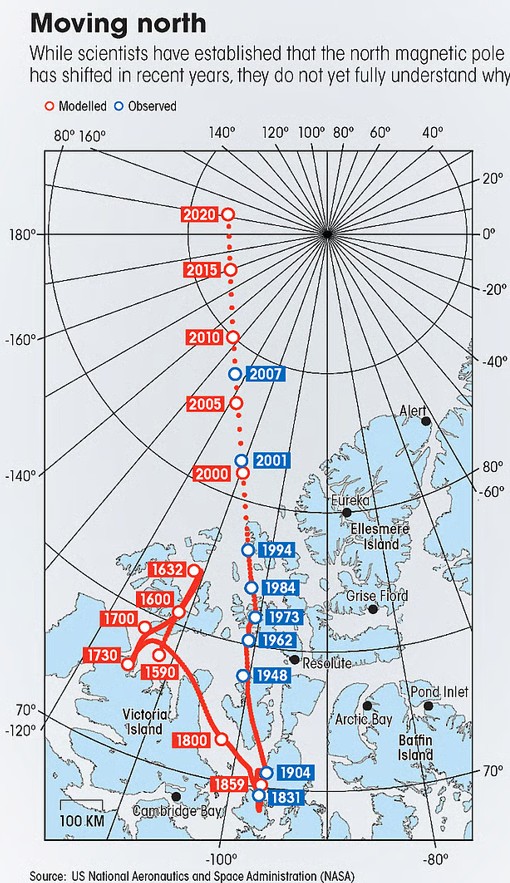
    • Pole Movement: Since 1831, the north magnetic pole has shifted 1,100 km toward Siberia and now moves at 35 km/year, while the south pole is more stable.

    Implications of Magnetic Flip-Flop:

    • Radiation Exposure: A weaker magnetic field during flip-flop allows more cosmic radiation, affecting:
      • Satellites and astronauts
      • Navigation and communication systems
      • Power grids and electronics
    • Protective Shield: Earth’s atmosphere still protects against harmful radiation even when the magnetic field is weak.
    • Climate & Ozone Effects: Events like Laschamps may have altered the ozone layer and climate, but no confirmed link to mass extinctions.
    • South Atlantic Anomaly: A current weak-field region affecting spacecraft over South America and South Africa.
    • Monitoring Tools: Scientists use satellites, ice cores, volcanic rocks, and geomagnetic observatories to track field changes.
    • Global Guidance: The World Magnetic Model, updated every 5 years, supports navigation systems worldwide.
    • Prediction Outlook: Though timing of future reversals is uncertain, computer models and cosmic data are improving forecasts.
    [UPSC 2017] Consider the following statements:

    1. The Earth’s magnetic field has reversed every few hundred thousand years.

    2. When the Earth was created more than 4000 million years ago, there was 54% oxygen and no carbon dioxide.

    3. When living organisms originated, they modified the early atmosphere of the Earth.

    Which of the statements given above is/are correct?

    Options: (a) 1 only (b) 2 and 3 only (c) 1 and 3 only * (d) 1, 2 and 3


  • New Species of Plants and Animals Discovered

    New Cambrian sea creature Mosura fentoni discovered in Canada

    Why in the News?

    Scientists have discovered a new sea creature from the Cambrian period named Mosura fentoni, found in Canada’s Burgess Shale, one of the most important fossil sites in the world.

    New Cambrian sea creature Mosura fentoni discovered in Canada

    About Mosura fentoni:

    • Discovery Site: Mosura fentoni was discovered in Canada’s Burgess Shale, a well-known Cambrian fossil site.
    • Biological Group: It belongs to radiodonts, an extinct group of marine predators related to insects, crabs, and spiders.
    • Size and Structure: The creature is very small (1.5 to 6 cm) but has a long, complex body made of 26 segments.
    • Body Zones:
      • The neck supports the head.
      • The mesotrunk has six paddle-shaped flaps for swimming, like mini propellers.
      • The posterotrunk has up to 16 segments with rows of thin gills and small flaps.
    • Breathing Adaptation: The gills in the posterotrunk likely acted as a breathing zone, similar to the tails of horseshoe crabs that help collect oxygen.

    Evolutionary Importance:

    • Arthropod Evolution: The find helps explain how early arthropods (like modern insects and crustaceans) evolved diverse forms.
    • Advanced Abilities: Despite its small size, M. fentoni had specialised swimming and breathing systems.
    • Evolutionary Position: It is placed near the base of the hurdiid family in the radiodont family tree.
    • Segment Specialisation: Its body shows early examples of segment division for specific tasks — a trait common in modern arthropods.
    • Key Insight: The discovery suggests that complex body planning in arthropods began much earlier than previously thought.

    Back2Basics: Cambrian Period:

    • The Cambrian Period is a division of the geologic time scale that lasted from approximately 541 million to 485 million years ago.
    • It is the first period of the Paleozoic Era and follows the Precambrian Eon.
    • It is significant because it marks a time when most major animal groups first appeared in the fossil record.
    • This period is characterized by the development of complex, multicellular life, especially in marine environments.
    • The Cambrian Explosion refers to a relatively short evolutionary event—occurring around 541 million years ago—during which a vast number of new animal species and body plans rapidly emerged.
    • Within about 20 to 25 million years, nearly all major animal phyla (like arthropods, mollusks, and chordates) appeared.
    • This explosion of biodiversity is seen as one of the most important evolutionary events in Earth’s history.


    [UPSC 2019] The word ‘Denisovan’ is sometimes mentioned in media in reference to-

    Options: (a) fossils of a kind of dinosaurs (b) an early human species* (c) a cave system found in North-East India. (d) a geological period in the history of Indian subcontinent


  • Parliament – Sessions, Procedures, Motions, Committees etc

    Elections to the Rajya Sabha

    Why in the News?

    The Election Commission of India has announced biennial elections for eight Rajya Sabha seats, including two seats from Assam and six seats from Tamil Nadu.

    These elections are part of the regular process through which

    About Elections to the Rajya Sabha:

    • Rajya Sabha members are indirectly elected by the elected members of the State Legislative Assemblies and Union Territory electoral colleges (Delhi and Puducherry).
    • The elections follow the proportional representation system through the Single Transferable Vote (STV) method.
    • Voting is done using an Open Ballot to ensure transparency and party discipline.
    • Composition of the Rajya Sabha:
      • It can have a maximum of 250 members.
      • Out of these, 238 members are elected, and 12 are nominated by the President of India for contributions to art, literature, science, and social service.
      • As of now, the RS has 245 members233 elected and 12 nominated.
      • One-third of RS members retire every two years.
    • Voting Requirements and Process:
      • A candidate must be proposed by at least 10 members of the State Legislative Assembly or 10% of the party’s strength in the Assembly.
      • Voters rank candidates by preference under the Single Transferable Vote system.
      • If a candidate is eliminated or elected, their votes are transferred to the next preference on the ballot.
      • Voting is done using an Open Ballot system to promote transparency.
    • Quota for Election:
      • To win, a candidate must secure a vote quota, calculated as:
        (Total valid votes / (Number of vacancies + 1)) + 1.
    • Tenure of Members:
      • RS is a permanent body and cannot be dissolved.
      • However, one-third of its members retire every two years, and new members are elected.
      • Each Rajya Sabha member serves a six-year term.
    • Chairmanship and Leadership:
      • The Vice President of India is the ex-officio Chairman of the Rajya Sabha.
      • A Deputy Chairman is elected by the Rajya Sabha members from among themselves.
    • Eligibility (as per Article 84):
      • A candidate must be a citizen of India.
      • The minimum age required is 30 years.
      • The candidate must also meet other qualifications specified by the Constitution or law.
    • Disqualification of Members:
      • A member can be disqualified for defection under the anti-defection law.
      • Disqualification can also happen due to criminal convictions, bankruptcy, or being declared of unsound mind.
    • Administrative and Historical Details:
      • The first sitting of the Rajya Sabha was held on May 13, 1952.
      • The Secretary General of the Rajya Sabha acts as the chief executive and administrative head of the Rajya Sabha Secretariat.

    Tap here to read everything about the Rajya Sabha.

    [UPSC 2020] Rajya Sabha has equal powers with Lok Sabha in:

    Options: (a) the matter of creating new All India Services (b) amending the Constitution* (c) the removal of the government (d) making cut motion


Join the Community

Join us across Social Media platforms.