💥UPSC 2026, 2027, 2028 UAP Mentorship (March Batch) + Access XFactor Notes & Microthemes PDF

Archives: News

  • New Species of Plants and Animals Discovered

    Squalus hima: A new deep-water Dogfish Shark discovered in Kerala

    Why in the News?

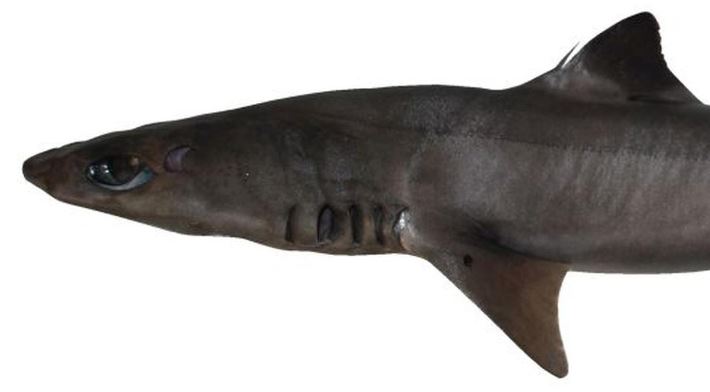
    Scientists from the Zoological Survey of India (ZSI) have discovered a new species of deep-water dogfish shark, Squalus hima, from the Sakthikulangara fishing harbour in Kerala along the Arabian Sea.

    About Squalus hima

    • Squalus is a genus of dogfish sharks in the family Squalidae, commonly known as spurdogs, characterized by smooth dorsal fin spines.
    • The new species, Squalus hima sp. nov., has been misidentified with S. mitsukurii and S. lalannei in the past.
    • Squalus hima differs from other species by the number of precaudal vertebrae, total vertebrae, teeth count, trunk and head heights, fin structure, and fin colour.

    Comparison with Other Species

    • On the Indian coast, two species of Squalus are found from the southwest coast of India.
    • The new species, Squalus hima n.sp., is very similar to Squalus lalannei but differs in many characteristics.
    • Species in the Squalus megalops group are characterized by an angular short snout, a small mouth almost as wide as the snout, the first dorsal fin origin behind the pectoral fins, and a body without any spots.

    Economic and Conservation Implications

    • Sharks in the genus Squalus and Centrophorus are exploited for their liver oil, which contains high levels of squalene, used in high-end cosmetic and anti-cancer products.
    • Fishermen from southern India and the Andaman and Nicobar Islands harvest these sharks for their liver oil, making conservation of these species critical.

    Importance of the Discovery

    • The discovery of Squalus hima is significant for the conservation of shark species exploited for commercial purposes.
    • Dogfish sharks are commercially important for their fins, liver oil, and meat and are sometimes caught as by-catch in fisheries targeting other species.

    PYQ:

    [2019] Consider the following pairs:

    Wildlife Naturally found in
    1. Blue-finned Mahseer Cauvery River
    2. Irrawaddy Dolphin Chambal River
    3. Rusty-spotted Cat Eastern Ghats

    Which of the pairs given correctly matched?

    (a) 1 and 2 only

    (b) 2 and 3 only

    (c) 1 and 3 only

    (d) 1, 2 and 3

  • RBI Notifications

    RBI Circular on Liberalised Remittance Scheme (LRS)

    Why in the News?

    The Reserve Bank of India (RBI) has broadened the regulations governing remittances to International Financial Services Centres (IFSCs) under the Liberalised Remittance Scheme (LRS). The RBI’s circular authorizes “authorised persons” to facilitate remittances for all permissible purposes under LRS to IFSCs.

    About Liberalised Remittance Scheme (LRS)

    • LRS is governed by the Foreign Exchange Management Act (FEMA) 1999, regulated by the Reserve Bank of India (RBI).
    • The scheme was introduced by the RBI in 2004 to facilitate outward remittances from India.
    • LRS allows resident individuals, including minors, to remit a specified amount of money abroad each financial year (April – March).
    • Currently, individuals are allowed to remit up to USD 250,000 per financial year under LRS.
    • Funds remitted under LRS can be used for permissible current or capital account transactions, or a combination of both.
    • Permissible Uses:
      • Expenses related to travel (private or for business).
      • Medical treatment abroad.
      • Payment of fees for education abroad.
      • Gifts and donations.
      • Maintenance of close relatives.
      • Investment in shares, debt instruments, and immovable properties overseas.
    • Accounts: Individuals can open and maintain foreign currency accounts with banks outside India for transactions permitted under LRS.
    • Exclusions: LRS is NOT available to corporations, partnership firms, Hindu Undivided Families (HUFs), trusts, etc.

    Prohibited Transactions:

    • Remittances for activities prohibited under Schedule-I of FEMA, such as purchase of lottery tickets, sweepstakes, proscribed magazines, etc.
    • Trading in foreign exchange abroad.
    • Remittances to countries identified as non-cooperative by the FATF.
    • Remittances to individuals/entities identified as posing a terrorism risk by the RBI.

    Significance of the move

    • The RBI’s decision reinforces GIFT IFSC’s position as a prominent international financial services hub.
    • By broadening the scope of LRS, GIFT IFSC aims to attract more diverse investments and transactions, contributing to the growth of India’s financial sector.
  • Wetland Conservation

    Species in News

    Description

    Cyrtobagus salvinia

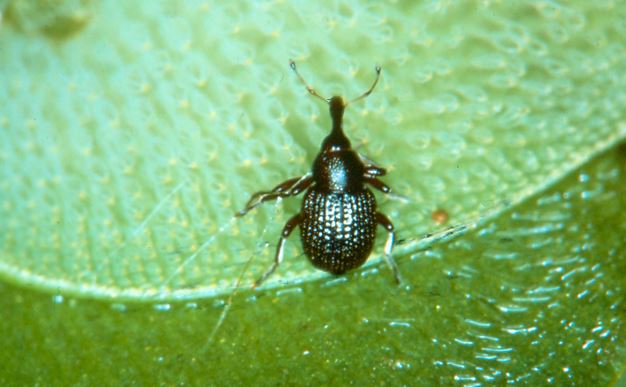
    • Context: Used to eradicate the invasive weed Salvinia molesta from the Sarani reservoir in Betul district, Madhya Pradesh.
    • Biological Details: Exotic beetle from Brazil, targets and eradicates Salvinia molesta, dies naturally post-eradication.
    • Bioremediation: Implemented by ICAR-DWR (Indian Council of Agricultural Research-Directorate of Weed Research), started in April 2022, completed within 15 to 18 months.
    • Economic and Social Impact: Restored livelihoods for fishermen by reviving fish populations; initial challenges included high cost and impracticality of manual removal.
    • Conservation Status: No risk, as the beetle dies naturally after eradicating the weed.

    Squalus hima


    • Context: Newly discovered species of deep-water dogfish shark found in the Arabian Sea off the coast of Kerala.
    • Biological Details: Genus Squalus, family Squalidae, commonly known as spurdogs; differs in vertebrae count, teeth, and fin structure from other species.
    • Discovery: Discovered by Zoological Survey of India (ZSI) at Sakthikulangara fishing harbour, Kerala; significant for new species identification and conservation.
    • Economic and Social Impact: Important for commercial products like liver oil used in cosmetics and anti-cancer products; challenges include high exploitation for liver oil, fins, and meat.
    • Conservation Status: Critical due to high commercial exploitation for liver oil, fins, and meat; important for conservation efforts.


    PYQ:

    [2018] Why is a plant called Prosopis juliflora often mentioned in the news?

    (a) Its extract is widely used in cosmetics.

    (b) It tends to reduce the biodiversity in the area in which it grows.

    (c) Its extract is used in the synthesis of pesticides.

    (d) None of the above.


    [2019] Consider the following pairs:

    Wildlife Naturally found in
    1. Blue-finned Mahseer Cauvery River
    2. Irrawaddy Dolphin Chambal River
    3. Rusty-spotted Cat Eastern Ghats

    Which of the pairs given correctly matched?

    (a) 1 and 2 only

    (b) 2 and 3 only

    (c) 1 and 3 only

    (d) 1, 2 and 3

  • Food Procurement and Distribution – PDS & NFSA, Shanta Kumar Committee, FCI restructuring, Buffer stock, etc.

    The PDS impact on household expenditure   

    Why in the news? 

    The Household Consumption Expenditure Survey Data provides an opportunity to analyze the effects of social transfers.

    About Public Distribution System (PDS):

    • The Public Distribution System (PDS) aims to ensure food security by providing subsidized foodgrains to economically vulnerable sections of society. Under the National Food Security Act (NFSA), 2013, up to 75% of the rural population and 50% of the urban population are eligible for subsidized foodgrains.
    • Foodgrains procured by the Food Corporation of India (FCI) are distributed through a network of Fair Price Shops (FPS).

    Its structural mandate: 

    • Procurement and Distribution: The PDS operates through the procurement of foodgrains by the Food Corporation of India (FCI) from farmers at Minimum Support Prices (MSP). These foodgrains are then allocated to states and union territories based on their requirements and distributed to Fair Price Shops (FPS), which deliver subsidized foodgrains to eligible beneficiaries.
    • Identification and Subsidy: Beneficiaries are identified based on the Socio-Economic and Caste Census (SECC) data, classifying households into Priority Households and Antyodaya Anna Yojana (AAY) households. Under the National Food Security Act (NFSA), 2013, eligible households receive rice at ₹3 per kg, wheat at ₹2 per kg, and coarse grains at ₹1 per kg. The system aims to ensure that food security is maintained for the economically vulnerable sections of society.

    Observations made by the HCES:2022-23 report  

    • The Household Consumption Expenditure Survey (HCES) 2022-23 provides insights into the coverage of social welfare programs, including the Public Distribution System (PDS).
    • The survey highlights discrepancies between administrative data and survey estimates due to inclusion and exclusion errors, offering detailed characteristics of households benefiting from these programs.

    Imputation of values for food and non-food items    

    Note: Imputation of values for food and non-food items refers to the process of assigning a monetary value to items received by households for free or at a subsidised rate through social welfare programs like the Public Distribution System (PDS) in India.

    • Purpose: Imputation is done to estimate the total consumption expenditure of households more accurately. It accounts for the fact that households receive goods (such as foodgrains from PDS) without directly paying for them, thus impacting their overall consumption.
    • Methodology: The National Sample Survey Office (NSSO) and other agencies use statistical methods to assign a value to these items. This involves determining the modal (most common) or percentile prices of the items received, which may vary by state and rural/urban classification.
    • Types of Items Imputed: Imputation covers both food and non-food items. In the context of the PDS, it primarily includes foodgrains but can extend to other essential commodities provided through government schemes.
    • Data Sources: Data for imputation can come from surveys like the HCES, where households report receiving these items. NSSO surveys typically provide detailed guidelines on how imputation values are derived and applied in their reports.
    • Impact on Analysis: Imputing values allows analysts to compute metrics like the Monthly Per Capita Consumption Expenditure (MPCE) accurately, reflecting the true economic status and welfare impact of households.

     Implications for Poverty

    • Economic Relief for Poorer Households: By providing foodgrains at highly subsidized rates, the PDS reduces the financial burden on poorer households, allowing them to allocate their limited resources to other essential needs.
    • Enhanced Measurement of Poverty: Imputing the value of free or subsidised items received through programs like the PDS allows for a more comprehensive assessment of household consumption. Including these imputed values in poverty measurements provides a more accurate reflection of the economic well-being of households.
    • Policy Insights and Targeting: Understanding how imputed values impact poverty metrics helps policymakers in targeting social welfare programs more effectively.
    • Diversification of Diet: Access to subsidized foodgrains from the PDS allows households to free up resources, potentially enabling them to purchase a more diverse range of nutrient and protein-rich foods such as vegetables, milk, pulses, eggs, fish, and meat

    Way forward: 

    • Enhancing Efficiency and Targeting: Improve the identification and targeting of beneficiaries through updated and accurate data collection methods. Continuous validation and updating of Socio-Economic and Caste Census (SECC) data can help in reducing inclusion and exclusion errors.
    • Promoting Nutritional Security and Health Outcomes: Expand the scope of subsidized items beyond basic grains to include more nutritious food options like pulses, edible oils, and fruits.

    Mains PYQ: 

    Q What are the major challenges of Public Distribution System (PDS) in India? How can it be made effective and transparent? (2022)

    Q Food Security Bill is expected to eliminate hunger and malnutrition in India. Critically discuss various apprehensions in its effective implementation along with the concerns it has generated in WTO. (2013)

  • ISRO Missions and Discoveries

    ISRO’s plans to venture into planetary defence 

    Why in the news? 

    Last week, ISRO Chairman S Somanath expressed the possibility of engaging with the asteroid Apophis during its close approach to Earth at a distance of 32,000 km in 2029. However, the specific manner of ISRO’s involvement has not yet been determined.

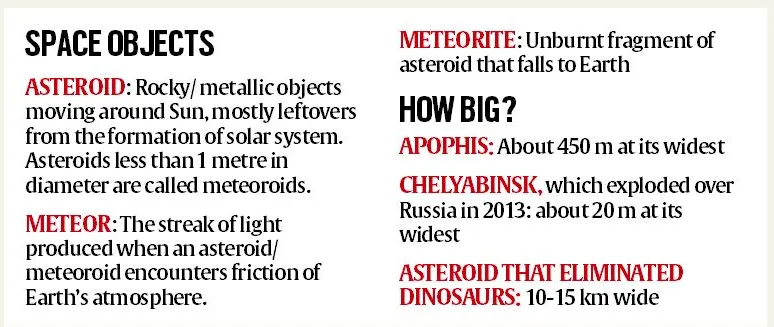
    Space objects: 


    The asteroid Apophis may pose a threat:

    • Initial Concerns: Discovered in 2004, Apophis initially posed a 2.7% chance of colliding with Earth, raising alarms due to its size (about 450 m wide).
    • Revised Risk: Subsequent observations ruled out immediate collision risks in 2029, 2036, and 2068, but it will pass close to Earth in 2029 at 32,000 km.
    • Potential Impact: Its size could cause significant damage if it were to collide with Earth, though recent observations suggest no imminent danger.

    Other possible incoming threats from space:

    • Daily Encounters: Thousands of asteroids enter Earth’s atmosphere daily, most burning up due to friction, causing phenomena like fireballs.
    • Russian Example: In 2013, a 20-meter asteroid exploded above Russia, releasing significant energy and causing damage and injuries.
    • Detection Challenges: Some asteroids are detected only upon entering the atmosphere, especially those coming from the direction of the Sun, which can obscure detection.

    ISRO’s plan: From sci-fi to reality:

    • Planetary Defense Initiative: ISRO aims to develop capabilities in planetary defense, potentially participating in missions to study and potentially deflect asteroids.
    • Collaboration: Considering sending its own spacecraft or collaborating with other space agencies, like NASA, which has already redirected a spacecraft to study Apophis in 2029.
    • Evolution of ISRO: Reflects ISRO’s evolution as a space agency, transitioning from aspirations to reality in tackling global space objectives, demonstrating growing confidence and capabilities.

    Way forward: 

    • Form Partnerships: ISRO should actively seek partnerships with leading space agencies like NASA, ESA (European Space Agency), and others involved in asteroid detection and planetary defense.
    • Joint Missions: Collaborate on joint missions to study and potentially mitigate asteroid threats. This could include sharing resources, technology, and expertise to maximize effectiveness and minimize costs.

    Mains PYQ: 

    Q What is India’s plan to have its own space station and how will it benefit our space programme? (UPSC IAS/2019)

  • Russian Invasion of Ukraine: Global Implications

    How PM Modi’s visit to Austria sends a message both to Moscow and the West

    Why in the news? 

    Prime Minister Narendra Modi selected Vienna as a neutral location to convey a message to both Moscow and the Western countries.

    What message it sent?

    • India’s Diplomatic Signal: Modi’s visit to Vienna after meeting Putin in Moscow underscored India’s commitment to global peace and non-violence.Statements emphasized India’s concern over civilian casualties in conflict zones and the futility of war as a solution.
    • Historical Context: Referencing Austria’s historical neutrality and diplomatic role during the Cold War, Modi’s visit reaffirmed India’s stance on maintaining strategic autonomy. Highlighted India’s support for negotiated settlements and dialogue in international disputes.

    Similarity in ideologies between both countries

    • Neutrality and Non-Alignment: Both India and Austria historically maintained neutrality in global conflicts. Shared values in promoting peace, diplomacy, and non-intervention in internal affairs of other nations.
    • Historical Ties: Nehru’s role in supporting Austria’s sovereignty post-World War II reflected shared principles of neutrality and independence. Both countries value multilateralism and respect for international law.

    Evolution of bilateral relations between India and Austria

    • Establishment of Diplomatic Relations: Diplomatic ties between India and Austria were established in 1949, celebrating 75 years of engagement in 2024.Historical visits by leaders from both countries have strengthened political and economic cooperation.
    • Modern Partnerships: Focus on future-oriented collaborations in infrastructure, renewable energy, technology, and trade. Continuation of bilateral engagements despite global geopolitical shifts, maintaining a balanced approach in international relations.

    Key dimension related to relation between Austria and India: 

    • Political Relations: India intervened in Austria’s favor during negotiations with the Soviet Union on the Austrian State Treaty in 1953.India supported Austria on the UN-South Tyrol conventions. Austria expressed support for India’s bid for a permanent seat on a reformed United Nations Security Council.
    • Economic Relations: As of 2019, there are over 200 collaborations, including 100 technical collaborations and 60 joint ventures between Indian and Austrian firms.Bilateral trade between Austria and India was EUR 2.93 billion in 2023. Austria has received a cumulative foreign direct investment of EUR 1.159 billion from India as of 2023.
    • Cultural Relations: The Indo-Austrian cultural relations date back to the 16th century. The Austrian tradition of Indology began in the 19th century.Rabindranath Tagore visited Vienna in 1921 and 1926, fostering cultural exchange.

    Way forward: 

    • Enhanced Political Dialogue: Increase high-level visits and diplomatic exchanges to deepen understanding and cooperation on global issues like climate change, terrorism, and global health.
    • Support for Multilateral Initiatives: Collaborate in multilateral forums such as the United Nations to promote shared values of peace, neutrality, and respect for international law. Work towards common positions on global challenges.

    Mains PYQ: 

    Q What introduces friction into the ties between India and the United States is that Washington is still unable to find for India a position in its global strategy, which would satisfy India’s National self-esteem. (UPSC IAS/2019)

  • NITI Aayog’s Assessment

    Release of SDG India Index 2023-24- NITI Aayog     

    Why in the news?

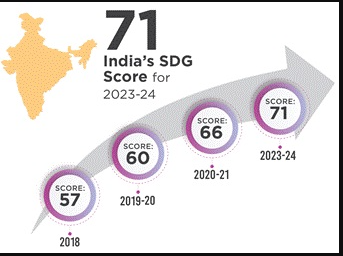
    Overall SDG score for the country is 71 for 2023-24, significant improvement from 66 in 2020-21 and 57 in 2018 (Baseline report).

    About SDG India Index:

    • The SDG India Index is a comprehensive tool developed by NITI Aayog to measure the progress of India and its states/UTs towards achieving the Sustainable Development Goals (SDGs).
    • The index tracks the progress on 113 indicators aligned with the National Indicator Framework of the Ministry of Statistics and Programme Implementation (MoSPI).

    Key highlights and results from the fourth edition of the SDG India Index:     

    • Top Performers: Uttarakhand and Kerala secured the top spots with a score of 79 out of 100, showcasing strong performance across Sustainable Development Goals (SDGs) such as poverty eradication, health, education, and environmental sustainability.
    • National Improvement: India’s overall SDG score improved from 66 points in 2020-21 to 71 points in 2023-24, indicating significant progress in achieving the SDGs nationwide. This improvement reflects efforts in poverty reduction, economic growth, and environmental conservation.
    • State-wise Variations: Bihar ranked lowest with 57 points, indicating areas needing more attention and development. States like Punjab, Manipur, West Bengal, and Assam showed notable improvements, with Punjab leading the pack with an increase of 8 points to reach 76 points.
    • Goal-specific Insights: Goals such as “No Poverty,” “Decent Work and Economic Growth,” and “Life on Land” saw the highest increases in scores, reflecting advancements in income equality, employment opportunities, and biodiversity conservation efforts.
    • Challenges and Focus Areas: Gender Equality received the lowest score at 49 points, highlighting persistent challenges in achieving parity in workforce participation, education access, and political representation. Addressing issues related to hunger and nutrition remains a priority, with the “Zero Hunger” goal scoring 52 points, emphasizing the need for nutritious food access and combating malnutrition.

    How did States and UT performed?    

    • Score Ranges: States’ scores range from 57 to 79, while UTs score between 65 and 77. This indicates an improvement compared to the 2020-21 scores, where the range was 52 to 75 for States and 62 to 79 for UTs.
    • Front Runner Category: There has been a significant increase in the number of States and UTs achieving Front Runner status. In the latest edition, 32 States/UTs scored between 65 and 99, up from 22 in the previous edition. Notably, 10 new States and UTs entered the Front Runner category, including Arunachal Pradesh, Assam, Chhattisgarh, Madhya Pradesh, Manipur, Odisha, Rajasthan, Uttar Pradesh, West Bengal, and Dadra and Nagar Haveli and Daman and Diu.
    • Score Improvements: Across all States and UTs, there has been improvement in composite scores ranging from 1 to 8 points since the 2020-21 edition. Leading in score improvements are Assam, Manipur, Punjab, West Bengal, and Jammu and Kashmir, each showing an increase of 8 points.
    • Methodology: The methodology involves compiling raw data for indicators, setting 2030 targets, normalizing data to a 0-100 score, and calculating Goal scores as means of relevant indicators. The composite score represents an average of all Goal scores, excluding Goal 14 focused solely on coastal States.

    Way forward: 

    • Targeted Interventions for Lagging States: Implement customized, data-driven interventions in States with lower scores, such as Bihar, to address specific challenges in poverty, health, and education.
    • Enhance Focus on Gender Equality and Nutrition: Strengthen policies and programs aimed at improving gender equality and combating malnutrition, particularly by increasing female workforce participation and ensuring access to nutritious food.
  • Wildlife Conservation Efforts

    Zoological Survey of India’s Report on Animal Discoveries 2023

    Why in the News?

    A report titled “Animal Discoveries 2023” by the Zoological Survey of India (ZSI) highlights significant new species findings in Maharashtra and across India.

    New Species in Maharashtra:

    • Maharashtra recorded 14 new animal species in 2023, with two species reported for the first time in India.
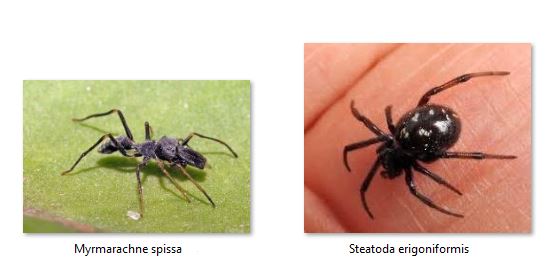
    • Notably, among the 25 Arachnid species reported for the first time in India, two belong to Maharashtra—Steatoda Erigoniformis and Myrmarachne Spissa.
    1. Steatoda Erigoniformis: It is a species of spider known for its resemblance to the more dangerous black widow spiders. They are commonly referred to as “false widow spiders.”
    2. Myrmarachne Spissa: It is part of a group of spiders that mimic ants in appearance and behaviour, a trait known as myrmecomorphy. Previously reported in Sri Lanka, Myrmarachne Spissa’s discovery in Pune marks its first report from India, highlighting the region’s biodiversity significance.

    Key Findings from the ZSI Report:

    • National Discoveries:
      • In 2023, Indian scientists reported a total of 641 new discoveries, including 442 new species and 199 new records for India.
      • This includes the discovery of 19 new genera. As of January 1, 2024, India’s faunal diversity stands at 104,561 species, with the additions in 2023 constituting 6.65% of the global faunal diversity.
    • Categories of Discoveries:
      • Invertebrates accounted for the majority of new discoveries with 564 species, while vertebrates contributed 77 species.
      • Among invertebrates, insects led with 369 new species, while vertebrates were dominated by fish with 47 species, followed by reptiles, amphibians, and mammals.
    • Regional Distribution:
      • Kerala reported the highest number of new discoveries (101), followed by West Bengal (72), Tamil Nadu (64), Arunachal Pradesh (45), Karnataka (45), and the Andaman and Nicobar Islands (36).
      • Southern India consistently reports the highest number of species.


    Back2Basics: Zoological Survey of India

    • The ZSI was set up by British zoologist Thomas Nelson Annandale, in 1916.
    • It is the premier taxonomic research organisation in India based in Kolkata.
    • It was established to promote surveys, exploration and research leading to the advancement of our knowledge of various aspects of the exceptionally rich animal life of India.
    • The ZSI had its genesis as the Zoological Section of the Indian Museum at Calcutta in 1875.
    • Since its inception, the ZSI has been documenting the diversity and distribution of the fauna of India towards carrying out its mandate of conducting exploration-cum-taxonomic-research programmes.
    • The ZSI has published an extremely large amount of information on all animal taxa, from Protozoa to Mammalia.


    PYQ:

    [2020] With reference to India’s Biodiversity, Ceylon frogmouth, Coppersmith barbet, Gray-chinned minivet and White-throated redstart are:

    (a) Birds

    (b) Primates

    (c) Reptiles

    (d) Amphibians

  • Renewable Energy – Wind, Tidal, Geothermal, etc.

    Upper Siang Hydropower Project in Arunachal Pradesh

    Why in the News?

    Activists are protesting against the Upper Siang Hydropower Project in Arunachal.

    About Upper Siang Multipurpose Storage Project

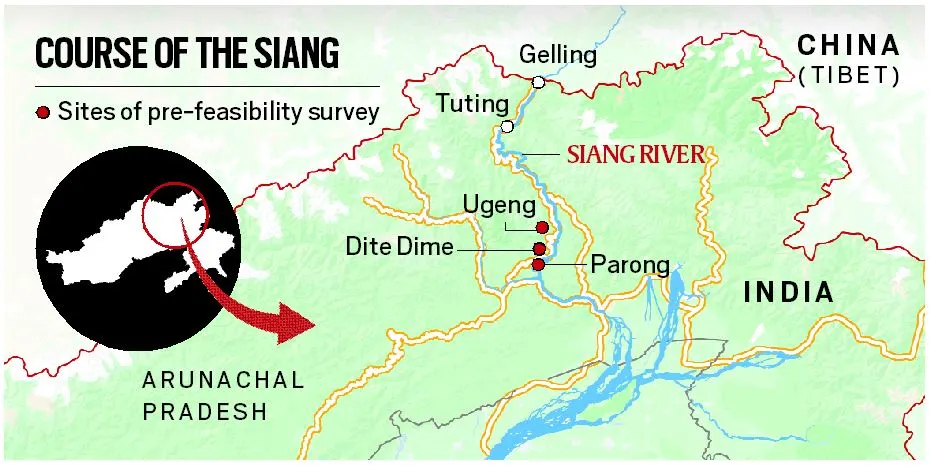
    • The Upper Siang project is a proposed 11,000 MW hydropower project on the Siang River in Arunachal Pradesh.
      • The Siang, originating near Mount Kailash in Tibet (Tsangpo), flows over 1,000 km eastward, enters Arunachal Pradesh as the Siang, and later becomes the Brahmaputra in Assam.
    • Initially proposed as two separate projects, it was consolidated into one larger project in 2017, to be built by the National Hydroelectric Power Corporation (NHPC), featuring a 300-metre high dam.

    Strategic Importance:

    • The Upper Siang project is seen as a strategic move to counter China’s hydel projects on the Tsangpo, particularly a 60,000 MW ‘super dam’ in Tibet’s Medog county.
    • This super dam’s capacity is nearly 3x that of the Three Gorges Dam in China and is intended to divert water to northern China.

    Environmental and Social Concerns

    • Anti-dam organizations express concerns about the project’s environmental and social impact in their memorandum.
    • The memorandum highlights the threat to delicate ecosystems, wildlife habitats, and biodiversity in Arunachal Pradesh, which already hosts numerous dams.
    • The activists are particularly worried about the displacement of communities, as the project could submerge over 300 villages of the Adi tribe, including the district headquarters of Yingkiong.
    • Activists are also wary of the project’s portrayal as a national interest endeavor and are troubled by a provision in the Forest (Conservation) Amendment Act, which exempts strategic projects within 100 km from India’s borders from clearance requirements.

    Back2Basics: Forest (Conservation) Amendment Act, 2023

    Details
    Land Under the Purview of the Act Defines two categories of land under its purview:

    1. Land declared as forest under the Indian Forest Act or any other law, or notified as a forest after 25th October 1980.
    2. Land converted from forest to non-forest use before 12th December 1996.
    Exemptions from the Act Allows exemptions for:

    • Up to 0.10 hectares of forest land for connectivity purposes along roads and railways. 
    • Up to 10 hectares for security-related infrastructure.
    • Up to 5 hectares in Left Wing Extremism Affected Districts for public utility projects.
    • Additionally, strategic projects within 100 km of international borders, LAC, and LoC are also exempted.
    Permitted Activities in Forest Land
    • Includes conservation, management, and development efforts.
    • Activities like zoos, ecotourism facilities, silvi-cultural operations, and specified surveys are exempted from non-forest purposes.
    Assignment/Leasing of Forest Land
    • Extends the prerequisite for obtaining prior approval from the central government for the assignment of forest land to any entity, broadening the scope beyond private entities.
    • It also grants the central government the authority to stipulate the terms and conditions governing such assignments.


    PYQ:

    [2011] The Brahmaputra, Irrawady and Mekong rivers originate in Tibet and flow it through narrow and parallel mountain ranges in their upper reaches. Of these rivers, Brahmaputra makes a “U” turn in its course to flow into India. This “U” turn is due to:

    (a) Uplift of folded Himalayan series

    (b) Syntaxial bending of geologically young Himalayas

    (c) Geo-tectonic disturbance in the tertiary folded mountain chains

    (d) Both (A) and (B) above

  • Animal Husbandry, Dairy & Fisheries Sector – Pashudhan Sanjivani, E- Pashudhan Haat, etc

    [pib] National Gopal Ratna Award, 2024

    Why in the News?

    • The National Gopal Ratna Award (NGRA) 2024 has been awarded by the Department of Animal Husbandry and Dairying.
      • The awards are conferred annually on National Milk Day, which is celebrated on 26th November.

    What is the National Gopal Ratna Award (NGRA)?

    • NGRA is an initiative under the Rashtriya Gokul Mission, launched by the Department of Animal Husbandry and Dairying.
    • Objective: The award aims to promote the conservation and development of indigenous bovine breeds, which are crucial for the sustainability of the dairy sector in India.
    • Categories: NGRA is awarded in several categories:
      • Best Dairy farmer rearing indigenous cattle/buffalo breeds.
      • Best Dairy Cooperative Society (DCS)/ Milk Producer Company (MPC)/ Dairy Farmer Producer Organization (FPO).
      • Best Artificial Insemination Technician (AIT).

    Other aspects of the Award

      • Special Recognition: In recent years, a special award category has been included for the North Eastern Region (NER) states to encourage dairy development activities in these regions.
    • Nomination and Recognition: Nominations for the NGRA are submitted online through the National Award portal.
    • Award Details:
    • NGRA 2024 will confer awards in 1st, 2nd, and 3rd ranks, and one Special Award for the NER States in each category.
    • Cash prizes for Best Dairy Farmer and Best DCS/FPO/MPC categories:
      • Rs. 5,00,000/- (1st rank)
      • Rs. 3,00,000/- (2nd rank)
      • Rs. 2,00,000/- (3rd rank)
      • Rs. 2,00,000/- (Special Award for NER).
    • Best AIT category: Certificate of merit and a memento, without any cash prize.

    Back2Basics: Rashtriya Gokul Mission

    Details
    About
    • Implemented for development and conservation of indigenous bovine breeds since December 2014.
    • Continued under the umbrella scheme Rashtriya Pashudhan Vikas Yojana from 2021 to 2026 with a budget of Rs.2400 crore.
    Nodal Ministry Ministry of Fisheries, Animal Husbandry and Dairying
    Objectives
    • Enhance productivity of bovines and increase milk production sustainably using advanced technologies.
    • Propagate the use of high genetic merit bulls for breeding purposes.
    • Enhance artificial insemination coverage by strengthening the breeding network and providing services at farmers’ doorsteps.
    • Promote indigenous cattle & buffalo rearing and conservation in a scientific and holistic manner.


    PYQ:

    [2015] Livestock rearing has a big potential for providing non-farm employment and income in rural areas. Discuss suggesting suitable measures to promote this sector in India.

Join the Community

Join us across Social Media platforms.