💥UPSC 2026, 2027, 2028 UAP Mentorship (March Batch) + Access XFactor Notes & Microthemes PDF

Archives: News

  • LGBT Rights – Transgender Bill, Sec. 377, etc.

    At the end of Pride Month, assessing the LGBTQIA+ communities’ rights   

    Why in the news? 

    Every June, Pride Month is celebrated globally to honour the contributions of LGBTQIA+ community members and to promote love, diversity, and acceptance.

    Varying rights and status of LGBTQIA+ communities across the world:
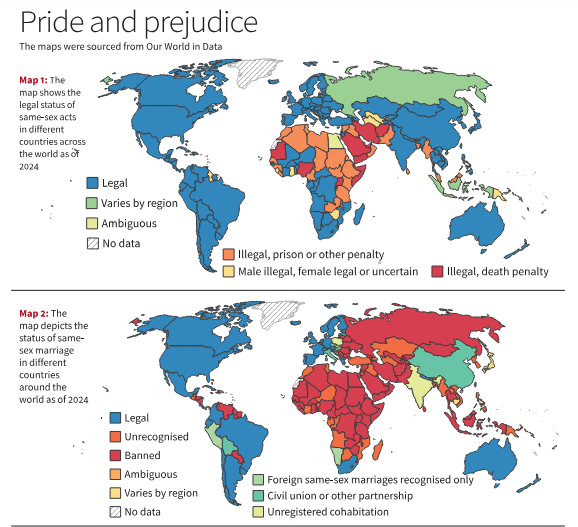
    • Legalization and Criminalization of Same-Sex Acts: The legal status of same-sex acts varies significantly while 37 countries have fully legalized same-sex marriage, 59 countries still penalize any expression of queerness, with severe punishments in some regions.
    • Marriage Rights: Same-sex marriage is legal in 37 countries, banned in 79 countries, and in some places, same-sex couples can only opt for civil unions, leaving their status partially recognized.
    • Employee Protections: Legal protections for queer employees are inconsistent. While 27 countries offer legal aid based on sexual orientation, 90 countries lack any legal protections for queer employees. India and three other countries provide legal aid based on gender identity, including transgender persons.
    • Adoption Rights: Adoption rights for same-sex couples also vary. In 39 countries, same-sex parents can adopt children, while 45 countries ban this practice. In 100 countries, single parents can adopt under certain conditions, similar to India’s laws.
    • Social and Legal Challenges: Despite legal advancements in some areas, LGBTQIA+ individuals globally continue to face significant social and legal challenges, including discrimination, harassment, and exclusion, with varying levels of legal aid and recognition depending on the country.

    Indian Scenario

    • Decriminalization of Homosexuality: In 2018, the Supreme Court of India partially struck down Section 377 of the Indian Penal Code, decriminalizing homosexuality. Same-sex couples have the right to cohabitation but not to legal marriage or unions.
    • Discrimination and Harassment: Queer individuals in India still face significant discrimination, harassment, and exclusion.
    • Legal Protections for Transgender and Intersex Individuals: The Transgender Persons (Protection of Rights) Act, 2019, prohibits unfair treatment in employment, education, healthcare, public facilities, and residence. Legal recourse is available for discrimination based on gender identity but not sexual orientation.
    • Adoption Rights: Same-sex couples cannot be recognized as co-parents to an adopted child. Single prospective adoptive parents, regardless of marital status, are allowed to adopt under the Juvenile Justice (Care and Protection of Children) Act, 2015.

    Way forward: 

    • Expand Legal Recognition: Countries should work towards fully recognizing same-sex marriages and providing comprehensive legal protections against discrimination based on sexual orientation and gender identity.
    • Education and Awareness: Implement nationwide educational programs to raise awareness about LGBTQIA+ issues, combat stereotypes, and promote understanding and acceptance. This can involve incorporating LGBTQIA+ history and rights into school curriculums and conducting public awareness campaigns.
    • Economic Opportunities: Ensure equal opportunities in the workplace by promoting diversity and inclusion policies, providing sensitivity training for employers, and supporting LGBTQIA+ entrepreneurs. Governments and organizations can offer grants, mentorship programs, and other resources to empower LGBTQIA+ individuals economically.

    Mains PYQ: 

    Q ‘Women’s movement in India has not addressed the issues of women of lower social strata.’ Substantiate your view. (UPSC 2018)

  • RBI Notifications

    What is Project Nexus that RBI has signed up for?

    Why in the news? 

    The Reserve Bank of India (RBI) has become a part of Project Nexus, a global initiative aimed at facilitating instant cross-border retail payments by connecting domestic Fast Payments Systems (FPSs).

    What is Project Nexus?

    • Project Nexus is conceptualized by the Innovation Hub of the Bank for International Settlements (BIS).
    • It is the first BIS Innovation Hub project in the payments area moving towards live implementation.
    • Aim: To enhance cross-border payments by connecting multiple domestic instant payment systems (IPS) globally.
    • The Reserve Bank of India (RBI) has joined Project Nexus, aiming to interlink India’s Unified Payments Interface (UPI) with the Fast Payments Systems (FPSs) of Malaysia, the Philippines, Singapore, and Thailand.
    • The platform is designed to be extended to more countries in the future.

    About Fast Payments Systems (FPSs):

    Fast payment systems (FPSs) are real-time payment systems that enable the immediate transfer of funds between accounts. Some key points about FPSs:

    • FPSs allow for the fast, secure, and low-cost processing of retail transactions, ensuring funds are immediately available to the recipient.
    • FPSs are becoming increasingly popular globally, with over 100 jurisdictions now having access to fast payment systems. They foster competition among payment service providers and serve as a gateway to additional financial services.
    • The design of FPSs is important, as they have public good characteristics. Factors that contribute to greater adoption of FPSs include central bank involvement, inclusion of non-bank providers, more use cases, and more cross-border connections.
    • The Payment and Settlement Systems Act, of 2007 regulates and supervises payment systems in India. It designates the Reserve Bank of India has the authority for that purpose and all related matters.

    What are the benefits of the platform?

    • Standardization: Project Nexus standardizes the way IPS connect to each other, simplifying the process.
    • Single Connection: Payment system operators can connect to the Nexus platform once, allowing them to reach all other countries on the network without building custom connections for each.
    • Instant Payments: Enables cross-border payments from sender to recipient within 60 seconds in most cases.
    • Cost Efficiency: Provides near-zero cost for sending and receiving payments.
    • Growth Acceleration: Significantly accelerates the growth of instant cross-border payments by leveraging existing instant payment systems.

    Way forward: 

    • Expand Membership: Actively encourage more countries to join Project Nexus, thereby increasing the global reach and impact of the platform. (Indonesia is joining in the near future)
    • Enhance Technological Infrastructure: Invest in robust and scalable technological infrastructure to support seamless integration and interoperability among different FPSs.

    Mains PYQ:

    Q What is Cryptocurrency? How does it affect global society? Has it been affecting Indian society also? (UPSC IAS/2021)

  • Wildlife Conservation Efforts

    Worlds Oldest Prehistoric Ostrich Nest discovered in Andhra 

    ostrich
    PC: India Today

    Why in the News?

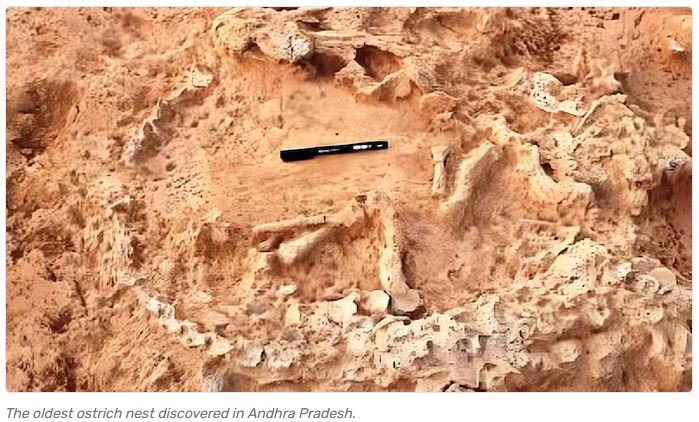
    Archaeologists have discovered a 41,000-year-old ostrich nest in Prakasam, Andhra Pradesh.

    Prehistoric Ostrich Nest: Details of the Discovery

    • The nest, identified as the world’s oldest known ostrich nest, measures 9-10 feet in width.
    • The nest was once home to 9-11 eggs but was capable of holding 30-40 eggs at a time.
    • Ostriches are mega omnivores, weighing between 90 and 140 kg and standing seven to nine feet tall.

    What are Megafauna?

    • Megafauna generally refers to animals weighing more than 50 kg, though scientific definitions vary.
    • The term was first used by Alfred Russel Wallace in his 1876 book, “The Geographical Distribution of Animals.”
    • Megafauna can be classified into:
      • Megaherbivores (plant-eaters),
      • Megacarnivores (meat-eaters), and
      • Megaomnivores (who eat both plants and meat).

    Historical Evidence of Megafauna

    • Early Documentation: Richard Lydekker in 1884 presented the earliest documented evidence of ostriches in the subcontinent, identifying the extinct Struthio asiaticus in the Dhok Pathan deposits in Upper Siwalik Hills, present-day Pakistan.
    • Discoveries in Maharashtra: Archaeologist S A Sali in 1989 reported ostrich eggshell beads and engraved pieces dating back to 50,000–40,000 years ago at Patne, Maharashtra.
    • CCMB Research in 2017: Researchers at the Centre for Cellular and Molecular Biology (CCMB) in Hyderabad established the presence of ostriches in Rajasthan, Madhya Pradesh, and Gujarat 25,000 years ago.

    Broader Implications and Studies

    • Biogeographical Dispersion: The presence of ostriches in India is attributed to bio-geographical dispersion from the continental drifting of Gondwanaland.
    • Late Quaternary Extinctions: The study, titled ‘Late Quaternary extinctions in the Indian Subcontinent,’ established that the disappearance of large animals began around 30,000 years ago, coinciding with the arrival of humans.
    • Co-Evolution Hypothesis: The study supports the hypothesis that fauna and their resilience to extinction resulted from coevolution with hominins, with geographic isolation and abiotic factors accelerating extinction.

    PYQ:

    [2018] The term “sixth mass extinction/sixth extinction” is often mentioned in the news in the context of the discussion of:

    (a) Widespread monoculture practices in agriculture and large-scale commercial farming with indiscriminate use of chemicals in many parts of the world that may result in the loss of good native ecosystems.

    (b) Fears of a possible collision of a meteorite with the Earth in the near future in the manner it happened 65 million years ago that caused the mass extinction of many species including those of dinosaurs.

    (c) Large-scale cultivation of genetically modified crops in many parts of the world and promoting their cultivation in other parts of the world which may cause the disappearance of good native crop plants and the loss of food biodiversity.

    (d) Mankind’s over-exploitation/misuse of natural resources, fragmentation/loss of natural habitats, destruction of ecosystems, pollution and global climate change.

  • Foreign Policy Watch: India-South Korea

    India seeks Tariff Elimination on key items in CEPA Talks with South Korea

    Why in the News?

    • India wants, South Korea to eliminate tariffs on items such as varieties of meat, milk, fruits, fish, stones, yarn, and petroleum products.
      • These items were previously exempted or protected against steep cuts in the India-Korea Comprehensive Economic Partnership Agreement (CEPA).

    What is CEPA?

    Details
    Definition A CEPA is a broad trade agreement that encompasses trade in goods and services, investments, intellectual property rights, and economic cooperation.
    Key Components
    • Trade in Goods: Reduction/elimination of tariffs and non-tariff barriers.
    • Trade in Services: Liberalization of service sectors.
    • Investment: Protection and promotion of investments.
    • Intellectual Property Rights (IPR): Strengthening protection of IPR.
    • Economic Cooperation: Collaboration on economic and technical aspects.
    • Dispute Resolution: Mechanisms for resolving disputes.
    Objectives
    • Enhance bilateral trade.
    • Promote investment.
    • Foster economic integration.
    • Encourage innovation and economic growth.
    Examples
    • India-Japan CEPA: Signed in 2011, focuses on tariff reduction, service trade liberalization, and investment promotion.
    • India-Mauritius CECPA: Effective from April 2021, includes provisions on trade in goods, services, and investment.
    • India-UAE CEPA: Entered into force on May 1, 2022
    Significance for India
    • Economic Growth: Provides new markets for Indian goods and services.
    • Job Creation: Increased trade and investment can create jobs.
    • Technological Advancements: Access to new technologies and best practices.
    • Strategic Partnerships: Strengthens economic and strategic ties.
    Challenges
    • Implementation Issues: Requires robust legal and institutional frameworks.
    • Domestic Industry Impact: Concerns about increased competition.
    • Regulatory Harmonization: Differences in regulatory standards can pose challenges.

    India-South Korea CEPA: A quick recap

    • The India-South Korea CEPA was signed in August 2009 and implemented in January 2010.
    • It covers trade in goods, investments, services, and bilateral cooperation.
    • Tariff Concessions:
      • India offered tariff elimination or concessions on 83.8% of tariff lines from South Korea.
      • While South Korea offered concessions on 93.2% of tariff lines.

    Upcoming Negotiations

    • Trade Deficit Focus: Narrowing the trade deficit with South Korea is high on India’s agenda.
    • Stakeholder Involvement: Indian industry stakeholders have been provided with a draft request list and asked to suggest more items for tariff cuts or propose deletions if needed.
    • Standards and Technical Barriers: The Department of Commerce has requested the industry to share issues related to SPS (Sanitary and Phytosanitary) and TBT (Technical Barriers to Trade) standards faced while exporting to South Korea.

    Back2Basics:

    Sanitary and Phytosanitary (SPS) Measures:

    • SPS measures are protocols implemented by countries to protect human, animal, and plant life from diseases, pests, and contaminants. 
    • These measures are primarily focused on ensuring the safety of food products and preventing the spread of diseases and pests across borders.
    • SPS measures must be based on scientific evidence and risk assessments to ensure they are appropriate and effective.
    • Examples: quarantine requirements for imported plants and animals, limits on pesticide residues in food, and import bans from regions affected by specific diseases.

    Technical Barriers to Trade (TBT):

    • TBT are regulations and standards related to product safety, quality, and environmental impact.
    • They aim to protect human health and safety, animal and plant life, the environment, and to prevent deceptive practices.
    • These measures should not create unnecessary obstacles to international trade and must be transparent and non-discriminatory.
    • Examples: Labeling requirements for food products, safety standards for electrical appliances, and environmental regulations for vehicle emissions.

    Major Issue: Trade Deficit Concerns

    • Trade Deficit Focus: Reducing the trade deficit with South Korea is a key discussion point for India.
      • Before CEPA (2007-09), India’s average exports to South Korea were $3.4 billion, with imports at $7.3 billion, leading to an average trade deficit of $4 billion.
    • Trade Statistics: In 2023-24, India’s imports from South Korea were $21.13 billion, while exports were only $6.41 billion.
    • Post-CEPA Data: After CEPA (2022-24), average exports increased to $7.1 billion, and imports surged to $19.9 billion, resulting in an average trade deficit of $12.8 billion.
    • GTRI Analysis: The Global Trade and Research Initiative (GTRI) report indicates a 220% increase in the trade deficit from the pre-CEPA period to the post-CEPA period.

    PYQ:

    [2015] The terms ‘Agreement on Agriculture’, ‘Agreement on the Application of Sanitary and Phytosanitary Measures’ and Peace Clause’ appear in the news frequently in the context of the affairs of the:

    (a) Food and Agriculture Organization

    (b) United Nations Framework Conference on Climate Change

    (c) World Trade Organization

    (d) United Nations Environment Programme

  • Wildlife Conservation Efforts

    [pib] Fauna of India Checklist Portal

    Why in the News?

    • The Union Minister of Environment, Forest, and Climate Change (MoEFCC) has launched a portal documenting all animal species in India.
      • The Portal was launched on the 109th Foundation Day of the Zoological Survey of India (ZSI) in Kolkata.

    Back2Basics: Zoological Survey of India

    • The ZSI was set up by British zoologist Thomas Nelson Annandale, in 1916.
    • It is the premier taxonomic research organisation in India based in Kolkata.
    • It was established to promote surveys, exploration and research leading to the advancement of our knowledge of various aspects of the exceptionally rich animal life of India.
    • The ZSI had its genesis as the Zoological Section of the Indian Museum at Calcutta in 1875.
    • Since its inception, the ZSI has been documenting the diversity and distribution of the fauna of India towards carrying out its mandate of conducting exploration-cum-taxonomic-research programmes.
    • The ZSI has published an extremely large amount of information on all animal taxa, from Protozoa to Mammalia.

    About the Fauna of India Checklist Portal

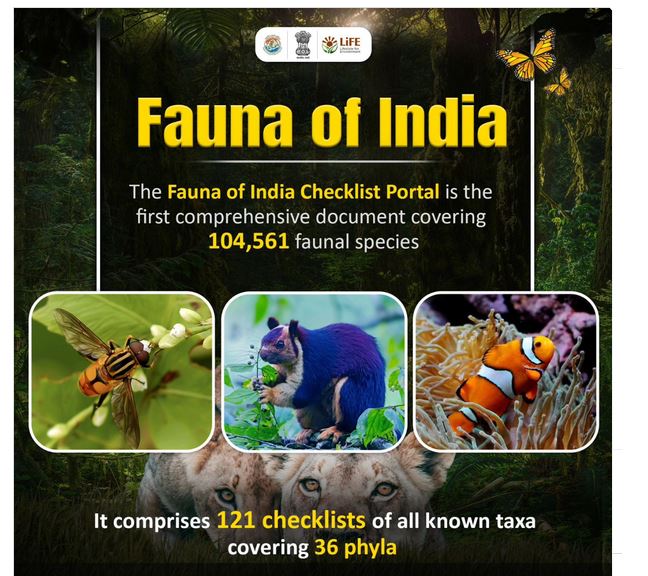
    • The portal consists of records of more than 100,000 animal species, prepared by over 150 scientists of the Zoological Survey of India (ZSI) over two years.
    • This checklist is the first comprehensive document on faunal species in India, covering 121 checklists of all known taxa across 36 phyla, including endemic, threatened, and scheduled species.
    • It is a compilation of all animal species recorded in India since the 1750s, including endemic, threatened, and scheduled species.
    • It provides essential data for conservation and management efforts, forming the basis for all biological sciences.
    • Significance of Portal: 
      • With this, India has become the first country to prepare a checklist of its entire fauna, covering 104,561 species, positioning itself as a global leader in biodiversity conservation.
      • The comprehensive documentation of India’s fauna aligns with Mission LiFE by providing crucial data for biodiversity conservation.

    Details from the ZSI Report

    • A 2023 ZSI report highlights that India is one of the world’s 17 megadiverse nations, hosting around 7-8% of the world’s documented species and containing four of the 34 globally recognised biodiversity hotspots.
    • The report lists 641 discoveries made by scientists and experts from India during 2023 with Kerala topping the list, followed by West Bengal.
    • It includes 442 new species globally and 199 newly recorded species in India.

    Significant Discoveries in 2023

    • New Species: The 2023 findings include 112 hymenopterans, 86 arachnids, 47 new fishes, 20 reptiles, and two mammals.
    • New Mammals: An ibex species found in Himachal Pradesh and Ladakh, named Capra himalayensis, and a new bat species, Miniopterus srinii, was discovered in Kodagu district, Karnataka.
    • State Rankings: Kerala recorded the highest number of new discoveries with 101, followed by West Bengal with 72, Tamil Nadu with 62, and Arunachal Pradesh and Karnataka with 45 each.

    About Mission LiFE

    • Mission LiFE, or Lifestyle for Environment, is a global mass movement initiated by India to encourage individual and community action towards environmental protection and preservation.
    • It was inaugurated by the PM Modi at the 26th UN Climate Change Conference of the Parties (COP26) in Glasgow in November 2021.
    • The program aims to mobilise one billion Indians and individuals worldwide to adopt sustainable lifestyles.
    • It aligns with the P3 model, promoting Pro Planet People and fostering a sense of collective responsibility.
    • It operates based on the principles of ‘Lifestyle of the planet, for the planet, and by the planet’.


    PYQ:

    [2020] With reference to India’s Biodiversity, Ceylon frogmouth, Coppersmith barbet, Gray-chinned minivet and White-throated redstart are:

    (a) Birds

    (b) Primates

    (c) Reptiles

    (d) Amphibians

  • Festivals, Dances, Theatre, Literature, Art in News

    Kozhikode awarded ‘City of Literature’ at UNESCO Creative Cities Network Conference

    Why in the News?

    • “Kozhikode” was awarded the title of ‘City of Literature’ at the 16th annual conference of the UNESCO Creative Cities Network (UCCN) in Braga, Portugal.
      • The theme of this year’s UCCN conference is ‘Bringing youth to the table for the next decade’.

    About UNESCO Creative Cities Network

    Purpose To promote cooperation among cities for cultural and creative industry development
    Initiation Established by UNESCO in 2004
    Seven Categories/Criteria
    • Sector-Specific Excellence: Prominence in one of the seven creative fields: Craft and Folk Art, Media Arts, Film, Design, Gastronomy, Literature, or Music.
    • Commitment to Creativity: Long-term dedication to creativity and culture as key drivers for urban development.
    • Supportive Infrastructure: Established cultural institutions, educational programs, and events promoting creativity.
    • Alignment with SDG 11: Initiatives supporting the 2030 Agenda for Sustainable Development.
    • Inclusivity: Ensuring creative activities are inclusive and accessible to all societal segments.
    Member Cities Over 250 cities from around the world
    Objectives Foster innovation, cultural diversity, and sustainable urban development
    Activities Collaborative projects, cultural events, and initiatives
    Selection Process Cities apply and are designated by UNESCO based on criteria related to creativity
    Network Coordination UNESCO provides coordination and support
    Impact Enhances cities’ cultural identity, economy, and international visibility
    Other Indian Cities in UCCN
    • Gwalior – Music Category (2023)
    • Srinagar– Crafts and Folk Arts (2022)
    • Jaipur– Crafts and Folk Arts (2015)
    • Varanasi– Creative City of Music (2015)
    • Chennai– Creative City of Music (2017)
    • Mumbai– Film (2019)
    • Hyderabad– Gastronomy/Food (2019)

    Reasons for Kozhikode’s Selection

    • Rich Literary Tradition: Kozhikode has a deep and rich literary heritage that spans centuries, contributing significantly to the cultural and intellectual life of the region.
    • Prominent Literary Figures: The city has been home to many renowned authors, poets, and scholars who have significantly contributed to Malayalam literature.
    • Cultural Festivals and Events: Kozhikode hosts various literary festivals, book fairs, and cultural events that promote literature and reading among the community.
    • Educational Institutions: The presence of several prestigious educational institutions that emphasise literature and the arts played a crucial role in its selection.
    • Community Engagement: Active involvement of local communities in promoting and preserving literary culture through libraries, reading clubs, and literary societies.
    • Literary Infrastructure: Well-established libraries, publishing houses, and bookshops that support and nurture the scholarly ecosystem.

    Historic Contributions of Kozhikode

    • Malayalam Literature: Kozhikode has been a centre for Malayalam literature and scholarly activities. It has produced notable literary figures and is a hub for literary festivals and cultural events.
    • Astronomy and Mathematics: The region, under the patronage of the Zamorins, was a centre for advancements in astronomy and mathematics, contributing significantly to the fields through scholars like the 14th-century mathematician and astronomer Madhava of Sangamagrama.
  • Disasters and Disaster Management – Sendai Framework, Floods, Cyclones, etc.

    On Tamil Nadu’s financial distress   

    Why in the news?

    At a June 22 meeting for Union Budget 2024-25, Tamil Nadu’s Finance Minister Thangam Thennarasu requested ₹63,246 crore for Chennai Metro Rail Phase-2, ₹3,000 crore for disaster restoration, and increased unit costs for centrally sponsored schemes.

    How are the funds for phase two of the Chennai Metro Rail distributed?

    • Funding Agencies and International Support: Chennai Metro Rail Phase-2 is financed by multiple international agencies, including the Japan International Cooperation Agency (JICA), Asian Development Bank (ADB), Asian Infrastructure Investment Bank (AIIB), and New Development Bank (NDB).
    • State Government Contributions: Up to March 31, 2024, the Tamil Nadu government sanctioned ₹5,400 crore as share capital for the Chennai Metro Rail Limited (CMRL) and ₹12,013.89 crore as subordinate debt, bearing the entire expenditure due to delays in approval from the Union Cabinet Committee on Economic Affairs (CCEA).

    Is the Centre stalling the funds for the metro project?

    Approval Status:

    • Public Investment Board: The Chennai Metro Rail Project’s Phase-2 was approved by the Public Investment Board (PIB) as a Central sector project under the equity sharing model in August 2021.
    • Union Cabinet Committee on Economic Affairs: The project has been awaiting approval from the Union Cabinet Committee on Economic Affairs (CCEA) since then.

    State Government Actions:

    • Foundation Stone: Despite the pending approval, the foundation stone for the phase was laid by Union Home Minister Amit Shah in November 2020 when the AIADMK was in power.
    • Ongoing Expenditure: The Tamil Nadu government continues to fund the project independently, stressing its finances and urging the Centre to sanction the project under the 50:50 equity sharing model as was done for Phase 1.

    What about funds released by the Centre for restoration work after natural disasters in the State?

    • Initial Request by Tamil Nadu: Tamil Nadu submitted detailed memoranda to the Union government, seeking approximately ₹37,906 crore for restoration works following two natural disaster spells in 2023.
    • Initial Central Release: The Union government initially released a sum of ₹276 crore for immediate restoration efforts.
    • Additional Approvals: The Union Ministry of Home Affairs (MHA) later approved additional assistance of ₹285.54 crore and ₹397.13 crore for the two disaster spells.
    • Disbursed Amounts: From these approvals, a total of ₹115.49 crore and ₹160.61 crore were disbursed under the National Disaster Response Fund (NDRF).
    • State Disaster Response Fund (SDRF): The Union government’s order also mentioned ₹406.57 crore as the 50% available in the State Disaster Response Fund (SDRF) account of Tamil Nadu as of April 1, 2023.

    Way forward: 

    • Metro Rail Project: The Union government should prioritize and expedite the approval process for significant infrastructure projects like the Chennai Metro Rail Phase-2. This can be achieved by setting stricter timelines for the Union Cabinet Committee on Economic Affairs (CCEA) to finalize decisions.
    • Natural Disaster Restoration: The Centre should reassess the current disaster relief funding mechanism to ensure timely and adequate financial support for states hit by natural disasters.

    Mains PYQ:

    Q Discuss the recent measures initiated in disaster management by the Government of India departing from the earlier reactive approach. (UPSC IAS/2020)

  • Judicial Reforms

    New criminal laws in effect; amendments soon

    bns

    Why in the news? 

    Despite objections from the Opposition-ruled States, three new criminal laws took effect nationwide. Union officials emphasized States’ autonomy to amend certain provisions of the Bharatiya Nagrik Suraksha Sanhita (BNSS)

    New Laws Introduced:

    • Bharatiya Nagrik Suraksha Sanhita (BNSS) replaces the Code of Criminal Procedure (CrPC).
    • Bharatiya Nyaya Sanhita (BNS) replaces the Indian Penal Code, 1860.
    • Bharatiya Sakshya (BS) replaces the Indian Evidence Act, 1872.

    Procedural and Evidence Reforms:

    • Cognisable Offences: From July 1, cognisable offences will be registered under Section 173 of BNSS instead of Section 154 of CrPC.
    • Audio-Video Recording: Mandatory audio-video recording of search and seizure operations and compulsory forensic examinations for offences with punishments of seven years or more, with electronic submission of evidence to the court.

    Some provisions of the Bharatiya Nagrik Suraksha Sanhita (BNSS) that replace the Code of Criminal Procedure (Cr.PC.)

    • Procedure for Arrest and Custody: BNSS prescribes new procedures and conditions for arrest, including bail provisions and custody arrangements.
    • Evidence Handling: Mandatory audio-video recording of search and seizure operations in all criminal cases, ensuring transparency and accountability. Compulsory forensic examinations in cases where the offence attracts a punishment of seven years or more.
    • Electronic Submission: All recordings and forensic evidence must be submitted electronically to the court without delay, enhancing efficiency and reducing paperwork.

    About handholding and electronic evidence

    • Training and Support: The Union government has provided comprehensive training and hand-holding for all States to facilitate the transition to the new criminal justice system under BNSS, BNS, and BS.
    • Crime and Criminal Tracking Network Systems (CCTNS): Upgrades to CCTNS enable the filing of e-FIRs and zero FIRs, allowing for remote registration of complaints without the need to visit a police station. CCTNS software has been modified to support FIR registrations in languages other than English and Hindi, ensuring accessibility across linguistic barriers.
    • eSakshya Mobile Application: Under testing, the eSakshya app assists police in recording crime scenes, search operations, and gathering evidence. It facilitates the secure uploading of recorded data to a cloud-based platform hosted by the National Informatics Centre, ensuring data integrity and accessibility.
    • State-Level Preparations: States like Delhi have developed specific applications, such as e-pramaan, to aid in the recording of crime scenes and the generation of digital certificates under the new laws. Some states have distributed necessary equipment like tablets and mobile devices to police stations to ensure compliance with recording and evidence collection requirements.
    • Forensic Capability Timeline: While the BNSS mandates forensic examinations for offences punishable by over seven years imprisonment, states have been given until June 2029 to enhance their forensic capabilities. This includes training police officials in proper evidence collection methods and the use of available resources until full upgrades are completed.

    Way Forward: 

    • Continued Collaboration and Feedback Mechanism: Establish a structured feedback mechanism between the Union government and States to address implementation challenges and refine the new criminal laws, ensuring effective collaboration.
    • Enhanced Public Awareness and Training: Conduct extensive public awareness campaigns and provide ongoing training sessions for law enforcement personnel on the use of new technologies and procedures introduced under BNSS, BNS, and BS.
  • International Monetary Fund,World Bank,AIIB, ADB and India

    IMF | Overlords of the developing world

    Why in the news?

    Once again, mass protests in Kenya, where at least 30 people were fatally shot by police, highlight opposition to an IMF-supported finance Bill proposing essential goods tax hikes.

    Bretton Woods Conference of 1944

    • The Bretton Woods Conference was held in 1944 in New Hampshire, USA. It established the International Monetary Fund (IMF) and the World Bank.
    • The IMF was designed to aid economic development and promote monetary cooperation and stability globally.
    • Criticism: It has been criticized for reflecting and perpetuating power dynamics favouring Western financial interests, with voting rights disproportionately allocated based on financial contributions rather than equal representation.

    Functions of IMF and Recent Challenges Faced by Developing Countries

    • Functions: The IMF aims to provide financial assistance and policy advice to member countries facing balance of payments problems.

    Challenges:

    • Austerity Measures: IMF loans often come with conditions such as austerity measures (like tax hikes and spending cuts) that can be unpopular and detrimental to social services and economic stability.
    • Dependency: Many developing countries face criticism for being overly dependent on IMF loans, which come with stringent conditions that may not always align with local priorities.
    • Public Backlash: There is often a public and political backlash against IMF policies perceived as imposing Western economic ideologies without adequate consideration for local contexts.

    SAP (Structural Adjustment Programs) and Its Impacts

    • Definition: SAPs are economic policies imposed by the IMF and World Bank on developing countries in exchange for loans.

    Impacts:

    • Economic Restructuring: SAPs typically involve privatization, deregulation, and liberalization policies aimed at restructuring national economies towards export-led growth.
    • Social Consequences: They often lead to job losses, reduced public spending on health and education, and increased poverty and inequality.
    • Criticism of SAPs: SAPs have been criticized for exacerbating social inequalities and benefiting Western financial interests over local populations.

    Way forward: 

    • Policy Transparency: The IMF could enhance transparency in its loan conditions and negotiations, ensuring that the terms and impacts of loans are clearly communicated to the public and local stakeholders.
    • Local Consultation: Before implementing major policy changes or austerity measures, the IMF could mandate extensive consultation with local governments, civil society organizations, and affected communities to ensure that proposed measures align with local economic priorities and social needs.

    Mains PYQ: 

    Q The World Bank and the IMF, collectively known as the Bretton Woods Institutions, are the two inter-governmental pillars supporting the structure of the world’s economic and financial order. Superficially, the World Bank and the IMF exhibit many common characteristics, yet their role, functions and mandates are distinctly different. Elucidate. (UPSC IAS/2013)

  • Zika Virus Outbreak

    India lacks diagnostic tests for emerging infectious diseases

    Why in the news?

    The detection of a Zika virus infection in Pune has once again raised concerns regarding India’s readiness to diagnose emerging infectious diseases.

    Recent Outbreaks in Various Regions of India

    • Zika Virus: Recent cases of Zika virus in Pune and previous outbreaks in Kerala and Uttar Pradesh highlight sporadic but concerning outbreaks across India.
    • Avian Influenza: Ongoing outbreaks affecting poultry, with occasional human cases reported, indicating challenges in surveillance and testing.
    • Nipah Virus: Multiple outbreaks in Kerala and sporadic cases in West Bengal underscore the recurrent nature of Nipah virus outbreaks in India.

    India’s Lack of Significant Zika Surveillance and Other Diseases

    • Limited Diagnostic Capabilities: India faces challenges with the absence of approved diagnostic tests for the Zika virus, relying on clinical symptoms and selective testing, which may lead to underreporting.
    • Surveillance Gaps: There is a notable gap in systematic surveillance systems specifically tailored for Zika and other emerging infectious diseases, hampering early detection and containment efforts.
    • Infrastructure Deficiencies: The country’s diagnostic infrastructure outside major institutes is inadequate, affecting the timely identification and response to outbreaks of diseases like Zika, Nipah, and avian influenza.
    • Dependency on Apex Institutes: Diagnostic facilities are largely concentrated in apex national institutes, limiting accessibility and delaying the implementation of crucial public health measures during outbreaks.

    Impacts of Unavailability of Infrastructure

    • Delayed Response: Lack of accessible diagnostics delays the identification and isolation of cases, contact tracing, and implementation of containment measures during outbreaks.
    • Loss of Time: Delays in releasing genomic sequences and validating diagnostic tests impede the rapid development and deployment of effective diagnostics.

    Way Forward (Role of ICMR)

    • Enhanced Surveillance: ICMR (Indian Council of Medical Research) should lead efforts to decentralize testing facilities, ensuring availability at district and sub-district levels.
    • Capacity Building: Develop accessible and affordable diagnostic tests for Zika, Nipah, and avian influenza, leveraging lessons from COVID-19 testing infrastructure expansion.
    • Genomic Surveillance: Establish a system for the rapid release of whole genome sequences into public repositories like GISAID to enhance understanding and response capabilities.
    • Collaboration: Foster collaboration with industry and research institutions to streamline diagnostic test approvals and improve preparedness for future outbreaks.

    Mains PYQ: 

    Q COVID-19 pandemic has caused unprecedented devastation worldwide. However, technological advancements are being availed readily to win over the crisis. Give an account of how technology was sought to aid the management of the pandemic. (UPSC IAS/2020)

Join the Community

Join us across Social Media platforms.