💥UPSC 2026, 2027, 2028 UAP Mentorship (March Batch) + Access XFactor Notes & Microthemes PDF

Archives: News

  • Tobacco: The Silent Killer

    Tobacco and related issues in India

    Context

    Tobacco is a silent killer in our midst that kills an estimated 1.35 million Indians every year.

    The harm caused by tobacco

    • It is the use of tobacco as a result of which more than 3,500 Indians die every single day, as estimated by scientific studies.
    • It also comes at a heavy cost: an annual economic burden of ₹1,77,340 crore to the country or more than 1% of India’s Gross Domestic Product (GDP).

    How price and taxation of tobacco matters

    •  Research from many countries around the world including India shows that a price increase induces people to quit or reduce tobacco use as well as discourages non-users from getting into the habit of tobacco use.
    • There is overwhelming consensus within the research community that taxation is one of the most cost-effective measures to reduce demand for tobacco products.
    • There has been no significant tax increase on any tobacco product for four years in a row.
    • This is quite unlike the pre-GST years where the Union government and many State governments used to effect regular tax increases on tobacco products.
    • As peer-reviewed studies show, the lack of tax increase over these years has made all tobacco products increasingly more affordable.
    •  The absence of a tax increase on tobacco has the potential to reverse the reduction in tobacco use prevalence that India saw during the last decade and now push more people into harm’s way.
    •  It would also mean foregone tax revenues for the Government.

    Way forward

    • The Union Budget exercise is not the only opportunity to initiate a tax increase on tobacco products.
    • The Goods and Services Tax (GST) Council could well raise either the GST rate or the compensation cess levied on tobacco products especially when the Government is looking to rationalise GST rates and increase them for certain items.
    • For example, there is absolutely no public health rationale why a very harmful product such as the bidi does not have a cess levied on it under the GST while all other tobacco products attract a cess.
    • GST Council meetings must strive to keep public health ahead of the interests of the tobacco industry and significantly increase either the GST rates or the GST compensation cess rates applied on all tobacco products.

    Conclusion

    The aim should be to arrest the increasing affordability of tobacco products in India and also rationalise tobacco taxation under the GST.

    UPSC 2022 countdown has begun! Get your personal guidance plan now! (Click here)

  • Government Budgets

    Centre and RBI must rely on unconventional policies to manage finances better

    Context

    Amid Ukraine crisis and high oil prices, the larger concern is how the government and the RBI will navigate this period at a time of record government borrowings, and prevent domestic interest rates from hardening.

    The Triffin paradox in current context

    • It is ironic that even as emerging economies running current account deficits are getting punished by a depreciating currency and a hardening of interest rates, we are witnessing the US dollar appreciating and US treasuries strengthening.
    • The most common argument for such a macroeconomic paradox is named after the economist Robert Triffin (the Triffin Paradox).
    •  It postulates that the US current account deficit is purely a reflection of the US supplying large amounts of dollars to fulfil the world’s demand.
    • In other words, central banks across the world must build up claims on the US to back their domestic money growth.

    Dollar’s dominance

    • Former US Federal Reserve Chairman Bernanke even extended this argument in 2005 to the “saving glut” proposition by espousing that emerging economies were accumulating foreign exchange reserves in dollars, and diverting domestic savings to buy US treasuries.
    • There are several counter arguments to this view that effectively state that the dominance of the US dollar is inevitable in the global financial architecture, and it is purely a fault of emerging market economies.

    Need for the unconventional tools to avoid the disruption by government borrowing

    This can be done in the following ways

    1] Spread the borrowing over four quarters after taking real-time view of disruption

    • Every year, the government front-loads its large borrowing programme by completing 60 per cent of the borrowings in the first half of the year.
    • This time, the RBI and the government may take a real-time view of disruptions and spread the borrowings over four quarters, keeping the initial two quarters light.
    • The borrowing programme can also be announced as per a quarterly schedule and there could be even two auctions during the week.
    • These steps could smoothen out the non-disruptive elements in government borrowings.

    2] Reconfigure the borrowing program

    • For example, as rates move up, banks tend to prefer short-term investments while insurance companies, provident funds and others prefer longer-term investments.
    • Given this, the borrowing schedule can be reconfigured with a higher proportion of short-and medium-tenor securities being offered in the initial months, while pushing back the longer tenor securities to the second half of the year.

    3] Push Small Savings Schemes

    • Third, small savings collections have significantly exceeded budget estimates.
    • The government could think of giving a push to small savings schemes such as the Sukanya Samriddhi Yojana (SSY).
    • The SSY has witnessed the registration of 2.82 crore girl children in the seven years since its inception in 2015, leaving enough room for further mop-up.
    • The newly opened accounts may even be given an enhanced savings limit in the first year to catch up for the years lost for these new additions.

    4] Listing of LIC

    • LIC currently holds around Rs 23.5 trillion worth of government bonds, higher than even than the RBI.
    • LIC’s G-sec holding is around 19 per cent, while in comparison the banking system’s ownership stands at around 38 per cent.
    • Thus LIC’s listing should augur well for the bond market as the insurance behemoth may have to deploy a greater share of inflows in safer avenues domestically.
    • This is a plausible option as banks may have to readjust their deposits into credit as the economic recovery gains momentum.

    Conclusion

    Rising oil prices have placed policymakers in an unenviable position. If higher oil prices are fully passed through, it will result in higher inflation and hence higher rates as a consequence.  In such a scenario it is best to follow the first option by using unconventional policy measures.

    UPSC 2022 countdown has begun! Get your personal guidance plan now! (Click here)

  • Foreign Policy Watch: India-Nepal

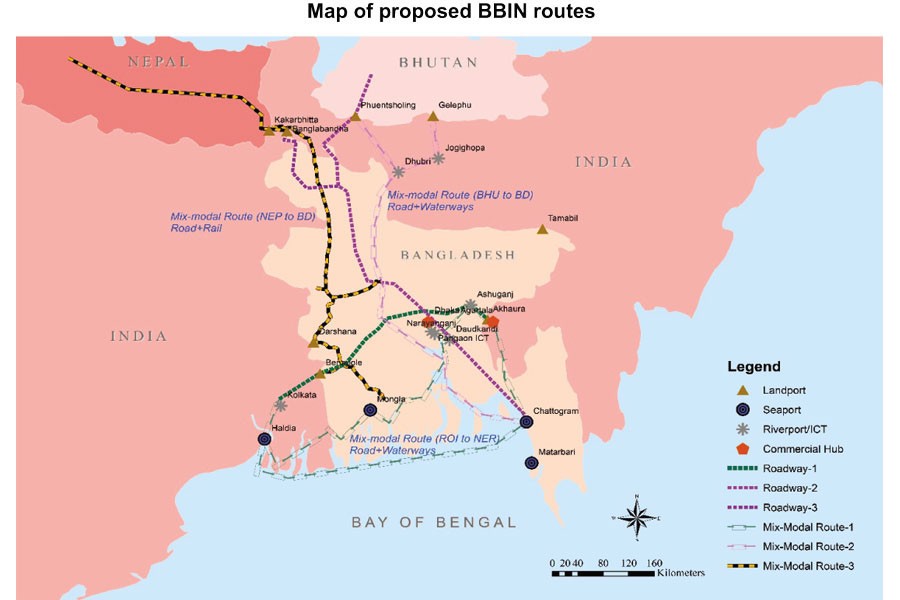
    Motor Vehicles Agreement (MVA) of the BBIN

    With Bhutan continuing to sit out the Motor Vehicles Agreement (MVA) of the sub-regional Bangladesh-Bhutan-India-Nepal (BBIN) grouping, a meeting of the other three countries was held to discuss the next steps in operationalizing the agreement for the free flow of goods and people between them.

    What is Motor Vehicles Agreement (MVA)?

    • India, Nepal, Bhutan and Bangladesh signed a Motor Vehicles Agreement (MVA) for the Regulation of Passenger, Personal and Cargo Vehicular Traffic among the four South Asian neighbours.
    • It was signed on 15 June 2015 at the BBIN transport ministers meeting in Thimpu, Bhutan.
    • The act will facilitate a way for a seamless movement of people and goods across their borders for the benefit and integration of the region and its economic development.

    Key terms of the Agreement

    • Trans-shipment of goods: Cargo vehicles will be able to enter any of the four nations without the need for trans-shipment of goods from one country’s truck to another’s at the border.
    • Free transport: The agreement would permit the member states to ply their vehicles in each other’s territory for transportation of cargo and passengers, including third-country transport and personal vehicles.
    • Electronic permit: As per the agreement each vehicle would require an electronic permit to enter another country’s territory, and border security arrangements between nations’ borders will also remain.
    • Ultra-security: Vehicles are fitted with an electronic seal that alerts regulators every time the container door is opened.

    Implementation status of the agreement

    • The agreement will enter into force after it is ratified by all four member nations.
    • The agreement has been ratified by Bangladesh, India and Nepal.
    • The lower house of the Bhutanese parliament approved the agreement in early 2016, but it was rejected by the upper house in November 2016.
    • Bhutan has requested for a cap to be fixed on the number of vehicles entering its territory

    What next?

    • India remains “hopeful” that Bhutan could change its position on the project, it was decided at a meeting in November 2021 to go ahead for now, given that there are no new signals from Thimphu on the project.
    • Progress on the seven-year-old project has been slow, despite several trial runs being held along the Bangladesh-India-Nepal road route for passenger buses and cargo trucks.
    • There are still some agreements holding up the final protocols.

    Back2Basics: Bangladesh, Bhutan, India, Nepal (BBIN)

    • BBIN Initiative is a sub-regional architecture of countries in Eastern South Asia, a sub-region of South Asia.
    • The group meets through the official representation of member states to formulate, implement and review quadrilateral agreements across areas such as water resources management, connectivity of power, transport, and infrastructure.


    UPSC 2022 countdown has begun! Get your personal guidance plan now! (Click here)

  • Russian Invasion of Ukraine: Global Implications

    What is the Temporary Protection Directive of the EU?

    Responding to the crisis, EU Member States made the unprecedented decision to activate a major European Union’s Council Directive, known as the Temporary Protection Directive (TPD).

    What is Temporary Protection?

    • The EU Commission describes “temporary protection” under the TPD as an “exceptional measure to provide immediate and temporary protection to displaced persons from non-EU countries and those unable to return to their country of origin”.
    • The directive applies when there is a risk that the standard asylum system is struggling to cope with demand stemming from a mass influx risking a negative impact on the processing of claims.

    Objectives of this protection

    1. To both establish minimum standards for giving temporary protection to displaced persons
    2. To promote a balance of effort between Member States in receiving and bearing the consequences of receiving such persons

    Why establish standards?

    The Commission gives two reasons for doing so:

    • It reduces disparities between the policies of EU States on the reception and treatment of displaced persons in a situation of mass influx.
    • It promotes solidarity and burden-sharing among EU States with respect to receiving large numbers of potential refugees at one time.”

    What obligations does the TPD place upon EU states?

    According to the European Commission, the TPD “foresees harmonised rights for the beneficiaries of temporary protection”, which include:

    • Residence permit for the duration of the protection (which can last from 1-3 years),
    • Appropriate information on temporary protection,
    • Access to employment,
    • Access to accommodation or housing,
    • Access to social welfare or means of subsistence,
    • Access to medical treatment,
    • Access to education for minors,
    • Opportunities for families to reunite in certain circumstances, and
    • Guarantees for access to the normal asylum procedure

    The TPD also contains provisions for the return of displaced persons to their country of origin, unless they have committed serious crimes or they “pose a threat to security from the benefit of temporary protection”.


    UPSC 2022 countdown has begun! Get your personal guidance plan now! (Click here)

  • Soil Health Management – NMSA, Soil Health Card, etc.

    What are Karewas?

    Kashmir’s highly fertile alluvial soil deposits called ‘karewas’ are being destroyed in the name of development, much to the peril of local people

    What are Karewas?

    • The Kashmir valley is an oval-shaped basin, 140 km long and 40 km wide, trending in the NNW–SSE direction.
    • It is an intermountain valley fill, comprising of unconsolidated gravel and mud.
    • A succession of plateaus is present above the Plains of Jhelum and its tributaries.
    • These plateau-like terraces are called ‘Karewas’ or ‘Vudr’ in the local language.
    • These plateaus are 13,000-18,000 metre-thick deposits of alluvial soil and sediments like sandstone and mudstone.
    • This makes them ideal for cultivation of saffron, almonds, apples and several other cash crops.

    Significance of Karewas

    • Today, the karewa sediments not only hold fossils and remnants of many human civilisations and habitations, but are also the most fertile spots in the valley.
    • Kashmir saffron, which received a Geographical Indication (GI) tag in 2020 for its longer and thicker stigmas, deep-red colour, high aroma and bitter flavour, is grown on these karewas.

    How are they formed?

    • The fertility of these patches is believed to be the result of their long history of formation.
    • When formed during the Pleistocene period (2.6 million years to 11,700 years ago), the Pir Panjal range blocked the natural drainage in the region and formed a lake spanning 5,000 sq km.
    • Over the next few centuries, the water receded, making way for the valley and the formation of the karewas between the mountains.

    Threats to Karewas

    • Despite its agricultural and archaeological importance, karewas are now being excavated to be used in construction.
    • Between 1995 and 2005, massive portions of karewas in Pulwama, Budgam and Baramulla districts were razed to the ground for clay for the 125-km-long Qazigund-Baramulla rail line.
    • The Srinagar airport is built on the Damodar karewa in Budgam.


    UPSC 2022 countdown has begun! Get your personal guidance plan now! (Click here)

  • Modern Indian History-Events and Personalities

    In news: Pal-Dadhvav Massacre

    The Gujarat government has marked 100 years of the Pal-Dadhvav killings, calling it a massacre “bigger than the Jallianwala Bagh”.

    Pal-Dadhvav Massacre

    • The massacre took place on March 7, 1922, in the Pal-Chitariya and Dadhvaav villages of Sabarkantha district, then part of Idar state.
    • The day was Amalki Ekadashi, which falls just before Holi, a major festival for tribals.
    • Villagers from Pal, Dadhvav, and Chitariya had gathered on the banks of river Heir as part of the ‘Eki movement’, led by one Motilal Tejawat.
    • The movement was to protest against the land revenue tax (lagaan) imposed on the peasants by the British and feudal lords.
    • Tejawat, who belonged to Koliyari village in the Mewad region of Rajasthan, had also mobilised Bhils from Kotda Chhavni, Sirohi, and Danta to participate.

    The fateful day

    • Tejawat had been outlawed by the Udaipur state, which had announced a Rs-500 reward on his head.
    • The Mewad Bhil Corps (MBC), a paramilitary force raised by the British that was on the lookout for Tejawat, heard of this gathering and reached the spot.
    • On a command from Tejawat, nearly 2000 Bhils raised their bows and arrows and shouted in unison- ‘We will not pay the tax’.
    • The MBC commanding officer, HG Sutton, ordered his men to fire upon them creating a huge stampede.
    • Nearly 1,000 tribals (Bhils) fell to bullets. While the British claimed some 22 people were killed, the Bhils believe 1,200-1,500 of them died.

    Must read:

    Important Rebellions and Peasant Movements


    UPSC 2022 countdown has begun! Get your personal guidance plan now! (Click here)

  • Promoting Science and Technology – Missions,Policies & Schemes

    [pib] Petascale Supercomputer “PARAM Ganga” established at IIT Roorkee

    The National Supercomputing Mission (NSM) has now deployed “PARAM Ganga”, a supercomputer at IIT Roorkee, with a supercomputing capacity of 1.66 Petaflops.

    What is a Supercomputer?

    • A supercomputer is a computer with a high level of performance as compared to a general-purpose computer.
    • The performance of a supercomputer is commonly measured in floating-point operations per second (FLOPS) instead of million instructions per second (MIPS).
    • Since 2017, there are supercomputers which can perform over a hundred quadrillion FLOPS (peta FLOPS).
    • Since November 2017, all of the world’s fastest 500 supercomputers run Linux-based operating systems.

    PARAM Ganga

    • PARAM Ganga is designed and commissioned by C-DAC under Phase 2 of the build approach of the NSM.
    • It is based on a heterogeneous and hybrid configuration of Intel Xeon Cascade lake processors, and NVIDIA Tesla V100.
    • There are 312 (CPU+GPU+HM) nodes with a total peak computing capacity of 1.67 (CPU+GPU+HM) PFLOPS performance.
    • The cluster consists of compute nodes connected with the Mellanox (HDR) InfiniBand interconnect network.
    • The system uses the Lustre parallel file system and operating system is CentOS 7.x.

    Back2Basics: National Supercomputing Mission (NSM)

    • NSM is a proposed plan by GoI to create a cluster of seventy supercomputers connecting various academic and research institutions across India.
    • In April 2015 the government approved the NSM with a total outlay of Rs.4500 crore for a period of 7 years.
    • The mission was set up to provide the country with supercomputing infrastructure to meet the increasing computational demands of academia, researchers, MSMEs, and startups by creating the capability design, manufacturing, of supercomputers indigenously in India.
    • Currently there are four supercomputers from India in Top 500 list of supercomputers in the world.

    Aims and objectives

    • The target of the mission was set to establish a network of supercomputers ranging from a few Tera Flops (TF) to Hundreds of Tera Flops (TF) and three systems with greater than or equal to 3 Peta Flops (PF) in academic and research institutions of National importance across the country by 2022.
    • This network of Supercomputers envisaging a total of 15-20 PF was approved in 2015 and was later revised to a total of 45 PF (45000 TFs), a jump of 6 times more compute power within the same cost and capable of solving large and complex computational problems.

    When did India initiate its efforts to build supercomputers?

    • India’s supercomputer program was initiated in the late 1980s, when the United States ceased the export of a Cray Supercomputer due to technology embargos.
    • This resulted in India setting up C-DAC in 1988, which in 1991, unveiled the prototype of PARAM 800, benchmarked at 5 Gflops. This supercomputer was the second-fastest in the world at that time.
    • Since June 2018, the USA’s Summit is the fastest supercomputer in the world, taking away this position from China.
    • As of January 2018, Pratyush and Mihir are the fastest supercomputers in India with a maximum speed of Peta Flops.

    What are the phases of the National Supercomputing Mission?

    Phase I:

    • In the first phase of the NSM, parts of the supercomputers are imported and assembled in India.
    • A total of 6 supercomputers are to be installed in this phase.
    • The first supercomputer that was assembled indigenously is called Param Shivay. It was installed in IIT (BHU) located in Varanasi.
    • Similar systems, Param Shakti (IIT Kharagpur) and Param Brahma (IISER, Pune) were also later installed within the country.
    • The rest will be installed at IIT Kanpur, IIT Hyderabad and Jawaharlal Nehru Institute of Advanced Studies (JNIAS).

    Phase II:

    • The supercomputers that are installed so far are about 60% indigenous.
    • The 11 systems that are going to be installed in the next phase will have processors designed by the Centre for Development of Advanced Computing (C-DAC) and will have a cumulative capacity of 10 petaflops.
    • These new systems are to be constructed more cost-effectively than the previous ones.
    • One of the 11 proposed supercomputers will be installed
    • at C-DAC exclusively for small and medium enterprises so that they can train employees as well as work on supercomputers at a very low cost.

    Phase III:

    • The third phase aims to build fully indigenous supercomputers.
    • The government had also approved a project to develop a cryogenic cooling system that rapidly dispels the heat generated by a computing chip. This will be jointly built together by IIT-Bombay and C-DAC.


    UPSC 2022 countdown has begun! Get your personal guidance plan now! (Click here)

  • Women empowerment issues – Jobs,Reservation and education

    Women and Politics

    Context

    For a proper appraisal of the relations between gender and democracy, we ought to examine the links between violence, representation, and the political participation of women.

    Role of women in South Asian democracy

    • Historically, one of the peculiar paradoxes of South Asian democracy has been the continued presence of strong women leaders at the executive centre coupled with a generally appalling condition of women in society at large.
    • South Asia has had the largest number of women heads of state — including Sirimavo Bandaranaike, Chandrika Kumaratunga, Indira Gandhi, Khaleda Zia, Sheikh Hasina, and Benazir Bhutto — of any region in the world till recently.
    • Under-represented: While women have played very visible and important roles at the higher echelons of power and at the grassroots level in social movements, they have been under-represented in political parties as officials and as members of key decision-making bodies.

    Electoral representation of women in India

    • In India, women currently make up 14.6 per cent of MPs (78 MPs) in the Lok Sabha, which is a historic high.
    • Although the percentage is modest, it is remarkable because women barely made up 9 per cent of the overall candidates in 2019.
    • In electoral representation, has fallen several places in the Inter-Parliamentary Union’s global ranking of women’s parliamentary presence, from 117 after the 2014 election to 143 as of January 2020. 
    • In terms of electoral quotas, there were two outstanding exceptions in the 2019 general elections.
    • Voluntary parliamentary quota: West Bengal under Mamata Banerjee and Odisha under Naveen Patnaik opted for voluntary parliamentary quotas, fielding 40 per cent and 33 per cent women candidates, respectively.

    Growing turnout of women voters and its implications

    • Assertion of citizenship rights: In 1962, the male voter turnout in India was 16 percentage points higher than for women. Six decades later, in the 2019 Lok Sabha elections, women’s participation exceeded that of men for the first time.
    • This suggests an increasing assertion of citizenship rights among women.
    • The growing turnout of women voters could influence political parties’ programmatic priorities and improve their responsiveness to women voters’ interests, preferences, and concerns, including sexual harassment and gender-based violence.
    • Women-centric schemes: The state government in Bengal ran and highlighted many women-centric schemes that potentially played a central role in their victory.
    • The central government must be commended for its achievements in two areas in particular: Its DBT schemes such as the Pradhan Mantri Vaya Vandana Yojana and the Pradhan Mantri Surakshit Matritva Abhiyan.
    • As a result, maternal mortality rate has reduced from 167 (2011-13) to 113 (2016-18).
    • The Maternity Benefit (Amendment) Bill, 2017 is another landmark achievement that extended the paid maternal leave to 26 weeks from the existing 12 weeks.

    Way forward

    • Government must use its parliamentary majority to finally pass the Women’s Reservation Bill, as was promised in their 2014 election manifesto.
    • Until that happens, the initiative taken by the governments of Banerjee and Patnaik to increase women’s parliamentary presence must serve as an inspiration to other Indian states.

    Conclusion

    The extent to which parties represent women and take up their interests is closely tied to the health and vitality of democratic processes.

    UPSC 2022 countdown has begun! Get your personal guidance plan now! (Click here)

  • Nuclear Diplomacy and Disarmament

    How invasion of Ukraine could transform nuclear landscape of Asia

    Context

    Russian President Vladimir Putin’s nuclear sabre-rattling in Ukraine, has triggered a far more consequential debate on the importance of atomic weapons in deterring Chinese expansionism.

    Background

    • Ukraine agreed in 1994 to give up the nuclear weapons that it inherited from the Soviet Union in return for guarantees on Kyiv’s sovereignty and territorial integrity.
    • Clearly, those legal guarantees were no substitute for nuclear weapons.

    Changing stand on nuclear weapons

    • Debate in Japan: In an important statement last week, the former prime minister of Japan, Shinzo Abe, called for a national debate on hosting American nuclear weapons on Japanese soil.
    • One element of the debate is the fact that nuclear weapons remain the greatest deterrent, especially against a vastly superior adversary.
    • Korea strengthening nuclear deterrence: In South Korea, which is electing its president this week, front-runner Yoon Suk-yeol has talked of strengthening Seoul’s nuclear deterrence against both Pyongyang and Beijing.
    • Taiwan and Australia developing nuclear submarine: Taiwan, is reportedly developing a nuclear-powered submarine that could offer some deterrence against a Chinese invading force.
    • Australia, which is working with the UK and the US to build nuclear-powered submarines, is accelerating the project after the Ukraine invasion.

    Threat of escalation to nuclear war

    • The threat of escalation to the nuclear level was very much in the mind of NATO’s military planners when the alliance refused to be drawn into a firefight with Russia in Ukraine.
    • Moscow is also conscious of the fact that there are two nuclear weapon powers in Europe — Britain and France.
    • Nuclear sharing arrangement: Russia is also aware of the “nuclear sharing” arrangements between the US and some European allies — Belgium, Germany, Italy, and the Netherlands.
    • Under this framework, European allies host US nuclear weapons on their soil and authorise their armed forces to deliver American nuclear weapons on Russia.
    • Nuclear sharing also involves continuous consultations on nuclear doctrine and the planning of nuclear operations.
    • The US and its allies are also pursuing a “hybrid war” that boosts Ukrainian resistance against Russian armed forces and raises military, economic, and political costs of Moscow’s aggression.

    Threat of China invading Taiwan

    • Taiwan is far more important for Asian (and global) security than Ukraine is for Europe.
    • Taiwan sits at the heart of the Western Pacific and straddles the sea line of communication in the world’s most dynamic economic arena.
    • It is the main source of silicon chips for the world.
    • When China conquers Taiwan it will dramatically transform the geopolitics of Asia.
    • As Putin becomes more dependent on China, Russia is bound to back Xi Jinping’s ambitions in Asia.
    • This is the context in which China’s eastern neighbours are taking a fresh look at the nuclear option.
    • Nuclear sharing arrangement: On the nuclear front, the debate in Japan and South Korea is about potential nuclear sharing arrangements with the US.
    • In Taiwan and Australia, the emphasis is on developing nuclear-powered submarines.
    • Deployment of strategic weapons: The US too is debating the deployment of new strategic weapon systems in Asia that might encourage China to pause before trying to emulate Russia’s Ukraine adventure.

    Consider the question ” Russia’s invasion of Ukraine is going to transform the nuclear landscape of Asia. Comment.”

    Conclusion

    One way or another, Russia’s war in Ukraine is bound to transform the Asian nuclear landscape.

  • Russian Invasion of Ukraine: Global Implications

    Do Economic Sanctions work as a deterrent?

    The economic sanctions imposed by the US, UK, and the EU on Russia for going to war against Ukraine could prove to be detrimental to the country.

    What do economic sanctions mean?

    • Economic sanctions are penalties or bans that are levied against a country to push it to modify its strategic decisions.
    • They include withdrawal of customary trade and financial relations for security and foreign policy purposes.
    • Sanctions could result in cutting economic ties in every respect such as terms of trade, financial assistance, transit support, travel bans, asset freezes, and trade restrictions.
    • The curbs could also be targeted, thus restricting transactions with certain businesses, groups, or individuals.
    • Amid increased global and economic interdependence, they could prove to be detrimental for the targeted country.

    How do sanctions impact an economy?

    • No country can afford to be a closed economy.
    • The affected country’s supply chain gets disrupted in terms of the inflow of goods and services and for reaching out to the export markets.
    • In the former, there is a risk of the internal economy being crippled, especially if it depends on imports of critical raw materials.
    • The domestic economy could also be deprived of external market support.
    • The risk element is high especially in case of economic curbs being imposed collectively, such as by the Organisation for Economic Co-operation and Development (OECD) or the North Atlantic Treaty Organization (NATO).

    What are the economic sanctions against Russia?

    • Major Russian banks have been banned from the SWIFT financial messaging service and their assets have been frozen.
    • Sanctions have been levied on the Russian Direct Investment Fund and against some of Russia’s wealthiest people.
    • Access to air-space has been denied and export controls introduced.
    • The countries imposing curbs on Russia account for 34% of world GDP.

    What is the cost of such restrictions?

    • This depends on the economic strength of the country being targeted.
    • Russia cannot be brushed aside as an ordinary economy.
    • The country is important to the global economy because of its oil reserves and access to nuclear power.
    • Russia is also a supplier of sophisticated defence products and is an important supplier of crucial defence products to India.
    • Given the long-term strategic nature of the relationship, India is abstaining from voting on resolutions to condemn Russia.

    How did India manage curbs after Pokhran-II?

    • India’s dependence on external assistance was more than $100 billion.
    • The government appealed to non-resident Indians (NRIs) whose annual savings were more than $400 billion.
    • NRIs’ subscription to government bonds was more than double the annual foreign assistance.
    • India could also showcase its scientific strength as none of the scientists involved were trained abroad.
    • This helped India display confidence, especially to investors.


    UPSC 2022 countdown has begun! Get your personal guidance plan now! (Click here)

Join the Community

Join us across Social Media platforms.
