💥UPSC 2026, 2027, 2028 UAP Mentorship (March Batch) + Access XFactor Notes & Microthemes PDF

Type: IOCR

  • Coronavirus – Health and Governance Issues

    COVID-19 Law Lab

    Note4Students

    From UPSC perspective, the following things are important:

    Prelims level: COVID-19 Law Lab

    Mains level: Health Policy measures against COVID-19

    The UN agencies have started a portal called the COVID-19 Law Lab to host all recent legal enactments to fight the novel coronavirus disease (COVID-19) pandemic.

    Note the following things about COVID-19 Law Lab:

    1) It is an online portal and not a cubical laboratory

    2) Parent agency includes the UN and WHO

    3) It is the first collation of health-related laws and protocols of the countries

    COVID-19 Law Lab

    • This digital portal hosts all legal steps taken by 190 countries to fight the pandemic.
    • The UNDP, the WHO, the Joint UN Programme on HIV/AIDS and the O’Neill Institute for National and Global Health Law at Georgetown University have collaborated for this initiative.
    • The collation initiative aims at dissemination of procedures and practices for effective enactment of health-related laws.
    • It is expected to be the most expansive collation of laws and procedures related to a health emergency.

    Why need such a repository?

    • The pandemic has led to confusion over treatment and management protocols.
    • Some 220 countries/territories have enacted various procedures backed by various enabling laws related to epidemics and health emergency.
    • Laws and policies that are grounded in science, evidence and human rights can enable people to access health services, protect themselves from COVID-19 and live free from stigma, discrimination and violence.
    • Sharing medicines and formulae for even general treatment has been a big challenge due to restrictive laws and trade practices.
    • As health is global, legal frameworks need to be aligned with international commitments to respond to current and emerging public health risks.

  • Lancet’s analysis of population trends for 2017-2100

    Note4Students

    From UPSC perspective, the following things are important:

    Prelims level: TFR, Demographic Dividends

    Mains level: Population explosion in India

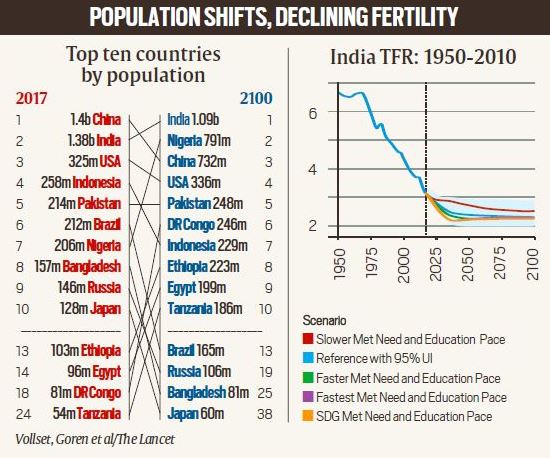
    When this century ends, India may no longer be a country of a billion, says a projection that appears in the online edition of the Lancet. The reference forecasts for China and India peaked before 2050 and both countries thereafter had steep declining trajectories.

    Try this question from CSP 2011:

    Q.India is regarded as a country with ‘Demographic Dividend’. This is due to

    (a) Its high population in the age group below 15 years

    (b) Its high population in the age group of 15-64 years

    (c) Its high population in the age group above 65 years

    (d) Its high total population

    World to see the peak

    • A new analysis published in The Lancet has projected that the world population will peak much earlier than previously estimated.
    • It projects the peak at 9.73 billion in 2064, which is 36 years earlier than the 11 billion peaks projected for 2100 by last year’s UN report World Population Prospects.
    • For 2100, the new report projects a decline to 8.79 billion from the 2064 peak.

    5 most populated countries

    • The five largest countries in 2100 are projected to be India, Nigeria, China, the U.S. and Pakistan.
    • However, these forecasts showed different future trajectories between countries.
    • Nigeria is forecast to have continued population growth through 2100 and was expected to be the second-most populous country by then.

    Predictions on India’s population

    • For India, the report projects a peak population of 1.6 billion in 2048, up from 1.38 billion in 2017.
    • By 2100, the population is projected to decline by 32% to 1.09 billion.
    • However, meeting UN Sustainable Goal Development targets, the peak would be earlier and see a population decline to 929 million.
    • Conventional wisdom is that though a decline in population is expected, it is expected to begin only around 2046.
    • The fall according to the latest 2019 assessment by the UNDP calculation, is expected to see India’s population settle at a little over 1.4 billion.

    Reasons for fall

    • The sharper fall is due to the assumption that all women globally will have much higher access to contraception and education.
    • This scenario will lead to a sharper reduction in the Total Fertility Rate, a metric that shows on average how many children a woman must have to keep replenishing the population.
    • A TFR is lower than 2.1leads to a decline in a country’s population.
  • Contention over South China Sea

    Malabar Naval Exercise to include Australia

    Note4Students

    From UPSC perspective, the following things are important:

    Prelims level: QSD, Malabar Exercise

    Mains level: Global move to curb Chinese overambitions

    India has finally planned to invite Australia to join the annual Malabar naval exercise that has so far included just Japan and the U.S., in a move that could risk China’s ire.

    Go through the list for once. UPSC may ask a match the pair type question asking exercise name and countries involved.

    [Prelims Spotlight] Defence Exercises

    About Ex. Malabar

    • Exercise Malabar is a trilateral naval exercise involving the United States, Japan and India as permanent partners.
    • Originally begun in 1992 as a bilateral exercise between India and the United States, Japan became a permanent partner in 2015.
    • Past non-permanent participants are Australia and Singapore.
    • The annual Malabar series began in 1992 and includes diverse activities, ranging from fighter combat operations from aircraft carriers through Maritime Interdiction Operations Exercises.

    Significance of Australia’s inclusion

    • Earlier, India had concerns that it would give the appearance of a “quadrilateral military alliance” aimed at China.
    • Now both look forward to the cooperation in the ‘Indo-Pacific’ and the strengthening of defence ties.
    • This has led to a convergence of mutual interest in many areas for a better understanding of regional and global issues.
    • Both are expected to conclude the long-pending Mutual Logistics Support Agreement (MLSA) as part of measures to elevate the strategic partnership.

    Back2Basics: Quadrilateral Security Dialogue (QSD)

    • The QSD is an informal strategic forum between the United States, Japan, Australia and India that is maintained by semi-regular summits, information exchanges and military drills between member countries.
    • The forum was initiated as a dialogue in 2007 by Prime Minister Shinzo Abe of Japan, with the support of Vice President Dick Cheney of the US, PM John Howard of Australia and PM Manmohan Singh of India.
    • The dialogue was paralleled by joint military exercises of an unprecedented scale, titled Exercise Malabar.
    • The diplomatic and military arrangement was widely viewed as a response to increased Chinese economic and military power, and the Chinese government responded to it by issuing formal diplomatic protest.
    • The QSD was recently revived considering the tensions in the South China Sea caused primarily by China and its territorial ambitions.
  • J&K – The issues around the state

    International Covenant on Civil and Political Rights (ICCPR)

    Note4Students

    From UPSC perspective, the following things are important:

    Prelims level: UNCAT, ICCPR

    Mains level: UN intervention in Kashmir

    United Nations (UN) Special Rapporteurs have made public their third communication forwarded to India expressing concern over alleged excessive use of force, ill-treatment during arrests and detentions.

    Practice question for mains:

    Q.There is an urgent need for reforming the criminal justice system in India in light of rising cases of custodial torture and killings. Comment.

    What is the issue?

    The UN urged the Indian government to conduct a prompt and impartial investigation into the allegations of arbitrary killings, torture and ill-treatment and to prosecute suspected perpetrators under articles 6 and of the International Covenant on Civil and Political Rights (ICCPR), and articles 7 and 12 of the Committee Against Torture (CAT).

    What are the conventions cited by the UN?

    1) International Covenant on Civil and Political Rights (ICCPR)

    • The ICCPR is a multilateral treaty adopted by UN General Assembly Resolution on 16 December 1966, and in force from 23 March 1976.
    • The covenant commits its parties to respect the civil and political rights of individuals, including the right to life, freedom of religion, freedom of speech, freedom of assembly, electoral rights and rights to due process and a fair trial.
    • As of September 2019, the Covenant has 173 parties and six more signatories without ratification.
    • It is part of the International Bill of Human Rights, along with the International Covenant on Economic, Social and Cultural Rights (ICESCR) and the Universal Declaration of Human Rights (UDHR).
    • It is monitored by the UN Human Rights Committee (a separate body to the UN Human Rights Council).

    2) United Nations Convention Against Torture (UNCAT)

    • The UNCAT is an international human rights treaty, under the review of the UN and was adopted in 1984.
    • It aims to prevent torture and other acts of cruel, inhuman, or degrading treatment or punishment around the world.
    • The convention requires states to take effective measures to prevent torture in any territory under their jurisdiction and forbids states to transport people to any country where there is reason to believe they will be tortured.
    • Since the convention’s entry into force, the absolute prohibition against torture and other acts of cruel, inhuman, or degrading treatment or punishment has become accepted as a principle of customary international law.

    3) The Committee against Torture (CAT)

    • It is a body of human rights experts that monitors implementation of the Convention by State parties.
    • The Committee is one of eight UN-linked human rights treaty bodies.
    • All state parties are obliged under the Convention to submit regular reports to the CAT on how rights are being implemented.
    • Upon ratifying the Convention, states must submit a report within one year, after which they are obliged to report every four years.
    • The Committee examines each report and addresses its concerns and recommendations to the State party in the form of “concluding observations.”
    • Under certain circumstances, the CAT may consider complaints or communications from individuals claiming that their rights under the Convention have been violated.
  • Foreign Policy Watch: India-Middle East

    UAE in support of Open Skies Agreement with India

    Note4Students

    From UPSC perspective, the following things are important:

    Prelims level: Open Sky Agreements, OST

    Mains level: Not Much

    The UAE is keen to have an open sky agreement with India.

    Open Skies Agreement! Look how confusing does it sound compared to the Open Skies Treaty between the US and Russia.

    What is the Open Skies Agreement?

    • The National Civil Aviation Policy, 2016, allows the government to enter into an ‘open sky’ air services agreement on a reciprocal basis with SAARC nations as well as countries beyond a 5,000-kilometre radius from New Delhi.
    • This implies that nations within this distance need to enter into a bilateral agreement and mutually determine the number of flights that their airlines can operate between the two countries.
    • India has open sky agreements with Japan, Greece, Jamaica, Guyana, Czech Republic, Finland, Spain and Sri Lanka.
    • India also has an open sky agreement with the US, among other countries.

    Why UAE wants such an agreement with India?

    • There are about 1,068 flights a week between India and the UAE operated by the airlines of the two countries under the bilateral Air Service Agreement.
    • India has open skies policy with SAARC countries and those beyond the 5,000-km radius.
    • UAE wants India to revisit this policy.

    Must read:

    U.S. set to exit the ‘Open Skies Treaty’ Copy

  • Wildlife Conservation Efforts

    Biodiversity Governance: The agreements and laws that help enforce it

    Note4Students

    From UPSC perspective, the following things are important:

    Prelims level: CBD, BDA

    Mains level: Biodiversity and its governance

  • Police Reforms – SC directives, NPC, other committees reports

    United Nations Convention Against Torture (UNCAT)

    Note4Students

    From UPSC perspective, the following things are important:

    Prelims level: United Nations Convention Against Torture (UNCAT)

    Mains level: Police reforms in India

    The alleged torture and custodial killing of TN father and son by police last week pointed towards a broken criminal justice system and highlighted the need for police reforms and the ratification of the United Nations Convention Against Torture (UNCAT).

    Practice question for mains:

    Q.There is an urgent need for reforming the criminal justice system in India in light of rising cases of custodial torture and killings. Comment.

    United Nations Convention Against Torture (UNCAT)

    • The UNCAT is an international human rights treaty, under the review of the UN and was adopted in 1984.
    • It aims to prevent torture and other acts of cruel, inhuman, or degrading treatment or punishment around the world.
    • The convention requires states to take effective measures to prevent torture in any territory under their jurisdiction and forbids states to transport people to any country where there is reason to believe they will be tortured.
    • Since the convention’s entry into force, the absolute prohibition against torture and other acts of cruel, inhuman, or degrading treatment or punishment has become accepted as a principle of customary international law.

    The Committee against Torture (CAT)

    • It is a body of human rights experts that monitors implementation of the Convention by State parties.
    • The Committee is one of eight UN-linked human rights treaty bodies.
    • All state parties are obliged under the Convention to submit regular reports to the CAT on how rights are being implemented.
    • Upon ratifying the Convention, states must submit a report within one year, after which they are obliged to report every four years.
    • The Committee examines each report and addresses its concerns and recommendations to the State party in the form of “concluding observations.”
    • Under certain circumstances, the CAT may consider complaints or communications from individuals claiming that their rights under the Convention have been violated.

    Optional Protocol to CAT

    • The Optional Protocol to the Convention against Torture and other Cruel, Inhuman or Degrading Treatment or Punishment (OPCAT) was adopted by the General Assembly on 18 December 2002.
    • It provides for the establishment of a system of regular visits undertaken by independent international and national bodies to places where people are deprived of their liberty, in order to prevent torture and other cruel, inhuman or degrading treatment or punishment.

    India needs to ratify UNCAT

    • India signed the convention in 1997 but it remains among a handful of countries including Pakistan and China which are yet to ratify the convention.
    • India is in the company of 25 other nations which have not ratified.
    • The National Human Rights Commission had said custodial violence and torture are already “rampant” in the country.
    • About 1,731 people had died in custody in 2019 a/c to NHRC report.
  • Women empowerment issues – Jobs,Reservation and education

    State of the World Population Report 2020

    Note4Students

    From UPSC perspective, the following things are important:

    Prelims level: UNFPA

    Mains level: Preventing violence and abuse against women

    The UNFPA has released the State of the World Population Report 2020.

    Highlights of the WPR

    I) Global prospects

    • According to estimates averaged over a five year period (2013-17), annually, there were 1.2 million missing female births, at a global level.
    • The same study shows that in Afghanistan, Bangladesh and Pakistan excess female mortality of girls below 5 years of age was under 3 per cent.
    • These skewed numbers translate into long-term shifts in the proportions of women and men in the population of some countries, the report points out.
    • In many countries, this results in a “marriage squeeze” as prospective grooms far outnumber prospective brides, which further results in human trafficking for marriage as well as child marriages.

    II) Data on India

    • India had about 4,60,000 girls ‘missing’ at birth each year.
    • The figure shows that the number of missing women has more than doubled over the past 50 years, who were at 61 million in 1970.
    • The report examines the issue of missing women by studying sex ratio imbalances at birth as a result of gender-biased sex selection as well as excess female mortality due to deliberate neglect of girls because of a culture of son preference.
    • Excess female mortality is the difference between observed and expected mortality of the girl child or avoidable death of girls during childhood.
    • The report cites a 2014 study to state that India has the highest rate of excess female deaths at 13.5 per 1,000 female births or one in nine deaths of females below the age of 5 due to postnatal sex selection.

    About UNFPA

    • The United Nations Population Fund (UNFPA), formerly the United Nations Fund for Population Activities, is a UN organization.
    • It is the lead UN agency for delivering a world where every pregnancy is wanted, every childbirth is safe and every young person’s potential is fulfilled.
    • Their work involves the improvement of reproductive health; including the creation of national strategies and protocols, and birth control by providing supplies and services.
    • The organization has recently been known for its worldwide campaign against child marriage, obstetric fistula and female genital mutilation.
  • Primary and Secondary Education – RTE, Education Policy, SEQI, RMSA, Committee Reports, etc.

    Global Education Monitoring (GEM) Report 2020

    Note4Students

    From UPSC perspective, the following things are important:

    Prelims level: Not Much

    Mains level: Impact of coronovirus outbreak on Education system

    The COVID-19 pandemic has exacerbated inequalities in education systems across the world a/c to the latest GEM report.

    Practice question for mains:

    Q.Discuss the impact of COVID-19 induced lockdown on India’s education sector.

    About the report

    • Originally the EFA Global Monitoring Report, it has been renamed as the Global Education Monitoring Report.
    • It is developed by an independent team and published by UNESCO aimed to sustain commitment towards Education for All.
    • The ‘UNESCO Institute for Statistics (UIS), based in Montreal provides data for the report on students, teachers, school performance, adult literacy and education expenditure.

    Highlights of the 2020 report

    • The report noted that efforts to maintain learning continuity during the pandemic may have actually worsened exclusion trends.
    • During the height of school closures in April 2020, almost 91% of students around the world were out of school.
    • About 40% of low- and lower-middle-income countries have not supported learners at risk of exclusion during this crisis, such as the poor, linguistic minorities and learners with disabilities.

    1. Risks of school closure

    • School closures also interrupted support mechanisms from which many disadvantaged learners benefit.
    • For poor students who depend on school for free meals or even free sanitary napkins, closures has been a major blow.
    • Cancellation of examinations in many countries, including India, may result in scoring dependence on teachers’ judgements of students, which could be affected by stereotypes of certain types of students.

    2. Substitutes were imperfect

    • Education systems responded with distance learning solutions, all of which offered less or more imperfect substitutes for classroom instruction said the report.
    • Many poorer countries opted for radio and television lessons, while some upper-middle-income countries adopted for online learning platforms for primary and secondary education.
    • India has used a mix of all three systems for educational continuity.

    3. The digital divide has resurfaced yet again

    • Even as governments increasingly rely on technology, the digital divide lays bare the limitations of this approach.
    • Not all students and teachers have access to an adequate internet connection, equipment, skills and working conditions to take advantage of available platforms.
  • Wildlife Conservation Efforts

    “Money Laundering and the Illegal Wildlife Trade” Report

    Note4Students

    From UPSC perspective, the following things are important:

    Prelims level: FATF

    Mains level: Wildlife trade and its prevention

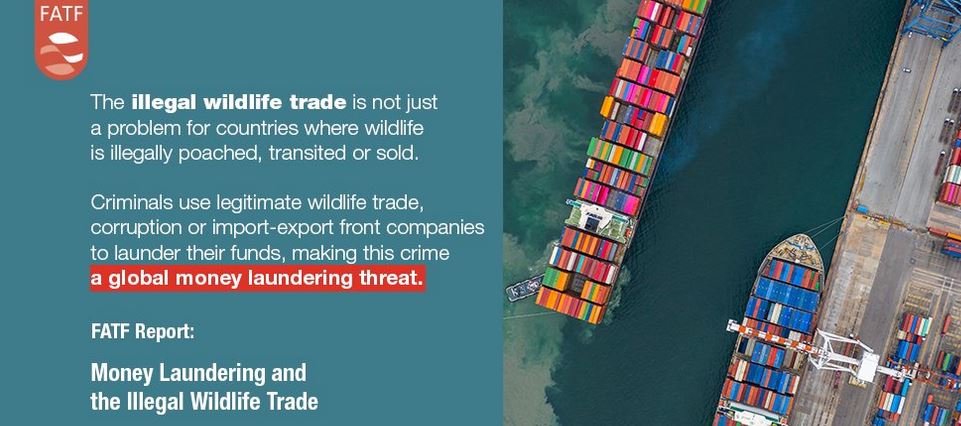
    A first global report on the illegal wildlife trade has been recently published by the Financial Action Task Force (FATF).

    Try this MCQ:

    Q.The report “Money Laundering and the Illegal Wildlife Trade”  recently seen in news is released by:

    A. TRAFFIC/ B. CITES/ C. IUCN/ D. FATF

    Highlights of the Report

    • FATF has described illegal wildlife trade as a “global threat”, which also has links with other organised crimes like modern slavery, drug trafficking and arms trade.
    • The illegal trade is estimated to generate revenues of up to $23 billion a year.
    • The report flagged a lack of focus on the financial aspects of wildlife crime.

    (1)Economy of illicit wildlife trade

    • It said that criminals are frequently misusing the legitimate wildlife trade, as well as other import-export type businesses.
    • The FATF found that jurisdictions often did not have the required knowledge, legislative basis and resources to assess and combat the threat posed by the funds generated through the illegal trade.
    • The study has highlighted the growing role of online marketplaces and mobile and social media-based payments to facilitate the movement of proceeds warranting a coordinated response from government bodies, the private sector and the civil society.

    (2)Money laundering is prominent

    • According to the report, criminal syndicates are misusing the formal financial sector to launder the proceeds.
    • Funds are laundered through cash deposits, under the guise of loans or payments, e-banking platforms, licensed money value transfer systems, and third-party wire transfers via banks.
    • Accounts of innocent victims are also used and high-value payments avoided evading detection.

    (3)Misuse of front companies

    • Another common trend is the misuse of front companies with links to the legal wildlife trade, said the report.
    • Front companies, often linked to import-export industries, and shell firms are used for the movement of goods and trans-border money transfers.

    Recommendations of the report

    • The report says the financial probe is the key to dismantling the syndicates involved, which can in turn significantly impact the associated criminal activities.
    • It recommended that jurisdictions should consider implementing good practices, as observed during the study.
    • They include providing all relevant agencies with the necessary mandate and tools; and cooperating with other jurisdictions, international bodies and the private sector.
    • The FATF said that legislative changes were necessary to increase the applicability of anti-money laundering laws to the illegal wildlife trade-linked offences.

    Back2Basics

    https://www.civilsdaily.com/news/financial-action-task-force-fatf-2/