💥UPSC 2027,2028 Mentorship (May Batch) + Access XFactor Notes & Microthemes PDF

Archives: News

  • Languages and Eighth Schedule

    English is the language of Court: Gujarat HC

    A Division Bench of the Gujarat High Court has asked a convict to speak only in English as that was the language in the higher judiciary referring to Article 348 of the Constitution which mandates that the language of the High Court would be English.

    What is Article 348?

    • It provides for languages to be used in the Supreme Court and in the High Courts and for Acts, Bills, etc
    • Article 348 (1) provides that all proceedings in the Supreme Court and in every High court shall be in English Language until Parliament by law otherwise provides.
    • Under Article 348 (2), the Governor of the State may, with the previous consent of the President, authorize the use of the Hindi language or any other language used for any official purpose of the State.
    • It states that in the proceedings of the High Court having its principal seat in that State provided that decrees, judgments or orders passed by such High Courts shall be in English.

    When is use of other languages permitted?

    • Section 7 of the Official Languages Act, 1963, provides that the use of Hindi or official language of a State in addition to the English language may be authorized.
    • This has to be done with the consent of the President of India, by the Governor of the State for purpose of judgments etc. made by the High Court for that State.


    UPSC 2022 countdown has begun! Get your personal guidance plan now! (Click here)

  • Modern Indian History-Events and Personalities

    Significance of Delhi government’s recognition to fifth Sikh Takht

    The Delhi Assembly has passed an amendment Bill to the Delhi Sikh Gurdwara Act, 1971, recognizing Takht Damdama Sahib as the fifth Takht of Sikhs.

    What is a Sikh Takht?

    • A Takht, which means a throne, is a seat of temporal authority for Sikhs.
    • There are five Sikh Takhts, three in Punjab and one each in Maharashtra and Bihar.

    (1) Akal Takht

    • Located in Amritsar, it is the oldest of the Takhts, and considered supreme among the five.
    • It was set up in 1606 by Guru Hargobind, whose succession as the sixth Guru after the execution of his father, Guru Arjan Dev, is considered a turning point in Sikh history.
    • The Akal Takht, a raised platform that he built in front of the causeway leading to the sanctum sanctorum of the Harmandir Sahib (Golden Temple).
    • It symbolised the coming together of the temporal authority and the political sovereignty of the Sikh community (miri) with the spiritual authority (piri).
    • It is seen as the first marker of Sikh nationalism.

    The other four Takhts are linked to Guru Gobind Singh, the tenth Sikh Guru.

    (2) Takht Keshgarh Sahib

    • Located in Anandpur Sahib in Punjab. It was here that Guru Gobind Singh raised Khalsa, the initiated Sikh warriors, in 1699.

    (3) Takht Patna Sahib

    • Guru Gobind Singh was born here in 1666.

    (4) Takht Hazur Sahib

    • In Nanded, where Guru Gobin Singh spent time and where he was cremated in 1708.

    (5) Takht Damdama Sahib

    • In Talwandi Sabo of Bathinda. Guru Gobind Singh spent several months here.

    What does the amendment to the Delhi Sikh Gurdwara Act mean?

    • Simply put, it adds one more ex officio member in the Delhi Sikh Gurdwara Managament Committee (DSGMC) house.
    • Earlier, there were four ex officio members in the house — the chiefs (jathedars) of the other four Sikh Takhts.

    Is it the first time it has been recognised as the fifth Takht?

    • It was back in 1999 that Takht Damdama Sahib was recognised as the fifth Sikh Takht by the Union Home Ministry.
    • It included it as such in the Sikh Gurdwaras Act, 1925 (Punjab Act VIII of 1925) with a notification dated April 23, 1999.
    • Before that, an SGPC sub-committee had declared it the fifth Takht of Sikhs back in November 1966 after Punjab was carved out as a separate state through the Punjab Reorganisation Act, 1966.

    How politically significant is the move?

    • It comes ahead of the Punjab Assembly elections, where the, Delhi’s ruling party, has high stakes.

    What is the role of the Sikh Takhts?

    • The Takhts are known to issue hukumnamas (morality orders) from time to time on issues that concern the Sikh community.
    • Akal Takht is supreme among them because it is the oldest and was created by a Sikh Guru himself, say Sikh scholars.
    • Any edict or order concerning the entire community is issued only from Akal Takht.
    • It is from Akal Takht that Sikhs found to be violating the Sikh doctrine and code of conduct are awarded religious punishment (declared tankhaiya).

    Who appoints the jathedars of the Takhts?

    • The three Takhts in Punjab are directly controlled by the SGPC, which appoints the jathedars.
    • The SGPC is dominated by SAD members.
    • It is widely understood that SAD puts the final seal on the appointment of these three jathedars.
    • The two Takhts outside Punjab have their own trusts and boards.


    UPSC 2022 countdown has begun! Get your personal guidance plan now! (Click here)

  • Foreign Policy Watch: India-China

    China’s bridge over Pangong Tso

    China is building a bridge across the Pangong Tso area connecting the North and South Banks which will significantly reduce the time for moving troops and equipment between the two sides.

    About Pangong Tso

    • Pangong Tso or Pangong Lake is an endorheic lake in the Himalayas situated at a height of about 4,350 m.
    • It is 134 km long and extends from India to the Tibetan Autonomous Region, China.
    • Approximately 60% of the length of the lake lies within the Tibetan Autonomous Region.
    • The lake is 5 km wide at its broadest point. All together it covers 604 sq.km.
    • During winter the lake freezes completely, despite being saline water.
    • It is not a part of the Indus river basin area and is geographically a separate landlocked river basin.
    • Earlier, Pangong Tso had an outlet to Shyok River, a tributary of Indus River, but it was closed off due to natural damming.

    Tactical significance of the lake

    • It lies in the path of the Chushul approach, one of the main approaches that China can use for an offensive into Indian Territory.
    • During the 1962 war, this was where China launched its main offensive — the Indian Army fought heroically at Rezang La under Maj. Shaitan Singh.
    • Not far away, to the north of the lake, is the Army’s Dhan Singh Thapa post, named after Major Dhan Singh Thapa who was awarded the country’s highest gallantry award, the Param Vir Chakra.
    • Major Thapa and his platoon were manning the Sirijap-1 outpost which was essential for the defense of the Chushul airfield.

    Connectivity in the region

    • Over the years, the Chinese have built motorable roads along their banks of the Pangong Tso. This points to the importance accorded by the Chinese to the area.
    • Even during peacetime, the difference in perception over where the LAC lies on the northern bank of the lake makes this contested terrain.
    • In 1999, when the Army unit from the area was moved to Kargil for Operation Vijay, China took the opportunity to build 5 km of a road inside the Indian Territory along the lake’s bank.
    • From one of these roads, Chinese positions physically overlook Indian positions on the northern tip of the Pangong Tso Lake.

    What is the importance of the bridge over Pangong Tso?

    • The bridge over Pangong Tso is located around 25 kms ahead of the LAC in Chinese territory and will significantly reduce the time for movement of Chinese army.
    • The Indian Army gained tactical advantage over the PLA on the south bank in end August 2020 by occupying several peaks lying vacant since 1962 gaining a dominating view.
    • This has prompted China to build deep alternate roads behind the friction points away from the line of sight.

    How is India responding to developments on the ground?

    • The bridge is well within Chinese territory.
    • The implications of this new bridge will have to be factored in the Indian Army’s operational planning for the future.
    • On its part, over the last few years India has been focusing on infrastructure development in forward areas and improving connectivity to the forward areas.
    • Large-scale construction of roads, bridges and tunnels is underway all along the LAC.


    UPSC 2022 countdown has begun! Get your personal guidance plan now! (Click here)
  • Zoonotic Diseases: Medical Sciences Involved & Preventive Measures

    Traditional vaccines just as effective, say US Scientists

    Vaccines like Biological E’s Corbevax and Bharat Biotech’s Covaxin that are made by traditional methods are “just as effective” as the latest mRNA technology-based vaccines a/c to US scientists.

    What are Vaccines?

    • A vaccine is a biological preparation that provides active acquired immunity to a particular infectious disease.
    • It typically contains an agent that resembles a disease-causing microorganism and is often made from weakened or killed forms of the microbe, its toxins, or one of its surface proteins.

    Types of Vaccines

    There are several types of vaccines, including:

    • Inactivated vaccines
    • Live-attenuated vaccines
    • Messenger RNA (mRNA) vaccines
    • Subunit, recombinant, polysaccharide, and conjugate vaccines
    • Viral vector vaccines

    [1] Inactivated vaccines

    • Inactivated vaccines use the killed version of the germ that causes a disease.
    • Inactivated vaccines usually don’t provide immunity (protection) that’s as strong as live vaccines.
    • So you may need several doses over time (booster shots) in order to get ongoing immunity against diseases.
    • Inactivated vaccines are used to protect against: Hepatitis A, Flu (shot only), Polio (shot only), Rabies etc.

    [2] Live-attenuated vaccines

    • Live vaccines use a weakened (or attenuated) form of the germ that causes a disease.
    • Because these vaccines are so similar to natural infection that they help prevent, they create a strong and long-lasting immune response.
    • Just 1 or 2 doses of most live vaccines can give you a lifetime of protection against a germ and the disease it causes.
    • They need to be kept cool in refrigerated conditions.
    • Live vaccines are used to protect against Measles, mumps, rubella (MMR), Rotavirus, Smallpox, Chickenpox, Yellow fever

    [3] Messenger RNA vaccines

    • Researchers have been studying and working with mRNA vaccines for decades and this technology was used to make some of the COVID-19 vaccines.
    • mRNA vaccines make proteins in order to trigger an immune response.
    • mRNA vaccines have several benefits compared to other types of vaccines, including shorter manufacturing times and, because they do not contain a live virus, no risk of causing disease in the person getting vaccinated.

    How does mRNA vaccine work?

    • The mRNA vaccines function differently from traditional vaccines.
    • Traditional vaccines stimulate an antibody response by injecting a human with antigens.
    • mRNA vaccines inject a fragment of the RNA sequence of a virus directly into the cells, which then stimulate an adaptive immune response mRNA fragment is a specific piece of the virus that carries instructions to build the antigen of the virus.
    • An advantage of RNA vaccines is that they stimulate cellular immunity.


    UPSC 2022 countdown has begun! Get your personal guidance plan now! (Click here)

  • What America’s Indo-Pacific policy mean

    Context

    The visit by United States Secretary of State  Antony J. Blinken to Southeast Asia in December 2021 underscores the importance that is being accorded to this region by the Joe Biden administration.

    Take aways from the visit

    [1] Projecting the US as reliable partner

    • The idea was to present the U.S. as a reliable partner in meeting the challenges that the Indo-Pacific region is facing.
    • For instance, completely aware that the Southeast Asian nations are averse to choosing sides in this U.S.-China competition, Mr. Blinken made it a point to mention that “individual countries will be able to choose their own path and their own partners.

    [2] Tackling China challenge

    • Both China and the U.S. are trying to lure the Association of Southeast Asian Nation (ASEAN) countries to their side — China with its grand economic infrastructure investment deals and the U.S. through recent high profile official visits as well as through the Build Back Better World initiative and Blue Dot Network.
    • In Southeast Asia, the U.S.-China competition is most visible in two areas; one is the South China Sea and the second is the investment in fulfilling the infrastructure development needs of Southeast Asian countries.
    • The U.S. has continued its Freedom of Navigation operations in the disputed waters of the South China Sea.
    • In his remarks in Indonesia, Mr. Blinken stressed America’s determination “to ensure freedom of navigation in the South China Sea, where Beijing’s aggressive actions there threaten the movement of more than $3 trillion worth of commerce every year”.

    [3] Closing the gap on infrastructure

    • Southeast Asia has been one of the top recipients of Chinese investments under its Belt and Road Initiative (BRI).
    • How these investments have driven countries such as Cambodia and Laos to do China’s bidding in the ASEAN even at the cost of compromising ASEAN’s unity is a known fact.
    • Mr. Blinken reiterated that the U.S. remains committed to help close the gap on infrastructure.
    • The infrastructure coordination group launched by the Quad members is seeking to catalyse even more investment and is looking to partner with Southeast Asia on infrastructure and many other shared priorities.
    • Washington is promising to do more under the Build Back Better World initiative and the Blue Dot Network.

    Way forward

    • The ASEAN countries, even after the release of the ASEAN Outlook on the Indo-Pacific, do not have a uniform approach when it comes to dealing with the U.S. and China.
    • These differing approaches are also challenging the much vaunted ASEAN centrality in the Indo-Pacific.
    • Though external players will have a limited role in ensuring that the unity within ASEAN is restored, providing proper alternative models of investments for development in sectors such as infrastructure, digital economy, supply chain, and health for the Southeast Asian nations will be critical.

    Conclusion

    The economic framework, investment plans and promises outlined need to be made operational quickly if Washington is to show that it is indeed serious about sustained commitment toward the Indo-Pacific.

    UPSC 2022 countdown has begun! Get your personal guidance plan now! (Click here)

  • NGOs vs. GoI: The Conflicts and Scrutinies

    Challenges facing the Civil Society Organisations

    Context

    Recently, the Missionaries of Charity established by Nobel Laureate Mother Teresa was in the news for the cancellation of its permission under the FCRA.

    Detailed scrutiny delaying permission for grant

    • The levels of due diligence and the information sought on the one hand and the annual declarations to be given by the board members of civil society organisations on the other have increased significantly.
    • The mandatory opening of bank accounts for foreign contributions has been centralised in one branch of the State Bank of India.
    • The linking of Permanent Account Number (PAN), Aadhaar number and mapping it with the bank account/s of the individual board members are happening.
    • The registrations under Foreign Contribution (Regulation) Act (FCRA) have been long necessitated in order to undertake due diligence of the causes for which the organisation is working for and also to have a handle on the traceability of funds.
    • The dashboard shows a little under 17,000 active organisations — which have either got permission or will know their fate by March 2022, while around 33,000 organisations have either lost their permission or it has expired.

    Various restrictions

    • Restriction on sub-grant: In the past, the amendments in the FCRA that restricted the ability to sub-grant, killed many of the niche organisations working in very remote areas which had no direct access to international funding but were doing it through larger non-governmental organisations.
    • Restriction on administrative expenses: The other amendment restricting the proportion of expenses on administration almost choked organisations that worked for the rights of the disposed.
    • The increasing level of surveillance type of data sought has resulted in many organisations losing people on their governance structure and resulting in problems in funding.

    Why do we need Civil Society Organisations?

    • We need them because they usually work on what can be called an unreasonable agenda.
    • This unreasonableness falls in three large verticals.
    • [1] Ensuring efficiency and accountability from state: The first is that they ask for greater efficiency, delivery and accountability from the state.
    • Whether is it about rehabilitation and compensation in the case of land acquisition or setting up a great accountability framework as was done through the movement led by the Mazdoor Kisan Shakti Sangathan for the Right to Information.
    • [2] Correcting extractive nature of market: The second vertical is in correcting the extractive nature of markets.
    • The groups asking for environmental accountability are looking at inter-generational justice on a matter that is not very precisely measurable but is palpable.
    • [3] Picking up niche causes: The third is basically picking up causes that are so niche that it is beyond the capability of the state to come up with such initiatives.
    • For example, a drama school set up in a village called Heggodu, Karnataka, or an idea of distributing clothing for work as done by Goonj.
    • These initiatives cannot be put into specific business plans, spreadsheets or government schemes.
    • They, therefore, need a grant-based, cause-based revenue stream model.

    Should these organisations accept foreign funding?

    • Causes have no boundaries: “Causes” have no boundaries and funding for such socially desirable belief systems could come from beyond borders.
    • Some causes carried out by organisations such as Doctors Without Borders, or Reporters Without Borders are by definition international in nature.
    • Similar is the case with the Jaipur foot provided by the Bhagwan Mahaveer Viklang Sahayata Samiti.
    • The humanitarian work by the Missionaries of Charity is beyond the capability of a state.
    • Such causes do not have a rational basis to be explained in terms of a financial model; how do you put a price tag to press freedom?
    • The niche funding will happen from agencies that may be beyond the borders.
    • The duality of welcoming foreign investments (which takes away capital gains and dividends) while actively discouraging foreign aid to charities is staring us in the face.

    Conclusion

    The government needs to ensure that the regulations do not create hurdles for the civil society organisations in their functioning and receiving fundings.

    UPSC 2022 countdown has begun! Get your personal guidance plan now! (Click here)

  • Climate Change Negotiations – UNFCCC, COP, Other Conventions and Protocols

    A partnership to carry India into net-zero future

    Context

    At a time when our planet faces an existential crisis, there is little doubt that we need innovative, scientific and urgent steps to secure humanity’s future.

    India’s climate commitment

    • We need to act decisively to reach global net-zero, restricting future cumulative emissions to the remaining carbon budget — as COP26 noted — if the rise in temperature is to remain within the limits of the Paris Agreement.
    • At COP26, India announced its climate commitments — the “Panchamrit”, including a commitment to reach net-zero by 2070.
    • India’s announcement of its net-zero goal is a major step considering that our country is not the cause of global warming.
    • Its historical cumulative emissions are a mere 4.37 per cent of the world’s total. 

    India’s steps to achieve the targets

    [1] India’s renewable energy targets and achievements

    • India’s renewable energy targets have steadily become more ambitious, from the 175 GW by 2022 declared at Paris, to 450 GW by 2030 at the UN Climate Summit, and now 500 GW by 2030, announced at COP26.
    • India has also announced the target of 50 per cent installed power generation capacity from non-fossil energy sources by 2030, raising the existing target of 40 per cent, which has already been almost achieved.
    • Renewable technologies: India will not lag in terms of new cutting-edge renewable technologies and has already announced a Hydrogen Energy Mission for grey and green hydrogen.
    • In energy efficiency, the market-based scheme of Perform, Achieve and Trade (PAT) has avoided 92 million tonnes of CO2 equivalent emissions during its first and second cycles.

    [2] India’s E-mobility transtion

    • FAME: India is accelerating its e-mobility transition with the Faster Adoption and Manufacturing of (Hybrid &) Electric Vehicles Scheme to support the electric vehicle market development and enable its manufacturing ecosystem to achieve self-sustenance.
    • Incentives for customers and companies: The government has also announced a slew of incentives for customers and companies to promote e-vehicles.
    • Adoption of BS-VI: India leapfrogged from Bharat Stage-IV (BS-IV) to Bharat Stage-VI (BS-VI) emission norms by April 1, 2020.
    • Scrapping policy: A voluntary vehicle scrapping policy to phase out old and unfit vehicles now complements these schemes.
    • Electrification of railway routes: Indian Railways is charging ahead, targeting the full electrification of all broad-gauge routes by 2023.

    [3] Ujjwala Yojana and UJALA

    • The Pradhan Mantri Ujjwala Yojana has benefitted 88 million households with LPG connections.
    • More than 367 million LED bulbs have been distributed under the UJALA scheme, leading to energy savings of more than 47 billion units of electricity per year and a reduction of 38.6 million tonnes of CO2 per year.
    • With these and many other initiatives, India has already achieved a reduction of 24 per cent in the emission intensity of its GDP between 2005 and 2016, and is on track to meet its target of 33 to 35 per cent by 2030.

    Role of private sector

    • Since industries also contribute to GHG emissions, any climate action will need to reduce or offset emissions that emerge from industrial and commercial activity.
    • The public and private sectors in India are already playing a key role in meeting the climate challenge, helped by growing customer and investor awareness, as well as increasing regulatory and disclosure requirements.
    • Enterprises are well-positioned to not just adapt to but also gain from the low-carbon transition.
    • The low-carbon transition challenge is bigger for companies that are largely coal-powered and contribute more than half of our country’s emissions.
    • The business fraternity must make the best possible use of this opportunity to invest in climate technologies and expand the use of renewable energy sources.
    • The Indian cement industry has taken pioneering measures and achieved one of the biggest sectoral low carbon milestones worldwide.

    Way forward

    • India’s journey on the low-carbon pathway towards net-zero requires the active participation of all stakeholders.
    • Sustainable lifestyles and climate justice are at the core of this journey.

    Conclusion

    With cooperation from the private sector, India will be able to responsibly use its fair share of the global carbon space and contribute to reaching the global net-zero goal to build a more environmentally sustainable planet.

    UPSC 2022 countdown has begun! Get your personal guidance plan now! (Click here)

  • Monsoon Updates

    Western Disturbances to bring rain in New Delhi

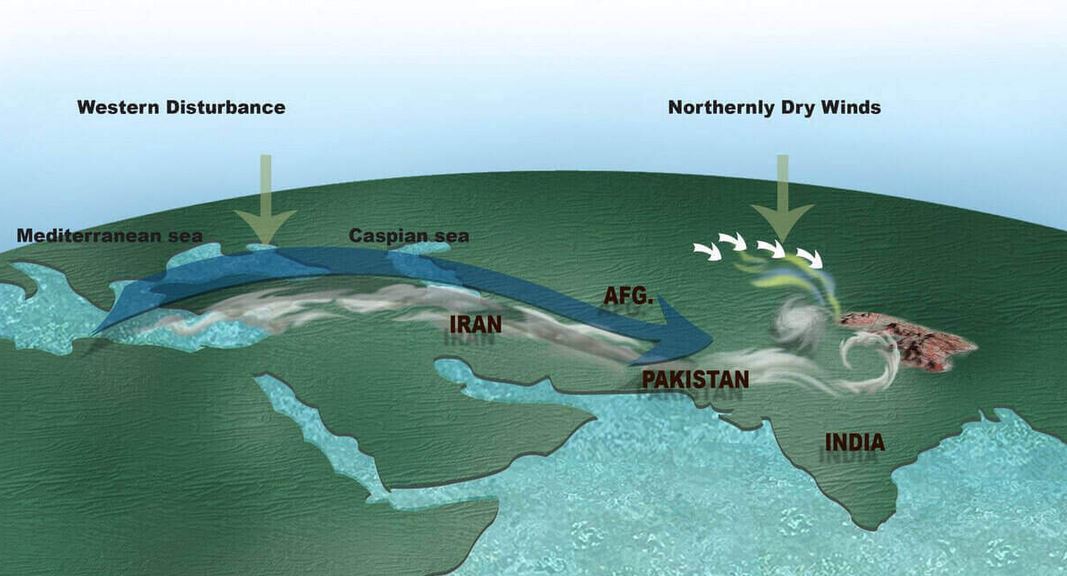
    Under the influence of two consecutive western disturbances, New Delhi is in for a wet spell.

    Western Disturbances

    • A western disturbance is an extratropical storm originating in the Mediterranean region that brings sudden winter rain to the northwestern parts of the Indian subcontinent.
    • It is a non-monsoonal precipitation pattern driven by the westerlies.
    • The moisture in these storms usually originates over the Mediterranean Sea, the Caspian Sea and the Black Sea.
    • Extratropical storms are global phenomena with moisture usually carried in the upper atmosphere, unlike their tropical counterparts where the moisture is carried in the lower atmosphere.
    • In the case of the Indian subcontinent, moisture is sometimes shed as rain when the storm system encounters the Himalayas.
    • Western disturbances are more frequent and strong in the winter season.

    Impact: Winter Rainfall and Extreme Cold

    • Western disturbances, specifically the ones in winter, bring moderate to heavy rain in low-lying areas and heavy snow to mountainous areas of the Indian Subcontinent.
    • They are the cause of most winter and pre-monsoon season rainfall across northwest India.
    • An average of four to five western disturbances forms during the winter season.

    Its significance

    • Precipitation during the winter season has great importance in agriculture, particularly for the rabi crops.
    • Wheat among them is one of the most important crops, which helps to meet India’s food security.

    Try this PYQ:

    Q. Consider the following statements:

    1. The winds which blow between 30°N and 60°S latitudes throughout the year are known as westerlies.
    2. The moist air masses that cause winter rains in the North-Western region of India are part of westerlies.

    Which of the statements given above is/are correct?

    (a) Only 1

    (b) Only 2

    (c) Both 1 and 2

    (d) Neither 1 nor 2


    Post your answers here.


    UPSC 2022 countdown has begun! Get your personal guidance plan now! (Click here)

  • Terrorism and Challenges Related To It

    Multi Agency Centre (MAC): A common counter-terrorism grid

    The Union government has asked the States to share more intelligence inputs through the Multi Agency Centre (MAC), a common counter-terrorism grid under the Intelligence Bureau (IB).

    Why in news?

    • States are often reluctant to share information on the platform.
    • There are several gaps in sharing critical information at the right time.
    • Plans are afoot for more than a decade to link the system up to the district level.

    About MAC

    • The Multi-Agency Centre (MAC) was formed in December 2001 following the Kargil intrusion and the subsequent overhaul of the Indian national security apparatus suggested by the Kargil Review Committee report.
    • Accordingly, the Intelligence Bureau (IB) was authorized to create a multi-agency centre (MAC) in New Delhi.
    • Now functioning 24×7 as the nodal body for sharing intelligence inputs, MAC coordinates with representatives from numerous agencies, different ministries, both central and state.
    • Various security agencies share real-time intelligence inputs on the MAC.
    • The state offices have been designated as subsidiary MACs (SMACs).
    • As many as 28 organisations, including the Research and Analysis Wing (R&AW), armed forces and State police, are part of the platform.

    Back2Basics: NATGRID

    • NATGRID is an intelligence-sharing network that collates data from the standalone databases of the various agencies and ministries of the Indian government.
    • It collects and collates a host of information from government databases including tax and bank account details, credit/debit card transactions, visa and immigration records and itineraries of rail and air travel.
    • It came into existence after the 2008 Mumbai attacks.
    • It is accessible to only authorized people from 10 security agencies on a case-to-case basis for investigations into suspected cases of terrorism.
    • It will also have access to the Crime and Criminal Tracking Network and Systems, a database that links crime information, including First Information Reports, across 14,000 police stations in India.

    Note: NATGRID data will be made available to 11 central agencies, which are: Research and Analysis Wing (R&AW), Intelligence Bureau (IB), National Investigation Agency (NIA), Central Bureau of Investigation (CBI), Narcotics Control Bureau (NCB), Financial Intelligence Unit (FIU), Enforcement Directorate (ED), Central Board of Direct Taxes (CBDT), Central Board of Indirect Taxes and Customs (CBIC), Directorate of Revenue Intelligence (DRI) and Directorate General of GST Intelligence.


    UPSC 2022 countdown has begun! Get your personal guidance plan now! (Click here)

  • Blockchain Technology: Prospects and Challenges

    Understanding IC15, India’s first Crypto Index

    Superapp CryptoWire recently launched India’s first cryptocurrency index, IC15, which will measure the performance of the 15 most widely traded cryptocurrencies listed on leading crypto exchanges by market capitalization.

    What is IC15?

    • CryptoWire constituted an Index Committee of domain experts, industry practitioners, and academicians that will select cryptocurrencies from the top 400 coins in terms of market capitalization.
    • The eligible cryptocurrency should have traded on at least 90% of the days during the review period and be among the 100 most liquid cryptocurrencies in terms of trading value.
    • Also, the cryptocurrency should be in the top 50 in terms of the circulating market capitalization.
    • The committee will then select the top 15 cryptocurrencies. The index will be reviewed quarterly.

    What is its significance?

    • IC15 can be replicated for creating index-linked products such as index funds or exchange-traded funds (ETFs).
    • Usually, the performance of a mutual fund scheme is assessed with reference to a benchmark, which could be a total return index of the Nifty or the Sensex.
    • IC15 is the first index in India that can act as a benchmark of the underlying cryptocurrency market and the performance benchmark for fund managers.
    • Moreover, robo-advisors, which provide financial advice with moderate to minimal human intervention, can use this index to create investment products at lower costs.

    How  does  IC15  correlate  with other market indicators?

    • IC15’s base value as on 1 April 2018 was 10,000.
    • It would mean that the index has gained 615% in absolute terms to 71,475.48 till 31 December 2021.

    Can  index-based  crypto investment reduce risks?

    • Index investing can be an effective way to diversify against risks as a fund invests in a basket of assets against a few limited coins.
    • However, index-based investing may not fully remove risks associated with investing in crypto assets.
    • Case in point: IC15 saw a 50% plunge in 2018, whereas other asset classes have seen a maximum drop in the range of 3-4%.
    • Further, bitcoin and ethereum have a combined weightage of 77% in the index, making it highly vulnerable to any volatility in these two coins.

    Can crypto funds be launched in India?

    • SEBI has recently asked mutual fund houses not to launch crypto-based funds until the Centre comes out with clear regulations.
    • This means asset management companies for now won’t be able to launch crypto funds based on IC15.
    • However, in the absence of any regulations, crypto platforms can offer products based on the index.
    • Global crypto investment platform Mudrex last year launched Coin Sets—crypto funds based on themes such as decentralized finance or market cap.


    UPSC 2022 countdown has begun! Get your personal guidance plan now! (Click here)

Join the Community

Join us across Social Media platforms.