💥UPSC 2026, 2027, 2028 UAP Mentorship (March Batch) + Access XFactor Notes & Microthemes PDF

Archives: News

  • Biofuel Policy

    PM inaugurated India’s first Bamboo-based Ethanol Plant

    Why in the News?

    PM has inaugurated the world’s first bamboo-based ethanol plant in Golaghat district, Assam, marking a significant step in India’s green energy journey.

    Note: Ethanol is prepared from bamboo using a multi-step biochemical conversion process that transforms its rich cellulose content into fermentable sugars, which are then fermented and distilled into ethanol.

    About Assam Bioethanol Plant:

    • Overview: World’s first 2G bamboo-based bioethanol facility, developed jointly by Numaligarh Refinery Limited (NRL), Fortum (Finland), and Chempolis OY.
    • Feedstock: Uses 5 lakh tonnes of green bamboo annually, sourced from Assam, Arunachal Pradesh, and other NE states.
    • Production Capacity: Generates 48,900 MT ethanol, 11,000 MT acetic acid, 19,000 MT furfural, and 31,000 MT food-grade CO₂ per year.
    • Benefits: Adds ~₹200 crore annually to Assam’s rural economy; supports farmers and tribal communities with assured markets.
    • Policy Enabler: Reclassification of bamboo (no longer a tree) allowed free cultivation and harvesting, unlocking industrial potential.

    Back2Basics: Regulation of Bamboo in India

    • Earlier Status: The Indian Forest Act, 1927 classified bamboo as a “tree”, though botanically it is a grass.
    • Regulatory Impact: Even in non-forest areas, felling, cutting, and transport of bamboo required permits like timber, discouraging farmers and traders.
    • 2017 Amendment: The Act was amended to remove “bamboos” from the definition of “tree” under Section 2(7), but only for non-forest areas.
    • Policy Goal: Intended to ease regulatory burdens, promote bamboo cultivation and trade, and strengthen agroforestry.
    • Current Rule: Bamboo on private/agricultural land can now be freely grown, cut, and transported without permits; bamboo in forest areas remains regulated.
    • Scientific Alignment: Recognises bamboo correctly as a grass (Poaceae family).
    • Significance: Supports rural farmers, artisans, and tribal communities by making bamboo a viable cash crop.


    [UPSC 2023] According to India’s National Policy on Biofuels, which of the following can be used as raw materials for the production of biofuels?

    1. Cassava 2. Damaged wheat grains 3. Groundnut seeds 4. Horse gram 5. Rotten potatoes 6. Sugar beet

    Select the correct answer using the code given below:

    Options: (a) 1, 2, 5 and 6 only * (b) 1, 3, 4 and 6 only (c) 2, 3, 4 and 5 only (d) 1, 2, 3, 4, 5 and 6


  • Tribes in News

    Ho Tribes’ Manki-Munda System

    Why in the News?

    Members of the Ho tribe in Jharkhand’s West Singhbhum district staged a protest for alleged interference in their traditional Manki-Munda governance system by removing village heads (Mundas).

    About Ho Tribes:

    • Location: Major community of Jharkhand (Kolhan, West Singhbhum), with presence in Odisha and Chhattisgarh.
    • Language: Speak Ho language (Munda branch, Austroasiatic family), traditionally written in Warang Citi script.
    • Livelihoods: Primarily agriculturalists, with farming, hunting, and forest produce as traditional occupations.
    • Festivals: Mage Parab, Ba Parab, Sohrai, tied to agriculture, celebrated with dance, music, rituals.
    • Resistance: Historically fought outsiders; staged Ho Revolt (1821–22) and Kol Revolt (1831) against British.
    • Social Fabric: Clan-based, community-oriented, guided by customary law and collective decision-making.

    What is the Manki-Munda System?

    • Structure:
      • Munda: Village head (hereditary), resolves disputes, represents village.
      • Manki: Head of pidh (cluster of 8–15 villages), adjudicates inter-village disputes.
    • Pre-British: Purely internal self-rule, no taxation or external sovereign authority.
    • British Codification:
      • Wilkinson’s Rules (1833–37) codified system into 31 rules, formally recognising Mankis/Mundas as British agents.
      • Introduced private property; Ho became raiyats (tenants) instead of communal landholders.
      • Led to demographic influx of dikkus (outsiders), rising from ~1,500 (1867) to ~15,700 (1897).
    • Post-Independence: Kolhan Government Estate dissolved (1947) but Wilkinson’s Rules still operative; Kolhan largely exempt from civil laws.
    • Judicial View: In Mora Ho vs State of Bihar (2000), Patna HC treated Wilkinson’s Rules as customs, not law, but upheld their continuance.
    • Current Practice: System governs village disputes; ~200 vacant posts filled by Gram Sabhas.
    • Criticism: Hereditary leadership limits efficiency; many leaders lack education for modern administration.
    • Reform Debate: Youth demand limiting hereditary succession and inclusion of non-tribal raiyats.
    • Contemporary Role: Remains a symbol of tribal autonomy yet requires modernisation for democratic governance.
    [UPSC 2010] Which one of the following pairs of primitive tribes and places of their inhabitation is not correctly matched?

    (a) Buksa : Pauri-Garhwal

    (b) Kol : Jabalpur

    (c) Munda : Chhotanagpur

    (d) Korba : Kodagu*


  • RTI – CIC, RTI Backlog, etc.

    [13th September 2025] The Hindu Op-ed: RTI’s shift to a ‘right to deny information’

    PYQ Relevance

    [UPSC 2020] Recent amendments to the Right to Information Act will have profound impact on the autonomy and independence of the Information Commission. Discuss.

    Linkage: The RTI’s strength lay in ensuring both citizens’ access to information and the independence of Information Commissions as watchdogs of transparency. Amendments such as those under the Digital Personal Data Protection Act, 2023–25, which expand the scope of “personal information” and override disclosure norms, severely limit this autonomy. This erosion risks converting RTI into a “Right to Deny Information,” thereby weakening institutional independence and citizen empowerment.

    Mentor’s Comment

    The Right to Information (RTI) Act, 2005 was once celebrated as a revolutionary step in India’s democratic journey, giving citizens a direct tool to hold the State accountable. But recent amendments through the Digital Personal Data Protection (DPDP) Act, 2023 have been termed a “fundamental regression of democracy.” By transforming RTI into a potential “Right to Deny Information (RDI),” the amendments threaten transparency, accountability, and the fight against corruption. This article unpacks the gravity of these changes, their implications for governance, and why the muted public response is a cause for deep concern.

    Introduction

    The RTI Act (2005) rests on the principle that in a democracy, government-held information belongs to the people. It has empowered ordinary citizens to expose corruption, inefficiency, and arbitrariness in governance. Section 8(1)(j) of the RTI Act, originally a balanced safeguard to protect personal privacy, has now been drastically curtailed by the DPDP Act, reducing it to six words. This shift fundamentally alters the spirit of transparency, tilting the Act from being a “Right to Know” towards a “Right to Deny.”

    Why is this in the news?

    For the first time since its enactment, the RTI Act faces a drastic truncation of one of its most crucial provisions. Section 8(1)(j), which earlier struck a delicate balance between privacy and transparency, has now been reduced in length and scope, effectively allowing authorities to deny a vast range of information. The problem is massive, nearly 90% of RTI requests could now be rejected as “personal information.” Yet, unlike earlier RTI amendments that triggered massive public protests, the current change has seen notable public and media apathy, making this a silent but severe assault on India’s democratic ethos.

    How has the original Section 8(1)(j) changed?

    1. Balanced safeguard: Earlier, information could be denied only if it had no connection to public activity or was an unwarranted invasion of privacy, unless larger public interest was served.
    2. Acid test provision: Any information that could not be denied to Parliament or State legislatures could not be denied to citizens.
    3. Case-by-case privacy: Privacy, as acknowledged in Justice K.S. Puttaswamy vs Union of India, was contextual and evolving, requiring nuanced interpretation.
    4. New truncated version: Reduced to just six words, making it vague and easier for Public Information Officers (PIOs) to deny information.

    What is the ambiguity around ‘personal information’?

    1. Natural person view: “Person” means a normal human being.
    2. DPDP definition: Expansive—includes companies, firms, associations, Hindu undivided families, and even the State.
    3. Result: Almost all government-held information can be linked to some “person,” enabling blanket denials.
    4. Overriding clause: DPDP Act overrides all other laws, with penalties up to ₹250 crore for violations, making PIOs fearful and risk-averse.

    How does this impact transparency and anti-corruption efforts?

    1. Loss of citizen monitoring: Citizens as watchdogs against corruption lose power. Other mechanisms like vigilance bodies or Lokpal have been ineffective.
    2. Denial of essential documents: Even mundane details, like corrected marksheets or pension beneficiary lists, can be refused. Rajasthan’s earlier use of such data to weed out “ghost employees” will now be impossible.
    3. Scope for corruption: By labeling corruption-related details as “personal information,” the law makes it easier to hide wrongdoing.
    4. Larger public interest clause weakens: Though Section 8(2) allows disclosure in larger public interest, it is rarely applied (<1% of cases).

    Why is there limited public outrage?

    1. Guise of data protection: Amendments are packaged under “privacy,” which appears benign or even desirable.
    2. Ego-driven perception: People instinctively think their information should remain private, ignoring how transparency aids collective accountability.
    3. Muted media response: Compared to earlier protests (e.g., changes to Information Commissioner tenure and salaries), public discussion is minimal.

    What needs to be done?

    1. Media engagement: Widespread discussion in print, digital, and regional media.
    2. Political accountability: Citizens must push parties to commit reversal of amendments in manifestos.
    3. Public opinion building: Civil society must highlight the democratic regression caused.
    4. Recognising gravity: The assault on RTI must be treated as seriously as threats to any other fundamental right.

    Conclusion

    The RTI Act, 2005  is not just a legal framework but a democratic ethos, where citizens are owners, not petitioners, of government-held information. The DPDP Act’s amendment transforms this ethos into an ethos of denial, threatening both transparency and accountability. Unless citizens, media, and political actors mobilise to resist, India risks losing one of its most powerful democratic tools.

  • Tribes in News

    Property rights, tribals, and the gender parity gap

    Introduction

    Property ownership is not merely an economic question; it is fundamentally about power, dignity, and equality. For tribal women in India, exclusion from statutory inheritance rights has been one of the deepest forms of gender injustice. The Supreme Court’s July 2025 judgment striking down customary exclusions in tribal property rights represents both a historic corrective and a challenge: how to reconcile tribal customs with constitutional equality. The debate is timely, following International Day of the World’s Indigenous Peoples (August 9) and growing recognition of indigenous rights worldwide.

    Why in the News

    In Ram Charan and Ors. vs Sukhram and Ors. (July 17, 2025), the Supreme Court equated the exclusion of daughters from ancestral property in tribal communities with a violation of their fundamental right to equality. This is a landmark first, since earlier judgments such as Madhu Kishwar vs State of Bihar (1996) had refrained from striking down such customs. The judgment underscores the scale of injustice: as per the Agriculture Census 2015–16, only 16.7% of ST women own land compared to 83.3% of men. This ruling, therefore, marks a dramatic departure from precedent and could fundamentally reshape tribal women’s access to property, inheritance, and dignity.

    Why are tribal women excluded from property rights?

    1. Customary laws: Tribals in Scheduled Areas follow customary laws on marriage, succession, and adoption, which largely exclude women from land inheritance.
    2. Economic contributions ignored: Despite tribal women contributing more to farms than men, they are legally excluded.
    3. Fear of land alienation: Communities argue that women marrying outside the tribe may lead to loss of tribal land to outsiders.
    4. Communitarian land ownership myth: Though land is termed “communitarian,” in practice, compensation from land sales rarely goes to gram sabhas; male members retain control.

    How did the courts address this case?

    1. Trial and appellate courts: Initially dismissed the claim, holding that no Gond custom granted daughters property rights.
    2. High Court intervention: Rejected Hindu Succession Act application but granted equality, noting that denying women rights under “custom” entrenched discrimination.
    3. Supreme Court ruling: Declared exclusion of daughters unconstitutional, setting a precedent for gender justice in tribal inheritance.

    What does the historical judicial background reveal?

    1. Madhu Kishwar (1996): SC upheld customary exclusions, citing possible chaos in existing law.
    2. Prabha Minz vs Martha Ekka (2022, Jharkhand HC): Recognized Oraon women’s inheritance rights, since defendants could not prove a valid exclusionary custom.
    3. Kamala Neti (2022, SC): Affirmed tribal women’s property rights in land acquisition compensation.

    Why is codification or a new law necessary?

    1. Exclusion from Hindu Succession Act: Section 2(2) leaves tribal women outside its ambit.
    2. Proposal for Tribal Succession Act: A separate codified framework could balance equality with respect for indigenous identity.
    3. Precedent in Hindu & Christian laws: Their codification addressed similar issues of gender parity and succession, showing a workable model.

    What makes this issue urgent and significant?

    1. Data on landholding: Only 16.7% ST women own land, highlighting systemic exclusion.
    2. Link to empowerment: Property rights directly determine women’s bargaining power, social security, and protection against violence.
    3. Constitutional mandate: Article 14 (equality), Article 15 (non-discrimination), and Article 21 (dignity) demand urgent correction.
    4. Global context: International Day of Indigenous Peoples (August 9) reaffirms focus on indigenous rights.

    Conclusion

    The Supreme Court’s July 2025 judgment marks a historic turning point in advancing gender justice for tribal women. Yet, lasting reform requires more than judicial intervention, it needs legislative codification, social sensitization, and integration of constitutional values into tribal governance frameworks. Recognizing tribal women as equal stakeholders in ancestral property is not just a matter of law, but of justice, dignity, and true nation-building.

    Value Addition

    Important Data & Reports

    1. Agriculture Census 2015–16: Only 16.7% of ST women own land vs. 83.3% of ST men.
    2. NITI Aayog Report on Women and Land (2020): Land ownership is key to reducing vulnerability and increasing empowerment.
    3. UNDP Gender Inequality Index (2023): India ranked 108/191, reflecting persistent gaps.
    4. FAO Report: Women with secure land rights invest more in family nutrition and education.

    Judicial Landmarks on Tribal Women’s Property Rights

    1. Madhu Kishwar vs State of Bihar (1996):
      1. Petition challenged customary laws that excluded tribal women from inheritance.
      2. SC majority upheld exclusion, fearing “chaos” if customs were struck down.
      3. Significance: Reflected judicial conservatism, prioritizing customary law over equality.
    2. Prabha Minz vs Martha Ekka (2022, Jharkhand HC):
      1. Inheritance rights of Oraon tribal women upheld.
      2. Court said no proven custom showed continuous exclusion.
      3. Significance: Shift towards demanding evidentiary proof of discriminatory customs.
    3. Kamala Neti vs Special Land Acquisition Officer (2022, SC)
      1. Affirmed tribal women’s rights to compensation in land acquisition.
      2. Significance: Opened the door to gender equality in compensation and land rights.
    4. Ram Charan vs Sukhram (2025, SC):
      1. Landmark ruling equating exclusion of daughters in ancestral property to violation of fundamental right to equality.
      2. First time SC directly struck down discriminatory tribal custom.
      3. Significance: A watershed in gender-justice jurisprudence, aligning tribal customs with constitutional morality.

    Committees & Commissions

    1. Xaxa Committee (2014): Noted that customary laws often disadvantage tribal women; recommended reforms.
    2. Law Commission of India (2008, 205th Report): Stressed codification of tribal customary laws to ensure women’s rights.

    Schemes & Policies

    1. Forest Rights Act, 2006: Joint titles in land given to both spouses, but implementation remains skewed towards men.
    2. National Tribal Policy (Draft, 2006): Proposed codification of tribal laws and ensuring gender parity, but never fully adopted.
    3. Beti Bachao, Beti Padhao: Though focused on education, land inheritance could complement its goals.

    International Conventions

    1. CEDAW (Convention on the Elimination of All Forms of Discrimination Against Women, 1979): India is a signatory, obligating reforms against gender-based discrimination.
    2. UNDRIP (United Nations Declaration on the Rights of Indigenous Peoples, 2007): Recognizes indigenous women’s equal rights in land and property.

    Analytical Enrichment

    1. Custom vs Constitutional Morality: As per Justice Chandrachud (Navtej Johar, 2018), customs must yield to constitutional morality when in conflict.
    2. Intersectionality: Tribal women face a double disadvantage: gender + tribal identity.
    3. Nation-building dimension: Empowering tribal women in land rights ensures inclusive growth, reduces poverty, and strengthens democratic justice.

    PYQ Relevance

    [UPSC 2024] Despite comprehensive policies for equity and social justice, underprivileged sections are not yet getting the full benefits of affirmative action envisaged by the Constitution. Comment.

    Linkage: This 2025 Supreme Court judgment on tribal women’s property rights directly illustrates the gap between constitutional promises of equality (Articles 14 & 15) and the reality of customary exclusions. Despite decades of affirmative action, only 16.7% of ST women own land, showing underutilization of protective policies. The case highlights how judicial intervention is now bridging the gap left by incomplete legislative and policy measures

  • Promoting Science and Technology – Missions,Policies & Schemes

    Trumps’ crackdown on science gives India a great opportunity

    Introduction

    Critical technologies are emerging as the new currency of global power. Yet India, despite ranking among the top five in 29 such domains, contributes only 2.5% of the world’s most highly cited papers and has just 2% of scientists in the global top 2% (Stanford–Elsevier). Meanwhile, China dominates 37 of 44 critical technologies (ASPI). A unique opening has now emerged: Donald Trump’s crackdown on US science funding has left many Indian-origin and global researchers stranded, while Europe and China are aggressively recruiting. India has announced large-scale mission-oriented funding for the first time in decades, but without a strategy to embed top-tier talent, the window may close.

    Why is this in the news?

    For the first time in decades, India faces a rare alignment of global and domestic factors: massive cuts in US federal science funding, visa restrictions, and declining tenure-track opportunities have created a glut of stranded researchers, while India has simultaneously launched the Anusandhan National Research Foundation and a ₹1 lakh crore R&D Innovation Fund. However, unless India builds mechanisms to absorb this talent as China did with its “Young Thousand Talents” programme  the opportunity will be lost. The stakes are enormous: missing this cohort could mean losing breakthroughs in semiconductors, quantum communication, synthetic biology, and propulsion for decades.

    What is India’s current research imbalance?

    1. Low global presence: India accounts for only 2.5% of most cited papers and 2% of top researchers globally.
    2. China’s dominance: Controls 37 of 44 critical technologies, producing 4x more high-impact research than the US in advanced aircraft engines.
    3. Structural weakness: India ranks in the top five in 29 technologies but lacks the ecosystem for consistent breakthroughs.

    Why does Trump’s crackdown matter for India?

    1. Massive US cuts: Trump has slashed 50%+ budgets of NSF and NASA.
    2. Bleak academic jobs: Only 15% of STEM PhDs in the US secure tenure-track jobs within 5 years (down from 25%).
    3. Visa restrictions: Many Indian-origin postdocs are stranded, creating a ready talent pool in critical technologies.

    How are other countries responding?

    1. Europe’s push: The “Choose Europe for Science” initiative; Macron announced a €100 million France 2030 fund.
    2. China’s precedent: The Young Thousand Talents Program (2011–17) recruited 3,500 scientists, boosting China’s institutions to 8 of the top 10 in the Nature Index by 2024.

    Why has India struggled to attract talent?

    1. Uncompetitive pay: Compensation not aligned with global benchmarks.
    2. Weak infrastructure: Lack of world-class labs and sustained grants.
    3. No clear pathways: Absence of long-term absorption and career progression.
    4. Fragmented recruitment: Not tied to mission-oriented streams, leading to scattered efforts.

    What institutional reforms are proposed?

    1. Focused Research Organisations (FROs): Modeled on the India Urban Data Exchange at IISc.
    2. Target: Attract 500 top researchers in 5 years.
    3. Integration: Involve existing Indian academics via joint appointments, rotational leadership, and competitive entry.
    4. Public–private–academy model: FROs as Section 8 companies with 51% industry stake, ensuring long-term sustainability.
    5. Case study: IIT Delhi–DRDO’s milestone in quantum entanglement-based free-space secure communication (1 km) makes it a natural anchor for an FRO on quantum communication.

    Conclusion

    India cannot afford to miss this historic opportunity. With Trump’s cuts destabilising US science and Europe and China already acting, India must move beyond funding announcements to credible, permanent talent pathways. Focused Research Organisations, with industry participation and global integration, can build sovereign capabilities in critical domains. Delay would mean losing not just researchers, but also the future of India’s technological autonomy.

    Value Addition

    Data/Reports

    1. Stanford–Elsevier Citation Report (2024) → India accounts for only 2.5% of the most highly cited papers and has just 2% of scientists in the global top 2%, reflecting poor global presence.
    2. ASPI Tech Dominance Index → China dominates 37 of 44 critical technologies, showing how talent recruitment directly builds sovereign capability.
    3. NSF/NASA Budget Cuts (Trump Administration) → US federal science agencies face 50%+ cuts, creating a glut of displaced researchers — a historic opportunity for India.

    Concepts

    1. Sovereign Capability → Building self-reliant strength in strategic domains (e.g., biotech, quantum communication) to reduce dependence on external powers.
    2. Mission-Oriented Research → Aligning R&D with national priorities like semiconductors, propulsion, synthetic biology, ensuring targeted breakthroughs rather than scattered efforts.
    3. Focused Research Organisations (FROs) → Permanent, Section 8 company–style entities with 51% industry stake, pooling government + private + academic resources to attract top scientists.

    Comparative Models

    1. China’s Young Thousand Talents Programme (2011–17) → Attracted 3,500 early-career scientists, leading to China’s leap in research outputs (e.g., 8/10 top global institutions in Nature Index by 2024).
    2. Europe’s “Choose Europe for Science” Initiative → Macron announced a €100m France 2030 fund, signalling Europe’s urgency in talent recruitment post-US cuts.
    3. US Example → Despite strong universities, declining tenure-track jobs (from 25% → 15% in 20 years) and visa restrictions are pushing talent outward — India can tap this pool.

    Schemes/Institutions (India)

    1. Anusandhan National Research Foundation (NRF) → India’s new umbrella funding agency for large-scale, mission-driven research.
    2. ₹1 Lakh Crore R&D Innovation Fund → First time in decades that India committed such large-scale funding to science, signalling intent to shift from incremental to transformational research.
    3. India Urban Data Exchange (IISc Model) → Early version of an FRO; shows how domain-specific research hubs can create national data/tech ecosystems.
    4. Ease of Doing Science Measures → Fast-tracked grants, simplified approvals, but missing element = talent attraction and long-term absorption pathways.

    PYQ Relevance

    [UPSC 2021] What are the research and developmental achievements in applied biotechnology? How will these achievements help to uplift the poorer sections of society?

    Linkage: India’s weak global research profile and failure to attract top talent have limited breakthroughs in applied biotechnology, despite its potential to revolutionise agriculture, health, and industry. The editorial stresses the need for mission-oriented research and Focused Research Organisations to ensure sovereign capability in biotech, much like China’s success in critical technologies. If harnessed effectively, such achievements can directly benefit the poorer sections by improving crop yields, affordable healthcare, and job creation.

  • Wildlife Conservation Efforts

    Bengaluru gets its 2nd Biodiversity Heritage Site (BHS)

    Why in the News?

    The Karnataka government declared 8.6 acres of green cover at Cantonment Railway Colony in Bengaluru as a Biodiversity Heritage Site (BHS), the second such site in the city after Gandhi Krishi Vigyan Kendra (GKVK).

    About Biodiversity Heritage Sites (BHS):

    • Legal Basis: Recognized under Section 37(1) of the Biological Diversity Act, 2002 as ecologically sensitive areas of high biodiversity.
    • Notifying Authority: The State Government, in consultation with local bodies, can declare an area as a BHS.
    • Objective: Conserves wild and domesticated species, including rare, threatened, and keystone species, vital for ecological balance.
    • Significance: Marked as ecologically fragile zones, essential for sustaining local ecosystems and long-term sustainability.
    • Community Role: Local communities and institutions are actively involved in management and protection.
    • Restrictions Put: Declaration does NOT restrict customary uses; aims to enhance quality of life through conservation.
    • Institutional Support: State Biodiversity Boards (SBBs) and Biodiversity Management Committees (BMCs) assist in proposing, managing, and monitoring BHS.
    • First BHS in India: Nallur Tamarind Grove, Bengaluru, Karnataka, notified in 2007.
    [UPSC 2023] Consider the following statements:

    1. In India, the Biodiversity Management Committees are key to the realization of the objectives of the Nagoya Protocol.

    2. The Biodiversity Management Committees have important functions in determining access and benefit sharing, including the power to levy collection fees on the access of biological resources within its jurisdiction.

    Which of the statements given above is/are correct?

    Options: (a) 1 only (b) 2 only (c) Both 1 and 2* (d) Neither 1 nor 2


  • Judicial Reforms

    National Lok Adalat  

    Why in the News?

    On September 13, a countrywide National Lok Adalat was held with a special focus on clearing pending traffic e-challans for minor offences.

    What is National Lok Adalat?

    • Overview: Lok Adalats held 4 times a year, on a single day, across all courts from the Supreme Court to Taluk Courts.
    • Scope: Settles both pending cases and pre-litigation disputes suitable for compromise.
    • Organisation: Dates fixed in the National Legal Services Authority (NALSA) calendar; sessions conducted nationwide.
    • Method: Focuses on amicable settlement rather than judicial imposition.
    • Common Cases: Matrimonial/family disputes, compoundable criminal cases, land acquisition, labour disputes, compensation claims, bank recoveries, and accident claims.
    • Exclusions: Non-compoundable or sensitive offences are outside its scope.

    About Lok Adalats:

    • Legal Status: Statutory body under the Legal Services Authorities Act, 1987; amended in 2002 for Permanent Lok Adalats (public utility services).
    • Composition: Includes a judicial officer (Chairman), a lawyer, and a social worker.
    • History: First Lok Adalat held in Gujarat, 1982, as a voluntary conciliatory forum.
    • Award/Decision: Final, binding, and equivalent to a civil court decree; no appeal permitted.
    • Jurisdiction: Can settle pending cases, matters within court jurisdiction (even pre-litigation), on mutual consent, referral, or court satisfaction.
    • Organisation: Conducted by NALSA and State/District/High Court/Taluk Legal Services Authorities. NALSA operational since 9 November 1995.
    • Powers: Enjoy powers of a civil court; proceedings treated as judicial proceedings.
    • Benefits: No court fee, speedy disposal, procedural flexibility, direct party–judge interaction, and finality of settlement.
    [UPSC 2009] With reference to Lok Adalats, consider the following statements:

    1. An award made by a Lok Adalat is deemed to be a degree of a civil court and no appeal lies against thereto before any court.

    2. Matrimonial/Family disputes are not covered under Lok Adalat.

    Which of the statements given above is/are correct?

    Options: (a) 1 only * (b) 2 only (c) Both 1 and 2 (d) Neither 1 nor 2


  • Tiger Conservation Efforts – Project Tiger, etc.

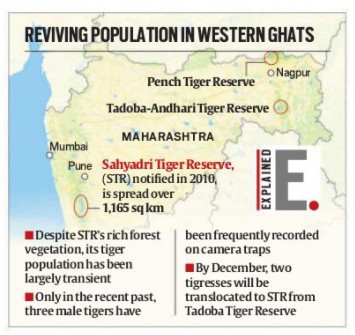
    In news: Sahyadri Tiger Reserve

    Why in the News?

    The Union Environment Ministry has approved the capture and translocation of eight tigers from Tadoba-Andhari and Pench reserves to the Sahyadri Tiger Reserve (STR) in western Maharashtra.

    In news: Sahyadri Tiger Reserve

    About Sahyadri Tiger Reserve (STR):

    • Overview: Situated in the Sahyadri Range, Western Ghats (Maharashtra), spanning districts of Satara, Sangli, Kolhapur, Ratnagiri.
    • Status: Declared Tiger Reserve (2010); part of UNESCO Western Ghats World Heritage Site (2012).
    • Geography: Dominated by Shivsagar (Koyna) and Vasant Sagar (Warana) reservoirs.
    • Vegetation: Moist evergreen, semi-evergreen, moist & dry deciduous forests; endemic trees like karvi, bamboo, Terminalia, Emblica.
    • Fauna: Bengal tiger, leopard, dhole, gaur, antelopes, mouse deer, giant squirrel. Birds include hornbills, vultures, river tern.
    • Tiger Status: Tigers absent for years; 5–9 present since 2018 (as per camera trap evidence).
    • Corridor Linkages: Connected to Radhanagari WLS (north) and Anshi–Dandeli TR (south, Karnataka), forming a key Western Ghats corridor.
    • Ecological Role: Secures catchments of Koyna & Warna rivers, crucial for farming and livelihoods.

    Need for Tiger translocation:

    • Prey base: Reserve has prey-rich habitat but lacks a stable breeding tiger population.
    • Other benefits: Prevents local extinction, strengthens corridor connectivity, supports Project Tiger, conserves biodiversity, and secures river watersheds.
    [UPSC 2017] From the ecological point of view, which one of the following assumes importance in being a good link between the Eastern Ghats and the Western Ghats?

    Options: (a) Sathyamangalam Tiger Reserve* (b) Nallamala Forest (c) Nagarhole National Park (d) Seshachalam Biosphere Reserve


  • Blockchain Technology: Prospects and Challenges

    What is Decentralised Finance (DeFi)?

    Why in the News?

    Decentralised Finance (DeFi) is rapidly expanding as a global financial innovation, enabling direct peer-to-peer transactions without intermediaries such as banks.

    What is DeFi?

    • It is a financial system that runs on blockchains like Ethereum.
    • It allows people to send, borrow, lend, invest, and trade money directly without banks.
    • All transactions happen using smart contracts (computer programs) and apps called dApps.
    • Anyone with a phone + internet can use it; no bank account or KYC needed.

    Features of DeFi:

    • No middlemen: Works without banks or brokers.
    • Smart contracts: Deals happen automatically once rules are met.
    • Open access: Anyone in the world can join with just a digital wallet.
    • Transparency: Every transaction is recorded on a blockchain for all to see.
    • Cross-border: Can be used internationally, without currency or banking restrictions.
    • Low cost & fast: Cheaper and quicker than traditional banking.
    • Anonymous: Many platforms don’t ask for ID, making it open but risky.

    DeFi in India:

    • Adoption: India ranks third globally in DeFi value (Chainalysis Global Crypto Adoption Index 2024).
    • Growth Drivers:
      • Large youth population and widespread smartphone use.
      • Strong digital payments ecosystem (UPI, JAM trinity).
      • Increasing retail investor interest in crypto-assets.
    • Uses: Indian users engage in lending, trading, yield farming, and staking via DeFi platforms like Aave, Compound, and SushiSwap.
    • Market Size: Projected to reach USD 1.7 billion by 2025.
    • Challenges: Regulatory uncertainty, risks of money laundering and terror financing, cyber vulnerabilities, and lack of investor protection.
  • Internal Security Architecture Shortcomings – Key Forces, NIA, IB, CCTNS, etc.

    [12th September 2025] The Hindu Op-ed: Relief for Refugees (Foreign (Exemption) Order, 2025)

    PYQ Relevance

    [UPSC 2022] India is an age-old friend of Sri Lanka. Discuss India’s role in the recent crisis in Sri Lanka in the light of the preceding statement.

    Linkage: The issue of Sri Lankan Tamil refugees directly ties to India’s longstanding friendship with Sri Lanka. While India has consistently extended humanitarian aid during Sri Lanka’s crises, the 2025 Immigration Order reflects another dimension of this support by protecting refugees from forcible repatriation. It highlights how India balances compassion for vulnerable groups with its broader role as a stabilising partner in Sri Lanka’s recovery

    Mentor’s Comment

    The recent Immigration and Foreigners (Exemption) Order, 2025, marks a turning point in India’s refugee policy, particularly concerning Sri Lankan Tamil refugees. While it offers legal relief, many gaps remain in ensuring citizenship, dignity, and durable solutions. This article explores the issue through a UPSC lens, connecting it with governance, international relations, and humanitarian concerns.

    Introduction

    The Union Ministry of Home Affairs notified the Immigration and Foreigners (Exemption) Order, 2025, exempting specified groups from passport and visa requirements for entering, staying, and exiting India. For the first time, Sri Lankan Tamil refugees, who have lived in Tamil Nadu since the 1990s, find explicit mention, gaining protection from forcible repatriation. However, questions of legal status, citizenship, and long-term rehabilitation remain unresolved, making this both a humanitarian and policy challenge.

    Why in the News

    For over three decades, Sri Lankan Tamil refugees have lived in India without a clear roadmap for citizenship or repatriation. The 2025 Order gives them temporary relief but does not resolve their “illegal migrant” status. This is significant because, unlike the six religious minorities from Afghanistan, Bangladesh, and Pakistan who received relief under the Citizenship Amendment Act (CAA), the Sri Lankan Tamils had been left out earlier. The recognition in 2025 is thus both a success and a reminder of unaddressed policy gaps.

    What Does the New Immigration Order Provide?

    1. Exemption Granted: Nationals of Nepal and Bhutan, Tibetan refugees, six religious minorities from Afghanistan, Bangladesh, Pakistan, and Sri Lankan Tamils are exempted from strict passport and visa rules.
    2. Historical Reference: Refugees must have entered India before January 9, 2015, and registered themselves to avail of the benefit.
    3. Protection from Forcible Return: This safeguards Sri Lankan Tamils from involuntary repatriation after decades of uncertainty.

    Why Are Sri Lankan Tamil Refugees a Special Case?

    1. Civil War Displacement: Many fled to Tamil Nadu in the 1990s during Sri Lanka’s civil war.
    2. Post-war Welfare: Both Union and Tamil Nadu governments provided welfare after the civil war ended in 2009.
    3. Exclusion from CAA 2019: Unlike refugees from Afghanistan, Pakistan, and Bangladesh, Sri Lankan Tamils were excluded from citizenship benefits.

    What Legal Hurdles Do Refugees Still Face?

    1. Illegal Migrant Tag: Despite the order, they remain classified as “illegal migrants” under Indian law.
    2. Citizenship Barriers: They cannot easily apply for citizenship under Section 5 (registration) or Section 6 (naturalisation) of the Citizenship Act, 1955.
    3. Long Term Visa (LTV) Gap: Exclusion from LTV eligibility blocks access to gainful employment and higher education.
    4. Missed Precedent: Tibetan refugees receive certificates of identity, which could serve as a model for Sri Lankan Tamils.

    What Are the Policy Options Ahead?

    1. Liberalisation of LTVs: Extending LTVs to Sri Lankan Tamil refugees would facilitate education and jobs.
    2. Voluntary Repatriation: India and Sri Lanka can collaborate on structured assistance for safe return.
    3. Local Integration: For those unwilling to return, gradual local integration with a humane approach can be considered.
    4. Model Replication: Certificates of identity, as given to Tibetan refugees, can help provide dignity and legal standing.

    Conclusion

    The 2025 Immigration Order is a step forward, but it leaves critical questions unresolved. Sri Lankan Tamil refugees deserve a humane, durable solution, whether through voluntary repatriation with assistance, or integration with rights and dignity. India, while balancing domestic concerns and foreign relations with Sri Lanka, must craft a policy that reflects compassion, legality, and long-term stability.

Join the Community

Join us across Social Media platforms.