💥UPSC 2027,2028 Mentorship (April Batch) + Access XFactor Notes & Microthemes PDF

Archives: News

  • Agricultural Sector and Marketing Reforms – eNAM, Model APMC Act, Eco Survey Reco, etc.

    How India’s Pesticide Market is Changing

    The Growth is Now Coming Not from Insecticides or Fungicides, but Herbicides.

    Understanding the Three Major Types of Pesticides:

    Pesticides are chemical or biological substances used to protect crops by eliminating or controlling pests, diseases, or weeds. India’s pesticide market primarily consists of:

    • Insecticides: These control insects that damage crops by feeding on them or transmitting diseases.
    • Fungicides: These are used to prevent or eliminate fungal infections like mildew, blight, or rust that affect crop yield and quality.
    • Herbicides: These destroy or inhibit the growth of weeds that compete with crops for nutrients, water, and sunlight.

    Herbicides – The New Growth Driver of India’s Pesticide Market:

    India’s organised crop protection market is valued at approximately ₹24,500 crore. While insecticides (₹10,700 crore) remain the largest segment, herbicides (₹8,200 crore) have emerged as the fastest-growing category, with an annual growth rate exceeding 10%. This shift reflects a deeper transformation in India’s rural economy—one driven by labour scarcity, rising wage rates, and the need for mechanisation and efficiency in farm operations.

    Why Herbicides Are Gaining Ground:

    1. Labour Shortages in Agriculture: Manual weeding is time-consuming and labour-intensive. A labourer takes 8–10 hours to weed one acre, and the average daily wage has increased from ₹326 in 2019 to over ₹447 in 2024. Moreover, rural youth are increasingly moving away from agricultural work. This has led to a surge in herbicide use as a labour-saving input, similar to how tractors reduced the need for manual ploughing.
    2. Time-Saving and Cost-Effective: Power weeders are limited in closely spaced or deep-rooted crops. Herbicides, on the other hand, can be sprayed easily and reduce both labour dependence and turnaround time between cropping cycles.
    3. Strategic Use Patterns Emerging: Earlier, herbicides were used only after weed emergence (“post-emergent”). Now, farmers increasingly apply “pre-emergent” herbicides at or just after sowing to prevent weed growth from the beginning—reflecting a shift from reactive to preventive agriculture.

    Role of Indian Companies Amidst MNC Dominance:

    India’s crop protection sector remains largely dominated by multinationals like Bayer (Germany), Syngenta (Switzerland), Corteva (USA), and Sumitomo (Japan). However, Indian companies like Crystal Crop Protection Ltd (CCPL) and Dhanuka Agritech are rising players:

    1. CCPL acquired rights for key herbicides like Ethoxysulfuron and Gramoxone from global majors.
    2. It has also developed new products like ‘Sikosa’ in partnership with Battelle (USA) and Mitsui (Japan), showing how Indian firms are strategically expanding through innovation and collaboration.

    Why This Matters for India’s Agricultural Future

    1. Productivity Gains: Weeds reduce crop yield by competing for water and nutrients. Herbicides help ensure better resource absorption by crops.
    2. Supports Mechanisation: Like other farm machinery, herbicides reduce dependence on human labour and enable faster, scalable farming.
    3. Aligns with Climate-Resilient Agriculture: Timely and smart weed control reduces input waste and improves crop resilience.

    Key Concerns

    1. Ecological Impact: Excessive herbicide use can lead to soil degradation, water contamination, and loss of biodiversity.
    2. Labour Displacement: As weeding becomes chemical-driven, demand for rural manual labour might further decline.
    3. MNC Monopoly: Unlike seeds and fertilisers, pesticides remain MNC-dominated, raising questions on strategic autonomy in agri-inputs.

    Conclusion:

    The rise of herbicides in India’s pesticide market marks a significant transformation in agricultural input use. While they offer a timely solution to labour shortages and boost farm efficiency, a cautious, balanced, and indigenously empowered approach is necessary.

  • Foreign Policy Watch: India-United States

    India– U.S. Trade Friction Escalates Amid Russian Oil Dealings

    President Trump announces steep tariff hikes on Indian imports over continued Russian oil purchases; India calls it “unjustified and unreasonable”.

    Context and Relevance (GS2 – International Relations, GS3 – Economy, Trade Policy):

    In a move that has strained India–U.S. economic ties, U.S. President Donald Trump has announced plans to “substantially” increase tariffs on Indian goods. This decision comes days after a 25% tariff plus penalty was imposed, with Trump citing India’s oil imports from Russia as the trigger. India has hit back, defending its energy security needs and calling out the West’s own trade with Russia.

    This development adds to the geopolitical-economic complexity facing India’s foreign policy and trade decisions in the wake of the Russia–Ukraine conflict.

    What are Tariffs?

    1. A tariff is a tax imposed by a government on imported goods.
    2. Tariffs make foreign goods costlier, potentially protecting domestic industries but also risking retaliation and higher consumer prices.

    Sectors Likely to Be Affected

    1. Pharmaceuticals – India is a major exporter of generic drugs to the U.S.; tariffs could increase prices and affect competitiveness.
    2. Metals and Engineering Goods – Steel, aluminum, and other value-added metals are vulnerable.
    3. Textiles and Apparel – A major Indian export to the U.S. which operates on thin margins.
    4. IT Services (Indirect Impact) – Not under direct tariff but can be impacted by broader deterioration in trade ties.
    5. Petrochemicals and Refined Products – As India refines and re-exports Russian crude, this area could come under scrutiny.
    6. Defence Procurement and Technology Sharing – Strategic relations could take a hit, affecting high-tech transfers.
    7. Startups and Digital Trade – New tech collaborations may slow if the overall atmosphere deteriorates.

    Why is the U.S. Taking This Step:

    President Trump’s reasoning includes:

    1. India allegedly buying “massive amounts of Russian oil” and re-exporting it for profits.
    2. High Indian tariffs and non-tariff barriers that restrict U.S. goods.
    3. India’s continued energy and defence cooperation with Russia.
    4. Trump’s argument taps into U.S. domestic concerns around trade imbalances and perceived strategic neutrality by India on the Russia–Ukraine issue.

    India’s Stand: Energy Security First:

    India’s Ministry of External Affairs (MEA) issued a strong rebuttal:

    1. India started buying from Russia when traditional suppliers diverted oil to Europe.
    2. The U.S. itself had encouraged these imports to stabilise global markets.
    3. Western nations continue trading with Russia in: LNG, uranium, palladium, fertilisers, and chemicals.
    4. EU–Russia bilateral trade in 2024 exceeded €84.7 billion (goods + services).

    India argued that its trade was a “vital compulsion”, unlike the West’s “strategic choice”.


    Economic and Strategic Implications for India:

    Core Economic Concepts at Play

    1. Trade Diversion & Substitution: U.S. importers may turn to other countries, diverting trade away from India.
    2. Protectionism vs Globalisation: Rising protectionism threatens the rules-based global trade order.
    3. Non-Tariff Barriers Debate: Focus returns to India’s complex regulatory environment that discourages FDI and foreign trade.
    4. Elasticity of Demand for Indian Exports: Tariff hikes could reveal price sensitivity in sectors like pharma and textiles.

    Foreign Policy and Strategic Autonomy

    1. India’s multi-alignment strategy is being tested.
    2. Strategic autonomy in energy choices now faces economic costs.

    Impact on India’s Export Competitiveness

    • With countries like Vietnam, Mexico, and Indonesia unaffected by such tariffs, India faces a competitive disadvantage.

    Investor Confidence

    • Heightened U.S.–India tensions could create policy uncertainty for foreign investors.

    Way Forward for India:

    1. Bilateral Negotiations: Urgent dialogue needed through trade channels to de-escalate.
    2. Diversification: India must strengthen ties with other large markets (e.g., EU, ASEAN, Africa).
    3. Strengthen Domestic Industry: Boost manufacturing competitiveness through PLI schemes, FTAs, and ease of doing business.
    4. Energy Diplomacy: Deepen engagement with Gulf countries and renewables to reduce over-dependence on Russia.

    Conclusion:

    This episode is a litmus test for India’s balancing act between strategic autonomy and economic pragmatism. It also reflects the larger trend of global economic nationalism overshadowing multilateral cooperation. India will need to walk a tightrope between asserting its sovereign right to energy security and preserving its vital trade relationships.


    Sample UPSC Mains Question (GS2/GS3 – 15 Marks)

    In the wake of rising global protectionism and India’s continued energy trade with Russia, critically examine the impact of unilateral tariff impositions by developed nations on India’s strategic autonomy and export competitiveness. Suggest a multi-pronged approach to mitigate such risks.


  • Electric and Hybrid Cars – FAME, National Electric Mobility Mission, etc.

    [pib] India Electric Mobility Index (IEMI)

    Why in the News?

    To support India’s net-zero transport goal by 2070, NITI Aayog launched the India Electric Mobility Index (IEMI) to track and rank States/UTs on their shift to electric mobility.

    [pib] India Electric Mobility Index (IEMI)

    About India Electric Mobility Index (IEMI):

    • Launched by: NITI Aayog in 2024.
    • Purpose: To evaluate and benchmark the progress of Indian States and Union Territories (UTs) in achieving their electric mobility and transport decarbonization goals.
    • Scoring: States and UTs are scored out of 100 using 16 indicators grouped under 3 core themes.
    • Core Themes:
      1. Transport Electrification Progress – Measures EV adoption across segments (2W, 3W, 4W, buses, etc.)
      2. Charging Infrastructure Readiness – Assesses public charging station density, coverage, and policy support.
      3. EV Research & Innovation Status – Tracks EV startups, R&D activity, patents, and skilling efforts.
    • Significance:
      • Supports tailored policymaking and cross-learning.
      • Enables transparency and healthy competition among states.
      • Aligns with India’s net-zero emissions target by 2070.
    • Methodology: Based on VAHAN data, charging infrastructure maps, and stakeholder consultations.
    • Accessibility: Publicly available dashboard and report for rankings, scores, and methodology.

    Key Highlights (2024 Edition):

    • Top Performers: Delhi, Maharashtra, and Chandigarh lead overall in EV readiness.
    • Category Leaders:
      • Transport Electrification: Delhi and Maharashtra.
      • Charging Infrastructure: Karnataka, Haryana, Himachal Pradesh, Ladakh.
      • Research & Innovation: Delhi, Tamil Nadu, Maharashtra, Karnataka, Telangana, Haryana.
    • EV Policy Status: 29 States/UTs have formal EV policies; 4 are in the draft stage.
    • EV Adoption Data:
      • EVs make up 5.3% of private vehicle sales in 2024.
      • Over 12 lakh EVs registered in India during the year.
    • Public Charging Network: India has over 25,000 public EV charging stations.
    • State Categories:
      • Performers: Karnataka, Tamil Nadu, Uttar Pradesh, Chhattisgarh, Odisha, Haryana, Goa.
      • Aspirants: Punjab, Rajasthan, Telangana, Andhra Pradesh, Assam, Bihar, Kerala, North-East states.
    [UPSC 2024] Which one of the following is the exhaust pipe emission from Fuel Cell Electric Vehicles powered by hydrogen?

    Options: (a) Hydrogen peroxide (b) Hydronium (c) Oxygen (d) Water vapour*


  • Dams and Hydroprojects

    Sawalkote Hydro Project

    Why in the News?

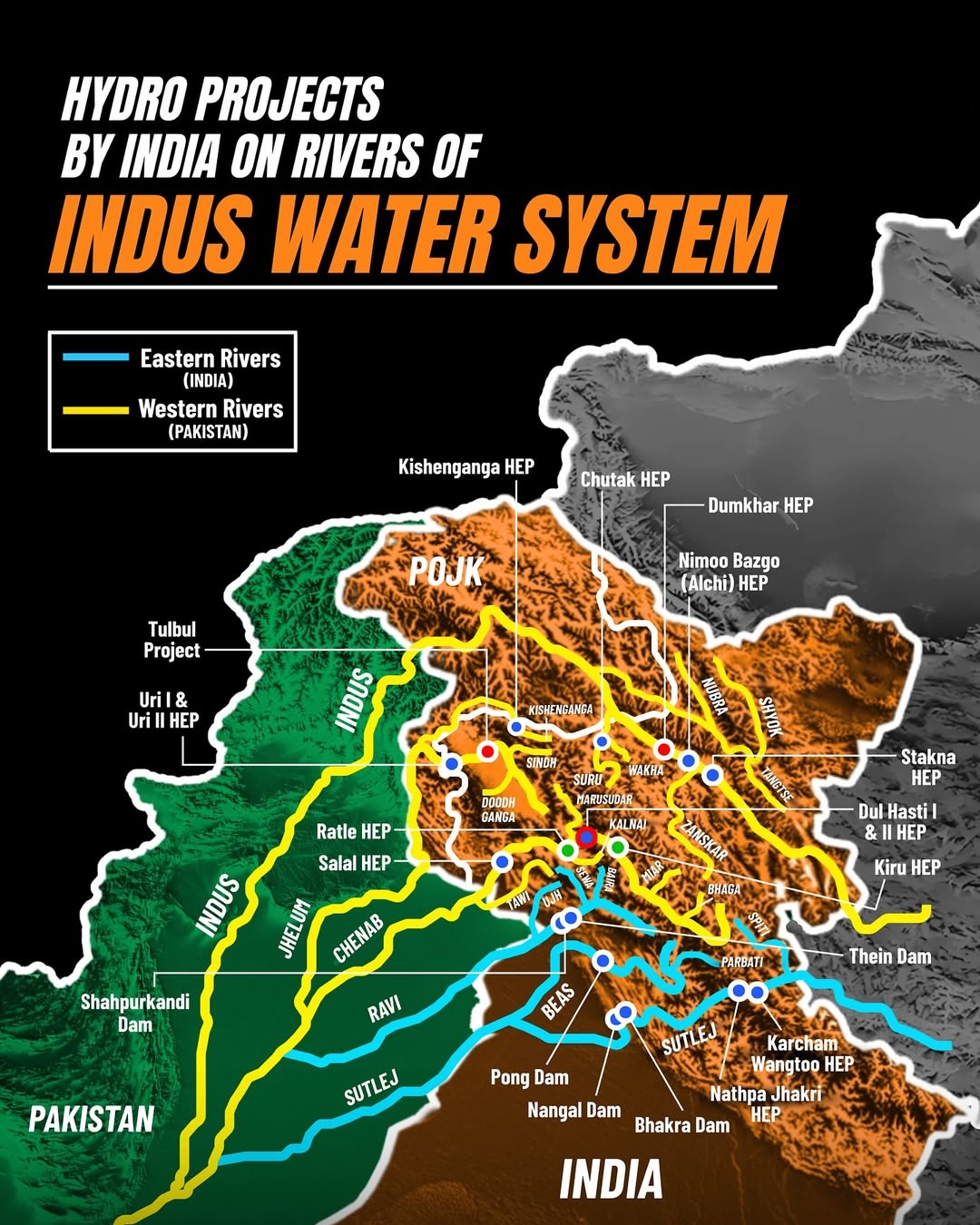
    After suspending the Indus Waters Treaty, India is asserting water control in J&K by reviving the Sawalkote Hydroelectric Project — the UT’s largest planned hydro project.

    Sawalkote Hydro Project

    About Sawalkote Hydro Project:

    • Location: Ramban and Udhampur districts, Jammu and Kashmir.
    • River: Built on the Chenab River (a western river under the Indus Waters Treaty).
    • Agency: Implemented by National Hydroelectric Power Corporation.
    • History: Proposed in the 1960s; delayed due to Pakistan’s objections, environmental issues, and red tape. Revived after India suspended the Indus Waters Treaty post the April 2025 Pahalgam terror attack.
    • Status (2025): Forest clearance granted; tenders floated on 29 July 2025; declared a project of national importance.
    • Timeline: 96 months post-clearance; expected commissioning by or after 2032.

    Key Features:

    • Type: Run-of-the-river (utilizes the natural flow and elevation drop of a river) hydroelectric project.
    • Capacity: 1,856 Megawatts (8 × 225 MW + 1 × 56 MW).
    • Dam: 192.5 m high, roller-compacted concrete gravity dam; reservoir holds 550 million cubic meters.
    • Powerhouse: Underground, with Francis turbines.
    • Cost: ₹22,704.8 crore (~2.6 billion United States Dollars).
    [UPSC 2009] Gandhi Sagar Dam is a part of which one of the following?

    Options: (a) Chambal Project * (b) Kosi Project (c) Damodar Valley Project (d) Bhakra Nangal Project


  • Waste Management – SWM Rules, EWM Rules, etc

    Pollution Control can levy Environmental Damages: SC

    Why in the News?

    In a landmark ruling, the Supreme Court has empowered Pollution Control Boards (PCBs) across India with the authority to impose and collect restitutionary and compensatory damages under the Water and Air Acts.

    Key Highlights of Supreme Court Ruling:

    • Key Powers Granted:
      • Impose and collect restitutionary and compensatory damages.
      • Demand bank guarantees in anticipation of environmental harm.
    • Legal Basis:
      • Section 33A, Water Act, 1974: Power to issue directions for closure/regulation of industries and stoppage of utilities to enforce water pollution norms.
      • Section 31A, Air Act, 1981: Similar binding powers to control air pollution; non-compliance is a legal violation.

    About Central Pollution Control Board (CPCB):

    • Established: September 1974 under the Water (Prevention and Control of Pollution) Act, 1974; Also empowered under Air (Prevention and Control of Pollution) Act, 1981.
    • Role: Statutory technical body to promote clean air and water; provides services under the Environment (Protection) Act, 1986.
    • Key Functions:
      • Control and abate water and air pollution; promote stream and well cleanliness.
      • Advise the Central Government on pollution-related issues.
      • Coordinate with and assist State Pollution Control Boards (SPCBs); resolve disputes.
      • Monitor pollution in Union Territories via delegated powers under Water, Air, and Water Cess Acts.
    • Develops and revises:
      • National Ambient Air Quality Standards.
      • Water Quality Criteria from various sources.
      • Emission/Discharge Standards under Environment Protection Rules, 1986.
      • Bio-Medical Waste Incineration Norms.
      • Noise/Emission Limits for diesel, LPG, and CNG generators.
    • Minimal National Standards (MINAS) Issuance:
      • Covers effluent, emission, noise, and solid waste across industries.
      • Mandatory for State adoption as baseline standards.
      • Publishes COINDS (Comprehensive Industry Documents), manuals, and codes for pollution treatment and control systems.

    About State Pollution Control Boards (SPCBs):

    • Constitution: Formed by State Governments under the Water and Air Acts.
    • Functions:
      • Monitor and control local pollution.
      • Inspect industries and enforce compliance.
      • Advise state governments.
      • Conduct awareness campaigns.
      • Implement control programmes and collaborate with CPCB and local bodies.
    [UPSC 2018] How is the National Green Tribunal (NGT) different from the Central Pollution Control Board (CPCB)?

    1. The NGT has been established by an Act whereas the CPCB has been created by an executive order of the Government.

    2. The NGT provides environmental justice and helps reduce the burden of litigation in the higher courts whereas the CPCB promotes cleanliness of streams and wells and aims to improve the quality of air in the country.

    Which of the statements given above is/are correct?

    Options: (a) 1 only (b) 2 only * (c) Both 1 and 2 (d) Neither 1 nor 2


  • Wildlife Conservation Efforts

    Asian Giant Tortoise reintroduced in Nagaland

    Why in the News?

    The Asian giant tortoise (Manouria emys), the largest tortoise in mainland Asia, has been reintroduced into the Zeliang Community Reserve in Nagaland’s Peren district.

    Asian Giant Tortoise reintroduced in Nagaland

    About Asian Giant Tortoise (Manouria emys):

    • It is the largest tortoise in mainland Asia.
    • Two subspecies: Manouria emys emys and Manouria emys phayrei.
    • Uniquely, it lays eggs above ground in leaf-litter nests.
    • Behaviour: It is solitary and active mostly during dawn and dusk.
    • Found in evergreen and bamboo forests across India, Bangladesh, Myanmar, Thailand, Malaysia, and Indonesia.
    • Habitat in India: Nengpui WLS, Nongkhyllem WLS, and North Cachar Hills.
    • Conservation status: IUCN – Critically Endangered; CITES – Appendix II; Wildlife Protection Act – Schedule IV.
    • Major threats: Illegal hunting for meat, habitat degradation, forest fires, and bamboo removal.
    [UPSC 2017] In India, if a species of tortoise is declared protected under Schedule I of the Wildlife (Protection) Act, 1972, what does it imply?

    Options: (a) It enjoys the same level of protection as the tiger*

    (b) It no longer exists in the wild, a few individuals are under captive protection; and how it is impossible to prevent its extinction

    (c) It is endemic to a particular region of India

    (d) Both (b) and (c) stated above are correct in this context.


  • Innovations in Sciences, IT, Computers, Robotics and Nanotechnology

    Blockchain-verified Quantum Randomness for Secure Communication

    Why in the News?

    A recent breakthrough demonstrated use of quantum science, blockchain, and cryptography to create truly random and secure numbers used in encryption for secure communication.

    About the Technology:

    • Encryption: Converts readable data into unreadable code using a “key”; only someone with the correct key can decrypt the message.
    • Importance of Randomness: Secure encryption depends on unpredictable keys—predictable keys can be guessed or hacked.
    • Issue with Computers: Most keys are generated using pseudo-random algorithms, which appear random but are predictable if the method is known.

    About the Breakthrough Lava Lamp Method:

    • Setup: 100 lava lamps placed on a wall at Cloudflare’s San Francisco office; a camera takes periodic photos of the moving blobs.
    • Process: Each photo is converted into numerical data, creating a random seed to generate encryption keys.
    • Why Lava Lamps? The heat-driven movement of wax blobs is unpredictable and creates unique images.
    • Limitations: Movements follow physics, so not truly random. Also, the algorithm that converts images is deterministic—reproducible if known.

    Quantum Random Number Generation Protocol:

    • Why Quantum Physics: Subatomic particles like photons behave randomly; for example, a photon’s polarization is unknown until measured.
    • How It Works: Scientists used lasers to generate entangled photons and measured them millions of times to produce random results.
    • Data Conversion: The raw data (in binary) was biased, so a randomness extractor was used to generate a clean 512-bit unbiased number using a second random seed.
    • Blockchain Role: Each step was recorded on blockchain for transparency, with digital fingerprints (hashes) to ensure data integrity.
    • Team Involvement: National Institute of Standards and Technology (NIST), University of Colorado, and DRAND each handled separate parts to ensure decentralization and trust.
    • Public Use: The final random numbers are shared via CURBy, a public distribution service.
    • Significance: Though still emerging, this method shows strong potential for future ultra-secure encryption systems.
    [UPSC 2025] Consider the following statements:

    I. It is expected that Majorana 1 chip will enable quantum computing. II. Majorana 1 chip has been introduced by Amazon Web Services (AWS). III. Deep learning is a subset of machine learning.

    Which of the statements given above are correct?

    Options: (a) I and only I (b) II and III only (c) I and III only* (d) I, II and III


  • Waste Management – SWM Rules, EWM Rules, etc

    [4th August 2025] The Hindu Op-ed: The ‘right to repair’ must include ‘right to remember’

    PYQ Relevance:

    [UPSC 2015] India’s Traditional Knowledge Digital Library (TKDL) which has a database containing formatted information on more than 2 million medicinal formulations is proving a powerful weapon in the country’s fight against erroneous patents. Discuss the pros and cons making this database publicly available under open-source licensing.

    Linkage: This question directly discusses the “Traditional Knowledge Digital Library (TKDL)” and its role in protecting “traditional knowledge” from erroneous patents. This is highly relevant as the source champions the idea of treating repair as a “cultural and intellectual resource” and recognizing “tacit knowledge”.


    Mentor’s Comment:  In May 2025, the Indian government accepted a report proposing a Repairability Index for mobile phones and appliances, marking a significant policy shift toward sustainable electronics and the Right to Repair. This move comes amid growing global and domestic recognition of repair as a cultural, environmental, and intellectual resource. It ties into India’s digital and AI policy evolution, yet highlights a blind spot — the continued exclusion of informal repair ecosystems from mainstream policy frameworks, even as they remain central to material resilience and circular economy goals.

    Today’s editorial analyses the Repairability Index for mobile phones and appliances. This topic is important for GS Paper II (Governance) and GS Paper III (Science and Technology) in the UPSC mains exam.

    _

    Let’s learn!

    Why in the News?

    Recently, the Indian government made an important move to support eco-friendly electronics by approving a report that suggests a Repairability Index.

    What is India’s Repairability Index?

    • India’s Repairability Index was introduced by the Department of Consumer Affairs under the Ministry of Consumer Affairs, Food and Public Distribution.
    • It is part of the broader Right to Repair framework announced in 2022, aimed at empowering consumers, reducing electronic waste, and promoting sustainable consumption practices in line with India’s LiFE (Lifestyle for Environment)movement.
    • This index will rank products based on:
      • Ease of repair
      • Availability of spare parts
      • Duration of software support

    What is the significance of it?

    • Sustainable consumption – Promotes products that last longer and are repairable. Eg: Smartphones with modular parts like Fairphone (Dutch electronics company known for producing sustainable and repairable smartphones).
    • Informed consumer choices – Enables buyers to compare repairability before purchase. Eg: Choosing a laptop with a higher repair score.
    • Reduction in e-waste – Minimizes discarding of electronics due to minor faults. Eg: Repairing washing machines instead of replacing them.
    • Accountability of manufacturers – Pushes brands to provide spare parts and repair guides. Eg: Brands like Apple offering self-service repair kits.
    • Support for circular economy – Aligns with India’s LiFE initiative and green goals. Eg: Encouraging reuse and repair to lower carbon footprint.

    Why is informal repair knowledge important?

    India’s Repairability Index promotes affordable, sustainable repairs by valuing informal repair knowledge

    • Affordable & Accessible Repairs: Informal repair shops offer low-cost services, especially in rural and low-income areas. Eg: Mobile repair kiosks in small towns reduce reliance on costly authorized centers.
    • Skill Preservation & Livelihoods: Supports local employment and traditional skills, often passed down informally. Eg: TV/radio technicians in informal markets maintain electronics affordably.
    • E-waste Reduction & Sustainability: Extends product lifespan, minimizing electronic waste and promoting circular economy. Eg: Refurbishing laptops in Delhi’s Nehru Place instead of discarding them.

    What are the challenges related to the informal repair sector?

    • No Legal Recognition: Informal repairers lack licensing, social security, and financial support. E.g.: Mobile repairers in small towns operate without official status or access to schemes.
    • Bias Toward Authorized Centres: Policies favour OEM (Original Equipment Manufacturer) -authorized repairs, sidelining local technicians. Eg: Warranties void if not repaired at authorized service centers.
    • Exclusion from Policy Frameworks: Right to Repair and e-waste policies neglect grassroots repair ecosystems. Eg: Informal markets like Nehru Place not integrated into national repair planning.

    Which steps can link repair to AI and sustainability goals?  

    • AI-Powered Predictive Maintenance: AI algorithms detect faults early and recommend timely repairs, reducing waste. Eg: Smart appliances (e.g., washing machines) alert users before breakdowns, helping extend product life.
    • AI-Driven Repair Diagnostics: AI tools assist technicians by analyzing errors and suggesting solutions, even in informal sectors. Eg: Mobile apps using AI (like Bhashini-based tools) guide rural repairers to fix smartphones or electronics.
    • Support for Circular Economy: Integrate AI with repairability data (e.g., India’s Repairability Index) to promote reuse and reduce e-waste.

    Way forward: 

    • Recognize Informal Repair Sector: Include informal technicians in policy frameworks and skilling programs under schemes like Skill India.
    • Strengthen India’s Repairability Index: Ensure it includes access to spare parts, repair manuals, and supports local repair ecosystems.
    • Promote Open Access to Repair Tools: Mandate OEMs to share diagnostic tools and data with certified independent and informal repairers.
    • Leverage AI for Inclusive Repair Solutions: Use AI-powered platforms to assist grassroots repairers and map repair needs, boosting sustainability goals.
  • International Monetary Fund,World Bank,AIIB, ADB and India

    How does the World Bank classify countries by income?

    Why in the News?

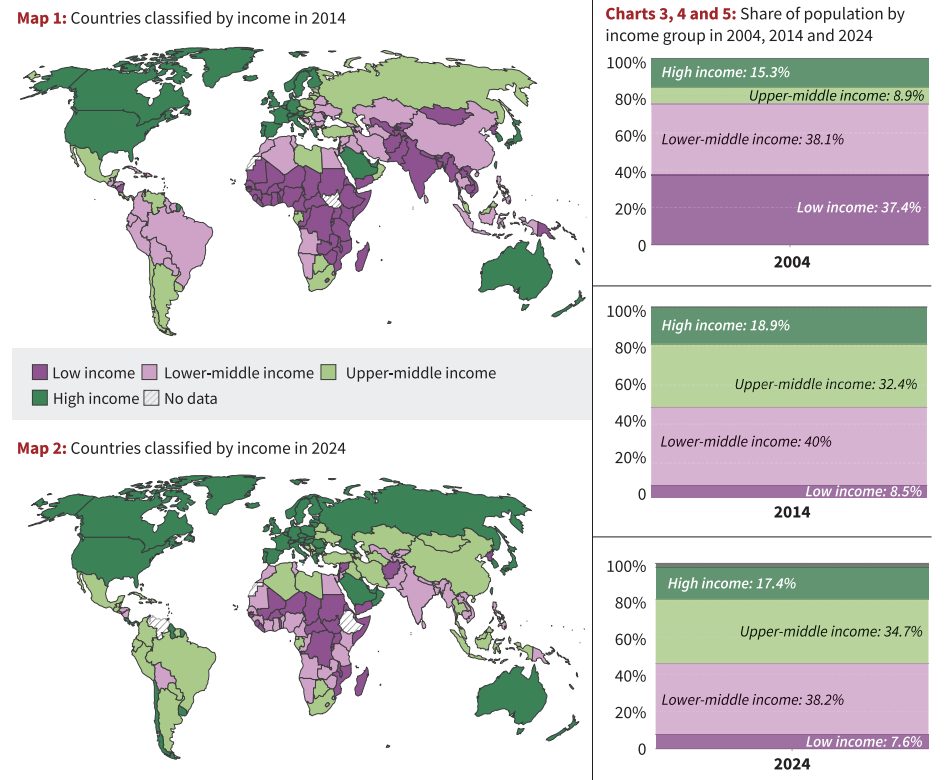
    Recently, the World Bank’s 2024 update to its income classification system revealed major shifts, with a sharp decline in low-income populations and a rise in upper-middle-income countries.

    Global Income Classification Trends (2004–2024): Key Shifts in Population Distribution: 

    • Global Shift Upwards: The share of the world population in low-income countries dropped from 37.4% in 2004 to 7.6% in 2024, showing significant poverty reduction.
    • Rise of Upper-Middle Group: The population in upper-middle-income countries rose from 8.9% in 2004 to 34.7% in 2024, indicating broad economic progress in many developing nations.
    • Lower-Middle Income Stability: The lower-middle-income group has remained relatively stable, around 38–40% of global population from 2004 to 2024.
    • High-Income Countries’ Share Fluctuated: The global population in high-income nations peaked at 18.9% in 2014, then slightly declined to 17.4% in 2024.
    • Country Reclassifications: Countries like India and Indonesia moved to higher income groups, while some African countries remained or slipped into low-income status.

    What is the World Bank’s income classification?

    • Four Income Groups: Countries are classified into low, lower-middle, upper-middle, and high-income based on their Gross National Income (GNI) per capita.
    • Annual Update: Classifications are updated yearly, adjusting for global inflation and changes in income.
    • Absolute Thresholds: Groupings are based on fixed income thresholds, not relative comparisons with other countries.
      • Low income: GNI per capita ≤ $1,135
      • Lower-middle income: $1,136 – $4,465
      • Upper-middle income: $4,466 – $13,845
      • High income: ≥ $13,846

    How is GNI per capita used in this system?

    • It measures the average income per person, including income from abroad.
    • GNI figures (reported in local currency) are converted to USD using exchange rates.
    • Countries are placed into groups using predetermined income thresholds.

    Why do countries shift between income groups?

    • Economic Growth or Decline: Strong GDP growth raises GNI per capita, moving countries to higher groups. Eg: India’s GNI per capita rose from $2,250 (2022) to $2,610 (2023), nearing upper-middle-income status.
    • Currency Exchange Fluctuations: A weaker local currency reduces GNI in USD terms. Eg: Egypt’s currency depreciation led its GNI per capita to fall from $3,890 (2022) to $3,240 (2023), reclassifying it from upper-middle to lower-middle-income.
    • Population Growth Rates: Fast population growth reduces GNI per capita even if total income rises. Eg: Nigeria’s large population growth kept its GNI per capita at $2,110 (2023), maintaining its lower-middle-income status.

    What are the challenges for India as a Lower-Middle-Income Country?

    • Limited Fiscal Space: India struggles to allocate sufficient funds for healthcare, education, and infrastructure. Eg: Public health spending remains around 2% of GDP, below the global average of 5–6%.
    • High Income Inequality: Rapid growth hasn’t translated into equitable wealth distribution. Eg: The top 10% in India hold nearly 77% of total national wealth (Oxfam, 2023).
    • Jobless Growth: Economic expansion hasn’t created enough formal sector jobs. Eg: Despite over 6% GDP growth, unemployment among youth remains high at around 45% (CMIE, 2023).

    What are the steps taken by the Indian government?

    • PM Gati Shakti Mission: Enhances infrastructure development for seamless connectivity and job creation.
    • National Education Policy (NEP) 2020: Aims to improve access, equity, and quality in education, especially in rural areas.
    • Ayushman Bharat Scheme: Provides free healthcare to over 50 crore people, addressing public health gaps.
    • Make in India & PLI Schemes: Promote domestic manufacturing and boost employment across key sectors.
    • Digital India & Skill India: Focuses on digital inclusion and vocational training to equip youth with employable skills.

    Way forward: 

    • Accelerate Inclusive Economic Growth: Focus on MSMEs, rural entrepreneurship, and labour-intensive sectors to boost incomes and job creation.
    • Invest in Human Capital: Enhance education quality, healthcare access, and nutritional outcomes, especially for the poor.
    • Strengthen Social Safety Nets: Expand direct benefit transfers (DBTs) and targeted subsidies to reduce vulnerability and inequality.
    • Promote Technological Innovation: Support startups, R&D, and digital infrastructure to drive productivity and global competitiveness.

    Mains PYQ:

    [UPSC 2013] The World Bank and the IMF, collectively known as the Bretton Woods Institutions, are the two inter-governmental pillars supporting the structure of the world’s economic and financial order. Superficially, the World Bank and the IMF exhibit many common characteristics, yet their role, functions and mandate are distinctly different. Elucidate.

    Linkage: This question directly asks about the World Bank’s role, functions, and mandate. A fundamental aspect of the World Bank’s function is its income classification system, which was initially designed to determine eligibility for loans, particularly concessional ones, based on a country’s average income.

  • Trade Sector Updates – Falling Exports, TIES, MEIS, Foreign Trade Policy, etc.

    Another slip up by India in the trade pact with the U.K.

    Why in the News?

    Concerns have emerged over India’s commitments in the India-UK Comprehensive Economic and Trade Agreement (CETA), particularly Article 13.6 on intellectual property. Critics argue it weakens India’s long-standing stance on compulsory licensing, favouring voluntary mechanisms instead.

    How does Article 13.6 affect medicine access in India?

    • Dilution of Compulsory Licensing Rights: The Article 13.6 of CETA favours voluntary licensing over compulsory licensing, reducing India’s legal room to ensure affordable drug access, especially during public health emergencies.
    • Reduced Policy Space in Patent Law: Provisions like weakening the “working requirement” restrict India’s ability to revoke non-working foreign patents, hampering local production of essential medicines.
    • Dependence on Foreign Patent Holders: Voluntary licensing shifts control to multinational corporations, allowing them to set restrictive terms, often limiting distribution, pricing, and manufacturing flexibility for Indian firms.
    • Loss of Global TRIPS Advocacy Role
      India’s past leadership in pushing for TRIPS flexibilities (Doha Declaration) is undermined, affecting its credibility in representing developing countries’ interests in global forums.
    • Risk to Access and Affordability of Medicines: The FTA could hinder production of low-cost generics, making life-saving drugs less accessible to Indian citizens and low-income countries relying on Indian pharma exports.

    What is Voluntary Licensing?

    Voluntary licensing is when the patent holder (usually a pharmaceutical company) gives permission to another company (often in another country) to produce and sell its patented product, usually generic versions under agreed terms and conditions.

    What is Compulsory Licensing?

    Compulsory licensing is when a government allows someone else to produce a patented product or process without the consent of the patent holder, usually under specific public interest grounds such as health emergencies.

    Which global rules backed India’s earlier patent stand?

    • TRIPS Agreement (WTO):  Allowed for compulsory licensing under public health grounds, helping India prioritize affordable access over strict patent monopolies.
    • Doha Declaration on TRIPS and Public Health (2001): Reaffirmed countries’ right to protect public health and promote access to medicines, supporting India’s flexible patent stance.
    • Paragraph 6 System (WTO, 2003): Enabled countries like India to export generic medicines to nations lacking manufacturing capacity, aligning with its role as the “pharmacy of the world.”
    • Indian Patent Act, 1970 (amended in 2005): Incorporated TRIPS flexibilities such as compulsory licensing and strict patentability criteria (e.g. Section 3(d)) to prevent evergreening.
    • UN High-Level Panel on Access to Medicines (2016): Emphasized that IP rights should not override public health, validating India’s position on balancing innovation and accessibility.

    What should be done? 

    • Reaffirm TRIPS Flexibilities in Trade Negotiations: India must ensure that all future FTAs explicitly protect its right to use compulsory licensing and patent law flexibilitiesunder the TRIPS Agreement.
    • Strengthen Domestic Patent Law: Amend and reinforce provisions like the “working requirement” to protect public health and allow challenges to non-working or unaffordable patents.
    • Enhance Public Health Safeguards in FTAs: Negotiate clear exceptions for essential medicines and green technology, ensuring that IP provisions do not override public interest obligations.
    • Build Strategic Alliances with Global South: Collaborate with developing countries to collectively oppose IP-heavy provisions in trade deals and promote affordable access to medicines globally.
    • Promote Indigenous Innovation and R&D: Invest in public sector research and incentivize Indian pharma and green tech innovation to reduce dependency on foreign patents and strengthen self-reliance.

    Mains PYQ:

    [UPSC 2024] Discuss the implications of Intellectual Property rights with respect to life materials? Although, India is second in the world to file patents, still only a few have been commercialized. Explain the reasons behind this less commercialization.

    Linkage: This question directly asks about “Intellectual Property rights with respect to life materials” and patents. The article talks about the implications of India’s CETA commitments on its patent regime concerning “patented medicines” and the “patent system”. The “slip up” in the trade pact is precisely about India compromising its traditional stance on IPR, particularly regarding access to medicines, which is a direct implication of intellectual property rights on life materials.

Join the Community

Join us across Social Media platforms.