💥UPSC 2027,2028 Mentorship (April Batch) + Access XFactor Notes & Microthemes PDF

Archives: News

  • Trade Sector Updates – Falling Exports, TIES, MEIS, Foreign Trade Policy, etc.

    Why was a Customs Duty hike imposed for Lab Chemicals?   

    Why in the News?

    The Finance Ministry has reversed the proposed post-Budget customs duty hike on imported laboratory chemicals following an outcry from scientists.

    What are the different kinds of chemicals which are imported into the country?  

    • Inorganic Chemicals: This category includes substances like ammonia, phosphoric acid, and sulfuric acid, which are essential for various industrial applications.
    • Organic Chemicals: Key imports in this category are methanol, acetic acid, and phenol, which are used in the production of plastics, solvents, and pharmaceuticals.
    • Petrochemicals: Significant imports include polyethene, polypropylene, and styrene, which are crucial for manufacturing plastics and synthetic materials.
    • Speciality Chemicals: Chemicals such as ethyl vinyl acetate and maleic anhydride are imported for specific applications in industries like adhesives and coatings.
    • Agrochemicals: This includes various pesticides and herbicides, which are vital for agricultural productivity and crop protection.

    How important are these chemicals for scientific research?    

    • Foundation for Experimental Work: Laboratory chemicals are essential for conducting experiments in various scientific fields, enabling researchers to test hypotheses and validate results.
    • Facilitate Innovation: These chemicals allow for the development of new products and technologies, driving advancements in industries such as pharmaceuticals, biotechnology, and materials science.
    • Support Medical Diagnostics: Laboratory chemicals play a crucial role in medical testing and diagnostics, aiding in disease detection and treatment monitoring, which is vital for public health.

    What was the issue?

    • Steep Duty Increase: The hike in customs duty on laboratory chemicals alarmed the scientific community, with prices of essential chemicals projected to rise dramatically, such as a batch that typically costs ₹1,00,000 now estimated at ₹2,50,000.
    • Impact on Research: Researchers expressed concerns that the increased costs would hinder scientific research and experimentation, as many essential chemicals are imported and the hike could disrupt ongoing projects.

    Is Ethanol also imported into the country?

    • Import Volume: India imported approximately 635 million liters of ethanol in 2022, primarily for use as fuel and in industrial applications.
    • Types of Ethanol: There are two main types of ethanol relevant to India:
      • Denatured Ethanol: This type is mixed with additives to make it unfit for consumption and is primarily used in laboratories and industrial applications. India has reduced the import tariff on denatured ethanol to encourage its use in manufacturing.
      • Undenatured Ethanol: This type incurs a higher import tariff of 150% and is generally used for beverage production.
    • Domestic Production Challenges: Although India has a significant capacity for ethanol production, it often faces challenges such as insufficient molasses supply. The government has set ambitious goals for ethanol blending in gasoline, aiming for a 20% blend by 2025.

    How was the issue resolved?

    • The Finance Ministry clarified that all imported laboratory chemicals, except undenatured ethyl alcohol, will be taxed at the original 10% customs duty rate instead of the proposed 150% hike.
    • The customs department had initially hiked the duty to 150% to curb the import of undenatured ethyl alcohol that was being mis-declared as laboratory chemicals to avoid the higher 150% duty on undenatured ethanol.

    Way forward: 

    • Strengthen Local Production of Niche Chemicals: Need to invest in domestic manufacturing capabilities for niche and specialty chemicals to reduce dependency on imports, enhance self-sufficiency, and lower costs for research institutions.
    • Facilitate Smooth Import Processes: Govt. should streamline import regulations for essential laboratory chemicals, ensuring clear guidelines and minimal delays, while maintaining necessary checks to prevent misclassification and misuse.

  • Renewable Energy – Wind, Tidal, Geothermal, etc.

    Powering India’s future  

    Why in the News?

    In her seventh consecutive Budget address, the Finance Minister unveiled initiatives demonstrating India’s dedication to advancing its clean energy transition.

    Recent Observations

    • In a seventh consecutive Budget speech, the Finance Minister announced measures indicating India’s commitment to its clean energy transition, including developing policies on pumped hydro storage, energy transition pathways to support nuclear energy, and energy efficiency.
    • The memories of this summer’s record-breaking heatwaves, which drove up power demand, reflect both a growing economy and a warming climate.
    • India has achieved 3 key milestones in the last decade: 
      • Near-universal electrification through the Saubhagya scheme;
      • Five-fold increase in installed renewable energy capacity making India the fourth-largest country globally, and
      • 40% drop in aggregate losses of power distribution companies.
    • India’s annual electricity demand has been growing by 7-9% every year since the COVID-19 pandemic, with peak demand rising even faster. Climate change-induced weather extremes further exacerbate these challenges.
    • In 2023 alone, China added 300 GW of solar and wind capacity, while the European Union added 73 GW. As of March, India’s cumulative renewable capacity stood at 144 GW, with another 128 GW in the pipeline

    Investing in a cleaner, flexible, and resilient power grid will help our economy grow sustainably and create jobs in the clean energy sectors

    • Infrastructure Development: The government has allocated significant resources for infrastructure development, recognizing that a robust energy grid is crucial for economic growth.
    • Renewable Energy Capacity Goals: India aims to achieve 500 GW of renewable energy capacity by 2030. This goal is part of a broader strategy to increase the share of renewables in the energy mix, which currently stands at only 13%.
    • Job Creation: Investments in clean energy infrastructure are expected to create numerous jobs.
    • Diverse Clean Energy Resources: The Budget encourages the faster deployment of various clean energy resources, including solar and wind, to meet rising energy demands.
    • Energy Storage Solutions: The emphasis on developing pumped energy storage systems and battery storage solutions is crucial for addressing the intermittency of renewable energy sources, enhancing grid flexibility and reliability.
    • Taxonomy for Climate Finance: The introduction of a taxonomy to identify green activities aims to attract climate finance, facilitating investments in clean energy projects and supporting the transition to a sustainable energy economy.

    Way forward:

    • Accelerate Renewable Energy Deployment: Need to expedite the deployment of solar, wind, and other renewable energy projects to meet the 500 GW target by 2030.
    • Enhance Energy Storage and Grid Resilience: Need to develop robust energy storage solutions, such as pumped hydro and battery storage, to address renewable energy intermittency.

    Mains PYQ:

    Q Clean energy is the order of the day.’ Describe briefly India’s changing policy towards climate change in various international fora in the context of geopolitics. (2022)

  • Women Safety Issues – Marital Rape, Domestic Violence, Swadhar, Nirbhaya Fund, etc.

    The issue of institutional violence, addressing it   

    Why in the News?

    India’s election had 642 million voters, mostly women, but few candidates focused on women’s safety, failing to address the pervasive institutional violence that millions of survivors endure daily.

    Gender-based Violence: Prolonged and Institutional 

    • Judicial and Police Challenges: A significant barrier to justice is the perception among police officers that complaints of gender-based violence are often baseless as per the report published in 2019 by J-PAL, a global policy think tank.
      • Survivors frequently encounter a judicial process that is lengthy and traumatizing, which perpetuates a cycle of violence and silence.
    • Silence Among Survivors: Many women endure violence in silence due to societal stigma and fear of further victimization. 
      • National Crime Records Bureau reported 405,861 cases of crimes against women in 2021, including 32,033 cases of rape. However, these figures are believed to represent only a fraction of the actual incidents due to underreporting driven by societal stigma and fear of retaliation

    Problems in Rural India

    • Caste and Gender Dynamics: In rural areas, the dominance of male and upper-caste individuals in local governance (panchayats) creates additional barriers for women seeking justice.
      • The socio-cultural norms often discourage women from reporting violence, as divorce and legal recourse are rarely options available to them.
    • Access to Justice: The backlog of court cases (estimated at 40 million) disproportionately affects survivors from marginalized communities, making it even more difficult for them to seek redress.

    Strong laws: 

    • The Dowry Prohibition Act 1961: Made giving and receiving dowry a crime
    • The Criminal Law (Amendment) Act 2013: Introduced new offences like stalking, voyeurism, and acid attacks
    • The Protection of Women from Domestic Violence Act 2005: Defines domestic violence and provides legal recourse for survivors.

    Issue of Weak Implementation of Law: 

    • Ineffective Enforcement: Despite having strong laws, the enforcement is often inadequate. For example, there are approximately 40 million pending court cases in India, leading to significant delays in justice.
    • Corruption and Indifference: Corruption within law enforcement and the judiciary hampers the implementation of laws. Police officials may exhibit insensitivity towards marginalized communities, leading to a lack of trust in the system.
    • Administrative Fragmentation: The structure of local governance, particularly through panchayats, is often disempowered and fragmented. This limits their capacity to address local issues effectively, as they lack the necessary funds and authority to implement programs that meet community needs.
    • Lack of Coordination: Multiple departmental organizations operate separately, leading to a lack of coordinated action.
      • For instance, local officials may be unable to address pressing community issues due to rigid departmental mandates that do not align with the actual needs of the population.
    • Inadequate Resources and Training: Many implementing organizations suffer from inadequate staffing and lack of expertise.
      • For example, while there may be a sufficient number of government personnel, they often lack the necessary training and resources to execute their duties effectively.
    • Cultural and Societal Barriers: Societal attitudes and stigma surrounding issues like gender-based violence can lead to underreporting and a reluctance to seek help.

    Way forward: 

    • Enhance Law Enforcement Training: Need to implement comprehensive training programs for police and judicial personnel focused on gender sensitivity, trauma-informed responses, and the legal rights of survivors.
    • Empower Local Communities: Engage community leaders and organizations to create support networks for survivors of gender-based violence. This can include establishing helplines, counseling services, and safe spaces for women to seek help without fear of stigma or retaliation.

    Mains PYQ:

    Q Women empowerment in India needs gender budgeting. What are the requirements and status of gender budgeting in the Indian context? (2016)

  • Liquor Policy of States

    On doorstep delivery of alcohol       

    Why in the News?

    Delhi, Karnataka, Haryana, Punjab, Tamil Nadu, Goa, and Kerala are considering or have considered allowing doorstep delivery of alcohol through platforms such as Swiggy, BigBasket, and Zomato.

    Arguments in favour of Online Delivery of Alcohol:

    • Revenue Generation: Excise taxes on alcohol sales can help generate significant revenue for Central and State governments.
    • Reduce Drunk-Driving Incidents: Doorstep delivery can potentially reduce drunk-driving incidents and prevent road traffic crashes and injuries.
    • Access and Safety for Women:  Doorstep delivery may reduce on-premise violence against women and allow women to access alcohol without facing social stigma.

    Arguments against Online Delivery of Alcohol:

    • Economic Costs vs. Benefits: The costs due to alcohol use often exceed the economic benefits from alcohol sales.
    • Increased Consumption and Binge Drinking: The availability of alcohol on-demand can increase consumption, promote binge drinking, and lead to alcohol-related harms.
    • Public Health Concerns: Alcohol is associated with various health risks including cancers, mental illnesses, liver disease, and increased risk of inter-partner violence.

    Consumption of Liquor in India:

    • India is the sixth-largest alcohol market worldwide with $52 billion in revenue.
    • Per capita alcohol consumption has increased from 1.6 litres in 2003-2005 to 5.5 litres in 2016-2018.
    • According to a 2019 survey, there were about 16 crore alcohol users in India in 2018.
    • Of these, 5.7 crore frequently consumed alcohol leading to social or interpersonal problems, and 2.9 crore were dependent users requiring therapeutic intervention.

    Can such a system make it safer for women to access alcohol?

    • Doorstep delivery may help women access alcohol without dealing with social stigma.
    • There is some evidence that it could reduce on-premise violence against women, as seen in Kerala. However, domestic violence related to alcohol use is rampant, and the overall safety of women cannot be presumed.

    How should governments regulate liquor consumption? (Way forward)

    • Restrict Availability and Marketing: Implement policies to limit the availability and marketing of alcohol.
    • Higher Taxes: Increase taxes on alcohol to deter consumption and generate revenue.
    • Enforce Drunk-Driving Laws: Strengthen the enforcement of drunk-driving laws with stringent penalties.
    • Invest in Treatment Programs: Allocate funds for psychosocial treatments of alcohol-use disorders and mental health initiatives.
    • Monitor and Evaluate Impact: Governments should work with health departments to monitor and evaluate the impact of doorstep delivery on alcohol consumption and revise policies if necessary.
    • Uniform Policy Standards: Develop more uniform policy standards and ensure better implementation grounded in public health priorities over revenue generation.

    Mains question for practice:

    Q Analyze the trends in alcohol consumption in India over the past two decades. How has this trend impacted public health and social dynamics? 10M

  • J&K – The issues around the state

    [pib] PM marks 5 years of abrogation of Articles 370 and 35(A)

    Why in the News?

    The Prime Minister recalled the Parliament’s 5-year-old decision to abrogate Articles 370 and 35(A), calling it a watershed moment.

    About Articles 370 and 35(A) of the Indian Constitution

    [1] Article 370: 

    Description
    Provision Grants special autonomous status to the state of Jammu and Kashmir.
    Nature Initially intended as a temporary provision, subject to eventual change or abrogation.
    Powers of State Allowed J&K to have its own Constitution and autonomy over internal matters except defense, foreign affairs, finance, and communications.
    Presidential Order President of India could extend or modify the application of Indian laws to J&K with the concurrence of the state government.
    Autonomy Details Provides a degree of autonomy to the state and permits the state to give some special privileges to its “permanent residents”.
    Emergency Provisions Emergency provisions are not applicable to the state on the grounds of “internal disturbance” without the concurrence of the State.
    State Boundaries Name and boundaries of the State cannot be altered without the consent of its legislature.
    Separate Institutions State has its own constitution, a separate flag, and a separate penal code (Ranbir Penal Code).
    Assembly Duration Duration of the state’s Assembly is 6 years, unlike five in the rest of India.
    Parliamentary Jurisdiction
    • Indian Parliament can pass laws regarding J&K in the matters of defense, external affairs, and communication only.
    • Any other law formed by Union will only be applicable in J&K by presidential order if it concurs with the state assembly.
    Abolishment Condition President may, by public notification, declare that this Article shall cease to be operative but only on the recommendation of the Constituent Assembly of the State.
    Abolishment In August 5, 2019, through a Presidential Order and a resolution passed by the Indian Parliament.
    Impact of Abrogation
    • J&K’s special status was revoked.
    • It was reorganized into two Union Territories: Jammu and Kashmir, and Ladakh.


    [2] Article 35A:  

    Description
    Provision Empowers the J&K legislature to define permanent residents of the state and provide them with special rights and privileges.
    Insertion Added to the Constitution through a Presidential Order in 1954.
    Permanent Residents Defined by the state as those who were state subjects on May 14, 1954, or have been residents for 10 years, and lawfully acquired immovable property.
    Special Rights Permanent residents were given exclusive rights to employment under the state government, acquisition of immovable property in the state, and scholarships.
    Constitutionality Debate Debated on the grounds that it was not added via an amendment procedure.
    Criticism Criticized for being discriminatory and creating a sense of separation from the rest of India.
    Revocation Along with Article 370, Article 35A was effectively nullified on August 5, 2019.


    PYQ:

    [2016] To what extent is Article 370 of the Indian Constitution, bearing marginal note “Temporary provision with respect to the State of Jammu and Kashmir”, temporary? Discuss The future prospects of this provision in the context of Indian polity.

  • Coastal Zones Management and Regulations

    [pib] National Coastal Mission Scheme (NCM)

    Why in the News?

    The Ministry of Environment, Forest and Climate Change (MoEFCC) has expanded the National Coastal Mission Scheme (NCM) to address the challenges posed by rising sea levels.

    About National Coastal Mission Scheme (NCM)

    • The NCM was launched in July 2014.
    • It aims to address the climate change impact on coastal areas and ensure sustainable development of coastal regions.
    • It is part of India’s National Action Plan on Climate Change (NAPCC), focusing on sustainable development and climate resilience in coastal areas.
    • Key Areas:
      • Coastal protection
      • Conservation of coastal ecosystems
      • Development of sustainable livelihoods
      • Enhancing climate resilience
    • The MoEFCC, Government of India, is responsible for implementing the scheme.

    Key Strategies

    • Coastal Protection: Construction and maintenance of coastal protection infrastructure to prevent erosion and manage coastal disasters.
    • Ecosystem Conservation: Conservation and restoration of mangroves, coral reefs, and other critical coastal ecosystems.
    • Sustainable Livelihoods: Promotion of sustainable livelihoods for coastal communities through skill development and capacity building.
    • Climate Resilience: Improving the resilience of coastal communities and infrastructure to climate change impacts.

    Major Initiatives:

    1. Management Action Plan on Conservation of Mangroves and Coral Reefs
    2. Research & Development in Marine and Coastal ecosystem
    3. Sustainable Development of Beaches under Beach Environment & Aesthetic Management Service
    4. Capacity Building / Outreach Programme of Coastal States/UTs on conservation of marine and coastal ecosystem including beach cleaning drive.

    PYQ:

    [2022] Explain the causes and effects of coastal erosion in India. What are the available coastal management techniques for combating the hazard?

    [2011] The 2004 Tsunami made people realize that mangroves can serve as a reliable safety hedge against coastal calamities. How do mangroves function as a safety hedge?

    (a) The mangrove swamps separate the human settlements from the sea by a wide zone in which people neither live nor venture out.

    (b) The mangroves provide both food and medicines which people are in need of after any natural disaster.

    (c) The mangrove trees are tall with dense canopies and serve as an excellent shelter during a cyclone or tsunami.

    (d) The mangrove trees do not get uprooted by storms and tides because of their extensive roots.

  • Wetland Conservation

    [pib] Bhoj Wetland

    Why in the News?

    The Madhya Pradesh State Wetland Authority has reported that Bhoj Wetland in Bhopal is not at risk of being removed from the Ramsar Convention List of important international wetlands.

    About Bhoj Wetland

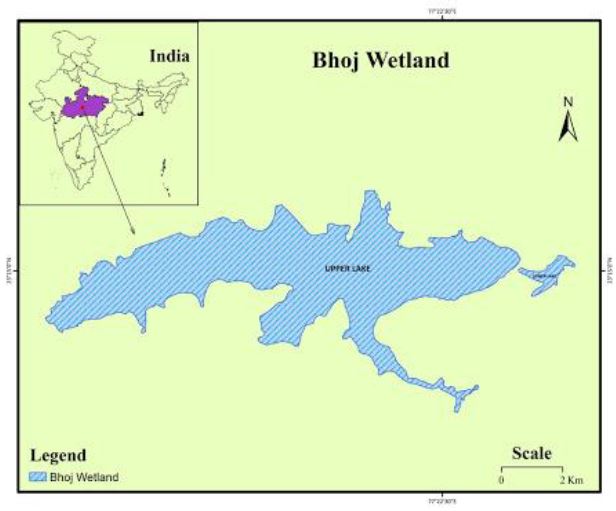
    • Bhoj Wetland is located in the center of Bhopal district in Madhya Pradesh.
    • The wetland includes two man-made lakes: the upper lake and the lower lake.
    • Since August 2002, they have been recognized as a wetland of international importance under the Ramsar Convention.
    • The upper lake, created by King Bhoj in the 11th century, is one of the oldest large man-made lakes in central India.
      • It was formed by building an earthen dam across the Kolans River, which used to be a tributary of the Halali River.
      • Now, the upper part of the Kolans River and the Bhojtal drain into the Kaliasot River through a diversion channel.
      • Bhadbhada Dam, built in 1965, controls the outflow to the Kaliasot River.
    • The lower lake was created in 1794 by Nawab Chhote Khan to beautify the city.
      • It also has an earthen dam and drains into the Halali River through the lower part of the Kolans River, now called the Patra Drain.
      • Both the Kaliasot and Halali Rivers flow into the Betwa River.

    Significance of Bhoj Wetland

    • The upper lake provides 40% of Bhopal’s drinking water, while the lower lake supplies raw water and enhances the city’s beauty.
    • It supports over 700 species of plants and animals, including zooplankton and phytoplankton.
    • Both lakes are rich in biodiversity, supporting various fish species, birds, insects, reptiles, and amphibians.

    PYQ:

    [2018] Which one of the following is an artificial lake?

    (a) Kodaikanal (Tamil Nadu)

    (b) Kolleru (Andhra Pradesh)

    (c) Nainital (Uttarakhand)

    (d) Renuka (Himachal Pradesh)

  • Tourism Sector

    [pib] Adopt a Heritage Scheme 2.0 

    Why in the News?

    Under the Adopt a Heritage Scheme 2.0, 19 MoUs have been signed so far covering a total of 66 monuments.

    About Adopt a Heritage Scheme 2.0 

    Aspect Details
    Revamped version of the original Adopt a Heritage Scheme.

    Launched in 2023.

    Legal Framework Defined as per the Ancient Monuments and Archaeological Sites and Remains Act (AMASR), 1958
    Application Process Stakeholders apply through a dedicated web portal listing available monuments for adoption
    Collaboration Encourages corporate stakeholders to contribute to monument preservation
    Term of Appointment Initially 5 years, extendable up to another five years
    Objective Foster collaboration for preservation of monuments for future generations
    Key Stakeholders Corporate stakeholders, Ministry of Tourism, Ministry of Culture, ASI, State/UT governments
    Program Goal Develop and maintain amenities at heritage sites
    Initial Scheme
    • Launch Date: 27 September 2017 (World Tourism Day) by the President of India.
    • Collaborators: Ministry of Tourism, Ministry of Culture, ASI, and State/UT governments.
    • Objective: Address challenges in operations and maintenance of heritage sites, develop mechanisms for amenities provision.
    • Monument Mitras: Agencies/Companies become ‘Monument Mitras’ through ‘Vision Bidding’.
    Note: Red Fort was the first monument to be adopted under the scheme by the Dalmia Bharat group in 2019.


    PYQ:

    [2018] Safeguarding the Indian Art Heritage is the need of the moment. Discuss.

  • Industrial Sector Updates – Industrial Policy, Ease of Doing Business, etc.

    Balancing competition and sustainability for India

    Why in the News?

    • In 2023, the Securities and Exchange Board of India (SEBI) introduced an updated framework for corporate sustainability reporting.
    • The revised Business Responsibility and Sustainability Report (BRSR) framework mandates that companies assess and disclose the environmental impact of their entire value chain.

    Business Responsibility and Sustainability Report (BRSR) 

    • In 2021, the Securities and Exchange Board of India (SEBI) introduced the Business Responsibility and Sustainability Report (BRSR) framework, mandating that the top 1,000 listed companies in India disclose their performance on environmental, social, and governance (ESG) parameters.
    • This initiative aimed to enhance transparency and encourage responsible business practices, building on the earlier Business Responsibility Report (BRR) introduced in 2012.

    Key Features of the BRSR Framework

    • Expanded Reporting Requirements: The BRSR Core builds upon the initial Business Responsibility and Sustainability Report (BRSR) introduced in 2021, which mandated the top 1,000 listed companies in India to disclose their ESG performance.
    • Mandatory Assurance: Starting from FY 2023-24, the BRSR Core mandates that the top 150 companies obtain reasonable assurance on their ESG disclosures. This requirement aims to improve the credibility of the reported data and combat greenwashing, ensuring that companies provide reliable information about their sustainability practices.
    • Nine ESG Attributes: The framework is structured around nine critical ESG attributes, which include greenhouse gas emissions, water usage, energy consumption, and employee well-being.
    • Comply or Explain Principle: SEBI has adopted a “comply or explain” approach, allowing companies to either adhere to the specified reporting requirements or provide valid reasons for non-compliance.
    • Alignment with International Standards: The BRSR Core is aligned with several internationally recognized frameworks, such as the EU Taxonomy and the Global Reporting Initiative (GRI) standards.  
    • Focus on Value Chain: A significant aspect of the BRSR Core is its emphasis on assessing the ESG impacts of a company’s supply chain.

    For India, every economic sector must contribute to greener means of production 

    For India to achieve its sustainability goals and contribute effectively to greener means of production, every economic sector must play a vital role.

    Importance of Sectoral Contribution to Sustainability

    • Diverse Economic Sectors: The key sectors such as agriculture, construction, power, manufacturing, transport, and tourism are crucial for transitioning to a green economy. For example, electric transport and eco-tourism.
    • Government Initiatives: The Indian government is actively promoting green growth through investments in priority sectors, which include manufacturing, renewable energy, and electric mobility.  For example, An allocation of ₹19,700 crore for the production of green hydrogen.
    • Green Manufacturing: The manufacturing sector is a significant focus for greening efforts, with studies indicating that sustainable manufacturing practices can lead to substantial reductions in greenhouse gas emissions. For example, the (Zero Defect Zero Effect) ZED initiative aims to create a competitive, qualitative, and clean manufacturing ecosystem.
    • Renewable Energy Commitment: India has set ambitious targets for increasing its non-fossil energy capacity to 500 gigawatts by 2030.
    • Collaboration and Policy Frameworks: Initiatives like the Partnership for Action on Green Economy (PAGE) and various policy dialogues aim to facilitate collaboration among sectors to promote inclusive and sustainable economic growth.

    Way forward: 

    • Enhanced Accountability: Ensure stricter enforcement of the BRSR and BRSR Core frameworks, expanding the scope to cover more companies and sectors beyond the top 1,000 listed companies.
    • Capacity Building: Provide training and resources to companies, especially small and medium enterprises (SMEs), to improve their ESG reporting capabilities and integrate sustainability into their core operations.

    Mains question for practice:

    Q Discuss the significance of the Business Responsibility and Sustainability Report (BRSR) framework introduced by the Securities and Exchange Board of India (SEBI) in promoting sustainable business practices among Indian corporations. 15M

  • Minority Issues – SC, ST, Dalits, OBC, Reservations, etc.

    Why did courts revisit bar on sub-quotas?     

    Why in the News?

    A seven-judge Bench of the Supreme Court has ruled that States can subdivide Scheduled Castes (SC) into groups to allocate sub-quotas within the Dalit reservation.

    Will the Weaker Among Dalits Get Representation from Further Sub-Classification?

    • The Supreme Court’s ruling allows states to create sub-classifications within the SC category, which is expected to enable states to earmark sub-quotas for the most marginalized sections of Dalits.
    • This decision aims to ensure better representation for weaker groups within the SC community who have historically been underrepresented and have not benefitted adequately from existing reservations.
    • The ruling emphasizes that treating SC communities as a homogeneous group undermines the objective of reservations, as there are significant differences in advancement and discrimination among various SC communities.

    Why Did the Supreme Court Overrule a Five-Judge Decision of 2004?

    • The 2004 judgment in E.V. Chinnaiah vs. State of Andhra Pradesh held that SCs constitute a single homogeneous class and that any sub-classification was unconstitutional, as it violated Article 341, which empowers the President to notify the list of SCs.
    • The recent seven-judge Bench, led by Chief Justice D.Y. Chandrachud, found this ruling to be incorrect, stating that SC communities are not homogeneous and that there are inter se differences among them.
    • The majority opinion argued that the act of notifying a list of SCs does not create a uniform class, and sub-classification is permissible based on “intelligible differentia” and should have a rational nexus to the purpose of doing it.

    What are the views on Creamy layer exclusion?

    • The concept of the creamy layer, which excludes more advanced members of a community from benefiting from affirmative action, is currently applicable only to Other Backward Classes (OBCs) and has not been extended to Dalit communities.
    • Justice B.R. Gavai, in a separate opinion, emphasized the need to identify and exclude the more advanced among SCs from affirmative action benefits, arguing that treating all members equally disregards the principle of equality.
    • The opinions regarding creamy layer exclusion do not constitute a directive for the government to implement this concept for SCs, as the issue was not directly addressed in the current case.

    Do the Judges’ Opinions on this Constitute a Direction to the Government?

    • The judges’ opinions on sub-classification and creamy layer exclusion provide a legal framework for states to follow but do not serve as a direct mandate for the government to implement changes.
    • The ruling establishes that states have the authority to sub-classify SCs for the purpose of extending reservation benefits, but the specific implementation details and parameters for creamy layer exclusion remain open for further consideration and do not compel immediate action from the government.

    Way forward: 

    • Implementation Framework for Sub-Classification: The government should establish a comprehensive framework that outlines the criteria and process for sub-classification of SCs.
    • Addressing Creamy Layer Exclusion: The government should consider developing specific criteria for identifying the “creamy layer” within SCs, similar to the criteria used for OBCs.

Join the Community

Join us across Social Media platforms.