💥UPSC 2027,2028 Mentorship (April Batch) + Access XFactor Notes & Microthemes PDF

Archives: News

  • OBOR Initiative

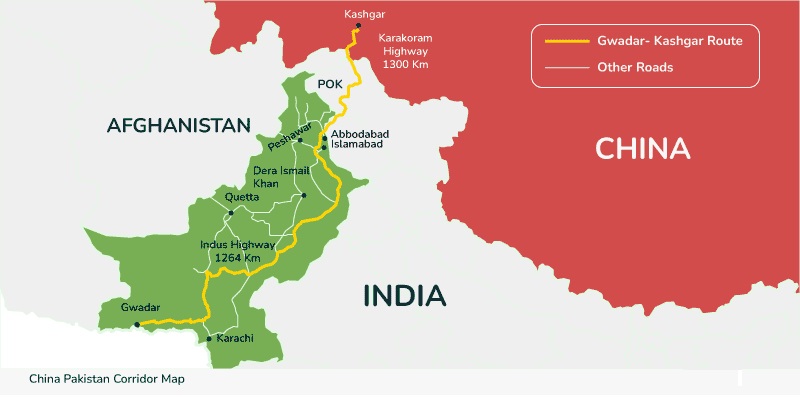
    Second Phase of China-Pakistan Economic Corridor (CPEC)

    Why in the News?

    Pakistani PM is on a formal visit to China to attend the formal announcement of the second phase of the China-Pakistan Economic Corridor (CPEC-II).

    About CPEC-II

    • CPEC’s next phase shifts focus from infrastructure and energy to sectors like agriculture, Pakistan Railways’ Main Line-I (ML-1) upgrade, and realignment of the Karakorum Highway.
    • CPEC was initiated in 2015 as part of President Xi Jinping’s Belt and Road Initiative (BRI).
    Why CPEC-II?

    • It will provide Pakistan with a strategic advantage in terms of trade and commerce
    • CPEC-II includes significant investments in the energy sector, which will help overcome Pakistan’s chronic power shortages and ensure a stable supply of electricity
    • Provides a shortcut for China’s access to the Persian Gulf to secure oil imports, and
    • Stimulate industrial and economic activity in Pakistan.

    Belt and Road Initiative (BRI)

    • The Belt and Road Initiative, formerly known as One Belt One Road, is a global infrastructure development strategy adopted by the Chinese government in 2013.
    • It will invest in nearly 70 countries and international organizations.
    • Infrastructure projects include ports, railways, highways, power stations, aviation and telecommunications.
    • “Belt” refers to the overland routes for road and rail transportation, called “the Silk Road Economic Belt”; whereas “road” refers to the sea routes or the 21st Century Maritime Silk Road.
    • The project has a target completion date of 2049 which coincides with the 100th anniversary of the People’s Republic of China.

    India’s Concerns

    • Sovereignty Concerns: India expresses reservations as CPEC traverses through Pakistan-occupied Kashmir (PoK), challenging territorial sovereignty and potentially bolstering Pakistan’s claim over the region.
    • Geostrategic Implications: The expansion of Gwadar port under CPEC extends China’s “String of Pearls” around India, prompting concerns over regional power dynamics.

    CPEC’s Progress so Far

    • Mixed Outcomes: The initial phase of CPEC primarily addressed infrastructure, energy, and port development projects, with progress showing variations.
    • Project Status: While several power projects have been completed, significant delays and challenges persist in transport-related projects and Special Economic Zones (SEZs).

    Challenges and Roadblocks

    • Slow pace: Gwadar, despite being the epicentre of multibillion-dollar projects, lacks basic necessities like reliable access to water and electricity, let alone other facilities.
    • Baloch freedom movement: This is another impediment to the stalled project where Chinese officials are targeted and killed.
    • Consistent security threat: China is also seeking to deploy its Army in the CPEC projects, to which Pakistan has contested.

    PYQ:

    [2018] The China-Pakistan Economic Corridor (CPEC) is viewed as a cardinal subset of China’s larger ‘One Belt One Road’ initiative. Give a brief description of CPEC and enumerate the reasons why India has distanced itself from the same. (150 Words, 10 Marks)

    [2016] ‘Belt and Road Initiative’ is sometimes mentioned in the news in the context of the affairs of

    (a) African Union

    (b) Brazil

    (c) European Union

    (d) China

  • Festivals, Dances, Theatre, Literature, Art in News

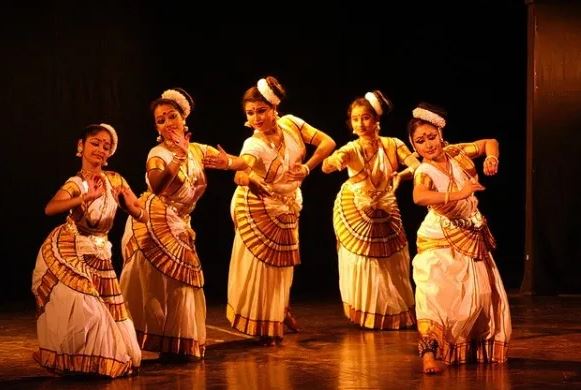
    In news: Mohiniyattam Dance

    Why in the News?

    A popular Mohiniyattam dancer in Kerala was refused bail against her alleged casteist remarks against the SC community.

    About Mohiniyattam

    Description
    Name Meaning Mohini – female enchantress avatar of Vishnu;

    Aattam – rhythmic motion or dance (Malayalam)

    Roots Natya Shastra, ancient Hindu Sanskrit text on performance arts
    Style Lasya Style – delicate, eros-filled, and feminine
    Performers Traditionally women, but men also perform in contemporary times
    Music Includes Carnatic music, singing, and enactment of plays through dance
    Language Manipravalam: a Malayalam-Sanskrit hybrid
    Posture Parted feet, gentle swaying of body, soft footwork synchronized with music beats
    Gestures Follow the classical text of Hastha Lakshanadeepika with elaborate mudras (hand gestures)
    Costumes Plain white or off-white sarees with golden brocade, pleated sheets for freedom of movement, adorned with jewellery
    Accessories Jewellery on fingers, wrists, neck, and ears, ankle bells (for female performers), dhotis and similar accessories (for male performers)
    Makeup Natural with brilliant red lips, tikka (Gobi) on the forehead, lined eyes
    Music Various rhythms and compositions in Manipravalam, accompanied by instruments like Mridangam, Idakka, flute, Veena, and Kuzhitalam
    Ragas Rendered in the Sopana Style, a slow melodic style rooted in the Natya Shastra

    Back2Basics: Classification of Classical Dances in India

    Classical Dance Form Origin Key Features
    Bharatanatyam Tamil Nadu
    • Ekaharya style with one dancer portraying multiple roles.
    • Intricate footwork, hand gestures (mudras), and facial expressions.
    • Traditional repertoire includes Alarippu, Jatiswaran, Shabda, Varna, Pada, Thillana, and Sloka.
    • Accompanied by the orchestra and conducted by Nattuvanar
    Kathak North India
    • Derived from the word “Katha,” meaning story
    • The blend of storytelling, footwork, and rhythmic patterns
    • The strong influence of Mughal and Persian culture
    • Solo performances with an emphasis on footwork and straight-legged movements
    Kathakali Kerala
    • A blend of dance, music, and acting
    • Elaborate makeup, costumes, and headgear
    • Enacts stories from Indian epics with specific facial colors for characters
    • Importance of hand gestures, facial expressions, and eye movements
    Kuchipudi Andhra Pradesh
    • Originated in Kuchipudi village, Andhra Pradesh
    • Dance-drama form with solo and group performances
    • Emphasis on storytelling, costumes, and ornaments
    • Includes solo items like Manduka Shabdam and Balgopala Taranga
    Odissi Odisha
    • Based on stories of Lord Vishnu and verses of Jayadeva’s Gita Govinda
    • Soft dance style with mudras and expressions similar to Bharatanatyam incorporates postures like Tribhanga and Chowk
    • Eminent performers include Sonal Mansingh and Kelucharan Mohapatra
    Sattriya Assam
    • Introduced by Vaishnava saint Sankaradeva for propagation of Vaishnava faith
    • Strictly governed by principles in hasta mudras, footwork, and costumes
    • Repertoire includes Bhaona-related and independent dance numbers
    • Prominent forms include Chali and Jhumura
    Manipuri Manipur
    • Associated with rituals, festivals, and creation myths
    • Lai Haraoba is the earliest form, reenacts the creation of the world
    • Rasleela dances originated in 18th-century Manipur
    • Popular forms include Ras, Sankirtana, and Thang-Ta with Kirtan accompaniment


    PYQ:

    [2012] How do you distinguish between Kuchipudi and Bharatanatyam dances?

    1. Dancers occasionally speak dialogues is found in Kuchipudi dance but not in Bharatanatyam.
    2. Dancing on the brass plate by keeping the feet on its edges is a feature of Bharatanatyam but Kuchipudi dance does not have such a form of movement.

    Which of the statements given above is/are correct?

    (a) 1 only

    (b) 2 only

    (c) Both 1 and 2

    (d) Neither 1 nor 2

  • Zoonotic Diseases: Medical Sciences Involved & Preventive Measures

    First Human Case of Avian H5N2 Infection

    Why in the News?

    • The World Health Organization (WHO) has confirmed the death of a Mexican resident due to bird flu, marking the first confirmed case of human infection with the H5N2 variant.
      • This H5N2 strain is different from another bird flu variety-H5N1 which infected people in America recently.

    What is Avian Influenza A (H5N2)?

    • Avian Influenza A (H5N2) is a subtype of the influenza A virus that primarily circulates among birds but can infect humans under certain circumstances.
    • Human infections typically result from direct contact with infected birds or contaminated environments, showcasing the zoonotic nature of the virus.

    Symptoms of H5N2

    • Infection of H5N2 may cause mild to severe upper respiratory tract infections and can be fatal.
    • Conjunctivitis, gastrointestinal symptoms, encephalitis and encephalopathy have also been reported.

    Diagnostic and Treatment Protocols

    • Laboratory Diagnosis: The identification of avian influenza in humans necessitates laboratory testing to confirm the presence of the virus.
    • WHO Guidance: The World Health Organization periodically updates technical protocols, such as RT-PCR methods, to enhance the detection of zoonotic influenza.
    • Treatment Strategies: Antiviral medications, notably neuraminidase inhibitors like oseltamivir and zanamivir, demonstrate efficacy in reducing viral replication duration and improving survival prospects for afflicted individuals.

    Influenza A Viruses

    • The alphanumeric codes of H and N are used to subdivide the viruses according to what kinds of proteins are on the surface of the virus based on 2 types:
    1. Hemagglutinin (HA) 
    2. Neuraminidase (NA)
    • There are 18 known HA subtypes and 11 known NA subtypes.
    • In birds, 16 HA and 9 NA subtypes have been identified. (Two additional subtypes, H17N10 and H18N11, have been identified in bats.)
    • Many different combinations of HA and NA proteins are possible.
    • For example, an “A(H7N2) virus” designates an influenza A virus subtype that has an HA 7 protein and an NA 2 protein.
    • Similarly, an “A(H5N1)” virus has an HA 5 protein and an NA 1 protein.


    PYQ:

    [2015] H1N1 virus is sometimes mentioned in the news concerning which one of the following diseases?

    (a) AIDS

    (b) Bird flu

    (c) Dengue

    (d) Swine flu

  • Wetland Conservation

    Two bird sanctuaries of Bihar added to Ramsar List

    Why in the News?

    Two wetlands in Bihar, Nagi and Nakti bird sanctuaries, have been added to the global list of wetlands of international importance under the “Ramsar Convention”, bringing India’s total Ramsar sites to 82.

    Do you know?

    • Currently, the highest number of such sites is in the UK (175) followed by Mexico (144).
    • The number of Indian sites on the list has increased from 26 to 82 in the last ten years, of which 40 have been added in the last three years.

    About Nagi-Nakti Wetland

    • These wetlands, situated in Bihar’s Jamui district within the Jhajha forest range, are man-made reservoirs nestled amid dry deciduous forests and hills.
    • Both sanctuaries were developed as man-made reservoirs, primarily for irrigation purposes, through the construction of dams.
    • These wetlands host a diverse range of flora and fauna, including over 150 species of birds, mammals, fish, aquatic plants, reptiles, and amphibians.

    Nakti Bird Sanctuary:

    • It was developed primarily for irrigation through the construction of the Nakti dam.
    • In 1984, the wetland was designated as a bird sanctuary, highlighting its importance as a wintering habitat for several migratory species, with over 20,000 birds congregating during winter months.
    • This includes one of the largest congregations of red-crested pochard in the Indo-Gangetic plain.

    Nagi Bird Sanctuary:

    • It was, on the other hand, created by the damming of the Nagi River, which enabled the gradual formation of water bodies with clear water and aquatic vegetation.
    • Overall, the wetland and its fringes provide habitat for over 75 bird species, 33 fish, and 12 aquatic plants.
    • Notably, the site hosts one of the largest congregations of bar-headed geese in the Indo-Gangetic plain.

    Ecological Significance

    • Migratory Bird Haven: The sanctuaries serve as critical wintering habitats for numerous migratory bird species, attracting over 20,000 birds during the winter months.
    • Species Diversity: Nagi and Nakti sanctuaries support a rich biodiversity, including over 75 bird species, 33 fish species, and 12 aquatic plant species.
    • Bar-headed Geese Congregation: Notably, the wetlands host one of the largest gatherings of bar-headed geese on the Indo-Gangetic plain, highlighting their importance as migratory bird habitats.

    Back2Basics: Ramsar Convention

    Explanation
    Purpose International treaty aimed at conserving and promoting the sustainable use of wetlands.
    Establishment Established on February 2, 1971, in Ramsar, Iran.
    Key Components
    • Identifying and designating wetlands of international importance.
    • Ensuring their effective management.
    • Promoting international cooperation for wetland conservation and sustainable use.
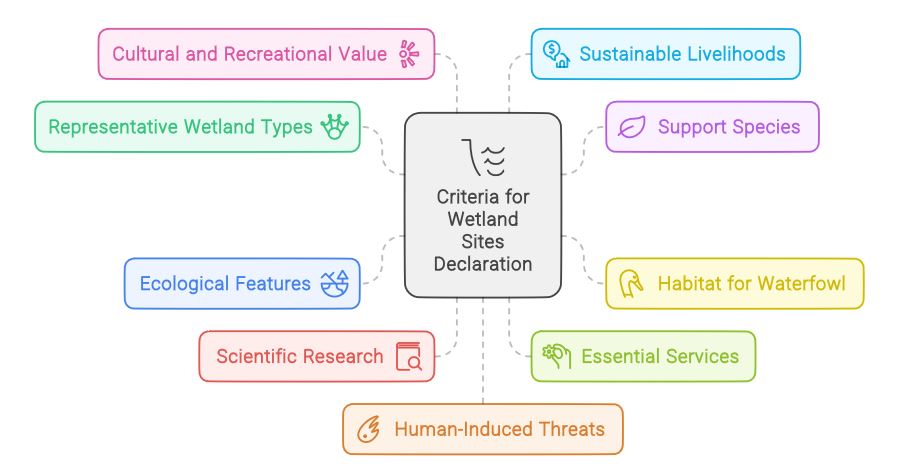
    9 Criteria for Sites Declaration
    1. A site should contain representative, rare, or unique wetland types.
    2. It should support vulnerable, endangered, or endemic species.
    3. It should be a habitat for waterfowl.
    4. It should have significant ecological, botanical, zoological, limnological, or hydrological features.
    5. It should support scientific research and biodiversity conservation.
    6. It should provide essential services such as flood control, water purification, and groundwater recharge.
    7. It should have cultural, recreational, or spiritual value for local communities.
    8. It should support sustainable livelihoods for human communities.
    9. It should be at risk or face human-induced threats that require international cooperation for conservation.
    Participating Countries 171 contracting parties (countries) as of September 2021.
    India and Ramsar Convention  The first Ramsar Site in India, the Chilika Lake in Odisha, was designated in 1981.
    Ramsar Secretariat The convention is administered by the Ramsar Secretariat, based in Gland, Switzerland.
    World Wetlands Day
    • February 2nd of each year.
    • To raise awareness about the importance of wetlands and commemorate the adoption of the Ramsar Convention.
    Montreux Record Register of wetland sites on the List of Wetlands of International Importance under the Ramsar Convention that require special attention.


    PYQ:

    [2014] If a wetland of international importance is brought under the ‘Montreux Record’, what does it imply?

    (a) Changes in ecological character have occurred, are occurring or are likely to occur in the wetland as a result of human interference.

    (b) The country in which the wetland is located should enact a law to prohibit any human activity within five kilometres of the edge of the wetland

    (c) The survival of the wetland depends on the cultural practices and traditions of certain communities living in its vicinity and therefore the cultural diversity therein should not be destroyed

    (d) It is given the status of ‘World Heritage Site’

    [2019] Consider the following statements:

    1. Under Ramsar Convention, it is mandatory on the part of the Government of India to protect and conserve all the wetlands in the territory of India.
    2. The Wetlands (Conservation and Management) Rules, 2010 were framed by the Government of India based on the recommendations of the Ramsar Convention.
    3. The Wetlands (Conservation and Management) Rules, 2010 also encompass the drainage area or catchment regions of the wetlands as determined by the authority.

    Which of the statements given above is/are correct?

    (a) 1 and 2 only

    (b) 2 and 3 only

    (c) 3 only

    (d) 1, 3 and 3

  • Nuclear Diplomacy and Disarmament

    Do North Korea’s trash balloons indicate an escalation?

    Why in the news?

    South Korea has suspended the 2018 peace agreement and announced the possibility of resuming propaganda broadcasts in North Korea following Pyongyang’s release of thousands of balloons filled with trash and human waste into the South.

    Inter-Korean Peace Agreement, 2018

    • The 2018 inter-Korean peace agreement refers to several agreements and declarations made between North and South Korea to reduce military tensions and improve diplomatic relations. Key elements of the agreement included:
      • Ceasefire Maintenance: Maintaining and reinforcing the Korean Armistice Agreement.
      • Demilitarization: Implementing measures to reduce military tensions, such as dismantling guard posts in the Demilitarized Zone (DMZ).
      • Family Reunions: Facilitating family reunions for those separated by the Korean War.
      • Economic Cooperation: Pursuing economic projects and infrastructure development.
      • Propaganda Halt: Both sides agreed to cease propaganda broadcasts and leaflet drops across the DMZ.

    Why did South Korea suspend the 2018 agreement?

    • Recent Provocations: North Korea’s recent aggressive actions, including GPS signal jamming, missile launches, and the release of balloons carrying trash and human waste, pose a threat to South Korean security and civilian safety.
    • Lack of Trust: The ruling People Power Party (PPP) in South Korea cited a significant erosion of trust between the two Koreas. Senior PPP official Choo Kyung-ho emphasized that mutual trust needs to be restored for any agreements to be honoured.
    • Calls for Apology: South Korea demands an immediate apology from North Korea for these provocations, highlighting the need for accountability and reparations for the damages caused.

    North Korea emboldened by Russian support 

    • Military Assistance: The US has warned that Russia is aiding North Korea in developing advanced weapons technologies, such as hypersonic missiles, in exchange for artillery shells amid Russia’s ongoing war in Ukraine.
    • Diplomatic Shield: As a permanent member of the UN Security Council, Russia provides a diplomatic shield for North Korea, stalling efforts to pass new resolutions condemning North Korean actions. This backing allows Pyongyang to act more aggressively without significant international repercussions.

    Escalated Danger of Conflict

    The situation on the Korean Peninsula poses an escalated danger of conflict due to several factors:

    • Aggressive Posturing: North Korea’s recent actions, including missile tests and aerial provocations, signal an aggressive stance that could lead to military confrontations.
    • Policy Shift: Analysts believe Kim Jong Un may be deviating from the defensive policies of his predecessors, adopting a more aggressive strategy aimed at altering the status quo on the peninsula.
    • International Alliances: North Korea’s alignment with Russia, and possibly other authoritarian states like China and Iran, suggests a willingness to use military force to achieve geopolitical goals, challenging the US-led liberal world order.
    • Military Preparedness: The South Korean military and its allies need to stay vigilant as North Korea tests the South’s air defences and military response times, indicating a higher readiness for potential conflict.

    Way forward:

    • Engage in Multilateral Talks: Revitalize dialogue with key stakeholders, including the United States, China, Japan, and Russia, to address North Korea’s actions and find diplomatic solutions.
    • Leverage International Organizations: Utilize platforms like the United Nations to garner international support and pressure North Korea to comply with international norms.

    Mains PYQ: 

    Q Evaluate the economic and strategic dimensions of India’s Look East Policy in the context of the post-Cold War international scenario. (UPSC IAS/2016)

  • Renewable Energy – Wind, Tidal, Geothermal, etc.

    Securing India’s energy transition 

    Why in the news?

    India has signed new agreements and updated existing ones with a dozen African countries to secure critical minerals. This initiative is crucial for achieving India’s energy transformation goals.

    India’s Critical Mineral Acquisition Plans in Africa

    • India has signed new agreements and updated existing ones with a dozen African countries to secure critical minerals.
    • This initiative is crucial for India’s energy transformation goals, aiming to diversify sources and reduce dependence on any single supplier.
    • The agreements are part of a broader strategy to secure access to minerals necessary for renewable energy technologies and electric vehicles.

    Demand for Energy in India and China’s Dominance

    • Energy Demand in India: India’s peak power demand increased to 250 GW in 2023-24, marking a 12.7% increase from the previous year. By 2030, India’s peak power demand is expected to reach 366 GW, up from the current level of 240 GW.
    • China’s Dominance: China leads in securing and processing critical minerals, having established long-term relationships with mineral-rich countries in Africa and Latin America. Chinese companies dominate mining rights in economically poor yet mineral-rich nations.
      • China has built significant capacities for processing and refining minerals, making it the primary global hub for critical mineral processing.

    India’s Other Overseas Critical Mineral Acquisition Plans

    • Earlier this year, India signed an agreement with Argentina to explore and develop five lithium brine blocks.
    • The Geological Survey of India (GSI) discovered inferred lithium reserves of 5.9 million tonnes in Jammu & Kashmir.
    • India aims to diversify its sources of critical minerals by securing mining leases abroad, ensuring a stable and sustainable supply chain.

    Government Initiatives to Secure Critical Minerals

    • Exploration and Geological Studies: The government is pushing for more extensive exploration and geological studies within India to identify potential reserves of critical minerals. The Geological Survey of India has been tasked with accelerating the exploration of India’s 3.2 lakh sq km land mass using new data and technologies.
    • Securing Mining Leases Abroad: India is focusing on securing mining leases in other countries to ensure a diversified supply of critical minerals. The agreements with African countries and Argentina are examples of this strategy.
    • Building Domestic Capacities: The government is providing incentives to build refining and processing capacities within India for critical minerals. There is an emphasis on attracting private miners, both domestic and global, to participate in critical mineral exploration within India.
    • Policy and Auction Reforms: The government is analyzing why auctions often fail to generate enough interest and is considering policy changes to attract big players. Coordinated efforts between the Centre and state governments on clearances and royalty payments are being emphasized to streamline the auction process.
    • White Hydrogen Exploration: There is a call for active exploration of potential White Hydrogen deposits within India’s geographical borders.

    Way forward:

    • Accelerate exploration efforts across India’s 3.2 lakh sq km land mass.
    • Utilize new data sources and advanced technologies to identify potential reserves of critical minerals.
    • Focus on unexplored areas for potential discoveries of critical minerals, including White Hydrogen deposits.

    Mains PYQ:

    Q Do you think India will meet 50 percent of its energy needs from renewable energy by 2030? Justify your answer. How will the shift of subsidies from fossil fuels to renewables help achieve the above objectives? Explain. (UPSC IAS/2022)

  • Electoral Reforms In India

    Two lakh plus NOTA votes in Indore: Why NOTA was introduced, its consequences

    Why in the news? 

    Over 200,000 votes were cast for NOTA in the Indore Lok Sabha constituency. Let’s explore the reasons behind the introduction of this option and what occurs if, in an improbable scenario, NOTA garners more votes than all other candidates.

    Back2Basics: NOTA in Indian Elections

    • NOTA, which stands for None of The Above, is an electoral choice where voters can express their disapproval of all the candidates in a voting system.
    • In the 2013 PUCL v. Union of India case, the Supreme Court mandated the use of NOTA in direct elections for the Lok Sabha and State Assemblies.
    • The ruling specified that in such elections, voters should have the option to select to indicate their dissatisfaction with all candidates or political parties listed on the ballot.
    • The NOTA option was first used in the 2013 legislative assembly elections held in four states—Chhattisgarh, Mizoram, Rajasthan, and Madhya Pradesh, and the union territory of Delhi.

    Impact of NOTA Receiving the Highest Number of Votes in a Particular Constituency

    1. Legal Consequence:

    • Current Status: NOTA has no legal consequence; the candidate with the highest votes after NOTA wins the election.
    • Indore Case: Shankar Lalwani won with a massive margin over NOTA, which received the highest number of votes ever recorded for NOTA in any constituency.
    • Possible Change: There are ongoing discussions and petitions urging that elections be declared null and void if NOTA receives the highest number of votes.

    2. Future Considerations:

    • Petition by Shiv Khera: Calls for the ECI to frame guidelines to declare elections null and void if NOTA receives the majority vote and to debar candidates who receive fewer votes than NOTA for five years.

    Judicial Stand

    • 2013 Judgment: The Supreme Court ruled that the right to secrecy in voting includes those who choose not to vote, mandating the introduction of the NOTA option.
    • Rationale: The Court emphasised that secrecy is an essential feature of free and fair elections, supported by the introduction of EVMs to maintain voter anonymity.

    Current Deliberations:

    • New Petition (2024): The Supreme Court is considering a petition to make elections null and void if NOTA gets the highest votes, with additional consequences for candidates.
    • State-Level Precedents: Some states and union territories (e.g., Maharashtra, Haryana, Delhi) have declared NOTA as a “Fictional Electoral Candidate” for local elections, mandating fresh elections if NOTA receives the majority vote.

    Way forward:

    • Null and Void Clause: Introduce a clause in the Representation of the People Act to declare elections null and void if NOTA receives the highest number of votes.
    • Debarment of Candidates: Amend the law to debar candidates who receive fewer votes than NOTA from contesting elections for a specified period (e.g., five years).

    Mains PYQ:

    Q Discuss the procedures to decide the disputes arising out of the election of a Member of the Parliament or State Legislature under The Representation of the People Act, 1951. What are the grounds on which the election of any returned candidate may be declared void? What remedy is available to the aggrieved party against the decision? Refer to the case laws. (UPSC IAS/2022)

  • Capital Markets: Challenges and Developments

    SEBI forms panel for reviewing economic structure of clearing corporations  

    Why in the news?

    SEBI forms a committee to review clearing corporations’ ownership and economic structure, aiming to enhance resilience, independence, and neutrality as risk managers.

    About the Securities and Exchange Board of India (SEBI):

    • SEBI is the capital markets regulator in India responsible for regulating the securities market and protecting the interests of investors.
    • It was established in 1988 and given statutory powers in 1992 under the SEBI Act.
    • SEBI’s functions include regulating stock exchanges, registering and regulating brokers and other intermediaries, and promoting fair and transparent securities markets.

    What is a Clearing Corporation? 

    • A clearing corporation is a central counterparty (CCP) that provides clearing and settlement services for trades executed on various exchanges.
    • It acts as an intermediary between buyers and sellers, guaranteeing the completion of transactions and managing counterparty risk.
    • Clearing corporations ensure the smooth functioning of financial markets by facilitating the timely settlement of trades and reducing systemic risk.

    About Usha Thorat Committee on Reviewing the Ownership and Economic Structure of Clearing Corporations:

    • SEBI has formed a committee chaired by Usha Thorat, former Deputy Governor of the Reserve Bank of India (RBI), to review the ownership and economic structure of clearing corporations.
    • The committee’s mandate includes examining the ownership structure and finances of clearing corporations to ensure their resilience, independence, and neutrality as risk managers.
    • It will assess the feasibility of broadening the list of eligible investors allowed to hold stakes in clearing corporations and suggest categories of investors who can acquire such stakes.
    • The committee will also explore alternative ownership structures and shareholding patterns suited to an interoperable environment, where clearing corporations provide services across multiple exchanges.
    • It aims to propose alternatives that address the periodic capital needs of clearing corporations and ensure sufficient capital and liquidity during market-wide systemic stress.
    • The current ownership structure of clearing corporations is dominated by the parent exchange, which exposes them to the expectations of shareholders of the parent exchange.

    Conclusion: The Usha Thorat Committee aims to enhance the resilience and independence of clearing corporations by exploring alternative ownership structures and suggesting measures to ensure adequate capital and liquidity.

    Mains PYQ: 

    Q The product diversification of financial institutions and insurance companies, resulting in overlapping of products and services strengthens the case for the merger of the two regulatory agencies, namely SEBI and IRDA. Justify.(UPSC IAS/2013)

  • International Space Agencies – Missions and Discoveries

    Blaze Star: A Celestial Phenomenon in the Making

    Why in the News?

    • NASA predicts the dim star T Coronae Borealis will become visible to the naked eye by September 2024, reaching brightness comparable to Polaris.
      • A dim star known as the “Blaze Star,” officially designated as T Coronae Borealis (T CrB), located 3,000 light-years from our solar system, is set to become visible to the naked eye for the first time since 1946.

    About the Blaze Star

    • The Blaze Star located in the constellation Corona Borealis, also known as the “Northern Crown,” is situated between the constellations of Bootes and Hercules.
    • To locate Corona Borealis, begin by identifying prominent stars in the summer night sky, such as those of the Big Dipper.

    Understanding the Blaze Star Phenomenon

    • The Blaze Star is a rare recurrent nova, a binary star system comprising a cool, red giant star and a smaller, hotter white dwarf star in orbit around each other.
    • Every 80 years, the red giant transfers matter onto the white dwarf, triggering explosive phenomena.
    • Historical observations suggest the Blaze Star is on the brink of another explosion, following similar brightness patterns observed before previous eruptions in 1866 and 1946.
      • Precursor Signs: The star has been steadily brightening since 2015, followed by a visible dimming in March 2023, mirroring past eruption precursors.

    Implications for Observation

    • Peak Visibility: During its brightness peak, the Blaze Star is expected to be visible to the naked eye for several days, extending to just over a week with stargazing binoculars or a small telescope.
    • Astronomical Insights: The impending eruption offers a unique opportunity for astronomers to observe and study this celestial event, providing valuable insights into stellar evolution and dynamics.

    PYQ:

    [2013]  Consider the following phenomena

    1. Size of the sun at dusk

    2. Colure of the sun at dawn

    3. Moon being visible at dawn

    4. Twinkle of stars in the sky

    5. Polestar being visible in the sky

    Which of the above are optical illusions?

    (a) 1, 2 and 3

    (b) 3, 4 and 5

    (c) 1, 2 and 4

    (d) 2, 3 and 5

  • Innovations in Biotechnology and Medical Sciences

    Neo: A Novel Protein in Bacterial Defense

    Why in the News?

    “Klebsiella pneumoniae” bacteria might employ a newly discovered protein called “Neo” to halt bacteriophage infections.

    About Neo Protein

    • Discovery Details: Researchers, led by Stephen Tang and Samuel Sternberg, reported the discovery of Neo in a 2023 preprint paper on bioRxiv, while investigating Klebsiella pneumoniae.
    • Neo’s Defense Strategy: Bacteria employ diverse immune systems to fend off viral infections, including defense-associated reverse transcriptase (DRT) systems, which Neo is a part of.
      • DRT-2 System: This system involves de novo gene synthesis via rolling-circle reverse transcription (RT) of a non-coding RNA (ncRNA).
      • Operational Process: In uninfected cells, the ncRNA and RT enzyme catalyze the synthesis of a repetitive single-stranded cDNA.
      • Activation by Phage: Phage presence triggers the synthesis of the second-strand cDNA, resulting in long double-stranded DNA.
      • Role of Neo Protein: The translation of this double-strand cDNA produces the Neo protein, which induces potent growth arrest (cell dormancy), thereby protecting the bacterial population from phage proliferation.

    Biotechnological and Medical Implications

    • Potential Applications: Neo represents a promising tool for controlling viral infections, holding significance in both biotechnology and medicine.
    • Evolutionary Connections: Neo’s discovery sheds light on the shared evolutionary history and functional mechanisms of retroelements in the human genome and bacterial reverse transcriptases.
    • Technological Influence: Bacterial reverse transcriptases, predecessors of their eukaryotic counterparts, share analogous mechanisms and have revolutionized molecular biology research methods.

    What is Reverse Transcriptase?

    • Reverse transcription, the conversion of RNA into DNA, is facilitated by the enzyme reverse transcriptase.
    • Discovered by Howard Temin and David Baltimore in 1970, reverse transcriptase has transformed molecular biology research, particularly in studying RNA viruses like HIV.
      • Practical Applications: Reverse transcriptase is instrumental in gene cloning, PCR techniques, genome analysis, and viral load detection in diagnostics, such as the case of SARS-2, aiding in virus surveillance, healthcare management, and vaccine development efforts.


    PYQ:

    [2019] What is Cas9 protein that is often mentioned in the news?

    (a) A molecular scissors used in targeted gene editing.

    (b) A biosensor used in the accurate detection of pathogens in patients.

    (c) A gene that makes plants pest-resistant.

    (d) A herbicidal substance synthesized in genetically modified crops.

Join the Community

Join us across Social Media platforms.