💥UPSC 2026, 2027, 2028 UAP Mentorship (March Batch) + Access XFactor Notes & Microthemes PDF

Type: Explained

  • How does John Mill’s theory define the Extent of Liberty?

    Note4Students

    From UPSC perspective, the following things are important:

    Prelims level: About Harm Principle,

    Mains level: Significance of Freedom of Speech and Expression and its limitation;

    Why in the News?

    A minor girl’s gang rape in Assam led to Chief Minister Sarma’s anti-Muslim remarks, criticized as hate speech, violating India’s secular Constitution and potentially harming societal harmony, breaching Mill’s Harm Principle.

    What does the Harm Principle Say?

    The harm principle, articulated by philosopher John Stuart Mill in his essay on ‘Liberty’, asserts that the actions of individuals should only be limited to prevent harm to others.

    • Legitimate Use of Power: The only justification for exercising power over any member of a civilized community, against their will, is to prevent harm to others. This means that individual liberties should be respected unless they infringe upon the rights or well-being of others.
    • Self-Regarding vs. Other-Regarding Actions: Mill distinguishes between self-regarding actions (which affect only the individual) and other-regarding actions (which affect others).
      • Society or the state has no right to interfere in self-regarding actions, but it can regulate other-regarding actions that cause harm.
    • Definition of Harm: Harm is defined as wrongful setbacks to interests to which individuals have rights. Mill emphasizes that mere offence or disapproval does not constitute harm.
      • For example, someone may be offended by another’s opinion, but this does not justify restricting that opinion unless it incites violence or causes direct harm.
    • Limitations of Freedom: Mill acknowledges that while individuals should have the freedom to act as they choose, this freedom can be curtailed when their actions pose a significant threat to others. For instance, inciting violence is harmful and justifies state intervention.

    What does Mill say about ‘Freedom of Speech and Expression’?

    • Importance of Free Speech: Mill talks about the idea that all opinions, whether true or false, should be allowed to flourish because they contribute to the pursuit of truth. 
      • Silencing any opinion robs humanity of the opportunity to challenge and refine its beliefs.
    • Truth and Error: Mill argues that the collision of differing opinions helps people correct their errors and strengthen their understanding of the truth. Even false beliefs are valuable as they force us to defend and reinforce our beliefs.
    • Limitations: While Mill strongly advocates for free speech, he acknowledges that it can be limited in cases where speech directly incites harm, such as inciting violence against a specific group. He provides the example of expressing harmful opinions to an agitated crowd, which could lead to immediate danger.
    • Balancing Freedom and Harm: Mill recognizes that while free speech is vital, it must be balanced against the potential harm it might cause, especially when it leads to violence or significant psychological harm to targeted groups.

    Way forward: 

    • Strengthen Legal Frameworks: Enhance laws against hate speech to ensure accountability, balancing the right to free expression with the need to protect societal harmony and prevent violence.
    • Promote Inter-Community Dialogue: Encourage programs fostering tolerance and understanding between communities, reinforcing the secular principles of the Constitution and mitigating divisive rhetoric.

    Mains PYQ:

    Q  What do understand by the concept “freedom of speech and expression”? Does it cover hate speech also? Why do the films in India stand on a slightly different plane from other forms of expression? Discuss. (UPSC IAS/2014)

  • OBOR Initiative

    Dealings at a China-Africa forum that India must track

    Note4Students

    From UPSC perspective, the following things are important:

    Prelims level: China-Africa Cooperation (FOCAC);

    Mains level: India-Africa relation;

    Why in the News?

    The 9th edition of the Forum on China-Africa Cooperation (FOCAC) is scheduled to be held in Beijing from 4th to 6th September, 2024.

    About the China-Africa Cooperation (FOCAC)

    The Forum on China-Africa Cooperation (FOCAC) was established in 2000 to enhance the strategic partnership between China and African nations. It serves as a platform for collective dialogue and cooperation in various sectors, including trade, investment, and development.

    Challenges of China-Africa Debt:

    • Chinese loans to African countries amounted to approximately $170 billion from 2000 to 2022. However, Chinese lenders represent only about 12% of Africa’s total public and private debt, indicating that China is not the primary creditor.
    • A significant portion of Chinese loans is not disclosed in sovereign debt records, complicating the understanding of Africa’s overall debt levels. This lack of transparency raises concerns about the sustainability of these debts.
    • Despite concerns over “debt trap diplomacy,” China is unlikely to forgive or cancel debts but may consider writing off smaller, interest-free loans.

    African Priorities at FOCAC 2024

    • Economic Goals: African nations are focusing on enhancing trade relations with China, with a modest goal of $300 billion in imports from Africa between 2022-2024. As of mid-2024, trade has reached $167 billion, primarily dominated by raw materials.
    • Agricultural Development: There is a pressing need to develop a sustainable agricultural industry in Africa. This includes improving the processing of agricultural commodities and leveraging the expertise of countries like China and India to enhance crop resilience and productivity.
    • Green Energy and Industrialization: African countries are advocating for the establishment of refining and processing hubs to increase the value added from their raw materials.

    What are the learnings that India can have?

    • Continuity in Engagement: India should emphasize consistent engagement with Africa, particularly by organizing the India-Africa Forum Summit (IAFS-IV) to capitalize on recent momentum, especially after the African Union’s inclusion in the G-20.
    • Support for Industrialization: Indian companies are encouraged to invest in higher value-added sectors in Africa, such as agriculture and pharmaceuticals, to foster local employment and market development.
    • Private Sector Participation: Greater involvement of the Indian private sector is essential, along with innovative financing solutions like public-private partnerships to support projects in Africa.
    • Digital and Financial Connectivity: Utilizing India’s digital stack and establishing rupee-based financial transactions can enhance connectivity and reduce forex risks for African nations.

    Conclusion: India should deepen its strategic partnerships with African nations by expanding bilateral and multilateral engagements, focusing on key sectors like healthcare, digital infrastructure, and renewable energy. Leveraging India’s experience in these areas can help address African development needs while enhancing India’s influence on the continent.

    Mains PYQ:

    Q Increasing interest of India in Africa has its pros and cons. Critically Examine. (UPSC IAS/2015)

  • Electoral Reforms In India

    On Germany’s electoral architecture 

    Note4Students

    From UPSC perspective, the following things are important:

    Prelims level: Proportional Representation;

    Mains level: Pros and cons of Proportional Representation;

    Why in the News?

    On July 30, Germany’s constitutional court approved downsizing the Bundestag, citing concerns over financial strain and efficiency due to its unprecedented 736 deputies.

    (Note: The Bundestag is the Lower house of Germany)

    Why has the German Constitutional Court upheld the move to downsize the lower house of parliament?

    • Constitutional Rationale: The court approved the plan to reduce the size of the Bundestag to improve its efficiency and reduce costs, as it had become the world’s largest elected assembly.
      • The court backed the government’s decision to limit the Bundestag to 630 members by removing “overhang” and “balance” seats, which had caused the number of legislators to grow significantly.
    • Legal Compliance: The court’s decision aligns with previous rulings that emphasized the need for electoral equality and the fair representation of political parties in the Bundestag, ensuring that the election system remains constitutionally valid.

    How does a mixed-member Proportional Representation system work?

    • Dual Voting System: In Germany, each voter casts two votes in federal elections:
      1. First Vote: Directly elects a candidate from a local constituency via the first-past-the-post method (299 seats).
      2. Second Vote: Chooses a political party, which determines the distribution of another 299 seats proportionally across Germany’s 16 regions.
    • Seat Allocation: The second vote is crucial as it determines the overall proportion of seats each party holds in the Bundestag. The final seat count for each party is based on a combination of directly elected candidates and the proportion of the second vote.
    • Overhang Seats: If a party wins more direct seats than the proportion of the second vote would allow, these extra seats are known as “overhang seats.” These were traditionally retained, leading to an increase in the total number of seats.

    How does a mixed-member Proportional Representation system work in India?

    • No MMP System in India: India does not use a mixed-member proportional representation system at the national level. The Indian electoral system primarily follows the first-past-the-post method, where the candidate with the most votes in each constituency wins a seat in the parliament.
    • Proportional Representation: In India, proportional representation (Single transferable) is used only in certain cases, such as elections to the Rajya Sabha (the upper house) and the President.

    Types of Proportional Representation:

    • Single Transferable Vote (STV): This system allows voters to rank candidates in order of preference. It is used to elect members of the Rajya Sabha (Council of States) and the President of India.
    • Party-List PR: In this system, voters cast their votes for a party rather than individual candidates. Seats are allocated to each party based on the proportion of votes they receive. A minimum threshold (usually between 3-5%) is often required for a party to gain representation, preventing excessive fragmentation in the legislature.
    • Mixed-Member Proportional Representation (MMP): This combines elements of FPTP and PR, allowing voters to cast two votes—one for a candidate and another for a party. This system aims to balance the benefits of direct representation with proportionality.

    What are balance or overhang seats and why were they deemed Unconstitutional?

    • Overhang Seats: These are additional seats that a party wins when it secures more direct constituency seats than it would be entitled to based on its second vote share. This situation arises due to the mixed-member proportional system.
    • Balance Seats: Introduced to maintain proportionality and fairness, balance seats are given to other parties to offset the overhang seats, ensuring that the overall seat distribution reflects the second vote shares accurately.
    • Unconstitutionality: In 2008, the German Constitutional Court ruled that the increasing number of overhang seats violated the principle of electoral equality. The recent judgment further upheld the move to eliminate these seats to simplify the electoral system and maintain fairness.

    Conclusion: Germany should swiftly implement the downsizing plan, ensuring that the transition to a 630-member Bundestag is smooth and transparent, with clear communication to the public and political parties.

    Mains PYQ:

    Q Critically examine the procedures through which the Presidents of India and France are elected. (UPSC IAS/2022)

  • Pension Reforms

    Why did the Centre alter its pension plan?

    Note4Students

    From UPSC perspective, the following things are important:

    Prelims level: Unified Pension Scheme;

    Mains level: Reason behind the need for a Unified Pension Scheme;

    Why in the News?

    The Union Cabinet approved a new Unified Pension Scheme for Central government employees, set to launch on April 1, 2025, benefiting 23 lakh employees.

    What are the main features of the Unified Pension Scheme? 

    • Assured Pension: Employees will receive half of their average basic pay from the last 12 months of service as a monthly pension, provided they have served at least 25 years. A minimum pension of ₹10,000 is guaranteed for those with at least 10 years of service.
    • Family Pension: Dependents will receive 60% of the government worker’s pension upon their demise (death of a person).
    • Inflation Adjustment: Pension incomes will be adjusted for inflation, similar to the dearness relief provided to current employees.
    • Lump Sum Superannuation Payout: A lump sum equivalent to 1/10th of an employee’s salary and dearness allowance for every six months of service, in addition to gratuity benefits.
    • Contributory Mechanism: Employees will contribute 10% of their salary to the pension pool, while the government will contribute 18.5%.

    How is it different from the current pension system?  

    1. Old Pension Scheme (OPS): Provided an assured pension at 50% of the last drawn salary with no contributions required from employees.
      1. It also offered an additional pension for pensioners above 80 years and adjustments based on Pay Commission recommendations.
    2. National Pension System (NPS): Introduced in 2004, it was a defined contribution scheme with 10% contributions from both employees and the government, but without guaranteed pension amounts.
    3. Unified Pension Scheme (UPS): Combines the assured pension model of OPS with the contributory mechanism of NPS, but with a higher government contribution (18.5%) and a guarantee of certain pension benefits.

    Why did the government feel the need to bring about this change? 

    1. Employee Dissatisfaction with NPS: Government employees, especially those who joined post-2004 under the NPS, were dissatisfied with the uncertainty in pension incomes compared to their predecessors under the OPS.
    2. Political and Electoral Considerations: The issue became politically sensitive, with opposition parties promising to revert to OPS in some states, prompting the central government to address these concerns.
    3. Balancing Aspirations with Fiscal Prudence: The government aimed to find a middle ground that would satisfy employees while maintaining fiscal discipline.

    How have government employees responded?  

    • Positive Reception: Government employees have largely welcomed the UPS as it addresses concerns with the NPS by reintroducing assured pension benefits and increasing the government’s contribution, offering greater financial security in retirement.
    • Reservations: Despite the positive aspects, there are concerns about the continued contributory nature of the scheme and the absence of a commutation option, with employees seeking more clarity on these issues.

    What will be the cost to the exchequer?

    1. Immediate Costs: The UPS is expected to cost an additional ₹7,050 crore this year due to the higher government contribution and arrears for some employees.
    2. Future Financial Impact: While the initial impact will be the additional 4.5% contribution from the government, the assured pensions will increase future government liabilities. However, economists believe this can be managed through higher revenue growth and can be compared to the impact of Pay Commission revisions.

    Way forward: 

    • Ensure Clear Communication and Transparency: The government should provide detailed guidelines and clarify any remaining ambiguities about the Unified Pension Scheme (UPS).
    • Plan for Long-Term Fiscal Sustainability: To manage the increased financial burden from the UPS, the government should incorporate these commitments into its fiscal planning, potentially exploring new revenue sources to maintain fiscal prudence while ensuring the long-term sustainability of the pension scheme.
  • Foreign Policy Watch: India-Africa

    A crisis in WANA that no one talks about 

    Note4Students

    From UPSC perspective, the following things are important:

    Prelims level: West Asia and North Africa (WANA)

    Mains level: Conflict in Africa;

    Why in the News?

    The fight between the Sudan Armed Forces (SAF), led by General Abdel Fattah al-Burhan, and the Rapid Support Forces (RSF), led by General Mohamed Hamdan Dagalo, also known as Hemayti (“My Protector”), has caused severe destruction in Sudan.

    Historical Background of Sudan

    • Civil Strife and Governance: Sudan has a history of civil strife, marked by 15 military coups and two civil wars since its independence in 1956, resulting in 1.5 million deaths and the secession of South Sudan in 2011. The conflict in Darfur has been particularly notable, involving the Janjaweed militia and leading to over 200,000 deaths and millions displaced.
    • Current Crisis Genesis: The ongoing conflict is rooted in the 30 years of autocratic rule by Omar Hassan al-Bashir, who was overthrown in 2019. The subsequent attempts to establish a civilian government failed, culminating in a military coup in October 2021, which led to the current armed conflict between the Sudan Armed Forces (SAF) and the Rapid Support Forces (RSF) starting on April 15, 2023.

    Global Power Competition and Regional Powers Influence

    • Foreign Involvement: Sudan’s conflict has drawn significant foreign interest due to its strategic location and natural resources. Egypt supports the SAF, while Iran backs the SAF despite its rivalry with Egypt. The UAE has emerged as the primary supporter of the RSF, providing weapons and resources. Russia’s Wagner Group has also supported the RSF, while the Kremlin seeks a naval base in Port Sudan.
    • Geopolitical Dynamics: The conflict has created complex alliances, with countries like Chad and Libya also involved. Mercenaries from various regions, including South Sudan and Ukraine, have joined the fray, complicating the conflict further.

    Sudan and Syria Issue:

    • Humanitarian Crisis: Sudan’s crisis is particularly acute due to its strategic location and resource wealth, leading to a massive displacement crisis, with over 10 million people displaced since April 2023
    • Parallel Conflicts: Both Sudan and Syria have experienced severe internal conflicts driven by authoritarian regimes, regional power plays, and foreign interventions, leading to widespread human suffering and instability.

    India’s Strategic Considerations:

    • Economic Interests: India’s trade with Sudan reached $2,034 million in 2022-23, with a significant trade surplus. India has also invested heavily in Sudan’s oil sector, with cumulative investments worth $2.3 billion.
    • Historical Ties: India has maintained strong people-to-people ties with Sudan, including educational exchanges and medical tourism. President A.P.J. Abdul Kalam’s visit in 2003 reinforced these relations.
    • Humanitarian and Diplomatic Engagement: India evacuated its nationals early in the conflict, but the ongoing crisis may require continued diplomatic and humanitarian engagement to protect its broader interests in the region.

    Way forward: 

    • Strengthen Multilateral Diplomacy: India should collaborate with international bodies like the UN and the African Union to promote peace initiatives in Sudan, leveraging its neutral position to mediate and support conflict resolution efforts that safeguard regional stability and its strategic interests.
    • Expand Humanitarian and Development Aid: India can bolster its humanitarian assistance, focusing on essential services like healthcare and education, while also exploring opportunities for post-conflict reconstruction projects, ensuring long-term economic engagement and goodwill in Sudan.
  • What is the Munich Agreement and the role it played in starting World War II?   

    Note4Students

    From UPSC perspective, the following things are important:

    Prelims level: Munich Agreement

    Why in the News?

    On September 1, 1939, German troops invaded Poland, sparking World War II. Britain and France declared war on Germany two days later, on September 3.

    The Sudeten crisis 

    • Background: The Sudeten crisis emerged from Hitler’s demand that the German-majority regions of Czechoslovakia, known as Sudetenland, be ceded to Germany. These regions, with a population of over three million German-speaking people, were part of Czechoslovakia after the dissolution of the Austro-Hungarian Empire post-World War I. Hitler aimed to incorporate Sudetenland into his vision of a “Greater Germany.”
    • German Occupation: Following the Munich Agreement, German troops occupied Sudetenland from October 1 to October 10, 1938. This occupation was part of Hitler’s broader plan for territorial expansion.

    About the Munich Agreement and changes after that 

    • Signatories: The Munich Agreement was signed on September 29-30, 1938, by Germany, France, Italy, and Great Britain. Czechoslovakia was not a party to the agreement but was pressured into accepting it by the signing powers.
    • Terms: The agreement allowed Germany to annex Sudetenland in exchange for a promise of peace. Great Britain’s Prime Minister Neville Chamberlain, who supported the agreement, famously declared it as “peace with honour” after returning from Munich.
    • Terms and Implementation:
      • Plebiscite: Some regions within Sudetenland were subject to a plebiscite for determining their fate.
      • Military Withdrawal: The Czechoslovak government was required to withdraw its military and police forces from Sudetenland and release Sudeten German prisoners within four weeks of the agreement.
    • Aftermath: Despite the Munich Agreement, Hitler violated the terms within six months by invading the rest of Czechoslovakia.
      • The Munich Agreement, intended to appease Hitler and maintain peace, ultimately failed and was seen as a significant misjudgment of dealing with expansionist totalitarian regimes.

    Conclusion: The Munich Agreement, meant to appease Hitler by ceding Sudetenland to Germany, failed disastrously. Within six months, Hitler violated the agreement by invading the rest of Czechoslovakia, highlighting the dangers of appeasing expansionist totalitarian regimes.

    Mains PYQ: 

    Q There arose a serious challenge to the Democratic State System between the two World Wars.” Evaluate the statement. (2021)

  • Indian Navy Updates

    INS Arighat: India’s second nuclear sub

    Note4Students

    From UPSC perspective, the following things are important:

    Prelims level: About INS Arighaat;

    Why in the News?

    India’s second nuclear submarine, the Arighaat, was officially commissioned into the Indian Navy in Visakhapatnam, following rigorous trials conducted over the past few months.

    Status of Navy’s Submarines in India: 

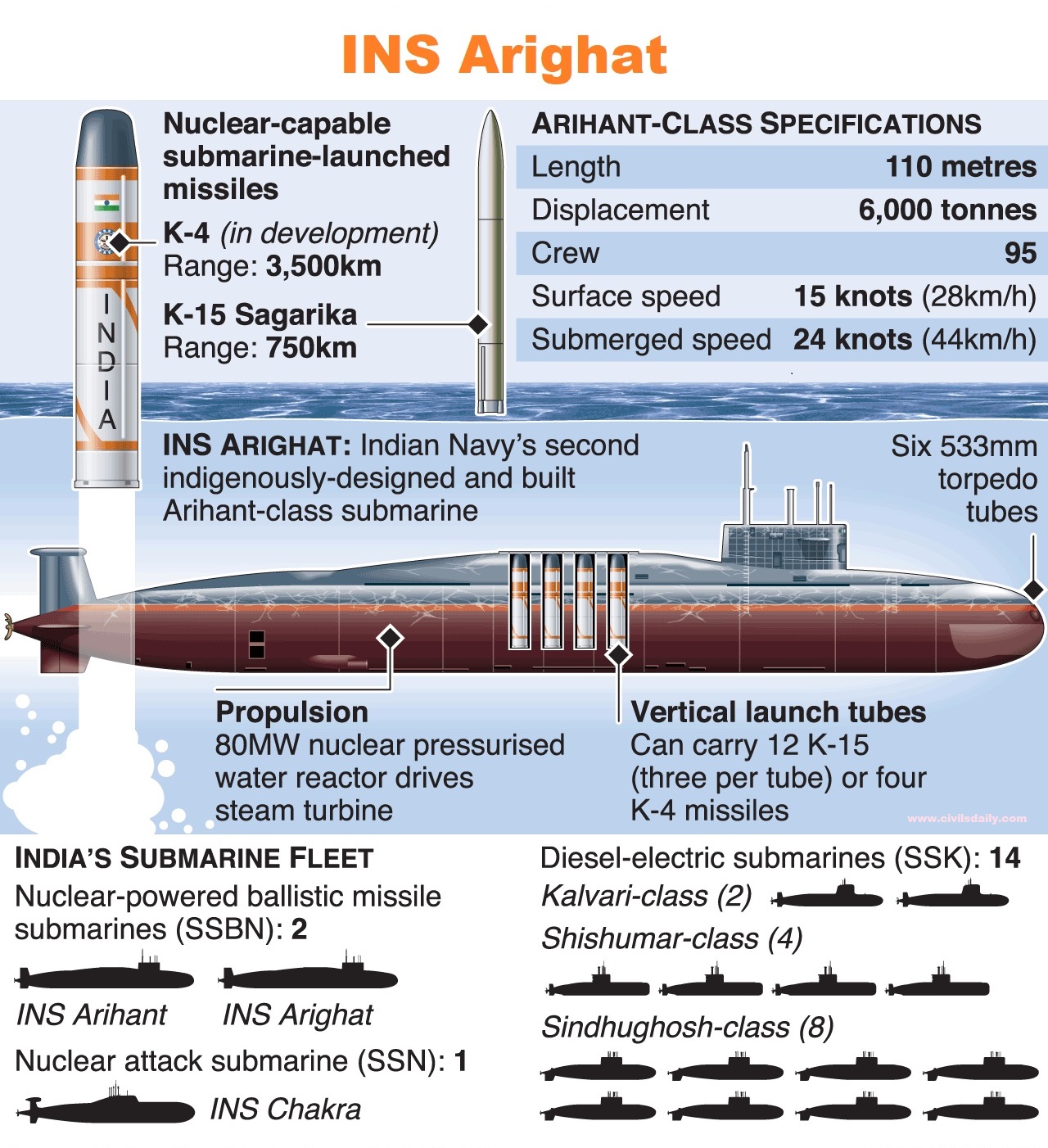
    • Current Fleet: The Indian Navy’s submarine fleet includes two nuclear-powered ballistic missile submarines (INS Arihant and INS Arighaat) and 16 conventional submarines. The Navy is also constructing two additional larger SSBNs.
    • Operational Readiness: The Navy is authorized to maintain a fleet of 18 submarines, but operational availability can be affected by maintenance and refitting schedules, with about 30% of the fleet typically under repair.

    About the newly inducted INS Arighaat

    • INS Arighaat is a 6,000-tonne Arihant-class ballistic missile submarine, which will join its predecessor, INS Arihant, as a vital component of India’s nuclear triad.
    • The submarine can carry up to 12 K-15 SLBMs with a range of approximately 750 km or four K-4 SLBMs exceeding 3,500 km.
      • It is powered by an 83 MW pressurized light-water nuclear reactor, allowing it to remain submerged for extended periods without surfacing compared to the diesel-electric submarine.
    • It will enhance India’s nuclear deterrence, support strategic balance in the region, and play a crucial role in national security.

    How does it significantly strengthen India’s nuclear triad?

    • Enhances Second-Strike Capability:  With two nuclear submarines now operational, India can maintain a constant presence of a submarine patrolling its waters, ready to launch a nuclear strike at short notice in retaliation.  
    • Expands Missile Reach: INS Arighaat is equipped with indigenously developed K-15 missiles with a range of over 700 km and long-lasting availability underwater due to a nuclear-powered engine without surfacing.
    • From the South China Sea, these submarines can potentially target locations in China, including its capital Beijing.  
    • Both of this major developments will provide India with a more balanced and robust nuclear deterrent capability across all three domains – land, air, and sea.

    Way forward: 

    • Indigenous Submarine Development: Accelerate the development and commissioning of indigenous SSBNs (Submersible Ship Ballistic Missile Nuclear) and advanced SLBMs (Submarine-Launched Ballistic Missiles) to further strengthen India’s strategic autonomy and ensure sustained deterrence capabilities.
    • Strategic Partnerships and Modernization: Enhance collaboration with global naval powers for technology transfers and expertise while modernizing the current submarine fleet to ensure continued operational readiness and address emerging maritime security challenges.

    Mains PYQ: 

    Q What are the maritime security challenges in India? Discuss the organisational, technical and procedural initiatives taken to improve maritime security. (UPSC IAS/2022)

  • Foreign Policy Watch: India-Pacific Island Nations

     Pacific Islands Forum back joint police plan, maintain ties with Taiwan 

    Note4Students

    From UPSC perspective, the following things are important:

    Prelims level: Pacific Islands Forum (PIF);

    Mains level: Importance of Taiwan for India;

    Why in the News?

    Pacific leaders endorsed a significant joint policing initiative and rejected attempts by China’s allies to marginalize Taiwan in the Pacific Islands Forum (PIF), held in Tonga.

                  (Note: India and Taiwan are not a member countries.)

    Why are the countries sticking to Taiwan despite the pressure?

    • Reaffirmation of Taiwan’s Status: The Pacific Islands Forum (PIF) leaders reaffirmed Taiwan’s participation as a “development partner,” despite efforts from China and the Solomon Islands to sideline Taiwan. 
      • Countries emphasize the importance of maintaining existing agreements from 1992 that recognize Taiwan’s role in the forum.
    • Support from Allies: Countries like New Zealand and the United States expressed support for Taiwan’s inclusion in the PIF, highlighting that any decision regarding the exclusion of parties should be made through consensus.
    • Resistance to Chinese Influence: Many nations recognize the strategic importance of Taiwan and its contributions against China’s increasing influence, leading them to uphold its involvement.

    Significance of Taiwan for India: 

    • Strategic Balance in the Indo-Pacific: Taiwan is a crucial player in the Indo-Pacific region, and  India’s engagement with Taiwan serves as a counterbalance to China.
    • Economic and Technological Cooperation: Taiwan is a global leader in semiconductor manufacturing and advanced technology, areas where India seeks to enhance its capabilities.
    • People-to-People Ties and Education: Taiwan offers significant opportunities for Indian students and professionals in education and skill development.
      • For example, in 2018, the number of Indian students enrolled in Taiwanese universities reached 2,398, marking a 56% increase from the previous year.
    • Diversifying Supply Chains: In the wake of global disruptions due to COVID-19, India aims to diversify its supply chains. Taiwan’s expertise in manufacturing and electronics presents opportunities for India to reduce its dependence on other countries, particularly China, for critical components and technology.

    What did the forum say on the Climate cash and French press?

    • Climate Finance Initiatives: The forum committed to organizing a “global pledging event” to raise funds for climate initiatives, with a goal of $500 million.
      • This decision was supported by UN Secretary-General Antonio Guterres, who emphasized the urgent need for climate finance in the Pacific, which is disproportionately affected by rising sea levels.
      • Although not officially on the agenda, deep-sea mining generated significant discussion among forum members. A company backed by Nauru plans to scale up ocean mining operations, while other members, like Palau, called for a moratorium due to environmental concerns. 
    • Concerns Over French Governance: The French government faced criticism during the forum for its handling of unrest in New Caledonia. A Pacific delegation is expected to conduct a fact-finding mission there, indicating ongoing tensions regarding French governance in the region and the need for improved oversight.

    Conclusion: India should enhance diplomatic and economic ties with Taiwan by establishing formal mechanisms for regular dialogue and collaboration in areas such as technology, trade, education, and healthcare. This will reinforce strategic partnerships while respecting the “One China” policy framework. 

  •  A game plan for India’s success as 2036 Olympic host 

    Note4Students

    From UPSC perspective, the following things are important:

    Prelims level: Khelo India Scheme;

    Mains level: Issue of Infrastructure related to sports;

    Why in the News?

    During his Independence Day address from the Red Fort this August, Prime Minister Narendra Modi announced India’s aspiration to host the 2036 Olympic Games, stating that preparations are already underway to realize this dream.

    Issue of Sports Infrastructure in Some States:

    • Limited Olympic-Standard Facilities: Currently, only about 10.4% of India’s mapped sports infrastructure meets Olympic standards. This includes only 1,645 completed facilities out of 15,822 across the country.
    • State-Level Disparities: Tamil Nadu leads with nearly 390 Olympic-standard facilities, followed by Delhi with 161 and Odisha with 153. This highlights a significant disparity in sports infrastructure across different states. 
      • The Gujarat government has earmarked Rs 6,000 crore for developing sports complexes in Ahmedabad.

    Potential in the present state of Infrastructure:

    • Current Infrastructure Landscape: India’s sports infrastructure is still developing, with significant investments needed to meet international standards.
      • The Khelo India Scheme, launched in 2017, aims to enhance sports infrastructure and promote talent development, focusing on grassroots improvements.
    • Future Developments: Plans are underway to upgrade existing facilities and build new ones, particularly in states like Tamil Nadu and Gujarat, which have shown commitment to developing world-class sports venues.
    • Leveraging Existing Facilities: By utilizing existing sports infrastructure in states like Tamil Nadu, Delhi, and Odisha, India can advance a cost-efficient and eco-friendly bid for the Olympics. This strategy involves repurposing venues for public use post-games, ensuring lasting benefits.

    Need for Collaborative Approach:

    • Multi-Stakeholder Involvement: A successful bid will require collaboration among various stakeholders, including state governments, sports associations, and the central government. A multi-stakeholder committee is essential to ensure that all voices are heard and that the bid reflects the country’s potential.
    • Building Consensus: The bid’s success hinges on building consensus both within India and with international stakeholders. This involves strategic planning and cooperation across political and territorial lines to present a unified front.

    Significance for India: 

    • Catalyst for Sports Development: Hosting the 2036 Olympics would necessitate significant investments in sports infrastructure across India. This would not only enhance existing facilities but also promote grassroots sports development through initiatives like the Khelo India Scheme.
    • Economic and Tourism Boost: The event is expected to generate substantial economic benefits, including job creation and increased tourism. The influx of international visitors and media attention would provide a platform to showcase India’s cultural heritage.
    • National Pride and Unity: The successful hosting of the Olympics would serve as a symbol of national achievement, fostering unity and pride among citizens.

    Conclusion: India should prioritize the expansion and upgradation of sports infrastructure across all states, focusing on creating new Olympic-standard facilities while enhancing existing ones. Leveraging the Khelo India Scheme, investments should be directed towards grassroots development to ensure widespread access to quality sports venues.

  • Renewable Energy – Wind, Tidal, Geothermal, etc.

    Cabinet approves BioE3 Policy for Fostering High-Performance Biomanufacturing  

    Note4Students

    From UPSC perspective, the following things are important:

    Prelims level: BioE3 Policy;

    Mains level: Significance of BioE3 Policy;

    Why in the News?

    The Union Cabinet has approved the ‘BioE3 (Biotechnology for Economy, Environment, and Employment) Policy’ proposed by the Department of Biotechnology to promote advanced biomanufacturing.

    What is the BioE3 Policy?

    The BioE3 (Biotechnology for Economy, Environment and Employment) Policy is a strategic initiative approved by the Indian Cabinet to foster high-performance biomanufacturing. 

    Aims and Objectives of the Policy:

    • Innovation Support: The policy promotes research and development (R&D) and entrepreneurship in various thematic sectors, facilitating technological advancement and commercialization.
    • Biomanufacturing Hubs: It proposes the establishment of Biomanufacturing & Bio-AI hubs and Biofoundries to enhance India’s bioeconomy.
    • Focus Areas: The policy targets several strategic sectors, including high-value bio-based chemicals, biopolymers, smart proteins, precision biotherapeutics, climate-resilient agriculture, carbon capture, and marine and space research.

    Significance of the Policy

    • Economic Growth: It is expected to catalyze a “bio revolution” similar to the IT revolution, generating substantial job opportunities in biotechnology and biosciences.
    • Sustainability Goals: The policy aligns with government initiatives for achieving a ‘Net Zero’ carbon economy and promotes sustainable lifestyles, thereby steering India towards accelerated green growth and a circular bio-economy.
    • Job Creation: By expanding the skilled workforce in biotechnology, the policy aims to create various kinds of employment opportunities, addressing critical societal issues such as climate change, food security, and human health.

    Present Status of Indian Bio-economy

    • Growing Potential: The biotechnology sector is seen as a key player in addressing challenges in health, agriculture, environment, and energy. India has a large pool of young, skilled workers, with 47% of its population under the age of 25.
    • Investment in R&D: Despite its potential, India spends less than 1% of its GDP on research, compared to countries like Israel and South Korea, which invest over 4%.
    • Existing Infrastructure: The government has established 9 biotech parks and 60 bio-incubators, which support the growth of the biotechnology sector.

    Challenges Ahead

    • Educational Gaps: The current educational curriculum does not adequately prepare students for industry demands, creating a skills mismatch.
    • Funding Issues: There is a lack of venture capital funding due to information asymmetry regarding the biotech industry, which hampers innovation and growth.
    • Clinical Trials: India conducts a low percentage of clinical trials compared to global standards, which is a concern for the development of biopharmaceuticals.
    • Research Investment: The government currently covers over 60% of total R&D spending, which is very different from countries where the private sector contributes a large portion.

    Way forward: 

    • Enhance Industry-Academia Collaboration: Encourage partnerships between educational institutions and biotech companies to align curricula with industry needs, thereby reducing the skills mismatch and preparing students for emerging job markets.
    • Increase Private Sector Investment: Implement policies and incentives to attract more private sector investment in R&D, such as tax benefits, public-private partnerships, and improved access to venture capital, to stimulate innovation and reduce reliance on government funding.
