💥UPSC 2026, 2027, 2028 UAP Mentorship (March Batch) + Access XFactor Notes & Microthemes PDF

Type: Schemes

  • Higher Education – RUSA, NIRF, HEFA, etc.

    [pib] PM-YASASVI Scheme

    Note4Students

    From UPSC perspective, the following things are important:

    Prelims level: PM-YASASVI Scheme

    Why in the News?

    The Ministry of Social Justice and Empowerment has implemented the PM Young Achievers Scholarship Award Scheme for Vibrant India (PM-YASASVI).

    About PM-YASASVI Scheme  

    Details
    Launch Year 2021-22
    Purpose To provide financial assistance and educational support to students from Other Backward Classes (OBC), Economically Backward Classes (EBC), and De-notified Tribes (DNT).
    Eligibility Criteria • Students from OBC, EBC, and DNT(Denotified Tribes) categories
    • Annual family income up to ₹2.50 lakh
    • Additional criteria may apply based on specific schemes.
    Benefits • Scholarships for pre-matriculation (Class 9-10) and post-matriculation (higher studies)
    • Covers tuition, hostel expenses, and academic costs
    • Hostel facilities for OBC students
    • Promotes educational advancement for marginalized communities.
    Scholarship Amounts • Class 9 and Class 10: ₹75,000 annually
    • Class 11 and Class 12: ₹1,25,000 annually
    Selection Criteria • Based on performance in the YASASVI Entrance Test (YET) conducted by the National Testing Agency (NTA)
    Application Process • Applications submitted online through the National Scholarship Portal (scholarships.gov.in)
    Significance Promotes inclusivity and social progress by supporting students from OBC, EBC, and DNT backgrounds in their educational pursuits.
  • Textile Sector – Cotton, Jute, Wool, Silk, Handloom, etc.

    [pib] Government extends SAMARTH Scheme till March 2026

    Note4Students

    From UPSC perspective, the following things are important:

    Prelims level: SAMARTH Scheme

    Why in the News?

    The Samarth Scheme (Scheme for Capacity Building in Textiles Sector), which aims to teach 300,000 people in textile-related skills, has been extended for two years (FY 2024–25 and 2025–26).

    Achievements of the SAMARTH Scheme:

    • So far, 3.27 lakh candidates have been trained under the Samarth Scheme, with 2.6 lakh (79.5%) of them gaining employment.
    • There is a strong focus on women’s employment, with 2.89 lakh (88.3%) women trained so far.

    What is ‘SAMARTH’ Scheme?

    Details
    Name Samarth (Scheme for Capacity Building in Textile Sector)
    Nodal Ministry Ministry of Textiles
    Approval Approved by the Cabinet Committee of Economic Affairs as a continuation of the Integrated Skill Development Scheme for the 12th Five Year Plan (FYP)
    Implementing Agency Office of the Development Commissioner (Handicrafts)
    Objectives • Provide demand-driven, placement-oriented skilling programs
    • Incentivize industry efforts to create jobs in organized textile and related sectors
    • Promote skilling and skill upgradation in traditional sectors
    Scope Covers the entire textile value chain, excluding spinning and weaving
    Special Provisions Includes upskilling and reskilling programs to improve productivity of existing workers in the apparel and garmenting segments
    Target Beneficiaries Handicraft artisans and individuals seeking employment in the textile sector
    Implementing Agencies • Textile Industry
    • Institutions/Organizations of the Ministry of Textiles/State Governments with training infrastructure
    • Reputed training institutions/NGOs/Trusts/Companies with placement tie-ups


    PYQ:

    [2020] Consider the following statements:

    1. The value of Indo-Sri Lanka trade has consistently increased in the last decade.
    2. “Textile and textile articles” constitute an important item of trade between India and Bangladesh.
    3. In the last five years, Nepal has been the largest trading partner of India in South Asia.

    Which of the statements given above is/are correct?

    (a) 1 and 2 only
    (b) 2 only
    (c) 3 only
    (d) 1, 2 and 3

  • Rural Distress, Farmer Suicides, Drought Measures

    Farmers to receive aid under Rythu Bharosa

    Note4Students

    From UPSC perspective, the following things are important:

    Prelims level: Rythu Bharosa Scheme

    Why in the News?

    After the completion of the loan waiver, the Telangana government will provide Rythu Bharosa assistance to support farmers further.

    About the Rythu Bharosa Scheme:

    Details
    Scheme Name Rythu Bharosa Scheme (Farmer’s Investment Support Scheme – FISS)
    Launch Year 2018-19 Kharif season (Telangana Govt’s Navratna Scheme)
    Objective To support the initial investment needs of farmers by providing financial aid for agriculture and horticulture crops.
    Benefits ₹5,000 per acre per season as a grant for input purchases, with no cap on the number of acres owned by farmers.
    Eligibility
    • Farmers must be residents of Telangana.
    • Must own agricultural land.
    • Small and marginal farmers are eligible.
    • Farmers cultivating land with Record of Forest Rights (ROFR) document (mainly from Scheduled Tribe communities).
    Ineligible Farmers
    • Commercial farmers.
    • Farmers working on a rental contract or tenant farmers.

    Significance of the move

    • Financial Relief for Farmers: By waiving loans of up to ₹2 lakh per farmer, the scheme provides significant financial relief, helping farmers manage their debt and invest in future agricultural activities.
    • Boost to Agricultural Sector: The waiver will enable farmers to focus on improving productivity and crop yields without the burden of debt, potentially boosting the state’s agricultural output.
    • Reduction in Farmer Distress: This move will alleviate distress among farmers, especially those affected by unpredictable weather and fluctuating crop prices, reducing the risk of farm-related suicides and financial instability.

    PYQ:

    [2020] Under the Kisan Credit Card scheme, short-term credit support is given to farmers for which of the following purposes?

    1. Working capital for maintenance of farm assets
    2. Purchase of combine harvesters, tractors and mini trucks
    3. Consumption requirements of farm households
    4. Post-harvest expenses
    5. Construction of family house and setting up of village cold storage facility

    Select the correct answer using the code given below:

    (a) 1, 2 and 5 only
    (b) 1, 3 and 4 only
    (c) 2, 3, 4 and 5 only
    (d) 1, 2, 3, 4 and 5

  • Agricultural Sector and Marketing Reforms – eNAM, Model APMC Act, Eco Survey Reco, etc.

    [pib] Cabinet approves PM Rashtriya Krishi Vikas Yojana (PM-RKVY) and Krishonnati Yojana (KY)

    Note4Students

    From UPSC perspective, the following things are important:

    Prelims level: PM-RKVY, KY

    Why in the News?

    The Union Cabinet approved the rationalization of all Centrally Sponsored Schemes (CSS) under the Ministry of Agriculture and Farmers Welfare into two umbrella schemes:

    • Pradhan Mantri Rashtriya Krishi Vikas Yojana (PM-RKVY) – A cafeteria scheme aimed at promoting sustainable agriculture.
    • Krishonnati Yojana (KY) – Focuses on food security and agricultural self-sufficiency.

    About PM Rashtriya Krishi Vikas Yojana (PM-RKVY):

    Details
    Objective To promote sustainable agriculture and improve agricultural productivity.
    Total Proposed Expenditure Rs 1,01,321.61 crore (combined with Krishonnati Yojana).
    Central Share (DA&FW) Rs 57,074.72 crore under PM-RKVY.
    Key Initiatives under PM-RKVY
    • Soil Health Management
    • Rainfed Area Development
    • Agro Forestry
    • Paramparagat Krishi Vikas Yojana
    • Agricultural Mechanization (including Crop Residue Management)
    • Per Drop More Crop
    • Crop Diversification Programme
    • RKVY DPR Component
    • Accelerator Fund for Agri Startups
    Key Focus Sustainable agricultural practices, soil health, water conservation, crop diversification, organic farming, and agricultural mechanization.
    Flexibility for States Increased flexibility for state governments to reallocate funds based on unique requirements of the states.
    Implementation Method Funds allocated to states, with state governments developing Comprehensive Strategic Documents addressing crop production, climate resilience, and value chains.
    Benefits Avoid duplication, ensure convergence, and streamline the approval process for quicker implementation of Annual Action Plans (AAP).


    Schemes merged into Krishonnati Yojana (KY):

    • National Food Security Mission (NFSM)
    • National Mission on Oilseeds and Oil Palm (NMOOP)
    • Mission for Integrated Development of Horticulture (MIDH)
    • National Mission on Sustainable Agriculture (NMSA)
    • Sub-Mission on Agricultural Mechanization (SMAM)
    • National Mission on Agricultural Extension and Technology (NMAET)
    • Mission Organic Value Chain Development for North Eastern Region (MOVCDNER)

    PYQ:

    [2014] Consider the following pairs:

    Programme/Project Ministry
    1. Drought – Prone Areas Programme Ministry of Agriculture and Farmers Welfare
    2. Desert Development Programme Ministry of Environment, Forest and Climate Change
    3. National Watershed Development Project for Rainfed Areas Ministry of rural development

    Which of the pairs given above is/are correctly matched?

    (a) Only 1 and 2

    (b) Only 3

    (c) 1, 2 and 3

    (d) None of these

  • Promoting Science and Technology – Missions,Policies & Schemes

    Bio-RIDE Scheme

    Note4Students

    From UPSC perspective, the following things are important:

    Prelims level: Bio-RIDE Scheme

    Why in the News?

    The Union Cabinet has approved the “Biotechnology Research Innovation and Entrepreneurship Development (Bio-RIDE) scheme” to support cutting-edge research and development in biotechnology.

    About Bio-RIDE Scheme

    Details
    Objective To support cutting-edge research, bio-entrepreneurship, and bio-manufacturing in biotechnology.
    Total Outlay ₹9,197 crore for the 15th Finance Commission period (2021-22 to 2025-26).
    Components
    • Merges Biotechnology Research and Development (R&D) and Industrial & Entrepreneurship Development (I&ED).
    • Introduces Bio-manufacturing and Bio-foundry as new components.
    Key Aims
    • Fostering Innovation: Promote bio-entrepreneurship and strengthen India’s position in biotechnology.
    • Bridging Gaps: Accelerate research and product development.
    Implementation Focus
    • Promoting Bio-Entrepreneurship: Seed funding, incubation, mentorship for startups.
    • Advancing Innovation: Grants for research in synthetic biology, bio-pharma, and bio-plastics.
    Focus Areas
    • Extramural Funding for research in agriculture, healthcare, bioenergy, and environmental sustainability.
    • Nurturing human resources in biotechnology.
    Industry-Academia Collaboration Synergies between academic institutions and industry to accelerate commercialization of bio-based products.
    Significance
    • Enhances bio-innovation and supports sustainable development.
    • Contributes to achieving green goals and global leadership in biotechnology.


    PYQ:

    [2019] Atal Innovation Mission is set up under the

    (a) Department of Science and Technology

    (b) Ministry of Labour and Employment

    (c) NITI Aayog

    (d) Ministry of Skill Development and Entrepreneurship

  • Rural Infrastructure Schemes

    Pradhan Mantri-Janjatiya Unnat Gram Abhiyan (PMJUGA)

    Note4Students

    From UPSC perspective, the following things are important:

    Prelims level: Pradhan Mantri Janjatiya Unnat Gram Abhiyan (PMJUGA)

    Why in the News?

    The Union Cabinet approved the “Pradhan Mantri Janjatiya Unnat Gram Abhiyan” with a total outlay of ₹79,156 crore (₹56,333 crore as central share and ₹22,823 crore as state share).

    About Pradhan Mantri Janjatiya Unnat Gram Abhiyan (PMJUGA)

    Details
    Objective Improve socio-economic conditions of tribal communities through scheme convergence.
    Outlay ₹79,156 crore (₹56,333 crore central; ₹22,823 crore state share).
    Coverage 63,000 villages; 5 crore people in 549 districts across 30 States/UTs.
    Focus Areas Housing, healthcare, education, skill development, livelihoods, infrastructure.
    Implementation 25 interventions by 17 ministries; monitored via PM Gati Shakti Portal.
    Social Component
    • Pucca houses (PMAY), water supply (Jal Jeevan Mission), road and mobile connectivity, education, healthcare.
    • Increase GER, build tribal hostels, reduce IMR & MMR through Mobile Medical Units.
    Economic Push Tribal Home Stays, Sickle Cell Disease management (Centers of Competence), 100 Tribal Multipurpose Marketing Centres (TMMCs) for tribal product marketing.
    Sustainable Livelihood Support 22 Lakh Forest Rights Act (FRA) patta holders for forest rights and sustainable agriculture, animal husbandry, and allied activities.
    Special Initiatives Tribal Home Stays, SCD management, and establishment of Tribal Multipurpose Marketing Centres (TMMC).
    Eligibility Tribal-majority villages: 500+ population (plains), 250+ (NE & Hill States), 100+ (LWE districts based on Census 2011).


    PYQ:

    [2021] At the national level, which ministry is the nodal agency to ensure effective implementation of the Scheduled Tribes and Other Traditional Forest Dwellers (Recognition of Forest Rights) Act, 2006?​

    (a) Ministry of Environment, Forest and Climate Change.​

    (b) Ministry of Panchayati Raj​

    (c) Ministry of Rural Development​

    (d) Ministry of Tribal Affairs​

    [2017] What are the two major legal initiatives by the State since Independence addressing discrimination against Scheduled Tribes (STs)?

    [2016] Why are the tribals in India referred to as ‘the Scheduled Tribes’? Indicate the major provisions enshrined in the Constitution of India for their upliftment.

  • Pension Reforms

    NPS Vatsalya Scheme

    Note4Students

    From UPSC perspective, the following things are important:

    Prelims level: NPS Vatsalya Scheme

    Why in the News?

    The Finance Ministry has launched the “NPS Vatsalya scheme” as per the Union Budget 2024-25 announcement.

    About NPS Vatsalya Scheme:

    Details
    Objective To secure children’s financial future by allowing parents to invest in a pension account early on.
    Nodal Agency Managed by Pension Fund Regulatory and Development Authority (PFRDA)
    Eligibility
    • Indian citizens, NRIs (Non-Resident Indians), and OCIs (Overseas Citizens of India) can open accounts for minors.
    • Parents or guardians.
    Contributions ₹500 per month or ₹6,000 annually
    Benefits offered
    • Contributions benefit from compounding, ensuring long-term wealth growth for the child.
    • At 18, Vatsalya account is converted into a regular NPS account for seamless retirement planning.
    • Promotes long-term financial security and retirement planning for future generations.


    PYQ:

    [2017] Who among the following can join the National Pension System (NPS)?

    (a) Resident Indian citizens only

    (b) Persons of age from 21 to 55 only

    (c) All State Government employees joining the services after the date of notification by the respective State Governments

    (d) All Central Government employees including those of Armed Forces joining the services on or after 1st April, 2004

  • Electric and Hybrid Cars – FAME, National Electric Mobility Mission, etc.

    PM E-Drive Scheme

    Note4Students

    From UPSC perspective, the following things are important:

    Prelims level: PM E-Drive Scheme

    Why in the News?

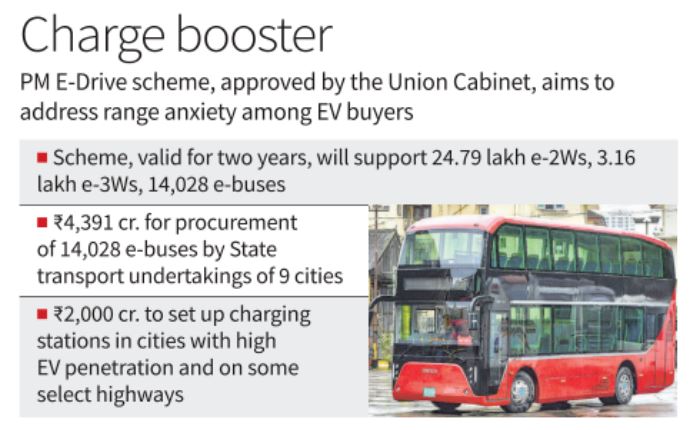
    The Union Cabinet approved the PM Electric Drive Revolution in Innovative Vehicle Enhancement (PM E-Drive) Scheme with an outlay of ₹10,900 crore over two years.

    About PM E-DRIVE Scheme:

    Details
    Name PM Electric Drive Revolution in Innovative Vehicle Enhancement (PM E-DRIVE) Scheme
    Total Outlay ₹10,900 crore for two years
    Goal
    • Promote electric mobility, reduce pollution, and enhance fuel security
    • Reduce range anxiety by providing charging infrastructure in cities and highways.
    Incentives Direct subsidies for e-2Ws, e-3Ws, e-buses, e-ambulances, and e-trucks
    Key Components
    • ₹3,679 crore for demand incentives for e-2Ws, e-3Ws, e-ambulances, and e-trucks.
    • ₹500 crore for e-ambulances.
    • ₹4,391 crore for e-buses.

    Other components:

    E-Vouchers
    • Aadhaar-authenticated e-voucher for EV buyers;
    • Signed by both buyer and dealer for claiming incentives.
    E-Bus Procurement ₹4,391 crore for 14,028 e-buses in 9 major cities (Delhi, Mumbai, Kolkata, Chennai, Ahmedabad, Surat, Bangalore, Pune, Hyderabad)
    Charging Infrastructure ₹2,000 crore for 72,300 public EV charging stations, including fast chargers for e-4Ws, e-buses, e-2Ws, and e-3Ws
    Incentivizing E-Trucks ₹500 crore tied to scrapping certificates from MoRTH-approved scrapping centres
    Testing and Upgradation ₹780 crore for upgradation of MHI’s test agencies for green mobility technologies


    PYQ:

    [2019] How is efficient and affordable urban mass transport key to the rapid economic development in India?

  • Rural Infrastructure Schemes

    Launch of PM Gram Sadak Yojana- Phase IV

    Note4Students

    From UPSC perspective, the following things are important:

    Prelims level: All phases of PMGSY

    Why in the News?

    The Union Cabinet has approved Phase IV of the Pradhan Mantri Gram Sadak Yojana (PMGSY-IV) to build 62,500 km of all-weather roads, connecting villages across India.

    About Pradhan Mantri Gram Sadak Yojana (PMGSY)

    Details
    Launch 
    • In 2000 by former PM Late Atal Bihari Vajpayee.
    • To provide connectivity to unconnected habitations.
    Nodal Agency Ministry of Rural Development
    Type Centrally Sponsored Scheme
    Phases
    • Phase I: Focus on connecting unconnected habitations.
    • Phase II: Upgrading roads built in Phase I to enhance rural infrastructure.
    • Phase III: Consolidation of 1.25 lakh km of rural roads connecting habitations to Gramin Agricultural Markets, Higher Secondary Schools, and Hospitals. Cost: ₹80,250 crore (2019-2025). Funding: 60:40 (Centre), 90:10 for North-East and Himalayan States.

    Phase IV: Aims at constructing 62,500 km of all-weather roads to provide connectivity to 25,000 unconnected habitations with focus on Left-Wing Extremism (LWE) areas, tribal areas, and remote regions.

    Road Length and Coverage 62,500 km of all-weather roads covering 25,000 unconnected habitations.

    Benefits of PMGSY-IV

    • Road Connectivity for 25,000 Villages: All-weather roads will provide reliable access to previously unconnected rural habitations, improving transportation and accessibility.
    • Socio-Economic Transformation: These roads will act as catalysts for socio-economic development in rural areas, enabling access to government educational institutions, health services, markets, and growth centers.
    • Enhanced Infrastructure: The construction will adopt international benchmarks and best practices, such as using Cold Mix Technology, Waste Plastic, Full Depth Reclamation, and materials like Fly Ash and Steel Slag, contributing to eco-friendly construction.

    PYQ:

    [2020] In rural road construction, the use of which of the following is preferred for ensuring environmental sustainability or to reduce carbon footprint?

    1. Copper slag
    2. Cold mix asphalt technology
    3. Geotextiles
    4. Hot mix asphalt technology
    5. Portland cement

    Select the correct answer using the code given below:

    (a) 1, 2 and 3 only

    (b) 2, 3 and 4 only

    (c) 4 and 5 only

    (d) 1 and 5 only

  • Agricultural Sector and Marketing Reforms – eNAM, Model APMC Act, Eco Survey Reco, etc.

    Expansion of Agricultural Infrastructure Fund (AIF) Scheme

    Note4Students

    From UPSC perspective, the following things are important:

    Prelims level: Agricultural Infrastructure Fund (AIF) Scheme

    Why in the News?

    • The Union Cabinet has approved the expansion of the Agricultural Infrastructure Fund (AIF) scheme.
      • It will now include financial support for Farmers’ Producers Organizations (FPOs) to enhance their financial security and creditworthiness.

    About Agriculture Infrastructure Fund (AIF) Scheme:

    Details
    Launch  July 2020, Central Sector Scheme
    Nodal Ministry Ministry of Agriculture and Farmers Welfare, Government of India
    Fund Allocation Rs. 1 lakh crore, with disbursements planned until 2025-26; interest subvention and credit guarantee assistance extended till 2032-33.
    Aim To mobilize medium to long-term debt financing for investment in viable projects relating to post-harvest management infrastructure and community farming assets, to enhance agricultural infrastructure in India.
    Key Features Interest Subvention: 3% on loans up to Rs. 2 crore, with additional rate reductions for NABARD loans for PACS.
    Credit Guarantees: Under the CGTMSE scheme for loans up to Rs. 2 crore.
    Fund Usage: Supports up to 25 projects per beneficiary across different locations.
    Target Beneficiaries Farmers, Farmer Producer Organizations (FPOs), Primary Agricultural Credit Societies (PACS), entrepreneurs, startups, Self Help Groups, Agricultural Produce Market Committees, and federations.
    Management Managed through an online MIS platform with national, state, and district level monitoring committees for real-time monitoring and feedback.
    Lending Institutions Includes 24 commercial banks, 40 cooperative banks, and NABARD among others.
    Hassle-Free Process Supported by a user-friendly online portal to facilitate speedy loan sanctions.


    Key changes introduced: 

    Description
    Support for FPOs Includes financial support for Farmers’ Producers Organizations (FPOs) to improve financial security and creditworthiness.
    Broader Eligible Projects Expand the scope to cover more types of agricultural infrastructure projects.
    Community Farming Assets Allows the creation of community farming assets to enhance productivity and sustainability.
    Integrated Processing Projects Adds integrated primary and secondary processing projects as eligible activities; standalone secondary projects remain under MoFPI schemes.
    Alignment with PM-KUSUM Converges AIF with PM-KUSUM Component-A for joint development of agricultural infrastructure and clean energy solutions.
    Extended Credit Guarantee Extends credit guarantee coverage to FPOs through NABSanrakshan, in addition to CGTMSE, to boost investment confidence.


    PYQ:

    [2015] With reference to ‘National Investment and Infrastructure Fund’, which of the following statements is/are correct?

    1. It is an organ of NITI Aayog.

    2. It has a corpus of 4,00,000 crore at present.

    Select the correct answer using the codes given below:

    (a) 1 only

    (b) 2 only

    (c) Both 1 and 2

    (d) Neither 1 nor 2