💥UPSC 2026, 2027, 2028 UAP Mentorship (March Batch) + Access XFactor Notes & Microthemes PDF

Type: IOCR

  • G20 : Economic Cooperation ahead

    G-20 summit expected to be in Delhi

    Note4Students

    From UPSC perspective, the following things are important:

    Prelims level: G7, G12, G20

    Mains level: Not Much

    India is expected to host the G-20 summit in Delhi, while a number of States, including Jammu and Kashmir and north-eastern States, have been asked to suggest venues for about 100 “preparatory” meetings.

    Why in news?

    • The clarifications came in response to questions being raised over reports in the media about the possibility of holding the summit itself in Jammu and Kashmir.
    • Pakistan had issued a strong protest last week, sent formal demarches to Foreign Ministries in G-20 member-states, asking them not to attend such meetings.
    • Pakistan (alone) believes J&K is internationally recognised disputed territory.

    Why such move?

    • The participation of the delegates from G-20 countries will be a major boost to the efforts of the Centre to project the situation in J&K as normal.
    • This is especially after J&K’s special constitutional position was ended in 2019.

    What is G-20?

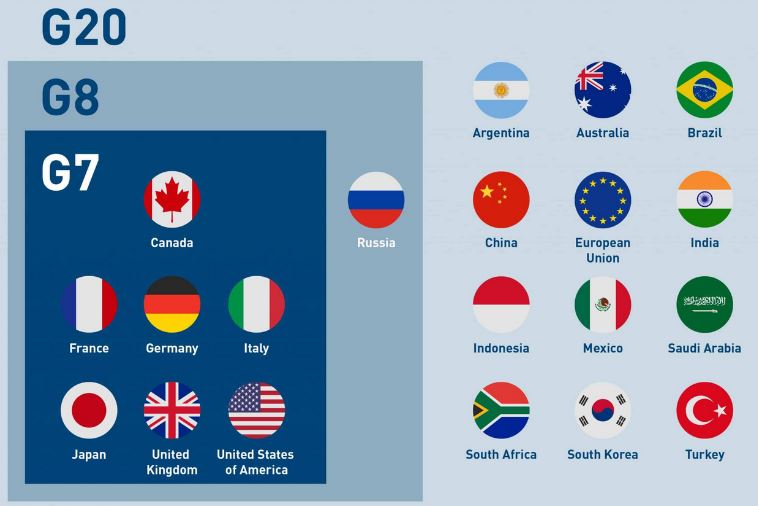
    • Formed in 1999, the G20 is an international forum of the governments and central bank governors from 20 major economies.
    • Collectively, the G20 economies account for around 85 percent of the Gross World Product (GWP), 80 percent of world trade.
    • To tackle the problems or address issues that plague the world, the heads of governments of the G20 nations periodically participate in summits.
    • In addition to it, the group also hosts separate meetings of the finance ministers and foreign ministers.
    • The G20 has no permanent staff of its own and its chairmanship rotates annually between nations divided into regional groupings.

    Aims and objectives

    • The Group was formed with the aim of studying, reviewing, and promoting high-level discussion of policy issues pertaining to the promotion of international financial stability.
    • The forum aims to pre-empt the balance of payments problems and turmoil on financial markets by improved coordination of monetary, fiscal, and financial policies.
    • It seeks to address issues that go beyond the responsibilities of any one organization.

    Members of G20

    The members of the G20 consist of 19 individual countries plus the European Union (EU).

    • The 19 member countries of the forum are Argentina, Australia, Brazil, Canada, China, France, Germany, India, Indonesia, Italy, Japan, Mexico, Russia, Saudi Arabia, South Africa, South Korea, Turkey, United Kingdom and the United States.
    • The European Union is represented by the European Commission and by the European Central Bank.

    Its significance

    • G20 is a major international grouping that brings together 19 of the world’s major economies and the European Union.
    • Its members account for more than 80% of global GDP, 75% of trade and 60% of population.

    India and G20

    • India has been a member of the G20 since its inception in 1999.


    UPSC 2023 countdown has begun! Get your personal guidance plan now! (Click here)

  • Russian Invasion of Ukraine: Global Implications

    Turkey backs Sweden and Finland’s NATO bid

    Note4Students

    From UPSC perspective, the following things are important:

    Prelims level: NATO

    Mains level: Read the attached story

    Turkey has agreed to support Finland and Sweden joining the NATO military alliance after weeks of angering partners by insisting it would veto the Scandinavian countries’ accession.

    What is NATO?

    • NATO is a military alliance established by the North Atlantic Treaty (also called the Washington Treaty) of April 4, 1949.
    • It sought to create a counterweight to Soviet armies stationed in Central and Eastern Europe after World War II.
    • Its original members were Belgium, Canada, Denmark, France, Iceland, Italy, Luxembourg, the Netherlands, Norway, Portugal, the United Kingdom, and the United States.
    • NATO has spread a web of partners, namely Egypt, Israel, Sweden, Austria, Switzerland and Finland.

    Expansion of NATO: Transforming Europe

    • The war in Ukraine has already changed the geopolitics of Europe and the world.
    • The admission of Finland and Sweden to NATO would bring about a transformation in the continent’s security map by giving NATO a contiguous long frontier in western Russia.
    • Finland and Russia share a 1,300-km border — and doubling it from the present 1,200 km, parts of it in northern Norway, Latvia and Estonia, and Poland and Lithuania.
    • In addition, Sweden’s island of Gotland in the middle of the Baltic Sea would give NATO a strategic advantage.
    • Furthermore, when Sweden and Finland join NATO, the Baltic Sea — Russia’s gateway to the North Sea and the Atlantic Ocean — would be ringed entirely by NATO members.

    Why Nordic countries are willing to join NATO?

    • Although the debate over joining NATO was ongoing in both countries for nearly three decades, Russia’s annexation of Crimea pushed both towards NATO’s “open door” policy.
    • Still, there was little political consensus in either country, especially in Sweden where the Social Democrats have long been against the idea.
    • However, February 24 changed everything the date on which Russia invaded Ukraine.

    A knee jerk reaction?

    • If Putin’s invasion of Ukraine was meant to deter NATO’s eastward expansion, the war has had the opposite effect.
    • If admitted, Sweden and Finland will become its 31st and 32nd members.

    Russian response

    • Back in March, Russia had evoked a threatening response to take retaliatory measures by stationing its nuclear and hypersonic weapons close to the Baltic Sea.
    • Russia denounced the problems with Finland and Sweden but the NATO’s expansion at the expense of these countries does not pose a direct threat to us.
    • But the expansion of military infrastructure into this territory will certainly provoke their response, warned Mr Putin.
    • Sweden had already said it would not allow NATO bases or nuclear weapons on its territory.

    Hurdles for Finland, Sweden

    • At the moment the main obstacle to their applications in Turkey, a member since 1952 and which has NATO’s second-largest army after the US.
    • Turkish president Erdogan has objected to their applications on the ground that the two countries had provided safe haven to the leaders of the Kurdish group PKK.
    • Many Kurdish and other exiles have found refuge in Sweden over the past decades.
    • PKK is an armed movement fighting for a separate Kurdistan, comprising Kurdish areas in Turkey, Iraq, Iran and Syria.
    • Neither of these countries have a clear, open attitude towards terrorist organisation.

    What could Turkey gain?

    • Turkey is expected to seek to negotiate a compromise deal to seek action on Kurdish groups.
    • Erdogan could also seek to use Sweden and Finland’s membership to wrest concessions from the United States and other allies.
    • Turkey wants to return to the US-led F-35 fighter jet program — a project it was kicked out of following its purchase of Russian S-400 missile defense systems.
    • Alternatively, Turkey is looking to purchase a new batch of F-16 fighter jets and upgrade its existing fleet.

    How does this affect Turkey’s image in the West?

    • Turkey is reinforcing an image that is blocking the alliance’s expansion for its own profit.
    • It also risks damaging the credit it had earned by supplying Ukraine with the Bayraktar TB2 armed drones that became an effective weapon against Russian forces.

    Is Turkey trying to appease Russia?

    • Turkey has built close relations with both Russia and Ukraine and has been trying to balance its ties with both.
    • It has refused to join sanctions against Russia — while supporting Ukraine with the drones that helped deny Russia air superiority.


    UPSC 2023 countdown has begun! Get your personal guidance plan now! (Click here)

  • Climate Change Negotiations – UNFCCC, COP, Other Conventions and Protocols

    Commonwealth adopts ‘Living Lands Charter’

    Note4Students

    From UPSC perspective, the following things are important:

    Prelims level: Living Lands Charter

    Mains level: Land degradation

    All 54 Commonwealth members have agreed to voluntarily dedicate a ‘living land’ in their respective countries to future generations, in line with the strategy set for the UN Decade on Ecosystem Restoration.

    Living Lands Charter

    • The non-binding mandates that member countries will safeguard global land resources and arrest land degradation while acting against climate change, biodiversity loss and sustainable management.
    • It helps to encapsulate the combined effort to hold the global average temperature increase to 1.5 degrees Celsius, said Commonwealth Secretary-General Patricia Scotland.
    • The document came after nearly two years of intense consultation, engagement and negotiation with member countries at UN Rio Convention.

    Key objectives

    • Leaders and their representatives noted with concern in the charter the alarming decline in the health and productivity of global land resources.
    • It aimed to support member countries to effectively deliver their commitments under the three Rio conventions:
    1. UN Convention on Biological Diversity
    2. UN Convention to Combat Desertification (UNCCD)
    3. UN Framework Convention on Climate Change

    Major outcomes

    • The attendees also underlined the principle ofcritical guardianship” provided by indigenous peoples and local communities in protecting land and vital ecosystem services.
    • The agreement was released along with a final wide-ranging communiqué by leaders, including on specific items on climate change.
    • Country heads underscored in it that the “urgent threat of climate change” exacerbates existing vulnerabilities and presents a significant threat to COVID-19 recovery efforts.


    Try this PYQ from CSP 2012:

    Q.Consider the following statements:

    1. The Commonwealth has no charter, treaty or constitution
    2. All the territories/countries once under the British Empire (jurisdiction/rule/mandate) automatically joined the Commonwealth as its members

    Which of the statements given above is/are correct?

    (a) 1 only

    (b) 2 only

    (c) Both 1 and 2

    (d) Neither 1 nor 2


    Post your answers here.

    Back2Basics: Commonwealth of Nations

    • The Commonwealth of Nations is an intergovernmental organisation of 53 member states that are mostly former territories of the British Empire.
    • It dates back to the first half of the 20th century with the decolonization of the British Empire through increased self-governance of its territories.
    • It was originally created as the British Commonwealth of Nation through the Balfour Declaration at the 1926 Imperial Conference, and formalized by the UK through the Statute of Westminster in 1931.
    • The current body was formally constituted by the London Declaration in 1949, which modernized the community, and established the member states as “free and equal”.
    • The symbol of this free association is Queen Elizabeth II, who is the Head of the Commonwealth.
    • The Queen is head of state of 16 member states, known as the Commonwealth realms, while 32 other members are republics and five others have different monarchs.
    • Member has no legal obligations to one another. Instead, they are united by language, history, culture and their shared values of democracy, human rights and the rule of law.


    UPSC 2023 countdown has begun! Get your personal guidance plan now! (Click here)

  • G20 : Economic Cooperation ahead

    G-20

    Note4Students

    From UPSC perspective, the following things are important:

    Prelims level: G7, G12, G20

    Mains level: Read the attached story

    The Jammu and Kashmir administration has constituted a committee to coordinate with the delegates of G-20 countries scheduled to participate in a meeting to be held in the Union Territory (UT) next year.

    Why such move?

    • The participation of the delegates from G-20 countries will be a major boost to the efforts of the Centre to project the situation in J&K as normal.
    • This is especially after J&K’s special constitutional position was ended in 2019.

    What is G-20?

    • Formed in 1999, the G20 is an international forum of the governments and central bank governors from 20 major economies.
    • Collectively, the G20 economies account for around 85 percent of the Gross World Product (GWP), 80 percent of world trade.
    • To tackle the problems or address issues that plague the world, the heads of governments of the G20 nations periodically participate in summits.
    • In addition to it, the group also hosts separate meetings of the finance ministers and foreign ministers.
    • The G20 has no permanent staff of its own and its chairmanship rotates annually between nations divided into regional groupings.

    Aims and objectives

    • The Group was formed with the aim of studying, reviewing, and promoting high-level discussion of policy issues pertaining to the promotion of international financial stability.
    • The forum aims to pre-empt the balance of payments problems and turmoil on financial markets by improved coordination of monetary, fiscal, and financial policies.
    • It seeks to address issues that go beyond the responsibilities of any one organization.

    Members of G20

    The members of the G20 consist of 19 individual countries plus the European Union (EU).

    • The 19 member countries of the forum are Argentina, Australia, Brazil, Canada, China, France, Germany, India, Indonesia, Italy, Japan, Mexico, Russia, Saudi Arabia, South Africa, South Korea, Turkey, United Kingdom and the United States.
    • The European Union is represented by the European Commission and by the European Central Bank.

    Its significance

    • G20 is a major international grouping that brings together 19 of the world’s major economies and the European Union.
    • Its members account for more than 80% of global GDP, 75% of trade and 60% of population.

    India and G20

    • India has been a member of the G20 since its inception in 1999.


    UPSC 2023 countdown has begun! Get your personal guidance plan now! (Click here)

  • WTO and India

    Outcomes of the WTO Ministerial Conference

    Note4Students

    From UPSC perspective, the following things are important:

    Prelims level: WTO

    Mains level: Read the attached story

    Recently, member countries of the World Trade Organization (WTO) wrapped up the Ministerial Conference’s twelfth outing (MC12).

    Key outcomes: “Geneva Package”

    • The conference has secured key agreements on
    1. Relaxing patent regulations to achieve global vaccine equity
    2. Ensuring food security
    3. According subsidies to the fisheries sector
    4. Continuing moratoriums relevant to e-commerce
    • Together they constitute what WTO Director-General is referred to as the “Geneva Package.”
    • India saw some successes at the MC12 with respect to the above mentioned sectors.

    What is the WTO’s Ministerial Conference?

    • The MC is at the very top of WTO’s organisational chart.
    • It meets once every two years and can take decisions on all matters under any multilateral trade agreement.
    • Unlike other organisations, such as the International Monetary Fund or World Bank, WTO does not delegate power to a board of directors or an organisational chief.
    • All decisions at the WTO are made collectively and through consensus among member countries at varied councils and committees.
    • This year’s conference took place in Geneva, Switzerland.

    Major debates at the MC12

    (1) Agriculture

    • India is a significant contributor to the World Food Programme (WFP).
    • India had earlier stated that it had never imposed export restrictions for procurement under the programme.
    • It put forth that a blanket exemption could constrain its work in ensuring food security back home.
    • In such a situation, it would have to keep its WFP commitments irrespective of its domestic needs.
    • Negotiators could not reach agreements on issues such as permissible public stockholding threshold for domestic food security, domestic support to agriculture, cotton, and market access.

    (2) Fisheries

    • India successfully managed to carve out an agreement on ELIMINATING subsidies to those engaged in illegal, unreported and unregulated fishing.
    • The only exception for continuing subsidies for overfished stock is when they are deemed essential to rebuild them to a biologically sustainable level.
    • Overfishing refers to exploiting fishes at a pace faster than they could replenish themselves — currently standing at 34% as per the UN Food and Agriculture Organization (FAO).
    • Declining fish stocks threaten to worsen poverty and endanger communities that rely on aquatic creatures for their livelihood and food security.
    • Further, the agreements hold that there would be no limitation on subsidies by developing or least-developed countries for fishing within their exclusive economic zones (EEZ).

    (3) Patent relaxations

    • Member countries agreed on authorising the use of a patent for producing COVID-19 vaccines by a member country, without the consent of the rights holder.
    • Further, it asks member countries to waive requirements, including export restrictions, set forth by WTO regulations to supply domestic markets and member countries with any number of vaccines.
    • The agreement, however, comes too little, too late for economically poorer countries.


    UPSC 2023 countdown has begun! Get your personal guidance plan now! (Click here)

  • Foreign Policy Watch: India-United States

    What is the I2U2 Initiative?

    Note4Students

    From UPSC perspective, the following things are important:

    Prelims level: Abraham Accord, I2U2

    Mains level: Read the attached story

    The US administration has named the new grouping as “I2U2” — “I” for India and Israel and “U” for the US and UAE. This was earlier referred as West Asian Quad.

    What is the news?

    • US President Joe Biden will host a virtual summit with PM Modi, Israel PM Naftali Bennett and UAE President Mohammed bin Zayed Al Nahyan during his visit to West Asia from July 13 to 16.

    I2U2 Initiative

    • Following the Abraham Accords between Israel and the UAE, I2U2 was founded in October 2021 to address marine security, infrastructure, and transportation challenges in the region.
    • It was known as the ‘International Forum for Economic Cooperation’at the time.
    • At that time, UAE had referred to the new grouping as the ‘West Asian Quad’.

    What makes this deal outstanding?

    • UAE forming sharing desk with Israel is no easy deal. Arab sentiments against Israel and their proposition for Anti-Semitism are well known.

    Significance of the initiative

    • I2U2 seeks to empower the partners and encourages them to collaborate more closely, resulting in a more stable region.
    • India is seen as a large consumer market as well as a large producer of high-tech and highly sought-after items in the United States.
    • This has led India to enhance its relationship with Israel without jeopardising its ties with the UAE and other Arab states.

    Back2Basics: Abraham Accords

    • The Israel–UAE normalization agreement is officially called the Abraham Accords Peace Agreement.
    • It was initially agreed to in a joint statement by the United States, Israel and the United Arab Emirates (UAE) on August 13, 2020.
    • The UAE thus became the third Arab country, after Egypt in 1979 and Jordan in 1994, to agree to formally normalize its relationship with Israel as well as the first Persian Gulf country to do so.
    • Concurrently, Israel agreed to suspend plans for annexing parts of the West Bank. The agreement normalized what had long been informal but robust foreign relations between the two countries.


    UPSC 2023 countdown has begun! Get your personal guidance plan now! (Click here)

  • Foreign Policy Watch: India-ASEAN

    Back in news: India- ASEAN Relations

    Note4Students

    From UPSC perspective, the following things are important:

    Prelims level: ASEAN

    Mains level: India-ASEAN Relations

    The Foreign Minister of Myanmar is unlikely to be part of the 24th ASEAN-India Ministerial summit.

    What is the news?

    • Myanmar’s absence is the souring ASEAN-Myanmar.
    • This is after the coup that overthrew the Aung San Suu Kyi government in Myanmar.
    • This shows India’s concern over the junta in Myanmar which has refused to enter into a negotiation

    What is ASEAN?

    • ASEAN is a political and economic union of 10 member states in Southeast Asia.
    • It brings together ten Southeast Asian states – Brunei, Cambodia, Indonesia, Laos, Malaysia, Myanmar, the Philippines, Singapore, Thailand and Vietnam – into one organisation.
    • It was established on 8th August 1967 in Bangkok, Thailand with the signing of the Bangkok Declaration by the founding fathers of the countries of Indonesia, Malaysia, Thailand, Singapore, and the Philippines.
    • The preceding organisation was the Association of Southeast Asia (ASA) comprising of Thailand, the Philippines, and Malaysia.
    • Five other nations joined the ASEAN in subsequent years making the current membership to ten countries.

    India-ASEAN Relations: A Backgrounder

    • Look-East Policy in 1992 gave an upthrust to India -ASEAN relation and helped India in capitalizing its historical, cultural and civilizational linkages with the region.
    • India entered into a Free Trade Agreement (FTA) in goods with the region in 2003 which has facilitated the bilateral trade which now stands at approximately USD 76 Billion.
    • Further, the launch of Act East Policy in 2014 has added a new vigour to India-ASEAN relations.

    Significance of ASEAN to India

    • ASEAN’s centrality in India’s foreign policy – A cohesive, responsive, and prosperous ASEAN is central to India’s Indo-Pacific Vision and India’s Act East Policy and contributes to Security and Growth for All in the Region (SAGAR).
    • Economic – ASEAN is the one of the largest market in the world comparative to the EU and North American markets.
      • It’s also the 4th most popular investment destination globally.
    • Investment opportunities for Indian businesses – Cost of production is lower in Laos, Cambodia, and Myanmar, which means that Indian firms can gain significantly by investing in these countries.
    • Countering China – Cooperation between India and ASEAN is crucial to counter China’s power projection in the region. Both have territorial and border issues with China, disputes over the South China Islands and waters for ASEAN and over land boundaries for India.
    • Integration with regional and global supply chains – Increasing engagement with ASEAN is pivotal to facilitate India’s integration with regional and global supply chain movements.
    • North-East development – Connectivity projects with the ASEAN nations keeping Northeast India at the centre can ensure the economic growth of the land-locked north-eastern states.
      • Collaboration with the ASEAN nations is necessary to counter insurgency in the Northeast, combat terrorism, etc.
    • Maritime security – The Indian Ocean carries 90% of India’s trade and its energy sources. Presence of choke points such as the Malacca strait makes the South-East Asian region significant for countering traditional and non-traditional maritime threats like piracy and terrorism.
    • Indian Diaspora – About 9-8% of the population in Malaysia and Singapore is of Indian origin, in Myanmar-4% and Indonesia about 0.5%.

    Areas of Cooperation

    • Economic Cooperation – ASEAN is India’s 4th largest trading partner.
      • India signed FTA in goods in 2009 and an FTA in services and investments in 2014 with ASEAN.
      • India has a Comprehensive Economic Cooperation Agreement (CECA) with various countries of the ASEAN region which has resulted in concessional trade and a rise in investments.
    • Political Cooperation – ASEAN-India Centre (AIC) was established to undertake policy research, advocacy and networking activities with organizations and think-tanks in India and ASEAN.
      • Delhi Dialogue – Annual Track 1.5 event for discussing politico-security and economic issues between ASEAN and India.
    • Financial Assistance – India provides financial assistance to the ASEAN nations through various mechanism like ASEAN-India Cooperation Fund, ASEAN-India S&T Development Fund and ASEAN-India Green Fund.
    • Connectivity – India has been undertaking several connectivity projects like India-Myanmar-Thailand Trilateral (IMT) Highway and the Kaladan Multimodal Project.
      • India is also trying to establish a Maritime Transportation Agreementwith ASEAN and also Plans for a Railway link between New Delhi in India to Hanoi in Vietnam.
    • Socio-Cultural Cooperation – Programmes to boost People-to-People Interaction with ASEAN are organized, such as inviting ASEAN students to India, Special Training Course for ASEAN diplomats, Exchange of Parliamentarians, etc.
    • Defence Cooperation – Joint Naval and Military exercises are conducted between India and most ASEAN countries.
      • Vietnam has traditionally been a close friend on defense issues, Singapore is also an equally important partner.
    • Maritime Cooperation – adopted Delhi Declaration and decided to identify Cooperation in the Maritime Domain as the key area of cooperation under the ASEAN-India strategic partnership.
      • India is developing its maiden deep-sea port in a strategically located Sabang port in Indonesia.

    REGIONAL COMPREHENSIVE ECONOMIC PARTNERSHIP (RCEP) AGREEMENT

    • RCEP is a Free Trade Agreement (FTA) that has been signed between 15 countries including the 10 ASEAN members, China, Japan, South Korea, Australia, and New Zealand.
      • RCEP was first proposed in 2011 with an aim to create a consolidated market for the ASEAN countries and their trade partners.
      • RCEP now forms the world’s largest trade bloc, covering over 2.2 billion people and accounting for 30% of the world’s economy.
    • Though India was a part of the RCEP’s negotiations, it dropped out in November 2019, citing significant outstanding issues that remain unresolved.

    Reasons behind India pulling out of RCEP

    • Trade imbalance with RCEP members – India’s trade deficit with RCEP countries has almost doubled in the last five-six years.
    • Chinese Angle – From a geopolitical perspective, RCEP is China-led or is intended to expand China’s influence in Asia. India has already signed FTA with all the countries of RCEP except China.
    • Signing of RCEP can lead to cheaper products from China flooding the Indian market.
    • Lack of adequate protection for domestic industries – India’s proposals for strict Rules of Origin (to prevent routing of products from non-RCEP countries) and an Auto-trigger mechanism to impose tariffs when imports crossed a certain threshold which were not accepted.
    • Lack of Service component – Most developed RCEP countries where India can export services, have been unwilling to negotiate wide-ranging disciplines in services that can create new market access for trade in services in this region.
    • Concerns by local industries – A large number of sectors including dairy, agriculture, steel, automobiles, etc had expressed serious apprehensions on RCEP citing dominance of cheap foreign goods would dampen its business.
    • India’s FTA experience – India’s FTAs has generally led to greater imports than exports, giving rise to high trade deficits with FTA partners like South Korea, Japan, and ASEAN.

    Possible Implications of India not joining RCEP

    Protectionist image – Withdrawal from RCEP along with other recent measures like call for self-reliance under Atmanirbhar Abhiyan, etc can be perceived as India taking a protectionist stance in terms of trade policy.

    Lost opportunity for India’s export sector – RCEP was envisaged to strengthen Asian supply chains, bring in investments and boost the member countries’ competitiveness in global markets.

    Effect on bilateral ties with RCEP countries – There are concerns that the decision will hamper India’s bilateral trade with RCEP member countries as they would be inclined to bolster trade within the bloc.

    Lost opportunity in securing a position in the post COVID world: RCEP is expected to help member countries emerge from the economic devastation caused by the pandemic through access to regional supply chains.

    Arguments for reviewing India’s decision

    • Global Economic Stagnation due to Covid-19 pandemic – RCEP can serve as a bulwark in containing the free fall of the global economy and re-energising economic activity.
      • RCEP presents a unique opportunity to support India’s economic recovery, inclusive development, and job creation even as it helps strengthen regional supply chains.
    • Economic Realism – India should deter seeing RCEP only from the Chinese perspective.
      • India can draw inspiration from Japan & Australia, as they chose to bury their geopolitical differences with China to prioritise what they collectively see as a mutually beneficial trading compact.
    • Strategic Need – RCEP’s membership is a prerequisite to having a say in shaping RCEP’s rules, which is necessary to safeguard India’s interests and the interests of several countries that are too small to stand up to the largest member, China.
    • As the summary of the final agreement shows, the pact does cover and attempt to address some issues that India had flagged, including rules of origin, trade in services, movement of persons. Therefore, this makes the case of India to review its decision and look RCEP through the lens of economic realism.

    Challenges in India-ASEAN Relations

    • China factor – India’s effort in this regard is meagre when compared to China’s dominance in the region
      • China’s assertive military, political and economic rise, as well as the South China Sea disputes have divided ASEAN without unanimity amongst them.
    • Economic challenges – India has an unfavourable balance of trade with the ASEAN nations.
    • RCEP deal – India walking out of RCEP can become a sticking point between India and ASEAN, since India’s domestic market was considered a key element in the RCEP negotiations.
      • India has not signed RCEP for various reasons like non-transparency in RCEP, RCEP’s non-accounting of India’s service sector relaxations, etc.
      • By not signing the RCEP India also lose access to new market opportunities created in East Asia.
    • Slow development in Bilateral relations – Many bilateral deals with these nations are yet to be finalised, leading to the halting of various aspects of diplomatic ties.
    • Delayed projects – Though India has committed to many connectivity projects, they have not been completed at the rate on par with China
      • China, on the other hand, through its BRI, is able to gain the trust of these countries.

    India’s pulling out of the RCEP deal shows the limitations of the ties with the ASEAN nations. Maintaining cordial ties, both bilaterally and multilaterally with these nations is essential for both India’s economic and security interests.

    South-East Asian nations are looking at India to take on a greater role for the economic integration of the region and for ensuring an open and inclusive Indo-Pacific. Many of the members of the ASEAN perceive India as a much-needed counterbalance to China.

    Way Forward

    • An alternative economic corridor based multimodal connectivity such as Mekong-India Economic Corridor may be promoted, which will connect Indian coast with unexplored Southeast Asian coast and beyond.
      • Strengthening land, air, and sea linkages will enhance people-to-people flows, as well as boost business, investment, and tourism.
      • With China having three times more commercial flights than India to Southeast Asia, improving air connectivity between India and ASEAN countries should also be high on the agenda.
    • India has proposed setting up of an ASEAN-India Network of Universities (AINU) to enhance our educational ties.
    • India can become the military partner after the Atma Nirbar Bharat, Make in India projects are successfully implemented.
      • No ASEAN country has close military ties with China as they never trusted China for military alliance.
    • Concept of QUAD must be expanded to include the ASEAN countries and become a QUAD+ arrangement.
      • Vietnam and Indonesia have expressed a positive note on QUAD in the region.
    • Digital technologies – Given the reluctance of ASEAN states to take help from Chinese giants in the field (due to concerns regarding China’s ability to own data), Indian IT sector may take some advantage.
    • Strengthening cultural connect – Tourism can be further encouraged between India and the ASEAN with some creative branding by the two sides.

    Failure of South Asian Association for Regional Cooperation (SAARC) has made India look outside South Asia towards countries of Southeast Asia for economic and political cooperation.

    The ASEAN region has become strategically important for India due to its growing importance in the world politics. And for India to be a regional power as it claims to be, continuing to enhance its relations with ASEAN in all spheres must be a priority.

  • Foreign Policy Watch: The BCIM Corridor

    [pib] BIMSTEC Technology Transfer Facility (TTF)

    Note4Students

    From UPSC perspective, the following things are important:

    Prelims level: BIMSTEC TTF

    Mains level: BIMSTEC

    The Union Cabinet chaired by the PM has approved a Memorandum of Association (MoA) by India for the establishment of the BIMSTEC Technology Transfer Facility (TTF).

    What is BIMSTEC?

    • The BIMSTEC formed in 1997 is an international organisation of seven South Asian and Southeast Asian nations, housing 1.73 billion people and having a combined gross domestic product of $3.8 trillion (2021).
    • The BIMSTEC member states – Bangladesh, Bhutan, India, Myanmar, Nepal, Sri Lanka, and Thailand – are among the countries dependent on the Bay of Bengal.
    • Leadership is rotated in alphabetical order of country names. The permanent secretariat is in Dhaka, Bangladesh.
    • A BIMSTEC free trade agreement is under negotiation (c. 2018), also referred to as the mini SAARC.

    What is BIMSTEC TTF?

    • The agreement was signed by the BIMSTEC member countries at the 5th BIMSTEC Summit held at Colombo, Sri Lanka on 30th March, 2022.
    • The main objectives of the BIMSTEC TTF are to coordinate, facilitate and strengthen cooperation in technology transfer among the BIMSTEC Member States.
    • It aims to promote the transfer of technologies, sharing of experiences and capacity building.
    • The TTF shall have a Governing Board and the overall control of activities of the TTF shall be vested in the Governing Board.
    • The Governing Board shall consist of one nominee from each Member State.

    Expected outcomes

    The expected outcomes of the BIMSTEC TTF are:

    • Databank of technologies available in BIMSTEC Countries,
    • Repository of information on good practices in the areas of technology transfer management, standards, accreditation, metrology, testing and calibration facilities,
    • Capacity building, sharing of experiences and good practices in development, and
    • Transfer and use of technologies among BIMSTEC countries.


    UPSC 2023 countdown has begun! Get your personal guidance plan now! (Click here)

  • Terrorism and Challenges Related To It

    FATF and Pakistan’s position on its ‘Grey List’

    Note4Students

    From UPSC perspective, the following things are important:

    Prelims level: FATF

    Mains level: Terror financing and money laundering

    Pakistan which continues to face an economic crunch from the Financial Action Task Force (FATF), is hoping for some respite in the form of its removal from the FATF’s ‘grey list’.

    What is the FATF?

    • The FATF is an international watchdog for financial crimes such as money laundering and terror financing.
    • It was established at the G7 Summit of 1989 in Paris to address loopholes in the global financial system after member countries raised concerns about growing money laundering activities.
    • In the aftermath of the 9/11 terror attack on the US, FATF also added terror financing as a main focus area.
    • This was later broadened to include restricting the funding of weapons of mass destruction.
    • The FATF currently has 39 members.

    Working of FATF

    • The decision-making body of the FATF, known as its plenary, meets thrice a year.
    • Its meetings are attended by 206 countries of the global network.
    • It includes members, and observer organisations, such as the World Bank, some offices of the UN, and regional development banks.

    Functions of FATF

    • The FATF sets standards or recommendations for countries to achieve in order to plug the holes in their financial systems and make them less vulnerable to illegal financial activities.
    • It conducts regular peer-reviewed evaluations called Mutual Evaluations (ME) of countries to check their performance on standards prescribed by it.
    • The reviews are carried out by FATF and FATF-Style Regional Bodies (FSRBs), which then release Mutual Evaluation Reports (MERs).
    • For the countries that don’t perform well on certain standards, time-bound action plans are drawn up.
    • Recommendations for countries range from assessing risks of crimes to setting up legislative, investigative and judicial mechanisms to pursue cases of money laundering and terror funding.

    What are the Black List and the Grey List?

    • The words ‘grey’ and ‘black’ list do not exist in the official FATF lexicon.
    • They however designate countries that need to work on complying with FATF directives and those who are non-compliant.
    1. Black List: The blacklist, now called the “Call for action” was the common shorthand description for the FATF list of “Non-Cooperative Countries or Territories” (NCCTs).
    2. Grey List: Countries that are considered safe haven for supporting terror funding and money laundering are put in the FATF grey list. This inclusion serves as a warning to the country that it may enter the blacklist.

    Consequences of being:

    (1) In the grey list:

    • Economic sanctions from IMF, World Bank, ADB
    • Problem in getting loans from IMF, World Bank, ADB and other countries
    • Reduction in international trade
    • International boycott

    (2) In the black list:

    • High-risk jurisdictions subject to call for action
    • Countries have considerable deficiencies in their AML/CFT (anti-money laundering and counter terrorist financing) regimens
    • Enhanced due diligence
    • Members are told to apply counter-measures such as sanctions on the listed countries

    Note: Currently, North Korea and Iran are on the black list.

    Pakistan and FATF

    • Pakistan, which continues to remain on the “grey list” of FATF, had earlier been given the deadline till the June to ensure compliance with the 27-point action plan against terror funding networks.
    • It has been under the FATF’s scanner since June 2018, when it was put on the Grey List for terror financing and money laundering risks.
    • FATF and its partners such as the Asia Pacific Group (APG) are reviewing Pakistan’s processes, systems, and weaknesses on the basis of a standard matrix for anti-money laundering (AML) and combating the financing of terrorism (CFT) regime.

    Why is Pakistan on the grey list?

    • Pakistan has found itself on the grey list frequently since 2008, for weaknesses in fighting terror financing and money laundering.
    • It never addressed concerns on the front of terror financing investigations and prosecutions targeting senior leaders and commanders of UN-designated terrorist groups.
    • However, now steps had been taken in this direction such as the sentencing of terror outfit chief Hafiz Saeed, prosecution of Masood Azhar and seizure of their properties.
    • India meanwhile, a member of FATF, suspects the efficacy and permanence of Pakistani actions.

    Steps taken by Pakistan

    • Pakistan is currently banking on its potential exclusion from the grey list to help improve the status of tough negotiations with the International Monetary Fund to get bailout money.
    • Pakistan is now making a high-level political commitment to the FATF and APG to address its strategic AML/CFT deficiencies.


    UPSC 2023 countdown has begun! Get your personal guidance plan now! (Click here)

  • Russian Invasion of Ukraine: Global Implications

    Explained: European Union’s ban on Russian Oil

    Note4Students

    From UPSC perspective, the following things are important:

    Prelims level: NA

    Mains level: Global sanctions on Russia

    As part of the sixth package of sanctions since Russia’s invasion of Ukraine, the European Union member states reached an agreement to ban 90% of Russian crude oil imports by the end of the year.

    Oil embargo on Russia

    • The proposal is to completely phase out Russian crude and refined products from EU territory.
    • It includes a complete import ban on all Russian oil, seaborne and pipeline crude and refined.
    • This however needed the agreement of all the 27 EU member states in order to be implemented.

    What was the rationale behind such a move?

    • The Russian economy is heavily dependent on energy exports, with the EU paying billions of dollars every month to Russia.
    • The EU wants to block this massive revenue inflow.
    • This is akin to Europeans bankrolling Russia’s war.

    Why such a move now?

    • The EU has been attempting, ever since the Ukraine invasion, to build consensus on ways to hurt Russia economically.
    • The most obvious route was to stop buying Russian energy, which isn’t easy given European households’ dependence on Russian oil and gas.

    What are the terms of the ‘compromise deal’ that has been agreed upon?

    • EU leaders have agreed to ban all seaborne imports of Russian crude, which account for two-thirds of EU’s oil imports from Russia.
    • Germany and Poland are pledging to phase out even their pipeline imports from Russia by the end of the year.
    • The embargo would eliminate 90% of Russian oil imports.

    Special concessions to Hungary

    • The remaining 10% that’s been allowed represents a free pass for Hungary, the Czech Republic, Slovakia, and Bulgaria to continue imports via the Druzhba pipeline, the world’s largest oil pipeline network.
    • Hungary has obtained a guarantee that it could even import seaborne Russian oil in case of a disruption to their pipeline supplies.
    • This was deemed a legitimate concession since the pipelines do pass through the war zone in Ukraine.

    Why was exemption given for pipeline imports?

    • The exemption for pipeline imports was made on the logic that landlocked countries (Hungary, Czech Republic and Slovakia).
    • They are heavily dependent on Russian pipeline oil and do not have a ready option to switch to alternative sources in the absence of ports.

    How will the sanctions affect Russia?

    • Analysts calculate that a two-thirds cut in Europe’s imports might cause Russia an annual loss in revenue of $10 billion.
    • Given Russia’s limited storage infrastructure, the cutback in demand would force Russia to find other markets.
    • Since that won’t be easy, Russia might have to cut production by 20-30%.
    • So far, Asian importers, especially India, have absorbed some of the excess inventory at discounted prices.

    Impact on the ongoing war

    • It remains unclear if the embargo would have any impact on Russian military operations in Ukraine.

    How will the sanctions affect Europe?

    • It is likely to further fuel inflation in Europe, where many countries are already facing a cost-of-living crisis.
    • European lifestyles have tended to take cheap Russian energy for granted, and if inflation peaks further, the EU runs the risk of losing public support for harsh sanctions.

    What about the import of Russian gas?

    • Compared to Russian oil, Europe’s dependence on Russian gas is much greater, and this embargo leaves the import of Russian gas — which accounts of 40% of Europe’s natural gas imports — untouched.
    • In other words, Europe will continue to pay Russia for gas imports.
    • But since crude is more expensive than natural gas, the oil ban is expected to hurt Russian revenues.

    Indian response to these developments

    • India ramped up purchases of Russian crude at discounted prices in the months following the Russian invasion, and this policy is expected to continue.
    • The announcement of the EU ban caused an immediate surge in oil prices, and as Europe seeks alternate sources – from West Asia, Africa and elsewhere — for its oil needs, prices are expected to stay high.
    • In this context, with Russia reportedly offering discounts of $30-35 per barrel, India has found it convenient to make the most of the cheap Russian crude on offer.


    UPSC 2023 countdown has begun! Get your personal guidance plan now! (Click here)
