💥UPSC 2026, 2027, 2028 UAP Mentorship (March Batch) + Access XFactor Notes & Microthemes PDF

Type: IOCR

  • Micro-plastic Pollution in Atlantic Ocean

    Note4Students

    From UPSC perspective, the following things are important:

    Prelims level: Microplastics

    Mains level: Threats of microplastic pollution

    The Atlantic Ocean contains 12-21 million tonnes of microplastics — about 10 times higher than previously determined — according to new research published in Nature Communications.

    Highlights of the report

    • In the study, scientists studied pollution of the Atlantic Ocean caused by three types of plastics: polyethylene, polypropylene, and polystyrene, which were suspended in the top 200 metres of the ocean.
    • These three types of plastic are most commonly used for packaging.
    • Scientists say that pollution caused by microplastics has been “severely” underestimated in previous assessments.
    • They also estimate that based on plastic waste generation trends from 1950-2015 and considering that the Atlantic Ocean has received 0.3-0.8 per cent of the global plastic waste for 65 years.
    • To date, a key uncertainty has been the magnitude of contamination of the ocean and our findings demonstrate that this is much higher in terms of mass than has been estimated previously.

    Try this PYQ:

    Q. Why is there a great concern about the ‘microbeads’ that are released into the environment? (CSP 2019)

    (a) They are considered harmful to marine ecosystems.

    (b) They are considered to cause skin cancer in children.

    (c) They are small enough to be absorbed by crop plants in irrigated fields.

    (d) They are often found to be used as food adulterants.

    What are Microplastics?

    • Microplastics are plastic debris smaller than 5mm in length, or about the size of a sesame seed.
    • While they come from a variety of sources, one of them is when larger pieces of plastic degrade into smaller pieces, which are difficult to detect.

    How does plastic reach the oceans?

    • There are multiple pathways for them to reach the oceans.
    • For instance, riverine and atmospheric transport from coastal and inland areas, illegal dumping activities and direct-at-sea littering from shipping, fishing and aquaculture activities, scientists have said.
    • According to the IUCN, at least 8 million tonnes of plastic end up in the oceans every year and makes up about 80 per cent of all marine debris from surface waters to deep-sea sediments.

    Why is plastic pollution especially harmful?

    • Plastic can take hundreds to thousands of years to decompose depending on the type of plastic and where it has been dumped.
    • Some marine species such as zooplanktons show preferential ingestion of smaller particles, making them easier to enter the food chain and their conversion to fast-sinking faecal pellets.
    • Over the past few years, various news reports have shown that marine animals such as whales, seabirds and turtles unknowingly ingest plastic and often suffocate to death.
    • While all sorts of marine species are prone to get impacted by plastic pollution, typically, bigger marine species tend to get more attention because of the amounts of debris they can hold up.

    Impact on humans

    • For humans, too, marine plastic pollution is harmful if it reaches the food chain. For instance, microplastics have been found in tap water, beer and even salt.
    • One of the first studies to estimate plastic pollution in human ingestion that was published in June 2019 said that an average person eats at least 50,000 particles of microplastic each year.
    • Consumption of plastic by humans is harmful since several chemicals that are used to produce plastics can be carcinogenic.
    • Even so, since microplastics are an emerging field of study, its exact risks on the environment and human health are not clearly known.

  • Digital India Initiatives

    Digital Quality of Life Index, 2020

    Note4Students

    From UPSC perspective, the following things are important:

    Prelims level: Digital Quality of Life Index

    Mains level: Digital divide in India

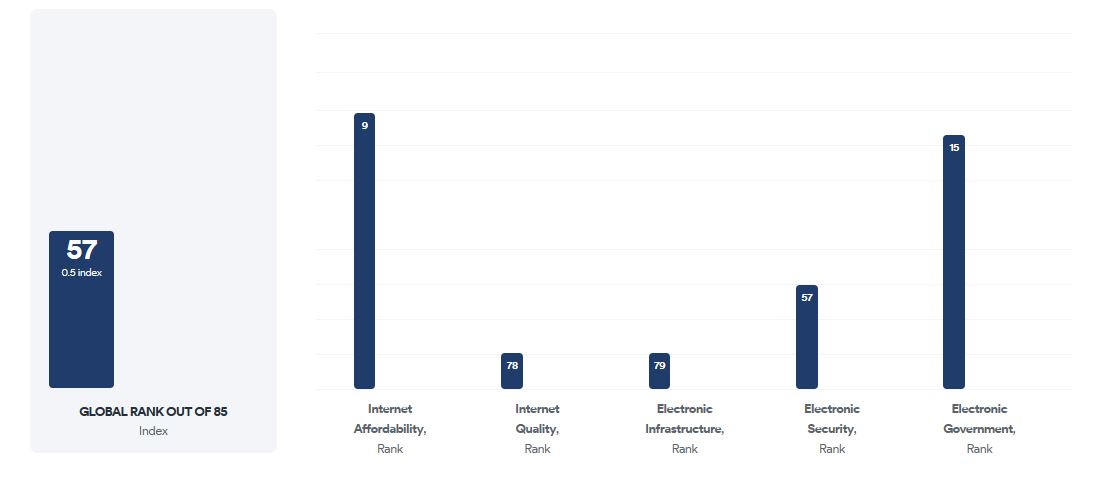
    India ranks among the lowest in the world in terms of Internet quality, according to the Digital Quality of Life Report.

    Note the following aspects:

    1)Organisation publishing the report

    2)India’s rank and its comparison with neighbors

    3)Rankers at the top

    Digital Quality of Life Index

    • It is global research released by online privacy solutions provider SurfShark.
    • It releases a report on the quality of digital wellbeing in 85 countries (81% of the global population), in terms of e-infrastructure.

    India’s ranking: Hits and Misses

    • India occupies 79th place, ranking below countries including Guatemala and Sri Lanka.
    • India makes it into the top 10 in terms of Internet affordability. With a ranking of nine, it outperforms countries such as the U.K., the U.S. and China.
    • Additionally, when it comes to e-government, India occupies the 15th place globally, just below countries like New Zealand and Italy.
    • However, at position 78, India’s Internet quality is one of the lowest across 85 countries analysed in the research.

    Global rankings

    • The report found that seven of the 10 countries with the highest digital quality of life are in Europe, with Denmark leading among 85 countries.
    • Canada stands out as a country with the highest digital quality of life in the Americas, while Japan takes the leading position in Asia.
    • Among the countries in Africa, people in South Africa enjoy the highest quality of digital lives whereas New Zealand leads in Oceania, outperforming Australia in various digital areas.
  • Solar Energy – JNNSM, Solar Cities, Solar Pumps, etc.

    One Sun, One World, One Grid (OSOWOG) Initiative

    Note4Students

    From UPSC perspective, the following things are important:

    Prelims level: OSOWOG Initiative

    Mains level: Global collaboration for Solar Energy

    The Union Ministry of New and Renewable Energy (MNRE) has put calls for proposals to the One Sun, One World, and One Grid (OSOWOG) initiative on hold till further notice.

    Try this PYQ:

    Q.Consider the following statements:

    1. The International Solar Alliance was launched at the United Nations Climate Change Conference in 2015.
    2. The Alliance includes all the member countries of the United Nations.

    Which of the above statements is/are correct? (CSP 2016)

    (a) 1 only

    (b) 2 only

    (c) Both 1 and 2

    (d) Neither 1 nor 2

    OSOWOG Initiative

    • Under the project, India envisaged having an interconnected power transmission grid across nations for the supply of clean energy.
    • The vision behind the OSOWOG mantra is ‘The Sun Never Sets’ and is a constant at some geographical location, globally, at any given point of time.
    • With India at the fulcrum, the solar spectrum can easily be divided into two broad zones viz. far East which would include countries like Myanmar, Vietnam, Thailand, Lao, Cambodia etc. and far West which would cover the Middle East and the Africa Region.

    Implementation

    • The OSOWOG would have three phases. In the first phase Phase I, Middle East, South Asia and South-East Asia would be interconnected.
    • In the second phase, solar and other renewable energy resources rich regions would be interconnected.
    • In the third phase would vie for global interconnection of the power transmission grid to achieve the One Sun One World One Grid vision.

    Benefits of the project

    • Attracting investment: An interconnected grid would help all the participating entities in attracting investments in renewable energy sources as well as utilizing skills, technology and finances.
    • Poverty allevation: Resulting economic benefits would positively impact poverty alleviation and support in mitigating water, sanitation, food and other socio-economic challenges.
    • Reduced project cost: The proposed integration would lead to reduced project costs, higher efficiencies and increased asset utilization for all the participating entities.

    Issues with project

    • It is hindered with the issues of intricate geopolitics, unfavourable economics, unwarranted globalisation and undue centralization that act against the concept.
  • Foreign Policy Watch: India-Afghanistan

    In news: Loya Jirga

    Note4Students

    From UPSC perspective, the following things are important:

    Prelims level: Loya Jirga

    Mains level: Taliban

    The Afghan Loya Jirga approves release of 400 ‘hard-core’ Taliban prisoners.

    The term seems peculiar. We may expect a prelim question on the same.

    What is Loya Jirga?

    • A Loya Jirga is a special type of jirga, or legal assembly, in Pashtunwali, the traditional code of laws of the Pashtun people.
    • It is mainly organized for choosing a new head of state in case of sudden death, adopting a new constitution, or to settle national or regional issue such as war.
    • It predates modern-day written or fixed laws and is mostly favoured by the Pashtun people but to a lesser extent by other nearby groups that have been influenced by Pashtuns (historically known as Afghans).
    • In Afghanistan, Loya Jirgas have been reportedly organized since at least the early 18th century when the Hotaki and Durrani dynasties rose to power.
  • Foreign Policy Watch: India-Pakistan

    Back in news: Indus Water Treaty (IWT)

    Note4Students

    From UPSC perspective, the following things are important:

    Prelims level: Indus River Systems

    Mains level: Indus Water Treaty and its significance

    India has refused a request by Pakistan to hold a meeting on issues around the Indus Water Treaty (IWT) at the Attari check post near the India-Pakistan border.

    The IWT has been in existence since 1960, and reached a flash point in the aftermath of the Uri attacks in 2016 with PM declaring that “blood and water couldn’t flow together”.

    About Indus Waters Treaty, 1960

    • The IWT is a water-distribution treaty between India and Pakistan, brokered by the World Bank signed in Karachi in 1960.
    • According to this agreement, control over the water flowing in three “eastern” rivers of India — the Beas, the Ravi and the Sutlej was given to India
    • The control over the water flowing in three “western” rivers of India — the Indus, the Chenab and the Jhelum was given to Pakistan
    • The treaty allowed India to use western rivers water for limited irrigation use and unrestricted use for power generation, domestic, industrial and non-consumptive uses such as navigation, floating of property, fish culture, etc. while laying down precise regulations for India to build projects
    • India has also been given the right to generate hydroelectricity through the run of the river (RoR) projects on the Western Rivers which, subject to specific criteria for design and operation is unrestricted.

    Talks stalled on key projects

    • Among the key points on the table was evolving a procedure to solve differences on technical aspects governing the construction of the Ratle run-of-the-river (RoR) project on the Chenab in the Kishtwar district.
    • India has called for the appointment of a ‘neutral’ party while Pakistan favours a Court of Arbitration to agree upon a final resolution on the design parameters of this hydropower project.
    • According to the IWT, India has the right to build RoR projects on the three ‘western’ rivers — the Chenab, Jhelum and Indus — provided it does so without substantially impeding water flow in Pakistan downstream.
    • Pakistan believes that the project’s current design does pose a serious impediment and has told the World Bank that it wants a Court of Arbitration (CoA) set up to decide on the issue.
    • India says this is only a technical issue and mutually solvable.
  • Terrorism and Challenges Related To It

    Back in news: Financial Action Task Force (FATF)

    Note4Students

    From UPSC perspective, the following things are important:

    Prelims level: FATF

    Mains level: Money laundering and terror financing

    Ahead of the crucial FATF meetings in October, Indian agencies plan to highlight its inaction in the Pulwama, 26/11 Mumbai attack and Daniel Pearl murder cases.

    Practice question for mains:

    Q.What is FATF? Discuss its role in combating global financial crimes and terror financing.

    What is the FATF?

    • FATF is an intergovernmental organization founded in 1989 on the initiative of the G7 to develop policies to combat money laundering.
    • The FATF Secretariat is housed at the OECD headquarters in Paris.
    • It holds three Plenary meetings in the course of each of its 12-month rotating presidencies.

    Why is Pakistan under its scanner?

    • Pakistan has been under the FATF’s scanner since June 2018, when it was put on the Grey List for terror financing and money laundering risks.
    • FATF and its partners such as the Asia Pacific Group (APG) are reviewing Pakistan’s processes, systems, and weaknesses on the basis of a standard matrix for anti-money laundering (AML) and combating the financing of terrorism (CFT) regime.
    • In June 2018, Pakistan gave a high-level political commitment to work with the FATF and APG to strengthen its AML/CFT regime, and to address its strategic counter-terrorism financing-related deficiencies.
    • Pakistan and the FATF then agreed on the monitoring of 27 indicators under a 10-point action plan, with specific deadlines.
    • The understanding was that the successful implementation of the action plan, and its physical verification by the APG, would lead the FATF to move Pakistan out of the Grey List.
    • However, Islamabad managed to satisfy the global watchdog over just five of them.
  • Poverty Eradication – Definition, Debates, etc.

    Technical Platform on the Measurement and Reduction of Food Loss and Waste

    Note4Students

    From UPSC perspective, the following things are important:

    Prelims level: UNFAO

    Mains level: Assurance of Food Security

    The Food and Agriculture Organization (FAO) has unveiled a new platform to help accelerate the global reduction in food loss and waste.

    Try this PYQ from CSP 2016:

    Q. The FAO accords the status of ‘Globally Important Agricultural Heritage System (GIAHS)’ to traditional agricultural systems. What is the overall goal of this initiative?

    1. To provide modern technology, training in modern farming methods and financial support to local communities of identified GIAHS so as to greatly enhance their agricultural productivity.
    2. To identify and safeguard eco-friendly traditional farm practices and their associated landscapers, agricultural biodiversity and knowledge systems of the local communities.
    3. To provide Geographical Indication status to all the varieties of agricultural produce in such identified GIAHS.

    Select the correct answer using the code given below.

    (a) 1 and 3 only
    (b) 2 only
    (c) 2 and 3 only
    (d) 1, 2 and 3

    About the Platform

    • The Technical Platform on the Measurement and Reduction of Food Loss and Waste brings together information on measurement, reduction, policies, alliances, actions and examples of successful models applied to reduce food loss and waste across the globe.
    • The platform will contain information on measurement, reduction policies, alliances, actions and examples of successful models applied to reduce food loss and waste.
    • The platform will be officially launched on the first International Day of Awareness of Food Loss and Waste on 29 September 2020.

    How will it work?

    • The platform is as a gateway to information on food loss and waste from various resources, including the largest online collection of data on what food is lost and wasted.
    • Links to related portals from development partners are also provided.

    Why need such a portal?

    • Food loss and waste is a sign of food systems in distress. Nutritious foods are the most perishable, and hence, the most vulnerable to lose.
    • Not only food is being lost, but food safety and nutrition are being compromised as well.
    • At least 14 per cent of food is lost (food wastage and food loss together), valued at $400 billion annually.
    • In terms of greenhouse gas emissions, the food that is lost is associated with around 1.5 gigatonnes of carbon dioxide equivalent.
    • Major losses are seen in roots tubers and oil-bearing crops (25 per cent), fruits and vegetables (22 per cent), and meat and animal products (12 per cent).
    • Reducing food loss and waste can bring about many benefits: more food available for the most vulnerable; a reduction in greenhouse gas emissions; less pressure on land and water resources; and increased productivity and economic growth.

    Food loss vs food wastage

    • There is a difference between food wastage and food losses.
    • Food is wasted when it is discarded by consumers or is disposed of in retail due to its inability to meet quality standards.
    • Food loss, on the other hand, occurs when it is spoilt or spilt before reaching the final product or retail stage.
    • For example, dairy, meat, and fish can go bad in transit because of inadequate refrigerated transport and cold storage facilities.

    Back2Basics: Food and Agriculture Organisation (FAO)

    Objective: Lead international efforts to defeat hunger

    Members: FAO has 194 Member Nations, two associate members and one member organization, the European Union

    Headquarters: Rome, Italy

    Year Founded: Established in 1945

  • Human Rights Issues

    Commonwealth Human Rights Initiative (CHRI)

    Note4Students

    From UPSC perspective, the following things are important:

    Prelims level: Commonwealth of Nations

    Mains level: Abolition of modern slavery

    The CHRI has released a report on “Eradicating Modern Slavery: An assessment of Commonwealth government progress”.

    Try this PYQ from CSP 2012:

    Q.Consider the following statements:

    1. The Commonwealth has no charter, treaty or constitution
    2. All the territories/countries once under the British Empire (jurisdiction/rule/mandate) automatically joined the Commonwealth as its members

    Which of the statements given above is/are correct?

    (a) 1 only

    (b) 2 only

    (c) Both 1 and 2

    (d) Neither 1 nor 2

    About the report

    The report was released on the occasion of World Day Against Trafficking in Persons by the Commonwealth Human Rights Initiative (CHRI) and an international anti-slavery organisation Walk Free.

    Highlights of the report

    • The report assessed the progress made by Commonwealth countries on the promises made in 2018 to end modern slavery by 2030 and achieve the SDGs of ending forced labour, human trafficking and child labour.
    • The report found that one-third of the Commonwealth countries had criminalised forced marriage, while 23 had not criminalised commercial sexual exploitation of children.
    • Commonwealth countries have made little progress towards their commitment to eradicate modern slavery by 2030.
    • One in every 150 people in the Commonwealth is living in conditions of modern slavery.
    • Out of 54 countries, only four engage with business to investigate supply chains, and all countries report gaps in victim assistance programs
    • None of the Asian countries in the group had implemented laws against forced labour in supply chains.

    India is the worst performer

    • India had fared the worst in terms of coordination with no national coordinating body or National Action Plan in place.
    • India, like all other Commonwealth countries in Asia, had not ratified the International Labour Organization’s 2011 Domestic Workers Convention or the 2014 Forced Labour Protocol.
    • The report said India accounted for one-third of all child brides in the world.
    • Despite being the largest country in the region, India has the weakest response on national coordination, with no national coordinating body or National Action Plan in place.

    Back2Basics: Commonwealth of Nations

    • The Commonwealth of Nations is an intergovernmental organisation of 53 member states that are mostly former territories of the British Empire.
    • It dates back to the first half of the 20th century with the decolonization of the British Empire through increased self-governance of its territories.
    • It was originally created as the British Commonwealth of Nation through the Balfour Declaration at the 1926 Imperial Conference, and formalized by the UK through the Statute of Westminster in 1931.
    • The current body was formally constituted by the London Declaration in 1949, which modernized the community, and established the member states as “free and equal”.
    • The symbol of this free association is Queen Elizabeth II, who is the Head of the Commonwealth.
    • The Queen is head of state of 16 member states, known as the Commonwealth realms, while 32 other members are republics and five others have different monarchs.
    • Member has no legal obligations to one another. Instead, they are united by language, history, culture and their shared values of democracy, human rights and the rule of law.

    Commonwealth Human Rights Initiative (CHRI)

    • It is an independent, non-partisan & nonprofit international NGO which works towards the practical realization of human rights in the countries of the Commonwealth.
    • It was founded in 1987 and is headquartered at New Delhi.
    • CHRI’s objectives are to promote awareness and adherence to the Commonwealth’s Harare Declaration, to the Universal Declaration of Human Rights, to other internationally recognised human rights instruments.
    • The organisation specializes in transparency and accountability issues, with a focus on access to justice and access to information.
    • The organisation mainly works in South Asia, East Africa, and Ghana region.
  • Human Rights Issues

    Protesting is a fundamental right: UN

    Note4Students

    From UPSC perspective, the following things are important:

    Prelims level: UNCAT, ICCPR, Art. 21

    Mains level: Right to peaceful assembly

    As authorities worldwide grapple with demonstrations over issues like political rights and racial justice, a UN committee has reaffirmed that protesting peacefully, online or in person, is a fundamental human right.

    Practice question for mains:

    Q.There is an urgent need for reforming the criminal justice system in India in light of rising cases of custodial torture and killings. Comment.

    What is the news?

    • The independent experts on the Human Rights Committee published a fresh interpretation of the right of peaceful assembly.
    • It offered comprehensive legal guidance about where and how it applies and also outlining governments’ obligations.
    • The committee is tasked with monitoring how countries implement the International Covenant on Civil and Political Rights (ICCPR), which under Article 21 guarantees the right to peaceful assembly.

    About ICCPR

    • The ICCPR is a multilateral treaty adopted by UN General Assembly Resolution on 16 December 1966, and in force from 23 March 1976.
    • The covenant commits its parties to respect the civil and political rights of individuals, including the right to life, freedom of religion, freedom of speech, freedom of assembly, electoral rights and rights to due process and a fair trial.
    • As of September 2019, the Covenant has 173 parties and six more signatories without ratification.
    • It is part of the International Bill of Human Rights, along with the International Covenant on Economic, Social and Cultural Rights (ICESCR) and the Universal Declaration of Human Rights (UDHR).
    • It is monitored by the UN Human Rights Committee (a separate body to the UN Human Rights Council).

    Back2Basics: Article 21

    • Article 21 is the protection of life and personal liberty No person shall be deprived of his life or personal liberty except according to the procedure established by law.
    • The Article prohibits the deprivation of the above rights except according to a procedure established by law.
    • Article 21 applies to natural persons. The right is available to every person, citizen or alien. Thus, even a foreigner can claim this right.
    • It, however, does not entitle a foreigner the right to reside and settle in India, as mentioned in Article 19 (1) (e).
  • Forest Conservation Efforts – NFP, Western Ghats, etc.

    Global Forest Resources Assessment (FRA)

    Note4Students

    From UPSC perspective, the following things are important:

    Prelims level: GFRA

    Mains level: Forest conservation in India

    India has ranked third among the top 10 countries that have gained in forest areas in the last decade a/c to the latest Global Forest Resources Assessment (FRA).

    Possible prelim question:

    Q.The Global Forest Resources Assessment Report recently seen in news is published by-

    a) UN-FAO

    b) UN Forum on Forests

    c) International Union of Forest Research Organizations

    d) None of these

    India gains in forest cover

    • The top 10 countries that have recorded the maximum average annual net gains in a forest area during 2010-2020 are China, Australia, India, Chile, Vietnam, Turkey, the US, France, Italy and Romania.
    • India accounts for two per cent of total global forest area.
    • Globally, 12.5 million people were employed in the forestry sector. Out of this, India accounted for 6.23 million, or nearly 50 per cent.

    Global prospects

    • The Asian continent reported the highest net gain in a forest area in 2010-2020, according to the report.
    • It recorded a 1.17 million hectares (ha) per year net increase in forests in the last decade.
    • However, the South Asia sub-region reported net forest losses during 1990-2020.
    • But, this decline would have been much higher without the net gain in India’s forest during this period, according to FRA 2020.

    How did India gain?

    • The FRA 2020 has credited the government’s Joint Forest Management programme for the significant increase in community-managed forest areas in the Asian continent.
    • The forest area managed by local, tribal and indigenous communities in India increased from zero in 1990 to about 25 million ha in 2015, the assessment said.
    • India has been taking up massive afforestation and plantation schemes.

    About Global Forest Resources Assessment

    • The Global Forest Resources Assessment (FRA) reports on the status and trends of the world’s forest resources.
    • It is led by the Forestry Department of the Food and Agriculture Organization of the UN.
    • It reports the extent of the world’s forest area as well as other variables, including land tenure and access rights, sustainable forest management (SFM), forest conservation, and sustainable use.

    Back2Basics: Defining forests as per FRA

    • The definition excludes tree stands in agricultural production systems, such as fruit tree plantations, oil palm plantations, olive orchards, and agroforestry systems when crops are grown under tree cover.

    The FAO definition of a forest includes:

    • land spanning more than 0.5 hectares with trees higher than 5 meters and a canopy cover of more than 10 per cent, or trees able to reach these thresholds in situ
    • does not include land that is predominantly under agricultural or urban land use