💥UPSC 2026, 2027, 2028 UAP Mentorship (March Batch) + Access XFactor Notes & Microthemes PDF

Archives: News

  • Foreign Policy Watch: India-China

    Rare Earth Metals at the heart of China-US rivalry

    Beijing’s dominance in rare earth minerals, the key to the future of manufacturing, is a cause for concern for the West.

    Answer this question from CSP 2011 in the comment box:

    Q.What is the difference between a CFL and an LED lamp? 

    1. To produce light, a CFL uses mercury vapor and phosphor while an LED lamp uses semi-conductor material.
      2. The average life span of a CFL is much longer than that of an LED lamp
      3. A CFL is less energy-efficient as compared to an LED lamp.

    Which of the statements given above is/are correct?

    (a) Only 1

    (b) 2 and 3 only

    (c) 1 and 3 only

    (d) 1, 2 and 3

    What are Rare Earth Metals?

    • The rare earth elements (REE) are a set of seventeen metallic elements. These include the fifteen lanthanides on the periodic table plus scandium and yttrium.
    • Rare earth elements are an essential part of many high-tech devices.
    • They have a wide range of applications, especially high-tech consumer products, such as cellular telephones, computer hard drives, electric and hybrid vehicles, and flat-screen monitors and televisions.
    • Significant defense applications include electronic displays, guidance systems, lasers, and radar and sonar systems.
    • Rare earth minerals, with names like neodymium, praseodymium, and dysprosium, are crucial to the manufacture of magnets used in industries of the future, such as wind turbines and electric cars.

    Curbing dependence on China

    • At a time of frequent geopolitical friction among those three powers, Washington and Brussels want to avoid this scenario.
    • They are investing in the market for 17 minerals with unique properties that today are largely extracted and refined in China.
    • The expected exponential growth in demand for minerals that are linked to clean energy is putting more pressure on US and Europe to take a closer look.
    • Amid the transition to green energy, in which rare earth minerals are sure to play a role, China’s market dominance is enough to sound an alarm in western capitals.

    Why such a move?

    • In 2019, the U.S. imported 80% of its rare earth minerals from China.
    • The EU gets 98% of its supply from China.
  • Food Safety Standards – FSSAI, food fortification, etc.

    Mustard oil blending is now banned

    The Food Safety and Standards Authority of India had decided this on March 31. This would end the practice to add other edible oil (like palms, rice bran, etc) to mustard oil.

    Why such move?

    • This is good news for mustard farmers whose fortunes were adversely hit as up to a fifth of mustard oil volume could earlier be blends of other oils.
    • But why did India start the practice in the first place? And how has it affected consumer health?

    Answer this question from CSP 2018:

    Q.Consider the following statements:

    1. The quantity of imported edible oils is more than the domestic production of edible oils in the last five years.
    2. The Government does not impose any customs duty on all the imported edible oils as a special case.

    Which of the statements given above is/are correct?

    (a) 1 only

    (b) 2 only

    (c) Both 1 and 2

    (d) Neither 1 nor 2

    Why did the blending begin?

    • The Union health ministry had allowed blending in edible vegetable oil in a notification in 1990.
    • In 1998, Delhi and other north Indian states witnessed the dropsy epidemic — a disease that caused swelling in the body due to the build-up of fluid in tissues.
    • At least 60 people died and 3,000 were hospitalized in the national capital.
    • Researchers believed the consumption of mustard oil caused the disease.

    Adulteration is hazardous

    • Upon investigation, it was found to be adulterated with Argemone Mexicana, a kind of weed that grows with yellow flowers.
    • The adulteration, however, was highly suspicious: While mustard is a rabi crop that is cultivated in the winters, Argemone Mexicana grows in April-May.
    • This meant that the possibility of mixing mustard seeds with that Argemone mexicana was rare.
    • The suspicious adulteration stoked fear among the masses.  It started a campaign against the consumption of oil.
    • Several studies have found mustard oil unsafe for consumption.

    The 1990 decision

    • Experts have claimed that the blending of mustard oil was not only dangerous to health but also adversely impacted mustard farming.
    • Some groups have also flagged the blending of refined oil.
    • Following the Union health ministry’s 1990 notification allowing for the blending of edible vegetable oil, the FSSAI rolled out regulations in the regard in 2006.
    • Producers and other companies involved in blending were regularised through the Agriculture Produce (Grading and Marking) Act (AGMARK).
    • It also made it mandatory to write the kind of oil used for blending over the packet.
    • The companies involved in blending strongly advocated for the cause, despite reports about its excess and unregulated use. The governments over the years have been tight-lipped about it.

    Has blending led to dependence over the import of oil?

    • In 1990-91, India was self-reliant in mustard oil production and produced 98 percent of the oil needed.
    • Blending mustard oil with other edible oils considered to bolster nutritional profile, taste, and quality.
    • Despite the harmful effects, the processing industry took advantage of blending.
    • Cheap palm oil would be blended up to 80 percent in mustard oil sometimes.
    • As a result, profits of mustard farmers dried up, which discouraged them from cultivating the crop.
    • This could be one of the reasons behind India’s increasing dependency on oil imports over the last two decades.
  • International Space Agencies – Missions and Discoveries

    Polar-Areas Stellar-Imaging in Polarisation High-Accuracy Experiment (PASIPHAE)

    The development of a vital instrument PASIPHAE, which will be used in upcoming sky surveys to study stars, is being led by an Indian astronomer.

    What is PASIPHAE?

    • PASIPHAE stands for Polar-Areas Stellar-Imaging in Polarisation High-Accuracy Experiment.
    • It is an international collaborative sky surveying project. Scientists aim to study the polarisation in the light coming from millions of stars.
    • The name is inspired by Pasiphae, the daughter of Greek Sun God Helios.
    • The survey will use two high-tech optical polarimeters to observe the northern and southern skies, simultaneously.
    • It will focus on capturing starlight polarisation of very faint stars that are so far away that polarisation signals from there have not been systematically studied.
    • By combining the data, astronomers will perform a maiden magnetic field tomography mapping of the interstellar medium of very large areas of the sky using a novel polarimeter instrument known as WALOP.

    Why is PASIPHAE important?

    • Since its birth about 14 billion years ago, the universe has been constantly expanding, as evidenced by the presence of Cosmic Microwave Background (CMB) radiation which fills the universe.
    • Immediately after its birth, the universe went through a short inflationary phase during which it expanded at a very high rate before it slowed down and reached the current rate.
    • However, so far, there have only been theories and indirect evidence of expansion associated with the early universe.
    • A definitive consequence of the inflationary phase is that a tiny fraction of the CMB radiation should have its imprints in the form of a specific kind of polarisation (known scientifically as a B-mode signal).
    • All previous attempts to detect this signal met with failure mainly due to the difficulty posed by our galaxy, the Milky Way, which emits copious amounts of polarized radiation.
    • Besides, it contains a lot of dust clouds that are present in the form of clusters. When starlight passes through these dust clouds, they get scattered and polarized.

    What will PASIPHAE do?

    • The PASIPHAE survey will measure starlight polarisation over large areas of the sky.
    • This data along with distances to the stars will help create a 3-Dimensional model of the distribution of the dust and magnetic field structure of the galaxy.
    • Such data can help remove the galactic polarized foreground light and enable astronomers to look for the elusive B-mode signal.

    What is WALOP?

    • Wide Area Linear Optical Polarimeter (WALOP) is an instrument when mounted on two small optical telescopes, that will be used to detect polarized light signals emerging from the stars along high galactic latitudes.
    • The images will simultaneously have the finest of details of a star along with its panoramic background.
    • WALOP will operate on the principle that at any given time, the data from a portion of the sky under observation will be split into four different channels.
    • Depending on the manner in which light passes through the four channels, the polarisation value from the star is obtained.
    • That is, each star will have four corresponding images which when stitched together will help calculate the desired polarisation value of a star.
  • Wildlife Conservation Efforts

    Operation Olivia to protect Olive Ridley Turtles

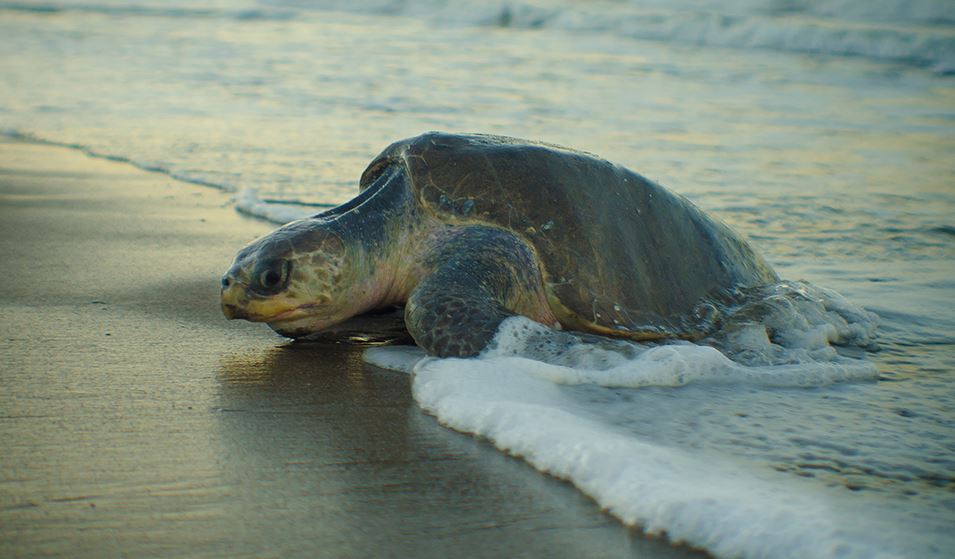
    Every year, the Indian Coast Guard’s “Operation Olivia”, initiated in the early 1980s, helps protect Olive Ridley turtles as they congregate along the Odisha coast for breeding and nesting from November to December.

    Answer this question from CSP 2012 in the comment box:

    Q.Which one of the following is the national aquatic animal of India?

    (a) Saltwater crocodile

    (b) Olive ridley turtle

    (c) Gangetic dolphin

    (d) Gharial

    Olive Ridley Turtles

    • The Olive Ridley (Lepidochelys olivacea) is listed as vulnerable under the International Union for Conservation of Nature’s Red list.
    • All five species of sea turtles found in India are included in Schedule I of the Indian Wildlife Protection Act, 1972, and in the Appendix I of the CITES, which prohibits trade in turtle products by signatory countries.
    • Odisha has also formulated laws for protecting Olive Ridley turtles, and the Orissa Marine Fisheries Act empowers the Coast Guard as one of its enforcement agencies.
    • Studies have found three main factors that damage Olive Ridley turtles and their eggs — heavy predation of eggs by dogs and wild animals, indiscriminate fishing with trawlers and gill nets, and beach soil erosion.
    • Dense fishing activity along the coasts of Andhra Pradesh, Odisha and West Bengal, especially ocean-going trawlers, mechanized fishing boats, and gill-netters pose a severe threat to turtles.

    Their habitats

    • The Olive Ridley has one of the most extraordinary nesting habits in the natural world, including mass nesting called arribadas.
    • The 480-km-long Odisha coast has three arribada beaches at Gahirmatha, the mouth of the Devi river, and in Rushikulya, where about 1 lakh nests are found annually.
    • They generally return to their natal beach, or where they were born, to lay eggs as adults.
    • Mating occurs in the offshore waters of the breeding grounds and females then come ashore to nest, usually several times during a season.
    • They crawl ashore, dig a flask-shaped nest about 1.5 to 2 foot deep, and lay 100 to 150 eggs in each clutch.
    • Hatchlings emerge from their nests together in about seven to 10 weeks.
  • New Species of Plants and Animals Discovered

    Species in news: Bharitalasuchus Tapani

    In the mid 20th century, researchers from the Indian Statistical Institute, Kolkata, carried out extensive studies on rocks of the Yerrapalli Formation in what is now Telangana, uncovering several fossils of Bharitalasuchus Tapani.

    Bharitalasuchus Tapani

    • This reptile belongs to a genus and species previously unknown to science. It is named Bharitalasuchus tapani considering Telugu etymology.
    • In the Telugu language, Bhari means huge, Tala means head, and Suchus is the name of the Egyptian crocodile-headed deity.
    • The species is named after paleontologist Tapan Roy Chowdhury in honour of his contribution to Indian vertebrate paleontology and especially his extensive work on the Yerrapalli Formation tetrapod fauna.

    Details of the reptile

    • The reptile belonged to a family of extinct reptiles named Erythrosuchidae.
    • A precise identification had not been possible earlier because the family was not known from other examples in India.
    • It was neglected because the fossil specimen was not as complete as those of other erythrosuchids from other countries.
    • The team notes that tapani were robust animals with big heads and large teeth, and these probably predated other smaller reptiles.
    • They were approximately the size of an adult male lion and might have been the largest predators in their ecosystems.
  • New Species of Plants and Animals Discovered

    Species in news: Pyrostria Laljii

    A 15-meter-tall tree that belongs to the genus of the coffee family has recently been discovered from the Andaman Islands by a team of researchers from India and the Philippines.

    Observe this PYQ from CSP 2016:

    Q.Recently, our scientists have discovered a new and distinct species of banana plant which attains a height of about 11 metres and has orange-coloured fruit pulp. In which part of India has it been discovered?

    (a) Andaman Islands

    (b) Anamalai Forests

    (c) Maikala Hills

    (d) Tropical rain forests of northeast

    Pyrostria Laljii

    • The new species, Pyrostria laljii, is also the first record of the genus Pyrostria in India.
    • Plants belonging to the genus Pyrostria are usually found in Madagascar but the recently discovered species is new to science.
    • The tree is distinguished by a long stem with a whitish coating on the trunk, and oblong-obovate leaves with a cuneate base, and was first reported from South Andaman’s Wandoor forest.
    • Pyrostria laljii has been assessed as ‘Critically Endangered’ based on the International Union for Conservation of Nature’s (IUCN) Red List criteria.
  • Coronavirus – Health and Governance Issues

    Challenges in Vaccinating All

    Reoriented vaccine policy

    • The foremost challenge in vaccination in India has been a supply deficit.
    • Announcing a reoriented vaccine policy recently, the Prime Minister announced a coherent path forward.
    • Starting from June 21, the Union government will take charge of 75 per cent of the total procurement, and provide vaccines to states at no cost.
    • The government has reserved 30 crore vaccines with Hyderabad-based Biological-E by facilitating an advance payment of Rs 1,500 crore.
    • Fortnightly updates on the supply of vaccines to states are being taken to ensure transparency and efficiency in planning.

    Dealing with two complex challenges

    • Two other complex challenges that need immediate focus are vaccine hesitancy and the much-discussed digital divide in the country.

    1) Challenge of vaccine hesitancy

    • Contextualised and curated approaches are crucial.
    • The WHO has put forth the BeSD (behavioural and social drivers) vaccination model, which emphasises “motivation” as the vanguard of human psychology during a vaccination drive.
    • Vaccination coverage could be increased by incentivising and motivating citizens.
    • Unfortunately, in India, misinformation, disinformation and misplaced beliefs have led to fears about the potential harmful effects of vaccines.
    • The diversity of India necessitates community engagement at the local level to counter this narrative of misinformation.
    • A successful information campaign requires dissemination through mediums that invoke trust.
    • Local languages and dialects should be used to engage people via local radio, television channels and regional newspapers.
    • Another network that can be leveraged at the district level is that of the ASHA workers and the auxiliary nurse-midwives.
    • These are trusted local figures.

    2) Bridging the digital divide

    • It is important to introduce solutions that bridge the digital divide.
    • A toll-free helpline number 1075 has been activated for those without internet.
    • Similarly, districts can explore missed-call campaigns, which could ensure that minimal infrastructure is being optimised for processing high-volume user requests.
    • Even though the reported adverse events following immunisation stands at only 0.012 per cent, dedicated representatives can provide vaccine-related pre- and post-counselling to individuals.

    Way forward

    Startups could help bridge digital divide

    • The devastating effects of the second wave in rural areas have prompted fintech startups to enable vaccine registration.
    • PayNearby has helped over 8 lakh citizens register through its network of agents called “digital pradhans”, who are present in kirana, ration, mobile and hardware stores, frequented regularly by rural users. 

    Use points of contact for publicising benefits of vaccine and registration

    • Almost 81 crore beneficiaries, 75 per cent of whom are in rural areas, procure ration from 5,46,165 fair price shops across India.
    • There are over 11 lakh business correspondent outlets in India working mostly in rural areas to advance the mission of financial inclusion.
    • A network of around 1,54,965 post offices (as on March 2017) exists in India of which 1,39,067 are in the rural areas.
    • Such points of contact can be leveraged as dedicated units for publicising the benefits of Covid vaccines and as physical locations for vaccine registration

    Direct engagement with citizens

    • The Prime Minister recently described district officials as “field commanders” in our efforts against Covid.
    • This ambit should move beyond just the district bureaucracy to the extensive network of public services. 
    • A stellar example of direct engagement also stems from the success of the Swachh Bharat Abhiyan.
    • Direct engagement with citizens contributed greatly to the operational success of previous immunisation campaigns like the pulse polio programme.

    Consider the question “What are the factors responsible for vaccine hesitency? Suggest the ways to deal with it.”

    Conclusion

    Thinking local and utilising established networks to create culturally resonant messages is the need of the hour to reduce vaccine hesitancy, bridge the digital divide and achieve vaccine saturation.


  • G20 : Economic Cooperation ahead

    Can the G-7 give new direction to globalisation?

    The article highlights the challenges associated with the globalisation and important role G-7 can play in dealing with these challenges.

    The context that makes this G-7 Summit significant

    • The most significant expectation of the summit is that it will help determine the shape of globalisation.
    • There has been much discussion of the possibility of the G-7 pushing for global coordination on minimum corporate taxation.
    • The summit also seeks to redefine the broader relationship between states and markets in three ways.

    Redefining the relationship between states and market in 3 ways

    1) States reasserting the control over markets

    • States are reasserting control over the terms on which markets operate.
    • The idea of Neoliberalism did convey the idea that states should follow where the market leads, or step in only where there is a market failure.
    • However, this account of the relationship between states and markets had four harmful consequences.
    • 1) It provided a misleading picture of what makes economies vibrant.
    • 2) It led to a sense of loss of collective control over our economic future.
    • 3) It led to great inequality.
    • 4) In some fields like technology, it created new forms of corporate power.
    • To reverse some of these consequences, some coordination at the global level on taxation, or treatment of technology monopolies etc is required.

    2) Global interdependence cannot be managed without global public goods

    • At one level the global roles of the G-7 or even the G-20 were something like the political steering committee for global capitalism.
    • Their most useful political roles were during the financial crisis, when global financial coordination was required.
    • But there was relatively little attention to the systemic vulnerabilities that globalisation might create.
    • These could be vulnerabilities because of the way supply chains were distributed, or those that arose from the creation of winners and losers within globalisation.
    • Most importantly, there was short shrift given to global public goods like health.
    • The Covid crisis has reminded us of all of these vulnerabilities.
    • The commitment of G-7 to provide one billion vaccine doses is a welcome step.
    • But whether this crisis-driven commitment will translate into an enduring and just framework for providing global public goods on health and environment remains to be seen.

    3) Geopolitical context

    •  There are two geopolitical “cold wars” that cast a shadow on the G-7.
    • The first involves China.
    • In the context of rising geopolitical tensions with China, greater coordination and unity of purpose amongst the G-7 will become more important.
    • The second is a threat of authoritarian disruption.
    • Greater global disarray strengthens the possibility of giving political support to these political tendencies.
    • It is important, therefore, to demonstrate that the G-7 countries are part of a functional democratic civilisation.

    Challenges ahead

    • Despite the directional changes, many of the central distributive conflicts that beset globalisation are likely to continue.
    • The talk of global public goods works only in a context where the advanced economies are at the receiving end.
    • Take the G-7 proposal for the coordination of taxation.
    • In principle, this is not a bad idea, if it can close off tax havens and prevent a global race to the bottom.
    • However, it is sobering to read the Tax Justice Network’s “The State of Tax Justice Report” 2020.
    • According to this report, the United States, Netherlands and United Kingdom are three of the top five countries (along with Cayman Islands and Luxembourg) responsible for tax losses inflicted on other countries.
    • The US, Switzerland, Singapore and Hong Kong are amongst the highest on the Financial Secrecy Index.
    • So, the visible corporate tax rate, or taxing at point of sales, may just be the window dressing the global tax problem that allows countries to hold onto their privileges.
    • Similarly, on climate change. There is a lot of encouraging talk of ambitious targets, investment-led transformations.
    • Intelligently done, this might be for the good.
    • But it could also repeat the familiar pattern of regulation serving to preserve the dominance of advanced economies.
    • There is also, in the talk of a new global economic order, the curious absence of discussions on finance.
    • But if one is looking at potential sources of vulnerability, the ability to create winners and losers, and possible threats to global resilience, then regulation and coordination of global finance deserve more attention.

    Consider the question “What are the vulnerabilities associated with globalisation. Suggest the solutions to deal with these vulnerabilities.”

    Conclusion

    If the G-7 wants to truly exercise more leadership, it will have to convince the world that all its wonderful new principles, resilience, inclusion, global public goods, are not simply ruses to serve only the interests of the developed world.

  • Forest Conservation Efforts – NFP, Western Ghats, etc.

    Protection of ‘Heritage Trees’ in Maharashtra

    The Maharashtra government will make amendments to the Maharashtra (Urban Areas) Protection and Preservation of Trees Act of 1975, to introduce provisions for the protection of ‘heritage trees’.

    What are Heritage Trees?

    • Under the proposed amendment, a tree with an estimated age of 50 years or more shall be defined as a heritage tree.
    • It may belong to specific species, which will be notified from time to time.
    • Experts believe that in addition to the age, the state climate change department should also consider a tree’s rarity, its botanical, historical, religious, mythological and cultural importance in defining a heritage tree.
    • The local Tree Authority will have to ensure tree census to be carried out every five years along with counting of heritage trees

    How is the age of the tree determined?

    • The most common method of determining the age of the tree is Dendrochronology – or tree-ring dating also called growth rings.
    • Each year, roughly a tree adds to its girth, the new growth is called a tree ring. By counting the rings of a tree, the age can be determined.
    • However, the process is invasive. To analyse the rings, core samples are extracted using a borer that’s screwed into the tree and pulled out, bringing with it a straw-size sample of wood.
    • The hole in the tree is then sealed to prevent disease.

    Why was the concept of heritage tree introduced?

    • A heritage tree will get special protection.
    • Crucially, the tree’s age will determine the number of trees to be planted as part of the compensatory plantation – that is anyone cutting a heritage tree will need to plant trees in the same numbers as the cut tree’s age.
    • According to the current Compensatory Plantation in the state, one sapling has to be planted for each tree that is cut.
    • In Mumbai, as per the Tree Authority set up in 1976, to help in regulating the felling of trees and providing for the planting of an adequate number of new trees, the compensation ratios are 1:3.

    Changes with the amendment

    • As per the amendment, the number of trees planted will be equal to the age of the heritage tree that is cut.
    • For instance, if a 52-year-old tree is to be felled, then the party felling the tree will have to plant 52 trees in compensation, with each compensatory tree at least 6-8 ft in height at the time of planting.
    • The organization planting the compensation trees will also have to ensure the survival of the plantation for seven years and geo-tag the trees.
    • Such plantations can be carried out either in the same plot or a common amenity plot.
    • Through the introduction of a heritage tree, the state environment wants to discourage the cutting of heritage trees.
    • The amendment has the fine for illegal felling of trees from a maximum of Rs 5,000 to Rs 1 lakh per tree.

    What is the economic value of the tree?

    • In case compensatory plantation is not possible, the tree feller has to pay compensation for the economic valuation of the trees being felled.
    • While the state government has not defined the economic value of the tree, experts say that the amount of oxygen that a tree releases into the environment should determine its economic value.
    • A realistic assessment of the economic value of a tree, which may be permitted to fell, concerning its value to the environment and its longevity, about factors such as:

    the production of oxygen and carbon sequestration, soil conservation, protection of flora/fauna, its role in habitat and ecosystem integrity and any other ecologically relevant factor, distinct from timber/wood

    Tree Authority formation

    • The amendments also make room for the formation of the Maharashtra State Tree Authority and also tree authority in local civic bodies and councils.
    • The Tree Authority is tasked with “increasing the tree cover in urban areas and protecting the existing ones.” Experts shall be a part of the local tree authority.
    • Their knowledge and expertise will form the basis of decisions taken up by the authority.
    • A proposal to cut more than 200 trees of age 5 years or more, will be referred to the state tree authority.
    • The local TA will have to ensure that the project is not sub-divided into smaller parts to keep the number of trees below the defined threshold.
    • Ensure preparation of a tree plan and should aspire over the years to have 33 percent green belt in their area.

  • Urban Transformation – Smart Cities, AMRUT, etc.

    Delhi’s Master Plan 2041

    The Delhi Development Authority gave its preliminary approval to the draft Master Plan for Delhi 2041.

    What is the Master Plan 2041 for Delhi?

    • The draft of the Master Plan seeks to “foster a sustainable, liveable and vibrant Delhi by 2041”.
    • It includes analysis, recommendations, and proposals keeping in mind the population, economy, housing, transportation, community facilities, and land use.
    • The current master plan of Delhi — Master Plan 2021 — expires this year.
    • The first volume is an introduction, providing an overview of Delhi in present times, its global and regional positioning, estimates of population, and projections for 2041.
    • The draft MPD presents a plan for the city for the next 20 years.

    What are the main focus areas of the master plan?

    • In the housing sector, it talks about incentivizing rented accommodation by inviting private players and government agencies to invest more, keeping in mind the large migrant population.
    • It addresses parking problems and suggests a ‘user pays principle, which means users of all personal motor vehicles, except for non-motorized ones, have to pay for authorized parking facilities, spaces and streets.

    How does the master plan tackle environmental pollution?

    • The draft plan aims to minimize vehicular pollution through key strategies, including a switch to greener fuels for public transport and the adoption of mixed-use of transit-oriented development (also known as TOD).
    • It also addresses improving the quality of water, which is taken from the Yamuna river as well as various lakes, natural drains and baolis.
    • The draft lays a clear boundary of the buffer zone near the Yamuna river and explores how to develop it.
    • As per the plan, a green buffer of 300-metre width shall be maintained wherever feasible along the entire edge of the river.

    How is it different from the 2021 Master Plan?

    • The world has gone through a drastic change due to the pandemic, and the growing population has led to shrinking spaces and unemployment.
    • The 2041 plan aims to develop common community spaces to provide refuge spots, common kitchens and quarantine space in an emergency.
    • To improve the nighttime economy, the plan focuses on cultural festivals, bus entertainment, metro, sports facilities, and retail stores included in Delhi Development Authority (DDA)’s Night Life Circuit plan.
    • It also proposes to reduce vulnerability to airborne epidemics through decentralized workspaces, mandatory creation of open areas, better habitat design and green-rated developments to reduce dependence on mechanical ventilation systems.

    What challenges will its implementation face?

    • The master plan on paper looks like a perfect document for the city’s progress.
    • However, when the implementing agencies try to replicate it on the ground, they face challenges like confrontation from political wings, lack of resources and funds, corruption in different departments, lack of political and bureaucratic will and multiplicity of agencies.
    • For instance, despite talks of increasing surface parking, removing junk vehicles, imposing fines for dumping debris, garbage burning, and segregation of waste, a lot of these things could never be implemented.
    • In some cases like, increasing parking or increasing its charges, there is resistance from politicians due to vote-bank politics. In other cases, lack of funds and improper implementation mar the projects.

Join the Community

Join us across Social Media platforms.